

Implementing PIM for Fashion Industry – How It Improves Sales?
Implementing Product Information Management (PIM) in the fashion industry involves more than centralizing product information. It requires a structured approach to managing styles, colorways, sizes, collections, supplier information, digital assets, and channel-specific product content.
For fashion brands and retailers, product information often originates across Product Lifecycle Management (PLM), Enterprise Resource Planning (ERP), Digital Asset Management (DAM), supplier systems, spreadsheets, and eCommerce platforms. Each system serves a different purpose. The challenge is connecting these sources while ensuring product information remains accurate, consistent, and ready for distribution.
A successful PIM implementation for fashion establishes a governed product-data foundation that supports complex variant structures, seasonal launches, supplier onboarding, enrichment workflows, and omnichannel product experiences. However, achieving this requires careful planning, the right product-data architecture, reliable integrations, and clearly defined governance.
This guide explains how fashion businesses can prepare for PIM implementation, execute the process step by step, avoid common challenges, and build a scalable product information ecosystem. If your organization is evaluating a broader product-data solution, explore Credencys’ PIM for Fashion services.
What Does PIM Implementation Involve for Fashion Businesses?
Fashion PIM implementation is the process of deploying and configuring a Product Information Management platform to manage enriched product information across fashion-specific product structures, enterprise systems, workflows, and sales channels. It typically involves defining how to organize product information, identifying authoritative data sources, migrating existing records, configuring enrichment processes, and establishing integrations with downstream channels.
Unlike a basic product database, a properly implemented Fashion PIM must understand relationships between styles and their variations. For example, a single clothing style may include multiple colors, sizes, fits, and market-specific configurations.
These variations must remain connected while retaining their individual attributes, identifiers, and digital assets. Fashion PIM implementation typically covers:
- Product-data assessment and requirements gathering
- Style, colorway, size, and SKU modeling
- Product taxonomy and attribute standardization
- Supplier-data onboarding
- Product-data cleansing and migration
- PLM, ERP, and DAM integrations
- Product enrichment and approval workflows
- Channel-specific data distribution
- Testing, deployment, and user training
- Ongoing optimization and governance
The goal is to create a reliable product-information layer that connects upstream enterprise systems to downstream commerce, marketplace, and retail channels.
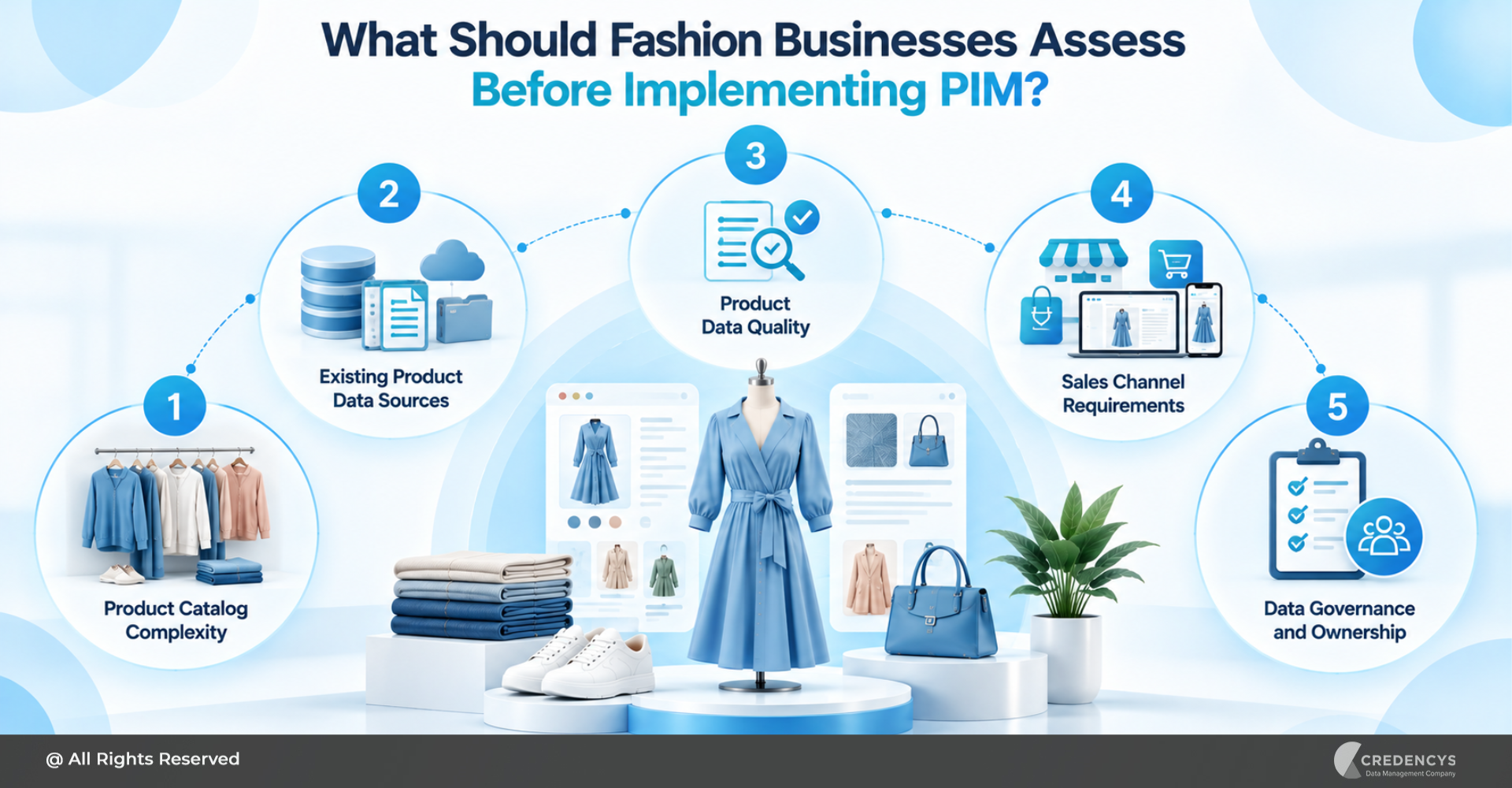
What Should Fashion Businesses Assess Before Implementing PIM?
A successful implementation begins with understanding the existing product-data environment. Before selecting or configuring a PIM platform, fashion businesses should assess their catalog structure, systems, data quality, channel requirements, and governance processes.
1. Product Catalog Complexity
Fashion catalogs often contain interconnected product structures rather than independent SKUs. A single style may have multiple:
- Colors
- Sizes
- Fits
- Materials
- Patterns
- Lengths
- Seasonal variations
- Regional assortments
For example, a jacket offered in four colors and six sizes creates 24 sellable SKUs. If each SKU is maintained independently, shared product information may be duplicated across 24 records.
During implementation planning, businesses should determine how product families, variant inheritance, and product relationships will work. This assessment helps define the future PIM data model.
2. Existing Product Data Sources
Fashion product information may be distributed across several systems. PLM may hold approved specifications and material details, ERP may maintain transactional identifiers, suppliers may provide additional attributes, and DAM may manage product photography.
Implementation teams should identify:
- Where each attribute originates
- Which system owns the information
- How frequently it changes
- How it should enter PIM
- Which downstream systems require it
This prevents unnecessary data duplication and conflicting updates.
3. Product Data Quality
Moving inconsistent data into a new PIM platform does not automatically improve its quality. Before migration, businesses should identify:
- Duplicate product records
- Missing mandatory attributes
- Inconsistent size labels
- Unstandardized color names
- Invalid identifiers
- Incorrect product relationships
- Missing product imagery
- Outdated product descriptions
A data-quality assessment establishes the cleansing and standardization effort required before implementation.
4. Sales Channel Requirements
Different sales channels require different product information. For example, a brand’s eCommerce website may prioritize detailed descriptions, campaign imagery, and styling content.
A marketplace may require specific product categories, identifiers, attributes, and image specifications. A wholesale customer may require different naming conventions, product classifications, and catalog formats.
Businesses should document these requirements before designing product attributes and publishing workflows.
5. Data Governance and Ownership
Successful PIM adoption requires clearly defined responsibilities. Fashion businesses should determine who is responsible for:
- Creating product records
- Maintaining technical attributes
- Enriching marketing descriptions
- Associating digital assets
- Translating product content
- Validating completeness
- Approving product information
- Publishing products to channels
Without clear ownership, teams may continue maintaining conflicting information outside PIM.
How to Implement PIM for Fashion: 8 Key Steps
A structured Fashion PIM implementation aligns product information, enterprise systems, workflows, and business teams before introducing new technology across the organization. The following eight-step approach provides a practical framework.
Step 1: Assess Existing Product Data and Systems
The first step is understanding how product information currently moves through the business. This involves reviewing existing catalogs, supplier information, product-data sources, technology platforms, workflows, and downstream channels.
Implementation teams should identify where product information is created, how it is enriched, who approves it, and where inconsistencies occur. For example, a fashion retailer may maintain product specifications in PLM, SKU identifiers in ERP, imagery in DAM, and marketplace descriptions in separate spreadsheets.
Mapping these dependencies helps identify which information should move into PIM and which systems should remain authoritative.
Key activities:
- Audit existing product catalogs
- Identify source systems
- Assess data completeness and consistency
- Review integration requirements
- Document current workflows
- Define business objectives
- Identify stakeholders and data owners
Expected outcome: A documented current-state assessment and implementation roadmap.
Step 2: Design the Fashion Product Data Model
The product data model determines how PIM will represent styles, variants, attributes, and relationships. This is one of the most important implementation decisions for fashion businesses.
Rather than treating every SKU as an unrelated product, a Fashion PIM can organize information into a hierarchy.
Style → Colorway → Size/Fit → Sellable SKU
Consider a men’s performance jacket.
Style-level information may include:
- Product name
- Brand
- Category
- Collection
- Season
- Material composition
- General description
Colorway-level information may include:
- Color name
- Color code
- Pattern
- Swatch
- Color-specific imagery
SKU-level information may include:
- Size
- Fit
- Length
- SKU number
- GTIN
- Weight
- Market-specific identifiers
Related variants can inherit shared information rather than entering it repeatedly for each SKU. The model should also account for product families, related products, collection membership, and category-specific attributes.
Expected outcome: A scalable fashion product-data model with defined inheritance, relationships, and attribute structures.
Step 3: Cleanse and Standardize Product Information
Once you define the target data model, you must prepare existing product information for migration. Fashion businesses frequently receive inconsistent attribute values from different suppliers and internal systems.
For example, color information may appear as:
- Navy
- Navy Blue
- Dark Navy
- Midnight Blue
Where appropriate, map these values to approved terminology. The same standardization process may apply to:
- Sizes
- Materials
- Fabric compositions
- Product categories
- Care instructions
- Units of measurement
- Product classifications
However, standardization should preserve meaningful distinctions. For example, do not merge two supplier color names if they represent genuinely different commercial colorways.
Data cleansing should also identify duplicate records, missing identifiers, incomplete attributes, and invalid relationships.
Expected outcome: Standardized, validated, and migration-ready product information.
Step 4: Integrate PIM with Enterprise Systems
Fashion PIM works best when integrated with the systems that create, maintain, and consume product information. Common integration requirements include:
PLM Integration: Transfer approved product specifications, materials, and development information into PIM for commercial enrichment.
ERP Integration: Synchronize relevant identifiers, product master information, and other approved transactional reference data.
DAM Integration: Connect product records with authoritative images, videos, swatches, and documents.
Supplier Integration: Import supplier attributes and product updates through approved data exchange processes.
eCommerce Integration: Publish enriched product content to online stores and commerce platforms.
Marketplace and Retailer Integration: Prepare and distribute approved product information according to destination requirements.
Implementation teams should define integration frequency, field mappings, error handling, validation rules, and synchronization dependencies. Not every system requires real-time integration.
The appropriate approach depends on how frequently information changes and how quickly downstream systems need it.
Expected outcome: Reliable information exchange between PIM and connected enterprise applications.
Step 5: Configure Product Enrichment Workflows
Raw product information is rarely ready for publication immediately after it enters PIM. Fashion businesses typically need to enrich products with customer-facing information.
This may include:
- Marketing descriptions
- Product highlights
- Material details
- Size and fit guidance
- Styling recommendations
- Care instructions
- Product imagery
- Related products
- Localized content
PIM workflows should guide products through the required enrichment stages. For example, a newly imported jacket may require merchandising approval, product photography, localized descriptions, and mandatory marketplace attributes before publication.
Completeness rules can identify missing information and direct tasks to the appropriate teams. Automated enrichment and AI-assisted content suggestions can support this process, but generated content should remain subject to validation and approval.
Expected outcome: Consistent enrichment workflows that prepare product information for each required channel.
Step 6: Establish Governance and Approval Processes
Without governance, even a well-configured PIM can become another source of inconsistent product information. Implementation teams should define how data is created, modified, validated, approved, and published.
This includes configuring:
- User roles and permissions
- Data ownership
- Attribute-level responsibilities
- Completeness rules
- Validation rules
- Approval workflows
- Change history
- Publishing controls
For example, product teams may own category and attribute structures, while marketing teams own descriptions and merchandising content. Digital asset teams may approve imagery, while regional teams validate translations and market-specific content.
These responsibilities should be reflected in the configured workflows.
Expected outcome: A governed product-information process with clear accountability and publishing controls.
Step 7: Test and Launch the PIM Solution
Before deployment, fashion businesses should validate the complete product-data workflow. Testing should cover more than whether records appear correctly inside PIM.
Teams should verify that product information moves accurately between connected systems and reaches downstream channels in the required format. For example, implementation testing should confirm that:
- Every SKU is associated with the correct style
- Colorway images match the correct products
- Size attributes remain accurate
- Shared attributes are inherited correctly
- Mandatory fields are populated
- Approved content reaches the intended channel
- Integration errors are detected and handled
User acceptance testing should involve the teams responsible for daily product-data operations. A phased rollout can reduce implementation risk.
Businesses may begin with one product category, brand, market, or channel before expanding the deployment.
Expected outcome: A validated PIM environment ready for controlled production use.
Step 8: Optimize and Scale the Implementation
PIM implementation does not end at deployment. Fashion catalogs continue evolving as businesses introduce new collections, suppliers, markets, and digital channels.
Post-launch optimization should focus on improving product-data quality, workflows, integrations, and adoption. Useful operational measures include:
- Product completeness
- Data-quality exceptions
- Time required for product enrichment
- Approval cycle time
- Channel publishing errors
- Supplier onboarding efficiency
- User adoption
- Time required to prepare new collections
These indicators help teams identify bottlenecks and prioritize improvements. As the business grows, the product-data model and integration architecture may also need to support additional categories, markets, and distribution requirements.
Expected outcome: A scalable Fashion PIM environment that evolves with changing business needs.
For organizations that need expert support throughout these stages, Credencys provides end-to-end PIM implementation services, including assessment, architecture, migration, integration, governance, deployment, and optimization.
How Fashion PIM Integrates with PLM, ERP, DAM, and eCommerce
One of the biggest challenges in Fashion PIM implementation is defining how product information should move between existing enterprise systems. Although these platforms may contain overlapping information, they serve different business purposes.
| System | Primary Responsibility | Relationship with PIM |
|---|---|---|
| PLM | Product development, design, specifications, sourcing, and lifecycle information | Supplies approved product specifications and development data |
| ERP | Purchasing, financials, inventory, pricing, and transactions | Supplies authoritative transactional reference data where required |
| DAM | Digital images, videos, documents, and other media | Connects approved digital assets with product records |
| PIM | Product enrichment, governance, categorization, and channel-ready information | Maintains the governed commercial product-information layer |
| eCommerce | Customer-facing product experiences and transactions | Consumes approved product information for digital storefronts |
A typical enterprise architecture may follow this structure:
PIM brings the relevant information together, adds marketing descriptions and channel-specific attributes, validates completeness, and distributes approved content. The implementation must define which system owns each data element.
PIM should not replace PLM for product development, ERP for transactional inventory and pricing, or DAM as the authoritative media repository. Clear ownership prevents conflicting updates and unnecessary duplication across the enterprise ecosystem.
Implementing Fashion PIM with Platforms Such as Syndigo
Selecting the right PIM software for the fashion industry is an important implementation decision. However, successful implementation depends on more than choosing a platform with a long feature list.
The selected solution must support the organization’s product structure, data sources, enrichment requirements, governance processes, and distribution channels. Syndigo is one platform fashion businesses may evaluate for product information management, content enrichment, data quality, and syndication requirements.
When planning a Syndigo Fashion PIM implementation, businesses should evaluate the platform configuration against several requirements.
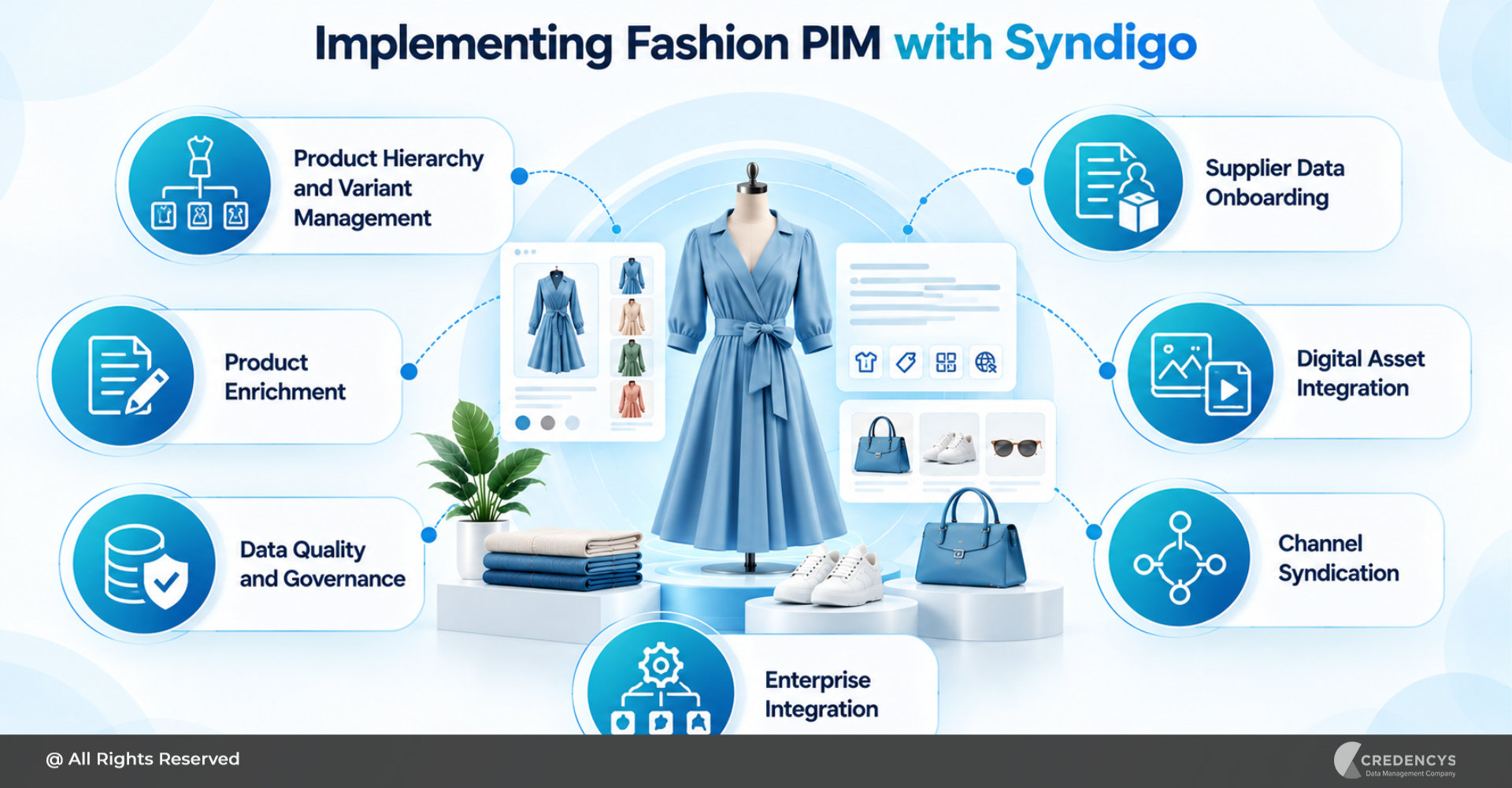
Product Hierarchy and Variant Management
Determine how styles, colorways, sizes, SKUs, and related products will be modeled.
Supplier Data Onboarding
Define how incoming supplier attributes will be mapped, standardized, and validated.
Product Enrichment
Configure the workflows required to prepare marketing content, product descriptions, attributes, and other channel-ready information.
Digital Asset Integration
Establish how product records will reference and distribute approved media.
Data Quality and Governance
Define required fields, completeness rules, permissions, and approval processes.
Channel Syndication
Identify the information retailers, marketplaces, commerce platforms, and other destinations require.
Enterprise Integration
Determine how Syndigo will exchange information with PLM, ERP, DAM, supplier systems, and downstream channels. Configure the platform around documented business requirements rather than forcing existing processes into unsuitable product-data structures.
Businesses evaluating this platform can explore Credencys’ Syndigo implementation and consulting services.
Real-World Example: Fashion PIM Implementation with Syndigo
A practical example demonstrates how structured PIM implementation can improve fashion product-data operations.
The Challenge
A fashion retailer managing clothing, footwear, and accessories needed to improve the accuracy and consistency of product information across its sales channels. The business faced challenges involving fragmented product information, rich media management, and time-consuming content updates.
These issues affected internal efficiency and the consistency of customer-facing product experiences.
The Implementation
Credencys implemented Syndigo to improve the retailer’s product content management processes. The solution included:
- Centralized Product Information Management: Credencys consolidated product information into a central environment to improve consistency across sales channels.
- Rich Media Integration: Credencys connected high-quality product images, videos, and other rich media to the product information experience.
- Automated Content Updates: Credencys automated product information synchronization to reduce repetitive manual updates and improve consistency.
The Business Results
According to Credencys’ published case study, the implementation delivered the following results:
| Business Outcome | Reported Improvement |
|---|---|
| Product information consistency and accuracy | 70% improvement |
| Conversion rates | 20% improvement |
| Time required for content updates | 60% reduction |
| Operational costs | 30% reduction |
These are results from this particular engagement and should not be interpreted as guaranteed outcomes for other Fashion PIM implementations.
Read the complete case study: Fashion Retailer PIM Implementation with Syndigo.
What Determines the Cost of Fashion PIM Implementation?
The cost of a Fashion PIM implementation depends on product catalog complexity, the selected platform, existing systems, integration requirements, and deployment scope. Two fashion businesses with similar SKU counts may have significantly different implementation requirements.
For example, a retailer with standardized supplier data and one commerce platform may require less implementation effort than a global fashion brand integrating PLM, ERP, DAM, multiple suppliers, and several regional channels. The following factors typically influence implementation costs.
| Cost Factor | Impact on Implementation |
|---|---|
| Product catalog complexity | Complex styles, variants, attributes, and relationships require more detailed modeling and configuration |
| Data quality | Duplicate, incomplete, or inconsistent records increase cleansing and migration effort |
| Enterprise integrations | Connecting PLM, ERP, DAM, suppliers, and commerce platforms adds technical complexity |
| Workflow requirements | Custom enrichment, validation, permissions, and approvals require additional configuration |
| Markets and channels | Localization and destination-specific requirements increase implementation scope |
| Platform customization | Unique requirements may involve additional configuration or custom development |
| Deployment and training | Testing, rollout, user training, and change management contribute to project effort |
| Ongoing support | Maintenance, monitoring, optimization, and new channel onboarding affect long-term costs |
How to Estimate Fashion PIM Implementation Costs
Start by documenting the product catalog, data sources, integrations, workflows, users, and channels involved in the initial rollout. Separate mandatory launch requirements from enhancements that can be delivered in later phases.
Then assess platform licensing, implementation, migration, integration, training, and ongoing support costs together. This provides a more realistic estimate than using SKU volume alone.
Credencys provides a PIM Cost & Business Case Builder to help organizations begin evaluating their potential investment.
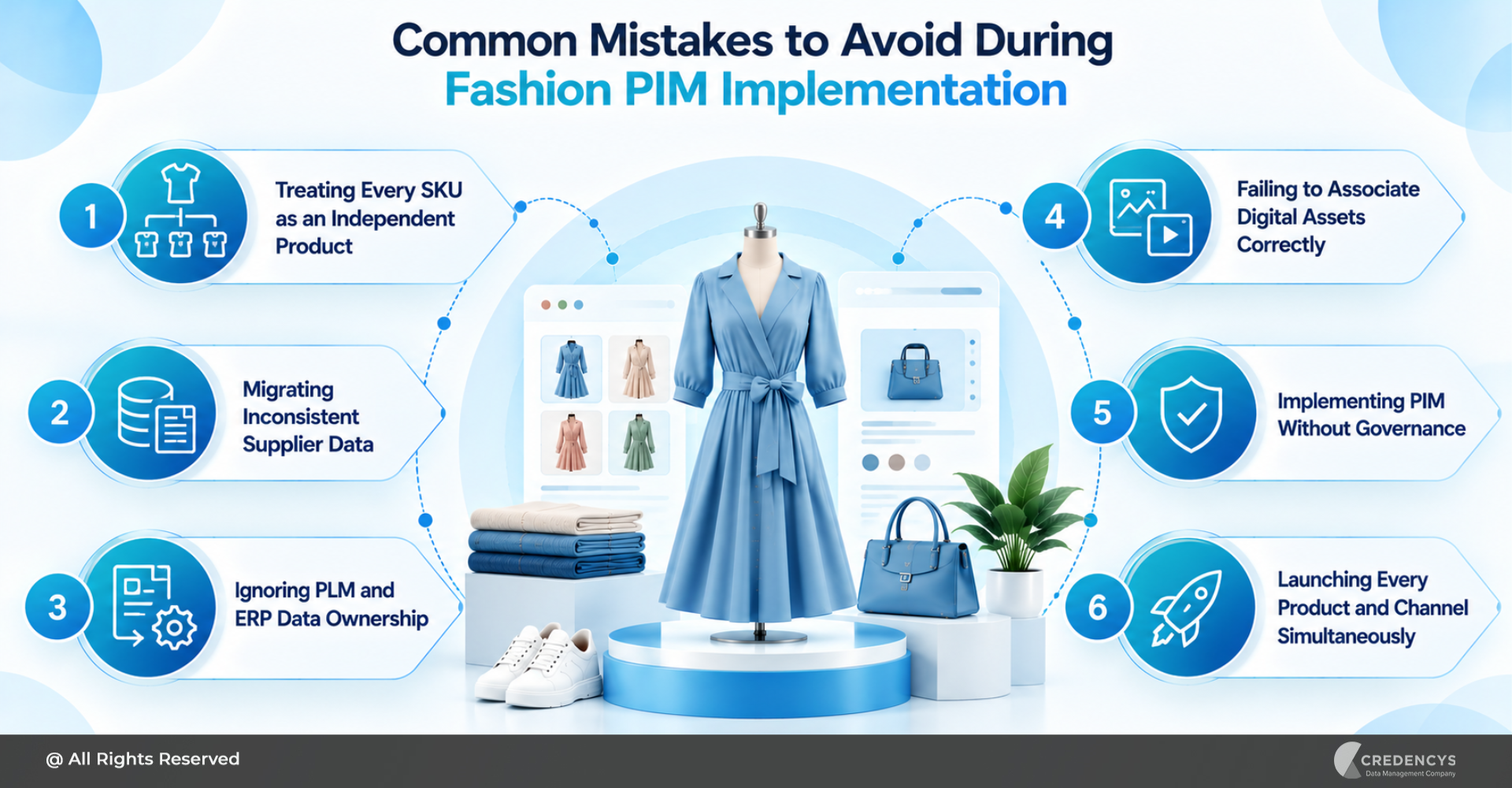
Common Mistakes to Avoid During Fashion PIM Implementation
Even a technically capable PIM platform can underperform when implementation decisions do not reflect the complexity of fashion product information. Avoiding the following mistakes can reduce rework and improve adoption.
1. Treating Every SKU as an Independent Product
Fashion products often share attributes across multiple variants. Creating isolated records for every size and color can lead to unnecessary duplication, inconsistent descriptions, and difficult maintenance.
How to avoid it:
Design a product hierarchy that supports styles, colorways, sizes, variants, and attribute inheritance.
2. Migrating Inconsistent Supplier Data
Supplier information may contain different field structures, naming conventions, and attribute values. Migrating these inconsistencies directly into PIM can create long-term data-quality problems.
How to avoid it:
Profile, cleanse, map, and standardize incoming information before migration. Define controlled vocabularies and validation rules.
3. Ignoring PLM and ERP Data Ownership
When system responsibilities are unclear, competing integrations may duplicate or overwrite information. For example, material specifications may originate in PLM, while transactional identifiers originate in ERP.
How to avoid it:
Define authoritative systems and data flows before configuring PIM integrations.
4. Failing to Associate Digital Assets Correctly
Fashion products depend heavily on visual content. If you associate images with the wrong colorway or variant, downstream channels may display incorrect product information.
How to avoid it:
Establish clear product-to-asset relationships and validate media assignments during migration and testing.
5. Implementing PIM Without Governance
Centralizing information does not automatically guarantee its accuracy. Without ownership and approval workflows, users may continue maintaining incomplete or conflicting information.
How to avoid it:
Define product-data ownership, required attributes, validation rules, approval processes, and publishing permissions.
6. Launching Every Product and Channel Simultaneously
Migrating all products and activating every channel in a single deployment can increase implementation complexity. Data mapping, integrations, or user workflows may become difficult to isolate.
How to avoid it:
Consider a phased rollout by category, brand, market, or channel. Validate the initial deployment before expanding.
Frequently Asked Questions
1. What is PIM implementation for the fashion industry?
Fashion PIM implementation involves deploying a Product Information Management platform to structure, enrich, govern, and distribute fashion product information. The process includes fashion-specific data modeling, product-data cleansing, migration, PLM and ERP integration, DAM connectivity, workflow configuration, testing, and deployment.
Its purpose is to establish a governed product-information layer that supports styles, variants, collections, suppliers, and downstream commerce channels.
2. How long does it take to implement Fashion PIM?
Fashion PIM implementation timelines depend on product catalog complexity, data quality, source systems, integrations, workflows, customization, and deployment scope. A focused implementation with a limited product category and fewer integrations may take less time than a global rollout across multiple brands, markets, enterprise systems, and suppliers.
Establish a realistic timeline after assessing requirements and planning implementation.
3. What product data should fashion businesses prepare before PIM implementation?
Fashion businesses should identify and prepare product names, descriptions, style identifiers, SKUs, colors, sizes, fits, materials, care information, categories, collections, product relationships, supplier attributes, and relevant digital-asset references. Assess data for completeness, duplicates, inconsistent terminology, and incorrect relationships.
Defining the target product-data model before migration helps prevent unnecessary rework.
4. How do you migrate style, colorway, and SKU data into PIM?
Migration begins by mapping existing product records to the target Fashion PIM hierarchy. Implementation teams identify parent styles, colorway variations, size-specific SKUs, shared attributes, and product relationships.
The team then cleanses, transforms, migrates, and validates the data. Testing should confirm that attribute inheritance, identifiers, colorway associations, and digital-asset relationships remain correct after migration.
5. Can Fashion PIM integrate with existing PLM and ERP systems?
Yes. Fashion PIM can integrate with PLM, ERP, DAM, supplier systems, eCommerce platforms, and other enterprise applications through supported APIs, connectors, middleware, or custom integrations. The implementation should define which system owns each data element and how information moves between systems.
How Credencys Helps Implement Fashion PIM
A successful Fashion PIM implementation requires product-data expertise, enterprise integration capabilities, platform knowledge, and an understanding of fashion catalog complexity. Credencys helps fashion brands, retailers, manufacturers, and distributors design and implement PIM solutions aligned with their product-data requirements and existing technology ecosystems.
Our implementation capabilities include:
- PIM Assessment and Planning: Evaluating existing product information, systems, workflows, and implementation requirements.
- Fashion Product Data Modeling: Designing style, colorway, size, SKU, collection, and product relationship structures.
- Product Data Cleansing and Migration: Standardizing and migrating product information into the target platform.
- Enterprise Integration: Connecting PIM with PLM, ERP, DAM, supplier systems, and commerce platforms.
- Workflow and Governance Configuration: Establishing enrichment, validation, ownership, and approval processes.
- Channel Content Readiness: Preparing governed product information for eCommerce, marketplaces, and retail distribution.
- Testing and Deployment: Validating data, workflows, integrations, and channel outputs before launch.
- Ongoing Optimization: Supporting evolving product catalogs, markets, workflows, and integration requirements.
Fashion businesses exploring PIM can also review our Fashion PIM Guide to understand how to structure product information across styles and variants, or explore the Benefits of PIM for Fashion for a closer look at its operational advantages.
Conclusion
Implementing PIM for the fashion industry requires more than selecting software and migrating product records. Fashion businesses must account for complex variant structures, seasonal collections, supplier-data inconsistencies, digital assets, enterprise integrations, and different channel requirements.
A successful implementation begins with understanding these challenges and designing a product-data model that supports them. From assessment and cleansing to integration, enrichment, governance, and deployment, every stage builds a reliable product-information foundation.
When fashion businesses implement PIM as part of the wider enterprise ecosystem, they can reduce repetitive data-management work, improve consistency, accelerate product-content preparation, and support more scalable omnichannel operations. The key is to establish the right product-data architecture and governance processes before scaling the solution.







Tags: