


Pimcore vs Akeneo (2026): Features, Pricing, Best Fit
Short answer: Choose Akeneo if you want a PIM that business users adopt quickly, with a large app ecosystem, as SaaS (or the self-hosted Community Edition). Choose Pimcore if you need a more flexible data model, PIM, MDM, and DAM in one platform, and control over hosting and customization.
Pimcore and Akeneo are the two best-known PIM platforms with free, source-available editions, and both are built on PHP and Symfony, so people often compare them. Today they differ more than they used to: Akeneo’s commercial product is SaaS, while Pimcore is an open-core platform you can host anywhere. This guide compares them on what matters.
Disclosure: Credencys is a Pimcore Strategic Partner (80+ certified Pimcore experts) and a Syndigo partner. We also advise on platforms we don’t implement and recommend them when they are a better fit.
Pimcore vs Akeneo at a Glance
| Pimcore | Akeneo | |
|---|---|---|
| Type | Open-core platform: PIM, MDM, DAM, DXP/CMS, commerce | PIM-focused platform |
| Free edition | Community Edition, free for eligible organizations (POCL) | Community Edition, open source and self-hosted (2026.x releases) |
| Paid editions | Professional, Enterprise and PaaS | SaaS editions (Growth and Enterprise) |
| Data model | Very flexible: any entity, relationships, custom objects | Product-centric families, attributes and variants |
| DAM | Full DAM included | Asset management; connects to DAMs |
| MDM | Built-in (multi-domain) | Not an MDM |
| Ease of use | Powerful; needs good configuration | Known for user-friendly enrichment |
| Ecosystem | Partners, bundles and Data Hub APIs | Large app marketplace and connectors |
What Is Pimcore?
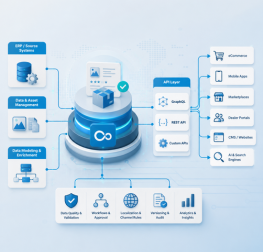
Pimcore is an open-core platform for PIM, MDM, DAM and digital experiences. Pimcore is open core: since version 2025.1, it ships under the Pimcore Open Core License (POCL).
The Community Edition is free for non-production use, academic and non-profit organizations, and companies with annual revenue under EUR/USD 5 million; other companies need a paid Professional, Enterprise, or PaaS edition. Learn more in What is Pimcore.
What Is Akeneo?
Akeneo is a product information management platform focused on product enrichment and experience. Its Community Edition is open source and self-hosted, with releases now on a calendar schedule (for example, 2026.4); its commercial Growth and Enterprise editions are delivered as SaaS.
Akeneo does not publish prices. See Akeneo implementation and Akeneo pricing. If you are looking past Akeneo, Akeneo alternatives rates nine platforms, Pimcore among them, against Akeneo on 40 criteria. Still comparing vendors?
Our PIM platform selection service gives you an independent recommendation, and the PIM platform comparison matrix compares ten platforms across 40 criteria.
Key Differences Between Pimcore and Akeneo
1. Scope
Akeneo is a PIM. Pimcore is a broader platform that also covers MDM, DAM, and digital experiences, so it suits companies that want several data domains in one place.
2. Data model flexibility
Both handle families, attributes, and variants well. Pimcore goes further with custom entities and complex relationships, useful for technical and B2B data.
3. Deployment
Akeneo’s paid editions are SaaS; only the Community Edition is self-hosted. Pimcore can be self-hosted, run in your cloud, or on Pimcore PaaS in every edition.
4. Ease of use and adoption
Akeneo is known for an approachable enrichment interface and completeness tracking. Pimcore’s new Studio interface is powerful, but its usability depends more on how it is configured.
5. Ecosystem
Akeneo has a large app marketplace for connectors. Pimcore relies on its Data Hub APIs, bundles, and partners, which offers flexibility but requires more integration work.
For retailers
Retailers with many suppliers value Akeneo’s onboarding and ease of use. Retailers that also want DAM, MDM or custom commerce experiences on the same data often choose Pimcore. See PIM for retail.
Feature-by-Feature Comparison
Our ratings on the 40 criteria in the PIM platform comparison matrix (Strong, Good, Partial or add-on, Not offered), based on public information and our project experience, October 2026.
| Area | Criterion | Pimcore | Akeneo |
|---|---|---|---|
| Data model | Flexible attributes and families | Strong | Good |
| Variants and configurable products | Strong | Good | |
| Relationships and bundles | Strong | Good | |
| Languages and markets | Strong | Strong | |
| Complex B2B and technical data | Strong | Good | |
| Workflow and governance | Approval workflows | Strong | Good |
| Completeness rules | Good | Strong | |
| Data validation | Good | Good | |
| Roles and permissions | Strong | Good | |
| Versioning and audit trail | Strong | Good | |
| Digital assets | Built-in DAM | Strong | Good |
| Asset-to-product linking | Strong | Good | |
| Asset renditions | Strong | Good | |
| Rich media and enhanced content | Good | Partial / add-on | |
| External DAM integration | Good | Strong | |
| Syndication and channels | Retailer and marketplace syndication | Partial / add-on | Good |
| GDSN data pools | Partial / add-on | Partial / add-on | |
| Channel-specific content | Strong | Strong | |
| eCommerce connectors | Good | Strong | |
| Print and catalog output | Good | Partial / add-on | |
| Integration and APIs | REST API | Strong | Strong |
| GraphQL API | Strong | Good | |
| Import and export tools | Strong | Good | |
| ERP integration | Good | Good | |
| Events and webhooks | Good | Good | |
| Automation and AI | AI attribute extraction and classification | Good | Good |
| Automation rules | Strong | Good | |
| AI included in license vs paid credits | Good | Partial / add-on | |
| AI agent / LLM API access | Good | Good | |
| Ease of use for business users | Good | Strong | |
| Deployment and security | SaaS option | Good | Strong |
| Self-hosted or private cloud | Strong | Partial / add-on | |
| Open source | Partial / add-on | Good | |
| Typical time to first release | Good | Strong | |
| Scale for large catalogs | Strong | Good | |
| Vendor and ecosystem | Implementation partner network | Good | Strong |
| App and connector marketplace | Partial / add-on | Strong | |
| Supplier onboarding | Good | Good | |
| Master data beyond products | Strong | Partial / add-on | |
| Digital shelf analytics | Partial / add-on | Partial / add-on |
Implementation: What to Expect
- Pimcore: Pimcore projects need a data model designed for your products, developers or a partner for configuration and integrations (Data Hub, bundles), and a hosting decision: self-hosted, your cloud, or Pimcore PaaS.
- Akeneo: Akeneo SaaS projects configure families, attributes, channels, and apps from its marketplace; Community Edition projects also need hosting and upgrades to stay on the latest release.
- For both: start with a few weeks of discovery and a data audit, design the data model before configuring screens, and plan integrations (ERP, eCommerce, DAM, channels) early.
- Timeline: A focused first release typically takes 3 to 6 months; larger programs run in phases over 6 to 12 months or more.
Talk to us about PIM implementation or moving between platforms.
How They Are Priced
Both are bought differently, so compare pricing models and total cost of ownership, not a single number.
| Pimcore | Akeneo | |
|---|---|---|
| Licence model | Open core (POCL): free Community Edition under conditions; paid Professional, Enterprise and PaaS editions | Open-source Community Edition; SaaS subscriptions for paid editions, quote-based |
| What drives the price | Edition, hosting, support level, plus implementation | Edition, products, users, channels |
| Free option | Yes: Community Edition, for eligible organizations | Yes: Community Edition (self-hosted) |
Implementation, integrations, data migration and support usually cost more than the first year’s license. Size your project with the PIM Cost & Business Case Builder.
See Pimcore pricing explained for the editions and what each costs.
Which One Do You Need?
Choose Akeneo if
- You need a PIM that marketing and merchandising teams adopt fast.
- You want SaaS and ready-made connectors from a large app marketplace.
- PIM is the main need; MDM and DAM live elsewhere.
Choose Pimcore if
- You need a flexible model for complex, technical, or B2B product data.
- You want PIM, MDM and DAM together, and control over hosting.
- You plan to use the same data across portals, websites, or apps.
Results from our projects
- Leading European jewelry brand: 41% fewer product launch delays
- US wholesale distributor: Pimcore upgrade, 40% faster backend processing
Frequently Asked Questions
What is the difference between Pimcore and Akeneo?
Akeneo is a PIM focused on product enrichment, with SaaS paid editions and an open-source Community Edition. Pimcore is an open-core platform that combines PIM, MDM, DAM, and digital experiences, with flexible hosting options.
Is Akeneo Community Edition still available?
Yes. Akeneo’s Community Edition remains open source and self-hosted, with calendar-versioned releases such as 2026.4. Only the latest release receives bug and security fixes, so plan regular upgrades.
Is Pimcore free?
Pimcore is open core: since version 2025.1 it ships under the Pimcore Open Core License (POCL). The Community Edition is free for non-production use, academic and non-profit organizations, and companies with annual revenue under EUR/USD 5 million; other companies need a paid Professional, Enterprise, or PaaS edition.
Which is better for retailers?
Retailers focused on supplier onboarding and easy enrichment often prefer Akeneo. Retailers that also need DAM, MDM or custom commerce experiences on the same data often choose Pimcore.
How long does a Pimcore or Akeneo implementation take?
A focused first release typically takes 3 to 6 months; larger programs run in phases over 6 to 12 months or more. SaaS editions reduce infrastructure work; data modeling and integrations drive the timeline.





Tags: