

Best PIM Software in 2026: 10 Tools Compared
Short answer: The best PIM software depends on your product data, channels, and team. For complex data and full control, evaluate Pimcore; for retailer and marketplace syndication, Syndigo and Salsify; for easy enrichment, Akeneo; for manufacturers, inRiver; for multi-domain MDM, Stibo STEP; for composable commerce, Bluestone PIM; for large catalogs with published plans, Pimberly; and for small, growing brands, Plytix.
Choosing the right Product Information Management platform isn’t just about comparing feature lists. The best PIM software for your organization depends on your product data complexity, the systems it needs to connect with, the number of channels you support, your supplier ecosystem, governance requirements, localization needs, syndication strategy, and long-term digital architecture.
A platform that works well for a consumer brand focused on retailer syndication may not suit an industrial manufacturer managing complex technical products. Likewise, an organization that needs PIM, MDM, DAM, and highly customized workflows may evaluate very different platforms from a retailer prioritizing rapid product enrichment and marketplace activation.
This guide compares leading enterprise PIM platforms and helps you understand where each one is likely to fit best.
Best PIM Software at a Glance
| PIM software | Deployment | Pricing model | Often the best fit for |
|---|---|---|---|
| Pimcore | Open source plus paid editions; self-hosted, cloud or PaaS | Free Community Edition (license conditions apply); paid enterprise editions | Complex data models; PIM, MDM and DAM in one platform |
| Syndigo | SaaS | Subscription, quote-based | Brands, retailers and distributors syndicating to many recipients and data pools |
| Akeneo | Open source plus SaaS | Free Community Edition; SaaS plans | Mid-market brands and retailers that want a fast start and many connectors |
| Salsify | SaaS | Subscription, quote-based | Consumer brands selling through retailers and marketplaces |
| inRiver | SaaS | Subscription, quote-based | B2B manufacturers and global brands |
| Stibo STEP | Enterprise license or SaaS | Quote-based | Large enterprises with multi-domain master data |
| Contentserv | Cloud (SaaS or PaaS) | Subscription, quote-based | Brands and manufacturers combining PIM, DAM and content |
| Bluestone PIM | Composable, API-first (MACH) | Usage-based, quote-based | Mid-size and enterprise companies building a headless stack |
| Pimberly | Subscription | Published annual tiers by SKUs, users, and storage; enterprise quote | Retailers, distributors and manufacturers with large catalogs |
| Plytix | SaaS | Monthly plans by SKU volume, with add-on modules | Small and growing brands |
How We Evaluated These PIM Platforms
We compared each platform on the criteria that decide real projects: data model flexibility, data quality and workflow, digital assets, syndication and channels, integration and APIs, AI and automation, deployment and security, scalability, ecosystem and pricing model. This information comes from vendor documentation and public pricing pages as of October 2026, as well as our own implementation and advisory work.
Disclosure: Credencys is a Pimcore Strategic Partner (80+ certified Pimcore experts) and a Syndigo partner. We also advise on platforms we don’t implement and recommend them when they are a better fit.
Want a side-by-side view? Download the free PIM platform comparison matrix.
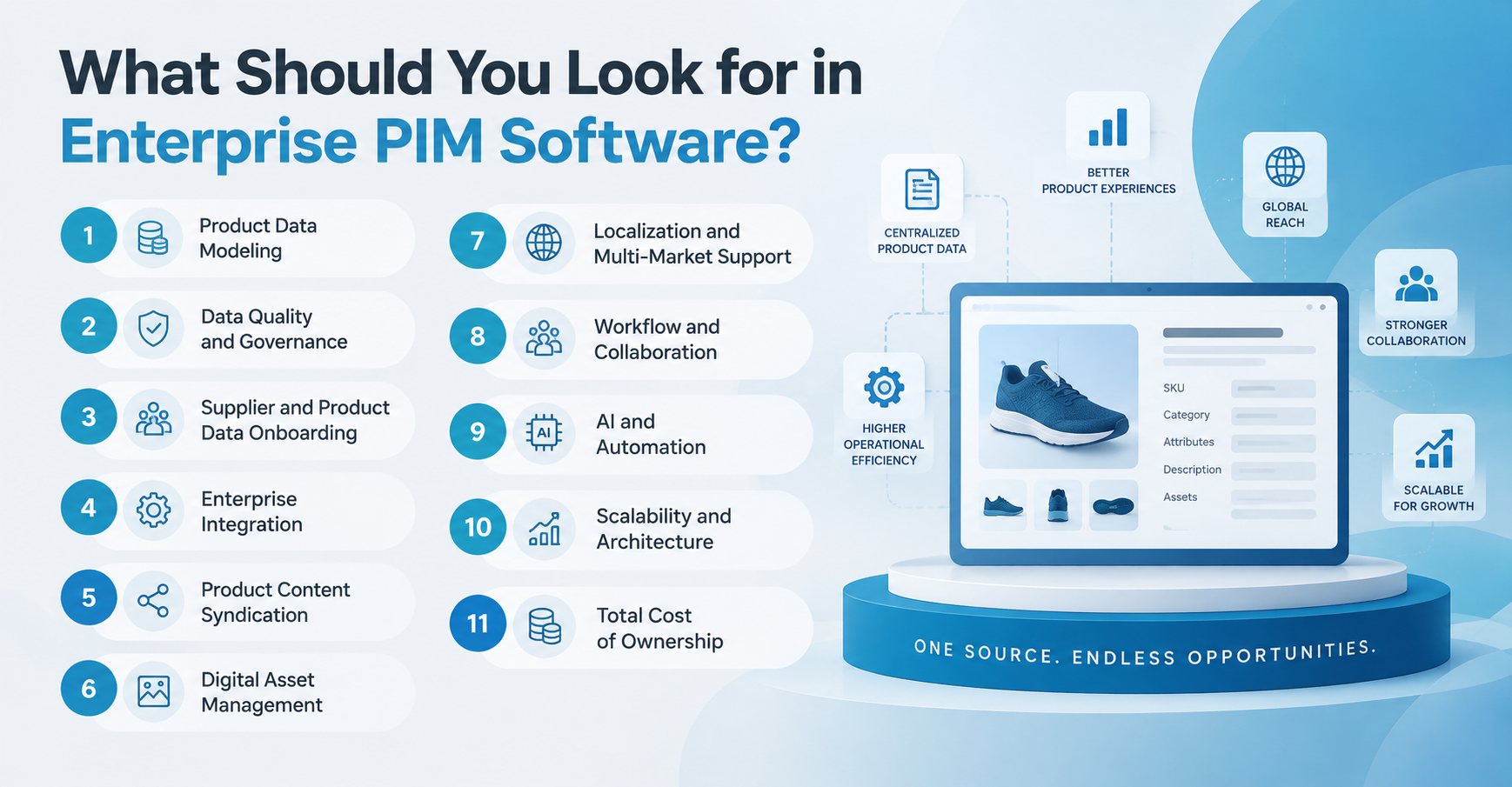
What Should You Look for in Enterprise PIM Software?
A strong PIM shortlist starts with your business requirements, not vendor demonstrations. Before comparing platforms, define how complex your product ecosystem actually is, and which capabilities will determine whether the implementation succeeds.
Product Data Modeling
Your PIM needs to represent products the way your business actually manages them. That may include:
- Products and SKUs
- Parent-child relationships
- Variants
- Configurable products
- Product families
For businesses with complex products, flexible data modeling often matters more than the length of a standard feature checklist.
Data Quality and Governance
A PIM should help your teams improve product-data quality, not just store information. Look for capabilities around:
- Completeness rules
- Validation
- Required attributes
- Controlled values
- Data-quality checks
The right platform should clearly show which products are complete, what information is missing, who owns the issue, and whether a product is ready for publication.
Supplier and Product Data Onboarding
Many organizations receive product information from manufacturers, suppliers, distributors, internal systems, and acquisitions. Assess how easily a PIM can ingest and normalize information from:
- ERP
- PLM
- Supplier spreadsheets
- CSV
- XML
For supplier-heavy businesses, efficient onboarding can significantly reduce the manual work required before a product is ready to enrich or publish.
Enterprise Integration
PIM should fit within your broader enterprise architecture. Typical integrations may include:
- ERP
- DAM
- PLM
- MDM
- CRM
Evaluate APIs, connectors, events, middleware requirements, data ownership, and synchronization patterns before selecting a platform. A strong PIM should not become another isolated data silo.
Product Content Syndication
If you distribute products across multiple external channels, syndication can become a major selection criterion. Your organization may need to distribute information to:
- Retailers
- Distributors
- Marketplaces
- B2B portals
- eCommerce platforms
Consider whether syndication is native to the platform, available through a broader product-experience ecosystem, or dependent on external systems.
Digital Asset Management
Product information and digital assets are closely connected. Products may require:
- Images
- Videos
- Datasheets
- Technical documents
- Certificates
Evaluate whether DAM capabilities are built into the same platform, provided through an integrated module, or expected to remain in a dedicated DAM system.
Localization and Multi-Market Support
Global businesses need to manage product information across countries, languages, regions, brands, and channel requirements. Your PIM may need to support:
- Multiple languages
- Translation workflows
- Regional content
- Localized attributes
- Market-specific assortments
The more global your organization is, the more important and structured localization becomes.
Workflow and Collaboration
PIM implementations usually involve multiple teams. Product information may pass through: Supplier → Product Team → Data Steward → Marketing → Regulatory → eCommerce → Channel Manager.
Your PIM should support workflows that reflect these responsibilities. Look for:
- Assignment
- Review
- Approval
- Escalation
- Notifications
- Business rules
- Role-based access
- Workflow automation
AI and Automation
AI is becoming part of modern PIM platforms, particularly for repetitive product-data work. Common use cases include:
- Attribute enrichment
- Product classification
- Content generation
- Translation
- Supplier-data mapping
AI should accelerate governed product-data processes—not replace validation, ownership, and business rules.
Scalability and Architecture
A platform that works for 20,000 straightforward products may behave very differently when managing millions of records, complex relationships, many integrations, or multiple business units. Evaluate:
- SKU volumes
- Attribute volumes
- Data-model complexity
- Concurrent users
- API requirements
Total Cost of Ownership
Software licensing is only one part of PIM cost. A realistic assessment should include:
- Software subscription or license
- Implementation
- Discovery and architecture
- Data modeling
- Data migration
The least expensive software license doesn’t necessarily mean the lowest total cost of ownership.
Best Enterprise PIM Software Compared
No single PIM platform is the universal #1. Each leading platform below emphasizes different things, uses a different architecture, and fits a different operating environment.
| Platform | Strong Fit When You Need | Typical Buyer Profile |
|---|---|---|
| Pimcore | Complex product and master data, flexible data modeling, PIM + MDM + DAM, and enterprise customization | Manufacturers, distributors, complex B2B businesses, and enterprise data programs |
| Syndigo | Product data governance with strong retailer, marketplace, and channel syndication | CPG, food & beverage, brands, manufacturers, retailers, and supplier networks |
| Akeneo | Product enrichment, usability, supplier onboarding, localization, and product experience workflows | Retailers, eCommerce businesses, brands, and mid-market to enterprise organizations |
| Salsify | Commerce-focused PIM/PXM, syndication, digital shelf management, and product activation | Consumer brands, CPG companies, and organizations selling through major retailers |
| inriver | Product content lifecycle management across complex markets, channels, and global teams | Manufacturers, global brands, and complex B2B organizations |
| Stibo Systems | Product information as part of a broader multi-domain Master Data Management strategy | Large global enterprises with mature data governance and MDM requirements |
| Contentserv | Integrated product information, digital assets, enrichment, and commerce activation | Brands, manufacturers, and retail-focused organizations |
Pimcore – Best Fit for Complex Product Data and Unified Enterprise Data Management
Evaluate Pimcore when product information is only one part of a broader enterprise data problem. Its platform combines capabilities across Product Information Management, Master Data Management, Digital Asset Management, content, commerce, and other data and experience domains.
This makes Pimcore particularly relevant for enterprises that need to model complex products and relationships while connecting PIM with broader master-data and digital-experience requirements.
Key Strengths to Evaluate
- Flexible product-data modeling
- Complex relationships and hierarchies
- Product variants
- Product and master-data management
- Integrated DAM capabilities
- Data quality and completeness
- Workflow automation
- Multichannel distribution
- APIs and enterprise integrations
- Customization and extensibility
- AI-assisted automation
Pimcore May Be a Strong Fit For
- Manufacturers
- Industrial distributors
- Automotive organizations
- Complex B2B companies
- Enterprises with sophisticated data relationships
- Organizations consolidating PIM, MDM, and DAM requirements
- Businesses requiring significant customization
What to Consider
The flexibility that makes Pimcore powerful also means the implementation architecture matters. Organizations should define their data models, integrations, governance, workflows, and deployment strategy carefully rather than treating the platform as an out-of-the-box catalog application.
Syndigo – Best Fit for Product Data Management and Large-Scale Syndication
Syndigo is particularly relevant when product information needs to move reliably from brands and manufacturers into retailer, marketplace, and commerce ecosystems. Its PIM capabilities sit alongside broader product-data management and syndication capabilities, making it a strong platform to evaluate when channel distribution is central to the business case.
Key Strengths to Evaluate
- Centralized product information
- Product enrichment
- Product-data governance
- Workflow automation
- Content syndication
- Retailer and commerce connectivity
- Product and multidomain master-data capabilities
- Supplier and product onboarding
- Channel-ready content
- Data-quality management
Syndigo May Be a Strong Fit For
- Consumer brands
- CPG companies
- Food & beverage businesses
- Manufacturers
- Retail suppliers
- Organizations distributing product information to many downstream partners
- Enterprises where syndication is a major operational requirement
What to Consider
If retailer connectivity, syndication, GDSN, and downstream product-content requirements are central to your business case. Evaluate those requirements early in the selection process, not after you’ve already chosen a core PIM.
Akeneo – Best Fit for Product Enrichment and Product Experience Workflows
Organizations that prioritize collaborative product enrichment, usability, supplier onboarding, localization, and product-experience management widely consider Akeneo. Its broader Product Cloud brings together PIM with capabilities for supplier data, DAM, activation, and product-experience optimization.
Key Strengths to Evaluate
- Product enrichment
- Product completeness
- Variant management
- Supplier-data onboarding
- Product assets
Akeneo May Be a Strong Fit For
- Retailers
- eCommerce organizations
- Consumer brands
- Product and merchandising teams
- Global organizations managing localized catalogs
What to Consider
Organizations with complex MDM requirements, deeply customized enterprise workflows, or unusually sophisticated technical data models should validate those needs during the proof-of-concept stage rather than relying only on standard enrichment demonstrations.
Salsify – Best Fit for Commerce-Focused Product Experience and Syndication
Salsify approaches product information as part of a broader Product Experience Management environment. Its platform combines PIM with commerce-oriented syndication, digital shelf capabilities, enhanced product content, and automation.
Key Strengths to Evaluate
- Centralized product information
- Product-content governance
- Channel-specific content
- Retail and commerce syndication
- Product experience management
Salsify May Be a Strong Fit For
- Consumer brands
- CPG organizations
- Food & beverage companies
- Retail suppliers
- Brands selling through multiple retail and commerce channels
What to Consider
Evaluate Salsify in the context of your broader commerce strategy. If syndication and digital shelf activation are major priorities, it may be particularly relevant.
If your primary requirement is highly complex technical master-data modeling, you may also need to consider other architectures.
Inriver – Best Fit for Manufacturers and Global Product-Content Operations
Inriver focuses on managing the product-content lifecycle, from onboarding and enrichment to governance, localization, and activation. Its current platform direction emphasizes AI-assisted enrichment, workflow orchestration, channel readiness, and product-commerce operations.
Key Strengths to Evaluate
- Product-content onboarding
- Product enrichment
- Product-data governance
- Localization
- Workflow orchestration
Inriver May Be a Strong Fit For
- Manufacturers
- Industrial organizations
- Global brands
- Complex B2B companies
- Businesses managing product information across many markets
What to Consider
Evaluate how well the platform’s lifecycle and activation model aligns with your ERP, PLM, DAM, commerce, and existing master-data architecture.
Stibo Systems – Best Fit for Multi-Domain Enterprise Master Data Management
Stibo Systems is often evaluated when Product Information Management sits within a broader Master Data Management program. Its STEP platform can manage product information while also supporting additional enterprise master-data domains.
Key Strengths to Evaluate
- Product master data
- Multi-domain MDM
- Enterprise governance
- Hierarchies
- Data quality
Stibo Systems May Be a Strong Fit For
- Large global enterprises
- Organizations with mature data-governance programs
- Businesses managing product, supplier, customer, location, or other master-data domains
- Enterprises where PIM is part of a broader MDM strategy
What to Consider
If your primary challenge is straightforward product enrichment and commerce activation, a broad multidomain MDM platform may add more capability and complexity than needed. The business case should therefore begin with data-domain requirements.
Contentserv – Best Fit for Integrated Product Content and Commerce Activation
Contentserv combines product information with digital assets and broader product-experience capabilities. It is worth evaluating where centralized product data, product-content enrichment, digital assets, feed management, and commerce activation need to operate together.
Key Strengths to Evaluate
- Product information management
- Digital asset management
- Product enrichment
- Workflow automation
- Localization
Contentserv May Be a Strong Fit For
- Manufacturers
- Consumer brands
- Retail organizations
- Organizations managing large omnichannel catalogs
- Businesses looking for integrated PIM and DAM workflows
What to Consider
Assess whether its broader product-experience and feed-management model matches your existing systems, especially if you already have DAM or syndication capabilities elsewhere.
PIM Options for Mid-Market and Composable Commerce
The platforms above dominate enterprise shortlists. Mid-market companies, small brands, and teams building a composable commerce stack often evaluate these three.
Bluestone PIM – Best Fit for Composable, Headless Commerce
Bluestone PIM is an API-first, MACH-based PIM built for composable architectures, with a large set of APIs and a marketplace of add-on apps. Pricing is usage-based and quoted after you share users, SKUs, and languages.
It suits mid-size and enterprise companies that want PIM as one service in a headless stack.
Pimberly – Best Fit for Large Catalogs with Predictable Plans
Pimberly targets retailers, distributors, and manufacturers and offers annual tiers based on SKUs, users, and storage, with unlimited channels, languages, and currencies on each tier, plus an enterprise tier by quote. DAM is included, with advanced features and AI as add-ons.
Plytix – Best Fit for Small and Growing Brands
Plytix is a SaaS PIM with monthly plans priced mainly by SKU volume and unlimited users, plus optional modules for channels such as Shopify, BigCommerce, Wayfair, and feed management. It is a common first PIM for smaller brands that have outgrown spreadsheets.
Smaller teams should also read open-source PIM compared and estimate a budget with the PIM cost calculator.
Which PIM Platform is Best for Your Business?
The right answer depends on the business problem you are solving. Instead of selecting one universal winner, build your shortlist around the scenarios below.
Best PIM for Complex Product Data – Pimcore
Pimcore is particularly relevant when your catalog includes:
- Complex hierarchies
- Product relationships
- Technical attributes
- Variants
- Configurable products
- Compatibility
- Large numbers of custom entities
- Broader master-data requirements
This is common in manufacturing, distribution, industrial products, automotive, and complex B2B environments.
Best PIM for Retailer and Marketplace Syndication – Syndigo and Salsify
These platforms should be strongly evaluated when your primary challenge is distributing accurate product information across:
- Retailers
- Marketplaces
- Commerce networks
- Consumer channels
- Trading partners
The decision should consider the specific retailers, networks, geographies, data standards, and workflows your business depends on.
Best PIM for Product Enrichment and User Adoption – Akeneo
Akeneo can be particularly relevant when your teams need an accessible environment for:
- Product enrichment
- Completeness management
- Supplier data
- Localization
- Product assets
- Product experience workflows
User adoption is a major consideration when large merchandising, marketing, or eCommerce teams use PIM daily.
Best PIM for Manufacturers – Pimcore and Inriver
Manufacturers often have highly technical product information, engineering dependencies, relationships, global catalogs, and multiple distribution channels. Pimcore may warrant stronger consideration when you need data flexibility, MDM, DAM, or a highly customized architecture.
Inriver may deserve stronger consideration where product-content lifecycle management, localization, enrichment, and channel activation are central requirements.
Best PIM for Multi-Domain MDM – Stibo Systems and Pimcore
If your initiative extends beyond product information into supplier, customer, location, or other master-data domains, evaluate the selection as an enterprise MDM decision, not simply a PIM purchase.
Best PIM for Commerce-Focused Consumer Brands – Salsify, Syndigo, and Akeneo
Brands selling through many digital channels may place greater emphasis on:
- Product enrichment
- Retail syndication
- Channel-specific content
- Digital shelf performance
- Commerce activation
- Product experience
In this environment, downstream activation may carry as much weight as upstream product modeling.
PIM Software Comparison by Business Requirement
| Business Requirement | Platforms Worth Evaluating |
|---|---|
| Complex technical product data | Pimcore, Inriver |
| Product + master-data management | Pimcore, Stibo Systems |
| Integrated PIM + DAM | Pimcore, Akeneo, Contentserv |
| Retailer syndication | Syndigo, Salsify |
| Supplier-data onboarding | Syndigo, Akeneo, inriver |
| Complex enterprise workflows | Pimcore, Stibo Systems |
| Global localization | Akeneo, inriver, Salsify |
| Commerce-focused product experience | Salsify, Syndigo, Akeneo |
| Complex B2B catalogs | Pimcore, inriver |
| Broad multidomain data strategy | Stibo Systems, Pimcore |
| Product-content lifecycle orchestration | inriver |
| Product content + feed management | Contentserv |
| Large retailer network requirements | Syndigo |
| Highly extensible enterprise architecture | Pimcore |
Treat this table as a shortlist starting point, not a substitute for a requirements assessment.
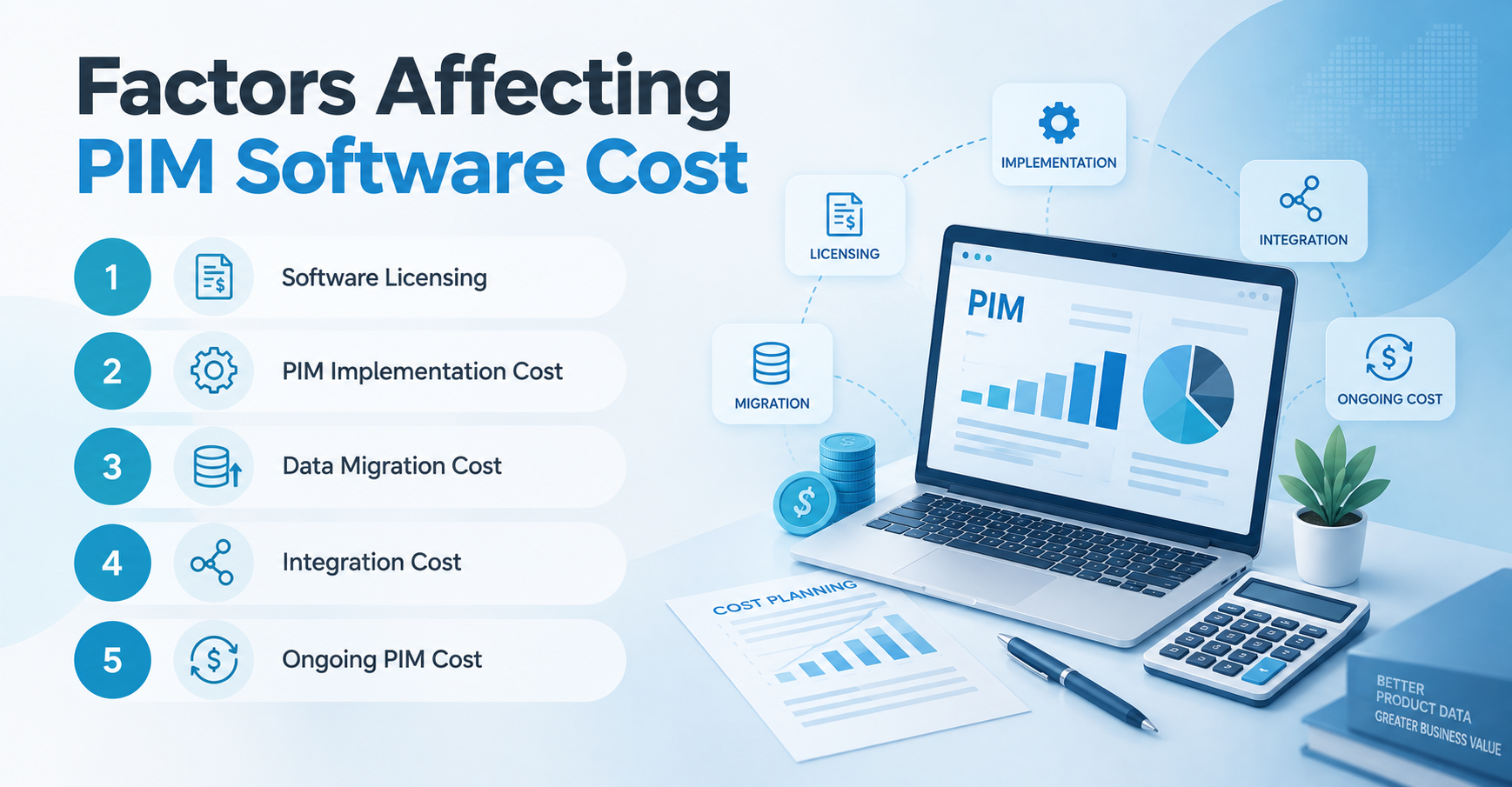
How Much Does PIM Software Cost?
No reliable universal price exists for enterprise PIM software. Total cost depends on both the platform you select and how complex it is to implement within your business.
Software Licensing
Licensing may depend on:
- Platform edition
- Number of users
- Data volume
- Modules
- Markets
Vendor pricing models vary significantly.
PIM Implementation Cost
Implementation costs can include:
- Discovery
- Architecture
- Configuration
- Data modeling
- Taxonomy
- Workflows
- Governance
- Custom development
- Testing
- Training
- Deployment
Complexity usually matters more than SKU count alone.
Data Migration Cost
Data migration can become a major workstream when product information is fragmented across:
- Legacy PIM
- ERP
- Spreadsheets
- Supplier systems
- DAM
- Databases
- Acquired business units
Typical migration activities include:
- Profiling
- Cleansing
- Deduplication
- Mapping
- Transformation
- Validation
- Migration
- Reconciliation
Integration Cost
PIM usually needs to exchange information with multiple enterprise applications. The number and complexity of integrations can materially affect implementation cost.
Common integrations include:
- ERP
- PLM
- DAM
- MDM
- Commerce
- CMS
- Marketplaces
- Supplier systems
- Data warehouses
Ongoing PIM Cost
Total cost of ownership should also include:
- Support
- Platform administration
- Hosting
- Enhancements
- Additional integrations
- Version upgrades
- New channels
- Governance
- Training
How to Shortlist PIM Vendors
A structured selection process reduces the risk of choosing a platform based on a polished demonstration rather than real requirements.
1. Document Your Product Data Complexity
Start with your products’ actual structure. Assess:
- Number of SKUs
- Number of attributes
- Product families
- Variants
- Relationships
SKU count alone does not explain PIM complexity.
2. Map Your Current Enterprise Architecture
Define where product information originates today. For example:
- ERP: Pricing, inventory, purchasing, transactional master data
- PLM: Engineering and product-development data
- PIM: Enriched and governed product information
- DAM: Images, videos, documents, and digital assets
- Commerce: Shopping experience, transactions, accounts, and checkout
Understanding system ownership prevents PIM from becoming responsible for data it shouldn’t own.
3. Define Your Channel Requirements
Document where product information needs to go. This may include:
- eCommerce
- Marketplaces
- Retailers
- Distributors
- B2B portals
Then evaluate how each platform supports those destinations.
4. Define Governance Requirements
Determine:
- Who creates information
- Who enriches it
- Who approves it
- Which attributes are mandatory
- Which validations apply
- Who owns each data domain
- When products become publishable
Governance requirements frequently expose differences between otherwise similar platforms.
5. Map Integration Requirements
Identify:
- Source systems
- Downstream systems
- APIs
- Middleware
- Batch integrations
This is particularly important when PIM is part of a large enterprise architecture.
6. Build a Weighted Selection Scorecard
Do not give every feature the same importance. For example:
- Critical
- Complex product modeling
- ERP integration
- Data governance
- Localization
- Important
- DAM
- Supplier onboarding
- AI enrichment
- Nice to Have
- Additional experience-management capabilities
- A weighted scorecard makes vendor comparison more objective.
7. Evaluate Real Use Cases
Ask vendors to demonstrate your actual requirements. Instead of asking “Show us product enrichment”, ask “show us how 50 suppliers can provide product data in different formats, how missing attributes are identified, how a data steward resolves exceptions, and how approved products are published into our commerce platform”.
Use cases reveal platform differences much more effectively than generic demos.
8. Run a Proof of Concept
For complex enterprise programs, use real data. Test:
- Complex products
- Variants
- Relationships
- Imports
- Integrations
A successful proof of concept should validate the hardest requirements—not the easiest ones.
PIM Software vs PIM Implementation Partner
Selecting the right software is only one part of a successful PIM program. A platform provides capabilities.
Your implementation determines how those capabilities are translated into:
- Data models
- Product hierarchy
- Taxonomy
- Governance
- Workflows
Even the strongest PIM software can underperform when the implementation doesn’t reflect how the organization actually manages product information. A PIM implementation partner can help connect business requirements with technical architecture.
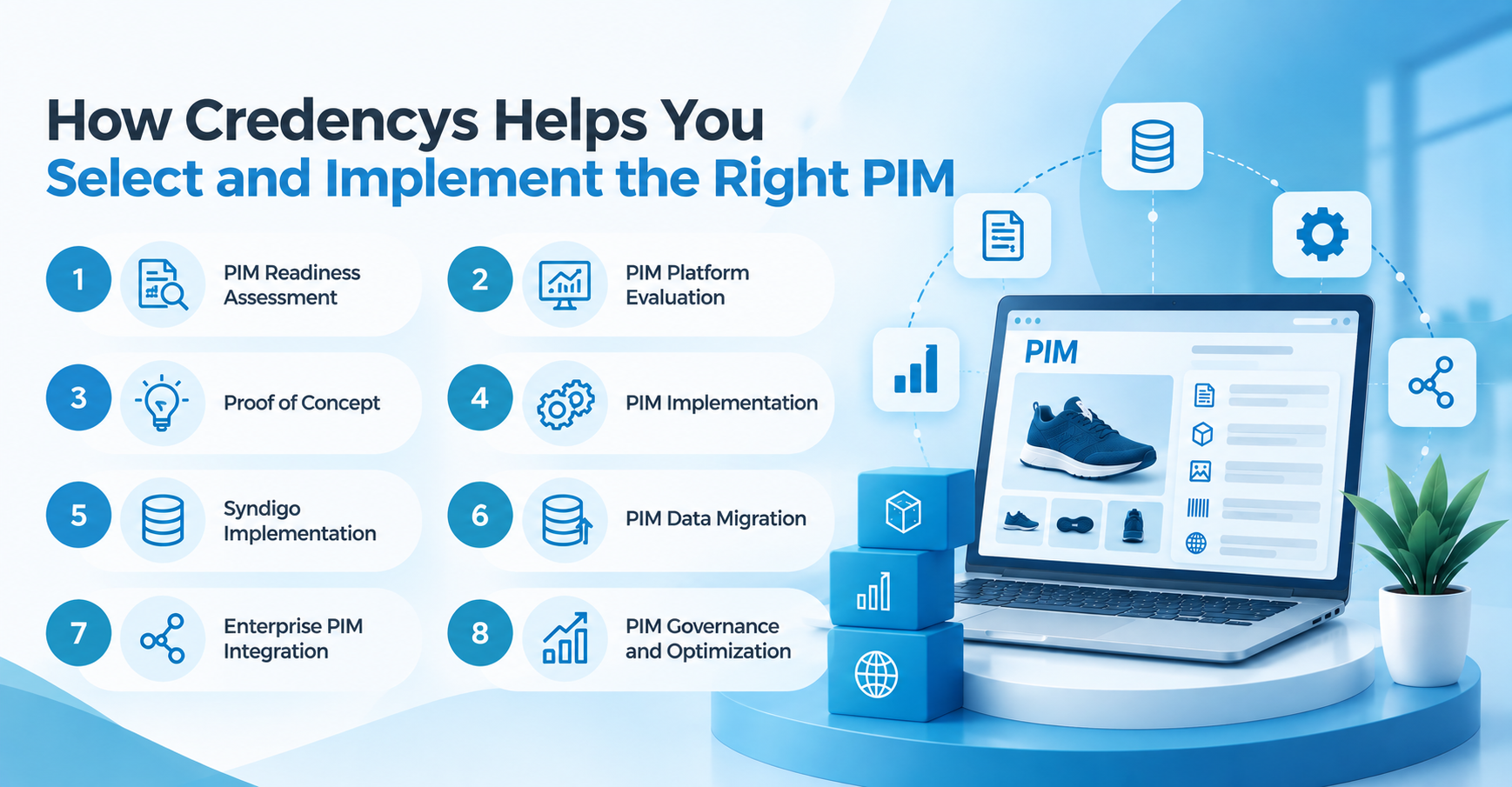
How Credencys Helps You Select and Implement the Right PIM
Credencys helps enterprises move from fragmented product information to a structured, scalable PIM environment. Our team can support the journey from initial assessment through architecture, data preparation, implementation, integration, migration, and optimization.
PIM Readiness Assessment
Evaluate:
- Existing product data
- Systems
- Data quality
- Processes
- Governance
The assessment helps determine whether your organization is ready for PIM implementation and which capabilities to prioritize.
PIM Platform Evaluation
Translate business needs into practical platform-selection criteria. Evaluate candidate platforms around:
- Product-data complexity
- Data modeling
- Governance
- Integrations
- Syndication
Proof of Concept
Validate shortlisted platforms using high-risk business scenarios before committing to a full implementation. This can include:
- Complex products
- Product relationships
- Workflow
- Data-quality rules
- ERP integration
PIM Implementation
Design and implement:
- Product models
- Attributes
- Categories
- Taxonomy
- Relationships
Credencys is a Pimcore Strategic Partner and provides enterprise Pimcore implementation services across PIM, MDM, DAM, integrations, migration, workflows, and omnichannel data delivery.
Syndigo Implementation
Credencys also supports Syndigo implementations across:
- PIM
- Product and multidomain MDM
- Product syndication
- Data migration
- Enterprise integrations
- Governance
- Workflow automation
This enables organizations to build a governed product-data foundation while connecting information to downstream retailer, marketplace, and commerce ecosystems.
PIM Data Migration
Move product information from legacy systems into the new platform through controlled:
- Profiling
- Cleansing
- Standardization
- Mapping
- Deduplication
- Transformation
- Migration
- Validation
Migration should improve data quality, not simply move existing problems into a new PIM.
Enterprise PIM Integration
Connect PIM with:
- ERP
- PLM
- DAM
- Commerce
- CMS
A well-designed integration architecture keeps PIM connected to the systems that create and consume product information.
PIM Governance and Optimization
After implementation, continuously improve:
- Product-data completeness
- Workflow performance
- Governance
- Automation
- Integrations
Frequently Asked Questions
What is the best PIM software?
No single PIM platform is best for every organization. The right choice depends on your product-data complexity, supplier ecosystem, integrations, channels, governance requirements, localization needs, architecture, and long-term business strategy.
Platforms such as Pimcore, Syndigo, Akeneo, Salsify, Inriver, Stibo Systems, and Contentserv address different combinations of these requirements.
What is the best enterprise PIM software?
Enterprise PIM software should support complex product data, scalable integrations, data governance, workflow, localization, security, large catalogs, multiple markets, and downstream distribution. The best enterprise platform depends on which of these capabilities are most important to your organization.
Which PIM is best for manufacturers?
Manufacturers should evaluate PIM platforms that can manage technical attributes, product relationships, hierarchies, variants, ERP and PLM integrations, documents, localization, and multiple sales channels. Pimcore and Inriver are two platforms commonly worth evaluating for complex manufacturing environments, depending on the required architecture and product-content workflows.
Which PIM is best for retail brands?
Retail and consumer brands should evaluate how effectively a PIM supports enrichment, variants, product assets, supplier onboarding, localization, marketplace requirements, commerce activation, and product syndication. Platforms such as Akeneo, Syndigo, Salsify, and others may be relevant depending on the specific retail model.
What is the difference between PIM and MDM?
PIM primarily manages enriched product information used by sales, marketing, commerce, and downstream channels. MDM establishes trusted master records across broader enterprise data domains such as products, suppliers, customers, and locations.
Some enterprise platforms can support both PIM and broader MDM requirements.
Is there free PIM software?
Yes. Pimcore and Akeneo offer free Community Editions that you host yourself, subject to their license conditions, and some SaaS vendors offer trials. Free editions still need hosting, implementation, and someone to run them, so compare the total cost of ownership, not just the license.
How long does it take to implement PIM software?
A focused first release typically takes 3 to 6 months; larger programs run in phases over 6 to 12 months or more. Discovery takes a few weeks and gives you a firm plan.





Tags: