


What Is Syndigo?
Syndigo is a SaaS product experience platform that helps brands, retailers and distributors manage product data and send it to retailers, marketplaces and data pools. It combines product information management (PIM), master data management (MDM), content syndication, GDSN, rich media and digital shelf analytics in its Product Experience Cloud.
What is Syndigo, what does it do, and is it right for your business? This guide explains the platform, its capabilities, pricing factors, and how implementation works.
Credencys, a Syndigo partner, wrote this guide; we implement and support Syndigo for brands, retailers, and distributors. Product data has become one of the most important growth drivers for brands, retailers, manufacturers, and distributors.
Every product listing, marketplace page, retail catalog, mobile app, supplier portal, and digital shelf experience depends on accurate, complete, and channel-ready product information. But for many businesses, product data is still scattered across ERP systems, spreadsheets, DAM platforms, supplier portals, legacy databases, and eCommerce tools.
This creates duplicate work, inconsistent content, delayed product launches, poor data quality, and weak customer experiences. That is where Syndigo helps.
Syndigo positions its Product Experience Cloud as a complete, composable product experience management solution for brands and retailers. It helps companies centralize product and vendor information, launch or update products quickly across channels, track performance, and work across a large eCommerce recipient network.
What is Syndigo?
Syndigo is a Product Experience Cloud platform that helps brands, retailers, manufacturers, distributors, and suppliers manage product information, master data, digital assets, product content syndication, rich media, and digital shelf performance. In simple terms, Syndigo helps businesses answer four important product data questions:
- Where is our trusted product data stored?
- Is our product content complete, accurate, and compliant?
- Can we publish product data to every retailer, marketplace, and channel in the right format?
- Can we measure and improve product performance across the digital shelf?
Syndigo supports the full product content lifecycle, from creating and enriching product data to governance, syndication, analytics, and optimization.
| Category | Syndigo Capabilities |
|---|---|
| Platform type | Product Experience Management and commerce data platform |
| Core solutions | PIM, MDM, syndication, rich media, GDSN, and analytics |
| Primary users | Brands, retailers, manufacturers, suppliers, and distributors |
| Main purpose | Manage, govern, distribute, and optimize product data |
| Key outcome | Faster and more consistent product experiences across channels |
For businesses managing large product catalogs or selling across multiple channels, Syndigo helps create a single, trusted foundation for product data and product experiences.
What is Syndigo: quick summary
| Topic | Answer |
|---|---|
| What it is | SaaS product experience platform (Product Experience Cloud) |
| Main modules | PIM, MDM, content syndication, GDSN, rich media, digital shelf analytics |
| Who uses it | Brands, manufacturers, distributors and retailers |
| Best known for | Syndication to a large network of retailers and data pools |
| Pricing | Quote-based subscription; prices are not published |
| Implementation | A focused first release typically takes 3 to 6 months |
Why Do Businesses Need Syndigo?
Modern commerce moves fast. Customers expect detailed, accurate, and engaging product information wherever they shop.
Retailers expect suppliers and brands to meet strict content requirements. Marketplaces demand structured product attributes, images, descriptions, compliance data, and category-specific information.
When product data is incomplete or inconsistent, businesses face challenges such as:
- Slow product launches
- Manual product content updates
- Duplicate product records
- Inaccurate product descriptions
- Missing images or rich media
- Retailer compliance issues
- Poor product discoverability
- Increased return risk
- Disconnected product, supplier, and location data
- Limited visibility into digital shelf performance
Syndigo helps businesses overcome these challenges by connecting product data, content workflows, syndication networks, and analytics into a single product experience ecosystem.
How Does Syndigo Work?
Syndigo connects the key steps of the product experience lifecycle.
1. Centralize Product Data
Syndigo helps businesses bring product data, vendor data, supplier data, pricing details, specifications, product descriptions, images, compliance data, and digital assets into one governed platform.
2. Enrich Product Content
Teams can improve product descriptions, attributes, media, category information, nutritional details, regulatory fields, and channel-specific content to make product records complete and ready for publication.
3. Govern and Validate Data
Syndigo supports data quality, validation, workflows, compliance rules, and approval processes. This helps teams reduce errors and maintain trusted product information before publishing.
4. Syndicate Product Content
Once product data is complete and approved, Syndigo helps businesses distribute it to retailers, marketplaces, distributors, and other trading partners in the required formats.
5. Analyze Performance
Syndigo helps brands and retailers understand what works across channels, where content gaps exist, and how to improve product experiences.
6. Optimize Product Experiences
With digital shelf analytics, rich media, AI-led workflows, and product experience optimization, Syndigo helps companies continuously improve product content performance.
A simple way to understand Syndigo is:
Centralize → Enrich → Govern → Syndicate → Analyze → Optimize
Syndigo’s Reach and Impact
Syndigo has built a large product experience ecosystem for brands, retailers, and trading partners.
The company highlights more than 18,000 global enterprises, 3,500+ retail-brand connections, 1M+ daily data quality checks, and 330M+ assets published across its network.
This scale is one of the reasons Syndigo is commonly used by businesses that need to manage large catalogs, complex product content, retail-specific requirements, and omnichannel product syndication.
Core Capabilities of Syndigo
Syndigo offers multiple capabilities that work together to support Product Experience Management. These capabilities help businesses manage trusted product data, publish content faster, deliver better customer experiences, and improve performance across the digital shelf.
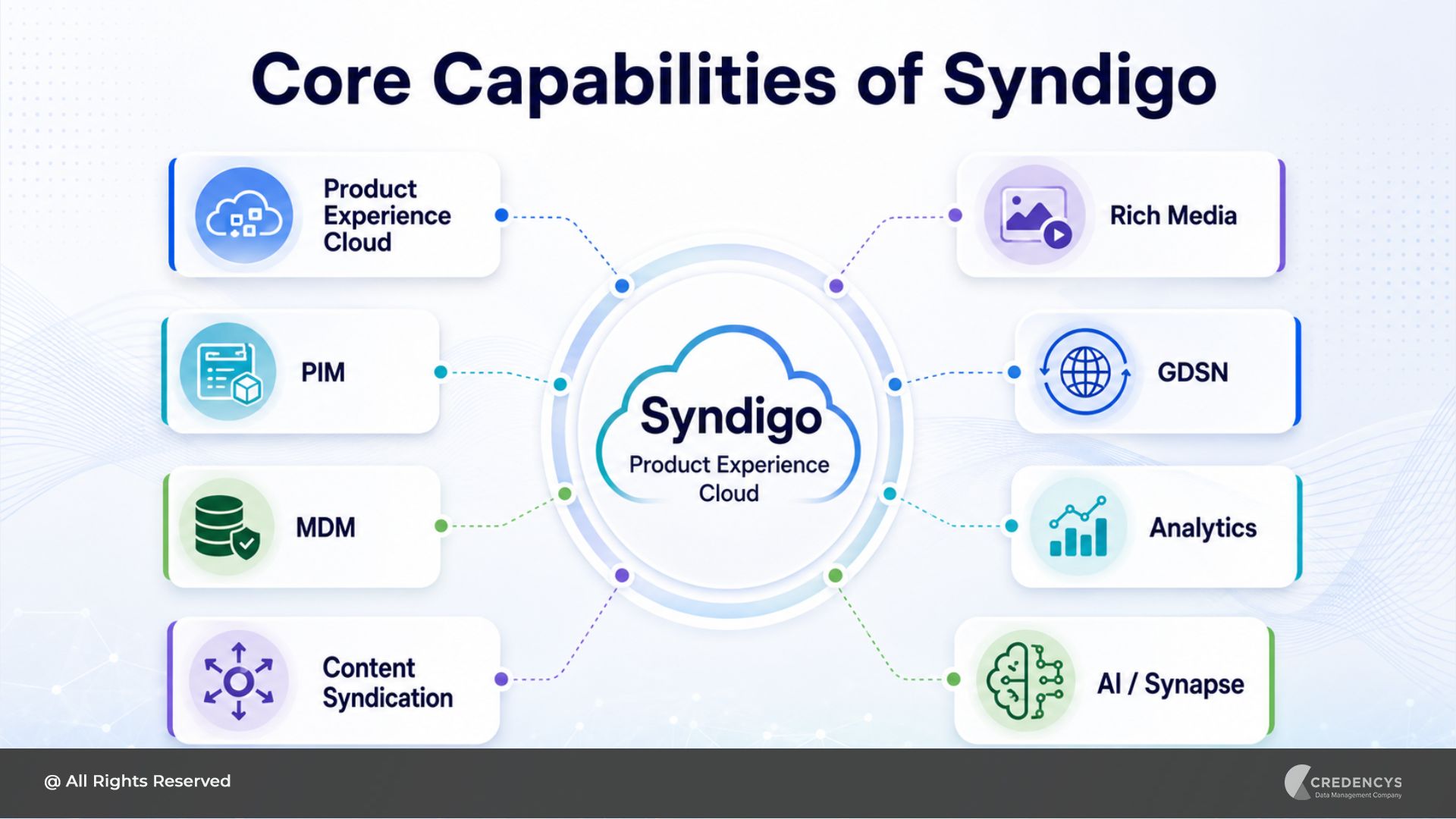
1. Syndigo Product Experience Cloud
Syndigo Product Experience Cloud is the broader platform layer that connects product data management, content syndication, rich media, analytics, and optimization. It helps brands and retailers manage product experiences from one connected platform.
Syndigo describes the Product Experience Cloud as a complete, composable product experience management solution built for retailers and brands. For brands, Syndigo helps optimize syndication, collaborate with channel partners, expand to more points of sale, and measure performance in real time.
For retailers, it centralizes brand and product data, ensures accuracy, supports standards, and optimizes product performance.
2. Syndigo Product Information Management
Syndigo PIM helps businesses manage product information from a central platform. It supports product data enrichment, content workflows, validation, syndication readiness, and omnichannel product content delivery.
Syndigo describes its PIM as an integrated solution that streamlines data management and helps businesses create accurate, syndication-ready content that accelerates time to market across channels. With Syndigo PIM, businesses can:
- Centralize product data in a single platform
- Improve product content completeness
- Manage product attributes, descriptions, specifications, and images
- Set up workflows for enrichment and approvals
- Validate product data before syndication
- Prepare product information for retailer and marketplace requirements
- Improve consistency across sales channels
For brands, Syndigo PIM manages content, compliance, and syndication in one place. For retailers, it supports vendor product data onboarding, assortment planning, collaborative workflows, pre-built retailer templates, and centralized content management.
3. Syndigo Master Data Management
Syndigo MDM helps businesses unify, govern, and synchronize master data across systems. This includes product, customer, supplier, vendor, location, and asset data.
Syndigo describes its multi-domain MDM as a solution that unifies, governs, and synchronizes dispersed and inconsistent data across systems to improve accuracy, compliance, and operations. With Syndigo MDM, businesses can:
- Create a single trusted view of master data
- Connect product, customer, supplier, vendor, location, and asset data
- Reduce duplicate and inconsistent data records
- Strengthen enterprise-wide data governance
- Improve compliance and risk management
- Support better reporting and decision-making
- Build a scalable foundation for product experience and AI use cases
This is especially valuable for enterprises where product data is connected to suppliers, locations, customers, logistics, merchandising, fulfillment, and commerce operations.
4. Syndigo Product Content Syndication
Syndigo Syndication helps businesses distribute product data and digital content to retailers, marketplaces, distributors, and trading partners. Syndigo positions its syndication solution around always-on, AI-ready content delivery across the digital shelf and emerging AI-shopping channels.
It helps brands deliver accurate and up-to-date product data across commerce destinations. Product content syndication is important because every retailer or marketplace may require product data in a different structure.
One channel may need specific images, another may require compliance fields, and another may need different product attributes, titles, or category mapping. Syndigo helps simplify this by supporting:
- Retailer and marketplace integrations
- Channel-specific product content delivery
- Automated content mapping
- Product data validation
- Data quality checks
- Compliance with recipient requirements
- Real-time product updates
- Enhanced content syndication
- GDSN publishing for relevant industries
This helps brands reduce manual effort, launch products faster, and deliver consistent product information across every channel.
5. Syndigo Rich Media and Enhanced Content
Today’s product experience goes beyond basic product titles and descriptions. Customers expect videos, lifestyle images, product comparison modules, 360-degree views, interactive content, and rich product storytelling.
Syndigo Enhanced Content lets businesses create, manage, and syndicate rich media, including videos, interactive modules, and 360-degree views, across product pages. With Syndigo rich media capabilities, brands and retailers can:
- Deliver more engaging product pages
- Showcase product features visually
- Improve shopper confidence
- Maintain consistent branded content
- Track rich media engagement
- Test and optimize content performance
- Reduce dependency on static product information
This is especially useful for CPG, grocery, retail, fashion, beauty, healthcare, home goods, and other product categories where visual experience influences purchase decisions.
6. Syndigo GDSN
GDSN, or Global Data Synchronization Network, matters for industries that require standardized product data exchange. This is especially relevant for grocery, CPG, foodservice, healthcare, and regulated product categories.
Syndigo GDSN helps businesses synchronize standardized product data with trading partners. It supports data accuracy, compliance, and structured exchange of product information across the product ecosystem.
For companies selling through retailers, distributors, and regulated commerce channels, GDSN capabilities help reduce manual data sharing and improve consistency across trading partners.
7. Syndigo Analytics and Digital Shelf Optimization
Managing product data is only the first step. Businesses also need to know how their product content performs after it goes live.
Syndigo analytics and digital shelf capabilities help businesses monitor product visibility, content quality, product page performance, and optimization opportunities. Brands can identify product content gaps, track what works, and make informed decisions to improve the product experience.
This is valuable for teams responsible for:
- eCommerce growth
- Digital shelf performance
- Product content optimization
- Retailer compliance
- Marketplace performance
- Conversion improvement
- Brand consistency
8. Syndigo Synapse and Agentic PXM
Syndigo has also introduced AI-led and agentic product experience capabilities through Synapse. Syndigo describes Synapse as an agentic PXM platform that orchestrates intelligent agents across product data and automates complex workflows while keeping humans in control when needed.
Synapse is designed to support the evolution of Product Experience Management as commerce becomes more AI-driven. It helps agents operate across product, supplier, location, compliance, and performance data.
Syndigo says Synapse powers agentic PXM in Product Experience Cloud, enabling intelligent agents to work across trusted product data with consistency and control. Some of the agentic capabilities include:
- Product creation support
- Product enrichment automation
- Supplier and product onboarding assistance
- Syndication validation and publishing
- Workflow coordination
- Human oversight and approvals
- Auditability and governance
For enterprises, this signals a shift from manual product data operations to more intelligent, automated, and governed product experience workflows.
Syndigo for Brands vs. Syndigo for Retailers
Syndigo supports both brands and retailers, but their use cases differ.
| Syndigo for Brands | Syndigo for Retailers |
|---|---|
| Centralize product content | Onboard vendor product data |
| Enrich product descriptions, attributes, and media | Validate supplier and vendor content |
| Syndicate product content to retailers and marketplaces | Improve product data quality |
| Manage retailer-specific content requirements | Support merchandising and assortment workflows |
| Track digital shelf performance | Manage product, vendor, and location data |
| Improve product visibility and consistency | Deliver better online and in-store product experiences |
| Reduce manual syndication work | Improve supplier collaboration |
| Optimize content for conversion | Maintain accurate and governed product information |
For brands, Syndigo helps deliver accurate product content to every sales channel. For retailers, Syndigo helps manage incoming product data from suppliers and vendors while ensuring consistency, accuracy, and speed.
Which Industries Use Syndigo?
Syndigo serves industries where product data quality, content syndication, and product experience management are critical. Syndigo lists industries such as manufacturing, retail, CPG, foodservice, restaurants and operators, industrial manufacturing, healthcare, and automotive aftermarket in its current solution ecosystem.
Common industries include:
- Retail
- Consumer Packaged Goods
- Grocery
- Foodservice
- Healthcare
- Automotive aftermarket
- Manufacturing
- Industrial manufacturing
- Distribution
- Restaurants and operators
Businesses in these industries often manage complex product catalogs, multiple suppliers, regulatory requirements, channel-specific data needs, and high expectations for product content accuracy.
Key Benefits of Implementing Syndigo
Implementing Syndigo can help businesses improve product data operations, commerce performance, and customer experience.
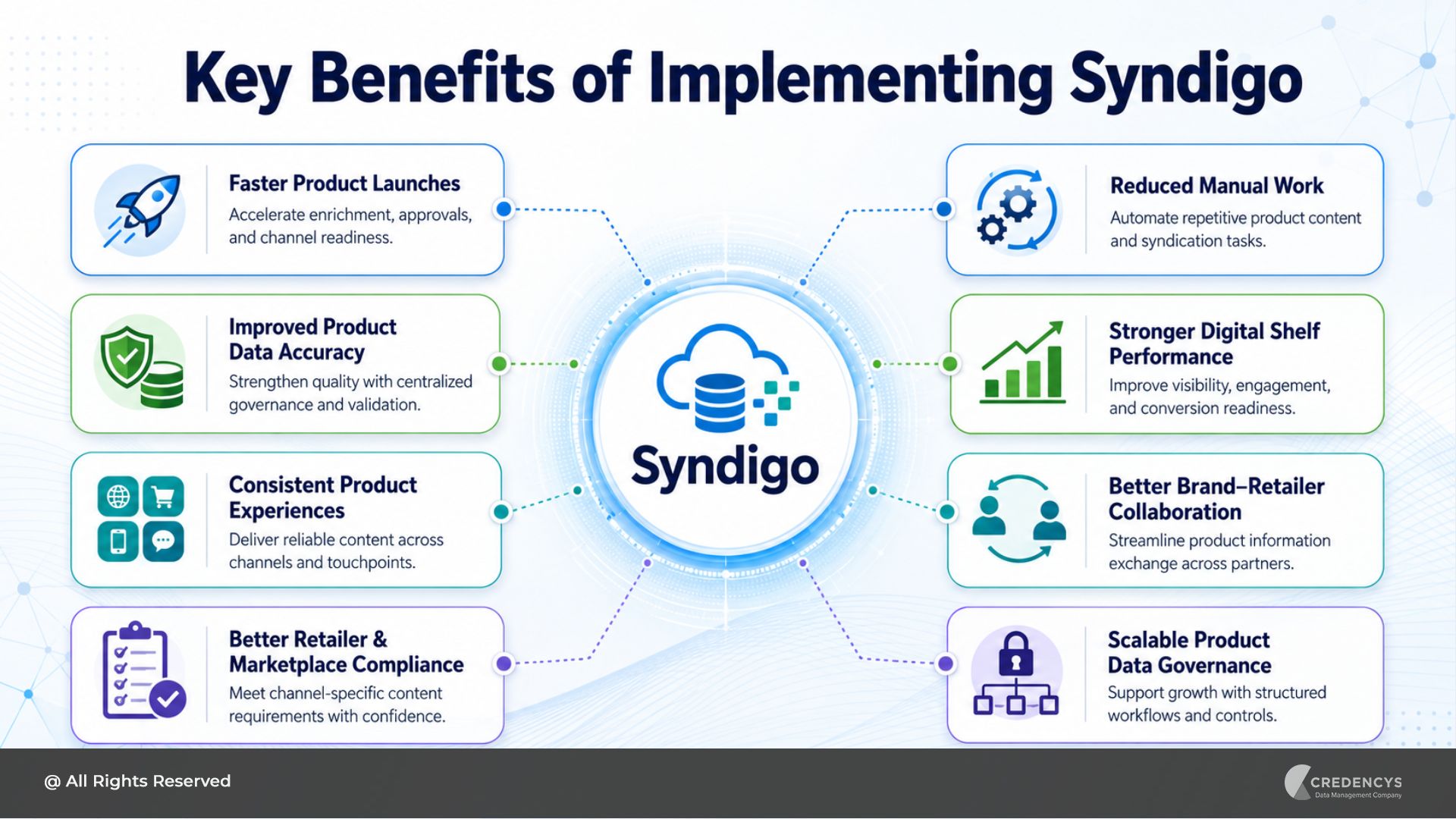
1. Faster Product Launches
Syndigo helps reduce manual work across product enrichment, approval, and syndication workflows. This allows teams to launch new products faster across retailers, marketplaces, and digital channels.
2. Improved Product Data Accuracy
With centralized product data, validation rules, governance, and quality checks, businesses can reduce errors and inconsistencies across product records.
3. Consistent Product Experiences Across Channels
Syndigo helps ensure product titles, descriptions, images, attributes, compliance details, and digital assets remain consistent across digital and physical commerce channels.
4. Better Retailer and Marketplace Compliance
Retailers and marketplaces have unique product content requirements. Syndigo helps businesses prepare, validate, and syndicate content based on recipient-specific standards.
5. Reduced Manual Work
Instead of managing product content in spreadsheets or manually updating multiple systems, teams can use automated workflows, templates, validations, and syndication processes.
6. Stronger Digital Shelf Performance
Syndigo helps businesses monitor product content performance and identify opportunities to improve product visibility, engagement, and readiness for conversion.
7. Better Collaboration Between Brands and Retailers
Syndigo creates a connected ecosystem where brands, retailers, vendors, and suppliers can exchange product information more efficiently.
8. Scalable Product Data Governance
As product catalogs grow, manual product data governance becomes difficult. Syndigo helps businesses scale governance through workflows, validation rules, centralized data models, and controlled access.
When Should a Business Consider Syndigo?
Consider Syndigo when product data becomes difficult to manage, distribute, or optimize across multiple systems and channels. Syndigo may be a good fit if your business is facing challenges such as:
- Product data stored across multiple disconnected systems
- Slow product onboarding
- Inconsistent product information across channels
- Manual syndication to retailers and marketplaces
- Duplicate or inaccurate product records
- Difficulty meeting retailer-specific content requirements
- Poor visibility into digital shelf performance
- Lack of standardized product data governance
- Growing product catalogs across regions, brands, or categories
- Need for PIM, MDM, DAM, syndication, and analytics in one ecosystem
For enterprises with complex product data operations, Syndigo can help build a more scalable, governed foundation for the product experience.
Syndigo Implementation: What Does the Process Look Like?
See also our Syndigo implementation services.
A successful Syndigo implementation is not just about platform setup. It requires the right data strategy, governance model, integration approach, and adoption plan.
A typical Syndigo implementation includes the following steps:
1. Business and Data Assessment
The first step is to understand the current product data landscape. This includes identifying source systems, data gaps, product categories, workflows, syndication needs, and business goals.
2. Data Model and Taxonomy Design
Next, define the product data model, attributes, categories, relationships, naming conventions, and taxonomy structure. A strong data model ensures product data can scale across brands, categories, regions, and channels.
3. Product Data Cleansing
Before migration, product data must be cleansed, standardized, deduplicated, and validated. This improves data quality and reduces downstream errors.
4. Platform Configuration
Syndigo is configured based on the company’s workflows, product data structure, business rules, roles, approval processes, and governance needs.
5. Integration With Enterprise Systems
Syndigo may need to integrate with ERP, DAM, PLM, CRM, eCommerce platforms, marketplaces, supplier portals, data warehouses, or internal applications. Integration ensures product data flows smoothly across the enterprise.
6. Syndication Channel Setup
Retailer, marketplace, distributor, and trading partner requirements are mapped within Syndigo. This helps ensure product content is delivered in the right format to each destination.
7. Workflow and Governance Setup
Syndigo configures product enrichment, approvals, content validation, data stewardship, and publishing workflows to support business operations.
8. User Training and Adoption
Teams need to understand how to manage product data, enrich content, approve workflows, use dashboards, and publish product content effectively.
9. Post-Launch Optimization
After launch, businesses should continuously monitor data quality, syndication performance, user adoption, and digital shelf outcomes.
How much does Syndigo cost?
Syndigo does not publish prices. It sells a SaaS subscription quoted per customer. The price usually depends on:
- the modules you need (PIM, MDM, syndication, GDSN, analytics);
- the number of products;
- the recipients and channels you syndicate to;
- your support level and contract terms.
Implementation, ERP and DAM integrations, and data migration come first. For a first estimate of the total, use our PIM cost calculator.
To compare Syndigo’s quote with other platforms on the same scope, use our free PIM RFP template and read Syndigo vs Salsify and Salsify pricing.
Why Work With a Syndigo Implementation Partner?
Syndigo is a powerful platform, but implementation success depends on how well it aligns with business processes, data models, integrations, workflows, and channel requirements. A Syndigo implementation partner helps businesses:
- Define the right product data strategy
- Design scalable product data models
- Cleanse and migrate product data
- Configure PIM, MDM, syndication, and workflows
- Integrate Syndigo with ERP, DAM, eCommerce, and marketplace systems
- Set up governance and validation rules
- Map retailer and channel requirements
- Improve adoption across business teams
- Reduce implementation risks
- Accelerate time to value
For businesses with complex product catalogs, multiple systems, and omnichannel distribution needs, working with a Syndigo partner can make implementation more structured, efficient, and scalable.
How Credencys helps with Syndigo
Credencys helps enterprises implement and optimize Syndigo for Product Information Management, Master Data Management, product content syndication, digital asset workflows, and omnichannel product experience delivery. As a Syndigo implementation partner, Credencys supports businesses from strategy and data modeling to integration, migration, governance, and long-term optimization.
Credencys was also named Syndigo Americas Emerging Partner of the Year 2023 for rapidly building and scaling a Syndigo practice, training and certifying resources, delivering thought leadership, and creating industry solutions that drove customer success. Our Syndigo implementation services help businesses:
- Build a scalable product data foundation
- Improve product data quality
- Streamline product enrichment workflows
- Connect Syndigo with enterprise systems
- Set up content syndication to retailers and marketplaces
- Improve product experience governance
- Reduce manual product data operations
- Support faster product launches across channels
Whether you are planning a new Syndigo implementation, migrating from another PIM or MDM platform, or optimizing an existing Syndigo setup, Credencys can help you build a future-ready product experience ecosystem. We are a Syndigo partner and also a Pimcore partner, so we can tell you honestly when Syndigo fits and when another platform fits better.
We help with requirements and the data model, retailer and GDSN setup, ERP and DAM integrations, data migration, and post-go-live support. See Syndigo implementation and our Syndigo partnership.
Real-World Impact of Centralized Product Data Management
What happens when a global health and nutrition brand replaces manual product data processes with a centralized PIM ecosystem? Credencys helped the company standardize product information, integrate its ERP and enterprise systems, automate item setup and approval workflows, and strengthen product data governance across web, mobile, marketplaces, wholesale, and offline channels.
The result:
- 37% reduction in time-to-market
- 38% improvement in product data accuracy
- 48% increase in operational efficiency
- More consistent product availability across online and offline channels
This demonstrates how a connected product data foundation, supported by capabilities such as PIM, data quality, workflow automation, integration, and governance, can accelerate product launches and reduce manual effort.
Explore the complete case study
For Syndigo, we helped a fashion retailer centralize product information, add rich media, and automate content updates across its website, app, and marketplaces, improving product data accuracy by 70%.
Ready to Build Better Product Experiences with Syndigo?
Syndigo helps businesses move from fragmented product data and manual syndication to a connected, governed, and optimized product experience ecosystem. With the right implementation approach, businesses can centralize product data, improve data quality, enrich product content, syndicate faster, and deliver consistent product experiences across every commerce channel.
If you are planning to implement Syndigo or want to improve your existing Syndigo ecosystem, Credencys can help you design, deploy, integrate, and optimize the platform for your business needs. Connect with our Syndigo consultants to build a scalable product data foundation and accelerate product experience transformation.
FAQs About Syndigo
1. What is Syndigo used for?
Syndigo manages, enriches, governs, syndicates, and optimizes product data and digital content across retailers, marketplaces, distributors, eCommerce platforms, and commerce channels.
2. Is Syndigo a PIM platform?
Yes. Syndigo includes Product Information Management capabilities, but it also extends beyond PIM. It supports Master Data Management, content syndication, rich media, GDSN, digital shelf analytics, AI-driven workflows, and Product Experience Management.
3. What is Syndigo Product Experience Cloud?
Syndigo Product Experience Cloud is a Product Experience Management platform that helps brands and retailers centralize product data, manage product content, syndicate information across channels, and optimize product experiences.
4. What is Syndigo PIM?
Syndigo PIM is a Product Information Management solution that helps businesses centralize, enrich, validate, and prepare product information for syndication across retailers, marketplaces, and digital channels.
5. What is Syndigo MDM?
Syndigo MDM is a Master Data Management solution that helps businesses unify, govern, and synchronize trusted product, customer, supplier, vendor, asset, and location data across enterprise systems.
6. What is Syndigo content syndication?
Syndigo content syndication is the process of distributing accurate, enriched, and channel-ready product content to retailers, marketplaces, distributors, and trading partners in the required format.
7. Who uses Syndigo?
Syndigo is used by brands, retailers, manufacturers, distributors, CPG companies, grocery businesses, healthcare companies, foodservice providers, restaurants, industrial manufacturers, and automotive aftermarket businesses.
8. How does Syndigo help retailers?
Syndigo helps retailers onboard vendor product data, validate supplier content, improve product data quality, manage product and vendor information, support merchandising workflows, and deliver better product experiences across online and offline channels.
9. How does Syndigo help brands?
Syndigo helps brands centralize product content, enrich product information, manage digital assets, syndicate product data to retailers and marketplaces, track digital shelf performance, and improve product visibility across channels.
10. Why do businesses need a Syndigo implementation partner?
A Syndigo implementation partner helps businesses define the right data model, migrate product data, integrate systems, configure workflows, set up syndication channels, improve governance, and accelerate user adoption.
11. How much does Syndigo cost?
Syndigo does not publish prices. It quotes a SaaS subscription based on modules, products, syndication recipients and support level. Implementation and integrations are extra. Use a PIM cost calculator for a first estimate and compare quotes on the same requirements.
12. What are the alternatives to Syndigo?
Common alternatives include Salsify (retailer content), Pimcore (an open platform for PIM, MDM, and DAM), Akeneo, and inRiver. Compare them in our PIM platform comparison matrix.




Tags: