

The Scale and Complexity of Distributor Product Data
Distributors manage product information from multiple manufacturers and suppliers, often across thousands or millions of SKUs. Each source may use different naming conventions, attribute structures, file formats, product identifiers, and classification standards.
As assortments expand across B2B commerce, customer portals, marketplaces, catalogs, and sales channels, maintaining accurate and complete product information becomes increasingly difficult without a governed product-data foundation.
Fragmented Supplier Product Data
Product information arrives through spreadsheets, supplier portals, ERP systems, PDFs, APIs, and manufacturer feeds. Different formats and structures make it difficult to create one consistent and reliable product record.
Inconsistent Product Attributes and Taxonomies
Suppliers often describe similar products using different terminology, units, categories, and attribute values. Without standardization, product search, filtering, comparison, and catalog maintenance become inconsistent across the organization.
Complex Product Relationships and Part Numbers
Distributor catalogs may include manufacturer part numbers, internal SKUs, replacement products, substitutes, accessories, kits, compatible items, and superseded products. Managing these relationships manually increases the risk of incorrect or disconnected product information.
Customer and Channel-Specific Product Requirements
B2B customers, marketplaces, digital storefronts, sales teams, and trading partners may require different product attributes, documents, classifications, descriptions, and catalog structures. Maintaining separate versions of product data for every destination creates duplicated work and inconsistencies.
Continuous Catalog Changes
New supplier products, discontinued items, specification updates, product replacements, new digital assets, and changing channel requirements create a constant stream of product-data updates. Without centralized governance and workflows, these changes can take too long to reach every system and customer touchpoint.

How Much is Your Product Data Costing You?
Get Your Score + 90-day action plan in 3 minutes.
Check Your ScoreThe Strategic Role of PIM in Distribution
PIM gives distributors a governed product-data foundation for collecting, standardizing, enriching, and distributing information across suppliers, internal systems, customer portals, B2B commerce, marketplaces, catalogs, and sales channels. Instead of maintaining multiple versions of the same product data, distributors can manage one trusted record and adapt it for different customers, markets, and channels.
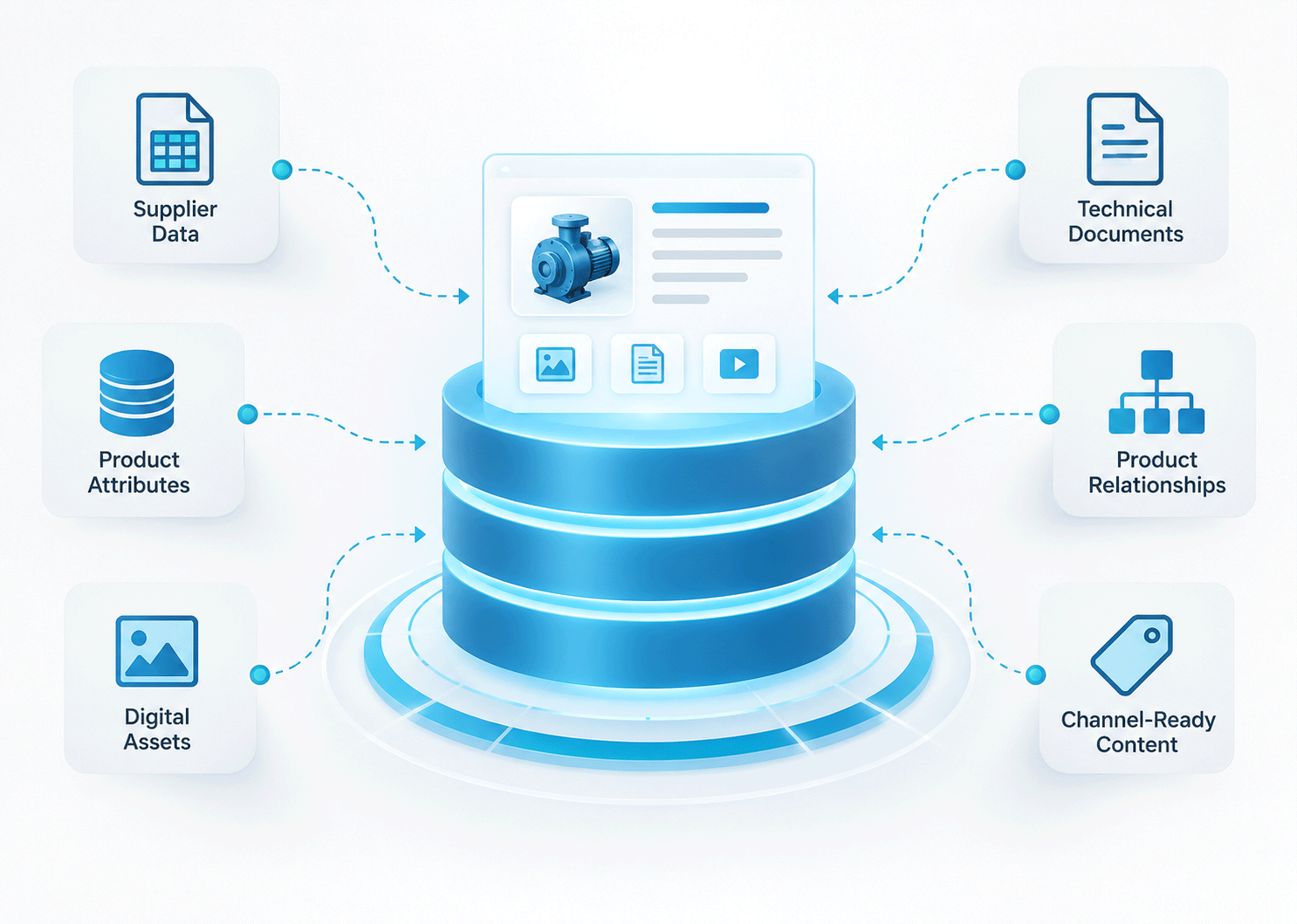
The Single Source of Truth
Connect manufacturers, suppliers, ERP systems, legacy databases, commerce platforms, and other enterprise applications through PIM Integration Services to establish one governed product-data foundation.
- Consolidate fragmented supplier and manufacturer data
- Reduce duplicate and conflicting product records
- Maintain consistent attributes, descriptions, identifiers, and documents
- Give teams access to trusted product information
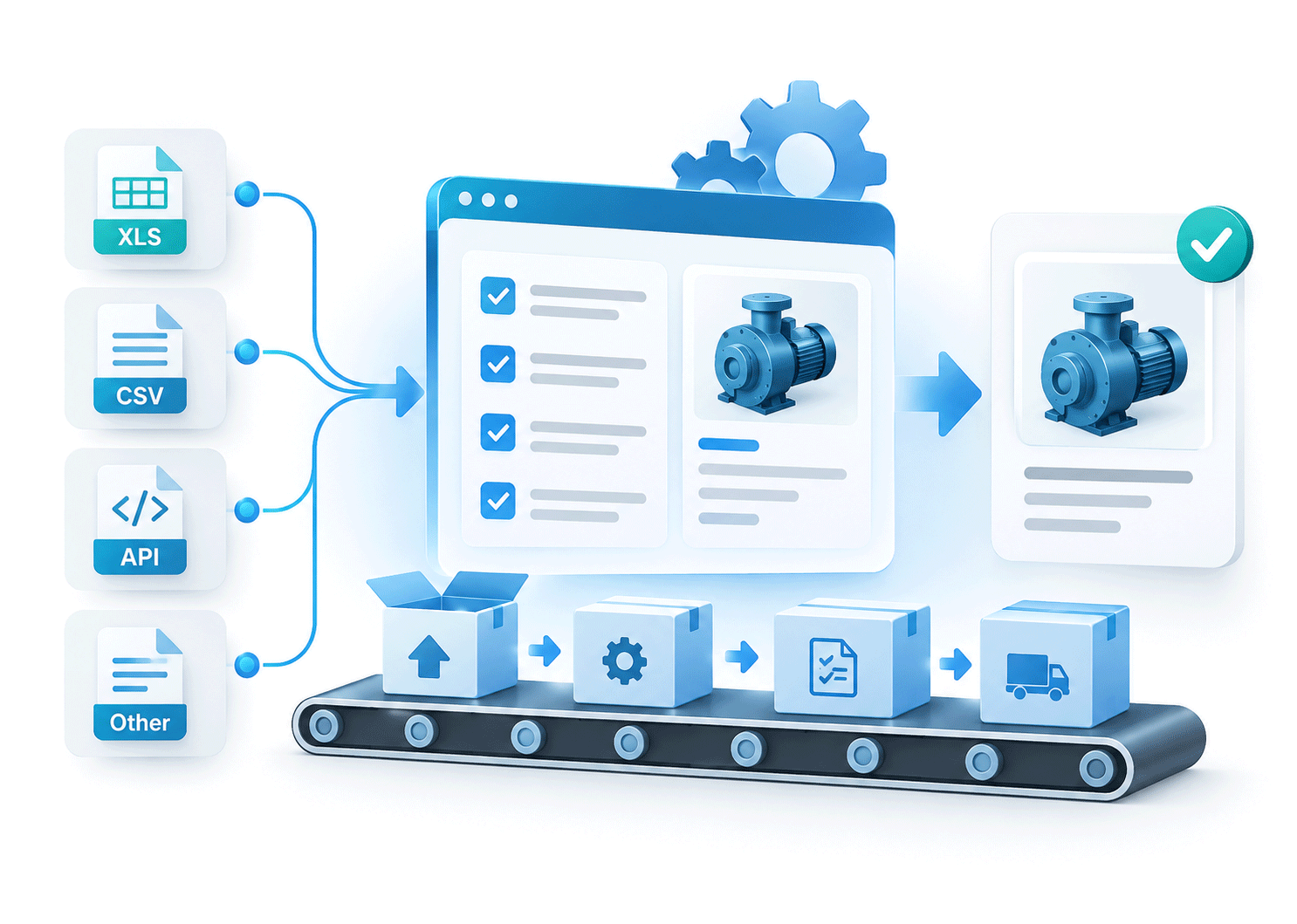
Faster Supplier Product Data Onboarding
Standardize incoming supplier data before it enters your catalog. PIM helps distributors map different source structures into a common product model so new products can be reviewed, enriched, and published faster.
- Import supplier files, feeds, APIs, and spreadsheets
- Map supplier attributes to standardized internal structures
- Identify missing or incomplete product information
- Route products through validation and approval workflows
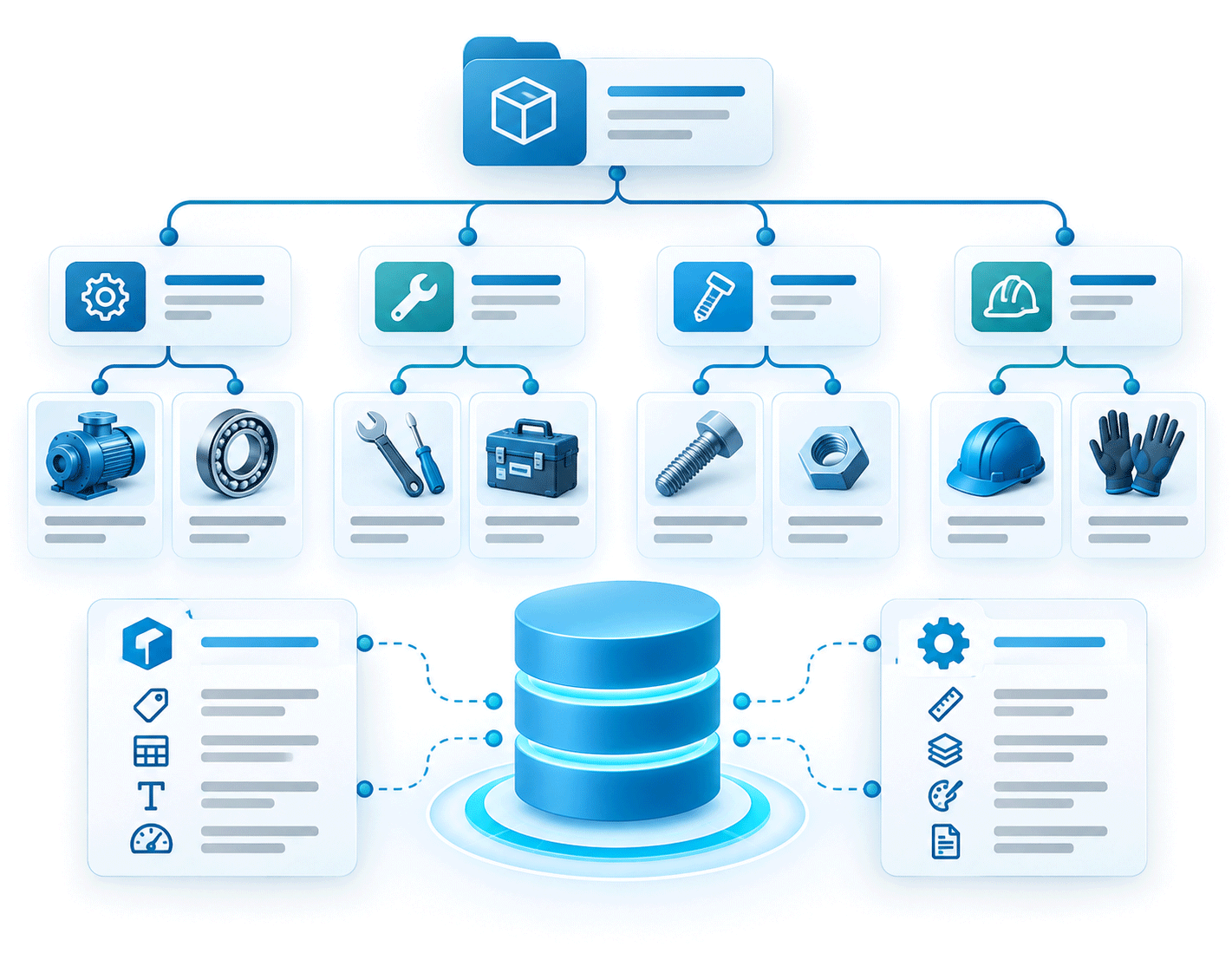
Standardized Product Taxonomy and Attributes
Create consistent categories, attributes, units, terminology, and controlled values across products from multiple manufacturers. Standardized data improves catalog quality and makes products easier to search, filter, compare, and maintain.
- Normalize product categories and attribute structures
- Standardize units of measure and controlled values
- Improve faceted navigation and B2B product discovery
- Reduce manual catalog cleanup
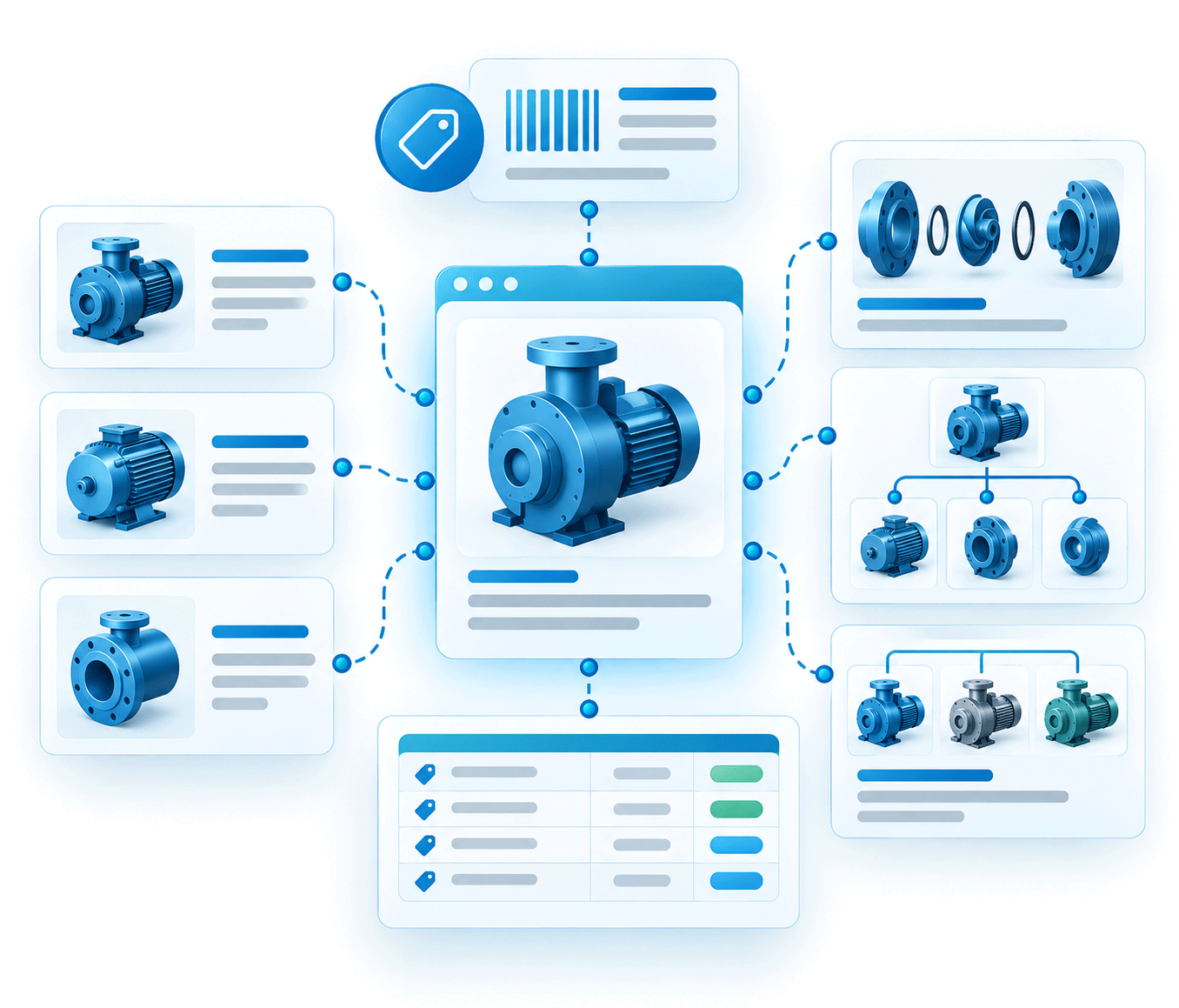
Product Relationships, Part Numbers, and Catalog Complexity
Distributors often manage more than individual SKUs. PIM can govern the relationships between manufacturer part numbers, distributor SKUs, accessories, alternatives, replacements, kits, compatible products, and superseded items.
- Maintain manufacturer and internal product identifiers
- Connect related and compatible products
- Manage approved replacements and supersessions
- Support cross-selling and product discovery
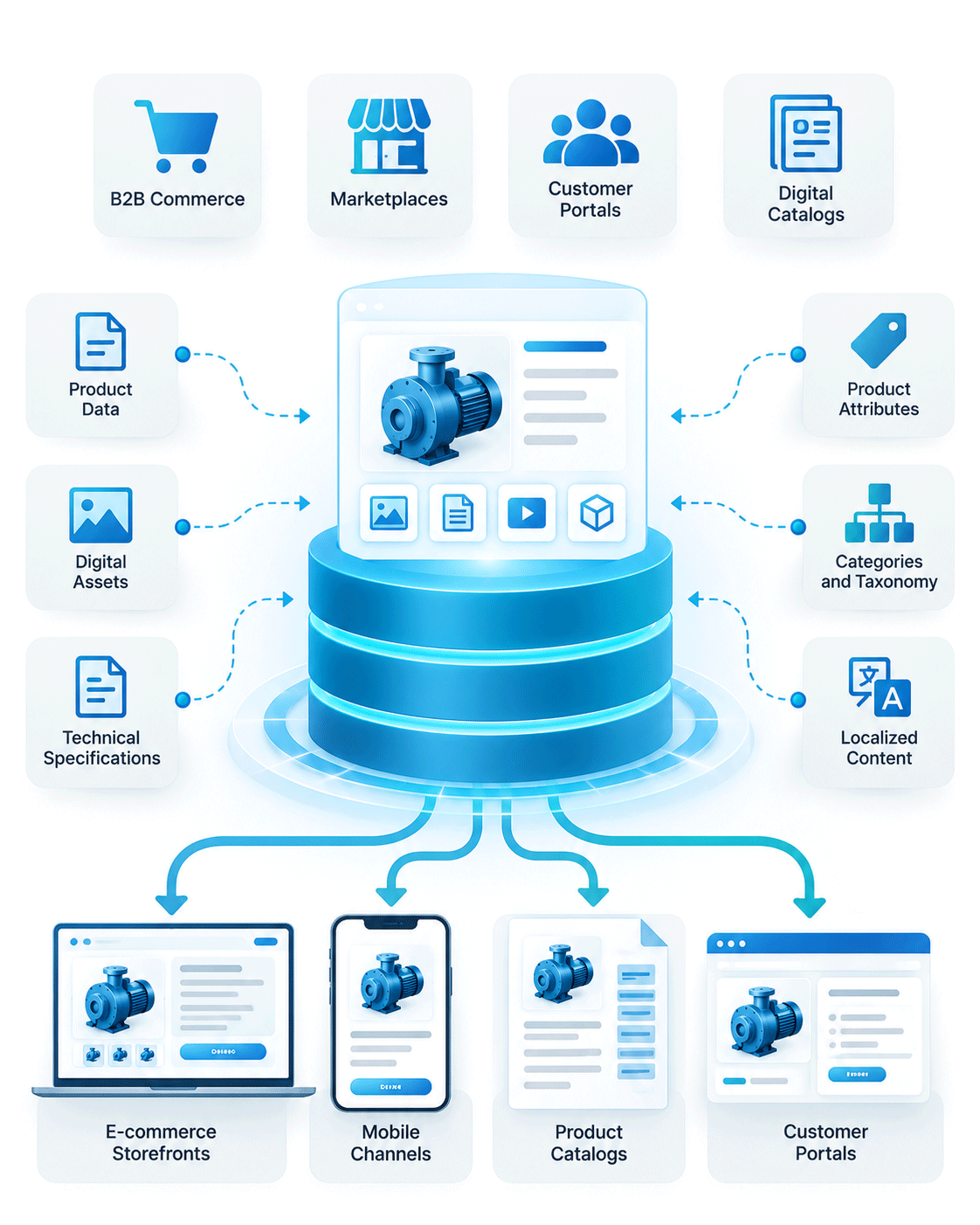
Customer and Channel-Ready Product Information
Transform governed product data into the structures required by different downstream destinations without rebuilding the catalog for every channel.
- Support complex distributor and buyer requirements with PIM for B2B, including B2B commerce catalogs, customer portals, and customer-specific product experiences.
- Use Product Data Syndication to distribute validated attributes, specifications, identifiers, classifications, and other structured product data across downstream channels.
- Extend this with Product Content Syndication to deliver channel-ready descriptions, digital assets, enriched content, and merchandising information.
- Maintain customer- or channel-specific content where required.
- Create structured product information for search, recommendations, and AI-powered commerce
Our Approach to PIM Implementation Services
Through our PIM Implementation Services, we help distributors build a scalable product-data foundation around complex supplier data, large catalogs, enterprise systems, B2B commerce, and downstream channel requirements. Our implementation approach focuses on product-data quality, governance, integration, and adoption from the beginning.
Our PIM Consulting Services help assess product-data maturity, define business and technical requirements, establish governance priorities, and create a practical implementation roadmap. We define the target product-data model, governance framework, integration architecture, and migration scope, with PIM Migration Services available for organizations moving from legacy PIM systems, spreadsheets, databases, or fragmented product repositories.
This can include:
- Product families and category structures
- Attribute groups and controlled values
- Manufacturer and distributor identifiers
- Product relationships and supersessions
- Supplier onboarding workflows
- Customer- and channel-specific data requirements
- User roles and approval workflows
We establish governance processes that help maintain product-data quality as suppliers, assortments, and channels continue to grow.
- Standardize supplier and manufacturer data
- Define completeness and validation rules
- Establish product-data ownership
- Connect digital assets and documents
- Configure review and approval workflows
- Improve catalog consistency and accuracy
Use our PIM Integration Services to connect PIM with ERP, DAM, B2B commerce, customer portals, marketplaces, CMS platforms, and other enterprise applications. We support testing, deployment, user training, adoption, and ongoing optimization so teams can manage product information confidently after launch.
Business Impact of PIM for Distributors
PIM helps distributors reduce product-data complexity, improve catalog quality, and scale digital commerce without adding the same level of manual effort. By centralizing and governing product information, distribution teams can onboard suppliers faster, publish products sooner, and give customers more accurate and complete product experiences.

PIM Integration with the Distribution Technology Stack
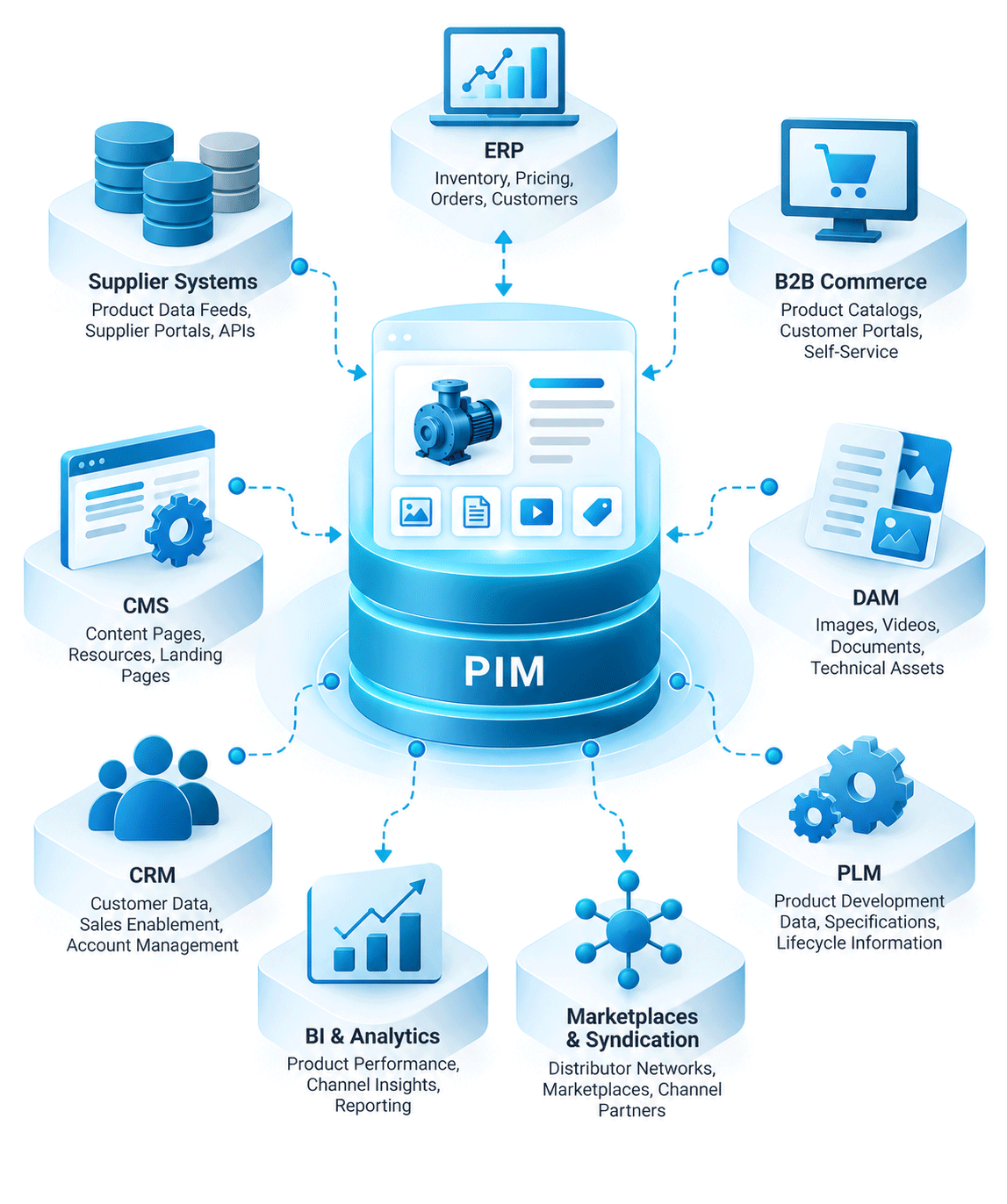
PIM becomes most valuable when it connects product information across the systems distributors already use. Rather than replacing ERP, DAM, commerce, or operational platforms, PIM acts as the governed product-data layer that enriches and distributes trusted product information across the enterprise.
Supplier and Manufacturer Data Sources
Bring product information into PIM from supplier spreadsheets, manufacturer feeds, APIs, portals, databases, and other source systems. PIM standardizes this information before it is used downstream.
ERP Systems
ERP typically remains the system of record for purchasing, inventory, pricing, customer transactions, and operational data. PIM complements ERP by managing richer product attributes, descriptions, relationships, classifications, documents, and channel-ready content.
Digital Asset Management
Integrate PIM with DAM to connect product records with images, videos, technical documents, certificates, installation guides, drawings, and other digital assets. This helps ensure the correct assets are associated with the right products and variants.
B2B Commerce and Customer Portals
Publish complete and enriched product information to B2B commerce platforms, customer portals, digital catalogs, and self-service buying experiences. Structured product data improves search, filtering, comparison, and product discovery.
Marketplaces and Product Syndication
Distribute channel-ready product information to marketplaces, retailer networks, trading partners, and other downstream destinations. PIM helps validate product data before it is syndicated and reduces repeated manual reformatting.
CMS, Sales, and Customer-Facing Systems
Make trusted product information available to websites, CMS platforms, CRM environments, sales tools, configurators, and customer-service applications. This gives commercial teams access to consistent product information across customer touchpoints.
Analytics, Search, and AI Applications
Structured and governed product data can also support enterprise search, recommendations, semantic discovery, analytics, and AI-powered product experiences. PIM provides the product-data foundation while specialized applications continue to manage search, analytics, personalization, and AI execution.
Real Business Impact: PIM Success Stories in Distribution
Global Industrial Solutions Leader
70%
Reduction in Manual Workload
Credencys centralized product information for 14,000 SKUs across four brands and automated bulk product-data operations. By integrating PIM with the client’s enterprise ecosystem through Dell Boomi, the solution reduced manual item setup while improving product-data accuracy and operational efficiency.
Read MoreIndustrial Equipment and Spare Parts Provider
50%
Faster Time-to-Market
Credencys implemented a connected PIM, DAM, and digital commerce ecosystem to centralize spare parts information, streamline catalog updates, and give sales teams access to complete and accurate product data. The solution reduced product-data fragmentation and helped the business make updated product information available to customers and internal teams faster.
Read MoreLeading U.S. Wholesale Distributor of Landscape Supplies
40%
Increase in Backend Processing Speed
Credencys modernized the distributor’s Pimcore platform, optimized custom components, and improved performance across its large product catalog. The upgraded product-data infrastructure created a faster and more scalable foundation for managing catalog growth, digital operations, and future commerce requirements.
Read MoreReady to Modernize Your Distribution Product Data?
Credencys helps distributors centralize product information, streamline supplier onboarding, integrate PIM with enterprise systems, and deliver accurate product data across customers, channels, and markets.
Book a Free ConsultationWhy Leading Enterprises Choose Credencys?
Credencys combines product-data expertise, enterprise integration capabilities, industry understanding, and AI-ready architecture to help distributors build scalable PIM ecosystems around complex catalogs and digital commerce requirements.

End-to-End Data Expertise
From product-data modeling and supplier onboarding to migration, enrichment, governance, integrations, and syndication, we support the complete PIM lifecycle.

Domain-Focused Solutions
We design PIM solutions around the realities of distribution, including multi-supplier catalogs, technical attributes, part numbers, product relationships, B2B commerce, customer-specific requirements, and downstream channels.

Enterprise-Grade Partnerships
Our technology partnerships and implementation expertise help enterprises build secure, scalable, and connected product-information ecosystems that integrate with their broader digital landscape.

AI-First
We help structure and govern product information so it can support semantic search, recommendations, conversational product discovery, automated enrichment, and other AI-enabled commerce experiences.
50+
Enterprise Clients
100%
Certified Consultants
15+
Years Experience
4.9/5
Client Satisfaction
We Build PIM Solutions for


Frequently Asked Questions
PIM for distributors is a centralized system for collecting, standardizing, enriching, governing, and distributing product information from multiple suppliers and manufacturers. It helps distributors manage large catalogs, technical attributes, product relationships, digital assets, customer-specific requirements, and downstream channel content from one governed product-data foundation.
Distributors often manage product information from many suppliers in different formats and structures. PIM helps standardize that information, reduce catalog errors, improve product completeness, accelerate supplier onboarding, and publish consistent product data across B2B commerce, marketplaces, customer portals, sales systems, and digital channels.
PIM can import supplier spreadsheets, feeds, APIs, and other data sources, map them to a standardized product model, identify missing information, and route records through validation and approval workflows. his reduces manual reformatting and makes it easier to onboard new supplier products at scale.
Yes. PIM can maintain manufacturer part numbers, internal distributor SKUs, product identifiers, aliases, and related references within a governed product record.
This helps teams connect supplier data with the identifiers used across ERP, commerce, sales, and customer-facing systems.
Yes. PIM can maintain approved relationships between original products, replacements, superseded items, compatible products, accessories, alternatives, and related products. These relationships can then be used by commerce, search, sales, and customer-service applications.
Trusted by Best
Choosing Credencys means partnering with a team that’s deeply committed to unlocking the true value of your data. Here’s why industry leaders trust us:
Our Valued Clientele


Send us a Message
