Why Product Data Optimization is Important for Online Marketplaces

As online marketplaces continue to flourish, the need for sellers to strategically manage and present their product information becomes paramount. The essence of optimization lies in presenting the products in the most favorable light, ensuring they stand out amidst the digital clutter.

Optimized product data acts as the foundation for a successful online presence, influencing various aspects of a seller’s performance. It goes beyond mere data entry and transforms into a strategic tool that can drive visibility, enhance customer trust, and ultimately boost sales.

Impact of Optimized Product Data

1. Visibility

Well-organized product data significantly improves the discoverability of the offerings. When the products are structured and categorized effectively, they are more likely to appear in relevant search results.

This heightened visibility is the first step in capturing the attention of potential customers browsing through the expansive digital marketplace.

2. Conversions

The journey from product discovery to conversion is paved with persuasive product information. By optimizing your data, you not only provide potential buyers with the details they seek but also create a seamless and trustworthy shopping experience.

This, in turn, increases the likelihood of converting interested visitors into satisfied customers.

3. Customer Satisfaction

Beyond the point of sale, well-organized product data continues to play a crucial role in customer satisfaction. Accurate and detailed information reduces the risk of post-purchase dissatisfaction, ensuring that customers receive what they expect.

This positive post-purchase experience contributes to brand loyalty and encourages repeat business.

Steps to Optimize Product Data for Online Marketplaces

1. Providing Comprehensive & Accurate Product Information

Providing accurate and comprehensive product information is a cornerstone of success in online shopping. Tailoring product data to meet the unique needs of buyers involves a meticulous approach, ensuring that technical specifications, dimensions, materials, and other pertinent details are not just listed but strategically presented to facilitate the intricate decision-making process.

Some things to consider while providing product information are:

  • Technical Specifications
  • Dimensions & Measurements
  • Material Specifications
  • Relevant Details for Decision-Making
  • User Guides & Documentation

2. Standardizing Data Format

The adoption of a standardized data format emerges as a foundational strategy for selling online. Standardizing product data format not only streamlines internal processes but also facilitates seamless comparisons across listings, simplifying the decision-making process for business buyers.

This step includes:

  • Consistency across listings
  • Standardized naming conventions
  • Uniform attributes & specifications

3. Including Rich Media Content

The incorporation of rich media content stands as a powerful tool for fostering comprehension and informed decision-making in online purchases where decisions are often intricate and significant. High-quality images, technical drawings, and videos play a pivotal role in showcasing how multimedia elements transcend conventional product presentations, elevating offerings and assisting buyers in making discerning choices.

Rich media content includes:

  • High-quality images
  • Technical drawings
  • Informative videos
  • 360-degree views
  • Immersive experiences

4. Providing Transparent Pricing Information

In the intricate landscape of online purchasing, where decisions often hinge on careful financial considerations, the pillars of pricing transparency and negotiation options play a pivotal role. Providing clear and transparent pricing information while concurrently offering avenues for negotiation, especially for bulk purchases, fosters an environment of trust and collaboration with discerning buyers.

This step includes providing:

  • Tiered pricing model
  • Negotiation options
  • Custom quote requests
  • Clearly defined payment terms
  • Contractual agreements

5. Ensuring Real-Time Visibility of Inventory Levels

Maintaining real-time visibility of inventory stands as a strategic imperative in online transactions where timing and accuracy are paramount. It emphasizes the need for systems that not only ensure accuracy but also streamline the tracking and management of extensive and diverse inventories.

Visibility of inventory levels can be taken care of by:

  • Real-time inventory monitoring
  • Automated replenishment systems
  • Product variations and attributes
  • Multi-Warehouse Management
  • RFID & Barcoding Technology

6. Creating a Well-Organized Digital Catalog

The organization and accessibility of product information stand as pivotal factors influencing purchasing decisions in online buying where time is a precious resource. Digital catalog management emphasizes the creation of a meticulously organized catalog equipped with intuitive navigation, filters, and search functionalities to streamline the complex B2B procurement process.

This includes:

  • Well-structured digital catalog
  • Intuitive navigation
  • Filters for precision
  • Mobile responsiveness
  • Integration with procurement systems

What is a Data Catalog? Definition, Benefits, Features, & More

7. Offering Quoting Functionalities

In the intricate realm of eCommerce, where every procurement decision is nuanced, the provision of customized quoting and ordering functionalities emerges as a strategic imperative. This accommodates custom orders while simultaneously simplifying the ordering experience for businesses with recurring needs, fostering precision and efficiency in every transaction.

This includes:

  • Streamlined quote request process
  • Simplified ordering for recurring needs
  • Automated approval workflows
  • Seamless integration with ERP systems

Importance of Optimizing Product Data for Marketplaces

1. Algorithmic Recommendations

Marketplaces often employ recommendation algorithms to showcase products to users based on their preferences and behaviors. Optimized product data provides the necessary information for algorithms to make accurate suggestions, increasing the likelihood of cross-selling and upselling opportunities.

2. Informed Purchasing Decisions

Detailed and well-organized product information enables customers to make informed purchasing decisions. When potential buyers find comprehensive details, high-quality images, and rich media content, they gain a deeper understanding of the product, leading to increased confidence in their decision-making process.

3. Adherence to Policies

Each online marketplace has specific guidelines and policies regarding product data. Optimizing product data ensures compliance with these guidelines, preventing potential issues such as product delisting or account suspension.

Staying within the framework of marketplace rules not only maintains a positive seller reputation but also contributes to long-term success on the platform.

4. Data for Targeted Advertising

Optimized product data forms the basis for effective and targeted advertising campaigns within online marketplaces. Advertising tools often leverage product attributes and specifications to display ads to users who are most likely to be interested in a particular product.

Well-optimized listings maximize the effectiveness of advertising investments.

Importance of Optimizing Product Data

Closing Thoughts

As we’ve navigated through the strategic steps of refining, structuring, and continually enhancing product information, it becomes evident that the art of optimization is a dynamic and ongoing process. From the meticulous structuring of information to the strategic incorporation of rich media content, each element in the product data plays a pivotal role in elevating your listings above the digital noise.

Product Data Optimization not only safeguards your presence on these platforms but also cultivates trust among users, establishing your brand as a reliable and professional player in the marketplace arena.

Voice Commerce and PIM: Reshaping Your Retail Business

The retail industry has been changing with each passing day due to the introduction of modern technologies. Integration of advanced technologies not only simplifies the buying journey for customers but also empowers the brands too.

One of the in-demand technologies in retail is Voice Commerce!

Voice commerce is considered the future of online shopping where customers’ voice commands shape the retail experience. It allows buyers to order their favorite products or explore new ones effortlessly, all through a simple conversation with their device.

When voice commerce combines with Product Information Management (PIM), it transforms the traditional ways of shopping. The intersection of PIM and Voice Commerce is a game-changer, simplifying the way we shop and creating a personalized.

Ready to explore how voice commerce in PIM transforms the retail domain?

Let’s dive in!

What is Voice Commerce?

Voice commerce, also known as V-commerce, is a type of e-commerce that allows customers to make purchases using voice commands. This could be through a voice assistant such as Amazon’s Alexa, Google Home, or a chatbot.

BIGCOMMERCE

Voice Commerce @ a Glance

Voice commerce has marked a transformative shift in the retail domain when it comes to how consumers interact with online platforms.

Voice-activated shopping, once a futuristic concept, has become a tangible reality, influencing consumer behavior and reshaping the way retail businesses engage with their customers.

Rise of Voice-Activated Shopping

The rise of voice-activated shopping is a testament to the growing integration of voice technology into our daily lives. Consumers are now leveraging voice commands to search for products, place orders, and navigate through the retail landscape effortlessly.

This shift is fueled by the convenience and hands-free nature of voice interactions, allowing users to multitask and access information seamlessly.

Popular Voice-Activated Devices

Voice-activated shopping is facilitated by a range of popular devices that have become household staples.

Smart speakers like Amazon Echo and Google Home, as well as virtual assistants like Siri and Google Assistant on smartphones, have become the conduits through which users engage in voice-driven e-commerce.

These devices act as gateways to a more intuitive and personalized shopping experience, connecting users directly with their preferred online retailers.

Impact on Consumer Behavior

The adoption of voice commerce has not only changed the way consumers shop but has also influenced their overall behavior in the digital marketplace.

The ease of voice commands expedites the decision-making process, providing consumers with quick and convenient access to product information. This shift has the potential to increase impulse purchases, as users can effortlessly act on their preferences without the need for manual browsing.

Impact of Voice Commerce on Retail

The emergence of voice commerce is reshaping the way retail businesses connect with consumers, providing a seamless and innovative shopping experience. Here are key insights into the impactful transformation that voice commerce is bringing to the retail sector:

Impact of Voice Commerce on Retail

1. Enhanced Customer Convenience

Voice commerce eliminates barriers in the customer journey by allowing users to interact with retail platforms using natural language. Shoppers can effortlessly search for products, place orders, and inquire about services, enhancing overall convenience and accessibility.

2. Personalized and Intuitive Experiences

With voice commerce, retailers can deliver highly personalized and intuitive experiences. Virtual assistants powered by voice technology can understand user preferences, offer tailored recommendations, and provide a level of engagement that resonates with individual shoppers.

3. Accelerated Purchasing Decisions

The hands-free nature of voice commerce expedites the purchasing process. Shoppers can quickly and effortlessly make decisions, reducing the time between product discovery and checkout. This acceleration contributes to increased sales and customer satisfaction.

4. Seamless Multichannel Integration

Voice commerce seamlessly integrates across various retail channels, including online platforms, mobile apps, and physical stores. This omnichannel approach ensures a consistent and cohesive brand experience, fostering customer loyalty and brand trust.

5. Accessibility for All Audiences

Voice commerce democratizes the retail experience, making it more accessible to diverse audiences, including those with varying levels of technological proficiency. This inclusivity opens new markets and strengthens a brand’s reach.

6. Data-Driven Insights and Analytics

Retailers leveraging voice commerce gain valuable data insights into customer behavior, preferences, and trends. This data-driven approach enables retailers to refine their strategies, personalize offerings, and gain a competitive edge.

As voice commerce continues to gain prominence, its transformative impact on retail is undeniable. Retailers embracing this technology are not only meeting the evolving expectations of consumers but also positioning themselves at the forefront of innovation in the dynamic world of retail.

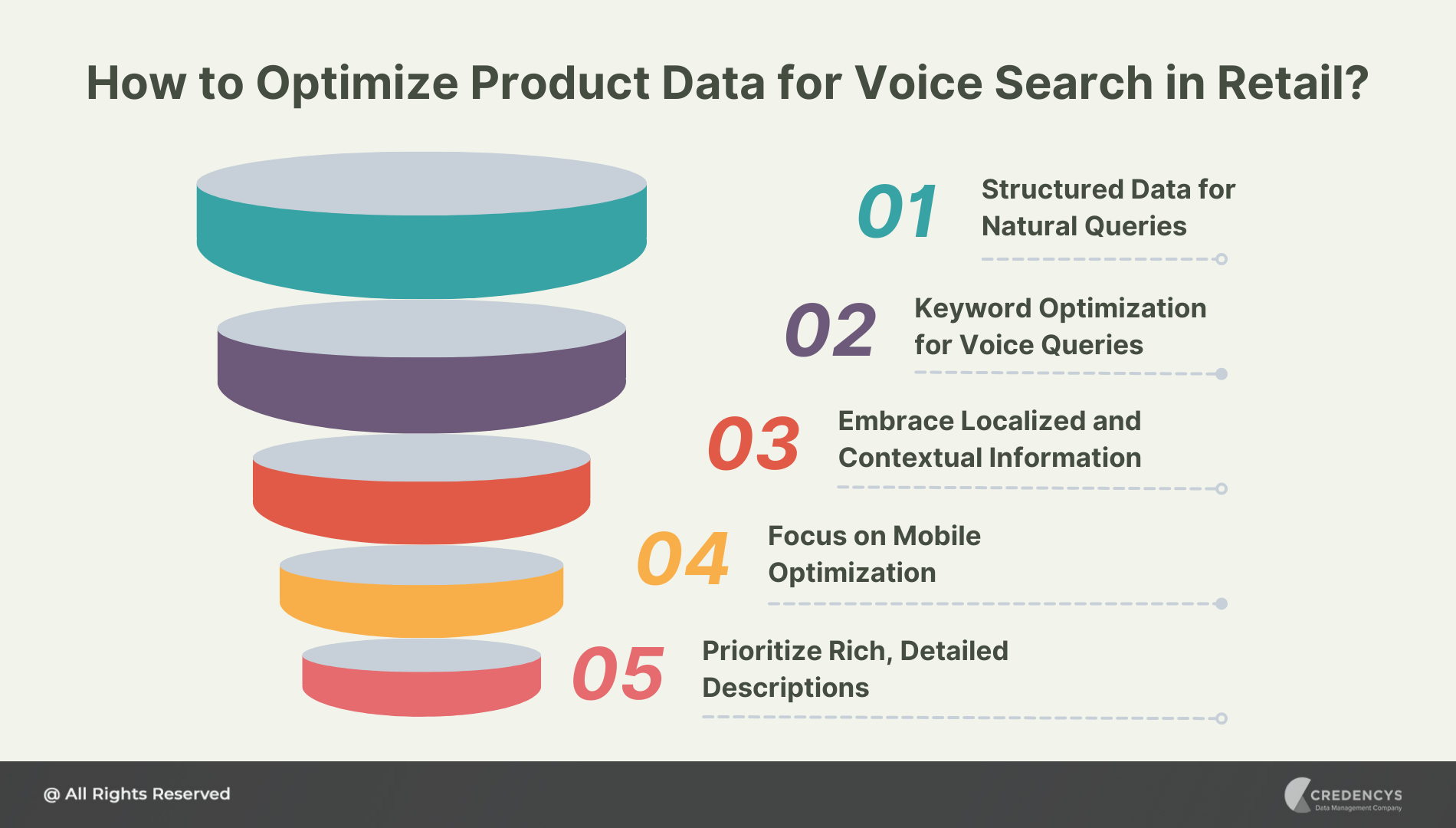
How to Optimize Product Data for Voice Search in Retail?

It is paramount for retailers to embrace the power of voice search to stay competitive. To thrive in this era of convenience, optimizing product data for voice search becomes a game-changer.

Voice commerce technology allows customers to ask for product details effortlessly, and retailers to deliver accurate and relevant information seamlessly. Here’s how you can achieve this:

How to Optimize Product Data for Voice Search in Retail

1. Structured Data for Natural Queries

Tailor your product data to match natural language queries. Think about how customers verbally express their needs and structure your product data accordingly. This ensures that your products align seamlessly with the conversational tone of voice searches.

2. Keyword Optimization for Voice Queries

Understand the nuances of voice queries and incorporate conversational keywords into your product data. Anticipate how users verbally inquire about products and infuse those phrases into your product descriptions, titles, and metadata.

3. Embrace Localized and Contextual Information

Leverage the location-based nature of many voice searches. Ensure that your product data includes relevant local information, making it easier for customers to find products available in their area.

4. Focus on Mobile Optimization

voice search mobile use statistics

Recognize that a significant portion of voice searches happen on mobile devices. Optimize your product data for mobile platforms, ensuring that voice search users receive a seamless and responsive experience.

5. Prioritize Rich, Detailed Descriptions

Enhance your product data with rich, detailed descriptions. This not only caters to voice search algorithms but also provides customers with comprehensive information, increasing the likelihood of conversion.

By optimizing your product data for voice search, your retail business can create a more accessible and user-friendly shopping experience. Experience the transformation of your retail business by harnessing the potential of voice search technology.

How Does the PIM System Help Retailers Optimize Product Data for Voice-Activated Search?

The evolution of PIM solutions has become instrumental in reshaping how retail businesses manage and optimize product data. Here’s a glimpse into how PIM systems are evolving to cater to the nuances of voice-activated search:

How Does the PIM System Help Retailers Optimize Product Data for Voice-Activated Search

1. Natural Language Processing (NLP) Integration

PIM systems are incorporating advanced Natural Language Processing capabilities, enabling them to comprehend and respond to the intricacies of voice-activated queries. This integration ensures that product data is structured to align seamlessly with the way users naturally express their search intents.

2. Enhanced Metadata and Tagging

Recognizing the importance of rich metadata and tagging for voice search, modern PIM systems are placing a heightened emphasis on optimizing product information. This involves enriching data with descriptive tags and metadata that resonate with the conversational nature of voice queries, enhancing the accuracy of search results.

3. Contextual Understanding

To deliver more relevant responses, PIM systems are evolving to understand the contextual aspects of voice searches. This includes factoring in location, user history, and real-time data to provide personalized and context-aware product recommendations, creating a more immersive and tailored shopping experience.

4. Mobile-Centric Optimization

Given the prevalence of voice searches on mobile devices, PIM systems are adapting to prioritize mobile-centric optimization. This involves structuring product data to align with the mobile user experience, ensuring that voice-activated searches deliver seamless and user-friendly results on smartphones and other mobile platforms.

5. Cross-Channel Consistency

PIM systems are emphasizing cross-channel consistency to provide a unified voice commerce experience. Whether users engage through voice-activated devices, websites, or mobile apps, the goal is to ensure a consistent and accurate representation of product data, reinforcing brand trust across diverse touchpoints.

6. Continuous Machine Learning Integration

To stay ahead of evolving user behaviors, PIM systems are integrating continuous machine learning capabilities. This allows the system to adapt and improve its understanding of voice search patterns over time, refining its responses based on user interactions and feedback.

As businesses navigate the transformative landscape of voice-activated search, the evolution of PIM systems stands as a crucial element in optimizing product data. This evolution not only meets the demands of the present but positions businesses to thrive in an increasingly voice-centric future of e-commerce.

In the Nutshell

The fusion of Voice Commerce and PIM is revolutionizing retail. Seamlessly enhancing customer experiences, optimizing data for voice search, and fostering brand loyalty, this dynamic duo is reshaping the retail landscape. Embrace this transformative synergy to stay ahead in the ever-evolving world of commerce.

How Cloud-Based PIM Reshapes Data Management in Retail & CPG?

In the fast-paced world of retail and Consumer Packaged Goods (CPG), managing product information efficiently has become a critical aspect of success. PIM efficiently manages and distributes product information across various channels in a consistent and accurate manner.

This includes product details, specifications, pricing, and other relevant information that is crucial for marketing, sales, and customer satisfaction. In the context of retail and CPG, where product portfolios are diverse and constantly evolving, PIM plays a pivotal role in ensuring that accurate and up-to-date information is available across all touchpoints from eCommerce platforms and mobile apps to physical stores.

Evolving Landscape of Data Management in Retail & CPG

Traditionally, retail and CPG companies relied on on-premises solutions for managing their product information. However, with the exponential growth in data volume, the increasing complexity of products, and the demand for real-time updates, the limitations of these traditional approaches became evident.

Managing vast amounts of data manually or through legacy systems often leads to inefficiencies, errors, and delays. The evolving landscape of data management in the retail and CPG sectors is marked by a paradigm shift towards more agile, scalable, and collaborative solutions.

The need for a centralized repository that can handle the dynamic nature of product information has become paramount. As the challenges of traditional data management became apparent, a new era emerged with the rise of cloud computing.

Cloud-based solutions offer a dynamic and scalable alternative to on-premises systems. In recent years, there has been a significant paradigm shift towards leveraging cloud-based solutions for PIM in the retail and CPG sectors.

Understanding Cloud-Based PIM Solutions

Cloud-Based PIM refers to a modern approach to product information management that leverages cloud computing infrastructure. In contrast to traditional on-premises solutions, cloud-based PIM systems are hosted on remote servers, providing accessibility and flexibility to users.

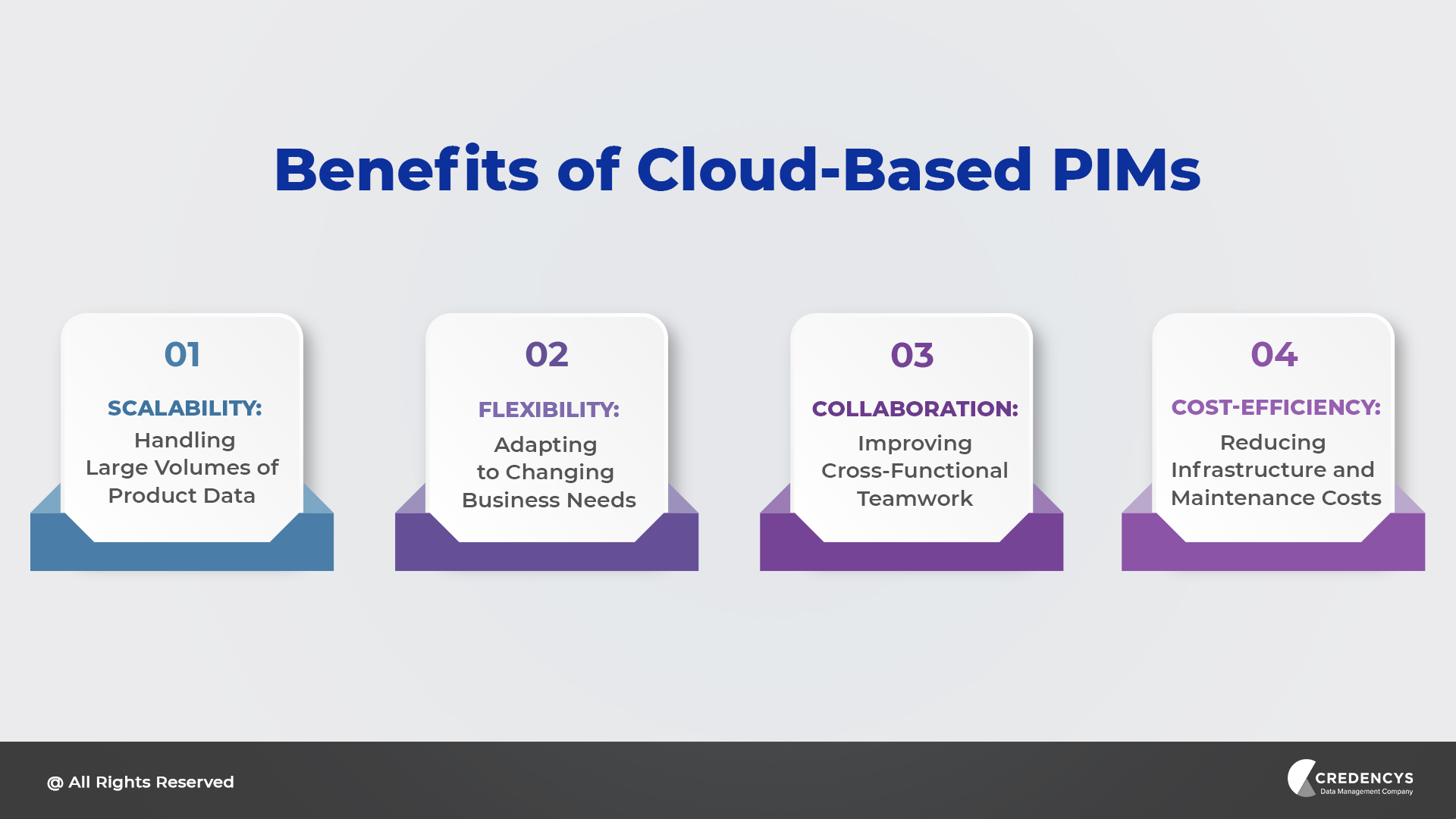
Benefits of Cloud-Based PIMs

The benefits of adopting Cloud-Based PIM include:

1. Scalability: Handling Large Volumes of Product Data

One of the defining features of cloud-based PIM solutions is their scalability. As retail and CPG companies experience growth and diversification in their product offerings, the ability to handle large volumes of product data becomes paramount.

Cloud-based PIM solutions provide a dynamic infrastructure that can effortlessly scale resources to accommodate expanding product catalogs, ensuring optimal performance and responsiveness. This scalability is particularly crucial during peak periods such as product launches or seasonal promotions when there is a surge in data activity.

The elasticity of cloud resources allows businesses to seamlessly adapt to fluctuations in demand, preventing performance bottlenecks and ensuring a smooth user experience.

2. Flexibility: Adapting to Changing Business Needs

In the fast-paced retail and CPG landscapes, adapting to changing business needs is essential for staying competitive. Cloud-based PIM solutions offer a level of flexibility that traditional on-premises systems struggle to match.

The flexibility of cloud architecture allows for rapid deployment of updates, modifications, and integrations, enabling businesses to respond promptly to market trends, regulatory changes, or shifts in consumer preferences. This adaptability is particularly advantageous for companies experiencing dynamic growth or undergoing digital transformation.

Whether it involves adding new product attributes, integrating with eCommerce platforms, or incorporating emerging technologies, cloud-based PIM solutions provide the agility required to keep pace with the evolving demands of the industry.

3. Collaboration: Improving Cross-Functional Teamwork

Effective collaboration is a cornerstone of successful data management, especially in organizations where product information is handled by cross-functional teams. Cloud-based PIM solutions facilitate collaboration by providing a centralized platform accessible to various stakeholders, including product managers, marketers, sales teams, and external partners.

Through real-time collaboration features, cloud-based PIM solutions enable teams to work concurrently on product data, reducing silos and streamlining workflows. This collaborative environment enhances communication, minimizes errors, and ensures that all stakeholders have access to the most up-to-date and accurate product information.

4. Cost-Efficiency: Reducing Infrastructure and Maintenance Costs

Traditional on-premises PIM solutions often entail significant upfront investments in hardware, software licenses, and ongoing maintenance costs. Cloud-based PIM solutions, on the other hand, follow a subscription-based model, eliminating the need for businesses to manage and maintain complex infrastructure.

The cost-efficiency of cloud-based PIM extends beyond infrastructure savings. With automatic updates, businesses benefit from the latest features and security patches without the need for manual interventions.

Additionally, the pay-as-you-go model allows companies to scale resources according to their needs, optimizing costs and ensuring that they only pay for the services they use.

Benefits of Cloud-Based PIMs

Key Features of Cloud-Based PIM Solutions

Cloud-based PIM solutions bring a host of features and functionalities that cater to the dynamic needs of the retail and CPG industries. In this section, we will delve into the essential features that make cloud-based PIM a powerful tool for scalable and efficient data management.

1. Centralized Data Repository

Centralization is at the core of effective PIM and cloud-based solutions excel in providing a centralized data repository. This centralized hub serves as the single source of truth for all product information, ensuring consistency and accuracy across various channels.

With cloud-based PIM, businesses can consolidate product data from diverse sources and manage it seamlessly in one centralized location. The advantages of a centralized data repository include improved data quality, reduced redundancy, and simplified data maintenance.

This feature is especially crucial in scenarios where multiple teams, departments, or even external partners need access to the same set of up-to-date product information.

2. Integration with Other Cloud Services and Applications

The interconnected nature of modern business operations emphasizes the importance of seamless integration between different tools and services. Cloud-based PIM solutions offer robust integration capabilities, allowing businesses to connect their PIM system with other cloud services, applications, and third-party tools.

Integration with eCommerce platforms, customer relationship management (CRM) systems, marketing automation tools, and analytics platforms ensures a smooth flow of information across the entire business ecosystem. This interoperability not only enhances overall efficiency but also provides a holistic view of data, empowering businesses to make informed decisions based on comprehensive insights.

3. Security Measures for Data Protection

Security is a top priority in data management, particularly when dealing with sensitive product information. Cloud-based PIM solutions prioritize data protection through robust security measures. Key security features include:

  • Data Encryption: All data, both in transit and at rest, is encrypted to safeguard against unauthorized access.
  • Access Controls: Role-based access controls ensure that only authorized personnel have access to specific information, reducing the risk of data breaches.
  • Regular Audits and Monitoring: Continuous monitoring and periodic security audits help identify and address potential vulnerabilities proactively.
  • Compliance Standards: Cloud-based PIM solutions often adhere to industry-specific compliance standards, providing assurance to businesses that their data management practices meet regulatory requirements.

By implementing these security measures, cloud-based PIM solutions not only protect sensitive information but also instill confidence in businesses, customers, and partners regarding the safety and integrity of their data.

4. Customization and Scalability Options

Every business has unique data management needs, and cloud-based PIM solutions acknowledge this by offering customization options. Businesses can tailor the PIM system to align with their specific requirements, including data fields, workflows, and user interfaces.

Scalability is a fundamental feature that ensures the PIM solution can grow alongside the business. Whether a company experiences an increase in product offerings, data volume, or user base, a scalable cloud-based PIM solution can adapt to these changes without compromising performance.

The flexibility to customize and scale the PIM solution empowers businesses to build a data management infrastructure that aligns precisely with their evolving needs and objectives.

On-Premises Vs Cloud PIM – Finding Your Best Fit

Implementation Strategies for Cloud-Based PIM

Adopting a cloud-based PIM solution is a significant step towards scalable and efficient data management for retail and CPG companies. This section explores key implementation strategies to ensure a seamless transition and successful utilization of cloud-based PIM.

1. Assessing Current Data Management Processes

Before embarking on the implementation of a cloud-based PIM solution, it is crucial for businesses to conduct a thorough assessment of their current data management processes. This involves:

  • Identifying Pain Points: Understand the challenges and inefficiencies in existing data management practices. This may include issues related to data accuracy, collaboration bottlenecks, or scalability limitations.
  • Mapping Workflows: Document current workflows for managing product information. Identify the touchpoints, teams involved, and the technologies currently in use.
  • Data Audit: Conduct a comprehensive audit of existing product data. Identify inconsistencies, inaccuracies, and areas that require improvement.
  • User Feedback: Gather feedback from end-users involved in data management. Understand their pain points and expectations from a new PIM solution.

The insights gained from this assessment serve as a foundation for tailoring the implementation strategy to address specific challenges and requirements unique to the business.

2. Choosing the Right Cloud-Based PIM Solution

Selecting the appropriate cloud-based PIM solution is a critical decision that directly influences the success of the implementation. Consider the following factors when choosing a PIM solution:

  • Scalability: Ensure that the chosen solution can scale seamlessly with the growth of your product catalog and data volume.
  • Integration Capabilities: Look for a PIM solution that offers robust integration capabilities with other essential business applications, such as eCommerce platforms, CRM systems, and marketing tools.
  • Customization Options: Assess the level of customization the PIM solution allows, ensuring it can be tailored to meet specific business needs and workflows.
  • Security Features: Prioritize solutions with strong security measures, including data encryption, access controls, and compliance with industry standards.
  • User-Friendly Interface: A user-friendly interface promotes user adoption and reduces the learning curve for staff members.

Selecting a PIM solution that aligns with the business’s current and future needs is essential for long-term success.

3. Migration Considerations and Best Practices

The migration process from legacy systems to a cloud-based PIM solution requires careful planning and execution. Consider the following best practices:

  • Data Cleansing: Cleanse and organize existing data before migration to ensure that the new PIM system starts with accurate and reliable information.
  • Phased Implementation: Consider a phased approach to implementation, focusing on specific product categories or business units first before scaling up.
  • Data Mapping: Clearly map data fields from the existing system to the new PIM solution, ensuring a smooth transition and data consistency.
  • Backup and Rollback Plan: Implement a robust backup and rollback plan to mitigate risks and ensure that critical data is not lost during the migration process.

By following these best practices, businesses can minimize disruptions and streamline the migration process, ensuring a successful transition to the new cloud-based PIM solution.

4. Staff Training and Change Management

The successful implementation of a cloud-based PIM solution requires a focus on staff training and change management. Key considerations include:

  • Training Programs: Develop comprehensive training programs to familiarize staff with the new PIM system. This may include hands-on sessions, documentation, and online resources.
  • Change Champions: Identify individuals within the organization who can serve as change champions for the new system who can support and guide their colleagues.
  • Communication Strategy: Communicate the benefits of the new PIM solution to all stakeholders. Clearly articulate how it will improve their workflows, collaboration, and overall efficiency.
  • Feedback Mechanisms: Establish feedback mechanisms to gather insights from end-users during the initial stages of implementation. Use this feedback to address concerns and optimize user experience.

A focus on staff training and change management ensures that the transition to a cloud-based PIM solution is embraced by the entire organization, leading to more effective and sustainable data management practices.

Strategies for Implementing Cloud-Based PIM

Overcoming Concerns and Challenges

The adoption of cloud-based PIM solutions in the retail and CPG industries is not without its challenges. Let’s explore and address key concerns, providing insights on how businesses can effectively overcome these hurdles to ensure a smooth transition and successful utilization of cloud-based PIM.

1. Security and Data Privacy Considerations

One of the foremost concerns when migrating to the cloud is the security and privacy of sensitive product information. To address this:

  • Encryption Protocols: Ensure that the cloud-based PIM solution implements robust encryption protocols for data both in transit and at rest.
  • Compliance Standards: Choose a PIM solution that complies with industry-specific data protection regulations and standards, providing assurance that your data is handled securely.
  • Access Controls: Implement strict access controls to limit who can access, modify, or view specific pieces of product information within the system.
  • Regular Audits: Conduct regular security audits to identify and address potential vulnerabilities proactively.

By prioritizing security measures, businesses can build confidence in the safety and integrity of their product data, addressing concerns related to unauthorized access and data breaches.

2. Connectivity and Potential Downtime

Concerns about connectivity and potential downtime during the migration or operation of a cloud-based PIM solution can hinder adoption. To mitigate these concerns:

  • Diligent Planning: Conduct thorough planning to minimize disruptions during migration, including scheduled downtimes during low-impact periods.
  • Redundancy Measures: Implement redundancy measures to ensure continuous availability, such as failover systems and load balancing.
  • Performance Testing: Conduct performance testing before and after implementation to identify and address potential bottlenecks and ensure optimal system performance.
  • Communication Strategy: Clearly communicate scheduled downtimes and system changes to stakeholders to manage expectations and minimize the impact on operations.

By implementing these strategies, businesses can proactively address concerns related to connectivity and potential downtime, ensuring a seamless transition to a cloud-based PIM solution.

3. Integration with Existing IT Infrastructure

Integrating a cloud-based PIM solution with existing IT infrastructure is a critical consideration for businesses. To address integration challenges:

  • API Capabilities: Choose a PIM solution with robust Application Programming Interface (API) capabilities to facilitate seamless integration with other systems.
  • Data Mapping: Conduct thorough data mapping exercises to ensure that data fields align correctly between the new PIM solution and existing systems.
  • Middleware Solutions: Explore the use of middleware solutions that act as connectors between different systems, simplifying the integration process.
  • Interdepartmental Collaboration: Foster collaboration between IT departments and other business units to ensure a cohesive approach to integration.

Addressing integration challenges requires a strategic approach that combines technological solutions with effective communication and collaboration among different stakeholders.

4. Cultural Shift Within the Organization

Implementing a cloud-based PIM solution often necessitates a cultural shift within the organization. To overcome resistance and foster a positive transformation:

  • Change Management Programs: Develop comprehensive change management programs that educate and prepare employees for the upcoming changes.
  • Engage Leadership: Ensure that leadership actively supports and communicates the benefits of the new PIM solution, setting the tone for a positive cultural shift.
  • User Training: Invest in user training programs to empower employees to navigate and utilize the new system effectively.
  • Feedback Mechanisms: Establish feedback mechanisms to continuously assess the impact of the cultural shift, allowing for adjustments and improvements based on user experiences.

By addressing concerns related to cultural shifts and emphasizing the benefits of the new PIM solution, businesses can foster a positive environment that encourages adaptation and innovation.

Closing Thoughts

The journey towards scalable data management through cloud-based PIM solutions is not just a trend but a strategic imperative. Businesses that embrace this intersection are better positioned to thrive in an era where data is a cornerstone of success, and adaptability is key to staying ahead of the competition.

As we move forward, the collaboration between PIM and the cloud is set to redefine how retail and CPG companies manage, distribute, and leverage product information in the pursuit of sustained growth and innovation.

PIM and the Rise of Direct-to-Consumer (DTC) Brands

Have you ever wondered about the driving force behind the phenomenal success of direct-to-consumer (DTC) brands?  

Direct-to-consumer (DTC) brands have emerged as powerful players, reshaping the way consumers interact with products and services. Central to this transformation is the growing significance of Product Information Management (PIM) systems. The synergy between PIM and DTC is a strategic alliance reshaping how businesses connect with consumers. 

A prime example illustrating this trend is retail giant Amazon, which has strategically embraced the private label model. Known for its extensive online marketplace, Amazon has ventured into developing and promoting its own range of private-label brands across various product categories. Examples include AmazonBasics for electronics and household essentials, Amazon Elements for consumer goods like baby wipes, and Amazon Essentials for clothing and accessories.

In this blog post, we will explore how direct-to-consumer brands are leveraging PIM to build and manage their product data for efficient operations. From the fundamental role PIM plays in enhancing customer experiences to the challenges DTC brands face in the dynamic e-commerce arena, we’ll delve into the core of this transformative partnership.  

So, grab your coffee while we get started.  

The Rise of Direct-to-Consumer (DTC) Wave 

The rise of direct-to-consumer brands signifies a paradigm shift in the retail industry. Traditionally, brands relied on intermediaries such as wholesalers and retailers to reach consumers. However, the advent of the internet and e-commerce platforms has enabled brands to establish a direct connection with their customers. This shift not only disrupts traditional supply chain models but also empowers brands to control their narrative, engage with consumers directly, and gather valuable insights. 

The Essence of Direct-to-Consumer (DTC) Brands 

DTC brands are characterized by their ability to bypass traditional distribution channels and sell products directly to consumers. This model allows them to cultivate a strong brand identity, maintain better control over pricing, and establish a personalized customer experience. Whether in the realms of fashion, beauty, or technology, DTC brands leverage their online presence to curate a seamless journey from discovery to purchase. 

An industry stalwart diving into the DTC space is Procter & Gamble (P&G), one of the world’s largest and oldest consumer goods companies. Historically known for distributing its products through retail partners, P&G has recognized the growing significance of direct consumer relationships. In response, P&G has launched several DTC initiatives, allowing customers to purchase their products directly from the company online.

The Role of PIM in the DTC Ecosystem 

Product Information Management (PIM) systems serve as the backbone of DTC brands. In a landscape where information is paramount, PIM empowers brands to efficiently manage and disseminate product data across various channels. Here’s how PIM fuels the success of DTC brands:

1. Data Accuracy and Consistency

One of the critical challenges DTC brands face is maintaining accurate and consistent product information across multiple touchpoints. PIM systems act as a centralized repository, ensuring that product details such as descriptions, images, and specifications are uniform across all platforms. This not only enhances the customer experience but also instills trust in the brand’s reliability.

2. Enhanced Customer Experience

DTC brands thrive on providing a personalized and seamless customer experience. PIM enables brands to deliver rich, detailed product information that aids customers in making informed decisions. From size guides and ingredient lists to user reviews, PIM ensures that customers have access to the information they need, fostering a sense of transparency and trust.

3. Omni-Channel Consistency

DTC brands often operate across various online channels, including their website, social media platforms, and third-party marketplaces. Maintaining consistency across these channels is vital for brand integrity. PIM systems facilitate the synchronization of product information, ensuring that the brand’s messaging remains cohesive regardless of the channel through which customers engage with it.

4. Adaptability and Scalability

As DTC brands grow, so does the complexity of managing product information. PIM systems are designed to be scalable, accommodating the expanding catalog of products and the increasing volume of data. This adaptability ensures that DTC brands can scale seamlessly without compromising on the quality of product information. 

The Evolving Landscape: DTC Challenges and PIM Solutions 

While the direct-to-consumer model offers immense opportunities, it comes with its own set of challenges. Brands must navigate issues such as data sprawl, integration complexities, and the need for real-time updates. PIM systems, a single source of truth, equipped with advanced features like automation, real-time collaboration, and integration capabilities, serve as the solution to these challenges.

1. Automation for Efficiency

PIM systems automate repetitive tasks associated with managing product information, reducing the likelihood of errors and saving valuable time. Automated workflows streamline the process of updating, adding, or removing products, ensuring that the latest information is always available to customers.

2. Real-Time Collaboration

DTC brands often operate in a fast-paced environment where multiple teams collaborate on product information. PIM systems facilitate real-time collaboration, allowing teams to work simultaneously on updating product details. This ensures that everyone has access to the latest information, fostering a collaborative and agile working environment.

3. Integration Capabilities

To thrive in the digital landscape, DTC brands must seamlessly integrate with various systems and platforms. PIM systems offer robust integration capabilities, enabling seamless connections with e-commerce platforms, ERP systems, and other tools. This integration ensures that product information flows seamlessly across the entire ecosystem, reducing friction and enhancing operational efficiency. 

Partnering with PIM Experts at Credencys 

As DTC brands continue to redefine the retail landscape, the role of PIM in their success cannot be overstated. The synergy between a robust PIM system and the DTC model empowers brands to provide a superior customer experience, build brand loyalty, and navigate the challenges of the digital age. 

Connect with our PIM experts to embark on a journey towards streamlined operations, enhanced customer satisfaction, and sustained growth in the ever-evolving world of direct-to-consumer brands. Your brand’s success is just a click away. 

Digital Transformation and PIM: Start Your Journey Towards Success

In the dynamic landscape of modern business, where technology is a driving force for change, companies are increasingly turning to Digital Transformation to stay competitive and relevant. Digital Transformation refers to the strategic integration of digital technologies into various aspects of a business, fundamentally altering how it operates and delivers value to its customers.

This holistic approach involves the adoption of cutting-edge technologies, process optimization, and a cultural shift that embraces innovation.

Significance of Digital Transformation

The significance of Digital Transformation lies in its ability to revolutionize traditional business models, enhance operational efficiency, and foster innovation across industries. It empowers organizations to leverage data, analytics, and emerging technologies to adapt to market dynamics swiftly.

Companies undergoing digital transformation not only streamline their internal processes but also redefine customer experiences, enabling them to remain agile in an ever-evolving business landscape.

Why Businesses are Embracing Digital Transformation Strategies?

Companies across industries are embracing digital transformation strategies for several compelling reasons:

1. Competitive Advantage

Digital transformation allows businesses to gain a competitive edge by staying ahead of market trends, adopting innovative technologies, and responding swiftly to changing customer demands.

2. Enhanced Efficiency and Productivity

Automation and optimization of processes lead to increased operational efficiency and productivity. Streamlined workflows and the integration of digital tools enable organizations to accomplish more with fewer resources.

3. Improved Customer Experiences

Digital transformation enables companies to offer personalized and seamless customer experiences. From online interactions to tailored services, businesses can build stronger relationships with their customers.

4. Innovation and Future Readiness

Digital transformation fosters a culture of innovation, positioning companies to embrace emerging technologies and stay ahead of industry disruptions. This future-oriented mindset ensures long-term relevance and sustainability.

Why Businesses are Embracing Digital Transformation Strategies

In essence, digital transformation is not just a technological evolution; it’s a strategic imperative for businesses looking to thrive in the digital age. The integration of digital technologies and a holistic approach to transformation are crucial for staying competitive, resilient, and future-ready.

Introducing Product Information Management

Amidst the myriad of digital transformations, one pivotal element that plays a crucial role in reshaping how businesses operate is PIM. At its core, PIM is a comprehensive system designed to collect, manage, and distribute product information efficiently.

This encompasses a wide array of data, including product descriptions, specifications, pricing, images, and more.

Role of PIM in Managing Product Data

In a world where consumers demand instant access to accurate and comprehensive product information, the role of PIM becomes paramount. PIM acts as the central repository for all product-related data, ensuring consistency and accuracy across various channels.

Whether a company operates in eCommerce, retail, manufacturing, or any other industry, PIM provides the foundation for coherent and up-to-date product communication. As companies navigate the complex terrain of digital transformation, understanding the pivotal role of PIM in managing product data becomes essential.

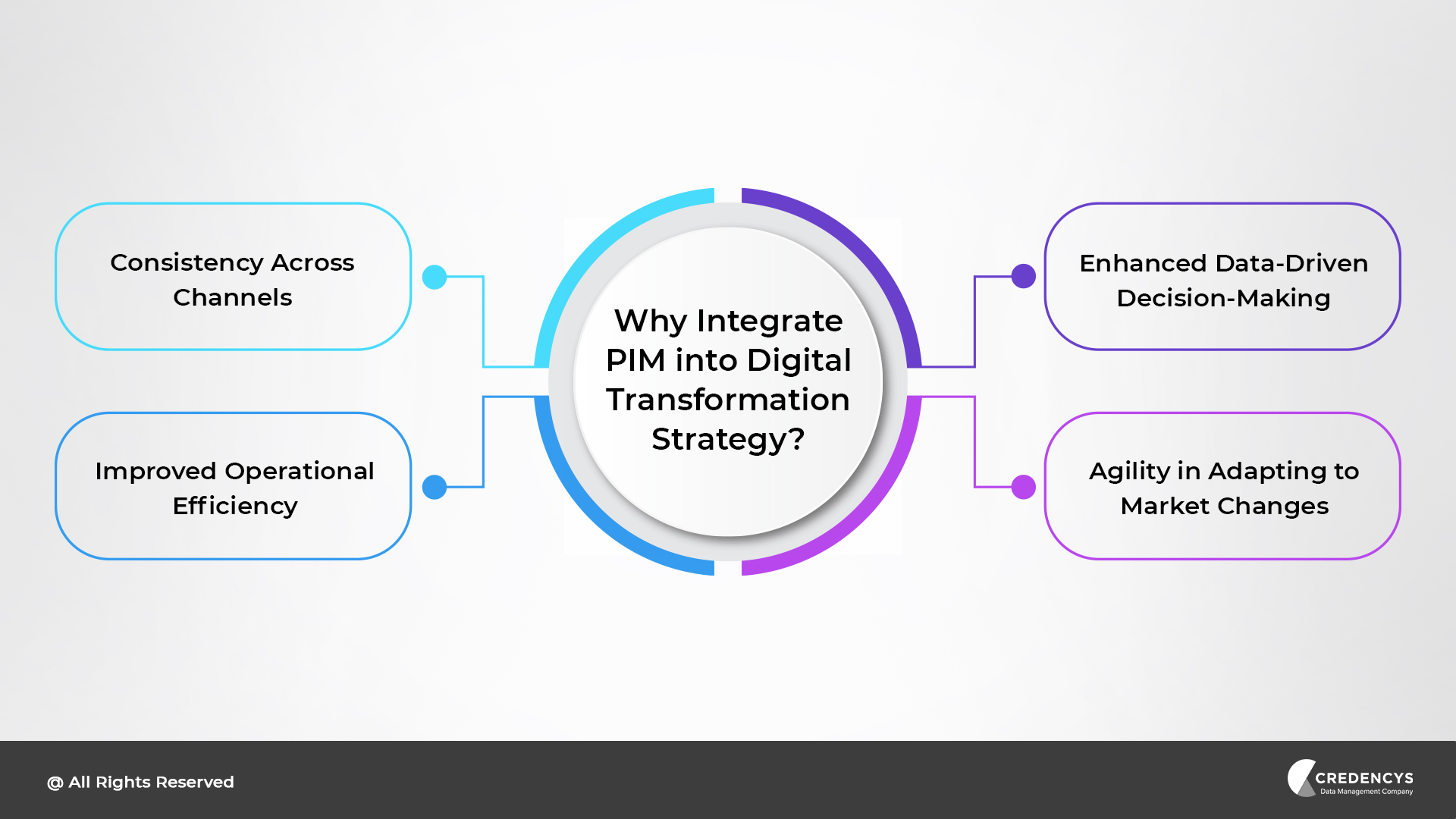
Integrating PIM into Digital Transformation Strategy

Integrating PIM into the broader digital transformation strategy is not just a tactical decision; it is a strategic imperative. The success of digital transformation initiatives relies heavily on the synergy between various technologies and processes.

Here, we delve into why aligning PIM with overall digital transformation goals is crucial for organizations aiming to thrive in the digital age.

1. Consistency Across Channels

In a digitally transformed ecosystem, maintaining consistency across all customer touchpoints is paramount. Whether a customer interacts with a brand through an eCommerce platform, a mobile app, or a physical store, the product information must remain uniform.

By aligning PIM with digital transformation goals, organizations ensure that a centralized repository of accurate and consistent product data is at the heart of their omnichannel strategy.

2. Improved Operational Efficiency

Digital transformation seeks to streamline and optimize operations. PIM contributes significantly to this goal by serving as the backbone for managing product data efficiently.

With a well-integrated PIM system, organizations can automate data workflows, reduce manual errors, and accelerate the time-to-market for new products. This efficiency not only enhances productivity but also frees up resources for more strategic initiatives.

3. Enhanced Data-Driven Decision-Making

Digital transformation emphasizes the importance of data as a strategic asset. PIM, by nature, involves the curation of vast amounts of product-related data.

When aligned with digital transformation goals, PIM becomes a source of valuable insights. Organizations can leverage this data for data-driven decision-making, gaining a deeper understanding of market trends, customer behaviors, and product performance.

4. Agility in Adapting to Market Changes

The business landscape is dynamic, and digital transformation aims to equip organizations with the agility to navigate market changes swiftly. PIM, when integrated seamlessly, ensures that organizations can adapt to market trends, regulatory requirements, and other variables that may necessitate changes to product data.

This adaptability is crucial for staying competitive and responsive to the evolving needs of the market.
Integrating PIM into Digital Transformation Strategy

Digital Capabilities of a PIM Solution

A robust PIM solution goes beyond the traditional realms of data management. It serves as a powerful digital tool with multifaceted capabilities that contribute to the overall digital strategy of an organization.

In this section, we will delve into the digital capabilities of PIM and how they enhance crucial aspects of data management, customer experience, and operational efficiency.

1. Centralized Data Management

At the core of a PIM solution is the ability to centralize and manage vast amounts of product data efficiently. A robust PIM acts as a single source of truth, consolidating information such as product specifications, images, pricing, and more.

This centralized approach streamlines data management, reducing errors and inconsistencies that may arise from disparate sources. By providing a structured and organized repository, PIM ensures that data is accurate, up-to-date, and easily accessible.

2. Integration with Multiple Systems

Digital ecosystems often involve a myriad of interconnected systems and platforms. A strong PIM solution is designed to seamlessly integrate with various tools, including eCommerce platforms, ERP systems, and marketing automation tools.

This integration capability ensures that product data flows cohesively across the organization, fostering a synchronized approach to data management and enhancing interoperability within the digital infrastructure.

3. Dynamic Data Enrichment

PIM solutions offer dynamic data enrichment capabilities, allowing organizations to enhance their product data continuously. This involves enriching basic product information with additional attributes, multimedia content, and other relevant details.

By facilitating dynamic data enrichment, PIM ensures that product data remains relevant and compelling, meeting the evolving needs of the digital marketplace.

4. Version Control and Audit Trails

In the dynamic landscape of digital business, changes to product data are inevitable. A robust PIM solution provides version control and audit trail features, allowing organizations to track changes, understand the evolution of product information, and revert to previous versions if necessary.

This capability enhances data governance, compliance, and transparency within the organization.

5. Automated Workflows

Automation is a key driver of operational efficiency in the digital age. PIM solutions introduce automated workflows for tasks such as data validation, approvals, and updates.

Automated workflows not only reduce manual effort but also ensure that product data moves seamlessly through the necessary processes, accelerating time-to-market and enhancing overall efficiency.

How PIM Contributes to the Digital Transformation Strategy?

PIM is not merely a tool for managing product data; it is a strategic asset that significantly contributes to a company’s overall digital strategy. In this section, we will delve into specific ways in which PIM plays a pivotal role in shaping and advancing the digital strategies of forward-thinking organizations.

1. Accelerates Time-to-Market for New Products

In the fast-paced digital landscape, the ability to bring new products to market swiftly is a competitive advantage. PIM streamlines the product information management process, allowing for quicker updates and introductions of new products.

This acceleration aligns with digital strategies focused on agility and responsiveness to market demands.

2. Supports Omnichannel Initiatives

Omnichannel strategies are at the core of many digital transformation efforts. PIM enables organizations to seamlessly integrate product data across various channels, whether online or offline.

This alignment ensures that customers experience a cohesive journey, irrespective of the channels they choose for interaction. PIM’s contribution to omnichannel initiatives enhances customer engagement and loyalty.

3. Enables Personalization and Targeted Marketing

Personalization is a key component of successful digital strategies. PIM provides the foundational product data needed for tailoring marketing messages, recommendations, and promotions to individual customer preferences.

Integrating PIM allows companies to move beyond generic marketing approaches, enhancing customer engagement through personalized experiences.

How PIM Contributes to the Digital Transformation Strategy

Impact of an Effective PIM Implementation on Digital Capabilities

1. Scalability and Growth

An effective PIM implementation sets the foundation for scalability and growth. As organizations expand their product portfolios or enter new markets, PIM ensures that the management of product information remains efficient and scalable.

This scalability supports long-term growth objectives and allows companies to evolve without compromising the integrity of their product data.

2. Continuous Innovation

PIM not only meets the immediate needs of digital transformation but also supports continuous innovation. As organizations adopt emerging technologies and business models, PIM provides a flexible and adaptable framework for managing product information.

This adaptability ensures that companies can embrace innovation seamlessly and stay ahead of industry trends.

3. Competitive Advantage

Long-term success in the digital landscape requires a sustained competitive advantage. Effective PIM implementation positions companies to differentiate themselves through superior product information management.

Consistent and accurate product data, coupled with the ability to adapt swiftly to market changes, becomes a key differentiator that contributes to a sustainable competitive edge.

4. Building a Customer-Centric Culture

PIM’s contribution to enhancing customer experiences fosters a customer-centric culture within the organization. Over the long term, this culture becomes ingrained in the company’s DNA, influencing decision-making processes, product development strategies, and overall business operations.

A customer-centric approach is vital for long-term success in the digital age.

5. Future-Proofing the Organization

Digital capabilities are not static; they evolve with technological advancements and market dynamics. An effective PIM implementation contributes to future-proofing the organization by providing a robust and adaptable foundation.

This ensures that the organization can navigate future challenges, embrace emerging technologies, and stay relevant in an ever-changing digital landscape.

Addressing Potential Challenges Associated with Integrating PIM into Digital Transformation Initiatives

While the integration of PIM into digital transformation initiatives brings forth numerous benefits, organizations may encounter challenges along the way. It’s crucial to identify and address these challenges proactively to ensure a smooth and successful implementation.

Here, we explore common challenges associated with PIM integration and provide tips for overcoming them.

1. Resistance to Change

Employees may resist changes to established processes, especially if they are accustomed to traditional methods of managing product information.

Solution: Foster a culture of openness and communication. Clearly communicate the benefits of PIM integration, highlighting how it streamlines processes, enhances efficiency, and contributes to broader digital transformation goals.

Provide training and support to ease the transition for employees.

2. Data Quality and Governance

Ensuring the quality and governance of data within the PIM system can be challenging, particularly when dealing with large datasets and multiple contributors.

Solution: Establish robust data governance policies. Implement data validation and quality control processes within the PIM system.

Conduct regular audits to ensure that data standards are maintained. Provide training to contributors on data quality expectations.

3. Integration with Existing Systems

Integrating PIM with existing systems, such as ERP or eCommerce platforms, may present technical challenges and require careful planning.

Solution: Conduct a thorough analysis of existing systems and their compatibility with the chosen PIM solution. Work closely with IT teams and vendors to ensure seamless integration.

Consider using middleware solutions if needed. Plan for data migration and ensure data mapping aligns with the requirements of both PIM and existing systems.

4. Scalability Concerns

Organizations may face scalability concerns, especially if they anticipate rapid growth or expansion of their product lines.

Solution: Choose a PIM solution that is scalable and capable of handling growing volumes of product data. Regularly review and upgrade the system to accommodate increasing demands. Consider cloud-based solutions that offer scalability with minimal infrastructure concerns.

5. Aligning with Business Processes

Aligning the PIM implementation with existing business processes may require adjustments and may face resistance.

Solution: Conduct a thorough business process analysis before implementing PIM. Customize the PIM system to align with existing workflows wherever possible.

Involve key stakeholders early in the planning process to ensure their needs are considered. Communicate the positive impacts of alignment on overall efficiency and effectiveness.

6. Data Security and Compliance

The handling of sensitive product information raises concerns about data security and compliance, especially in regulated industries.

Solution: Prioritize data security in the selection of a PIM solution. Choose a solution that offers robust security features, including encryption and access controls. Ensure compliance with relevant industry regulations and standards. Regularly update security protocols and conduct audits to maintain compliance.

7. Cost Considerations

Implementing a PIM system may involve significant upfront and ongoing costs, which can be a concern for organizations with budget constraints.

Solution: Conduct a thorough cost-benefit analysis before selecting a PIM solution. Consider the long-term benefits in terms of operational efficiency, customer satisfaction, and overall digital transformation goals.

Look for flexible pricing models and explore cloud-based solutions that may offer cost savings.

Potential Challenges Associated with Integrating PIM

By addressing these challenges proactively and incorporating these tips into the PIM integration process, organizations can pave the way for a smoother and more successful digital transformation journey. These considerations help build resilience, enhance adaptability, and ensure that the benefits of PIM integration are realized in the long term.

Over to You

Digital transformation is not a destination but a continuous journey, and a well-implemented PIM solution is the compass guiding organizations through the dynamic terrains of the digital age. From streamlining data management to enhancing customer experiences and boosting operational efficiency, PIM emerges as a versatile ally in achieving broader digital goals.

The integration of PIM into digital transformation is not merely a technological investment; it’s a strategic commitment to resilience, agility, and customer-centricity. As organizations embark on their digital journeys, the robust foundation provided by PIM becomes the cornerstone for navigating the complexities of the digital era and emerging not just as survivors but as leaders in the digital frontier.

Style with Substance: Leveraging PIM for Sustainability in Fashion

“We all share the responsibility for our playground—Planet Earth. That’s why we’re reimagining things top to bottom through sustainability and circularity.” – Nike

During a recent visit to Nike’s store and website, I couldn’t help but notice the emphasis on sustainability in their product details. Intrigued by this commitment, I decided to purchase a pair of running shoes from their online platform. What caught my attention was a specific line in the product details: “This product is made with at least 20 percent recycled content by weight, which reduces waste and carbon footprint.”

The attention to sustainability didn’t stop with the product itself. Upon receiving the shoes, I saw that the packaging echoed the same commitment. The box proudly conveyed the message about the product’s recycled content, aligning with Nike’s dedication to reducing waste and environmental impact.

As a customer, this experience not only left me satisfied with my purchase but also impressed by Nike’s transparent approach to sustainability.

In the ever-evolving world of retail, where fashion reigns supreme, sustainability has emerged as a defining factor for businesses aiming to make a positive impact. From sourcing materials to the end-of-life of products, a comprehensive overhaul of processes is necessary. In this journey towards sustainability in fashion, the integration of Product Information Management (PIM) systems plays a pivotal role, offering a technological solution to align with eco-conscious goals.

This article explores the pivotal role of Product Information Management (PIM) solutions in steering fashion towards sustainability.

The Paradigm Shift Towards Sustainability in Fashion

the fashion industry has undergone a profound transformation, marked by a significant paradigm shift towards sustainability. This shift is not merely a trend but a fundamental reevaluation of the industry’s impact on the environment, society, and ethical practices. Several key factors contribute to this evolution, reflecting a growing awareness and a collective commitment to fostering positive change.

1. Sourcing Materials: A Crucial Starting Point

The fashion industry, known for its environmental impact, often faces challenges in material sourcing, contributing to significant emissions.

With approximately 100 billion fashion items produced annually, a staggering 92 million tons end up in landfills. The carbon-intensive processes of treating, dyeing, and transporting textiles further compound the industry’s ecological footprint.

Adopting a circular economy must begin at the inception of the product lifecycle. PIM systems, by centralizing and managing product information, provide a platform for transparency. Customers and investors alike seek detailed insights into sourcing processes, making PIM an invaluable tool in showcasing a commitment to sustainable practices.

2. Designing Products: Quality Over Quantity

The prevalent ‘take-make-dispose’ mentality of fast fashion contributes to immense waste in the linear economy. The paradigm shift towards sustainable eCommerce calls for a focus on quality over quantity. Products designed and built to last represent a departure from the fast fashion ethos. Consideration of the end-of-life of clothing and footwear during the design stage ensures optimal resource utilization.

3. The Way You Market: Beyond Greenwashing

Greenwashing, a term frequently used in the fashion industry, underscores the need for genuine sustainability efforts. Consumers now demand proof of a company’s commitment to sustainability. Here, PIM becomes a storytelling tool, leveraging product data and digital assets to narrate a brand’s sustainability journey. By providing comprehensive information, businesses can build trust with customers, employees, and investors, aligning with Environmental, Social, and Governance (ESG) goals.

4. The End of Life of Products: Embracing a Circular Economy

Only 1% of clothes currently get recycled and transformed into new garments, highlighting the necessity of a circular economy. Companies can take positive steps by exploring recycling processes for end-of-life products. PIM enables businesses to supply customers with after-care information, from repair instructions to optimal product care, fostering a circular mindset and prolonging the lifespan of products.

What Environmentally Savvy Customers Want to Know

Today’s customers including Gen Z and Gen Alpha are not only interested in the end product but also in the entire lifecycle of a product, from its raw materials to its manufacturing process and eventual disposal.

To cater to the preferences of environmentally savvy consumers, businesses need to address key aspects that align with their values and concerns.

  • Pre-Purchase Information:

Informed buying decisions hinge on detailed pre-purchase information. Customers seek insights into product sourcing, materials, working conditions, and logistics, demanding transparency throughout the supply chain.

  • Key Product Details:

Granular information about product components, sustainable materials, and eco-friendly practices is critical. PIM serves as a powerful tool for showcasing these details and reinforcing a brand’s commitment to environmental consciousness.

  • Delivery Details:

Sustainability extends beyond the product to delivery. PIM enables businesses to highlight different delivery options, providing clarity on environmental impacts and delivery timelines.

  • Post-Purchase Considerations:

Educating customers on after-care, repair options, and recycling processes contributes to building a circular mindset. PIM enables meticulous management of product data for effective communication.

pim-for-sustainability-in-fashion

Making Fashion More Sustainable with PIM

One powerful tool that can contribute significantly to making fashion more sustainable is Product Information Management (PIM). This technology not only enhances operational efficiency but also facilitates transparency in the supply chain, addressing critical aspects of sustainability.

One of the primary challenges in the fashion industry is managing diverse and detailed information about sustainable practices. This includes data about eco-friendly materials, ethical sourcing, and environmentally conscious manufacturing processes. PIM provides a centralized hub where all this information can be systematically organized, updated, and accessed. By consolidating sustainable data in one platform, fashion brands can ensure accuracy, eliminate redundancies, and communicate their commitment to sustainability effectively.

Consumers today are increasingly interested in the origins of their products, from raw materials to manufacturing processes. PIM facilitates traceability by allowing brands to track and showcase every step of a product’s lifecycle. Whether it’s the sourcing of organic cotton, the use of recycled materials, or adherence to ethical labor practices, PIM enables brands to provide detailed information about the sustainability journey of each item. This transparency builds trust with environmentally conscious consumers who seek assurance that their purchases align with their values.

  • Tools for Reporting Processes:

Sustainable eCommerce platforms with existing reporting processes find it easier to adapt to new standards. PIM’s powerful tools, workflows, automation, and data governance help standardize product data to meet these reporting standards.

  • Storage Capabilities:

PIM’s extensive storage capabilities allow businesses to manage and distribute media files showcasing green credentials, from images and videos to regulatory compliance documents.

  • Complete Visibility:

PIM provides complete visibility over the accuracy and completeness of product data, ensuring consistency and conformity across the entire product range.

  • Channel-Specific Publishing:

PIM allows businesses to specify which product data to publish on different sales channels, tailoring information for different audiences.

Navigating Sustainability in Fashion Trends with PIM

As global retail eCommerce accelerates, sustainability emerges as a pivotal trend. Consumers, particularly Millennials and Gen Z, increasingly prioritize sustainability in their purchasing decisions.

Businesses are focusing on reducing environmental impact, with transparency becoming more critical. The circular economy, eco-friendly packaging, fair trade, and ethical supply chains are among the key sustainability trends. AI is increasingly employed by retail brands to analyze supply chains and personalize shopping experiences. PIM facilitates the integration of AI-based tools, contributing to sustainability efforts. Conveying Sustainability through Product Data:

Importance of Product Information:

Accurate and comprehensive product information is critical for consumers making sustainable choices. Incomplete or inaccurate information can lead to unintended negative environmental impacts.

Messaging in Product Data:

Customers seek information on ingredients, packaging, energy and resource use, carbon footprint, certifications, supply chain transparency, product lifespan, and end-of-life management. PIM enables businesses to convey this information effectively.

Digital Product Passport (DPP):

Legislation, such as the proposed Digital Product Passport (DPP) by the European Commission, plays a crucial role in promoting sustainability. DPPs contain essential product information and can facilitate compliance with safety, environmental, and ethical standards.

Wrapping Up: Handling Sustainability in Fashion with PIM

The partnership between retailers and consumers, facilitated by PIM, is crucial for building a sustainable eCommerce ecosystem. Transparent product information, conscious purchasing decisions, and legislative support pave the way for a greener economy, where sustainability becomes the norm rather than an exception.

As we navigate the ever-evolving landscape of eCommerce, embracing sustainable practices through the effective use of PIM is not just a choice but a responsibility. Together, through transparent product information and conscious purchasing decisions, retailers and consumers can make a real difference in building a greener economy.

Connect with our certified PIM experts to learn more about PIM’s role in managing sustainability in the fashion industry.

PIM’s Integration with Emerging Technologies and Beyond

In the dynamic landscape of retail and CPG industries, the effective management of product information plays a pivotal role in sustaining competitiveness and meeting consumer expectations. PIM emerges as a key solution, providing a centralized and structured approach to handle the vast array of data associated with products.

Emerging Technologies Shaping the Future

As we stand on the cusp of a technological revolution, several emerging technologies are poised to redefine the landscape of retail and CPG. The integration of these technologies with PIM systems holds immense potential for enhancing operational efficiency, enriching customer experiences, and future-proofing businesses.

From the Internet of Things (IoT) offering real-time insights into product usage and performance to the transformative power of 5G revolutionizing data transfer speeds, the future is laden with opportunities. Artificial Intelligence (AI) and Machine Learning (ML) promise intelligent automation and data enrichment, while blockchain ensures data security and transparency in the supply chain.

Moreover, Augmented Reality (AR) and Virtual Reality (VR) are set to revolutionize the customer shopping experience, offering immersive and personalized interactions. In this blog post, we delve into the intricate synergy between PIM systems and these emerging technologies, exploring how their integration is shaping the future of retail and CPG industries.

1. Integration with IoT

The IoT has emerged as a revolutionary force, transforming the way businesses operate across various industries, including retail and CPG. In this interconnected era, everyday objects are embedded with sensors, software, and connectivity, enabling them to collect and exchange data.

IoT devices in retail range from smart shelves and Radio Frequency Identification (RFID) tags to connected devices in the supply chain, creating a web of interconnected data points. These devices generate a vast amount of real-time data, providing insights into consumer behavior, inventory levels, and product performance.

How PIM System Can Leverage IoT Data

Integrating IoT with PIM systems creates a symbiotic relationship that elevates the capabilities of both technologies. PIM systems, traditionally focused on centralizing and managing static product information, can now tap into the dynamic and real-time data streams produced by IoT devices.

PIM systems can leverage IoT data to enrich product information with real-time updates on factors such as product availability, location, and usage patterns. For instance, sensors on products or shelves can communicate directly with the PIM system, updating information on stock levels, and ensuring that customers receive accurate and up-to-date information on product availability.

Furthermore, the integration enables PIM systems to incorporate contextual data, such as weather conditions or location-based preferences, providing a deeper understanding of consumer behavior. This not only enhances the personalization of marketing efforts but also aids in predicting and meeting customer demands more effectively.

Enhancing Product Visibility & Tracking with IoT Integration

One of the significant advantages of integrating PIM with IoT is the improved visibility and tracking of products throughout the supply chain. IoT devices can monitor the movement of products in real-time, from manufacturing to distribution to the retail shelf.

This level of visibility helps minimize the risk of stockouts, reducing overstock situations, and optimizing inventory management. In the retail environment, IoT-enabled devices can provide insights into customer interactions with products

Moreover, the combination of PIM and IoT facilitates a more responsive and agile supply chain. Businesses can proactively address issues such as transportation delays, quality control problems, or sudden shifts in demand, ensuring that the right products are available at the right time.

2. The Impact of 5G on PIM

The advent of 5G technology represents a paradigm shift in the realm of telecommunications, offering unprecedented speed, low latency, and enhanced connectivity. Unlike its predecessors, 5G is not merely an incremental upgrade but a transformative force that opens up new possibilities for industries worldwide.

At its core, 5G leverages high-frequency radio waves to transmit data at speeds up to 100 times faster than 4G, with latency reduced to a mere fraction of a second.

Opportunities for PIM Systems in a High-Speed, Low-Latency Environment

The integration of 5G technology with PIM systems introduces a host of opportunities for businesses operating in the retail and CPG sectors. The key advantage lies in the high-speed, low-latency nature of 5G networks, which facilitates near-instantaneous communication and data transfer.

PIM systems thrive in an environment where data flows seamlessly and rapidly. The low latency of 5G networks ensures that PIM systems can access and distribute product information in real time, enabling businesses to keep their catalogs consistently updated across various platforms.

This instantaneous synchronization is especially crucial in fast-paced industries where product launches, pricing updates, and inventory changes happen in real-time. Moreover, 5G technology enhances the scalability of PIM systems, allowing them to handle an increasing volume of data without compromising speed or performance.

This scalability is particularly advantageous as businesses expand their product portfolios, cater to larger customer bases, and integrate more diverse types of product information.

Accelerating Data Transfer and Real-Time Updates with 5G

One of the most tangible benefits of integrating 5G with PIM systems is accelerating data transfer processes. Large datasets associated with product information, such as high-resolution images, multimedia content, and intricate specifications, can be transmitted swiftly and efficiently over 5G networks.

This rapid data transfer capability is instrumental in delivering real-time updates across all customer touchpoints. Whether through eCommerce platforms, mobile apps, or in-store displays, PIM systems leveraging 5G can ensure that consumers have access to the latest and most accurate product information.

This not only enhances the customer experience by providing up-to-the-minute details but also instills confidence in the brand’s commitment to transparency and accuracy.

3. Artificial Intelligence and Machine Learning in PIM

AI and ML are transforming the landscape of PIM by introducing a layer of intelligence that goes beyond traditional data management. The role of AI and ML in PIM extends far beyond manual data entry and categorization.

These technologies have the capability to understand, analyze, and interpret vast datasets, enabling businesses to derive actionable insights from their product information. In the realm of PIM, AI and ML algorithms play a pivotal role in automating routine tasks, allowing teams to focus on more strategic initiatives.

The ability to recognize patterns, relationships, and anomalies within product data helps in maintaining data accuracy and consistency, ensuring that the information provided is reliable across all channels.

Intelligent Automation and Data Enrichment Using AI

AI and ML bring intelligent automation to product data management, significantly reducing the burden of manual processes. Automation, powered by AI, can handle tasks such as categorizing products, identifying duplicates, and enriching product information with relevant attributes.

Furthermore, AI-driven data enrichment goes beyond basic product information. It can analyze customer interactions, purchase history, and market trends to recommend complementary products or personalized content, enhancing the overall customer experience. This level of automation improves efficiency and contributes to a more personalized and targeted approach to marketing and sales efforts.

Improving Decision-Making Through Predictive Analytics

The integration of AI and ML in PIM introduces predictive analytics, a game-changer for decision-making processes. By analyzing historical data, customer behavior, and market trends, these technologies can forecast future demand, identify emerging patterns, and help businesses make informed decisions about product launches, pricing strategies, and inventory management.

Predictive analytics powered by AI enables businesses to optimize their supply chain, reducing the risk of overstock or stockouts. It empowers retailers to align their product offerings with customer preferences, ensuring that the right products are available at the right time.

Additionally, predictive analytics can aid in identifying opportunities for cross-selling and upselling, maximizing revenue potential.

How Does AI-powered PIM Transform Retail with Intelligent Data Management?

4. Blockchain in PIM

Blockchain technology, originally developed for cryptocurrency, has evolved into a transformative force across various industries. At its core, blockchain is a decentralized and distributed ledger that records transactions across a network of computers.

Each transaction, or “block,” is linked to the previous one in a chain, creating a secure and transparent record. The decentralized nature of blockchain ensures that no single entity has control, enhancing security, transparency, and trust in data transactions.

Enhancing Data Security and Integrity in PIM Systems

Integrating blockchain into PIM systems addresses critical concerns related to data security and integrity. Traditional PIM systems rely on centralized databases, making them susceptible to data breaches and tampering.

Blockchain, with its decentralized and tamper-resistant architecture, provides a robust solution to these challenges. In a blockchain-enabled PIM system, each piece of product information is recorded as a block on the chain.

Once recorded, it becomes virtually immutable, and any attempt to alter or tamper with the information is immediately detected by the network. This not only safeguards the integrity of product data but also ensures that historical records remain accurate and trustworthy.

Blockchain’s encryption techniques enhance data security, protecting sensitive product information from unauthorized access. By decentralizing control and encrypting transactions, blockchain technology minimizes the risk of cyber threats and unauthorized modifications, instilling confidence in the reliability of product data.

Ensuring Transparency and Traceability in the Supply Chain

Blockchain technology also addresses the growing demand for transparency and traceability in the supply chain, a crucial aspect of modern business operations. Through blockchain-enabled PIM systems, stakeholders in the supply chain gain real-time visibility into the journey of products from manufacturer to end-user.

Each transaction or movement of a product is recorded on the blockchain, creating an unalterable trail of information. This transparency is particularly valuable in verifying the authenticity of products, tracking the origin of raw materials, and ensuring compliance with ethical and sustainability standards.

In the event of a product recall or quality issue, blockchain provides a traceable and auditable record, simplifying the identification and removal of affected products. This not only reduces the impact of recalls on consumers but also safeguards the reputation of the brand by demonstrating proactive and transparent supply chain management.

The Transformative Power of Blockchain in PIM

5. Augmented Reality (AR) and Virtual Reality (VR) Integration

AR and VR have emerged as transformative technologies, revolutionizing the way customers engage with products and brands. In the context of retail and CPG, AR and VR are not just technologies but powerful tools that can elevate the customer shopping experience to unprecedented levels.

AR overlays digital information onto the physical world, enhancing the real-world environment, while VR immerses users in a completely virtual experience. Both technologies have the potential to bridge the gap between the online and offline retail worlds, offering consumers a more interactive and personalized shopping journey.

How PIM Systems Can Incorporate AR/VR Data for Enriched Product Presentations

The integration of AR and VR with PIM systems introduces a dynamic layer to product presentations. PIM systems, traditionally focused on organizing and disseminating static product information, can now leverage AR and VR to provide consumers with immersive and interactive experiences.

On the other hand, VR offers a more immersive experience, transporting customers to virtual environments where they can explore products in a simulated setting. This is particularly valuable for industries like real estate, where customers can take virtual tours of properties, or automotive, where potential buyers can experience a virtual test drive.

PIM systems play a crucial role in this integration by managing the vast array of product-related data needed for AR and VR experiences. From high-quality images and 3D models to detailed specifications, PIM ensures that the data presented in these immersive environments is accurate, consistent, and up-to-date.

Personalizing Customer Engagement Through Immersive Technologies

AR and VR not only enhance the visual representation of products but also provide opportunities for personalizing customer engagement. PIM systems, when integrated with these immersive technologies, can leverage customer data to deliver personalized AR and VR experiences.

By personalizing customer engagement through AR and VR, businesses can strengthen brand loyalty, increase customer satisfaction, and differentiate themselves in a competitive market. PIM systems, as the backbone of product data management, play a pivotal role in ensuring that the personalized information presented in these immersive experiences is accurate and aligns with the overall brand messaging.

Revolutionize Your Product Experiences using AR and VR in PIM

Addressing Potential Obstacles in Integrating PIM with Emerging Technologies

While the integration of Product Information Management (PIM) systems with emerging technologies offers tremendous benefits, it is not without its challenges. Understanding and addressing these potential obstacles is crucial for successful implementation. Some common challenges include:

1. Data Standardization

Integrating PIM with emerging technologies often involves dealing with diverse data formats and standards. Ensuring consistency and standardization across different data sources can be a significant hurdle.

2. Interoperability

The compatibility of PIM systems with other technologies and platforms is a critical consideration. Ensuring seamless interoperability is essential for avoiding data silos and promoting a unified data environment.

3. Cost and Resource Constraints

Implementing and maintaining PIM systems integrated with emerging technologies may require significant financial investments and skilled resources. Smaller businesses, in particular, might face challenges in allocating budgets and expertise for these initiatives.

4. Data Security and Privacy Concerns

As PIM systems handle sensitive product information, ensuring robust data security and privacy is paramount. Integrating with technologies like IoT and blockchain introduces additional considerations for securing data throughout the supply chain.

Summing Up

In the ever-evolving landscape of retail and Consumer Packaged Goods (CPG), the integration of PIM systems with emerging technologies stands as a beacon of innovation and efficiency. As we look to the future, it is clear that the integration of PIM with emerging technologies is not just a technological upgrade but a strategic imperative for businesses aiming to thrive in the dynamic and competitive world of retail and CPG.

By embracing these advancements and adopting a forward-thinking approach, businesses can position themselves at the forefront of innovation, delivering superior customer experiences and achieving sustainable growth in the digital era.

Revolutionize Your Product Experiences using AR and VR in PIM

Embark on a journey of transformation as we delve into the revolutionary fusion of Augmented Reality (AR) and Virtual Reality (VR) within the realm of Product Information Management (PIM).

In an era where immersive experiences redefine how we engage with products, the integration of AR and VR heralds a new frontier in PIM.

In this post, we will explore how these cutting-edge technologies go beyond visual appeal, fundamentally reshaping how businesses manage, present, and leverage product information. Discover how AR and VR revolutionize product experiences and elevate the landscape of PIM.

What is Augmented Reality (AR)?

Augmented reality (AR) is the real-time use of information in the form of text, graphics, audio, and other virtual enhancements integrated with real-world objects.

It is this “real world” element that differentiates AR from virtual reality. AR integrates and adds value to the user’s interaction with the real world, versus a simulation.

Gartner

What is Virtual Reality (VR)?

Virtual reality (VR) provides a computer-generated 3D environment (including both computer graphics and 360-degree video) that surrounds a user and responds to an individual’s actions in a natural way, usually through immersive head-mounted displays.

Gesture recognition or handheld controllers provide hand and body tracking, and haptic (or touch-sensitive) feedback may be incorporated. Room-based systems provide a 3D experience while moving around large areas, or they can be used with multiple participants.

Gartner

Applications of AR and VR in Various Industries

AR and VR have transcended novelty to become integral tools across diverse industries. Below are some examples of how AR and VR empower different industries.

  • In retail, they help brands create amazing product experiences to drive better customer engagement. Retailers utilize AR for virtual try-ons and VR for virtual shopping experiences.
  • In healthcare, they aid in surgical training and patient treatment simulations.
  • In education, they provide immersive learning experiences.

Connection of AR and VR to PIM Systems

The integration of AR and VR with PIM systems is transforming how businesses manage and present product information.

PIM systems organize and centralize product data, ensuring consistency. By incorporating AR, businesses can offer customers real-time product visualizations, and VR can create virtual showrooms for immersive exploration.

With the effective amalgamation of AR and VR with PIM, organizations can enhance product experiences, facilitate better decision-making, and open new avenues for customer engagement.

How AR and VR in PIM Enhance Product Data Management?

For product data management, the integration of AR and VR stands as a transformative force, reshaping the way businesses handle and present product information. The synergy between AR, VR, and PIM systems is not merely technological integration; it’s a strategic evolution.

Here’s a closer look at how AR and VR are intricately connected to PIM systems, enhancing product information management.

How AR and VR in PIM Enhance Product Data Management

1. Immersive Product Visualization

AR and VR technologies empower PIM systems to provide immersive product visualizations. Businesses can go beyond traditional imagery, offering customers interactive, three-dimensional experiences.

This not only enhances customer engagement but also allows for a more comprehensive understanding of product details and specifications through interactive content.

2. Visualizing Product Attributes

AR enhances the visualization of product attributes by overlaying digital information onto the physical world.

For example, users can use AR to see detailed specifications, customer reviews, or virtual demonstrations simply by pointing their devices at a product.

3. Interactive Product Information

PIM systems augmented with AR and VR enable interactive product information. Customers can access detailed specifications, explore features, and even receive real-time updates through these technologies.

This interactivity enhances the depth and richness of product data, fostering better-informed purchase decisions.

4. Virtual Try-Ons and Simulations

AR, especially, facilitates virtual try-ons and simulations. In the fashion industry, for instance, customers can virtually try on clothing items, ensuring a more personalized and accurate shopping experience.

VR simulations take this a step further, allowing users to virtually engage with products before making a purchase.

5. Product Management

The integration of AR and VR in PIM systems streamlines product management processes. Businesses can use these technologies to visualize and optimize product layouts, design packaging, and simulate various scenarios, ultimately enhancing the efficiency of product data management.

6. Data Analytics and Insights

AR and VR contribute to advanced data analytics within PIM systems. These technologies enable businesses to gather insights into customer interactions, preferences, and behaviors in immersive environments.

Moreover, PIM solution users can leverage these technologies to track product performance metrics and gain actionable insights too. This data-driven approach enhances decision-making and allows for more targeted product strategies.

7. Interactive Product Catalogs

AR transforms traditional product catalogs into interactive experiences. Users can use AR applications to scan catalog images and unlock additional product information, turning static materials into engaging and informative content.

As AR and VR continue to evolve, their impact on product data management within PIM systems is poised to revolutionize how businesses handle, present, and collaborate on product information. Embracing these technologies opens new avenues for delivering compelling and interactive product experiences while streamlining product data management processes.

Benefits of Integrating AR and VR in PIM Solution

The integration of AR and VR into PIM systems brings several benefits, transforming how businesses handle and leverage product information.

Benefits of Integrating AR and VR in PIM Solution

1. Improved Customer Engagement

By incorporating AR and VR into product presentations, businesses elevate customer engagement. Interactive and immersive experiences capture the attention of consumers, fostering a deeper connection with products and brands.

2. Enhanced Product Visualization

AR and VR transform the product data management landscape by providing immersive visualizations. Stakeholders can engage with detailed product models, fostering a deeper understanding and minimizing misinterpretations.

3. Reduced Return Rates

The immersive experiences offered by AR and VR contribute to more informed purchasing decisions. Customers have a clearer understanding of products, leading to a potential reduction in return rates as products better align with their expectations.

4. Competitive Advantage

Businesses adopting AR and VR in PIM gain a competitive edge by delivering cutting-edge, technology-driven experiences. This not only attracts tech-savvy consumers but also positions the brand as innovative and forward-thinking in the market.

5. Reduced Errors and Improved Accuracy

Immerse yourself in error-free product information management as AR and VR offer a visual approach, enhancing precision and mitigating the risks associated with data inaccuracies.

6. Streamlined Product Lifecycle Management

Embed AR and VR seamlessly throughout the product lifecycle, ensuring a harmonized and efficient approach from design and development to marketing, fostering cohesive PIM practices.

7. Future-Ready Product Presentations

Propel your brand into the future by embracing AR and VR technologies and delivering innovative and captivating product presentations that set you apart in the competitive market landscape.

In the Nutshell

By embracing the transformative synergy of AR and VR within PIM solutions, businesses not only revolutionize product data management but also embark on a journey toward unparalleled precision, customer satisfaction, and future-proof innovation.

Leverage the immersive capabilities of these technologies by harnessing the PIM excellence of Credencys. We redefine your business landscape, ensuring your brand stays at the forefront of effective and forward-thinking product information management. Elevate your PIM strategy—immerse, engage, and lead with AR and VR.

The Transformative Power of Blockchain in PIM

Blockchain technology is a decentralized and distributed ledger system that enables secure, transparent, and tamper-resistant record-keeping. At its core, a blockchain is a chain of blocks, each containing a list of transactions or records.

These blocks are linked together using cryptographic hashes, forming a continuous and unchangeable chain. The decentralized nature of blockchain ensures that no single entity has control over the entire network, promoting a transparent environment.

Blockchain operates on a peer-to-peer network, where each participant has a copy of the entire ledger. When a new transaction is added to the blockchain, it undergoes a consensus mechanism, where a majority of the nodes must agree on its validity before it becomes part of the chain.

This decentralized consensus model enhances security, making it extremely difficult for malicious actors to manipulate or alter data.

Key Characteristics of Blockchain

1. Decentralization

Traditional PIM systems often rely on a centralized database, making them susceptible to a single point of failure. Blockchain, on the other hand, distributes data across a network of nodes, eliminating the need for a central authority.

This decentralization enhances security, resilience, and availability.

2. Immutability

Once information is added to a block and the block is added to the blockchain, it becomes nearly impossible to alter. Each block contains a unique cryptographic hash that is dependent on the data within it and the previous block’s hash.

Any attempt to change information in a block would require changing the data in that block and all subsequent blocks, a computationally infeasible task.

3. Transparency

Transparency is a fundamental feature of blockchain. All participants in the network have access to the entire history of transactions, ensuring a shared and transparent view of data.

This transparency fosters trust among stakeholders as they can independently verify the information recorded on the blockchain.

Key Charcateristics of Blockchain

How Blockchain Addresses Challenges in PIM?

1. Data Integrity

In traditional PIM systems, maintaining data integrity can be challenging due to the risk of data manipulation or errors in a centralized database. Blockchain’s immutability ensures that once product information is recorded on the blockchain, it remains unchanged.

This guarantees the integrity of product data throughout its lifecycle.

2. Traceability

The traceability of products is crucial in supply chain management. Blockchain’s transparent and decentralized ledger enables the tracking of every transaction or change in product information.

Each participant in the supply chain can trace the origin and journey of a product, ensuring accountability and reducing the risk of counterfeit goods.

3. Transparency in Collaboration

Collaboration among different entities in the supply chain often involves sharing product data. Blockchain facilitates secure and transparent data sharing by providing a decentralized and verifiable record.

This transparency fosters trust among stakeholders, as they can confidently rely on the accuracy and authenticity of the shared product information.

4. Data Synchronization

In a supply chain involving multiple stakeholders, maintaining consistent and synchronized product information across all participants can be challenging. Blockchain provides a shared and distributed ledger, ensuring all authorized parties can access the most up-to-date and accurate product data in real-time.

5. Security and Fraud Prevention

Traditional PIM systems may be vulnerable to cybersecurity threats and data breaches. Blockchain’s cryptographic techniques and decentralized architecture make it highly secure.

The use of private keys for access control and the immutability of data makes it extremely challenging for unauthorized parties to manipulate or compromise product information.

6. Real-Time Visibility

Traditional supply chain systems may lack real-time visibility into the movement and status of products. Blockchain provides a decentralized and real-time view of transactions, allowing stakeholders to track products throughout the supply chain.

This enhanced visibility enables quicker decision-making and responsiveness to changes or issues.

By addressing these challenges, blockchain technology in PIM not only improves the accuracy and trustworthiness of product data but also enhances overall efficiency, security, and collaboration within the supply chain.

Benefits of Using Blockchain in PIM

Blockchain technology offers a myriad of benefits when applied to PIM, revolutionizing the way organizations handle and share product data across the supply chain. Here are the key advantages:

1. Data Integrity

Immutability: One of the primary benefits of blockchain in PIM is the immutability of data. Once product information is recorded on the blockchain, it cannot be altered or tampered with. This ensures the integrity of the data, providing a single source of truth that all stakeholders can rely on.

Trustworthy Record-Keeping: Blockchain’s decentralized nature and cryptographic security mechanisms create a trustworthy record-keeping system. This significantly reduces the risk of errors, fraud, and unauthorized modifications, fostering confidence in the accuracy of product data.

2. Traceability

End-to-End Visibility: Blockchain enhances traceability by providing end-to-end visibility into the supply chain. Each transaction or update related to a product is recorded on the blockchain, allowing stakeholders to trace the entire journey of a product from its origin to its current status.

Provenance Verification: Organizations can verify the provenance of products by accessing the immutable record on the blockchain. This is particularly crucial in industries where authenticity and compliance with regulations are paramount, such as food, pharmaceuticals, and luxury goods.

3. Transparency

Shared and Transparent Database: Blockchain creates a shared and transparent database that is accessible to all authorized participants in the network. This transparency eliminates information asymmetry, ensuring that all stakeholders have access to the same set of information, and reducing misunderstandings and disputes.

Enhanced Collaboration: Collaborative efforts within the supply chain are streamlined through transparent data sharing. Blockchain facilitates secure and auditable sharing of product information among different entities, promoting a more collaborative and efficient ecosystem.

4. Data Synchronization and Consistency

Real-time Updates: Blockchain enables real-time updates to product information across the supply chain. This ensures that all participants have access to the most current and consistent data, reducing the likelihood of discrepancies and errors associated with outdated information.

Interoperability: The use of blockchain as a standardized platform enhances interoperability between different systems and databases. This interoperability streamlines communication and data exchange between diverse stakeholders, creating a more connected and efficient supply chain.

5. Security and Fraud Prevention

Cryptographic Security: Blockchain employs advanced cryptographic techniques to secure data. Each block is linked to the previous one using cryptographic hashes, and consensus mechanisms ensure that only valid transactions are added. This robust security framework minimizes the risk of data breaches and unauthorized access.

Reduced Counterfeiting: In industries where counterfeiting is a significant concern, such as pharmaceuticals and luxury goods, blockchain’s traceability and authenticity verification capabilities play a pivotal role in reducing counterfeiting and ensuring the legitimacy of products.

6. Real-time Visibility

Quicker Decision-Making: Blockchain provides real-time visibility into the movement and status of products. This enables stakeholders to make quicker and more informed decisions, respond promptly to changes or issues in the supply chain, and optimize overall operational efficiency.

Benefits of Using Blockchain in PIM

Potential Obstacles in Implementing Blockchain in PIM

1. Initial Resistance to Change

The integration of blockchain into existing PIM systems may face resistance from stakeholders accustomed to traditional databases. Overcoming this resistance requires effective communication about the benefits and long-term advantages that blockchain brings to PIM.

2. Technical Complexity

Implementing blockchain technology involves a learning curve for organizations, as it requires expertise in distributed ledger technology. The technical complexity of developing and maintaining a blockchain infrastructure can be a hurdle, necessitating skilled professionals or third-party providers.

3. Interoperability Challenges

Existing PIM systems and databases may not be designed to seamlessly integrate with blockchain. Ensuring interoperability between legacy systems and new blockchain implementations can be a challenge, requiring careful planning and potentially custom development.

4. Cost of Implementation

The initial investment required for implementing blockchain in PIM, including development, integration, and training costs, can be a significant barrier. Organizations need to weigh the long-term benefits against the upfront costs to justify the adoption of blockchain technology.

While adopting blockchain in PIM offers numerous benefits, organizations must be mindful of the challenges and considerations associated with implementation. Overcoming these obstacles requires a strategic approach, collaboration with experts, and a commitment to addressing both technical and regulatory aspects to ensure the successful integration of blockchain technology into Product Information Management.

Emerging Trends in Blockchain Technology for PIM

1. Tokenization of Product Information

A growing trend is the tokenization of product information, where product attributes and data are represented as digital tokens on the blockchain. This not only enhances data security but also allows for fractional ownership and streamlined transactions within the supply chain.

2. Decentralized Identifiers (DIDs)

Decentralized Identifiers provide a way to create and manage unique, self-sovereign identities for entities such as products, organizations, and individuals. Implementing DIDs in PIM can enhance data ownership and privacy, allowing for secure and verifiable identification of products throughout their lifecycle.

3. Interoperable Blockchains

The development of protocols that enable different blockchains to interoperate seamlessly is gaining traction. This can be particularly beneficial for organizations working with diverse partners in the supply chain, ensuring that data can flow seamlessly across various blockchain networks.

4. Blockchain as a Service (BaaS)

Blockchain as a Service platform is emerging, offering cloud-based solutions for organizations to deploy and manage blockchain networks without the complexity of building and maintaining the infrastructure. BaaS can democratize access to blockchain technology, making it more accessible for a wider range of businesses.

5. Zero-Knowledge Proofs for Privacy

Zero-knowledge proofs, such as zk-SNARKs (Zero-Knowledge Succinct Non-Interactive Arguments of Knowledge), are becoming more prevalent for preserving privacy on the blockchain. This technology allows for the verification of information without revealing the details, enhancing privacy in PIM applications.

Emerging Trends in Blockchain for PIM

The convergence of these emerging trends and technologies is expected to bring about transformative changes in how Product Information Management is approached. Organizations that stay abreast of these developments and strategically integrate them into their PIM systems will be better positioned to leverage the full potential of blockchain and its synergies with other cutting-edge technologies.

Closing Thoughts

The integration of blockchain technology into PIM holds immense promise for reshaping the landscape of data management and transparency in the supply chain. In this era of rapid technological advancement, the journey towards a blockchain-enabled future in PIM is not just a technological upgrade; it is a strategic move towards a more resilient, connected, and efficient supply chain ecosystem.

As we witness these transformations unfold, it becomes clear that the fusion of blockchain and PIM is more than a technological upgrade — it’s a paradigm shift toward a future where trust and transparency are foundational elements in the world of product information management.

Role of PIM in Optimizing Product Information in eCommerce

In the ever-evolving landscape of eCommerce, where consumer choices are vast and competition is fierce, the significance of product content cannot be overstated. The success of an online business hinges not only on the quality of the products offered but also on how effectively the information about those products is presented to potential customers.

As the digital marketplace continues to grow, so does the need for businesses to curate compelling, accurate, and engaging product content.

Impact of Product Content on Customer Decision-Making

In the realm of eCommerce, customers lack the ability to physically interact with products. Therefore, the impact of product content on customer decision-making is profound.

The information provided about a product serves as a crucial touchpoint, influencing potential buyers at every stage of their journey. Compelling product content can captivate the audience, educate them about the features and benefits of a product, and ultimately sway their purchasing decisions.

Importance of High-Quality Product Descriptions, Images, and Specifications

1. Product Descriptions

  • Crafting product descriptions that are informative, concise, and persuasive.
  • Highlighting unique selling points and benefits to differentiate products in a competitive market.
  • Incorporating keywords strategically for search engine optimization.

2. Images and Visuals

  • Providing high-resolution images that showcase products from multiple angles.
  • Using lifestyle images to demonstrate product usage in real-world scenarios.
  • Ensuring consistency in image quality across all products for a cohesive brand image.

3. Specifications

  • Offering detailed technical specifications to cater to the needs of informed buyers.
  • Clearly presenting size, dimensions, materials, and other relevant details.
  • Using standardized formats for specifications to enhance readability and comparison.

Challenges of Managing Product Content in a Dynamic eCommerce Landscape

While the importance of robust product content is clear, managing it poses unique challenges, particularly in the fast-paced and dynamic eCommerce landscape.

Challenges of Managing Product Content

1. Volume and Diversity

  • Handling a large and diverse product catalog with varying content requirements.
  • Managing content for different product categories and catering to niche markets.

2. Consistency Across Channels

  • Ensuring uniformity in product information across multiple sales channels.
  • Avoiding discrepancies in content presentation on different platforms.

3. Dynamic Updates

  • Adapting to frequent product launches and updates in response to market trends.
  • Managing real-time changes in pricing, promotions, and inventory status.

4. Localization and Globalization

  • Addressing the need for localized content to cater to diverse markets.
  • Ensuring accuracy and cultural relevance in translated product information.

Strategies for Optimizing Product Content

The optimization of product content is a strategic imperative in the eCommerce landscape. A seamless fusion of compelling narratives, captivating visuals, accurate specifications, and strategic SEO efforts can elevate the online shopping experience, fostering customer engagement and driving conversions.

1. Crafting Compelling and Informative Product Descriptions

Crafting compelling product descriptions is an art that goes beyond a mere listing of features. It involves telling a story that resonates with the target audience, addressing their pain points, and showcasing how the product can enhance their lives.

2. Utilizing High-Quality Images and Visuals

Visual appeal is a powerful driver of customer engagement in eCommerce. High-quality images and visuals not only grab attention but also provide a virtual experience that bridges the gap between online browsing and in-store shopping.

3. Providing Detailed and Accurate Product Specifications

Accurate and detailed product specifications are essential for customers who seek specific information before making a purchase. Clear specifications instill confidence and reduce uncertainty, contributing to a positive customer experience.

4. Incorporating SEO Strategies for Better Discoverability

In a vast digital marketplace, discoverability is paramount. Strategic SEO efforts can significantly improve the visibility of your products, driving organic traffic and enhancing the likelihood of conversions.

By implementing these strategies, businesses can enhance the overall quality of their product content, making it more appealing to customers and optimizing it for improved search engine visibility.

How PIM Streamlines the Management of Product Information

The complexity of managing product information intensifies as eCommerce businesses grow and diversify their product offerings. PIM addresses this complexity by introducing a systematic approach to data management. Here’s how PIM streamlines the management of product information:

How PIM Streamlines Management of Product Information

1. Centralization of Data

  • PIM serves as a central repository where all product-related data is stored in a structured manner.
  • This centralization eliminates silos and ensures that all stakeholders access the same up-to-date information.

2. Efficient Data Input and Enrichment

  • PIM systems provide intuitive interfaces for efficient data input and enrichment.
  • Businesses can streamline the process of adding new products, updating existing information, and enriching data with multimedia elements.

3. Consistent Data Formatting

  • PIM ensures that product information is consistently formatted according to predefined standards.
  • This consistency is crucial for maintaining a professional and coherent presentation across diverse platforms.

4. Version Control

  • PIM systems often include version control features, allowing businesses to track changes and revert to previous versions if necessary.
  • This capability ensures that only approved and accurate information is disseminated to customers.

How PIM Maintains Data Consistency and Accuracy

Consistency and accuracy are paramount in eCommerce, where discrepancies in product information can erode customer trust and impact purchasing decisions. PIM plays a pivotal role in maintaining data consistency and accuracy through the following mechanisms:

1. Uniform Information Across Channels

  • PIM ensures that product information is consistent across various sales channels, including websites, marketplaces, and offline catalogs.
  • This consistency fosters a cohesive brand image and minimizes confusion for customers.

2. Real-time Updates

  • PIM allows for real-time updates, ensuring that changes to product information are reflected across all platforms instantly.
  • Businesses can respond swiftly to market trends, inventory updates, and other dynamic factors.

3. Quality Assurance Checks

  • PIM systems often include quality assurance checks to identify and rectify errors or inconsistencies in product data.
  • This proactive approach minimizes the risk of inaccuracies reaching the customer.

4. Cross-Reference and Linking

  • PIM facilitates cross-referencing and linking of related product information.
  • This feature ensures that interconnected details, such as accessories or complementary products, are accurately associated with each item.

Common Challenges and Their Solutions in Implementing PIM for Content Optimization

Common Challenges in Implementing PIM

1. Data Onboarding and Migration

  • Challenge: The initial process of onboarding existing product data and migrating it to the PIM system can be labor-intensive and error-prone.
  • Solution: Develop a meticulous data migration plan, ensure data cleanliness beforehand, and leverage automated tools for seamless onboarding.

2. User Adoption and Training

  • Challenge: Resistance or challenges in getting teams accustomed to using the new PIM system.
  • Solution: Invest in comprehensive training programs, communicate the benefits of PIM clearly, and involve key stakeholders early in the implementation process.

3. Integration with Existing Systems

  • Challenge: Ensuring seamless integration of PIM with existing systems, such as ERP or CRM.
  • Solution: Prioritize system compatibility during the selection process, engage IT experts for integration, and utilize middleware if necessary.

4. Scalability Concerns

  • Challenge: Adapting PIM to accommodate the growing volume and complexity of product data as the business expands.
  • Solution: Choose a PIM solution with scalability in mind, regularly reassess system performance, and plan for future growth in product offerings.

5. Ensuring Data Quality

  • Challenge: Maintaining data accuracy and completeness, especially with frequent updates and changes.
  • Solution: Implement stringent data quality control measures, establish regular auditing processes, and utilize PIM’s quality assurance features.

6. User Permissions and Access Control

  • Challenge: Managing user permissions and access control to ensure that only authorized personnel can make changes.
  • Solution: Define clear access roles, limit access based on job responsibilities, and implement robust security protocols to protect sensitive product data.

By anticipating these challenges and implementing strategic solutions, businesses can overcome obstacles in adopting PIM for content optimization, unlocking the full potential of this powerful tool in the eCommerce landscape.

Closing Thoughts

In the realm of eCommerce, where content shapes customer decisions, PIM emerges as a transformative force. Centralizing product information, enhancing data quality, and streamlining updates, PIM ensures a seamless online shopping journey.

Overcoming challenges through strategic planning, businesses can fully harness PIM’s potential, elevating the eCommerce experience to a narrative crafted with precision and care. In this dynamic landscape, PIM isn’t just a tool; it’s the linchpin propelling businesses toward excellence.