Influence of PIM in the Digitization of Automotive Aftermarket Industry

The automotive aftermarket industry is undergoing a profound transformation fueled by digital innovation.

As businesses strive to adapt to evolving consumer demands and technological advancements, the role of Product Information Management (PIM) emerges as a pivotal factor in driving this digitization journey.

In this post, we delve into the influential role of PIM in revolutionizing the automotive aftermarket sector. From streamlining product data management to enhancing digital marketing strategies, we explore different aspects of PIM and how it empowers businesses to thrive in the digital age.

Join us as we uncover the transformative influence of PIM in shaping the future of the automotive aftermarket industry.

Let’s start with an industry overview.

Understanding the Automotive Aftermarket Industry

Automotive Aftermarket – An Overview

The automotive aftermarket industry serves as a crucial component of the automotive sector, encompassing a wide array of products, services, and solutions tailored to meet the needs of vehicle owners in the post-purchase phase.

Unlike the primary automotive market focused on new vehicle sales, the aftermarket sector revolves around the repair, maintenance, customization, and enhancement of existing vehicles.

This multifaceted industry caters to diverse consumer demands, ranging from replacement parts and accessories to performance upgrades and aftermarket services. It encompasses various players including

  • Original Equipment Manufacturers (OEM)
  • Distributors/Suppliers
  • Retailers (retail stores, online retail platforms, and marketplaces)
  • Repair Shops (individual garages and service centers of manufacturers)

These players collectively contribute to a thriving aftermarket ecosystem.

Key Characteristics of the Automotive Aftermarket Industry

The automotive aftermarket industry exhibits dynamic traits shaped by consumer demand, technological advancements, and evolving market dynamics.

With a diverse range of products, service-oriented offerings, and a focus on digital transformation, it represents a vibrant ecosystem poised for growth and innovation in the automotive sector.
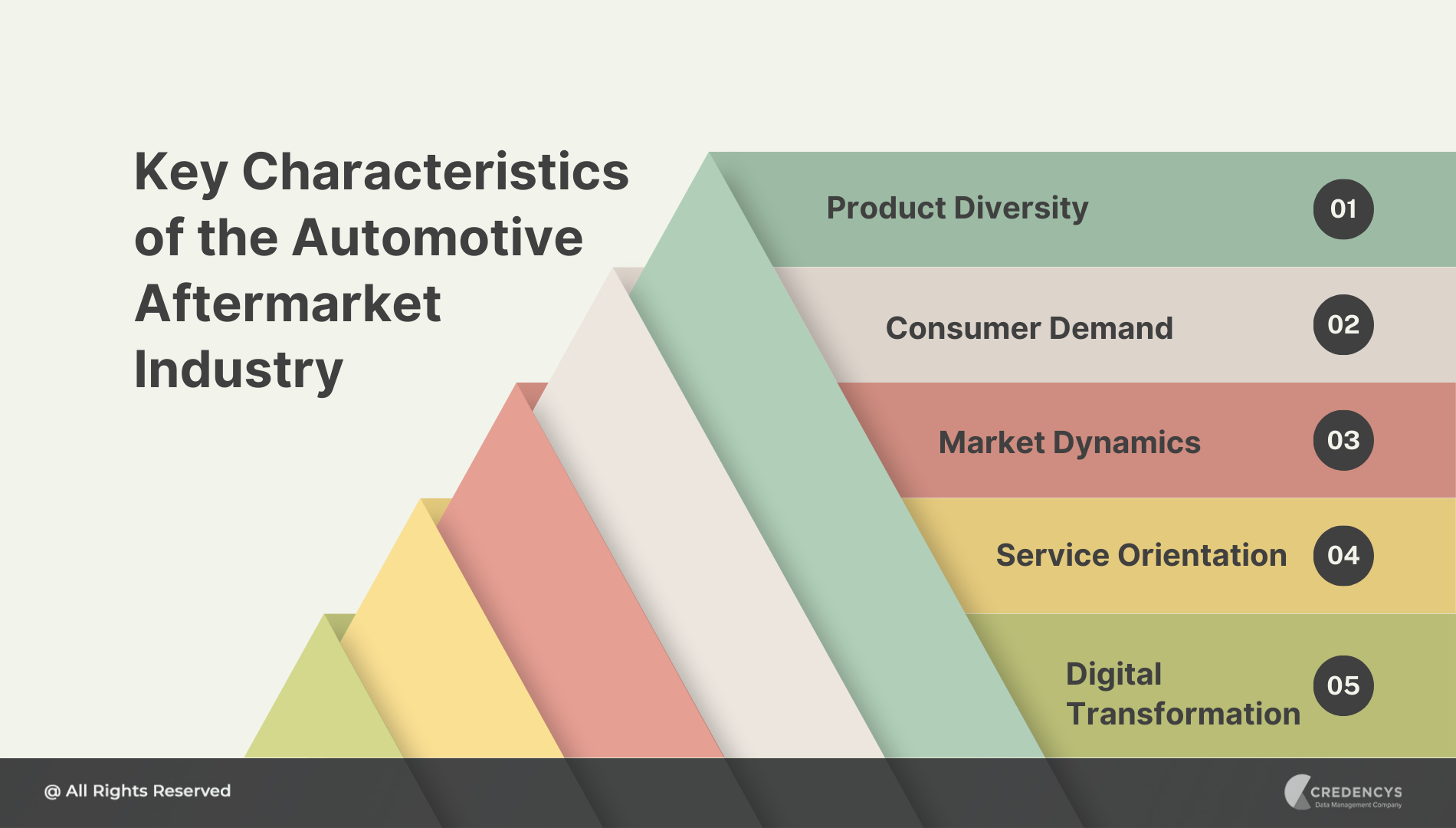
Key Characteristics of the Automotive Aftermarket Industry

1. Product Diversity

The aftermarket industry boasts a vast assortment of products, spanning from essential components like brakes, filters, and batteries to specialty accessories such as car audio systems, lighting upgrades, and cosmetic enhancements.

2. Consumer Demand

With an ever-growing vehicle population and a penchant for personalization, consumers seek aftermarket parts to customize their vehicles, enhance performance, and extend their lifespan.

3. Market Dynamics

The aftermarket landscape is dynamic, characterized by rapid technological advancements, evolving consumer preferences, and shifting regulatory requirements. This dynamic nature necessitates agility and adaptability among industry stakeholders.

4. Service Orientation

Beyond product sales, the aftermarket industry emphasizes service-oriented offerings, including installation, repair, maintenance, and technical support. These services play a vital role in ensuring customer satisfaction and loyalty.

5. Digital Transformation

In recent years, digitalization has significantly impacted the aftermarket industry, revolutionizing distribution channels, customer engagement strategies, and operational efficiencies. Automotive aftermarket e-commerce platforms, online marketplaces, and digital marketing techniques have reshaped the market landscape, offering new opportunities and challenges for businesses.

The automotive aftermarket industry is driven by innovation and technological advancements. Thus, understanding its intricacies and key characteristics is essential for stakeholders to navigate the evolving landscape and capitalize on emerging opportunities for growth and success.

Importance of Digital Transformation in the Automotive Aftermarket Industry

Digital transformation has become imperative for automotive aftermarket businesses to stay competitive and relevant in today’s rapidly evolving market space. Here’s why it holds paramount importance:
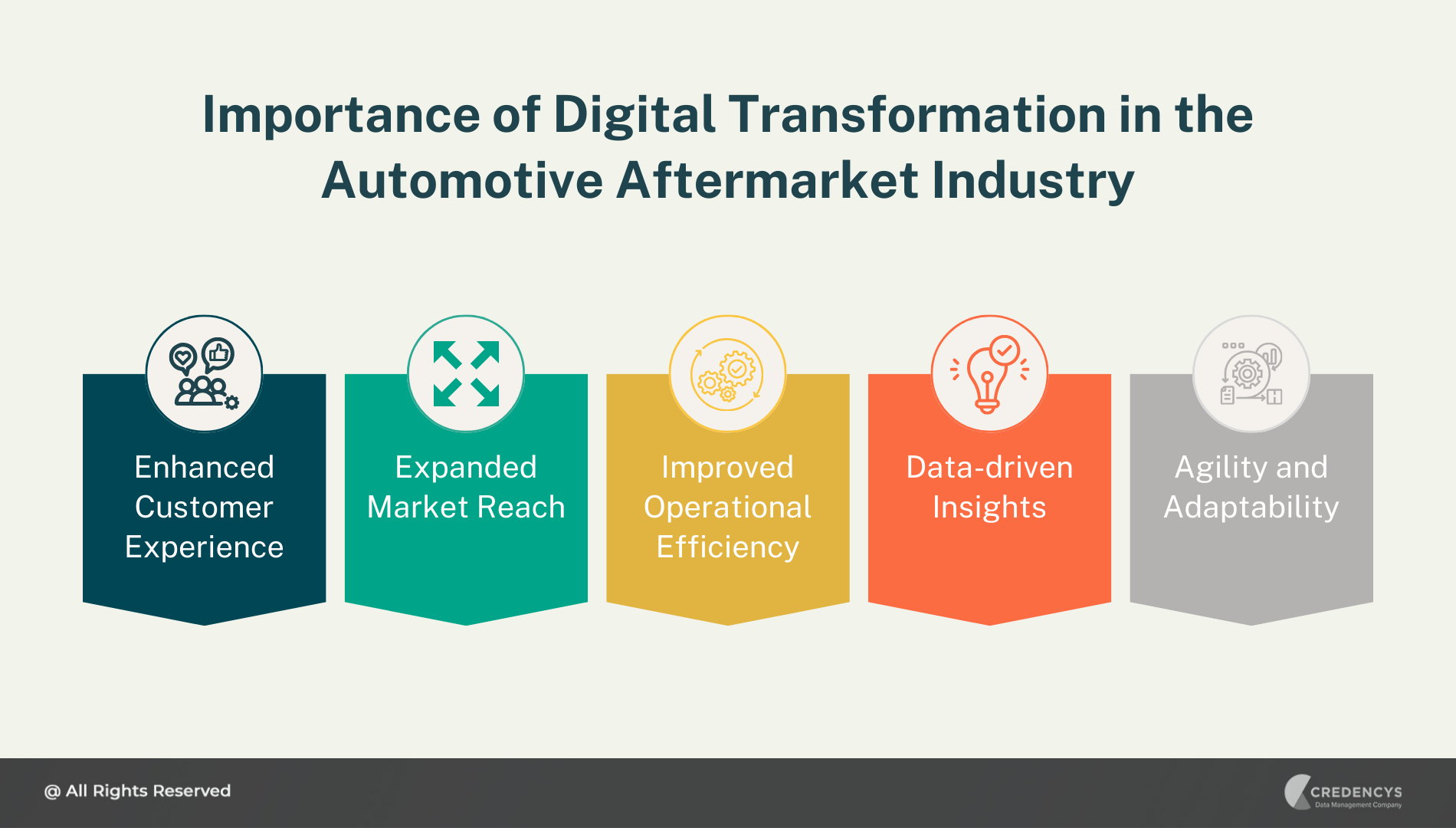
Importance of Digital Transformation in the Automotive Aftermarket Industry

1. Enhanced Customer Experience

Digital transformation enables businesses to offer seamless, personalized experiences to customers across various touchpoints, including online platforms, mobile apps, and social media channels.

By leveraging technologies like AI-driven recommendation engines and interactive interfaces, aftermarket companies can tailor their offerings to individual preferences, improve engagement, and foster customer loyalty.

2. Expanded Market Reach

Embracing digital channels allows automotive aftermarket businesses to transcend geographical boundaries and tap into global markets.

Online marketplaces, e-commerce platforms, and digital marketing strategies enable companies to reach a broader audience, driving sales and revenue growth beyond traditional brick-and-mortar establishments.

3. Improved Operational Efficiency

Digital tools and automation streamline internal processes, from inventory management and order fulfillment to customer service and supply chain operations.

Integrated software solutions, such as PIM systems and Enterprise Resource Planning (ERP) platforms, facilitate real-time data exchange, optimize resource allocation, and minimize manual errors, resulting in cost savings and operational excellence.

4. Data-driven Insights

Digital transformation empowers aftermarket businesses to harness the power of data analytics and business intelligence tools.

By capturing and analyzing customer behavior, market trends, and operational metrics, companies can gain valuable insights into consumer preferences, competitive landscapes, and emerging opportunities.

These insights inform strategic decision-making, product development initiatives, and marketing campaigns, driving innovation and competitive advantage.

5. Agility and Adaptability

In a rapidly changing industry, digital transformation enables aftermarket businesses to stay agile and responsive to market shifts, regulatory changes, and technological advancements.

Cloud-based solutions, flexible IT infrastructure, and scalable platforms empower companies to adapt quickly to evolving business requirements, seize new opportunities, and navigate challenges effectively.

Digital transformation is not just a trend but a strategic imperative for automotive aftermarket businesses seeking to thrive in today’s digital age. By embracing digital technologies, companies can elevate customer experiences, expand market reach, enhance operational efficiency, and unlock new avenues for growth and innovation.

Key Challenges Faced by Automotive Aftermarket Industry

Navigating the automotive aftermarket landscape presents unique challenges for businesses seeking to thrive in this dynamic industry. From fragmented data sources to complex supply chain dynamics, addressing these challenges requires strategic foresight and innovative solutions.

Key Challenges in the Automotive Aftermarket Industry

Let’s explore the key challenges automotive aftermarket businesses face and strategies to overcome them.

1. Fragmented Data Sources

Automotive aftermarket businesses often encounter challenges related to fragmented data sources, including data silos, inconsistent formats, and disparate systems. This fragmentation complicates data management processes, leading to inefficiencies, inaccuracies, and hindered decision-making.

2. Compatibility and Fitment Issues

Ensuring accurate compatibility and fitment information for automotive parts across a wide range of vehicle makes and models poses a significant challenge.

Managing and updating fitment data to reflect the latest vehicle specifications and aftermarket parts compatibility requires meticulous attention to detail and robust data management practices.

3. Data Accuracy and Integrity

Maintaining data accuracy and integrity is paramount in the automotive aftermarket industry. Errors or inconsistencies in product information, such as part numbers, specifications, and pricing, can lead to customer dissatisfaction, returns, and brand reputation damage.

Ensuring data accuracy and consistency across various channels and touchpoints is a persistent challenge for aftermarket businesses.

4. Complex Supply Chain Dynamics

Automotive aftermarket businesses operate within complex supply chain ecosystems involving multiple stakeholders, including manufacturers, distributors, retailers, and service providers.

Coordinating inventory management, order fulfillment, and logistics across the supply chain while navigating varying lead times, inventory levels, and demand fluctuations presents inherent challenges.

5. Regulatory Compliance

Compliance with industry regulations, ACES & PIES standards, and certifications is essential for automotive aftermarket businesses to ensure product quality, safety, and legal compliance.

Staying abreast of evolving regulatory requirements, such as environmental regulations, product labeling standards, and consumer protection laws, can be challenging, particularly for businesses operating in multiple jurisdictions.

6. Digital Transformation and Technology Adoption

Embracing digital transformation and adopting new technologies is critical for automotive aftermarket businesses to remain competitive in the digital age.

However, navigating the complexities of technology implementation, integration, and adoption while managing legacy systems and organizational resistance poses significant challenges for many businesses.

7. Customer Expectations and Demands

Meeting evolving customer expectations and demands for personalized experiences, seamless transactions, and exceptional service presents a continuous challenge for automotive aftermarket businesses.

Balancing product quality, pricing, and customer service while adapting to changing consumer preferences and market trends requires agility, innovation, and customer-centric strategies.

Automotive aftermarket businesses face a myriad of challenges. Businesses can address these challenges by leveraging collaborative partnerships with an experienced technology company, like Credencys, to drive innovation, efficiency, and competitiveness in the aftermarket industry.

The Role of PIM in Digitizing the Automotive Aftermarket Industry

As the automotive aftermarket industry embraces digital transformation, PIM emerges as a critical enabler of this digitization journey. Here’s how PIM plays a pivotal role in revolutionizing the automotive aftermarket landscape:

Role of PIM in Digitizing the Automotive Aftermarket Industry

1. Centralized Product Data Management

PIM serves as a centralized repository for managing vast volumes of product data, including part numbers, specifications, fitment details, pricing, and imagery.

By consolidating product information from diverse sources into a single platform, PIM streamlines data management processes, enhances data accuracy, and ensures consistency across channels.

2. Standardization of Product Information

With PIM, automotive aftermarket businesses can standardize product information according to industry standards such as ACES (Aftermarket Catalog Exchange Standard) and PIES (Product Information Exchange Standard).

By aligning product data with standardized formats and taxonomies, PIM facilitates seamless integration with trading partners, e-commerce platforms, and online marketplaces.

3. Enhanced Fitment Data Management

Fitment data, which specifies the compatibility of aftermarket parts with various vehicle makes and models, is crucial for automotive businesses.

PIM enables efficient management of fitment data by mapping parts to specific vehicles, maintaining accurate fitment details, and updating compatibility information in real-time. This ensures that customers receive precise fitment recommendations, reducing returns and enhancing satisfaction.

4. Improved Product Discoverability and Searchability

In the digital realm, product discoverability and searchability are paramount for automotive aftermarket businesses. PIM optimizes product data for online search engines, enhances metadata and attributes, and enriches product descriptions with keywords and tags.

This improves product visibility, increases search engine rankings, and drives traffic to e-commerce websites and online catalogs.

5. Seamless Omnichannel Experiences

PIM enables automotive aftermarket businesses to deliver seamless omnichannel experiences to customers across various touchpoints, including websites, mobile apps, social media platforms, and brick-and-mortar stores.

By synchronizing product data across channels, PIM ensures consistency in product information, pricing, and availability, regardless of the customer’s preferred shopping channel.

6. Agile Product Lifecycle Management

PIM facilitates agile product lifecycle management by streamlining processes such as new product introductions, updates, and retirements.

With PIM implementation, automotive aftermarket businesses can efficiently manage product variants, track inventory levels, and respond quickly to market demands and trends, driving innovation and competitiveness.

PIM plays a pivotal role in digitizing the automotive aftermarket industry by empowering their varied business operations. As automotive businesses embrace digital transformation, PIM emerges as a strategic asset for driving efficiency, innovation, and growth in the aftermarket ecosystem.

How PIM Addresses Challenges Specific to the Automotive Aftermarket Industry?

PIM serves as a powerful solution for overcoming the unique challenges faced by the automotive aftermarket industry. Here’s how PIM addresses these challenges:

How Does PIM Address Challenges Specific to the Automotive Aftermarket Industry

1. Single Source of Truth

Automotive aftermarket businesses often encounter fragmented data from various suppliers, manufacturers, and distributors. PIM consolidates and centralizes this data, providing a single source of truth for product information.

By harmonizing disparate data sources, PIM streamlines operations and ensures consistency across the entire supply chain.

2. Compatibility and Fitment

Precise fitment data is essential in the automotive aftermarket to ensure compatibility between parts and vehicles.

PIM facilitates accurate mapping of parts to specific vehicle models, enabling businesses to provide reliable fitment information to customers. By addressing compatibility challenges, PIM enhances customer satisfaction and reduces returns.

3. Data Syndication Across Channels

Distributing product data across multiple online channels and marketplaces can be complex and time-consuming. PIM automates data syndication processes, enabling businesses to efficiently publish product information to various output channels.

With PIM, businesses can ensure consistency and accuracy in product listings across all digital touchpoints.

4. Regulatory Compliance Requirements

The automotive aftermarket industry is subject to various regulations and standards governing product specifications, warranties, and safety requirements.

PIM helps businesses stay compliant by providing tools for managing regulatory data and ensuring that product information meets industry standards. By maintaining regulatory compliance, businesses can mitigate risks and build trust with customers.

5. Integration with Industry Standards

PIM solution seamlessly integrates with industry standards such as ACES and PIES. By aligning product data with these standards, PIM enables businesses to exchange information with trading partners and online platforms efficiently. This interoperability enhances data accuracy and facilitates collaboration within the aftermarket ecosystem.

PIM tackles automotive aftermarket challenges with its advanced capabilities. With PIM, businesses streamline operations, enhance customer experiences, and fuel growth in the digital marketplace.

Impact of PIM on Automotive Aftermarket Business Operations

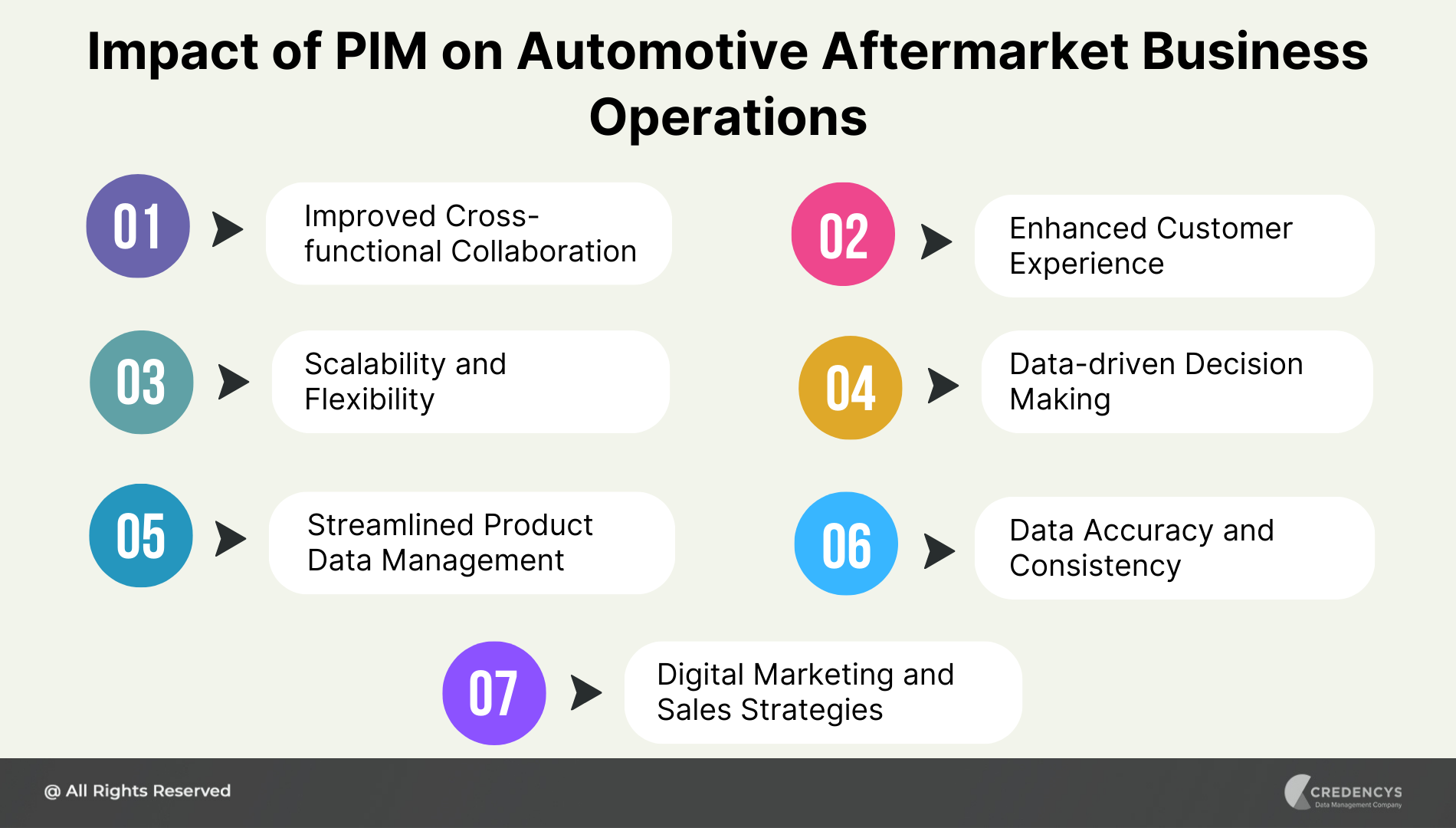
PIM has a profound impact on the operations of automotive aftermarket businesses, revolutionizing the way they manage and distribute product data. Here’s how PIM transforms various aspects of business operations:
Impact of PIM on Automotive Aftermarket Business Operations

1. Improved Cross-functional Collaboration

Leverage seamless communication and collaboration among different departments using PIM as it provides a centralized platform for product data management. This ensures that all stakeholders have access to accurate and consistent product information, leading to more effective decision-making and streamlined workflows.

2. Enhanced Customer Experience

Guaranteeing precision, depth, and seamless accessibility across all sales and marketing channels, PIM ensures product information is accurate and comprehensive. This encompasses detailed product descriptions, precise fitment data, and real-time pricing and availability updates, fostering heightened customer satisfaction and unwavering loyalty.

3. Scalability and Flexibility

Facilitating scalability and flexibility, PIM equips businesses with the agility to expand operations and pivot in response to evolving market dynamics.

Whether broadening product lines, venturing into new markets, or integrating with additional sales channels, PIM furnishes the foundational framework necessary to accommodate growth and diversification initiatives seamlessly.

4. Data-driven Decision Making

By offering analytical insights into product performance, customer behavior, and market trends, PIM empowers businesses to make informed, data-driven decisions.

Leveraging robust analytics and reporting functionalities, PIM facilitates the analysis of sales data, monitoring of product performance metrics, and identification of optimization opportunities, driving continual improvement and strategic refinement.

5. Streamlined Product Data Management Processes

By centralizing and automating product data management processes, PIM optimizes efficiency while minimizing errors. Businesses benefit from streamlined organization, categorization, and updating of product information, thereby maintaining consistency across diverse sales channels.

6. Enhancing Data Accuracy and Consistency

Functioning as the ultimate authority for product information, PIM guarantees standardized attributes and real-time updates on pricing and availability. Through the enforcement of data validation rules and workflows, PIM upholds data integrity, fostering trust and confidence among customers.

7. Enabling Efficient Digital Marketing and Sales Strategies

PIM provides tools for product enrichment, segmentation, and targeting, enabling businesses to create personalized catalogs and tailor marketing campaigns. By optimizing product listings for search engines and online marketplaces, businesses can reach their target audience effectively and drive sales growth.

PIM revolutionizes automotive aftermarket operations by centralizing data, enhancing accuracy, and streamlining cross-channel syndication. It enables agile product management and seamless integration with industry standards. Leveraging PIM solutions boosts efficiency, fuels growth, and ensures exceptional customer experiences in the digital era.

Rough Country – An Example of Automotive Aftermarket Business Leveraging PIM for Digitization

Credencys developed a tailored Product Information Management (PIM) solution for Rough Country, a leading automotive parts manufacturer.

By centralizing product, asset, and ACES data, the PIM system streamlined operations across sales and marketing teams. Integration with ERP and Digital Asset Management (DAM) facilitated seamless data management, while automation reduced manual tasks and enhanced efficiency.

The solution ensured accurate compatibility mapping and improved data governance, resulting in faster operations, improved customer experience, and increased employee efficiency.

Overall, the PIM solution transformed Rough Country’s data-driven processes, driving significant business benefits and enhancing customer satisfaction.

Explore Case Study: Credencys engineered a PIM solution for Rough Country, an automotive parts manufacturer, that improves operational efficiency.

Final Thoughts

In the dynamic landscape of automotive aftermarket business, embracing innovation is key to staying ahead. Credencys offers tailored PIM solutions designed to address the unique challenges of the industry.

With centralized data management, enhanced efficiency, and improved customer experiences, PIM solutions pave the way for sustainable growth.

Take the next step towards success by exploring PIM solutions with Credencys PIM experts today. Accelerate your journey towards excellence in the automotive aftermarket business.

Success Stories: Credencys’ Top 5 Case Studies

In today’s competitive landscape, efficient management of product information is essential for businesses to thrive. Credencys has been at the forefront of empowering organizations with robust Product Information Management (PIM) solutions tailored to their unique needs.

In this blog, we’re excited to share a collection of five case studies illuminating various aspects of Credencys’ expertise. These stories not only illustrate our reach across diverse industries but also underscore the transformative impact of PIM solutions on global businesses. If you’re interested in expert guidance, don’t hesitate to reach out to us directly – we’re here to assist you every step of the way!

So grab your cup of coffee while we get started on our top five success stories!

Rough Country

Since 1975, Rough Country has excelled in producing and distributing branded aftermarket automotive products, including suspension systems, lift kits, and accessories for trucks and SUVs, marketed through various channels such as Magento-based eCommerce, Amazon, and a dealer network.

PIM case studies

They faced inefficiencies in managing product data, assets, and the ACES database across multiple systems. Manual processes for product data syndication and fitment management led to poor data quality and slowed operations.

Credencys implemented a robust Product Information Management (PIM) solution, integrating ERP, DAM, and the ACES database, helping them to:

  • Manage products, assets, and ACES data from a single source of truth
  • Streamline the complex processes of data enrichment, data approval, and data validation with a workflow for the sales and marketing team
  • Integrate the ACES database seamlessly

Read the case study in detail here.

Light Manufacturing Company

A leading manufacturer of lighting products selling through eCommerce and physical stores, managing product data from 300+ vendors. They sell a comprehensive selection of more than 100K lighting products belonging to different categories such as Bath Collections, Chandelier Collections, Close-To-Ceiling Collections, Lamps & Shades, LED Retrofit Kits, and so on.

Major challenges of the client were inconsistent data from vendors, scattered data management, and limitations of the Magento solution, which hindered effective product data management and distribution.

Credencys developed a comprehensive PIM platform, centralizing product data and integrating it with ERP, third-party plugins, and Magento.

  • Implementation of PIM and DAM to manage all the product data, inventory updates, and price changes of 300+ vendors in a single platform
  • Integration with ERP, Magento eCommerce store, third-party marketplace plugin, and customer reporting tools
  • Streamline the data management process and save a lot of time for their team for manual data management.

Explore the full case study for more details.

Kenmare

Kenmare, headquartered in Ireland, is a leading mine manufacturer with operations spanning globally. They have a large unit in Mozambique, Africa, known for its vast titanium mineral deposits. Renowned for supplying major mineral sand products like Zircon, Rutile, and Ilmenite, they serve a diverse customer base across 15+ countries.

The client faced challenges with sharing product information stored in their ERP system, SYSPRO, requiring manual conversion of CSV files for distribution. They aimed to streamline data accessibility for users and automate catalog management processes, reducing manual intervention and validation efforts.

Credencys created a Pimcore-based web portal and admin panel, enabling easy management of the client’s diverse product range through various PIM capabilities including MDM, CDM, DAM, and web content management.

  • Streamline their complex process of change request validation and implementation with the automated workflow for Request of Correction
  • Manage complicated product information validation process seamlessly
  • Bi-direction data synchronization between SYSPRO ERP and PIM solution-based web and admin portals

Click here to read the full case study.

IronList

IronList is a rapidly growing online sales and auction aggregator platform for used heavy equipment and machinery. They serve various sectors globally, including construction, transportation, agriculture, energy, oil and gas, mining, and forestry. They offer the best search and discovery platform in the fragmented heavy equipment and machinery industry, catering to diverse users such as vendors, contractors, pipeline companies, and construction firms.

The client’s core business is importing and exporting heavy equipment and machinery, catering to a global customer base. With connections to numerous suppliers, they sought to create a data aggregator platform to manage product, supplier, and customer data alongside content.

Credencys developed a data aggregate solution for the client using a PIM solution.

  • Custom web portal for the client using Product Information Management, Digital Asset Management, Digital Experience Platform, and Customer Data Platform
  • Manage a large volume and variety of product data efficiently in a centralized location.
  • Time-to-market product improved significantly

Read the complete case study here

Tractmotor

Established in 1975, Tractmotor Parts (M) SDN BHD is a leading Malaysia-based company. They specialize in agriculture, machinery, construction, and manufacturing parts. It is supported by global manufacturers and suppliers, positioning itself as an industry leader.

They faced challenges managing scattered automobile spare parts data, impacting sales and customer communication. Lack of synchronization between account and inventory systems led to inefficiencies. Manual catalog updates hindered sales team productivity. Inaccurate product information and disparate data affected decision-making. A centralized data repository and streamlined processes were needed for improved efficiency.

Credencys developed and implemented a web-based digital platform for Tractmotor using Product Information Management (PIM), Digital Asset Management (DAM), and Digital Commerce capabilities of Pimcore.

  • Manage the products, media, and commerce-related activities from a single platform.
  • Enrich their product information and improve product data quality by managing and aggregating the product data and relevant media assets.
  • Manage different price levels for different products for different clients accurately.

Explore the full case study here. 

We’re Obsessed with Product Data Management

These case studies demonstrate the transformative impact of PIM solutions in overcoming data management challenges and driving business growth. By partnering with Credencys, businesses can unlock operational efficiencies, improve data quality, and deliver superior customer experiences.

Across diverse industries, we are passionate about using the power of data solutions to empower your business. Connect with our certified PIM expert to explore more about our expertise and how we can help you.

Syndigo PIM – A Game Changer for Modern Businesses

In the fast-paced realm of eCommerce, marked by intense competition and constantly shifting consumer expectations, the importance of efficient product information management is huge. Serving as the linchpin for thriving online retail operations, PIM functions as a central hub, orchestrating the organization, enrichment, and distribution of crucial product data.

It provides a structured framework for managing and enhancing the information associated with each product.

  • Consistency: PIM ensures consistency in product information across all channels, preventing discrepancies that could confuse or deter potential customers. Consistent data fosters trust and credibility in the eyes of consumers.
  • Accuracy: By centralizing product information, PIM reduces the likelihood of errors caused by manual data entry or updates. Accurate and reliable product data is crucial for providing customers with the information they need to make informed purchasing decisions.
  • Efficiency: PIM streamlines workflows by providing a single platform for managing product information. This efficiency not only saves time but also allows businesses to adapt quickly to market changes and updates.
  • Enrichment: PIM enables businesses to enrich product data with additional information such as images, videos, specifications, and marketing content. This enriched data enhances the overall product presentation and creates a more engaging and informative shopping experience.
  • Adaptability: As businesses expand and diversify their product offerings, PIM ensures scalability and adaptability. It provides a flexible infrastructure that can accommodate new products, attributes, and channels without compromising data integrity.

In the absence of a robust PIM solution, businesses often grapple with challenges such as data inconsistency, errors, and delays in updating product information across multiple channels. This not only hampers the customer experience but can also lead to missed sales opportunities and increased operational costs.

Syndigo’s PIM module emerges as a game-changer in this context, offering businesses a comprehensive toolkit to tackle these challenges head-on. By providing a centralized repository for all product information, Syndigo’s PIM module becomes the cornerstone for maintaining data accuracy, facilitating collaboration among teams, and ensuring seamless integration with various e-commerce platforms.

Overview of Syndigo

Syndigo stands at the forefront of providing innovative solutions for businesses in the realm of product information management. As a leading global provider, Syndigo empowers companies to excel in the competitive eCommerce landscape by offering a comprehensive suite of tools designed to streamline and optimize the way they manage and distribute product information.

Syndigo’s commitment to excellence is reflected in its cutting-edge technologies, which are tailored to meet the diverse needs of businesses across various industries. From data enrichment to digital asset management, Syndigo’s solutions are crafted to enhance the efficiency of product information workflows, ultimately enabling businesses to deliver accurate, consistent, and compelling product content to their customers.

What is Syndigo – A Comprehensive Guide

Key Features and Capabilities of Syndigo PIM

1. Data Enrichment and Quality Control

Enhancing product data is a pivotal aspect of Syndigo’s PIM solution. It allows businesses to enrich their product information with additional details such as images, videos, specifications, and marketing content.

The module also incorporates robust quality control mechanisms to ensure that the data remains accurate, consistent, and adheres to predefined standards.

2. Integration Capabilities

Understanding the diverse technology landscapes of businesses, Syndigo’s PIM module offers seamless integration capabilities with various eCommerce platforms, content management systems, and other essential business applications. This ensures that businesses can leverage Syndigo’s PIM module as part of their existing infrastructure, promoting a cohesive and integrated ecosystem.

3. Workflow Automation

Syndigo’s PIM module streamlines and automates critical workflows associated with product information management. From data input to approval processes, automation reduces manual errors, accelerates time-to-market, and enhances overall operational efficiency.

This feature is particularly beneficial for businesses dealing with a high volume of products and frequent updates.

4. Centralized Product Data Management

Syndigo’s PIM module provides businesses with a centralized hub to aggregate and manage all aspects of product data. This centralized repository ensures that accurate and up-to-date information is readily accessible to all stakeholders, facilitating collaboration and maintaining consistency across various channels.

5. Digital Asset Management

Recognizing the importance of visual content in eCommerce, Syndigo’s PIM module includes advanced digital asset management capabilities. Businesses can efficiently organize, store, and retrieve multimedia assets, such as images and videos, ensuring a compelling and consistent visual presentation across online platforms.

Key Features and Capabilities of Syndigo PIM

Syndigo’s PIM module, through its innovative features and capabilities, addresses the multifaceted challenges of product information management. Whether it’s centralizing data, ensuring its quality, or automating workflows, Syndigo’s PIM module equips businesses with a robust toolkit to not only meet but exceed the expectations of the modern eCommerce landscape.

Benefits of Syndigo’s PIM Module

Syndigo’s PIM module extends a multitude of benefits to businesses, addressing key challenges associated with product information management. By leveraging this innovative solution, organizations can elevate their operations and deliver a superior experience to both internal teams and customers.

1. Enhanced Collaboration and Workflow Efficiency

Syndigo’s PIM module acts as a catalyst for improved collaboration among teams involved in the product information management process. Through centralized access, teams can seamlessly collaborate on data enrichment, updates, and approvals.

The workflow efficiency is further amplified by automation features, reducing the time and effort required to manage product information. This collaborative and efficient approach contributes to faster time-to-market for new products or updates.

2. Streamlined Product Content Syndication

Syndigo’s PIM module excels in streamlining product content syndication, ensuring that the right product information reaches the right channels seamlessly. Through integrated syndication capabilities, businesses can effortlessly distribute consistent and enriched product data to various eCommerce platforms, marketplaces, and other digital channels.

This not only expands the reach of products but also enhances the overall online presence and visibility, driving potential sales.

3. Improved Data Accuracy and Consistency

One of the primary advantages of Syndigo’s PIM module is the significant enhancement of data accuracy and consistency. By centralizing product information, businesses can mitigate the risks of errors stemming from manual data entry or disparate data sources.

This results in a single, reliable source of truth that ensures consistent and accurate product data across all channels, fostering trust among consumers.

4. Time and Cost Savings in Managing Product Information

The streamlined workflows and automation embedded in Syndigo’s PIM module translate directly into tangible time and cost savings for businesses. The reduction in manual efforts, data discrepancies, and the need for constant corrections not only accelerates operational processes but also minimizes the associated costs.

Businesses can allocate resources more strategically, focusing on value-added tasks rather than routine data management.

The cumulative impact of these benefits positions Syndigo’s PIM module as a transformative tool for businesses seeking to optimize their product information management processes. As organizations embrace the advantages of improved accuracy, collaboration, efficiency, and streamlined syndication, they are better equipped to navigate the complexities of the eCommerce landscape and stay ahead in the competitive market.

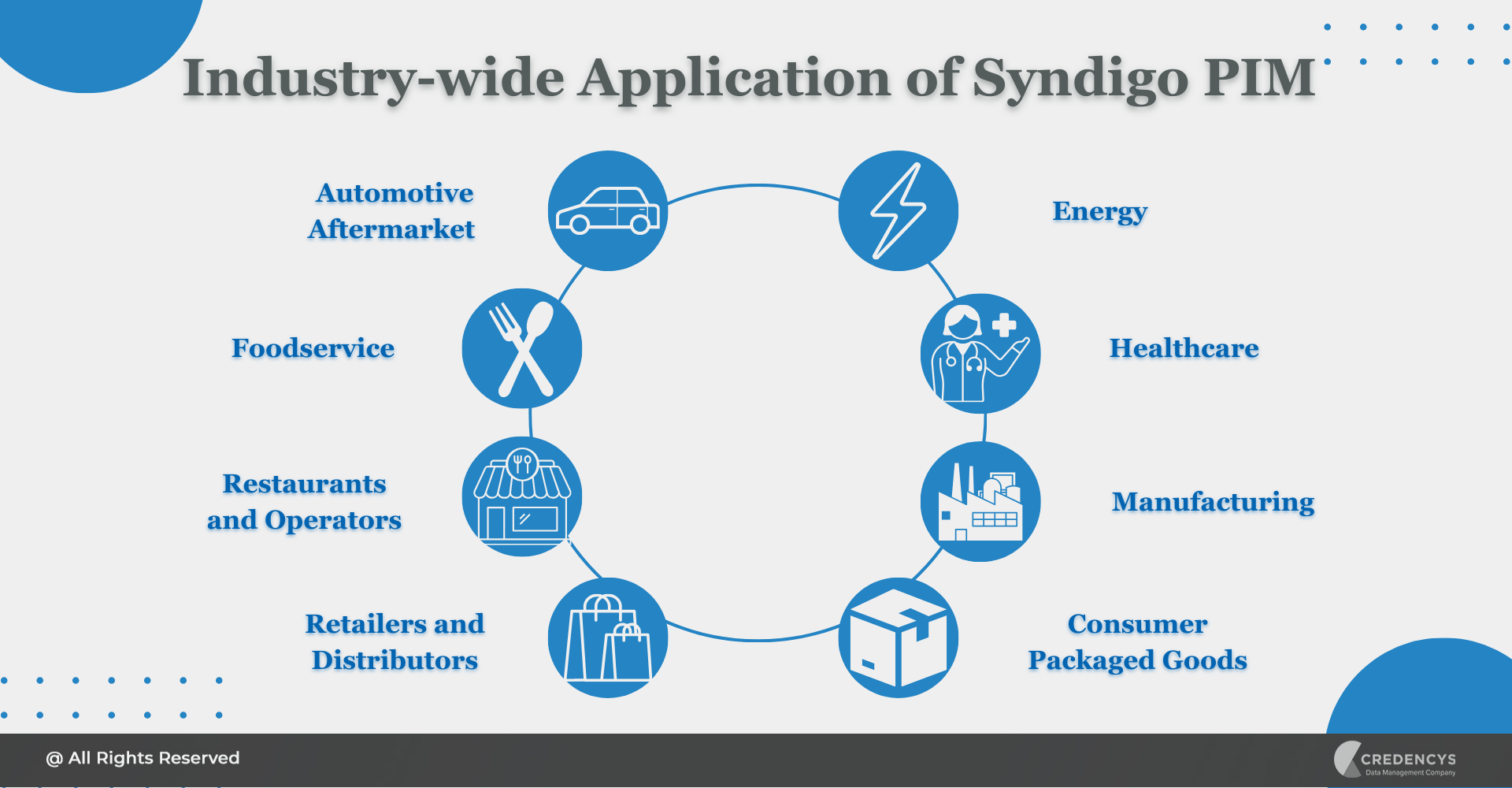
Industry-wide Application of Syndigo PIM

Let’s explore how Syndigo PIM is beneficial for businesses in various industries.

1. Automotive Aftermarket

Syndigo’s PIM module assists automotive aftermarket businesses in managing extensive product catalogs. It ensures that accurate product details, fitment information, and compatibility data are readily available.

This is essential for providing a seamless online shopping experience for customers looking for specific automotive parts.

How Does PIM Empower Your Automotive Aftermarket eCommerce Journey?

2. Foodservice

In the foodservice industry, compliance with regulatory standards is crucial. Syndigo’s PIM module enables businesses to manage and communicate accurate nutritional information, ingredient lists, and allergen details.

This ensures compliance with food safety regulations and builds trust with consumers.

3. Restaurants and Operators

For restaurants and operators, managing menu items, pricing, and nutritional information is crucial. Syndigo’s PIM module aids in efficient menu management, enabling quick updates, accurate pricing, and the addition of rich media content to enhance the presentation of dishes.

4. Retailers and Distributors

Retailers and distributors benefit from Syndigo’s PIM module by streamlining product information workflows. This leads to improved collaboration, reduced time-to-market for new products, and a more efficient process for updating and managing product data across diverse channels.

5. Energy

In the energy sector, where technical specifications are critical, Syndigo’s PIM module supports the centralization of detailed product information. This includes specifications for equipment, machinery, and technical components, ensuring accurate communication of product features and capabilities.

6. Healthcare

Healthcare businesses deal with complex product information, including medical devices and pharmaceuticals. Syndigo’s PIM module helps manage and disseminate critical product data while ensuring compliance with regulatory standards, making it easier to meet industry-specific requirements.

7. Manufacturing

Syndigo’s PIM module helps manufacturing businesses centralize and manage vast amounts of product data, including specifications, dimensions, and materials. This ensures consistency in product information across all channels, facilitating better collaboration among teams.

8. Consumer Packaged Goods (CPG)

CPG companies rely on brand consistency for consumer recognition. Syndigo’s PIM module helps maintain consistency in product information, packaging details, and marketing content across various retail channels, contributing to a unified brand image.

Industry-wide Application of Syndigo PIM

In summary, Syndigo’s solutions offer industry-specific features and capabilities by addressing the unique challenges each sector faces in managing and disseminating product information. The centralization, efficiency, and accuracy provided by Syndigo’s PIM module contribute to improved operations, enhanced customer experiences, and increased competitiveness in these diverse industries.

Steps to Implement Syndigo’s PIM Module

Implementing Syndigo’s PIM module is a strategic process that involves careful planning, collaboration, and customization to align with the specific needs of a business. Here are the key steps in implementing Syndigo’s PIM module:

1. Assessment and Planning

Conduct a comprehensive assessment of the current state of product information management within the organization. Define specific goals and objectives for implementing the PIM module, considering factors such as data accuracy, workflow efficiency, and syndication needs.

2. Customization and Configuration

Customize the PIM module to align with the unique requirements of the business. This includes configuring data fields, workflows, and user roles to match the organization’s structure and processes.

3. Data Migration

Migrate existing product data into the PIM module, ensuring a smooth transition. This involves cleansing and organizing data to meet the standards set by the business and Syndigo’s PIM system.

4. User Training

Provide comprehensive training to users who will interact with the PIM module. This includes instruction on data input, enrichment processes, and utilizing automation features to optimize workflow efficiency.

5. Testing and Quality Assurance

Conduct thorough testing to ensure that the PIM module functions as intended. This includes testing data accuracy, workflow automation, and integration with other systems.

6. Go-Live and Monitoring

Launch the PIM module across the organization, monitoring its performance and addressing any issues that may arise during the initial phases of implementation.

Establish a feedback loop to continuously refine and optimize the system based on user experiences and evolving business needs.

Key Considerations While Integrating Syndigo’s PIM with Existing Systems and Software

Syndigo’s PIM module is designed to seamlessly integrate with a variety of existing systems and software, enhancing its versatility and adaptability. The integration process involves the following key considerations:

1. Identify Integration Points

Assess the existing technology ecosystem and identify the systems that need to integrate with Syndigo’s PIM module. This may include eCommerce platforms, ERP systems, content management systems, and more.

2. API Integration

Leverage Syndigo’s robust APIs to facilitate smooth integration with other systems. APIs enable real-time data exchange and synchronization, ensuring that information is consistently updated across all connected platforms.

3. Customization for Compatibility

Customize integration parameters to ensure compatibility with existing software. Syndigo’s PIM module offers flexibility to adapt to different data formats, protocols, and communication standards.

4. Data Mapping and Transformation

Define data mapping and transformation rules to ensure that data flows seamlessly between Syndigo’s PIM module and other integrated systems. This is crucial for maintaining consistency and accuracy in information exchange.

5. Testing Integration

Conduct thorough testing to verify the effectiveness of integration. Test data flow, data consistency, and system behavior under various scenarios to identify and address any potential issues.

6. Continuous Monitoring and Optimization

Implement monitoring tools to track the performance of integrations in real time. Regularly assess and optimize integration processes to accommodate changes in business requirements or technology updates.

Considerations While Integrating Syndigo’s PIM with Existing Software

By following these steps, businesses can ensure a successful implementation of Syndigo’s PIM module and seamless integration with their existing systems, unlocking the full potential of the platform to enhance product information management and overall operational efficiency.

Credencys – A Trusted Syndigo PIM Implementation Partner

Credencys Solutions is a seasoned and reliable Syndigo PIM implementation partner dedicated to transforming the digital landscape. Credencys’ deep understanding of Syndigo’s innovative PIM module and its proficiency in seamless integrations positions Credencys as the ideal implementation partner for businesses aspiring to optimize their product data workflows.

From the initial assessment of your unique business requirements to the meticulous customization of Syndigo’s PIM module, the team at Credencys is committed to tailoring solutions that resonate with businesses’ specific needs. Credencys doesn’t just implement; it collaborates to enhance your operational efficiency, ensuring that Syndigo’s PIM module becomes a catalyst for accuracy, consistency, and streamlined workflows.

Closing Thoughts

Syndigo’s PIM module emerges as a game-changing solution for businesses seeking to excel in the intricate realm of eCommerce product information management. From its intuitive user interface to robust features like centralized data management, enrichment capabilities, and workflow automation, Syndigo’s PIM module offers a comprehensive toolkit to meet the diverse needs of industries ranging from manufacturing to healthcare.

As the eCommerce landscape continues to evolve, the strategic implementation of Syndigo’s PIM, facilitated by Credencys, not only meets but exceeds the demands of the dynamic market, ensuring businesses stay ahead in the competitive arena. Embrace this transformative journey, elevate your product information management practices, and thrive in the digital age with Syndigo and Credencys by your side.

Pimcore PIM – A Comprehensive Guide

In the contemporary marketplace, where consumers interact with products through diverse channels such as eCommerce platforms, mobile applications, and physical stores, the significance of PIM cannot be overstated. PIM serves as the linchpin for organizations seeking to create a consistent and engaging customer experience by effectively managing the vast array of product data.

A PIM helps businesses in the following ways:

  • Data Consistency and Accuracy: PIM addresses the challenge of maintaining consistent and accurate product information across multiple touchpoints. It acts as a central repository where businesses can define and manage standardized product attributes, ensuring that information presented to customers is uniform and error-free.
  • Time and Cost Efficiency: PIM streamlines the process of updating, modifying, or expanding product catalogs. With centralized control, organizations can reduce the time and resources spent on manual data entry and rectifying inconsistencies, leading to increased operational efficiency and cost savings.
  • Multichannel Commerce: As businesses expand their presence across various sales channels, PIM becomes indispensable for managing product data tailored to each platform’s requirements. This adaptability enables seamless integration with eCommerce systems, marketplaces, and other distribution channels.
  • Enhanced Customer Experience: Consistent and accurate product information enhances customer experience. Whether online or offline, customers can access reliable information about products, fostering trust and loyalty.

How can Businesses Benefit from PIM?

  • Data Transparency: The availability of transparent and high-quality product information for internal and external stakeholders allows for faster processes and more satisfaction.
  • Elimination of Data Silos: Product data scattered in different corporate silos leads to deficits in the quantity and quality of product data.
  • Acceleration of Digitalization: Central and consolidated product data management ensures consistent data supply and accelerates processes.
  • Data Quality: Consolidated and aggregated product information leads to better workflows and higher data quality.

Top 15 Benefits of Product Information Management (PIM) for Your Business

Overview of Pimcore as a PIM Solution

Pimcore, a comprehensive and flexible PIM solution, emerges as a key player in facilitating the streamlined handling of product-related data. Pimcore stands out as an open-source, centralized platform designed to holistically manage product information throughout its lifecycle.

Its PIM module is a robust and versatile tool that enables organizations to efficiently gather, organize, enrich, and distribute product data across various channels. By providing a unified repository for product information, Pimcore empowers businesses to maintain consistency, accuracy, and relevance in their product offerings.

What is Pimcore and the Benefits of Pimcore

Pimcore’s Application Across Industries

As a dynamic and versatile solution, Pimcore transcends industry boundaries, bringing a unified approach to diverse sectors.

Application of Pimcore PIM Across Industries

Why Should Businesses Consider Using Pimcore PIM?

1. Efficient Workflows and Quality Assurance

Pimcore goes beyond data management; it takes charge of critical aspects like workflows, reporting, auditing, and quality management associated with product information. This comprehensive approach ensures that the product data is not only organized but also meets the highest standards of accuracy and reliability.

2. Versatility in Action

Pimcore empowers users to accomplish a multitude of tasks with ease. From centralizing and harmonizing data to managing, translating, and publishing marketing, sales, and technical product information, Pimcore serves as a comprehensive solution for diverse needs.

3. Central Content Hub and Collaborative Sharing

Pimcore serves as a centralized hub for product information, making it easily accessible for both internal and external teams. This collaborative approach ensures that information is shared seamlessly across departments, fostering efficient communication and collaboration.

4. Leading the PIM Landscape

Pimcore PIM stands at the forefront as the premier Enterprise Open-Source solution for product information management. It has established itself as a leader in this domain, offering robust features and capabilities.

5. Seamless Data Delivery

Pimcore excels in delivering precise product information to an extensive network of over 2,500 marketing and sales channels. This capability ensures that businesses can effectively reach their target audiences with accurate and up-to-date product details.

6. Integration Excellence with IT Systems

Pimcore seamlessly integrates with existing IT system landscapes, ensuring a harmonious coexistence within the organization’s technological ecosystem. This adaptability streamlines processes and enhances overall efficiency in managing product information.

Diverse Data Types Managed by Pimcore PIM

Pimcore proficiently handles a spectrum of data types, from product information and vendor data to customer profiles and more. Here is a visual representation of the extensive data landscape Pimcore seamlessly manages, empowering businesses with a unified and holistic approach to data management.

Diverse Data Types Managed by Pimcore

Key Characteristics of Pimcore PIM

1. Lowest Cost of Ownership

The Community Edition of Pimcore is available for free, eliminating any license costs. For those seeking additional support and access to certified extensions, there’s the option of an Enterprise Subscription, ensuring 24/7 support services at the lowest total cost of ownership.

2. Tailored to Your Strategy

Pimcore is not a one-size-fits-all solution. It fully adapts to the unique digital strategy of your enterprise, offering seamless integration into your existing IT landscape. This flexibility empowers businesses to tailor the platform to their specific requirements.

3. Open-Source Technology

Pimcore operates on the principles of open-source technology, embracing open standards and maintaining a transparent roadmap. Powered by the latest technology, it thrives on a global community of contributors, fostering rapid innovation through decentralized development.

4. Developer-Friendly Framework

Pimcore is crafted to be developer-friendly, efficiently addressing the challenges of Enterprise Digital Transformation Projects. It offers a stable and tested framework, providing developers with the tools they need to navigate and implement solutions effectively.

5. Intelligent System Architecture

Built on a fully API-driven system architecture, Pimcore actively enhances processes and automates workflows, ensuring an unparalleled time-to-market. This smart architecture is designed to adapt seamlessly to the evolving needs of businesses.

6. IP Protection without Vendor Lock-in

Pimcore prioritizes the protection of your intellectual property. It provides a platform that allows you to use, develop, and own your solutions independently, avoiding any vendor lock-in commonly associated with proprietary software.

Features of Pimcore PIM

Pimcore offers a robust set of features making it a comprehensive and powerful solution for businesses seeking efficient and flexible Product Information Management.

1. Localization and Translation

Pimcore’s robust Localization and Translation features play a pivotal role in empowering businesses to reach a global audience by facilitating the seamless adaptation of product information into multiple languages. This capability not only addresses the linguistic diversity of customers but also ensures a tailored and culturally relevant presentation of product content across different regions.

2. Product Relationship Management

Pimcore’s Product Relationship Management is a powerful feature that allows businesses to navigate the intricacies of their product landscape by efficiently managing complex relationships between different products, variations, and configurations. This capability is essential for businesses dealing with diverse product offerings, ensuring a cohesive and well-organized representation of their entire product portfolio.

3. Customizable Data Modeling

One of the standout features of Pimcore is its robust capability for customizable data modeling, providing businesses with the flexibility to tailor their product information structures according to their unique requirements. This feature plays a pivotal role in adapting Pimcore to diverse industries, varied product offerings, and evolving business strategies.

4. Developer-Friendly Framework

Pimcore stands out as a powerful PIM solution not just for its robust features but also for its commitment to being a developer-friendly framework. This characteristic is paramount in empowering developers to customize, extend, and innovate within the platform, contributing to a flexible and scalable solution for businesses.

5. Import and Export Functionality

Pimcore’s Import and Export functionality stands as a robust feature within its PIM system, providing businesses with powerful tools to facilitate the seamless movement of product data. This capability streamlines data operations, enhances efficiency, and supports a variety of file formats for versatile and efficient data exchange.

6. Multi-Channel Publishing

Multichannel publishing is a critical feature within Pimcore’s PIM system, offering businesses the capability to efficiently distribute product information across diverse channels. This functionality is instrumental in maintaining a consistent and coherent brand message across various touchpoints, ultimately enhancing the customer experience and streamlining marketing efforts.

How to Succeed in Multi-channel Marketing Using the PIM System?

7. Workflow Management

Workflow management is a pivotal component within Pimcore’s system, providing businesses with a structured and automated framework for handling the approval, modification, and publishing processes related to product information. This feature streamlines operations, enhances collaboration and ensures that product data undergoes a controlled and efficient lifecycle.

8. Reporting and Auditing

Pimcore’s robust Reporting and Auditing features serve as critical components within its PIM system, providing businesses with comprehensive tools to monitor, analyze, and maintain a detailed record of product information workflows. These features contribute to informed decision-making, transparency, and compliance with industry standards.

9. Data Quality and Validation

Data Quality and Validation stand as critical components within Pimcore’s PIM system, ensuring that product information is accurate, consistent, and meets predefined standards. This feature plays a pivotal role in maintaining the integrity of product data throughout its lifecycle.

Features of Pimcore

Pimcore – Summing Up

In conclusion, Pimcore stands as a dynamic and feature-rich PIM solution that redefines how businesses manage and optimize their product information workflows. From its open-source foundation and API-driven architecture to robust features like Centralized Data Management, Workflow Management, and Localization, Pimcore offers a comprehensive suite of tools that cater to the diverse needs of modern enterprises.

The platform not only centralizes product information but also enhances data quality, streamlines processes, and facilitates seamless integration across channels. As businesses navigate the ever-evolving landscape of product information management, Pimcore emerges as a versatile and scalable solution, empowering organizations to deliver enriched and consistent product experiences to their customers.

Credencys – Unlocking the Full Potential of Pimcore PIM

As businesses seek to harness the full capabilities of Pimcore, choosing the right implementation partner is paramount. Credencys, a distinguished Pimcore Implementation Partner, brings unparalleled expertise, a proven track record, and a commitment to tailored solutions. With a focus on proven expertise, end-to-end implementation services, and a global-local approach, Credencys ensures that your Pimcore deployment is seamless, innovative, and aligned with your unique business goals.

From seamless integrations to user training and ongoing support, Credencys stands ready to guide your organization through every phase of Pimcore implementation, fostering efficiency, scalability, and sustained success in the digital era. Choose Credencys as your partner to unlock the full potential of Pimcore and transform your product information management landscape.

The Role of PIM in Automotive Fitment Data Management: An Overview

In recent years, the automotive aftermarket industry has undergone significant transformations in design, engineering, and manufacturing. The surge in data usage across various chains, from suppliers to end customers, has become a pivotal aspect of both production and marketing strategies.

According to a study by Grand View Research, the global automotive aftermarket size is expected to reach USD 486.36 billion by 2028, with accurate fitment data playing a crucial role in this growth.

Fitment data refers to the specific vehicle make, model, year, and other details required to determine if a particular auto part will fit a specific vehicle. This information is crucial for businesses selling auto parts and accessories online.

Using incorrect or incomplete fitment data can lead to dissatisfied customers, negative reviews, and increased return rates, all of which can harm a business’s reputation and bottom line.

Managing fitment data accurately can be challenging. Without proper data management tools and processes, businesses may struggle to ensure the accuracy and consistency of their fitment data across different sales channels. This can result in customers receiving incorrect information about whether a product will fit their specific vehicle.

In this blog, we will explore the role of product information management (PIM) solutions in automotive fitment data management.

Understanding Fitment Data

Fitment data is the backbone of the automotive aftermarket, providing detailed specifications and attributes that determine the compatibility of auto parts with specific makes, models, and years of vehicles.

Automotive Fitment Data

The Automotive Aftermarket Industry Association (AAIA) has established two standards for fitment and product information communication:

  • ACES (Aftermarket Catalog Exchange Standard) and
  • PIES (Product Information Exchange Standard)

These standards play a crucial role in maintaining accuracy and consistency across various sales channels, ultimately reducing return rates. Adhering to ACES and PIES standards enables businesses to efficiently manage fitment data, streamline operations, and decrease costs.

Accurate fitment data is not only essential for operational efficiency but also vital for maintaining a positive reputation and building trust with customers. Inaccurate fitment information can lead to dissatisfaction and negative reviews, emphasizing the importance of providing precise data to enhance customer satisfaction and foster repeat business.

For consumers and businesses alike, accurate fitment data is paramount in ensuring the right part is chosen, minimizing returns, and enhancing the overall user experience.

A study by UPS found that 88% of consumers consider accurate product information, including fitment details, to be extremely important when making online purchases.

Major Challenges in Managing Automotive Fitment Data

Managing fitment data comes with its set of challenges. The sheer volume and complexity of data, frequent updates from manufacturers, and the need for consistency across various platforms make it a complex task. Manual processes often lead to errors, causing disruptions in supply chains and affecting customer satisfaction.

Additionally, the lack of a standardized approach can result in data inconsistencies, further complicating the management of fitment information. Managing automotive fitment data poses several challenges due to the complexity and diversity of vehicles, parts, and specifications. Some of the key challenges include:

1. Vast and dynamic data

Automotive fitment data covers a vast range of vehicles, each with various models, years, and configurations. The constant release of new models and updates requires frequent database updates, making it challenging to keep data accurate and up-to-date.

2. Data accuracy and reliability

Ensuring the accuracy and reliability of fitment data is crucial. Mistakes or inaccuracies in fitment information can lead to compatibility issues, customer dissatisfaction, and increased return rates.

3. Diverse sources of data

Fitment data can come from various sources, including manufacturers, suppliers, and third-party databases. Consolidating and integrating data from these diverse sources can be challenging, as each may use different formats and standards.

4. Compatibility complexities

The automotive industry has numerous components, each with its own set of specifications. Ensuring compatibility between different parts, such as tires, brakes, and accessories, requires comprehensive and detailed fitment data.

5. Rapid product changes

The automotive industry experiences rapid changes in product designs, specifications, and compatibility requirements. Keeping up with these changes and promptly updating fitment data is a constant challenge.

6. Interoperability issues

Incompatibility between different systems and databases can hinder the seamless exchange of fitment data. Achieving interoperability between various platforms used by manufacturers, suppliers, and retailers is essential for smooth data management.

7. Product variations

Vehicles often have multiple trim levels, engine options, and special editions, leading to a myriad of product variations. Managing fitment data for each unique combination requires meticulous attention to detail.

8. Global variations

Different regions may have specific vehicle models, standards, and regulations. Managing fitment data on a global scale involves dealing with regional variations and ensuring that products comply with local requirements.

9. Data standardization

A lack of standardized formats and data structures can make it challenging to aggregate and manage fitment data consistently. Adopting industry standards for data exchange can help address this challenge.

Understanding ACES and PIES Standards in Automotive Fitment Data

Industry standards play a crucial role in addressing the challenges associated with fitment data. Establishing standardized formats and protocols for fitment information ensures consistency across the automotive ecosystem. Industry organizations, such as the Automotive Aftermarket Industry Association (AAIA), have developed ACES (Aftermarket Catalog Enhanced Standard) and PIES (Product Information Exchange Standard) standards.

Automotive Fitment Data

As mentioned above, the ACES and PIES data standards are integral in the automotive aftermarket industry, providing a standardized format for storing fitment data.

  • ACES (Aftermarket Catalog Exchange Standard) focuses on automotive products, while
  • PIES (Product Information Exchange Standard) handles non-automotive products.

These standards, developed by the Auto Care Association, ensure accurate and consistent fitment information throughout the supply chain. ACES and PIES facilitate the easy exchange of fitment data between businesses and enable timely updates with new product releases.

These standards play a crucial role in creating a common understanding of fitment data among customers, dealerships, suppliers, and manufacturers. ACES aids dealerships in importing compatibility information, while PIES is predominantly used internally by automobile manufacturers when obtaining fitment details from component companies. Fitment data in the aftermarket industry is categorized using four compatibility data categories:

  • Vehicle type
  • Category
  • Subcategory
  • Subset

These categories, essential for maintaining accuracy, guide how components are combined within a manufacturer’s product range. Compliance with ACES and PIES requirements is crucial for automakers, dealerships, and marketers to ensure that aftermarket fitment feeds align precisely with the manufacturer’s product specification database.

The importance of accurate fitment data cannot be overstated, as it ensures a smooth flow of components between stakeholders and end customers in the automobile industry. Without these standards, managing fitment information would be challenging, leading to difficulties in data exchange and updates.

According to a study by MarketsandMarkets, the adoption of standardized solutions for fitment data is expected to witness significant growth, reaching a market size of USD 8.2 billion by 2025.

The Role of PIM in Managing Automotive Fitment Data

Product Information Management (PIM) systems emerge as a powerful solution to overcome the challenges associated with fitment data. PIM provides a centralized platform where businesses can store, organize, and distribute accurate and up-to-date fitment data.

Automotive Fitment Data

Here’s how PIM for automotive industry contributes to the effective management of fitment data:

1. Centralized Data Repository

PIM serves as a centralized repository for all product-related information, including fitment data. It consolidates data from various sources, such as manufacturers, suppliers, and third-party databases, into a single, organized platform. This centralization streamlines data management and ensures consistency across the organization.

2. Data Standardization

PIM systems help standardize fitment data by enforcing consistent formats, terminology, and categorization. This standardization is crucial, especially in the automotive industry where precise fitment information is essential for compatibility and safety. PIM ensures that fitment data adheres to industry standards like ACES and PIES.

3. Integration with Other Systems

PIM systems are designed to integrate seamlessly with other enterprise systems, such as e-commerce platforms, ERP (Enterprise Resource Planning) systems, and content management systems. This integration facilitates the flow of accurate fitment data across various channels, ensuring that customers, suppliers, and internal teams access up-to-date information.

4. Efficient Updates and Changes

Fitment data is dynamic and requires regular updates to accommodate changes in vehicle models, parts specifications, and industry standards. PIM systems enable efficient updates, ensuring that the latest fitment information is readily available. This agility is crucial in the fast-paced automotive industry.

5. Workflow Automation

PIM systems often include workflow automation features, streamlining the processes involved in managing fitment data. Automated workflows can handle tasks such as data validation, approval processes, and data enrichment, reducing manual errors and expediting the overall data management process.

6. Enhanced Data Quality

PIM systems contribute to maintaining high data quality by providing tools for data cleansing, validation, and enrichment. This ensures that fitment data is accurate, consistent, and free from errors, improving the overall reliability of the information.

7. Support for Multi-Channel Distribution

In industries like automotive retail, where products are sold through various channels, including online platforms, brick-and-mortar stores, and third-party distributors, PIM facilitates the distribution of consistent fitment data across all channels. This helps in providing a unified and accurate customer experience.

8. Analytics and Reporting

PIM systems often come with analytics and reporting capabilities, allowing organizations to gain insights into the performance of fitment data. Analytics can help identify trends, track the effectiveness of fitment information in driving sales, and inform strategic decision-making.

Wrapping Up

The effective management of Automotive Fitment Data is pivotal in the automotive industry, influencing customer satisfaction and operational efficiency. PIM acts as an efficient solution in this process, providing businesses with the tools needed to navigate the complexities of fitment data and deliver a seamless experience to customers. As the automotive landscape continues to evolve, investing in robust PIM solutions becomes not just a choice but a necessity for businesses striving to stay ahead in the competitive market.

Connect with a certified PIM expert to learn how PIM can redefine the way you handle your fitment data.

How Does PIM Empower Your Automotive Aftermarket eCommerce Journey?

Welcome to the gateway of transforming your automotive aftermarket eCommerce journey!

The emergence, acceptance, and implementation of advanced digital technologies have transformed almost all industries. One of them is automotive. Now, it has started impacting a very niche but crucial subdomain of this sector, which is the automotive aftermarket industry.

In this post, we will explore the automotive aftermarket industry and the role of Product Information Management (PIM) in empowering your automotive aftermarket journey. From overcoming automotive product data challenges to enhancing customer experiences, discover how PIM becomes the catalyst for operational efficiency and better ROI in the dynamic world of automotive eCommerce.

Buckle up as we explore the transformative power of PIM on your journey to eCommerce success in the automotive aftermarket segment.

Let’s get started!

Automotive Aftermarket – An Industry Overview

The term “Automotive Aftermarket” refers to the secondary market for vehicle components, parts, equipment, and services that come into play after the initial sale of a vehicle by the Original Equipment Manufacturer (OEM).

In other words, it encompasses all products and services related to vehicles that are offered after the initial purchase and delivery to the end consumer.

Key stakeholders of the automotive aftermarket industry

Key Stakeholders of Automotive Aftermarket Industry

The Automotive Aftermarket industry is vast and diverse, covering a wide range of businesses and activities. The key stakeholders of this industry are

  • Manufactures (generic manufacturer & OEM)
  • Distributors/Suppliers
  • Retailers (OEM retail stores, independent retailers, and online retailers such as AutoZone, O’Reilly, etc.)
  • Workshops (small independent garages and auto centers, repair shops, OEM franchises, and service providers)

These businesses make significant contributions to maintaining, repairing, upgrading, and personalizing vehicles in the post-purchase phase.

Important aspects of the automotive aftermarket industry

  • Providing consumers with choices beyond OEM offerings
  • Offering competitive pricing
  • Catering to the demand for customization and individualization of vehicles

It plays a crucial role in keeping vehicles on the road, ensuring their longevity, and meeting the diverse needs and preferences of vehicle owners.

Growth and future of the automotive aftermarket industry

The industry is continually evolving, influenced by technological advancements, changing consumer behaviors, and regulatory developments.

The global Automotive Aftermarket Industry size is projected to grow USD 542.139 billion by 2032.

Source

Growth of the automotive aftermarket industry

Understanding of the Automotive Aftermarket eCommerce Industry

The Automotive Aftermarket eCommerce industry is a vibrant sector dedicated to the online retailing of automotive parts, accessories, and services post OEM sale.

With a diverse product range, competitive pricing, and emphasis on personalization, it caters to the evolving needs of vehicle owners. Integration of technology, customer feedback, and adherence to industry standards like ACES and PIES characterize the landscape.

Efficient data management, adaptation to trends, and overcoming challenges in fragmented data sources are pivotal for success in this dynamic and customer-centric industry.

Unveiling Challenges in Automotive Aftermarket eCommerce

Navigating the landscape of automotive aftermarket eCommerce reveals a myriad of challenges that businesses must grapple with. From fragmented data sources to managing extensive product catalogs, each hurdle demands strategic solutions. This exploration delves into the complexities, offering insights into overcoming obstacles and thriving in this dynamic online marketplace.

Challenges of Automotive Aftermarket eCommerce

1. Fragmented Product Data Sources

Handling product data from various sources, including suppliers, manufacturers, and distributors, can be fragmented.

It is difficult to consolidate and harmonize this diverse data to create a cohesive and accurate product catalog. This not only impacts operational efficiency but also poses hurdles in providing a unified and seamless customer experience.

2. Complex Product Data Management

Effectively managing diverse products, each with intricate specifications and fitment details, is critical for success.

Due to such a massive amount of data, it becomes challenging to ensure accurate and standardized product data. It results in discrepancies in product information, leading to potential customer dissatisfaction and returns.

3. Automotive Aftermarket Standards

In the Automotive Aftermarket, adhering to ACES and PIES standards is crucial. These standards play a key role in fitment management. It helps customers identify the right automotive parts that fit with their vehicles.

Achieving and maintaining consistency in product information and ensuring seamless compatibility within these standards can be complex. Moreover, the constant evolution of these standards requires businesses to stay agile and up-to-date.

4. Compatibility and Fitment Issues

The automotive industry’s intricate compatibility requirements demand precise fitment information. The challenge lies in handling compatibility issues and providing accurate fitment data for a wide range of vehicles.

It is beyond a technical challenge. It impacts customer trust and satisfaction, as incorrect fitment information can lead to product returns and dissatisfaction.

5. Data Syndication Challenges

Syncing and distributing product data across various online channels and marketplaces can be complicated. It is essential to maintain consistency and accuracy during data syndication.

This involves overcoming the complexities of different data formats, channel requirements, and ensuring that the product information presented aligns with the intended brand image and messaging.

6. Managing Large and Diverse Product Catalogs

Maintaining a comprehensive catalog of diverse automotive products is difficult for automotive aftermarket businesses. The sheer volume of products, coupled with the need for accurate specifications and fitment details, creates a challenge in organizing and managing large catalogs.

Businesses must grapple with efficient categorization, updating product information, and ensuring that customers can easily navigate through the extensive catalog.

7. Regulatory Compliance

Navigating through diverse regulations, especially regarding product specifications, warranties, and consumer protection, adds a layer of complexity. The aftermarket parts businesses need to ensure compliance with industry standards and regulations.

It involves staying abreast of evolving regulations, implementing necessary changes in product data and processes, and ensuring that the business operates within legal frameworks.

Overcoming these difficulties requires a comprehensive approach, blending technological innovation, meticulous data management, customer-centric strategies, and adherence to industry standards. Businesses that effectively address these challenges can unlock the full potential of the digital automotive aftermarket landscape.

The Role of PIM in Addressing Automotive Aftermarket eCommerce Challenges

Automotive aftermarket eCommerce brands can address these challenges efficiently with PIM implementation. It helps organizations mitigate complexities and streamline operations. Here’s how PIM takes center stage in addressing the multifaceted challenges faced by businesses:

Role of PIM in Addressing Automotive Aftermarket eCommerce Challenges

1. Harmonizing Fragmented Data

PIM manages fragmented product data from diverse sources in a single platform by ensuring accuracy and completeness. By establishing a centralized repository, it ensures uniformity, accuracy, and consistency in product information.

Eliminate complexities arising from disparate data origins and foster a cohesive and reliable product catalog with a PIM system.

2. Efficient Catalog Management

Managing large and diverse product catalogs becomes seamlessly efficient with PIM. It provides a structured framework for organizing extensive product lists, ensuring accurate specifications, and facilitating efficient catalog management.

Following the systematic approach, PIM enhances the accessibility and usability of vast product inventories, enabling businesses to present a well-organized and user-friendly catalog.

3. Seamless Integration of Aftermarket Automotive Standards

PIM ensures that product data seamlessly adheres to the structured formats of industry standards like ACES and PIES. This integration fosters not only consistency and compatibility but also streamlines the entire product data lifecycle.

PIM’s role in harmonizing and optimizing automotive standards becomes paramount, enhancing efficiency and reliability in the aftermarket ecosystem.

4. Accurate Compatibility and Fitment Data

PIM excels in integrating with precision when it comes to compatibility and fitment data. It streamlines the process of providing accurate fitment information, addressing the intricate compatibility requirements of automotive products.

It ensures that customers receive precise details tailored to their specific vehicle models, enhancing their confidence in product compatibility.

5. Streamlining Data Syndication

PIM plays a pivotal role in streamlining data syndication across various online channels and marketplaces. By automating the process, the PIM solution guarantees consistency and accuracy in product information dissemination.

It not only enhances customer experiences but also facilitates better collaboration with external platforms, ensuring that product data is presented uniformly across diverse channels.

6. Ensuring Regulatory Compliance

Navigating regulatory complexities becomes more manageable with PIM. It provides a structured framework to ensure compliance with industry standards and regulations. This not only mitigates risks but also contributes to building a trustworthy and compliant eCommerce ecosystem.

PIM’s role in ensuring regulatory compliance safeguards businesses and fosters a transparent and compliant digital presence.

The role of PIM in addressing Automotive Aftermarket eCommerce challenges is transformative. It emerges as a strategic ally, bringing order to data chaos, fostering customer trust, enhancing competitiveness, and ensuring businesses are well-equipped to thrive in the ever-evolving digital landscape.

DRIVE – Helping Automotive Aftermarket Businesses

Introducing DRIVE, a cutting-edge Product Information Management (PIM) solution tailored for the automotive aftermarket industry. Powered by Syndigo, DRIVE excels in integrating and harmonizing data from various sources such as PLM and ERP systems, ensuring a unified, accurate view of product information.

DRIVE

This powerful platform not only enhances data quality and compliance but also facilitates seamless syndication to major retailers and eCommerce platforms.

The DRIVE Advantage

  • Centralized and accurate product database
  • Management of complex parts, fitment, and reference data
  • Compliance with industry standards (ACES and PIES)
  • Data syndication to multiple platforms
  • Enhanced reach and sales
  • Streamlined data management
  • Improved efficiency and customer satisfaction
  • No extra charge

Case Study: Rough Country – Credencys engineered a PIM solution for automotive parts manufacturer that improves operational efficiency.

Connect with PIM experts to redefine your automotive aftermarket journey, providing operational efficiency, customer satisfaction, and a distinctive market advantage. Credencys – your catalyst for success in the dynamic world of automotive aftermarket eCommerce.

What is Product Data Management

You’re working on the next groundbreaking product with your team, and suddenly, many questions arise.  

Which is the latest version of the design file?  

Where are the production notes for that crucial component?  

How do you ensure everyone’s on the same page, no matter where they are in the world? 

Managing product data has become a crucial aspect of ensuring streamlined operations and optimal performance. Companies dealing with an extensive range of products face the challenge of organizing, updating, and distributing vast amounts of data effectively.  

This is where Product Data Management (PDM) steps in as a key solution. In this comprehensive blog post, we will explore what product data management is, learning its definition, functions, benefits, and the role it plays in enhancing business processes. 

Understanding Product Data Management 

What is Product Data Management

what is pdm

At its core, Product Data Management refers to the process of organizing, centralizing, and managing all the information related to a product throughout its lifecycle. This includes data associated with product design, development, manufacturing, and distribution. PDM aims to streamline these processes by providing a centralized repository for product data, ensuring accuracy, consistency, and accessibility. 

The Role of PDM in Business Operations 

In the intricate web of modern business operations, effective PDM acts as a catalyst for efficiency. It serves as a digital backbone, connecting various departments within an organization and facilitating seamless collaboration. From design teams creating product prototypes to manufacturing units producing the final goods, PDM ensures that everyone involved works with accurate and up-to-date information. 

Key Components of Product Data Management 

Effective Product Data Management is crucial for organizations looking to enhance efficiency, reduce errors, and streamline their product development processes. The components mentioned below work together to provide a comprehensive solution for managing product data throughout its lifecycle. 

Product Data Management1. Data Centralization

Centralizing product data is fundamental to PDM. By having a single source of truth, organizations can avoid discrepancies that may arise from working with disparate data sets. This centralization ensures that everyone involved in the product lifecycle is working with the most current and accurate information.

2. Version Control

Version control is crucial in industries where product designs undergo frequent revisions. PDM systems enable organizations to maintain a clear record of different versions of a product, ensuring that changes are tracked, documented, and reversible if necessary. This not only enhances collaboration but also mitigates the risk of errors caused by working with outdated information.

3. Collaboration Tools

One of the primary advantages of implementing PDM is improved collaboration. Modern PDM systems come equipped with collaboration tools that allow teams to work seamlessly, regardless of geographical location. This facilitates real-time sharing of information, reducing delays in decision-making processes and accelerating the overall product development cycle.

4. Security Measures

As organizations handle sensitive product data, security is a paramount concern. PDM systems incorporate robust security measures to protect valuable intellectual property and confidential information. Access controls, encryption, and authentication protocols ensure that only authorized personnel have access to specific data, safeguarding against unauthorized use or data breaches. 

Importance of Product Data Management for Businesses

Product Data Management (PDM) plays a crucial role in the efficient management and success of businesses, particularly those involved in product development and manufacturing. Here are several key reasons highlighting the importance of PDM for businesses:

1. Enhancing Product Development Processes 

Product Data Management significantly contributes to enhancing product development processes. By providing a centralized platform for collaboration, design teams can work concurrently on different aspects of a product, accelerating the time-to-market. This agility is especially critical in industries where innovation and rapid product launches are key to staying competitive. 

2. Ensuring Data Accuracy and Consistency 

Inaccurate or inconsistent product data can lead to costly errors and delays. PDM systems enforce data accuracy and consistency by maintaining a single, authoritative source of product information. This not only reduces the likelihood of errors but also enhances the overall quality of products by ensuring that all teams are working with the same set of accurate data. 

3. Streamlining Regulatory Compliance 

In industries with stringent regulatory requirements, such as aerospace, healthcare, or automotive, adherence to standards is non-negotiable. PDM systems aid in maintaining compliance by providing tools to track and manage regulatory data. This ensures that products meet the necessary standards, reducing the risk of regulatory fines and ensuring the organization’s reputation remains intact. +

4. Enabling Better Decision-Making 

Access to accurate and up-to-date information is crucial for making informed decisions. PDM systems empower decision-makers by providing a comprehensive view of the product data. From historical changes to current statuses, having a centralized repository ensures that decisions are based on the most relevant and reliable information, ultimately leading to better outcomes. 

In the automotive industry, where product design and development involve intricate collaboration between various teams, PDM plays a pivotal role in ensuring efficiency and accuracy. Consider a scenario where an automotive company is designing a new model. The design team utilizes a PDM system to centralize all design documents, CAD drawings, and specifications. 

With version control features, the team can track changes made during the design process. If the aerodynamics team adjusts to improve fuel efficiency, these changes are recorded, and other teams working on manufacturing and assembly have immediate access to the updated data. This seamless collaboration accelerates the product development cycle, reduces errors, and ensures that the final product aligns with the company’s quality standards. 

Benefits of Implementing Product Data Management

Implementing Product Data Management (PDM) offers a range of benefits for businesses involved in product development and manufacturing. Here are the key advantages associated with the adoption of PDM:

1. Increased Efficiency

Efficiency is the cornerstone of successful business operations. PDM systems streamline workflows, reduce manual errors, and enhance collaboration, leading to a significant increase in overall efficiency. Teams can focus on their core competencies, knowing that they have access to accurate and updated product information.

2. Cost Savings

By minimizing errors, reducing the time spent searching for information, and accelerating product development cycles, PDM systems contribute to substantial cost savings. Organizations can allocate resources more effectively, optimize their supply chains, and minimize the risk of expensive product recalls caused by faulty data.

3. Improved Collaboration

Modern business landscapes often involve teams spread across different locations and time zones. PDM systems break down geographical barriers by providing a centralized platform for collaboration. This not only improves communication but also fosters a collaborative culture where teams can work seamlessly toward common goals.

4. Enhanced Innovation

Innovation thrives in an environment where information flows freely, and collaboration is seamless. PDM systems provide the infrastructure for innovation by ensuring that all stakeholders have access to the latest information. This facilitates the creative process, enabling organizations to bring new and improved products to market faster. 

Challenges in Implementing Product Data Management and How to Overcome Them

Implementing Product Data Management (PDM) systems can be a transformative process, but it comes with its own set of challenges. Here are common challenges and strategies to overcome them:

1. Resistance to Change

Implementing a PDM system often requires a shift in established workflows. Employees may resist the change, fearing disruptions to their daily routines. Overcoming this resistance requires effective change management strategies, including comprehensive training programs and clear communication about the benefits of the new system.

2. Integration with Existing Systems

Integrating a PDM system with existing tools and systems can be a complex task. Ensuring seamless interoperability requires careful planning and coordination. Organizations may need to invest in customization or seek expert guidance to integrate PDM seamlessly into their existing IT infrastructure.

3. Data Migration Challenges

Migrating existing product data into a new PDM system poses challenges, especially in large organizations with extensive legacy data. Ensuring that data is accurately transferred without loss or corruption requires meticulous planning and execution. Data migration processes must be thoroughly tested to minimize disruptions.

4. Cost of Implementation

While the long-term benefits of PDM are substantial, the initial costs of implementation can be a deterrent for some organizations, particularly smaller ones with limited budgets. Understanding the return on investment and long-term gains is crucial to justifying the upfront costs of implementing a PDM system. 

Wrapping Up

In conclusion, understanding What is Product Data Management is crucial for organizations aiming to stay competitive in today’s dynamic business environment. PDM is not just a tool for organizing product data; it is a strategic asset that can enhance efficiency, collaboration, and innovation across the entire product lifecycle.  

While challenges exist in implementing PDM, the long-term benefits, including increased efficiency, cost savings, and improved decision-making, make it a worthwhile investment for organizations of all sizes. Connect with our expert to learn more about PDM and how it can benefit your business. 
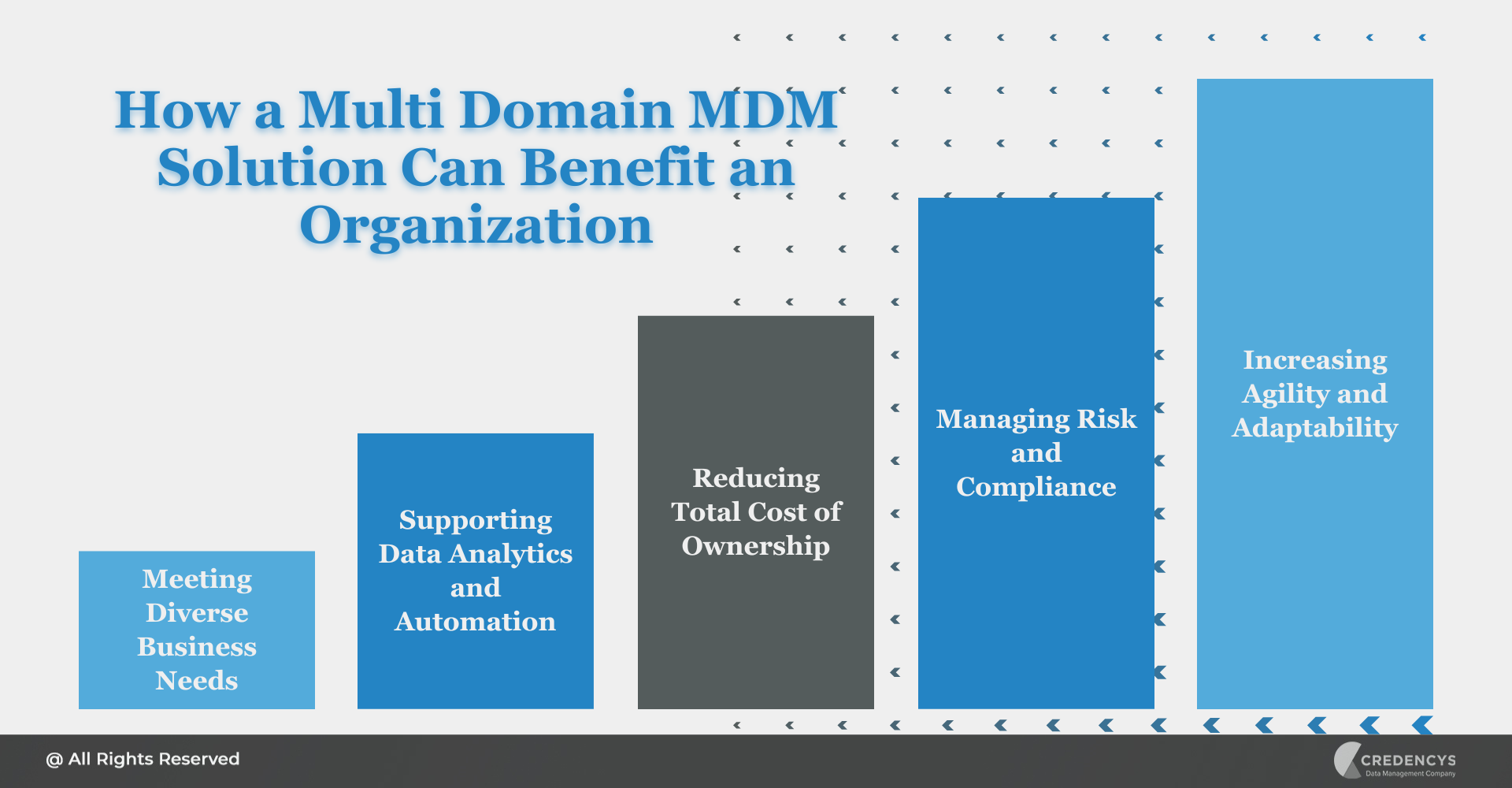
Unleashing the Power of Augmented Data Management

In today’s hyperconnected world, where data plays a pivotal role in driving business decisions, the effective management of information has become a critical aspect of organizational success. Data management, traditionally seen as the practice of collecting, storing, and processing data, has undergone a revolutionary transformation in recent times.

This transformation is marked by the emergence of Augmented Data Management (ADM), a cutting-edge approach that leverages advanced technologies to enhance the entire data management lifecycle. Traditionally, organizations have relied on manual processes and legacy systems to handle their data.

However, as the volume, variety, and velocity of data have skyrocketed, traditional approaches have proven inadequate in meeting the demands of the modern data landscape. Augmented Data Management is a paradigm shift that combines the power of Artificial Intelligence and machine learning with traditional data management processes.

ADM augments human decision-making and automates routine data management tasks, allowing organizations to extract more value from their data assets. It goes beyond the limitations of conventional methods, offering intelligent insights, automation, and enhanced efficiency in dealing with the complexities of modern data ecosystems.

What is Augmented Data Management?

Augmented Data Management is a revolutionary approach to data management that integrates advanced technologies, particularly Artificial Intelligence and machine learning, into traditional data management processes. ADM aims to enhance the efficiency, accuracy, and overall value derived from data by automating routine tasks, providing intelligent insights, and facilitating more informed decision-making.

Key concepts integral to ADM include:

  • Automation: ADM leverages automation to streamline and expedite routine data management tasks. From data cleansing and validation to metadata management, automation reduces manual effort, minimizes errors, and accelerates processes.
  • Machine Learning Algorithms: ADM incorporates machine learning algorithms to analyze patterns, predict outcomes, and continuously improve data management processes. This enables the system to adapt and evolve based on data trends and user interactions.
  • Data Discovery and Cataloging: ADM emphasizes the importance of discovering, cataloging, and organizing data assets. This ensures that organizations can effectively leverage their data by making it easily accessible and understandable.

How Augmented Data Management Differs from Traditional Data Management?

While traditional data management approaches have served organizations well in the past, they are often constrained by manual processes, limited scalability, and an inability to adapt to the dynamic nature of modern data ecosystems. Here’s how ADM differs:

  • Intelligence and Insight: ADM goes beyond the basic storage and retrieval functions of traditional data management. It adds an intelligent layer, allowing organizations to gain deeper insights into their data through automated analysis, pattern recognition, and predictive modeling.
  • Automation of Routine Tasks: One of the key differentiators is the degree of automation. ADM automates repetitive and time-consuming tasks, such as data cleaning, validation, and indexing, freeing up human resources for more strategic activities.
  • Adaptability and Learning: Traditional data management systems often require manual updates and interventions. ADM, on the other hand, is designed to learn and adapt over time. Machine learning algorithms enable the system to improve its performance based on user interactions and evolving data patterns.

Role of Emerging Technologies in Augmented Data Management

At the heart of Augmented Data Management are emerging technologies, particularly AI and machine learning. These technologies play a pivotal role in transforming how organizations manage, analyze, and derive value from their data:

  • Predictive Analytics: Machine learning algorithms in ADM enable predictive analytics, helping organizations anticipate future trends, identify potential issues, and make proactive decisions based on data-driven insights.
  • Natural Language Processing (NLP): NLP is integrated into ADM to facilitate more natural interactions with data. Users can query and interact with the system using natural language, making it more accessible to individuals across various departments.
  • Continuous Improvement: Machine learning algorithms enable ADM systems to learn and improve continuously. As more data is processed, the system becomes more adept at identifying patterns, and anomalies, and optimizing data management processes.

Key Components of Augmented Data Management

1. Data Discovery & Cataloging

The Importance of Identifying and Cataloging Data

In the vast sea of data generated daily, identifying, organizing, and understanding data is crucial for effective decision-making. Traditional data management often struggled with this task due to the sheer volume and complexity of data sources.

Augmented Data Management addresses this challenge by placing a strong emphasis on data discovery and cataloging. Accurate data discovery ensures organizations can locate and leverage the right data at the right time.

This, in turn, enhances efficiency, reduces redundancy, and facilitates collaboration across teams. Cataloging involves creating a comprehensive inventory of available data assets, including their origin, structure, and relevance.

ADM automates and optimizes these processes, allowing organizations to maintain a dynamic and up-to-date catalog of their data resources.

How ADM Automates and Enhances the Data Discovery Process?

ADM leverages advanced algorithms and machine learning to automate the data discovery process. Instead of relying on manual searches and human input, ADM systems analyze data patterns, relationships, and user interactions to identify relevant datasets.

This automation not only accelerates the discovery phase but also ensures a more accurate and comprehensive understanding of available data. Furthermore, ADM enhances the data discovery process by providing intelligent recommendations and insights.

It goes beyond simple cataloging to offer suggestions based on user behavior, preferences, and historical data usage. This proactive approach ensures that organizations not only find the data they are looking for but also discover hidden insights that may have otherwise gone unnoticed.

What is a Data Catalog? Definition, Benefits, Features, & More

2. Data Quality & Cleansing

Significance of Data Quality in Decision-Making

Poor data quality can significantly compromise the integrity of decision-making processes. Inaccurate, incomplete, or inconsistent data can lead to misguided conclusions and suboptimal strategic choices.

Recognizing this, ADM places a high premium on data quality, understanding that reliable insights can only be derived from reliable data.

How ADM Utilizes AI for Data Cleansing and Maintaining Data Quality

ADM employs Artificial Intelligence to implement robust data cleansing processes. AI algorithms can automatically identify and rectify errors, inconsistencies, and outliers within datasets.

Machine learning models, trained on historical data patterns, continuously improve their ability to detect anomalies, ensuring that the data quality remains high over time. Additionally, ADM systems often incorporate proactive measures to prevent data quality issues before they arise.

This includes real-time monitoring, validation rules, and automated data profiling. By leveraging AI in data cleansing, ADM not only ensures the accuracy of current datasets but also contributes to the ongoing improvement of data quality standards within an organization.

What is Data Quality – Everything Businesses Need to Know

3. Metadata Management

Role of Metadata in Effective Data Management

Metadata, often referred to as data about data, provides critical context and information about the characteristics, origin, and usage of datasets. Effective metadata management is essential for navigating the complexities of modern data environments.

It aids in data discovery, understanding data lineage, and ensuring compliance with regulatory requirements.

How ADM Improves Metadata Management Processes

ADM takes metadata management to the next level by automating the creation, maintenance, and utilization of metadata. Machine learning algorithms analyze data usage patterns to dynamically update metadata, reflecting changes in data relevance and importance.

This ensures that the metadata remains accurate and up to date, contributing to the overall reliability of the data catalog. Furthermore, ADM facilitates enhanced metadata search capabilities.

Users can leverage natural language queries, and the system, powered by AI, can intelligently interpret these queries to retrieve relevant metadata. This not only simplifies the metadata discovery process but also makes the entire data management system more accessible to users across different roles and expertise levels.

Key Components of Augmented Data Management

Importance of Adopting Augmented Data Management in the Modern Data-Driven Landscape

In today’s rapidly evolving business landscape, where data has become the lifeblood of organizations, adopting ADM is a strategic imperative. The significance of ADM extends far beyond operational efficiency; it encompasses the very essence of thriving in a modern, data-driven world.

Here’s why organizations should prioritize the adoption of ADM:

1. The Velocity and Volume of Data

The sheer velocity and volume of data generated daily are unprecedented. Traditional data management approaches struggle to cope with the influx of diverse data sources, including structured and unstructured data, streaming data, and data from IoT devices.

ADM, powered by advanced technologies like AI and machine learning, excels in handling large datasets, extracting meaningful insights, and ensuring the efficient management of data at scale.

2. Real-Time Decision-Making

In today’s dynamic business environment, the ability to make real-time, data-driven decisions is a competitive advantage. ADM leverages predictive analytics and automation to provide timely insights, enabling organizations to respond swiftly to market changes, customer preferences, and emerging trends.

This real-time decision-making capability is crucial for staying ahead in industries where agility is paramount.

3. Maximizing Data Value

Data is a valuable asset, but its true value is unlocked when organizations can derive meaningful insights from it. ADM goes beyond traditional data management by leveraging AI to uncover hidden patterns, correlations, and trends within datasets.

This not only enhances decision-making but also positions organizations to innovate, optimize processes, and gain a competitive edge by maximizing the value extracted from their data.

4. Proactive Issue Identification and Resolution

ADM’s incorporation of machine learning algorithms enables proactive issue identification and resolution. By continuously analyzing data, ADM systems can predict potential challenges, anomalies, or data quality issues before they impact operations.

This proactive approach minimizes disruptions, enhances operational reliability, and ensures a more robust and resilient data management infrastructure.

5. Enabling Cross-Functional Collaboration

In a modern organization, data is not confined to a specific department or function; it permeates every aspect of operations. ADM fosters cross-functional collaboration by providing a unified platform for data discovery, analysis, and sharing.

This interconnected approach breaks down silos, encourages knowledge sharing, and enables a holistic understanding of data across the organization.

6. Meeting Compliance and Security Standards

As regulations governing data privacy and security become more stringent, organizations face the challenge of ensuring compliance with evolving standards. ADM plays a crucial role in meeting compliance requirements by incorporating advanced security measures, encryption, and automated processes to safeguard sensitive information.

This not only mitigates regulatory risks but also builds trust among stakeholders.

7. Future-Proofing Data Management Strategies

The future of business is intricately linked to the effective management and utilization of data. ADM, with its adaptability and incorporation of emerging technologies, serves as a future-proof solution.

Organizations that embrace ADM are better positioned to navigate technological advancements, evolving data landscapes, and changing market dynamics.

8. Enhancing Overall Organizational Agility

ADM’s ability to automate routine tasks, provide intelligent insights, and facilitate real-time decision-making contributes to an organization’s overall agility. In an era where adaptability is a key determinant of success, ADM empowers organizations to respond quickly to changing circumstances, innovate efficiently, and stay ahead of the curve in a fast-paced business environment.

Benefits of Augmented Data Management

1. Improved Decision Making

One of the primary advantages of ADM is its transformative impact on decision-making processes. By combining advanced analytics, machine learning, and automation, ADM equips organizations with the tools to make more accurate, timely, and informed decisions.

ADM leverages predictive analytics to identify trends, patterns, and potential outcomes based on historical and real-time data. This enables decision-makers to anticipate market shifts, customer preferences, and operational challenges.

The integration of intelligent insights into the decision-making workflow ensures that choices are not solely based on intuition but are backed by a data-driven understanding of the current landscape.

2. Increased Efficiency and Productivity

ADM excels in automating routine and time-consuming data management tasks, liberating human resources from manual efforts. From data cleansing and validation to cataloging and metadata management, automation ensures that these processes are executed swiftly and accurately.

Automation not only accelerates the pace of data management but also reduces the risk of errors inherent in manual tasks. This efficiency gain allows organizations to focus their human capital on strategic initiatives, innovation, and more value-added tasks.

3. Enhanced Data Security and Compliance

As data breaches become more sophisticated and regulations governing data privacy and security become stringent, organizations are increasingly turning to ADM as a safeguard. ADM plays a crucial role in ensuring data security and compliance by implementing advanced security measures and automating compliance-related processes.

ADM systems often incorporate encryption, access controls, and monitoring mechanisms to protect sensitive data from unauthorized access or cyber threats. Automation helps in the timely identification and mitigation of security vulnerabilities, reducing the risk of data breaches.

The benefits of ADM extend beyond operational efficiency to encompass improved decision-making, increased productivity, and heightened data security and compliance. These advantages position organizations to thrive in a data-centric landscape while mitigating risks and ensuring responsible data practices.

Benefits of Augmented Data Management

Future Trends in Augmented Data Management

As technology continues to advance at a rapid pace, the landscape of ADM is poised to undergo significant transformations. Anticipated advancements in ADM will not only enhance the capabilities of data management systems but will also shape the way organizations extract insights and value from their data.

Here are some future trends to watch for in the realm of Augmented Data Management:

1. Quantum Computing

The advent of quantum computing holds the potential to revolutionize ADM by tackling complex data processing tasks at unprecedented speeds. Quantum computing’s ability to perform parallel computations could significantly accelerate data analytics, allowing organizations to process vast datasets in real time and uncover insights that were previously impractical to obtain.

2. Edge Computing Integration

As the IoT expands, edge computing will play an increasingly crucial role in data processing. ADM systems are likely to integrate with edge computing architectures, enabling organizations to analyze and derive insights from data at the source.

This can lead to faster decision-making, reduced latency, and more efficient use of network resources.

3. Extended Use of Natural Language Processing (NLP)

The integration of NLP into ADM is expected to become more sophisticated. Future ADM systems may leverage advanced NLP techniques to not only interpret user queries but also generate more contextual and human-like responses.

This will enhance the user experience and make data management more accessible to individuals without specialized technical knowledge.

Final Thoughts

The future of ADM is characterized by the integration of cutting-edge technologies, improved automation, enhanced security measures, and a focus on ethical data practices. These advancements will not only empower organizations to manage their data more effectively but will also shape the broader landscape of data-driven decision-making in the years to come.

Businesses need to stay tuned for the exciting developments that will unfold as Augmented Data Management continues to evolve.

Navigating the Landscape of Multi-Domain MDM

The Master Data Management Market size is estimated at USD 15.33 billion in 2024 and is expected to reach USD 36.48 billion by 2029, growing at a CAGR of 18.93% during the forecast period. Modern businesses heavily rely on data, with a recent study highlighting that the effective utilization of data significantly influences an enterprise’s success in the digital realm.

Master Data Management Market

Additionally, organizations that have efficiently managed their data are three times more likely to emerge as digital leaders. As a business expands, the volume of data generated, encompassing data about products, services, customers, and suppliers, also increases.

However, this data often ends up stored in separate silos, leading to challenges in accessing and analyzing it. This issue of data fragmentation poses a hurdle, diverting leadership from focusing on innovation and extracting tangible business value.

The remedy to this challenge is the adoption of multi-domain master data management.

What is Multi-Domain MDM?

Multi-domain Master Data Management (MDM) offers a unified set of technologies designed to efficiently oversee, regulate, and share master data across various domains, maximizing its overall value. MDM plays a crucial role in structuring the fundamental data of your business, ensuring consistency and accuracy essential for seamless operational processes.

Moreover, it facilitates precise and detailed data analytics and reporting. However, the growing number of data sources introduces challenges when using domain-specific systems, leading to complexities, inaccessibility, and segregation.

These issues can impede the successful implementation of personalized client experiences, the management of global supply chains, and innovative data-driven practices. Multi-domain MDM addresses this challenge by integrating all domains into a single, comprehensive platform.

This integration eliminates barriers and enhances the efficiency of data utilization across diverse aspects of business operations.

Multi Domain MDM

How a Multi-Domain MDM Solution Can Benefit an Organization?

Businesses leveraging multi-domain MDM gain the capability to effortlessly connect, analyze, and oversee relationships between different domains, including locations, customers, products, suppliers, and even assets related to IoT or AI.

1. Meeting Diverse Business Needs

Multi-domain MDM serves as a transformative tool, converting fragmented data into strategic information that offers a comprehensive business overview by establishing connections across various domains. This interconnectivity, achieved through effective data analysis, leads to reduced cycle times, cost control, and improvements in forecasting and planning.

These positive outcomes directly contribute to enhanced measurable revenue for the business.
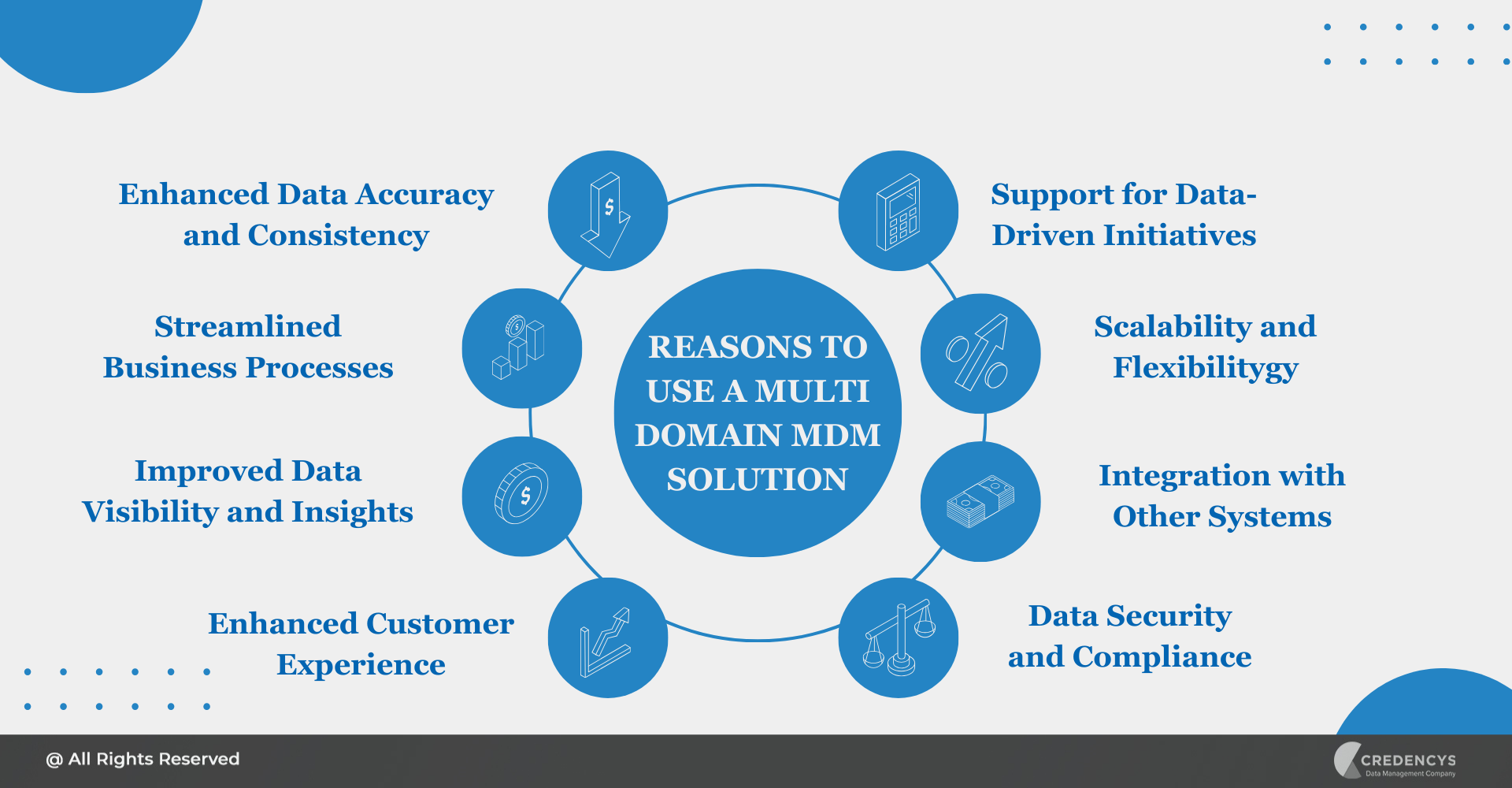
2. Supporting Data Analytics and Automation

The effectiveness of AI-based analytics relies heavily on the quality of the input data. A unified data repository, provided by multi-domain MDM, proves optimal for running modern analytics, yielding profound business insights across diverse domains simultaneously

Additionally, this MDM approach enables more efficient deployment of automation, ensuring accurate information extraction while minimizing manual tasks and avoiding errors.

3. Reducing Total Cost of Ownership (TCO)

By dismantling data silos and offering a 360-degree view of various entities such as products, services, processes, and suppliers using a unified set of technologies, multi-domain MDM saves businesses time, money, and effort that would otherwise be spent on employing separate master data systems for different domains.

4. Managing Risk and Compliance

A trusted, singular perspective across different businesses and domains facilitates faster integrations, enhances compliance, and mitigates risk for large enterprises with numerous subsidiaries or those undergoing mergers.

5. Increasing Agility and Adaptability

The innate cross-domain compatibility of multi-domain MDM injects increased agility into the enterprise, speeding up the deployment of various solutions across business processes. Furthermore, it promotes data democratization securely, enabling teams across domains to leverage insights from master data to achieve their goals.

How a Multi Domain MDM Solution Can Benefit an Organization

What Does Multi-Domain MDM Involve?

To fully harness the advantages of multi-domain MDM, organizations must comprehend its essential components and functionalities.

1. Data Modeling and Governance

The bedrock of multi-domain MDM lies in data modeling, where the structure, relationships, and attributes of master data entities across diverse domains are defined. Robust data governance solutions ensure consistent data management by adhering to predefined rules, policies, and standards.

2. Data Integration and Consolidation

Data integration and consolidation facilitate the amalgamation of data from various sources and domains into a unified view. This involves processes such as data profiling, cleansing, and transformation to guarantee accuracy and consistency.

3. Data Quality Management

Ensures master data is accurate, complete, and reliable through processes like data cleansing, standardization, validation, and enrichment. Aimed at eliminating errors and inconsistencies to enhance overall data quality.

4. Data Stewardship and Workflow

Involves assigning ownership and responsibility for managing master data to designated individuals or teams. Workflow capabilities orchestrate data governance processes, ensuring adherence to predefined rules and policies during data review, approval, and updates.

5. Data Security and Access Control

Implements mechanisms to safeguard sensitive master data from unauthorized access or breaches. Utilizes role-based access controls, encryption, and audit trails to maintain data confidentiality and integrity.

6. Metadata Management

Encompasses the documentation, organization, and management of metadata, providing context and meaning to master data. Enhances data discovery, understanding, and governance by offering insights into the background and structure of the data.

7. Data Integration and Interoperability

Ensures seamless data exchange between multi-domain MDM solutions and other business systems. Utilizes specialized data integration software, APIs, connectors, and standard protocols to facilitate the flow of data across the organization’s data ecosystem.

8. Data Analytics and Reporting

Empowers organizations to extract insights and generate meaningful reports from their master data. Advanced analytics capabilities, data visualization tools, and reporting features facilitate data-driven decision-making processes.

Reasons to Use a Multi-Domain MDM Solution

Utilizing a multi-domain MDM solution brings forth various advantages for organizations, providing compelling reasons for its adoption.

1. Enhanced Data Accuracy and Consistency

Centralizing data management across diverse domains eradicates data silos, minimizing the risk of duplicate or conflicting information. This, in turn, enhances data quality and reliability.

2. Streamlined Business Processes

Multi-domain MDM simplifies data workflows and business processes by establishing a single source of truth for all master data. This eliminates the need for manual data reconciliation and integration, leading to cost reductions and increased overall operational efficiency.

3. Improved Data Visibility and Insights

Offering a unified view of data across multiple domains, multi-domain MDM empowers organizations with deeper insights into their operations. This facilitates comprehensive data analytics, reporting, and data-driven decision-making, contributing to more informed business strategies and better outcomes.

4. Enhanced Customer Experience

Through the integration of customer data from various domains, multi-domain MDM facilitates a 360-degree view of customers, crucial for Customer MDM. This holistic perspective enables organizations to deliver personalized and targeted customer experiences, fostering loyalty and satisfaction.

5. Support for Data-Driven Initiatives

Serving as a robust foundation for data-driven initiatives like marketing campaigns, sales strategies, and supply chain optimization, multi-domain data management ensures accurate and reliable data. This enables organizations to make informed decisions, identify trends, and capitalize on new opportunities.

6. Scalability and Flexibility

Designed to scale and adapt to evolving business needs, multi-domain MDM solutions can accommodate new data domains as organizations grow. This ensures long-term flexibility and future-proofing of data management capabilities.

7. Integration with Other Systems

Seamlessly integrating with critical business systems such as CRM, ERP, and BI tools, multi-domain MDM facilitates smooth data flow between systems. This eliminates data silos, allowing organizations to leverage their data assets more effectively.

8. Data Security and Compliance

Prioritizing data security and privacy, multi-domain MDM solutions implement robust access controls and data privacy measures. This ensures the protection of sensitive information and compliance with regulatory requirements.

Reasons to Use a Multi Domain MDM Solution

Challenges of Implementing Multi-Domain MDM

Implementing Multi-Domain MDM offers a multitude of advantages, but it comes with its share of challenges. Organizations encounter several hurdles during the adoption of Multi-Domain MDM:

1. Data Complexity Hinders Objectives

Managing data across multiple domains becomes intricate due to the unique attributes, models, and relationships within each domain. The complexity deepens, making it challenging to achieve the desired end-state of data and create a unified view.

Initiatives may span several years, causing organizations to lose focus and abandon the process halfway, leading to missed potential benefits.

2. Governance Challenges

Multi-Domain MDM necessitates a clear and coherent governance structure for effective data management. However, bringing together information from diverse sources creates unstructured data, making governance challenging.

Organizations often overlook external dependencies, resulting in conflicts, silos, and a lack of accountability that can render the entire initiative futile.

3. Scalability Concerns

Organizations sometimes adopt Multi-Domain MDM programs with a short-term perspective, overlooking evolving business scenarios. Consequently, scaling becomes a challenge as the market evolves, and organizations find themselves stuck with an outdated operating model.

Managing diverse data becomes complex, causing scalability initiatives to fail, leading to performance issues, delays, and errors.

4. Resistance to Change Impacts the Process

Implementing Multi-Domain MDM initiatives requires a fundamental shift in processes, systems, and culture. However, driving change can be challenging, especially in an environment where familiarity is equated with survival.

Employees, particularly those with longer tenures, may resist change, sticking to established processes and avoiding the uncertainties associated with volatile environments. Resistance to change can act as a significant barrier to the successful implementation of MDM.

Functionalities to Consider While Choosing a Multi-Domain MDM Solution

In a competitive landscape, the right choice of a multi-domain MDM solution tailored to your business needs can significantly impact your operations. Here are some essential functionalities within MDM solutions that can streamline business systems and enhance the overall value of their deployment.

1. Configurability and Adaptability

The chosen multi-domain MDM solution should offer easy configurability and adaptability to align with the specific needs of the business. It should prioritize flexibility, allowing operations to seamlessly integrate with the chosen model framework.
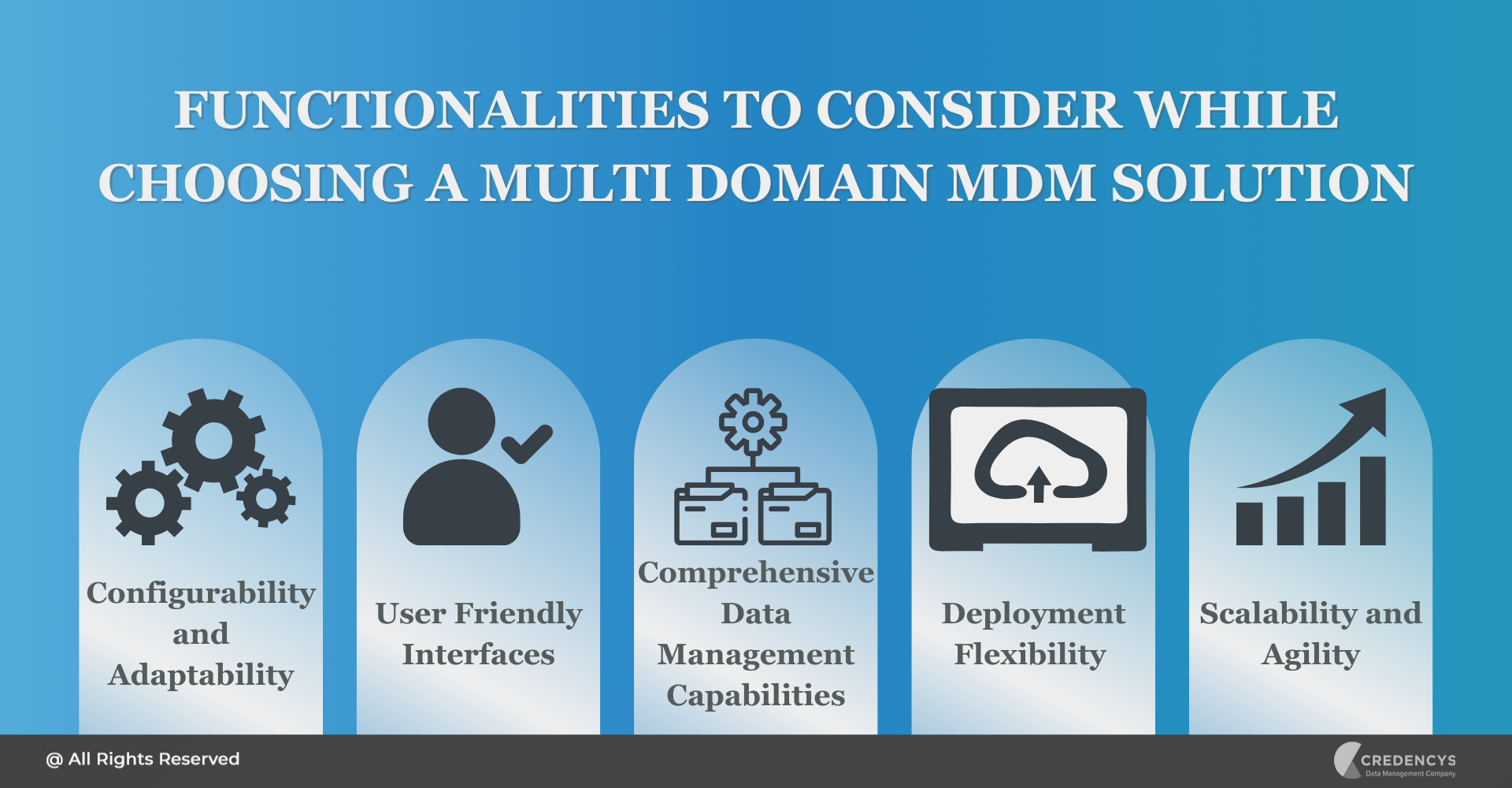
2. User-Friendly Interfaces

An effective MDM solution should feature user-friendly interfaces that encourage engagement across various levels of technical knowledge. Intuitive interfaces facilitate user interaction, ensuring that the benefits of the MDM system can be harnessed by users with different skill levels.

3. Comprehensive Data Management Capabilities

A proficient MDM solution should possess a comprehensive set of capabilities to establish and uphold a robust data management practice. This encompasses functions that cover the entire data lifecycle, ensuring data accuracy, consistency, and security.

4. Deployment Flexibility

Businesses should have the flexibility to choose the deployment model that best suits their requirements, whether it’s on-premises, cloud-based, or a hybrid environment. This ensures that the MDM solution seamlessly integrates with the existing IT infrastructure and aligns with the organization’s preferences.

5. Scalability and Agility

An ideal multi-domain MDM solution must support scalability and agility, enabling organizations to evolve and iterate as business needs change. This adaptability ensures that the MDM solution remains effective and relevant in the face of evolving data management requirements.

Functionalities to Consider While Choosing a Multi Domain MDM Solution

Final Thoughts

The journey may be challenging, but the destination marked by data-driven innovation, operational excellence, and sustained business growth is undeniably worth the effort. As organizations embark on this transformative endeavor, the key lies in understanding the nuances, addressing challenges proactively, and reaping the rewards that Multi-Domain MDM can bring to the forefront of their operations.

Overcoming Automotive Product Data Challenges with PIM

Automotive businesses deal with a large scale of product data just like any other industry, but this becomes extremely complicated when they need to ensure the compatibility of automotive products (spare parts and accessories) with different vehicles. From compatibility mapping to fitment association, ensuring accurate, complete, and standardized information is critical.

Thus, the management of product data in automotive has a unique set of challenges. In this post, we will dive into the intricate landscape of overcoming automotive product data challenges, exploring how Product Information Management (PIM) emerges as the driving force to streamline operations, enhance data governance, and propel automotive businesses toward unparalleled success.

Let’s uncover the transformative power of PIM solutions in navigating the complexities of the automotive data highway.

Significance of Product Data Management in the Automotive Industry

In the auto parts industry, precise product data management is crucial, serving as the heart for efficient operations, heightened customer satisfaction, and revenue growth.

Significance of Product Data Management in Automotive Industry

1. Efficient Order Fulfillment

Managing product data with accuracy optimizes inventory management, reducing errors in order fulfillment and ensuring prompt delivery of the correct parts to customers.

2. Enhancing Customer Satisfaction

Accurate product data fosters customer confidence, leading to positive purchasing experiences, repeat business, and positive referrals.

3. Competitive Edge through Online Shopping Experience

Effective product data management enables businesses to stay competitive by providing a superior online shopping experience, contributing to confident purchasing decisions.

4. Facilitating Data-Driven Decision Making

Leverage robust product data management to empower businesses with insights for data-driven decision-making, allowing them to analyze trends, anticipate demand, and align with customer preferences.

5. Improving Overall Operational Efficiency

Ensure a responsive and well-organized business that minimizes errors, optimizes internal processes, and enhances overall operational efficiency with efficient product data management.

The importance of managing product data in the automotive industry cannot be overstated. It is the catalyst for seamless operations, heightened customer satisfaction, and sustained growth. As the industry continues to evolve, businesses that recognize and invest in effective product data management will undoubtedly steer ahead with confidence and competence.

ACES & PIES: An Overview

ACES and PIES are foundational frameworks in the automotive industry, playing a pivotal role in standardizing and streamlining information exchange.

What is ACES?

The Aftermarket Catalog Exchange Standard (ACES®) is the aftermarket industry data standard for the management and communication of product fitment data.

Source

It establishes a common language that facilitates seamless communication between manufacturers, distributors, retailers, and other stakeholders. ACES includes standardized codes and terminology for vehicle attributes, parts classifications, and other crucial details, ensuring consistency across the automotive supply chain.

What is PIES?

The Product Information Exchange Standard (PIESTM) is the aftermarket industry data standard for the management and communication of product information.

Source

PIES focuses on product information, serving as a standard for exchanging comprehensive details about automotive products. It defines a structured format for conveying product attributes, descriptions, images, pricing, and more. This standard ensures that product information is accurate, consistent, and easily accessible across various platforms and systems.

Why are ACES & PIES Important for the Automotive Industry?

Why are ACES & PIES So Important for the Automotive Industry

1. Compatibility and Fitment Accuracy

ACES ensures that products are precisely mapped to specific vehicles, reducing errors in fitment and compatibility. This accuracy is vital to ensure that the right parts reach the right vehicles during repairs and aftermarket upgrades.

2. Efficient Information Exchange

Both ACES and PIES streamline communication within the automotive supply chain. Standardized formats simplify the exchange of catalog, fitment, and product information among manufacturers, distributors, retailers, and other stakeholders, promoting efficiency and reducing manual errors.

3. Enhanced Online Shopping Experience

ACES and PIES contribute to a seamless online shopping experience for customers. Consistent product information across various platforms allows consumers to make informed decisions, boosting confidence in their purchases.

4. Data Standardization

The standards provided by ACES and PIES facilitate data standardization, enabling businesses to speak the same language when exchanging information. This consistency leads to improved collaboration and operational efficiency across the industry.

5. Regulatory Compliance

Adhering to ACES and PIES standards ensures compliance with industry regulations and requirements. This is especially crucial in an industry where accuracy and conformity are paramount.

ACES and PIES serve as the backbone of information exchange in the automotive industry, fostering accuracy, efficiency, and collaboration among all stakeholders. Their standardized approach ensures that the wheels of the automotive supply chain turn smoothly, benefiting businesses and customers alike.

Challenges of Product Data Management in the Automotive Industry

Product Data Management Challenges

1. Fragmented Data Sources

One of the foremost challenges lies in dealing with fragmented data sources. Product data in the automotive sector can originate from various channels such as suppliers, manufacturers, data pools, and retailers. The multiplicity of sources makes it challenging to consolidate and manage this information effectively.

2. Large and Complex Product Data Sets

Automotive product data, by nature, is vast and intricate. The sheer volume and complexity of data make its organization, analysis, and maintenance a daunting task. From specifications to fitment details, handling this extensive dataset requires a strategic and comprehensive approach.

3. Manual Data Entry

Manual data entry remains a time-consuming and error-prone aspect of product data management in the automotive industry. The necessity for precision coupled with the sheer volume of data makes manual entry prone to errors, leading to challenges in maintaining data accuracy and consistency.

4. Distributing Data across Downstream Systems

Sharing product data seamlessly with downstream systems poses another significant challenge. Ensuring that the data meets industry standards and is compatible with various downstream systems requires careful formatting and compliance, adding complexity to the data-sharing process.

Challenges to Manage Product Data with ACES & PIES

Navigating the challenges of product data, especially with additional compatibility details for automotive materials, causes unique challenges. Managing data with ACES & PIES fitment in a solution involves several complexities.

  • The data itself is intricate, with numerous points that demand precise categorization and ongoing maintenance.
  • Integrating and mapping this data across diverse systems becomes challenging, given variations in data structures and formats. Inconsistencies arising from these differences can impact the quality and integrity of product information.
  • Staying current with evolving standards presents an ongoing challenge. Businesses must continuously align their data with the latest updates, adding an extra layer of complexity.
  • Managing fitment data adds another layer of complexity, necessitating accurate matching of parts to specific vehicles while ensuring that the data remains current.
  • The sheer volume of data can be overwhelming, demanding a robust system equipped with powerful tools for data management, integration, and analysis.

To overcome these hurdles, businesses need to make strategic investments in comprehensive PIM solutions and establish dedicated data management teams. This ensures effective management and maintenance of product data, guaranteeing accuracy, consistency, and currency.

How Does PIM Address Data Management Challenges in the Automotive Industry?

The centralization of data and harmonizing them for multiple sources have put PIM solutions at the forefront of every section of eCommerce including the automotive industry.

How Does PIM Address Data Management Challenges in Automotive Industry

1. Integration of Multiple Sources

PIM streamlines the integration of product data from diverse sources in the automotive sector. Whether it’s data from suppliers, manufacturers, or retailers, PIM ensures a cohesive approach, allowing seamless integration and harmonization of data from various channels.

2. Product Data Management

One of PIM’s primary strengths lies in its ability to enable effective product data management. By providing a centralized repository, PIM ensures that automotive businesses can organize, enrich, and maintain product data efficiently, fostering streamlined operations.

3. Data Syndication

PIM facilitates the syndication of product data to multiple channels effortlessly. Whether it’s online marketplaces, e-commerce platforms, or other sales channels, PIM ensures consistent and accurate data syndication, enhancing the reach and visibility of automotive products.

4. Data Accuracy

Ensuring data accuracy is paramount in the automotive industry. PIM employs robust validation mechanisms, minimizing errors in product data. This accuracy is crucial for compatibility mapping, fitment details, and other specifications, contributing to a reliable automotive data ecosystem.

5. Data Consistency

Maintaining data consistency across various platforms is a common challenge in the automotive sector. PIM establishes standardized processes, ensuring that product data is consistent across all channels. This consistency enhances customer trust and facilitates a seamless experience in the automotive product landscape.

PIM helps in overcoming data management challenges in the automotive industry. Its ability to integrate multiple sources, manage product data effectively, syndicate data to diverse channels, ensure accuracy, and maintain consistency positions PIM as a catalyst for success in the fast-evolving world of automotive commerce.

Conclusion

Navigating the complexities of automotive product data is a transformative journey and embracing PIM is the key to overcoming challenges.

Credencys, with its profound expertise in PIM for automotive industry, stands as a beacon of innovation and efficiency. Our comprehensive approach ensures accurate fitment, streamlined operations, and data governance excellence.

Case Study:
Rough Country – Engineered a PIM solution for automotive parts manufacturer, Rough Country, that improves operational efficiency.

If you want to build a solution like Rough Country that manages your automotive product data effortlessly with the integration of the ACES & PIES database, Credencys stands ready to help you with cutting-edge PIM solutions, ensuring you stay ahead in the fast-evolving landscape of automotive commerce.

Talk to our PIM experts to discuss your automotive product data management challenges, not just to address them but to drive efficiency to your organization and your processes.