PIM and DAM: Why You Need Both of These Solutions

Are you choosing between Product Information Management (PIM) and Digital Asset Management (DAM)? What if we told you that integrating both could be the key to unlocking your business’s full potential instead of choosing one over the other?

PIM and DAM are two different solutions with a unique set of capabilities. But, when you combine they deliver powerful capabilities that can redefine how you manage your product data.

Join us on this exploration to understand how and why PIM and DAM integration makes perfect sense in the dynamic landscape of online retail.

Understanding PIM – Precision in Product Information

PIM takes center stage in the fast-paced world of product management, where information accuracy is non-negotiable. Product Information Management is the systematic approach to creating, managing, and distributing product information across various channels. It acts as the guardian of your product data, ensuring that every piece of information is not only accurate but also consistent throughout the product lifecycle. 

Why PIM Matters

The answer lies in its transformative impact on various facets of your business:

  • Consistency Across Channels: Imagine a scenario where product details vary on your website, mobile app, and third-party platforms. PIM eliminates this inconsistency, providing a single source of truth for product information. 
  • Enhanced Customer Experience: PIM empowers businesses to deliver a unified and accurate product experience, contributing to increased customer satisfaction and loyalty. 
  • Time and Cost Efficiency: With streamlined processes, PIM reduces the time spent on manual data management tasks, allowing businesses to allocate resources more efficiently.
  • Seamless Omnichannel Experiences: With PIM as the anchor of your omnichannel strategy, customers enjoy consistent, personalized experiences across online and offline touchpoints, reinforcing brand identity and maximizing sales opportunities.
  • Dynamic Scalability: Whether you’re expanding your product catalog or venturing into new markets, PIM scales effortlessly with your business, providing the flexibility and agility needed to adapt to evolving demands.

Unveiling DAM – The Guardian of Digital Assets

By centralizing, organizing, and distributing digital assets, DAM empowers businesses to streamline workflows, enhance collaboration, and maximize the value of their multimedia content.

Key Features of DAM

Let’s explore the key features that make DAM an indispensable tool for modern enterprises:

  • Centralized Asset Storage: DAM serves as a centralized repository for digital assets, eliminating the chaos of scattered files across different platforms. 
  • Efficient Collaboration: Teams can collaborate seamlessly with DAM, accessing the latest version of digital assets and maintaining a cohesive brand identity. 
  • Rights Management: DAM provides control over access rights and usage permissions, safeguarding businesses from potential legal issues related to unauthorized asset usage.
  • Metadata Management: DAM systems enable users to attach metadata to digital assets, such as descriptions, tags, keywords, and usage rights. This metadata enhances searchability, making it easier for users to find and retrieve specific assets quickly.
  • Asset Organization and Categorization: DAM solutions provide robust tools for organizing and categorizing digital assets. Users can create folders, collections, and taxonomies to structure assets logically, facilitating efficient asset management and retrieval.

How PIM and DAM Can Benefit Your Business

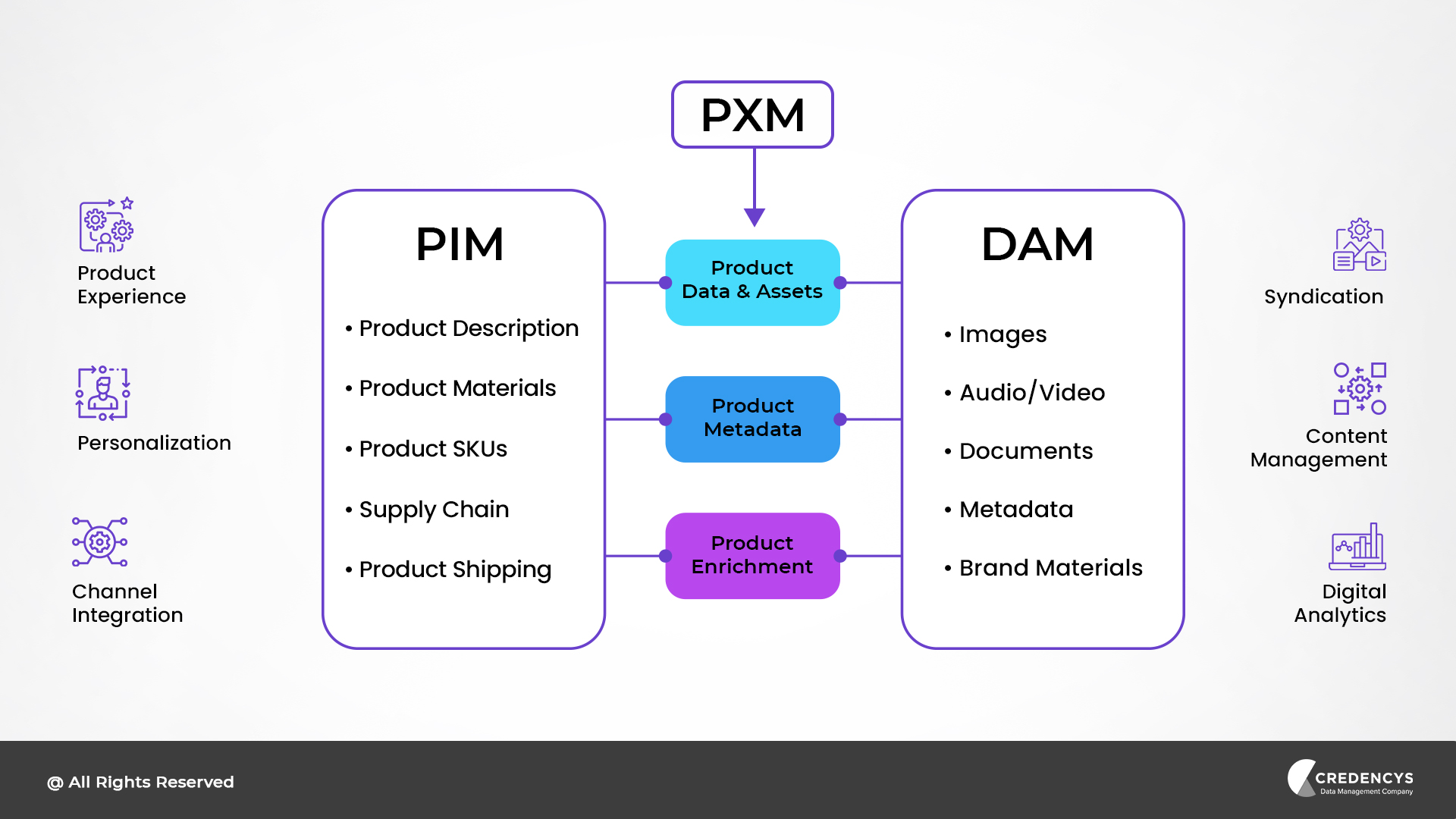
While PIM and DAM each play a crucial role independently, their true power lies in their symbiotic relationship. PIM ensures that product information is accurate and consistent, while DAM safeguards the integrity and accessibility of digital assets. 

PIM and DAM

Benefits of Integration:

  • Holistic Product Storytelling: Integrating PIM and DAM allows businesses to create compelling product stories by combining accurate information with visually appealing digital assets. 
  • Streamlined Workflows: With seamless integration, teams can work cohesively, ensuring that product launches and marketing campaigns are executed without hiccups. 
  • Data-Driven Decision Making: The combined power of PIM and DAM provides businesses with comprehensive insights, enabling data-driven decisions for future strategies. 
  • Optimized Omnichannel Marketing: PIM and DAM integration empower you to deliver cohesive brand experiences across multiple channels and touchpoints. Whether it’s your e-commerce website, mobile app, social media platforms, or physical stores, consistent product information, and visually appealing assets ensure a seamless omnichannel experience for customers.
  • Streamlined Content Creation and Publishing: Integrating PIM and DAM streamlines the process of creating, managing, and publishing product content. Teams can easily access the latest product information and assets from a centralized repository, accelerating content creation and reducing time-to-market.

Also read our blog: PIM vs DAM: What’s the Difference? 

Navigating Industry Challenges with PIM and DAM 

In a rapidly evolving business landscape, challenges are inevitable. However, armed with the robust capabilities of PIM and DAM, businesses can overcome common industry hurdles. 

Addressing Challenges: 

  • Global Expansion: PIM helps businesses adapt product information for different markets, while DAM ensures that marketing materials cater to diverse audiences. 
  • Changing Regulations: PIM aids in maintaining compliance by centralizing and updating product information according to changing regulations, while DAM assists in managing rights and permissions for digital assets. 
  • Rapid Product Launches: With PIM streamlining product information and DAM ensuring efficient access to digital assets, businesses can accelerate product launches without compromising quality. 

Wrapping Up

The integration of PIM and DAM isn’t just a matter of convenience. It’s a strategic imperative for businesses operating in today’s digital landscape. By harmonizing product data with rich visual assets, organizations can unlock a myriad of benefits, from improved data quality and enhanced customer experiences to streamlined workflows and increased operational efficiency.

The synergy between PIM and DAM helps businesses to stay ahead of the curve. Connect with PIM experts to explore how PIM and DAM can benefit your business.

Syndigo Vs Akeneo – A Comparative Analysis

Managing product information effectively is paramount for businesses aiming to stand out amidst fierce competition and meet consumers’ ever-growing demands. Two prominent solutions in the realm of PIM are Syndigo and Akeneo.

What is Syndigo?

Syndigo is a leading end-to-end product content solutions provider, empowering brands and retailers to efficiently manage, enrich, and syndicate their product information across various channels. With a robust suite of tools and services, Syndigo enables businesses to streamline their product data management processes, ensuring accuracy, consistency, and compliance across all touchpoints.

Syndigo has risen to prominence as a premier provider of end-to-end product content solutions. It brings together decades of industry expertise and innovation to empower brands and retailers in managing, enriching, and syndicating their product information efficiently.

What is Syndigo – A Comprehensive Guide

What is Akeneo?

On the other hand, Akeneo is renowned for its open-source PIM platform, designed to centralize and harmonize product information for enhanced collaboration, data quality, and efficiency. Akeneo empowers businesses to create compelling product experiences by leveraging rich, accurate, and up-to-date information, thereby driving customer engagement and loyalty.

Akeneo has rapidly emerged as a leading provider of open-source PIM solutions. Born out of a vision to simplify product information management for businesses of all sizes, Akeneo has garnered recognition for its innovative approach to centralizing and harmonizing product data.

Key Features & Functionalities of Syndigo

Syndigo offers a comprehensive suite of features and functionalities designed to address the diverse needs of businesses across various industries. Some key features include:

1. Centralized Product Information Management

Syndigo provides a centralized repository for storing and managing all product information, including descriptions, images, videos, specifications, and attributes. This centralized approach ensures data consistency and accuracy across all channels and touchpoints.

2. Data Enrichment and Digital Asset Management

With Syndigo, businesses can enrich their product data with high-quality images, videos, marketing content, and other digital assets. The platform offers robust digital asset management capabilities, allowing users to organize, categorize, and optimize assets for maximum impact.

3. Syndication and Distribution

Syndigo enables businesses to syndicate their product information to a wide range of channels and platforms, including eCommerce websites, online marketplaces, retailer portals, and digital catalogs. The platform supports various syndication formats and protocols, ensuring seamless integration with partner systems.

4. Compliance and Regulatory Management

Syndigo helps businesses ensure compliance with industry standards, regulations, and labeling requirements. The platform offers features for tracking and managing compliance-related information, such as nutritional data, ingredient lists, allergen information, and country-of-origin labeling.

Key Features of Syndigo

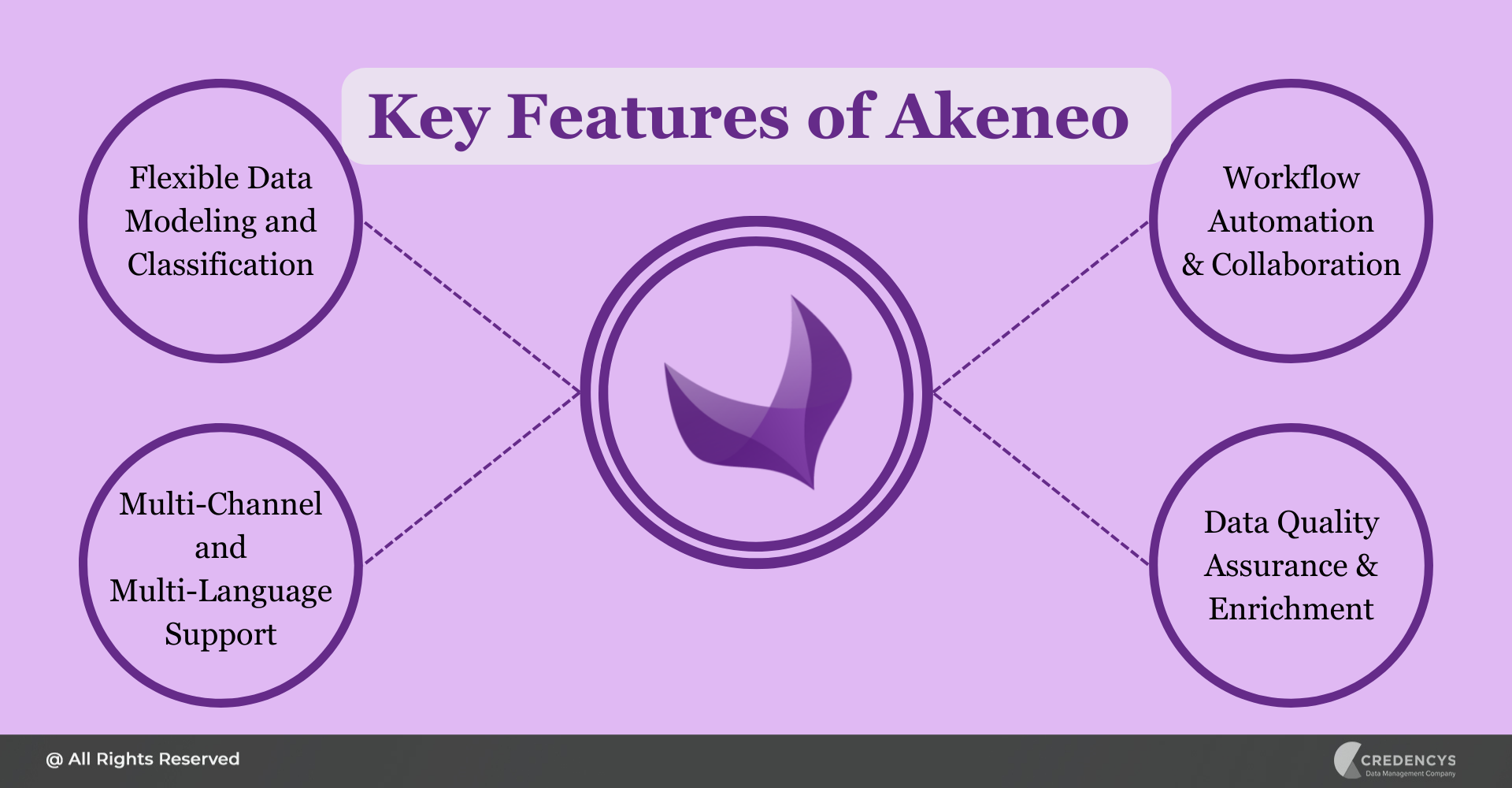
Key Features and Functionalities of Akeneo

1. Flexible Data Modeling and Classification

Akeneo offers a flexible and customizable data model, allowing businesses to define their own product structures, attributes, and classifications. This flexibility enables businesses to adapt the platform to their unique product data requirements and workflows.

2. Multi-channel and Multi-Language Support

Akeneo supports multi-channel and multi-language product information management, enabling businesses to manage and distribute product data across various channels, regions, and languages. The platform facilitates localization and translation of product information, ensuring relevance and consistency for global audiences.

3. Workflow Automation and Collaboration

Akeneo streamlines product data management processes through workflow automation and collaboration tools. Users can define custom workflows, assign tasks, and track progress, facilitating efficient collaboration across teams and departments.

4. Data Quality Assurance and Enrichment

Akeneo offers features and tools for ensuring data quality and enrichment, including data validation, enrichment rules, and integration with third-party data providers. Businesses can enhance the completeness, accuracy, and relevance of their product information to drive customer engagement and satisfaction.

Key Features of Akeneo

Feature Comparison

When considering Product Information Management (PIM) solutions like Syndigo and Akeneo, comparing their features is crucial to determine which platform aligns best with your business needs. Let’s delve into a detailed comparison across various key aspects:

1. User Interface and Ease of Use

  • Syndigo: Syndigo offers an intuitive and user-friendly interface designed to simplify navigation and streamline workflows. Its dashboard provides quick access to essential features, making it easy for users to manage product information efficiently.
  • Akeneo: Similarly, Akeneo boasts a clean and intuitive user interface that prioritizes ease of use. Its customizable dashboard and drag-and-drop functionality enable users to organize and manage product data with minimal effort.

2. Data Management Capabilities

  • Syndigo: Syndigo provides robust data management capabilities including centralized storage, data validation, and version control in multiple domains; product, customer, and location. Its advanced search and filtering options facilitate quick and efficient data retrieval and manipulation.
  • Akeneo: Akeneo excels in data management with features such as flexible data modeling, attribute management, and category management. Its comprehensive data governance tools ensure data accuracy, completeness, and consistency across the entire product catalog.

3. Integration Options with Other Systems

  • Syndigo: Syndigo offers seamless integration with a wide range of systems, including ERP (Enterprise Resource Planning), CRM (Customer Relationship Management), DAM (Digital Asset Management), and e-commerce platforms. Its robust API enables smooth data exchange and synchronization between systems.
  • Akeneo: Akeneo supports extensive integrations with ERP, CRM, CMS (Content Management System), and other business applications. Its open-source architecture and flexible API facilitate seamless connectivity with third-party systems, enabling businesses to leverage existing infrastructure and tools.

4. Customization and Scalability

  • Syndigo: Syndigo provides customization options tailored to meet specific business requirements. Its scalable architecture ensures flexibility and adaptability to accommodate growing product catalogs and evolving business needs.
  • Akeneo: Akeneo offers extensive customization capabilities, allowing businesses to tailor the platform to their unique workflows, data models, and branding requirements. Its scalable architecture ensures high performance and reliability, even in large enterprise environments.

5. Data Quality and Enrichment Tools

  • Syndigo: Syndigo offers advanced data quality and enrichment tools, including automated data validation, attribute mapping, and content enrichment. Its integration with third-party data providers enables businesses to access additional product information and enhance data completeness and accuracy.
  • Akeneo: Akeneo provides robust data quality assurance and enrichment features, such as data validation rules, attribute mapping, and enrichment rules. Its integration with data enrichment services and marketplace extensions enables businesses to augment product data with rich content, improving customer engagement and conversion rates.

6. Support and Customer Service

  • Syndigo: Syndigo offers comprehensive support and customer service, including dedicated account managers, training resources, and 24/7 technical support. Its customer success team works closely with clients to ensure successful implementation, onboarding, and ongoing support.
  • Akeneo: Akeneo provides extensive support and resources to assist users at every stage of their PIM journey. From documentation and tutorials to community forums and training programs, Akeneo empowers users to maximize the platform’s value. Additionally, professional services and support packages are available to meet specific needs and requirements.

Syndigo Vs Akeneo – Tabular Comparison

Key AspectsSyndigoAkeneo
Ideal CustomerSmall, medium, and large businesses specifically manufacturers, retailers, distributors, and businesses operating in CPG, food service, healthcare, and automotive aftermarketsRetailers, distributors, manufacturers, and businesses in automotive, CPG, food, and fashion with a wide range of products managing large amounts of product data
Features & CapabilitiesEnd-to-end product content management platform (MDM, PIM, DAM, analytics)Specialized in PIM, focuses on product data management for data accuracy, consistency, and distribution.
PIMDrives revenue, accelerates time to market, cuts marketing costs, identifies and mitigates risksTrial and free version, easy setup, user-optimized interface, applicable to B2C and B2B
DAMThe largest active database of standardized and verified digital assetsThe enterprise version works with DAM for product pictures, photos, guides, manuals, and videos
WorkflowsSupports product experience loop, reduces processes, easy notificationsValidation workflow, collaborative teamwork assistant for building workflows
SyndicationThe largest two-sided global network of 1750+ brands and recipients to easily distribute verified and standardized content.Industry-leading technology for syndicating product data across all channels
OnboardingEquipped with core data points for standardizing supplier onboardingEnables scalable workflows for onboarding product data rapidly
Data ModellingSupports various file formats, automatic metadata addition, tracks incremental changes in versions; excels in managing complex data modelsLimited ability to manage complex data models
SupportHigh support scores, quick responses, uncomplicated updatesEmail/Help Desk, FAQs/Forum, Knowledge Base, Phone and chat support
IntegrationsSyndigo Marketplace with connectors for marketplaces, data pools, eCommerce platformsAPI-centered cloud capabilities connect PIM with existing ecosystems, connectors to major marketplaces
PartnersTechnology partners for integrated solutions, worldwide network of PIM and MDM solution integrator partnersSolution partners for business and taxonomy expertise, technology partners for extending functionality

Considerations for Choosing Between Syndigo and Akeneo

When choosing between Syndigo and Akeneo, businesses should consider the following factors based on their specific needs, preferences, and objectives:

  • Business Requirements: Assess your business requirements, including the size of your product catalog, complexity of data, integration needs, and scalability requirements.
  • Customization and Flexibility: Determine the level of customization and flexibility required to align the platform with your unique workflows, data models, and business processes.
  • Community and Support: Consider the availability of community resources, documentation, support, and training options to ensure ongoing success and support.
  • Cost and Budget: Evaluate the cost of ownership, including licensing fees, implementation costs, and ongoing support, to determine the most cost-effective solution for your business.
  • Future Growth: Anticipate future growth and expansion plans to ensure the chosen platform can scale with your business and adapt to evolving needs and requirements.

Over to You

Both Syndigo and Akeneo offer powerful and feature-rich PIM solutions tailored to meet the diverse needs of businesses across industries. Your choice between the two platforms will ultimately depend on factors such as your specific business requirements, budget, customization preferences, and support needs.

If you prioritize robust data quality and enrichment capabilities, an extensive syndication network, and scalability, Syndigo may be the right choice for your business. On the other hand, if you value open-source flexibility, customizable features, and strong community support, Akeneo may better align with your needs and preferences.

It is recommended to carefully evaluate the features, strengths, and considerations discussed in this comparison to make an informed decision that aligns with your business goals and objectives. Whether you choose Syndigo or Akeneo, both platforms offer powerful tools and capabilities to streamline product information management, enhance customer experiences, and drive business growth in today’s competitive eCommerce landscape.

Multi-Domain MDM in Manufacturing: A Complete Guide

For most manufacturers, management of multi-domain data seems quite difficult. But not anymore!

Unleash the power of multi-domain Master Data Management (MDM) that helps manufacturers manage data of different domains in a single platform by ensuring accuracy and quality. It also plays a vital role in streamlining operations, enhancing data quality, and driving innovation in the manufacturing industry.

Are you struggling with multi-domain data management challenges?

This guide will equip you with the knowledge and insights needed to harness the power of multi-domain MDM for unparalleled success in manufacturing.

Let’s delve into the transformative potential of multi-domain MDM

What is Multi-domain MDM?

Multi-domain MDM goes beyond the limitations of single-domain MDM solutions by providing a holistic framework to manage diverse data domains within an organization.

Semarchy

It ensures uniformity, integrity, and precision of master data across your organization, systems, and affiliates. Multi-domain MDM elevates this by consolidating all domains into a unified platform, encompassing various master types including

  • Customer Data
  • Product Data
  • Location Data
  • Asset Data
  • Supplier Data
  • Financial Data
  • Employee Data, and more

By managing all the different data in a single platform, MDM streamlines data-driven operations, enhances decision-making, and fosters greater agility in responding to market dynamics.

Role of Multi-domain MDM in Manufacturing Business

For manufacturing organizations, master data involves the details pivotal to numerous operational workflows. Ranging from supplier and customer information to product attributes and pricing, this data forms the backbone of manufacturing processes. Yet, maintaining data accuracy poses a challenge. With input from diverse sources and departments, data discrepancies are inevitable.

This is where MDM comes in.

By guaranteeing data accuracy, consistency, and accessibility, MDM eliminates errors and inconsistency, providing dependable information for informed decision-making and seamless business operations.

Why Manufacturers Should Consider Multi-domain MDM Implementation?

In an era where data reigns supreme, manufacturers struggle to manage diverse datasets dispersed across various domains. Multi-domain MDM is a strategic approach that promises to propel manufacturing enterprises towards unparalleled success.

Why Manufacturers Should Consider Multi-domain MDM Implementation

1. Data Quality

Data inaccuracies and inconsistencies can impact business decisions and operational efficiency. MDM addresses this challenge by implementing data quality controls, validation rules, and data cleansing mechanisms.

By ensuring data accuracy and completeness, manufacturers can make informed decisions and enhance customer satisfaction.

2. Scalability and Adaptability

As manufacturing organizations evolve and expand, their data management requirements also evolve. With a scalable and adaptable multi-domain MDM platform, it becomes easy to accommodate changing business needs and growth trajectories.

Whether scaling operations, entering new markets, or diversifying product portfolios, manufacturers can rely on MDM to support their growth journey seamlessly.

3. Product Lifecycle Management

Multi-domain MDM transforms product lifecycle management by managing product data, specifications, and configurations in a single platform.

Manufacturers can seamlessly orchestrate product development, design, manufacturing, and maintenance processes, ensuring product quality, compliance, and innovation at every stage.

4. Supplier and Customer Data Management

Effective supplier and customer data management is critical for manufacturing success. Multi-domain Master Data Management enables manufacturers to consolidate and harmonize supplier and customer data from disparate sources, enhancing visibility, relationship management, and collaboration.

By maintaining accurate, up-to-date supplier and customer records, manufacturers can optimize procurement, sales, and service operations.

5. Better Decision-Making

To gain competitive advantage and drive business growth, data-driven decision-making is imperative for manufacturers. Multi-domain MDM empowers manufacturers with robust data analytics capabilities, enabling them to derive actionable insights from vast datasets across multiple domains.

By leveraging advanced analytics, predictive modeling, and machine learning algorithms, manufacturers can make informed decisions, optimize processes, and anticipate market trends accurately.

6. Aligning with Industry 4.0 Trends

In the era of Industry 4.0, digital transformation is reshaping the manufacturing landscape, driving automation, connectivity, and intelligence across the value chain.

Multi-domain MDM aligns with Industry 4.0 trends by providing a foundation for data-driven innovation, smart manufacturing, and agile operations. Manufacturers can integrate MDM with emerging technologies such as IoT, AI, and blockchain to create interconnected ecosystems, enhance supply chain visibility, and unlock new business opportunities.

By embracing MDM implementation, manufacturers can harness the full potential of their data assets, drive operational excellence, and position themselves for sustainable growth in today’s dynamic marketplace.

How to Select the Right Multi-domain MDM for Your Manufacturing Business?

Selecting the right multi-domain MDM platform is a critical decision for manufacturing businesses looking to unlock the full potential of their data.

Providing a step-by-step approach, we help manufacturers navigate the selection process and choose the ideal solution tailored to their unique needs and objectives.

How to Select the Right Multi-domain MDM for Your Manufacturing Business

Step:1 – Assess Your Business Requirements

Conduct a thorough assessment of your business requirements. Identify the specific domains and data types crucial to your manufacturing operations, such as product data, supplier information, customer records, and internal processes.

Determine your scalability needs, integration requirements with existing systems, and regulatory compliance considerations to establish clear selection criteria.

Step:2 – Find Vendors & Evaluate Their Capabilities

Once you’ve defined your business requirements, search for the vendors that offer MDM development, customization, and implementation. Shortlist the most suitable ones. Evaluate the capabilities of each vendor to ensure they align with your needs. Consider factors such as vendor reputation, industry expertise, product features, scalability, and flexibility.

Check their track record of successful MDM implementations, customer support services, and ongoing maintenance and updates to ensure a reliable partnership for the long term.

Step:3 – Explore Features and Functionality of Multi-domain MDM

Understand the features and functionality offered by each multi-domain MDM solution to determine its suitability for your manufacturing business. Look for robust data modeling capabilities, data governance features, data quality management tools, and integration capabilities with third-party systems.

Analyze the user interface, customization options, and scalability of each MDM platform to ensure it accommodates your future growth and evolving business requirements.

Step:4 – Consider Implementation and Integration

Evaluate the implementation process and integration capabilities of each MDM platform to ensure a seamless deployment within your manufacturing ecosystem. Consider factors such as deployment models (on-premises, cloud-based, or hybrid), implementation timelines, data migration strategies, and support for industry standards and protocols.

Assess the compatibility of each platform with your existing IT infrastructure and integration requirements with ERP, CRM, and other enterprise systems.

Step:5 – Evaluate Total Cost of Ownership (TCO)

Finally, consider the total cost of ownership (TCO) associated with each multi-domain MDM solution to make an informed decision. Evaluate upfront licensing costs, implementation fees, ongoing maintenance and support expenses, and hidden costs such as data migration, training, and customization.

Compare pricing models, subscription options, and ROI to ensure the selected solution delivers maximum value for your investment.

Selecting the right multi-domain MDM solution is a strategic decision that can significantly impact your manufacturing business’s efficiency, agility, and competitiveness. By following a structured approach, you can choose the perfect solution that successfully meets your specific business needs.

How to Ensure Successful Implementation of Multi-domain MDM for Your Manufacturing Unit?

Ensuring the successful implementation of multi-domain MDM in your manufacturing unit requires careful planning, collaboration, and adherence to best practices. Here’s how can you navigate the implementation process effectively:

How to Ensure Successful Implementation of Multi-domain MDM for Your Manufacturing Unit

Define Clear Objectives

Start by defining clear objectives and goals for implementing multi-domain MDM in your manufacturing unit. Identify the specific business challenges you aim to address, such as improving data accuracy, streamlining processes, or enhancing decision-making.

Analyze Current Data Landscape

Conduct a thorough assessment of your current data landscape to understand the scope and complexity of your data management needs. Identify existing data sources, formats, and quality issues, as well as any data governance policies or regulations that need to be considered.

Engage Stakeholders

Collaboration with key stakeholders across departments is essential for the success of MDM implementation. Involve representatives from IT, operations, supply chain, finance, and other relevant departments to ensure that their requirements and perspectives are considered throughout the process.

Choose the Right MDM Solution

Selecting the right MDM solution is critical to meeting your business objectives. Choose a platform that comes with scalability, flexibility, data integration capabilities, user-friendliness, and support services. Implement a solution that aligns with your specific requirements and budget constraints.

Develop a Data Governance Framework

Establish a robust data governance framework to define policies, procedures, and responsibilities for managing and maintaining master data. This framework should address data quality standards, data ownership, data stewardship roles, data access controls, and compliance requirements.

Plan Data Migration and Integration

Develop a comprehensive plan for migrating and integrating data from existing systems and sources into the MDM solution. Ensure that data mappings, transformations, and cleansing processes are carefully executed to maintain data integrity and consistency.

Provide Training and Change Management

Provide training and support to users who will interact with the MDM system to ensure adoption and proficiency. Implement change management strategies to address resistance to change and foster a culture of data-driven decision-making within the organization.

Monitor and Measure Progress

Continuously monitor the implementation progress and measure KPIs to track the effectiveness of MDM initiatives. Regularly assess data quality, process efficiency, user satisfaction, and business outcomes to identify areas for improvement and optimization.

Iterate and Improve

MDM implementation is an iterative process, and continuous improvement is essential for long-term success. Solicit feedback from users and stakeholders, identify lessons learned, and implement enhancements and optimizations to maximize the value of your MDM investment.

By following these steps and leveraging the expertise of your team and technology partners, you can ensure a successful implementation of multi-domain MDM in your manufacturing unit and unleash the power of your master data assets.

Benefits of Multi-domain MDM for Manufacturing Units

It is paramount for manufacturing brands to manage vast sets of data efficiently. With multi-domain MDM, they can establish strong data governance across various domains within the organization.

Benefits of Multi-domain MDM for Manufacturing Units

1. Streamlined Data Management

Multi-domain MDM integrates data from disparate sources, including supplier information, product specifications, and inventory data, into a centralized platform.

This consolidation streamlines data management processes, enabling manufacturers to access accurate and up-to-date information across departments seamlessly.

2. Enhanced Data Accuracy and Consistency

By implementing powerful data governance policies and validation rules, multi-domain MDM ensures data accuracy and consistency throughout the manufacturing lifecycle. It results in heightened data integrity that mitigates risks in making strategic business decisions.

3. Improved Operational Excellence

With a unified view of critical data assets, manufacturing units can optimize operational workflows, minimize downtime, and enhance resource utilization. Multi-domain MDM facilitates real-time data updates and synchronization, empowering teams to make informed decisions promptly.

4. Accelerated Innovation and Product Development

Access to comprehensive and reliable data enables manufacturers to identify market trends, anticipate customer demands, and innovate products effectively.

By implementing an MDM solution, companies improve collaboration between cross-functional teams and leverage accelerated product development cycles and time-to-market.

5. Compliance and Regulatory Adherence

Manufacturing units operate within a stringent regulatory framework, requiring meticulous management of compliance-related data. Multi-domain MDM ensures adherence to industry regulations, standards, and data privacy laws, safeguarding against non-compliance risks.

6. Effective Data Integration

By ensuring seamless integration of data from different sources, MDM provides a holistic view of the manufacturing ecosystem. It helps manufacturers respond swiftly to the ever-changing market dynamics.

7. Improved Business Efficiency

Offering a unified platform for data management, MDM eliminates silos, redundancies, and inefficiencies within manufacturing operations. This not only improves business efficiency but also reduces lead times and enhances customer satisfaction.

8. Cost Reduction

Implementing MDM, manufacturing brands optimize resource allocation, reduce manual intervention, and minimize data errors, resulting in cost savings and improved profitability for manufacturing units.

Thus, multi-domain MDM emerges as a transformative force within manufacturing units that helps navigate through the complexities, increase productivity, and thrive success in today’s competitive landscape.

In a Nutshell

Implementing multi-domain MDM in manufacturing holds tremendous potential for driving business growth. By centralizing and harmonizing master data across domains, organizations can enhance decision-making, streamline processes, and adapt more effectively to industry trends and customer demands.

However, successful MDM implementation requires careful planning, collaboration, and ongoing monitoring to overcome challenges and realize the full benefits.

With a strategic approach, commitment to data governance, and investment in the right technology and resources, manufacturing units can leverage MDM as a powerful tool for achieving operational excellence and maintaining a competitive edge in today’s dynamic marketplace.

Omni-channel Retail: Rethinking Retail Strategy for Growth

The retail landscape is undergoing a profound transformation. Consumers now demand seamless shopping experiences across various channels, be it online, mobile, or in-store. This paradigm shift has given rise to the concept of omni-channel retailing, where retailers integrate their physical and digital channels to provide a cohesive and personalized shopping journey.  

Product Information Management (PIM) enables retailers to manage and distribute product data efficiently across all touchpoints. In this article, we delve into the significance of omni-channel retailing and explore how PIM can revolutionize retail strategy for sustainable growth. 

Understanding Omni-channel Retailing

Omni-channel Retailing

Omni-channel retailing is more than just a buzzword; it’s a fundamental shift in how retailers interact with consumers. Unlike traditional multichannel retailing, where channels operate in silos, omni-channel retailing focuses on creating a seamless and integrated shopping experience. Whether a customer is browsing products online, using a mobile app, or visiting a physical store, they expect consistent information, pricing, and promotions across all touchpoints.

According to a study by Harvard Business Review, companies with strong omni-channel strategies retain an average of 89% of their customers, compared to just 33% for companies with weak omni-channel strategies. 

Nike is a prime example of a brand that has successfully implemented omni-channel retailing. Through its website, mobile app, and brick-and-mortar stores, Nike offers a unified shopping experience. Customers can seamlessly transition from browsing products online to trying them on in-store, thanks to features like in-store pickup and reserve online, try in-store. 

Benefits of Omni-Channel Retailing for Businesses 

Omni-channel retailing offers numerous benefits for businesses, ranging from enhanced customer experience and increased sales opportunities to improved inventory management and strengthened brand identity. By embracing omni-channel retailing, businesses can position themselves for long-term success in today’s dynamic retail landscape. 

A study by Accenture found that 65% of consumers are more likely to purchase from a retailer that provides personalized recommendations. 

1. Enhanced Customer Experience

Omni-channel retailing allows businesses to provide a seamless and consistent shopping experience across multiple channels. Whether customers are shopping online, using a mobile app, or visiting a physical store, they expect the same level of service, product information, and convenience. By meeting these expectations, businesses can enhance customer satisfaction and loyalty. 

2. Increased Sales Opportunities

By integrating multiple channels, businesses can reach customers at various touchpoints throughout their shopping journey. For example, a customer may browse products online, visit a physical store to try them on, and then make the purchase via a mobile app. Omni-channel retailing ensures that businesses are present wherever their customers are, maximizing sales opportunities. 

3. Enhanced Data Insights

By centralizing customer data from multiple channels, businesses can gain valuable insights into customer behavior, preferences, and trends. This data can inform strategic decisions related to product assortment, pricing, marketing campaigns, and more. By leveraging data-driven insights, businesses can better understand their customers and tailor their offerings to meet their needs. 

4. Strengthened Brand Identity

Consistency is key to building a strong brand identity, and omni-channel retailing ensures that businesses deliver a consistent brand experience across all touchpoints. Whether customers interact with the brand online, in-store, or via social media, they should encounter the same brand messaging, aesthetics, and values. A cohesive brand identity helps businesses build trust and loyalty with their customers. 

5. Competitive Advantage

In today’s competitive retail landscape, omni-channel retailing can provide businesses with a significant competitive advantage. By offering a seamless and integrated shopping experience, businesses can differentiate themselves from competitors and attract and retain customers. Moreover, businesses that embrace omni-channel retailing are better equipped to adapt to changing consumer preferences and market trends. 

6. Increased Customer Loyalty and Lifetime Value

By providing a personalized and convenient shopping experience, businesses can foster customer loyalty and increase customer lifetime value. When customers have positive interactions with a brand across multiple channels, they are more likely to become repeat purchasers and brand advocates. Additionally, loyal customers are more likely to spend more and recommend the brand to others, driving long-term growth and profitability. 

The Role of PIM in Omni-channel Retailing

Central to the success of omni-channel retailing is the ability to manage product information effectively across all channels. This is where PIM comes into play. PIM solutions serve as a centralized hub for storing, enriching, and distributing product data across various channels, ensuring consistency and accuracy.  

According to Gartner, companies that invest in PIM solutions can expect to see a 20% increase in sales conversions, a 30% reduction in product returns, and a 50% reduction in time-to-market for new products. 

With PIM, retailers can: 

1. Centralized Product Data Management

In an Omni-channel environment, retailers need to manage product information across multiple platforms and channels. PIM serves as a centralized hub for storing, managing, and enriching product data, ensuring consistency and accuracy across all channels. This centralized approach streamlines operations and reduces the risk of errors caused by disparate systems.

2. Consistent Product Experience

Customers expect consistency in product information regardless of the channel they use for shopping. With PIM, retailers can maintain a single source of truth for product data, ensuring that descriptions, images, prices, and other details remain consistent across all channels. This consistency enhances the customer experience and builds trust in the brand.

3. Efficient Content Syndication

PIM systems facilitate the syndication of product data to various sales channels, including e-commerce websites, mobile apps, social media platforms, marketplaces, and brick-and-mortar stores. By leveraging PIM, retailers can efficiently distribute product information to these channels in the appropriate format and structure, ensuring that it meets the requirements of each platform.

4. Personalization and Localization

Omni-channel retailers often need to tailor product information to specific customer segments or geographical regions. PIM enables retailers to manage and customize product data based on customer preferences, demographics, and regional requirements. This capability allows retailers to deliver personalized and localized experiences to customers, thereby increasing engagement and conversions.

5. Real-time Updates and Agility

In fast-paced retail environments, product information needs to be updated rapidly to reflect changes such as price adjustments, inventory availability, or product launches. PIM systems enable real-time updates and ensure that accurate information is available across all channels instantly. This agility allows retailers to respond promptly to market dynamics and customer demands.

6. Cross-channel Analytics and Insights

By consolidating product data from various channels, PIM systems provide retailers with valuable insights into customer behavior, sales performance, and channel effectiveness. Retailers can analyze this data to identify trends, optimize product assortments, and fine-tune marketing strategies for better results across all channels.

Wrapping Up: Omni-channel Retailing

Omni-channel retailing has become the new standard in the retail industry, driven by evolving consumer expectations and digital advancements. To thrive in this competitive landscape, retailers must prioritize the seamless integration of physical and digital channels. By leveraging PIM solutions, retailers can effectively manage product data across all touchpoints, delivering a consistent and personalized shopping experience that drives growth and fosters customer loyalty in the long run.

As the retail landscape continues to evolve, embracing omni-channel retailing with PIM will be essential for staying ahead of the curve and meeting the ever-changing needs of consumers. Connect with our experts to discuss how PIM can help you redefine your omni-channel retail marketing.

How to Ensure Enterprise Master Data Management Success Within Your Business

In the modern landscape, where data plays a central role in business operations, organizations face the challenge of efficiently handling vast amounts of information to remain competitive. This is where the significance of Enterprise Master Data Management becomes evident.

Through the adoption of a Master Data Management strategy, businesses can skillfully navigate the complexities of managing data, transforming it from a formidable challenge into a powerful asset with untapped potential.

Understanding Enterprise MDM

Enterprise Master Data Management is a comprehensive approach to managing and leveraging an organization’s critical data assets to ensure accuracy, consistency, and reliability across the entire enterprise. EMDM involves the strategic management of master data, which comprises the foundational information shared across an organization, such as customer data, product information, employee details, and more.

Master data is fundamental for various business processes and decision-making activities. EMDM aims to establish a centralized and authoritative source for this critical data, preventing discrepancies and redundancies that may arise when different departments or systems independently manage their data.

EMDM provides a structured framework to create, maintain, and distribute master data consistently, ensuring that accurate and up-to-date information is readily available for operational processes, analytics, and business intelligence.

Importance of Enterprise MDM in Large Businesses

The importance of EMDM in large enterprises can be highlighted through several key aspects:

1. Operational Efficiency

Large enterprises often operate across multiple departments, geographic locations, and business units. EMDM streamlines operations by providing a unified view of critical data, reducing the likelihood of errors, and improving overall efficiency.

2. Cost Savings

Inaccurate or redundant data can lead to unnecessary costs in terms of operational inefficiencies, failed processes, and compliance violations. EMDM helps mitigate these issues, leading to cost savings in the long run.

3. Regulatory Compliance

Many industries face stringent regulatory requirements regarding data accuracy and privacy. EMDM establishes control mechanisms and data governance practices that help enterprises comply with regulatory standards, avoiding legal and financial consequences.

4. Adaptability to Change

Large enterprises frequently undergo organizational changes, mergers, or acquisitions. EMDM provides a foundation that can adapt to evolving business structures and ensures that data remains coherent amid organizational transformations.

5. Informed Decision-Making

Effective decision-making relies on accurate and timely information. EMDM ensures that decision-makers have access to trustworthy data, enabling them to make informed choices that align with organizational objectives.

6. Customer Experience

Large enterprises often interact with a vast customer base. EMDM contributes to a unified customer view, facilitating personalized experiences, better customer service, and improved satisfaction.

Importance of EMDM in Large Enterprises

In summary, EMDM serves as a crucial organizational strategy for large enterprises, addressing the complexities of data management to unlock operational excellence, facilitate informed decision-making, and ensure compliance with regulatory standards. As businesses continue to navigate the digital era, the role of EMDM becomes increasingly pivotal in maintaining a competitive edge and sustaining long-term success.

Challenges of Managing Data in a Big Business

1. Security Concerns

With the increasing frequency and sophistication of cyber threats, security concerns are paramount in the management of data for big businesses. Safeguarding sensitive information, such as customer data, financial records, and intellectual property, becomes a critical priority.

The expansive nature of large enterprises, with multiple access points and diverse user roles, elevates the risk of data breaches. Addressing security concerns involves implementing robust cybersecurity measures, access controls, encryption, and regular audits to protect valuable data assets from unauthorized access or malicious activities.

2. Integration Challenges

Large enterprises often operate with diverse and specialized systems that cater to specific functions or departments. Integrating data seamlessly across these disparate systems poses a significant challenge.

The lack of standardized formats, data models, and communication protocols can hinder the smooth flow of information. Integration challenges not only impede real-time data access but also contribute to silos, limiting the holistic view of the organization.

Overcoming these challenges requires a strategic approach to ensure interoperability and coherence across the entire data ecosystem.

3. Data Quality Issues

Data quality is a critical concern for big businesses due to the potential for errors, inconsistencies, and inaccuracies across various datasets. As data is sourced from multiple channels and integrated into different systems, maintaining high-quality information becomes challenging.

Poor data quality can have cascading effects, leading to misguided decision-making, operational inefficiencies, and compromised customer experiences. Addressing data quality issues is essential for businesses to derive accurate insights and maintain the integrity of their operations.

4. Scale and Complexity

The sheer scale and complexity of data present formidable challenges. With a multitude of departments, diverse systems, and extensive operations, managing data at scale becomes intricate.

The volume of information generated daily can quickly become overwhelming, leading to difficulties in organizing, processing, and extracting meaningful insights. The challenge lies not only in handling the vastness of data but also in ensuring that it remains cohesive and relevant across the enterprise.

In navigating the challenges of managing data in a big business, organizations must develop strategies that not only address the scale and complexity but also prioritize data quality, integration, and security. Overcoming these challenges is essential for harnessing the full potential of data as a strategic asset in driving business success and maintaining a competitive edge in today’s dynamic business environment.

Benefits of Enterprise MDM

EMDM offers a myriad of benefits that contribute to the overall efficiency, effectiveness, and competitiveness of large enterprises. Let’s delve into these advantages in detail:

1. Enhanced Decision-Making

EMDM empowers organizations with the tools and infrastructure needed for data-driven decision-making. With a unified and accurate view of master data, decision-makers can make informed choices based on reliable information.

This leads to more effective strategic planning, better resource allocation, and the ability to seize opportunities promptly. The enhanced decision-making capabilities provided by EMDM contribute to the overall agility and competitiveness of large enterprises in dynamic markets.

2. Improved Data Quality

One of the primary benefits of EMDM lies in its ability to significantly enhance data quality. By establishing standardized processes for data creation, maintenance, and validation, EMDM ensures that the master data remains accurate, consistent, and free from errors.

This high level of data quality instills confidence in decision-makers, reduces the risk of misinformation, and improves the reliability of insights derived from the data.

3. Operational Efficiency

Efficiency is a cornerstone of successful business operations, and EMDM plays a pivotal role in optimizing processes. By streamlining the management of master data, EMDM reduces redundancies, eliminates data silos, and ensures that information flows seamlessly across departments.

This enhanced operational efficiency leads to quicker response times, smoother workflows, and an overall improvement in the organization’s ability to adapt to changing business dynamics.

4. Cost Savings

Effective EMDM implementation results in tangible cost savings for large enterprises. By eliminating data inaccuracies, reducing manual data correction efforts, and preventing operational inefficiencies, organizations can achieve significant cost reductions.

The streamlined processes and improved data quality contribute to resource optimization, enabling the allocation of resources to more strategic initiatives that drive growth and innovation.

5. Regulatory Compliance

Large enterprises often operate in highly regulated industries where compliance with data protection and governance standards is non-negotiable. EMDM establishes robust data governance practices, ensuring that master data adheres to regulatory requirements.

This proactive approach not only mitigates the risk of legal repercussions but also instills trust among stakeholders, including customers, partners, and regulatory bodies.

Benefits of Enterprise Master Data Management

In summary, the benefits of Enterprise Master Data Management extend across various facets of large enterprises. From ensuring data quality and regulatory compliance to enhancing decision-making, operational efficiency, and cost savings, EMDM serves as a foundational strategy that propels organizations toward success in today’s data-intensive business landscape.

What Does Enterprise Master Data Management Involve?

EMDM is a multifaceted approach encompassing various key components, each playing a crucial role in ensuring the accuracy, consistency, and reliability of master data across an organization. Let’s explore the integral aspects of EMDM in detail:

1. Data Governance

Robust data governance is at the core of EMDM. This involves the establishment of policies, standards, and procedures that govern the creation, maintenance, and usage of master data.

Data governance ensures that there is accountability and transparency in the management of data assets. It defines roles and responsibilities, sets quality standards, and provides a framework for decision-making regarding data-related issues.

A well-defined data governance framework is essential for maintaining the integrity and reliability of master data throughout its lifecycle.

2. Data Stewardship

Data stewardship involves assigning responsibility for the oversight and management of specific sets of master data to individuals or teams within the organization. These data stewards play a key role in ensuring the quality and integrity of the data under their purview.

They are responsible for data governance compliance, data issue resolution, and acting as advocates for data quality within their respective domains. Data stewardship is integral to maintaining a proactive and accountable approach to EMDM.

3. Data Integration

Data integration is a pivotal aspect of EMDM that addresses the challenge of harmonizing data from various sources and systems. In large enterprises, data often resides in different departments, databases, and applications.

EMDM facilitates the seamless integration of this disparate data, ensuring that information flows cohesively across the organization. Integration enables a unified view of master data, preventing silos and providing a holistic perspective that supports informed decision-making and operational efficiency.

4. Data Quality

Data quality management is a critical component of EMDM, focusing on maintaining the accuracy and consistency of master data. This involves processes for data profiling, cleansing, and validation.

EMDM systems implement measures to identify and rectify errors, anomalies, and duplications in the data. By ensuring high-quality master data, organizations can enhance the reliability of their business processes, reduce the risk of errors, and build trust in the information used for decision-making.

5. Metadata Management

Metadata is a critical element in EMDM. It involves the documentation and management of information describing various aspects of master data, such as its origin, format, usage, and relationships with other data elements.

Metadata management enhances data understanding, facilitates data discovery, and supports effective data governance. By providing context to master data, metadata management contributes to the overall success of EMDM initiatives.

Enterprise Master Data Management is a comprehensive strategy that incorporates these key components – data governance, data integration, data quality, data stewardship, and metadata management to establish a cohesive, reliable, and well-governed foundation for master data across the entire enterprise. Each component plays a vital role in achieving the overarching goal of leveraging master data as a strategic asset for organizational success.

Best Practices for a Successful Enterprise MDM Implementation

Implementing Enterprise Master Data Management is a strategic initiative that requires careful planning, commitment, and adherence to best practices. Successful EMDM implementation ensures that organizations derive maximum value from their data assets. Here are key best practices to guide a successful EMDM implementation:

1. Regular Training and Communication

User adoption is a critical factor in the success of EMDM. Providing regular training sessions for employees at all levels ensures that they understand the importance of EMDM, how it impacts their daily activities, and how to use the new tools and processes effectively.

Effective internal and external communication is key in building awareness, addressing concerns, and garnering support for the EMDM initiative. Clear and transparent communication fosters a positive attitude toward change and encourages collaboration across departments.

2. Comprehensive Data Mapping

A thorough understanding of the organization’s data landscape is crucial for effective EMDM. Comprehensive data mapping involves documenting and analyzing the flow of data across systems, processes, and departments.

This mapping exercise helps identify data sources, relationships, and dependencies, laying the foundation for successful integration and governance. A detailed data map serves as a guide for implementing EMDM solutions and ensures that all relevant data is considered in the master data management strategy.

3. Executive Support and Sponsorship

Executive support is foundational to the success of any EMDM initiative. Securing sponsorship and commitment from top leadership is essential in obtaining the necessary resources, overcoming organizational hurdles, and fostering a culture of data-driven decision-making.

Executives play a crucial role in championing the importance of EMDM across the organization, aligning it with strategic goals, and ensuring that it receives the priority and attention it requires.

4. Incremental Implementation Approach

Instead of attempting a full-scale implementation at once, adopting an incremental approach can mitigate risks and facilitate smoother integration. Breaking down the EMDM implementation into manageable phases allows organizations to focus on specific data domains, departments, or business units.

This incremental approach provides the flexibility to learn and adapt based on early feedback, minimizing disruptions and ensuring a more agile and effective implementation.

5. Continuous Monitoring and Improvement

EMDM is not a one-time project; it’s an ongoing process that requires continuous monitoring and improvement. Implementing monitoring mechanisms, such as data quality checks, performance metrics, and feedback loops, enables organizations to identify and address issues proactively.

Regularly assessing the effectiveness of the EMDM strategy allows for adjustments and enhancements to align with evolving business needs, technological advancements, and changing data landscapes.

Best Practices for a Successful EMDM Implementation

By adhering to these best practices, organizations can navigate the complexities of EMDM implementation more effectively. A well-executed EMDM initiative not only ensures the integrity and reliability of master data but also positions the organization for greater agility, innovation, and competitiveness in the ever-evolving business landscape.

Overcoming Common Obstacles in Enterprise Master Data Management

The successful implementation of EMDM can encounter various challenges. Addressing and overcoming these common obstacles is crucial for realizing the full potential of EMDM within an organization.

1. Ensuring User Adoption

The success of EMDM relies heavily on user adoption. If employees do not embrace new data management practices and tools, the initiative’s effectiveness can be compromised.

To ensure user adoption, organizations should prioritize user-friendly interfaces and provide comprehensive training programs. Involving end-users early in the process, gathering their input, and addressing their concerns can also contribute to a more positive reception.

Continuous communication about the benefits of EMDM, coupled with ongoing support and feedback mechanisms, helps foster a culture where employees see EMDM as an enabler rather than a hindrance to their daily tasks.

2. Resistance to Change

Resistance to change is a prevalent challenge in any transformative initiative, and EMDM is no exception. Employees, especially those accustomed to existing processes and systems, may resist adopting new data management practices.

To overcome this obstacle, organizations must prioritize change management strategies. This includes effective communication about the benefits of EMDM, providing ample training opportunities, and involving employees in the decision-making process.

Creating a culture that values the importance of data management and its positive impact on daily workflows can help mitigate resistance and encourage buy-in from stakeholders at all levels.

3. Integration Complexity

Large enterprises often operate with a diverse array of systems, each serving specific functions within different departments. The complexity of integrating these disparate systems can pose a significant challenge to EMDM implementation.

To overcome integration complexity, organizations should prioritize a phased approach. Breaking down integration tasks into manageable components allows for step-by-step implementation, reducing the risk of disruptions.

Investing in flexible and scalable integration solutions that can adapt to the organization’s existing infrastructure is also key to simplifying the integration process.

4. Data Security Concerns

In an era of increasing cyber threats and data breaches, concerns about the security of sensitive information are paramount. Organizations implementing EMDM must establish robust security measures to safeguard master data.

This involves implementing encryption, access controls, and regular security audits. Addressing data security concerns also requires clear communication with stakeholders about the measures in place to protect their information.

Demonstrating a commitment to data security through compliance with industry standards and regulations can help build trust and alleviate concerns.

By proactively addressing these common obstacles, organizations can pave the way for a smoother EMDM implementation. Overcoming resistance to change, ensuring data security, simplifying integration processes, and prioritizing user adoption are integral components of a successful EMDM strategy that empowers organizations to harness the full potential of their master data.

Closing Thoughts

As we navigate the complexities of a data-driven world, where information is a strategic asset, effective management of master data emerges as a cornerstone for organizational success. By prioritizing EMDM, businesses unlock a plethora of benefits, ranging from improved data quality and informed decision-making to enhanced operational efficiency and cost savings.

The future of EMDM holds exciting possibilities, with the integration of artificial intelligence, the evolution of regulatory frameworks, and the synergy with emerging technologies such as blockchain and the Internet of Things. Businesses that embrace and evolve with these changes position themselves as leaders in data governance and management.

They are not only better equipped to navigate the challenges but are also poised to seize new opportunities in an increasingly competitive landscape. As EMDM continues to shape the way businesses manage and leverage their data, those who embrace this evolution will undoubtedly lead the charge in the data-centric era that lies ahead.

Maximizing Efficiency by Integrating PIM With Procurement Management

In today’s hyper-competitive business environment, optimizing sourcing processes has become a key differentiator for organizations aiming to achieve sustainable growth. Sourcing optimization involves identifying the right suppliers, negotiating favorable terms, and ensuring a seamless flow of goods and services to meet customer demands.

Effective sourcing is not only about cost savings but also about enhancing product quality, reducing lead times, and mitigating risks associated with supply chain disruptions. As global markets evolve and customer expectations rise, businesses must adopt strategic approaches to sourcing that go beyond traditional cost-cutting measures.

The intersection of PIM and Procurement Management becomes particularly critical in this context, as accurate and accessible product information is the cornerstone of informed decision-making in the procurement process. Let’s delve deeper into how these two management systems complement each other, leading to optimized and efficient sourcing practices.

What is Procurement Management?

Procurement Management is a strategic function within an organization that focuses on acquiring goods and services systematically and efficiently to meet the company’s operational needs. It involves a set of processes and activities aimed at identifying suitable suppliers, negotiating contracts, managing relationships with vendors, and ensuring the timely delivery of goods or services.

Key components of Procurement Management include:

1. Supplier Relationship Management

The ongoing management of relationships with suppliers to ensure the delivery of high-quality goods or services, timely communication, and collaboration for mutual success.

2. Sourcing

Identifying and evaluating potential suppliers to fulfill the organization’s procurement requirements. This involves assessing supplier capabilities, pricing, and overall suitability.

3. Risk Management

It is identifying and mitigating potential risks in the procurement process, such as supply chain disruptions, quality issues, or changes in market conditions.

4. Negotiation

The process of reaching mutually beneficial agreements with suppliers on pricing, delivery schedules, and quality standards.

5. Purchase Order Creation

Once negotiations are successful, a purchase order is created, specifying the quantity, price, and other terms of the purchase.

Key Components of Procurement Management

Procurement Process from Sourcing to Supplier Management

The procurement process is a multi-stage workflow that encompasses various activities from the initial identification of needs to the ongoing management of supplier relationships. Here’s an overview of the typical procurement process:

  • Needs Identification: The process begins with identifying the organization’s needs, whether they are related to goods, services, or both.
  • Sourcing: Potential suppliers are identified, evaluated, and selected based on factors like pricing, quality, reliability, and other relevant criteria.
  • Negotiation: Negotiations take place to establish mutually beneficial terms and conditions with the selected suppliers.
  • Purchase Order Creation: Once negotiations are successful, a formal purchase order is issued to the supplier, outlining the details of the agreed-upon transaction.
  • Delivery and Inspection: Goods or services are delivered, inspected, and verified against the specifications outlined in the purchase order.
  • Invoice and Payment: Invoices from suppliers are matched with the purchase order and goods received, and payments are processed accordingly.
  • Supplier Relationship Management: Ongoing collaboration and communication with suppliers to ensure a positive and sustainable relationship.

Challenges in Procurement Management

While procurement is a critical function, it comes with its own set of challenges that can impact organizational efficiency and effectiveness. Common challenges include:

  • Supplier Risk: Dependence on a limited number of suppliers or suppliers in geographically concentrated areas can expose organizations to risks such as supplier bankruptcy, quality issues, or changes in regulations.
  • Supply Chain Disruptions: External factors such as natural disasters, geopolitical events, or economic downturns can disrupt the supply chain, affecting the timely availability of goods or services.
  • Manual Processes: Reliance on manual procurement processes can result in inefficiencies, increased cycle times, and a higher likelihood of errors.
  • Data Inaccuracy: Inaccurate or incomplete data in the procurement process can lead to errors, delays, and additional costs.
  • Lack of Visibility: Insufficient visibility into the procurement process can hinder proactive decision-making and risk management.

Challenges in Procurement Management

Optimizing the procurement process is essential for overcoming these challenges. The integration of PIM in Procurement Management provides a holistic solution to enhance efficiency, accuracy, and collaboration throughout the procurement lifecycle.

The Intersection of PIM and Procurement Management

1. Support in Sourcing Activities

Centralized Product Information for Informed Decision-Making

Centralizing product information through a PIM system is a game-changer for procurement teams engaged in sourcing activities. PIM provides a unified repository where all product data is stored, ensuring that procurement professionals have easy access to accurate, up-to-date, and comprehensive information about the goods or services they are sourcing.

This centralized hub enables informed decision-making by providing a holistic view of product details, specifications, pricing, and availability across the organization. For instance, when evaluating potential suppliers during the sourcing process, having centralized product information allows procurement teams to compare offerings more efficiently, consider quality standards, and negotiate with suppliers based on a clear understanding of the products they are acquiring.

Ensuring Data Accuracy and Completeness

One of the critical challenges in procurement is dealing with inaccurate or incomplete data, which can lead to errors in orders, delays, and increased costs. PIM addresses this challenge by enforcing data accuracy and completeness.

By setting validation rules and standards within the PIM system, organizations can ensure that product information meets predefined criteria. This results in reliable data that procurement teams can trust during the sourcing process, reducing the likelihood of mistakes and enhancing the efficiency of procurement activities.

Streamlining Communication with Suppliers

Effective communication with suppliers is vital for successful sourcing. PIM facilitates streamlined communication by acting as a centralized platform for sharing product information with suppliers.

Through the PIM system, procurement teams can provide accurate and consistent details to suppliers, reducing the potential for misunderstandings and errors in the procurement process. This not only enhances collaboration but also fosters stronger relationships with suppliers, leading to more successful and sustainable partnerships.

2. Collaboration Between Procurement & Other Departments

PIM not only benefits procurement in sourcing activities but also enhances collaboration across various departments within an organization. The seamless sharing of product information ensures that different teams are working with the same data, promoting consistency and efficiency.

Here’s how PIM facilitates collaboration:

  • Marketing and Sales Alignment: PIM ensures that marketing and sales teams have access to accurate and consistent product information, enabling them to create compelling product listings, marketing materials, and sales collateral. This alignment improves the overall customer experience and contributes to more effective sales efforts.
  • Inventory and Operations Coordination: PIM helps coordinate product information with inventory and operations teams. Accurate data on product specifications, availability, and lead times ensures that procurement decisions align with inventory management and operational requirements.
  • Cross-Functional Workflows: PIM supports cross-functional workflows, allowing different departments to contribute and access relevant product information. This collaboration streamlines processes and reduces the risk of miscommunication or duplication of efforts.

Benefits of Procurement Management and PIM Integration

The integration of PIM and Procurement Management brings forth a host of advantages, contributing to more streamlined processes, cost savings, and improved overall business performance.

1. Faster Decision-Making

The centralization of product information through PIM significantly accelerates the sourcing process. Procurement teams can quickly access detailed and up-to-date information on potential products and suppliers, facilitating faster decision-making.

This agility is crucial in today’s fast-paced business environment, allowing organizations to stay ahead of competitors and respond swiftly to market demands.

2. Reduced Manual Effort

Integration eliminates manual data entry and the need to switch between multiple systems, reducing the risk of errors and saving valuable time. With a unified platform for product information, procurement professionals can focus on strategic decision-making rather than spending time on administrative tasks, contributing to increased efficiency.

3. Vendor Performance Visibility

The integration allows for enhanced visibility into vendor performance. Procurement teams can analyze supplier data within the PIM system, evaluating factors such as on-time deliveries, quality consistency, and adherence to contractual agreements. This visibility enables organizations to strategically manage their vendor relationships, optimizing for reliability and cost-effectiveness.

4. Negotiation Leverage

A consolidated view of product information and supplier details empowers procurement teams during negotiations. Armed with accurate and comprehensive data, organizations can negotiate more effectively on factors such as pricing, payment terms, and delivery schedules.

This negotiation leverage often leads to better deals and cost savings.

5. Optimized Workflows

PIM and Procurement Management integration enables the optimization of workflows. Seamless communication between systems ensures that data flows seamlessly from sourcing to supplier management, creating a cohesive and efficient procurement process.

This optimization minimizes delays, bottlenecks, and the likelihood of redundant tasks.

6. Reduction in Errors and Revisions

Accurate and standardized product information, ensured by PIM, reduces errors in procurement transactions. This accuracy minimizes the need for order revisions, returns, and associated costs.

Organizations can achieve cost savings by mitigating the financial impact of mistakes in the procurement process.

Benefits of Procurement Management and PIM Integration

Best Practices for Integrating PIM and Procurement Management

Integrating Product Information Management PIM with Procurement Management is a strategic initiative that requires careful planning and execution. To maximize the benefits of this integration, organizations should follow best practices that ensure a seamless and effective collaboration between these two critical systems.

1. Selecting the Right PIM System for Your Organization

  • Assess Organizational Needs: Before selecting a PIM system, conduct a thorough assessment of your organization’s specific needs and requirements. Consider factors such as the volume and complexity of your product data, the number of users, and integration capabilities with other enterprise systems.
  • Scalability and Flexibility: Choose a PIM system that is scalable and flexible, capable of growing with your organization and adapting to evolving business needs. Ensure that the PIM solution can handle the increasing volume of product data and users as your business expands.
  • Integration Capabilities: Look for a PIM system that has robust integration capabilities, especially with procurement platforms and other relevant systems within your organization’s technology stack. Seamless integration is essential for data flow and communication between PIM and procurement systems.
  • User-Friendly Interface: Opt for a PIM system with an intuitive and user-friendly interface. This ensures that users across different departments, including procurement professionals, can easily navigate and utilize the system without extensive training.
  • Data Governance and Security: Prioritize data governance and security features in the PIM system. Ensure that the platform provides robust data quality control mechanisms, permission controls, and encryption to safeguard sensitive product information.

2. Ensuring Seamless Communication Between PIM and Procurement Platforms

  • Standardize Data Formats: Establish standardized data formats and structures across both PIM and procurement platforms. Consistency in data formats ensures smooth communication and prevents issues related to incompatible data.
  • Implement APIs and Integration Middleware: Leverage APIs and integration middleware to facilitate seamless communication between PIM and procurement systems. APIs enable data transfer and real-time updates, enhancing the overall efficiency of the integration.
  • Define Clear Data Flows: Clearly define the data flows between PIM and procurement platforms. Specify how product information is shared, updated, and synchronized between the systems, ensuring a transparent and well-documented integration process.
  • Real-Time Data Synchronization: Aim for real-time data synchronization between PIM and procurement systems. This ensures that all stakeholders have access to the most current and accurate product information, minimizing delays and errors in the procurement process.
  • Regular Testing and Monitoring: Conduct regular testing to validate the effectiveness of the integration. Implement monitoring mechanisms to track data flows and identify any issues promptly. Regular maintenance and updates are essential to ensure continued seamless communication.

3. Training and Involving Relevant Stakeholders in the Integration Process

  • Comprehensive Training Programs: Provide comprehensive training programs for users involved in both PIM and procurement processes. Training ensures that stakeholders understand how to use the integrated systems effectively, maximizing the benefits of the collaboration.
  • Cross-Functional Collaboration: Foster cross-functional collaboration by involving relevant stakeholders from different departments, including procurement, IT, marketing, and operations. This collaborative approach ensures that the integration aligns with the needs and goals of all relevant parties.
  • Change Management Strategies: Implement change management strategies to ease the transition to the integrated system. Clearly communicate the benefits of the integration to stakeholders and address any concerns or resistance through effective change management practices.
  • Continuous Feedback Mechanisms: Establish continuous feedback mechanisms to gather insights from users involved in the integration. This feedback helps identify areas for improvement, refine processes, and address any challenges that may arise during the implementation and usage phases.
  • Documentation and Knowledge Sharing: Document the integration processes and encourage knowledge sharing among stakeholders. Clear documentation serves as a reference for users, ensuring consistency and aiding troubleshooting when necessary.

By adhering to these best practices, organizations can navigate the complexities of integrating PIM with Procurement Management successfully. A well-executed integration enhances collaboration, efficiency, and the overall effectiveness of sourcing activities, contributing to organizational growth and competitiveness.

Credencys – A Reliable PIM Implementation Partner

Selecting the right implementation partner is crucial for the successful integration of PIM with other critical systems, including Procurement Management. Credencys stands out as a reliable and experienced partner, offering a range of qualities that make it an ideal choice for organizations seeking seamless and efficient PIM and procurement integration.

Credencys distinguishes itself as a reliable PIM implementation partner with a combination of expertise, a proven track record, and a client-centric approach. Businesses can trust Credencys to navigate the complexities of PIM and Procurement Management integration, ensuring a smooth and successful collaboration that optimizes sourcing activities and contributes to overall business excellence.

6 CPG Trends Reshaping The Industry And How PIM Can Help

The Consumer-Packaged Goods (CPG) landscape has undergone a profound transformation over the past 18 months. Shifting consumer preferences, the emergence of conscious consumerism, and advancements in technology have presented both challenges and opportunities for CPG companies.

Coca-Cola.

It’s a perfect example of how the well-established CPG brand effortlessly adapted to the CPG trend, skillfully balancing tradition and innovation.

By embracing the Direct-to-Consumer (DTC) approach, Coca-Cola broadened its presence with the DTC Coke On app in Asia, creating new opportunities for consumer engagement. This change isn’t just a response to shifting consumer preferences; it also emphasizes the crucial role of Product Information Management (PIM) in facilitating a smooth transition.

How exactly does PIM contribute to this transformation, and what trends will it lead in the CPG landscape? In this blog, we will delve into the top six CPG trends that are set to dominate in future, with a special focus on Product Information Management (PIM) and its pivotal role in navigating these trends successfully.

CPG Trends Reshaping The Industry

CPG Trends Reshaping The Industry in 2024

1. Direct-to-consumer (DTC) Dominance

The Direct-to-Consumer (DTC) model has emerged as a game-changer CPG trend for companies, especially after the global pandemic. As e-commerce sales continue to soar, embracing DTC becomes crucial for building brand loyalty and enhancing customer retention. Notable industry giants like Proctor & Gamble and Coca-Cola have successfully pivoted towards DTC strategies, launching innovative brands and expanding capabilities globally. In 2024, DTC is poised to be a catalyst for rapid industry growth.

PIM facilitates the management of extensive product information, ensuring accuracy and consistency across various channels.

With the rise of Direct-to-Consumer (DTC) models, having a centralized repository for product data enables CPG companies to provide a unified and compelling brand experience. PIM streamlines the process of updating product details, ensuring that information across e-commerce platforms and websites is always current. This not only boosts operational efficiency but also enhances customer trust by presenting a cohesive brand image.

2. Live Streaming Redefines CPG Marketing

Live streaming has become a dynamic force in CPG marketing, riding on the wave of increased video content consumption and heightened connectivity. The adoption of live commerce, particularly in Asia, has proven immensely successful in boosting sales and engaging audiences. As we navigate 2024, live streaming is set to redefine how CPG brands connect with consumers in real time.

PIM ensures that product information is rich and ready for real-time engagement, a crucial element in the era of live streaming.

As live streaming gains prominence in CPG marketing, the need for engaging and informative product content becomes paramount. PIM systems empower companies to enrich product information with multimedia elements, such as videos, images, and interactive features. This not only enhances the live shopping experience but also aligns with evolving consumer preferences for visually immersive content.

3. Evolving Consumer Expectations in a Post-Pandemic Era

The COVID-19 pandemic has not only accelerated consumer trends but has also given rise to new behaviors and preferences. The demand for subscription boxes has surged, and online shopping continues to be a significant driver of sales. CPG companies must leverage Customer Data Platforms (CDPs) to bridge the online and offline experience, ensuring a 360-degree view of consumers. In an era where expectations are higher, providing a seamless and personalized customer experience is paramount.

PIM enables the creation of personalized customer experiences by providing a 360-degree view of consumer preferences and behaviors.

In the realm of evolving consumer expectations, delivering personalized experiences is key. PIM serves as the foundation for Customer Data Platforms (CDPs), consolidating data on customer preferences, purchase history, and interactions. Armed with this comprehensive view, CPG brands can tailor marketing messages, recommend personalized product bundles, and anticipate consumer needs, thereby elevating overall customer satisfaction.

4. Sustainability Takes Center Stage

Sustainability has become a non-negotiable aspect for CPG companies, with 80% of the largest players committing to fully recyclable packaging by 2030. While meeting this commitment poses challenges, it is an opportunity to align with consumer values. Adapting to sustainability trends involves not only eco-friendly product positioning but also increased transparency in supply chain practices. For legacy companies, this shift presents a chance to enhance revenue and foster stronger brand affinity.

PIM facilitates the transparent communication of sustainability initiatives and practices, addressing the growing consumer demand for eco-friendly products.

With sustainability taking center stage, CPG companies can leverage PIM to communicate their environmental commitments effectively. By incorporating details about eco-friendly packaging, supply chain sustainability, and product life cycles, brands can build trust with conscious consumers. PIM ensures that this information is consistent across all channels, reinforcing the brand’s dedication to sustainability.

5. Omnichannel Speed: Navigating the Hyper-Connected Consumer Journey

In the age of hyper-connectivity, consumers seamlessly transition between online and offline channels. CPG companies must invest in robust data infrastructure to meet omnichannel expectations. Sephora’s integration of AR technology and tablets to enhance in-store shopping experiences serves as a model for brands looking to bridge the gap between digital and physical retail spaces. In 2024, delivering fast and smooth omnichannel experiences is imperative for retaining customer loyalty.

PIM supports the creation of consistent and seamless omnichannel experiences, aligning with the expectations of hyper-connected consumers.

The omnichannel speed demanded by today’s consumers requires a unified approach to product information. PIM ensures that product details are harmonized across online and offline channels, allowing for a smooth transition between different touchpoints. Whether a consumer engages with a brand through a website, mobile app, or in-store, the information remains accurate, contributing to enhanced customer loyalty.

6. Multi-Channel Marketing in the Digital Landscape

Traditional marketing channels are witnessing a decline in favor of digital alternatives. CPG brands are reallocating budgets, with digital ad spending increasing by 31.7% in 2021. The rise of influencer marketing has further revolutionized the industry. As CPG companies continue to embrace the digital landscape and CPG trends, a multi-channel marketing approach becomes essential for reaching and engaging diverse consumer segments.

PIM empowers CPG brands to efficiently manage and adapt their digital marketing efforts, aligning with the shift towards multi-channel strategies.

As digital marketing becomes increasingly dominant, PIM streamlines the creation and distribution of product information across various digital channels. From social media and influencer collaborations to SEO and content marketing, PIM ensures consistency and accuracy. This efficiency allows marketing teams to focus on crafting compelling narratives rather than grappling with data inconsistencies.

Wrapping Up: Navigating the CPG Trends with PIM

As the CPG industry navigates the intricate landscape of 2024’s trends, PIM emerges as a strategic ally. From optimizing DTC strategies to enriching live streaming content, ensuring sustainability communication, and fostering omnichannel consistency, PIM empowers CPG brands to keep pace with trends and lead in an era defined by constant change.

By embracing PIM technologies, the CPG industry can foster innovation, enhance customer experiences, and lay a robust foundation for sustainable growth in the years to come. Connect with a PIM expert to explore how it can benefit your CPG brand.

An Ultimate Guide to eCommerce Product Categorization

The art of product categorization stands as a pivotal force shaping the online shopping experience in the landscape of eCommerce. As we delve into the digital aisles of virtual stores, the significance of how products are organized becomes increasingly apparent.

In fact, studies show that a well-structured product categorization system not only facilitates smoother navigation but also significantly impacts customer satisfaction and, consequently, a company’s bottom line. This underscores the critical role that effective organization plays in influencing consumer behaviour and preferences.

What is Product Categorization?

Product categorization is the systematic organization and classification of diverse merchandise into distinct groups or classes. It’s the digital framework that provides structure to an online store, ensuring that products are arranged in a logical and easily navigable manner.

Product categorization is not merely about grouping similar items; it’s a strategic approach to presenting a cohesive and user-friendly online shopping experience.

Importance of Product Categorization

Product categorization is the unsung hero of eCommerce, silently orchestrating the online shopping experience for both businesses and consumers. Its importance becomes pronounced, particularly for online stores with expansive catalogs offering a diverse range of products.

Let’s unravel the layers of significance that make product categorization a strategic imperative in the eCommerce landscape.

1. Reduced Overstock and Stockouts

Proper categorization enables businesses to monitor the performance of each product category effectively. Businesses can optimize inventory levels by understanding which categories experience higher demand and which may need adjustments.

This, in turn, minimizes the risk of overstocking slow-moving items or encountering stockouts for popular products. The result is a more balanced and cost-effective inventory management system.

2. Targeted Advertisement

Product categorization acts as a strategic foundation for targeted advertising efforts. By grouping products into meaningful categories, eCommerce platforms can tailor advertising campaigns to specific audience segments.

For instance, a category like “Summer Essentials” can be leveraged for targeted ads during the warmer months, maximizing relevance and engagement.

3. SEO Benefits

Beyond internal search optimization, product categorization contributes to the overall SEO of your website. Categorized and structured product pages make it easier for search engines like Google to index your site, potentially increasing your site’s visibility and ranking.

4. Enhanced User Experience

An organized eCommerce site creates a seamless path for customers, reducing obstacles and making it easier for them to find what they need. This streamlined experience correlates with increased sales and a higher likelihood of completing purchases.

How eCommerce Retailers Provide Better Customer Experience with PIM (Product Information Management)?

5. Improved Search Relevance

Well-organized products not only enhance the functionality of your store’s search but also optimize it for accuracy. Proper categorization allows your search engine to fetch products quicker, creating a more efficient and precise search experience for users.

6. Upselling and Cross-Selling Opportunities

Effective categorization isn’t just about finding products; it’s a strategic approach to upselling and cross-selling. Presenting a variety of options on a category page increases the chances of customers adding more items to their cart.

How Does PIM Help Ecommerce Stores in Creating Effective Cross-Selling Recommendations?

7. Data-Driven Insights

Categorizing products into meaningful groups provides valuable insights into customer behavior. Monitoring category-specific metrics, such as visits and conversion rates, offers a deeper understanding of user preferences and aids in data-driven decision-making.

8. Operational Streamlining

Product categorization isn’t just for customers; it streamlines operational processes within the business. A well-organized hierarchy facilitates swift access to product information across departments, improving workflow and project timelines.

9. Efficient Browsing

Product categorization ensures an intuitive shopping experience, guiding users to find what they need quickly and discover new products based on their interests or occasions.

10. Increased Sales

Whether catering to impulse buys or fulfilling specific needs, an optimal product hierarchy enhances the overall shopping experience, ultimately leading to increased sales.

Importance of Product Categorization

From creating an intuitive user experience to influencing strategic promotions and leveraging advanced technologies, the impact of product categorization reverberates across every aspect of the online shopping journey. Understanding and implementing effective product categorization is not just a best practice, it’s a competitive edge in the ever-evolving world of eCommerce.

5 Steps for Product Categorization

Organizing and categorizing products is a crucial step in creating an optimized shopping experience for your customers. Follow these steps to streamline your product categorization process and enhance your eCommerce store:

1. Collect Essential Product Data

Start by gathering essential product data such as brand, material, size, color, and other relevant attributes. If you lack updated information, reach out to your suppliers for the necessary details.

Utilize a PIM system to automatically organize and analyze product datasets. A PIM system serves as a centralized hub for managing product data, providing efficiency and control over categorizations from the backend.

2. Create Potential Categories for Your Products

Put yourself in the shoes of the shopper and brainstorm potential categories that align with their needs. Consider the following tips:

  • Seek Inspiration: Look at established eCommerce sites for inspiration on effective category structures.
  • Avoid Over-Specificity: Aim for a balance between specificity and a manageable number of categories to prevent overwhelming shoppers.
  • Navigate Your Store: Personally navigate through your online store to assess the user experience created by your product hierarchy.
  • Clear Category Titles: Create clear and straightforward titles for your product categories, prioritizing clarity over cleverness.

3. Use Keyword Research for Optimization

Optimize your product descriptions and category pages by incorporating carefully chosen keywords. This not only improves your store’s product search functionality but also enhances SEO, driving more traffic from search engines.

Leverage keyword research tools like SEMRush, Google Keyword Planner, and Ahrefs to identify relevant keywords and phrases for your products.

4. Categorize Products Based on User Behavior

Utilize tools to categorize products based on user behavior, such as past purchases. This data-driven approach can increase revenue by up to 10%. For instance:

  • Merchology creates categories like “Gifts” and “Ideas” based on common customer purchases.
  • Adika features a “Best Sellers” category to highlight products with the highest conversion rates.

5. Scale and Iterate Your Efforts

As your business evolves, continually adjust and rearrange your product categories based on metrics and user behavior. Consider incorporating “facets” as additional attributes or tags for products.

Facets act as keywords, offering another layer for shoppers to navigate and find specific items. Ensure you scale categorization efforts without overcomplicating store navigation.

Be cautious not to overwhelm shoppers and periodically assess the effectiveness of your categorization strategy.

A systematic approach to product categorization is essential for a well-organized and user-friendly eCommerce store. Follow these steps, adapt to changing user behavior, and leverage technology like Product Information Management systems to maintain an efficient and optimized product categorization process.

Regular iterations and adjustments will ensure that your online store continues to provide a seamless and enjoyable shopping experience for your customers.

3 Best Practices for Effective Product Categorization in eCommerce

Creating a seamless and engaging online shopping experience requires not only thoughtful categorization but also adherence to best practices. Implementing these strategies will not only enhance user satisfaction but also contribute to the overall success of your eCommerce platform.

1. Utilizing Product Tags and Attributes

Descriptive Product Details

Leverage product tags and attributes to provide detailed information about each item. Descriptive details such as material, size, color, and features not only assist users in making informed decisions but also contribute to effective categorization.

Ensure that these details are easily accessible to users and visible on product pages.

Optimizing for Search Engines

Incorporate relevant keywords into product tags and attributes to optimize your store for search engines. This improves the chances of your products appearing in search results when users query specific terms.

Consistent use of keywords across product details, categories, and tags reinforces the relevance of your store in the eyes of search engines, driving organic traffic.

2. Consistent and Clear Naming Conventions

Standardized Labels for Uniformity

To maintain a sense of order and coherence, establish standardized labels for your product categories. Consistency in naming conventions ensures that similar products are grouped logically, facilitating easy navigation for users.

Whether it’s color variations, sizes, or product types, a uniform approach to labeling contributes to a cohesive and organized product taxonomy.

Avoiding Ambiguity in Product Titles

Ambiguous or overly creative product titles can confuse users and hinder their ability to find what they’re looking for. Opt for clear, descriptive titles that convey the essence of the product.

This not only aids in categorization but also improves search engine optimization by aligning with user search queries.

3. User-Friendly Navigation

Intuitive Menu Structures

Design your menu structures with the end-user in mind. Intuition is key here; users should be able to predict where to find specific products based on the menu labels.

Prioritize main categories and use subcategories judiciously to avoid overwhelming users. A clear hierarchy in your menu structures enhances the user experience and simplifies the path to desired products.

Clear Call-to-Action Buttons

Implement clear call-to-action buttons that guide users through the navigation process. Whether it’s “Shop Now,” “Explore More,” or “View Collections,” these buttons should be strategically placed and visually distinct.

Well-designed call-to-action buttons encourage users to explore different categories, promoting engagement and potentially increasing conversion rates.

Best Practices for Product Categorization

Effective product categorization in eCommerce extends beyond organization; it’s about creating a user-centric environment that fosters easy navigation and discovery. By adhering to best practices such as consistent naming conventions, user-friendly navigation, and strategic use of product tags and attributes, your online store can provide a compelling and intuitive shopping experience.

These practices not only benefit your customers but also contribute to the overall success and visibility of your eCommerce venture.

5 Errors to Avoid in Setting Up Product Categorization

Setting up your product categorization demands careful consideration and strategic planning. While navigating the complexities of organizing your products, it’s crucial to steer clear of common pitfalls.

Here are the errors to avoid in the process:

1. Neglecting SEO

Overlooking the impact of product hierarchy on SEO can be detrimental. From the initial stages of setup, prioritize SEO considerations.

Regularly review keywords and research common search terms to guide your category creation. Avoid the oversight of having a product in multiple categories, as it negatively impacts SEO by causing duplicate content issues.

Pay attention to wording and ensure a user-friendly navigation system to minimize bounce-offs.

2. Overcomplicating Your Product Hierarchy

Overcomplication is subjective and varies based on business size and product variety. Some businesses, especially those with vast SKU items, may be prone to over-categorization.

Smaller enterprises may not face this challenge as prominently. As a rule of thumb, if your main product categories exceed 15, it’s worth reconsidering the structure.

Strive for a balance that maintains clarity without unnecessary complexity.

3. Duplications

One of the primary pitfalls is the presence of redundant categories. Identifying duplications might be challenging, especially without a comprehensive view of your product data.

Double-check for any categories or product information attributes that overlap, particularly when utilizing a PIM system. A thorough review of your taxonomy structure and relevant keywords helps uncover duplicates and rectify errors.

4. Forgetting or Missing Categories

Haphazardly setting up your product hierarchy may result in overlooked or missing categories. Assess the organization by checking for overcrowded categories or subcategories, as this could indicate areas that need refinement.

A well-structured hierarchy should distribute products logically, and any concentration in specific categories may highlight gaps in your organization.

5. Misidentification

Categorizing products incorrectly is a common error, often stemming from manual or outdated systems. The absence of an automated system to manage product hierarchy can lead to misidentifications.

Automating the organization of product attributes serves as a preventive measure against these mistakes, ensuring accurate categorization.

Looking Ahead to Future Developments

The landscape of eCommerce is ever-evolving, and the same holds true for product categorization methodologies. The future promises advancements in technology, with machine learning and artificial intelligence likely to play more significant roles in automating and refining the categorization process.

Keeping an eye on emerging trends, staying adaptable to technological shifts, and continuously reassessing and optimizing product categorization strategies will be paramount.

Closing Thoughts

We recognize that the journey of product categorization is ongoing. It’s a dynamic process that requires a commitment to continuous improvement, a keen understanding of user behavior, and an openness to embrace emerging technologies.

By staying vigilant and responsive to the evolving needs of the digital marketplace, eCommerce ventures can ensure that their product categorization remains a cornerstone of success in the years to come. In essence, effective product categorization is a journey of refinement, adaptation, and innovation.

This blog post serves as a roadmap for those seeking to create a digital shopping environment that is not only organized and efficient but also poised for the challenges and opportunities that lie ahead.

Fast-Tack Retail Success – A Recap of Crucial Learnings from Our Webinar with Pimcore

The retail industry thrives on data. Every product, every customer interaction, and every transaction generate a wealth of information.

From inventory details and pricing structures to customer preferences and purchasing behaviors, the sheer volume of data can be overwhelming. Efficient data management is not merely a convenience; it is the foundation upon which great customer journeys are built.

At the heart of efficient data management is the capacity to turn raw data into actionable insights. Retailers need to seamlessly navigate through vast datasets to understand market trends, consumer behaviors, and inventory dynamics.

This is where the role of Product Information Management comes into play.

Importance of Product Information Management

PIM is the strategic solution that empowers retailers to master the intricacies of their product data. In an industry where product information sprawls across diverse categories, channels, and geographical locations, maintaining consistency, accuracy, and relevance is no small feat.

PIM serves as the central hub for product information, ensuring that data is not just stored but organized, enriched, and readily accessible. It acts as the catalyst for delivering a unified and compelling customer experience across various touchpoints, from online platforms to physical stores.

Top 15 Benefits of Product Information Management (PIM) for Your Business

Retail Challenges

Ranging from managing diverse product portfolios to navigating global marketplaces, there are several challenges faced by retailers. Here, we dissect some of the prominent challenges that underscore the urgency of addressing these issues.

1. Data is the Fuel of Great Customer Journeys

Customer journeys are increasingly complex and non-linear. Retailers must cater to a diverse audience with varied preferences and buying behaviors.

However, this diversity often leads to fragmented and inconsistent product information.

2. Onboard New Channels as They Rise

The retail landscape is constantly evolving with the emergence of new sales channels from eCommerce platforms to social commerce. Adapting to these channels swiftly is essential, but integrating new channels seamlessly can be a logistical challenge.

3. Transparency, Social & Ecological Actions are Becoming More Relevant

Modern consumers are increasingly conscientious, seeking transparency regarding product origins, ethical practices, and ecological impacts. Retailers must not only meet these expectations but also communicate such information effectively.

By addressing these challenges head-on, retailers can lay the groundwork for success. However, the solution lies not just in recognizing the challenges but in adopting a powerful and adaptive PIM system that transforms obstacles into opportunities for growth and innovation.

Pimcore – Overview

Pimcore emerges as a leading force in this landscape, offering a comprehensive platform designed to tackle the multifaceted challenges encountered by retailers. It is a unified platform that addresses the intricate needs of modern retailers.

As an open-source digital experience platform, Pimcore seamlessly integrates various capabilities, making it a one-stop solution for businesses aiming to excel in today’s competitive retail environment.

What is Pimcore and the Benefits of Pimcore

Key Functionalities of Pimcore

1. Data Management

Pimcore excels in centralizing and managing product data, providing a single source of truth for all product information. Its advanced data modeling capabilities allow retailers to define and organize complex product structures, attributes, and relationships.

This centralized approach not only ensures data consistency but also streamlines processes related to onboarding, updates, and syndication.

2. Experience Management

Beyond data, Pimcore empowers retailers to curate exceptional customer experiences. With integrated digital asset management, retailers can efficiently manage images, videos, and other media assets.

This capability is pivotal in creating compelling product stories, enhancing brand narratives, and delivering immersive experiences across various channels.

3. Operations

Pimcore extends its capabilities to operational efficiency, offering tools and features that streamline essential processes. Long-term support, access to consulting experts, and Service Level Agreements (SLAs) are integral components of Pimcore’s operational support.

This ensures that businesses not only implement Pimcore seamlessly but also receive ongoing assistance to navigate challenges and optimize their PIM strategy effectively.

Pimcore Overview


What is Retail Accelerator?

The Retail Accelerator is an extension of Pimcore’s capabilities, designed by Credencys to specifically target the challenges prevalent in the retail sector. It is a solution born out of a deep understanding of retail intricacies.

It ensures that retailers don’t merely cope with challenges but proactively address them, turning obstacles into opportunities for growth. Stemming from years of collaboration between Credencys and Pimcore, this accelerator takes the essence of Pimcore’s flexibility and adaptability to a whole new level.

The retail accelerator is a direct response to the universal challenges faced by retailers globally, ranging from data management hurdles to the intricacies of workflow orchestration. It encapsulates years of experience, insights, and best practices gained from working with diverse retailers worldwide.

Key Features of Retail Accelerator

1. Pre-Built Data Model

The Retail Accelerator introduces a pre-built data model with 30-plus reference datasets, a result of over 60,000 hours of Pimcore implementation across various retail projects. This ensures that retailers don’t start from scratch, but rather on a solid foundation aligned with industry-grade data models.

2. Ready-to-Use Integrations

Recognizing the importance of seamless data integration, the accelerator comes with ready-to-use templates for data migration, both importing and exporting. The goal is to accelerate the implementation journey, allowing retailers to integrate upstream and downstream systems efficiently.

3. Implemented Role-Based Workflows

One of the standout features of the Retail Accelerator is its understanding of the key roles in the retail ecosystem – vendor, business merchandiser, marketing team, sales and eCommerce team, and administration. The accelerator integrates role-based workflows, optimizing the entire product data management supply chain process.

4. Quality and Governance

Acknowledging the concerns around data quality and governance, the Retail Accelerator embeds quality checks and predefined roles, ensuring that data meets the necessary standards and authorization criteria. This is vital for maintaining consistency and compliance in an ever-expanding retail landscape.

5. Supplier Portal

To streamline collaboration with suppliers, the accelerator introduces a supplier portal, digitizing the workflow for product information exchange. This not only enhances efficiency but also reduces the friction in the traditionally cumbersome process of coordinating with suppliers.

6. AI/ML Capabilities

In alignment with the evolving technological landscape, the Retail Accelerator incorporates AI/ML capabilities. From enhancing product descriptions using generative AI to image detection for automated association, these features position retailers on the cutting edge of technology.

Benefits of Retail Accelerator

Let’s delve into the concrete benefits of retail accelerators each intricately connected to resolving specific retail challenges.

  • Industry Best Practices Included: The Retail Accelerator incorporates industry best practices gleaned from 50+ PIM implementations, guiding retailers toward optimal data management workflows.
  • Faster System Setup: The Retail Accelerator slashes the setup time, allowing retailers to achieve a Minimum Viable Product (MVP) within a mere 10 weeks.
  • Reduced Cost of Implementation: Leveraging the Retail Accelerator results in a 30% reduction in implementation costs, making PIM implementation more cost-effective.
  • 100% Customizable: The Retail Accelerator’s adaptability ensures it aligns seamlessly with any business model, regardless of what, where, and how products are sold.
  • Rapid Data Onboarding: The Retail Accelerator streamlines data onboarding, offering convenient templates for migrating data, and facilitating swift and efficient integration.
  • Ready-to-Use Connectors for eCommerce: Connectors for platforms like Shopify, Magento, Salesforce Commerce, SAP Commerce, and third-party marketplaces simplify the syndication process.
  • Future Ready: The Retail Accelerator, built in collaboration with Pimcore, is future-ready, with ongoing enhancements, especially in the realm of AI/ML, ensuring sustained relevance.

In summary, the Retail Accelerator is a transformative force, aligning with the core challenges faced by retailers and offering tangible, strategic advantages that position them for success in an ever-evolving market.

Retail Accelerator – Real-World Results

The graphical representation of the PIM implementation vividly illustrates the impact of the Retail Accelerator. The purple line, representing the project with the Retail Accelerator, consistently outperforms the blue line, indicating the traditional implementation.

Retail Accelerator – Real World Results

Notably, the bump in the graph signifies challenges arising from additional scope or changes requests. The comparative analysis reveals a remarkable 45% reduction in both the timeline and costs for the project integrated with the Retail Accelerator.

This tangible result underscores the transformative impact of adopting a specialized solution, not just as a component but as a strategic catalyst for efficient PIM implementation.

This underscores the pivotal role the Retail Accelerator plays in mitigating challenges, ensuring adaptability to change, and delivering quantifiable results, ultimately translating into a more streamlined and cost-effective PIM implementation process.

Credencys’ Expertise and Services

As a strategic partner with Pimcore, Credencys stands at the forefront of PIM and MDM solutions, offering a spectrum of services backed by a team of over 150 certified PIM experts. Here’s an in-depth look at the specific services and expertise that make Credencys a trusted partner in the realm of Product Information Management.

1. PIM Implementation

Credencys specializes in end-to-end PIM implementation, leveraging its strategic status with Pimcore. With a wealth of experience working on diverse projects, Credencys ensures a seamless transition to PIM solutions, incorporating best practices and tailored strategies.

2. Value Workshops and Readiness Assessments

Credencys goes beyond mere implementation by offering value workshops and readiness assessments. These strategic initiatives help organizations evaluate their preparedness for a PIM solution and align their business goals with the capabilities of Pimcore.

3. ROI Analysis

Credencys firmly believes in the principle that technology should deliver tangible returns on investment. Therefore, the team conducts comprehensive ROI analyses to ensure that the implementation of Pimcore, including the Retail Accelerator, aligns with and enhances the client’s business objectives.

4. Global Presence and Strategic Partnerships

With a footprint in the U.S., Canada, Finland, and India, Credencys ensures a global reach for its clients. The strategic partnerships and certifications underscore Credencys’ commitment to staying at the forefront of PIM technology.

Credencys, as a strategic partner with Pimcore, brings a wealth of expertise and services to the table. From meticulous PIM implementation to strategic value workshops and ROI analyses, Credencys stands as a reliable partner, ensuring clients not only adopt PIM solutions but also leverage them to achieve transformative results in their data management and retail endeavors.

What is Data Democratization – An Insightful Guide

In the ever-evolving landscape of technology and information, the concept of data democratization has emerged as a transformative force, reshaping the way organizations and individuals interact with and leverage data. This post aims to set the stage for understanding the fundamental aspects of data democratization.

What is Data Democratization?

Data democratization refers to the process of making data and information accessible to a broad and diverse audience within an organization. Traditionally, access to data was limited to a select group of individuals with specialized skills, often residing within IT departments or data science teams.

However, the paradigm is shifting towards a more inclusive approach, where data becomes a democratized asset accessible to employees at all levels, irrespective of their technical background. In a democratized data environment, the goal is to empower users across various departments with the ability to access, understand, and utilize data for decision-making and problem-solving.

This democratization extends beyond mere access; it encompasses fostering a culture where individuals feel confident in interacting with data to extract valuable insights.

What is the Primary Purpose of Data Democratization?

The significance of making data accessible to everyone lies in the democratization of knowledge and decision-making power. When data is confined to a select few, there’s a risk of decision-making being influenced by a narrow perspective.

By making data accessible to a broader audience, organizations unlock the potential for diverse insights and perspectives. Data accessibility promotes a more inclusive workplace culture where individuals from various departments can contribute to and benefit from the data-driven decision-making process.

It breaks down silos and encourages collaboration, fostering an environment where innovation and creativity thrive.

Key Components of Data Democratization

In order to successfully democratize data within an organization, several key components must be addressed. These components are crucial for ensuring that data is not only accessible but also usable and empowering for a diverse range of users.

1. Accessibility

Breaking Down Data Silos

One of the primary barriers to data democratization is the existence of data silos; isolated pockets of data within different departments or teams. Breaking down these silos involves integrating data sources to create a unified and comprehensive view.

This may require technological solutions, such as data integration platforms, that facilitate seamless communication between disparate systems. Additionally, fostering a collaborative culture where departments actively share and contribute to the overall data pool is essential for breaking down silos.

Cloud-Based Solutions

Cloud computing has revolutionized the way organizations store, manage, and access their data. Cloud-based solutions provide a scalable and flexible infrastructure, allowing users to access data from anywhere with an internet connection.

This is particularly beneficial for remote teams and organizations with a global footprint. The cloud not only enhances accessibility but also facilitates real-time collaboration and ensures that everyone is working with the most up-to-date information.

2. Usability

User-Friendly Interfaces

Usability is a critical aspect of data democratization. Complex data tools and interfaces can be intimidating for non-technical users.

To address this, organizations should invest in user-friendly interfaces that simplify the process of accessing and interpreting data. Intuitive dashboards, drag-and-drop functionalities, and visually appealing representations of data contribute to a positive user experience, encouraging more individuals to engage with and derive insights from the data.

Data Literacy Initiatives

Data literacy is the foundation for effective data usage. Initiatives that promote data literacy across the organization ensure that employees have the skills and confidence to work with data.

Training programs, workshops, and resources that cover basic data concepts, interpretation of visualizations, and understanding key metrics are essential. By fostering a data-literate workforce, organizations empower employees at all levels to contribute meaningfully to data-driven decision-making.

3. Empowerment

Enabling Non-Technical Users

Democratizing data involves making it accessible to individuals who may not have a background in data science or analytics. This requires tools and platforms that cater to the needs of non-technical users.

User-friendly applications with guided workflows and built-in assistance empower employees from various departments to explore and analyze data without being dependent on data specialists.

Promoting Self-Service Analytics

Empowering users to perform their own data analysis is a key aspect of data democratization. Self-service analytics tools allow users to create their own reports, visualizations, and analyses without relying on IT or data teams.

This not only reduces the burden on specialized departments but also accelerates decision-making processes. Training programs and support for self-service analytics further enhance the capabilities of users, enabling them to derive actionable insights independently.

By addressing these key components ensuring accessibility, enhancing usability, and promoting empowerment organizations can lay the groundwork for successful data democratization.

Benefits of Data Democratization

Data democratization brings about a myriad of benefits that extend beyond traditional data-centric roles. By making data accessible to a broader audience within an organization, several positive outcomes emerge, ultimately influencing decision-making processes, collaboration dynamics, innovation, and overall productivity.

1. Informed Decision-Making

One of the primary advantages of data democratization is the democratization of decision-making. When data is accessible to employees across various departments and levels, decision-makers can base their choices on a more comprehensive understanding of the organization’s landscape.

This data-driven decision-making process allows for more accurate, timely, and informed choices. Executives, managers, and frontline employees can utilize relevant data to assess performance, identify trends, and respond quickly to changing circumstances.

This democratization of information ensures that decisions are not confined to a select few but are distributed throughout the organization, leading to more agile and responsive decision-making processes.

2. Increased Collaboration

Data democratization fosters a collaborative environment where employees from different departments can contribute their insights and expertise. Breaking down data silos and making information accessible to a wider audience promotes cross-functional collaboration.

Teams can work together on projects, share data-driven insights, and collectively address challenges. Collaboration is not limited to a single department; instead, it becomes a cross-organizational endeavor.

Marketing teams can collaborate with sales teams, and finance teams with operations, creating a holistic approach to problem-solving. This interdepartmental collaboration often leads to a more comprehensive understanding of business challenges and, consequently, more effective solutions.

3. Innovation and Creativity

Democratizing data empowers individuals to explore and analyze information, sparking innovation and creativity. When employees have the tools and knowledge to work with data, they can identify new opportunities, patterns, and trends that might have gone unnoticed.

This democratized approach to data encourages a culture of curiosity and experimentation. Innovation is not confined to a specific department or role; it can emerge from any corner of the organization.

By democratizing data, organizations tap into the diverse perspectives and experiences of their workforce, driving a continuous cycle of innovation. This democratized innovation culture is crucial for staying competitive in rapidly changing markets.

4. Enhanced Productivity

Data democratization contributes to enhanced productivity by streamlining processes and reducing dependencies on specialized roles. With self-service analytics and user-friendly interfaces, employees can independently access and analyze data, eliminating the need to wait for data scientists or analysts to generate reports.

Moreover, when decision-makers have direct access to the information they need, the decision-making process becomes faster and more efficient. This agility in decision-making, coupled with increased collaboration and innovation, collectively leads to a more productive and responsive organizational environment.

Benefits of Data Democratization

Challenges and Considerations for a Successful Data Democratization Implementation

While the benefits of data democratization are substantial, organizations must navigate several challenges and considerations to ensure a successful and secure implementation. Addressing these issues is crucial to maintain the integrity of the data and to build trust in the democratization process.

1. Data Security and Privacy Concerns

As data becomes more accessible to a wider audience, concerns about data security and privacy naturally arise. Organizations must implement robust security measures to safeguard sensitive information.

This includes encryption protocols, access controls, and regular audits to identify and rectify potential vulnerabilities. Furthermore, compliance with data protection regulations, such as GDPR or HIPAA, is paramount.

Organizations must strike a balance between making data accessible and ensuring that privacy regulations are adhered to. Educating users about responsible data handling practices and emphasizing the importance of confidentiality helps mitigate these concerns.

2. Maintaining Data Quality

Data quality is a critical consideration in the context of democratization. With a broader user base accessing and manipulating data, there is an increased risk of errors, inconsistencies, or misinterpretations.

Organizations must establish data quality standards, implement validation checks, and provide training to ensure that users understand the importance of accurate and reliable data. Regular data audits and quality assessments help identify and rectify issues promptly.

By fostering a culture that values data accuracy, organizations can maintain the integrity of their data assets.

3. Overcoming Resistance to Change

Resistance to change is a common challenge when introducing new processes or technologies, and data democratization is no exception. Employees accustomed to traditional data handling methods may resist adopting new tools or workflows.

Resistance can stem from fear of the unknown, concerns about job security, or a lack of understanding of the benefits. Organizations can address resistance through comprehensive communication and change management strategies.

Clearly articulating the reasons behind data democratization, providing training and support, and showcasing success stories can help overcome resistance and foster a positive attitude toward the changes.

4. Balancing Accessibility with Governance

Finding the right balance between making data accessible to a broad audience and maintaining governance and control is a delicate task. While democratizing data aims to empower users, unchecked access can lead to misuse or misinterpretation of information.

Organizations need to establish clear governance policies, define roles and responsibilities, and implement access controls to ensure data is used responsibly. Implementing data stewardship programs and appointing data custodians within departments can contribute to effective governance.

Striking this balance between accessibility and governance is crucial for deriving the benefits of democratization without compromising on data integrity and security.

As organizations embark on the journey of data democratization, addressing these challenges and considerations proactively is essential. By doing so, they can build a foundation for a successful, secure, and sustainable democratized data environment.

Data Democratization – Best Practices

Successfully implementing data democratization requires a strategic approach and adherence to best practices that ensure the responsible and effective use of data across an organization. The following best practices guide the process, fostering a culture of data-driven decision-making while addressing challenges and maintaining data integrity.

1. Establishing a Data-Driven Culture

  • Leadership Buy-In: Ensure that leadership is committed to fostering a data-driven culture. Leadership support is essential for driving organizational change and encouraging employees to embrace data as a valuable asset.
  • Communication and Transparency: Communicate the vision and benefits of data democratization to all stakeholders. Transparency about the goals and expected outcomes helps build trust and enthusiasm among employees.
  • Rewarding Data-Driven Behavior: Recognize and reward individuals and teams that actively contribute to data-driven decision-making. This reinforces the importance of data in the organization and encourages a culture where data is valued.
  • Integration with Business Processes: Integrate data into existing business processes to demonstrate its relevance. Embed data-driven decision-making into day-to-day operations to make it a natural part of how the organization functions.

2. Providing Adequate Training and Support

  • Data Literacy Programs: Implement comprehensive data literacy programs to enhance the skills of employees at all levels. Training should cover basic data concepts, interpretation of visualizations, and effective use of analytics tools.
  • User-Friendly Tools: Invest in user-friendly analytics tools with intuitive interfaces. Ensure that users, even those without a technical background, can easily access, analyze, and derive insights from the available data.
  • Ongoing Support and Resources: Establish a support system for users, providing access to tutorials, documentation, and helpdesk assistance. Continuous support helps users overcome challenges and fosters a positive experience with data tools.

3. Implementing Robust Data Governance Policies

  • Clear Data Ownership: Define clear data ownership and stewardship responsibilities. Assign roles and responsibilities for maintaining data quality, security, and compliance within each department.
  • Access Controls and Permissions: Implement access controls and permissions to ensure that data is accessed only by authorized individuals. This is crucial for maintaining security and preventing unauthorized use of sensitive information.
  • Data Quality Standards: Establish and enforce data quality standards. Regularly audit and assess the quality of data to identify and rectify any issues promptly.
  • Regular Training on Governance Policies: Provide regular training on data governance policies to ensure that employees understand their responsibilities and the importance of adhering to established guidelines.

4. Continuous Monitoring and Evaluation

  • Performance Metrics: Define key performance indicators (KPIs) related to data democratization. Measure the impact on decision-making, collaboration, and innovation to assess the success of the initiative.
  • User Feedback and Iteration: Collect feedback from users regularly to understand their experiences and challenges. Use this feedback to iterate and improve data tools, training programs, and governance policies.
  • Adaptability to Changing Needs: Maintain flexibility and adaptability in data democratization processes. As the organization evolves, ensure that data practices evolve accordingly to meet changing needs and objectives.
  • Celebrate Successes and Learn from Challenges: Celebrate successes and milestones achieved through data democratization. Additionally, view challenges as opportunities for improvement and learning, refining strategies based on experiences.

Data Democratization – Best Practices

By incorporating these best practices, organizations can establish a solid foundation for data democratization, promoting a culture where data is a catalyst for informed decision-making, collaboration, and innovation.

Future Trends in Data Democratization

As technology continues to advance, the landscape of data democratization is evolving, presenting new opportunities and challenges. The following trends shed light on the future trajectory of democratized data, indicating exciting developments that organizations should consider as they navigate the data-driven future.

1. Integration of AI and Machine Learning

  • Automated Insights: The integration of AI and machine learning algorithms is poised to automate data analysis, providing users with actionable insights without the need for extensive manual intervention. This empowers even non-technical users to derive valuable conclusions from complex datasets.
  • Predictive Analytics for Decision-Making: AI-driven predictive analytics will play a pivotal role in informing decision-making processes. By leveraging historical data and identifying patterns, organizations can make more accurate predictions, enabling proactive rather than reactive decision-making.
  • Natural Language Processing (NLP) for Accessibility: Natural Language Processing capabilities will enhance accessibility, allowing users to interact with data using everyday language. This makes data tools more user-friendly and extends the reach of data democratization to individuals who may not have a technical background.

2. The Role of Decentralized Technologies

  • Blockchain for Data Security: Decentralized technologies, such as blockchain, will become increasingly relevant in ensuring the security and integrity of democratized data. Blockchain can provide a transparent and tamper-proof ledger, assuring users of the authenticity and reliability of the data they access.
  • Decentralized Data Storage: Decentralized storage solutions will emerge, allowing organizations to distribute and store data across a network of nodes rather than relying on centralized servers. This enhances data resilience and reduces the risk of a single point of failure.
  • Data Ownership and Control: Decentralized technologies will empower individuals to have greater control over their personal data. Users may own and control access to their data, deciding how and when it is shared, contributing to a more ethical and privacy-centric data environment.

3. Global Efforts and Initiatives

  • Interoperability Standards: Global efforts will focus on establishing interoperability standards for data sharing. This involves creating frameworks that enable seamless communication and collaboration between organizations, industries, and even countries, promoting a more connected and collaborative data ecosystem.
  • Open Data Initiatives: Governments and organizations worldwide will increasingly embrace open data initiatives, making non-sensitive data freely available to the public. This promotes transparency, innovation, and the development of new applications and insights through the collective intelligence of a global community.
  • Cross-Border Data Collaboration: Cross-border data collaboration initiatives will gain momentum, facilitating the responsible sharing of data between organizations operating in different regions. This will enable a more comprehensive understanding of global challenges and the development of collaborative solutions.

As these trends shape the future of data democratization, organizations should stay agile and proactive in adopting emerging technologies and participating in global initiatives. The integration of AI, decentralized technologies, and collaborative efforts will contribute to a more interconnected, secure, and inclusive data landscape.

Closing Thoughts

As we conclude this exploration into the world of data democratization, it’s evident that the democratization of data is not merely a technological trend but a transformative force reshaping the way organizations operate, make decisions, and innovate. As organizations actively embrace data democratization, they contribute to the realization of this vision, a future where the power of data is harnessed by everyone, propelling societies and businesses towards unprecedented growth, collaboration, and innovation.

The journey towards this data-driven future is ongoing, and it is a collective effort that organizations, leaders, and individuals alike must champion.