AI-Ready Data Infrastructure: How to Build a Scalable Foundation for Enterprise AI

Despite massive investments in artificial intelligence, a large percentage of enterprise AI initiatives fail to deliver expected outcomes. The reason isn’t flawed algorithms; it’s the lack of a strong data foundation.

Most organizations today still operate legacy data systems that were never designed to support AI workloads. These systems struggle with fragmented data, delayed processing, and limited scalability, making it nearly impossible to operationalize AI at scale.

This is where AI-ready data infrastructure becomes critical. An AI-ready data infrastructure goes beyond traditional storage and analytics.

It enables organizations to ingest, process, and activate high-quality data in real time, powering everything from predictive analytics to hyper-personalized customer experiences. In this blog, we’ll explore what AI-ready data infrastructure looks like, why traditional systems fall short, and how enterprises, especially in retail, can build a scalable foundation to unlock real AI value.

What Is AI-Ready Data Infrastructure?

AI-ready data infrastructure is a modern, scalable, and governed data ecosystem designed to ingest, process, store, and deliver high-quality data for AI and machine learning workloads. Unlike traditional systems, it is built with AI use cases in mind, ensuring that data is not only available but also reliable, timely, and usable for advanced analytics.

Core Characteristics

  • Real-time and batch data processing to support both operational and analytical use cases
  • Scalable storage architecture, often based on a lakehouse model
  • Strong data governance and quality controls to ensure trust in AI outputs
  • Seamless AI/ML integration, enabling faster model development and deployment
  • Unified data access, eliminating silos across business functions

Why Traditional Data Infrastructure Fails AI Initiatives

Many enterprises attempt to layer AI capabilities on top of legacy infrastructure, but this approach rarely works.

Key Limitations

  • Data silos prevent a unified view of customers and operations
  • Batch-only processing delays insights and decision-making
  • Poor data quality leads to inaccurate models
  • Lack of ML pipeline support slows down experimentation and deployment
  • High costs at scale due to inefficient architectures

Business Impact

For decision-makers, these limitations translate into:

  • Slower time-to-market for AI-driven initiatives
  • Lower ROI on data and AI investments
  • Missed opportunities in personalization and optimization
  • Reduced ability to innovate and compete

In short, without the right data infrastructure, even the most advanced AI strategies fail to deliver measurable business outcomes.

Key Components of AI-Ready Data Infrastructure

Building a robust data foundation requires more than just tools; it demands a well-orchestrated approach across ingestion, storage, and processing layers. Leveraging end-to-end data & analytics services ensures that data is not only accessible but also actionable for AI-driven insights.

1. Data Ingestion Layer

This layer is responsible for collecting data from multiple internal and external sources.

  • Supports batch and real-time ingestion
  • Integrates APIs, IoT devices, applications, and third-party systems
  • Enables streaming data pipelines for real-time use cases

2. Data Storage Layer

Modern AI workloads demand flexible and scalable storage.

  • Traditional options: data lakes and data warehouses
  • Emerging standard: lakehouse architecture, combining the best of both

A lakehouse allows organizations to manage structured and unstructured data in a unified environment, making it ideal for AI use cases.

3. Data Processing & Transformation

Raw data needs to be cleaned, transformed, and enriched before it can be used.

  • Shift from ETL (Extract, Transform, Load) to ELT (Extract, Load, Transform)
  • Use of distributed processing frameworks for scalability
  • Support for large-scale data transformations

4. Data Governance & Security

AI systems are only as trustworthy as the data behind them.

  • Data cataloging for discoverability
  • Data lineage tracking for transparency
  • Role-based access control for security
  • Compliance with regulatory requirements

5. AI/ML Enablement Layer

This is where data infrastructure directly supports AI development.

  • Feature stores for reusable ML features
  • Model training and deployment pipelines
  • Experiment tracking and version control
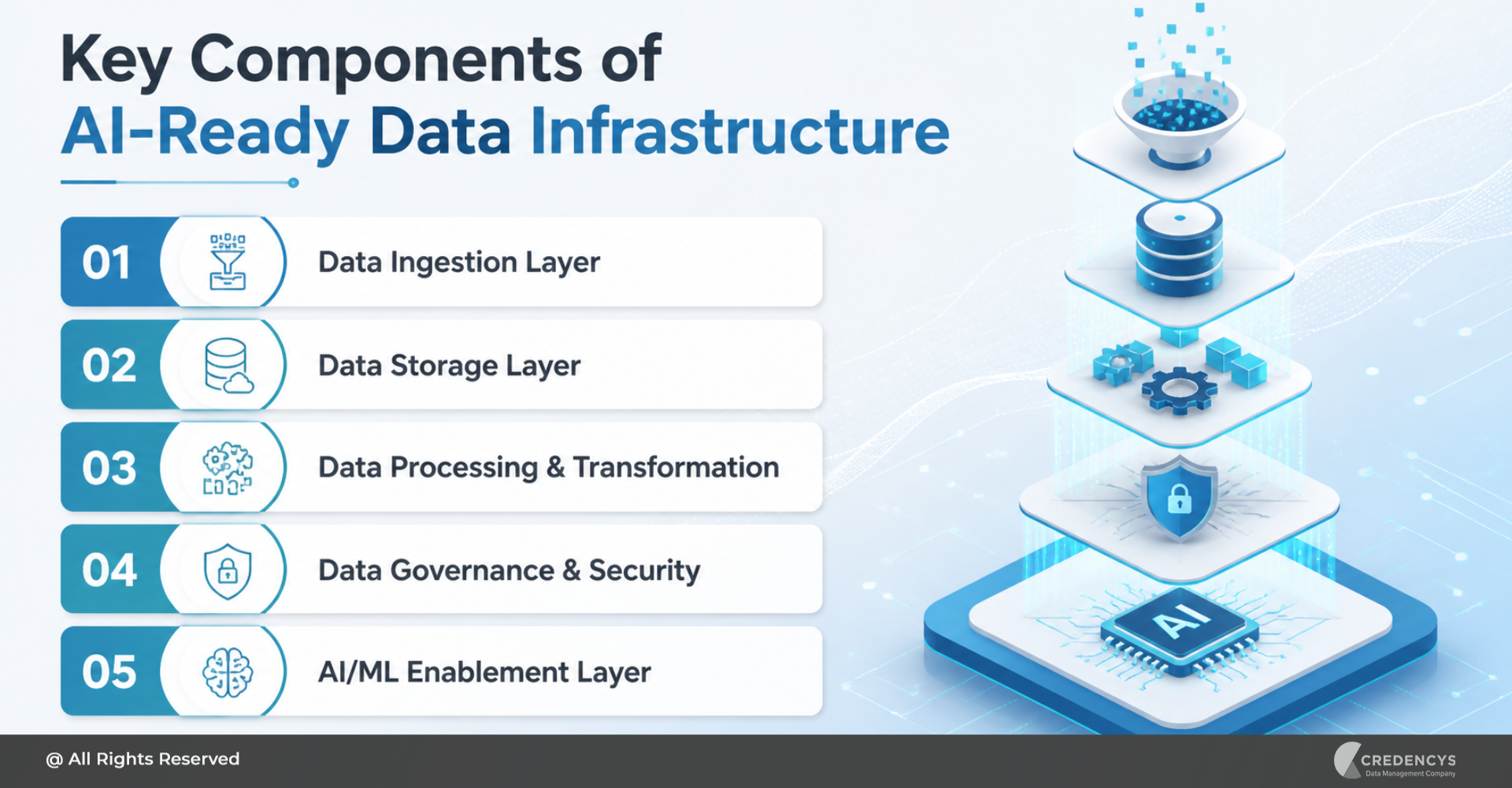
Key Components of AI-Ready Data Infrastructure

Together, these components create a robust foundation for scalable AI initiatives.

AI-Ready Data Infrastructure Use Cases in Retail

For retail and CPG enterprises, AI-ready infrastructure unlocks high-impact use cases.

1. Personalized Customer Experiences

By integrating data across channels, retailers can build a Customer 360 view and deliver:

  • Real-time product recommendations
  • Personalized offers and content
  • Seamless omnichannel experiences

2. Demand Forecasting

AI models powered by high-quality data can:

  • Predict demand more accurately
  • Optimize inventory levels
  • Reduce stockouts and overstock situations

3. Dynamic Pricing

With real-time data pipelines, retailers can:

  • Adjust prices dynamically based on demand, competition, and inventory
  • Maximize margins while remaining competitive

4. Marketing Optimization

AI-ready infrastructure enables:

  • Hyper-targeted campaigns
  • Better audience segmentation
  • Improved campaign ROI

Challenges in Building AI-Ready Data Infrastructure

While the benefits are clear, building such infrastructure is not without challenges.

  • Legacy system integration slows down modernization efforts
  • Data silos across departments hinder unified insights
  • Skill gaps in data engineering and AI capabilities
  • Cost management for large-scale data processing
  • Complex governance requirements

Organizations often underestimate the effort required to transition from traditional systems to AI-ready architectures. Without the right strategy and expertise, projects can become expensive and time-consuming.

Steps to Build AI-Ready Data Infrastructure

1. Assess Current Data Maturity

Start by evaluating your existing data landscape, including data sources, architecture, quality, and governance practices. Identify gaps that could impact AI readiness, such as fragmented systems, inconsistent data, or a lack of real-time capabilities.

This baseline helps prioritize modernization efforts and investments.

2. Define Business-Driven AI Use Cases

Avoid a technology-first approach. Instead, identify high-impact AI use cases, like personalization, demand forecasting, or pricing optimization, that align with business goals.

Clear use cases ensure that your data infrastructure is purpose-built to deliver measurable outcomes and ROI.

3. Break Down Data Silos

Integrate data across departments such as marketing, sales, supply chain, and customer service to create a unified data ecosystem. Eliminating silos enables a holistic view of operations and customers, which is essential for accurate AI models and advanced analytics.

4. Adopt a Lakehouse Architecture

Move toward a lakehouse architecture that combines the scalability of data lakes with the performance of data warehouses. This approach allows you to manage structured and unstructured data in a single platform, simplifying data access and enabling diverse AI workloads.

5. Enable Real-Time Data Pipelines

Implement streaming and real-time data processing capabilities to support time-sensitive use cases like recommendations and dynamic pricing. Real-time pipelines ensure that AI models are powered by the most up-to-date data, improving decision accuracy and responsiveness.

6. Implement Governance Frameworks

Establish strong data governance practices, including data quality checks, cataloging, lineage tracking, and access controls. A well-governed data environment builds trust in AI outputs while ensuring compliance with regulatory requirements.

7. Align Data, AI, and Business Teams

Foster collaboration between data engineers, data scientists, and business stakeholders to ensure alignment on goals and execution. Breaking down organizational silos accelerates AI adoption and ensures that data initiatives directly support business outcomes.
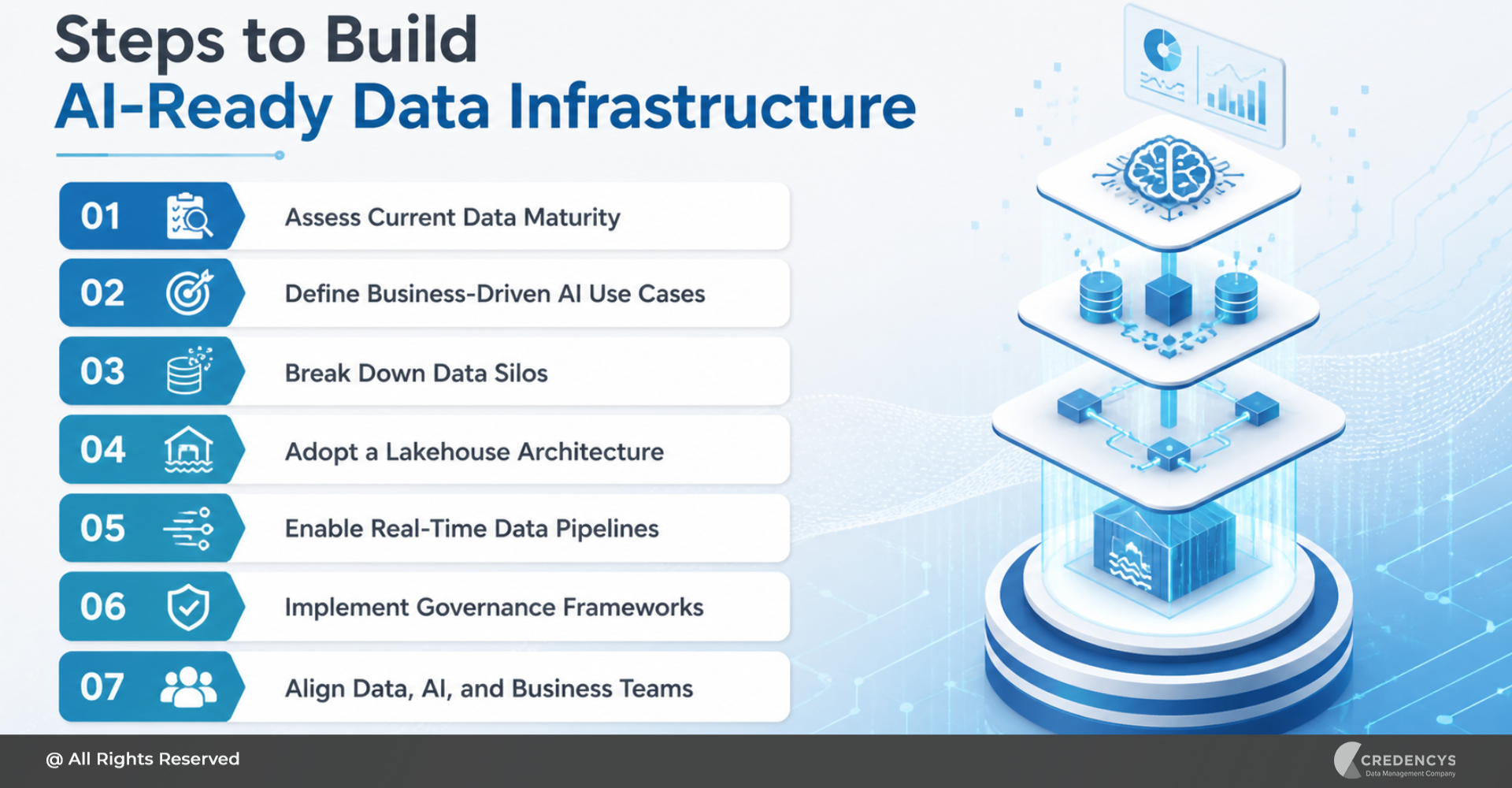
Steps to Build AI-Ready Data Infrastructure

Best Practices for AI-Ready Data Infrastructure

To maximize ROI, enterprises should follow these best practices:

  • Design for scalability from day one
  • Prioritize data quality over volume
  • Enable self-service data access for business users
  • Automate data pipelines and monitoring
  • Align infrastructure investments with business KPIs

Future Trends in AI Data Infrastructure

As AI continues to evolve, so does the underlying data infrastructure.

  • AI-native data platforms designed specifically for AI workloads
  • Real-time decision intelligence becoming the norm
  • Convergence of data mesh and lakehouse architectures
  • Integration of generative AI into data platforms
  • Autonomous data pipelines with minimal human intervention

Enterprises that adopt these trends early will gain a significant competitive advantage.

Why Enterprises Partner with Experts Like Credencys

Building an AI-ready data infrastructure requires more than just selecting the right tools; it demands a strategic approach and deep technical expertise. Organizations often partner with experienced providers to:

  • Design and implement scalable data architectures
  • Enable AI and machine learning capabilities
  • Modernize legacy systems with minimal disruption
  • Accelerate time-to-value for AI initiatives

With strong expertise in data engineering, AI/ML enablement, and platforms like Databricks and Snowflake, Credencys helps enterprises transform their data into a powerful AI engine, especially in retail and CPG environments.

Conclusion

AI success doesn’t start with models; it starts with data. Without a robust, scalable, and governed data infrastructure, even the most ambitious AI initiatives will struggle to deliver value.

On the other hand, organizations that invest in AI-ready data infrastructure can unlock faster insights, better decision-making, and truly personalized customer experiences. As competition intensifies and AI adoption accelerates, the question is no longer whether you should modernize your data infrastructure, but how quickly you can do so.

Now is the time to build a foundation that can support your AI ambitions, today and in the future.

FAQs

1. What is an AI-ready data infrastructure?

AI-ready data infrastructure is a modern data ecosystem designed to support AI and machine learning workloads by enabling scalable, real-time, and high-quality data processing.

2. Why is an AI-ready data infrastructure important?

It ensures that AI models have access to accurate, timely, and governed data, leading to better insights, faster decisions, and higher ROI.

3. How do you make your data infrastructure AI-ready?

You can make data infrastructure AI-ready by adopting a lakehouse architecture, enabling real-time pipelines, improving data quality, and aligning data systems with AI use cases.

4. What architecture is best for AI workloads?

Lakehouse architecture is widely considered the best option as it combines the scalability of data lakes with the performance of data warehouses.

5. What are the key components of an AI-ready data infrastructure?

Key components include data ingestion, storage, processing, governance, and AI/ML enablement layers.
Databricks vs Snowflake: Data Migration Strategies for Modern Enterprises

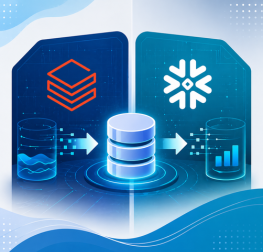
As enterprises accelerate their cloud transformation journeys, migrating legacy data warehouses and lakes has become a strategic priority. However, choosing the right target platform, Databricks or Snowflake, can significantly impact performance, scalability, cost efficiency, and long-term innovation.

Databricks offers a unified Lakehouse architecture powered by Delta Lake and Apache Spark, enabling organizations to handle structured, semi-structured, and unstructured data while supporting advanced analytics, AI, and machine learning. Snowflake, in contrast, delivers a fully managed Data Cloud optimized for SQL analytics, business intelligence, and high-concurrency workloads with minimal operational overhead.

This guide provides a comprehensive comparison of migration strategies for both platforms, covering key considerations such as planning, tools, cost models, performance, security, downtime, rollback mechanisms, and post-migration validation. It also highlights best practices such as phased migration, pilot testing, and automation to minimize risk.

Understanding the Platforms: Databricks Vs Snowflake

Architectural Differences: A clear understanding of architecture is essential before planning your migration.
Databricks Lakehouse ArchitectureSnowflake Data Cloud Architecture
Built on open formats like Delta Lake and ParquetFully managed platform with separate compute and storage layers
Combines data lake flexibility with data warehouse reliabilityUses virtual warehouses for elastic compute scaling
Uses Apache Spark for distributed data processingOptimized for SQL-based analytics and BI workloads
Supports batch and real-time streaming workloadsOffers built-in features like time travel, cloning, and data sharing
Typical Workloads: Each platform is optimized for different business needs.
Databricks is ideal forSnowflake is ideal for
Machine learning and AI workloadsBusiness intelligence dashboards
Real-time analytics and streaming pipelinesHigh-concurrency SQL queries
Large-scale ETL/ELT processingData warehousing and reporting
Unstructured data processing (logs, images, IoT data)Governed data sharing across teams
Ecosystem & Compliance: Both platforms support AWS, Azure, and Google Cloud and provide:
Enterprise-grade security (SOC 2, GDPR, HIPAA)
Encryption at rest and in transit
Integration with modern data tools (BI, ETL, AI frameworks)

Migrating to Databricks Lakehouse

Migrating to Databricks involves more than just moving data; it’s about rearchitecting your data platform into a unified Lakehouse. This shift enables organizations to consolidate data engineering, analytics, and AI workloads on a single platform powered by Apache Spark and Delta Lake.

Unlike traditional migrations, Databricks allows you to modernize both data pipelines and processing frameworks, making it especially suitable for organizations dealing with large-scale, diverse, or real-time data.

Overall Migration Approach

The migration approach typically focuses on transitioning from legacy systems (data warehouses, Hadoop, ETL tools) to a Delta Lake-based architecture.

  • Existing Spark or SQL-based workloads can often be migrated with minimal refactoring
  • Legacy ETL pipelines (e.g., Informatica, SSIS) are replatformed using modern data pipelines
  • Emphasis is placed on shifting from ETL → ELT and leveraging distributed processing

The goal is not just migration, but modernization for scalability and performance.

Tools and Automation

Databricks provides a robust ecosystem of tools to accelerate migration and reduce manual effort.

  • Databricks Auto Loader
    • Efficiently ingests large volumes of data from cloud storage
    • Automatically detects new files and schema changes
  • Delta Live Tables(DLT)
    • Simplifies pipeline creation with built-in data quality checks
    • Automates ETL workflows with reliability and scalability
  • Databricks Notebooks(DLT)
    • Enable collaborative development using Python, SQL, and Scala
    • Replace legacy stored procedures and scripts
  • Integration with Cloud ETL Tools(DLT)
    • Azure Data Factory, AWS Glue, and others can orchestrate pipelines
    • Useful for hybrid or phased migration strategies

Data Architecture Best Practices

A well-defined data architecture is critical for long-term success in Databricks.

  • Adopt the Medallion Architecture(DLT)
    • Bronze → Raw, unprocessed data
    • Silver → Cleaned and enriched data
    • Gold → Aggregated, business-ready datasets
  • Standardize on Delta Lake
    • Provides ACID transactions and schema enforcement
    • Supports time travel and version control
  • Separate Storage and Compute
    • Store data in cloud storage
    • Use clusters only when needed for processing

This structure improves scalability, governance, and performance.

Security and Governance

Databricks provides enterprise-grade governance capabilities, but they must be configured correctly during migration.

  • Use Unity Catalog for centralized access control and data governance
  • Implement role-based access control (RBAC)
  • Enable data lineage tracking for compliance and auditing
  • Ensure:
    • Encryption at rest and in transit
    • Secure cluster configurations
    • Integration with cloud IAM (Azure AD, AWS IAM)

Key Benefits of Migrating to Databricks

  • Unified platform for data engineering, analytics, and AI
  • Scalability for large and complex datasets
  • Open architecture with no vendor lock-in
  • Strong support for real-time and streaming workloads
  • Built-in capabilities for advanced analytics and ML

Migrating to Snowflake Data Cloud

Migrating to Snowflake is primarily about modernizing your data warehouse into a fully managed, cloud-native analytics platform. Unlike Lakehouse migrations, Snowflake focuses on simplifying data operations by abstracting infrastructure management and enabling high-performance SQL analytics at scale.

This makes Snowflake an ideal choice for organizations looking to streamline BI, reporting, and governed data access without managing complex data engineering infrastructure.

Overall Migration Approach

Snowflake migration typically involves data replication, schema conversion, and SQL transformation modernization.

  • Legacy data warehouses (e.g., Teradata, Oracle, SQL Server) are migrated into Snowflake tables
  • Existing SQL workloads are adapted to Snowflake’s ANSI-compliant SQL
  • ETL pipelines are often redesigned into ELT workflows, pushing transformations into Snowflake

The focus is on simplification, scalability, and faster analytics delivery.

Tools and Automation

Snowflake provides several tools to accelerate migration and reduce manual effort.

  • SnowConvert AI
    • Automates conversion of legacy SQL, DDL, and ETL scripts
    • Reduces manual rewriting effort and speeds up migration timelines
  • Snowpipe
    • Enables continuous, automated data ingestion
    • Supports near-real-time data pipelines
  • SnowSQL CLI
    • Command-line tool for bulk loading and automation
  • Third-Party Integrations
    • Tools like Fivetran, Talend, or Informatica for data ingestion and orchestration
    • Useful for complex enterprise migrations

Data Architecture Best Practices

Snowflake encourages a structured and optimized data warehouse design.

  • Layered Data Model
    • Raw → Staging → Curated → Data marts
    • Supports clean separation between ingestion and analytics
  • Leverage Native Features
    • Use the VARIANT data type for semi-structured data (JSON, XML)
    • Utilize zero-copy cloning for testing and development
  • Optimize Storage and Compute Separation
    • Store all data centrally
    • Use independent virtual warehouses for different workloads

This ensures scalability, performance isolation, and efficient resource utilization.

Security and Governance

  • Snowflake offers strong, built-in security and compliance features.
  • Role-based access control (RBAC) for fine-grained permissions
  • Dynamic data masking and secure views for sensitive data
  • End-to-end encryption (in transit and at rest)
  • Compliance support:
    • SOC 2
    • GDPR
    • HIPAA
    • PCI DSS
  • Network security:
    • Private connectivity (PrivateLink)
    • IP whitelisting and network policies

Governance is largely out-of-the-box, reducing setup complexity.

Key Benefits of Migrating to Snowflake

  • Fully managed platform with minimal operational overhead
  • High performance for SQL analytics and BI workloads
  • Seamless scalability and concurrency handling
  • Strong built-in security and compliance
  • Faster time-to-value for business users

Migration Planning: The Foundation of Success

A successful data migration is not defined by the tools you choose, but by the strength of your planning. Whether you are moving to Databricks or Snowflake, a structured approach ensures minimal disruption, controlled costs, and predictable outcomes.

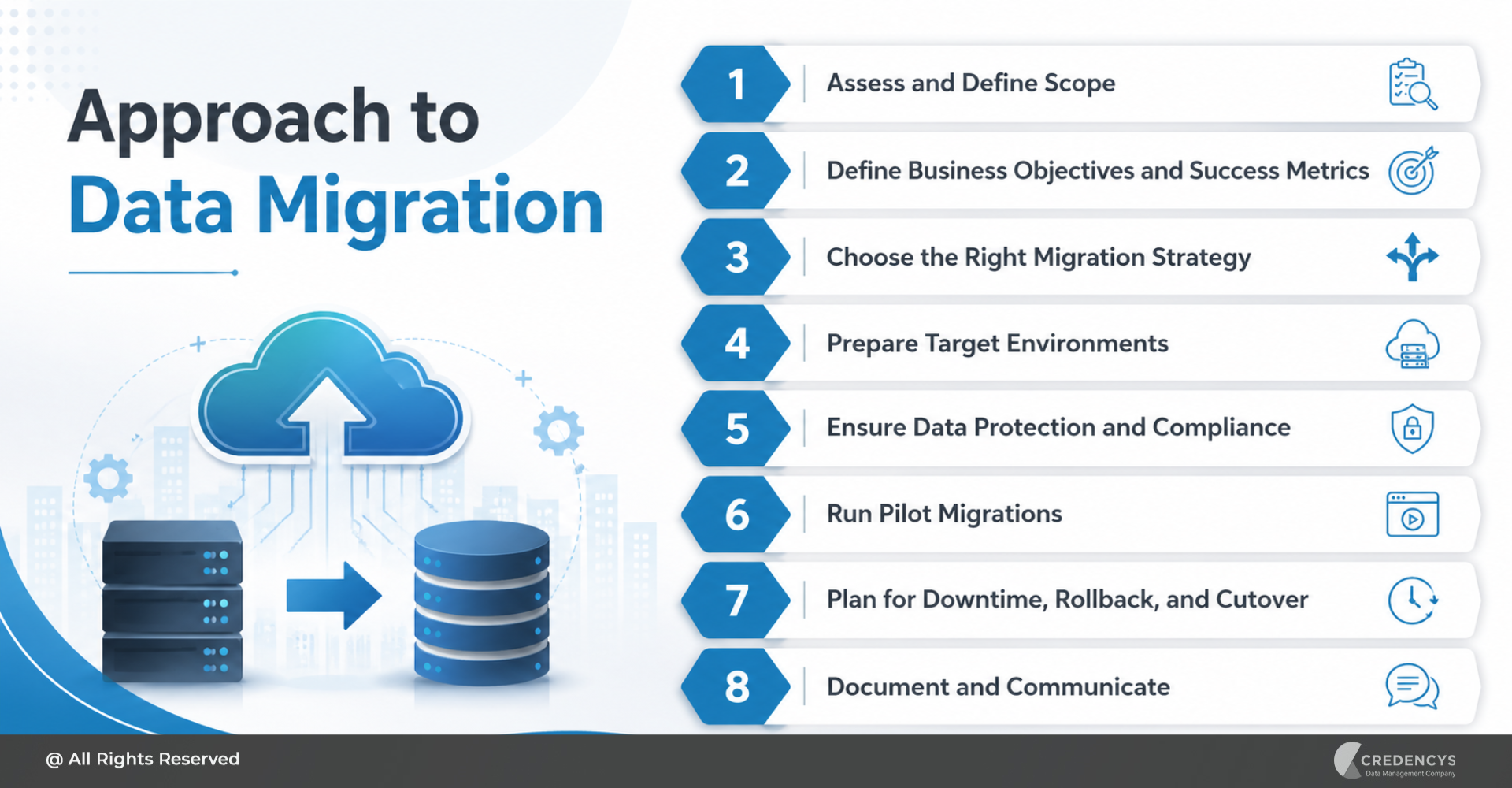
1. Assess and Define Scope

Begin with a comprehensive audit of your current data landscape. This includes identifying all data sources, pipelines, dependencies, and downstream applications that rely on the system.

Go beyond just inventory, evaluate data volume, velocity, formats, and sensitivity. Clearly defining scope helps avoid surprises mid-migration and ensures that no critical workload is overlooked.

2. Define Business Objectives and Success Metrics

Migration should be driven by business outcomes, not just technology upgrades. Establish clear goals such as reducing infrastructure costs, improving query performance, enabling real-time analytics, or supporting AI/ML initiatives.

Translate these goals into measurable KPIs, for example, “30% reduction in query latency” or “20% cost optimization.” These benchmarks help track ROI and keep stakeholders aligned throughout the migration journey.

3. Choose the Right Migration Strategy

Selecting the right migration approach significantly impacts risk and timelines. A phased migration allows workloads to be moved incrementally, enabling validation at each stage and reducing business disruption.

A big-bang approach may seem faster but introduces a higher risk, especially for mission-critical systems. Most enterprises prefer phased execution combined with parallel runs to ensure accuracy before full cutover.

4. Prepare Target Environments

Before migrating any data, ensure that your target environment is fully configured and production-ready. This includes setting up compute resources, storage layers, access controls, and monitoring systems.

For Databricks, this means configuring clusters, Delta Lake schemas, and governance tools like Unity Catalog. For Snowflake, it involves setting up virtual warehouses, schemas, and role-based access controls to ensure a smooth onboarding experience.

5. Ensure Data Protection and Compliance

Data security must be embedded into the migration process from the start. Create full backups or snapshots of all critical data to safeguard against accidental loss or corruption during migration.

Implement encryption both in transit and at rest and ensure compliance with relevant regulations. If required, plan for advanced security measures such as customer-managed encryption keys (BYOK) and audit logging.

6. Run Pilot Migrations

A pilot migration acts as a safety net before full-scale execution. Select a representative dataset or workload and migrate it in a controlled, non-production environment.

This helps identify performance bottlenecks, compatibility issues, and transformation challenges early. It also allows teams to validate tools, processes, and timelines before committing to full migration.

7. Plan for Downtime, Rollback, and Cutover

Even with the best planning, unexpected issues can arise. Define a clear cutover strategy, including the timing and approach for transitioning systems from legacy to the new platform.

Prepare rollback mechanisms in advance, whether through backups, snapshots, or platform-specific features like time travel or cloning. This ensures business continuity if anything goes wrong during the final migration.

8. Document and Communicate

Thorough documentation ensures transparency, governance, and long-term maintainability. Capture all migration steps, data mappings, transformation logic, and configuration settings.

Equally important is communication; keep stakeholders informed about timelines, potential risks, and expected outcomes. Clear communication minimizes resistance and ensures smoother adoption across teams.

Approach to Data Migration

Why Choose Credencys for Databricks & Snowflake Migration?

Migrating to modern data platforms like Databricks and Snowflake requires more than technical execution; it demands strategic planning, deep platform expertise, and proven delivery frameworks. This is where Credencys stands out.

As a certified partner for both Databricks and Snowflake, Credencys helps enterprises accelerate cloud data migration while minimizing risk, downtime, and cost overruns. Our team brings hands-on experience across industries like retail, eCommerce, manufacturing, and supply chain, ensuring your migration aligns with real business outcomes.

Why Enterprises Trust Credencys

  • Certified partner for Databricks and Snowflake
  • Proven experience across complex enterprise migrations
  • Industry expertise in retail, CPG, manufacturing, and eCommerce
  • Strong focus on governance, security, and compliance
  • End-to-end support; from strategy to execution to optimization

Conclusion

Data migration is no longer just an IT initiative; it’s a strategic enabler of innovation, agility, and data-driven decision-making. Choosing between Databricks and Snowflake ultimately comes down to your organization’s priorities, workloads, and long-term data strategy.

If your focus is on advanced analytics, machine learning, and large-scale data processing, Databricks offers the flexibility and power of an open Lakehouse architecture. On the other hand, if your priority is high-performance SQL analytics, business intelligence, and ease of management, Snowflake provides a streamlined, fully managed experience.

However, the success of any migration doesn’t depend solely on the platform; it depends on how well it’s planned and executed. From defining clear objectives and choosing the right strategy to validating data and optimizing performance post-migration, every step plays a critical role in achieving desired outcomes.

This is where having the right partner becomes essential. With deep expertise in both platforms, Credencys helps organizations navigate complexity, reduce risk, and accelerate time-to-value, ensuring your migration is not just successful but transformational.

Modernizing Retail Data Lakes: Lakehouse vs Hybrid vs Data Mesh

Retailers today are no longer struggling with a lack of data; they are overwhelmed by it. From POS systems and eCommerce platforms to IoT sensors, mobile apps, and social media, retail organizations generate massive volumes of data every second.

However, many legacy data lakes, often built on Hadoop or on-prem systems, have evolved into fragmented “data swamps” that are difficult to manage, govern, and extract value from. The result?

Delayed insights, poor personalization, and stalled AI/ML initiatives. As real-time analytics and omnichannel experiences become business-critical, modernizing retail data lakes is no longer optional; it’s a competitive necessity.

This blog explores three key approaches: data lakehouse, hybrid architectures, and data mesh to help retailers build a future-ready data foundation.

Drivers for Modernization: Why Retailers Must Evolve

Several business and technology trends are pushing retailers to rethink their data architecture:

  • Omnichannel Competition: Customers expect seamless experiences across online, in-store, and mobile channels.
  • Demand for Real-Time Insights: Delayed analytics can lead to missed sales opportunities and poor decision-making.
  • AI/ML Adoption: Advanced use cases like demand forecasting and personalization require unified, high-quality data.
  • Seasonal Demand Spikes: Retailers need scalable infrastructure to handle peak events like Black Friday.
  • Data Privacy & Compliance: Regulations demand stronger governance, data lineage, and control.
  • Legacy System Limitations: High costs, inflexibility, and poor performance hinder innovation.

The payoff of modernization is significant:

  • Faster time-to-insight
  • Reduced infrastructure costs
  • Improved customer intelligence
  • Scalable analytics and AI capabilities

Approach 1 – Data Lakehouse: A Unified Architecture for Modern Retail

The data lakehouse architecture is rapidly becoming the default for modern retail data platforms. It combines the flexibility and scalability of data lakes with the performance and governance of data warehouses, offering a unified system for structured, semi-structured, and unstructured data.

Key Capabilities

  • ACID Transactions for reliable data operations
  • Schema Enforcement to maintain data quality
  • Open Formats like Parquet for interoperability
  • Unified Storage Layer for all data types
  • SQL + AI/ML Support in a single platform

Technologies such as Delta Lake and Apache Iceberg enable these capabilities by providing reliability and structure for cloud-based data lakes. Modern platforms such as Databricks and Snowflake further accelerate adoption by integrating storage, compute, and governance into a single ecosystem.

Benefits for Retailers

  • Single Source of Truth for customer, product, and transaction data
  • Real-Time Personalization across channels
  • Improved Demand Forecasting using unified datasets
  • Lower Costs with scalable cloud object storage
  • Streamlined Data Governance

Considerations

  • Requires migration from legacy systems
  • Needs strong governance frameworks
  • Involves upskilling teams on modern tools

Many retailers partner with experienced data engineering firms like Credencys to accelerate lakehouse adoption, ensuring the right architecture, governance, and migration strategy from day one.

Approach 2 – Hybrid Data Lake + Data Warehouse: A Transitional Model

A hybrid architecture combines a data lake for raw data storage with a data warehouse for structured analytics. This approach allows retailers to modernize incrementally while continuing to use existing investments.

Typical Architecture

  • Data Lake: AWS S3, Azure Data Lake, or Google Cloud Storage
  • Data Warehouse: Snowflake, Amazon Redshift, or BigQuery
  • ETL/ELT Tools: AWS Glue, Azure Data Factory, Databricks

Benefits

  • Leverages existing BI systems
  • Optimized performance for SQL analytics
  • Cost-effective storage for raw data
  • Suitable for compliance and historical data retention

Challenges

  • Data Duplication across systems
  • Complex Pipelines for data movement
  • Latency Issues between ingestion and analytics
  • Multiple Governance Layers

Best Fit For: Retailers looking for a phased modernization approach without a complete architectural overhaul.

Approach 3 – Data Mesh: Domain-Centric Data Ownership

Data mesh is less about technology and more about how organizations manage and scale data. It shifts ownership from centralized teams to domain-specific teams (e.g., marketing, supply chain), enabling them to create and manage “data products.”

Core Principles

  • Domain-oriented ownership
  • Data as a product
  • Self-service data infrastructure
  • Federated governance

Benefits

  • Faster innovation and decision-making
  • Domain expertise embedded in data
  • Scalability across large organizations

Challenges

  • Requires significant cultural and organizational change
  • Complex governance across distributed teams
  • Risk of inconsistent standards without strong controls

Best Fit For: Large retail enterprises with multiple business units and mature data capabilities.

Comparing Modernization Approaches

ApproachBenefitsChallengesTech StackRetail Use CasesBest Fit ForMigration Complexity
LakehouseUnified storage, real-time analytics, and strong governanceRequires migration, new skillsDelta Lake, Iceberg, Databricks, SnowflakePersonalization, forecasting, and inventory optimizationAI-driven retailersMedium–High
HybridCost-efficient, leverages existing systemsData duplication, latency, pipeline complexityS3/ADLS + Snowflake/RedshiftBI reporting, complianceLegacy-heavy organizationsLow–Medium
Data MeshDecentralized agility, domain ownershipCultural shift, governance complexityDatabricks/Snowflake + dbt/KafkaOmnichannel analytics, domain-specific insightsLarge enterprisesHigh

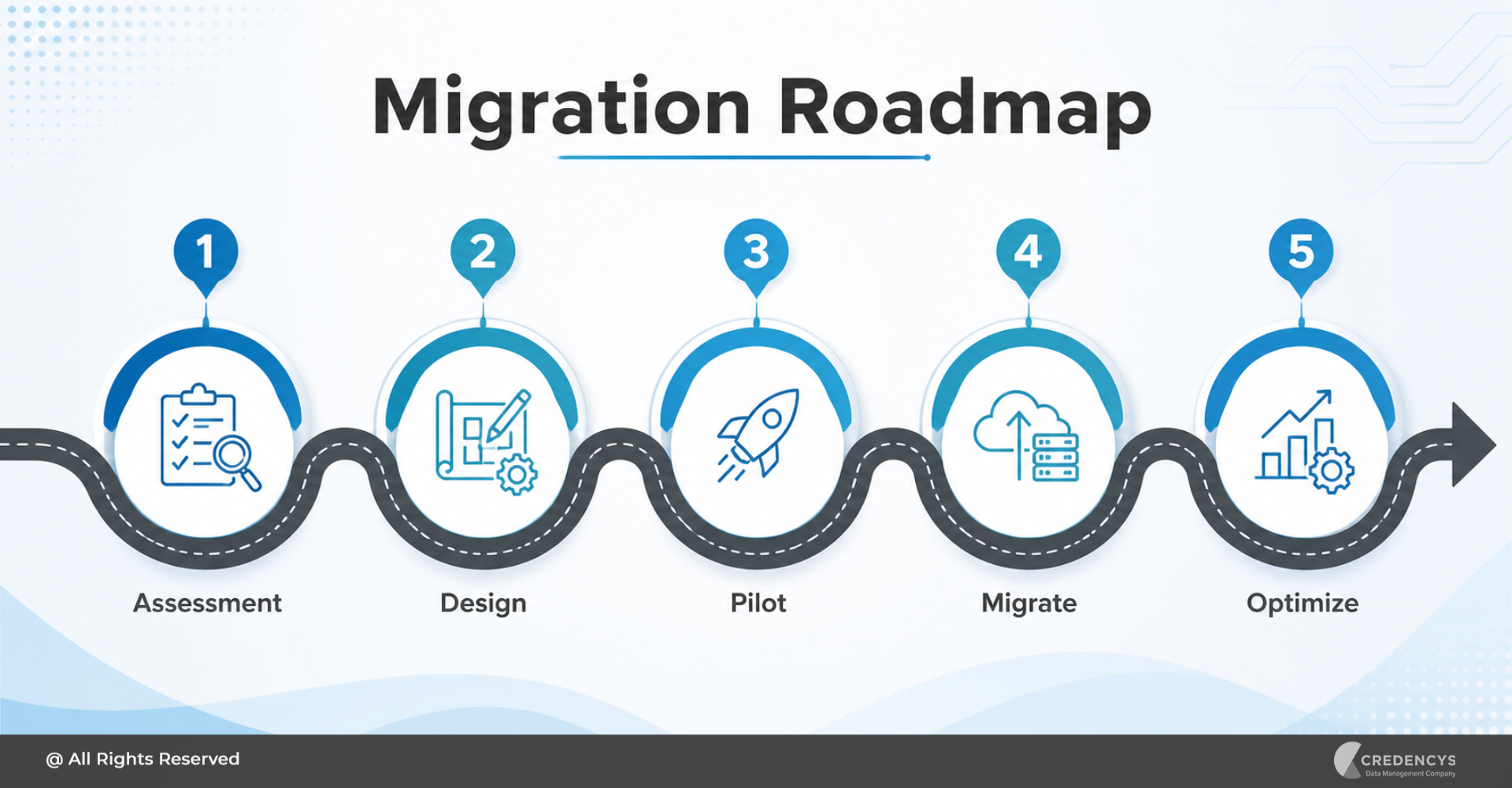
Migration Roadmap: From Legacy to Modern Data Platform

Modernizing retail data lakes is a structured, phased transformation that balances risk, cost, and business value. A well-defined roadmap ensures minimal disruption while delivering incremental wins.

1. Assessment

  • Evaluate Current Data Landscape: Conduct a comprehensive audit of existing data sources, pipelines, storage systems, and tools. Identify data silos, redundancies, quality issues, and performance bottlenecks that impact business outcomes.
  • Align Business & Data Priorities: Map data capabilities to business goals such as personalization, supply chain optimization, or forecasting. This ensures modernization efforts are tied directly to measurable ROI.
  • Identify High-Impact Use Cases: Prioritize 1–2 use cases (e.g., customer 360, demand forecasting) that can demonstrate quick value and build internal momentum for broader transformation.

2. Design

  • Select the Right Architecture: Choose between lakehouse, hybrid, or data mesh based on organizational maturity, scalability needs, and existing technology investments. Define how data will be ingested, stored, processed, and consumed.
  • Define Governance & Security Frameworks: Establish policies for data access, lineage, quality, and compliance. Incorporate role-based access control, data cataloging, and audit mechanisms from the start.
  • Create a Scalable Data Model & Pipeline Strategy: Design data models that support both analytics and AI workloads. Plan batch and real-time pipelines, ensuring flexibility to handle future data growth and new use cases.

3. Pilot

  • Build a Proof of Concept (PoC): Implement the chosen architecture using a limited dataset or business domain. Validate data ingestion, transformation, and analytics capabilities in a controlled environment.
  • Measure Performance & Business Impact: Track metrics such as query speed, data freshness, and usability. Compare outcomes against legacy systems to quantify improvements and justify further investment.
  • Gather Stakeholder Feedback: Involve business users, data engineers, and analysts early. Their feedback helps refine data models, dashboards, and workflows before scaling.

4. Migrate

  • Execute Incremental Data Migration: Move data in phases rather than a full lift-and-shift. Start with prioritized datasets and gradually migrate less critical historical data to reduce risk.
  • Rebuild and Optimize Pipelines: Transition from legacy ETL to modern ELT or streaming pipelines. Optimize transformations for cloud-native performance and scalability.
  • Enable Change Management & Training: Upskill teams on new tools and processes through structured training programs. Ensure clear communication to drive adoption across technical and business users.
  • Leverage Expert-Led Migration Support: Partnering with experienced firms like Credencys accelerates migration while minimizing risks. With proven frameworks, pre-built accelerators, and deep expertise in platforms like Databricks and Snowflake, we help streamline data movement, pipeline modernization, and governance implementation.

5. Optimize

  • Enhance Performance & Cost Efficiency: Continuously monitor workloads, optimize queries, and right-size compute resources. Implement cost governance practices to avoid cloud overspending.
  • Implement DataOps & Automation: Introduce CI/CD pipelines, automated testing, and monitoring for data workflows. This ensures reliability, faster deployments, and reduced manual effort.
  • Scale Across Use Cases & Domains: Expand the platform to additional business areas, integrating more data sources and enabling advanced analytics and AI initiatives.

Migration Roadmap

Retail Use Cases & Business Benefits

Modernizing retail data platforms directly impacts revenue, customer experience, and operational efficiency. By unifying and activating data, retailers can unlock high-value use cases across the business.

1. Personalized Customer Experiences

  • Unified Customer 360 View: Combine data from CRM systems, purchase history, website interactions, mobile apps, and in-store behavior to create a single, accurate customer profile. This eliminates fragmentation and enables consistent engagement across all touchpoints.
  • AI-Driven Recommendations & Targeting: Use machine learning models to deliver personalized product recommendations, promotions, and content in real time. This significantly improves conversion rates, average order value, and customer retention.
  • Omnichannel Journey Optimization: Track and analyze customer journeys across channels to identify drop-offs and optimize experiences. Retailers can deliver seamless transitions between online and offline interactions.

2. Inventory & Supply Chain Optimization

  • Real-Time Inventory Visibility: Integrate sales, warehouse, and logistics data to gain up-to-date visibility into stock levels across locations. This helps prevent stockouts and overstocking.
  • Demand-Supply Alignment: Use integrated data to align procurement, distribution, and replenishment strategies with actual demand patterns. This reduces waste and improves margins.
  • Supplier & Logistics Performance Insights: Analyze supplier reliability, delivery timelines, and logistics efficiency. Retailers can proactively address bottlenecks and optimize supply chain operations.

3. Demand Forecasting & Pricing Optimization

  • AI-Powered Demand Forecasting: Leverage historical sales data, seasonal trends, promotions, and external factors (weather, events) to generate accurate forecasts. This enables better planning and inventory allocation.
  • Dynamic Pricing Strategies: Adjust pricing in real time based on demand, competition, and inventory levels. Retailers can maximize revenue while remaining competitive.
  • Promotion Effectiveness Analysis: Evaluate the impact of discounts and campaigns across channels. Insights help refine future promotions and improve ROI.

4. Omnichannel Analytics & Business Intelligence

  • Cross-Channel Data Integration: Break down silos between eCommerce, physical stores, marketplaces, and mobile platforms. This provides a holistic view of business performance.
  • Real-Time Dashboards & Reporting: Enable business users with self-service analytics and live dashboards for faster decision-making. Executives gain immediate visibility into KPIs.
  • Improved Customer Attribution: Understand which channels and campaigns drive conversions. This helps optimize marketing spend and channel strategy.

5. AI/ML Innovation & Advanced Analytics

  • Advanced Predictive Models: Build models for churn prediction, customer lifetime value (CLV), and recommendation engines. These insights drive proactive business decisions.
  • Fraud Detection & Risk Management: Identify anomalies in transactions and customer behavior using real-time analytics. This reduces fraud losses and improves security.
  • Experimentation & A/B Testing at Scale: Run controlled experiments across pricing, promotions, and user experiences. Data-driven experimentation accelerates innovation.

6. Scalability & Peak Performance

  • Handle Seasonal Demand Spikes: Cloud-based modern data platforms scale automatically during peak events like Black Friday or festive sales. This ensures uninterrupted performance.
  • Elastic Compute & Storage: Dynamically allocate resources based on workload requirements, optimizing both performance and cost.
  • Future-Ready Data Foundation: A modern architecture supports new data sources, technologies, and use cases without major rework.

Conclusion: Turning Retail Data into a Competitive Advantage

Retailers can no longer afford to operate on fragmented, slow, and unreliable data systems. As customer expectations rise and competition intensifies, the ability to harness data in real time has become a defining factor for success.

Modernizing retail data lakes, whether through a lakehouse, hybrid architecture, or data mesh, is not just a technology upgrade. It’s a strategic shift toward building a scalable, AI-ready data foundation that powers personalization, optimizes operations, and drives smarter decision-making.

Each approach has its place:

  • Lakehouse for unified, future-ready analytics
  • Hybrid for gradual, low-risk transformation
  • Data Mesh for large-scale, domain-driven agility

The key is to align your data strategy with business goals, start with high-impact use cases, and adopt an incremental, well-governed migration approach. Retailers that get this right don’t just improve analytics, they unlock new revenue opportunities, enhance customer experiences, and build a long-term competitive edge.

FAQs

1. What is retail data lake modernization?

It is the process of upgrading legacy data lakes to modern architectures such as lakehouses, hybrid systems, or data meshes to improve analytics, governance, and scalability.

2. What is the difference between a lakehouse and a data warehouse?

A lakehouse combines the flexibility of data lakes with the performance and governance of data warehouses in a single platform.

3. Is data mesh suitable for mid-size retailers?

Typically, data mesh is better suited for large enterprises due to its organizational complexity.

Cloud Data Migration Best Practices: A Strategic Guide for CTOs and Data Leaders

Cloud adoption is no longer optional for enterprises aiming to stay competitive.

According to Gartner, over 85% of organizations will embrace a cloud-first principle, yet a significant number of cloud migration initiatives fail to meet expectations due to poor planning and execution.

Data migration is one of the most complex and high-risk components of this journey. From data loss and downtime to security vulnerabilities and cost overruns, even small missteps can lead to major business disruptions.

For CTOs and data leaders, the challenge is not just moving data from legacy systems to the cloud. It is about ensuring data integrity, governance, scalability, and long-term value realization.

This blog outlines the most critical cloud data migration best practices to help you minimize risk, control costs, and achieve a seamless transition to the cloud.

Why Cloud Data Migration Fails

Despite strong business intent, many cloud migration initiatives fall short because organizations underestimate the complexity of moving data at scale.

According to Gartner, 50% of cloud migration projects will be delayed or fail to meet objectives due to poor planning and cost mismanagement.

Here are the most common reasons behind failure:

1. Lack of a Clear Migration Strategy

Many organizations jump into migration without defining clear goals, timelines, or success metrics. This leads to misalignment between IT and business teams, resulting in delays and rework.

2. Underestimating Data Complexity

Enterprise data is often siloed, unstructured, and inconsistent. Without proper data discovery and classification, migration efforts become chaotic and error-prone.

3. Poor Data Quality

Migrating duplicate, outdated, or incomplete data into the cloud only amplifies existing problems. It affects analytics accuracy and increases storage costs.

4. Inadequate Testing and Validation

Skipping rigorous testing leads to data corruption, missing records, or application failures post-migration. This can directly impact business operations.

5. Security and Compliance Gaps

Failing to address regulatory requirements and security controls during migration can expose sensitive data and lead to compliance violations.

6. Ignoring Cost Optimization

Without proper planning, cloud costs can spiral due to inefficient storage, data transfer fees, and over-provisioned resources.
Understanding these pitfalls is the first step toward a successful migration.

Cloud Data Migration Best Practices

To ensure a successful migration, organizations need a structured approach that balances technical execution with business priorities. Below are the most critical cloud data migration best practices every CTO and data leader should follow:

1. Define a Clear Migration Strategy

Start with a well-defined roadmap that aligns with business goals. Identify what data needs to be migrated, why it matters, and how success will be measured.

  • Define migration objectives such as cost reduction, scalability, or performance improvement
  • Choose the right migration approach such as rehosting, replatforming, or refactoring
  • Establish KPIs like downtime, data accuracy, and migration speed

2. Assess and Classify Your Data

Not all data should be migrated. A detailed data assessment helps prioritize what is critical and what can be archived or retired.

  • Perform data discovery across systems
  • Classify data based on sensitivity, usage, and business value
  • Eliminate redundant, obsolete, and trivial data

3. Ensure Data Quality Before Migration

Migrating poor-quality data leads to poor outcomes. Clean, standardized, and validated data ensures better performance in the cloud.

  • Remove duplicates and inconsistencies
  • Standardize formats and structures
  • Validate data accuracy before transfer

4. Choose the Right Cloud Architecture

Selecting the right cloud environment is crucial for performance and scalability. The architecture should align with your workload and data needs.

  • Decide between public, private, or hybrid cloud models
  • Optimize storage and compute configurations
  • Design for scalability and future growth

5. Prioritize Security and Compliance

Data security should be embedded throughout the migration process, not treated as an afterthought.

  • Encrypt data in transit and at rest
  • Implement role-based access controls
  • Ensure compliance with regulations like GDPR or industry standards

6. Use Automation and Migration Tools

Manual migration increases risk and slows down the process. Automation tools improve efficiency and accuracy.

  • Leverage ETL and data integration tools
  • Automate data validation and reconciliation
  • Use cloud-native migration services where possible

7. Test, Validate, and Monitor Continuously

Testing is critical to ensure data integrity and system performance after migration.

  • Conduct pre- and post-migration testing
  • Validate data completeness and accuracy
  • Monitor performance and resolve issues in real time

8. Plan for Downtime and Business Continuity

Even with the best planning, disruptions can occur. A strong continuity plan minimizes business impact.

  • Schedule migrations during low-traffic periods
  • Implement backup and rollback strategies
  • Ensure failover mechanisms are in place

9. Optimize Costs Throughout the Process

Cloud migration can become expensive without proper control mechanisms.

  • Monitor data transfer and storage costs
  • Avoid over-provisioning resources
  • Continuously optimize cloud usage post-migration

10. Build a Cross-Functional Team

Successful migration requires collaboration across IT, data, and business teams.

  • Involve stakeholders early in the planning phase
  • Ensure clear communication across teams
  • Assign ownership and accountability

How Credencys Can Help with Cloud Data Migration

Credencys helps enterprises execute cloud data migration with speed, accuracy, and minimal risk.

  • Strategy & Planning: Define the right migration roadmap aligned with business goals
  • End-to-End Execution: Secure, low-downtime migration with modernized pipelines
  • Data Quality & Governance: Clean, standardized, and well-governed data
  • Cloud Expertise: Proven experience with modern data platforms and architectures
  • Testing & Optimization: Ensure accuracy, performance, and cost efficiency

With Credencys, your migration is not just smooth but also future-ready.

Conclusion

Cloud data migration is a critical step toward building a scalable, data-driven enterprise. However, without the right strategy and execution, it can quickly become complex and risky.

By following proven cloud data migration best practices, organizations can minimize disruption, control costs, and ensure data integrity throughout the process.

Partnering with experts like Credencys further strengthens your approach, enabling faster migration, better governance, and long-term value from your data investments.

Generative AI for Retail Personalization: The 2026 Playbook

Retail is no longer just about selling products; it’s about delivering experiences. Today’s consumers expect brands to understand their preferences, anticipate their needs, and engage them with highly relevant interactions across every touchpoint.

Yet, most retailers struggle to deliver this consistently.

  • Customer data is fragmented across systems
  • Personalization engines are rule-based and limited
  • Content creation cannot scale with demand

This is where generative AI changes the game.

Generative AI acts as a “creativity engine” for personalization, enabling retailers to generate tailored content, recommendations, and interactions in real time. It transforms personalization from a static, rules-driven process into a dynamic, AI-powered experience layer.

Why Personalization is a Revenue Imperative

Personalization is no longer optional; it directly impacts revenue, retention, and customer lifetime value. Consider this:

  • 80% of consumers are more likely to purchase from brands that offer personalized experiences
  • AI-driven personalization can improve marketing ROI by 10-20%
  • Retailers using advanced analytics are significantly more likely to acquire and retain customers

However, there’s a gap. Despite heavy investments in data and analytics:

  • Only a fraction of customers feels truly understood
  • Poor data quality continues to cost enterprises millions annually
  • Many personalization efforts remain superficial (e.g., “Customers also bought…”)

The real issue isn’t intent, it’s execution. Retailers need:

  • Unified customer and product data
  • Scalable AI models
  • Real-time decisioning capabilities

Generative AI addresses all three by combining data, intelligence, and content generation into a single layer.

What Makes Generative AI Different

Traditional AI focuses on prediction, what a customer might do next. Generative AI goes a step further; it creates.

Instead of just recommending products, it can:

  • Generate personalized product descriptions
  • Craft tailored marketing messages
  • Simulate conversations with customers
  • Produce contextual recommendations based on real-time behavior

This is powered by technologies like:

  • Large Language Models (LLMs)
  • Retrieval-Augmented Generation (RAG)
  • Vector search and embeddings

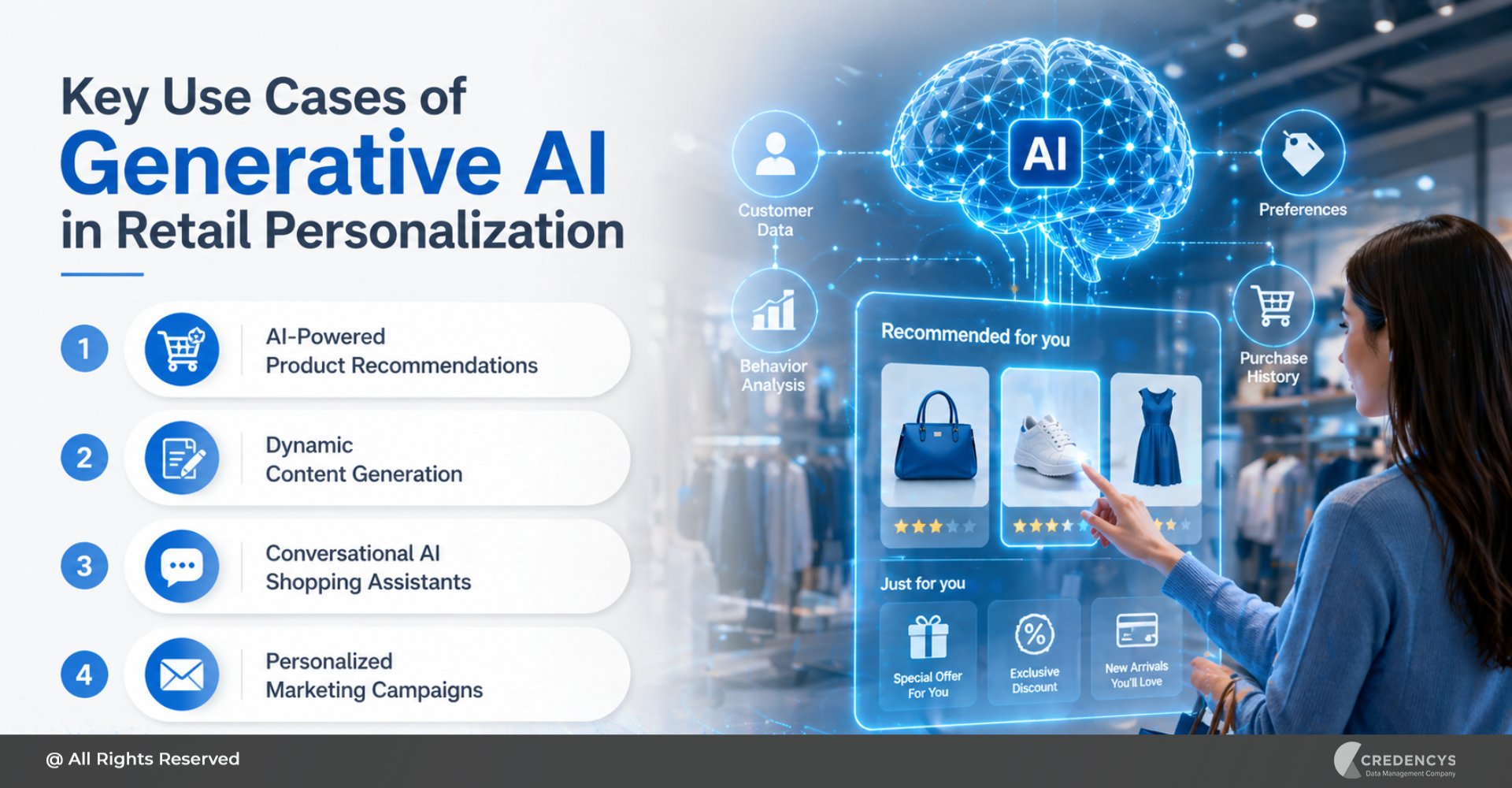
Key Use Cases of Generative AI in Retail Personalization

Generative AI unlocks multiple high-impact use cases across the retail value chain.

1. AI-Powered Product Recommendations

Traditional recommendation engines rely on collaborative filtering or simple rules. Generative AI enhances this by:

  • Incorporating real-time customer context
  • Understanding intent through natural language
  • Combining behavioral, transactional, and product data

Using RAG pipelines, retailers can:

  • Retrieve relevant product data from catalogs
  • Combine it with customer profiles
  • Generate highly contextual recommendations

Instead of “Customers also bought,” shoppers receive, “Based on your recent purchase and upcoming travel plans, here are lightweight, weather-resistant jackets you might like.” This level of personalization significantly improves conversion rates and engagement.

2. Dynamic Content Generation

Creating personalized content at scale has always been a challenge. Generative AI solves this by automatically producing:

  • Product descriptions
  • Email campaigns
  • Ad creatives
  • Landing page content

For example:

  • A single product can have multiple descriptions tailored to different audiences
  • Marketing emails can be dynamically generated based on customer behavior
  • Localization becomes effortless with AI-generated variations

This reduces content production time while improving relevance.

3. Conversational AI Shopping Assistants

AI-powered chatbots are evolving into intelligent shopping assistants. These systems can:

  • Answer product queries in natural language
  • Provide personalized recommendations
  • Assist in product discovery
  • Support post-purchase interactions

Unlike traditional bots, generative AI enables:

  • Context-aware conversations
  • Memory of past interactions
  • Human-like responses

For example, when a customer asks, “I need a gift for a 10-year-old who loves science”, the AI assistant can generate:

  • Curated product suggestions
  • Explanations for each recommendation
  • Add-to-cart options

This creates a seamless and engaging shopping experience.

4. Personalized Marketing Campaigns

Marketing teams can now move from segmentation to true 1:1 personalization. Generative AI enables:

  • Automated campaign creation
  • Personalized messaging for each user
  • Real-time A/B testing and optimization

Retailers can generate:

  • Email subject lines tailored to individual preferences
  • Social media ads customized by demographic
  • Promotions aligned with purchase history

The result:

  • Higher engagement
  • Lower customer acquisition cost (CAC)
  • Faster campaign execution

5. Additional Emerging Use Cases

  • Sentiment-driven personalization from reviews and feedback
  • AI-powered search (text, voice, image)
  • Automated review summarization
  • Dynamic pricing and promotions

Key Use Cases of Generative AI in Retail Personalization

How to Implement Generative AI Personalization

Implementing generative AI requires more than just plugging in an LLM; it demands a structured architecture. Here are three proven implementation patterns:

1. GenAI-Powered Recommendation Engine

This approach combines data platforms, AI models, and retrieval systems.

How it works:

  • Customer and product data are unified in a data platform
  • Data is converted into embeddings and stored in a vector database
  • RAG pipelines retrieve relevant context
  • LLMs generate personalized recommendations

Key benefit: Highly contextual, real-time personalization at scale.

2. Conversational AI Layer

This pattern focuses on customer interaction.

How it works:

  • LLMs are integrated into chat interfaces (web/app)
  • Connected to customer data platforms and CRM systems
  • Real-time data (inventory, orders, preferences) is accessed
  • AI generates tailored responses

Key benefit: Enhanced customer engagement and guided selling.

3. Automated Content Generation Pipeline

This approach transforms content operations.

How it works:

  • Product data flows from PIM systems
  • AI generates descriptions, ads, and content
  • Outputs are reviewed (human-in-the-loop)
  • Content is published via CMS or marketing tools

Key benefit: Scalable, consistent, and high-quality content production.

Privacy, Ethics & Compliance

With great personalization comes great responsibility. Generative AI introduces challenges around:

  • Data privacy
  • Bias
  • Transparency

Retailers must ensure:

  • Use of consented, first-party data
  • Compliance with regulations (GDPR, CCPA)
  • Explainable AI decisions
  • Bias detection and mitigation

Responsible AI is not just a compliance requirement; it’s a trust builder.

Real-World Examples of Generative AI in Retail

Women’s Specialty Apparel Brand

A leading women’s specialty apparel leader unified customer and other data from multiple sources, including on-premises, cloud, and third-party systems, to deliver a seamless shopping experience.

Outcome:

  • 24% increase in online sales
  • 31% improvement in customer satisfaction
  • Significant reduction in stockouts

Read Full Case Study Here

How Credencys Helps Retailers Scale GenAI Personalization

Credencys enables retailers to move from data chaos to AI-driven personalization at scale. Key offerings include:

  • Customer 360 (Custonomy CDP): Unified customer profiles
  • Product Data Management (RetailOne): Clean, enriched product data
  • Generative AI Solutions: Custom AI models and integrations

With deep expertise in data engineering, AI/ML, and retail domain solutions, Credencys helps organizations:

  • Build scalable AI architectures
  • Integrate GenAI into existing ecosystems
  • Accelerate time-to-value

Final Thoughts

Generative AI is redefining what’s possible in retail personalization. From intelligent recommendations to real-time content generation, it enables retailers to deliver truly individualized experiences at scale.

Those who adopt early will gain a significant competitive advantage. With the right strategy, technology, and partner, retailers can turn generative AI into a powerful growth engine, and Credencys is well-positioned to help make that transformation a reality.

Top Snowflake Consulting Companies in 2026 (With Comparison & Selection Guide)

As organizations race to become data-driven, Snowflake has positioned itself as a cornerstone of modern data architecture. Its ability to unify data warehousing, data lakes, and advanced analytics into a single platform has made it a go-to choice for enterprises aiming to scale insights and innovation.

This rapid adoption is reflected in market growth.

According to Fortune Business Insights, the global data warehousing market is projected to reach over $50 billion by 2028, driven largely by cloud platforms like Snowflake.

This signals a clear shift toward scalable, cloud-native data ecosystems. However, adopting Snowflake is not just about deploying a new technology stack.

It involves rethinking data architecture, optimizing performance, controlling costs, and aligning data initiatives with business outcomes. This is where many organizations struggle to turn potential into measurable value.

That’s why Snowflake consulting partners have become critical to success. The right partner brings not only technical expertise but also strategic clarity, ensuring that your Snowflake investment delivers tangible results.

In this blog, we explore the top Snowflake consulting companies in 2026, compare their strengths, and help you choose the right partner for your business.

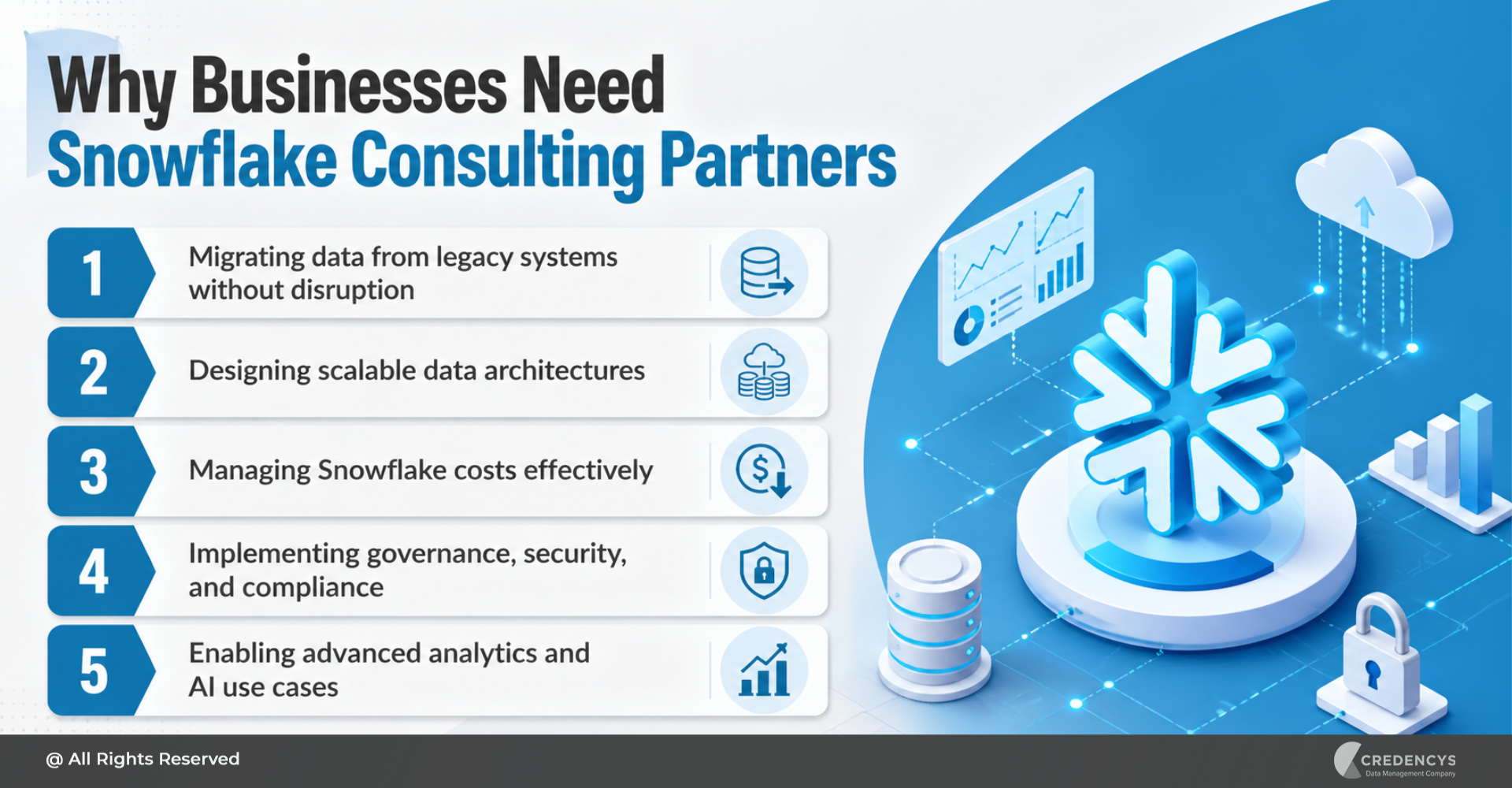
Why Businesses Need Snowflake Consulting Partners

While Snowflake simplifies data infrastructure, implementing it effectively requires a deep understanding of both technology and business context. Many organizations underestimate the complexity involved, leading to delays, inefficiencies, and rising costs.

1. Migrating data from legacy systems without disruption

Data migration is often the first major hurdle in any Snowflake implementation. Legacy systems are deeply embedded within business processes, and moving large volumes of structured and unstructured data without downtime can be challenging.

Even minor errors during migration can lead to data inconsistencies or operational disruptions. A consulting partner helps design a phased migration strategy to minimize business impact.

They also implement validation mechanisms to maintain data integrity and continuity throughout the transition.

2. Designing scalable data architectures

Snowflake offers immense scalability, but without the right architecture, organizations fail to leverage its full potential. Poorly designed schemas, inefficient data pipelines, and a lack of standardization can lead to performance bottlenecks over time.

Experienced consultants bring proven architectural frameworks that ensure scalability from day one. They design systems that can handle increasing data volumes while maintaining performance and reliability.

3. Managing Snowflake costs effectively

One of Snowflake’s strengths, its consumption-based pricing, can also become a challenge if not managed properly. Inefficient queries, oversized warehouses, and a lack of monitoring can quickly inflate costs.

Snowflake Consulting Companies help implement cost governance strategies, including workload optimization and usage monitoring. This ensures that organizations maximize performance while keeping costs under control.

4. Implementing governance, security, and compliance

As data becomes more central to business operations, governance and security cannot be overlooked. Organizations must ensure data privacy, access control, and compliance with regulations such as GDPR or industry-specific standards.

A skilled consulting partner establishes robust governance frameworks, including role-based access control and data lineage tracking. This not only enhances security but also builds trust in data across the organization.

5. Enabling advanced analytics and AI use cases

Many organizations adopt Snowflake to enable advanced analytics and AI. However, moving from data storage to actionable intelligence requires additional capabilities, including data modeling, feature engineering, and integration with AI tools.

Consultants bridge this gap by enabling end-to-end analytics workflows. They help organizations unlock predictive insights and real-time decision-making capabilities using Snowflake’s ecosystem.

Why Businesses Need Snowflake Consulting Partners

Key Criteria to Evaluate Snowflake Consulting Companies

Choosing the right Snowflake consulting partner is not a straightforward decision. It requires evaluating multiple dimensions beyond technical capabilities to ensure long-term success.

1. Technical expertise and certifications

A strong consulting partner should have certified Snowflake professionals with hands-on experience in complex implementations. This ensures they can handle challenges such as large-scale migrations, performance optimization, and multi-cloud deployments.

Beyond certifications, practical experience matters significantly. Firms that have delivered multiple successful Snowflake projects are better equipped to anticipate and mitigate risks.

2. End-to-end service capabilities

Snowflake implementation is not a one-time project but an ongoing journey. From strategy and architecture design to deployment and optimization, organizations need a partner who can support them across the lifecycle.

End-to-end capabilities ensure continuity and consistency in execution. This reduces dependency on multiple vendors and accelerates time-to-value.

3. Industry-specific experience

Every industry has unique data challenges and use cases. For example, retail focuses on customer analytics and demand forecasting, while manufacturing emphasizes supply chain optimization.

A consulting partner with industry expertise can bring pre-built solutions and best practices. This significantly reduces implementation time and improves business relevance.

4. Ecosystem and partnerships

Strong partnerships with cloud providers and Snowflake itself indicate a higher level of expertise. These partnerships often provide access to advanced tools, training, and support.

They also enable better integration with the broader data ecosystem, including BI tools, data integration platforms, and AI frameworks.

5. Cost structure and engagement flexibility

Different organizations have different needs when it comes to engagement models. Some may prefer fixed-cost projects, while others require ongoing managed services.

A flexible consulting partner offers multiple engagement options and aligns pricing with business outcomes. This ensures better financial predictability and scalability.

6. AI and advanced analytics capabilities

As data strategies evolve, the ability to integrate AI and machine learning becomes crucial. Organizations should look for snowflake consulting companies that can go beyond data warehousing and enable intelligent use cases.

This includes building predictive models, real-time analytics pipelines, and data-driven applications that create a competitive advantage.

Top Snowflake Consulting Companies in 2026

Selecting the right consulting partner can significantly influence the success of your Snowflake journey. Below are five leading companies known for their expertise, innovation, and ability to deliver business impact.

1. Credencys

Credencys stands out as a strong partner for organizations looking to combine Snowflake implementation with advanced analytics and AI capabilities. The company focuses on delivering business outcomes rather than just technical solutions.

With deep expertise in data engineering and AI, Credencys helps organizations design scalable data architectures and unlock actionable insights. Their industry focus on retail and CPG allows them to deliver highly relevant solutions tailored to specific business challenges.

Best for: End-to-end Snowflake + AI transformation

Why choose Credencys:

  • Combines data, analytics, and AI for real impact
  • Tailored solutions aligned with business goals
  • End-to-end services, from strategy to optimization

Success Story: Renewable Energy Manufacturing Brand

Credencys helped a renewable energy provider modernize its data infrastructure, unlocking faster, more reliable decision-making.

Business Overview

The client is a forward-thinking renewable energy company focused on accelerating the adoption of sustainable energy. It connects consumers with local green energy producers, ensuring transparency and promoting a cleaner energy ecosystem.

Problem Statement

The organization struggled with fragmented, siloed data systems, resulting in inconsistent reporting and reduced operational efficiency. Critical financial calculations took several hours to complete, delaying business insights and decision-making.

Additionally, the existing infrastructure lacked scalability and could not efficiently handle growing data volumes. This limited the company’s ability to generate timely analytics and respond to business needs effectively.

Solution Implemented

Credencys implemented a modern data platform powered by Snowflake, enabling a centralized and clean data architecture. This unified data across systems, ensuring consistency and improved accessibility for business users.

The solution also enabled seamless data sharing across teams and reduced maintenance overhead through Snowflake’s scalable, low-maintenance architecture. This allowed internal teams to focus more on insights rather than infrastructure management.

Business Impact

  • 30% reduction in data processing time, enabling faster financial computations
  • 3x faster report generation, improving access to business insights
  • Centralized data access for 140+ employees, enhancing collaboration
  • 20% reduction in maintenance overhead, lowering operational costs

Read Full Case Study Here

2. Slalom

Slalom is a well-established consulting firm known for its expertise in modern data platforms and digital transformation. It has built a strong reputation for delivering enterprise-scale Snowflake implementations.

The company’s strength lies in its ability to align technology with business strategy. Slalom works closely with clients to design and implement data solutions that drive measurable outcomes.

Best for: Enterprise-scale Snowflake implementations

Key strengths:

  • Strong Snowflake partnership
  • Expertise in modern data architecture
  • Proven success with large enterprise clients

3. LTIMindtree

LTIMindtree brings global scale and extensive experience in enterprise data transformation. It is particularly well-suited for large organizations with complex data environments and compliance requirements.

With strong governance and industry-specific solutions, LTIMindtree enables organizations to implement Snowflake securely and efficiently. Its global delivery model ensures scalability and consistency across regions.

Best for: Large-scale digital transformation

Key strengths:

  • Strong governance and compliance capabilities
  • Industry-specific solutions
  • Global delivery and scalability

4. Analytics8

Analytics8 specializes in helping organizations become data-driven through analytics and business intelligence. Its focus on strategy and insights makes it a strong choice for companies looking to enhance decision-making.

Analytics8 combines Snowflake implementation with BI expertise, enabling organizations to derive actionable insights from their data. This makes it particularly valuable for analytics-focused transformations.

Best for: Data strategy and BI transformation

Key strengths:

  • Strong BI and analytics expertise
  • Focus on decision intelligence
  • Snowflake implementation and optimization

5. Onesix Solutions

Onesix Solutions is a boutique consulting firm dedicated to Snowflake services. Its specialization enables it to deliver highly focused, efficient implementations.

The company is known for its agile approach and strong migration capabilities. This makes it an ideal choice for organizations seeking a fast, reliable Snowflake deployment.

Best for: Snowflake-focused implementation and migration

Key strengths:

  • Deep Snowflake specialization
  • Agile and fast delivery model
  • Strong migration expertise

Comparison of Top Snowflake Consulting Companies

When comparing Snowflake consulting companies, it’s important to evaluate their strengths in relation to your specific needs. While some firms excel in large-scale transformations, others offer specialized expertise or faster delivery.

CompanyBest ForStrengthLimitation
CredencysEnd-to-end + AIIndustry-focused + AI expertiseMid-sized firm
SlalomEnterprise projectsStrong executionPremium pricing
LTIMindtreeLarge enterprisesScale + governanceComplex engagement
Analytics8BI & analyticsStrategy + insightsLimited AI depth
OnesixMigrationSnowflake specializationSmaller team

This comparison highlights that there is no one-size-fits-all solution. The right partner depends on your organization’s priorities, scale, and long-term goals.

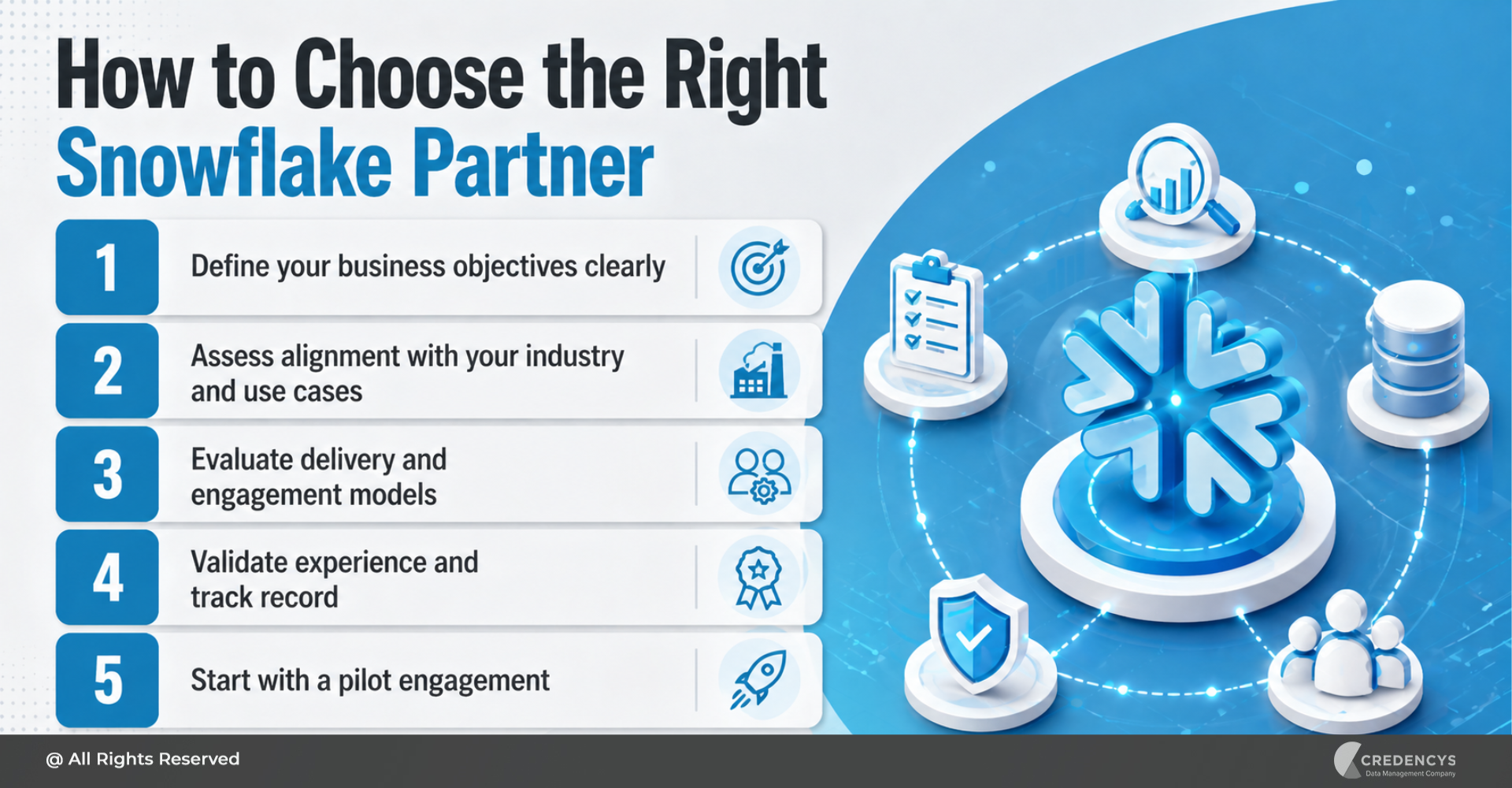
How to Choose the Right Snowflake Company

Choosing a Snowflake consulting partner requires a structured approach that aligns with your business objectives. It is not just about technical capability but also about strategic fit.

1. Define your business objectives clearly

Before evaluating partners, organizations must define their goals. Whether it is migration, modernization, or enabling AI-driven insights, clarity on objectives helps narrow down the right partner.

Clear goals also ensure that the consulting engagement remains focused and outcome-driven.

2. Assess alignment with your industry and use cases

A partner with relevant industry experience can accelerate implementation and deliver better results. They bring domain knowledge, pre-built solutions, and best practices that reduce complexity.

This alignment ensures that your Snowflake implementation addresses real business challenges rather than generic use cases.

3. Evaluate delivery and engagement models

Different projects require different engagement models. Organizations should assess whether they need a project-based approach, dedicated teams, or managed services.

The right model ensures flexibility and scalability as your data needs evolve.

4. Validate experience and track record

Case studies, client testimonials, and proven results are critical indicators of a partner’s capability. Organizations should look for evidence of successful Snowflake implementations.

This validation reduces risk and builds confidence in the partner’s ability to deliver.

5. Start with a pilot engagement

A pilot project is an effective way to evaluate a consulting partner before committing to a larger engagement. It allows organizations to assess technical expertise, communication, and delivery quality.

This approach minimizes risk while ensuring alignment with expectations.

How to Choose the Right Snowflake Partner

Why Credencys is the Right Snowflake Partner

Credencys differentiates itself by combining Snowflake expertise with advanced analytics and AI capabilities. Its business-first approach ensures that data initiatives are aligned with organizational goals.

The company’s focus on industry-specific solutions enables faster implementation and higher impact. By integrating data engineering, analytics, and AI, Credencys helps organizations move beyond data management to data-driven decision-making.

For organizations looking to unlock Snowflake’s full potential, Credencys offers a comprehensive, outcome-driven approach.

Conclusion

Snowflake has transformed the way organizations manage and analyze data, but its true potential can only be realized with the right strategy and expertise. Choosing the right consulting partner is a critical decision that impacts the success of your data initiatives.

The companies listed in this blog are among the best options available in 2026. Each brings unique strengths, and the right choice depends on your specific needs and goals.

Ultimately, the right partner will not just implement Snowflake but will help you turn data into a strategic asset that drives growth and innovation.

Top Databricks Consulting Companies in 2026 (With Comparison & Selection Guide)

Data is no longer just a byproduct of business operations; it’s the foundation of competitive advantage. Over the past few years, organizations have rapidly adopted modern data platforms to unify analytics, AI, and real-time decision-making.

At the center of this shift is Databricks and the lakehouse architecture, enabling businesses to break down silos and accelerate innovation. But while the technology is powerful, the implementation is not simple.

From migrating legacy systems to building scalable AI pipelines, most organizations struggle with execution. That’s where Databricks consulting companies come in.

The right partner can help you unlock faster time-to-value, reduce risk, and maximize ROI. The wrong one can lead to delays, cost overruns, and underperforming data initiatives.

In this guide, we’ll cover:

  • Why businesses need Databricks consulting partners in 2026
  • How to evaluate and choose the right partner
  • A curated list of top Databricks consulting companies
  • A comparison table to simplify your decision

Why Businesses Need Databricks Consulting Partners in 2026

The Challenge: Increasing Data Complexity

Modern data ecosystems are more complex than ever. Organizations are dealing with:

  • Multiple data sources (structured, semi-structured, unstructured)
  • Real-time and batch processing requirements
  • Integration with AI/ML models and business applications

Without the right expertise, managing this complexity becomes overwhelming.

The Talent Gap

There is a growing shortage of professionals skilled in Databricks, Apache Spark, and advanced data engineering. Hiring and retaining such talent in-house is both expensive and time-consuming.

The Need for Faster Time-to-Value

Businesses can’t afford long implementation cycles. They need to:

  • Launch data platforms quickly
  • Deliver insights faster
  • Scale AI initiatives efficiently

Databricks consulting partners bring proven frameworks, accelerators, and expertise to speed up execution.

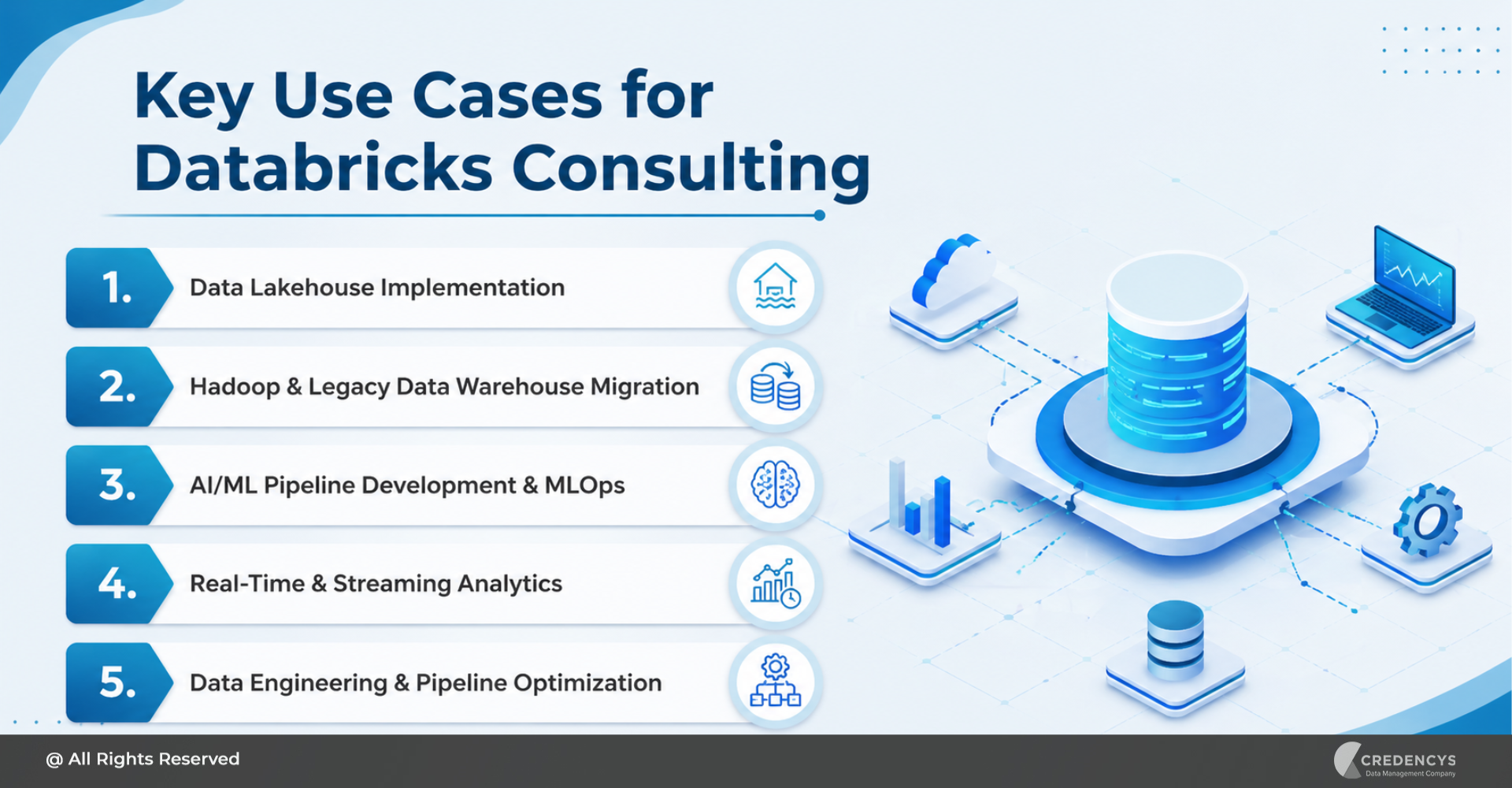
Key Use Cases for Databricks Consulting

Databricks consulting companies don’t just implement technology; they help organizations unlock business value from data at scale. Below are the most impactful use cases in 2026:

1. Data Lakehouse Implementation

Many organizations struggle with fragmented data across warehouses and lakes. Databricks consultants help design and implement a lakehouse architecture that:

  • Unifies data engineering, analytics, and AI
  • Eliminates data silos
  • Improves data accessibility and governance

2. Hadoop & Legacy Data Warehouse Migration

Legacy systems such as Hadoop and traditional data warehouses are costly, rigid, and difficult to scale. Consulting partners:

  • Assess existing architecture
  • Design migration roadmaps
  • Execute seamless transitions to Databricks

3. AI/ML Pipeline Development & MLOps

Building models is easy, but scaling them is not. Databricks consulting companies help:

  • Develop end-to-end ML pipelines
  • Implement MLOps frameworks
  • Automate model deployment and monitoring

4. Real-Time & Streaming Analytics

Modern businesses require real-time insights, especially in retail, logistics, and finance. Consultants enable:

  • Streaming data pipelines
  • Real-time dashboards
  • Event-driven architectures

5. Data Engineering & Pipeline Optimization

Poorly designed pipelines lead to delays, failures, and high costs. Databricks experts:

  • Optimize Spark workloads
  • Improve pipeline reliability
  • Reduce compute costs

Key Use Cases for Databricks Consulting

How We Selected the Top Databricks Consulting Companies

To ensure this list is credible and actionable, we used a multi-dimensional evaluation framework aligned with how real buyers make decisions.

1. Databricks Certifications & Partner Status

We prioritized companies that are official Databricks partners with certified professionals. Certified partners have validated expertise and access to the latest platform capabilities.

2. Industry-Specific Expertise

Not all consulting firms understand your domain. We evaluated:

  • Retail & eCommerce experience
  • Manufacturing & supply chain expertise
  • CPG and data-heavy industry exposure

Industry context accelerates implementation and improves outcomes

3. End-to-End Capabilities

Top firms don’t just implement, they transform. We looked for:

  • Data engineering
  • Data architecture
  • AI/ML capabilities
  • Analytics and BI

You need a partner who can handle the entire data lifecycle, not just one piece.

4. Proven Client Success

We analyzed:

  • Case studies
  • Measurable outcomes (ROI, performance gains)
  • Real-world implementations

Execution capability matters more than marketing claims.

5. Scalability & Engagement Flexibility

Different companies have different needs. We assessed:

  • Ability to serve mid-market vs enterprise
  • Flexible engagement models
  • Global vs regional delivery

The right partner should scale with your business, not constrain it.

Top Databricks Consulting Companies in 2026

Below is a curated list of leading Databricks consulting companies that stand out in 2026.

1. Credencys Solutions

A fast-growing Databricks consulting partner focused on data modernization and AI transformation. Known for its strong presence in retail and eCommerce, Credencys combines deep technical expertise with an agile delivery model.

Credencys offers a balanced approach combining deep technical expertise with agility and cost efficiency, making it an ideal alternative to large system integrators.

Key Strengths:

  • Strong expertise in retail, eCommerce, and supply chain
  • End-to-end capabilities across data engineering and AI/ML
  • Proven experience in lakehouse architecture

Best For:

  • Mid-market and scaling enterprises

2. Tiger Analytics

A leading analytics and AI firm specializing in data science-driven decision-making. Strong in retail and CPG, with a focus on delivering business insights through advanced analytics.

Key Strengths:

  • Strong presence in retail and CPG
  • Advanced analytics and AI capabilities

Best For:

  • Enterprises looking for AI-driven decision intelligence

3. Tredence

A data science and AI consulting company focused on customer analytics and business intelligence. Known for helping enterprises turn data into actionable insights.

Key Strengths:

  • Customer analytics expertise
  • Strong AI and machine learning focus

Best For:

Organizations focused on customer-centric analytics

4. Slalom

A business and technology consulting firm offering strategy-to-execution services. Strong in aligning business goals with technical implementations.

Key Strengths:

  • Strong client collaboration model
  • End-to-end delivery capabilities

Best For:

Companies looking for both strategy and execution

5. Sigmoid

A data engineering-focused company specializing in cloud-native analytics and real-time data processing. Ideal for organizations needing a scalable data infrastructure.

Key Strengths:

  • Real-time data processing
  • Scalable data pipelines

Best For:

Organizations needing advanced data engineering solutions

Comparison Table: Top Databricks Consulting Companies

CompanyBest ForKey StrengthIndustry FocusEngagement Size
CredencysMid-market transformationData + AI + retail expertiseRetail, CPGMid-market
Tiger AnalyticsAI-led analyticsAdvanced analyticsRetail, CPGEnterprise
TredenceCustomer analyticsAI + data scienceRetail, BFSIEnterprise
SlalomStrategy + implementationBusiness + tech consultingMulti-industryMid-large
SigmoidData engineeringReal-time analyticsTech, retailMid-large

How to Choose the Right Databricks Consulting Company

Selecting the right Databricks consulting partner is a strategic decision that can significantly impact your data and AI success. Beyond technical expertise, the ideal partner should align with your business goals, industry needs, and long-term scalability plans.

Here’s how to evaluate your options effectively:

1. Verify Certifications and Partner Status

Start by checking whether the consulting company is an official Databricks partner with certified professionals on their team. Certifications indicate that the team has undergone formal training and understands the platform’s best practices.

A recognized partner is also more likely to stay up to date with the latest Databricks features and innovations. This ensures your implementation is future-ready and aligned with platform advancements.

2. Look for Relevant Industry Experience

Industry expertise plays a crucial role in successful implementation. A partner familiar with your domain can better understand your data challenges, compliance requirements, and business objectives.

For example, data use cases in retail differ significantly from those in manufacturing or finance. Choosing a partner with proven experience in your industry can accelerate deployment and improve outcomes.

3. Evaluate End-to-End Capabilities

Databricks projects often require more than just data engineering. From data ingestion and transformation to AI/ML deployment and analytics, the right partner should cover the entire lifecycle.

Working with a full-service provider reduces the need to manage multiple vendors. It also ensures better coordination, faster execution, and a more cohesive data strategy.

4. Assess Proven Results and Client Success

Instead of relying solely on marketing claims, ask for case studies, client references, and measurable results. Look for evidence of successful implementations with tangible business impact.

Metrics such as reduced costs, improved performance, or increased revenue can give you confidence in the partner’s capabilities. Real-world success stories are often the best indicators of reliability.

5. Consider Scalability and Cost Alignment

Your chosen partner should be able to scale with your business as your data needs grow. Evaluate their engagement models, team structure, and ability to handle larger or more complex projects over time.

At the same time, ensure their pricing aligns with your budget and expected ROI. A partner that offers flexibility and long-term value will be more beneficial than one that only meets short-term needs.

How to Choose the Right Databricks Consulting Company

Why Credencys Stands Out as a Databricks Consulting Partner

Choosing the right partner isn’t just about technical skills; it’s about alignment with your business goals. Credencys stands out by offering:

  • Industry Focus: Deep expertise in retail, eCommerce, and supply chain
  • AI-Driven Approach: Strong capabilities in machine learning and advanced analytics
  • Agile Execution: Faster delivery compared to large system integrators
  • Cost Efficiency: High-quality services without enterprise-level pricing

This combination makes Credencys a strong choice for organizations looking to modernize their data platforms and scale AI initiatives effectively.

Conclusion: The Right Partner Can Make or Break Your Data Strategy

Databricks has become a cornerstone of modern data and AI strategies. But the platform alone isn’t enough; success depends on how well it’s implemented and scaled.

The right consulting partner can:

  • Accelerate your data transformation journey
  • Reduce risk and complexity
  • Deliver measurable business outcomes

On the other hand, the wrong choice can slow you down and limit your ROI.

Data Orchestration Tools in 2026: The Ultimate Buyer’s Guide

In 2026, data ecosystems are more complex than ever. Enterprises are managing data across multiple cloud platforms, SaaS tools, real-time streams, and distributed architectures like lakehouses and data mesh.

As a result, data pipelines have become highly interconnected, making them harder to manage, monitor, and scale. Without a structured orchestration layer, organizations often face:

  • Pipeline failures and broken dependencies
  • Delayed or inconsistent data delivery
  • Limited visibility into pipeline performance
  • Increased operational burden on data teams

This is where data orchestration tools play a critical role. They act as the control layer that automates, schedules, and monitors data workflows, ensuring seamless data movement across the entire stack.

As businesses increasingly rely on real-time analytics and AI-driven decisions, data orchestration is essential for building reliable, scalable, and efficient data pipelines. Let’s start by understanding what data orchestration really means.

What Is Data Orchestration?

Data orchestration is the process of automatically managing, coordinating, and monitoring data workflows across multiple systems. It ensures that data moves seamlessly through the stages of ingestion, transformation, validation, and delivery without manual intervention.

At its core, data orchestration connects various tools in your data ecosystem and ensures they work together in the right sequence, at the right time, with the right dependencies.

Key Capabilities of Data Orchestration Tools

Modern data orchestration tools provide several critical capabilities:

  • Workflow Scheduling: Automate when pipelines run (batch, event-driven, or real-time)
  • Dependency Management: Ensure tasks execute in the correct order
  • Monitoring & Alerting: Track pipeline health and get notified of failures
  • Error Handling & Retries: Automatically recover from failures
  • Scalability: Handle growing data volumes and complex workflows
  • Integration: Connect seamlessly with tools like data warehouses, lakes, APIs, and ML platforms

By bringing all these capabilities together, data orchestration tools act as the backbone of modern data operations, ensuring that data is always available, reliable, and ready for analysis.

Key Benefits of Data Orchestration Tools

Implementing the right data orchestration tools can significantly improve how organizations manage and scale their data operations. Beyond automation, these tools bring structure, reliability, and efficiency to complex data pipelines.

1. Improved Data Reliability

Orchestration tools ensure workflows run in the correct sequence and manage dependencies properly. This reduces pipeline failures and ensures consistent, high-quality data outputs.

2. Faster Time-to-Insight

By automating data workflows, organizations can deliver data to analytics platforms and dashboards faster, enabling quicker, data-driven decision-making.

3. End-to-End Automation

Manual intervention is minimized with automated scheduling, execution, and error handling. This allows data teams to focus on innovation rather than routine pipeline management.

4. Enhanced Observability

Modern orchestration platforms provide visibility into pipeline performance, logs, and failures. This makes it easier to monitor workflows, troubleshoot issues, and maintain system health.

5. Scalability Across Complex Environments

Whether operating in cloud, hybrid, or multi-cloud environments, orchestration tools can scale to handle increasing data volumes and workflow complexity.

6. Better Resource Efficiency

Automated workflows reduce redundant processing and optimize resource use, resulting in lower operational costs over time.

By enabling reliable, automated, and scalable data workflows, data orchestration tools form the foundation of a modern data stack supporting everything from business intelligence to advanced AI use cases.

Key Benefits of Data Orchestration Tools

Top Data Orchestration Tools in 2026 (Expert Picks)

With a rapidly evolving data ecosystem, modern orchestration tools are moving beyond simple scheduling to enable scalable, reliable, and data-aware pipelines. Below are the top 5 data orchestration tools in 2026, along with a more detailed look at what makes each one stand out.

1. Apache Airflow

Apache Airflow is the standard for data orchestration, especially in large enterprises. Originally developed at Airbnb, it introduced the concept of defining workflows as code using Python-based DAGs. This approach gives data engineers full control over pipeline logic, making it highly flexible for complex workflows.

Over the years, Airflow has evolved into a robust ecosystem with strong community support and widespread adoption across industries. It integrates seamlessly with a wide range of data tools, including cloud platforms, data warehouses, and transformation tools.

Key Features:

  • Python-based DAG workflows
  • Extensive plugin ecosystem
  • Scalable scheduling and monitoring

Pros:

  • Highly customizable
  • Mature and widely adopted
  • Strong community support

Limitations:

  • Complex setup and maintenance
  • Steeper learning curve
  • Limited native data awareness

Best For:

  • Large enterprises with complex, batch-oriented pipelines and strong data engineering teams

2. Prefect

Prefect is designed as a modern alternative to traditional orchestration tools like Airflow, focusing on simplicity, flexibility, and developer experience. It takes a “developer-first” approach, allowing engineers to build workflows in pure Python without the constraints of rigid DAGs.

One of Prefect’s biggest strengths is its dynamic execution model, which allows workflows to adapt in real time based on conditions and data states. It also offers built-in observability, making it easier to track pipeline performance and debug issues.

Key Features:

  • Python-native workflows
  • Dynamic pipeline execution
  • Built-in retries and caching
  • Strong observability and logging

Pros:

  • Easy to use and deploy
  • Flexible and dynamic workflows
  • Excellent developer experience

Limitations:

  • Smaller ecosystem than Airflow
  • Advanced features in paid tiers

Best For:

  • Teams seeking a modern, flexible orchestration tool with minimal complexity

3. Dagster

Dagster represents a shift toward data-aware orchestration, where the focus is not just on tasks but on the data assets themselves. Instead of managing pipelines as a series of steps, Dagster models workflows around data dependencies, lineage, and quality.

This makes it particularly well-suited for modern data platforms where reliability, testing, and observability are critical. Dagster includes built-in features for data validation, type checking, and lineage tracking, helping teams catch issues early and maintain trust in their data.

Key Features:

  • Asset-based orchestration
  • Built-in data lineage and observability
  • Type checking and testing support

Pros:

  • Strong focus on data reliability
  • Better debugging and testing
  • Ideal for modern data stacks

Limitations:

  • Learning curve for new concepts
  • Smaller community than Airflow

Best For:

  • Organizations focused on data quality, governance, and scalable data platforms

4. Astronomer

Astronomer is a fully managed orchestration platform built on Apache Airflow, designed to eliminate the operational complexity of deploying and maintaining Airflow at scale. It provides a production-ready environment with built-in tools for monitoring, scaling, and securing workflows.

By abstracting infrastructure management, Astronomer allows teams to focus on building and optimizing pipelines rather than managing clusters and dependencies. It also enhances Airflow with enterprise-grade capabilities, including CI/CD integration, role-based access control, and advanced observability.

Key Features:

  • Managed the Airflow platform
  • Automated scaling and monitoring
  • Enterprise-grade security and governance

Pros:

  • Eliminates infrastructure overhead
  • Faster deployment and scaling
  • Enterprise-ready features

Limitations:

  • Higher cost
  • Still tied to Airflow architecture

Best For:

  • Enterprises that want the power of Airflow without managing infrastructure

5. Kestra

Kestra is an emerging orchestration platform designed for event-driven, cloud-native workflows. Unlike traditional tools that rely heavily on scheduled batch processing, Kestra is designed to handle real-time events and trigger workflows dynamically.

It uses a declarative YAML-based approach, making it easier to define and manage workflows without extensive coding. Kestra also offers a scalable architecture capable of handling large volumes of tasks with low latency.

Key Features:

  • YAML-based workflow definitions
  • Event-driven execution
  • Scalable, cloud-native architecture

Pros:

  • Simple and intuitive workflow design
  • Strong support for real-time use cases
  • Modern and scalable

Limitations:

  • Relatively new ecosystem
  • Limited enterprise adoption

Best For:

  • Teams building event-driven, real-time data pipelines in modern architectures

These five tools highlight how the data orchestration landscape is evolving from traditional workflow schedulers to modern, developer-friendly, and data-aware platforms.

Comparison Table: Top Data Orchestration Tools

To help you evaluate the right platform for your needs, here’s a side-by-side comparison of the top data orchestration tools in 2026:

ToolBest ForStrengthLimitationsPricing Model
AirflowEnterprise batch pipelinesHighly flexible, large ecosystem, open sourceComplex setup, not data-awareFree (infra cost applies)
PrefectDeveloper-friendly orchestrationEasy to use, dynamic workflows, strong UXSmaller ecosystem, paid featuresFreemium
DagsterData-centric organizationsData-aware, strong testing & lineageLearning curve, smaller communityLimited to observability use cases
AstronomerManaged Airflow deploymentsFully managed, enterprise-readyCostly, tied to AirflowSubscription
KestraEvent-driven, real-time pipelinesScalable, modern architectureLess mature ecosystemOpen core

How Credencys Helps You Implement Data Orchestration at Scale

Choosing the right data orchestration tool is only part of the equation. The real challenge lies in designing, implementing, and scaling orchestration workflows that align with your business goals and data architecture.

This is where Credencys brings deep expertise.

1. End-to-End Data Pipeline Design

Credencys helps you design robust, scalable data pipelines tailored to your business needs. From architecture planning to workflow structuring, the focus is on building pipelines that are reliable, efficient, and future-ready.

2. Tool Selection & Implementation

With a wide range of orchestration tools available, selecting the right one can be overwhelming. Credencys evaluates your:

  • Use cases (batch, real-time, AI/ML)
  • Existing tech stack
  • Team capabilities

and recommends the best-fit orchestration platform, followed by seamless implementation.

3. Integration with Modern Data Stack

Credencys ensures smooth integration of orchestration tools with your existing ecosystem, including:

  • Data platforms like Databricks and Snowflake
  • Transformation tools like dbt
  • APIs, streaming platforms, and cloud services

This enables unified and efficient data workflows across your organization.

4. Data Observability & Monitoring

Beyond orchestration, Credencys implements strong observability frameworks to:

  • Monitor pipeline performance
  • Detect and resolve failures quickly
  • Ensure data reliability and trust

5. Migration & Modernization

Still relying on legacy ETL tools or manual workflows? Credencys helps you:

  • Migrate to modern orchestration platforms
  • Modernize outdated data pipelines
  • Adopt best practices for scalability and performance

6. Ongoing Optimization & Support

Data orchestration is not a one-time setup. Credencys provides continuous support to:

  • Optimize pipeline performance
  • Reduce operational costs
  • Scale workflows as your data grows

How Credencys Help You Implement Data Orchestration at Scale

Final Thoughts

Data orchestration has become a foundational layer of modern data ecosystems. As organizations continue to scale their data platforms and adopt real-time analytics and AI-driven use cases, the need for reliable, automated, and well-orchestrated pipelines is only growing.

While there are several powerful data orchestration tools available in 2026, the right choice ultimately depends on your specific requirements, whether it’s flexibility, ease of use, data awareness, or cloud-native scalability. Each tool brings unique strengths, and selecting the right one requires careful evaluation of your architecture, team capabilities, and long-term goals.

However, it’s important to remember that choosing the right tool is only half the battle. The real value comes from how effectively it is implemented, integrated, and scaled within your data ecosystem.

By combining the right orchestration platform with a strong data engineering strategy, organizations can:

  • Ensure consistent and reliable data flows
  • Accelerate time-to-insight
  • Improve decision-making with trusted data
  • Build a scalable foundation for future growth

As data complexity continues to rise, investing in the right data orchestration approach will be key to staying competitive in a data-driven world.

Why AI Initiatives Fail and How AI Consulting Fixes Them

Artificial Intelligence has rapidly moved from a boardroom buzzword to a business imperative. Across industries, organizations are investing heavily in AI to unlock efficiencies, improve customer experiences, and create new revenue streams. Yet despite this momentum, many AI initiatives fail to deliver meaningful business value.

The issue is not a lack of ambition or access to technology. The real challenge lies in the gap between AI aspiration and execution.

Many enterprises start their AI journey with clear intent but struggle to move forward. Common obstacles include fragmented data, unclear use cases, lack of alignment across stakeholders, and pilots that never progress beyond the proof-of-concept stage. What begins as a strategic initiative often turns into isolated experiments with limited impact.

For CXOs and business leaders, this raises an important question:

Why do so many AI initiatives fail, and what does it take to make them succeed?

This is where AI consulting plays a critical role.

With the right mix of strategic direction, technical expertise, and a focus on business outcomes, AI consulting helps organizations move beyond experimentation toward scalable success. It ensures that AI initiatives are aligned with business goals, built on reliable data foundations, and designed to deliver measurable results.

In this blog, we will explore the most common reasons AI initiatives fail and how AI consulting helps organizations turn these challenges into opportunities for long-term success.

Top Reasons Why AI Initiatives Fail

Despite strong intent and significant investment, many AI initiatives struggle to move beyond early experimentation. The failure is rarely due to the technology itself. In most cases, it comes down to gaps in strategy, data, and execution.

Here are the most common reasons AI initiatives fail:

1. Lack of Clear Business Objectives

Many organizations start with “we want to use AI” instead of defining a specific business problem to solve. Without clear objectives tied to measurable outcomes, AI projects quickly lose direction.

AI initiatives that are not aligned with revenue growth, cost reduction, or customer experience improvements often fail to gain long-term traction.

2. Poor Data Readiness

AI is only as effective as the data behind it. Many enterprises operate with siloed, inconsistent, or incomplete data, making it difficult to build reliable models.

Without strong data governance, quality, and integration, even the most advanced AI tools cannot deliver accurate or actionable insights.

3. Overemphasis on Technology Instead of Strategy

Organizations often invest in AI tools and platforms before defining a clear strategy. This leads to a mismatch between capabilities and actual business needs.

Technology alone does not create value. Without a strategic roadmap, AI becomes an expensive experiment rather than a business driver.

4. Failure to Scale Beyond Pilot Projects

Many AI initiatives get stuck in the proof-of-concept phase. While pilots may show promise, organizations struggle to operationalize and scale them across the enterprise.

This results in isolated success stories that never translate into enterprise-wide impact.

5. Lack of Cross-Functional Alignment

AI initiatives require collaboration across business, IT, and data teams. When these functions operate in silos, projects face delays, miscommunication, and conflicting priorities.

Without strong alignment, even well-designed AI initiatives can stall.

6. Skills Gap and Resource Constraints

Building and scaling AI requires specialized skills that many organizations lack. Hiring, training, and retaining talent can be both time-consuming and expensive.

As a result, projects either move slowly or fail to reach their full potential.

7. Ignoring Change Management

AI adoption is not just a technology shift. It is an organizational transformation. Employees may resist change if they do not understand how AI impacts their roles.

Without proper change management and stakeholder buy-in, adoption remains low and value realization is delayed.

8. Unrealistic Expectations

AI is often expected to deliver immediate results. When outcomes take time, stakeholders lose confidence and projects are deprioritized. Successful AI initiatives require patience, iteration, and continuous improvement.

How AI Consulting Fixes These Challenges

Addressing AI failure requires more than better tools or bigger investments. It demands a structured, outcome-driven approach that connects business strategy, data, and execution. This is exactly where AI consulting delivers value.

AI consulting helps organizations move from fragmented efforts to a cohesive, scalable AI strategy that drives measurable results.

Here’s how:

1. Aligning AI with Business Goals

AI consultants work closely with leadership teams to identify high-impact use cases that directly support business objectives. Instead of starting with technology, the focus is on solving real problems tied to revenue, efficiency, and customer experience.

This ensures every AI initiative has a clear purpose and defined success metrics.

2. Establishing a Strong Data Foundation

One of the first steps in any successful AI journey is fixing the data layer. AI consulting helps assess data readiness, eliminate silos, and implement governance frameworks that ensure accuracy and consistency.

With the right data foundation in place, AI models become more reliable, scalable, and valuable.

3. Creating a Clear AI Roadmap

AI consulting brings structure to what is often an ambiguous journey. Consultants define a phased roadmap that outlines priorities, timelines, and expected outcomes.

This prevents organizations from investing in disconnected initiatives and instead builds a clear path from experimentation to enterprise-wide adoption.

4. Accelerating Time to Value

Rather than getting stuck in endless pilots, AI consulting focuses on delivering quick wins while building toward long-term scalability.

By prioritizing high-impact use cases and leveraging proven frameworks, organizations can start seeing tangible results faster.

5. Enabling Scalable Implementation

AI consulting ensures that successful pilots do not remain isolated. It introduces the right architecture, processes, and governance models needed to scale AI across departments and use cases.

This transforms AI from a series of experiments into a core business capability.

6. Bridging the Skills Gap

AI consultants bring specialized expertise across data science, engineering, and business strategy. This reduces dependency on hiring and accelerates execution.

At the same time, they help upskill internal teams to ensure long-term sustainability.

7. Driving Cross-Functional Collaboration

AI consulting acts as a bridge between business, IT, and data teams. It ensures alignment on priorities, improves communication, and creates a unified approach to execution.

This significantly reduces friction and accelerates decision-making.

8. Supporting Change Management and Adoption

Successful AI implementation requires people to embrace new ways of working. AI consultants help organizations manage this transition through training, communication, and stakeholder engagement.

This increases adoption and ensures that AI initiatives deliver their intended impact.

AI success is not accidental. It is the result of the right strategy, strong data foundations, and disciplined execution. With the right AI consulting approach, organizations can turn failed initiatives into scalable, value-driven outcomes.

Emerging Trends in AI Consulting Leaders Should Watch

AI is evolving rapidly, and so are the expectations from it. For business leaders, staying ahead of these trends is critical to making the right investment decisions and building future-ready capabilities.

Here are the key AI consulting trends shaping enterprise adoption:

1. Shift from AI Pilots to Scaled Deployments

Organizations are moving beyond experimentation and focusing on scaling AI across business functions. The emphasis is now on operationalizing AI and embedding it into core processes rather than running isolated pilots.

AI consulting plays a key role in enabling this transition with scalable architectures and governance models.

2. Rise of Generative AI in Enterprise Use Cases

Generative AI is no longer limited to content creation. Enterprises are leveraging it for customer support, product recommendations, knowledge management, and internal productivity.

Consulting helps identify practical use cases and ensures responsible and secure implementation.

3. Increased Focus on Data Readiness and Governance

As AI adoption grows, organizations are realizing that success depends heavily on data quality and governance. Clean, connected, and well-managed data is becoming a top priority.

AI consulting is increasingly focused on building strong data foundations before deploying models.

4. AI + Data Platform Integration

Modern AI initiatives are closely tied to data platforms such as cloud data warehouses and lakehouses. Organizations are investing in unified data ecosystems that support real-time analytics and AI workloads.

Consulting ensures seamless integration between AI models and data infrastructure.

5. Responsible and Ethical AI Adoption

With increased use of AI comes greater scrutiny around ethics, bias, and compliance. Organizations are prioritizing transparency, fairness, and governance in AI systems.

AI consultants help define frameworks that ensure responsible AI usage while minimizing risk.

6. AI Democratization Across Teams

AI is no longer limited to data scientists. Business users are increasingly leveraging AI-powered tools for decision-making and automation.

Consulting helps enable this shift by building user-friendly solutions and training teams to adopt AI effectively.

7. Outcome-Driven AI Investments

Enterprises are becoming more focused on measurable ROI from AI initiatives. The focus is shifting from experimentation to tangible business outcomes.

AI consulting is evolving to prioritize value realization, not just implementation.

Conclusion: From AI Experimentation to Business Impact

AI has the potential to transform how businesses operate, compete, and grow. However, success is not defined by how many AI tools you adopt or how many pilots you run. It is defined by the business outcomes you achieve.

For many organizations, the gap between ambition and execution continues to hold them back. Disconnected initiatives, poor data readiness, and lack of strategic direction often result in stalled projects and missed opportunities.

AI consulting changes this trajectory.

By aligning AI initiatives with business goals, strengthening data foundations, and enabling scalable execution, AI consulting helps organizations move beyond experimentation toward real, measurable impact. It brings clarity to complexity and ensures that every AI investment contributes to long-term growth.

The question is no longer whether to invest in AI. The real question is whether your organization is set up to realize its full value.

FAQs: AI Consulting

1. What is AI consulting?

AI consulting helps organizations identify, design, and implement AI solutions that align with business goals. It combines strategy, data readiness, technology selection, and execution to ensure AI initiatives deliver measurable outcomes.

2. Why do most AI initiatives fail?

Most AI initiatives fail due to unclear business objectives, poor data quality, lack of cross-functional alignment, and inability to scale beyond pilot projects. Without a structured approach, AI efforts often remain experimental instead of delivering real business value.

3. How does AI consulting improve success rates?

AI consulting brings a structured, outcome-driven approach. It aligns AI with business goals, ensures data readiness, defines a clear roadmap, and enables scalable implementation. This significantly increases the chances of success and ROI.

4. When should a company consider AI consulting?

Organizations should consider AI consulting when:

  • They are starting their AI journey and need a clear strategy
  • Existing AI projects are not delivering expected results
  • They lack in-house expertise
  • They want to scale AI across the enterprise

5. What industries benefit most from AI consulting?

AI consulting delivers value across industries including retail, manufacturing, healthcare, BFSI, and logistics. Common use cases include demand forecasting, personalization, fraud detection, predictive maintenance, and process automation.

Product Data Readiness Assessment: What is Your Product Data Really Costing You?

Most businesses assume their product data is “good enough.”

Until it starts costing them.

It shows up in ways that are easy to overlook, products that don’t convert, inconsistent information across channels, delayed launches, or an increase in returns. Individually, these may seem like minor operational issues. But together, they create a compounding effect that impacts revenue, efficiency, and customer experience.

The real challenge?

Product data problems rarely look like data problems. They often appear as marketing inefficiencies, poor digital experiences, or supply chain delays, making them harder to identify and fix.

A Product Data Readiness Assessment helps you evaluate how accurate, complete, consistent, and usable your product data truly is; and more importantly, how it is affecting your business performance.

And the best part? You don’t need weeks of analysis to get started.

In just 3 minutes, you can answer 10 simple questions and get your Product Data Readiness Score; a clear, actionable snapshot of whether your data is driving growth or holding you back.

Start your free assessment here.

The Hidden Cost of Poor Product Data

Poor product data does not fail loudly. It fails quietly, across multiple parts of your business.

At first, it looks like small inefficiencies. A missing attribute here. An incorrect specification there. A delayed product update that seems minor in isolation.

But over time, these issues compound and start impacting key business outcomes.

1. Lost Conversions

Incomplete or inconsistent product information makes it harder for customers to make decisions. When key details are missing or unclear, customers hesitate or drop off entirely.

The result is simple. Lower conversion rates and missed revenue opportunities.

2. Increased Returns and Customer Dissatisfaction

When product data is inaccurate or inconsistent across channels, customers receive something different from what they expected.

This leads to higher return rates, negative reviews, and loss of trust. Fixing returns is far more expensive than getting product data right in the first place.

3. Slower Time-to-Market

Launching new products should be fast and seamless. But when product data is scattered, incomplete, or manually managed, every launch gets delayed.

Teams spend more time fixing data instead of focusing on growth. This slows down your ability to respond to market demand.

4. Operational Inefficiencies

Poor product data creates friction between teams. Marketing, eCommerce, and operations teams often end up working with different versions of the same data.

This leads to rework, manual corrections, and constant back-and-forth. Productivity drops, and costs increase.

5. Limited Personalization and AI Readiness

Modern digital experiences depend on high-quality data. Whether it is personalization, recommendations, or AI-driven insights, everything relies on clean and structured product data.

If your data is not ready, your advanced initiatives will not deliver results.

What is a Product Data Readiness Assessment?

A Product Data Readiness Assessment is a structured way to evaluate how reliable, complete, and usable your product data is across systems, channels, and teams.

In simple terms, it answers one critical question:

“Is your product data ready to support growth, scale, and better customer experiences?”

Instead of relying on assumptions, this assessment gives you a clear, measurable view of where your data stands today and where it needs improvement.

What does a Product Data Readiness Assessment Evaluate?

A comprehensive assessment looks at the core dimensions that directly impact how your product data performs in real business scenarios.

1. Accuracy

Is your product data correct and up to date?

Incorrect specifications, pricing errors, or outdated information can lead to customer dissatisfaction and operational issues.

2. Completeness

Do your products have all the required attributes?

Missing descriptions, images, or specifications reduce product discoverability and make it harder for customers to make decisions.

3. Consistency

Is your product data uniform across all channels?

When the same product looks different on your website, marketplace, and catalogs, it creates confusion and weakens trust.

4. Accessibility

Can your teams easily access and use product data?

If data is siloed across systems or difficult to retrieve, it slows down workflows and reduces efficiency.

5. Structure and Standardization

Is your product data organized in a scalable and standardized format?

Without proper structure, it becomes difficult to manage large catalogs, integrate systems, or enable automation.

6. Governance and Ownership

Do you have clear ownership and processes for managing product data?

Lack of governance leads to inconsistent updates, duplication, and long-term data quality issues.

Importance and Benefits of Data Readiness in Business

Product data is no longer just operational support. It plays a direct role in how businesses grow, compete, and deliver customer experiences.

Product Data Readiness Assessment

When your product data is ready, structured, and reliable, it becomes a strategic advantage rather than a limitation.

1. Improves Conversion Rates

High-quality product data helps customers make faster and more confident purchase decisions. Clear descriptions, accurate specifications, and complete information reduce hesitation and increase the likelihood of conversion.

2. Enhances Customer Experience

Consistent and reliable product information across all channels creates a seamless customer journey. Customers know what to expect, which builds trust and improves satisfaction.

3. Reduces Returns and Operational Costs

Accurate product data minimizes mismatches between expectations and actual products. This leads to fewer returns, lower support costs, and improved operational efficiency.

4. Accelerates Time-to-Market

When product data is well-structured and easily accessible, teams can launch new products faster. This enables businesses to respond quickly to market trends and opportunities.

5. Enables Omnichannel Consistency

Data readiness ensures that product information remains consistent across websites, marketplaces, mobile apps, and other touchpoints. This consistency strengthens brand credibility and improves customer trust.

6. Supports AI and Advanced Analytics

Modern technologies such as AI, personalization, and automation rely on clean and structured data. Data readiness ensures that these initiatives deliver accurate insights and meaningful results.

7. Improves Team Productivity

When product data is centralized and reliable, teams spend less time fixing errors and more time focusing on strategic work. This improves collaboration and overall efficiency.

Data Readiness is a Business Enabler, Not Just a Technical Requirement

Organizations that prioritize data readiness are better positioned to scale, innovate, and compete effectively. Without it, even the best tools and strategies struggle to deliver results.

From Evaluation to Insight: Your Product Data Readiness Score

A Product Data Readiness Assessment does not just highlight problems. It translates them into a clear, actionable score.

This Product Data Readiness Score gives you a snapshot of:

  • How strong your product data foundation is
  • Where the biggest gaps exist
  • How urgently those gaps need to be addressed

Instead of guessing, you get a benchmark you can act on.

Product Data Readiness Checklist: 6 Key Elements

Before investing in new tools or scaling your operations, it is important to evaluate whether your product data is truly ready.

Use this simple checklist to assess your current state:

1. Complete Product Information

Do all your products have the required attributes such as descriptions, specifications, images, and pricing?

Missing or incomplete data directly impacts discoverability and conversions.

2. Consistent Data Across Channels

Is your product information consistent across your website, marketplaces, catalogs, and internal systems?

Inconsistencies create confusion and reduce customer trust.

3. Accurate and Up-to-Date Data

Is your product data regularly updated and free from errors?

Outdated or incorrect information leads to poor customer experiences and increased returns.

4. Standardized Data Structure

Is your product data organized in a consistent and scalable format?

Without standardization, managing large catalogs and integrating systems becomes difficult.

5. Centralized and Accessible Data

Can your teams easily access the latest version of product data from a single source?

Siloed data slows down operations and creates inefficiencies across teams.

6. Clear Ownership and Governance

Do you have defined ownership and processes for managing product data?

Without governance, data quality deteriorates over time, leading to duplication and inconsistencies.

How Many Boxes Did You Check?

If you could not confidently check all six, your product data may not be as ready as you think. Even small gaps in these areas can lead to significant business impact over time.

Why Product Data Readiness Is Critical for AI, PIM, and Digital Growth

Many organizations jump straight into implementing new technologies such as PIM systems or AI-driven solutions.

But without ready and reliable product data, these investments often fail to deliver expected results.

Product Data Readiness is the foundation that determines whether your digital initiatives succeed or struggle.

1. AI is only as Good as Your Data

AI-powered use cases such as product recommendations, search optimization, and automated content generation rely heavily on structured and high-quality data.

If your product data is incomplete, inconsistent, or unstructured, AI outputs will be unreliable.

Instead of driving growth, it can lead to poor recommendations and inaccurate insights.

2. PIM Implementation without Data Readiness Leads to Delays

A Product Information Management system can centralize and streamline your data.

However, if your existing data is not clean or standardized, implementation becomes complex and time-consuming.

Teams often end up spending months fixing data issues instead of realizing value from the system.

3. Omnichannel Consistency Depends on Data Quality

Today’s customers interact with your brand across multiple channels such as websites, marketplaces, mobile apps, and social platforms.

Consistent product information across all these touchpoints is critical.

Without data readiness, maintaining this consistency becomes difficult, leading to fragmented customer experiences.

4. Faster Time-to-Market Requires Ready Data

Launching new products quickly is a competitive advantage.

But if your product data is scattered or incomplete, every launch gets delayed due to manual corrections and approvals.

Data readiness ensures that your teams can move faster with fewer dependencies.

5. Better Customer Experience Starts with Better Data

Clear, accurate, and complete product information builds trust and helps customers make confident decisions.

From product discovery to purchase, data plays a critical role in shaping the overall experience. Poor data leads to confusion, drop-offs, and dissatisfaction.

Start with Readiness, Then Scale

Before investing in new platforms or advanced capabilities, it is essential to ensure your product data foundation is strong. A simple assessment can help you identify gaps early and avoid costly mistakes later.

Your Product Data Might be Costing You More Than You Think

Most organizations do not realize the true impact of poor product data until it starts affecting revenue, customer experience, and operational efficiency.

By then, the cost is already significant.

The reality is simple. Product data is no longer just a backend function. It is a critical business asset that directly influences how fast you grow, how well you compete, and how effectively you deliver customer experiences.

The difference between high-performing and struggling organizations often comes down to one thing.

How ready their data is.

The First Step is Awareness

You do not need to overhaul your entire data ecosystem overnight.

You just need to understand where you stand today.

A Product Data Readiness Assessment gives you that clarity. It helps you identify gaps, measure impact, and take the right next steps with confidence.

Frequently Asked Questions (FAQs)

1. What is a Product Data Readiness Assessment?

A Product Data Readiness Assessment is a structured evaluation of how accurate, complete, consistent, and usable your product data is. It helps businesses understand whether their data is ready to support growth, digital commerce, and advanced initiatives like AI and personalization.

2. Why is product data readiness important?

Product data readiness directly impacts conversions, customer experience, and operational efficiency. Poor data can lead to lost sales, higher return rates, delayed product launches, and inconsistent experiences across channels.

3. How do you measure product data readiness?

Product data readiness is measured by evaluating key dimensions such as accuracy, completeness, consistency, accessibility, and governance. Many businesses use a scoring system to quantify readiness and identify gaps.

4. What are common product data quality issues?

Common issues include missing product attributes, inconsistent information across channels, duplicate records, outdated data, and lack of standardization. These issues can significantly impact business performance.

5. How long does a Product Data Readiness Assessment take?

A quick assessment can take just a few minutes. For example, you can answer 10 simple questions and get a Product Data Readiness Score in under 3 minutes to understand your current state.

6. When should you conduct a Product Data Readiness Assessment?

You should conduct an assessment before implementing a PIM system, launching new products, expanding to new channels, or investing in AI and personalization initiatives.

7. What is a Product Data Readiness Score?

A Product Data Readiness Score is a numerical representation of how prepared your product data is. It highlights strengths, identifies gaps, and helps prioritize improvements.