


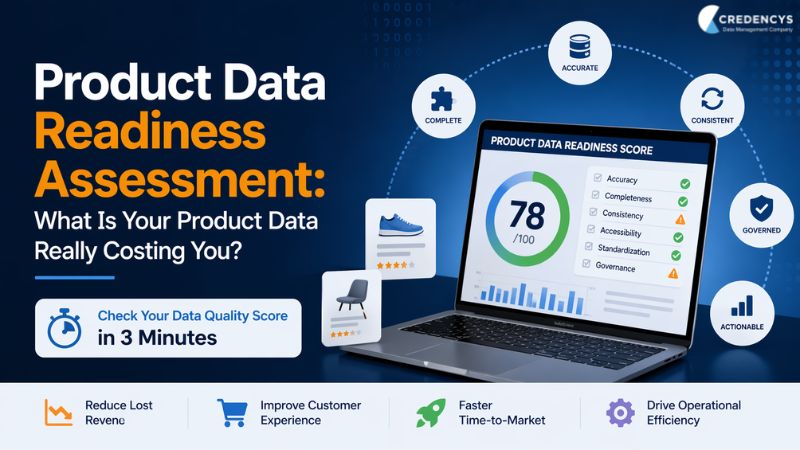
Product Data Readiness Assessment: What is Your Product Data Really Costing You?
Most businesses assume their product data is “good enough.”
Until it starts costing them.
It shows up in ways that are easy to overlook, products that don’t convert, inconsistent information across channels, delayed launches, or an increase in returns. Individually, these may seem like minor operational issues. But together, they create a compounding effect that impacts revenue, efficiency, and customer experience.
The real challenge?
Product data problems rarely look like data problems. They often appear as marketing inefficiencies, poor digital experiences, or supply chain delays, making them harder to identify and fix.
A Product Data Readiness Assessment helps you evaluate how accurate, complete, consistent, and usable your product data truly is; and more importantly, how it is affecting your business performance.
And the best part? You don’t need weeks of analysis to get started.
In just 3 minutes, you can answer 10 simple questions and get your Product Data Readiness Score; a clear, actionable snapshot of whether your data is driving growth or holding you back.
Start your free assessment here.
The Hidden Cost of Poor Product Data
Poor product data does not fail loudly. It fails quietly, across multiple parts of your business.
At first, it looks like small inefficiencies. A missing attribute here. An incorrect specification there. A delayed product update that seems minor in isolation.
But over time, these issues compound and start impacting key business outcomes.
1. Lost Conversions
Incomplete or inconsistent product information makes it harder for customers to make decisions. When key details are missing or unclear, customers hesitate or drop off entirely.
The result is simple. Lower conversion rates and missed revenue opportunities.
2. Increased Returns and Customer Dissatisfaction
When product data is inaccurate or inconsistent across channels, customers receive something different from what they expected.
This leads to higher return rates, negative reviews, and loss of trust. Fixing returns is far more expensive than getting product data right in the first place.
3. Slower Time-to-Market
Launching new products should be fast and seamless. But when product data is scattered, incomplete, or manually managed, every launch gets delayed.
Teams spend more time fixing data instead of focusing on growth. This slows down your ability to respond to market demand.
4. Operational Inefficiencies
Poor product data creates friction between teams. Marketing, eCommerce, and operations teams often end up working with different versions of the same data.
This leads to rework, manual corrections, and constant back-and-forth. Productivity drops, and costs increase.
5. Limited Personalization and AI Readiness
Modern digital experiences depend on high-quality data. Whether it is personalization, recommendations, or AI-driven insights, everything relies on clean and structured product data.
If your data is not ready, your advanced initiatives will not deliver results.
What is a Product Data Readiness Assessment?
A Product Data Readiness Assessment is a structured way to evaluate how reliable, complete, and usable your product data is across systems, channels, and teams.
In simple terms, it answers one critical question:
“Is your product data ready to support growth, scale, and better customer experiences?”
Instead of relying on assumptions, this assessment gives you a clear, measurable view of where your data stands today and where it needs improvement.
What does a Product Data Readiness Assessment Evaluate?
A comprehensive assessment looks at the core dimensions that directly impact how your product data performs in real business scenarios.
1. Accuracy
Is your product data correct and up to date?
Incorrect specifications, pricing errors, or outdated information can lead to customer dissatisfaction and operational issues.
2. Completeness
Do your products have all the required attributes?
Missing descriptions, images, or specifications reduce product discoverability and make it harder for customers to make decisions.
3. Consistency
Is your product data uniform across all channels?
When the same product looks different on your website, marketplace, and catalogs, it creates confusion and weakens trust.
4. Accessibility
Can your teams easily access and use product data?
If data is siloed across systems or difficult to retrieve, it slows down workflows and reduces efficiency.
5. Structure and Standardization
Is your product data organized in a scalable and standardized format?
Without proper structure, it becomes difficult to manage large catalogs, integrate systems, or enable automation.
6. Governance and Ownership
Do you have clear ownership and processes for managing product data?
Lack of governance leads to inconsistent updates, duplication, and long-term data quality issues.
Importance and Benefits of Data Readiness in Business
Product data is no longer just operational support. It plays a direct role in how businesses grow, compete, and deliver customer experiences.
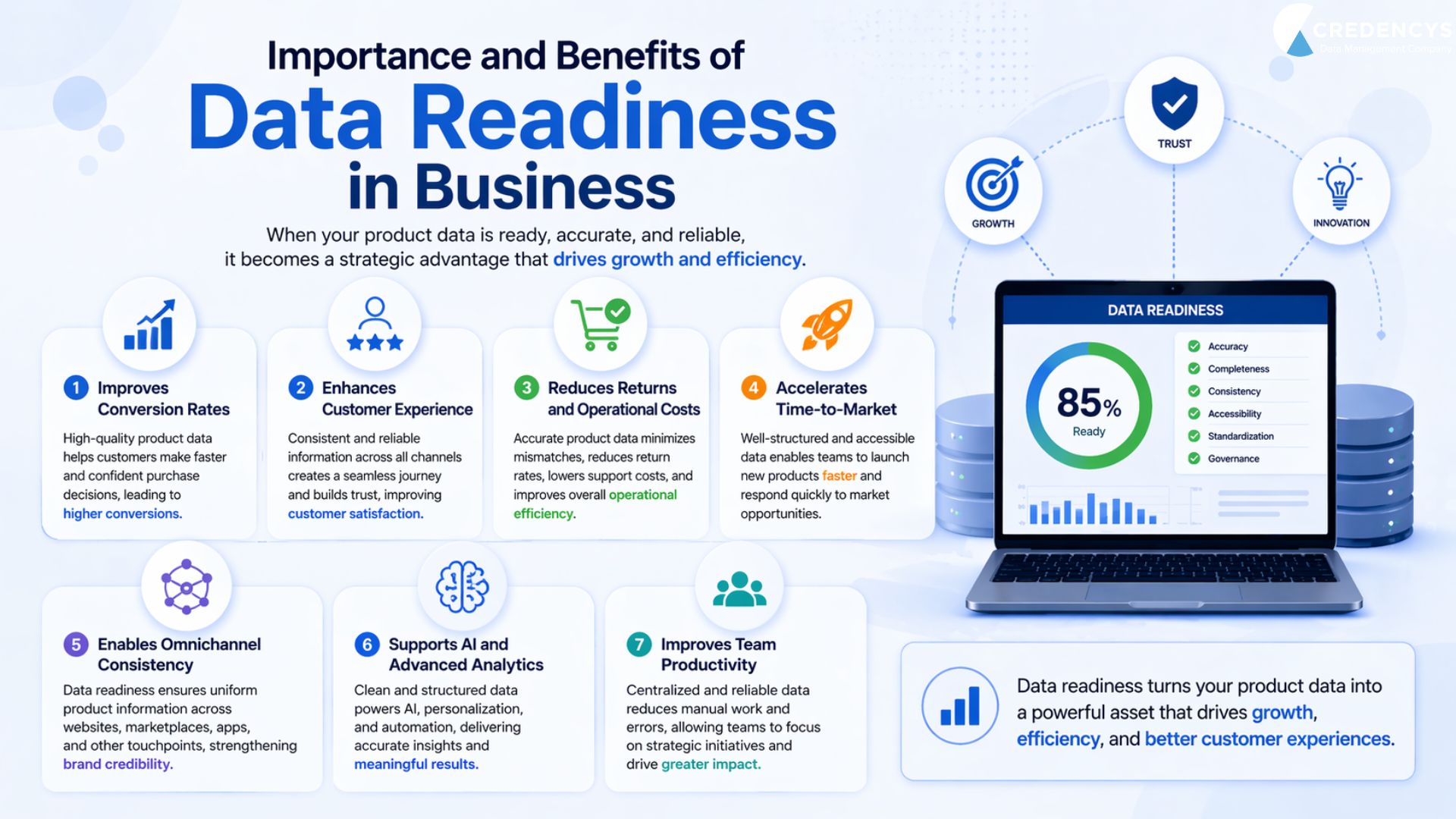
When your product data is ready, structured, and reliable, it becomes a strategic advantage rather than a limitation.
1. Improves Conversion Rates
High-quality product data helps customers make faster and more confident purchase decisions. Clear descriptions, accurate specifications, and complete information reduce hesitation and increase the likelihood of conversion.
2. Enhances Customer Experience
Consistent and reliable product information across all channels creates a seamless customer journey. Customers know what to expect, which builds trust and improves satisfaction.
3. Reduces Returns and Operational Costs
Accurate product data minimizes mismatches between expectations and actual products. This leads to fewer returns, lower support costs, and improved operational efficiency.
4. Accelerates Time-to-Market
When product data is well-structured and easily accessible, teams can launch new products faster. This enables businesses to respond quickly to market trends and opportunities.
5. Enables Omnichannel Consistency
Data readiness ensures that product information remains consistent across websites, marketplaces, mobile apps, and other touchpoints. This consistency strengthens brand credibility and improves customer trust.
6. Supports AI and Advanced Analytics
Modern technologies such as AI, personalization, and automation rely on clean and structured data. Data readiness ensures that these initiatives deliver accurate insights and meaningful results.
7. Improves Team Productivity
When product data is centralized and reliable, teams spend less time fixing errors and more time focusing on strategic work. This improves collaboration and overall efficiency.
Data Readiness is a Business Enabler, Not Just a Technical Requirement
Organizations that prioritize data readiness are better positioned to scale, innovate, and compete effectively. Without it, even the best tools and strategies struggle to deliver results.
From Evaluation to Insight: Your Product Data Readiness Score
A Product Data Readiness Assessment does not just highlight problems. It translates them into a clear, actionable score.
This Product Data Readiness Score gives you a snapshot of:
- How strong your product data foundation is
- Where the biggest gaps exist
- How urgently those gaps need to be addressed
Instead of guessing, you get a benchmark you can act on.
Product Data Readiness Checklist: 6 Key Elements
Before investing in new tools or scaling your operations, it is important to evaluate whether your product data is truly ready.
Use this simple checklist to assess your current state:
1. Complete Product Information
Do all your products have the required attributes such as descriptions, specifications, images, and pricing?
Missing or incomplete data directly impacts discoverability and conversions.
2. Consistent Data Across Channels
Is your product information consistent across your website, marketplaces, catalogs, and internal systems?
Inconsistencies create confusion and reduce customer trust.
3. Accurate and Up-to-Date Data
Is your product data regularly updated and free from errors?
Outdated or incorrect information leads to poor customer experiences and increased returns.
4. Standardized Data Structure
Is your product data organized in a consistent and scalable format?
Without standardization, managing large catalogs and integrating systems becomes difficult.
5. Centralized and Accessible Data
Can your teams easily access the latest version of product data from a single source?
Siloed data slows down operations and creates inefficiencies across teams.
6. Clear Ownership and Governance
Do you have defined ownership and processes for managing product data?
Without governance, data quality deteriorates over time, leading to duplication and inconsistencies.
How Many Boxes Did You Check?
If you could not confidently check all six, your product data may not be as ready as you think. Even small gaps in these areas can lead to significant business impact over time.
Why Product Data Readiness Is Critical for AI, PIM, and Digital Growth
Many organizations jump straight into implementing new technologies such as PIM systems or AI-driven solutions.
But without ready and reliable product data, these investments often fail to deliver expected results.
Product Data Readiness is the foundation that determines whether your digital initiatives succeed or struggle.
1. AI is only as Good as Your Data
AI-powered use cases such as product recommendations, search optimization, and automated content generation rely heavily on structured and high-quality data.
If your product data is incomplete, inconsistent, or unstructured, AI outputs will be unreliable.
Instead of driving growth, it can lead to poor recommendations and inaccurate insights.
2. PIM Implementation without Data Readiness Leads to Delays
A Product Information Management system can centralize and streamline your data.
However, if your existing data is not clean or standardized, implementation becomes complex and time-consuming.
Teams often end up spending months fixing data issues instead of realizing value from the system.
3. Omnichannel Consistency Depends on Data Quality
Today’s customers interact with your brand across multiple channels such as websites, marketplaces, mobile apps, and social platforms.
Consistent product information across all these touchpoints is critical.
Without data readiness, maintaining this consistency becomes difficult, leading to fragmented customer experiences.
4. Faster Time-to-Market Requires Ready Data
Launching new products quickly is a competitive advantage.
But if your product data is scattered or incomplete, every launch gets delayed due to manual corrections and approvals.
Data readiness ensures that your teams can move faster with fewer dependencies.
5. Better Customer Experience Starts with Better Data
Clear, accurate, and complete product information builds trust and helps customers make confident decisions.
From product discovery to purchase, data plays a critical role in shaping the overall experience. Poor data leads to confusion, drop-offs, and dissatisfaction.
Start with Readiness, Then Scale
Before investing in new platforms or advanced capabilities, it is essential to ensure your product data foundation is strong. A simple assessment can help you identify gaps early and avoid costly mistakes later.
Your Product Data Might be Costing You More Than You Think
Most organizations do not realize the true impact of poor product data until it starts affecting revenue, customer experience, and operational efficiency.
By then, the cost is already significant.
The reality is simple. Product data is no longer just a backend function. It is a critical business asset that directly influences how fast you grow, how well you compete, and how effectively you deliver customer experiences.
The difference between high-performing and struggling organizations often comes down to one thing.
How ready their data is.
The First Step is Awareness
You do not need to overhaul your entire data ecosystem overnight.
You just need to understand where you stand today.
A Product Data Readiness Assessment gives you that clarity. It helps you identify gaps, measure impact, and take the right next steps with confidence.
Frequently Asked Questions (FAQs)
1. What is a Product Data Readiness Assessment?
A Product Data Readiness Assessment is a structured evaluation of how accurate, complete, consistent, and usable your product data is. It helps businesses understand whether their data is ready to support growth, digital commerce, and advanced initiatives like AI and personalization.
2. Why is product data readiness important?
Product data readiness directly impacts conversions, customer experience, and operational efficiency. Poor data can lead to lost sales, higher return rates, delayed product launches, and inconsistent experiences across channels.
3. How do you measure product data readiness?
Product data readiness is measured by evaluating key dimensions such as accuracy, completeness, consistency, accessibility, and governance. Many businesses use a scoring system to quantify readiness and identify gaps.
4. What are common product data quality issues?
Common issues include missing product attributes, inconsistent information across channels, duplicate records, outdated data, and lack of standardization. These issues can significantly impact business performance.
5. How long does a Product Data Readiness Assessment take?
A quick assessment can take just a few minutes. For example, you can answer 10 simple questions and get a Product Data Readiness Score in under 3 minutes to understand your current state.
6. When should you conduct a Product Data Readiness Assessment?
You should conduct an assessment before implementing a PIM system, launching new products, expanding to new channels, or investing in AI and personalization initiatives.
7. What is a Product Data Readiness Score?
A Product Data Readiness Score is a numerical representation of how prepared your product data is. It highlights strengths, identifies gaps, and helps prioritize improvements.
Related: product data quality management, product data governance, product data enrichment.



Tags: