

When Data Governance Consulting Creates Value
Data governance becomes difficult when responsibility for enterprise data is distributed across teams, systems, business units, and regions without a common operating model.
Data governance consulting helps establish the organizational foundation needed to make consistent decisions about data before governance is operationalized through technology and controls.
No Clear Data Ownership
Multiple teams create, manage, and consume the same data, but accountability for definitions, quality, access, approvals, and issue resolution remains unclear. We help establish ownership and stewardship responsibilities across critical data domains.
Different Business Units Govern Data Differently
Business units, regions, and functions may follow different definitions, policies, approval processes, and governance practices. A common governance framework creates consistency while allowing appropriate domain-level flexibility.
Governance Exists, but Adoption Is Weak
Policies may already exist, but unclear roles, decision rights, escalation paths, and governance routines make them difficult to apply consistently. We help translate governance principles into a model people can understand and operate.
MDM, Analytics, or AI Initiatives Need Stronger Governance
Technology initiatives cannot resolve unclear ownership, conflicting definitions, or inconsistent governance decisions on their own. For organizations preparing for enterprise MDM, our Master Data Management consulting services help translate those governance decisions into governed master-data models, stewardship processes, and scalable MDM capabilities.
Regulatory and Risk Requirements Are Increasing
Organizations need clearer accountability for how critical data is defined, owned, governed, accessed, and managed. We align governance structures and policies with organizational, regulatory, and risk-management requirements.
Existing Governance Needs to Scale
Governance that works for one data domain or business unit may not scale across a larger enterprise. We help design governance models that can expand across domains, functions, geographies, and data initiatives.
Data Governance Consulting Services for Enterprise Data
Our data governance consulting services help enterprises make the organizational and strategic decisions required to govern data consistently at scale. We define how governance should work before technology, workflows, controls, and monitoring are operationalized.
Data Governance Maturity Assessment
Understand where governance stands today and where the most important gaps exist. Credencys evaluates current governance structures, policies, roles, decision processes, data domains, technology capabilities, stakeholder participation, and adoption.
The assessment creates a clear view of current-state maturity and the areas that need to be addressed first.
Data Governance Strategy & Framework
Define what governance needs to accomplish and how it should support broader business and data priorities. We help establish governance principles, scope, critical data domains, policies, standards, decision structures, and measurable objectives.
The result is an enterprise governance framework that connects business priorities with practical governance requirements. For a deeper look at governance models, domains, ownership, and framework components, explore our comprehensive data governance framework guide.
Data Governance Operating Model Design
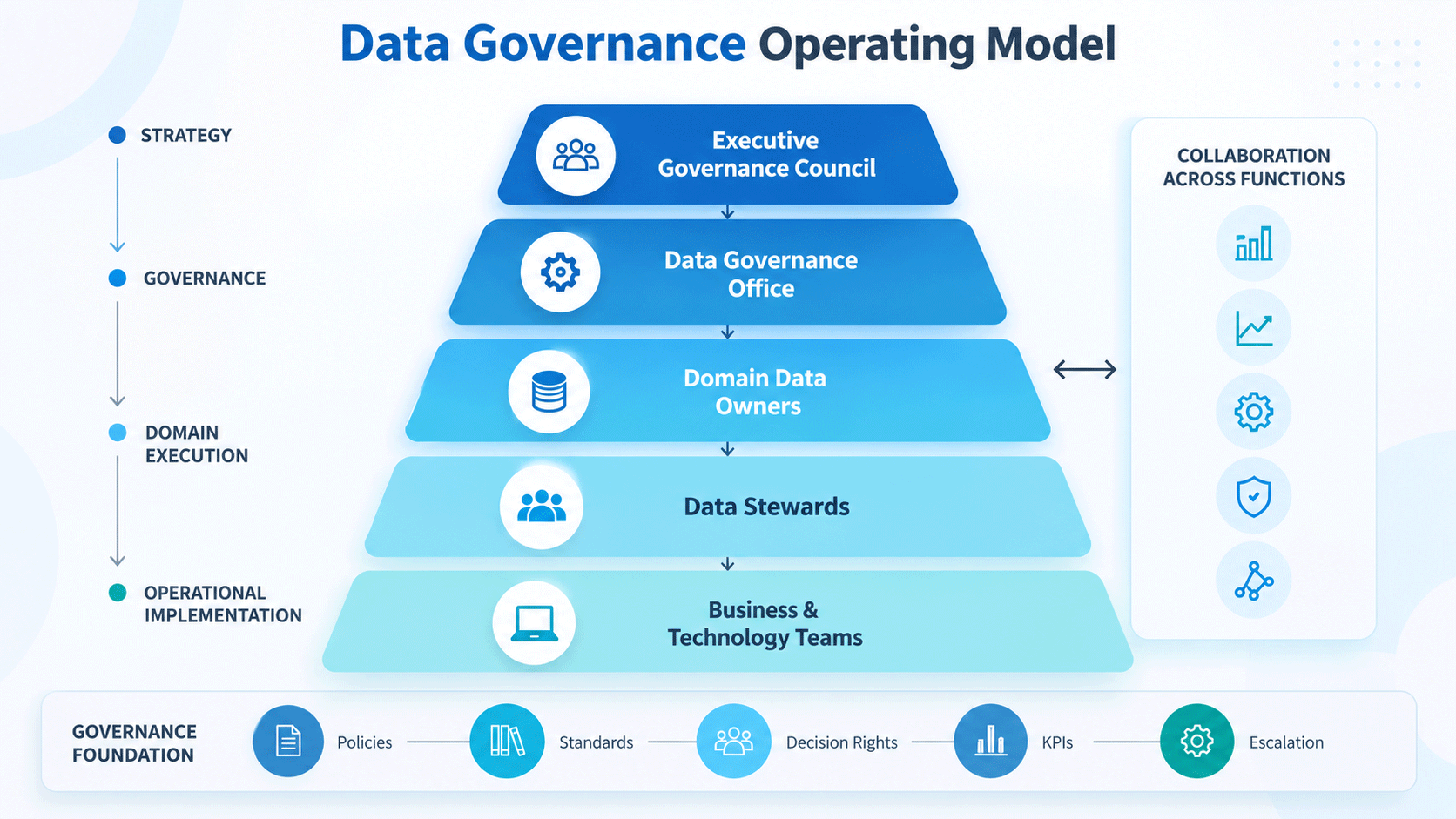
Determine how governance decisions should be made across the organization. Credencys helps enterprises design centralized, federated, domain-led, or hybrid governance models based on organizational structure and data complexity.
We define governance councils, decision rights, escalation paths, domain responsibilities, and interactions between business and technology teams.
Data Ownership & Stewardship
Make accountability for enterprise data explicit. We define the roles of data owners, stewards, domain leaders, business teams, and technology teams across critical data domains.
This includes ownership boundaries, responsibilities, approval authority, issue escalation, and decision-making structures.
Data Governance Policies, Standards & KPIs
Create the rules and measures required to govern data consistently. Credencys helps define enterprise data policies, governance standards, terminology principles, accountability requirements, governance KPIs, and measures for adoption.
The objective is to create standards that are practical enough to be applied across day-to-day data operations.
Data Governance Roadmap & Change Enablement
Turn the target governance model into an actionable plan. We prioritize governance initiatives based on business value, risk, dependencies, data domains, technology readiness, and organizational capacity.
The roadmap defines the sequence required to move from the current state toward scalable enterprise governance.
Data Governance Consulting Deliverables
A data governance consulting engagement should leave your organization with more than recommendations. It should provide the structures, responsibilities, and decisions required to move into execution.
Depending on your current maturity and priorities, the engagement can deliver:
- Governance maturity assessment and current-state gap analysis
- Enterprise data governance strategy and framework
- Target governance operating model
- Data ownership and stewardship framework
- Governance council and decision-rights structure
- RACI and accountability model
- Enterprise data policies and governance standards
- Governance KPI and measurement framework
- Data-domain prioritization
- Technology capability requirements
- Change and stakeholder enablement plan
- Prioritized data governance implementation roadmap
Data Governance Consulting Approach
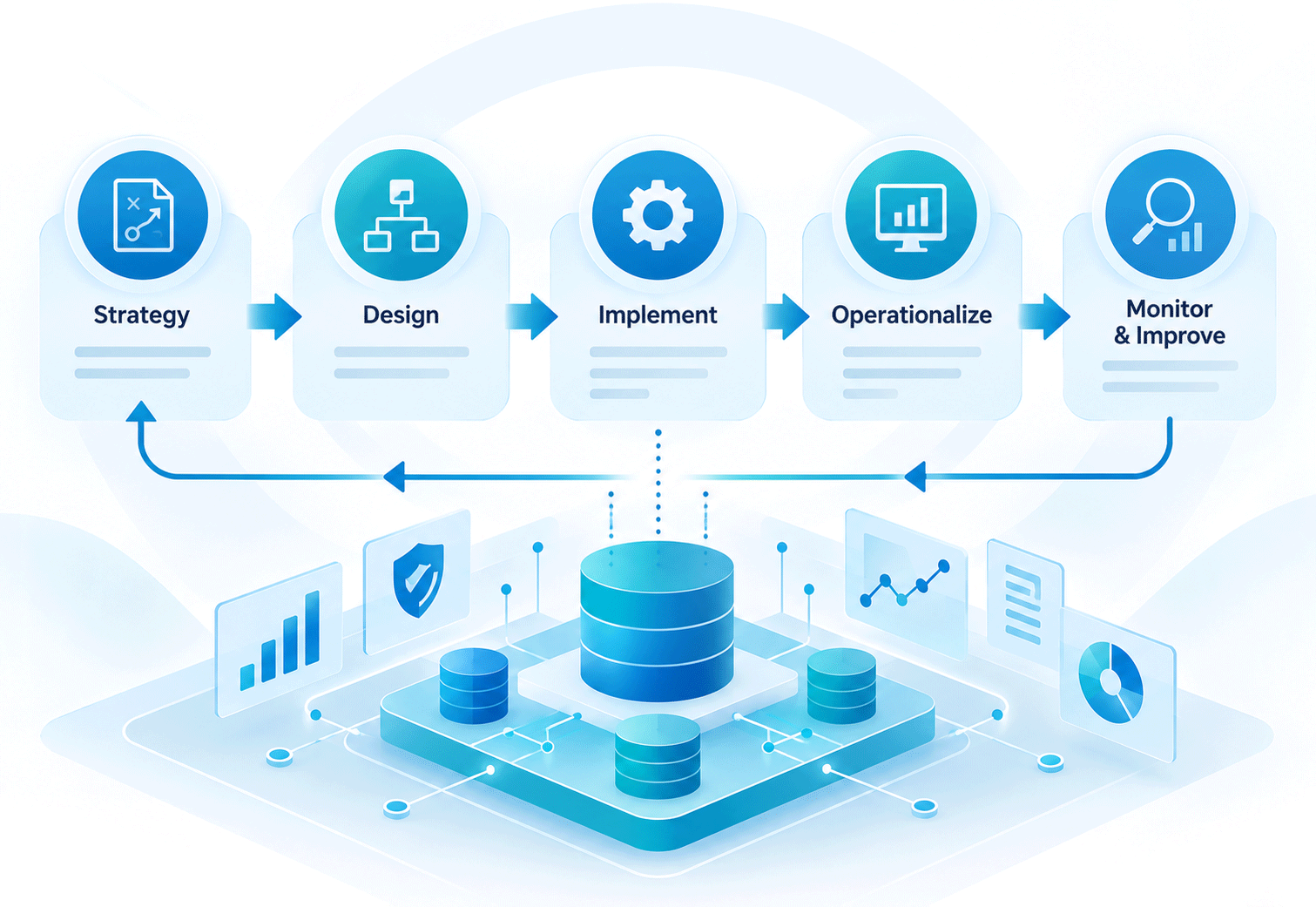
Our approach connects business priorities, enterprise data requirements, organizational responsibilities, and technology readiness before implementation begins.
01
Assess Data Governance Maturity
Understand the current state of governance across people, processes, policies, data domains, technology, ownership, and decision-making. We identify gaps, inconsistencies, risks, and areas where unclear governance is affecting business outcomes.
02
Align Data Governance Priorities
Connect governance objectives with business priorities. We align stakeholders around why governance is needed, which domains matter most, what problems it should solve, and how success should be measured.
03
Design the Data Governance Model
Create the target governance model. We define governance structures, ownership, stewardship, councils, policies, standards, decision rights, escalation paths, and interactions between business and technology teams.
04
Build the Data Governance Roadmap
Translate the target model into prioritized initiatives. The roadmap identifies implementation phases, dependencies, data domains, technology requirements, governance milestones, and measures of progress.
05
Enable Data Governance Adoption
Prepare governance leaders, data owners, stewards, and business teams to operate the model. We help establish the responsibilities, governance routines, and adoption mechanisms needed to move from design into execution.
Business Impact of Data Governance Consulting
Effective governance creates a common way to make decisions about data across the enterprise.
Clear Data Accountability
Establish who owns critical data, who stewards it, who approves changes, and who resolves governance issues.
Consistent Enterprise Decisions
Create common policies, definitions, standards, and decision structures across functions and data domains.
Reduced Governance Risk
Replace informal governance practices with defined accountability, policies, decision rights, and escalation processes.
Scalable Data Management
Build governance structures that can expand across new domains, systems, business units, geographies, and data initiatives.
Stronger Analytics & AI Readiness
Create clearer ownership, standards, and accountability around the data used for analytics, machine learning, and AI.
Faster Data Transformation
Reduce ambiguity around roles, definitions, policies, and governance requirements during MDM, modernization, and enterprise data programs.
Data Governance Success Stories
Global Logistics & Supply Chain Leader
4 Data
Domains Unified Under One MDM
Credencys modernized the organization’s master data environment by bringing Customer, Supplier, Employee, and Item data under a unified governance model. The solution introduced stewardship workflows, validation controls, role-based access, auditability, and enterprise integrations, strengthening data ownership, traceability, and compliance across global operations.
Read MoreGlobal Scientific Technology Leader
45%
Reduction in Duplicate Records
Credencys established stronger data governance practices across global customer data by defining ownership, standardization protocols, and data-quality KPIs. The initiative aligned fragmented regional data, created clearer accountability, and improved data consistency across enterprise systems while supporting ongoing governance and decision-making.
Read MoreGlobal Consumer Goods Leader
38%
Reduction in Compliance Risks
Credencys established governed master data across Customer, Supplier, Product, and Location domains within a Snowflake-native environment. Stewardship workflows, validation, lineage, security controls, and centralized governance improved enterprise visibility while helping the organization strengthen compliance across GDPR, CCPA, and SOX requirements.
Read MoreFrom Data Governance Strategy to Operational Execution
Defining governance is the first step. The next challenge is translating policies, ownership, and standards into the controls and processes used across enterprise data operations.
Once your governance model and roadmap are defined, Credencys can help operationalize them through our Data Quality & Governance Services, including data-quality controls, validation, governance workflows, metadata, lineage, cataloging, and continuous monitoring. This creates a clear path from governance strategy to operational execution without combining the two objectives into the same engagement.
Why Choose Credencys for Data Governance Consulting
Data governance cannot succeed as a documentation exercise. The operating model needs to reflect how your teams make decisions, manage data, and work across business and technology functions.

Business-Led Data Governance
We start with business priorities and governance outcomes rather than tools.

Practical Governance Operating Models
Governance structures are designed around your organizational reality, data domains, and decision-making processes.

Connected Enterprise Data Expertise
Our broader data management consulting capabilities connect governance decisions with MDM, integration, data platforms, analytics, modernization, and AI initiatives.

Data Governance Designed for Execution
Strategies and frameworks are translated into concrete roles, policies, decision rights, KPIs, and an actionable implementation roadmap.
50+
Enterprise Clients
100%
Certified Consultants
15+
Years Experience
4.9/5
Client Satisfaction
Build Your Data Governance Roadmap
Define the ownership, operating model, policies, and priorities required to govern enterprise data at scale.
Talk to an ExpertFrequently Asked Questions
Data governance consulting helps organizations define how enterprise data should be owned, governed, standardized, and managed. It typically covers governance strategy, operating models, ownership, stewardship, policies, decision rights, maturity assessment, and implementation roadmaps.
Data governance consulting is useful when data ownership is unclear, governance practices differ across teams, policies are difficult to enforce, MDM or analytics initiatives are being planned, or existing governance needs to scale across additional business units and data domains.
A maturity assessment evaluates current governance structures, responsibilities, policies, processes, data domains, technology capabilities, stakeholder participation, and adoption. The output identifies current-state gaps and helps prioritize governance improvements.
A data governance operating model defines how governance decisions are made and who is responsible for them. It establishes governance councils, data owners, data stewards, decision rights, escalation paths, policies, and interactions between business and technology teams.
A data owner is typically accountable for a data domain and the business decisions associated with it. A data steward is responsible for applying governance standards and supporting the day-to-day management of data within that domain.
Trusted by Best
Choosing Credencys means partnering with a team that’s deeply committed to unlocking the true value of your data. Here’s why industry leaders trust us:
Our Valued Clientele


Send us a Message
