

Connect Your PIM. Eliminate Product Data Silos.
Implementing PIM is only part of building a scalable product-data ecosystem. Product information typically originates and evolves across ERP, PLM, supplier systems, DAM, commerce platforms, marketplaces, and other enterprise applications.
When these systems operate independently, teams spend time moving data manually, resolving inconsistencies, and determining which system contains the correct information. Credencys’ PIM integration services connect these systems through governed, scalable data flows so product information can move from source to enrichment to distribution without unnecessary manual intervention.
Duplicate Product Data Across Systems
The same SKU, specification, description, or attribute is maintained independently across ERP, PIM, commerce platforms, spreadsheets, and other applications.
Manual Data Transfers
Teams rely on CSV exports, spreadsheet uploads, file exchanges, and manual synchronization to keep systems aligned.
Conflicting Systems of Record
Unclear ownership between ERP, PLM, PIM, DAM, and commerce systems creates conflicting values and inconsistent product information.
Slow Product Updates
Approved changes take too long to move from source systems through PIM and into websites, marketplaces, distributors, and other channels.
Integration Complexity at Scale
Point-to-point connections become increasingly difficult to maintain as product volumes, markets, suppliers, applications, and sales channels grow.

How Much is Your Product Data Costing You?
Get Your Score + 90-day action plan in 3 minutes.
Check Your ScoreBuild a Connected Product Data Ecosystem with PIM
A successful PIM integration architecture defines not only how systems connect, but also which system owns which information. Credencys helps establish clear boundaries between enterprise applications, so each system performs the role it is designed for while PIM becomes the governed enrichment and distribution layer for product information.
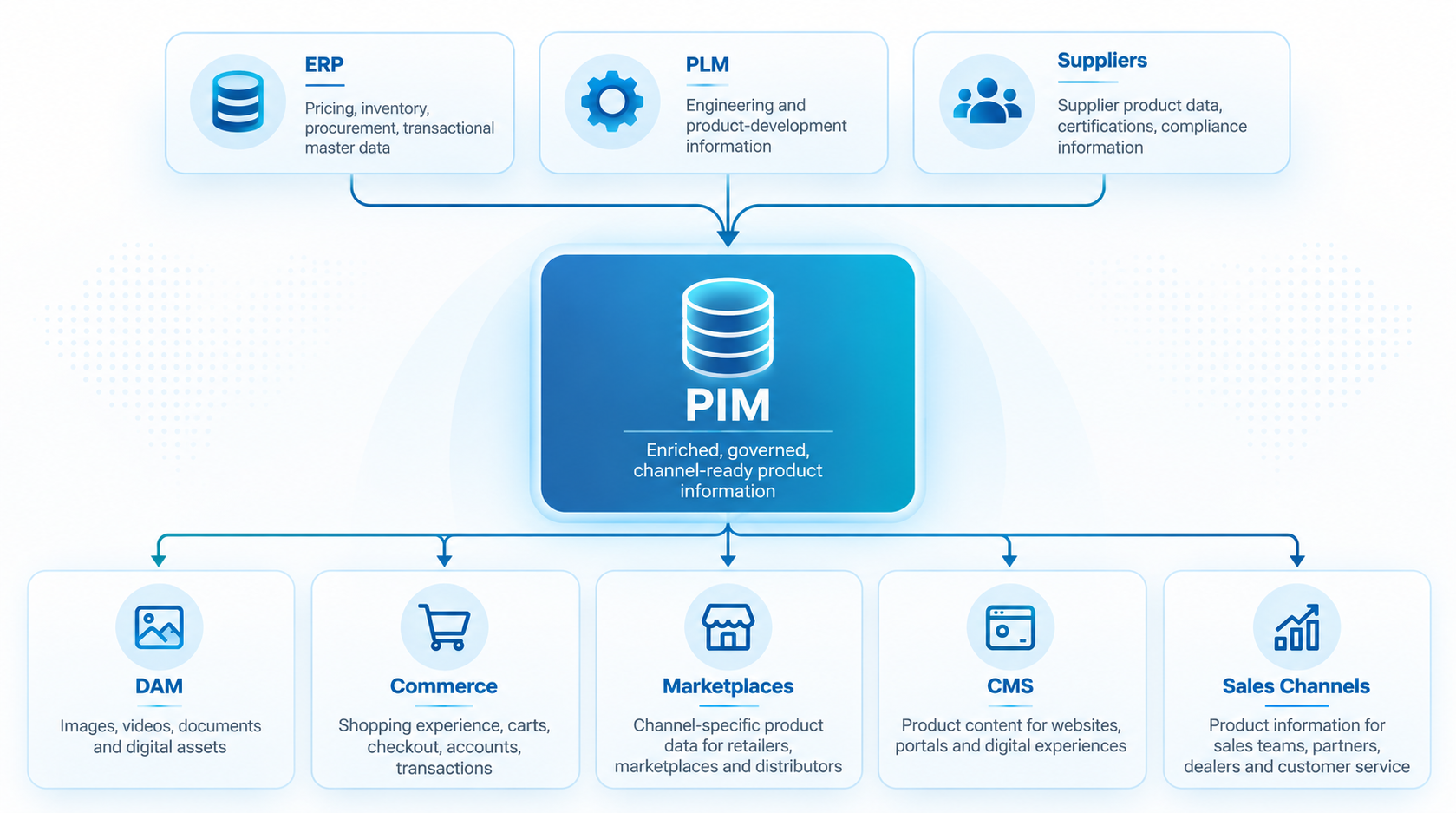
Our PIM Integration Services
From enterprise applications to customer-facing channels, Credencys connects PIM with the systems that create, manage, enrich, and consume product information.
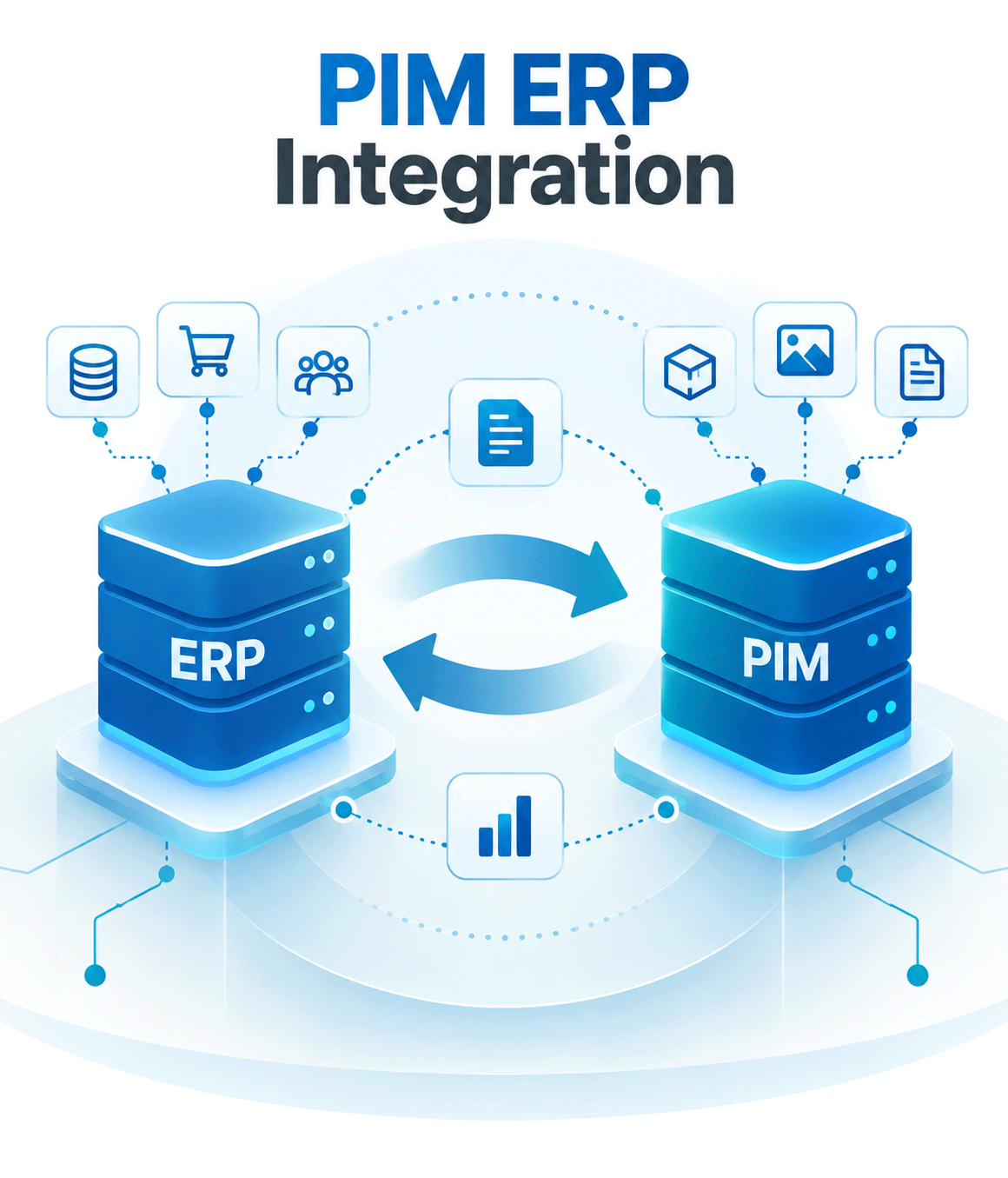
PIM ERP Integration
Connect PIM with ERP platforms to automate product onboarding and synchronize approved operational product information. We help define what should remain mastered in ERP and what should be enriched and governed in PIM.
- Automate creation and updating of product records
- Synchronize SKUs, material numbers, suppliers, status, and reference data
- Reduce duplicate data entry between ERP and PIM
- Support one-way or bidirectional data flows where appropriate
- Establish validation and exception-management processes
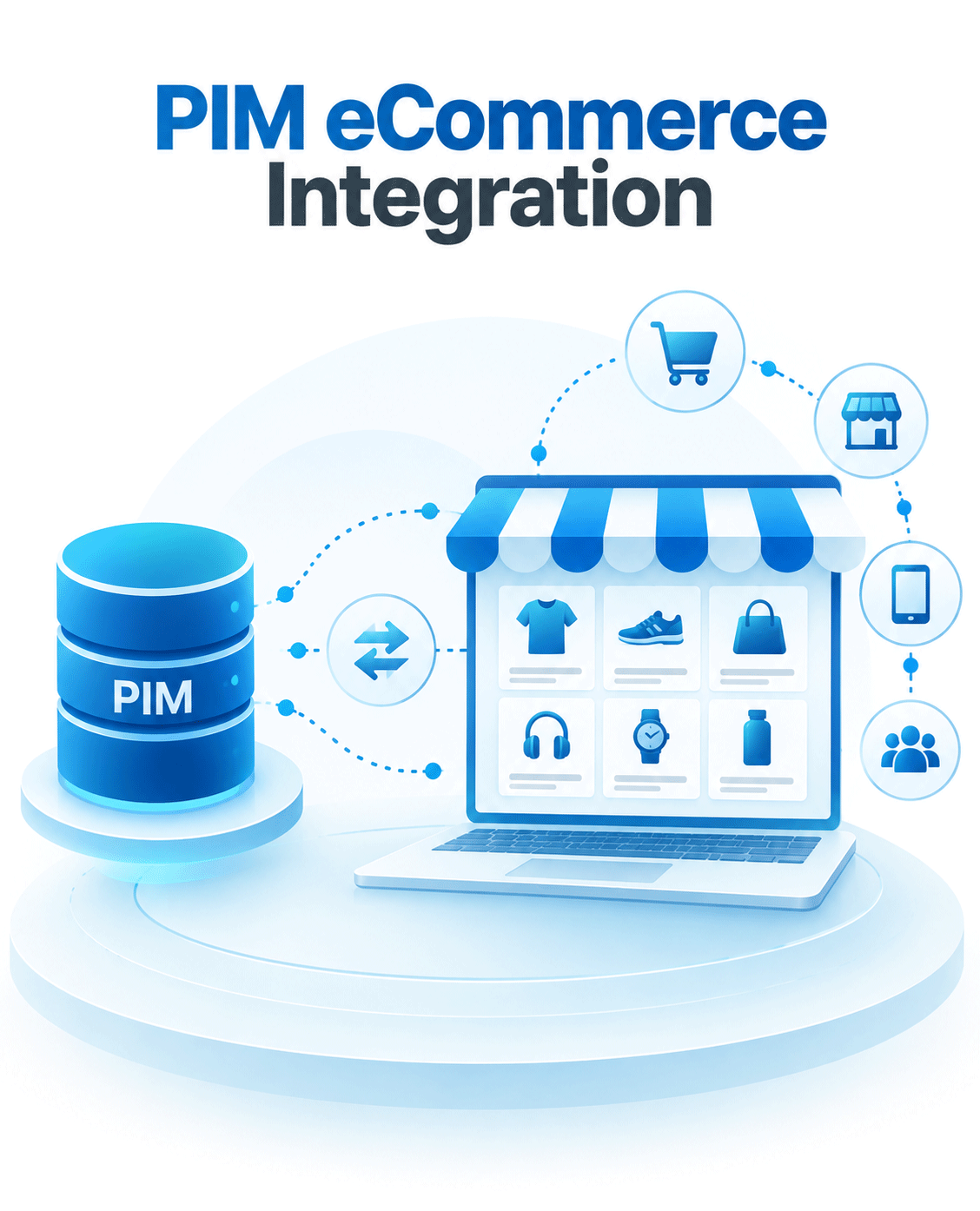
PIM eCommerce Integration
Deliver complete, enriched, and channel-ready product information from PIM to your commerce ecosystem. We integrate PIM with platforms such as Shopify, Adobe Commerce, Salesforce Commerce Cloud, commercetools, BigCommerce, WooCommerce, and custom commerce environments.
- Synchronize product titles, descriptions, attributes, variants, and assets
- Support multiple storefronts, brands, and markets
- Automate product publishing and updates
- Maintain localized and channel-specific product content
- Reduce manual catalog maintenance
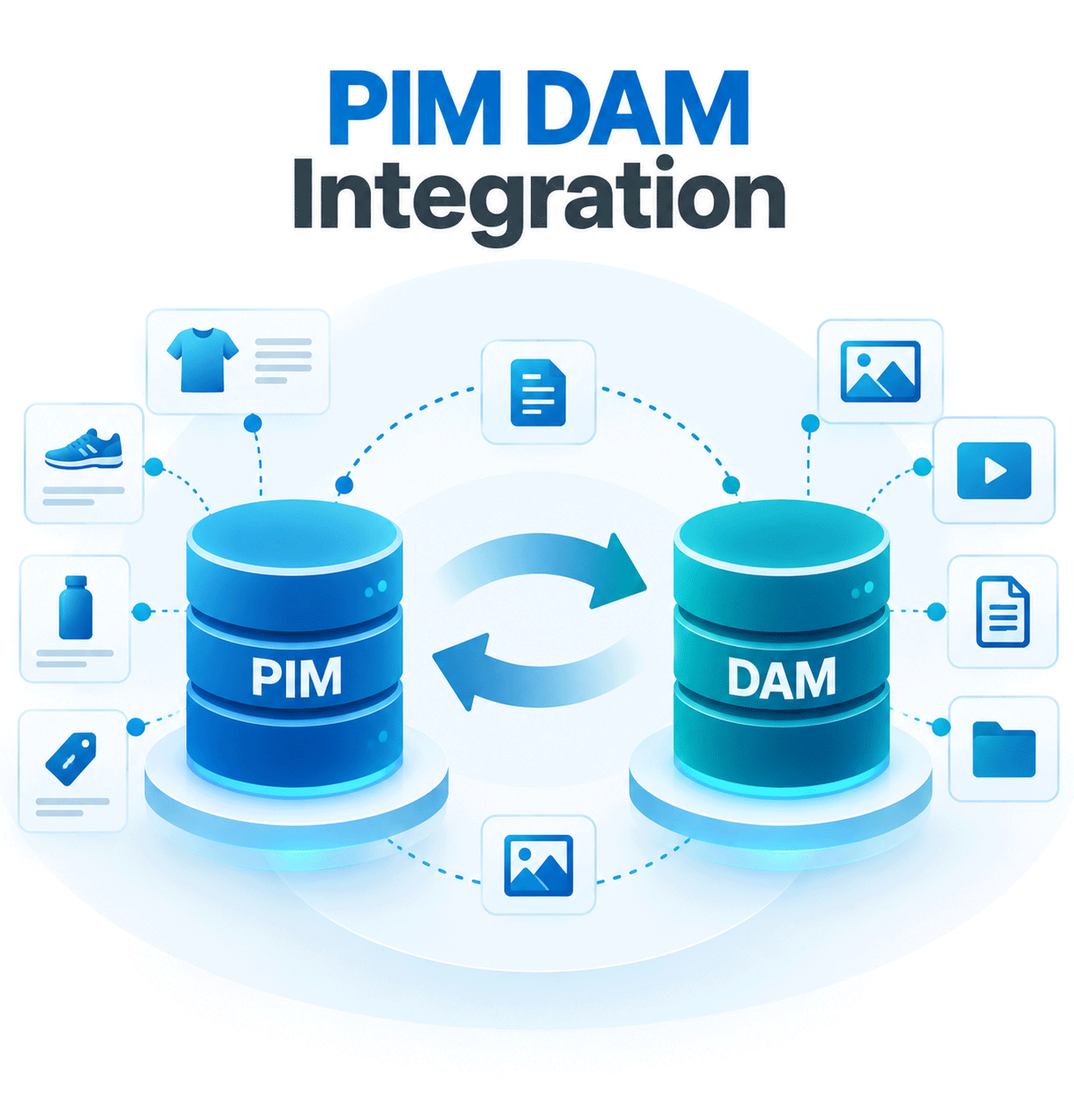
PIM DAM Integration
Connect structured product information with the images, documents, videos, drawings, certifications, and other digital assets associated with each product.
- Link products with approved digital assets
- Maintain product-to-asset relationships
- Synchronize asset metadata
- Control asset versions and publication status
- Deliver the correct assets to downstream channels
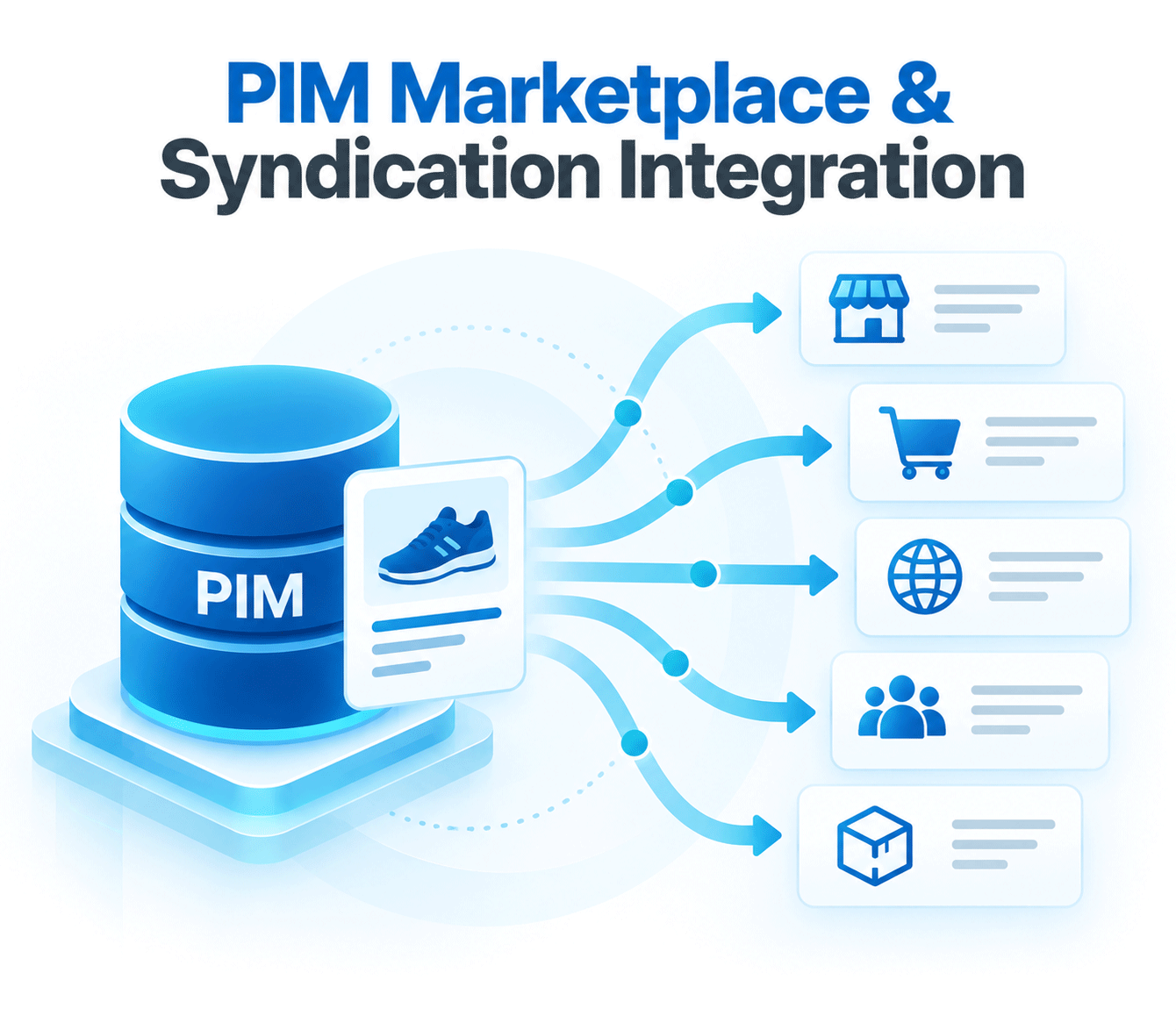
PIM Marketplace & Syndication Integration
Transform governed PIM data into channel-ready product information for retailers, marketplaces, distributors, trading partners, and syndication platforms.
- Map internal attributes to external schemas
- Apply channel-specific validation rules
- Transform product categories and taxonomies
- Manage channel-required attributes
- Automate product-content syndication
- Monitor failed or incomplete records
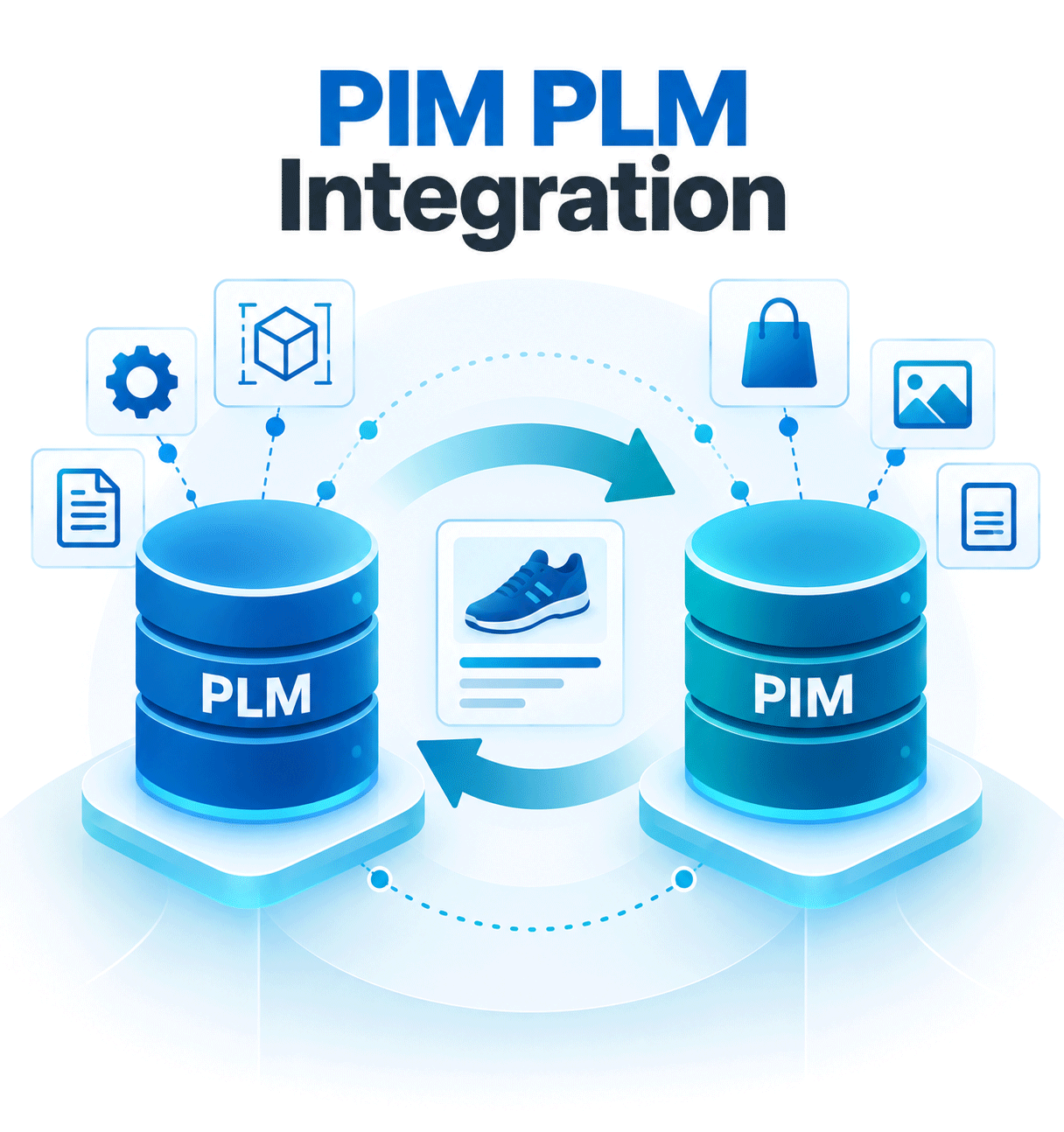
PIM PLM Integration
Connect engineering-approved product information with the richer commercial content required by marketing, sales, distributors, and digital channels.
- Synchronize technical specifications
- Transfer approved engineering attributes
- Connect product families and variants
- Manage engineering-to-commercial handoffs
- Reduce repeated manual data entry
PLM continues to govern product-development and engineering information while PIM manages enriched, market-facing product information.
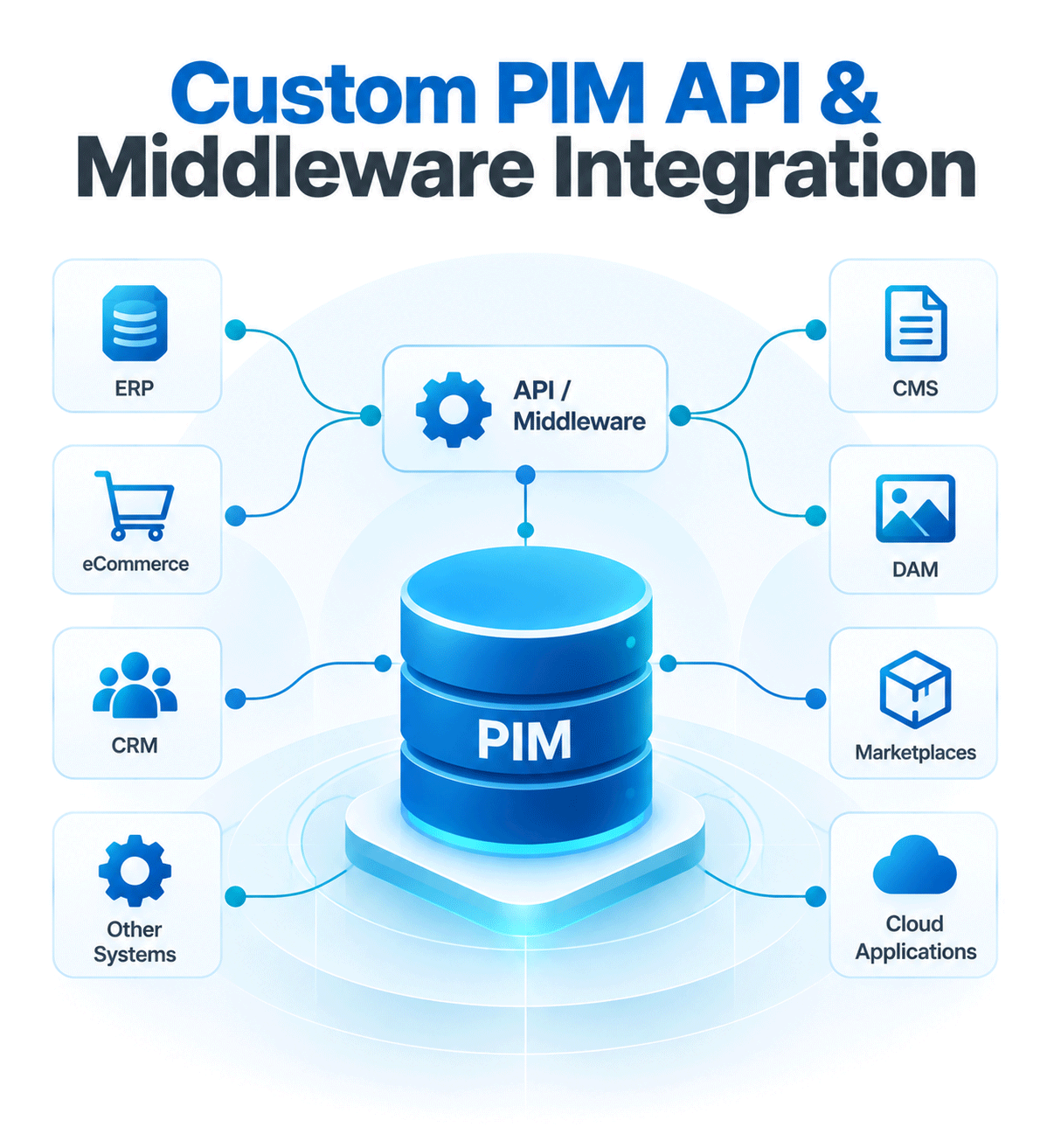
Custom PIM API & Middleware Integration
Complex enterprise environments often require more than an out-of-the-box connector. Credencys designs custom integrations using APIs, middleware, scheduled feeds, message queues, and event-driven architectures based on your systems, data volumes, synchronization requirements, and business processes.
- REST and API-based integrations
- Middleware and iPaaS architecture
- Batch and file-based interfaces
- Event-driven data flows
- Custom connectors
- Legacy-system integration
- Integration monitoring and exception handling
Our Approach to PIM Integration Services
From discovery to production monitoring, we follow a structured approach that aligns product-data ownership, integration architecture, and business processes.
We identify:
- Source and destination systems
- System-of-record ownership
- Data dependencies
- Existing integrations
- Data volumes
- Synchronization frequency
- API capabilities
- Integration risks
- Business-critical workflows
We establish:
- Source-of-truth rules
- Field and attribute mappings
- Product identifiers
- Data transformations
- Taxonomy mappings
- Parent-child relationships
- Synchronization logic
- Error handling
- API or middleware requirements
We test:
- Data accuracy
- Mapping logic
- Product relationships
- Update behavior
- Exception scenarios
- Performance
- Data volumes
- Authentication and access
- End-to-end business workflows
We support:
- Production deployment
- Monitoring
- Alerts
- Failed-record handling
- Logging
- Retry mechanisms
- Documentation
- Performance optimization
- Ongoing enhancement
Business Impact of PIM Integration
PIM integration transforms disconnected product-data operations into governed, scalable data flows across enterprise systems.

Faster Product Onboarding
Move base product information automatically from source systems into PIM for enrichment instead of recreating product records manually.
Reduced Manual Data Work
Eliminate repetitive exports, imports, copy-paste processes, and spreadsheet-based synchronization.
Improved Product Data Accuracy
Maintain clear ownership and validation rules as information moves across ERP, PLM, PIM, DAM, commerce, and other systems.
Faster Time-to-Market
Reduce integration and publishing bottlenecks between product creation, enrichment, approval, and channel distribution.
Scalable Channel Expansion
Add new storefronts, marketplaces, retailers, distributors, brands, or markets without rebuilding the entire product-data process.
Better Enterprise Governance
Give business and IT teams clear visibility into where product information originates, where it is enriched, and where it is consumed.
Not Sure How Your PIM Should Connect with Your Existing Systems?
Our PIM experts can assess your current product-data ecosystem, identify integration gaps, and recommend an architecture aligned with your systems, data volumes, and business priorities.
Review My PIM ArchitectureReal Business Impact: PIM Integration Success Stories
Leading Automotive Aftermarket Manufacturer & Distributor
3X
Faster Operations
Credencys implemented a centralized PIM environment and integrated it with the client's ERP, DAM, ACES database, and downstream sales channels. ERP integration streamlined product onboarding, ACES integration automated vehicle compatibility mapping, and automated syndication delivered verified product information to third-party sales channels.
Read MoreLeading Medical Equipment Provider
40%
Reduction in Time-to-Market
Credencys integrated Microsoft Dynamics 365 with a Pimcore-based PIM so base product information could flow from ERP into a centralized environment for market-specific enrichment, approval, and publication. The connected architecture allowed teams across multiple markets to enrich product content without duplicating the operational product information already maintained in ERP.
Read MoreB2B Healthcare Products Company
27%
Increase in Order Volume
Credencys built a connected B2B commerce ecosystem combining PIM, DAM, eCommerce, shipping, payment, MDM-driven business rules, and ERP synchronization. Real-time ERP synchronization reduced duplicate data and kept ordering information aligned across the commerce and enterprise environment.
Read MorePIM Platforms and Enterprise Systems We Integrate
Credencys helps enterprises integrate PIM with the technologies already operating across their product-data ecosystem.
PIM & Product Data Platforms
- Pimcore
- Syndigo
- Supported enterprise PIM environments
ERP & Enterprise Systems
- SAP environments
- Microsoft Dynamics
- Oracle environments
- NetSuite
- Custom ERP systems
Commerce Platforms
- Shopify
- Adobe Commerce / Magento
- Salesforce Commerce Cloud
- commercetools
- BigCommerce
- WooCommerce
Integration Technologies
- APIs
- Middleware
- iPaaS
- Azure integration technologies
- Event-driven architecture
- Custom connectors
Why Leading Enterprises Choose Credencys for PIM Integration

Product Data Expertise
We understand how product information moves from source systems through enrichment, governance, and downstream distribution—not just how APIs connect.

End-to-End PIM Capabilities
From consulting and implementation to integration, migration, syndication, governance, and optimization, Credencys supports the complete PIM lifecycle.

Enterprise Integration Experience
We build connected architectures across ERP, PIM, DAM, commerce, marketplaces, middleware, and custom applications.

Governance-First Architecture
Integration design includes system ownership, validation, transformation, monitoring, and exception management to protect product-data quality.
50+
Enterprise Clients
100%
Certified Consultants
15+
Years Experience
4.9/5
Client Satisfaction
Ready to Connect Your Product Data Ecosystem?
Connect PIM with ERP, DAM, eCommerce, marketplaces, CMS, PLM, and enterprise systems to eliminate manual data movement and create reliable product-data flows at scale.
Talk to a PIM Integration ExpertFrequently Asked Questions
PIM integration connects a Product Information Management system with the applications that create, enrich, manage, or consume product information. Common integrations include ERP, PLM, DAM, eCommerce, CMS, CRM, marketplaces, supplier systems, and syndication platforms.
The goal is to automate reliable product-data flows while maintaining clear ownership between systems.
PIM integration services include assessing existing systems, defining data ownership, designing integration architecture, mapping fields, developing APIs or connectors, configuring transformation logic, testing data flows, deploying integrations, and monitoring them after launch. They can cover both new PIM implementations and existing PIM environments.
ERP typically provides base operational product information such as SKU numbers, supplier data, item status, units of measure, and other transactional references. PIM receives the relevant information and enriches it with descriptions, attributes, classifications, relationships, localization, and digital content required by sales and commerce channels.
The integration can be API-based, middleware-driven, event-driven, or scheduled depending on the ERP and business requirements.
ERP generally manages transactional and operational information such as purchasing, inventory, financial data, orders, and pricing-related information. PIM manages enriched product information such as descriptions, specifications, classifications, attributes, variants, relationships, localization, and channel content.
Exact ownership should be established during integration architecture design.
Yes. Enterprises operating across business units, acquisitions, regions, or brands may need PIM to consume product information from multiple ERP systems. The integration architecture should normalize identifiers, data structures, ownership rules, and mappings before information is consolidated in PIM.
Trusted by Best
Choosing Credencys means partnering with a team that’s deeply committed to unlocking the true value of your data. Here’s why industry leaders trust us:
Our Valued Clientele


Send us a Message
