

Why Shopify Product Data Becomes Difficult to Manage at Scale
Shopify provides strong commerce capabilities, but product-data operations become increasingly complex as catalogs, suppliers, variants, markets, storefronts, and downstream channels expand.
When product information is maintained across ERP, spreadsheets, DAM, supplier feeds, Shopify, and other commerce platforms, teams spend more time correcting data than launching and improving products.
Growing SKU and Variant Complexity
Products may contain multiple colors, sizes, materials, configurations, pack sizes, models, and other variations. As catalogs grow, maintaining accurate relationships between products and variants becomes harder without a governed product-data structure.
Product Data Spread Across Multiple Systems
Descriptions, specifications, identifiers, supplier information, images, categories, and other product content may live across ERP, spreadsheets, DAM, PLM, supplier systems, and Shopify. Disconnected systems create duplicate records, conflicting values, and repeated manual work.
Complex Metafield and Attribute Management
Shopify metafields allow merchants to store specialized product and variant information. As catalog complexity grows, however, inconsistent naming, duplicate fields, and unstructured attribute values can become difficult to govern across thousands of products.
Manual Product Enrichment and Publishing
Product teams may repeatedly copy specifications, descriptions, images, attributes, and other content from suppliers or enterprise systems into Shopify. Manual enrichment and publishing increase operational effort while making catalog quality dependent on individual processes.
Multichannel Product Data Requirements
Shopify is often only one product-data destination. The same catalog may also need to support marketplaces, B2B portals, retailer feeds, social commerce, mobile applications, catalogs, and international commerce experiences.
Shopify Limits a PIM Solves
Shopify is an excellent store. It was not built to be the master of your product information.
 Shopify on Its Own
 With a PIM
At most three options per product, and a cap on variants
Any number of attributes in the PIM; the right options and variants published to Shopify
Metafields with no inheritance, workflow or completeness checks
Attribute groups, inheritance, approval workflows and completeness scores before go-live
Bulk changes through CSV exports and imports
Edit once in the PIM and sync only the changes through the API
Translations through apps, with no review step
Translation workflows per language, approved before publishing
Images on each product, with no versions or usage rights
Central assets with versions and rights, reused across products and channels
A separate catalog for each Shopify Plus expansion store
One product record published to every store, market and marketplace

How Much is Your Product Data Costing You?
Get Your Score + 90-day action plan in 3 minutes.
Check Your ScoreHow PIM Strengthens Shopify Product Management
PIM creates a governed product-information layer between enterprise source systems and Shopify. It allows teams to collect, standardize, enrich, approve, and distribute product information before it reaches the storefront, reducing manual catalog work and making Shopify easier to scale.
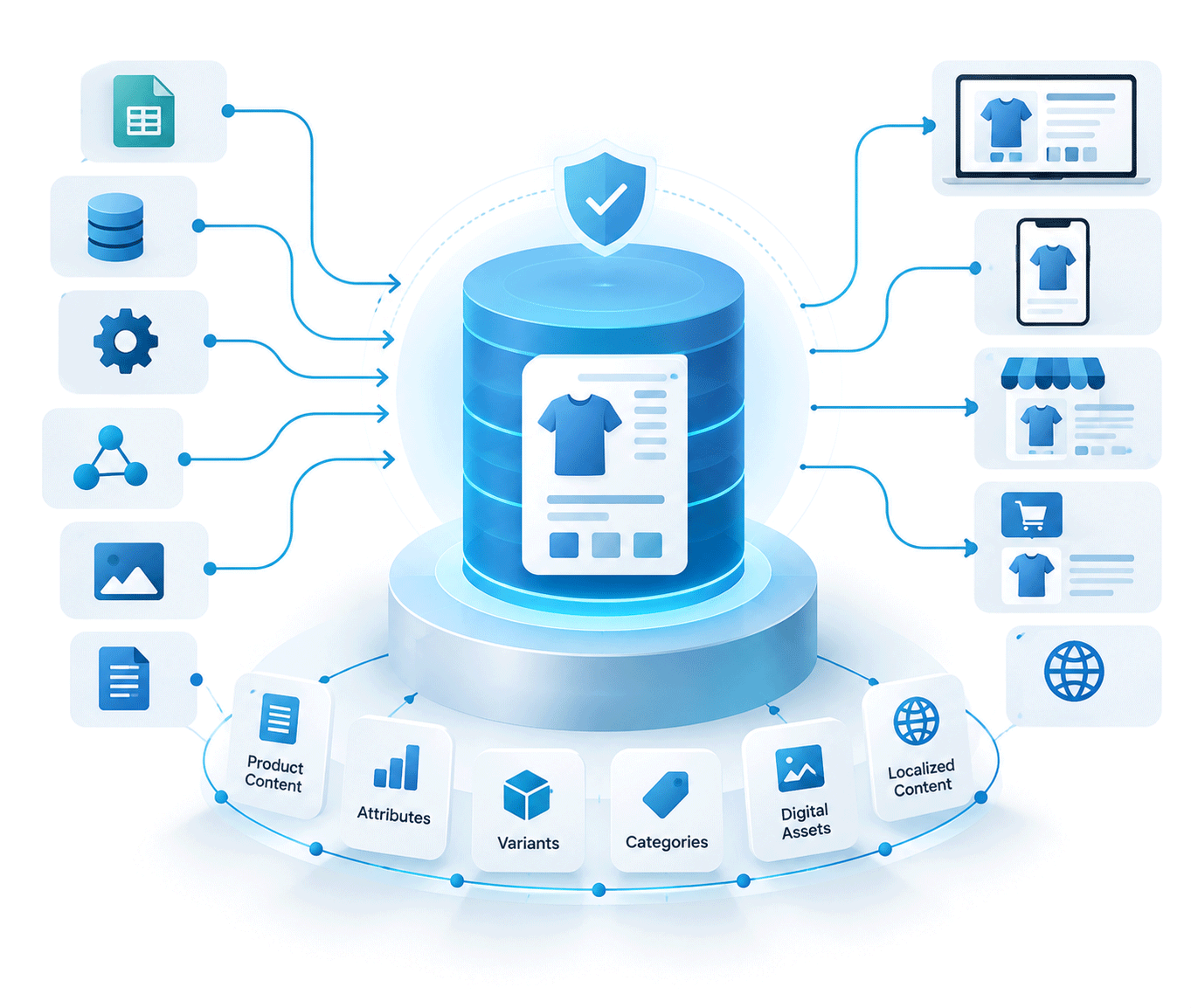
The Single Source of Truth
PIM centralizes product titles, descriptions, attributes, specifications, identifiers, variants, categories, relationships, digital assets, and localized content. Instead of managing different versions of the same information across ERP, spreadsheets, DAM, and Shopify, teams work from one governed product record.
- Centralize product information from multiple source systems
- Reduce duplicate and conflicting product records
- Establish clear ownership for product attributes
- Maintain approved product information before publishing to Shopify
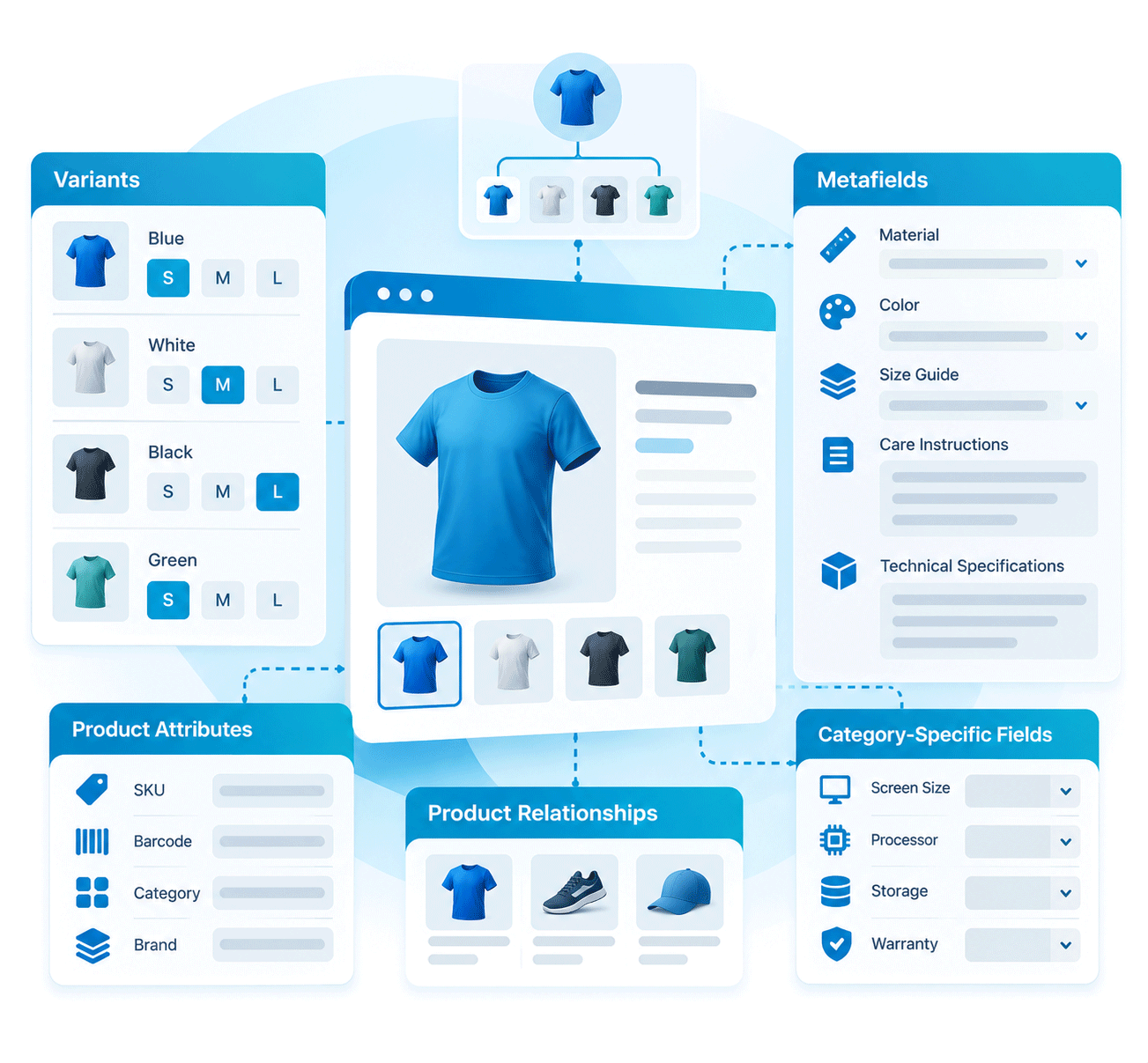
Product Variant and Metafield Management
Complex Shopify catalogs require structured relationships between products, variants, attributes, and custom data. PIM allows enterprises to model this information upstream before mapping the appropriate data to Shopify.
- Structure parent-child product relationships
- Manage variant attributes such as size, color, material, and configuration
- Standardize values used in Shopify metafields
- Apply category-specific attribute models
- Maintain product- and variant-level information consistently
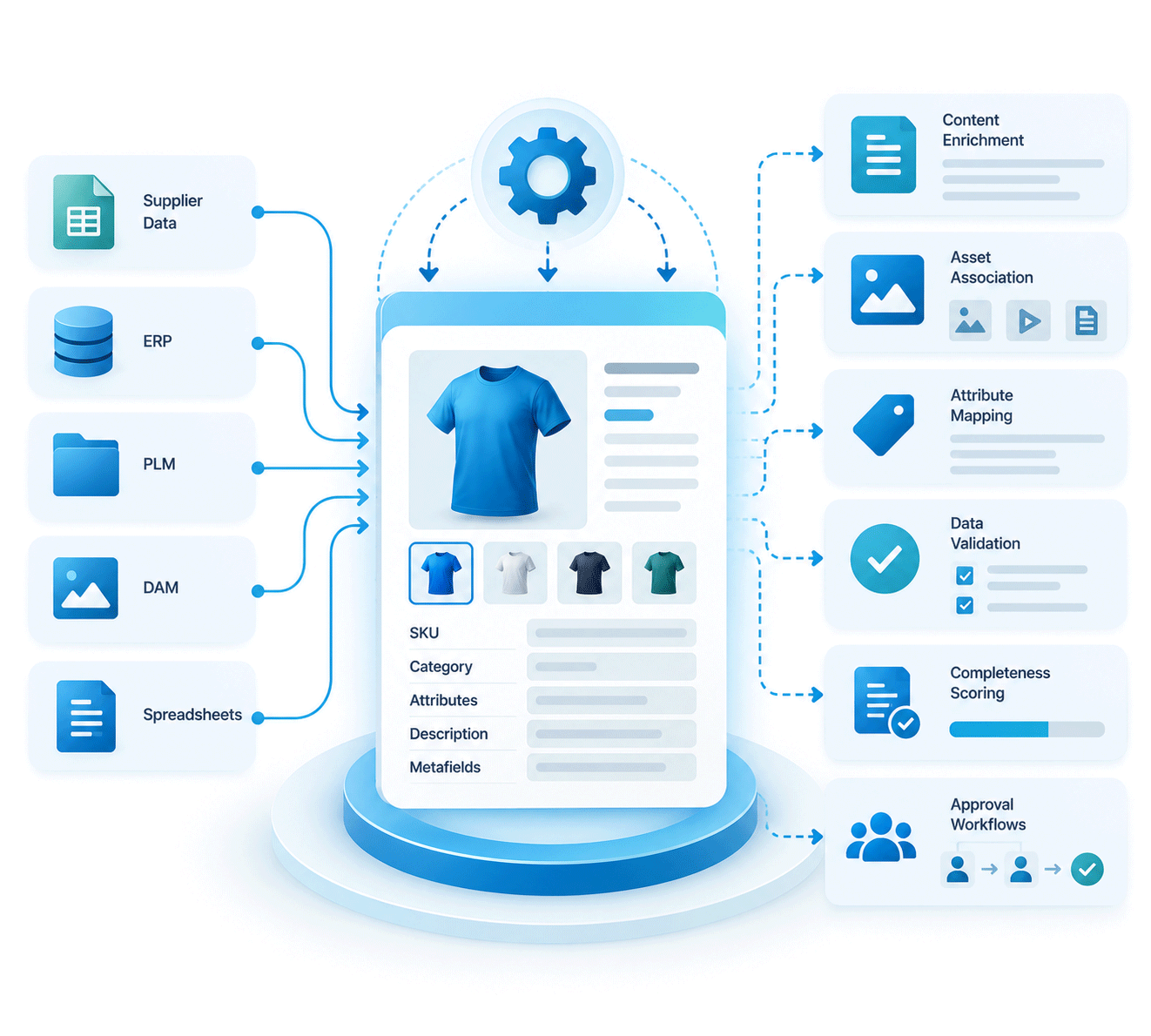
Automated Product Enrichment
PIM creates structured workflows for transforming basic product records into commerce-ready content.
- Import supplier and enterprise product information
- Map incoming attributes to standardized data models
- Enrich descriptions and specifications
- Associate digital assets
- Track product completeness
- Validate required information
- Route products through review and approval workflows
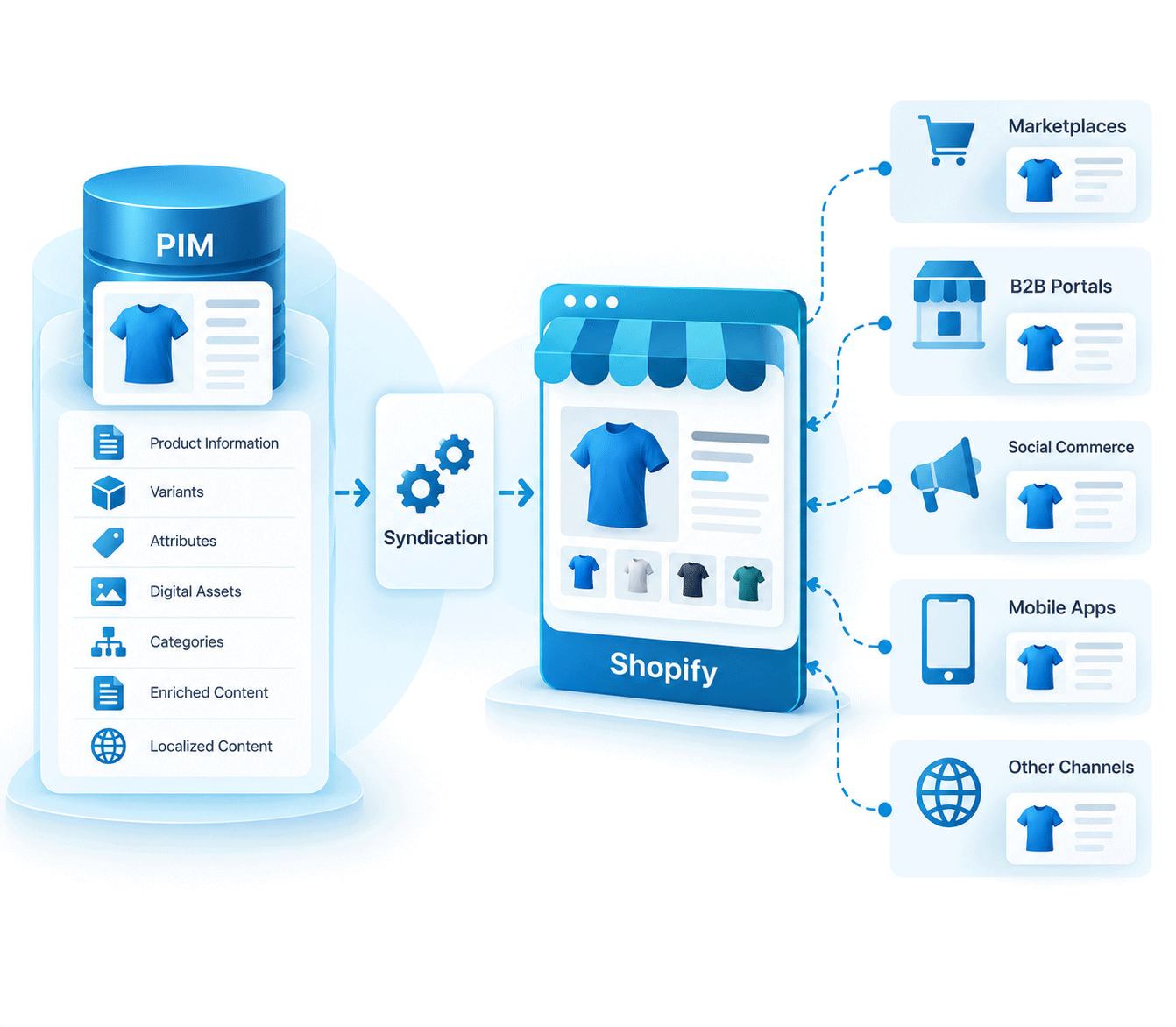
Shopify Product Data Syndication
Once product information is approved, PIM can distribute Shopify-ready data through APIs, middleware, connectors, or other integration patterns.
- Publish product information to Shopify
- Map PIM attributes to Shopify product fields and metafields
- Synchronize product and variant information
- Maintain classifications and merchandising structures
- Update approved product content without repeated manual entry
- Support additional commerce channels from the same governed product foundation
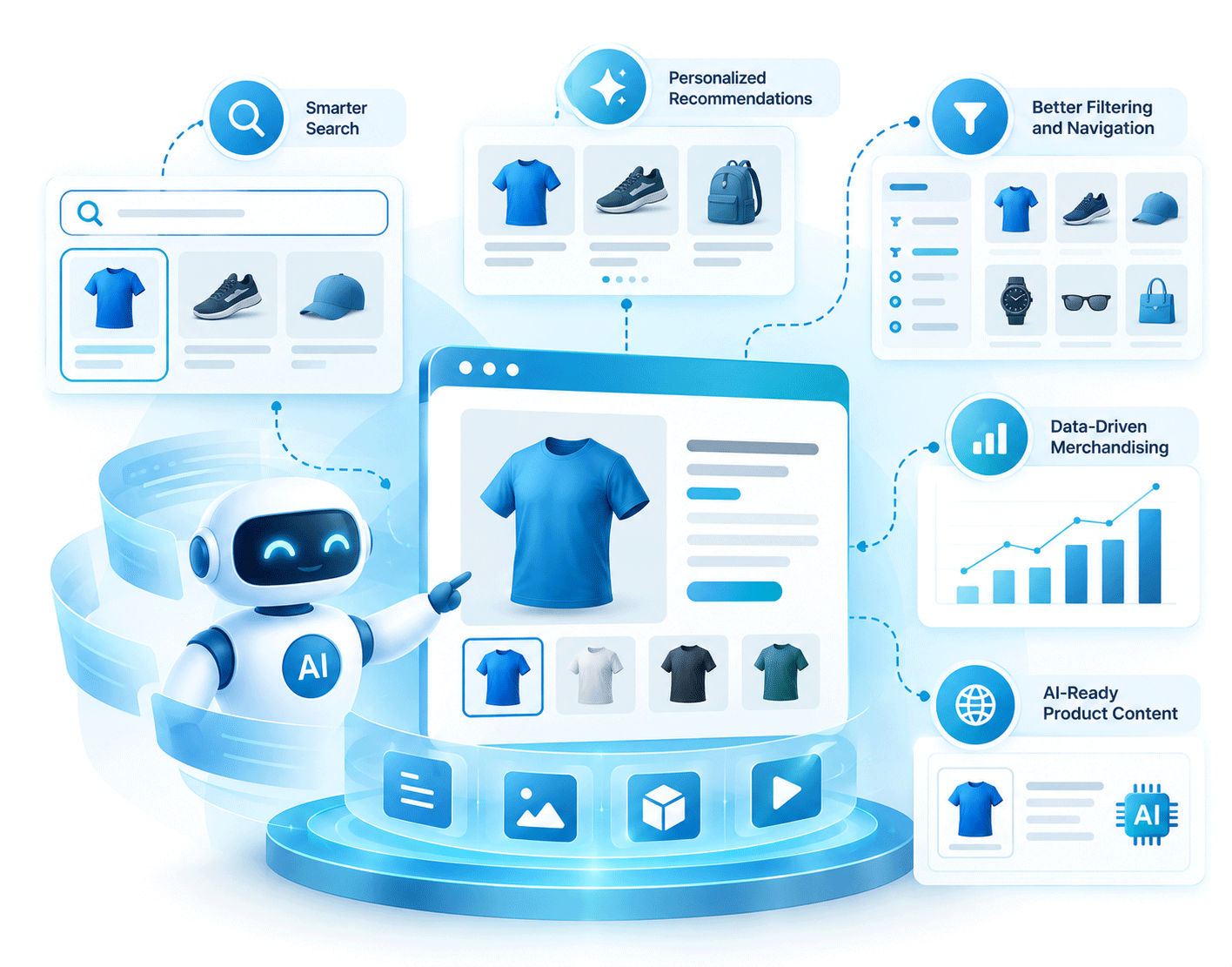
Commerce and AI Readiness
Structured product information improves the context available to search, merchandising, recommendation, automation, and AI applications.
- Improve product search and filtering
- Provide more consistent attributes for product comparison
- Strengthen related-product and recommendation logic
- Support semantic and natural-language search
- Prepare governed product content for AI-assisted commerce experiences
Our Shopify PIM Integration Services
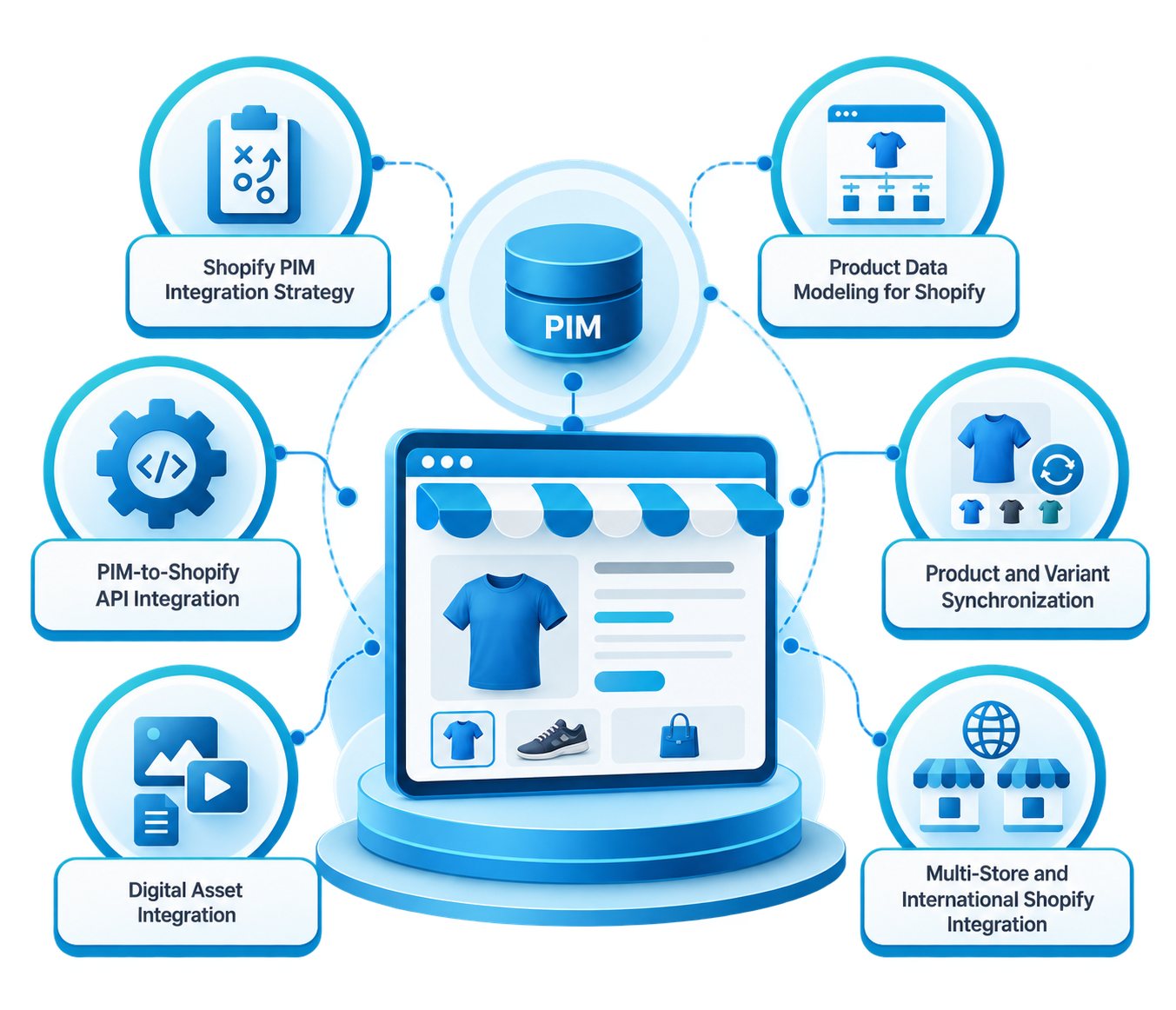
As part of our broader PIM integration services, Credencys connects PIM with Shopify to automate the flow of enriched product information, variants, attributes, digital assets, and channel-ready content into your commerce environment.
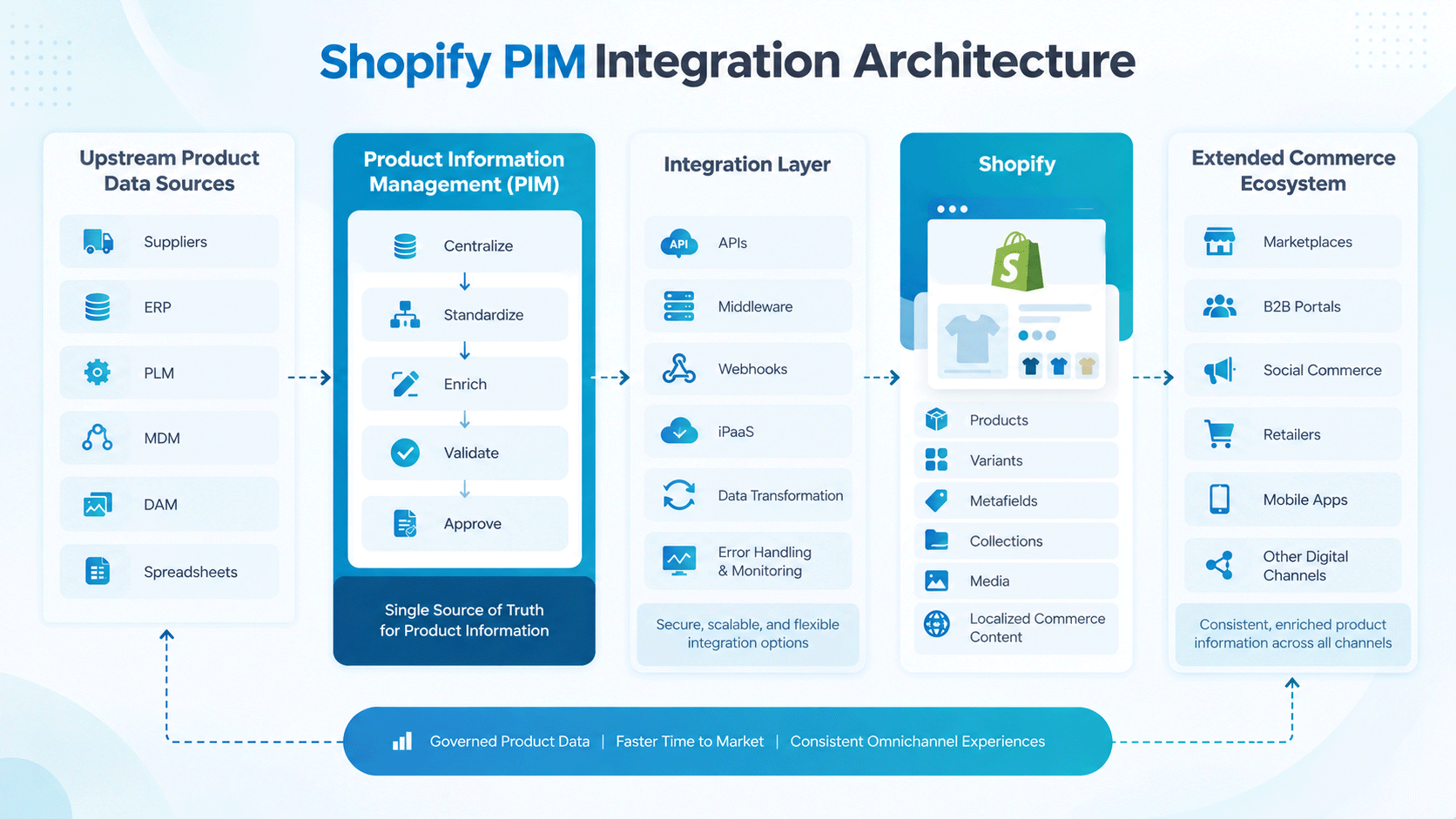
Shopify PIM Integration Architecture
A scalable Shopify PIM architecture separates product-information governance from transactional commerce.
What Product Data Can Be Synchronized Between PIM and Shopify?
The exact data flow depends on your architecture and system-of-record decisions.
PIM-Managed Information
Shopify Destination
Product names
Product titles
Product descriptions
Product descriptions
Structured attributes
Metafields
Variant attributes
Product options and variants
SKU and product identifiers
SKU, barcode, and related fields
Product taxonomy
Categories and merchandising structures
Product images and media
Shopify product media
SEO-ready product content
Shopify search engine fields
Localized descriptions
Localized storefront content
Product relationships
Merchandising or custom relationship logic
Specifications
Metafields or structured content
Care and usage information
Metafields or product content
PIM should generally manage relatively stable enriched product information. Frequently changing transactional data, such as inventory, orders, checkout information, and potentially pricing depending on the architecture should remain mastered in the appropriate ERP, OMS, WMS, pricing, or commerce system.
Shopify PIM Integration with Your Existing Technology Stack
Shopify rarely operates independently within an enterprise commerce environment. Credencys can design PIM integration around the surrounding systems responsible for creating, managing, enriching, and consuming product information.
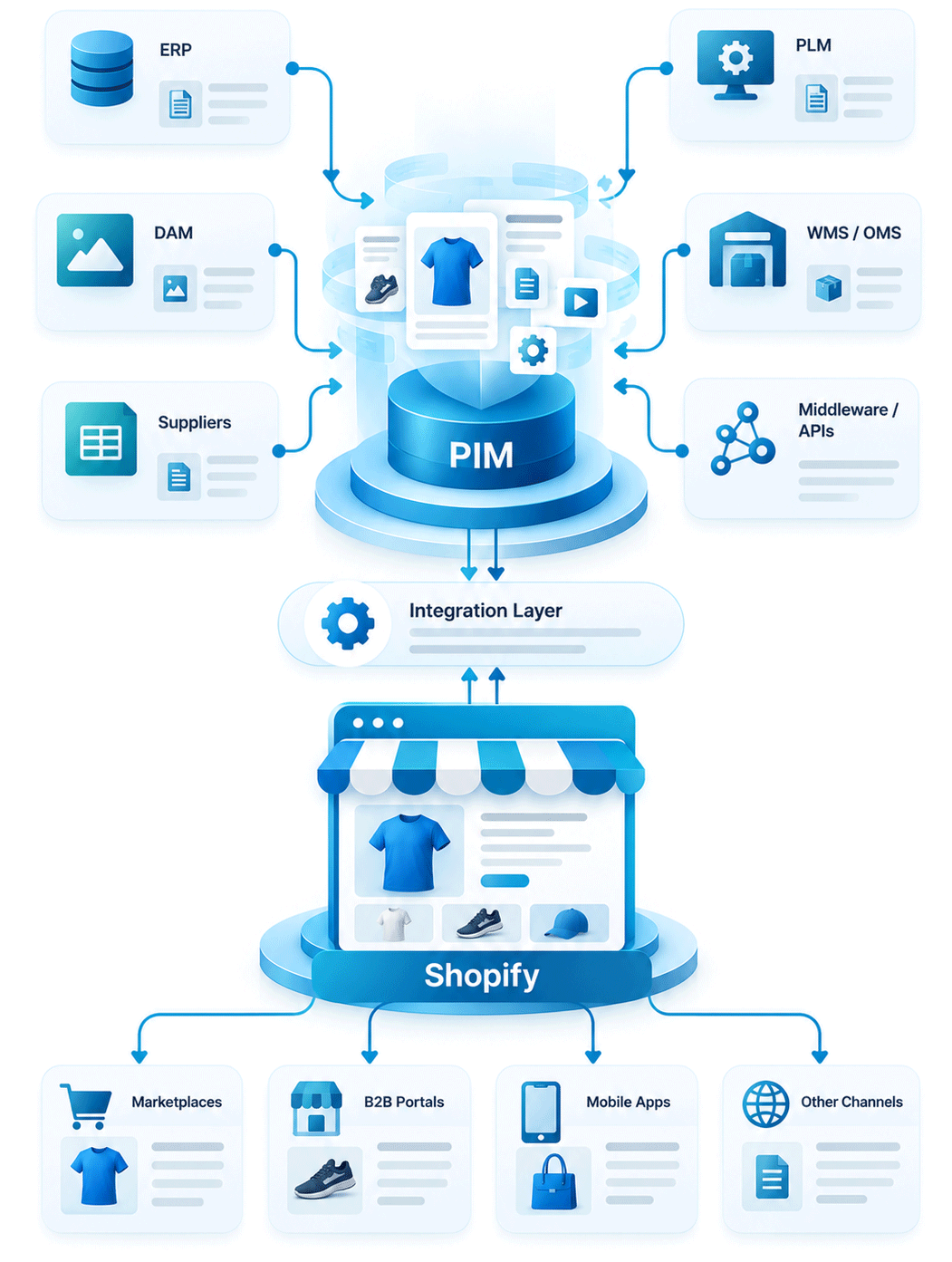
ERP Integration
Connect approved ERP master data such as SKUs, product identifiers, supplier references, and other enterprise records with PIM.
DAM Integration
Associate governed product information with approved images, videos, documents, swatches, and marketing assets.
PLM Integration
Transfer approved engineering and product-development information into PIM for downstream commercial enrichment.
Marketplace Integration
Reuse enriched product information for Amazon, retailer feeds, marketplaces, and other commerce destinations.
OMS and WMS Integration
Keep product information connected to the systems responsible for order management, availability, inventory, and fulfillment.
Middleware and Enterprise APIs
Use middleware, iPaaS, APIs, events, or custom services to coordinate product-data flows across complex enterprise architectures.
Our Approach to Shopify PIM Integration
From initial product-data assessment through deployment, we follow a structured integration approach designed to reduce implementation risk and create scalable data flows.
Define:
- System ownership
- Data-flow direction
- Product-data requirements
- Synchronization frequency
- Integration architecture
- Error-handling requirements
- Migration strategy
Validation rules ensure only approved and Shopify-ready information moves downstream.
Test:
- Data completeness
- Mapping accuracy
- Synchronization
- Error handling
- Performance
- Publishing workflows
- Integration monitoring
Once deployed, continuously optimize the integration as catalogs and commerce requirements evolve.
Business Impact of Shopify PIM Integration
A governed PIM-to-Shopify integration reduces repetitive product-data work while creating a stronger foundation for catalog growth.

When Should You Integrate Shopify with a PIM?
Not every Shopify implementation needs a dedicated PIM. PIM becomes increasingly valuable when product-data complexity begins to exceed what teams can efficiently govern within the commerce platform alone.
You should consider Shopify PIM integration when:
- You manage thousands of SKUs or a rapidly growing catalog
- Products contain complex variants or technical attributes
- Product information comes from multiple suppliers
- Teams rely heavily on spreadsheets
- ERP and Shopify contain conflicting product information
- Multiple departments enrich product content
- You operate several Shopify stores
- You sell across multiple markets and languages
- Shopify is only one of several sales channels
- Marketplace content must also be maintained
- Product launches are delayed by data preparation
- Metafield structures are becoming difficult to govern
- Product data frequently requires correction after publication
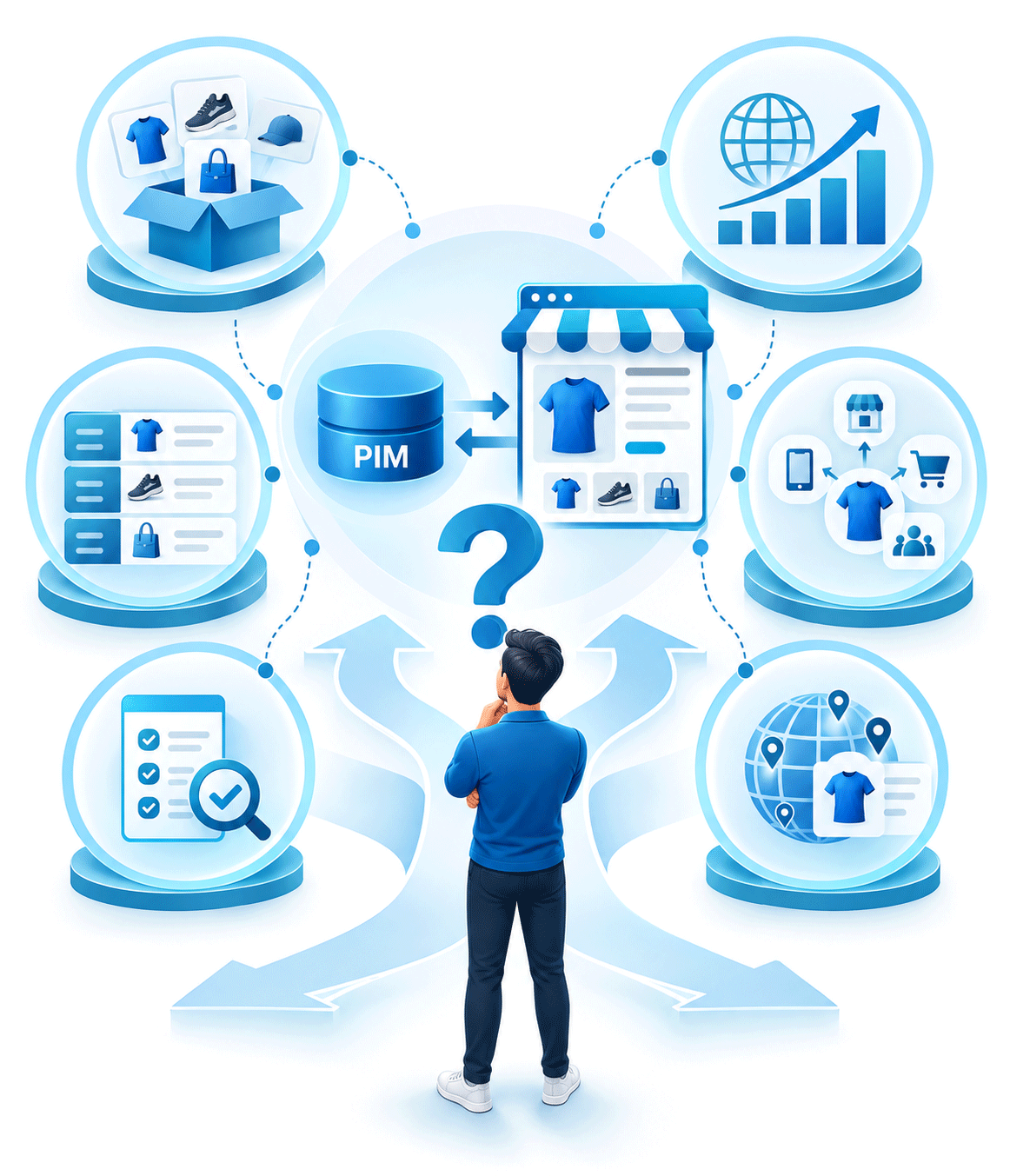
Is Shopify Product Data Becoming Difficult to Scale?
Build a governed product-information foundation before catalog complexity slows your commerce operations.
Talk to a PIM ExpertShopify Product Management vs. Shopify + PIM
Shopify can effectively manage product information for many commerce businesses. A dedicated PIM becomes more valuable when organizations need stronger governance, enrichment workflows, supplier-data normalization, complex product modeling, or multichannel distribution.
Shopify Product Management
Shopify + PIM
Product information maintained primarily in the commerce platform
Product information governed centrally before publication
Suitable for relatively straightforward catalog operations
Better suited to complex and enterprise-scale product-data ecosystems
Product enrichment managed within Shopify
Dedicated enrichment and approval workflows
Attributes maintained for storefront requirements
Attributes modeled for reuse across channels
Supplier data often requires manual preparation
Supplier information can be normalized upstream
Commerce-focused product catalog
Enterprise product-data foundation
Shopify-specific product management
Reusable product information for Shopify and other channels
Why Choose Credencys for Shopify PIM Integration?
Credencys combines product-information management expertise with enterprise integration experience to solve complex product-data challenges across commerce ecosystems.

End-to-End Product Data Expertise
From data modeling and governance to integration, syndication, migration, and commerce enablement, we address the complete product-data lifecycle.

Enterprise PIM Implementation Experience
Our teams have implemented product-information solutions for retailers, manufacturers, distributors, and enterprises managing complex catalogs and multichannel operations.

Complex Integration Capabilities
Connect PIM with ERP, DAM, PLM, Shopify, marketplaces, middleware, and other enterprise systems using scalable integration architectures.

Commerce-Focused Product Data
We structure product information around real commerce requirements, including product discovery, variants, taxonomy, merchandising, localization, and syndication.

API-First Integration Approach
Use APIs, middleware, webhooks, events, and modern integration patterns to create reliable product-data flows between systems.

AI-Ready Product Data Architecture
Establish structured and governed product information that can support AI-powered search, enrichment, recommendations, and commerce experiences.
50+
Enterprise Clients
100%
Certified Consultants
15+
Years Experience
4.9/5
Client Satisfaction
Ready to Simplify Product Data Management in Shopify?
Connect Shopify with a governed PIM foundation that improves product-data quality, reduces manual catalog work, accelerates product launches, and supports scalable commerce operations.
Book a Free ConsultationFrequently Asked Questions
Shopify PIM integration connects Shopify with a Product Information Management system so enriched and approved product information can move between the PIM and Shopify automatically. PIM typically governs product descriptions, specifications, attributes, variants, identifiers, relationships, and digital content, while Shopify manages the commerce experience.
Shopify provides comprehensive product-management capabilities, including products, variants, categories, metafields, media, and other commerce data. A separate PIM becomes valuable when an organization needs centralized product governance across multiple source systems, suppliers, teams, storefronts, markets, and commerce channels.
A Shopify business should consider PIM when managing large or complex catalogs, multiple suppliers, extensive variants, several storefronts, multiple markets, complex enrichment workflows, or additional sales channels. PIM is especially useful when product information is being maintained repeatedly across spreadsheets, ERP, Shopify, marketplaces, and other systems.
Yes. PIM can model parent-child product relationships and maintain variant-defining attributes such as size, color, material, capacity, model, or configuration.
The integration then maps the required product and variant information into Shopify. Shopify itself supports products with multiple options and variants, as well as custom variant information through metafields.
Yes. PIM can maintain structured information that is mapped to Shopify metafields during integration.
This can include technical specifications, materials, dimensions, care information, compatibility, marketing attributes, or other category-specific information. The PIM should govern the underlying product information, while the integration determines how those values are represented in Shopify.
It depends on catalog size, channels and team. Plytix and Shopify apps suit small catalogs. Akeneo and Pimcore suit growing and complex catalogs. Syndigo and Salsify suit brands that also sell through retailers. See our comparison of the best PIM for Shopify.
A focused first release typically takes 3 to 6 months. Multi-store and multi-market programmes run in phases over 6 to 12 months or more.
Trusted by Best
Choosing Credencys means partnering with a team that’s deeply committed to unlocking the true value of your data. Here’s why industry leaders trust us:
Our Valued Clientele


Send us a Message
