

The Complexity Behind Successful PIM Implementation
A successful PIM implementation requires more than configuring software. Product information often originates across ERP, PLM, supplier files, spreadsheets, DAM, legacy applications, and other enterprise systems.
Before that information can be governed and distributed through PIM, businesses must define how products are structured, which system owns each data element, how information moves between systems, and how teams enrich, validate, approve, and publish it.
Without the right implementation strategy, organizations risk replacing fragmented product data with a new platform that recreates the same underlying problems.
Fragmented Product Data
Product information is frequently distributed across ERP, spreadsheets, supplier systems, DAM, PLM, databases, and legacy applications, creating inconsistent and duplicate records.
Complex Product Data Models
Products, variants, families, bundles, accessories, classifications, attributes, and relationships require a scalable information model aligned with business and channel requirements.
Data Migration Challenges
Legacy product information often contains duplicates, inconsistent terminology, incomplete attributes, outdated values, and incompatible structures that cannot simply be moved into a new PIM.
Workflow and Governance Gaps
Without clear ownership, validation rules, approval workflows, and publishing controls, product data quality deteriorates even after PIM goes live.
What We Deliver Through PIM Implementation Services
Credencys provides end-to-end PIM implementation services covering the strategy, product data, technology, integration, governance, and operational components required to deploy a scalable enterprise PIM solution.
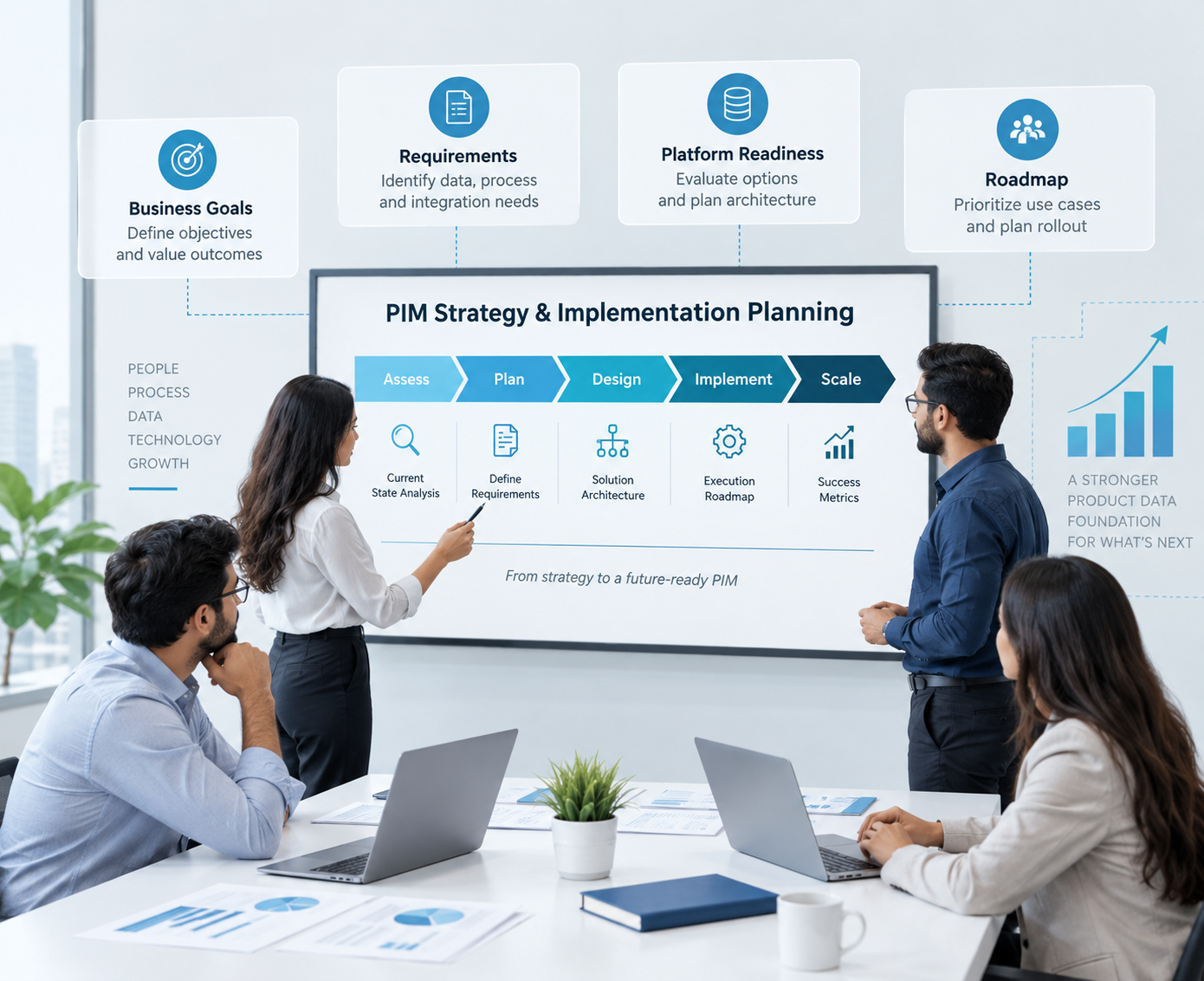
PIM Strategy & Implementation Planning
Define the business objectives, implementation scope, priority use cases, systems, stakeholders, rollout strategy, and success measures before configuration begins.
- Current-state PIM and product data assessment
- Business and technical requirement definition
- Implementation roadmap and prioritization
- Platform and architecture planning
- Implementation scope and success criteria
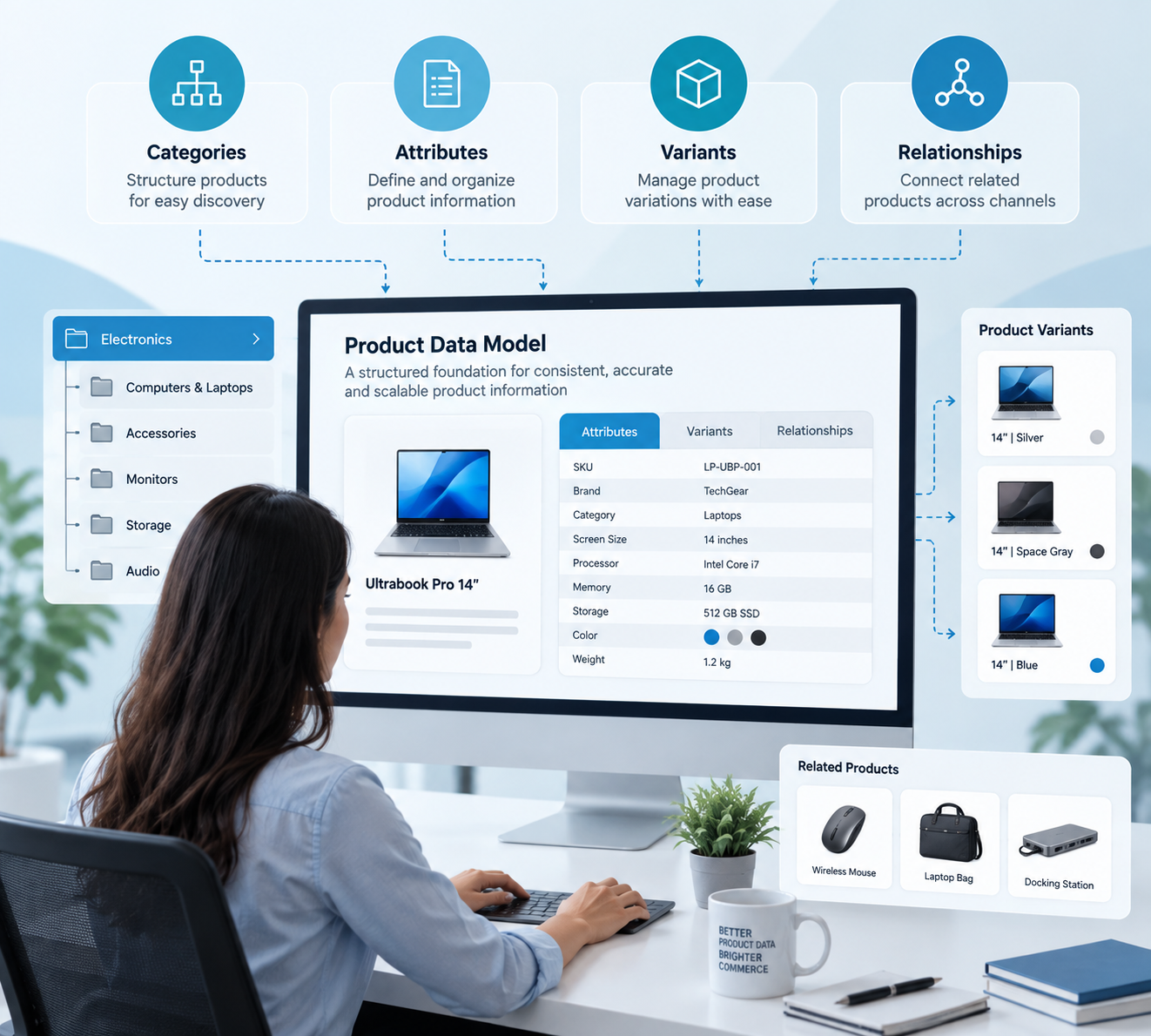
Product Data Modeling
Design a scalable product information model around your products, business rules, customer requirements, and downstream channels.
- Product families and categories
- Attributes and attribute groups
- Variants and inheritance
- Product hierarchies
- Product relationships
- Classifications and controlled values
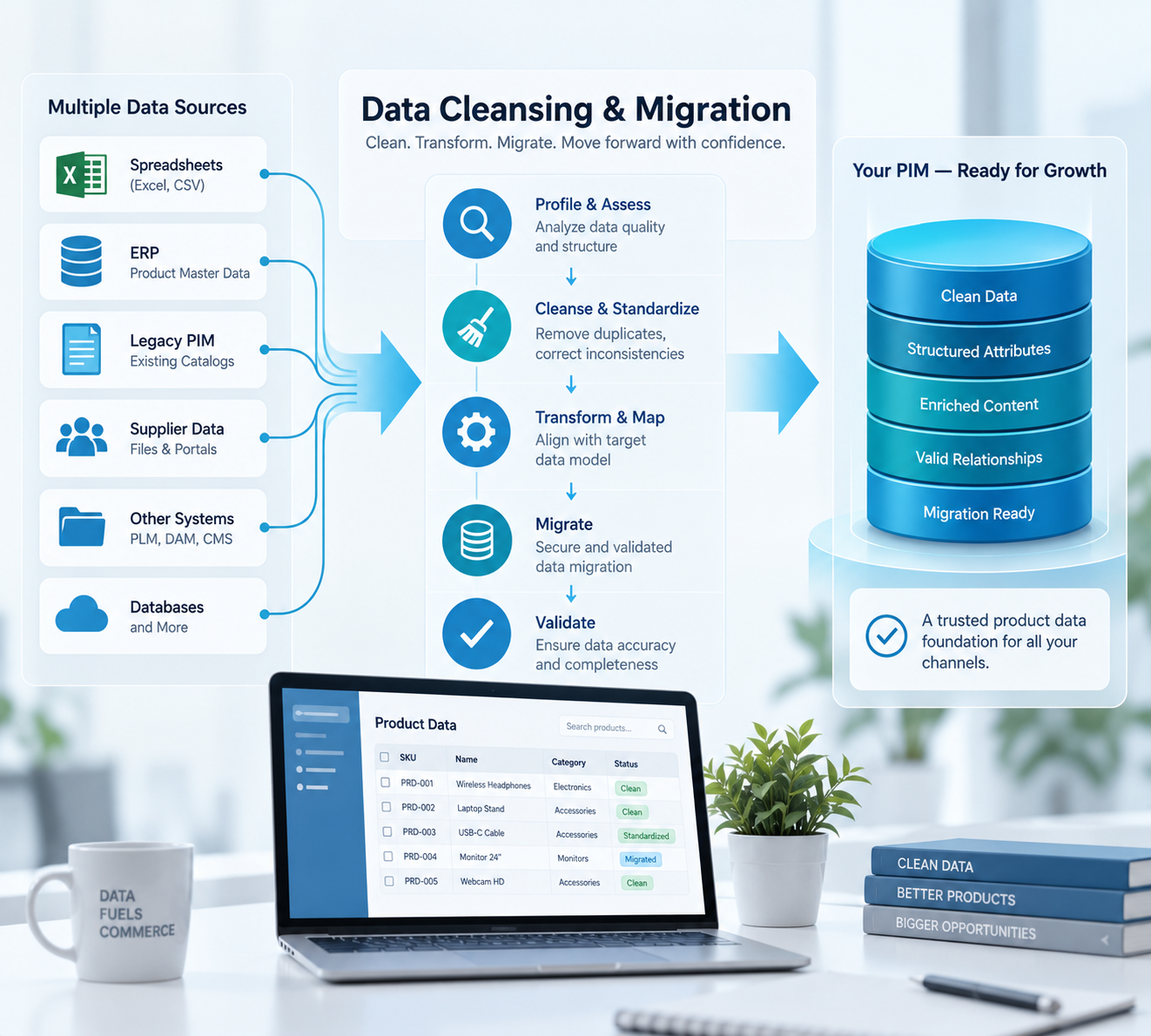
Product Data Cleansing & Migration
Our PIM migration services prepare legacy product information for a controlled transition into the new PIM environment, covering
- Data Assessment
- Cleansing
- Mapping
- Transformation
- Validation
- Cutover.
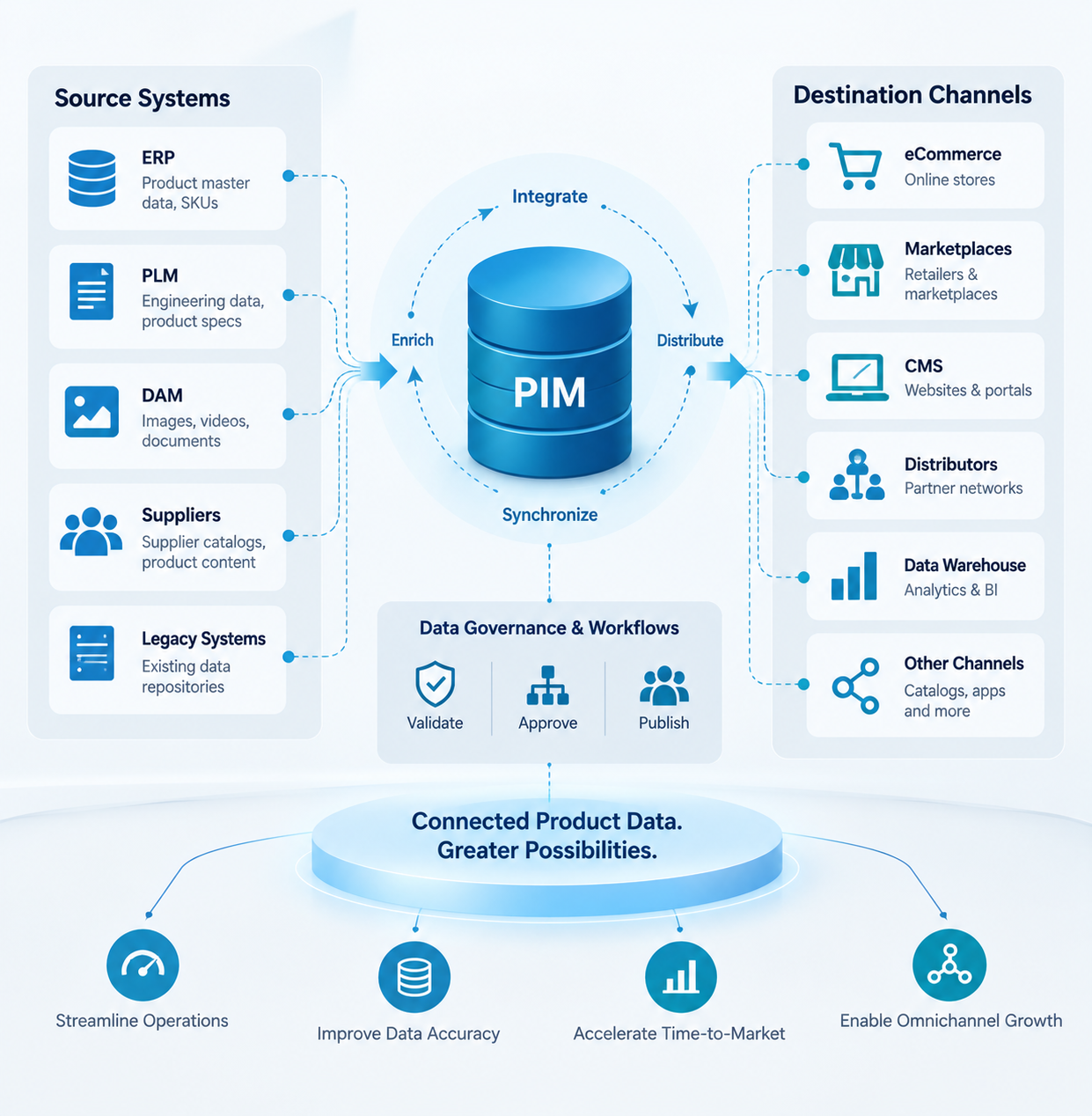
PIM Integration
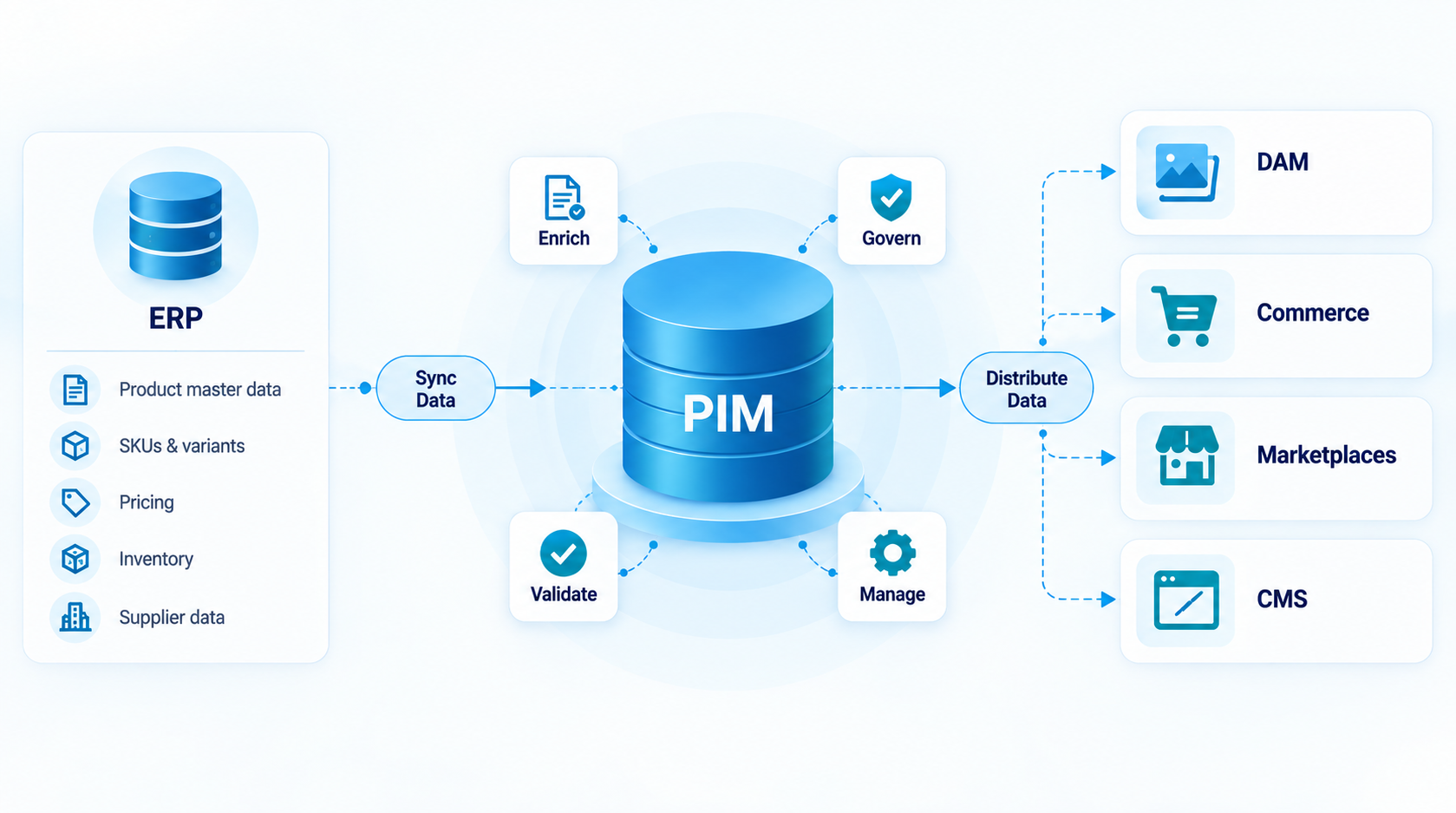
Connect PIM with the systems that create, enrich, consume, and distribute product information.
- ERP integration
- DAM integration
- PLM integration
- CMS integration
- eCommerce integration
- Marketplace and retailer feeds
- Supplier systems
- APIs and middleware
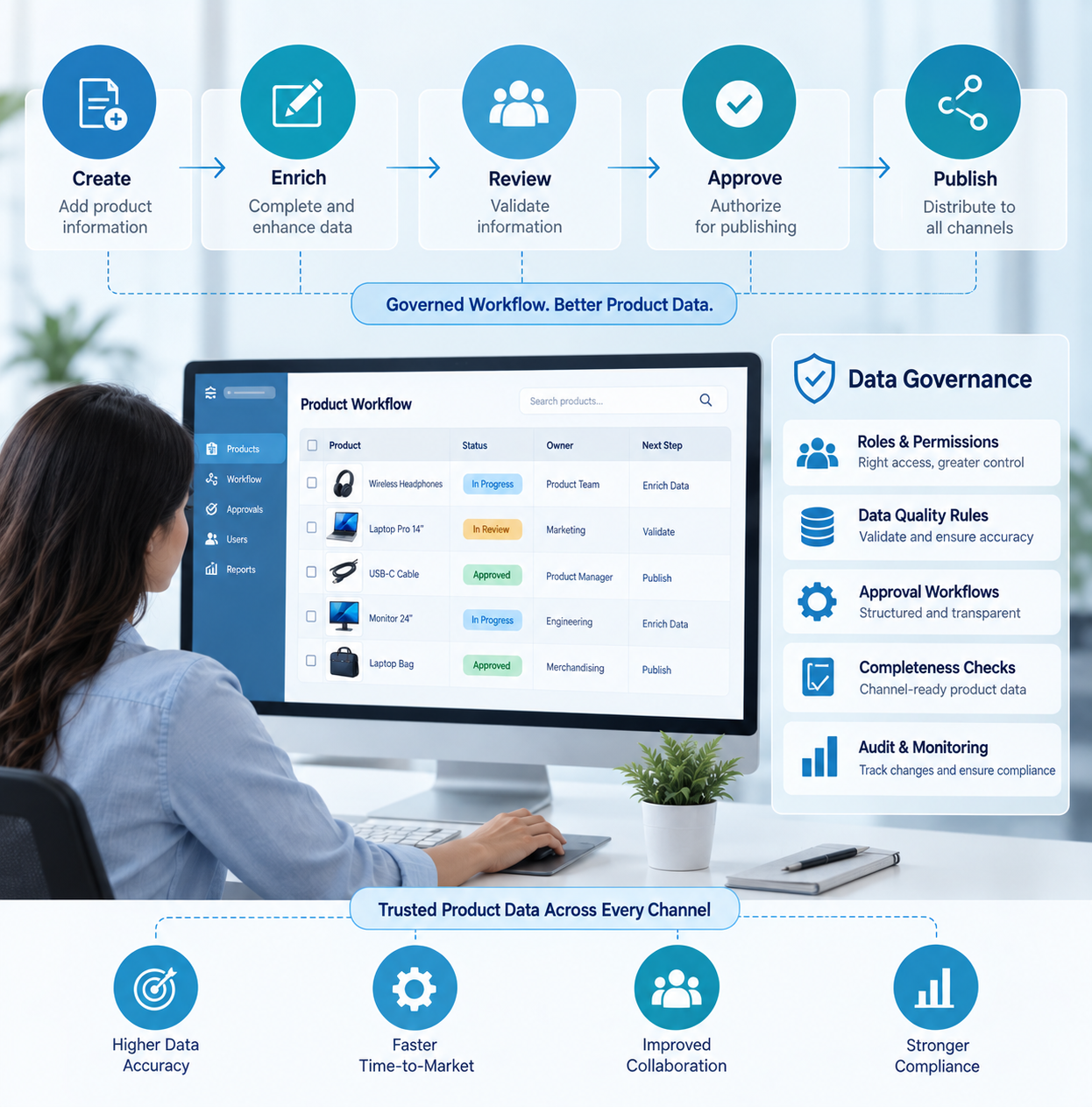
Workflow & Data Governance
Create processes that define how product information moves from creation through enrichment, validation, approval, and publication.
- Product data ownership
- User roles and permissions
- Enrichment workflows
- Approval workflows
- Completeness rules
- Data-quality validation
- Publishing controls
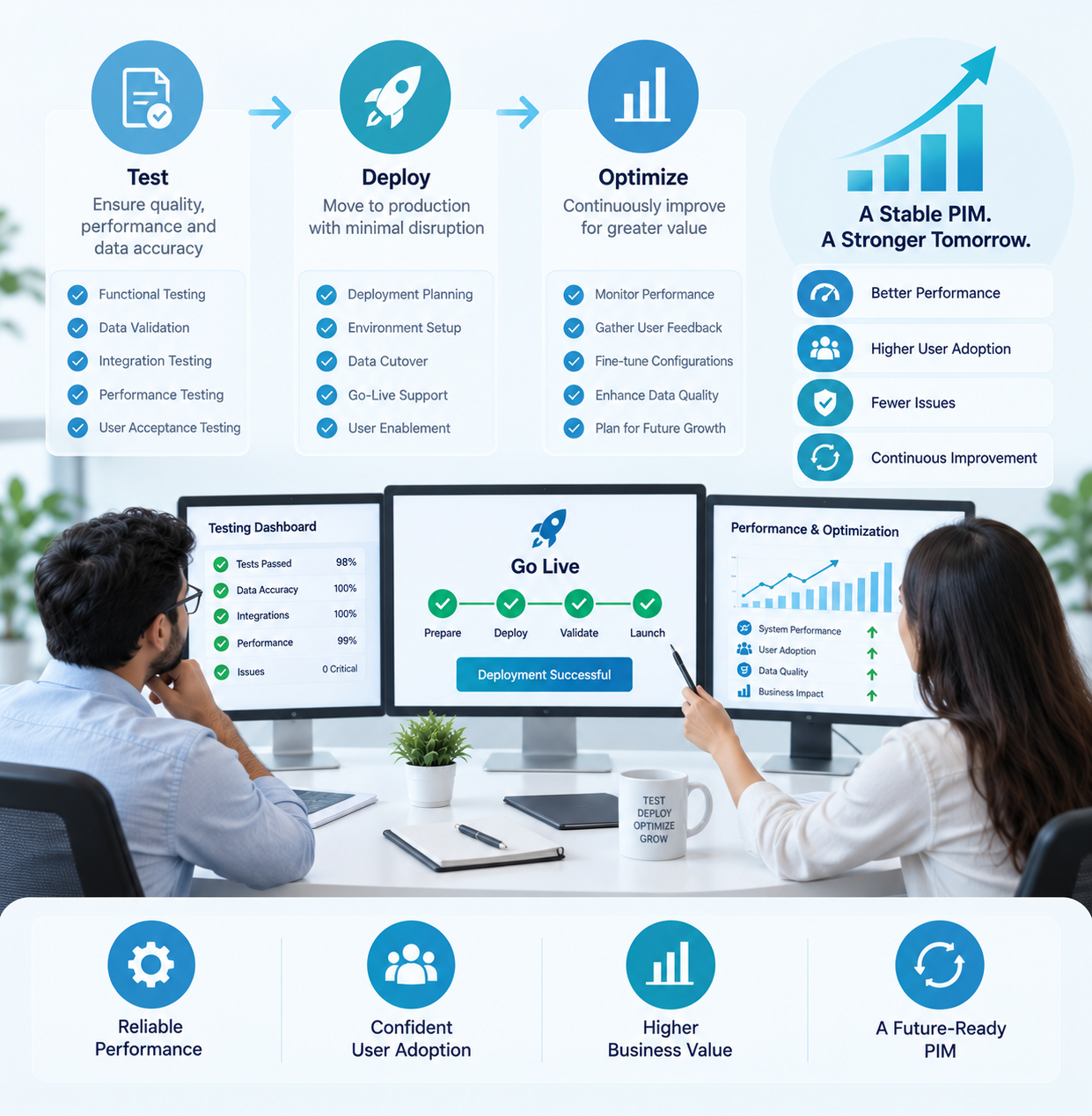
Testing, Deployment & Optimization
Validate the complete PIM environment before launch and continuously improve it as business requirements evolve.
- Functional testing
- Integration testing
- Data validation
- User acceptance testing
- Production deployment
- User training
- Post-launch monitoring
- Continuous optimization
Our PIM Implementation Approach
Credencys follows a structured implementation approach that aligns product data, technology, governance, and business processes before scaling the solution across the enterprise.
Key activities:
- Product data maturity assessment
- Source-system analysis
- Product catalog assessment
- Data-quality analysis
- Workflow discovery
- Integration assessment
- Channel requirements
- Implementation roadmap
Key activities:
- PIM architecture
- Product data models
- Taxonomy
- Attribute framework
- Product relationships
- Governance model
- Integration architecture
- Role and workflow design
Key activities:
- PIM configuration
- Product classes and families
- Business rules
- Validation rules
- Roles and permissions
- Workflow automation
- Data-quality controls
- User interfaces
Key activities:
- Data cleansing
- Migration mapping
- Data transformation
- Initial migration
- ERP integration
- DAM and PLM integration
- Commerce and marketplace integration
- Synchronization testing
Key activities:
- Functional QA
- Data validation
- Integration testing
- Performance testing
- UAT
- Training
- Production migration
- Go-live support
Key activities:
- Adoption monitoring
- Data-quality optimization
- Workflow improvements
- New category onboarding
- New channel integrations
- Platform enhancements
- Performance optimization
- AI readiness
Enterprise PIM Integration
PIM becomes significantly more valuable when it works as part of the broader enterprise data ecosystem. Credencys designs integrations that allow approved product information to move reliably between systems while maintaining clear ownership of each data domain.
PIM Platforms We Implement
Credencys combines product data consulting with implementation and integration expertise to help enterprises deploy PIM platforms around real business requirements.

Implement and customize Pimcore for complex product information, digital assets, master data, workflows, portals, integrations, and multichannel experiences. Our Pimcore implementation capabilities include:
- PIM implementation
- DAM and MDM
- Product data modeling
- Workflow automation
- ERP and commerce integration
- Data migration
- Custom portals and applications
- Platform optimization

Implement Syndigo capabilities for enterprise product information management, supplier data, product content, data quality, and syndication requirements. Our Syndigo capabilities can support:
- PIM implementation
- Product data onboarding
- Content enrichment
- Product data governance
- Retailer and recipient syndication
- Data migration
- Enterprise integrations
- Implementation optimization
Platform-Agnostic PIM Consulting
The right PIM platform should follow your product-data, process, integration, channel, scalability, and operating requirements. Credencys helps businesses evaluate those requirements before making implementation decisions, reducing the risk of designing processes around software limitations.
PIM Implementation Expertise Across Industries
Different industries require different product structures, standards, relationships, workflows, and downstream integrations. Credencys combines PIM implementation expertise with industry-specific product data knowledge.

Business Impact of PIM Implementation
A well-designed PIM implementation improves more than product-data storage. It changes how product information is created, governed, enriched, and delivered across the enterprise.

Faster Product Onboarding
Reduce manual handoffs and create structured processes for importing, enriching, validating, and approving new products.
Improved Product Data Quality
Standardize attributes, terminology, classifications, relationships, and validation rules across the catalog.
Faster Time-to-Market
Reduce the time required to prepare products for new markets, assortments, websites, retailers, and marketplaces.
Lower Manual Data Effort
Replace spreadsheet-driven enrichment, validation, approvals, and channel preparation with governed digital workflows.
Faster Channel Syndication
Reuse approved product information across downstream destinations instead of rebuilding product content separately for every channel.
Stronger Data Governance
Define ownership, roles, approval rules, completeness requirements, and quality controls around product information.
Real Business Impact: PIM Implementation Success Stories
Leading U.S. Wholesale Landscape Supplies Distributor
40%
Increase in Backend Processing Speed
Credencys modernized the Pimcore environment for the largest U.S. wholesale distributor of landscape supplies, upgrading the platform from Pimcore 6.9 to 11.1.4 while addressing legacy code, custom bundles, database migration, outdated integrations, and large-catalog performance requirements. The implementation reduced custom dependencies, optimized the platform for high product volumes, and created a more scalable foundation for future integrations and enhancements.
Read MoreGlobal Industrial Solutions Leader
70%
Reduction in Manual Workload
Credencys implemented a centralized PIM solution for an industrial solutions provider managing 14,000 SKUs across four major brands. The implementation integrated PIM with Dell Boomi for inbound and outbound data flows, automated bulk product operations, introduced structured enrichment and approval workflows, and strengthened product data governance across the organization.
Read MoreMid-Sized Electrical Distributor
41%
Fewer Zero-Result Searches
Credencys implemented and optimized PIM for an electrical distributor managing more than 310,000 product records across wire and cable, circuit protection, controls, wiring devices, commercial lighting, and related categories. By standardizing taxonomy, enriching technical attributes, establishing product relationships, and connecting governed product data with eCommerce, the solution made products easier to find and accelerated the expansion of the distributor's digital assortment.
Read MoreWhy PIM Implementations Fail and How We Reduce the Risk
PIM implementation challenges rarely come from software alone. They usually result from unclear requirements, weak product data foundations, poor ownership, unnecessary customization, integration complexity, or lack of user adoption.
Credencys addresses those risks before they become expensive implementation problems.
Risk
Our Approach
Starting With Technology Instead of Requirements Selecting and configuring a platform before defining business requirements can force teams to redesign processes around software.
Requirements first approachEstablish product-data, workflow, integration, channel, and governance requirements before detailed platform configuration.
Migrating Poor-Quality Product Data Moving duplicate, inconsistent, or incomplete information into the new system simply transfers legacy problems.
Data profiling and cleansingAssess, cleanse, standardize, transform, and validate information before final migration.
Overcomplicated Product Models Highly customized models can become difficult for business teams to understand, maintain, and scale.
Scalable product data modelsBuild the simplest product model that accurately supports product complexity and downstream use cases.
Unclear System Ownership PIM, ERP, PLM, DAM, commerce, and other applications may overwrite one another when data ownership is unclear.
Defined system-of-record strategyDefine system-of-record responsibilities and integration rules for each major data domain.
Weak Data Governance Product-data quality declines quickly when ownership, validation, approvals, and completeness requirements are not clearly defined.
Built-in governance frameworkEmbed governance into roles, workflows, validation rules, and publishing controls.
Excessive Customization Unnecessary custom development increases implementation cost, maintenance effort, upgrade complexity, and technical debt.
Platform-first implementationUse platform capabilities where they meet requirements and reserve customization for genuine business differentiation.
Big-Bang Deployment Attempting to migrate every category, process, market, and channel simultaneously increases implementation complexity and risk.
Phased and value-driven rolloutPrioritize rollout based on business value, dependencies, product categories, and implementation readiness.
Poor User Adoption Even a technically successful PIM fails if teams continue maintaining product information outside the platform.
Adoption-focused approachDesign workflows around real operating processes, involve business users early, provide training, and monitor adoption after launch.
Why Leading Enterprises Choose Credencys?
Credencys helps enterprises turn complex data into trusted insights, intelligent operations, and measurable business growth. Here’s what makes us a preferred data and AI partner:

End-to-End Data Expertise
From data strategy to AI deployment, we cover the entire spectrum—Data Management, Engineering, Insights, and Intelligence—to ensure your data drives measurable business outcomes.

Domain-Focused Solutions
Whether you're in retail, automotive, or manufacturing, our purpose-built platforms solve industry-specific challenges with precision and speed.

Enterprise-Grade Partnerships
We collaborate with the best in the business to deliver future-ready, scalable, and secure solutions.

AI-First
We help you move beyond dashboards—accelerating AI readiness, deploying GenAI and enterprise AI agents, and enabling intelligent automation across your data ecosystem.
50+
Enterprise Clients
100%
Certified Consultants
15+
Years Experience
4.9/5
Client Satisfaction
Frequently Asked Questions
PIM implementation services typically include current-state assessment, requirements definition, product data modeling, platform configuration, data migration, enterprise integrations, workflow and governance setup, testing, deployment, user training, and post-launch optimization. The exact scope depends on your product complexity, source systems, data quality, number of channels, markets, integrations, and business requirements.
A PIM implementation partner helps translate product-data and business requirements into a working PIM environment. This typically includes designing the product information architecture, configuring the platform, migrating product data, integrating enterprise systems, implementing governance and workflows, testing the solution, supporting deployment, and helping business teams adopt the new operating model.
There is no single implementation timeline for every PIM project. Duration depends on factors such as the number of products, source systems, product-data quality, complexity of the product model, integrations, workflows, markets, channels, customizations, migration requirements, and rollout strategy.
A focused implementation may be delivered considerably faster than a global enterprise rollout involving multiple business units and systems.
PIM implementation cost depends on the selected platform, implementation scope, product-data complexity, number of SKUs, integrations, migration effort, custom development, workflows, users, markets, channels, and support requirements. The most reliable estimate requires evaluating both the software and implementation requirements rather than using SKU count alone.
Start by identifying product-data sources, owners, duplicates, mandatory attributes, categories, relationships, and known quality issues. Source data should then be profiled, mapped, standardized, cleansed, and validated against the target PIM data model.
Migrating product information before understanding its quality and intended structure usually creates unnecessary rework later.
Planning a PIM Implementation?
Build your PIM on the right product-data foundation from the beginning. Credencys can assess your existing product information, systems, integrations, migration requirements, workflows, and business priorities to define a practical implementation roadmap.
Discuss Your PIM ImplementationTrusted by Best
Choosing Credencys means partnering with a team that’s deeply committed to unlocking the true value of your data. Here’s why industry leaders trust us:
Our Valued Clientele


Send us a Message
