

The Scale and Complexity of Manufacturing Product Data
Manufacturers manage some of the most complex product information environments, from engineering specifications and product configurations to manufacturer part numbers, technical documents, accessories, replacement parts, and market-specific content.
As product portfolios grow, fragmented data across ERP, PLM, spreadsheets, supplier systems, and digital channels makes it increasingly difficult to maintain complete and consistent product information.
Fragmented Product Data Across Enterprise Systems
Core product information is frequently distributed across ERP, PLM, spreadsheets, databases, engineering systems, DAM, supplier files, and legacy applications. Without a governed product-information layer, teams may work with different versions of the same product data.
Complex Product Families and Configurations
Manufacturers often manage products with multiple models, sizes, materials, specifications, options, accessories, and configurations. These relationships become difficult to maintain when product information is duplicated across systems and channels.
Engineering-to-Commercial Data Gaps
Engineering systems contain critical technical product information, but that information is not always structured or enriched for sales, distributors, eCommerce, marketplaces, or customer-facing catalogs. Teams frequently spend significant time translating engineering data into usable commercial content.
Technical Documents and Product Relationships
Manufacturing products may require CAD files, manuals, technical drawings, certificates, installation guides, warranties, compatible accessories, spare parts, and replacement-product relationships. Keeping these assets and relationships aligned with the correct product records becomes increasingly difficult at scale.
Multiple Markets, Distributors, and Sales Channels
Manufacturers need to distribute accurate product information across dealer networks, distributors, sales teams, B2B portals, eCommerce platforms, marketplaces, catalogs, and regional markets, each with different product-data requirements.

How Much is Your Product Data Costing You?
Get Your Score + 90-day action plan in 3 minutes.
Check Your ScoreThe Strategic Role of PIM in Manufacturing
PIM creates a governed product-information layer between engineering and operational systems and the channels where products are marketed, specified, sold, and supported. It helps manufacturers standardize complex technical data, manage product relationships, improve product-data quality, and deliver consistent information across internal teams and customer-facing channels.
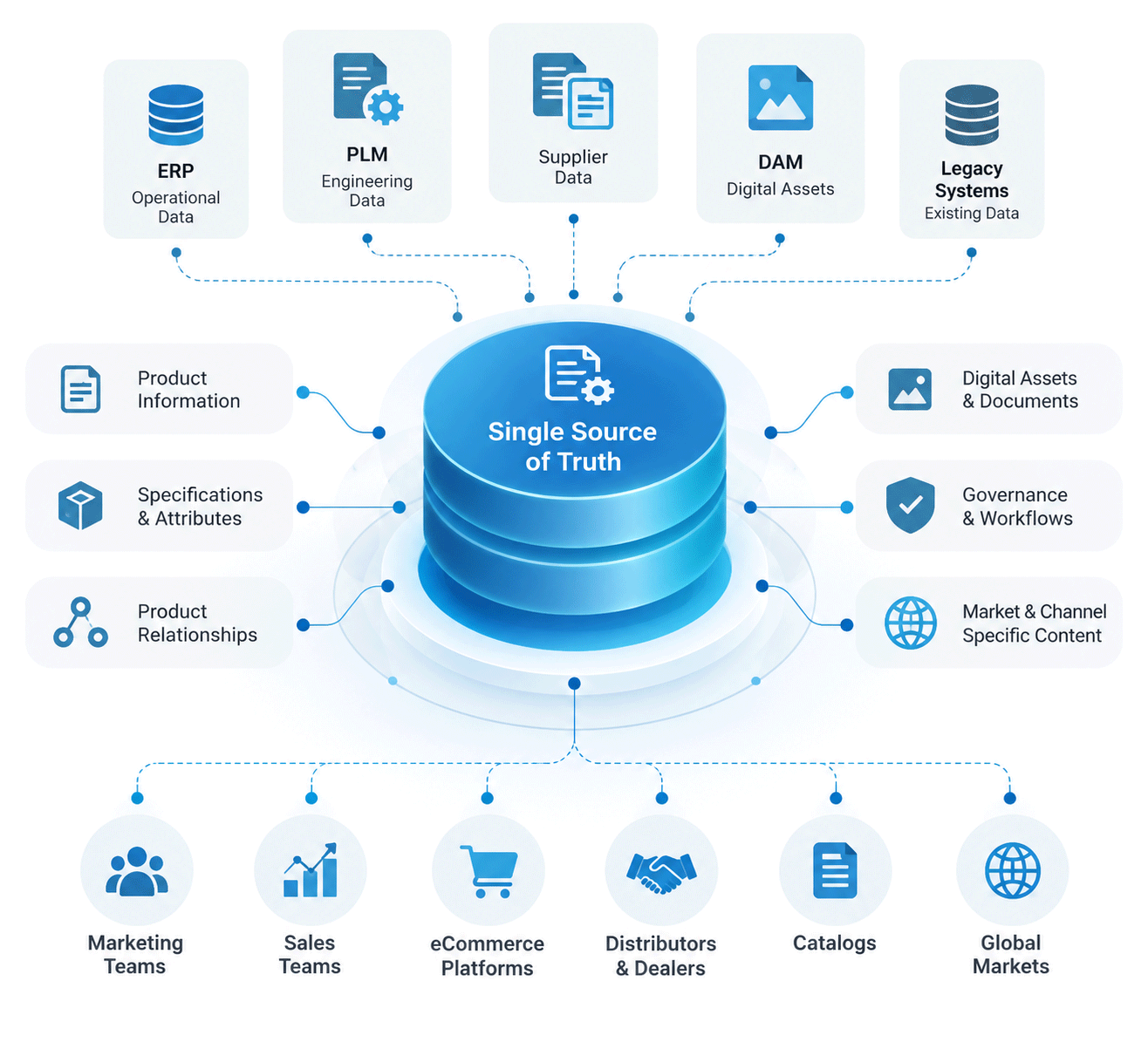
The Single Source of Truth
PIM creates one governed foundation for product descriptions, specifications, attributes, identifiers, documents, digital assets, product relationships, and channel-ready content. It enables engineering, product, marketing, sales, eCommerce, and distributor-management teams to work with consistent product information.
- Consolidate product information from ERP, PLM, supplier files, spreadsheets, DAM, and legacy systems
- Reduce duplicate and conflicting product records
- Establish ownership and governance across product-data domains
- Maintain approved product information across markets and channels
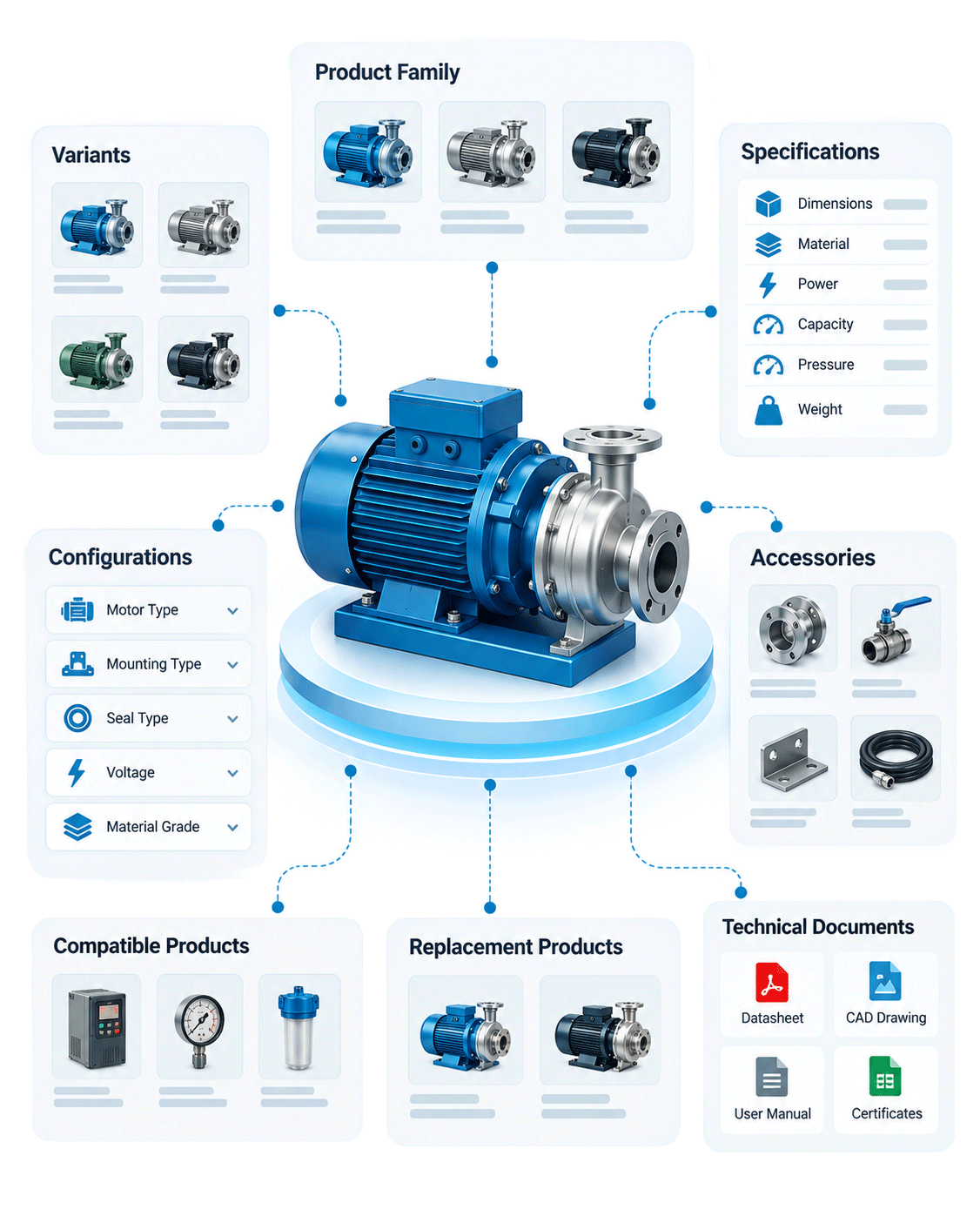
Complex Product and Configuration Management
Manufacturing catalogs frequently contain product families, models, variants, configurations, accessories, compatible components, and replacement products. PIM structures these relationships so teams can manage complex catalogs without maintaining disconnected copies of product information.
- Manage parent-child and product-family relationships
- Structure configurable product attributes and options
- Connect accessories, compatible products, spare parts, and replacements
- Maintain shared and variant-specific specifications
PIM manages the product information and relationships required by configurable products, while CPQ systems continue to manage configuration logic, pricing, and quoting.

Standardized Technical Product Information
Different manufacturing product categories require different technical attributes, measurement units, documentation, and data-quality rules. PIM enables manufacturers to create category-specific product models and standardized technical information.
- Standardize dimensions, materials, performance values, and specifications
- Normalize units of measure and controlled values
- Define mandatory attributes by product category
- Validate completeness before products are distributed downstream

Engineering-to-Commerce Product Data
Technical product information often originates in PLM or engineering systems but requires additional enrichment before it can support distributors, customers, or digital commerce. PIM bridges this gap by transforming approved engineering data into customer- and channel-ready product information.
- Consume approved product information from PLM and ERP
- Enrich products with commercial descriptions and marketing content
- Associate technical documents and digital assets
- Prepare data for distributor, dealer, catalog, marketplace, and eCommerce requirements

Omnichannel and AI Readiness
Structured product information improves both digital commerce and emerging AI-driven product experiences. PIM provides the context required for better search, recommendations, automated enrichment, product matching, and conversational product discovery.
- Improve search, filtering, comparison, and product discovery
- Support product recommendations and related-product experiences
- Enable structured product-data syndication
- Prepare governed data for AI-assisted enrichment and semantic search
- Provide trusted product context to AI applications and commerce agents
Our Approach to PIM Implementation Services
From initial assessment to final deployment, Credencys follows a structured four-step approach to build a scalable PIM solution around your manufacturing product-data ecosystem.
01 Assessment and Planning
We assess your product portfolio, ERP and PLM landscape, product families, technical attributes, documents, supplier data, integrations, data quality, workflows, governance requirements, and downstream channels. The result is a clear PIM roadmap aligned with your manufacturing operations and digital priorities.
02 Customization and Configuration
We design manufacturing-specific product models, categories, attribute structures, product relationships, variants, workflows, validation rules, user roles, and integration architecture. The PIM is configured around the complexity of your products rather than forcing manufacturing data into generic structures.
03 Enrichment and Governance
We cleanse and migrate product information, normalize attributes and units, establish product-data ownership, connect digital assets and documents, and configure enrichment, validation, review, and approval workflows. This creates a reliable foundation for consistent product information across teams and channels.
04 Deployment and Training
We connect PIM with upstream and downstream systems, launch priority product categories and channels, validate data flows, train internal teams, and support adoption and continuous improvement after deployment.
Business Impact of PIM for Manufacturing
A structured PIM foundation helps manufacturers reduce product-data complexity, improve operational efficiency, accelerate product launches, and deliver better product information across sales and distribution networks.

Real Business Impact: PIM Success Stories in Manufacturing
Leading Sports Equipment Manufacturer
50%
Improvement in Product Data Consistency
Credencys implemented a centralized PIM solution to standardize complex product information, improve product-data governance, and streamline product approval and validation workflows. The solution enabled teams to work with more consistent product records while reducing the manual effort involved in managing and validating product information.
Read MoreCustom Bathroom Products Manufacturer
55%
Reduction in Overhead Costs
Credencys implemented a centralized PIM and DAM solution for a manufacturer managing complex product families, product compatibility, digital assets, and catalog-production workflows. The solution established structured product relationships, automated catalog creation through EasyCatalog and Adobe InDesign, and syndicated governed product data to customer-facing digital experiences.
Read MoreAutomotive Aftermarket Parts Manufacturer
40%
Faster Product Data Syndication
Credencys implemented a centralized product-information environment to standardize product data, improve data quality, and streamline product distribution across downstream systems and channels. The solution reduced product-data errors and helped teams manage large aftermarket catalogs more efficiently.
Read MoreReady to Modernize Your Manufacturing Product Data?
Centralize technical product data, simplify complex catalogs, improve product-data quality, and accelerate the journey from engineering-approved information to customer-ready product experiences.
Book a Free ConsultationWhy Leading Enterprises Choose Credencys?

End-to-End Data Expertise
From product-data strategy and modeling to migration, integrations, governance, syndication, and optimization, Credencys helps enterprises manage the complete PIM lifecycle.

Domain-Focused Solutions
We design PIM solutions around real manufacturing product structures, workflows, systems, product relationships, and channel requirements.

Enterprise-Grade Partnerships
Our experience across enterprise data platforms enables us to design scalable solutions that integrate with the broader manufacturing technology ecosystem.

AI-First
We combine governed product information with AI-enabled enrichment, classification, search, automation, and product experiences where they deliver measurable business value.
50+
Enterprise Clients
100%
Certified Consultants
15+
Years Experience
4.9/5
Client Satisfaction
We Build PIM Solutions for


Frequently Asked Questions
PIM for manufacturing is a centralized approach to collecting, structuring, enriching, governing, and distributing product information across enterprise systems and customer-facing channels. It helps manufacturers manage technical specifications, product families, variants, documents, product relationships, digital assets, commercial content, and channel-specific information from one governed product-data foundation.
Manufacturing product information is often fragmented across ERP, PLM, spreadsheets, engineering systems, supplier files, DAM, and digital commerce platforms. PIM provides a governed layer that brings this information together, standardizes it, enriches it, and distributes approved product content to sales, distributors, dealers, catalogs, marketplaces, and eCommerce channels.
Manufacturers should evaluate PIM software based on its ability to manage complex product models, technical attributes, product relationships, variants, documents, localization, data quality, workflows, governance, integrations, and multichannel syndication. The platform should also integrate effectively with existing ERP, PLM, DAM, CPQ, commerce, and enterprise systems.
PLM primarily manages the engineering lifecycle of a product, including design data, CAD, BOMs, revisions, engineering changes, and lifecycle processes. PIM manages enriched and governed product information required by commercial, sales, distributor, and digital channels. In many manufacturing environments, approved engineering information flows from PLM into PIM, where it is enriched and prepared for downstream use.
ERP manages transactional and operational information such as materials, purchasing, inventory, costing, orders, and financial processes. PIM manages rich product information such as technical specifications, descriptions, attributes, documents, digital assets, relationships, and channel content. Integrating ERP and PIM allows operational product records and enriched product content to remain aligned.
Trusted by Best
Choosing Credencys means partnering with a team that’s deeply committed to unlocking the true value of your data. Here’s why industry leaders trust us:
Our Valued Clientele


Send us a Message
