Get the Template Close

Trusted by Best

Choosing Credencys means partnering with a team that’s deeply committed to unlocking the true value of your data. Here’s why industry leaders trust us:

ABB logo
Linde logo
Panasonic logo
Syngenta logo
Party City logo
Samsung logo
Malabar Gold & Diamonds logo
SM Retail logo
Nykaa logo
WeightWatchers logo
McDonald's logo
Taco Bell logo

Pimcore Strategic Partner · 80+ certified Pimcore experts · Syndigo partner · Semarchy partner

50+

Enterprise Clients

100%

Certified Consultants

15+

Years Experience

4.9/5

Client Satisfaction

When Industrial Distributors Need a PIM

Most industrial and MRO distributors call us in one of these situations. If one sounds like yours, a 30-minute call is worth your time.

Short on time? Jump to cost and timeline, ERP, search and punch-out or a stalled rollout and other risks. Not ready to talk? Check your product data in 8 questions.

What is PIM for industrial distributors? A product information management (PIM) system gives an industrial or MRO (maintenance, repair and operations) distributor one place to collect manufacturer data, map it to one product model, complete technical attributes with units, link part numbers and cross-references, and publish the same approved record to the B2B store, site search, punch-out catalogs and the ERP.

Product data for industrial distributors sits in ERPs, spreadsheets, PDFs, supplier portals and legacy systems. A PIM gives it one home: manufacturer data comes in through one process, gets checked and completed, and goes out to every channel the same way.

Related: PIM for distribution, product taxonomy and PIM for bearing distributors.

“Every manufacturer sends a different spreadsheet.”

Different column names, units and naming for the same kind of product. Someone retypes each file into the ERP and the web store, and a new price file starts it all again.

“The specs our customers filter on are missing.”

Thread size, pressure rating, voltage, material, dimensions, pack quantity, certificates or the drawing. Without them a product cannot be filtered, compared or bought online, so customers call the branch instead.

“New product lines wait weeks to go live.”

The catalog team cleans files, maps attributes and attaches documents by hand before anything can be published. A new manufacturer or category means weeks of backlog.

“Customers search a part number and find nothing.”

Our part number, the manufacturer's or a competitor's cross-reference: the B2B store returns no results, or the wrong ones, for products we stock.

“The website, the PDF catalog and the punch-out catalog disagree.”

Each channel holds its own copy of the product. Descriptions, specs and documents drift apart, and customers and sales reps stop trusting what they read.

“Our first PIM rollout stalled halfway.”

The PIM is licensed and part of the catalog is in it, but the rest is stuck, the integrations are fragile, or the partner who built it has moved on.

Still preparing? Use our PIM requirements checklist, the free PIM RFP template, the PIM data migration checklist or the PIM Cost & Business Case Builder, and read how to choose a PIM implementation partner. Implementation is one part of our end-to-end PIM services.

Real Business Impact from Connected Product Data

Mid-sized electrical distributor · 310,000+ products from 120+ manufacturers41% fewer zero-result searches and 36% better product findability, after taxonomy, attributes and relationships were fixed and the PIM connected to searchRead the case study
Largest US wholesale distributor of landscape supplies · Pimcore with legacy code from a previous providerPhased upgrade from Pimcore 6.9 to 11.1.4, 14 custom bundles modernised: 40% faster backend processing, 50% less system complexityRead the case study
US lighting products company · 100K+ products from 300+ vendorsProduct, price and stock files from 300+ vendors mapped automatically into one Pimcore model, connected to the ERP, Magento and marketplacesRead the case study

What You Get From the Call

In 30 minutes, a senior PIM consultant looks at how manufacturer data reaches you today, what your customers search and filter on, and what to fix first. You need nothing prepared. One messy manufacturer file and a list of your systems help.

Your Product Data Today

How manufacturer files come in, where data is retyped, which missing attributes break your filters and search, how part numbers and cross-references are kept, and whether your product data is ready for AI search.

The Platform That Fits, or the One You Have

Keep and fix the PIM you run, or choose one. We partner with Pimcore and Syndigo and give independent advice on Akeneo, Salsify, inRiver and Stibo Systems STEP.

A Rough Roadmap and Budget

What to do first (often one category or one group of manufacturers), what it depends on in your ERP and B2B store, and the main cost drivers to plan for.

No Obligation

The call is free and about your catalog. If you later want help, we send a proposal; nothing is sold on the call.

Manish Shewaramani

Manish Shewaramani, VP Sales
Your first contact. Manish personally reviews every request and guides you through your call with a senior PIM consultant.

End-to-End PIM Services for Industrial Distributors

Six services, from the first data review to support after go-live. You can start with one.
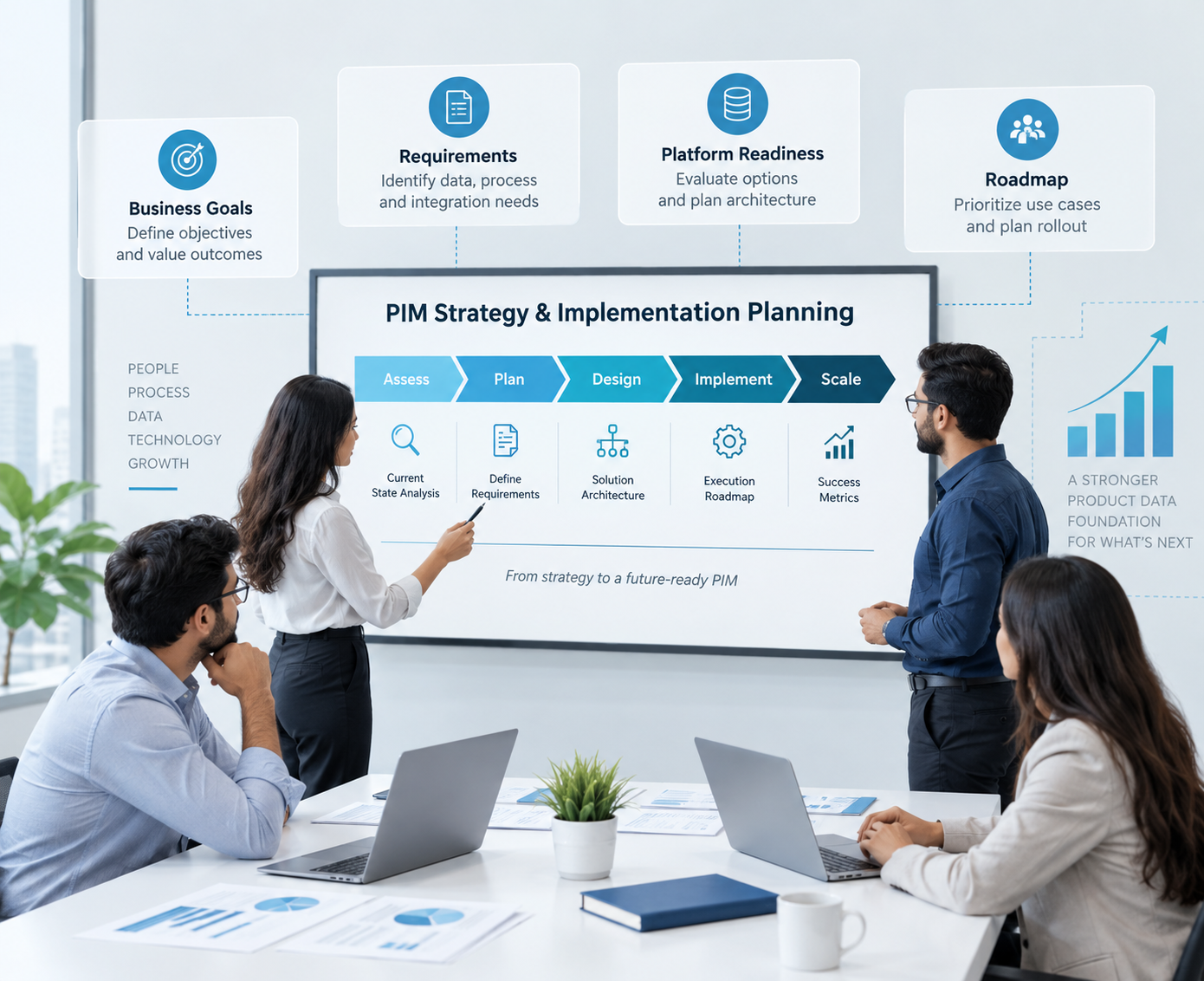
PIM strategy implementation planning

PIM Consulting and MRO Data Strategy

A plan for your catalog that your team, your budget holder and your IT can agree on.

  • Review how data flows between ERP, DAM, supplier files, catalogs and eCommerce
  • Find the product data quality, ownership and governance gaps
  • A phased implementation and adoption roadmap, starting where the return is fastest
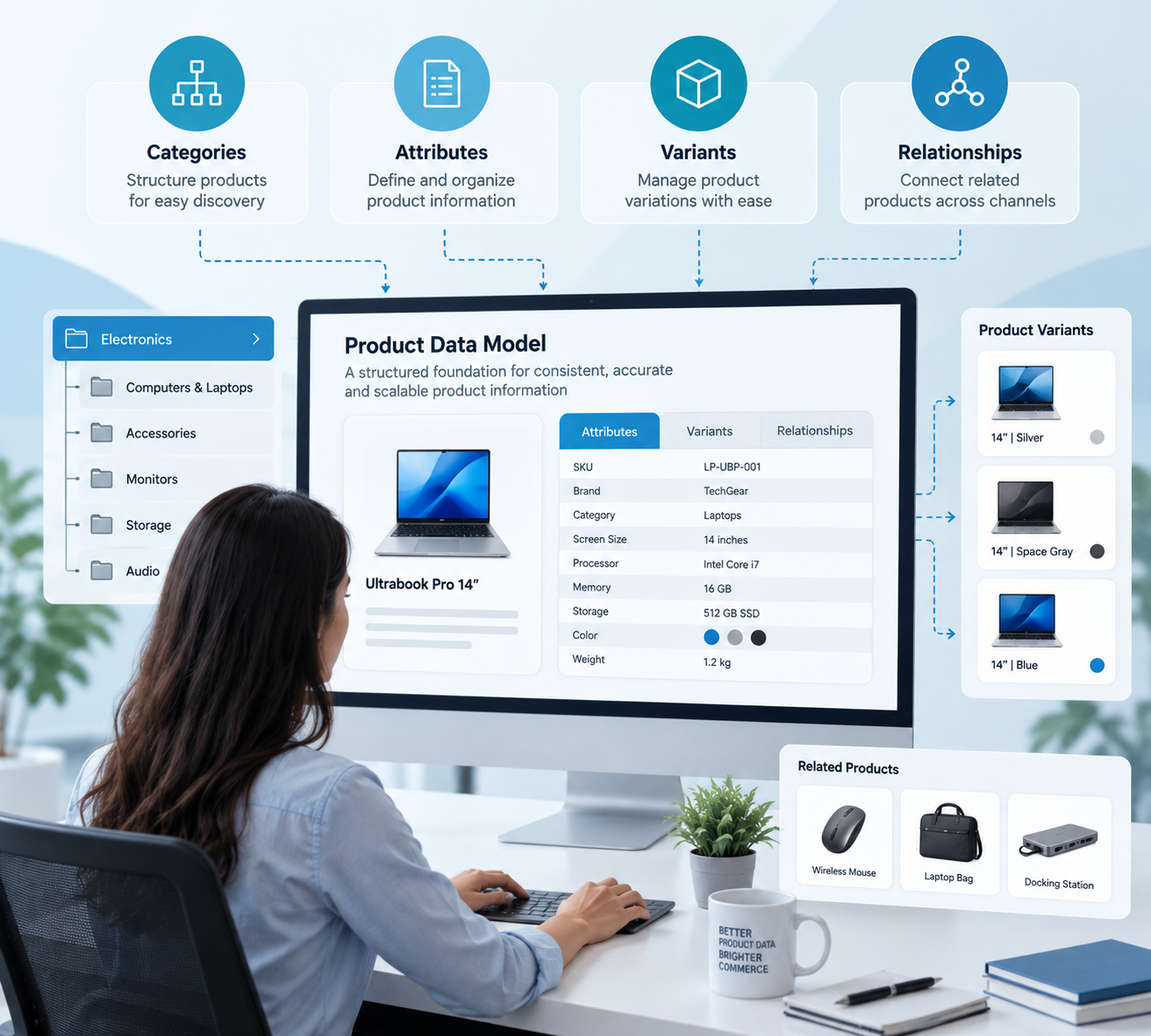
Product data modeling

PIM Implementation for Industrial Distributors

A PIM set up around your catalog, your manufacturers and the people who maintain it.

  • Product families, attributes, workflows and user permissions configured
  • Manufacturer part numbers, your SKUs and customer part numbers on one record
  • Validation, approval, completeness and publishing rules

More on our PIM implementation services.
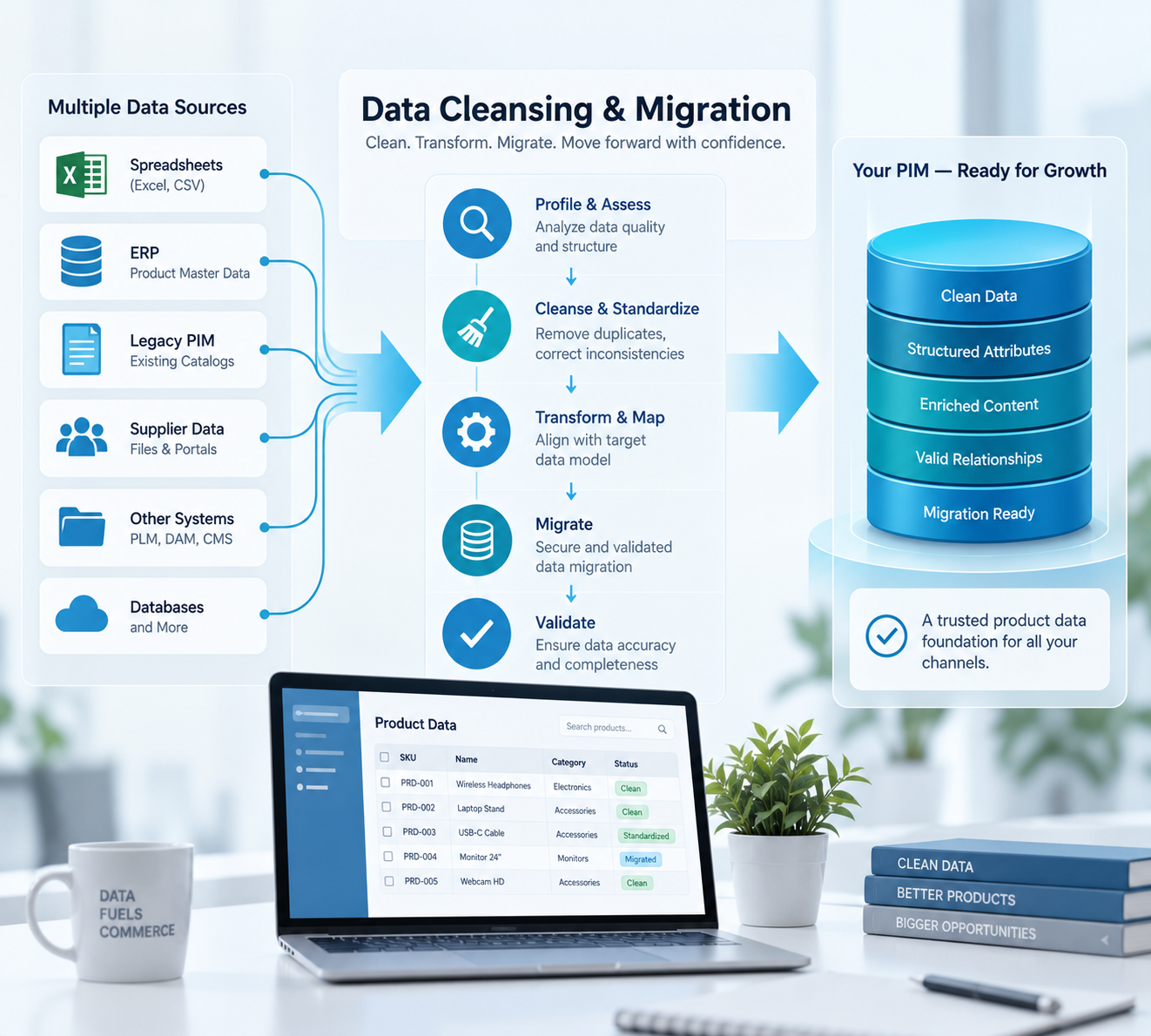
Product data cleansing migration

Industrial Product Taxonomy and Data Modeling

Categories and attributes that match how your customers search for a part.

  • Technical categories, product classes and attribute groups
  • Dimensions, materials, ratings, finishes and applications with standard units and values
  • ETIM, ECLASS and UNSPSC, your own or customer-specific taxonomies
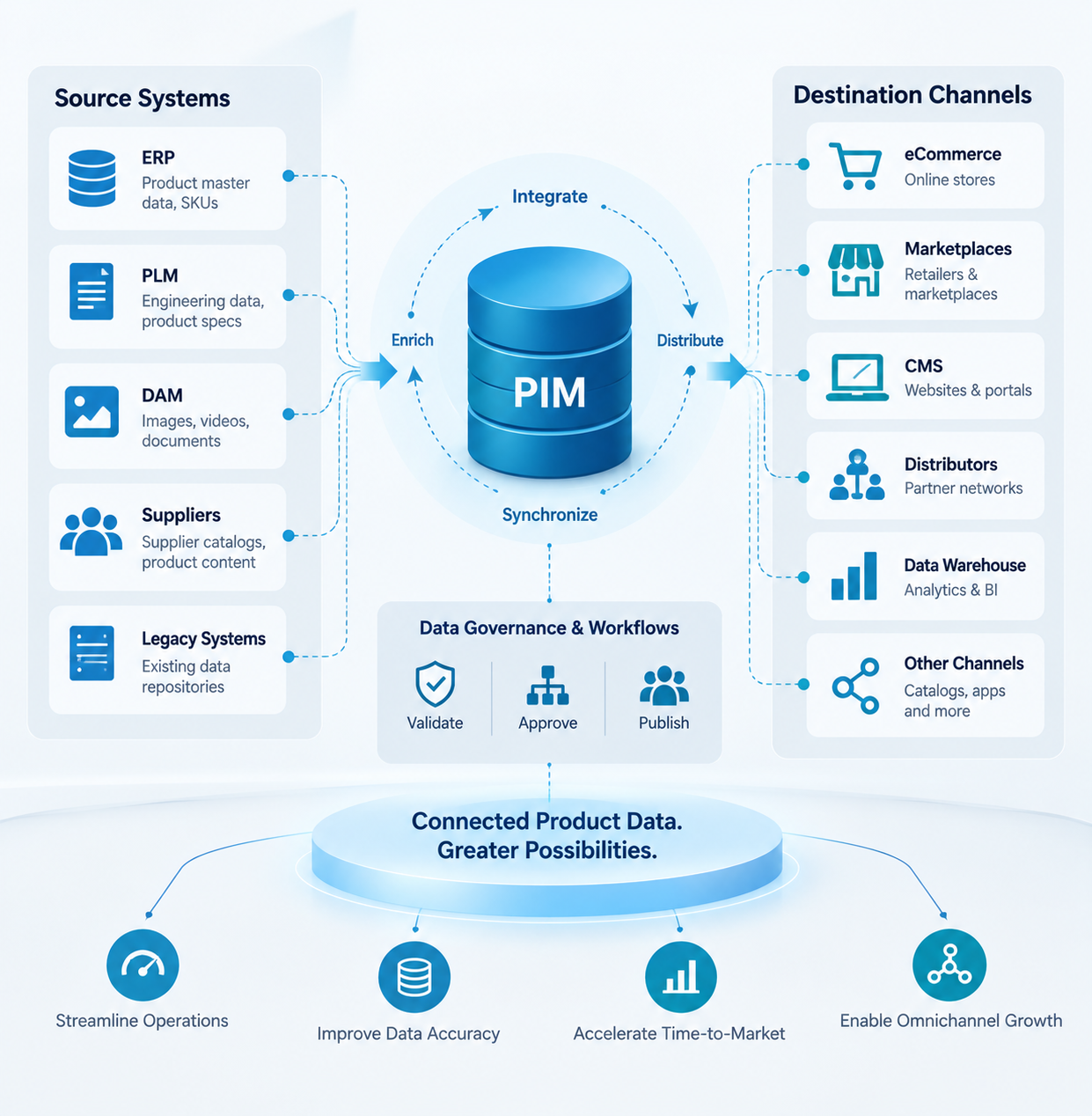
PIM integration

Supplier Data Onboarding and Product Enrichment

Manufacturer spreadsheets, APIs, PDFs and portal exports turned into complete, ready-to-sell products.

  • Each manufacturer’s terms mapped once to your product model
  • Specifications, images, manuals and certificates added
  • Missing attributes, duplicates and incomplete records flagged
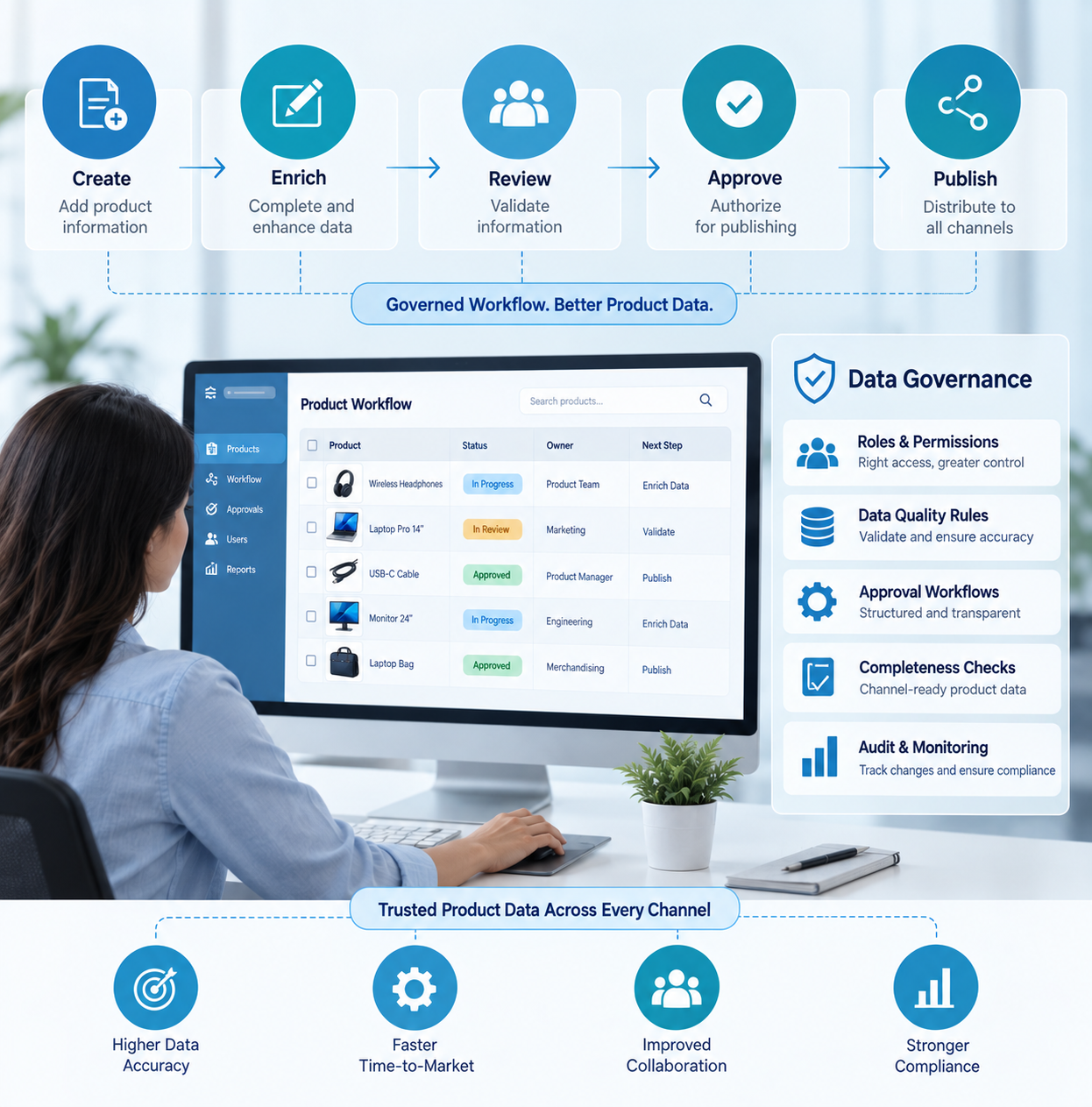
Workflow data governance

PIM Integration and Channel Enablement

Approved product data reaches every system that needs it, without re-keying.

  • ERP, DAM, eCommerce, site search, supplier portals, marketplaces and procurement systems connected
  • SKU, supplier and inventory information kept in sync with the ERP
  • APIs, middleware, batch feeds or event-driven integrations, whichever fits
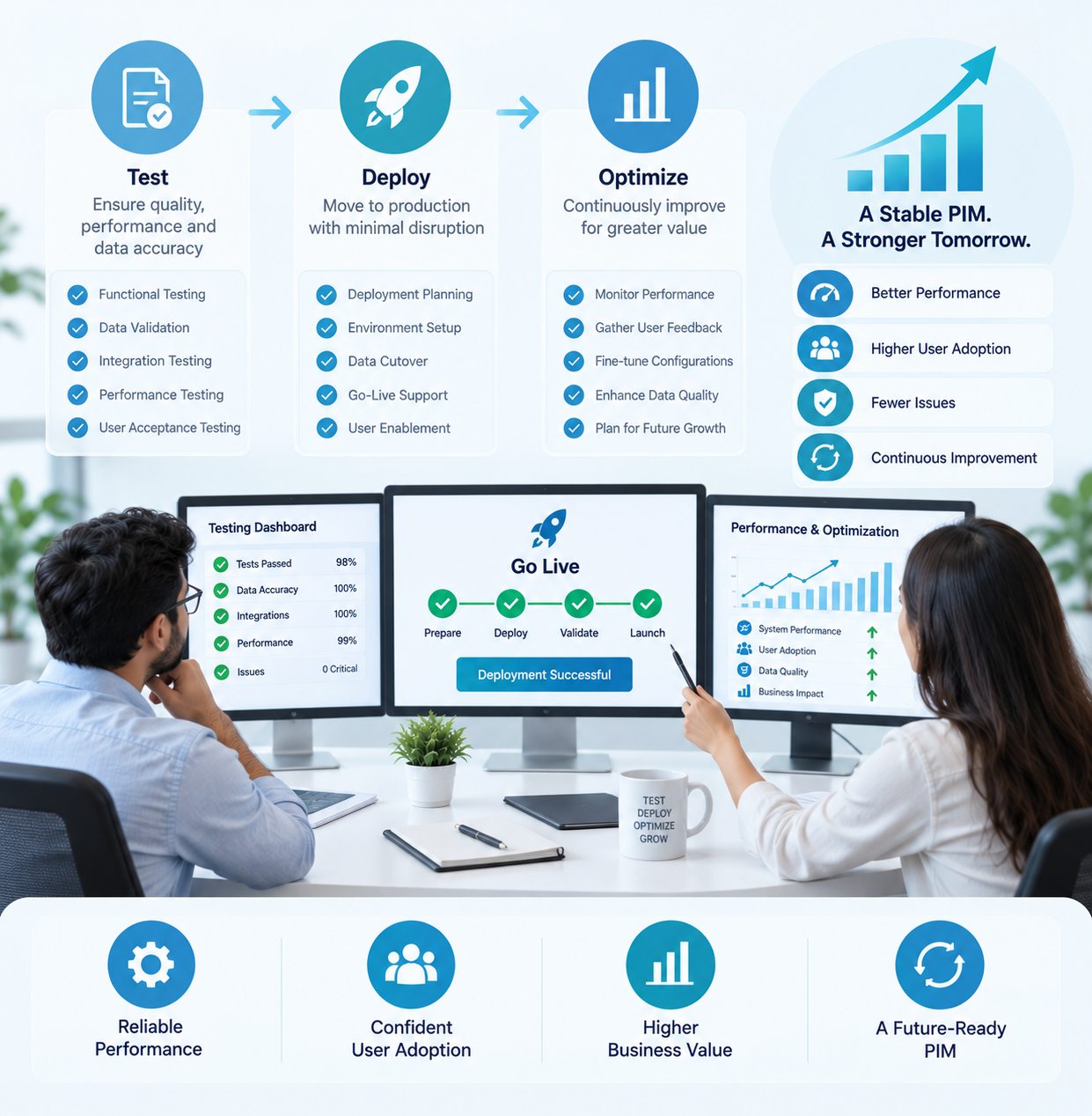
Testing deployment optimization

Product Data Governance, Support, and Optimization

The catalog stays clean as manufacturers, acquisitions and channels are added.

  • Ownership, approval, quality and completeness standards
  • Safety Data Sheets, certificates, manuals and technical documents kept current
  • Ongoing work on workflows, integrations, data quality, search and AI readiness

MRO Product Data Capabilities for Industrial Distributors

What the PIM does with your MRO product data once it is running.

An example of supplier mapping. One manufacturer sends “Thread: 1/4 NPT, Max PSI: 3000”. Another sends “Port size: .25 in NPT, Pressure rating: 207 bar”. The PIM maps both to your attributes (port size, thread type, maximum pressure in psi), converts the units, and flags the file that has no material, before anything reaches your store.

The same works for bearings (bore, outside diameter, width, load ratings and the interchange between manufacturers’ part numbers) and for fasteners (thread pitch, grade or property class, head and drive type, finish, and the selling unit: each, box of 100 or per hundred).

Automated Supplier Data Mapping

Supplier spreadsheets, CSV files, APIs and portal exports come in through one process. Supplier fields matched to your internal attributes Terms, values and units of measurement normalized Selling units and pack quantities converted to yours Missing, invalid or badly formatted data flaggedEach mapping is kept and reused for that manufacturer's next file.

Standards-Aligned Product Classification

Each product carries a standard class beside your own web categories. ETIM, ECLASS and UNSPSC structures Internal and customer-specific taxonomies Dimensions, materials, ratings and applications standardized

Automated Data Quality Controls

Incomplete or conflicting products are stopped before they are published. Validation rules per category Completeness and channel readiness measured Duplicate, conflicting or incomplete records detected

Product Relationship and Cross-Reference Management

Every number a customer might search for leads to the right product. Manufacturer part numbers linked to your SKUs and customer SKUs Alternatives, replacements and superseded products Accessories, kits, components and spare parts

Channel-Specific Product Publishing

Each channel gets the format and attributes it needs from the same approved record. eCommerce sites and customer portals Marketplaces, sales tools and procurement channels Customer-specific catalogs and approved product lists

AI-Ready Product Discovery

Structured attributes and relationships that search and AI tools can read. Semantic and natural-language product search Better recommendations and substitutions Trusted data for sales and customer-service assistants


Is Your MRO Product Data Ready to Support Digital Growth?

Bring one manufacturer file and a few searches that fail. On the free call a senior PIM consultant shows where supplier data, missing attributes and disconnected systems hold back your digital sales, and what to fix first.

Book my free assessment

PIM Integration for Industrial Distribution: ERP, Search and Punch-Out

In industrial distribution, the ERP (for example SAP, NetSuite, Microsoft Dynamics 365, Oracle or a distribution-specific ERP) stays the system of record for item numbers, pricing, inventory and orders. The PIM adds attributes, classes, documents and cross-references, and sends complete product data to the B2B store, site search and punch-out catalogs. What each system keeps, and what it gets from the PIM. We agree ownership before anything is built.

System

How It Works with the PIM

Your ERP

The ERP stays the system of record for item numbers, pricing, inventory and orders. The PIM takes the item and adds attributes, descriptions, classes, documents and relationships. The split is the same whether you run SAP, NetSuite, Microsoft Dynamics 365, Oracle or a distribution-specific ERP; tell us which one and we confirm the connection method on the call.

B2B store and site search

Search and filters read structured attributes, units, part numbers and cross-references from the PIM, so a search for a part number or a spec returns the product.

Punch-out and customer catalogs

The PIM holds the approved content and each customer's assortment. Your commerce platform or punch-out provider serves it as punch-out (cXML or OCI) catalogs for customers' procurement systems such as SAP Ariba or Coupa.

Manufacturer data

Spreadsheets, portal exports, feeds, APIs and PDFs come in through templates and mapping, and are checked against your rules before they reach the catalog.

DAM

Images, drawings, manuals, certificates and Safety Data Sheets are linked to the right products and versions.

Marketplaces, PDF catalogs and sales tools

Each gets the attributes and format it needs from the same approved record, so channels stop disagreeing.

How the systems connect

APIs, middleware such as Boomi (formerly Dell Boomi), batch feeds or event-driven integrations, chosen for your systems and data volumes.

A Practical PIM Implementation Approach for Industrial Distributors

Six steps, delivered in phases. Once a project starts we need from you: someone who decides which system owns which data, the people who know your categories and manufacturers, and access to your systems and sample files.

We review your catalog, manufacturer data, systems, workflows, data quality and priorities. You get: a picture of where your data stands and the first category or manufacturer group to start with.

We define product hierarchies, technical attributes, identifiers, relationships and standards such as ETIM, ECLASS and UNSPSC. You get: a product model your catalog team and IT have both approved.

We set up the PIM, user roles, validation rules, completeness checks, approval workflows and publishing. You get: a working PIM your team can use.

We clean, de-duplicate, standardize, enrich and migrate product data from ERP systems, spreadsheets, supplier files and legacy platforms. You get: clean product data in the PIM, checked against the source.

We connect the PIM with ERP, DAM, eCommerce, search, supplier portals, marketplaces and customer applications. You get: product data that moves between systems without re-keying.

We launch in phases and keep improving catalog completeness, onboarding speed, data quality, product discovery and user adoption. You get: a catalog that stays complete as manufacturers and channels are added.

PIM for Industrial Distribution: Cost and Timeline

How long does a PIM project take for an industrial distributor?

A first release typically takes 3 to 6 months. Larger programmes, with hundreds of manufacturers, several systems or a stalled rollout to recover, run in phases over 6 to 12 months or more. Most distributors keep the first release short by starting with one product category or one group of manufacturers, then adding the rest in phases.

What drives the cost of PIM for industrial distribution?

Five things drive the cost most: how many manufacturers and formats, catalog size and attribute depth, the state of your data, the systems and channels to connect, and the platform and starting point. We do not quote a price before we have seen your data; the free assessment gives you a rough budget.

Manufacturers and Formats

How many manufacturers send data, in how many formats, and whether templates or a supplier portal are needed.

Catalog Size and Attribute Depth

How many SKUs, how many attributes per category, and how many cross-references, replacements and kits.

The State of Your Data

How much must be cleaned, de-duplicated, classified and enriched before go-live.

Systems and Channels

Your ERP, B2B store and search, punch-out and customer catalogs, DAM and marketplaces, and whether standard connectors are enough.

Platform and Starting Point

A new PIM, or fixing and finishing the one you run, and the licence model of the platform you choose.

Book my free assessment

PIM for MRO Distributors: Risks and How We Reduce Them

Eight risks we see in industrial distribution PIM projects, and how we deal with each.

Risk

Our Approach

Manufacturer data is worse than expected. The scope grows once the real files are opened.

Looked at first. Real manufacturer files are reviewed in the assessment, and completeness rules per category are set before the scope is fixed.

The ERP and the PIM fight over the item master.

Ownership agreed first. The ERP keeps pricing, inventory and orders; the PIM owns the enriched product information. Decided before anything is built.

The clean-up never ends. New files arrive as messy as the old ones.

Checks at the door. Supplier templates and validation rules on import stop bad records before they reach the catalog.

Search and filters still fail after go-live.

Taxonomy first. Categories, attributes, units, allowed values and cross-references are agreed and loaded with the products, not added later.

Go-live disturbs orders, the B2B store or punch-out customers.

In phases. We launch one category or manufacturer group at a time, with testing before each release.

The team goes back to spreadsheets.

Built for the people who use it. User roles, approval workflows, clear data ownership and training are part of the delivery.

The rollout stalls halfway.

Fix what you have. We start from an audit of what is running, then upgrade, tune and integrate it, reducing custom code instead of rebuilding by default.

The partner disappears after go-live.

Support after launch. Governance, support and ongoing optimization are a service of their own, not an afterthought.

Had a PIM rollout that stalled, or a partner who went quiet? Tell us what went wrong, and we plan around it.

Book my free assessment

How Healthy Is Your Product Data?

Not ready to talk yet? Start here. 8 questions: a score, your two weakest areas and a 30/90-day plan, with practical steps to improve data quality and reduce risk before a PIM project.

Check my product data

Measurable Business Outcomes from Better MRO Product Data

The six outcomes we measure against. We agree the starting figure for each in the assessment, so you can see the change.

Turn Better Product Data into Better Distribution Performance

Reduce Supplier Onboarding Time

Less time to collect, map, check, enrich, approve and publish a new manufacturer’s products.

US lighting products company: files from 300+ vendors mapped automatically

Increase Digitally Sellable SKU Coverage

More of the catalog with the descriptions, technical attributes, images, documents and relationships needed to sell online.

Reduce Catalog Enrichment Effort

Fewer hours spent correcting supplier files, filling attribute gaps, attaching documents and preparing channel content.

Global industrial solutions leader: 70% less manual workload across 14,000 SKUs

Improve Product Search Success

Customers and sales teams find the right product by specification, part number, application or compatibility.

Measured as the share of searches that return no result, before and after.

Accelerate New Category and Channel Launches

Governed product data is reused for new categories, manufacturers, marketplaces, websites and customer portals.

Industrial spare parts provider: 40% less catalog creation time

Reduce Product Data Support Requests

Fewer calls to branches and customer service about missing specs, wrong documents or unclear replacements.

Related PIM Pages for Distributors and Industrial Suppliers

Related industries and the pages that cover them in detail.

Pimcore Strategic Partner

Why Industrial Distributors Choose Credencys

What industrial distributors check before they shortlist a PIM partner.

Brands logo

One Team From Data Review to Support

A practice of 150+ data experts with 15+ years of experience: consulting, taxonomy, supplier onboarding, migration, integration, governance and support from one team.

Brands logo

Built Around Industrial Distribution

Built around how industrial distribution works: hundreds of manufacturers, technical attributes with units, part numbers, cross-references and supersessions, branches, B2B stores and customer catalogs. On this page alone: three distributors with 120+, 145+ and 185+ manufacturers each, a manufacturer that sells through distributors and an industrial spare parts business.

Brands logo

Pimcore, Syndigo and Semarchy Partner

Pimcore Strategic Partner with 80+ certified Pimcore experts; Syndigo partner, Syndigo Americas Emerging Partner of the Year 2023; Semarchy partner. Independent advice on Akeneo, Salsify, inRiver and Stibo Systems STEP, so you get the platform that fits your catalog.

Brands logo

Product Data AI Search Can Read

AI search, recommendations and buying assistants read structured fields, not PDFs. The same work that fixes your filters (complete attributes with units, a standard class, clean relationships) makes your catalog usable by AI.

Frequently Asked Questions About PIM for Industrial Distributors

Turn Your MRO Product Data into a Growth-Ready Asset

Book a free 30-minute assessment with a senior PIM consultant. You leave with a view of your product data today, the gaps in supplier data, taxonomy, attributes and integrations, and a rough roadmap and budget.

Book my free assessment