



 Client Overview
A mid-sized industrial electrical distributor supplying controls, enclosures, power distribution equipment, sensors, drives, relays, and automation components to manufacturers, system integrators, and industrial facilities. The company operated through 36 branches and managed 275000+ product records from more than 145 manufacturers.
Product information was distributed across ERP, spreadsheets, shared drives, DAM, e-commerce, branch databases, and legacy catalog applications.
 Problem Statement
Years of business growth, system customization, and acquisitions had created a fragmented product-data environment. ERP contained transactional item information, while descriptions, technical attributes, images, documents, categories, and product relationships were maintained across separate systems.
Custom scripts and manual file transfers synchronized some of the information, but the architecture was difficult to maintain and frequently produced conflicting product records across channels.
 Key Challenges
-
Product data fragmented
across ERP, e-commerce, DAM, spreadsheets, legacy databases, and branch systems.
-
No complete product record
existed within a single governed platform.
-
Duplicate and conflicting SKUs
resulted from acquisitions, legacy identifiers, and different manufacturer records.
-
Fragile point-to-point integrations
required frequent maintenance and depended on internal technical knowledge.
-
Unclear data ownership
created inconsistencies across product attributes, classifications, documents, and channel content.
 Solution Implemented
-
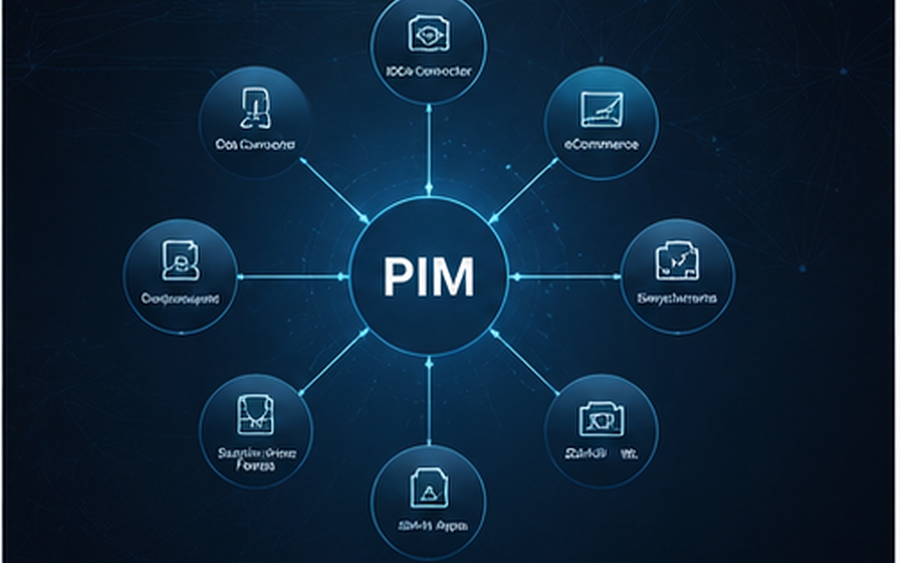
Implemented PIM as the centralized platform : for governing enriched electrical product information.
-
Defined the responsibilities : of ERP, PIM, DAM, e-commerce, and other enterprise systems.
-
Created a common product-data model : covering technical attributes, packaging, classifications, documents, variants, and relationships.
-
Consolidated and deduplicated product records : from legacy and acquired catalogs.
-
Integrated manufacturer feeds, : ERP, DAM, e-commerce, customer portals, and branch applications.
-
Replaced selected point-to-point processes : with scalable API and middleware-based integrations.
-
Established ownership, validation, approval, : and publication workflows for product information.
-
Implemented data-quality dashboards : to monitor completeness, duplicates, exceptions, and synchronization status.
-
Structured product attributes : and relationships to support future AI-powered search and product-assistance initiatives.
 Business Impact
-
64% faster product-data updates
through connected systems and automated synchronization workflows.
-
29% reduction in duplicate records
following catalog harmonization and identity-matching processes.
-
48% lower manual synchronization effort
by replacing spreadsheet exchanges and selected custom scripts.
-
Consistent product information across channels
improved trust in the data used by branches, sales teams, e-commerce, and customer portals.
-
Scalable foundation for future growth
supported new manufacturers, acquisitions, digital channels, and AI initiatives without recreating fragmented processes.
Highlights
- 64% faster product-data updates
- 29% reduction in duplicate records
- 48% lower manual synchronization effort

Is Data Management a Challenge in Your Organization?
Discover how Credencys can streamline your data processes, just like we did for our clients. Let’s connect to discuss solutions tailored to your needs.
Book a Free Consultation