

The Scale and Complexity of Food & Beverage Product Data
Food and beverage companies manage product information across brands, product variants, packaging configurations, markets, retailers, and digital channels. As portfolios grow and product information changes, teams struggle to keep ingredients, nutrition, allergens, claims, packaging data, digital assets, and channel content accurate, complete, and synchronized.
Fragmented Product Information
Product data is often spread across ERP, PLM, formulation systems, labeling applications, spreadsheets, DAM, and commerce platforms, creating multiple versions of the same product record.
Complex Ingredient, Nutrition, and Allergen Data
Ingredients, nutrition facts, allergen information, serving details, dietary attributes, and other consumer-facing data must remain accurate as formulations and products change.
Multiple Products and Packaging Configurations
The same product may exist across sizes, flavors, multipacks, cases, foodservice packs, and regional variants, each requiring different GTINs, dimensions, weights, packaging details, and content.
Retailer and Channel-Specific Requirements
Retailers, distributors, foodservice operators, marketplaces, and data pools may require different attributes, formats, images, classifications, and product-content structures.
Constant Product and Content Changes
Reformulations, packaging updates, new claims, certifications, seasonal products, new variants, and discontinued SKUs make product-data maintenance continuous and difficult to manage manually.

How Much is Your Product Data Costing You?
Get Your Score +90 days action plan in 3 minutes.
Check Your ScoreThe Strategic Role of PIM in Food & Beverage
PIM gives food and beverage companies a governed foundation for managing complex product information across brands, systems, markets, and channels. It helps standardize product data, streamline product onboarding, improve digital commerce, and ensure every team works with accurate, consistent, and channel-ready information.
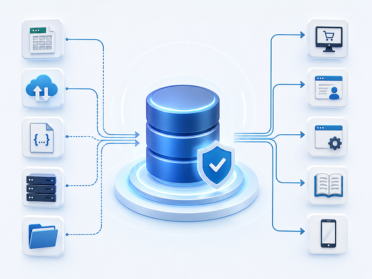
The Single Source of Truth
PIM creates one governed foundation for ingredients, nutrition information, allergens, claims, certifications, packaging details, descriptions, images, and channel-specific content. It ensures teams across product, marketing, eCommerce, sales, and IT work with reliable product information.
- Consolidate product data from ERP, PLM, formulation systems, spreadsheets, DAM, and legacy applications
- Reduce duplicate and conflicting product records
- Maintain consistent product information across brands, markets, and channels

Efficient Product Data Onboarding
New products and product updates may involve information from formulation systems, ERP, spreadsheets, suppliers, packaging teams, digital asset libraries, and other sources. PIM streamlines the mapping, validation, enrichment, and approval processes required to create complete, channel-ready product records.
- Import product information from multiple files, systems, and feeds
- Map incoming data to a standardized food product model
- Identify incomplete or inconsistent records before publication

Standardized Food Product Information
Food and beverage products require detailed information such as ingredients, nutrition facts, allergens, dietary attributes, claims, certifications, serving information, storage requirements, and packaging details. PIM structures and standardizes this information so products can be governed, searched, filtered, compared, and distributed consistently.
- Standardize product attributes, values, terminology, and formats
- Maintain category-, brand-, and market-specific product structures
- Apply product-specific validation and completeness rules

Omnichannel Agility and Product Consistency
Retailers, distributors, foodservice operators, marketplaces, and eCommerce channels may require different attributes, descriptions, images, formats, and product content. PIM enables companies to prepare information for each destination while maintaining one governed product record.
- Syndicate product information to retailers, marketplaces, eCommerce, and foodservice channels
- Manage channel-specific requirements without duplicating product records
- Keep approved product updates synchronized across downstream systems

Data-Driven Digital Commerce and AI Readiness
Search, filters, recommendations, product comparisons, and AI applications depend on complete and structured product information. PIM organizes food and beverage attributes so customers and buyers can discover products based on dietary needs, ingredients, flavors, formats, pack sizes, and other relevant characteristics.
- Improve product search, filtering, comparison, and recommendations
- Enable attribute-driven product discovery across digital channels
- Prepare product information for natural-language search and AI applications
Our Approach to PIM Implementation Services
From initial assessment to final deployment, we follow a proven four-step process to deliver a scalable PIM solution aligned with your food product data, channel, and digital-commerce priorities.
01
Assessment and Planning
Analyze your product portfolio, data sources, systems, workflows, packaging structures, channels, and business goals to define a clear PIM implementation roadmap.
02
Customization and Configuration
Design the product-data model, categories, food-specific attributes, packaging hierarchies, workflows, user roles, validation rules, and integrations required for your product portfolio.
03
Enrichment and Governance
Cleanse and migrate existing product information, establish data-quality rules, assign data ownership, and configure enrichment, review, approval, and change-management workflows.
04
Deployment and Training
Launch the PIM across priority product categories, brands, markets, and channels, train internal users, monitor performance, and provide ongoing post-deployment support.
Business Impact of PIM for Food & Beverage
PIM transforms fragmented food and beverage product information into a governed business asset. It reduces manual effort, improves product-data accuracy, strengthens digital commerce, and helps companies scale products, brands, markets, and channels without increasing data-management complexity.



Real Business Impact: PIM Success Stories in Food & Beverage
Leading US-Based Supermarket Chain
78%
Improvement in Customer Satisfaction
Credencys implemented a tailored data and order management solution using PIM and eCommerce technologies to replace paper-based processes and improve product and order data management. The solution streamlined transaction reconciliation and increased operational efficiency by 24%.
Read MoreGlobal CPG Manufacturer
45%
Faster Order Completion
Credencys built a centralized eCommerce platform powered by PIM to unify product data and simplify the buying experience across previously disconnected websites. The solution centralized 65% of the buying process and delivered 25% operational cost savings.
Read MoreRenowned Food Manufacturer
50%
Decrease in Manual Efforts
Credencys implemented a centralized PIM solution with a unified data model, approval workflows, automated notifications, reporting, and streamlined publishing. The solution reduced data retrieval time by 45%, improved data accuracy by 35%, and increased product-data completeness by 40%.
Read MoreReady to Modernize Your Food Product Data?
Build a trusted product-data foundation that improves product information accuracy, accelerates launches, simplifies channel syndication, and prepares your business for scalable digital and AI growth.
Book a Free ConsultationWhy Leading Enterprises Choose Credencys?
Credencys helps enterprises turn complex data into trusted insights, intelligent operations, and measurable business growth. Here’s what makes us a preferred data and AI partner:

End-to-End Data Expertise
From data strategy to AI deployment, we cover the entire spectrum—Data Management, Engineering, Insights, and Intelligence—to ensure your data drives measurable business outcomes.

Domain-Focused Solutions
Whether you're in retail, automotive, or manufacturing, our purpose-built platforms solve industry-specific challenges with precision and speed.

Enterprise-Grade Partnerships
We collaborate with the best in the business to deliver future-ready, scalable, and secure solutions.

AI-First
We help you move beyond dashboards—accelerating AI readiness, deploying GenAI and enterprise AI agents, and enabling intelligent automation across your data ecosystem.
50+
Enterprise Clients
100%
Certified Consultants
15+
Years Experience
4.9/5
Client Satisfaction
We Build PIM Solutions for


Frequently Asked Questions
Product Information Management for food and beverage is a centralized approach to collecting, structuring, enriching, governing, and distributing the product information required across commercial and customer-facing channels.
It can manage information such as product descriptions, ingredients, nutrition information, allergens, dietary attributes, certifications, claims, packaging information, GTINs, images, product relationships, preparation information, and channel-specific content.
Food and beverage organizations often maintain product information across ERP, formulation or PLM systems, labeling tools, spreadsheets, DAM, commerce platforms, supplier files, and trading-partner portals.
PIM creates a governed product-information layer that connects these sources and ensures approved information can be reused across retail, foodservice, eCommerce, marketplaces, data pools, and internal applications.
PIM can structure ingredient, nutrition, serving, allergen, and related consumer-facing information; validate required attributes; route information through review workflows; maintain market-specific versions; and publish approved content to downstream channels.
FDA rules governing packaged food labels make accurate allergen and ingredient information important in the U.S. market. PIM supports governance of this information, but it does not replace qualified regulatory, food-safety, formulation, or labeling expertise.
Yes. PIM can act as the governed source from which product information is mapped, validated, transformed, and supplied into GDSN workflows or certified data-pool environments.
GS1 describes GDSN as an ecosystem for continuously sharing synchronized product master information among trading partners. The exact architecture depends on the organization’s PIM platform, data pool, trading partners, existing integrations, and product-data workflow.
PIM manages and governs product information inside the enterprise. GDSN is a standards-based network used to synchronize product information among trading partners.
A food or beverage company may therefore use PIM to create and approve its trusted product record and then publish required information through a GDSN-certified data pool.
Trusted by Best
Choosing Credencys means partnering with a team that’s deeply committed to unlocking the true value of your data. Here’s why industry leaders trust us:
Our Valued Clientele


Send us a Message
