
The Product Data Challenges Behind Scaling BigCommerce
BigCommerce provides the commerce infrastructure to sell products digitally. But as catalogs grow across products, variants, categories, brands, markets, and channels, managing all the information required to power those experiences becomes increasingly complex.
When product data is spread across ERP, supplier files, spreadsheets, DAM, PIM, and other enterprise systems, teams spend more time correcting and synchronizing information than launching and selling products.
Fragmented Product Information
Descriptions, specifications, identifiers, images, categories, and other product information often exist across multiple disconnected systems. Without a governed product-data source, BigCommerce may receive inconsistent or outdated information from different teams and applications.
Complex Product and Variant Structures
Large catalogs may contain thousands of SKUs differentiated by size, color, material, configuration, capacity, model, or other product options. Managing these relationships manually increases the risk of incorrect variants, duplicate records, and inconsistent product experiences.
Manual Catalog Updates
Teams may repeatedly copy, upload, validate, and correct product information whenever products, attributes, images, or categories change. As the catalog grows, these manual processes slow product launches and consume merchandising and eCommerce resources.
Inconsistent Attributes and Categories
Supplier terminology, ERP attributes, internal taxonomy, and BigCommerce catalog structures frequently use different values and formats. These inconsistencies make product mapping, search, filtering, and channel synchronization more difficult.
Growing Storefront and Channel Requirements
Products may need to support multiple BigCommerce storefronts alongside marketplaces, B2B portals, retail partners, regional websites, and other digital destinations. Maintaining separate versions of product information for each destination makes catalog operations increasingly difficult to scale.

How Much is Your Product Data Costing You?
Get Your Score + 90-day action plan in 3 minutes.
Check Your ScoreWhat BigCommerce PIM Integration Enables
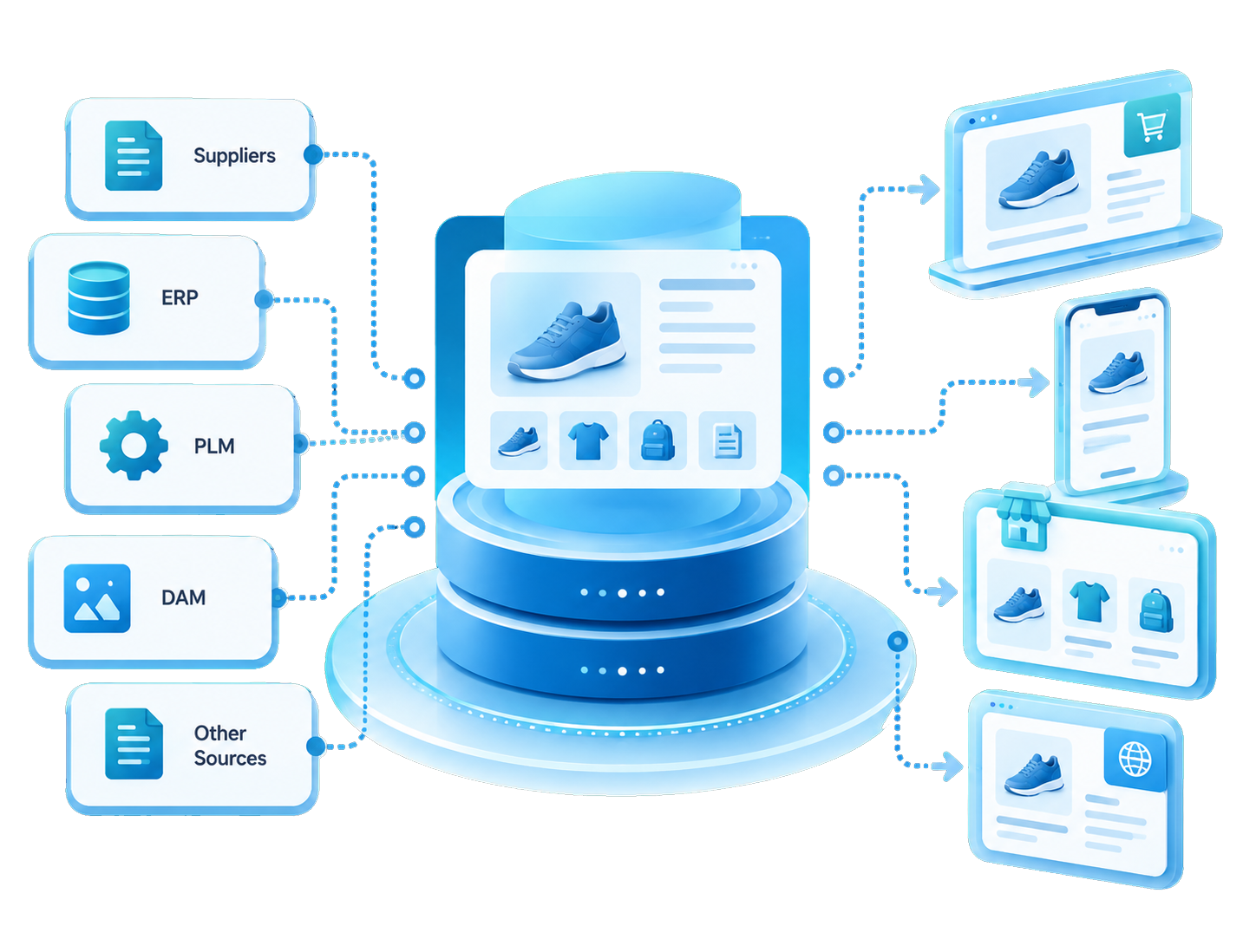
BigCommerce PIM integration creates a governed product-information layer between your enterprise systems and your commerce storefronts. Instead of maintaining product information independently within every destination, PIM centralizes enrichment, validation, governance, and product relationships before approved data is synchronized with BigCommerce.
Centralized Product Data Management
Create a single governed foundation for product descriptions, identifiers, specifications, categories, variants, relationships, digital assets, and commerce content.
- Consolidate product information from ERP, suppliers, spreadsheets, DAM, PLM, and legacy systems
- Maintain consistent product records across teams and channels
- Establish clear ownership and approval workflows
- Reduce duplicate and conflicting product information
Automated Product and Variant Synchronization
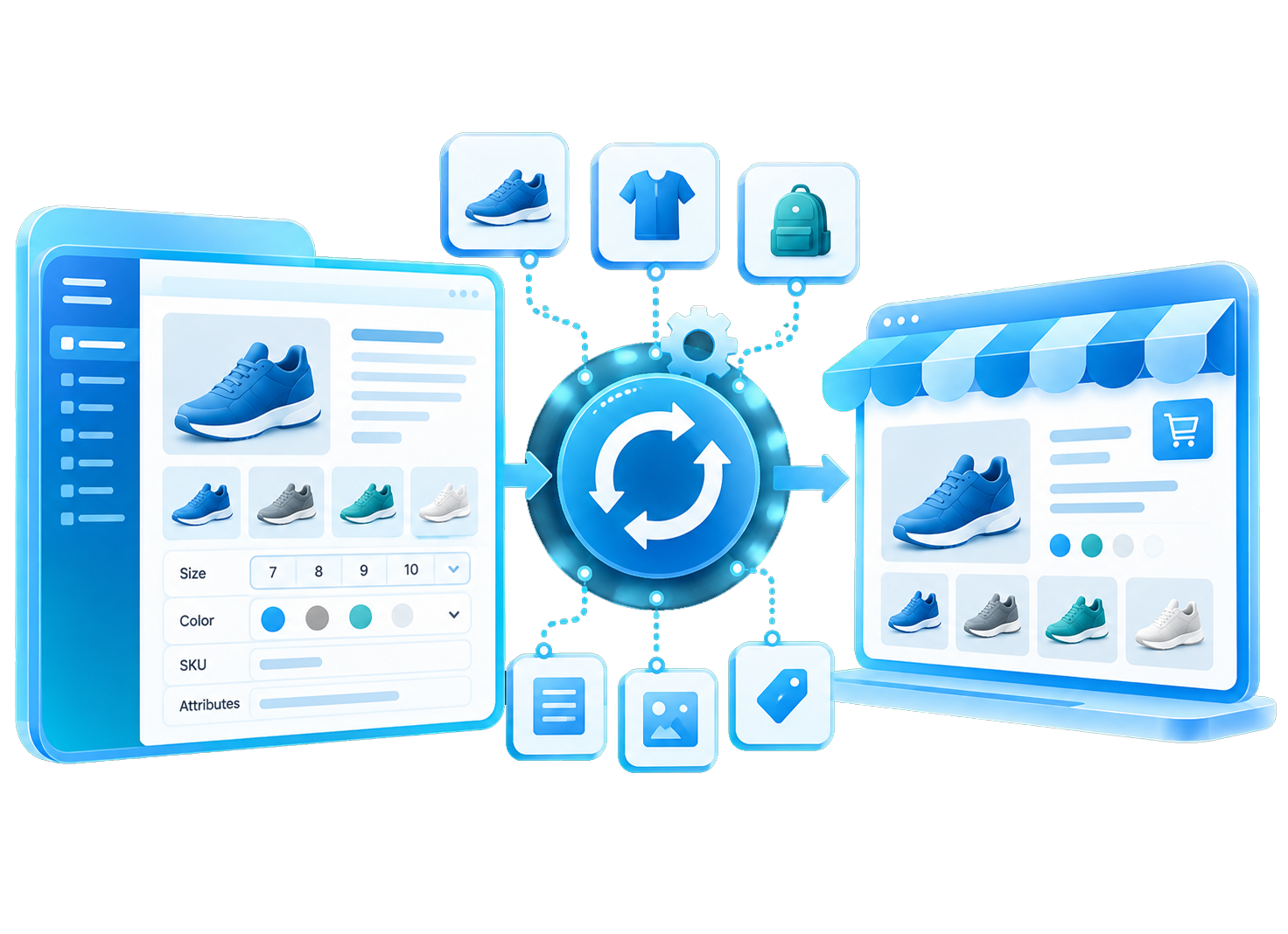
Synchronize governed PIM data with BigCommerce product and variant structures without repeatedly recreating catalog information.
- Map parent products and sellable SKUs
- Manage variant relationships and options
- Synchronize product- and variant-level attributes
- Maintain identifiers such as SKU, UPC, GTIN, and MPN
- Reduce manual product creation and updates
Category and Attribute Mapping
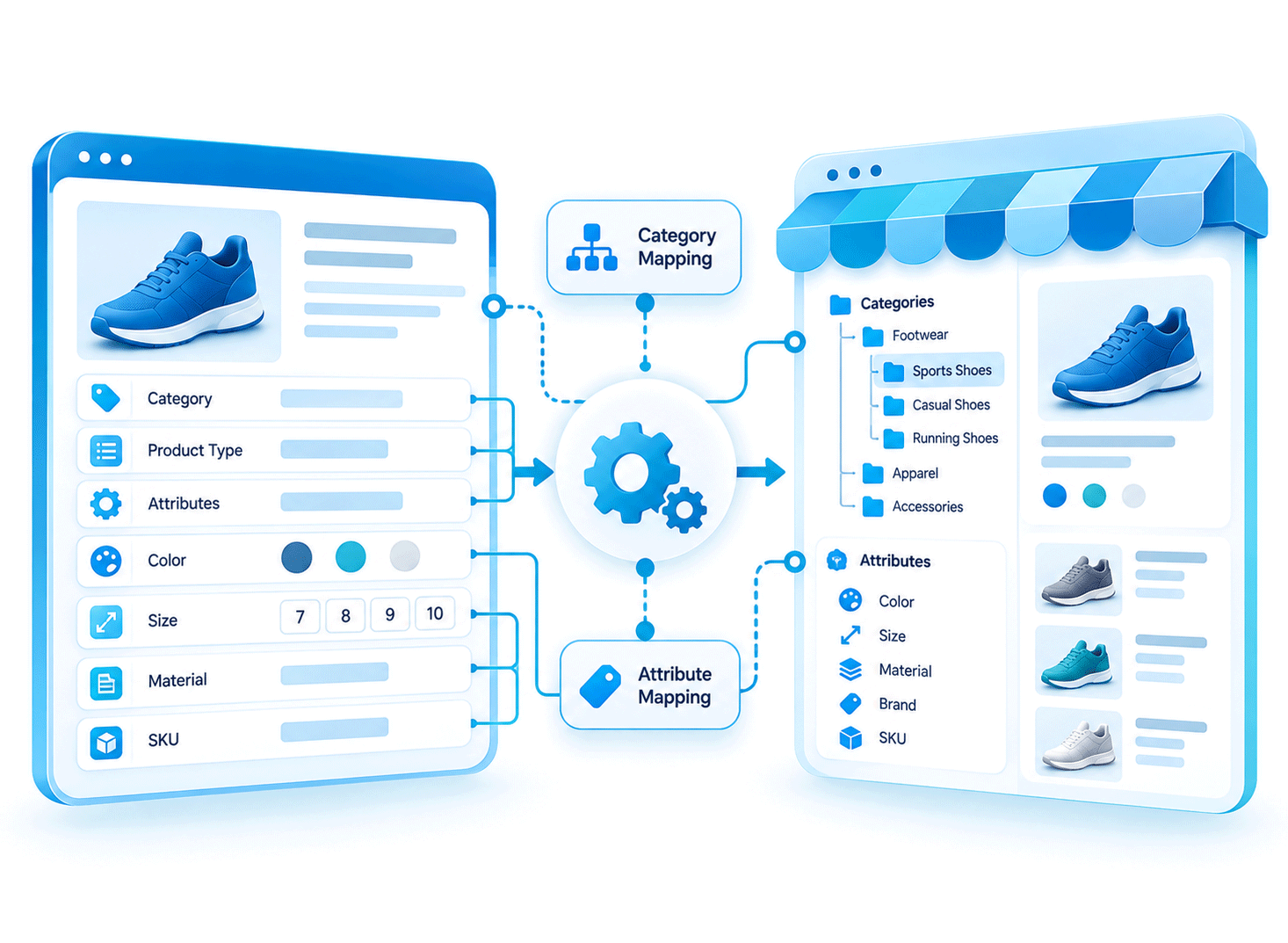
Translate enterprise product models into structures that BigCommerce storefronts can consume.
- Map PIM taxonomy to BigCommerce categories
- Standardize attribute values before synchronization
- Populate custom fields and applicable metadata
- Apply category-specific completeness rules
- Maintain mappings as catalogs evolve
Digital Asset Synchronization
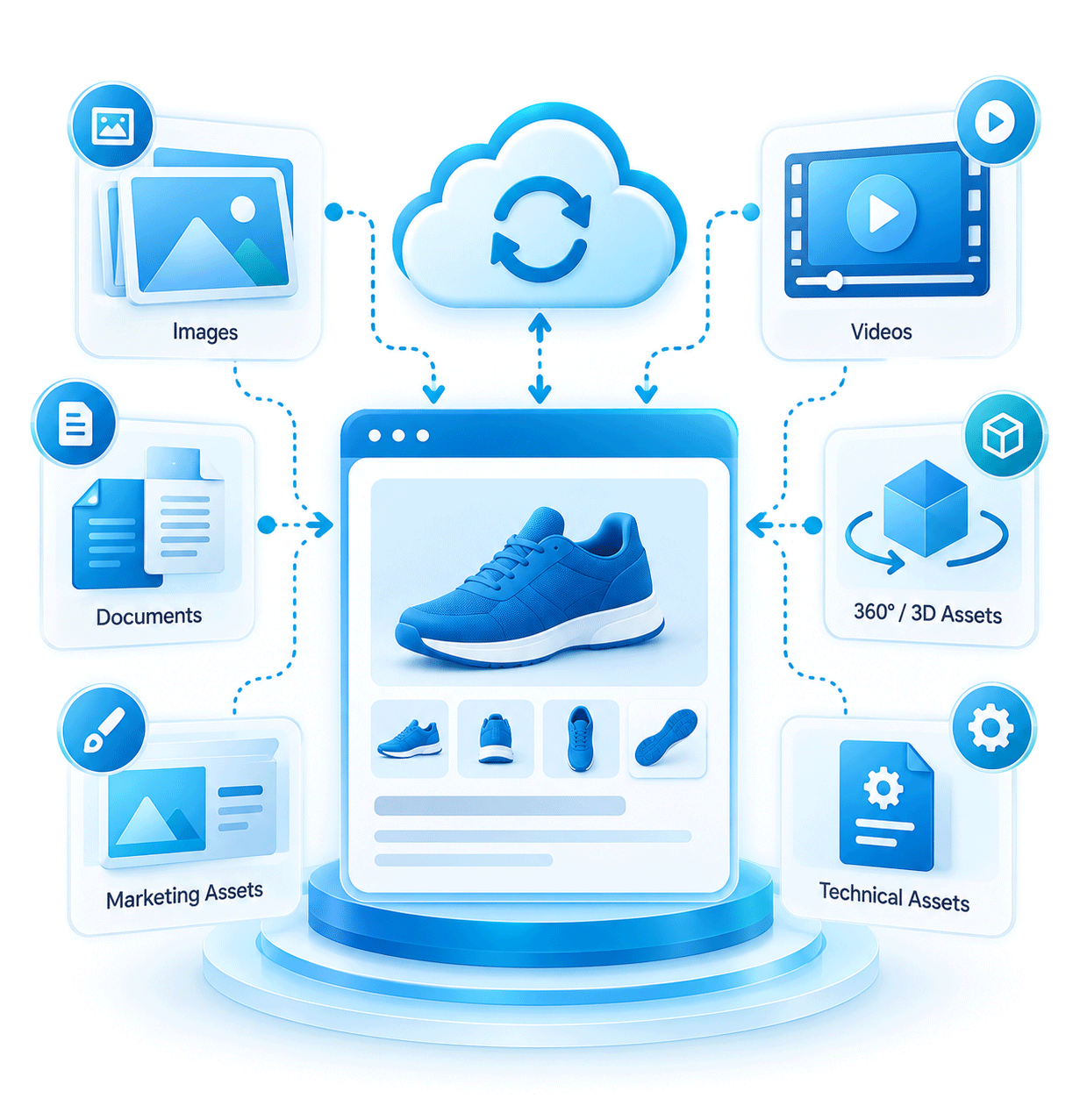
Connect approved product media to the correct products and variants before publication.
- Product images
- Variant-specific imagery
- Videos
- Product documents
- Marketing assets
- Supporting technical content
When combined with DAM, PIM helps ensure the correct content and media are associated with every product experience.
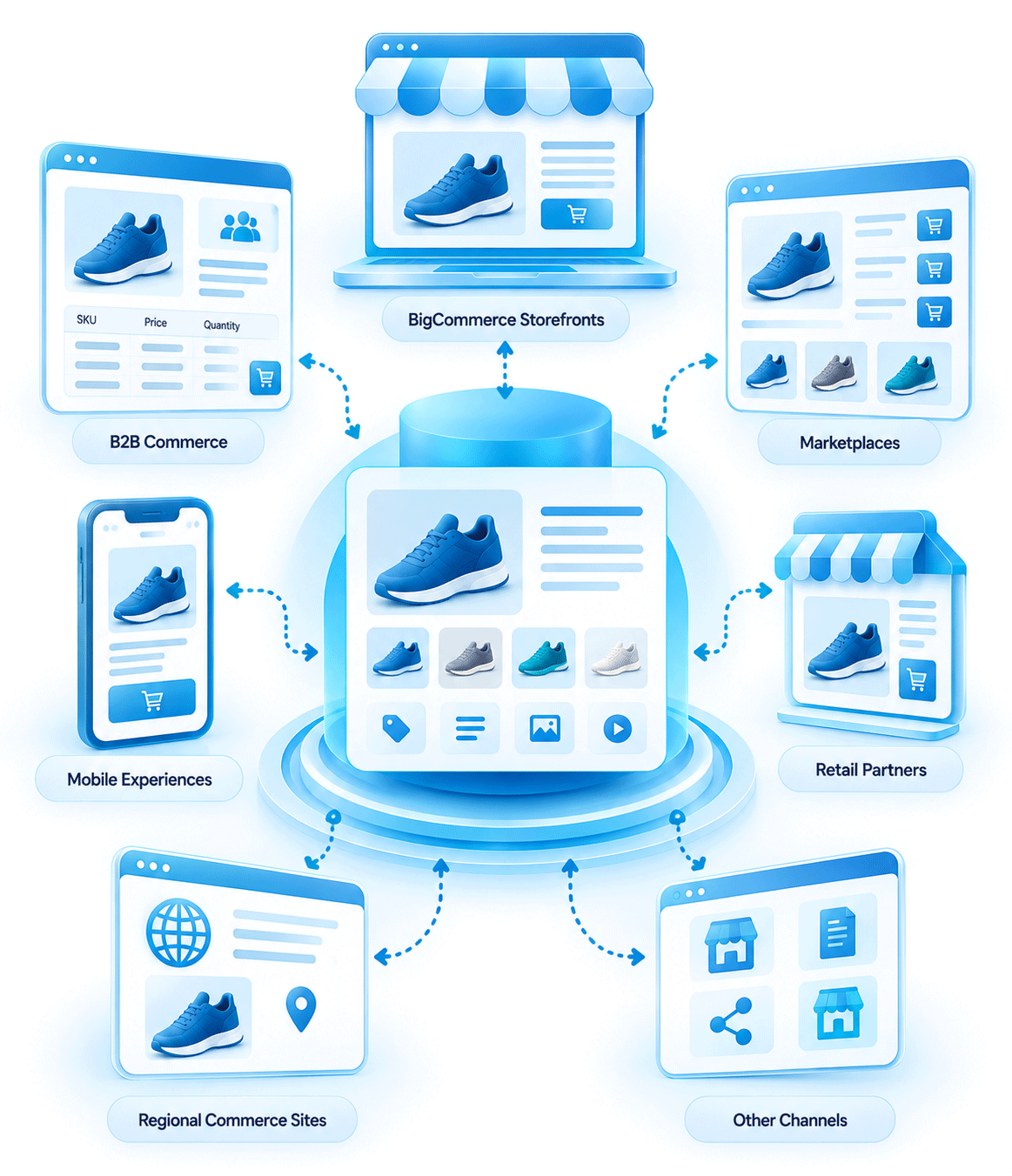
Multi-Storefront and Omnichannel Readiness
Prepare product information once and reuse it across BigCommerce and other digital destinations.
- BigCommerce storefronts
- B2B commerce experiences
- Marketplaces
- Retail partners
- Mobile experiences
- Regional commerce sites
- Additional downstream channels
PIM becomes the governed product-information source while downstream applications consume the information relevant to their individual requirements.
Our BigCommerce PIM Integration Services
Credencys helps enterprises design and implement BigCommerce PIM integrations around their existing catalog, enterprise applications, product-data model, and digital commerce strategy. From architecture and mapping to APIs, migration, validation, and ongoing optimization, we build integrations designed to support growing products, channels, and markets.
We define:
- Data ownership
- System boundaries
- Integration architecture
- Synchronization direction
- Product-data dependencies
- Mapping requirements
- Update frequency
- Exception handling
- Implementation roadmap
The result is an integration strategy aligned with both your commerce requirements and broader enterprise architecture.
We configure mapping for:
- Product families
- SKUs
- Variants
- Categories
- Brands
- Specifications
- Attributes
- Custom fields
- Metafields
- Product relationships
- Identifiers
- Digital assets
This creates a repeatable transformation layer instead of maintaining mapping logic manually for every product.
Depending on your architecture, integrations can support:
- Products
- Product variants
- Variant options
- Categories
- Brands
- Custom fields
- Metafields
- Product images
- Videos
- Product relationships
- Channel assignments
- Other catalog information
Approved product information can move from PIM into BigCommerce using controlled workflows and synchronization rules.
Integration approaches may include:
- BigCommerce APIs
- PIM APIs
- Middleware
- iPaaS
- Webhooks
- Scheduled synchronization
- Event-driven architecture
- Custom integration services
The integration can be designed for batch processing, near-real-time synchronization, or a hybrid model depending on business requirements.
Configure rules for:
- Mandatory attributes
- Product completeness
- Variant consistency
- Category mapping
- Data formats
- Identifier validation
- Asset availability
- Channel requirements
- Business-specific quality checks
Incomplete or invalid products can be routed back for enrichment instead of being published with missing information.
PIM can manage:
- BigCommerce-specific content
- Marketplace attributes
- Retail partner requirements
- Regional product content
- B2B catalog information
- Channel-specific descriptions
- Digital assets
- Localized product information
This reduces the need to maintain separate master catalogs for every destination.
Migration services may include:
- Product catalog assessment
- Duplicate identification
- Data cleansing
- Attribute normalization
- Taxonomy restructuring
- Variant reconciliation
- Asset mapping
- Legacy-data transformation
- PIM data migration
- Post-migration validation
The objective is to avoid transferring existing product-data problems into the new architecture.
We provide ongoing support for:
- Integration monitoring
- Mapping changes
- Catalog expansion
- API updates
- Synchronization issues
- New attributes and categories
- New storefront requirements
- Performance optimization
- Additional channel integrations
BigCommerce PIM Integration Architecture
A well-designed BigCommerce PIM architecture clearly separates where product information originates, where it is governed, and where it is consumed.
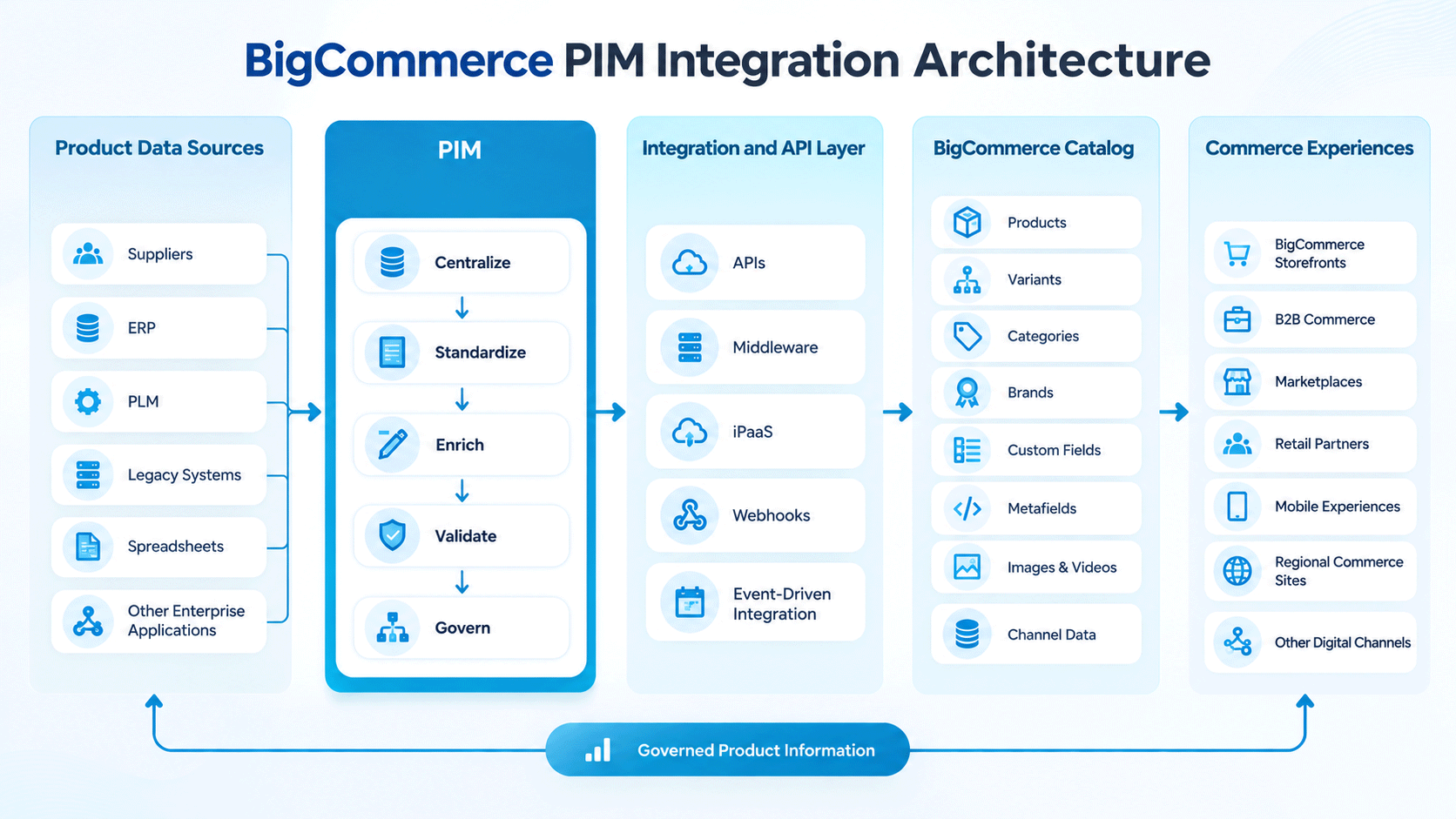
This architecture prevents BigCommerce from unintentionally becoming the enterprise product master while allowing the commerce platform to focus on digital selling experiences.
Product Data We Can Synchronize with BigCommerce
BigCommerce PIM integration can support a broad range of product information depending on your PIM platform, commerce configuration, and system-of-record architecture.

Core Product Information
- Product names
- SKUs
- Product IDs
- UPC
- GTIN
- MPN
- Brand information
- Product descriptions

Classification and Attributes
Categories
Product types
Specifications
Custom fields
Metafields
Controlled attribute values
Product classifications

Variants and Product Relationships
- Product variants
- Variant options
- Size
- Color
- Material
- Capacity
- Model
- Configuration
- Related products
- Accessories
- Replacements
- Bundles

Digital Assets
- Product images
- Variant images
- Videos
- Documents
- Instructions
- Marketing assets

Commerce and SEO Content
- Channel-specific descriptions
- SEO titles
- Search descriptions
- Product URLs where applicable
- Merchandising content
- Localized product information

Physical Product Information
- Dimensions
- Weight
- Packaging information
- Other logistics-related attributes
Pricing, inventory, availability, and other frequently changing transactional information can also participate in the wider integration architecture. However, depending on the enterprise setup, these values may remain mastered in ERP, OMS, WMS, pricing applications, or BigCommerce rather than PIM.
BigCommerce PIM Integration with Your Existing Technology Stack
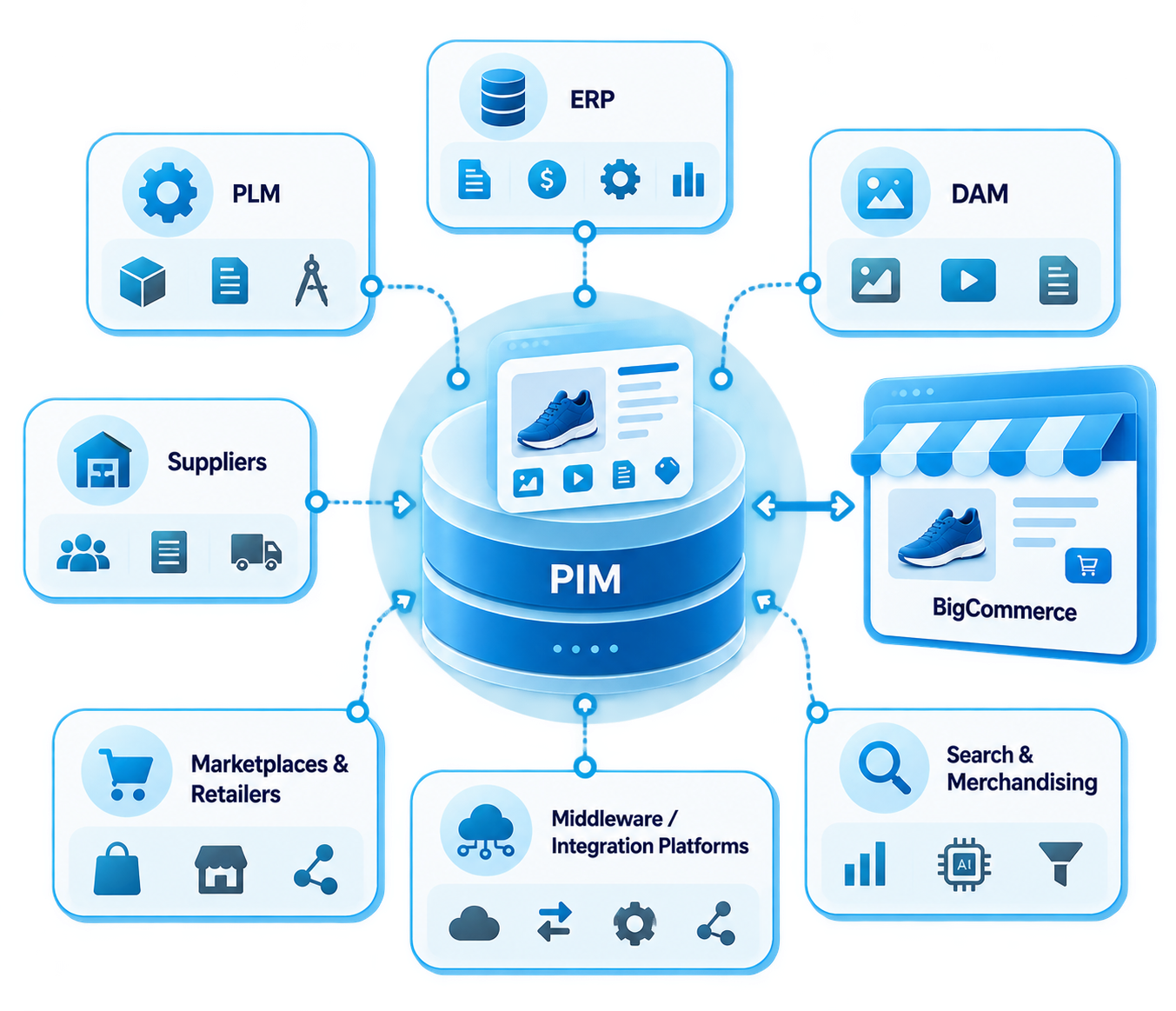
PIM does not operate in isolation. A successful BigCommerce PIM integration connects product information with the wider enterprise systems responsible for product creation, digital assets, transactions, inventory, analytics, and channel distribution.
When Should You Integrate BigCommerce with a PIM?
BigCommerce can manage product information effectively for many commerce use cases. A dedicated PIM becomes increasingly valuable when the product-data operation extends beyond the needs of a single storefront.
You Manage Thousands of Products or Variants
As product and SKU volumes grow, maintaining attributes, relationships, categories, assets, and variant structures directly within commerce platforms becomes harder to govern.
Product Data Comes from Multiple Systems
If information arrives from suppliers, ERP, PLM, DAM, spreadsheets, databases, or other sources, PIM can create one governed layer before the data reaches BigCommerce.
BigCommerce Is Becoming Your Product Master by Accident
When merchandising teams begin maintaining enterprise product information only inside BigCommerce because no upstream product-data system exists, information can become difficult to reuse across other channels.
PIM establishes clear data ownership upstream.
Catalog Updates Require Too Much Manual Work
Repeated uploads, spreadsheet imports, corrections, copy-and-paste processes, and manual approvals indicate that product-data operations are not scaling with the business.
You Sell Through More Than BigCommerce
PIM becomes increasingly valuable when the same products need to support marketplaces, retailers, B2B portals, regional websites, mobile experiences, and other commerce channels.
Your Product Data Is Incomplete or Inconsistent
If products routinely reach storefronts with missing attributes, inconsistent terminology, incorrect variants, or incomplete assets, PIM can enforce quality rules before publication.
You Are Expanding into New Markets or Storefronts
New storefronts introduce additional taxonomy, localization, content, assortment, and channel requirements.
PIM allows core product information to be reused while maintaining market-specific differences.
You Need Better Product Discovery
Search, filters, recommendations, and product comparison all depend on structured attributes and consistent taxonomy. PIM helps create the product-data foundation those experiences require.
BigCommerce Alone vs. PIM + BigCommerce
BigCommerce and PIM solve different problems. BigCommerce provides the commerce experience and transactional environment. PIM governs the rich product information used across BigCommerce and other channels.
Requirement
BigCommerce Alone
PIM + BigCommerce
Simple product catalog
Suitable
Suitable
Multiple upstream product-data sources
Requires additional processes
Centralized and governed
Complex product enrichment
Commerce-focused
Dedicated enrichment workflows
Supplier product onboarding
Additional process required
Structured onboarding and normalization
Product-data governance
Basic commerce governance
Enterprise product governance
Complex product taxonomy
Storefront-oriented
Centralized enterprise taxonomy
Large variant structures
Supported in commerce
Governed upstream and synchronized
Data-quality validation
Requires custom processes
Rules, completeness, and approval workflows
Multiple commerce channels
Repeated channel management
Govern once and syndicate
Localization
Storefront/channel dependent
Centralized localization management
Product relationships
Commerce focused
Enterprise-wide relationship modeling
Large enterprise catalogs
Possible with supporting architecture
Designed for centralized product-data operations
The objective is not to replace BigCommerce. It is to ensure BigCommerce receives trusted, structured, and commerce-ready product information from the right upstream system.
Where BigCommerce Product Data Hits Its Limits
BigCommerce is a strong commerce platform. These are the places where product data outgrows it.
 In BigCommerce
 With a PIM
Custom fields are simple name-value text with short character limits
Typed, validated attributes, grouped by product family
A cap on variants per product
Complex variant logic in the PIM; only sellable variants are published
Metafields are reachable through the API only
Every attribute can be edited and approved in one interface
Multi-storefront catalogs are managed per channel
One record, with channel-specific values, published to every storefront
Bulk edits by CSV
Rules, workflows and change-only syncs
Our Approach to BigCommerce PIM Integration
We follow a structured implementation approach that aligns product data, integration architecture, business workflows, and BigCommerce requirements.
01 Discovery and Architecture
Assess your PIM, BigCommerce catalog, ERP, DAM, product-data sources, workflows, downstream channels, APIs, and business objectives. Define:
- System ownership
- Integration architecture
- Synchronization direction
- Product-data scope
- Dependencies
- Performance requirements
- Implementation priorities
02 Data Modeling and Integration Design
Design or refine product models, attributes, taxonomy, variants, product relationships, validation rules, and BigCommerce mappings. Define how PIM information maps to:
- Products
- Variants
- Categories
- Brands
- Custom fields
- Metafields
- Assets
- Channel requirements
03 Integration, Migration and Validation
Develop APIs, middleware, or connectors and migrate existing catalog information where required. Test:
- Product creation
- Product updates
- Variant synchronization
- Attribute mapping
- Category mapping
- Asset association
- Data-quality validation
- Error handling
- Performance
- End-to-end workflows
04 Deployment and Optimization
Deploy the integration, train business and technical teams, monitor synchronization, resolve exceptions, and optimize workflows as the catalog grows. The integration can then expand to additional storefronts, marketplaces, regions, or business units.
Business Impact of BigCommerce PIM Integration
Connecting BigCommerce to a governed PIM foundation reduces the operational effort required to maintain product catalogs while improving the quality of information reaching commerce experiences.

Real Business Impact: PIM Success Stories in Digital Commerce
Leading eCommerce Agency
70%
Faster Product Data Turnaround
Credencys implemented an AI-powered PIM solution for an eCommerce agency managing more than 500,000 active SKUs across 70+ retail partners and 20+ home-furnishing categories. The solution centralized product information, attributes, and digital assets, automated product onboarding and enrichment, and introduced structured data-governance workflows to support rapidly growing commerce operations.
Read MoreLeading U.S.-Based Retail Brand
40%
Improvement in Marketplace Control
Credencys implemented a Pimcore-based product-data solution for a retail brand managing a complex catalog across multiple marketplaces. The solution centralized data enrichment, introduced custom data-quality reporting, enabled bulk product updates, and streamlined marketplace distribution to ensure accurate product information reached the right channels.
Read MoreLeading Automotive Aftermarket Retailer
50%
Improvement in Data Compliance
Credencys implemented a centralized PIM solution for an automotive aftermarket retailer managing thousands of SKUs across distributors, resellers, and digital channels. The solution consolidated scattered product information, automated product validation, introduced configurable taxonomy management, and streamlined product-data syndication.
Read MoreReady to Simplify Your BigCommerce Product Data?
Connect BigCommerce to a governed product-data foundation that accelerates catalog updates, improves product accuracy, simplifies variant management, and supports growth across storefronts and digital channels.
Book a Free ConsultationWhy Leading Enterprises Choose Credencys?

End-to-End Data Expertise
From product-data strategy and modeling to integration, migration, governance, syndication, and commerce enablement, Credencys helps enterprises solve product-data challenges across the complete lifecycle.

Domain-Focused Solutions
We design PIM solutions around the complexity of your products, industry requirements, channels, supplier ecosystem, and customer experiences.

Enterprise-Grade Partnerships
Our PIM and data expertise enables organizations to build scalable architectures around enterprise platforms and complex system landscapes.

AI-First
We help businesses establish structured, governed, and machine-readable product information that can support search, recommendations, automation, and AI-enabled commerce.
50+
Enterprise Clients
100%
Certified Consultants
15+
Years Experience
4.9/5
Client Satisfaction


Frequently Asked Questions
BigCommerce PIM integration connects a Product Information Management system with BigCommerce so governed product information can be enriched, validated, and synchronized with the commerce catalog. PIM manages the upstream product-data foundation, while BigCommerce uses approved information to power storefront products, variants, categories, and digital commerce experiences.
A PIM becomes valuable when product information comes from multiple sources, catalogs contain complex variants or attributes, multiple teams participate in enrichment, or product content must be distributed beyond BigCommerce. The integration reduces manual catalog work and creates one governed process for preparing product information before it reaches commerce channels.
BigCommerce provides extensive catalog-management capabilities for products, variants, categories, brands, custom fields, metafields, imagery, and other commerce information. A dedicated PIM serves a different role. PIM provides enterprise-wide product-data collection, enrichment, governance, workflow, taxonomy, quality management, localization, and multichannel distribution before approved information reaches BigCommerce and other destinations.
A dedicated PIM becomes particularly useful when you manage:
- Large product catalogs
- Complex product attributes
- Multiple variants
- Several suppliers
- Multiple upstream systems
- Multiple storefronts
- Marketplaces
- B2B catalogs
- International markets
- Complex enrichment workflows
The greater the product-data complexity outside BigCommerce, the stronger the case for an upstream PIM.
PIM can integrate with BigCommerce through APIs, middleware, iPaaS platforms, webhooks, scheduled synchronization, custom integration services, or combinations of these approaches. The right architecture depends on product volume, update frequency, existing enterprise systems, performance requirements, and which application owns each data domain.
A focused first release typically takes 3 to 6 months; larger programmes run in phases over 6 to 12 months or more.
Trusted by Best
Choosing Credencys means partnering with a team that’s deeply committed to unlocking the true value of your data. Here’s why industry leaders trust us:
Our Valued Clientele


Send us a Message
