Top DataOps Tools in 2026 to Build Scalable, Reliable Data Pipelines

The volume, velocity, and variety of data are growing at an unprecedented pace. From real-time customer interactions to AI-driven decision-making, modern enterprises are now managing hundreds of data pipelines across cloud platforms, applications, and business systems.

As organizations scale their analytics and AI initiatives, the demand for faster, more reliable data has never been higher. But here’s the problem: traditional data engineering approaches are breaking down.

Legacy workflows were never designed for today’s complexity. Teams often deal with:

  • Fragmented pipelines across multiple tools
  • Manual processes that slow down deployment
  • Poor data quality and unreliable outputs
  • Limited visibility into pipeline failures

The result? Delayed insights, frustrated teams, and missed business opportunities.

Studies show that only about 20% of raw business data actually reaches analytics systems, highlighting massive inefficiencies in traditional data workflows.

This is exactly where DataOps comes in. Inspired by DevOps, DataOps introduces a modern approach to managing data pipelines focused on automation, collaboration, and reliability.

It enables organizations to:

  • Automate data workflows end-to-end
  • Improve data quality through continuous monitoring and testing
  • Accelerate time-to-insight
  • Foster better collaboration between data engineers, analysts, and business teams

The impact is significant. Organizations adopting DataOps tools report faster insights, improved operational efficiency, and stronger business outcomes, with many seeing measurable improvements in productivity and data reliability.

In this blog, we’ll help you navigate the DataOps landscape by covering:

  • The top DataOps tools in 2026
  • Key tool categories and use cases
  • A detailed comparison of leading platforms
  • A practical guide on how to choose the right DataOps tool for your business

Let’s dive in.

What is DataOps?

DataOps is a set of practices, processes, and technologies designed to improve the speed, quality, and reliability of data analytics. It brings together principles from DevOps, Agile, and data engineering to create a more automated, collaborative, and scalable data ecosystem.

Instead of treating data pipelines as one-off projects, DataOps approaches them as continuous, production-grade systems that require monitoring, testing, and ongoing optimization.

Key Principles of DataOps

DataOps is built on a few foundational principles that enable modern data teams to operate efficiently:

Automation

  • Automates data ingestion, transformation, and deployment
  • Reduces manual errors and accelerates delivery cycles

Continuous Integration & Continuous Delivery (CI/CD)

  • Enables rapid updates to data pipelines without breaking systems
  • Ensures faster release of analytics and insights

Data Quality & Observability

  • Continuously monitors data freshness, accuracy, and anomalies
  • Helps teams detect and resolve issues before they impact business decisions

Collaboration Across Teams

  • Breaks silos between data engineers, analysts, and business users
  • Encourages shared ownership of data pipelines and outcomes

Why DataOps is Critical for Modern Businesses

As organizations move toward AI-driven and real-time decision-making, DataOps has become essential. Here’s why:

Faster Time-to-Insight

  • Automated pipelines reduce delays in data processing
  • Business users get timely, actionable insights

Improved Data Reliability

  • Built-in testing and monitoring ensure high-quality data
  • Reduces the risk of flawed analytics and decisions

Better Support for AI/ML Initiatives

  • Reliable, well-managed data pipelines are the backbone of AI models
  • Enables continuous model training and improvement

Reduced Operational Bottlenecks

  • Eliminates manual intervention and firefighting
  • Frees up teams to focus on innovation instead of maintenance

DataOps transforms data from a bottleneck into a strategic asset, enabling organizations to scale analytics, improve decision-making, and stay competitive in a data-driven world.

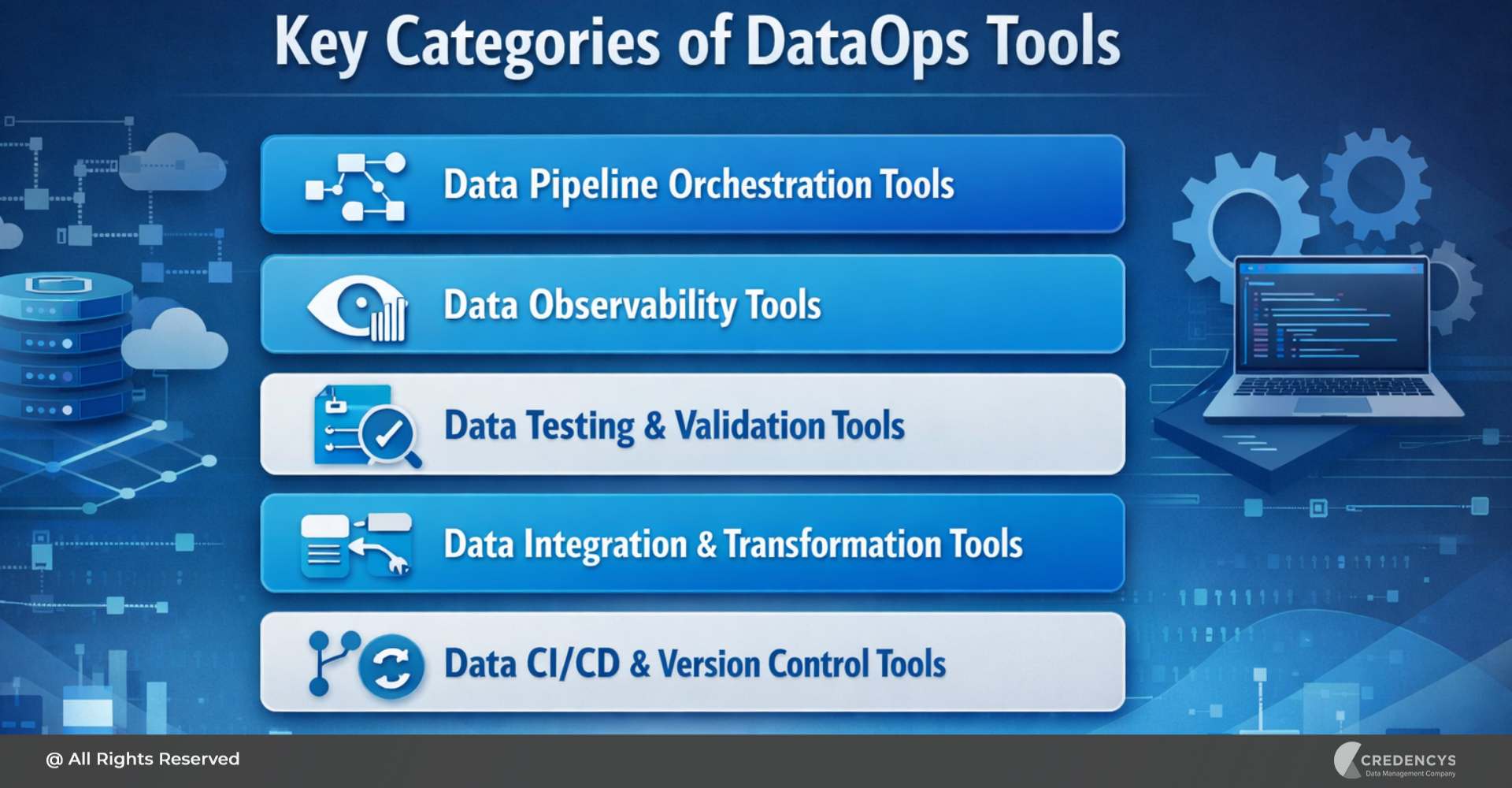
Key Categories of DataOps Tools

Before diving into the top DataOps tools, it’s important to understand that no single tool solves everything. A modern DataOps stack comprises multiple categories, each addressing a specific part of the data lifecycle.

Breaking tools into these categories will help you evaluate, compare, and choose the right combination based on your business needs.

1. Data Pipeline Orchestration Tools

These tools act as the central nervous system of your data operations. They help you:

  • Schedule and automate workflows
  • Manage dependencies between tasks
  • Monitor pipeline execution

Why it matters: Without orchestration, pipelines become chaotic and difficult to scale.

Typical use cases:

  • Automating ETL/ELT workflows
  • Managing complex, multi-step data pipelines
  • Handling retries and failure recovery

2. Data Observability Tools

Data observability tools provide visibility into the health of your data pipelines. They help answer critical questions like:

  • Is the data fresh?
  • Has something broken?
  • Are there anomalies in the data?

Why it matters: You can’t fix what you can’t see. Observability ensures trust in your data.

Typical use cases:

  • Detecting data anomalies and schema changes
  • Monitoring pipeline health in real time
  • Root cause analysis for failures

3. Data Testing & Validation Tools

These tools ensure that your data is accurate, consistent, and reliable before it reaches business users.

Why it matters: Bad data leads to bad decisions; testing is non-negotiable in DataOps.

Typical use cases:

  • Validating data quality rules
  • Schema testing
  • Preventing pipeline breakages during updates

4. Data Integration & Transformation Tools

These tools focus on moving and transforming data across systems. They enable:

  • Data ingestion from multiple sources
  • Data transformation into usable formats
  • Building scalable ETL/ELT pipelines

Why it matters: They form the backbone of any data platform.

Typical use cases:

  • Integrating data from CRMs, ERPs, APIs
  • Transforming raw data into analytics-ready datasets
  • Supporting data warehouse/lakehouse architectures

5. Data CI/CD & Version Control Tools

These tools bring software engineering discipline into data workflows. They help teams:

  • Version control data pipelines
  • Automate deployments
  • Collaborate more effectively

Why it matters: As data systems grow, manual deployments become risky and unsustainable.

Typical use cases:

  • Managing changes in data models
  • Automating testing and deployment pipelines
  • Enabling team collaboration across environments
Key Categories of DataOps Tools

Top DataOps Tools in 2026 (Expert Picks)

With a rapidly evolving data ecosystem, organizations are no longer looking for standalone tools; they need solutions that fit into a connected, scalable DataOps strategy. The right tools not only streamline workflows but also improve data reliability, enable faster deployments, and support advanced analytics and AI initiatives.

Here are 5 of the most impactful DataOps tools in 2026, carefully selected for their capabilities, adoption, and relevance to modern data teams.

1. Apache Airflow

Apache Airflow remains one of the most widely adopted tools for data pipeline orchestration, especially in complex enterprise environments. It allows teams to define workflows as code using Python, making it highly flexible and extensible.

Key Features:

  • DAG (Directed Acyclic Graph)-based workflow management
  • Dynamic scheduling and dependency handling
  • Extensive library of integrations with cloud and data tools

Pros:

  • Highly customizable for complex workflows
  • Strong open-source community and ecosystem
  • Scales well with the right infrastructure

Cons:

  • Requires dedicated resources for setup and maintenance
  • Can become complex to manage at scale without proper governance

Best For:

  • Organizations that need full control over complex data pipelines and have the engineering maturity to manage them.

2. Databricks

Databricks has evolved into a unified DataOps platform by combining data engineering, analytics, and AI within a lakehouse architecture. Its native workflow capabilities allow teams to orchestrate pipelines while seamlessly integrating with large-scale data processing and machine learning.

Key Features:

  • Unified lakehouse architecture (data lake + warehouse)
  • Built-in workflow orchestration and job scheduling
  • Native support for big data processing and AI/ML

Pros:

  • End-to-end platform reduces tool sprawl
  • Highly scalable for enterprise-grade workloads
  • Strong integration with modern data stacks

Cons:

  • Higher cost compared to standalone tools
  • Requires expertise to fully leverage its capabilities

Best For:

  • Enterprises building data-intensive, AI-driven platforms that require scalability and unified operations.

3. Prefect

Prefect is a modern orchestration tool designed to address many of the usability and reliability challenges of traditional schedulers. It offers a developer-first approach with improved visibility and control over data workflows.

Key Features:

  • Python-native workflow creation
  • Dynamic and reactive pipeline execution
  • Built-in observability and monitoring

Pros:

  • Easier to set up and use compared to legacy tools
  • Strong focus on developer experience
  • Flexible deployment options (cloud or self-hosted)

Cons:

  • Smaller ecosystem compared to more established tools
  • Advanced enterprise features may require paid plans

Best For:

  • Teams looking for a modern, flexible orchestration tool with faster onboarding and better usability.

4. Monte Carlo

Monte Carlo is a leading data observability platform that helps organizations ensure the reliability and trustworthiness of their data pipelines. It provides deep visibility into data health, making it easier to detect and resolve issues before they impact business outcomes.

Key Features:

  • Automated anomaly detection across datasets
  • End-to-end pipeline monitoring
  • Root cause analysis and alerting

Pros:

  • Strong focus on data reliability at scale
  • Reduces downtime and data incidents
  • Enterprise-ready with advanced monitoring capabilities

Cons:

  • Premium pricing may not suit smaller teams
  • Primarily focused on observability (not a full pipeline solution)

Best For:

  • Organizations where data quality and uptime are mission-critical, such as those that rely on real-time analytics or AI-driven decision-making.

5. dbt

dbt has become a cornerstone of modern DataOps by enabling teams to transform data directly within their data warehouse using SQL. It brings software engineering best practices like version control, testing, and modular development into analytics workflows.

Key Features:

  • SQL-based data transformation
  • Built-in testing and documentation
  • Integration with version control systems (like Git)

Pros:

  • Empowers analytics engineers and data teams
  • Strong community and widespread adoption
  • Improves collaboration and governance

Cons:

  • Limited to the transformation layer (not orchestration or ingestion)
  • Requires a modern data warehouse/lakehouse setup

Best For:

  • Teams focused on data modeling, transformation, and analytics engineering within a modern data stack.

These tools represent the core building blocks of a modern DataOps ecosystem, from orchestration and transformation to observability. The right combination depends on your organization’s data maturity, architecture, and business goals.

ToolCategoryBest ForKey StrengthLimitation
Apache AirflowOrchestrationComplex, large-scale data pipelinesHighly flexible & customizableRequires setup, maintenance, and expertise
DatabricksUnified Data PlatformEnterprise data + AI workloadsEnd-to-end scalability & integrationHigher cost and learning curve
PrefectOrchestrationModern, developer-friendly workflowsEasy to use with strong observabilitySmaller ecosystem compared to Airflow
Monte CarloObservabilityMonitoring data quality at scaleAutomated anomaly detectionLimited to observability use cases
dbtTransformationData modeling and analytics engineeringSQL-based transformation & testingNot a full DataOps solution (no orchestration)

How to Choose the Right DataOps Tool

With so many options available, selecting the right DataOps tool can quickly become overwhelming. The key is to move beyond feature comparisons and focus on how well a tool aligns with your business goals, data architecture, and team capabilities.

Here’s a practical framework to guide your decision-making:

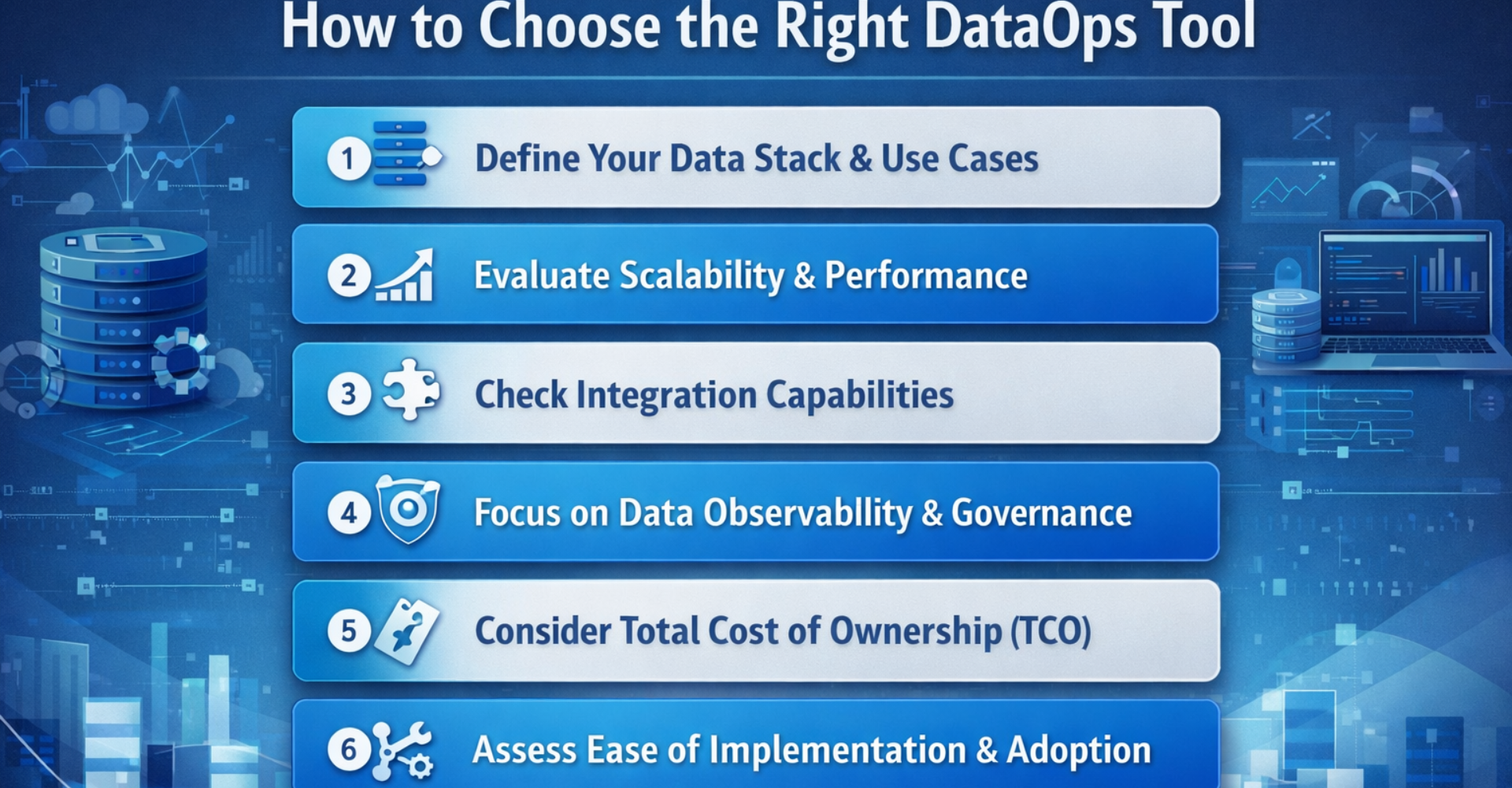
1. Define Your Data Stack & Use Cases

Start by understanding your current and future data needs. Ask yourself:

  • Are you working with batch processing, real-time data, or both?
  • Do you need to support AI/ML workloads?
  • What does your existing stack look like (cloud, warehouse, lakehouse)?

Why it matters: Not all tools are designed for every use case. Choosing the wrong one can lead to scalability issues later.

2. Evaluate Scalability & Performance

As your data grows, your tools should scale without compromising performance. Consider:

  • Data volume and pipeline complexity
  • Ability to handle concurrent workflows
  • Performance under peak loads

Why it matters: A tool that works for a small team may fail at enterprise scale.

3. Check Integration Capabilities

Your DataOps tool should integrate seamlessly with your existing ecosystem. Look for compatibility with:

  • Data warehouses/lakehouses
  • BI tools
  • AI/ML platforms
  • Cloud providers

Why it matters: Poor integration leads to data silos and operational inefficiencies.

4. Focus on Data Observability & Governance

Data reliability is non-negotiable, especially for decision-making and AI. Evaluate:

  • Built-in monitoring and alerting
  • Data quality checks
  • Lineage and audit capabilities

Why it matters: Without observability, you risk making decisions on inaccurate or outdated data.

5. Consider Total Cost of Ownership (TCO)

The cost of a tool goes beyond licensing. Include:

  • Infrastructure costs
  • Maintenance and support
  • Hiring or training resources

Why it matters: A cheaper tool upfront may become expensive in the long run due to operational overhead.

6. Assess Ease of Implementation & Adoption

Even the most powerful tool is useless if your team can’t use it effectively. Check:

  • Learning curve
  • Documentation and community support
  • Availability of managed services

Why it matters: Faster adoption leads to quicker ROI and reduced friction across teams.
How to Choose the Right DataOps Tool

Why Credencys is Your Ideal DataOps Implementation Partner

Choosing the right DataOps tools is only half the battle. The real challenge lies in implementing, integrating, and scaling them effectively within your existing data ecosystem.

That’s where the right partner makes all the difference. Credencys helps organizations move beyond tool selection to build a fully operational, scalable, and outcome-driven DataOps framework.

1. End-to-End DataOps Expertise

Credencys supports your entire DataOps journey, from strategy to execution and continuous optimization.

  • Assess your current data maturity and gaps
  • Define a tailored DataOps roadmap
  • Implement and integrate the right tools
  • Continuously optimize pipelines for performance and reliability

Result: A structured, future-ready DataOps foundation aligned with your business goals.

2. Strong Experience with Modern Data Stack

Credencys brings hands-on expertise across leading DataOps and analytics platforms, including:

  • Databricks and modern lakehouse architectures
  • Cloud data platforms like Snowflake
  • Transformation tools like dbt
  • Orchestration and pipeline automation tools

Result: Seamless integration across your data ecosystem with minimal disruption.

3. Industry-Focused Approach

Unlike generic consulting firms, Credencys takes a domain-driven approach, especially across:

  • Retail
  • eCommerce
  • Manufacturing
  • Supply Chain
  • CPG

This ensures your DataOps implementation is not just technically sound but also aligned with industry-specific challenges and use cases.

Result: Faster time-to-value with solutions tailored to your business context.

4. Accelerated Implementation Frameworks

Credencys leverages proven frameworks and best practices to speed up deployment.

  • Pre-built accelerators for common use cases
  • Standardized implementation methodologies
  • Automation-first approach

Result: Reduced implementation time and quicker ROI.

5. Focus on Business Outcomes

Credencys prioritizes measurable impact over technical complexity.

  • Improved data reliability and quality
  • Faster analytics and reporting cycles
  • Enhanced readiness for AI/ML initiatives

Result: Tangible business value, not just a modernized tech stack.

With the right strategy and partner in place, DataOps becomes a competitive advantage rather than just a process.

Conclusion

From orchestrating complex pipelines to ensuring data quality and observability, the right set of tools can help organizations:

  • Accelerate time-to-insight
  • Improve data reliability and trust
  • Enable seamless collaboration across teams
  • Support advanced analytics and AI initiatives

However, it’s important to remember that DataOps success is about building a cohesive strategy, integrating the tools effectively, and aligning them with your business goals. Whether you are just starting your DataOps journey or looking to optimize your existing setup, taking a structured, outcome-driven approach will help you unlock the full value of your data.

If you are looking to implement or scale DataOps within your organization, partnering with experts like Credencys can help you move faster, reduce risks, and achieve measurable results.

Data Pipeline Implementation: Step-by-Step Approach for Enterprise Success

Over 80% of data projects fail to deliver measurable business value, not because of a lack of data, but because of how that data flows. Poor integration, unreliable pipelines, and delayed processing continue to hold organizations back from becoming truly data-driven.

That’s where Data Pipeline Implementation becomes critical.

In today’s enterprise landscape, data is constantly moving across systems, applications, and channels. From customer interactions and product catalogs to operational and transactional data, every insight depends on how efficiently this data is collected, processed, and delivered.

But here’s the challenge. Most organizations do not struggle with access to data. They struggle with making data usable, reliable, and timely.

A poorly implemented data pipeline leads to:

  • Data silos and inconsistencies
  • Delayed analytics and reporting
  • Increased operational overhead
  • Limited trust in data across teams

On the other hand, a well-designed data pipeline enables:

  • Real-time decision-making
  • Scalable data operations
  • Improved data quality and governance
  • Faster time to insight

What are Data Pipelines?

This blog will walk you through how to get Data Pipeline Implementation right, covering the right strategy, essential tools, and proven best practices to help you build pipelines that are not just functional, but scalable, reliable, and aligned with business goals.

A data pipeline is a system that moves data from multiple sources to a destination where it can be stored, processed, and used for analysis.

It ensures that data flows in a structured and reliable way across your organization. Instead of manually collecting and preparing data from different systems, pipelines automate the process, making data readily available for reporting, analytics, and business decisions.

Typically, a data pipeline involves collecting raw data, transforming it into a usable format, and delivering it to systems like data warehouses or analytics platforms.

In simple terms, data pipelines act as the backbone of modern data operations. They connect fragmented data sources and turn them into consistent, usable insights that teams can rely on.

Strategy for Data Pipeline Implementation

Getting Data Pipeline Implementation right starts with strategy, not tools.

Many organizations jump straight into selecting technologies, only to realize later that their pipelines are difficult to scale, maintain, or align with business needs. A strong strategy ensures your pipeline is built for long-term success.

1. Define Clear Business Objectives

Start with the outcomes you want to achieve. Whether it is real-time personalization, faster reporting, or unified customer data, your pipeline should be designed around business goals, not just data movement.

When objectives are unclear, pipelines often become overly complex and fail to deliver measurable value.

2. Identify Data Sources and Consumers

Understand where your data is coming from and who will use it. This includes internal systems, third-party platforms, APIs, and streaming sources.

At the same time, identify the end users of this data such as analytics teams, business users, or AI models. This ensures your pipeline delivers the right data in the right format and frequency.

3. Choose the Right Architecture

Decide whether your use

case requires batch processing, real-time streaming, or a hybrid approach.

Also consider whether a centralized architecture or a more distributed model fits your scale and organizational structure. Making these decisions early prevents rework later.

4. Build for Data Quality and Governance

Data pipelines are only as valuable as the quality of data they deliver.

Include validation checks, standardization rules, and governance policies within the pipeline. This helps maintain consistency, accuracy, and trust across teams.

5. Design for Scalability and Flexibility

As your data grows, your pipeline should scale without performance bottlenecks.

Cloud-native and modular architectures allow you to handle increasing volumes and evolving requirements without rebuilding your entire pipeline.

6. Ensure Monitoring and Observability

A pipeline should never be a black box.

Implement monitoring to track performance, detect failures, and ensure data is flowing as expected. Observability helps teams quickly identify and resolve issues before they impact business decisions.

Tools for Data Pipeline Implementation

Choosing the right tools is a critical part of successful Data Pipeline Implementation. The focus should be on building a cohesive ecosystem that aligns with your data strategy, not just selecting individual tools.

1. Data Ingestion Tools

These tools help collect data from multiple sources such as databases, APIs, and applications.

Popular options include:

  • Apache Kafka for real-time data streaming
  • Fivetran for automated data ingestion
  • Apache NiFi for data routing and integration

2. Data Processing and Transformation

This layer is where raw data is cleaned, transformed, and prepared for analysis.

Common tools include:

  • Apache Spark for large-scale processing
  • dbt for warehouse-native transformations
  • Databricks for unified data processing, analytics, and machine learning

3. Orchestration and Workflow Management

These tools help schedule, automate, and monitor data workflows.

Examples include:

  • Apache Airflow for managing complex pipelines
  • Prefect for modern orchestration and observability

4. Data Storage and Analytics Platforms

Processed data is stored and made available for analytics and reporting.

Popular platforms include:

  • Snowflake for scalable and governed analytics
  • Google BigQuery for fast SQL-based insights
  • Amazon Redshift for enterprise-scale workloads

5. Monitoring and Observability

To maintain reliability, pipelines must be continuously monitored.

Tools include:

  • Datadog for performance tracking
  • Monte Carlo for tracking data quality and pipeline health

Best Practices for Data Pipeline Implementation

A successful Data Pipeline Implementation is not just about building pipelines. It is about building pipelines that are reliable, scalable, and aligned with business needs.

Here are the key best practices to follow:

1. Design for Reliability from Day One

Pipelines should be built to handle failures gracefully. Include retry mechanisms, fault tolerance, and backup processes to ensure data flow is not disrupted.

Unreliable pipelines lead to broken dashboards and loss of trust in data.

2. Prioritize Data Quality Early

Do not treat data quality as an afterthought. Implement validation checks, schema enforcement, and data cleansing within the pipeline.

High-quality input ensures accurate insights and better decision-making.

3. Build Modular and Reusable Pipelines

Avoid tightly coupled designs. Break pipelines into smaller, reusable components that can be easily updated or scaled.

This reduces maintenance effort and improves flexibility as requirements evolve.

4. Automate as Much as Possible

Manual intervention slows down data operations and increases the risk of errors.

Use orchestration tools to automate scheduling, dependency management, and error handling across pipelines.

5. Implement Strong Monitoring and Alerts

Always have visibility into pipeline performance.

Set up alerts for failures, delays, and anomalies so teams can act quickly. Observability ensures your pipeline remains reliable over time.

6. Optimize for Performance and Cost

Balance speed and cost efficiency. Not all workloads need real-time processing.

Choose the right processing approach based on business requirements to avoid unnecessary infrastructure costs.

7. Ensure Security and Compliance

Data pipelines often handle sensitive information.

Implement access controls, encryption, and compliance measures to protect data and meet regulatory requirements.

Conclusion

Getting Data Pipeline Implementation right is no longer optional. It is a foundational capability for any organization looking to scale analytics, AI, and data-driven decision-making.

As data volumes grow and business expectations shift toward real-time insights, pipelines must evolve from basic data movement systems to strategic assets that enable speed, reliability, and trust.

Organizations that invest in the right data pipeline strategy are able to move faster, reduce operational inefficiencies, and unlock the true value of their data.

However, many teams still struggle to assess where they stand and what to fix first.

That’s where a structured evaluation can help.

If you are unsure about the maturity of your current data setup, start with a Product Data Readiness Assessment. It helps you identify gaps in your data pipelines, uncover inefficiencies, and define a clear roadmap for improvement.

Top Data Warehouse Tools in 2026: Features, Comparisons & How to Choose the Right Platform

Data is growing at an unprecedented pace, and so is the demand to turn that data into real-time, actionable insights. Today, businesses can no longer rely on delayed reports or batch processing.

Around 58% of companies now use real-time data pipelines to enable faster decision-making, highlighting how quickly real-time analytics is becoming the norm.

This surge in demand has fundamentally transformed how data is stored and processed. Modern systems are built to handle massive data volumes, support real-time analytics, and seamlessly integrate with AI and machine learning workloads.

However, with a growing number of platforms and architectural choices, selecting the right data warehouse tool has become increasingly complex. A poor choice can lead to performance bottlenecks, rising expenses, and limited innovation potential.

In this guide, we simplify that decision-making process. You will discover the top data warehouse tools in 2026, explore a side-by-side comparison of their capabilities, and learn a practical framework to choose the right platform based on your business needs.

What Are Data Warehouse Tools?

Data warehouse tools are platforms designed to collect, store, and analyze large volumes of structured data from multiple sources in a centralized repository. They serve as the foundation for business intelligence, reporting, and advanced analytics, enabling organizations to make data-driven decisions with confidence.

At their core, these tools bring together data from systems like CRM, ERP, marketing platforms, and transactional databases, transforming raw data into a format optimized for querying and analysis.

Key Capabilities of Data Warehouse Tools

Modern data warehouse platforms go far beyond simple storage. They provide:

  • Data Ingestion: Seamlessly collect data from multiple sources, including cloud apps, databases, and streaming systems
  • Data Storage: Efficiently store structured and semi-structured data at scale
  • Data Processing: Enable fast query execution using distributed computing and columnar storage
  • Analytics & Querying: Support SQL-based analysis and integration with BI tools like dashboards and reporting platforms
  • Integration: Connect easily with ETL/ELT pipelines, data lakes, and AI/ML tools

Why Choosing the Right Data Warehouse Tool Matters

Selecting a data warehouse tool is a strategic decision that directly impacts your organization’s ability to scale, innovate, and compete in a data-driven world. The right platform can accelerate analytics, reduce costs, and empower teams with faster insights.

The wrong choice, however, can lead to inefficiencies, rising expenses, and long-term limitations.

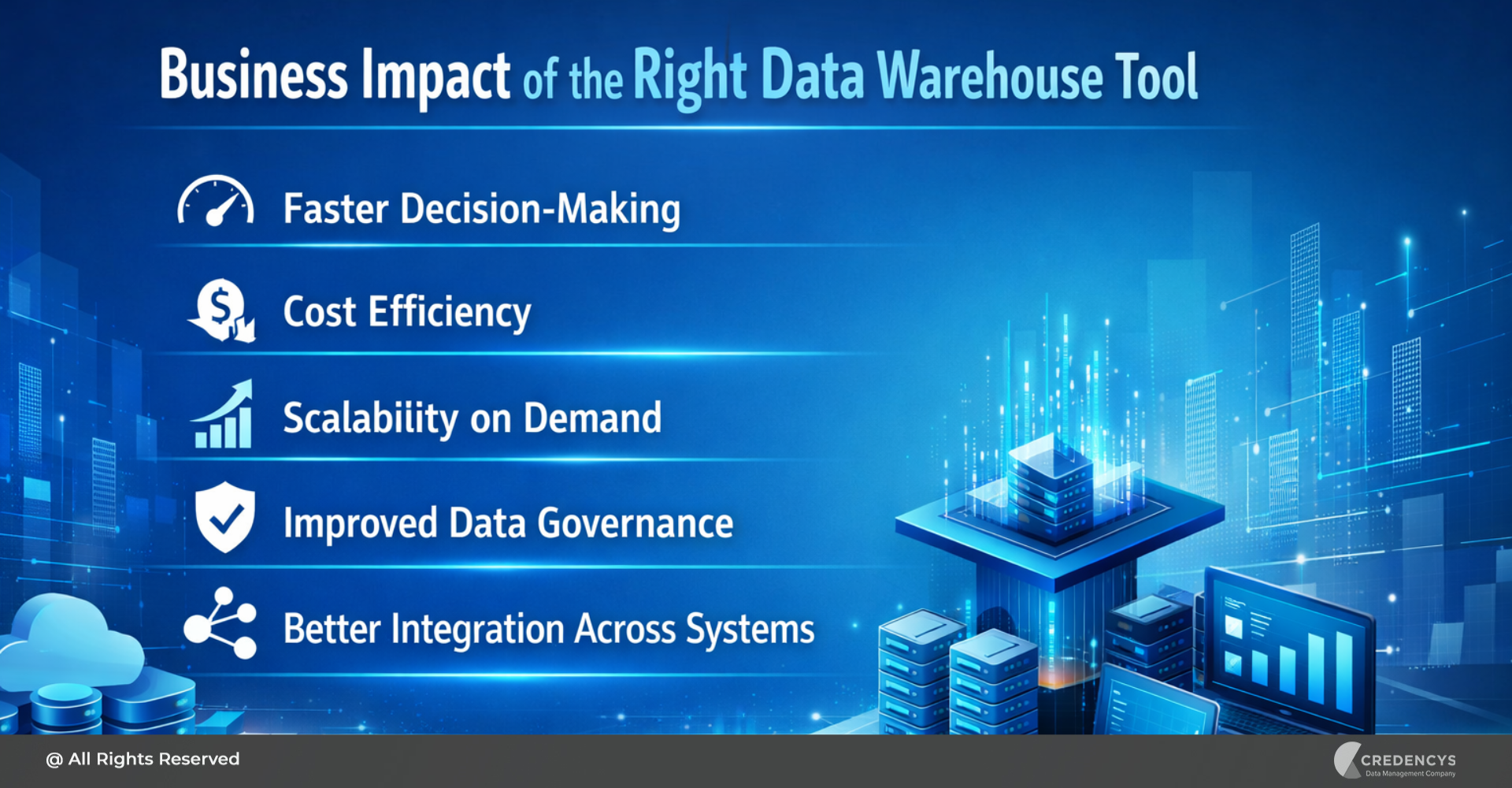
Business Impact of the Right Data Warehouse Tool

A well-aligned data warehouse tool enables:

  • Faster Decision-Making: High-performance query engines and real-time processing allow teams to access insights instantly rather than waiting hours or days
  • Cost Efficiency: Modern cloud platforms offer flexible pricing models (pay-per-query, on-demand compute), helping optimize infrastructure costs
  • Scalability on Demand: Easily scale storage and compute resources as your data grows without major infrastructure investments
  • Improved Data Governance: Built-in security, access controls, and compliance features ensure data is accurate, secure, and accessible to the right users
  • Better Integration Across Systems: Seamless connectivity with BI tools, ETL pipelines, and AI/ML platforms enables a unified data ecosystem

Business Impact of the Right Data Warehouse Tool

Risks of Choosing the Wrong Platform

On the flip side, an ill-suited data warehouse tool can create significant challenges:

  • High Total Cost of Ownership: Hidden costs from inefficient queries, over-provisioned resources, or licensing models
  • Performance Bottlenecks: Slow query execution and limited concurrency can delay insights and frustrate teams
  • Vendor Lock-in: Limited flexibility to migrate or integrate with other platforms
  • Complex Integrations: Difficulty connecting with existing tools and data sources
  • Limited Future Readiness: Inability to support advanced use cases like real-time analytics or AI/ML workloads

The right data warehouse tool becomes a growth enabler, while the wrong one turns into a long-term constraint. That’s why organizations must evaluate their options carefully based on business goals, data needs, and future scalability requirements.

Top Data Warehouse Tools in 2026 (Expert Picks)

In a rapidly evolving data ecosystem, several platforms have emerged as leaders in data warehousing. Each tool offers unique strengths, ranging from scalability and performance to advanced analytics and AI capabilities.

Below are the top data warehouse tools in 2026 that enterprises are trusting for modern analytics:

1. Snowflake

A fully managed, cloud-native data warehouse known for its separation of storage and compute, enabling high scalability and performance.

Key Features:

  • Multi-cluster shared data architecture
  • Near-zero maintenance (fully managed)
  • Secure data sharing across organizations
  • Supports structured and semi-structured data

Best For:

  • Enterprises looking for scalability, ease of use, and multi-cloud flexibility

Limitations:

  • Can become expensive with heavy usage
  • Limited built-in ML capabilities compared to lakehouse platforms

2. Google BigQuery

A serverless, highly scalable data warehouse designed for real-time analytics and big data processing.

Key Features:

  • Serverless architecture (no infrastructure management)
  • Pay-per-query pricing model
  • Built-in machine learning (BigQuery ML)
  • Real-time analytics capabilities

Best For:

  • Organizations handling large-scale analytics with unpredictable workloads

Limitations:

  • Cost unpredictability with high query volumes
  • Less control over infrastructure

3. Amazon Redshift

A powerful, fully managed data warehouse service within the AWS ecosystem, optimized for large-scale data processing.

Key Features:

  • Deep integration with AWS services
  • Columnar storage for faster queries
  • RA3 instances for scalable storage
  • Supports structured and semi-structured data

Best For:

  • Businesses already invested in the AWS ecosystem

Limitations:

  • Requires tuning for optimal performance
  • Can be complex for beginners

4. Databricks

A unified analytics platform that combines data warehousing and data lake capabilities through the lakehouse architecture.

Key Features:

  • Delta Lake for reliable data storage
  • Unified support for BI, data engineering, and ML
  • Strong AI/ML and real-time analytics capabilities
  • Open and flexible architecture

Best For:

  • Organizations looking to unify data warehousing with AI/ML workloads

Limitations:

  • Steeper learning curve
  • Requires strong data engineering expertise

5. Microsoft Azure Synapse Analytics

An integrated analytics service that combines data warehousing, big data analytics, and data integration.

Key Features:

  • Unified experience across data pipelines and analytics
  • Integration with Power BI and Azure services
  • Serverless and dedicated resource options
  • Strong enterprise security

Best For:

  • Organizations using the Microsoft ecosystem

Limitations:

  • Can be complex to configure
  • Performance tuning required

These tools represent the best-in-class data warehouse platforms in 2026, each catering to different business needs, architectures, and ecosystems.

ToolDeployment TypePricing ModelScalabilityBest Use CaseKey Strength
SnowflakeCloud (multi-cloud)Pay-per-use (compute + storage)Very highEnterprise BI & data sharingSeparation of compute & storage
Google BigQueryCloud (Serverless)Pay-per-queryVery HighReal-time analytics, big dataServerless & fast queries
Amazon RedShiftCloud (AWS)Instance-based + storageHighAWS-based analytics workloadsDeep AWS integration
DatabricksCloud (multi-cloud)Usage-basedVery HighAI/ML + unified analyticsLakehouse architecture
Microsoft Azure Synapse AnalyticsCloud (Azure)Pay-per-query + dedicatedHighEnterprise analytics (Microsoft stack)Unified analytics platform

This comparison gives you a high-level view, but the right choice ultimately depends on your specific use case, budget, and long-term data strategy.

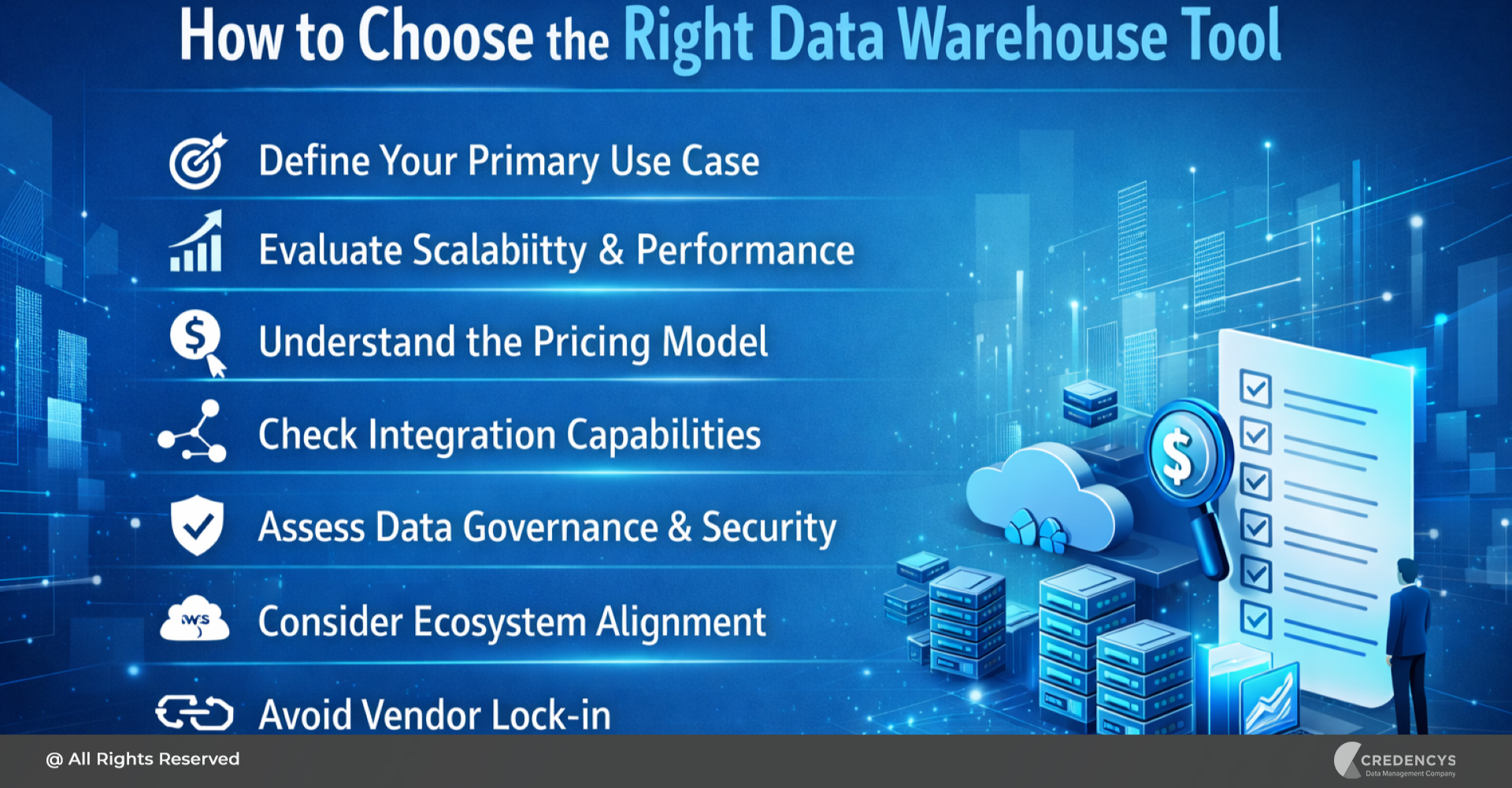
How to Choose the Right Data Warehouse Tool

Choosing the right data warehouse tool means selecting one that aligns with your business goals, data strategy, and future scalability needs. Here’s a practical framework to help you make the right decision:

1. Define Your Primary Use Case

Start by identifying what you want to achieve with your data:

  • Business Intelligence & Reporting: Choose tools optimized for fast SQL queries and dashboards
  • Real-Time Analytics: Look for platforms with streaming and low-latency capabilities
  • AI/ML Workloads: Consider unified platforms like Databricks

Your use case will quickly narrow down the most suitable tools.

2. Evaluate Scalability & Performance

Your data will grow, and your platform must grow with it.

  • Can it handle increasing data volumes without performance degradation?
  • Does it support high concurrency (multiple users/queries)?
  • Does it separate compute and storage (like Snowflake)?

Scalability ensures long-term viability.

3. Understand the Pricing Model

Cost structures vary significantly across tools:

  • Pay-per-query: Google BigQuery
  • Compute + storage separation: Snowflake
  • Instance-based pricing: Amazon Redshift

Ask:

  • Is pricing predictable?
  • Can you optimize costs based on usage?

The wrong pricing model can lead to unexpected cost overruns.

4. Check Integration Capabilities

Your data warehouse should fit seamlessly into your ecosystem.

  • Does it integrate with your existing data sources (CRM, ERP, APIs)?
  • Does it support your BI tools (Power BI, Tableau)?
  • Can it connect with ETL/ELT pipelines?

Strong integration reduces implementation complexity.

5. Assess Data Governance & Security

For enterprises, this is non-negotiable.

  • Role-based access control
  • Data encryption
  • Compliance (GDPR, HIPAA, etc.)
  • Data lineage and auditing

Tools like Microsoft Azure Synapse Analytics offer strong enterprise-grade governance.

6. Consider Ecosystem Alignment

Choosing a tool that aligns with your existing cloud ecosystem simplifies operations:

  • AWS users → Amazon Redshift
  • Azure users → Microsoft Azure Synapse Analytics
  • Google Cloud users → Google BigQuery

This reduces integration effort and improves performance.

7. Avoid Vendor Lock-in

Flexibility is key to long-term success.

  • Does the platform support multi-cloud or open formats?
  • Can you migrate data easily if needed?

Platforms like Databricks offer greater openness than tightly coupled ecosystems.

8. Evaluate Ease of Use & Team Expertise

Even the best tool fails if your team can’t use it effectively.

  • Does it require heavy technical expertise?
  • Is there a learning curve?
  • Are there enough community and support resources?

Balance capability with usability.

How to Choose the Right Data Warehouse Tool

There is no one-size-fits-all data warehouse tool. The right choice depends on your use case, scale, budget, and long-term data strategy.

If you are unsure, working with an experienced partner can help you evaluate options, avoid costly mistakes, and implement the right architecture from day one.

Why Choose Credencys as Your Data Warehouse Partner

Selecting the right data warehouse tool is only half the battle; the real value comes from how effectively it is implemented, optimized, and aligned with your business goals. That’s where Credencys comes in.

As a trusted data and analytics consulting partner, Credencys helps organizations design and deploy modern data warehouse solutions that are scalable, cost-efficient, and future-ready.

1. Deep Expertise in Modern Data Platforms

Credencys brings hands-on experience across leading platforms like Snowflake and Databricks. This multi-platform expertise ensures you get unbiased recommendations tailored to your specific use case, not tied to a single vendor.

2. End-to-End Data Warehouse Services

From strategy to execution and beyond, Credencys covers the entire lifecycle:

  • Strategy & Consulting: Define the right data architecture aligned with your business objectives
  • Data Architecture Design: Build scalable, high-performance data models and pipelines
  • Migration & Modernization: Seamlessly move from legacy systems to cloud-native platforms
  • Integration & Optimization: Connect your data ecosystem and continuously improve performance and cost efficiency

3. Industry-Focused Expertise

Credencys understands the unique data challenges across industries:

  • Retail & eCommerce: Customer 360, personalization, dynamic pricing
  • CPG: Demand forecasting, supply chain optimization
  • Manufacturing: Operational analytics, predictive maintenance

This domain expertise ensures faster implementation and more relevant outcomes.

4. A Proven, Business-First Approach

Credencys goes beyond technology implementation by focusing on business impact:

  • Business-first strategy aligned with measurable outcomes
  • Scalable architecture designed for long-term growth
  • Faster time-to-value with agile and efficient execution

This integrated expertise allows you to move from data to insights, and from insights to action, faster.

Conclusion

There is no one-size-fits-all when it comes to choosing the right data warehouse tool. Each platform, whether it’s Snowflake, Google BigQuery, or Databricks, offers unique strengths tailored to different use cases, architectures, and business goals.

That’s why a structured decision framework is essential. By clearly defining your use case, evaluating scalability, understanding pricing models, and aligning with your existing ecosystem, you can confidently select a platform that supports both your current needs and future growth.

The key is to think beyond short-term requirements and make a strategic, long-term investment in your data infrastructure. The right choice will not only improve analytics performance but also unlock innovation, efficiency, and competitive advantage.

Top Data Observability Tools in 2026: A Complete Buyer’s Guide

Data has become the foundation of modern enterprises, but there’s one growing problem: you can’t trust what you can’t see. As organizations scale their data ecosystems with platforms like Snowflake, Databricks, and real-time pipelines, data failures are becoming more frequent and more expensive.

Broken dashboards, inaccurate forecasts, and flawed AI models are often symptoms of a single root issue: a lack of data observability. That’s why data observability tools are no longer optional in 2026; they’re essential.

In this guide, we’ll break down:

  • What data observability really means
  • Why traditional monitoring falls short
  • The top data observability tools in 2026
  • How to choose the right platform for your business

What Is Data Observability?

Data observability is the ability to monitor, track, and understand the health of your data throughout its lifecycle. Unlike traditional monitoring, it goes beyond surface-level checks and provides deep insights into data behavior.

Core Pillars of Data Observability

  • Freshness → Is your data up to date?
  • Volume → Is the data complete and consistent?
  • Schema → Has the structure changed unexpectedly?
  • Lineage → Where did the data come from—and where is it used?
  • Quality → Is the data accurate and reliable?

Why It Matters in 2026

  • Data pipelines are more complex than ever
  • Real-time analytics demands instant reliability
  • AI/ML models depend heavily on clean, trustworthy data
  • Businesses can’t afford downtime or data errors

Why Traditional Data Monitoring Is No Longer Enough

Legacy monitoring tools were built for simpler systems. Today’s data environments are far more dynamic.

Here’s where they fall short:

  • Static rules can’t adapt to changing data patterns
  • Limited visibility across distributed systems
  • No root cause analysis
  • Delayed issue detection

Result: Issues are detected too late, after they have already impacted business outcomes. Modern data observability tools solve this by using automation, AI, and end-to-end visibility.

Key Features to Look for in Data Observability Tools

Not all data observability tools are created equal. While many platforms claim to offer “end-to-end visibility,” the real differentiator lies in how intelligently and proactively they detect, diagnose, and resolve data issues.

Here are the must-have capabilities you should evaluate:

1. Automated Anomaly Detection (AI/ML-Driven)

Modern data environments are too dynamic for manual rule-setting. Look for tools that:

  • Automatically learn normal data behavior (baselines)
  • Detect anomalies in real time without predefined thresholds
  • Reduce alert fatigue by prioritizing meaningful incidents

Manual rules can’t scale. AI-driven detection ensures you catch issues before they impact dashboards, reports, or AI models.

2. End-to-End Data Lineage

Data doesn’t exist in isolation; it flows across pipelines, transformations, and systems. A strong observability tool should:

  • Provide column-level lineage
  • Show upstream and downstream dependencies
  • Visualize how data moves across your ecosystem

When something breaks, lineage helps you trace the issue instantly and understand its business impact.

3. Real-Time Monitoring & Intelligent Alerts

Speed is critical when dealing with data issues. Look for:

  • Real-time or near real-time monitoring
  • Context-aware alerts (not just generic notifications)
  • Integration with tools like Slack, PagerDuty, or Teams

4. Root Cause Analysis

Detection is only half the battle; diagnosis is where real value lies. Top tools provide:

  • Automated root cause identification
  • Correlation across pipelines, jobs, and systems
  • Insights into what changed, when, and why

Without RCA, teams waste hours troubleshooting. With it, they can fix issues in minutes instead of days.

5. Data Quality Monitoring & Validation

Observability tools should go beyond monitoring to ensure data integrity. Key capabilities include:

  • Schema validation
  • Null value checks, duplicates, and distribution analysis
  • Custom business rules and data tests

Even if pipelines run successfully, bad data can still slip through, impacting decisions and analytics.

6. Seamless Integration with Modern Data Stack

Your observability tool should fit into your ecosystem, not disrupt it. Ensure compatibility with:

  • Cloud data warehouses
  • Data processing platforms
  • Transformation tools
  • BI tools

Poor integration leads to data silos and incomplete visibility.

7. Scalability & Performance

As your data grows, your observability solution must keep up. Evaluate:

  • Ability to handle large-scale data volumes
  • Performance impact on your pipelines
  • Support for distributed architectures

A tool that works for small datasets may fail at enterprise scale.

Key Features to Look for in Data Observability Tools

Top Data Observability Tools in 2026

Choosing the right data observability platform depends on your data stack, scale, and use cases. Below is a curated list of the top 5 data observability tools in 2026, based on their capabilities, enterprise adoption, and ability to handle modern data complexity.

1. Monte Carlo

Monte Carlo is widely recognized as a category leader in data observability, helping organizations improve data reliability through automated monitoring and intelligent alerting. It leverages machine learning to detect anomalies across data pipelines without requiring extensive manual configuration.

The platform provides deep visibility into data lineage, enabling teams to understand how data flows and where issues originate. Its enterprise-grade capabilities make it a preferred choice for organizations with complex, large-scale data ecosystems.

Strengths

  • Advanced ML-powered anomaly detection
  • Comprehensive data lineage
  • Strong enterprise adoption

Best For

  • Large enterprises with complex data ecosystems

Limitations

  • Premium pricing
  • Requires onboarding effort

2. Acceldata

Acceldata offers a comprehensive data observability platform that combines data monitoring with system performance insights. It provides visibility not only into data quality but also into the infrastructure and pipelines that process the data.

This dual-layer observability makes it particularly valuable for organizations managing high-volume, mission-critical workloads. With strong scalability and enterprise focus, Acceldata is well-suited for large organizations aiming to optimize both data reliability and performance.

Strengths

  • End-to-end observability (data + infrastructure)
  • High scalability
  • Deep pipeline insights

Best For

  • Enterprises handling large-scale, mission-critical data

Limitations

  • Complex implementation
  • May require specialized expertise

3. Bigeye

Bigeye simplifies data observability with an intuitive platform that prioritizes ease of use and rapid deployment. It automatically generates and monitors key data metrics, helping teams quickly identify anomalies and maintain data quality.

The platform integrates seamlessly with modern data stacks, making it accessible for teams that want quick value without heavy engineering effort. Its user-friendly approach makes it especially appealing to mid-market organizations.

Strengths

  • Easy setup and deployment
  • Automated metric monitoring
  • Strong integrations

Best For

  • Mid-sized teams looking for quick implementation

Limitations

  • Limited deep customization
  • Less suited for highly complex environments

4. Databand (IBM)

Databand, now part of IBM, is a data observability platform focused on pipeline reliability and operational visibility. It enables teams to monitor workflows, track data incidents, and proactively address pipeline failures before they impact downstream systems.

The platform emphasizes collaboration through incident management and alerting workflows. With IBM’s backing, it is increasingly positioned as an enterprise-ready solution for organizations seeking robust pipeline monitoring.

Strengths

  • Strong pipeline observability
  • Built-in incident management workflows
  • Enterprise-grade support

Best For

  • Teams focused on pipeline monitoring and reliability

Limitations

  • Best suited for IBM ecosystem users
  • May require integration effort in diverse stacks

5. Soda

Soda is a flexible, open-source-first data observability platform that focuses heavily on data quality monitoring. It allows teams to define custom data checks and validations, making it highly adaptable to specific business requirements.

With its developer-friendly approach, Soda integrates well into modern data workflows and CI/CD pipelines. It’s a strong choice for organizations that want control and customization without being locked into proprietary systems.

Strengths

  • Open-source flexibility
  • Strong data quality capabilities
  • Customizable checks and rules

Best For

  • Engineering-driven teams and organizations seeking flexibility

Limitations

  • Requires technical expertise
  • Setup and maintenance effort

Comparison Table: Top Data Observability Tools in 2026

ToolBest ForKey StrengthLimitation
Monte CarloLarge enterprisesML-driven anomaly detection + lineageHigh cost, onboarding effort
AcceldataData-intensive enterprisesData + infrastructure observabilityComplex implementation
BigeyeMid-market & growing teamsEase of use, quick deploymentLimited advanced customization
DatabandPipeline reliability-focused teamsWorkflow monitoring & incident managementEcosystem dependency, integration effort
SodaEngineering-driven organizationsOpen-source flexibility, data qualityRequires technical expertise

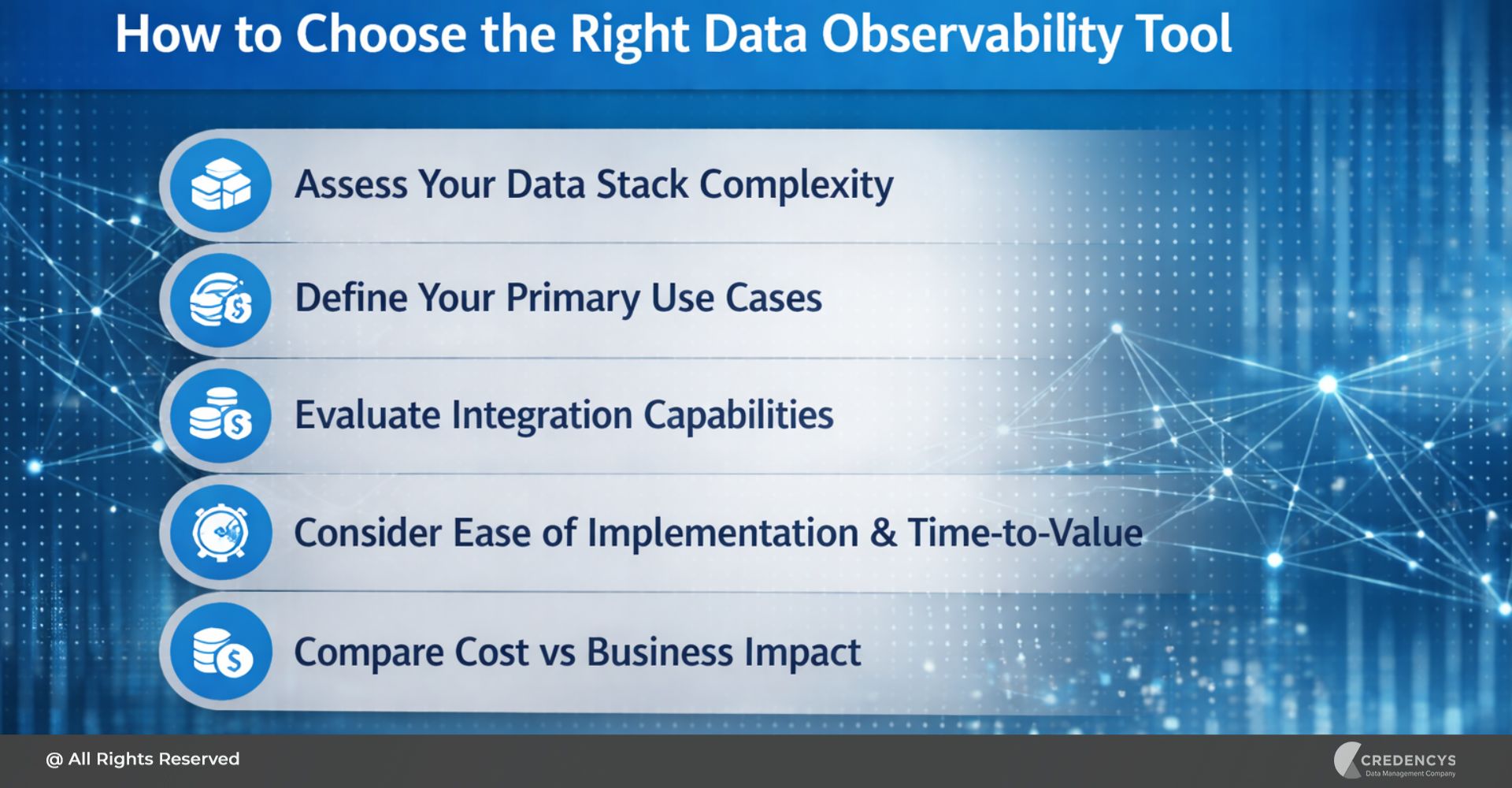
How to Choose the Right Data Observability Tool

With multiple data observability tools offering overlapping capabilities, choosing the right one can quickly become overwhelming. The key is to move beyond feature comparison and focus on fit, scalability, and business impact.

Here’s a step-by-step framework to help you make the right decision:

1. Assess Your Data Stack Complexity

  • Start by understanding your current data ecosystem. Ask:
  • Are you running a cloud-native stack (Snowflake, BigQuery, Databricks) or a hybrid?
  • Do you have batch pipelines, real-time streaming, or both?
  • How many tools are involved (ETL, orchestration, BI, ML)?

The more complex your stack, the more you need end-to-end observability with strong lineage and integrations.

2. Define Your Primary Use Cases

Not all tools are built for the same purpose. Clarify your priorities:

  • Data quality monitoring (accuracy, completeness)
  • Pipeline reliability (failures, delays, job monitoring)
  • Data governance & lineage
  • AI/ML data validation

Choosing a tool without a clear use case often leads to underutilization and wasted investment.

3. Evaluate Integration Capabilities

Your observability tool should seamlessly connect with your existing ecosystem. Check for:

  • Native integrations with your data warehouse
  • Compatibility with orchestration tools
  • Support for BI tools and downstream applications

Poor integration creates blind spots in your data visibility, defeating the purpose of observability.

4. Consider Ease of Implementation & Time-to-Value

Some tools require months of setup, while others deliver value quickly. Look at:

  • Deployment time
  • Learning curve for your team
  • Availability of pre-built connectors and templates

Faster implementation means quicker ROI and less strain on your engineering team.

5. Compare Cost vs Business Impact

Pricing models vary widely from open source to enterprise subscriptions. Instead of focusing only on cost, evaluate:

  • Potential savings from reduced data downtime
  • Impact on decision-making accuracy
  • Productivity gains for data teams

The right tool should pay for itself by preventing costly data failures.

How to Choose the Right Data Observability Tool

How Credencys Helps You Build Reliable Data Pipelines

At Credencys, we go beyond implementing tools. We help organizations build a strong, scalable foundation for data reliability, ensuring your data is always accurate, trustworthy, and ready to drive action.

Many organizations invest in modern data platforms but still struggle with:

  • Broken or delayed pipelines
  • Inconsistent data quality
  • Lack of visibility across systems
  • Slow issue detection and resolution

We solve this by combining strategy, technology, and execution, so your data works for you, not against you.

Our Approach to Data Observability & Pipeline Reliability

We follow a structured, outcome-driven approach:

1. Assess & Identify Gaps

  • Evaluate your current data architecture and pipelines
  • Identify blind spots in monitoring, quality, and governance
  • Pinpoint risks impacting business-critical data

2. Recommend the Right Tools & Architecture

  • Help you choose the right data observability tools based on your stack and goals
  • Design a scalable, future-ready data architecture
  • Ensure seamless integration with platforms like Snowflake, Databricks, and more

3. Implement & Integrate

  • Deploy observability tools across your pipelines
  • Set up automated monitoring, alerts, and lineage tracking
  • Integrate with your existing data ecosystem

4. Optimize Data Quality & Performance

  • Establish data quality frameworks and validation checks
  • Improve pipeline performance and reduce failures
  • Enable proactive issue detection

5. Continuous Monitoring & Improvement

  • Fine-tune observability systems for better accuracy
  • Reduce alert noise and improve incident response
  • Continuously enhance data reliability as your business scales

With Credencys, you don’t just get a solution, you gain measurable outcomes:

  • Trusted, high-quality data for better decision-making
  • Reduced data downtime and faster issue resolution
  • Improved operational efficiency for data teams
  • Scalable data pipelines ready for AI and analytics

Conclusion

As organizations continue to scale their data ecosystems in 2026, one thing is clear: data reliability is no longer optional; it’s mission-critical. With the rapid adoption of cloud platforms, real-time analytics, and AI-driven decision-making, even minor data issues can quickly escalate into major business risks.

Broken pipelines, inaccurate reports, and delayed insights don’t just affect technical teams; they impact revenue, customer experience, and strategic decisions. This is where data observability tools play a transformative role.

They enable organizations to move from:

  • Reactive firefighting → Proactive monitoring
  • Data uncertainty → Data trust
  • Delayed insights → Real-time decision-making

However, choosing the right tool is only part of the equation. To truly unlock value, businesses must take a holistic approach, aligning the right platform with a well-defined strategy, strong data architecture, and continuous optimization.

The most successful organizations treat data observability not as a tool but as a core capability embedded in their data culture. Ultimately, the goal isn’t just to monitor data; it’s to ensure that every decision made across your organization is backed by accurate, timely, and trustworthy information.

In a world where data drives competitive advantage, the question is no longer “Do you need data observability?” It’s “How quickly can you implement it effectively?”

Your Data is Only as Reliable as Your Observability: Here’s How to Choose the Right Services

Can you trust your data?
Is it always accurate?
Do you know when it breaks?

For many organizations, the answer is not always clear.

As data pipelines become more complex and distributed, even small issues like broken pipelines, delayed updates, or silent anomalies can quickly impact business decisions. Dashboards start showing conflicting numbers, reports lose credibility, and teams spend more time fixing data than using it.

Data observability is no longer enough to just move and store data. You need clear visibility into the health, reliability, and performance of your entire data ecosystem. Without it, even the most advanced data stack can struggle to deliver consistent value.

That is why choosing the most reliable data observability services is now a critical step for modern data-driven organizations.

In this blog you will learn what reliable data observability really means, why it matters, and how you can choose the right services to ensure your data stays accurate, trustworthy, and ready for action.

What are Data Observability Services?

Data observability services refer to the practice of monitoring, managing, and maintaining data systems to ensure data quality, availability, and reliability across your entire data ecosystem.

At its core, data observability is about understanding the true health of your data as it moves through pipelines, platforms, and transformations. It goes beyond traditional monitoring, which only tells you when something breaks. Instead, it helps you identify, troubleshoot, and resolve data issues in near real time.

The most reliable data observability services bring together a set of capabilities that give you complete visibility and control over your data, including:

  • Automated monitoring of data pipelines
  • Intelligent alerting and anomaly detection
  • Root cause analysis to quickly fix issues
  • End-to-end data lineage tracking
  • Data quality checks and validations
  • SLA tracking to ensure data reliability

These capabilities work together to help data teams proactively manage data health, rather than reacting after issues impact business outcomes.

Why it Matters for Modern Data Teams

In today’s data-driven environment, data is used to power analytics, customer experiences, and machine learning models. But without proper observability, data can quickly become a liability instead of an asset.

Many organizations still struggle with data trust. Teams often discover issues only after dashboards show incorrect insights or decisions are made on flawed data. Unlike system failures, which are immediately visible, data issues can remain hidden for long periods, silently impacting performance.

That is why data observability is becoming a foundational layer in modern data stacks.

By adopting the most reliable data observability services, you ensure that:

  • Data issues are detected before they impact users
  • Data pipelines remain consistent and reliable
  • Teams can trust the data they are using
  • Business decisions are backed by accurate insights

Data observability is not just an enhancement to data quality. It is an evolution toward proactive, reliable, and scalable data operations, making it a critical component of any modern data strategy.

The 5 Pillars of Data Observability

To truly evaluate the most reliable data observability services, it is important to understand the foundational pillars that define data health and reliability. These pillars give you a complete view of how your data behaves across its lifecycle and help you detect issues before they impact business outcomes.

1. Freshness

Freshness measures how up-to-date your data is and whether it is being delivered within expected timeframes.

Delays in data updates can lead to outdated dashboards, incorrect reporting, and poor decision-making. Data observability services continuously monitor data pipelines to ensure data arrives on time and highlight any delays or interruptions. This helps teams quickly identify pipeline failures or ingestion issues before they escalate.

2. Distribution

Distribution focuses on the statistical patterns and expected range of your data values. It helps determine whether your data behaves as expected over time.

Unexpected changes in data distribution, such as sudden spikes, drops, or unusual patterns, can indicate underlying issues like data corruption, source changes, or transformation errors. By monitoring distribution, observability services can detect subtle anomalies that might otherwise go unnoticed.

3. Volume

Volume tracks the amount of data being generated, processed, and stored across your pipelines. It ensures that data flows match expected thresholds.

A sudden drop in volume may indicate missing data, while an unexpected spike could signal duplication or upstream issues. Monitoring volume helps ensure completeness and consistency, which are critical for accurate analytics and reporting.

4. Schema

Schema refers to the structure and organization of your data, including fields, formats, and data types.

Changes in schema, such as added, removed, or modified fields, can break pipelines and disrupt downstream systems. Data observability services detect schema changes in real time and provide alerts, allowing teams to adapt quickly and maintain data integrity across systems.

5. Lineage

Lineage provides end-to-end visibility into how data flows through your ecosystem, from its source to its final destination.

It answers key questions like where the data originated, how it was transformed, and which systems or reports depend on it. When issues occur, lineage helps teams trace the root cause quickly and understand the downstream impact, significantly reducing resolution time.

Business Impact of Using the Most Reliable Data Observability Services

A strong data observability strategy goes far beyond monitoring pipelines. It directly influences how confidently your organization operates, how quickly teams respond to issues, and how effectively you turn data into business value.

The most reliable data observability services help you move from reactive data management to a proactive, insight-driven approach, where data becomes a trusted foundation for every decision.

Here is the impact you can expect:

Higher Data Quality

Reliable observability services continuously monitor data for issues such as missing values, duplicates, inconsistencies, and anomalies. Instead of discovering problems after they affect reports or models, teams can identify and resolve them early.

This ensures that downstream systems always receive clean, accurate, and consistent data, leading to better decision-making and reduced risk.

Faster Troubleshooting

Data issues can be difficult to detect and even harder to diagnose without proper visibility. Observability services use real-time monitoring, anomaly detection, and intelligent alerting to surface issues instantly.

With built-in root cause analysis and lineage tracking, teams can quickly pinpoint where the problem originated and fix it faster, significantly reducing downtime and operational disruption.

Improved Collaboration

Data observability creates a shared layer of visibility across data, engineering, and business teams. Everyone has access to the same insights about data health and performance.

This transparency reduces miscommunication, aligns teams around a single version of truth, and builds confidence in the data being used across the organization.

Increased Efficiency

Without observability, data teams often spend a significant amount of time manually identifying and fixing issues. Reliable services automate monitoring, validation, and alerting, reducing the need for constant manual intervention.

This allows data engineers, analysts, and scientists to focus on high-value tasks such as building models, generating insights, and driving innovation.

Better Compliance

For organizations operating in regulated industries, maintaining data accuracy, consistency, and security is critical. Data observability helps ensure that data meets compliance requirements by continuously validating data quality and tracking changes across systems.

This reduces the risk of non-compliance, audit failures, and potential financial or reputational penalties.

Enhanced Customer Experience

Customer-facing applications and experiences rely heavily on accurate and timely data. Observability ensures that customer data remains consistent and up to date across systems.

This enables organizations to deliver more personalized, relevant, and seamless experiences, ultimately improving customer satisfaction and loyalty.

Increased Revenue Potential

High-quality, reliable data unlocks better insights into customer behavior, market trends, and operational performance. With fewer data issues and greater confidence in analytics, organizations can identify new opportunities, optimize strategies, and make faster, data-driven decisions.

Over time, this leads to improved business performance and increased revenue growth.

Top Use Cases of Data Observability Services

The most reliable data observability services deliver value across critical data workflows. Here are a few high-impact use cases:

  • Reliable Dashboards: Ensure accurate, up-to-date data for reporting and decision-making.
  • Pipeline Monitoring: Detect failures and bottlenecks early to keep data flowing smoothly.
  • Schema Change Detection: Identify structural changes before they break downstream systems.
  • Data Quality Management: Continuously validate data for accuracy, completeness, and consistency.
  • AI and Analytics Readiness: Ensure high-quality data for reliable models and insights.

How to Choose the Most Reliable Data Observability Services

Choosing the right solution is not about picking the most popular tool. It is about finding a service that aligns with your data ecosystem, scales with your needs, and consistently ensures data reliability.

Here is how you can evaluate the most reliable data observability services for your business:

1. Start with Your Data Stack

Every organization has a different data architecture. Your observability solution should fit seamlessly into it. Ask yourself:

  • Does it integrate with your existing data warehouse, pipelines, and tools
  • Does it support cloud, hybrid, or multi-cloud environments
  • Can it handle your current and future data volumes

A good fit reduces implementation friction and speeds up adoption.

2. Evaluate Depth of Monitoring Capabilities

Basic monitoring is not enough. You need visibility across multiple layers of your data pipeline. Look for services that cover:

  • Data freshness, volume, and quality
  • Schema changes and anomalies
  • End-to-end data lineage

This ensures you are not blind to critical issues.

3. Check for Intelligent Automation

Manual rule-based monitoring does not scale. Reliable services should offer:

  • Automated anomaly detection
  • Smart alerting with minimal noise
  • Self-learning capabilities based on data patterns

This reduces dependency on manual configurations.

4. Focus on Ease of Use

Even the most powerful solution fails if teams do not adopt it. Ensure the service:

  • Has an intuitive interface
  • Provides clear and actionable insights
  • Enables both technical and business users to understand data health

Adoption is key to realizing value.

5. Assess Root Cause Analysis Capabilities

Detecting an issue is only half the job. Fixing it quickly is what matters. Choose services that:

  • Provide clear traceability of issues
  • Show upstream and downstream impact
  • Reduce time to resolution

This directly improves operational efficiency.

6. Consider Scalability and Performance

As your data grows, your observability solution should not become a bottleneck. Make sure it:

  • Scales with increasing data volumes
  • Performs efficiently without slowing pipelines
  • Supports real-time or near real-time monitoring

7. Align with Business Goals

Ultimately, your choice should support business outcomes, not just technical requirements. Ask:

  • Will this improve data trust across teams
  • Will it reduce downtime and operational costs
  • Will it support future initiatives like AI and advanced analytics

How to Implement a Data Observability Framework

Building an effective observability strategy requires a structured approach that combines tools, processes, and team alignment.

Here are the key steps:

1. Define Key Metrics

Identify what you need to track, such as data quality, volume, latency, and error rates.

2. Choose the Right Tools

Select tools that integrate with your existing data stack and can scale with your needs.

3. Standardize Data Practices

Ensure consistent data definitions, libraries, and communication across teams.

4. Instrument Your Data Pipeline

Add monitoring across every stage of the pipeline to capture meaningful insights.

5. Set Up Scalable Data Storage

Store observability metrics in systems that can handle growing data volumes.

6. Implement Analysis and Visualization

Use tools that provide clear insights and support advanced querying.

7. Configure Alerts and Notifications

Set up automated alerts for anomalies and threshold breaches.

8. Integrate Incident Management

Connect observability with incident response systems for faster resolution.

9. Continuously Improve

Regularly review and refine your observability setup as your data evolves.

Conclusion

Your data stack can be modern, scalable, and powerful, but without reliability, it cannot deliver real value.

Data issues are no longer rare events. They are constant, often silent, and can impact everything from dashboards to strategic decisions. The difference between high-performing data teams and the rest is not just tooling, but how well they can trust and act on their data.

That is why investing in the most reliable data observability services is not optional anymore. It is a foundational step toward building a data-driven organization.

When you choose the right services, you enable your teams to detect issues early, reduce downtime, and maintain consistent data quality at scale. More importantly, you create an environment where decisions are backed by data that is accurate, timely, and dependable.

Top Data Integration Companies in 2026: How to Choose the Right Partner

Most enterprises today are drowning in data spread across CRMs, ERPs, marketing platforms, eCommerce systems, and cloud applications. Yet, despite massive data investments, many still struggle to extract meaningful insights.

The problem isn’t data. It’s data fragmentation.

Disconnected systems lead to:

  • Inconsistent reporting
  • Delayed decision-making
  • Poor customer experiences
  • Failed AI and analytics initiatives

That’s why data integration has become a strategic priority in 2026. Choosing the right data integration partner can mean the difference between scalable, AI-ready operations and costly, inefficient data chaos.

In this blog, we’ll explore the top data integration companies in 2026 and help you choose the right one for your business.

What Do Data Integration Companies Do?

Data integration companies play a foundational role in modern data ecosystems. But their value goes far beyond simply moving data from one system to another.

They enable organizations to create a unified, reliable, and actionable data layer across the enterprise. Here’s a deeper look at what they actually do:

1. Data Ingestion Across Complex Ecosystems

Modern enterprises operate across hundreds of systems:

  • CRM (Salesforce, HubSpot)
  • ERP (SAP, Oracle)
  • eCommerce platforms
  • Marketing automation tools
  • IoT devices and operational systems

Data integration companies build pipelines that:

  • Connect to structured and unstructured data sources
  • Handle batch and real-time ingestion
  • Ensure data flows seamlessly into centralized repositories

2. Data Transformation and Standardization

Raw data is rarely usable in its original form. Integration partners:

  • Clean and normalize inconsistent data
  • Standardize formats across systems
  • Apply business rules and transformations
  • Enrich datasets with additional context

This ensures that all teams are working with consistent and meaningful data.

3. Building Scalable ETL/ELT Pipelines

Modern data integration has evolved from traditional ETL to flexible ELT approaches. Companies design pipelines that:

  • Scale with growing data volumes
  • Support cloud-native architectures
  • Optimize performance and cost
  • Enable faster analytics

The focus is on building future-ready pipelines, not just quick fixes.

4. Real-Time and Event-Driven Data Integration

Batch processing is no longer enough. Today’s businesses require:

  • Real-time dashboards
  • Instant personalization
  • Event-driven workflows

Integration companies enable:

  • Streaming pipelines
  • API-based integrations
  • Event triggers and automation

This allows organizations to act on data as it is generated.

5. Data Quality, Governance, and Compliance

Without governance, integration creates chaos at scale. Leading providers ensure:

  • Data validation and cleansing
  • Deduplication and accuracy checks
  • Master Data Management (MDM)
  • Compliance with regulations

This builds trust in data, which is critical for decision-making.

6. Enabling Analytics and AI Use Cases

Ultimately, the goal of integration is not just consolidation, it’s activation. Data integration companies prepare data for:

  • Business intelligence dashboards
  • Predictive analytics
  • Machine learning models
  • Customer 360 platforms

They turn data into a strategic asset that drives business outcomes.

What Do Data Integration Companies Do

Top Data Integration Companies in 2026

Here’s a curated list of modern data integration companies that are helping businesses build scalable, AI-ready data ecosystems.

1. Credencys Solutions

Best for: End-to-end data integration with AI readiness

Credencys stands out as a business-first data integration partner, especially for mid-market enterprises looking to modernize their data infrastructure. Unlike tool-focused vendors, Credencys combines strategy, engineering, and domain expertise to deliver measurable outcomes.

Key strengths:

  • Expertise in modern data platforms like Databricks and Snowflake
  • Strong focus on retail, CPG, and manufacturing industries
  • Capabilities across PIM, MDM, CDP, and enterprise integrations
  • Emphasis on data quality, governance, and scalability

Ideal use cases:

  • Customer 360 platforms
  • Demand forecasting
  • Omnichannel data integration
  • AI and advanced analytics enablement

Why it stands out:

Credencys goes beyond pipelines to build AI-ready data foundations, making it a strong choice for companies scaling their data maturity.

2. Talend

Best for: Data integration with built-in data quality

Talend offers a unified platform that combines integration and governance, making it a solid choice for organizations prioritizing data reliability.

Strengths:

  • Strong data quality capabilities
  • Broad integration features
  • Open-source foundation

Limitation:

Can become complex for large-scale customization

3. Fivetran

Best for: Automated ELT pipelines

Fivetran simplifies data integration with fully managed pipelines that require minimal engineering effort.

Strengths:

  • Fast deployment
  • Automated schema updates
  • Low maintenance

Limitation:

Limited flexibility for complex transformations

4. Stitch

Best for: Lightweight data integration

Stitch is designed for simplicity and speed, making it ideal for smaller teams or straightforward use cases.

Strengths:

  • Easy to set up
  • Cost-effective
  • Quick deployment

Limitation:

Not suitable for complex enterprise architectures

5. Matillion

Best for: Cloud-native data integration

Matillion is purpose-built for cloud environments and works well with platforms like Snowflake and BigQuery.

Strengths:

  • Strong ELT capabilities
  • Cloud optimization
  • Scalable architecture

Limitation:

Requires alignment with specific cloud ecosystems

CompanyBest ForStrengthLimitation
CredencysEnd-to-end integrationData + AI + domain expertiseMid-sized firm
TalendIntegration + data qualityUnified platformComplexity
FivetranAutomated ELTEase of useLimited customization
StitchLightweight integrationSimplicityLimited scalability
MatillionCloud-native ELTCloud optimizationPlatform dependency

How to Choose the Right Data Integration Company

Choosing the right partner is a high-impact decision that directly affects your ability to scale, innovate, and compete. Here’s how to evaluate your options effectively:

1. Modern Data Stack Expertise

The data landscape has evolved significantly. Your partner must be fluent in modern architectures.

Look for:

  • Cloud-native experience (AWS, Azure, GCP)
  • Lakehouse platforms (Databricks, Snowflake)
  • API-first integrations
  • Real-time and streaming capabilities

A partner focused only on legacy ETL tools will struggle to support future-ready architectures.

2. Strong Focus on Data Quality & Governance

Integration without governance leads to inaccurate insights at scale. Evaluate whether the company offers:

  • Data profiling and cleansing
  • Standardization frameworks
  • Master Data Management (MDM)
  • Data lineage and monitoring

High-quality data is the foundation of reliable analytics and AI.

3. Scalability and Performance

As your data volumes grow, your integration architecture must keep pace. Ask:

  • Can the system handle large-scale data processing?
  • How does it perform under high loads?
  • Is it cost-efficient as data grows?

Scalability ensures you don’t outgrow your integration solution in 1–2 years.

4. Ability to Support AI and Advanced Analytics

Modern data strategies are increasingly AI-driven. The right partner should:

  • Prepare data for machine learning pipelines
  • Enable real-time analytics
  • Support predictive and prescriptive use cases

If your integration strategy doesn’t support AI, it will quickly become obsolete.

5. Balance Between Ease of Use and Flexibility

Different tools offer different trade-offs:

  • No-code/low-code tools:
  • Faster implementation
  • Easier for business users
  • Limited customization
  • Custom/engineering-heavy solutions:
  • Greater flexibility
  • Better for complex use cases
  • Requires technical expertise

Choose a partner that aligns with your internal capabilities and long-term vision.

6. End-to-End Capabilities

Many vendors offer tools, but not all offer strategic guidance. The best partners provide:

  • Data strategy and architecture design
  • Implementation and integration
  • Ongoing optimization and support

This ensures your integration efforts are aligned with business goals, not just technical execution.

How to Choose the Right Data Integration Company

Why Credencys Is a Strong Choice for Mid-Market Enterprises

While many data integration providers focus on tools or large-scale enterprise consulting, Credencys occupies a unique and valuable position in the market. It combines technical expertise, domain knowledge, and business-first thinking, making it particularly well-suited for mid-market organizations.

1. Business-First Approach to Data Integration

Credencys doesn’t start with tools; it starts with business outcomes. This means:

  • Understanding your data challenges in a business context
  • Aligning integration strategies with revenue, efficiency, and customer experience goals
  • Delivering measurable impact, not just technical implementation

2. Strong Domain Expertise

Credencys has deep experience in:

  • Retail
  • CPG
  • Manufacturing
  • eCommerce

This allows them to:

  • Understand industry-specific data challenges
  • Accelerate implementation timelines
  • Deliver more relevant and impactful solutions

3. Expertise in Modern Data Platforms

Credencys is well-versed in:

  • Databricks (lakehouse architecture)
  • Snowflake (cloud data warehousing)
  • Cloud ecosystems (AWS, Azure, GCP)

This ensures your data architecture is:

  • Scalable
  • Cost-efficient
  • Future-ready

4. Focus on AI-Ready Data Foundations

Many companies integrate data, but few prepare it for AI. Credencys emphasizes:

  • Clean, governed datasets
  • Structured data pipelines for ML
  • Real-time data readiness

This helps organizations move beyond reporting to predictive, AI-driven decision-making.

5. End-to-End Services

Credencys provides a complete lifecycle approach:

  • Data strategy and consulting
  • Architecture design
  • Implementation and integration
  • Continuous optimization

This eliminates the need to manage multiple vendors and ensures consistency across the data journey.

6. Agility and Cost-Effectiveness

Compared to large consulting firms, Credencys offers:

  • Faster execution
  • More personalized engagement
  • Better cost efficiency

This makes it an ideal partner for mid-market enterprises looking for high impact without enterprise-level overhead.

Final Takeaway

If your goal is simply to move data, many tools can help. But if your goal is to:

  • Build a unified data ecosystem
  • Enable real-time insights
  • Power AI and advanced analytics
  • Scale efficiently

Then choosing the right data integration partner becomes critical. And that’s where a specialized, business-focused company like Credencys can make all the difference.

Top MLOps Companies in 2026: How to Choose the Right Partner for Scalable AI Deployment

Machine learning is no longer experimental; it’s mission-critical. Yet, most enterprises still struggle to move models from experimentation to production.

Despite heavy investments in AI, only a small percentage of models deliver real business value. This is where MLOps (Machine Learning Operations) becomes essential.

And more importantly, choosing the right MLOps company can make or break your AI success. In this blog, we’ll explore:

  • The top MLOps companies in 2026
  • What makes them stand out
  • How to choose the right partner for your business

Why MLOps Is Critical for Enterprises in 2026

Building ML models is just the beginning. The real challenge lies in:

  • Deploying models reliably
  • Monitoring performance over time
  • Managing data and model drift
  • Ensuring governance and compliance

Without MLOps, organizations face:

  • Fragmented workflows
  • Delayed deployments
  • Inconsistent model performance
  • High operational costs

MLOps bridges the gap between data science and production systems, enabling scalable, repeatable, and governed AI operations.

What to Look for in an MLOps Company

Choosing an MLOps partner is a strategic one that directly impacts how effectively your organization can scale AI initiatives. The right partner should not only understand machine learning but also how to operationalize it across complex enterprise environments.

Here are the key factors to evaluate in detail:

1. End-to-End MLOps Capabilities

Many vendors claim MLOps expertise but only specialize in isolated parts of the lifecycle, such as model development or infrastructure setup. A strong MLOps company should support the entire lifecycle, including:

  • Data ingestion and preprocessing
  • Feature engineering and versioning
  • Model training and experimentation
  • Model deployment (batch and real-time)
  • Continuous monitoring and retraining

This end-to-end ownership ensures there are no gaps between stages, reducing friction and accelerating time-to-production. It also eliminates the need to coordinate multiple vendors, thereby reducing inefficiencies.

2. Deep Platform and Ecosystem Expertise

Modern MLOps is heavily dependent on tools and platforms. However, simply knowing tools isn’t enough; your partner should have hands-on experience integrating and optimizing them within enterprise ecosystems.

Look for expertise in:

  • Unified platforms like Databricks (Lakehouse architecture)
  • Orchestration tools like Kubernetes and Airflow
  • ML lifecycle tools such as MLflow or Kubeflow
  • Cloud ecosystems (AWS, Azure, GCP)

More importantly, they should know when to use what and how to design a cohesive architecture rather than a fragmented toolchain.

3. Strong Data Engineering Foundation

MLOps is only as good as the data that powers it. A capable MLOps company must have strong data engineering capabilities, including:

  • Building scalable data pipelines
  • Ensuring data quality and consistency
  • Managing large-scale structured and unstructured data
  • Supporting real-time and batch processing

Without this foundation, even the most advanced ML models will fail in production due to unreliable data.

4. Industry-Specific Experience

AI is not one-size-fits-all. The challenges faced in retail (e.g., demand forecasting), manufacturing (e.g., predictive maintenance), or supply chain (e.g., inventory optimization) are fundamentally different.

An experienced MLOps partner brings:

  • Pre-built accelerators and frameworks
  • Understanding of domain-specific KPIs
  • Faster implementation cycles

This reduces experimentation time and increases the likelihood of success.

5. Scalability, Automation, and Performance Optimization

As organizations mature, they move from managing a few models to hundreds or even thousands. Your MLOps partner should design systems that:

  • Automatically scale infrastructure based on demand
  • Enable CI/CD pipelines for ML models
  • Reduce manual intervention through automation
  • Optimize performance and cost across environments

This ensures your AI initiatives remain sustainable as they grow.

6. Governance, Security, and Compliance

With increasing regulations around AI, governance is no longer optional. A mature MLOps company should provide:

  • Model explainability and transparency
  • Version control for models and datasets
  • Audit trails for compliance
  • Role-based access controls and security frameworks

This is especially critical for enterprises operating in regulated industries or across multiple geographies.

What to Look for in an MLOps Company

Top MLOps Companies in 2026

Here are the top MLOps service providers helping enterprises operationalize AI at scale:

1. Credencys Solutions

Credencys stands out as a strategic MLOps partner for enterprises looking to scale AI initiatives, not just implement tools. With strong expertise in Databricks and modern data architectures, Credencys helps organizations move from fragmented ML efforts to fully operationalized AI ecosystems.

Key Strengths

  • End-to-end MLOps implementation (data → model → deployment → monitoring)
  • Deep expertise in Data Engineering + AI + Lakehouse architecture
  • Custom ML pipelines tailored for retail, CPG, and manufacturing
  • Strong focus on governance, model monitoring, and optimization

What Sets Them Apart

Credencys doesn’t just deploy models; they build scalable AI foundations that align with business outcomes.

Best for: End-to-end MLOps + Data Engineering + AI transformation

2. Turing

Turing provides enterprises with access to vetted remote AI engineers and MLOps specialists.

Key Strengths

  • Large pool of AI/ML talent
  • Flexible engagement models
  • Quick team scaling

Best for: Access to global AI/ML talent and MLOps engineers

Limitations

  • More talent-focused than full lifecycle MLOps consulting
  • Limited strategic transformation capabilities

3. Markovate

Markovate focuses on building AI-powered applications and integrating MLOps practices into product development.

Key Strengths

  • Strong AI product engineering
  • MLOps integration for startups and mid-market
  • Focus on innovation and rapid development

Best for: AI product development with MLOps integration

Limitations

  • Less focus on large-scale enterprise transformation
  • Limited depth in data engineering ecosystems

4. Intellias

Intellias brings strong engineering capabilities and supports MLOps within broader digital transformation initiatives.

Key Strengths

  • Enterprise IT and engineering expertise
  • Scalable architecture design
  • Strong delivery capabilities

Best for: Enterprise-grade digital transformation with MLOps

Limitations: MLOps is part of broader services, not always the core focus

5. Accenture

Accenture is a global consulting giant offering comprehensive AI and MLOps services.

Key Strengths

  • Global scale and resources
  • Strong governance and compliance frameworks
  • Extensive industry experience

Best for: Large-scale enterprise AI transformation

Limitations

  • High cost
  • Less flexibility compared to niche MLOps specialists
CompanyBest ForStrengthLimitation
CredencysEnd-to-end MLOps transformationData + AI + MLOps expertiseMore specialized and agile
TuringTalent sourcingFast scalingLimited strategy
MarkovateAI product developmentInnovation-focusedNot enterprise-heavy
IntelliasDigital engineeringScalable systemsMLOps is not the core focus
AccentureEnterprise transformationGlobal reachExpensive

How to Choose the Right MLOps Company

Selecting the right MLOps partner requires a structured approach. Beyond evaluating capabilities, you need to ensure alignment with your organization’s current maturity, future goals, and operational complexity.

Here’s a step-by-step framework to guide your decision:

1. Assess Your Current MLOps Maturity

Before evaluating vendors, you need clarity on where you stand. Ask:

  • Are your data science teams still experimenting in silos?
  • Do you have models in production but struggling with monitoring?
  • Are you scaling AI across multiple business units?

Your answers will determine whether you need:

  • Foundational MLOps setup
  • Optimization and scaling
  • Enterprise-wide governance and standardization

Choosing a partner aligned with your maturity prevents overengineering or under-delivery.

2. Validate End-to-End Ownership

Many organizations make the mistake of hiring separate vendors for:

  • Data engineering
  • Model development
  • Deployment

This often leads to misalignment and delays. Instead, prioritize partners who can own the entire MLOps lifecycle. This ensures:

  • Faster implementation
  • Better accountability
  • Seamless integration across stages

Ask for case studies that demonstrate full lifecycle delivery, not just isolated capabilities.

3. Evaluate Architecture and Tooling Approach

A good MLOps company doesn’t just implement tools; it designs future-proof architectures. During evaluation:

  • Ask how they select tools and platforms
  • Understand how they avoid vendor lock-in
  • Evaluate their approach to integrating with existing systems

The goal is to ensure flexibility, scalability, and long-term sustainability.

4. Look for Industry Alignment and Use Cases

Generic AI expertise is not enough for enterprise success. Request:

  • Industry-specific case studies
  • Demonstrations of similar use cases
  • References from companies in your domain

This helps you gauge how quickly the partner can deliver value in your specific context.

5. Assess Collaboration and Operating Model

MLOps is not a one-time project; it’s an ongoing capability. Your partner should:

  • Work closely with your internal teams
  • Provide knowledge transfer and training
  • Offer flexible engagement models (project-based, managed services, etc.)

Strong collaboration ensures long-term success rather than short-term delivery.

6. Focus on ROI and Business Outcomes

Ultimately, MLOps should drive measurable business value. Evaluate partners based on their ability to:

  • Reduce model deployment time
  • Improve model accuracy and performance
  • Lower operational costs
  • Increase business impact (e.g., revenue, efficiency)

Avoid vendors who focus only on technical metrics without linking them to business outcomes.

How to Choose the Right MLOps Company

Common MLOps Challenges Enterprises Face

Even with the right intent and investment, many organizations struggle to operationalize machine learning effectively. These challenges often stem from a lack of structured processes, fragmented tooling, and limited operational expertise.

Let’s explore the most common issues in detail:

1. Model Deployment Bottlenecks

One of the biggest gaps in AI adoption is the transition from experimentation to production. Data scientists often build models in isolated environments, but:

  • Deployment requires coordination with engineering teams
  • Infrastructure dependencies create delays
  • Lack of standardized processes leads to inconsistencies

As a result, models remain stuck in development, delaying business impact.

2. Limited Visibility and Monitoring

Once models are deployed, many organizations lack proper monitoring mechanisms. This leads to:

  • No visibility into model performance over time
  • Inability to detect issues early
  • Reactive rather than proactive maintenance

Without monitoring, even high-performing models can silently degrade, impacting business outcomes.

3. Data Drift and Model Drift

Real-world data is constantly changing. Over time:

  • Input data distributions shift (data drift)
  • Model accuracy declines (model drift)

Without automated detection and retraining pipelines, models become unreliable and produce inaccurate predictions.

4. Fragmented Tooling and Workflows

Many enterprises use multiple tools across the ML lifecycle: data processing, training, deployment, and monitoring. This creates:

  • Integration challenges
  • Data silos
  • Increased operational complexity

A lack of unified architecture leads to inefficiencies and higher costs.

5. Lack of Standardization and Reusability

In many organizations, ML workflows are built from scratch for each use case. This results in:

  • Duplication of effort
  • Inconsistent practices across teams
  • Difficulty scaling AI initiatives

Standardized pipelines and reusable components are essential for scaling efficiently.

6. Governance and Compliance Challenges

As AI adoption grows, so do regulatory requirements. Organizations often struggle with:

  • Explaining how models make decisions
  • Tracking changes to models and datasets
  • Ensuring compliance with industry regulations

Without proper governance frameworks, AI initiatives can introduce significant risk.

7. Talent and Skill Gaps

MLOps requires a combination of skills:

  • Data engineering
  • Machine learning
  • DevOps

Finding professionals with this hybrid expertise is challenging.

This often leads to:

  • Overburdened teams
  • Delayed implementations
  • Suboptimal solutions

Final Thoughts

MLOps is no longer a “nice-to-have” capability; it has become the backbone of successful AI adoption in modern enterprises. While many organizations have made significant investments in data science and machine learning, the real challenge lies in turning those investments into consistent, scalable business outcomes.

Without a structured MLOps strategy, even the most advanced models remain underutilized, siloed, or quickly become obsolete in dynamic business environments. This is why MLOps is critical.

It transforms machine learning from isolated experimentation into a repeatable, production-grade system that continuously delivers value. However, achieving this transformation is not just about implementing tools or hiring a few specialists.

It requires:

  • A well-defined architecture that integrates data, models, and infrastructure
  • Standardized workflows that enable collaboration across teams
  • Automation to reduce manual effort and accelerate deployment cycles
  • Continuous monitoring to ensure models remain accurate and relevant over time

And most importantly, it requires a strategic partner who understands both the technical and business sides of AI. The right MLOps company doesn’t just help you deploy models; they help you:

  • Build a scalable AI foundation aligned with long-term business goals
  • Reduce time-to-market for new ML initiatives
  • Improve model reliability and performance
  • Minimize operational risks and costs
  • Enable enterprise-wide adoption of AI

As AI continues to evolve, especially with the rise of real-time analytics and generative AI, the importance of MLOps will only grow. Organizations that invest in strong MLOps capabilities today will be better positioned to innovate faster, respond to market changes, and maintain a competitive edge.

On the other hand, those who delay may find themselves stuck in a cycle of experimentation without tangible returns. In this landscape, choosing the right MLOps partner becomes a critical decision.

If your goal is to move beyond pilot projects and build scalable, enterprise-grade AI systems, partnering with an experienced provider like Credencys can accelerate your journey. With the right expertise, tools, and strategy in place, you can transform your machine learning initiatives into measurable, long-term business success.

ETL vs ELT: A Complete Guide to Choosing the Right Data Pipeline Strategy

Over 80% of enterprise data projects fail to deliver expected value, and one of the biggest reasons is a poor choice of data integration strategy.

Businesses are collecting massive volumes of data from multiple sources such as applications, IoT devices, customer interactions, and third-party platforms. But raw data alone does not drive decisions. What matters is how efficiently that data is processed, transformed, and made available for analytics.

This is where the debate of ETL vs ELT becomes critical.

Choosing between ETL (Extract, Transform, Load) and ELT (Extract, Load, Transform) is not just a technical decision. It directly impacts your data quality, scalability, speed of insights, and overall business agility. While ETL has been the traditional approach for decades, ELT has gained significant momentum with the rise of cloud data platforms and modern analytics needs.

So, which one is better?

The answer depends on your data architecture, business goals, and the kind of insights you want to generate.

In this blog, we will break down ETL vs ELT, explore their key differences, advantages, challenges, and help you determine which approach is the right fit for your organization.

TLDR

  • ETL vs ELT comes down to when data is transformed
  • ETL transforms data before loading, ensuring clean and structured data upfront
  • ELT loads raw data first and transforms it later, enabling speed and scalability
  • Choose ETL if you need strong governance, compliance, and structured data from the start
  • Choose ELT if you need flexibility, handle large data volumes, and use cloud platforms
  • ELT is becoming the preferred approach for modern, cloud-first and AI-driven organizations
  • ETL still matters for regulated and legacy environments

What is ETL (extract, transform, load)?

ETL stands for Extract, Transform, Load. It is a traditional data integration approach where data is first extracted from various sources, then transformed into a structured and usable format, and finally loaded into a target system such as a data warehouse.

How ETL Works

1. Extract

Data is collected from multiple sources such as databases, CRM systems, APIs, and files.

2. Transform

The extracted data is cleaned, filtered, enriched, and formatted based on predefined business rules before it reaches the destination.

3. Load

The transformed data is then loaded into a data warehouse or storage system for reporting and analysis.

Key Characteristics of ETL

  • Transformation happens before loading into the target system
  • Requires a separate processing engine or ETL tool
  • Ensures high data quality before storage
  • Works well with structured data and legacy systems

Advantages of ETL

  • Strong data governance and control
  • Clean and consistent data before it reaches analytics systems
  • Suitable for compliance-heavy industries
  • Optimized for traditional on-premise data warehouses

Limitations of ETL

  • Slower processing for large volumes of data
  • Less flexible when dealing with unstructured or semi-structured data
  • Higher infrastructure and maintenance overhead
  • Not ideal for real-time analytics use cases

ETL has been the backbone of data integration for years, especially in environments where data quality and consistency are critical before any analysis takes place. However, as data volumes and speed requirements have increased, newer approaches like ELT have started gaining traction.

What is ELT (extract, load, transform)?

ELT stands for Extract, Load, Transform. It is a modern data integration approach where raw data is first extracted from source systems and loaded directly into a target system, typically a cloud data warehouse. The transformation happens later, within the target system itself.

How ELT Works

1. Extract

Data is collected from various sources such as applications, databases, APIs, and streaming platforms.

2. Load

The raw data is loaded directly into a data warehouse or data lake without significant transformation.

3. Transform

Data is then transformed inside the target system using its processing power, based on analytical needs.

Key Characteristics of ELT

  • Transformation happens after loading into the target system
  • Leverages the compute power of modern cloud platforms
  • Supports structured, semi-structured, and unstructured data
  • Enables faster ingestion of large data volumes

Advantages of ELT

  • Faster data ingestion and processing at scale
  • High flexibility as raw data is always available
  • Ideal for big data and advanced analytics use cases
  • Better suited for cloud-native architectures

Limitations of ELT

  • Requires strong governance to manage raw data
  • Data quality issues can propagate if not handled properly
  • Higher dependency on the performance of the data warehouse
  • Can increase storage and compute costs if not optimized

ELT is becoming the preferred choice for modern data teams, especially those working with cloud data platforms and real-time analytics requirements. It allows organizations to store all their data first and decide how to use it later, making it more adaptable to evolving business needs.

ETL vs ELT: Key Differences

While both ETL and ELT aim to move and prepare data for analytics, the way they handle transformation creates significant differences in performance, scalability, and use cases.

Here is a side-by-side comparison to simplify the decision:

ETL vs ELT Comparison

AspectETLELT
Process OrderTransform before loadingLoad before transforming
Data ProcessingHappens in a separate ETL toolHappens inside the data warehouse
SpeedSlower for large datasetsFaster due to parallel processing
ScalabilityLimited by ETL infrastructureHighly scalable with cloud platforms
Data TypesBest for structured dataSupports structured, semi-structured, and unstructured data
StorageOnly processed data is storedRaw and processed data both stored
FlexibilityLess flexible once data is transformedHighly flexible for future use cases
Cost StructureHigher upfront infrastructure costPay-as-you-go cloud cost model
Use Case FitLegacy systems, compliance-heavy environmentsModern analytics, big data, real-time insights

Key Takeaway

The core difference in ETL vs ELT lies in where and when transformation happens.

ETL focuses on cleaning and structuring data before it enters the warehouse, ensuring control and consistency. ELT, on the other hand, prioritizes speed and scalability by loading raw data first and transforming it later using the power of modern data platforms.
This shift is the reason why many organizations moving to the cloud are adopting ELT as their preferred approach.

ETL vs ELT: When Should You Use Each?

Choosing between ETL vs ELT is not about which one is universally better. It is about selecting the right approach based on your data environment, business priorities, and technical capabilities.

When to Use ETL

ETL is a better fit when control, data quality, and compliance are your top priorities. You should consider ETL if:

  • You are working with legacy or on-premise systems
  • Your organization has strict data governance and compliance requirements
  • You need clean, structured data before loading into the warehouse
  • Your data volumes are manageable and not extremely large
  • You rely heavily on traditional BI and reporting tools

In such scenarios, transforming data before loading ensures consistency and reduces the risk of inaccurate insights.

When to Use ELT

ELT is ideal for organizations that prioritize speed, scalability, and flexibility. You should consider ELT if:

  • You are using cloud data platforms like Snowflake, BigQuery, or Redshift
  • You deal with large volumes of structured and unstructured data
  • You need real-time or near real-time analytics
  • Your use cases include AI, machine learning, or advanced analytics
  • You want to store raw data for future analysis and reprocessing

ELT allows you to ingest data quickly and transform it later based on evolving business needs.

The Modern Reality

For many enterprises today, the decision is not strictly ETL vs ELT. Instead, a hybrid approach is becoming more common. Organizations use ETL for sensitive, compliance-driven workloads and ELT for scalable analytics and innovation use cases.

This balanced strategy helps businesses maintain control where needed while still leveraging the speed and flexibility of modern data platforms.

ETL vs ELT: Which One is Better?

The honest answer is that there is no one size fits all winner in the ETL vs ELT debate. The better approach depends on what your business values more: control or scalability, structure or flexibility, predictability or speed.

Choose ETL if:

  • Data quality and governance are critical from the start
  • You operate in highly regulated industries
  • Your data architecture is largely on-premise
  • You need structured, ready-to-use data before analysis

Choose ELT if:

  • You are building on modern cloud data platforms
  • Speed and scalability are top priorities
  • You want to leverage raw data for multiple use cases
  • Your teams rely on advanced analytics, AI, and machine learning

Strategic Perspective

Modern enterprises are increasingly leaning toward ELT because it aligns better with cloud-first strategies and the growing demand for real-time insights. However, ETL still plays a crucial role in environments where precision, compliance, and data control cannot be compromised.
The key is not to follow trends blindly, but to align your data pipeline strategy with your business goals, technical ecosystem, and future roadmap.

Final Thoughts: ETL vs ELT

Understanding the difference between ETL vs ELT is essential for building a scalable and future-ready data architecture.
As data continues to grow in volume and complexity, organizations that choose the right integration approach will be better positioned to unlock insights, drive innovation, and stay competitive.

If you are planning to modernize your data infrastructure, this decision will shape not just your data pipelines, but your entire analytics and AI strategy.

Top Enterprise AI Agents Development Companies in 2026

According to industry estimates, over 80% of enterprises are expected to deploy AI agents or agent-like systems by 2028, especially across operations, customer experience, and supply chain. Even more interesting is the fact that companies using autonomous AI systems are already seeing 20–30% efficiency gains in complex workflows.

Not small wins, but real business impact. This isn’t about chatbots answering FAQs.

This is about systems that think, decide, and act. And suddenly, choosing the right AI agent development partner becomes kind of a big deal.

Why Enterprises Are Investing in AI Agents

Because the old automation playbook is hitting a wall. Here’s what’s driving the shift:

  • Complex workflows need smarter automation
  • Real-time decision-making is non-negotiable
  • Cost pressure is relentless
  • High Customer expectations
  • Scaling without chaos

AI agents are becoming the backbone of autonomous enterprises.

What to Look for in an AI Agent Development Company

Not all vendors are built for this. Some are still stuck in chatbot land.

Here’s what actually matters:

1. Custom AI Agent Development

Look for expertise in:

  • LLMs (Large Language Models)
  • RAG (Retrieval-Augmented Generation)
  • Agent orchestration frameworks

Because plug-and-play won’t cut it.

2. Multi-Agent System Design

Real enterprise use cases rarely involve just one agent. You need systems where:

  • Agents collaborate
  • Delegate tasks
  • Share context

Think orchestration, not isolation.

3. Enterprise Integration Capabilities

If it doesn’t integrate with your:

  • ERP
  • CRM
  • Data platforms

it’s basically a demo.

4. AgentOps & Lifecycle Management

Building agents is one thing, and managing them in production is a completely different game.

You need:

  • Monitoring
  • Logging
  • Continuous improvement loops

What to Look for in an AI Agent Development Company

Top Enterprise AI Agent Development Companies in 2026

Plenty of companies claim they build AI agents. Very few actually deliver systems that survive real enterprise complexity.

Here are five that stand out in 2026, not just for what they promise, but for what they have proven.

1. Credencys Solutions

Credencys is not approaching AI agents as isolated innovations. They are building them as part of a larger, AI-native data ecosystem where agents are deeply connected to enterprise data, workflows, and decision-making layers.

That is a big deal. Most AI agents fail not because of intelligence but because of a lack of context.

Credencys solves that.

Core Strengths

  • Deep expertise in data engineering, data platforms, and AI integration
  • Strong focus on AI-driven decision systems, not just automation
  • Proven experience in retail, CPG, and supply chain ecosystems
  • Ability to embed AI agents into Customer 360, CDPs, and enterprise data lakes
  • End-to-end capabilities, from strategy to deployment to optimization

Key Services

  • AI-powered Customer 360 agents for real-time personalization
  • Autonomous agents for demand forecasting and dynamic pricing
  • Intelligent workflow automation across the supply chain and operations
  • AI agents integrated with enterprise data platforms (Databricks, Snowflake, etc.)
  • Decision intelligence systems that continuously learn and improve

Industries Served

  • Retail
  • CPG
  • Manufacturing
  • Supply chain & logistics

If you are looking to build scalable, enterprise-grade AI agents that actually drive decisions, Credencys stands out as a strategic partner rather than just a service provider.

Success Story: AI Agents for Order Management Automation

It’s one thing to talk about AI agents and another to see them actually work, inside messy, real-world enterprise workflows. Here’s a quick look at how Credencys Solutions helped a business transform its order management process using AI agents.

Challenge

Order management sounds simple, but it’s not. Most enterprises still deal with:

  • Orders coming from multiple channels (emails, PDFs, portals)
  • Manual data entry into ERP systems
  • Frequent errors and delays
  • Teams spending hours on repetitive processing

The result?

  • Slow operations.
  • High error rates.
  • And frustrated customers.

Solution

Credencys implemented an AI agent-driven order management automation system designed to handle the process end-to-end. Instead of just automating tasks, the system actually understood incoming data.

Here’s what the AI agents did:

  • Extracted order data from unstructured inputs (emails, documents, attachments)
  • Validated and standardized information
  • Automatically entered data into ERP systems
  • Flagged exceptions for human review
  • Continuously improved accuracy through learning loops

In short, the agents didn’t just assist, they operated.

Impact

This is where things get interesting. AI-driven order processing systems like this have been shown to:

  • Reduce manual effort by up to 70–75%
  • Cut processing time significantly
  • Improve data accuracy and consistency
  • Free up teams for higher-value work

And that’s exactly the kind of transformation enterprises are aiming for.

  • Less manual work.
  • Faster execution.
  • Better decisions.

2. Algoscale

Algoscale focuses on building LLM-powered autonomous agents designed to handle complex enterprise workflows. Their strength lies in orchestration, getting multiple agents to work together effectively.

Core Strengths

  • Advanced LLM and GenAI expertise
  • Custom-built agent orchestration frameworks
  • Strong focus on scalability and performance
  • Experience with multi-agent environments

Key Services

  • Autonomous AI agents for enterprise operations
  • Multi-agent workflow coordination systems
  • AI copilots for internal teams
  • Decision intelligence platforms powered by LLMs

Industries Served

  • Technology
  • Finance
  • eCommerce
  • SaaS

3. RTS Labs

RTS Labs combines AI agent development with strong data engineering, making its solutions practical and grounded in real business data.

Core Strengths

  • Strong data engineering backbone
  • End-to-end AI solution development
  • Industry-focused implementation approach
  • Practical, execution-first mindset

Key Services

  • AI agents for supply chain optimization
  • Predictive analytics and decision systems
  • Workflow automation across enterprise operations
  • Data-driven AI solutions for complex business problems

Industries Served

  • Logistics
  • Finance
  • Real estate
  • Healthcare

4. Kanerika

Kanerika brings a data-first, compliance-driven approach to AI agent development. They are particularly strong in structured environments where governance and accuracy are critical.

Core Strengths

  • Expertise in data engineering and governance
  • Strong capabilities in document intelligence
  • Focus on compliance-driven AI solutions
  • Integration with enterprise data ecosystems

Key Services

  • AI agents for document processing and automation
  • Compliance and risk management systems
  • Data integration and transformation solutions
  • Intelligent workflow automation

Industries Served

  • Banking & financial services
  • Insurance
  • Healthcare
  • Manufacturing

5. Markovate

Markovate specializes in customer-facing AI agents that enhance engagement, support, and personalization. Their solutions are designed to directly impact customer experience.

Core Strengths

  • Expertise in conversational AI and AI copilots
  • Strong focus on product-driven AI development
  • Ability to build scalable, user-centric AI systems
  • Fast deployment cycles for customer-facing solutions

Key Services

  • AI-powered virtual assistants and chat agents
  • Customer support automation
  • AI copilots for sales and service teams
  • Personalized customer engagement systems

Industries Served

  • Retail & eCommerce
  • Healthcare
  • Fintech
  • Travel & hospitality

How to Choose the Right AI Agent Development Partner

This is where most enterprises get it wrong. Not because they pick a bad partner.

But because they don’t ask the right questions early enough. And with AI agents, mistakes get expensive fast.

Let’s make this practical.

1. Define Your Use Case Clearly

“Build an AI agent” is not a use case; it’s a vague ambition.

Start with:

  • What specific problem are you solving?
  • Where does human decision-making slow things down today?
  • What outcome do you expect: cost savings, speed, accuracy, revenue?

Be brutally specific. Because the clearer your use case, the easier it is to:

  • Choose the right architecture
  • Avoid overengineering
  • Measure success later

No clarity here = chaos later.

2. Evaluate the Technical Stack

You don’t need to be deeply technical. But you do need to ask smart questions.

A capable partner should comfortably explain:

  • Which LLMs do they use (and why)
  • How they implement RAG (Retrieval-Augmented Generation)
  • What vector databases do they work with
  • Which agent orchestration frameworks do they prefer

If everything sounds like buzzwords stitched together, pause. Good partners simplify complexity rather than hiding behind it.

3. Check Integration Capabilities

Your AI agent is only as powerful as the systems it connects to. Ask:

  • Can it integrate with your ERP, CRM, data warehouse, or CDP?
  • How does it access real-time data?
  • Can it trigger actions across systems?

Because an AI agent that can’t integrate is just a very expensive chatbot.

4. Assess Domain Expertise

AI is not one-size-fits-all. A partner who understands:

  • Retail will think differently from one focused on healthcare
  • Supply chain challenges are very different from fintech workflows

Domain context affects:

  • Data modeling
  • Decision logic
  • Edge cases

You don’t want to spend months explaining your industry.

5. Review Past Case Studies

Not demos and prototypes. Real-world implementations.

Look for:

  • Measurable outcomes (not vague claims)
  • Complexity of use cases
  • Integration depth
  • Scalability of solutions

And if possible, ask, “What didn’t work in your past projects?” The answer tells you more than the success stories.

6. Ensure Scalability and Governance

Your first AI agent is a pilot. Your fifth is a system, and the tenth is a transformation layer.

So, think ahead. Ask about:

  • How agents are monitored and managed (AgentOps)
  • How performance is tracked and improved
  • How security, access control, and compliance are handled
  • How easily new agents can be added over time

Because scaling AI agents without governance is how things quietly spiral out of control.

How to Choose the Right AI Agent Development Partner

Choosing an AI agent development partner is a capability decision instead of a vendor decision. You’re building the foundation for how your business will operate in the future.

So, take your time here, ask uncomfortable questions, and don’t settle for surface-level answers.

Conclusion

AI agents aren’t some experimental layers you can afford to ignore anymore. They are quickly becoming core business infrastructure.

The shift is subtle at first, with a few automated workflows and a decision engine. Then suddenly, the entire process starts running with minimal human intervention.

That’s when it clicks that this isn’t just about efficiency. It’s about how your business operates.

And in that kind of transformation, the partner you choose matters a lot. Because building AI agents isn’t just about writing prompts or plugging into an API.

It’s about:

  • Connecting fragmented data
  • Embedding intelligence into workflows
  • Ensuring decisions are accurate, scalable, and secure

Get it right, and you unlock real competitive advantage. Get it wrong, and you are stuck with expensive experiments that never scale.

That’s where a partner like Credencys Solutions comes in. With a strong foundation in data engineering, deep industry expertise, and a clear focus on AI-driven decision systems, Credencys helps enterprises move beyond surface-level automation, toward truly intelligent and connected operations.

And honestly, that’s the difference that matters. If you are serious about building enterprise-grade AI agents, now’s the time to start.

Best Business Intelligence Companies in 2026 [Expert Picks]

Data is everywhere, but clarity is still rare.

In fact, studies suggest that over 60% of organizations struggle to turn data into actionable insights even after investing heavily in analytics tools.

Dashboards and reports exist, yet decision-making still feels slow, fragmented, and uncertain. That’s the gap Business Intelligence companies are trying to close.

And not just with dashboards. Today’s BI partners help you connect scattered data, build scalable pipelines, and deliver insights that actually drive revenue, efficiency, and growth.

The difference between “we have data” and “we understand our business” often comes down to choosing the right partner. This blog breaks down some of the top Business Intelligence companies in 2026, the ones helping enterprises move from data overload to real clarity. Let’s get into it.

What Do Business Intelligence Companies Do?

At a glance, Business Intelligence companies help you make sense of your data. But that’s a bit of an understatement.

The good ones go deeper. They typically help with:

  • BI strategy and roadmap development
  • Data integration across systems (ERP, CRM, eCommerce, etc.)
  • Data warehousing and lakehouse implementation
  • Dashboard and report development
  • Advanced analytics and forecasting
  • Self-service BI enablement
  • Data governance and quality frameworks

In simple terms, they build the foundation, not just the front-end visuals. Because a dashboard is only as good as the data behind it.

Key Benefits of Working with a Business Intelligence Company

You could try building BI capabilities in-house. Many companies do.

But they quickly realize that it’s not just about tools. Here’s what working with the right BI partner actually unlocks:

  • Faster Decision-Making: No more waiting days (or weeks) for reports.
  • Real-time Visibility: Know what’s happening now, not what happened last month.
  • Improved Operational Efficiency: Spot bottlenecks before they become problems.
  • Better Data Governance: Clean, consistent, and reliable data across teams.
  • Scalable Analytics Infrastructure: Systems that grow with your business; not break under pressure.

How We Selected These Top Business Intelligence Companies

There are hundreds of BI service providers out there. So how do you narrow it down?

For this list, we focused on companies that consistently deliver across a few critical areas:

  • Strong expertise in modern BI tools and platforms
  • Proven capabilities in data engineering and integration
  • Experience across industries like retail, CPG, manufacturing, and eCommerce
  • A track record of successful BI implementations
  • Ability to build scalable, future-ready analytics systems

The companies listed below are not ranked, but each one brings something valuable to the table.

Top Business Intelligence Companies in 2026

1. Credencys Solutions

Credencys Solutions is a data-focused consulting company that specializes in data engineering, analytics, and AI-driven Business Intelligence solutions. Their strength lies in building strong data foundations before layering on BI, something many companies overlook.

Key BI Services

  • BI strategy and consulting
  • Data integration and pipeline development
  • Interactive dashboards and reporting
  • Data warehouse and lakehouse implementation

Industries Served

Retail, CPG, Manufacturing, eCommerce

Success Story: Business Intelligence for Textile Inspection

One example of Credencys’ BI capabilities comes from a global textile quality management organization struggling with fragmented inspection and analytics systems. Their data was scattered across multiple applications.

Reporting and decision-making were slow.

Credencys stepped in and:

  • Integrated multiple application databases into a centralized Azure Data Warehouse
  • Built automated data pipelines to eliminate manual data handling
  • Enabled real-time data access and visualization using Power BI

The result wasn’t just cleaner dashboards; it was a complete shift in how the business operated.

  • 80% improvement in response time to customers
  • Reduced manual effort and increased team productivity
  • Faster, more effective strategy execution with real-time insights

That’s the difference between having data and actually using it.

Read Full Case Study Here

Why Choose Them

  • Deep expertise in modern data architectures like lakehouse and cloud BI
  • Strong focus on data engineering as the backbone of BI success
  • Ability to turn complex, fragmented data into clear, actionable insights

If your data is messy, this kind of foundation-first approach makes a big difference.

2. ScienceSoft

ScienceSoft has been in the IT consulting space for decades and offers comprehensive BI services tailored for enterprise environments. They bring a structured, process-driven approach to analytics.

Key BI Services

  • BI consulting and implementation
  • Data warehousing
  • Dashboard development
  • Predictive analytics

Industries Served

Healthcare, Retail, Manufacturing, BFSI

Why Choose Them

  • Extensive experience with large-scale BI implementations
  • Strong domain expertise across multiple industries

They are a solid choice if you are dealing with complex enterprise ecosystems and need a partner who’s done it all before.

3. Radixweb

Radixweb focuses on delivering Business Intelligence solutions that are both practical and scalable. Their approach leans toward customization, building solutions that fit the business rather than forcing the business to adapt.

Key BI Services

  • BI solution development
  • Data visualization
  • Data integration
  • Analytics consulting

Industries Served

Retail, Logistics, SaaS, Healthcare

Why Choose Them

  • Strong focus on custom BI solutions tailored to business needs
  • Emphasis on flexibility and scalability

They are especially useful for companies that want something more tailored than out-of-the-box BI setups.

4. inVerita

inVerita is a technology consulting firm that combines software development with data analytics and BI capabilities. They are known for their agile delivery approach.

Key BI Services

  • BI implementation
  • Data analytics
  • Dashboard creation
  • Data integration

Industries Served

Finance, Logistics, eCommerce

Why Choose Them

  • Agile methodology enables faster delivery and iteration
  • Strong focus on custom analytics solutions

If speed and adaptability matter to you, they are worth considering.

5. Vention

Vention provides engineering-driven BI and analytics services, helping companies build scalable data ecosystems from the ground up.

Key BI Services

  • BI consulting
  • Data engineering
  • Analytics solutions
  • Visualization tools

Industries Served

Fintech, Healthtech, eCommerce

Why Choose Them

  • Strong engineering expertise in modern data stacks
  • Focus on building scalable, high-performance analytics systems

They are a good fit for tech-driven organizations that need robust, future-ready BI systems.

Key BI Technologies Used by These Companies

Technology matters. But how it’s used matters more.

Most top BI companies work with a mix of:

  • Microsoft Power BI
  • Tableau
  • Looker
  • Qlik
  • Cloud platforms like AWS, Azure, and Google Cloud

These tools enable:

  • Interactive dashboards
  • Real-time analytics
  • AI-powered insights
  • Self-service reporting

But again, it’s not just about the tool. A poorly designed data pipeline will break even the best dashboard.

How to Choose the Right Business Intelligence Company

Choosing a BI partner sounds simple until you start comparing options. Everyone claims “end-to-end expertise”, lists the same tools, and shows polished dashboards.

So how do you actually decide? It comes down to looking beyond surface-level capabilities and asking the right questions.

Here’s how to evaluate a BI company properly, not just based on what looks good in a pitch deck.

1. Look Beyond Dashboards

This is where most companies get it wrong. Dashboards are the output, not the system.

A visually impressive dashboard means very little if:

  • The data is inconsistent
  • Reports don’t match across departments
  • Metrics change depending on who’s looking

Ask this instead:

  • How do you ensure data consistency across reports?
  • How do you define and standardize KPIs?

Because honestly, a simple dashboard with reliable data beats a flashy one with broken logic.

2. Evaluate Data Engineering Capabilities

If the BI partner is not strong in data engineering, you will feel it later in the form of slow dashboards, broken pipelines, missing data, and constant fixes.

Look for expertise in:

  • Data integration (multiple sources, legacy systems, APIs)
  • ETL/ELT pipeline design
  • Data modeling and schema design
  • Cloud data platforms and lakehouse architectures

You want a team that can handle messy and real-world data, not just clean demo datasets.

3. Check Industry Experience

A retail dashboard is very different from a manufacturing one. Same tools, but completely different logic.

A good BI partner should:

  • Understand your key metrics
  • Know common industry challenges
  • Suggest improvements, not just implement what you ask

That kind of context speeds everything up.

4. Assess Their Approach to Scalability

What works for 10GB of data might fail at 1TB. And most companies don’t think about this early enough.

Ask:

  • How do you design systems for scale?
  • What happens when data volume increases 5x or 10x?
  • Can your architecture support real-time analytics later?

You are not just building for today. You are building for what your business will look like in 2–3 years.

5. Understand Their BI Tool Expertise

Yes, tools matter. But here’s the truth: most good BI partners can work with:

  • Power BI
  • Tableau
  • Looker
  • Qlik

The real question is: How do they use these tools?

Do they:

  • Design intuitive, user-friendly dashboards?
  • Enable self-service analytics?
  • Optimize performance for large datasets?

6. Evaluate Their Data Governance and Quality Approach

A strong BI partner should have a clear approach to:

  • Data validation
  • Data cleaning and transformation
  • Governance frameworks
  • Access control and security

Ask them:

  • How do you ensure data accuracy?
  • How do you handle conflicting data sources?

If they don’t have a clear answer, that’s a red flag.

7. Look for a Long-Term Partner, Not Just a Vendor

BI is not a one-time project. It evolves as your business evolves.

You’ll need:

  • New dashboards
  • Updated metrics
  • Integration with new tools
  • Continuous optimization

So ask:

  • Do you offer post-implementation support?
  • How do you handle ongoing improvements?

Because the real value of BI comes after implementation.

8. Review Case Studies

Case studies can be selective. So don’t just look at outcomes.

Look at how they got there. Pay attention to:

  • The complexity of the problem
  • The scale of data involved
  • The industries they have worked in
  • The measurable business impact

Bonus points if they can show:

  • Before vs after scenarios
  • Real metrics improvement

That’s where credibility shows.

9. Communication and Collaboration Style

This one is underrated. A lot of BI projects fail not because of technology but because of misalignment.

You want a partner who:

  • Asks the right questions
  • Challenges assumptions
  • Explains things clearly (without jargon overload)

If the communication feels confusing during the sales process, it probably won’t get better later.

10. Start Small, Then Scale

If you are unsure, don’t commit to a massive project upfront. Start with:

  • A pilot project
  • A single dashboard
  • A specific use case

See how they:

  • Approach the problem
  • Communicate progress
  • Deliver results

Then scale from there. It’s a safer, smarter way to evaluate fit.

BI Trends to Watch in 2026

The BI space is evolving fast. Some trends that are shaping decisions right now:

  • AI-powered BI and augmented analytics
  • Real-time data processing
  • Self-service BI adoption across teams
  • Embedded analytics in business applications
  • Stronger focus on data governance and compliance

We’re also seeing a shift. From dashboards to decision intelligence.

Conclusion

Business Intelligence is no longer optional; it’s foundational. But tools alone won’t get you there.

And hiring internally isn’t always enough, especially as data complexity scales. The right BI partner helps you:

  • Build a strong data foundation
  • Create meaningful insights
  • And actually, use those insights to drive decisions

That’s the real goal. Not more data. Better decisions.