Data Pipeline Implementation: Step-by-Step Approach

Check How Much

insight
Blog
By: Sagar Sharma

Data Pipeline Implementation: Step-by-Step Approach for Enterprise Success

Over 80% of data projects fail to deliver measurable business value, not because of a lack of data, but because of how that data flows. Poor integration, unreliable pipelines, and delayed processing continue to hold organizations back from becoming truly data-driven.

That’s where Data Pipeline Implementation becomes critical.

In today’s enterprise landscape, data is constantly moving across systems, applications, and channels. From customer interactions and product catalogs to operational and transactional data, every insight depends on how efficiently this data is collected, processed, and delivered.

But here’s the challenge. Most organizations do not struggle with access to data. They struggle with making data usable, reliable, and timely.

A poorly implemented data pipeline leads to:

  • Data silos and inconsistencies
  • Delayed analytics and reporting
  • Increased operational overhead
  • Limited trust in data across teams

On the other hand, a well-designed data pipeline enables:

  • Real-time decision-making
  • Scalable data operations
  • Improved data quality and governance
  • Faster time to insight

What are Data Pipelines?

This blog will walk you through how to get Data Pipeline Implementation right, covering the right strategy, essential tools, and proven best practices to help you build pipelines that are not just functional, but scalable, reliable, and aligned with business goals.

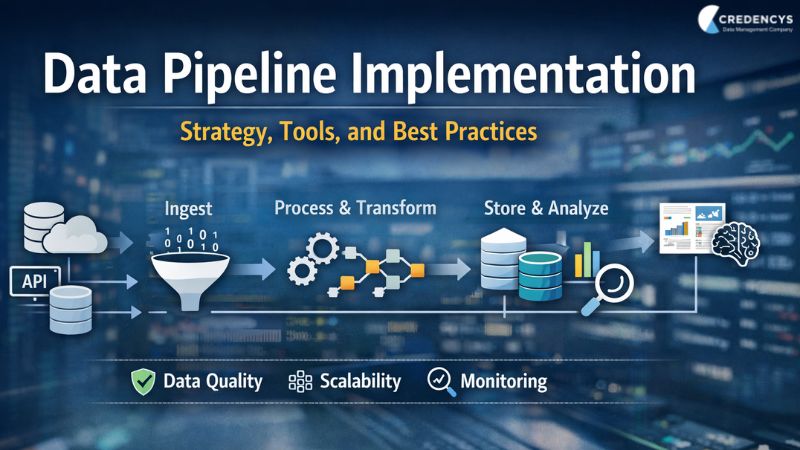
A data pipeline is a system that moves data from multiple sources to a destination where it can be stored, processed, and used for analysis.

It ensures that data flows in a structured and reliable way across your organization. Instead of manually collecting and preparing data from different systems, pipelines automate the process, making data readily available for reporting, analytics, and business decisions.

Typically, a data pipeline involves collecting raw data, transforming it into a usable format, and delivering it to systems like data warehouses or analytics platforms.

In simple terms, data pipelines act as the backbone of modern data operations. They connect fragmented data sources and turn them into consistent, usable insights that teams can rely on.

Strategy for Data Pipeline Implementation

Getting Data Pipeline Implementation right starts with strategy, not tools.

Many organizations jump straight into selecting technologies, only to realize later that their pipelines are difficult to scale, maintain, or align with business needs. A strong strategy ensures your pipeline is built for long-term success.

1. Define Clear Business Objectives

Start with the outcomes you want to achieve. Whether it is real-time personalization, faster reporting, or unified customer data, your pipeline should be designed around business goals, not just data movement.

When objectives are unclear, pipelines often become overly complex and fail to deliver measurable value.

2. Identify Data Sources and Consumers

Understand where your data is coming from and who will use it. This includes internal systems, third-party platforms, APIs, and streaming sources.

At the same time, identify the end users of this data such as analytics teams, business users, or AI models. This ensures your pipeline delivers the right data in the right format and frequency.

3. Choose the Right Architecture

Decide whether your use

case requires batch processing, real-time streaming, or a hybrid approach.

Also consider whether a centralized architecture or a more distributed model fits your scale and organizational structure. Making these decisions early prevents rework later.

4. Build for Data Quality and Governance

Data pipelines are only as valuable as the quality of data they deliver.

Include validation checks, standardization rules, and governance policies within the pipeline. This helps maintain consistency, accuracy, and trust across teams.

5. Design for Scalability and Flexibility

As your data grows, your pipeline should scale without performance bottlenecks.

Cloud-native and modular architectures allow you to handle increasing volumes and evolving requirements without rebuilding your entire pipeline.

6. Ensure Monitoring and Observability

A pipeline should never be a black box.

Implement monitoring to track performance, detect failures, and ensure data is flowing as expected. Observability helps teams quickly identify and resolve issues before they impact business decisions.

Tools for Data Pipeline Implementation

Choosing the right tools is a critical part of successful Data Pipeline Implementation. The focus should be on building a cohesive ecosystem that aligns with your data strategy, not just selecting individual tools.

1. Data Ingestion Tools

These tools help collect data from multiple sources such as databases, APIs, and applications.

Popular options include:

  • Apache Kafka for real-time data streaming
  • Fivetran for automated data ingestion
  • Apache NiFi for data routing and integration

2. Data Processing and Transformation

This layer is where raw data is cleaned, transformed, and prepared for analysis.

Common tools include:

  • Apache Spark for large-scale processing
  • dbt for warehouse-native transformations
  • Databricks for unified data processing, analytics, and machine learning

3. Orchestration and Workflow Management

These tools help schedule, automate, and monitor data workflows.

Examples include:

  • Apache Airflow for managing complex pipelines
  • Prefect for modern orchestration and observability

4. Data Storage and Analytics Platforms

Processed data is stored and made available for analytics and reporting.

Popular platforms include:

  • Snowflake for scalable and governed analytics
  • Google BigQuery for fast SQL-based insights
  • Amazon Redshift for enterprise-scale workloads

5. Monitoring and Observability

To maintain reliability, pipelines must be continuously monitored.

Tools include:

  • Datadog for performance tracking
  • Monte Carlo for tracking data quality and pipeline health

Best Practices for Data Pipeline Implementation

A successful Data Pipeline Implementation is not just about building pipelines. It is about building pipelines that are reliable, scalable, and aligned with business needs.

Here are the key best practices to follow:

1. Design for Reliability from Day One

Pipelines should be built to handle failures gracefully. Include retry mechanisms, fault tolerance, and backup processes to ensure data flow is not disrupted.

Unreliable pipelines lead to broken dashboards and loss of trust in data.

2. Prioritize Data Quality Early

Do not treat data quality as an afterthought. Implement validation checks, schema enforcement, and data cleansing within the pipeline.

High-quality input ensures accurate insights and better decision-making.

3. Build Modular and Reusable Pipelines

Avoid tightly coupled designs. Break pipelines into smaller, reusable components that can be easily updated or scaled.

This reduces maintenance effort and improves flexibility as requirements evolve.

4. Automate as Much as Possible

Manual intervention slows down data operations and increases the risk of errors.

Use orchestration tools to automate scheduling, dependency management, and error handling across pipelines.

5. Implement Strong Monitoring and Alerts

Always have visibility into pipeline performance.

Set up alerts for failures, delays, and anomalies so teams can act quickly. Observability ensures your pipeline remains reliable over time.

6. Optimize for Performance and Cost

Balance speed and cost efficiency. Not all workloads need real-time processing.

Choose the right processing approach based on business requirements to avoid unnecessary infrastructure costs.

7. Ensure Security and Compliance

Data pipelines often handle sensitive information.

Implement access controls, encryption, and compliance measures to protect data and meet regulatory requirements.

Conclusion

Getting Data Pipeline Implementation right is no longer optional. It is a foundational capability for any organization looking to scale analytics, AI, and data-driven decision-making.

As data volumes grow and business expectations shift toward real-time insights, pipelines must evolve from basic data movement systems to strategic assets that enable speed, reliability, and trust.

Organizations that invest in the right data pipeline strategy are able to move faster, reduce operational inefficiencies, and unlock the true value of their data.

However, many teams still struggle to assess where they stand and what to fix first.

That’s where a structured evaluation can help.

If you are unsure about the maturity of your current data setup, start with a Product Data Readiness Assessment. It helps you identify gaps in your data pipelines, uncover inefficiencies, and define a clear roadmap for improvement.

Tags:

Sagar Sharma

Co - Founder & CTO

Sagar is the Chief Technology Officer (CTO) at Credencys. With his deep expertise in addressing data-related challenges, Sagar empowers businesses of all sizes to unlock their full potential through streamlined processes and consistent success.

As a data management expert, he helps Fortune 500 companies to drive remarkable business growth by harnessing the power of effective data management. Connect with Sagar today to discuss your unique data needs and drive better business growth.

PIM Cost Calculator

Wondering about the investment involved in implementing a PIM solution? Get an estimate to plan your budget effectively with our PIM Cost Calculator.