


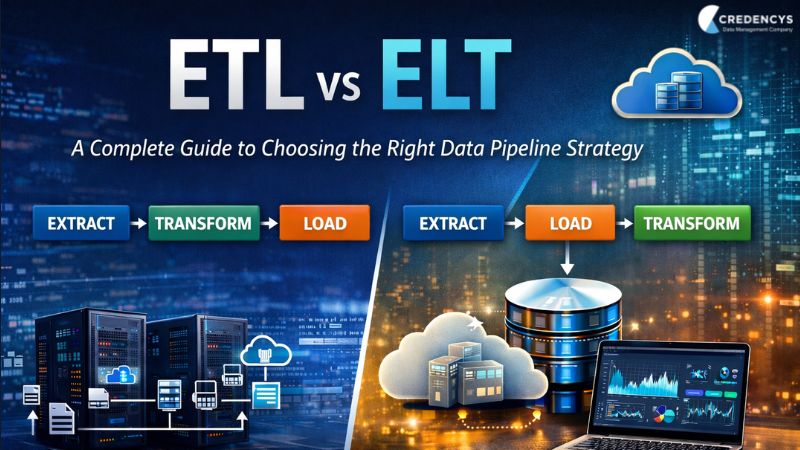
ETL vs ELT: A Complete Guide to Choosing the Right Data Pipeline Strategy
Over 80% of enterprise data projects fail to deliver expected value, and one of the biggest reasons is a poor choice of data integration strategy.
Businesses are collecting massive volumes of data from multiple sources such as applications, IoT devices, customer interactions, and third-party platforms. But raw data alone does not drive decisions. What matters is how efficiently that data is processed, transformed, and made available for analytics.
This is where the debate of ETL vs ELT becomes critical.
Choosing between ETL (Extract, Transform, Load) and ELT (Extract, Load, Transform) is not just a technical decision. It directly impacts your data quality, scalability, speed of insights, and overall business agility. While ETL has been the traditional approach for decades, ELT has gained significant momentum with the rise of cloud data platforms and modern analytics needs.
So, which one is better?
The answer depends on your data architecture, business goals, and the kind of insights you want to generate.
In this blog, we will break down ETL vs ELT, explore their key differences, advantages, challenges, and help you determine which approach is the right fit for your organization.
TLDR
- ETL vs ELT comes down to when data is transformed
- ETL transforms data before loading, ensuring clean and structured data upfront
- ELT loads raw data first and transforms it later, enabling speed and scalability
- Choose ETL if you need strong governance, compliance, and structured data from the start
- Choose ELT if you need flexibility, handle large data volumes, and use cloud platforms
- ELT is becoming the preferred approach for modern, cloud-first and AI-driven organizations
- ETL still matters for regulated and legacy environments
What is ETL (extract, transform, load)?
ETL stands for Extract, Transform, Load. It is a traditional data integration approach where data is first extracted from various sources, then transformed into a structured and usable format, and finally loaded into a target system such as a data warehouse.
How ETL Works
1. Extract
Data is collected from multiple sources such as databases, CRM systems, APIs, and files.
2. Transform
The extracted data is cleaned, filtered, enriched, and formatted based on predefined business rules before it reaches the destination.
3. Load
The transformed data is then loaded into a data warehouse or storage system for reporting and analysis.
Key Characteristics of ETL
- Transformation happens before loading into the target system
- Requires a separate processing engine or ETL tool
- Ensures high data quality before storage
- Works well with structured data and legacy systems
Advantages of ETL
- Strong data governance and control
- Clean and consistent data before it reaches analytics systems
- Suitable for compliance-heavy industries
- Optimized for traditional on-premise data warehouses
Limitations of ETL
- Slower processing for large volumes of data
- Less flexible when dealing with unstructured or semi-structured data
- Higher infrastructure and maintenance overhead
- Not ideal for real-time analytics use cases
ETL has been the backbone of data integration for years, especially in environments where data quality and consistency are critical before any analysis takes place. However, as data volumes and speed requirements have increased, newer approaches like ELT have started gaining traction.
What is ELT (extract, load, transform)?
ELT stands for Extract, Load, Transform. It is a modern data integration approach where raw data is first extracted from source systems and loaded directly into a target system, typically a cloud data warehouse. The transformation happens later, within the target system itself.
How ELT Works
1. Extract
Data is collected from various sources such as applications, databases, APIs, and streaming platforms.
2. Load
The raw data is loaded directly into a data warehouse or data lake without significant transformation.
3. Transform
Data is then transformed inside the target system using its processing power, based on analytical needs.
Key Characteristics of ELT
- Transformation happens after loading into the target system
- Leverages the compute power of modern cloud platforms
- Supports structured, semi-structured, and unstructured data
- Enables faster ingestion of large data volumes
Advantages of ELT
- Faster data ingestion and processing at scale
- High flexibility as raw data is always available
- Ideal for big data and advanced analytics use cases
- Better suited for cloud-native architectures
Limitations of ELT
- Requires strong governance to manage raw data
- Data quality issues can propagate if not handled properly
- Higher dependency on the performance of the data warehouse
- Can increase storage and compute costs if not optimized
ELT is becoming the preferred choice for modern data teams, especially those working with cloud data platforms and real-time analytics requirements. It allows organizations to store all their data first and decide how to use it later, making it more adaptable to evolving business needs.
ETL vs ELT: Key Differences
While both ETL and ELT aim to move and prepare data for analytics, the way they handle transformation creates significant differences in performance, scalability, and use cases.
Here is a side-by-side comparison to simplify the decision:
ETL vs ELT Comparison
| Aspect | ETL | ELT |
|---|---|---|
| Process Order | Transform before loading | Load before transforming |
| Data Processing | Happens in a separate ETL tool | Happens inside the data warehouse |
| Speed | Slower for large datasets | Faster due to parallel processing |
| Scalability | Limited by ETL infrastructure | Highly scalable with cloud platforms |
| Data Types | Best for structured data | Supports structured, semi-structured, and unstructured data |
| Storage | Only processed data is stored | Raw and processed data both stored |
| Flexibility | Less flexible once data is transformed | Highly flexible for future use cases |
| Cost Structure | Higher upfront infrastructure cost | Pay-as-you-go cloud cost model |
| Use Case Fit | Legacy systems, compliance-heavy environments | Modern analytics, big data, real-time insights |
Key Takeaway
The core difference in ETL vs ELT lies in where and when transformation happens.
ETL focuses on cleaning and structuring data before it enters the warehouse, ensuring control and consistency. ELT, on the other hand, prioritizes speed and scalability by loading raw data first and transforming it later using the power of modern data platforms.
This shift is the reason why many organizations moving to the cloud are adopting ELT as their preferred approach.
ETL vs ELT: When Should You Use Each?
Choosing between ETL vs ELT is not about which one is universally better. It is about selecting the right approach based on your data environment, business priorities, and technical capabilities.
When to Use ETL
ETL is a better fit when control, data quality, and compliance are your top priorities. You should consider ETL if:
- You are working with legacy or on-premise systems
- Your organization has strict data governance and compliance requirements
- You need clean, structured data before loading into the warehouse
- Your data volumes are manageable and not extremely large
- You rely heavily on traditional BI and reporting tools
In such scenarios, transforming data before loading ensures consistency and reduces the risk of inaccurate insights.
When to Use ELT
ELT is ideal for organizations that prioritize speed, scalability, and flexibility. You should consider ELT if:
- You are using cloud data platforms like Snowflake, BigQuery, or Redshift
- You deal with large volumes of structured and unstructured data
- You need real-time or near real-time analytics
- Your use cases include AI, machine learning, or advanced analytics
- You want to store raw data for future analysis and reprocessing
ELT allows you to ingest data quickly and transform it later based on evolving business needs.
The Modern Reality
For many enterprises today, the decision is not strictly ETL vs ELT. Instead, a hybrid approach is becoming more common. Organizations use ETL for sensitive, compliance-driven workloads and ELT for scalable analytics and innovation use cases.
This balanced strategy helps businesses maintain control where needed while still leveraging the speed and flexibility of modern data platforms.
ETL vs ELT: Which One is Better?
The honest answer is that there is no one size fits all winner in the ETL vs ELT debate. The better approach depends on what your business values more: control or scalability, structure or flexibility, predictability or speed.
Choose ETL if:
- Data quality and governance are critical from the start
- You operate in highly regulated industries
- Your data architecture is largely on-premise
- You need structured, ready-to-use data before analysis
Choose ELT if:
- You are building on modern cloud data platforms
- Speed and scalability are top priorities
- You want to leverage raw data for multiple use cases
- Your teams rely on advanced analytics, AI, and machine learning
Strategic Perspective
Modern enterprises are increasingly leaning toward ELT because it aligns better with cloud-first strategies and the growing demand for real-time insights. However, ETL still plays a crucial role in environments where precision, compliance, and data control cannot be compromised.
The key is not to follow trends blindly, but to align your data pipeline strategy with your business goals, technical ecosystem, and future roadmap.
Final Thoughts: ETL vs ELT
Understanding the difference between ETL vs ELT is essential for building a scalable and future-ready data architecture.
As data continues to grow in volume and complexity, organizations that choose the right integration approach will be better positioned to unlock insights, drive innovation, and stay competitive.
If you are planning to modernize your data infrastructure, this decision will shape not just your data pipelines, but your entire analytics and AI strategy.






Tags: