


AI and Data Engineering: Why They Must Work Together for Real Business Impact
AI promises automation, predictive insights, personalization, smarter decisions, and competitive advantage. But here’s the uncomfortable truth most organizations discover too late:
AI without strong data engineering is just an expensive experiment.
According to industry research, nearly 80% of AI projects fail to deliver measurable business value. Mainly because the data feeding those models is fragmented, inconsistent, or simply not production-ready.
This is where AI and Data Engineering become inseparable.
AI is the intelligence layer.
Data engineering is the foundation that makes intelligence possible.
Without reliable pipelines, clean datasets, scalable infrastructure, and governance controls, even the most advanced AI models struggle to move beyond proof-of-concept. On the other hand, when AI and Data Engineering are aligned, organizations move from dashboards to decisions, and from predictions to measurable impact.
What You’ll Learn
In this blog, we’ll explore:
- Why AI initiatives stall without strong data engineering
- How modern data architectures enable scalable AI
- The real business outcomes when both work together
- What leaders should prioritize to build an AI-ready data foundation
What AI and Data Engineering Must Deliver for AI to Actually Work
AI sounds powerful in theory. Feed it data, train a model, deploy it, and let the insights flow. But in practice, AI is far more demanding than most organizations expect. It is not enough to simply “have data.” AI needs structured, reliable, and continuously flowing data environments. That is where AI and Data Engineering intersect in a very real, operational way.
When leaders say, “Our AI model isn’t performing as expected,” the root cause is rarely the algorithm. It is usually the data foundation underneath it.
Here is what AI truly needs from Data Engineering to move beyond experimentation.
1. Clean, Trusted, and Governed Data
AI models amplify whatever you feed them. If the data is inconsistent, duplicated, incomplete, or biased, the output will reflect those flaws.
Data engineering ensures:
- Standardized data formats across systems
- Removal of duplicates and inconsistencies
- Clear data ownership and governance rules
- Validation checks before data reaches AI models
2. Reliable Data Pipelines, Not Manual Exports
Many AI pilots begin with CSV files manually pulled from different systems. That may work for a demo. It does not work in production. AI needs automated, scalable pipelines that:
- Ingest data from multiple sources in near real time
- Transform and enrich it consistently
- Deliver structured datasets to training and inference environments
- Run without constant human intervention
3. Scalable Infrastructure
AI workloads are not static. Models retrain. Data volumes grow. New features get added. If infrastructure cannot scale, performance degrades. Modern data engineering provides:
- Cloud-native storage and compute
- Distributed processing frameworks
- Elastic scaling for training workloads
- Monitoring and performance optimization
4. Context, Not Just Raw Data
Raw data alone does not create intelligence. Context does. For example, a spike in sales numbers means little without understanding promotions, seasonality, supply chain delays, or regional variations. Strong AI and Data Engineering frameworks integrate:
- Historical data
- Real-time transactional data
- External variables
- Business rules and metadata
5. Continuous Feedback Loops
AI is not “build once and forget.” Models drift. Customer behavior changes. Markets shift. Data engineering supports AI through:
- Continuous data refresh cycles
- Performance monitoring dashboards
- Model retraining pipelines
- Version control and traceability
Why AI and Data Engineering Often Fail to Align
On paper, AI and Data Engineering seem naturally connected. One produces intelligence. The other supplies the data. But inside many organizations, they operate in parallel rather than in partnership.
And that gap is where AI initiatives quietly lose momentum.
The data team focuses on pipelines, warehousing, and governance. The AI team focuses on models, accuracy metrics, and experimentation. Both are technically strong. Yet the business still struggles to see measurable impact.
Here’s why.
1. Different Success Metrics
Data engineering teams are often evaluated on stability, uptime, and delivery timelines. AI teams are evaluated on model performance and innovation.
But production AI success depends on both.
If pipelines break, the model cannot function. If models are not tuned to business KPIs, accurate predictions may still lack relevance. Without shared performance goals, misalignment grows.
2. AI Pilots Without Production Planning
Many organizations build impressive AI proofs of concept. The models work well in controlled environments. But once it is time to deploy, the infrastructure is not ready. Common challenges include:
- No automated data ingestion
- No real-time model deployment pipelines
- No monitoring for model drift
- No governance for AI decision traceability
3. Data Silos That AI Cannot Bridge
AI cannot magically unify disconnected systems. If customer data sits in CRM, transactions live in ERP, and marketing data exists in separate tools, AI models will see only fragments.
When AI and Data Engineering are not integrated at an architectural level, the model trains on incomplete truth.
And incomplete truth leads to flawed insights.
4. Underestimating the Operational Complexity
AI is often perceived as an advanced analytics layer sitting on top of existing systems. In reality, it changes how data flows across the organization. It requires:
- Higher data quality standards
- More frequent refresh cycles
- Stronger governance controls
- Cross-functional collaboration
When AI and Data Engineering teams operate in silos, AI remains experimental. When they co-design architecture, pipelines, governance, and performance tracking together, AI becomes embedded in business workflows.
How Your Organization Can Align AI and Data Engineering
If AI initiatives in your organization feel slow, fragmented, or permanently stuck in pilot mode, the challenge may not be technical capability. More often, it is a matter of alignment between AI ambitions and the underlying data engineering foundation required to support them.
AI and Data Engineering must evolve together. When they operate in silos, progress becomes uneven and business value remains unclear. When they are aligned around shared objectives and architecture, execution becomes smoother and outcomes become measurable.
Here is how your organization can approach this alignment in a structured and practical way.
1. Start With the Business Problem, Not the Algorithm
Before discussing models, frameworks, or tools, clarify the business objective you are trying to influence. AI initiatives gain momentum when they are rooted in tangible outcomes rather than technical curiosity. Ask questions such as:
- What specific decision are we trying to improve or automate?
- Which business metric must move for this initiative to be considered successful?
- Who will rely on these insights, and how will they use them in daily operations?
2. Strengthen the Data Foundation Before Scaling AI
AI cannot compensate for fragmented, inconsistent, or poorly governed data. If foundational datasets lack accuracy or standardization, model outputs will reflect those weaknesses. Your organization should focus on:
- Cleaning and standardizing critical data assets across departments
- Eliminating system silos that prevent a unified view of information
- Establishing clear data ownership and accountability
- Implementing governance controls and validation checks before data reaches AI systems
3. Design Data Pipelines With Production in Mind
One of the most common reasons AI initiatives stall is that deployment considerations were overlooked during early experimentation. A model may perform well in a controlled environment, but without production-ready pipelines, it cannot operate consistently in real-world conditions. Your organization should ensure that:
- Data ingestion processes are automated and reliable
- Transformation workflows are standardized and repeatable
- AI models receive fresh and context-rich data on a continuous basis
- Predictions are embedded directly into operational systems rather than isolated dashboards
4. Align Success Metrics Across Technical and Business Teams
Misalignment often occurs when teams operate under different definitions of success. Data engineers may focus on system stability, while data scientists focus on model accuracy, and business leaders focus on revenue or cost impact. Bringing these perspectives together requires shared KPIs such as:
- Revenue growth influenced by AI insights
- Cost reduction driven by predictive optimization
- Improvement in forecast accuracy or decision speed
- Operational efficiency gains across departments
5. Establish Continuous Feedback and Improvement Loops
AI is not a static deployment. Customer behavior shifts, markets evolve, and data patterns change over time. Without continuous monitoring and refinement, even well-built systems can lose effectiveness. Your organization should encourage:
- Regular reviews of model performance against business KPIs
- Open communication between business users and technical teams
- Ongoing refinement of data inputs and assumptions
- Monitoring systems that detect anomalies or model drift early
The Business Impact of Aligning AI and Data Engineering
When AI and Data Engineering are aligned, the impact is felt quickly and across the organization. AI stops being a proof-of-concept experiment and starts becoming part of how real decisions are made.
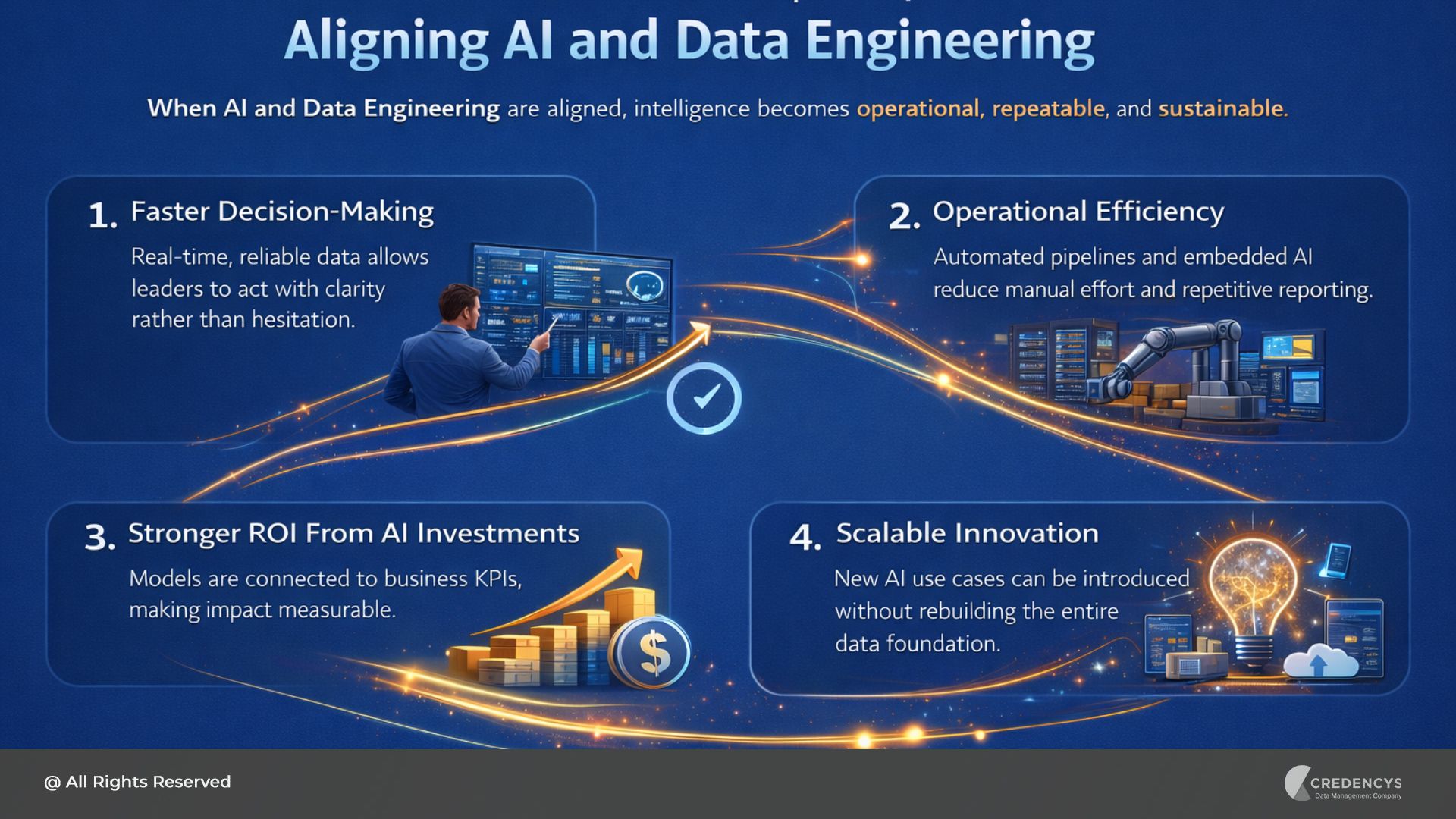
Instead of fragmented insights and unreliable outputs, organizations gain a steady flow of trusted intelligence that directly supports operations and strategy. Here is what typically changes.
- Faster decision-making: Real-time, reliable data allows leaders to act with clarity rather than hesitation.
- Operational efficiency: Automated pipelines and embedded AI reduce manual effort and repetitive reporting.
- Stronger ROI from AI investments: Models are connected to business KPIs, making impact measurable.
- Scalable innovation: New AI use cases can be introduced without rebuilding the entire data foundation.
Why AI and Data Engineering Are Stronger Together
AI is exciting. It promises smarter decisions, automation, and competitive advantage. But behind every successful AI initiative is something less glamorous and far more important: disciplined data engineering.
Organizations often chase AI because it feels transformative. The real transformation, however, happens when AI and Data Engineering mature together. When pipelines are reliable, data is trusted, infrastructure is scalable, and governance is clear, AI stops being experimental. It becomes dependable.
If your organization is investing in AI, the most strategic question to ask is not, “Which model should we build next?” It is, “Is our data foundation ready to support intelligence at scale?”
Because AI does not fail due to lack of ambition. It fails when the systems underneath it cannot sustain it.
When AI and Data Engineering operate as one integrated capability, intelligence becomes operational, repeatable, and aligned with business goals. Decisions become faster. Insights become clearer. Investments become measurable.



Tags: