



Data Engineering Outsourcing: A Complete Guide for Modern Enterprises
Modern enterprises generate massive volumes of data from applications, customer interactions, IoT devices, digital platforms, and third-party systems. Yet for many organizations, turning that raw data into reliable insights remains a challenge.
The reason is simple: data is only as valuable as the engineering behind it.
According to the IDC, global data is expected to reach 175 zettabytes, and enterprises are rapidly investing in modern data platforms to manage and analyze this growth.
However, building and maintaining scalable data pipelines, real-time architectures, and reliable data platforms requires specialized expertise that many organizations struggle to hire and retain internally.
This is where Data Engineering outsourcing becomes a strategic advantage. Instead of building large internal teams from scratch, organizations increasingly partner with experienced data engineering providers to design, build, and maintain modern data infrastructures. These partners bring proven frameworks, skilled engineers, and deep expertise in cloud platforms, helping businesses accelerate analytics, AI initiatives, and data-driven decision-making.
For enterprises aiming to modernize their data stack, reduce infrastructure complexity, and ensure reliable data pipelines, outsourcing data engineering offers a faster and more cost-effective path to scale.
In this guide, we’ll explore what data engineering outsourcing includes, the challenges it solves, the benefits it delivers, and how enterprises can choose the right outsourcing model and partner.
TL;DR
- Modern enterprises rely on strong data engineering foundations to power analytics, AI, and real-time decision-making.
- Building scalable data platforms requires specialized skills in pipelines, cloud infrastructure, data modeling, and governance.
- Many organizations struggle with talent shortages, high hiring costs, and increasing data complexity.
- Data engineering outsourcing allows companies to access experienced engineers without long hiring cycles.
- Outsourced teams help build reliable data pipelines, scalable cloud data platforms, and high-quality datasets for analytics and AI.
- It also helps organizations reduce operational complexity, accelerate data initiatives, and improve analytics performance.
- By partnering with experts like Credencys Solutions Inc., enterprises can transform fragmented data environments into scalable, reliable data platforms that enable faster and smarter decisions.
Data Engineering Outsourcing: What’s Included
Data engineering outsourcing involves partnering with external specialists to design, build, and maintain the systems that collect, organize, and move data across an organization.
At its core, data engineering focuses on creating reliable pipelines and preparing raw data for analysis, while ensuring information flows smoothly between databases, applications, and analytics tools.
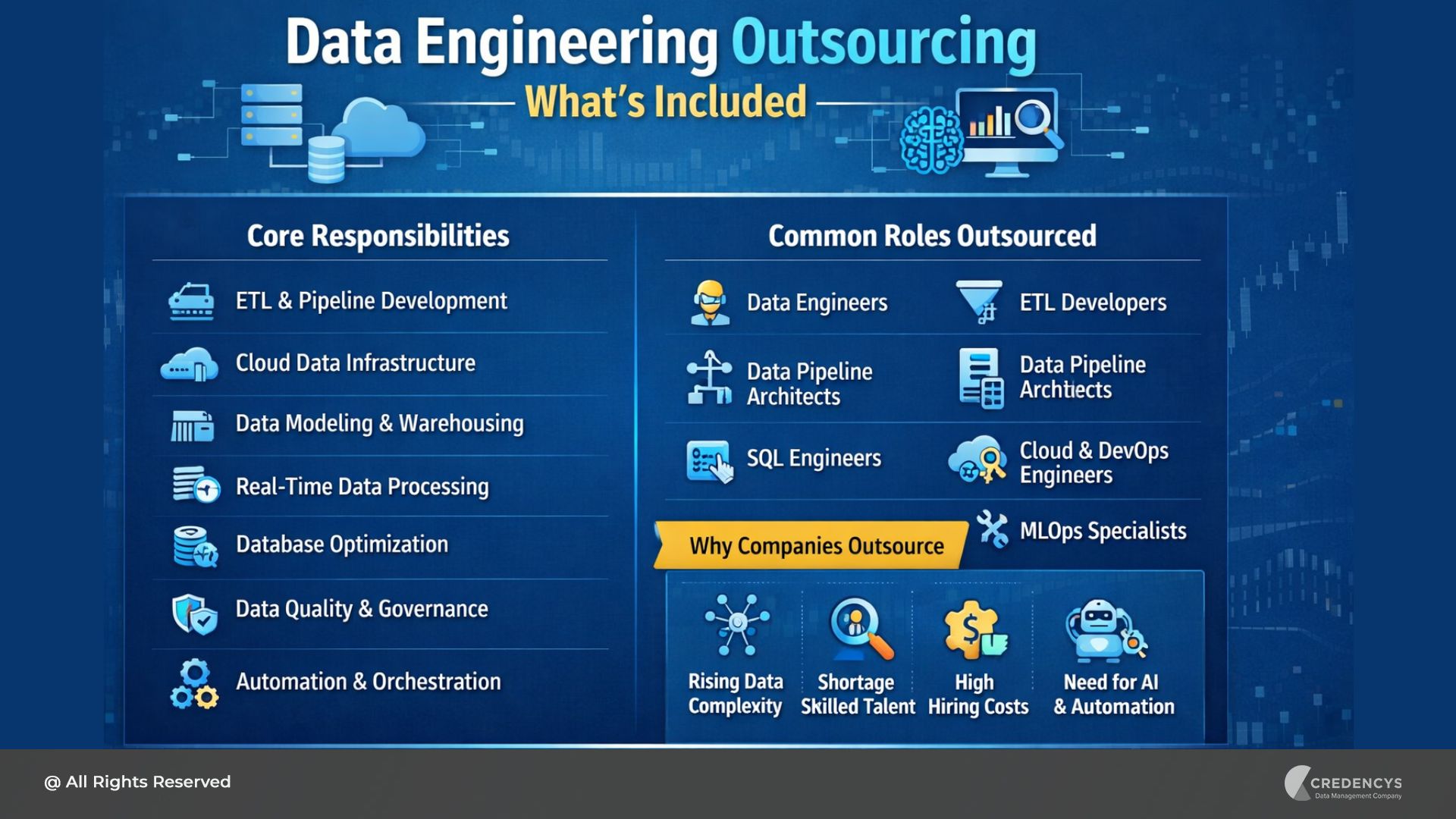
Data engineers design the infrastructure that supports reporting, dashboards, AI models, and day-to-day business decisions, making it one of the most critical functions in modern data-driven organizations.
As a discipline, data engineering requires a combination of:
- Software engineering
- Database architecture
- Cloud infrastructure management
- Data governance
- Workflow automation
Because of this complexity, skilled data engineers are highly sought after. According to research from the U.S. Bureau of Labor Statistics, demand for data-related roles continues to grow rapidly, while hiring cycles remain competitive and expensive.
As a result, many organizations choose data engineering outsourcing to access experienced talent and accelerate their data initiatives.
Common reasons companies outsource data engineering include:
- Rising data complexity
- Shortage of experienced data engineers
- High hiring and retention costs
- Slow or unreliable analytics pipelines
- Increasing pressure to support AI and automation initiatives
Core Responsibilities you Get in Data Engineering Outsourcing
A strong outsourced data engineering team typically supports a wide range of responsibilities across the data lifecycle, including:
- Pipeline design and ETL workflow development
- Cloud data infrastructure in AWS, Azure, or Google Cloud
- Data modeling and data warehousing
- Real-time and streaming data processing
- Database optimization and SQL engineering
- Data quality frameworks and validation
- Workflow automation and orchestration
- DevOps and MLOps support for data systems
Key Common Roles Companies Outsource
When organizations outsource data engineering, they often extend their internal teams with specialized experts such as:
- Mid-level and senior data engineers
- ETL developers
- Data pipeline architects
- SQL engineers
- Database administrators
- Cloud infrastructure engineers
- DevOps and MLOps engineers
Which Challenges does Data Engineering Outsourcing Help Solve?
As organizations scale their digital operations, data environments become increasingly complex. New applications, cloud platforms, customer channels, and analytics tools continuously generate and consume data. Without strong engineering foundations, these systems often become difficult to manage.
Many enterprises struggle to maintain reliable pipelines, scalable infrastructure, and consistent data quality with limited internal resources. Data engineering outsourcing helps organizations overcome these challenges by providing specialized expertise and scalable engineering support.
Below are some of the most common challenges companies address through data engineering outsourcing.
1. Talent Shortage and Long Hiring Cycles
Experienced data engineers are among the most in-demand professionals in the technology industry. Recruiting senior engineers often takes months, and competition for talent can drive salaries significantly higher.
Outsourcing allows companies to access experienced engineers immediately, without lengthy hiring processes or long-term staffing commitments.
2. Unstable or Failing Data Pipelines
Many organizations rely on pipelines that frequently break, produce incomplete data, or require manual fixes. When pipelines fail, analytics teams lose trust in the data, and decision-making slows down.
An outsourced data engineering team can redesign pipelines with proper orchestration, monitoring, and error handling, ensuring reliable data flow across systems.
3. Growing Data Volumes and Infrastructure Complexity
As businesses adopt more digital platforms, the amount of data they generate grows rapidly. Managing large-scale data infrastructure across cloud platforms requires deep technical expertise.
Data engineering outsourcing helps organizations build scalable architectures that can handle increasing data volumes without performance bottlenecks.
4. Slow Analytics and Reporting
If data pipelines are inefficient or poorly structured, analytics queries can become slow and unreliable. This delays reporting and limits the ability of business teams to make timely decisions.
Outsourced engineers optimize data models, storage structures, and query performance, enabling faster reporting and better analytics outcomes.
5. Poor Data Quality and Governance
Inconsistent or inaccurate data can lead to flawed insights and poor business decisions. Many organizations lack the frameworks needed to maintain data quality across systems.
Data engineering outsourcing helps implement data validation, monitoring, and governance frameworks that ensure consistent and trustworthy data.
6. Difficulty Supporting AI and Advanced Analytics
Modern initiatives such as machine learning, predictive analytics, and real-time decision systems require well-engineered data pipelines and structured datasets.
Outsourced data engineering teams help prepare AI-ready data environments, ensuring that machine learning models receive high-quality, well-structured data.
The Most Significant Benefits of Data Engineering Outsourcing
When executed with the right partner, data engineering outsourcing delivers more than just additional development capacity. It enables organizations to build stronger data foundations, accelerate innovation, and reduce operational risks.
By leveraging external expertise, enterprises can modernize their data infrastructure while allowing internal teams to focus on analytics, product development, and strategic initiatives.
Here are the most significant benefits organizations gain from outsourcing data engineering.
1. Faster Data Platform Development
Building modern data platforms requires expertise in pipelines, cloud infrastructure, data modeling, and orchestration tools. Hiring and assembling a full internal team can take months.
Data engineering outsourcing allows organizations to accelerate platform development with experienced engineers who can quickly design and deploy scalable architectures.
2. Access to Specialized Expertise
Data engineering spans multiple disciplines, including cloud architecture, database optimization, streaming systems, and workflow orchestration. Few organizations have deep expertise across all of these areas internally.
Outsourcing gives companies access to specialized engineers with experience across modern data stacks and large-scale data environments.
3. Reduced Operational Costs
Hiring and maintaining a full in-house data engineering team can be expensive, especially in competitive talent markets.
Data engineering outsourcing helps organizations optimize costs by accessing skilled engineers without the overhead of long hiring cycles, recruitment costs, and full-time salaries.
4. Improved Data Reliability
Reliable data pipelines are essential for analytics, reporting, and AI initiatives. Poorly designed pipelines often lead to failures, delays, and inconsistent insights.
Experienced outsourcing partners implement robust pipeline architectures, monitoring systems, and automated error handling, improving the reliability of enterprise data systems.
5. Scalability for Growing Data Needs
As organizations grow, their data volumes and processing requirements increase significantly. Internal teams may struggle to scale infrastructure quickly enough to support these demands.
Outsourcing allows companies to scale data engineering resources and infrastructure without major internal restructuring.
6. Stronger Support for AI and Analytics
Advanced analytics and AI initiatives require clean, structured, and well-governed data. Without strong engineering foundations, these initiatives often fail to deliver expected results.
Data engineering outsourcing helps organizations prepare data for machine learning, real-time analytics, and intelligent automation, enabling faster adoption of AI-driven solutions.
Onshore, Nearshore, or Offshore: Choosing the Right Data Engineering Outsourcing Model
When organizations decide to pursue data engineering outsourcing, one of the first strategic decisions is choosing the right outsourcing model. The location of your engineering team can impact collaboration, costs, scalability, and overall project success.
Most enterprises typically choose between onshore, nearshore, and offshore outsourcing models, each offering different advantages depending on business priorities.
1. Onshore Outsourcing
Onshore outsourcing involves working with a data engineering partner located in the same country as your organization.
This model offers strong communication alignment, similar working hours, and fewer cultural differences. Teams can collaborate more easily and meet in person if needed.
However, onshore outsourcing is usually the most expensive option, especially in markets like the United States or Western Europe where engineering salaries are significantly higher.
Best suited for:
- Highly regulated industries
- Projects requiring close collaboration
- Organizations prioritizing proximity over cost savings
2. Nearshore Outsourcing
Nearshore outsourcing means partnering with engineering teams located in neighboring or nearby countries, often within similar time zones.
This model balances cost efficiency with collaboration benefits. Teams typically share overlapping working hours, making communication smoother compared to offshore teams.
Many organizations choose nearshore outsourcing to maintain strong collaboration while still reducing operational costs.
Best suited for:
- Companies seeking moderate cost savings
- Projects requiring regular collaboration
- Organizations that prefer smaller time-zone differences
5. Offshore Outsourcing
Offshore outsourcing involves working with engineering teams located in distant regions, often in countries known for strong technology talent pools such as India, Eastern Europe, or Southeast Asia.
This model offers the highest cost efficiency and access to large talent pools. Offshore teams can scale quickly and provide specialized expertise across modern data technologies.
With strong processes, communication frameworks, and experienced partners, offshore outsourcing can deliver significant value for enterprises building modern data platforms.
Best suited for:
- Large-scale data platform development
- Long-term data engineering initiatives
- Companies seeking cost optimization and rapid scalability
Choosing the Right Model
The right outsourcing model depends on several factors, including:
- Project complexity
- Budget constraints
- Collaboration requirements
- Time-zone preferences
- Security and compliance considerations
Many enterprises adopt a hybrid approach, combining offshore engineering teams with local project management to balance cost efficiency with effective collaboration.
Selecting the right outsourcing model ensures that organizations can scale data engineering capabilities while maintaining strong communication, reliability, and delivery speed.
Why Choose Credencys for Data Engineering Outsourcing
Successful data engineering outsourcing requires more than technical skills. It requires a partner who understands modern data architecture, cloud platforms, and how data systems support real business outcomes.
At Credencys Solutions Inc., we help organizations build scalable data platforms that power analytics, AI, and data-driven decision-making.
1. Modern Data Engineering Expertise
Our team designs and builds modern data ecosystems including data pipelines, cloud data platforms, and scalable architectures that support growing data volumes and advanced analytics.
2. End-to-End Data Engineering Support
Credencys provides complete data engineering capabilities, including:
- Data ingestion and integration
- ETL/ELT pipeline development
- Cloud data platform architecture
- Data warehousing and modeling
- Data governance and quality frameworks
- Pipeline monitoring and optimization
3. Flexible Engagement Models
We offer flexible outsourcing models that allow organizations to extend internal teams, build dedicated engineering squads, or accelerate large-scale data initiatives.
With deep technical expertise and a collaborative approach, Credencys helps enterprises transform complex data environments into reliable, scalable data platforms.
Our Data Engineering Success Stories
Data Engineering Transformation for a Global Textile Quality Management Leader
A Hong Kong–based global textile quality management organization needed a unified data platform to support inspection, analysis, and reporting across geographically distributed teams. Their data was spread across multiple applications, which created delays in reporting, slowed decision-making, and required frequent manual intervention.
To address this challenge, Credencys Solutions Inc. implemented a centralized Azure-based data platform that unified data from multiple operational systems. Using Azure Data Factory, Azure SQL Database, and Azure Analysis Services, the team built automated pipelines and established a single source of truth for analytics.
With automated data processing and modern dashboards, the organization gained real-time visibility into global operations and significantly reduced manual data handling.
Business Impact
- 80% faster response time to customer queries
- Significant reduction in manual data processing
- Real-time visibility across global operations
Data-Driven Transformation for a Global Automotive Leader
A leading Korean automotive conglomerate struggled with fragmented data across sales, marketing automation, CRM, and ERP systems. Business teams relied heavily on spreadsheets to combine data, which made reporting slow, inconsistent, and prone to errors.
Credencys implemented a centralized data management and analytics framework to unify data across departments. The solution included automated data ingestion, advanced data modeling, and interactive dashboards that replaced manual reporting processes.
This modernized data platform enabled business users to access consistent, real-time insights across multiple business units.
Business Impact
- 380+ spreadsheets eliminated through automated reporting
- 400+ business users enabled with trusted data access
- 100% elimination of manual data reconciliation
Data Engineering Outsourcing: Key Takeaways
As data volumes grow and organizations invest in analytics and AI, strong data engineering foundations are essential. However, building and managing scalable pipelines, cloud data platforms, and reliable data systems requires specialized expertise that many companies struggle to hire internally.
Data engineering outsourcing allows enterprises to access experienced engineers who can design modern data architectures, build reliable pipelines, and support advanced analytics initiatives, without the delays and costs of building large in-house teams.
By partnering with experts like Credencys Solutions Inc., organizations can modernize their data infrastructure, improve analytics performance, and build scalable data platforms that support faster and smarter business decisions.
Frequently Asked Questions (Data Engineering Outsourcing)
1. What is data engineering outsourcing?
Data engineering outsourcing is the practice of hiring external specialists or teams to design, build, and maintain data infrastructure such as pipelines, data warehouses, and cloud-based data platforms. These teams help organizations ensure reliable data flow, improve analytics capabilities, and support AI initiatives without building large in-house engineering teams.
2. When should a company consider data engineering outsourcing?
Organizations typically consider data engineering outsourcing when they face challenges such as unstable data pipelines, long hiring cycles for data engineers, increasing data complexity, or the need to modernize their data platforms for analytics and AI.
3. What services are included in data engineering outsourcing?
Data engineering outsourcing usually includes services such as data pipeline development, ETL/ELT implementation, cloud data platform architecture, data warehousing, real-time data processing, data quality management, and pipeline monitoring.
4. Is data engineering outsourcing secure?
Yes, when working with an experienced partner, data engineering outsourcing can follow strict security and governance frameworks, including role-based access control, data encryption, compliance with data privacy regulations, and secure cloud infrastructure management.
5. How do you choose the right data engineering outsourcing partner?
Choosing the right partner involves evaluating their experience with modern data architectures, cloud platforms, scalability capabilities, governance practices, and proven project outcomes. A strong data engineering outsourcing partner should also provide transparent collaboration and flexible engagement models to support long-term data initiatives.


Tags: