

Top Data Observability Tools in 2026: A Complete Buyer’s Guide
Data has become the foundation of modern enterprises, but there’s one growing problem: you can’t trust what you can’t see. As organizations scale their data ecosystems with platforms like Snowflake, Databricks, and real-time pipelines, data failures are becoming more frequent and more expensive.
Broken dashboards, inaccurate forecasts, and flawed AI models are often symptoms of a single root issue: a lack of data observability. That’s why data observability tools are no longer optional in 2026; they’re essential.
In this guide, we’ll break down:
- What data observability really means
- Why traditional monitoring falls short
- The top data observability tools in 2026
- How to choose the right platform for your business
What Is Data Observability?
Data observability is the ability to monitor, track, and understand the health of your data throughout its lifecycle. Unlike traditional monitoring, it goes beyond surface-level checks and provides deep insights into data behavior.
Core Pillars of Data Observability
- Freshness → Is your data up to date?
- Volume → Is the data complete and consistent?
- Schema → Has the structure changed unexpectedly?
- Lineage → Where did the data come from—and where is it used?
- Quality → Is the data accurate and reliable?
Why It Matters in 2026
- Data pipelines are more complex than ever
- Real-time analytics demands instant reliability
- AI/ML models depend heavily on clean, trustworthy data
- Businesses can’t afford downtime or data errors
Why Traditional Data Monitoring Is No Longer Enough
Legacy monitoring tools were built for simpler systems. Today’s data environments are far more dynamic.
Here’s where they fall short:
- Static rules can’t adapt to changing data patterns
- Limited visibility across distributed systems
- No root cause analysis
- Delayed issue detection
Result: Issues are detected too late, after they have already impacted business outcomes. Modern data observability tools solve this by using automation, AI, and end-to-end visibility.
Key Features to Look for in Data Observability Tools
Not all data observability tools are created equal. While many platforms claim to offer “end-to-end visibility,” the real differentiator lies in how intelligently and proactively they detect, diagnose, and resolve data issues.
Here are the must-have capabilities you should evaluate:
1. Automated Anomaly Detection (AI/ML-Driven)
Modern data environments are too dynamic for manual rule-setting. Look for tools that:
- Automatically learn normal data behavior (baselines)
- Detect anomalies in real time without predefined thresholds
- Reduce alert fatigue by prioritizing meaningful incidents
Manual rules can’t scale. AI-driven detection ensures you catch issues before they impact dashboards, reports, or AI models.
2. End-to-End Data Lineage
Data doesn’t exist in isolation; it flows across pipelines, transformations, and systems. A strong observability tool should:
- Provide column-level lineage
- Show upstream and downstream dependencies
- Visualize how data moves across your ecosystem
When something breaks, lineage helps you trace the issue instantly and understand its business impact.
3. Real-Time Monitoring & Intelligent Alerts
Speed is critical when dealing with data issues. Look for:
- Real-time or near real-time monitoring
- Context-aware alerts (not just generic notifications)
- Integration with tools like Slack, PagerDuty, or Teams
4. Root Cause Analysis
Detection is only half the battle; diagnosis is where real value lies. Top tools provide:
- Automated root cause identification
- Correlation across pipelines, jobs, and systems
- Insights into what changed, when, and why
Without RCA, teams waste hours troubleshooting. With it, they can fix issues in minutes instead of days.
5. Data Quality Monitoring & Validation
Observability tools should go beyond monitoring to ensure data integrity. Key capabilities include:
- Schema validation
- Null value checks, duplicates, and distribution analysis
- Custom business rules and data tests
Even if pipelines run successfully, bad data can still slip through, impacting decisions and analytics.
6. Seamless Integration with Modern Data Stack
Your observability tool should fit into your ecosystem, not disrupt it. Ensure compatibility with:
- Cloud data warehouses
- Data processing platforms
- Transformation tools
- BI tools
Poor integration leads to data silos and incomplete visibility.
7. Scalability & Performance
As your data grows, your observability solution must keep up. Evaluate:
- Ability to handle large-scale data volumes
- Performance impact on your pipelines
- Support for distributed architectures
A tool that works for small datasets may fail at enterprise scale.

Top Data Observability Tools in 2026
Choosing the right data observability platform depends on your data stack, scale, and use cases. Below is a curated list of the top 5 data observability tools in 2026, based on their capabilities, enterprise adoption, and ability to handle modern data complexity.
1. Monte Carlo
Monte Carlo is widely recognized as a category leader in data observability, helping organizations improve data reliability through automated monitoring and intelligent alerting. It leverages machine learning to detect anomalies across data pipelines without requiring extensive manual configuration.
The platform provides deep visibility into data lineage, enabling teams to understand how data flows and where issues originate. Its enterprise-grade capabilities make it a preferred choice for organizations with complex, large-scale data ecosystems.
Strengths
- Advanced ML-powered anomaly detection
- Comprehensive data lineage
- Strong enterprise adoption
Best For
- Large enterprises with complex data ecosystems
Limitations
- Premium pricing
- Requires onboarding effort
2. Acceldata
Acceldata offers a comprehensive data observability platform that combines data monitoring with system performance insights. It provides visibility not only into data quality but also into the infrastructure and pipelines that process the data.
This dual-layer observability makes it particularly valuable for organizations managing high-volume, mission-critical workloads. With strong scalability and enterprise focus, Acceldata is well-suited for large organizations aiming to optimize both data reliability and performance.
Strengths
- End-to-end observability (data + infrastructure)
- High scalability
- Deep pipeline insights
Best For
- Enterprises handling large-scale, mission-critical data
Limitations
- Complex implementation
- May require specialized expertise
3. Bigeye
Bigeye simplifies data observability with an intuitive platform that prioritizes ease of use and rapid deployment. It automatically generates and monitors key data metrics, helping teams quickly identify anomalies and maintain data quality.
The platform integrates seamlessly with modern data stacks, making it accessible for teams that want quick value without heavy engineering effort. Its user-friendly approach makes it especially appealing to mid-market organizations.
Strengths
- Easy setup and deployment
- Automated metric monitoring
- Strong integrations
Best For
- Mid-sized teams looking for quick implementation
Limitations
- Limited deep customization
- Less suited for highly complex environments
4. Databand (IBM)
Databand, now part of IBM, is a data observability platform focused on pipeline reliability and operational visibility. It enables teams to monitor workflows, track data incidents, and proactively address pipeline failures before they impact downstream systems.
The platform emphasizes collaboration through incident management and alerting workflows. With IBM’s backing, it is increasingly positioned as an enterprise-ready solution for organizations seeking robust pipeline monitoring.
Strengths
- Strong pipeline observability
- Built-in incident management workflows
- Enterprise-grade support
Best For
- Teams focused on pipeline monitoring and reliability
Limitations
- Best suited for IBM ecosystem users
- May require integration effort in diverse stacks
5. Soda
Soda is a flexible, open-source-first data observability platform that focuses heavily on data quality monitoring. It allows teams to define custom data checks and validations, making it highly adaptable to specific business requirements.
With its developer-friendly approach, Soda integrates well into modern data workflows and CI/CD pipelines. It’s a strong choice for organizations that want control and customization without being locked into proprietary systems.
Strengths
- Open-source flexibility
- Strong data quality capabilities
- Customizable checks and rules
Best For
- Engineering-driven teams and organizations seeking flexibility
Limitations
- Requires technical expertise
- Setup and maintenance effort
Comparison Table: Top Data Observability Tools in 2026
| Tool | Best For | Key Strength | Limitation |
|---|---|---|---|
| Monte Carlo | Large enterprises | ML-driven anomaly detection + lineage | High cost, onboarding effort |
| Acceldata | Data-intensive enterprises | Data + infrastructure observability | Complex implementation |
| Bigeye | Mid-market & growing teams | Ease of use, quick deployment | Limited advanced customization |
| Databand | Pipeline reliability-focused teams | Workflow monitoring & incident management | Ecosystem dependency, integration effort |
| Soda | Engineering-driven organizations | Open-source flexibility, data quality | Requires technical expertise |
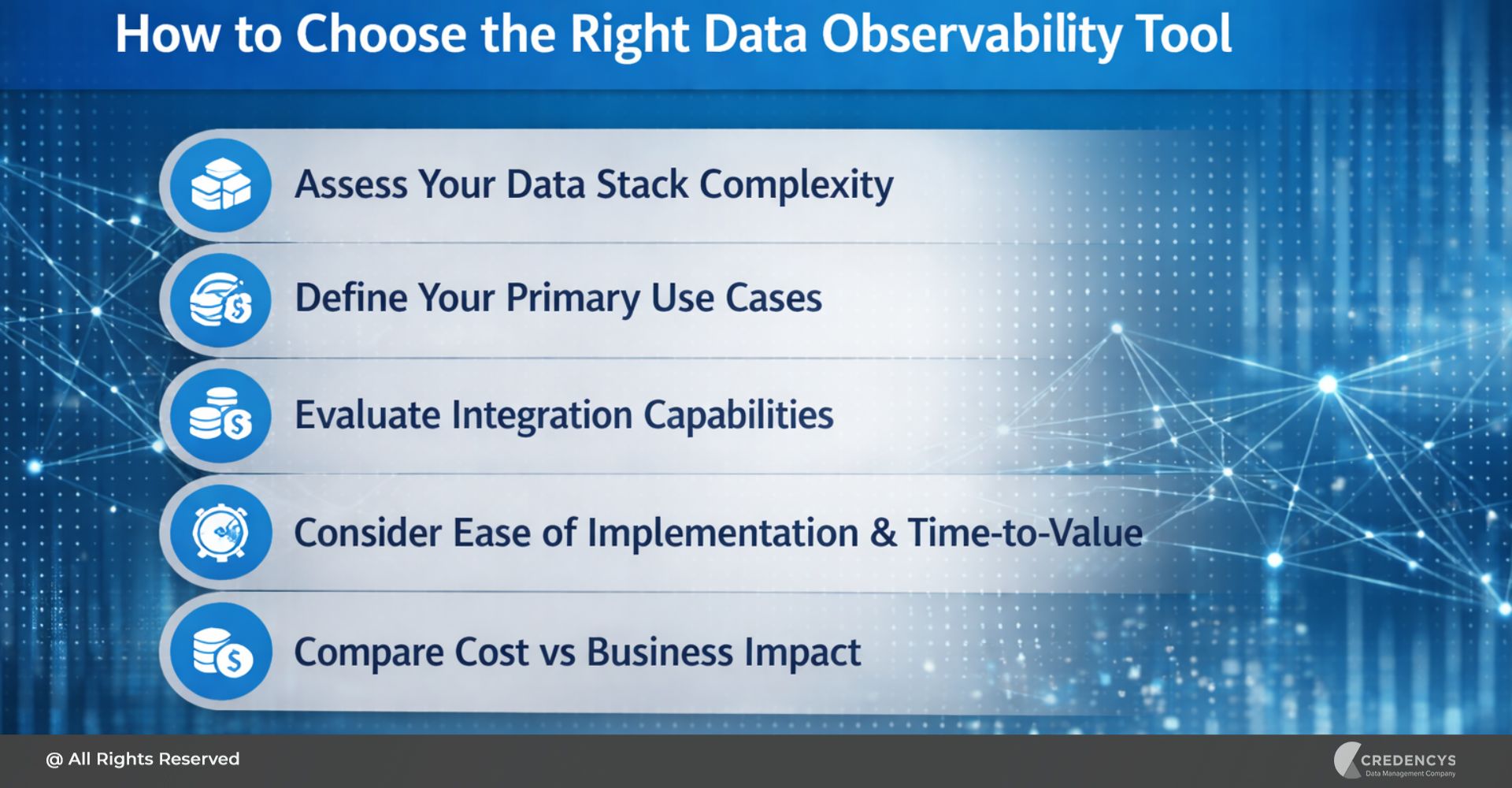
How to Choose the Right Data Observability Tool
With multiple data observability tools offering overlapping capabilities, choosing the right one can quickly become overwhelming. The key is to move beyond feature comparison and focus on fit, scalability, and business impact.
Here’s a step-by-step framework to help you make the right decision:
1. Assess Your Data Stack Complexity
- Start by understanding your current data ecosystem. Ask:
- Are you running a cloud-native stack (Snowflake, BigQuery, Databricks) or a hybrid?
- Do you have batch pipelines, real-time streaming, or both?
- How many tools are involved (ETL, orchestration, BI, ML)?
The more complex your stack, the more you need end-to-end observability with strong lineage and integrations.
2. Define Your Primary Use Cases
Not all tools are built for the same purpose. Clarify your priorities:
- Data quality monitoring (accuracy, completeness)
- Pipeline reliability (failures, delays, job monitoring)
- Data governance & lineage
- AI/ML data validation
Choosing a tool without a clear use case often leads to underutilization and wasted investment.
3. Evaluate Integration Capabilities
Your observability tool should seamlessly connect with your existing ecosystem. Check for:
- Native integrations with your data warehouse
- Compatibility with orchestration tools
- Support for BI tools and downstream applications
Poor integration creates blind spots in your data visibility, defeating the purpose of observability.
4. Consider Ease of Implementation & Time-to-Value
Some tools require months of setup, while others deliver value quickly. Look at:
- Deployment time
- Learning curve for your team
- Availability of pre-built connectors and templates
Faster implementation means quicker ROI and less strain on your engineering team.
5. Compare Cost vs Business Impact
Pricing models vary widely from open source to enterprise subscriptions. Instead of focusing only on cost, evaluate:
- Potential savings from reduced data downtime
- Impact on decision-making accuracy
- Productivity gains for data teams
The right tool should pay for itself by preventing costly data failures.
How Credencys Helps You Build Reliable Data Pipelines
At Credencys, we go beyond implementing tools. We help organizations build a strong, scalable foundation for data reliability, ensuring your data is always accurate, trustworthy, and ready to drive action.
Many organizations invest in modern data platforms but still struggle with:
- Broken or delayed pipelines
- Inconsistent data quality
- Lack of visibility across systems
- Slow issue detection and resolution
We solve this by combining strategy, technology, and execution, so your data works for you, not against you.
Our Approach to Data Observability & Pipeline Reliability
We follow a structured, outcome-driven approach:
1. Assess & Identify Gaps
- Evaluate your current data architecture and pipelines
- Identify blind spots in monitoring, quality, and governance
- Pinpoint risks impacting business-critical data
2. Recommend the Right Tools & Architecture
- Help you choose the right data observability tools based on your stack and goals
- Design a scalable, future-ready data architecture
- Ensure seamless integration with platforms like Snowflake, Databricks, and more
3. Implement & Integrate
- Deploy observability tools across your pipelines
- Set up automated monitoring, alerts, and lineage tracking
- Integrate with your existing data ecosystem
4. Optimize Data Quality & Performance
- Establish data quality frameworks and validation checks
- Improve pipeline performance and reduce failures
- Enable proactive issue detection
5. Continuous Monitoring & Improvement
- Fine-tune observability systems for better accuracy
- Reduce alert noise and improve incident response
- Continuously enhance data reliability as your business scales
With Credencys, you don’t just get a solution, you gain measurable outcomes:
- Trusted, high-quality data for better decision-making
- Reduced data downtime and faster issue resolution
- Improved operational efficiency for data teams
- Scalable data pipelines ready for AI and analytics
Conclusion
As organizations continue to scale their data ecosystems in 2026, one thing is clear: data reliability is no longer optional; it’s mission-critical. With the rapid adoption of cloud platforms, real-time analytics, and AI-driven decision-making, even minor data issues can quickly escalate into major business risks.
Broken pipelines, inaccurate reports, and delayed insights don’t just affect technical teams; they impact revenue, customer experience, and strategic decisions. This is where data observability tools play a transformative role.
They enable organizations to move from:
- Reactive firefighting → Proactive monitoring
- Data uncertainty → Data trust
- Delayed insights → Real-time decision-making
However, choosing the right tool is only part of the equation. To truly unlock value, businesses must take a holistic approach, aligning the right platform with a well-defined strategy, strong data architecture, and continuous optimization.
The most successful organizations treat data observability not as a tool but as a core capability embedded in their data culture. Ultimately, the goal isn’t just to monitor data; it’s to ensure that every decision made across your organization is backed by accurate, timely, and trustworthy information.
In a world where data drives competitive advantage, the question is no longer “Do you need data observability?” It’s “How quickly can you implement it effectively?”





Tags: