

Top Data Integration Companies in 2026: How to Choose the Right Partner
Most enterprises today are drowning in data spread across CRMs, ERPs, marketing platforms, eCommerce systems, and cloud applications. Yet, despite massive data investments, many still struggle to extract meaningful insights.
The problem isn’t data. It’s data fragmentation.
Disconnected systems lead to:
- Inconsistent reporting
- Delayed decision-making
- Poor customer experiences
- Failed AI and analytics initiatives
That’s why data integration has become a strategic priority in 2026. Choosing the right data integration partner can mean the difference between scalable, AI-ready operations and costly, inefficient data chaos.
In this blog, we’ll explore the top data integration companies in 2026 and help you choose the right one for your business.
What Do Data Integration Companies Do?
Data integration companies play a foundational role in modern data ecosystems. But their value goes far beyond simply moving data from one system to another.
They enable organizations to create a unified, reliable, and actionable data layer across the enterprise. Here’s a deeper look at what they actually do:
1. Data Ingestion Across Complex Ecosystems
Modern enterprises operate across hundreds of systems:
- CRM (Salesforce, HubSpot)
- ERP (SAP, Oracle)
- eCommerce platforms
- Marketing automation tools
- IoT devices and operational systems
Data integration companies build pipelines that:
- Connect to structured and unstructured data sources
- Handle batch and real-time ingestion
- Ensure data flows seamlessly into centralized repositories
2. Data Transformation and Standardization
Raw data is rarely usable in its original form. Integration partners:
- Clean and normalize inconsistent data
- Standardize formats across systems
- Apply business rules and transformations
- Enrich datasets with additional context
This ensures that all teams are working with consistent and meaningful data.
3. Building Scalable ETL/ELT Pipelines
Modern data integration has evolved from traditional ETL to flexible ELT approaches. Companies design pipelines that:
- Scale with growing data volumes
- Support cloud-native architectures
- Optimize performance and cost
- Enable faster analytics
The focus is on building future-ready pipelines, not just quick fixes.
4. Real-Time and Event-Driven Data Integration
Batch processing is no longer enough. Today’s businesses require:
- Real-time dashboards
- Instant personalization
- Event-driven workflows
Integration companies enable:
- Streaming pipelines
- API-based integrations
- Event triggers and automation
This allows organizations to act on data as it is generated.
5. Data Quality, Governance, and Compliance
Without governance, integration creates chaos at scale. Leading providers ensure:
- Data validation and cleansing
- Deduplication and accuracy checks
- Master Data Management (MDM)
- Compliance with regulations
This builds trust in data, which is critical for decision-making.
6. Enabling Analytics and AI Use Cases
Ultimately, the goal of integration is not just consolidation, it’s activation. Data integration companies prepare data for:
- Business intelligence dashboards
- Predictive analytics
- Machine learning models
- Customer 360 platforms
They turn data into a strategic asset that drives business outcomes.

Top Data Integration Companies in 2026
Here’s a curated list of modern data integration companies that are helping businesses build scalable, AI-ready data ecosystems.
1. Credencys Solutions
Best for: End-to-end data integration with AI readiness
Credencys stands out as a business-first data integration partner, especially for mid-market enterprises looking to modernize their data infrastructure. Unlike tool-focused vendors, Credencys combines strategy, engineering, and domain expertise to deliver measurable outcomes.
Key strengths:
- Expertise in modern data platforms like Databricks and Snowflake
- Strong focus on retail, CPG, and manufacturing industries
- Capabilities across PIM, MDM, CDP, and enterprise integrations
- Emphasis on data quality, governance, and scalability
Ideal use cases:
- Customer 360 platforms
- Demand forecasting
- Omnichannel data integration
- AI and advanced analytics enablement
Why it stands out:
Credencys goes beyond pipelines to build AI-ready data foundations, making it a strong choice for companies scaling their data maturity.
2. Talend
Best for: Data integration with built-in data quality
Talend offers a unified platform that combines integration and governance, making it a solid choice for organizations prioritizing data reliability.
Strengths:
- Strong data quality capabilities
- Broad integration features
- Open-source foundation
Limitation:
Can become complex for large-scale customization
3. Fivetran
Best for: Automated ELT pipelines
Fivetran simplifies data integration with fully managed pipelines that require minimal engineering effort.
Strengths:
- Fast deployment
- Automated schema updates
- Low maintenance
Limitation:
Limited flexibility for complex transformations
4. Stitch
Best for: Lightweight data integration
Stitch is designed for simplicity and speed, making it ideal for smaller teams or straightforward use cases.
Strengths:
- Easy to set up
- Cost-effective
- Quick deployment
Limitation:
Not suitable for complex enterprise architectures
5. Matillion
Best for: Cloud-native data integration
Matillion is purpose-built for cloud environments and works well with platforms like Snowflake and BigQuery.
Strengths:
- Strong ELT capabilities
- Cloud optimization
- Scalable architecture
Limitation:
Requires alignment with specific cloud ecosystems
| Company | Best For | Strength | Limitation |
|---|---|---|---|
| Credencys | End-to-end integration | Data + AI + domain expertise | Mid-sized firm |
| Talend | Integration + data quality | Unified platform | Complexity |
| Fivetran | Automated ELT | Ease of use | Limited customization |
| Stitch | Lightweight integration | Simplicity | Limited scalability |
| Matillion | Cloud-native ELT | Cloud optimization | Platform dependency |
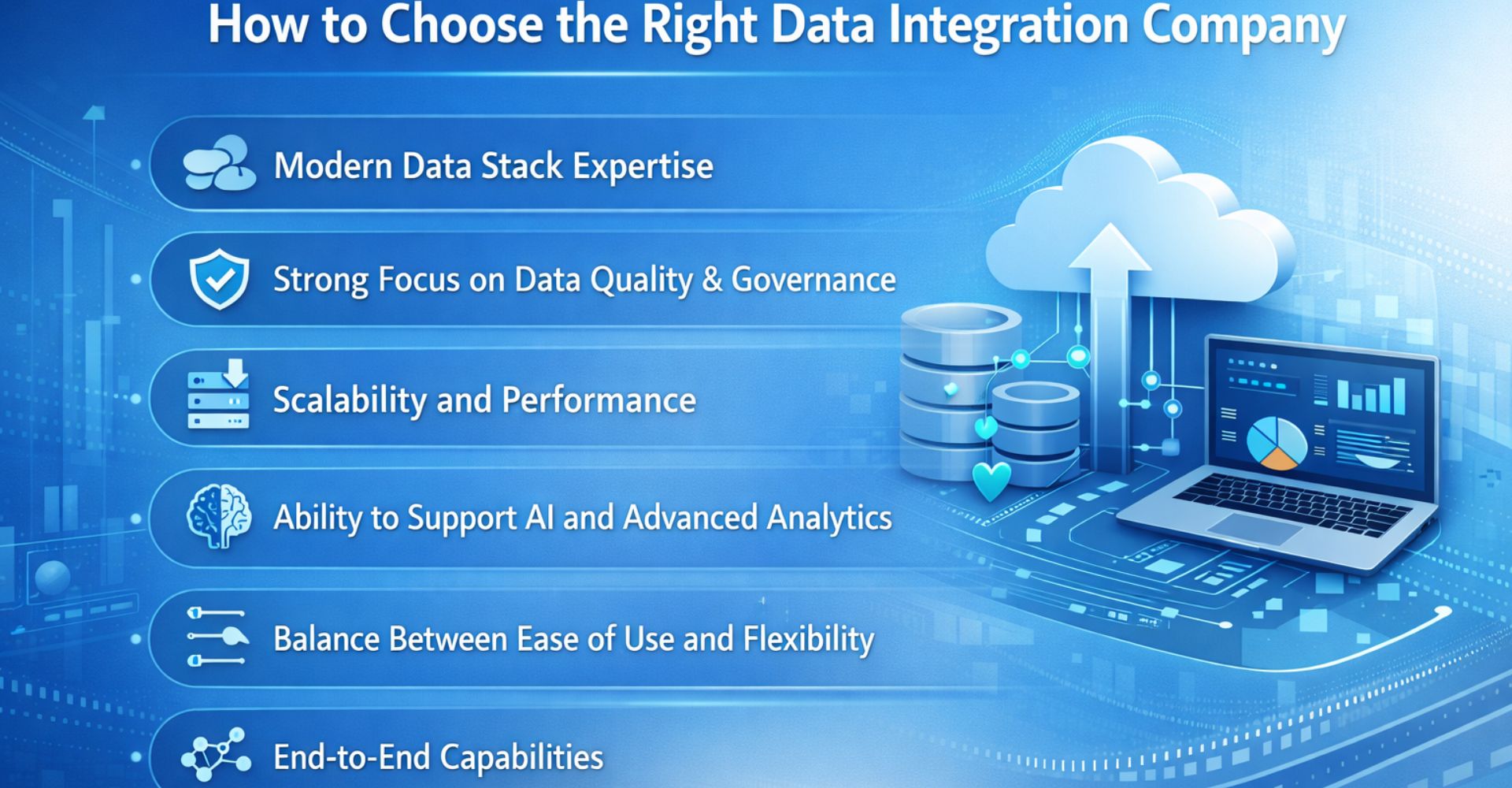
How to Choose the Right Data Integration Company
Choosing the right partner is a high-impact decision that directly affects your ability to scale, innovate, and compete. Here’s how to evaluate your options effectively:
1. Modern Data Stack Expertise
The data landscape has evolved significantly. Your partner must be fluent in modern architectures.
Look for:
- Cloud-native experience (AWS, Azure, GCP)
- Lakehouse platforms (Databricks, Snowflake)
- API-first integrations
- Real-time and streaming capabilities
A partner focused only on legacy ETL tools will struggle to support future-ready architectures.
2. Strong Focus on Data Quality & Governance
Integration without governance leads to inaccurate insights at scale. Evaluate whether the company offers:
- Data profiling and cleansing
- Standardization frameworks
- Master Data Management (MDM)
- Data lineage and monitoring
High-quality data is the foundation of reliable analytics and AI.
3. Scalability and Performance
As your data volumes grow, your integration architecture must keep pace. Ask:
- Can the system handle large-scale data processing?
- How does it perform under high loads?
- Is it cost-efficient as data grows?
Scalability ensures you don’t outgrow your integration solution in 1–2 years.
4. Ability to Support AI and Advanced Analytics
Modern data strategies are increasingly AI-driven. The right partner should:
- Prepare data for machine learning pipelines
- Enable real-time analytics
- Support predictive and prescriptive use cases
If your integration strategy doesn’t support AI, it will quickly become obsolete.
5. Balance Between Ease of Use and Flexibility
Different tools offer different trade-offs:
- No-code/low-code tools:
- Faster implementation
- Easier for business users
- Limited customization
- Custom/engineering-heavy solutions:
- Greater flexibility
- Better for complex use cases
- Requires technical expertise
Choose a partner that aligns with your internal capabilities and long-term vision.
6. End-to-End Capabilities
Many vendors offer tools, but not all offer strategic guidance. The best partners provide:
- Data strategy and architecture design
- Implementation and integration
- Ongoing optimization and support
This ensures your integration efforts are aligned with business goals, not just technical execution.
Why Credencys Is a Strong Choice for Mid-Market Enterprises
While many data integration providers focus on tools or large-scale enterprise consulting, Credencys occupies a unique and valuable position in the market. It combines technical expertise, domain knowledge, and business-first thinking, making it particularly well-suited for mid-market organizations.
1. Business-First Approach to Data Integration
Credencys doesn’t start with tools; it starts with business outcomes. This means:
- Understanding your data challenges in a business context
- Aligning integration strategies with revenue, efficiency, and customer experience goals
- Delivering measurable impact, not just technical implementation
2. Strong Domain Expertise
Credencys has deep experience in:
- Retail
- CPG
- Manufacturing
- eCommerce
This allows them to:
- Understand industry-specific data challenges
- Accelerate implementation timelines
- Deliver more relevant and impactful solutions
3. Expertise in Modern Data Platforms
Credencys is well-versed in:
- Databricks (lakehouse architecture)
- Snowflake (cloud data warehousing)
- Cloud ecosystems (AWS, Azure, GCP)
This ensures your data architecture is:
- Scalable
- Cost-efficient
- Future-ready
4. Focus on AI-Ready Data Foundations
Many companies integrate data, but few prepare it for AI. Credencys emphasizes:
- Clean, governed datasets
- Structured data pipelines for ML
- Real-time data readiness
This helps organizations move beyond reporting to predictive, AI-driven decision-making.
5. End-to-End Services
Credencys provides a complete lifecycle approach:
- Data strategy and consulting
- Architecture design
- Implementation and integration
- Continuous optimization
This eliminates the need to manage multiple vendors and ensures consistency across the data journey.
6. Agility and Cost-Effectiveness
Compared to large consulting firms, Credencys offers:
- Faster execution
- More personalized engagement
- Better cost efficiency
This makes it an ideal partner for mid-market enterprises looking for high impact without enterprise-level overhead.
Final Takeaway
If your goal is simply to move data, many tools can help. But if your goal is to:
- Build a unified data ecosystem
- Enable real-time insights
- Power AI and advanced analytics
- Scale efficiently
Then choosing the right data integration partner becomes critical. And that’s where a specialized, business-focused company like Credencys can make all the difference.





Tags: