PIM System – How Companies Achieving Values?

A PIM (Product Information Management) System is a platform that collects data from various channels and stores it in a centralized database for easy access and easy distribution to multiple channels.

In addition, the PIM system allows users to add or edit stored product data and makes it more efficient. Having a good PIM system will provide a better product experience; also marketers could find it easy to conduct an effective marketing campaign.

More importantly, a good PIM system eliminates the time delay of a new product to reach the market. By doing so, PIM plays a key role in boosting the ROI of an organization or company along with increasing user/customer experience.

This article illustrates how a company gains value through a good PIM system.

Benefits of Using PIM System

Product information management (PIM) is essential for an organization for improving its data integration process and management systems. A robust PIM system helps in the efficient collection and compilation of product-related details that are required for improved marketing strategy.

This leads to enriching the product details that help to retain the regular customers while attracting new ones, leading to enhancing sales and business.

There are various added advantages for the organization as well as for all the members involved in the product supply chain. The different benefits gained by using a robust PIM system involve:

Enhanced product data management

With the growth and development in the business, the number of products keeps increasing. For the product-based company, it is important to keep their product-related details always updated.

If product data is not handled properly it might lead to difficulty in tracking the product information that might lead to disorganization and may adversely affect the business.

A robust and reliable PIM system allows in organizing and managing all the product-related data. This updated information is easier to share across the different channels leading to growth in business.

Better Customer Experience

Public while shopping online prefers to check the product specification and other product-related details. The customer feedback related to the products helps in providing more detailed product information. This also leads to a decrease in the chances of shopping cart abandonment.

A robust PIM system makes the newer product easily available to the customers. PIM system helps the distribution and marketing team thus not allowing the product to go out of stock.

Enhance Time Efficiency

PIM system helps in saving a lot of time as due to its centralized mechanism it reduces the manual load of data entry. This makes updating the inventory easy.

PIM Allows Cleaning & Streamlining The Data

It allows removal of the obsolete and old data thus reducing the confusion. Using PIM helps save a lot of time that can be utilized in other profitable tasks.

Cost-Saving

PIM is very useful software for all the different departments involved in the product-related business. It allows in keeping the accurate product details thus reducing the management risk while preventing the cost due to bad product data.

It reduces the cost involved in operational and supply chain management. The data from PIM helps the supplier to perform the audit and improvise their delivery methods.

Ease Integration

Using the PIM system makes the integration process much easier when compared to the ERP. This provides flexibility in managing all the data processes. IT reduces the cost involved in the management and marketing of the new products.

Provide Transparency

PIM system helps to disclose the majority of the product-related data to their users. Providing the true details for the products helps the customer to gain confidence in the product and the company thus enhancing the business.

Accurate product details help the customers make the right selection decision. This reduces the chances of product return and customer complaints.

Using the robust PIM system helps the organization in many different ways thus leading to enhanced business. Thus any product-based company should have a good PIM system to manage all their product data efficiently.

Type of Companies Benefits a Lot Using a PIM system

Customers are the key players in the product-oriented business as the growth of the business depends on them. Providing accurate and true product information to the customers helps them to build confidence in the product and the trust in the company thus leading to enhancing the business.

Accurate product information helps in retaining new customers while attracting newer ones. The product information management (PIM) system helps the organization keep its product-related information updated and managed efficiently.

Companies That Need To Use The PIM System

There are different types of businesses and each type requires some software and systems that help them in managing various tasks efficiently. For most product-based companies, it is essential to use the PIM system as it benefits the business in different ways.

The different cases or situations when the companies should use this PIM system for enhancing their business include:

Complex product with variants

When a company has a product that has different variants, then adding these details manually will take a lot of time and money. This manual work can lead to errors. In such conditions, PIM allows the data inheritance functionality to fill the common data and the variant data needs to be added manually thus reducing time and effort.

The product has different types of information

In certain cases, the products have a large amount of information based on their description, specification, use of metadata, etc. Handling these product details manually becomes tedious. Using the PIM system for these products proves to be beneficial.

Selling products in various markets

For enhancing the business, many companies target markets all over the world. They make their product available on multiple channels. Different countries need the product data in their specific format and specific language.

Providing this data manually can become tiresome. Using the PIM system will help in managing the different language layers thus easing the complexity caused by the language layer.

Increasing business activities

For increasing the business, the company needs to increase the marketing activities to new markets, add several websites, provide price lists, catalogs, etc. All these activities need several actions for optimized functioning. Using the PIM system will ease the work and will allow enhancing the business activities.

Publishing product information on various channels

Improving the eCommerce for the product will help in strengthening the business. For this, the company can publish the product details on various sales and marketing channels that will attract a larger crowd. This includes providing digital catalogs, pricelists, datasheets, etc.

Supplier data enrichment

Working with the product data received from the suppliers involves handling the data in different formats and with inconsistent quality. Handling this work becomes easier when using a PIM system. This system will allow the company to handle this varied data from the supplier more efficiently.

Overall development of the business

Using the PIM system helps the company by benefitting the different departments within the company. Using the robust PIM system benefits the eCommerce team, management team, marketing and sales team, information technology department, etc.

Overall development and growth of these individual departments will lead to improved efficiency thus leading to growth in the business.

Using the PIM system helps in managing all the product-related data over the different marketing channels. This PIM software helps all product-based companies have their business depending solely on the development of their products.

How To Choose the Right PIM System for Your Organization?

Choosing the right PIM system for your company can be a daunting task if you are not familiar with how to choose them. Here in this section, we have briefed what you have to look for when choosing the right PIM software.

1. Choosing PIM Solution Based on Users Who Handles

When it comes to choosing the right PIM software, the first and best thing one should focus on is who is going to use the tool and what features they would seek in the tool? Let’s discuss this in brief.

  • Total Number of Users: The number of users who are going to handle the PIM system could be a crucial factor in deciding a PIM system. Because some PIM tool charges are based on the user count.
  • Role-Based Access for User: Choosing PIM that allows you to set access rights to the users based on their types would allow you to utilize all its benefits. PIM system is a platform where many users like manufacturers, suppliers, marketers, salespeople, and more users can access it. So, assigning access rights to each user would ensure your data safety and data quality.
  • PIM System Matching User’s Skill Sets: Picking a PIM system that doesn’t require any up-skilling of users for effective handling of the PIM system. Else, you need to spend money and time to train users for handling it.

So, as a business person, you need to consider the technical skills of the users along with the learning curve of the PIM solution while deciding on purchasing a PIM system.

2. Choosing PIM Solution Based on Its Management Functionalities

While selecting a PIM solution for your company/organization you need to be aware of what a PIM system can deliver you in terms of data management. Let’s discuss this in brief.

  • Data On-boarding: Many companies suffer a lot while onboarding data from their suppliers and vendors while doing verifications, accessing in different formats, checking their standards & regulations. Having centralized PIM software will allow suppliers and vendors to upload data as per the assigned formats and the PIM system takes care of managing and regulatory processes automatically. So, picking a PIM system with enriched onboarding features is a must.
  • Data Quality: Product data quality becomes so important to run a business successfully in today’s market. A good PIM system should have the capabilities to fix data format errors, highlight discrepancies and maintain the data quality before distributing data to multiple channels.
  • Efficient Management of Product’s Digital Asset: For every business having enriched product content is advantageous, a good PIM system should have the capabilities of effective management of product digital assets like images, videos, tutorials, product catalogs, and so.
  • Easy Configuration & Flexibility: A good PIM system should have better adaptability features so that it can match the expectation of different organization requirements. Also, it should be easy to configure and highly flexible so that organizations can customize it according to their needs. Picking such a PIM solution would be handy.

3. Choosing PIM Solution Based on Data Distribution Features

Almost every PIM system in today’s market comes with the features of data sharing with multiple systems. However, picking the one that is compatible to face all challenges prevailing in data distribution would be the best choice. Let’s discuss this in brief.

  • Easy Integrations: Integrating with multiple systems is one of the key features of a PIM system. If your business requires a lot of such integrations with an external system, then you should go with the PIM system that offers sophisticated APIs for easy integration with external organizations/channels.
  • Language Translation: PIM system plays a major role in business expansion across overseas markets. To be successful in such expansion, a business needs to provide accurate product data according to the local language. For that, the PIM system should have language translation and multi-language support.
  • Automated Distribution: Picking a PIM system based on its capabilities of partial/fully automated data distribution to multiple channels could be wise if your business involves a large amount of data. By doing so, you can save a lot of time and also eliminate the risk of time delay in data distribution.

Finally, picking a PIM system that provides a highly scalable PIM solution with easy maintenance would account a lot in business future growth.

Bottom Line

PIM tool is an effective and essential tool for all businesses to gain a competitive edge over competitors in today’s market. If you are about to implement a PIM system, first explore the latest PIM trends and start choosing a PIM system based on the provided tips for getting full benefits.

11 Types of Data that You Can Store in Product Information Management (PIM) Solution

All the eCommerce business runs on how the products are displayed on their online store. To sell the products online successfully, brands embrace the Product Information Management (PIM) solution.

Why store product data spreadsheets and excel sheets in a scattered way when you have a single location to store and manage your indefinite product information.

PIM allows companies to centralize their product and inventory data and keep enriching them for sales and marketing.

If I explain PIM in very simple words, ‘Product Information Management is a platform that allows collecting a wide amount of product data and elements. It allows you to create and manage product catalogs in a more simple and agile way.’

Moreover, it opens up various opportunities to sell your products across different output channels such as marketplaces, social media, etc. It enables you with the flexibility to sell your products everywhere across the globe. But, it’s your responsibility to make sure while pushing the product information across different channels you deliver a consistent product experience.

This post helps you understand which product entities you need to consider as product information and what types of product data you can store and manage in PIM.

Let’s start over with what is product information.

What is Product Information?

It is very important for companies to identify which data they should consider as product information. Be quite clear which information is crucial for you to store in a single platform in a structured and effective way.

The unfamiliarity of what you should consider as product information creates a dilemma for PIM adoption. You can consider any product-related data or content that helps promote and sell your products.

To support marketing and merchandising, eCommerce businesses harness the potential of content. As we talk about content, it could be anything from a product video to SKUs.

In short, any product-related information that adds value to the readers can be stored and managed in the Product Information Management solution. It enhances the customer shopping experience, improves customer engagement, increases conversion, and boosts the revenue stream for an eCommerce company.

What is Product Information Management (PIM)?

Product Information Management is a process of managing the product data that is required to promote and sell the products through different distribution channels.

It helps your organization in defining the multichannel marketing strategy. The PIM platform allows companies to distribute the product information on varied output channels such as websites, eCommerce, marketplaces such as Amazon and eBay, print catalogs, point of sales, social media platforms, electronic data feeds to trading partners, and more.

PIM is the prime choice of business-to-consumer (B2C) and business-to-business (B2B) companies as they can sell the products to a large target audience through varied sales channels.

To get exclusive insights on product information management, don’t miss to read What is PIM? – An Ultimate Guide for Product Information Management.

Types of product information that you can store in Product Information Management (PIM)

1. Products

PIM allows you to import excel files. It performs this process in the fastest way. You can add all the products that you already have accumulated information from the sheets to the product information management solution.

It is quite helpful when you receive the data from external users like suppliers, vendors, distributors, etc. who send product data in excel files. You can import the excel files in PIM to manage the product data in a single location.

Import of product data from an excel file to PIM takes only a few clicks. You can organize the data in the PIM that will display into their corresponding fields. Once the data is imported into PIM, you can organize them as per your requirement. It is highly recommended to create a structure to manage the data. With a proper structure, it becomes easier to import the data into PIM and perform the reviewing and enriching process faster.

PIM allows brands to manage all the SKU-related information of the product. Store and manage basic as well as technical details in the solution. It is mandatory to insert certain types of product data as it is the key information that every customer needs to know while buying online. However, to deliver a better shopping experience to your target audience, focus on creating complete content for your product.

Additionally, product information management allows companies to link the products. If you have an eCommerce store, then it is a very useful aspect of the platform. You can facilitate buyers with suggestions for accessories, spare parts, and related items on a product-by-product basis.

Implement a PIM that comes with analytical capabilities. It allows you to check if the product data is complete and where to improve it.

2. Product identifier

Product identifier helps you to manage data like product’s SKU number and name. PIM allows brands to collect such product data and allow the internal departments as well as external partners such as suppliers and distributors to track the products easily.

Integrating the quick search functionality on the frontend, brands allow the buyers to find the products online quickly.

Merchants who are selling the products in international markets need to manage the Global Trade Item Numbers (GTINs). Different countries use different types of GTIN forms. While managing multiple forms, you also need to manage varied versions of your product information.

PIM works as a single source of truth and manages all the GTINs along with required product information in a single location. Thus, it ensures smoother sales and shipping from one country to another.

3. Categories

To create an engaging product catalog and leverage catalog management, you need to have a well-defined tree of product families and categories. By this, I mean to say your products must be properly categorized as per their typology.

Within PIM, you can create a tree of categories and subcategories for the products. You are allowed to set the name of categories as per your choice. In case you have defined the categories of the products in the excel sheet and you want to import that data into PIM, you can directly import it.

For example; if you are creating a clothing catalog, you can choose categories like Casual and Partyware and subcategories such as Pants and T-shirts.

4. Technical specifications of the product

In a product information management solution, you can manage technical specifications of the products such as dimensions, size, color, material, performance data, weight, material, and more.

You might feel this information is not necessary to store in the PIM for your internal team. But it is certainly necessary when you want to sell the products on marketplaces or other channels.

When you have the product data in a single place, it becomes easy to syndicate the product content with the relevant platform without human intervention. You do not need to add the product information from time to time.

It is also helpful from the customers’ perspective. You can meet the customers’ expectations and enable them with extreme transparency.

Offering detailed technical specifications to the buyer, you can provide an accurate representation of your products and how they will fit into their life.

5. Media asset management

While selecting a product information management platform, make sure it comes with digital asset management (DAM) capabilities or allows for a DAM integration.

To make every product saleable, brands need to publish high-quality product pictures on the online store for the buyers. It helps them make well-informed buying decisions and reduce product returns.

When it comes to managing the visual assets, you also need to store and manage marketing and sales-related imagery files that support your brand’s voice and messaging. If you are managing the products in a spreadsheet, then you have one line per product. This means you can manage limited visuals.

PIM enables you with extreme flexibility. It allows companies to manage multiple product pictures to improve the quality of your product listing.

To promote and sell the products on different platforms, you need to manage the product images in different and specific sizes as per the specific requirements of each platform. Within PIM, you can manage any number of images in a single location.

6. Languages

If you are targeting the global market, then you need to design your sales and marketing strategy accordingly.

Most importantly, it is essential for you to consider multi-channel, multi-country, and multi-region as a part of your business strategy. However, syndication of all the product content in varied languages can be a major obstacle.

Implementing PIM, you can easily manage multi-language product information in a completely automated way. It allows brands to edit fields and import content in multiple languages at the same time.

It also enables you with automatic translation of the content. It fastens your product promotion and sales process by pushing the content on online platforms in different languages.

Additionally, PIM allows adding more language variants such as British English, Mexican Spanish, etc.

7. Marketing messaging

Businesses that are selling the products in different countries need to manage and share the different marketing messaging as per the specific needs of the customers who belong to different regions. Thus, you need to show the product-related data such as product title, description, etc. in different languages.

Though the languages are different, you need to make sure the structural layout of the product information is consistent and uniform throughout each product and/or language. Your marketing messaging is very crucial for your products as it is the story that you are trying to sell.

Invest some time in your product listing optimization and make them SEO-friendly for search engines and customer-centric for buyers.

Moreover, create an outline for your product taxonomy by organizing your content into different categories using filers. A well-planned taxonomy holds the power to transform your customer experience via improved digital commerce, content discovery, and self-service.

8. Variants

The product catalog contains more than one product. It covers the different variants of the same product. These products differ from each other due to several variable characteristics.

For example; a piece of clothing or a piece of furniture available in different sizes and colors. While managing variants, it is the biggest challenge that you need to add the data repetitively such as you need to enter the product name and description again and again.

To streamline such mundane and time-consuming activities, a product information management solution allows you to create or import variants of your products. You do not need to repeat uniform content across all the variants. You only need to deal with the product data that varies in the same product category.

9. Value-added asset management

The one thing that stops customers from buying products from online stores is they do not experience a product the way they can have an in-store experience. Buyers cannot see, smell, and feel the products they want to purchase.

Thus, it is very essential to enable them with all the required product details that ignite their imagination and help them to visualize how the actual product looks like.

To create enriched customer experiences for each sales channel, you can add more product information such as user manuals, videos, PDF downloadable guides, etc.

10. Point of sales

Almost every product information management retail business has physical stores, an online presence, or associations with different distribution points. Generally, PIM is considered as a part of online strategy and companies feel it helps to empower their eCommerce platform.

Let me introduce the advanced capabilities of PIM to you. It allows companies to store point of sale information and listing.

Integrating PIM with the point of sale allows you to centralize basic shop data and analyze the performance of products in individual shops.

For example; in a product information management solution, you can store a wide variety of information including contact numbers, demographics, geographical coordinates, payment methods accepted in every shop, opening hours of the shop, and more. You have the flexibility to update any of this information whenever you want as per the changing situation of each shop.

11. Sales and marketing material

PIM allows managing more content than just product information. You can store and manage sales and marketing material that you use for product promotion and selling.

For example; store the useful sales material that enables the buyers with all the required information about each product. Manage important documents that are required for product sales such as customized documents and certifications.

In the PIM, you also store the sales material such as technical specifications or operating instructions that are shared by several products or models.

In the nutshell

PIM allows brands to create customized workflows where they allow the team to edit the product data as per their roles and responsibilities. Editors can make the required edits in data, approve review and verify the product data, and the publisher pushes the information on online platforms.

Through the workflow, PIM ensures better data synchronization between teams. It also makes sure the product content should be accurate and complete. It simplifies the work for your team, especially while working remotely. It improves collaboration amongst your teams regardless of geographic locations.

Adoption of product information management allows you to store and manage everything that you need to create an engaging product catalog. Moreover, you can organize such a huge amount of data in a well-structured and effective way for your different departments and external users.

Every PIM platform does not contain all these capabilities. So be careful while selecting product information management for your brands.

Many Product Information Management platforms are available in the market. However, to select the right one, ask for a demo before making a final call. Check out all the features, functionality, and abilities of the platform. Choose the one that matches your business requirements.

PIM for Reseller – How Product Information Management Helps Resellers to Scale the Business?

With the changing time, the conventional ways of running the business get updated with the modern approaches and technologies.

Product Information Management (PIM) is one of such technologies that have helped product-driven businesses to adopt digital transformation seamlessly.

Earlier, the product data were managed manually on paper. With the invention of computers, it has become digital. Still, with such old-school storage, it becomes challenging to run the business.

PIM for resellers not only manages the product data centrally but also streamlines various business processes, reaches a large target audience, boosts customer engagement, improves the conversion rate, and increases the ROI.

Role of resellers in retail

Resellers are usually less connected with manufacturers as they mostly buy products from distributors. They are closely connected with wholesalers or retailers or end-users. They purchase products from manufacturers or distributors and sell to their target audience.

Resellers do not prefer to keep an inventory of the products. Also, they do not provide after-sales service. Manufacturers with renowned profits are quite interested in establishing a strong relationship with resellers as they focus on generating a better profit than developing a market for the products.

How PIM for resellers transforms eCommerce?

When it comes to Product Information Management, it is a common myth that only large-scale organizations can afford it. Well, it’s not true.

Also, manufacturers or distributors compare PIM with ERP systems and inventory management systems. But, it offers much more than these systems. Management of product data centrally and effectively is the primary need of any product-driven business regardless of size. Especially for resellers.

As a reseller, you might not need to manage the inventory and stock details. However, effective and structured management of product information and relevant media assets are quite essential to run your business seamlessly.

You can manage these data in excel sheets, ERP, Google Drive, Dropbox, etc. However, your data will be scattered. Why manage the critical product data in different files, folders, and software when you can manage them in a single location in an open-source product information management platform.

Considering PIM, you cannot only manage the product data effectively but also centralize all your product content and empower marketing efforts.

Why resellers should consider Product Information Management (PIM)?

Centralized data benefits everyone

Have you ever had the best data management experience? Probably not. I completely understand the reason that you do not need to keep thousands of products in stock like distributors. But, I am sure you must have your own inventory to manage.

For example; you have to manage and store product title, description, SKUs, technical specifications, prices, marketing data, manuals, images, and so on in a platform. Like your business, your product list will also grow. By considering the PIM for product data management invite the challenges like

  • Scatter product data that are spread across clunky spreadsheets
  • Spending hours on manual data entries
  • Difficulties in tracking the product content if the data is scattered at various places
  • A wrong product data entry results in costly errors
  • Limits your business opportunities as you cannot scale your product content
  • Sharing product information externally becomes challenging

When your product information is scattered across the different systems, finding and sharing relevant data becomes a nightmare. Implementation of Product Information Management, you can simplify the management of complex product data. It saves time for your resources by eliminating manual data entry. Eventually, it enables you with the benefits of reduced errors and improved time to market.

Track your product performance

Many PIM platforms are integrated with different analytics tools with Google Analytics. Integration of analytics tools allows sellers to have experience of how to manage the product centralized and single source of truth for data.

Analytics tools help you to analyze the performance of your product and optimize your content in the PIM platform to make it more relevant to the consumers. It enables you with valuable insights such as

  • How many users have visited your online solution?
  • Which products are highly searched?
  • Which products are getting maximum customer engagement?
  • What are the highest selling products?
  • How many times have the products been added or checked out?

It also helps you to check and compare the product’s performance across different channels. It enables you with insight into where your products tend to sell the most.

Considering PIM for resellers that have integration of advanced analytics tools, resellers can track individual products in which the consumers are interested. It allows the resellers to make a strategic decision whether they should stop selling specific products, manage the products to a broader customer base, or find a relevant solution.

Successful Integration of multiple output channels

To expand the business across the wider target audience, businesses consider all the possible ways. One of the most potent approaches is to reach your target audience through different customer touchpoints and output channels.

Today’s tech-savvy customers perform a detailed search before buying a product. They move from physical store to webshop to mobile app to marketplace to social eCommerce within a few minutes. Thus, the competition raised to the next level for the sellers. They utilize all the platforms to grab customer attention, increase customer engagement and improve conversion rate.

Product Information Management platform allows you to sell your products on different channels and improve ranking on the search engines so that your target audience can easily find you. To win the online competition, you need to optimize the product content by considering the targeted keywords, relevant languages, and focus on product listing optimization. It ensures you meet all your marketing needs.

With an advanced PIM, you can enrich your product content and distribute it on the sales channels. Through this strategic process, you can tweak the content and meet the specific requirements of your targeted marketplace. By allowing you to store the channel-specific information, PIM simplifies the integrations of marketplace channels.

Enhanced customer satisfaction

Resellers need to produce complete and accurate product data to the customers to help them make a well-informed buying decision. It improves customer experience and satisfaction. It reduces product return. However, most of the resellers do not have an idea about which solution helps them to manage the product information correctly and effectively.

Considering the right product information management platforms, you can leverage product experience management. It allows resellers to deliver a long-lasting customer experience by establishing satisfying interactions across the different channels.

With a good PIM, resellers can push relevant, updated, and consistent product information on the online platform. Enabling potential buyers with enriched product data, you can enhance their shopping experience.

Additionally, PIM empowers your omnichannel strategy and optimizes your product data for all the different channels. It helps you improve product impressions as per the customer expectations and makes sure it improves the customer experience. So, implementing Product Information Management, helps you increase your customer base and boost your revenue stream.

Streamlining eCommerce

PIM is one of the most essential tools to streamline your digital strategies and leverage digital transformation effectively. These days customers’ buying behavior of the consumers is changed frequently. PIM helps you to distribute the product information in an engaging way that drives sales and increases conversion.

Deal with your everyday product-related challenges with Product Information Management. Moreover, it helps you improve time-to-market, deliver the data your consumer seeks faster and save resources on internal processes.

Improve compliance, consistency, and quality

If you are managing your product data in different files and folders, Product Information Management is the most essential platform for you. It manages your product data in the silo that is scattered across multiple channels. When your data is scattered, your interactions with customers become difficult. In the digital environment, customer interactions are very important for your business.

Rules, regulations, and legal requirements keep changing over a period of time that creates compliance issues. Eventually, it creates conflicts between you and your customers. Implementation of PIM helps resellers to leverage data compliance and integrity. Moreover, it ensures more accurate and rich product information to the client.

PIM works as a single source of truth where you can create and maintain your product data. It helps you fill the gap between multiple marketing touchpoints and channels.

Share your product content seamlessly

Having a Product Information Management platform is a game-changer business strategy. It allows resellers to share the product list for restocking to a wholesaler, distributors, or manufacturer. As all the product data is available in a single place, data sharing becomes simplified.

It allows access to the relevant data without doing beak and forth with excel sheets. Containing product cataloging capabilities, PIM allows you to create a product catalog instantly.

Product catalog

Sometimes you need to respond to customers’ queries about a product range or you want to check what you have in stock, you need to create and share the custom product catalog with your customers in real-time.

PIM enables you with automated product catalog creation. Your sales team can create the product catalog instantly on customers’ demands and share a quotation immediately. By offering the product catalog, you can build a strong relationship with your target audience and improve the customer experience.

Harnessing the potential of Product Information Management, you can create personalized catalogs online to address the needs of your customers. Moreover, PIM for resellers allows you to create and market the products through your own marketing and branding messaging.

With the help of PIM, you can create a long-lasting impression on customers. Due to the personalized treatment, they can connect with your brands and feel familiar with you.

Customized catalogs provide you with a way to market your products to a varied audience. You can share this product information with retailers and your internal teams as and when needed.

Increase sales and boost ROI

To drive customer engagement, it is essential to deliver consistent experiences across the different channels such as in-store, social media, websites, marketplaces, and more. If you achieve this, you will be able to convert your consumers into brand advocates who support your brand messaging and promote your products in their circles. These loyal customers help you to boost your sales.

Implementation of PIM allows resellers to manage all the product information, inventory updates, and pricing updates in a centralized location and distribute them across different customer touchpoints. Eventually, it helps in generating a better ROI. It helps you win the customers’’ trust by enabling them with a consistent experience across multiple channels.

Enriched product information helps you to win the customers’ trust. PIM also allows you to optimize the processes for producing contextualized product information for specific locations and channels.

Additionally, PIM helps you to create personalized interactions and experiences with customers for your brands and products.

Addressing omnichannel challenges

PIM makes it easier for resellers to distribute the product data across the internal users and push the product information across different output channels. To deliver the omnichannel experiences, you might face a few challenges, and where Product Information Management will help you to overcome those challenges.

  • Fasten online product release
  • Maintain data consistency
  • Create and manage all sizes of the product catalogs and distribute them across all channels
  • Simplify OMS and ERP maintenance
  • Scale internationally to create and deliver better shopping experiences
  • Optimize inventory updates across sales channels and storefront

Considering PIM, you can automate various manual processes for product information management and allow your team to focus on what they do best in your different business areas.

In the nutshell

Resellers can streamline and automate their complex product data and product information management process by implementing a tailored Product Information Management platform.

Credencys has a team of experts who have successfully developed and delivered the PIM solutions to the different brands as per their specific business needs. We utilize the potential of the Pimcore platform to build a robust Product Information Management solution.

If you are dealing with product data management-related challenges, then connect with our PIM experts. They will address your challenges and predict personalized consultation for your specific concerns.

A Brief about The Role Of Product Information Management (PIM) For Enterprise

The modern digitalized world is so competitive for enterprises. It makes businesses learn the importance and limitless power of handling optimized data or information. In recent years, companies around the world have started paying attention to their product data. By doing so, they gain a competitive edge over their competitors and the attention of global potential buyers.

This makes Product Information Management (PIM) an inevitable tool for enterprises to collect, enrich and distribute their product data across multiple channels. In this article, the role played by PIM in enterprises growth and strategy to be followed by enterprises in detail.

Product Information Management (PIM) for Enterprises

Product Information Management (PIM) for enterprises also known as EPIM assists companies to create proper documentation for their product properties along with the processes involved with the products for internal usage. PIM is a platform where companies can store their product data effectively and categorize.

In addition, the PIM system helps companies to distribute accurately documented product information to the sales and marketing departments to boost product sales. Modern elements of the PIM tool create a path for businesses to document their business operation properly and to manage their business process effectively. Also, PIM elements assist the marketing team to create an efficient marketing campaign.

If you want exclusive insights about product information management, don’t miss to read What is PIM? – An Ultimate Guide for Product Information Management.

Product Information Management (PIM) Market

Experts have predicted that the global market value of the PIM system will grow to US $13 billion by 2026. As of the year 2020, the global market value of the PIM tool has reached 7.7 million USD.

Since every business requires accurate and enriched product data/information to increase its productivity PIM becomes essential. Also, the PIM system plays a key role in enhancing the data experience which boosts product sales. On considering these facts, it is widely believed that the implementation of PIM systems by enterprises around the world will reach new heights in the next couple of years.

How Business Revenue Increased Because of PIM?

As we all know, the PIM system offers a centralized location for storing all product information or data in an organized manner. This helps enterprises to gain full control over their product data or information and to manipulate them according to the needs of modern-day consumers.

Data distribution is one of the main features of the PIM system that allows enterprises to share up-to-date product information among multiple systems to reach potential consumers around the world.

Modern-day consumers use multiple channels to purchase a product; mostly they prefer digitized channels for seeking their needed products. With the help of the PIM system, enterprises can attract such potential consumers by offering accurate and optimized product information through various channels like web portals, POS, mobile platforms, and so.

This kind of action offers huge support to the sales and marketing team to increase product sales. With accurate product data, marketers can do effective marketing campaigns and make sure every potential buyer is aware of the new product of the company even before the launch.

Apart from being a handy tool for improving customer experience and boosting company revenue, PIM helps enterprises to expand their distribution channels/market overseas by distributing translated product data or information in the local languages of overseas customers. With detailed and accurate product information modern-day consumers will surely get attracted and make a positive purchase decision in a quick time.

PIM is undoubtedly one of the key strategic investments that every enterprise should do for boosting its growth. Nevertheless, unlike any other investment, investing in the PIM system will never let you down.

Benefits Of PIM System To Enterprises

Having a good PIM system will create a dynamic business environment for enterprises and helps to attain a competitive edge over the competitors. Here are lists of few vital benefits an enterprise can avail of through a good PIM system.

Better & Efficient Management of Product Data

Managing product information or data will be complicated for businesses once they start witnessing growth. In such a situation, implementing a PIM system will help enterprises to manage all product data in a centralized location with full control.

Also, the PIM system allows enterprises to keep track of the data or information of all their products and make sure it delivers better product and customer experience as well.

Enhances Customer Experience

Good PIM solution will provide detailed and accurate product information to the customers, this ensures customers are getting what they are looking for. As a result, product returns and complaints against the products by the buyers get reduced significantly.

Detailed and relevant product information will reduce cart abandoning activities by the buyers. Also, it enables sales agents to serve better to the customers.

Time Efficiency Gets Improved

Enterprises need to reach their product to the market on time to get the desired attraction from the potential buyers. PIM software makes sure products reach the marketplace faster.

PIM eliminates all those constants and issues that prevail in manual data entry on updating product data or information in inventory. Also, it streamlines the business process with clean and accurate product information allowing workers to carry their work without any delay.

Cost-Effective

Reducing operational and supply chain costs are the major aspects that every enterprise is looking for. PIM system enables an automated process for managing and distributing product data across multiple channels by saving a lot of time and operational costs for enterprises.

Apart from this, a good PIM solution will eliminate the high risk of data management and prevent the loss from happening due to poor or bad product data. This will eventually increase product experience among the potential buyers and helps companies to outplay their competitors.

Easy To Integrate

Easy integration is one of the prime benefits of a PIM system. PIM solution enables the system to integrate; this flexibility feature allows enterprises to merge all systems and to manage all product data in a single location. This ensures enterprises cut costs on data management and marketing teams to perform seamless marketing campaigns by accessing all those up-to-date data of all products.

Product information management strategy for enterprises in 2021

Digitalization has allowed the public access to enormous products, services, and data available at the click of a button. People can search for the products of their choice from a pool of varieties. These customers get attracted by the images and information provided for the product on the various channels.

Product Information Management (PIM) helps enterprises in collecting data, managing data, and sharing it in multiple channels. This system allows efficient management of the data with ease of updating the product details across different channels.

Principles for product information management strategies

As the number of products and customers keeps increasing, it is very important to strategize product information management. This helps in efficient communication of accurate product information and consistent brand message through the various channels.

The strategy of the PIM depends on different factors like quality of product data, optimizing cost, time, defining the right metrics, operational efficiency, time to market, etc. Keeping track of all these details helps the organization in keeping a track of heading towards the right direction.

The different principles are vital for designing the product information management strategies include:

Assess the product data

It is important to consider the quality as well as the quantity of data provided to the users. Poor data can have a long-lasting negative impact on business performance. This can affect the sales chart and weaken the competitiveness.

It is important to quantify the data quality by identifying and solving the underlying issues. The different factors that need consideration include product master data, digital assets, and rich product content.

It is important to identify the data having the most significant impact on the syndication channels. Identifying the gaps and working on them to improve the data will help to strengthen the data.

Design a holistic and robust PIM

The selection of the proper vision and strategy is the foundation of product information management. Keeping the strategy simple and practical is important for gaining the desired outcomes. Clear vision allows the organization to have high quality, integrity, and product data availability across different channels.

Balanced PIM software selection

PIM software plays a crucial role in selecting the PIM strategy. It should have the capabilities to align the available data while handling the vision and support. Most of the software can deliver a wide range of products and can address a wider set of buyers and requirements.

Omnichannel presence

As the competition is increasing, the product should not be just available in the store or on the website but should also be available across the various channels. This omnichannel allows the public all across the globe to reach the product of their required specification.

The different channels should provide all the required information effortlessly to their customers. They should be able to understand the needs of their customers, be able to gauge the customer feedback for the products, allow them to compare their products, etc.

Improved open-source systems

Increasing competition in the market needs the organization to present its product in the desired format to all its customers across the different channels. The use of the open-source system resolves pain points like adaptability, flexibility, and customizability. The system selection should allow the organization to grow its business. This will help in rapid scale-up and system updates as required by the market needs.

Improved use of the cloud system

The PIM system maintains the information for the products in a centralized location for easy access. Maintaining such information requires a lot of storage space. Nowadays the cloud system is gaining popularity for its scalability.

The top cloud service providers available in the market include Amazon Web Services, Azure, Google Cloud, etc. These platforms provide space for providing all the required product information over different channels.

Deploying the PIM software over the cloud allows the organization to gain the benefits provided by the cloud.

Integration of products

The product information should be able to integrate with the available, existing, and new systems without making any major changes. The customers should be able to access the product information from any different system without any difficulty. The organization or enterprise should enrich the product information and publish it on multiple channels for customers’ access.

Customization

The PIM system provides personalization or segmentation of the products based on the details available. The segmentation of products based on the behavioral traits in a real-time manner will help in delivering the best and accurate information to the right targeted customer segment.

The PIM system should be robust to allow automated rule-based actions. This will allow in generating customer-specific segments, personalized requirements, etc. to deliver a seamless transaction experience.

The organization should select the PIM system that will allow them in managing and delivering tailored digital data based on the unique interest of their target audiences.

Digital asset management

The PIM system provides varied information related to the product. These details include the specifications in form of text data along with the images, videos, etc. The PIM system should also provide crucial details regarding the product’s technical specification, warranty, etc.

This data asset management is a very important and challenging task and adds value to the integrated product information. A robust PIM allows relating their digital assets with adequate product information.

360-degree view of the product

The adequate PIM system allows the enterprise to display all the essential details of the product in a 360-degree view. This holistic view of the product helps in collecting and generating rich product content. The B2B view allows information exchange related to product data essential for the supply chain or purchasing process.

Bottom Line

For a product-based industry, it is essential to provide accurate product information to the customers and all the members involved in the product sales cycle. Updated management technologies used in the PIM system streamlines the product information. The use of adequate product information strategies helps the organization in adapting and evolving in the competitive business.

Why PIM Is Better For Enterprises Depending on Product Data?

Looking for crystal clear aspects of Product Information Management (PIM) and Master Data Management (MDM) for choosing the right solution for your enterprise?

Well, you are in the right place. Here, we briefed PIM and MDM in detail and what to look for before picking the right one for your enterprise.

Both PIM and MDM play an important role in the growth of an organization. MDM helps businesses or enterprises to improve their operation by eliminating all data inconsistencies. Similarly, the centralized storage of product data provided by the PIM system allows enterprises or businesses to improve productivity and allows them to access product data at the right moment.

However, many enterprises prefer PIM because of its ease and cost-effective implementation of the ambitious MDM system.

Let’s take a deep look in-depth!

What is Product Information Management (PIM)?

Product Information Management (PIM) is a tool that allows an enterprise or an organization to collect and manage all data/information related to products in a centralized database. In simple words, a PIM system acts as a Single Source of Truth (SSOT) for all product data. PIM allows an enterprise to enrich and distribute accurate product data to a multichannel marketing environment.

To get better insights about the different aspects of product information management, don’t miss to read the post What is PIM? – An Ultimate Guide for Product Information Management.

Core Capabilities of a PIM System

  • Centralized database for storing/managing product data
  • Seamless Integrating with multiple systems/database/tools
  • Structured and logical type of managing product data/information
  • Get rid of the data duplication problem
  • Effective product data management and sharing

Who Can Choose a PIM System?

A PIM system helps to enrich their product data quality and also for conducting better omnichannel marketing. The goals of the enterprises fall in the below-listed categories means you can surely go for a PIM solution.

  • An enterprise that looks to organize and refine its product data is suitable for conducting a better marketing campaign.
  • Enterprise collaborating product data/information with the marketing promotional data for covering customers can go for a PIM solution.
  • An enterprise that looks to enrich product data quality for achieving optimal workflow. And to empower the functions of the marketing team can opt for a PIM tool.
  • Businesses that depend upon commerce operation, experience management, and managing product standards can prefer PIM.

What is Master Data Management MDM?

Master Data Management (MDM) offers a solution to manage all critical data in a single platform with optimal security. The MDM platform manages all that data related to each other and helps an organization to drive business operations smoothly and efficiently.

To learn more about Master Data Management, visit What is Master Data Management & How Can It Benefit Your Business?

Core Capabilities of an MDM System

  • Correcting improper/error data
  • Effective data governance
  • Relating products through data matching
  • Managing business hierarchy effectively
  • Easy reporting and monitoring data quality
  • Prevents data obfuscation
  • Offers organized data structure for relationship analysis

Who Can Choose an MDM system?

MDM system helps an organization or an enterprise to conduct an excellent back-end operation. The goals of the enterprises fall in the below-listed categories means you can surely go for the MDM solution.

  • An enterprise that mainly depends upon its data by pulling all its elements together can go for an MDM solution.
  • An enterprise looks to refine its master data for developing an accurate and updated version of it from multiple sources.
  • An enterprise looks to empower its operation by building relationships within its master data.

What To Choose: PIM Or MDM for Your Enterprise?

It doesn’t matter what type of business you run, each business has its own set of high-value information/data that plays a key role in making vital decisions and transactions. Both Master Data Management (MDM) and Product Information Management (PIM) systems are essential tools to manage data effectively.

If you are in a situation of picking either a PIM or MDM tool for managing and handling your enterprise data then this section will be helpful to identify the key differences between them.

PIM & MDM

Master Data Management (MDM) is designed to address issues-oriented with analytical and operational requirements of an enterprise. Here the term analytical refers to business analysis, business insight, and predicting the future of business based on its performance. And the term operational requirement refers to the technology stack that an organization requires to improve its overall function and process.

Product Information Management (PIM) system is a data management platform that allows an enterprise or an organization to collect, manage, and enrich the product information/data in such a way as to improve product sales. In simple words, the PIM solution will help organizations or enterprises to address the needs of the marketing or sales team by providing enriched product data/information.

Having both systems will add extra benefits to organizations or enterprises by accessing the features of MDM and PIM solutions. PIM solution consolidates all your product information/data and distributes it to all channels accurately. On the other hand, having an MDM system helps an organization to establish the relationship between products, end-users, and suppliers/vendors.

Here are the questionnaires you need to ask yourself before picking PIM or MDM systems for your enterprise.

1. Do you need a tool for management or promoting your product?

MDM system plays a key role in offering better data management. However, the PIM system allows an enterprise to manage and enrich product information suitable for doing exceptional promotional/marketing campaigns.

2. To address what type of problems you seek data management tools?

In today’s market, it is essential to make necessary changes in product data to address the expectation of modern customers. MDM systems handle those data changes pretty effectively within internal systems/departments. The PIM system helps enterprises to enrich product data according to both internal and external systems/departments.

3. Platform/Channel Supportability

An MDM system offers limited support to channels or platforms. PIM system allows enterprises to connect with numerous channels/platforms and deliver content/data accordingly.

Understanding both systems in depth becomes essential before picking the right one from these for your enterprise. Determining the goals of your enterprise is key to deciding on choosing the right data management solution.

To get exclusive insights about the difference between PIM and MDM, you must read PIM vs. MDM: A Detailed Comparison that Leaves You with No Confusion.

Why PIM is Considered Better than MDM For Enterprises Depending on Product Data?

Picking the right data management tool for your enterprise is always going to be a headache. Especially, if you ended with these two at the end PIM or MDM. The above-illustrated definitions and differences of these two data management solutions might give you a clear thought on the features, functions, and capabilities.

In this section, we have briefed about why many enterprises prefer PIM to MDM. On what basis do they judge the PIM tool is better than MDM. MDM solution could be more appealing when it comes to managing all information of your enterprise, however, if you are planning to manage product information then you should prefer using the PIM solution.

Here are the key factors that make the PIM solution far better than the MDM solution.

1. Built-in Connectivity for Handling Multiple Channels

Unlike the old days, where manufacturers or retailers used a single printed catalog for handling merchant’s sales channels, now they are forced to meet the customer from different channels. In recent years, the number of channels used to handle B2C and B2B customers are increasing in a significant manner.

Based on the recent study, it is found that an average potential buyer/customer uses a minimum of 6 different channels to buy a product and the majority of those prefer the digital mode of shopping. So, the enterprise would require using a tool that has built-in connectivity features.

Considering those facts, many top enterprises prefer PIM solutions for managing their product information to utilize a wide range of channels to cover potential buyers/customers. PIM tool offers an excellent solution to manage and deliver product information on an accurate, complete, and consistent basis.

With its built-in connectivity, PIM delivers appropriate product information to relevant channels to attract potential customers. Apart from that, PIM gives the enterprise complete control over their product information by storing it in a centralized database.

On the other hand, MDM doesn’t have the capabilities of PIM solutions to manipulate the product information and deliver according to an eCommerce store needs. Moreover, it simply provides you with common data records which can be effective for carrying internal operations and analytical systems.

2. Strengths of Supporting Product Attributes

New age customers seek more from the manufacturers/enterprise to make sure they are purchasing the right product for their needs. So, apart from just using multiple channels to buy a product, they seek more product information like specifications, size, color, materials used to manufacture, and so on. A recent study shows, around 90% of buyers prefer to do online research on products before making a purchase decision.

This indicates the importance of having the right solution for managing multiple attributes of a product. Well, when it comes to managing multiple product attributes PIM stands tall by beating all other tools.

PIM can handle a huge number of product attributes like technical data, usage details, enriched product description, product image, size, specification, and so. In addition, all that information can be manipulated easily in such a way to deliver according to the demands of the local market/channels.

On the other hand, the MDM tool is designed to handle not more than a dozen product attributes that too needed an SKU for easy identification. PIM is the best when it comes to delivering an excellent product experience and making sure customers get what they want.

3. Ability to Handle Product’s Digital Asset

Though product attributes are vital for convincing buyers to make positive purchase decisions, you still need to deliver appealing effects to your products for making customers look into your product in this omnichannel age. To drive customers’ attention towards your product you need to ensure your products are in action through its digital assets. Here product digital assets are photos and videos.

No other solution will offer better asset management capabilities than PIM. PIM offers a superior solution when it comes to digital asset management. PIM tool is specifically designed to assist the developing team or production team to manage digital assets of a product along with its product information.

On the other hand, MDM systems fail to provide better asset management capabilities just like PIM. A PIM system has the upper hand with this high flexibility, because of that enterprises can easily manage, organize and manipulate their product digital assets according to their needs of different channels.

4. Data Onboarding and Management

Managing product information isn’t about gathering, storing, and enriching product data/information from the internal system/department of an enterprise. The data management solution needs to collect and manage the data/information from the external systems/departments like distributors or suppliers as well.

For your information, managing product information/data from external systems like distributors or suppliers could be a time-consuming process, it doesn’t matter whether it’s a new supplier or existing suppliers it always consumes a lot of time to collect and manage data from external sources.

A PIM solution offers an easy and effective onboarding and managing of data from the supplier end. It allows suppliers to onboard product data directly to the manufacturer or supplier; this eliminates the painful and time-consuming factor of managing or handling product data from external systems.

On the other hand, an MDM system lacks the ability of handling product information/data from the external systems as the PIM tool provides. PIM tools help enterprises to collaborate with external departments like distributors or suppliers to provide better product experiences to a customer and make sure products reach markets faster.

Conclusion

Both PIM and MDM offer a complementary solution when it comes to handling and managing product data or information. However, determining the goals of the enterprise is very important to pick the right data management solution in-between PIM and MDM systems.

If you need a system to deliver a business-centric marketing solution, by collaborating with the marketing and merchandising team to increase sales and a better product experience along with better management of digital assets, then you should prefer PIM.

Why B2B Healthcare Ecommerce Evolving Towards Unified Process of Content Management?

B2B eCommerce solution gives a golden opportunity to the healthcare industry to stay ahead of the challenges which customers are facing during this COVID-19 pandemic and to tackle those demands of customers.

Recent study reports show around 85% of B2B buyers interact and purchase products from the healthcare product manufacturers through digital. As the consumer prefers to engage with the companies in the healthcare industry digitally, companies are trying to satisfy their potential consumers to gain their loyalty and to improve their shopping experience.

This article elaborates why and how companies using B2B healthcare commerce adapt towards a unified process of managing their product content.

B2B Ecommerce in Healthcare Industry

B2B eCommerce leverages companies in the healthcare industry to sell their products worldwide. Apart from allowing consumers to buy products from healthcare companies, B2B eCommerce solutions offer a lot.

  • B2B eCommerce solutions reduce the time to process B2B orders.
  • Delivers better customer experience.
  • Improves customer interactions with companies.
  • Increases business sales and the company’s ROI.
  • Delivers optimized and personalized content to consumers.

Apart from that, B2B Ecommerce solution transforms Healthcare Industry by solving the common challenges of the healthcare industry through the below-given 5 ways.

  1. Delivering a suitable solution to all the pain points of healthcare companies.
  2. Delivers exceptional online shopping experience to enterprises.
  3. Buyers can buy products at a reduced cost.
  4. The flexibility and audit ability of B2B Commerce supports companies to carry out regulatory entitlements.
  5. Improves sales in different channels.

In addition, unifying B2B healthcare commerce allows companies to gain a competitive edge in today’s dynamic market.

Unifying B2B Healthcare Commerce

The growth of eCommerce development leads to rapid and dynamic changes in the B2B Healthcare Commerce industry. Manufacturers in the healthcare industry are selling their products to both customers and also to businesses in large numbers this forces manufacturers to adapt to a unified platform that can support both B2B and B2C sides.

Here are lists of few vital reasons that manufacturers in the healthcare industry prefer the Unified process of content management.

  • To simplifying branding and marketing
  • To reduce operational cost
  • To easy business operations
  • To reduce purchasing time for B2B Customers
  • To Improve Shopping Experience

Well, before getting into the core topic, let’s discuss the unified commerce platform and how it is beneficial.

Unified Commerce Platform – A Brief

Unified commerce can be defined as the process of integrating all backend systems/channels of a business in a single platform where the potential buyers/customers interact. This kind of setup supports an omnichannel journey and delivers a unified view of the product content via a centralized platform.

This unified commerce platform allows businesses to collect consolidated data insights, end-to-end growth and delivers a seamless shopping experience to potential consumers.

The Importance of Unified Commerce

Unified commerce is the right set of technology for the healthcare industry to invest in, to get the ultimate results of loyalty from the potential customer, improve the efficiency of business operation, and take a vital decision in today’s data-driven market.

Well, many business people in the healthcare industry are aware of omnichannel commerce and its benefits. This unified commerce goes ahead of omnichannel commerce when it comes to gathering and managing all data under a single platform. By implementing a unified commerce solution, businesses in healthcare eCommerce can improve their customer experience by offering comprehensive profiles to potential customers to improve their business sales.

Unified commerce offers a centralized eCommerce platform for integrating multiple software and to enable operational efficiency. Here are the Interactional benefits B2B Healthcare eCommerce can get through unified commerce

API Integration

Integrating multiple singles to collect data under a single platform is one of the magical benefits B2B Healthcare eCommerce can get from API Integration. API (Application Program Interfaces) is a term that is specifically used to create a certain workflow by using which multiple systems can communicate with each other.

Business Process Integration

Business Process Integration commonly termed as BPI is a platform in which business operational data is collected and shared automatically among multiple applications/systems. ERP (Enterprise Resource Planning) is the perfect software example when it comes to illustrating the BPI (Business Process Integration).

Data Integration

Apart from just integrating systems and business applications, unified commerce integrated data at the database level. Unified commerce solution carried ETL process to integrate data from the different databases in three steps, data extraction, data transformation, and data loading to target systems.

Meanwhile, ETL transfers data in batch by batch which is not ideal for real-time applications, in such a scenario unified eCommerce offers an alternative platform iPaaS (Integration Platform as a Service) which performs the data transfer automated among different systems.

User Interface Integration

The user interface (UI) brings the integrated data to the presentation level. The presentation level plays a key role in delivering integrated data from the different systems/databases to offer a consolidated view to the potential consumers to interact with them.

Many B2B Healthcare eCommerce suffer due to clunkier and less effective UI due to the integration of many systems. However, a cloud-based unified commerce platform offers high flexibility to the business involved in the healthcare industry to carry out various integration and implementation methods without any hassles.

Benefits of Unified Commerce Solution in B2B Healthcare Industry

  • B2B Healthcare Industry can deliver strategic, and fully AI-based personalized content to their potential buyers at every touchpoint. This boosts the shopping experience of the customers on all devices.
  • The unified commerce solution helps businesses in the B2B healthcare industry to implement innovative business operational ideas continuously without causing any disruptions or delays.
  • Unified commerce solutions help eCommerce businesses to launch new sites in quick time and to roll out the necessary promotional activities faster, thanks to the simplified data integration. Apart from that, it helps the online store to manage complete eCommerce operations including orders effectively.
  • Cloud-based Unified commerce solution delivers robust, reliable, and highly stable IT operations to the businesses involved in the B2B healthcare industry. Also, the scalability of Unified cloud solutions helps businesses to expand their business operation easily.
  • Centralized data storage offered by a unified commerce solution maximizes business productivity through automation. This helps B2B healthcare businesses to cover new regions and go globe time in a short time.

Unified Omnichannel Experience for B2B Business

Digitalization has boosted the digital marketing experience allowing the public to shop online. This online shopping has made it easier for the public to select the products and services of their choice at a click of a single button. Different items from pins to a car all can be shopped online. For such a time of business organization, it is important to provide the best and the truest details to their customer.

The organizations should provide the best e-commerce platform for extending B2B sales. The omnichannel solutions help the organization to enhance the customer experience. It helps them to target a wide range of audiences. Understanding the customer’s needs and providing them with customized or personalized service will help to satisfy their needs. This helps the organization in retaining its customers and attracts new ones.

Factors affecting the growth of B2B e-commerce

Few key distinctive factors play a crucial role in shaping the growth process of B2B e-commerce providers. These include:

Decision process

B2B sales take a long time and money for attracting the right kind of customers. The decision process involved more than one member before finalizing the product purchase. These decisions are dependent on the business needs. The product purchase cycles take a long time and involve nurturing leads and relationships with the clients and customers.

These prospects of the decision process are time and cost-intensive. Outsourced providers help to bridge the gaps and provide valuable insights and solutions. For enterprise sales, these decision processes are very common. These demands are increased for entry-level, small to medium-sized businesses.

Marketing process

The marketing of any product is a very important process as it helps in creating the recognition platform for the product. A proper marketing process or strategy helps in reaching the larger crowd most effectively. During the B2B sales, more brands are involved, thus making the sales difficult.

The use of different types of marketing strategies helps to get better results. The contents for the products help in defining the marketing strategy. The main focus for the consumer-focussed environment is building trust within customers and creating brand awareness. B2B e-commerce aims for educating and informing the clients and customers.

Unified experience

For most companies having a product-based business, it is important for having a unified user experience. This helps in creating a clear distinction by separating the B2C and B2B markets and e-commerce platforms. This helps the organization in targeting the right type of audience by unifying the shopping experiences.

The different e-commerce platforms allow the customers to switch from B2C experience to B2B using the same platform. The different sales platforms adapt them from time to time to provide the best seamless shopping experiences to their customers.

Personal touch

Most of the B2C e-commerce sites have evolved from Artificial intelligence (AI) and provide AI-based support experience to their customers. These techniques help in creating automated touchpoints that enhance the customer’s shopping experience.

The automated solutions implemented by the B2B e-commerce platform help to target the right type of audience and also depends on the product value. Personal contact plays a key indicator and a supporting factor leading to long-term progress and success.

Mutual benefit

Using B2B e-commerce helps to focus on proving the mutual benefit to the buyer as well as the seller. The B2B providers allow maintaining a long-term relationship that adds value to the client folio. Valuable feedback from the customers helps the business in the development of the new products and can encourage various innovations.

The use of automation and data mining process together and continuously leads to gathering more and adequate details regarding the user behavior. The unified process of managing product content data in the e-commerce environment will allow in improving the sales experience for the customers as well as for the business.

Creating a Unified Process For Better Product Content Management In B2B Healthcare Ecommerce

In recent years, B2B Healthcare eCommerce witnessed tremendous growth especially in COVID-19 pandemic B2B healthcare companies were forced to adapt and to elevate digital technology. Growing competition in the global B2B Healthcare eCommerce business in today’s market has forced them to offer seamless customer experience and to introduce transparency on their business operation, especially in product manufacturing and pricing.

This drives businesses in the B2B healthcare eCommerce industry towards a unified process to manage product content effectively. Here are the few aspects that businesses in B2B healthcare eCommerce can do for creating a unified process of data management.

Sourcing Data From Various Systems

Companies or businesses can create and own Product Information Management platforms to gather and distribute optimized product content to manufacturing and distribution units. Because they require a single source of truth to consolidate product information consistently.

Product Syndication

Syndicating product information with the aid of a PIM system to multiple channels will help consumers to receive accurate product data. However, there are few challenges that companies face when serving syndicated data to different channels in multiple categories.

To get rid of such challenges, companies and businesses need to develop a new kind of strategy for mapping and to carry out the automated configuration of data syndications of their product data in the PIM system.

Personalized Content

Implementing a PIM system offers a centralized location for storing and sharing optimized and personalized content to multiple channels. Though end users/buyers don’t interact with the company’s PIM systems, still they get personalized content through different channels. However, this kind of personalized content delivery can be provisioned by setting rules and building efficiency in PIM systems.

Conclusion

B2B Healthcare companies and distributors need to evaluate and keep ready their unified commerce solution to keep up with digital maturity on handling and managing their product content across multiple channels to witness growth in their business in the post-pandemic period of COVID-19.

Importance of Transparent Product Information for The Pharmaceutical Manufacturing Industry

The healthcare industry is experiencing data evolution in recent times, this forces medical device manufacturers to understand and master their product information/data to gain a competitive edge in today’s highly competitive market.

PIM solution offers complete business transparency starting with data transparency. This article elaborates on the importance of having a PIM solution in the pharmaceutical manufacturing industry.

PIM Solution in the Healthcare Industry

In today’s growing demand for health and safety requirements all over the globe, healthcare professionals are forced to set up the right provisions to supply all the products and also to comply with future demands. When it comes to the distribution and supply of medical devices or any other healthcare products, product information is the key.

Apart from the manufacturers, even the distributors, purchasing agencies, pharmacies, and healthcare units should maintain strong and traceable details of the healthcare products or medical devices. Almost every medical device or healthcare product has a direct impact on a patient’s health, keeping proper and detailed records of devices and products of the healthcare industry becomes necessary.

To gather and manage all those details, manufacturers of medical devices or healthcare products would need a single source of truth (SSOT). So, the product information management (PIM) system comes to play at a high level in the healthcare industry.

Here are the two vital actions carried by the healthcare professional using a PIM system

  • Managing detailed descriptions of the healthcare products/medical devices complying with the standards.
  • Distribution of healthcare products/medical devices to all commercial partners or departments involved in the healthcare ecosystem.

In addition, the PIM solution helps manufacturers in the healthcare industry to manufacture quality products by implementing the Medical Device Regulation (MDR). Also, PIM solutions guide manufacturers in a path where they can focus more on documentation of master data and enable transparency of product information in the healthcare industry through its centralized database.

Benefits of Transparent Product Information in Healthcare Device Manufacturers

With the increasing prevalence of the ever-growing online supply chain, manufacturers of medical devices are using new tools and software that connect their back and front office to the customers. In the world of digitalization, the medical device manufacturing industry has become data-intensive and digitally enabled.

What are the challenges in the medical device manufacturing sector where transparency of data can help?

  • To identify new ways of offering value to the customers
  • To ensure the safety of the patient by keeping knowledge of recent evolutions in the regulations and compliance of industry codes of practice
  • Building cost-effective supply chains by investing in digital evolution for addressing any changes in the procurement or delivery models

Importance of data transparency

To act confidently on certain crucial business data facts like customer or product data needs transparency of data. To achieve data transparency, implementation of business-led processes such as the ability to collect, share and enrich accurate information across the company and beyond is important.

However, product information can be fragmented as despite having advantages of data transparency, organizations, technologies or applications have their versions of the truth. In addition, there is no clear organization that is accountable for its accuracy, construction, or coherence.

Different ways to boost the medical device business with product information management (PIM) lifecycle

1. Improve the safety of the patient

It is crucial to have access to complete product information. This is important as it plays a role in the prevention of adverse events that might be linked to mishandling of the information. In case of malfunction of the medical device, it is required that regulators should inform their agencies through centralized reporting systems in digital format. These electronic systems ensure a prompt and suitable response.

A PIM solution helps in adverse event management by offering centralized controls on the accuracy, comprehensiveness, and availability of the product information.

2. Offer new ways for customers to use products and services

In the competitive industry, medical device manufacturers are always finding new and better ways to engage with their customers. It creates valued customer services along with the existing products portfolios. For instance, putting suitable products together in packages that are generally consumed by care environments or are used in certain medical procedures.

With a PIM solution, it is easy to configure, define and pack the services or products that are new delivery models or are solution-centric packages.

3. Minimize data errors expenses in regulatory requirements

With the advancement in technology and the healthcare industry, the codes for industry ethics relating to patient safety and care have become more important than ever. It demands business transparency. To establish the current basis for reporting, Regulatory information management (RIM) systems require accurate and compliant product information.

Information declared to any regional or local authorities should abide by certain organizational structures and rules. It must be established in a unified way to ensure comprehensiveness and coherence. Some examples of spending reporting associated with the pharmaceutical sector which is also into the medical device industry are the Sunshine Act and EFPIA code. Spending analytics needs reliable product information along with healthcare organizations and professionals.

In such a scenario, a PIM solution can help by offering business-led controls in the data of the products or services that feed compliance functions. This further helps to avoid expenses and penalties related to data errors.

4. Improve business transparency with product traceability of medical devices.

Medical device manufacturers are using global standardization efforts like IVDR/MDR. The adoption of such efforts increases product traceability as well as the safety of the patient. With the help of the Unique Device Identification (UDI) system, standardized identification formats are used that are generally represented by barcodes or RFID. This helps to track medical device manufacturers and their locations accurately.

With the help of a PIM solution, one can ensure that the packaging and product description have compliance with standards for identification, traceability, and patient safety.

5. Help the customer to find and order products easily

Make the ordering process easy for the customers and for which normalized product coding can help. Some organizations like healthcare and group purchasing organizations are using automated e-procurement processes. Such digitized transformations help to increase efficiency and minimize expenses.

In the medical device industry, it is important to have normalized data of the product that is obtained from data pools. It helps to reduce ordering errors. Some healthcare organizations are now making it mandatory for their suppliers to adopt GS1. In some cases, the buying organizations impose penalties for providing wrong information that results in a delay in their procurement operations.

A PIM solution in such cases can help by harmonizing accurate and clear product information with GS1-certified data pools and/or e-procurement platforms of the customer.

6. Educate the staff and customers

Providing up-to-date knowledge and accurate product reference data in a unique format ensures better learning management systems. It serves internal employees, other staff members, distributors, patients, and customers.

With the help of a PIM solution, organization and making the availability of information becomes easier. It helps in identification, packaging, description, digital assets, imagery, etc.

7. Make data-driven decisions

Making better business decisions and taking immediate action on the received data is crucial in this demanding industry. It helps in growth and has the power to change the business outcome. It is possible to gain better insights into the business with the help of transparent product data. With accurate, clear, and insightful data, businesses can anticipate many things rather than reacting as per the demand.

A PIM solution in such situations helps to organize products into various categories and several hierarchies. This further aids in a better decision.

8. Build better efficiency with electronic supply chains

Atomization helps in normalizing product descriptions across the company and customer portals. A unified PIM process helps to automate digitizing operations and internal processes along with other important processes like on-boarding of supplier catalog, e-procurements, remote management of inventory, e-sales, etc.

Top 5 Product Information Management Platforms for Medical Device Manufacturers

Product Information Management tools for Medical Device offers a single, centralized solution for compliance and quality of the product information throughout the manufacturing process of the device. These solutions are modern software that facilitates data-driven improvement efforts. The product information provided by PIM solution helps manufacturers in improving the quality, testing, and safety monitoring or re-testing of a device once its design is completed.

The PIM software solution acts as a quality management system for the Pharmaceutical Manufacturing Industry. It aids to improve all stages of the device lifecycle, including its design, testing, regulatory needs, and commercialization.

Here are some best PIM tools for medical device manufacturing:

1. PIMCore

PIMCore is the best open source PIM software you can find in today’s market. PIMCore’s PIM comes with the capability of integrating both 3rd party applications and marketplaces effectively. The community version of PIMCore allows enterprises to add unlimited product entities, product data, and users.

Strengths of PIMCore

  • Enterprise-grade quality Open source community software is free of cost.
  • Best in delivering quality WYSIWYG CMS, Web CMS, and MDM solutions along with PIM Solution.
  • Provides Strong ACL (Access Control List) & RBAC (Role-based Access Control)
  • Highly Scalable/Extensible

2. Akeneo

Akeneo is a popular open-source PIM software, allows enterprises and organizations to utilize it free of cost. The Akeneo system comes with excellent built-in task management features that make it outstanding when compared with many other PIM systems.

Strengths of Akeneo

  • Extremely User Friendly & Easy to use
  • Comes with robust functionality
  • Easy export-import wizards
  • Easy to add new product attributes
  • Highly flexible & featured rich

3. Syndigo

Syndigo delivers optimized PIM solutions by uniting manufacturers, suppliers, vendors, distributors through their contents. Syndigo acts as a content experience hub (CXH) and monitors all product contents efficiently.

Strengths of Syndigo

  • One-stop tool for webpage content
  • Best in data syndication
  • Highly Scalable
  • Easy integration with 3rd party tools

4. Agility Multichannel

Agility software is pretty simple to use yet it delivers a sophisticated PIM solution. Agility PIM solution comes with strict data quality and governance. The most highlighting feature of Agility PIM system is it puts your most valuable product information in stable

In short, Agility delivers offers powerful and adaptable PIM solution suits well for enterprises.

Strengths of Agility Multichannel

  • Lightening fast speed to market
  • Delivers quality content for promotional aspects
  • Supports boundless productivity
  • Increases internal and external promotional channels

5. Widen Collective

Widen Collective offers a cloud-based PIM solution and is a crowd leader in delivering the best DAM solution. Widen collective is best at serving mid-to-large companies with an excellent data-driven platform.

By using widen collective companies can enjoy seamless content/data distribution of data to any person through its unlimited portal. Widen collective can integrate with more than 50 apps and act as creative suites for project management.

Strengths of Widen Collective

  • Good & highly effective built-in features
  • Powerful API
  • Unlimited Portals
  • Intuitive User Interface
  • Excellence in customer support & user engagement
  • Best in offering supreme DAM solution

Bottom Line

Medical devices have a critical role in saving patient lives and hence, having transparent product information on them is crucial. With transparent product information, people can understand the specifics of the medical devices like manufacturing location, third-party supplier, etc. A PIM solution offers product information in a simple format for use by all applications and systems within the supply chains.

Holiday Season Coming Soon… How Retailers Boost Sales through PIM?

What ensures the success of an online business?

The answer is seamless customer experience. Today, customers are not just focusing on product quality and price. They give equal importance to experiences they receive from the brands during the buying journey.

Integration of tailored Product Information Management solutions helps create excellent customer experiences. Beyond that, it helps to create amazing omnichannel and multichannel experiences by distributing the product content with consistency across different channels.

I guess we should move ahead step by step.

So let’s get started.

Transformation of Retail Domain Impacts the Holiday Season

The retail industry has witnessed some rapid and significant changes in the last few years, especially the last two years. People have started preferring online shopping rather than visiting the physical store. Almost all the retail sectors have experienced this change and the increase in online sales.

As per the prediction made by eMarketer, “Total US holiday retail sales in 2021 will rise 2.7% to $1.093 trillion, while the season’s eCommerce sales will rise 11.3% to $206.88 billion. Ecommerce will account for a record 18.9% of total holiday season retail sales.”
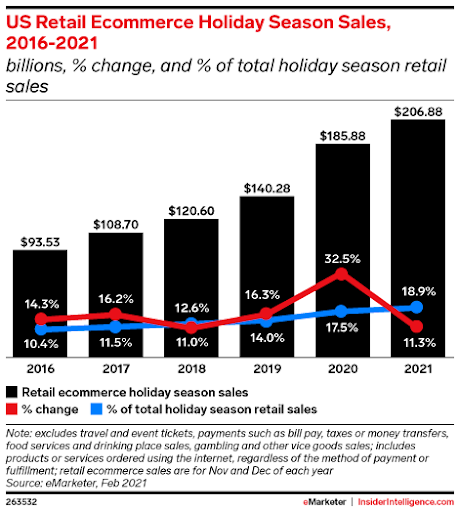
US Retail eCommerce Holiday Season

Image Credit: eMarketer

Though it’s more than one and half years since the pandemic approached, it is still hampering human life. We can experience this in every area of business as well. The continuously growing online sale proves that people are not ready to go out shopping yet.

There are more interesting facts too. In a survey, it is mentioned that 43% of the consumers are willing to continue online shopping instead of returning to the pre-pandemic shopping behaviors.

If retail brands need to stay ahead in competition during the holiday season, it is crucial to stay updated about the recent shopping trends and define their strategy accordingly.

Do you want to understand how you can be a part of the digital transformation that the retail domain is passing through these days? – Let’s connect

Challenges faced by retailers during the holiday season
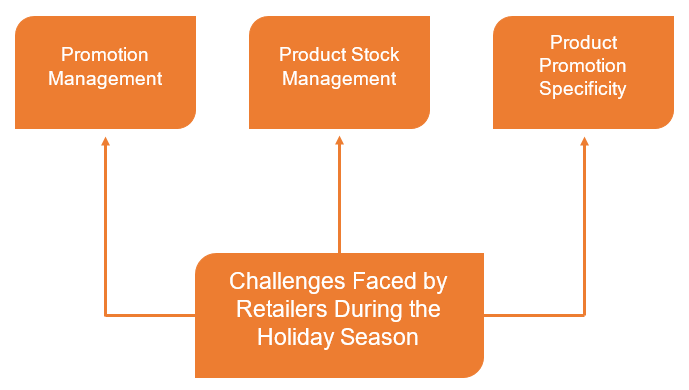
Challenges faced by retailers during the holiday season

Promotion management

Retailers create a variety of campaigns, promotions, and messages to attract a different set of target audiences. But that’s not enough, they have to roll out these campaigns across all the potential output channels at the same time to establish coherence.

Most of the retailers manage the promotions manually from the different sales and marketing tools. This requires a lot of time, effort, and money to run a campaign effectively across all the customer touchpoints. With the right digital solution, you can address these challenges and push out the promotions at the exact time.

Product stock management

In the holiday season, it is obvious that the sales increase significantly. When the sales boost, online retailers have to increase their stock. The increase in stock will increase the product volume you already have. It also helps in branching out into new product lines.

Eventually, you have to manage more products and promotions during the buying season. Moreover, tracking product data will be challenging for the retail business when the sale is at a peak.

Product promotion specificity

When you have a wide range of products to sell, you need to have a great strategy in place. Moreover, for the success of your seasonal campaign, it is very important to define the set of products that you want to promote. Of course, you cannot and do not want to promote all the products as it will be a quite expensive initiative for you.

Especially, on Black Friday, when the sale is on the hype, you need to choose your products for promotions carefully and set discounts that you are willing to give to the shoppers. To maximize sales effectiveness, you need to define and manage the promotions of potential products.

Holiday eCommerce shopping trends

Holiday eCommerce shopping trends

Online commerce continuously grows

Many pieces of research have clearly depicted that even if the world returned to normal, the essence of eCommerce will continue to thrive.

Here are some facts that support the above statement.

As per McKinsey, “As economies reopen, 73 percent of consumers are still hesitant to resume regular activities outside the home.”

Mobile eCommerce is also rising. According to a prediction of Mordor Intelligence, the growth rate of mobile eCommerce will reach nearly 27% from 2021 to 2025. Such increase in the usage and popularity of mCommerce is thanks to the leading brands that have allowed consumers to pay through mobile payments such as Amazon Pay, Apple Pay, PayPal, and more.

Social commerce is also a growing trend these days. Technavio recently reported that the social commerce market is poised to grow by $2,051 billion during 2020-2024, progressing at a compound annual growth rate of almost 31 percent.

Buyers will compare prices

Whether it’s offline shopping or online, finding good deals is always in customers’ interest. So, of course, this trend will continue in 2021.

Almost all the shoppers prefer to compare prices across the different retail platforms such as eCommerce stores, marketplaces, and so forth. They make a buying decision after analyzing the price and customer reviews.

A few surveys were conducted in 2020 to understand the shopping trends. One of the surveys reported that 41% of respondents replied they prefer to use holiday discounts. Another survey that is specifically conducted for Back Friday reveals that 44% of respondents look for special deals on Black Friday.

One more survey also showed that 74% of customers actually do not want to buy products through a tablet or mobile. But, they would like to buy through mobile devices just to redeem a discount.

All these data provide clear insights that while preparing for the Holiday season, it is important for the brands to consider the holiday discount.

Looking for the most convenient options for shopping

With each passing day, we are getting closer to the holiday season. Consumers still prefer to avoid crowded shopping places.

A recent survey reported that 49% of respondents prefer to shop holiday gifts from different online platforms to avoid traffic, crowded areas, and cramped parking lots.

The same survey also communicated the fact about online shopping where they mentioned 75% of the respondents purchased at least half of their holiday purchase through an online platform and 26% of the respondents bought all the gifts through digital platforms.

One of the prime reasons for considering online platforms is convenience. According to another survey, 77% of the buyers accepted that convenience is the prime reason for online shopping. Also, online shopping enables the buyers with easy payment options including BIPOD, buy now and pay later, and subscription services.

How retailers can gel with holiday shopping trends?

Understand the existing shopping trends and customers’ buying behavior to create the right strategy for the upcoming holiday season.
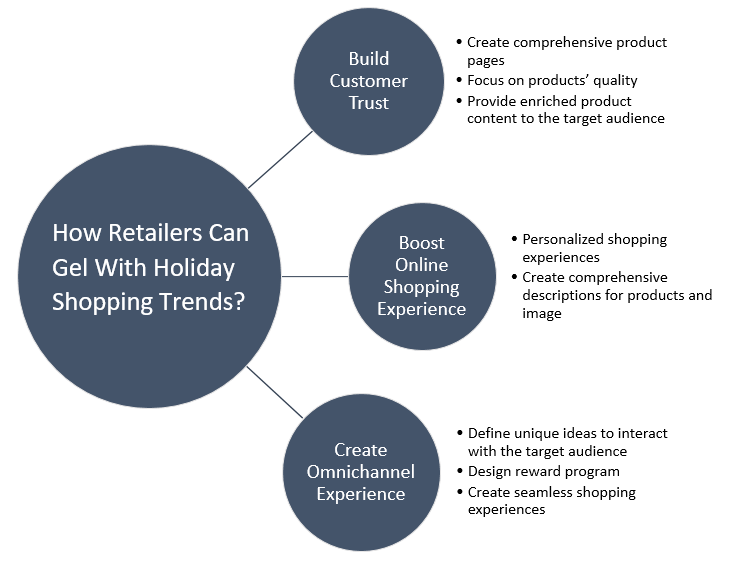
How retailers can gel with holiday shopping trends
Build customer trust

As we have discussed earlier, the growth of the eCommerce sector increases immensely. This has also raised the level of competition. Even though there is tough competition, there are more opportunities for businesses to embrace.

A survey reported that 86% of the customers are ready to spend more with a brand they trust.

Create comprehensive product pages

Before buying any product, consumers study the information available on the product pages. It helps them a lot in making the final buying decisions. Spend some time creating the content for your products.

While distributing product-related information across the different digital platforms, make sure there is consistency in the message. Also, consider presenting reviews and provide answers preemptively to the buyers’ queries.

Focus on products’ quality

High-quality product information, ingredients, craftsmanship, materials, and other rich content help retailers build trust across the customers.

Spread awareness about your products across your shoppers. Show them how the products are made, what they are made of, and your business practices by harnessing the potential of different digital platforms.

Provide enriched product content to the target audience

Enable the consumers with enriched content such as 360-degree image views, stunning product images, videos, comparison charts, and so forth. Offering detailed information about the product, you help buyers to know what they are purchasing.

Enhanced content helps improve your customer conversation. As per a survey, the enriched content improves customer conversion from 10% to 30% across different product categories.

Boost online shopping experience

Convenience is essential to impress and engage the customers during the highly competitive time of holiday shopping. It is difficult to try new experiences every time but with the right digital platform, you can deal with this requirement up to some extent. Here’re some ways that help you create memorable shopping experiences for your target audience.

Personalized shopping experiences

To create everlasting experiences, you need to enable the buyers with personalization. Provide relevant product information to the shoppers that they are looking for. Share the relevant product content, images, videos, reviews, etc.

With a robust digital solution, you can create and deliver highly personalized experiences to your buyers that help you boost brand engagement and increase conversion rates.

Create comprehensive descriptions for products and images

Provide detailed product descriptions and high-resolution products images to the buyers. It helps in earning customers’ trust. If you want to gain more customer attention with fewer efforts, then you should focus on product content.

Create an amazing omnichannel experience

During the holiday season, every retailer invests all their efforts and money into eCommerce initiatives to increase online sales. Along with digital stores, brick-and-mortar stores can also create an amazing buying journey for the customers by introducing omnichannel experiences.

Define unique ideas to interact with the target audience

Buyers interact with your brand either through the online store or mobile app or social media or physical store. By implementing cross-promotional customer experiences across the different output channels, you can improve customer engagement with your brand.

Let’s understand this through an example.

In our brick-and-mortar store, create a holiday-themed area where the buyers can click pictures and share them across different social media platforms with their preferred hashtags.

Design reward program

Create a customer loyalty program that encourages your target audience to engage with your brand through different touchpoints. Consider linking a member’s reward number that is accessible through your website, mobile app, and physical store.

Create seamless shopping experiences

As we discussed earlier, customers love conveniences regardless of how and where they want to shop. To enable them the best buying experiences, ensure you provide them online shopping, same-day shipping, BIPOS, and other options that are accessible across the different customer touchpoints.

What is Product Information Management (PIM)?

As the name itself suggests, Product Information Management (PIM) is a platform that allows you to manage all types of product data in a centralized location. It allows you to collect, manage, enrich, syndicate, aggregate, and distribute product information across different sales and marketing channels in a consistent way.

Along with that, PIM allows companies to create product catalogs and distribute them across different output channels. The platform manages all the product-related data that you need to sell and promote the products.

To learn about product information management in detail, visit What is PIM? – An Ultimate Guide for Product Information Management.

How to define a holiday eCommerce strategy with a Product Information Management platform?
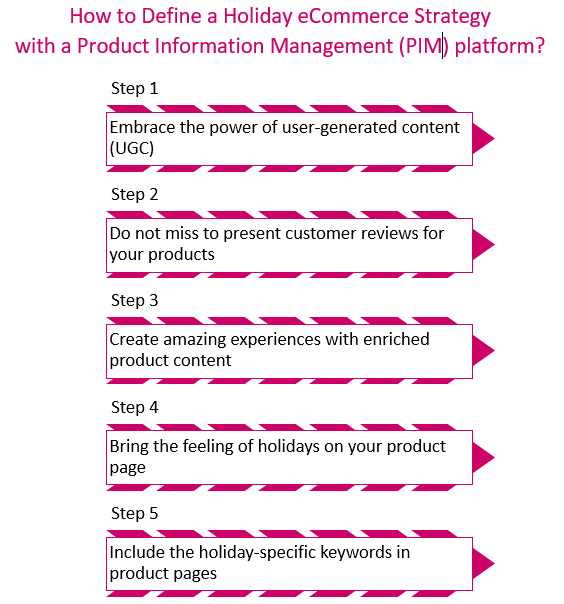
How to Define a Holiday eCommerce Strategy with a Product Information Management (PIM) platform

Digital shopping is gaining tremendous popularity with each passing day. Especially in the holiday season, people go crazy to shop online on special days like Black Friday, Christmas, Kwanzaa, Cyber Monday, New Year’s, etc.

If you want to capture the opportunity to drive tremendous customer engagement and win over the competition with your competitors, you should start working on your holiday eCommerce strategy right now. Said that you also start defining the required tools and technologies that help you attain immense growth and success.

One of the surest ways to gain success is to consider the latest eCommerce holiday trends that we have covered in this post previously. Retailers need to analyze the trends and learn from them which one is more effective for the business in their defined budget. These trends help you understand the behavior, requirements, and challenges of digital customers through the way they interact with your brand.

If you want to stay ahead in the competition, stand out from the industry crowd and gain customers’ attention, you have to work on defining powerful, emotional, and unique ways to connect with your target audience by creating engaging product content.

Leveraging the right product information management platform, you can easily optimize your product content. Here are the essential steps to optimize your product content.

Step 1: Embrace the power of user-generated content (UGC)

As we have already discussed, digital trends are changing with the passing of time. Nowadays, user-generated content has gained immense popularity across digital marketers. The incremental demand of UGC is the primary reason that the apps like Instagram, Snapchat, TikTok, etc. are constantly working to cater more and more innovative and creative features to the creators.

It is proven that before buying any product, the shoppers go through the creators’ content. They find it useful while making the purchase decision. As creators’ content influences most buyers’ decisions, it is essential for businesses to define a strategy accordingly.

Utilize the creator content in your product pages and D2C (direct-to-consumer) website across the digital shelf.

How to transform your user-generated content into product content?

Video testimonials: While creating product pages, consider the video testimonials along with other product descriptions. Video testimonials add more value to your brand’s credibility.

Brand advocates: Take help from brand advocates to curate a collection of your products and share it on your site.

Unique hashtags: Create and share unique hashtags on your site. Your customers can use these hashtags to generate excitement about your products.

Authentic visuals: Collect the authentic visuals of your products from the social media influencers’ accounts and include those visuals on your website.

Social media challenges: People share a lot about their experiences in social media these days. You can analyze their challenges and include their issues in your product content. This encourages brand and product engagement.

Step 2: Do not miss to present customer reviews for your products

We all know that today’s tech-savvy customers prefer to buy a product after performing detailed research. In this research journey, they give prime importance to the rating and reviews shared by other customers who have already bought and used the products. These reviews give them a more realistic view of the product from the buyers like them.

If your product reviews tell a powerful and consistent product story, then there is a maximum chance that your shoppers make a purchase decision.

Various researches are conducted around the essence of customer reviews. It is proven that buyers trust the customers more than the brand voices. All the eCommerce websites typically present high-resolution product images in the well-presented form. They create product copies like take our word for that. Many times, it happens shoppers purchase the product based on this information but they do not get the product they ordered.

As reviews are playing a vital role in making buying decisions. It is important for the brands to invest some time and energy in capturing more and more customer reviews. Present the product reviews and ratings on the product description page on your website when customers are exploring the products and are ready to buy.

Reviews on your product detail page work as 3rd party endorsement and add incentives to persuade customers to buy.

Step 3: Create amazing experiences with enriched product content

Converting your prospects into a buyer through purchasing funnel is all about enabling them with the outstanding user and customer experience. You can mimic your in-store experience by creating a digital platform that helps you achieve similar types of shopping experiences as a part of your customer experience strategy.

While creating the digital platform for your products make sure to provide the same product detail and customer experience that they get from your physical store. It gives the same feeling of physically walking into the store and picking the products up off the shelf.

To create the ultimate product experience, it is essential to create visual details with enriched content that involves engaging graphics, comparison charts, image galleries, videos, and more. With the enhanced content, you can increase the conversion rate of almost all your categories and deliver compelling customer experiences.

As you prepare your digital shelf for the coming holidays, you need to consider different types of product content and add them to your product pages. Create better customer experiences by telling your brand story and presenting the product use and functions through visual content. It helps stand out from the other retailers during this holiday season.

Cover below listed points and enrich your product content for the product description page

  • Image galleries
  • Professional product images
  • Engaging and helpful brand videos
  • Images of varied fabric, colors, etc.
  • Close-up and product shots
  • Detailed information about the product and its use
  • Zoom-in and zoom-out functionality
  • Rotating image to show how the product looks on different models
  • How-to videos
  • Downloadable manuals and other content
  • 360-degree image spin

Step 4: Bring the feeling of holidays on your product page

A picture is worth a thousand words. This is a true saying. But do not mistake it by considering the power of words less than image.

Similarly, by presenting visually rich product images, you can definitely engage the buyers but that’s not enough. Buyers won’t make a purchase decision on the basis of images. They also need product information to understand every aspect of the product. So, provide every detail to the consumers. Enable them with your unifying product description across all your commerce platforms.

If your eCommerce platform is not converting the visitors to buyers, then one of the possibilities is that there are some issues with product content.

To encourage customers to make a buying decision in this holiday season, you need to organize, optimize, and prioritize the different product content including manuals, copy, etc. across the digital shelf. It helps you gain a competitive edge that other brands don’t.

Do you want to improve product content copy? Here are a few tips to consider.

Important tips for creating a product description

Consider all the relevant product information

While exploring your product page, the customers wanted to know every information about the product. So make sure your product description page covers the information like product name, title, and brand name.

It should also cover product-specific information such as colors, sizes, dimensions, sustainability practices, product categories, ingredients, and more.

Write that consumers demand

It is essential to cover all the product information on the product description page. But, the most important part is to focus and include the content that is most valuable for your target audience. Enable the buyer with the information that they want to know. Later on, preemptively answer the questions raised by the prospects on your product pages.

Centralized management of your product copy

All the leading brands manage their product content copy in a centralized repository in order to create a consistent and complete product story across the different output channels.

Creating the detailed product copy for each product and managing the product-related information into Product Information Management (PIM) is a highly effective strategy. The tailored PIM solution allows you to manage and distribute product content across different sales and marketing channels from a single platform.

Another most important thing is once you create the product content copy, keep updating it regularly. The holiday season is about to come. Start creating amazing product copy, rewrite your copy and make it SEO-friendly by including holiday-focused keywords.

Step 5: Include the holiday-specific keywords in product pages

Search Engine Optimization (SEO) plays a vital role to make your product searchable. Using holiday-specific keywords, you help the consumer to find the products during the holiday season. These days, when buyers want to buy anything they do the online research first and then make a purchase decision.

As shoppers prefer to perform online research before buying a product, brands have to optimize their product description page to make their products searchable on different search engines. By making your product information search engine friendly, you can earn more sales and profit.

You can also hyper-targeting your product description pages for the holiday season. It helps you beat your competitors and gain the attention of your targeted customers.

How to optimize your product description pages for the holiday season?

Incorporate the voice of your customers

Keywords: For successful SEO, it is very essential to consider the keywords that are highly searched by the customers during the holiday season. So, select the right keywords and optimize our product description page accordingly.

Interviews: You can conduct interviews with customers to understand their experiences with the product.

Customer reviews: You should include the customer reviews on the product description page. It influences the buying decision of the customers.

Keep updating product content on the product description pages where you present what your customers are talking about your product. This will be the most influential strategy during the holiday season.

Identify and use seasonal keyword research

Collect your product data and analyze the product name, titles, and description you have mentioned. Make sure you have added all the trending keywords in your product description such as gifts for women, gifts for dad, great stock stuffers, and more.

Consider the more search engine results pages (SERP)

Have you added schema markup on your product description pages?

If not, then do it right now.

This is one of the most underrated SEO strategies. Schema markup helps you implement structured data on your product pages. This helps search engines like Google to understand your product details in a better way. You can add structured data that involves product price, availability, style, and more.

In this information, Google adds more value. When you integrate SERP on your product page, it provides a more detailed, more exclusive, and more compelling Google product listing.

How Product Information Management (PIM) helps you boost your revenue during the holiday season?
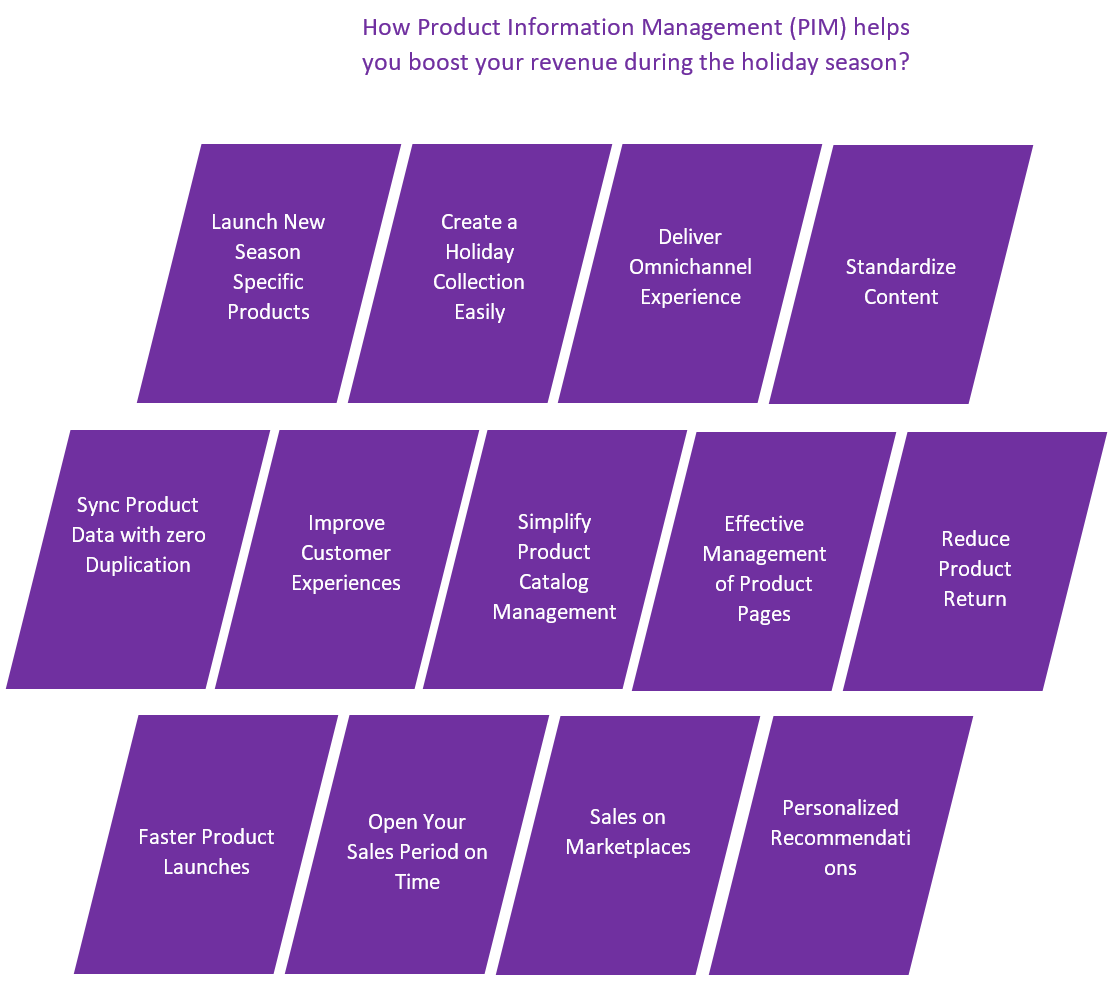
How Product Information Management (PIM) helps you boost your revenue during the holiday season

Launch new season-specific products

In the festive seasons, people feel totally different vibes around. They meet and greet relatives, have fun, do parties, go out on a vacation, and whatnot. To make these moments memorable, they spend more on different products. This is why shopping is increased immensely in the festive season. Especially on Christmas.

During the holiday season, to be different from others, customers look for new products, seasonal discounts, and have fun out of the shopping. Many pieces of research proved that most of the shoppers buy gifts for their relatives as well as near and dear ones only in a week before Christmas.

Retailers can grab this opportunity for product innovation and partnerships that are available in the market.
Implementation of a product information management platform empowers you by allowing you to launch the products faster. Not just that, PIM helps retailers to understand buyers’ behavior and streamline their purchase preferences based on shopping history, existing stock, and topography.

With this data, it becomes easier for retailers to plan their product launches smartly by establishing guidelines and timelines for collecting and delivering the content elements. Moreover, with an advanced PIM, you can gather and manage the detailed product attributes that work as a significant differentiating factor for your product.

Create a holiday collection easily

While creating the product catalogs, keep your customers in mind and design your catalog accordingly. The way your catalog is organized and provides all the small details to the customers makes a huge difference when it comes to making a buying decision.

In the holiday season, you can beat your competitors by having an important product line that helps you to grab customer attention significantly like pre-Christmas flash sales.

PIM helps you in creating a compelling product catalog by presenting your products in a collection list. To manage your new collection catalog strategically, you need a powerful system in place that comes with no restrictions in terms of the expansion in size and rate.

Implementing the ultra-modern PIM, you can streamline various business operations such as updating stock numbers, handling product catalogs based on in-stock availability, managing a catalog, and adding new versions.

Deliver omnichannel experience

The millennials interact with your brand from various platforms. By focusing on a single output channel, you won’t ensure growth and success for the business. Furthermore, modern customers are looking for omnichannel experiences so enable them with a solution that helps you to engage them.

By creating and delivering omnichannel experiences, you can set up the backbone for the success of your retail business.

In today’s words, buyers are moving between offline and online channels interchangeably. Thus, make sure the product information they receive at different customer touchpoints is timely and consistent.

Retailers have started understanding the impotence of this process. They have realized that buyers purchase the products from different output channels. Once this is clear, they can think beyond product sales and focus on creating product experiences and presentations.

PIM allows retailers to enable the users with a smooth cross-channel experience. By providing accurate and consistent product information. It ensures that business persona is an integral part of customers’ decision-making journey along with their purchase.

Standardize content

It’s very important to provide product information to the buyers effectively and efficiently regardless of any specific season or festival, including the holiday season. Retailers have to run a variety of offers simultaneously across different channels. Additionally, they have to keep introducing new products and product ranges with content consistency.

One of the researches conducted for holiday-specific shopping has revealed that most of the shoppers prefer product-related advice from family and friends. There is a user base who prefer to take advice from retailers where they may discuss which product they should buy.

Through these researches, it is proven that word of mouth strongly influences buyers’ behavior. But, content consistency is the paramount need to convert your customers into your influencers. They share their positive experiences with your brand in the market and impact the buying decisions of other users.

Achieve seamless synchronization with zero duplication

Product Information Management handles all the product data in a centralized repository. It enables your teams with a single interface to access all the product data. This helps to avoid the situation of data duplication that occurs with multiple entries of the same product data.

Implementation of PIM ensures that all the product information is latest and updated. They can share these details across their online and offline channels.

Improved customer experiences

Considering an avant-garde PIM platform, you can create customer-centric product categories and structures independently without following the ERP system. This helps you create the site navigation more intuitive and user-friendly.

Moreover, when customers search for a product by defining different parameters such as technical specification, category, size, color, etc., the platform provides a list of all the relevant products.

Enables the buyers with a short search process, helps them find their preferred products quickly, and allows them to purchase their selected products faster. Integrating PIM, you can leverage easy navigation, effective search results, and relevant product information that helps you boost your brand confidence and buyers’ shopping experience.

Simplified product catalog management

During the festive season, retailers try hard to attract buyers. One of the most effective ways to get customer attention is by creating exclusive product catalogs. Before making a purchase decision, the buyers pay considerable attention to read and interpret the product information described in the product catalog.

PIM allows retailers to identify and filter important product attributes. This process simplifies the complex and confusing product catalogs and eliminates the possibilities of product data duplication. Create a categorized product catalog with the help of PIM and allow the buyers to make intelligent buying decisions.

Effective management of product pages

During the holiday season, retailers launch varied offers and discounts for the customers. These offers are available for a limited span. Buyers tend to make instant buying decisions and take advantage of these offers.

To make quick buying decisions, they want retailers to present the product information in such a way that can view and analyze the essential info swiftly and make the buying decisions. While buying a product, the most important aspects of a product that shoppers need to know are product price, description, technical specification, customer reviews, quality, usefulness, return conditions, shipping information, etc.

Include all the above-listed details on your product description page and convert your product page into a conversion-driven product page.

Reduce product return

Product return is one of the biggest challenges in the eCommerce domain compared to brick-and-mortar stores.

Most of the returned products are non-liquidated inventory that could be a reason for loss for the retailers. It costs retailers 20% to 30% of the sales price of the product.

The most common reasons for product return are products not matching descriptions, incorrect sizing information, and general unfamiliarity of the customers with the products. Inaccurate and incomplete product information is the root of these issues.

With PIM, you can standardize the product content and present all the details on the product description page that helps in reducing the product returns. Include customer ratings and reviews as well as how-to videos on the product page that helps buyers to make a well-informed purchase decision.

Faster product launches

The holiday season is the prime time for retailers to launch new products and roll out exclusive offers for shoppers. It is essential for them to spread the news about newly launched products quicker in the market. PIM allows them to distribute new product-related content across the different sales and marketing channels.

PIM platform streamlines the product data management and distribution process. You also need to make sure that when the product information gets updated in the system, it gets distributed across all the output channels.

Improve your sales by harnessing the multichannel marketing capabilities of PIM that allows you to run your bundled offers and seasonal campaigns seamlessly.

Open your sales period on time

It is a common scenario that retailers pressurize their sales and marketing teams to keep their product information and product catalog updated while launching new products. Implementation of PIM allows your departments to work with unpublished data. Not only that, you have the freedom to make the necessary edits and revisions in the product information before making it live across different platforms.

Define a workflow for your different teams and team members in the PIM as per their roles and responsibility. You can provide access to the users you want. It allows to define and organize the editing rules as well as supervise all the changes before the product content goes live.

Additionally, you can schedule the time and date when to go live with new or different product pages. Thus, during every holiday season or festive period, the sales begin at the exact time you want and distribute the product data across different channels at the same moment.

Program-specific products and sales on marketplaces

To save time and effort, most organizations prefer to have a single eCommerce strategy and implement it for different output channels. Well, honestly, it won’t work. You cannot satisfy the requirements of different sales and marketing channels through a single eCommerce strategy.

Brands also sell the products on the leading marketplaces such as Amazon, eBay, Flipkart, Rakuten, etc. You can launch your products on a very niche platform like Newegg. Implementation of PIM allows you to differentiate easily how you want to sell the product catalog on the marketplaces and in your own channels like eCommerce store or website or mobile apps.

Selling the products on marketplaces at the same prices and adding your products to your marketplace page adds value to your business. It allows you to launch your new collection and sell your best seller products on the marketplace.

You need to tailor the products as per the specific taste and preferences of the marketplaces’ target audiences and product niche by considering the traffic volume of the specific platform.

One of the drawbacks of considering marketplaces is the profit that you earn from marketplaces will be lower than your own channels if you are a big brand. But, for small and medium scale businesses, it’s easier to reach a larger customer base through marketplaces.

Implementation of the PIM platform allows you to select and explore the required product information in just a couple of clicks to sell the products on marketplaces. To upload the product data easily, PIM allows for the integration of any specific connectors and plugins for the largest and the most reputed marketplaces.

Personalized recommendations

In a conventional method, sales representatives need to pass the information to the owners about the previously purchased items and the products that are sold immensely in the last Holiday season.

They also analyze the discounts offered on the high-performing products and propose the relevant discounts for the same product lines. They provide an overview of top-selling products that complement their existing product lines. Moreover, analysis of the past year helps retailers to produce the future trends of the coming year.

Retailers can earn customers’ trust by offering personalized recommendations by considering their demographics and preferences. To attain this, you need to equip your sales reps with the right tools and technologies.

With the right PIM solution, you can get insights into recent product purchases, personalized product recommendations, and more. Personalization is the most essential feature these days that ensures the success of your business during the holiday season.

Closing Lines

Happy Holidays to all the readers in advance!

I really wish that the small to large-scale retailers have a blast in the holiday season. Considering the right PM solution you cannot only increase the revenue but also boost the customer experiences that help you stay ahead in the competition.

Many product information management platforms are available in the market, you need to make the right choice as per your specific business needs. If you are in a dilemma of which one is right for you, feel free to connect with our PIM experts to get exclusive guidance on PIM.

A Brief about Digital Commerce (D-commerce) & Why PIM is Essential to it?

When compared with a few years back, Digital commerce (D-commerce) has a new face. In recent years, D-commerce is considered as the successor to eCommerce by top businesses and companies who utilize commerce platforms for selling their products and services.

This article will elaborate on digital commerce in detail along with the information on why PIM is essential for businesses preferring the D-commerce business model.

What is Digital Commerce?

Digital Commerce (D-commerce) is a business model that facilitates the business process involved in purchasing or selling products/services via multiple digital channels like mobile gadgets, the internet, or through any commerce platform.

D-commerce delivers an interactive and positive customer experience to the buyers/users. Apart from that, digital commerce eases the working operation of marketers to create and execute digital commerce strategies by offering personalized content. Mainly personalized content and mobile gadgets drive the D-commerce business model.

Being consistent on data governance and meeting the expectation of the buyers through optimizing the product information/data are the main things delivered by digital commerce to the businesses. Digital commerce is an omnichannel that carries functions through an automated process.

By keeping automation as its core feature, the digital commerce business model achieves its success when it is supported by relevant data.

Aspects of Digital Commerce

Well, digital commerce is bundled with the elements which play a vital role in triggering consumers to make a purchase decision. D-commerce is an amalgamation of the elements which are essential for strategists to create an effective business strategy by mapping all the activities and journeys of a buyer.

In simple words, digital commerce acts as a power source for businesses and provides a seamless buying experience to potential consumers.

Here are the lists of a few key aspects covered by the digital commerce business model.

  • Effective content marketing through personalized content
  • Well-optimized product content, images, and other assets
  • Creates efficient marketing strategies, promotional campaigns, and social media engagement by providing accurate data/content in time
  • Perfect data Analytics
  • Seamless customer service
  • Effective supply chain management

The Need for Digital Commerce

The commerce platform keeps evolving every single day which leads to changes in consumer behavior. To satisfy potential buyers with the modernization of technology, companies prefer digital commerce also known as D-commerce.

Study report shows smartphone users view 48% of the web pages. The scope of digital marketing turns towards mobile gadgets, the online retail world prefers to satisfy the needs of smartphone customers. This clearly shows how mobile gadgets play a vital role in commerce platforms.

Here are a few things companies/businesses can achieve through digital commerce.

  • To deliver better customer experience consistently
  • To Keep up with the evolving market challenges
  • To ease the customer data collection and storage process
  • To deliver more personalized content
  • To drive more visibility to the products through multiple channels
  • To gain authenticity to brands by generating reviews and content on social media

Benefits of Digital Commerce

Digital Commerce plays a vital role in all business aspects starting from its strategy, administration, revenue, and many more. Take a look over the below-given few attractive benefits of Digital commerce.

Seamless Business Process

When it comes to successful business strategy, every potential customer needs to be mapped in well-advanced, and product information should be provided accordingly. It is well-carried in D-commerce through automation.

D-commerce predicts the customer’s next move and provides the answers in such a way that matches their expectation. By doing so, the buying time of a potential consumer reduces significantly.

Less Manpower

Since Digital Commerce is relying on automation, business owners need not depend on heavy manpower. Also, an automated process eliminates the risk of human errors and saves a lot of time.

This allows a business owner to focus on the business growth rather than focusing their attention on the workforce. Apart from that, D-commerce handles business/product data effectively, this allows business owners to take care of repetitive processes.

Easy to Scale

Digital commerce uses an automated business model, because of that, businesses can be easily scalable. Because of automation, the challenges involved in business expansion in managing customers, consolidating sales, managing employees/product performance, and so on can be eliminated in digital commerce.

Enhance User Experience

Digital commerce delivers a personalized experience to potential consumers which leads to the growth of positive consumer experience. As a result, potential buyers will keep coming back to purchase more products. This will eventually increase business revenues.

Digital Commerce Trends 2021

In today’s digital world, everything is in the state of evolution; digital commerce is not an exception to it. Even marketing experts would find difficulties in keeping up with the world of digital commerce innovation.

Here are the lists of a few trends which are popular in the world of digital commerce.

API Based Commerce

API-based commerce is also well-known as headless commerce offers a platform to develop unique experiences and business growth through API interface with various business systems.

Subscription Commerce

The subscription commerce model delivers constant and recurring revenue to both sellers and merchants. This model saves a lot of cost on the administrative level by predicting the cash flow and budget.

Unlike other commerce business models, this subscription commerce is the perfect one that suits well for doing repeat business. Many companies in the field of cosmetics, food, health, and more prefer this model.

Progressive Web Apps (PWAs)

PWA apps are highly reliable, secured, and more engaging that users will feel the native-live experience. Moreover, when compared with native app development, PWA app development costs much less. That’s the main reason modern companies mostly prefer developing Progressive Web Apps to developing native apps.

Reasons Why PIM Is Essential for Digital Commerce (D-commerce) Business

When it comes to digital commerce (D-commerce) business, managing and aggregating the data/information of the product is the cornerstone that every owner needs to pay attention to. To make things right, digital commerce businesses require a proper data management technique, as a result, product information management (PIM) becomes critical.

A good PIM system offers a wide range of benefits to businesses especially in the digital platform like improving the quality of the product data, better data governance, and so on. In simple terms, a PIM system helps businesses to grow with full potential by responding to the evolving market condition.

Apart from that, here are a few more vital points that make PIM solutions mandatory for every business digital commerce (D-commerce) or electronic commerce (E-commerce) journey.

1. Data Quality Enhancement

In today’s heavy competitive market, having low-quality product data will surely impact customer’s interaction with your products which may lead to a loss in the business sale. In a digital platform maintaining, high-quality data is essential and critical. Also, government regulations and legal requirements are changing constantly. To maintain the changing compliances of modern-day regulations business owners need to update their product data on a regular basis.

Introducing a PIM system will help E-commerce or D-commerce business owners to address those issues easily. In addition, the PIM solution eliminates incomplete data attribution and offers full control over the data values.

2. Creates Effective Marketing Strategies

Modern-day businesses in digital commerce platforms use multiple channels for promoting and selling products/services. It doesn’t matter what products/services are being offered by a business, having a better and effective marketing strategy plays a key role in reaching target audiences/customers. To create such an effective marketing strategy and to achieve a unified customer experience in multiple channels a proper data management is required for providing accurate data in a timely manner.

A PIM system establishes one source of product data for multiple channels helps marketers to create effective marketing strategies that will enhance customer experience uniformly. Having a unified customer experience across multiple customer touchpoints will make sure the product/services of an E-commerce or D-commerce business growth rate rises steeply.

3. Improves Product Position in Search Result Page

Google’s bot and other search engine programs prefer products with detailed information or data to be listed on the result page. So that users of search engines will find it more useful. Having a good PIM system will provide accurate and extensive information to search engines and enable search engine users to view 90% of the product content.

Also, the PIM system provides enriched product content that will increase your website page density and makes your pages more appealing to search engine’s site crawlers.

In addition, the PIM solution enables business owners to concatenate product data attributes and generate attractive Titles, Meta tags, and catchy Alt tags for images this makes SEO professional’s work easier to optimize web pages more search engine friendly.

4. Makes New Product To Reach Market Faster

The time taken by the new product or sales channel of your digital commerce business to the market will determine when you can start experiencing the profit revenue through it. Generally, the marketing team will take time on seeking detailed information/data from the E-commerce or D-commerce teams to create an effective marketing strategy for the particular new product.

But in the case of having a PIM Solution, business owners can manage the product data/information efficiently and send more accurate detailed product information to the marketing team. This eliminates the confusion and time delay caused by raising requests and sending product data. The fully automated workflow of the PIM system gets rid of the possibilities of human error while doing manual data entry.

5. Business Growth

It doesn’t matter what kind of E-commerce or D-commerce business you are doing, if you want to expand and start witnessing business growth, you need to comply with the evolving market conditions and react quickly. In addition, you need to be aware of the importance of providing syndicated product content to multiple sales channels to grab the opportunities caused by raising demands.

A good PIM system will offer a wide range of integration tools by using which you can easily create a product portfolio according to the expectation of the buyers. Also, a PIM system enables you to translate and manage product content in multiple languages. This feature of PIM enables business owners to attract more overseas customers by providing optimized product content in the local language and to carry out the business’s geographic expansion.

6. Increases Performance

Many believe that a PIM system is just better data management, but it’s not true. PIM plays a major role in maximizing business productivity and offers more work satisfaction among employees. A good PIM system will eliminate the complexity of manual mode of data entry and manual maintenance of data in a spreadsheet and so.

Instead, the PIM system helps business management to streamline the business process and improves the work effort of employees. Moreover, it enables business owners to store and maintain business data/product content in a centralized trustworthy location where data can be retrieved easily at any time.

7. Better Customer Experience

Having loyal customers is a key for every business, to have loyal customers’ businesses need to satisfy their customers. In today’s growing competition providing customer satisfaction and maintaining loyalty among potential buyers becomes harder and harder. Apart from providing various value-added features like hassle-free shopping and free shipments by digital commerce businesses, it is important to provide accurate and enriched product content constantly to customers.

A PIM system has the personalization capabilities through which businesses can provide personalized product content to the individual customer to gain their loyalty. Also, the PIM system allows management to quickly correct the issues raised by customers and gain their trust. This set of actions will surely improve customer experiences.

Bottom Line

Meeting the requirements and expectations of modern digital consumers will become easy with a good PIM system. So, what you are waiting for is to implement a PIM solution to your digital commerce business and start witnessing the positive changes it brings to your business. PIM offers a flexible content strategy that will lead your business growth in digital commerce.

All You Need To Know About Hyper-Personalized Customer Experiences, Benefits, Frameworks & Why It Needs Multidomain MDM?

In this world of growing business, every organization needs to develop themselves as per the customer needs. They need to develop and update their products based on their customer demands to gain their trust and confidence.

The organization can attract its customer’s attention by providing personalized communication and through customized experience. The customers prefer accepting the service from the organization that provides personalized care, products, and services.

What is hyper-personalization?

Due to digitalization, the organization can gather a lot of data related to their products and services as well as the data specific to their customers. The organization can make use of this advancement to collect the behavioral data of the customers to understand their needs and requirements.

It becomes possible to interpret the customer characteristic and develop product-centric marketing strategies. With this data, the organization can develop better personalized customer-centric marketing.

Hyper-personalization allows the gathering of real-time behavioral data from the customers related to the services, tailored products, and their experience based on their requirements.

For making this purpose easy, the organization needs to combine the product and customer data to collect data from multiple channels regarding their product experience, their needs, and requirements.

Hyper-personalization will allow in the collection of relevant accurately that will be the same in a lot of time. This helps in collecting efficient details related to the customer’s requirements and accordingly provides personalized products to them.

How does hyper-personalization differ from personalization?

It is important to understand how hyper-personalization is different from personalization. There are different forms of personalization definitions where the organization understands their customers and recognizes them by the different products they purchased and reviewed. Hyper-personalization is a more advanced technique that makes the use of artificial intelligence-driven methods for personalization.

The personalization that interacts with the customers with their emails or other contact details obtained from their previous purchases. Hyper-personalization gathers the customer needs and requirements from various sources. These details are in context from the different channels, locations, product categories, different brand interactions, etc.

Hyper-personalized framework & its benefits

There are different important steps involved in forming the best framework for this hyper-personalization. The essential steps required for designing the blueprint for the best hyper-personalized framework include:

Data collection

This is the first and the most important step responsible for identifying the audience. It is essential to understand all the customers distinctly based on their requirements. Having adequate details about the target customers will help in better personalization.

Customer segmentation

In this step, the customer data is split into various sub-segments for better personalization. These subgroupings are based on spending, demographics, contentment, location, and past interaction with the customers. This helps in improving customer engagement and adherence to the band.

Target exploration

After the segmentation, the next step involves setting the communication facet. There are different factors involved in engaging the customers.

Analysis

The final step of the framework includes the implementation of the calculation and examining the different measures for making this campaign successful.

The different benefits gained by an organization from the hyper-personalization include:

  • It allows in removing the different obstacles in their sales channels that can lead to various complications in customer’s shopping experience. It helps to decrease the efforts and search time by the customers to get as per their requirements.
  • It eases the burden from the customers and helps them in selecting the items that they want. This hyper-personalization uses the recommendation algorithm that allows displaying the products to the customers based on their needs.
  • It is the best path that helps any brand to attract customers promptly and also retain the already existing ones. This is possible as it allows them in recognizing their customer’s interests and requirements. This helps the customers by saving time by providing the best and relevant solutions.

Creating a hyper-personalized customer experience

The customers while shopping prefers the business partners that will allow them to buy the best possible product or services based on their requirements. There is an increase in the targeted or personalized strategies that help in attracting customers. These techniques help the organization in taking their business to a higher level.

This hyper-personalization helps to enhance the real-time marketing of the products. This helps in improving the customer connection and leaving a better impression.

1. Understand real-time marketing

Real-time marketing is the best strategy that will help any business to target its customers. Based on the location, the customers can be prompted with the current sales and offers. This will trigger the customers to visit the store for making the purchase.

2. Know the customer

Based on the customer data, the marketing team can get an idea of the items or product category that the customer is currently focussing on. Based on their needs based on the category search, the customer can be prompted the details of related products that might interest them.

Sending out the survey sheets, polls and getting their responses will help in creating the detailed requirements. These will also help in understanding the customers and increasing the conversations. Based on the search details from customers will help to target the different customers.

3. Rapid follow-ups

Certain customers add their product of interest into their shopping cart but due to certain reasons, abandon their carts. They visit the product site but do not complete the purchase procedure. This customer can be prompted to purchase their selected product by giving them a helpful nudge to look into their filled cart and proceed with the purchase.

Based on the customer’s previous purchases, the company can prompt the customer for the upgraded or latest product belonging to a similar category that the customer prefers. If the customer is suggested with the trending product based on their likes and interests, they will be prompted to make the purchase.

4. Personalization

For providing hyper-personalization, it is essential to update the data and response from the customers. For this, they send out the survey sheets on a regular basis to understand the customer needs and requirements. Marketing the products that the customers are looking for is the best way to attract customers and increase the business.

Understanding the customers is essential for marketing. If the customer product list includes the makeup items related to the cruelty-free items, then suggesting similar types of products to the customers makes them feel that they are heard and their requirements are considered.

This will help to retain the customers and increase their purchases. Better understanding the customers helps in providing them the best services and products.

Why do hyper-personalized customer experiences need multidomain MDM?

Attracting more customers and retaining the original one is the most important task that the organization needs to take up. Customers prefer online shopping for the product of their desire.

There are various channels where the customers can search their requirements. It will be beneficial if these customers get hyper-personalized services on the various domains. The different factors that need to be considered while making personalization are available on multiple domains.

Multi-domain Master Data Management (MDM) provides personalization strategies:

The customer experience helps the organization to understand the customer needs. These details help in setting up the hyper-personalization strategies. The different ways that allow the multidomain MDM in achieving hyper-personalization include:

Governance capability

Multidomain MDM helps the business owner by providing them the important data elements required for personalization like product data, customer data, location data, channel data, etc.

Data quality

Multidomain MDM makes sure that all the data related to the customers, products, and other data used for the hyper-personalization is accurate, coherent, and complete.

Generate new data insight

Multidomain MDM does not generate any data on its own. It uses all the data that is readily available. It helps to compile all the data efficiently to yield new insights. This will help to generate information that will be helpful in hyper-personalization.

Different sources of data

MDM compiles the data from different sources like social media data, census data, etc. Combining these data efficiently with the master data records can help in revealing newer insights.

Use of analytics for personalization

Efficient customer interaction can help in generating a lot of crucial data that will help in understanding the customer demands and needs. It can be done based on direct interaction or the basis of various sources like surveys, channels, reviews, etc. MDM helps in generating the repository for collecting and sharing all this data. This will allow the business owner to create a coherent customer-centric experience for purchasing desired products.

Proper data collection

There are certain problems faced by the organization in collecting the customer’s data as there are different challenges. These include non-disclosure due to no consent to use the information, insufficient or lack of tools for collecting the data, management, and organization of the ill-defined objectives. MDM supports in overcoming these challenges. It helps in collecting all the data in a safe place and then collates the data efficiently. MDM ensured keeping the process of data collection transparent.

Multidomain MDM helps in moving from segmentation to personalization to hyper-personalization:

  • Segmentation allows addressing a wider set of public or customers based on the set of demographic similarities like gender, demographic location, or region, etc. On the other hand, personalization takes into consideration the individual customers by understanding their needs and providing them the best suitable products and services.
  • The personalization process is a very data-intensive process. The different aspects that define the customer experience are based on personalization accuracy, coherence, relevance, pertinence, timeliness, etc. Different recommendations tools that can adjust the experience will help them to prompt the relevant products to the customer based on their interests.
  • Multidomain MDM helps to define the different zones of insight. It allows defining the unique cross-domain governance that leads to the development of effective hyper-personalization. These zones of insight are formed by the intersection of the different data domains like customer data, product data, location data, and supplier data.

The multidomain MDM makes use of and relies on the different types of data essential for hyper-personalization. These types of data include:

Event-based data

This includes the real-time data that directly impacts the individual and is related to the local information, local weather, device usage, behavior, etc.

Configuration-based data

This information is based on the individual configuration settings adapted by the user. This depends on their aspirations, needs, product preferences, content appearance, information alerts, consent information, etc.

Deduction-based data

This data includes the results based on the analytics. Based on the previous behavior or purchase of the customer, the next offer, eligibility, sentiment is considered.

The multidomain MDM helps to achieve the hyper-personalization in the following ways:

  • It is important to have the governance strategy in place for an effective hyper-personalization. This required data transparency, relevance, better quality, coherence, etc. across the different channels. Multidomain MDM helps in having data transparency.
  • It allows managing the different data domains and this information directly impacts the customer experience.

Brands doing hyper-personalization

There are some top brands like Amazon, Starbucks, Spotify, etc. that have gained their current positions in the market due to this hyper-personalization. These brands use machine learning and artificial intelligence techniques for setting up their privilege recommendation engine. These techniques help these brands to keep their customers engaged and attracted to their products.

Amazon

They provide a hyper-personalized experience for each of their customers. They have access to huge data regarding the search query, search history, brand fondness, category browsing, etc. They propose the items to their customers based on their previous browsing and items in the shopping cart.

Starbucks

They boost hyper-personalization by using real-time data and deliver the messages related to the different offers on the food and beverages based on their preferences and past activities.

Spotify

It understands the individual music selection and based on the category suggests some details by mails or text for similar live events.

Bottom line

Providing personalized service to the customers is beneficial to the business in many ways. This hyper-personalization includes several steps added to the conventional. This personalization helps in creating a better experience for each of their customers as their expectations keep growing with the increase in digital competence.

The organizations need to adopt the new techniques, approaches, and plan accordingly to make this personalization experience and achieve their goals.