Why Centralized Data is Key to Faster Product Launches in the Automotive Aftermarket

The automotive aftermarket is a highly competitive landscape. With rapid advancements in technology and consumer expectations, aftermarket players must constantly innovate and introduce new products to stay ahead.

However, launching new products can be a complex and time-consuming process, fraught with challenges. This is where centralized data emerges as a crucial enabler for faster and more successful product introductions.

In the automotive aftermarket industry, 66.7% of suppliers have reported a reduction in time to market for product data after implementing internal data management systems.

Challenges in Launching New Automotive Aftermarket Parts in the Market

Traditional product launch processes in the aftermarket are often hindered by a lack of data integration. Disconnected data sources across different departments (R&D, marketing, sales, operations) and even between manufacturers, distributors, and retailers create significant inefficiencies.

  • Data Silos: Product information might reside in disparate systems like spreadsheets, databases, and even physical documents. This makes it difficult to access and analyze the complete picture of a product.
  • Inaccurate or Incomplete Data: Inconsistent and inaccurate product information, such as incorrect specifications, missing descriptions, or outdated images, can lead to costly errors, delays, and customer dissatisfaction.
  • High Risk of Errors: Manual data entry and communication between different stakeholders increase the risk of human error, leading to inaccuracies and delays in product launches.
  • Lengthy Time-to-Market: The manual handling of data throughout the product lifecycle, from initial concept to market launch, significantly slows down the entire process.

Challenges in Launching New Automotive Aftermarket Parts in the Market

What is Centralized Data in the Context of Automotive Aftermarket?

Centralized data management in the automotive aftermarket involves consolidating and unifying all product-related information into a single, accessible source of truth. This can be achieved through the implementation of systems like PIM and MDM solutions.

  • PIM systems act as a central repository for all product information, including attributes, descriptions, images, and multimedia content.
  • MDM systems ensure data consistency and accuracy across the entire organization and its ecosystem.

How Centralized Data Speeds Up Product Launches

By centralizing product data, aftermarket companies can significantly accelerate their product launch cycles:

1. Improved Collaboration

Centralized data platforms facilitate seamless communication and collaboration between internal teams (R&D, marketing, sales, operations) and external stakeholders (distributors, retailers). All parties involved have access to the same, consistent information, minimizing confusion and delays.

2. Enhanced Data Accuracy

By establishing a single source of truth for product information, companies can minimize errors in product specifications, descriptions, and other critical data. Automated data validation rules can further enhance data quality.

Enhancing Product Data Accuracy and Consistency in Automotive Aftermarket

3. Automated Updates

Centralized systems can automatically update product catalogs across all sales channels (e.g., eCommerce platforms, distributor portals) in real-time. This ensures that customers always have access to the most current information.

4. Streamlined Data Access

Teams across the organization can quickly access and share accurate, up-to-date product information whenever needed. This eliminates the need for time-consuming searches through multiple systems.

5. Regulatory Compliance

Centralized data helps companies ensure compliance with industry regulations and standards by providing a centralized platform for managing and maintaining product certifications and compliance information.

How Centralized Data Speeds Up Product Launches

Business Benefits of Centralized Data for Product Launches

The benefits of centralized data extend beyond faster product launches:

  • Competitive Advantage: By bringing products to market faster and offering a superior customer experience, companies can gain a significant competitive advantage in the dynamic aftermarket landscape.
  • Improved Customer Satisfaction: Accurate and complete product information leads to better customer experiences. Customers can make informed purchasing decisions, and retailers can provide better support.
  • Increased Operational Efficiency: Streamlined data workflows and automated processes significantly improve operational efficiency and reduce costs associated with data management.
  • Quicker Time-to-Market: Reduced time-to-market translates to faster revenue generation and a quicker return on investment for new products.

Conclusion

In today’s fast-paced automotive aftermarket, the ability to launch new products quickly and efficiently is critical for success. Centralized data management provides a powerful foundation for achieving this goal.

By investing in robust data management systems and building a data-driven culture, aftermarket companies can unlock significant improvements in product launch speed, operational efficiency, and overall business performance.

Streamlining Automotive Product Data Management with Centralized Systems

The automotive industry is in constant motion, driven by rapid technological advancements, evolving customer demands, and stringent regulatory requirements. This dynamic landscape generates an immense volume of complex product data, from design specifications and engineering drawings to manufacturing processes and sales information.

Managing this data effectively is crucial for success, yet many automotive companies struggle with outdated, decentralized systems that hinder efficiency and innovation. This blog explores how centralized product data management systems offer a powerful solution, streamlining operations, reducing costs, and driving the future of automotive.

Growing Pains of Traditional Data Management in Automotive Aftermarket

The traditional approach to managing product data in the automotive sector often resembles a fragmented archipelago of information silos. Different departments, such as engineering, design, manufacturing, sales, marketing, and after-sales service, operate with their own databases, spreadsheets, and legacy systems.

This decentralized approach creates a multitude of problems:

1. Lack of Real-Time Visibility and Collaboration

Without a unified view of product data, it’s difficult for stakeholders to collaborate effectively and make informed decisions in real time. This hinders cross-functional teamwork, slows down problem-solving, and reduces overall efficiency.

For example, marketing teams might not have access to the latest product specifications, leading to inaccurate marketing materials.

2. Version Control Nightmares

Managing multiple versions of product data across different systems creates a chaotic environment. It becomes difficult to track changes, identify the latest version, and prevent costly errors due to working with outdated information.

This is especially critical in safety-related components, where using the wrong version could have severe consequences.

3. Data Silos and Inconsistencies

Information is duplicated, outdated, or contradictory across different departments. This leads to confusion, errors in decision-making, and costly rework.

For example, an engineer might be working with an older version of a design specification, leading to manufacturing errors and delays.

4. Manual Processes and Inefficiencies

Manual data entry, updates, and sharing are time-consuming, error-prone, and inefficient. This slows down product development cycles, increases administrative overhead, and hinders responsiveness to market changes.

Imagine the time wasted manually updating spreadsheets with component pricing changes across multiple departments.

5. Compliance and Regulatory Challenges

The automotive industry is subject to stringent regulations and compliance requirements, such as those related to safety, emissions, and data privacy. Managing compliance becomes significantly more complex with decentralized data management, making audits difficult and increasing the risk of non-compliance.

6. Impact on Time-to-Market and Profitability

All these challenges collectively contribute to longer product development cycles, increased costs, and reduced profitability. In a highly competitive market, delays in launching new models or features can have a significant impact on market share and revenue.

Challenges of Traditional Data Management in Automotive Aftermarket

The Power of Centralization: A Unified Approach to Product Data

Centralized product data management systems offer a robust solution to these challenges by providing a single, unified platform for all product-related information. This “single source of truth” eliminates data silos, ensures data consistency, and empowers effective collaboration across the entire organization.

The benefits are transformative:

1. Enhanced Data Accuracy and Integrity

By consolidating data into a central repository, these systems eliminate data redundancy and ensure that everyone works with the same, up-to-date information. This drastically reduces errors, improves decision-making, and enhances overall efficiency.

Enhancing Product Data Accuracy and Consistency in Automotive Aftermarket

2. Data-Driven Decision Making

Real-time visibility into product data empowers informed decision-making based on accurate and timely information. This enables companies to respond quickly to market trends, optimize product offerings, and improve overall business performance.

3. Streamlined Collaboration and Communication

A centralized platform facilitates seamless information sharing and collaboration across departments, suppliers, and other stakeholders. This improves communication, reduces misunderstandings, and fosters a more collaborative work environment.

4. Significant Cost Reductions

By minimizing errors, rework, administrative overhead, and the costs associated with managing disparate systems, centralized systems generate significant cost savings across the entire organization.

5. Simplified Compliance and Regulatory Adherence

A centralized system provides a comprehensive audit trail and ensures data integrity, making it easier to meet regulatory requirements and pass audits.

6. Accelerated Product Development Cycles

By streamlining data management and improving collaboration, centralized systems significantly accelerate product development cycles, reducing time-to-market and enabling faster innovation.

7. Improved Product Quality and Reliability

Accurate and accessible data contributes to better design, engineering, manufacturing, and quality control processes, resulting in higher-quality, more reliable vehicles.

Essential Features of a Modern Centralized System

Choosing the right centralized system is crucial for maximizing its benefits. Key features to consider include:

1. Scalability and Flexibility

The system should be able to scale to accommodate growing data volumes and evolving business needs. It should also be flexible enough to adapt to changing requirements and integrate with new technologies.

2. Robust Data Integration and Interoperability

Seamless integration with existing enterprise systems (ERP, CRM, CAD, PLM, MES) is essential for maximizing efficiency and avoiding data silos. APIs and open standards are crucial for enabling this integration.

3. Comprehensive Reporting and Analytics

Powerful reporting and analytics tools provide valuable insights into product performance, identify areas for improvement, and support data-driven decision-making. This includes customizable dashboards, real-time reporting, and data visualization capabilities.

4. Advanced Version Control and Change Management

Sophisticated version control and change management capabilities are essential for tracking changes, managing revisions, and preventing errors. This includes features like branching, merging, and audit trails.

5. Granular Access Control and Security

Robust security measures and role-based access control ensure that sensitive data is protected and that only authorized personnel have access to specific information.

6. Automated Workflows and Processes

Automated workflows streamline processes, reduce manual effort, and improve efficiency. This includes automating tasks like data entry, approval processes, and notifications.

7. Cloud-Based Deployment Options

Cloud-based deployment offers advantages in terms of scalability, accessibility, and cost-effectiveness.

Essential Features of a Modern Centralized System

Conclusion: Driving Automotive Innovation Through Data Centralization

Effective product data management is no longer optional, it’s a strategic imperative. Centralized product data management systems offer a powerful solution for streamlining operations, reducing costs, improving product quality, and driving innovation.

By embracing these systems, automotive companies can unlock the full potential of their data, navigate the challenges of the modern automotive industry, and pave the way for a more efficient, innovative, and successful future.

Top Challenges of Using Legacy Systems for Data Management

Data is one of the most critical assets for businesses. Whether it’s understanding customer behavior, streamlining operations, or driving innovation, effective data management is the key to success.

However, many organizations still rely on legacy systems – outdated technologies that were once cutting-edge but now struggle to meet modern demands.

Shockingly, 70% of organizations believe their legacy systems are holding them back from achieving digital transformation goals

While these systems might still function, their limitations create significant obstacles in managing data effectively. This blog explores the key challenges posed by legacy systems in data management and why modern businesses need to address them.

What Are Legacy Systems?

Legacy systems are traditional software or hardware solutions that have been in use for many years. While they may still perform the tasks they were designed for, they often lack the adaptability to meet current business requirements.

Key Characteristics of Legacy Systems:

  • Outdated technology stacks.
  • Limited integration capabilities with modern tools.
  • High reliance on manual processes.
  • Vulnerable to cybersecurity risks.

Although legacy systems might seem cost-effective in the short term, they often lead to inefficiencies that hinder business growth.

Challenges in Legacy Systems for Data Management

Managing data with legacy systems presents several critical challenges:

1. Lack of Integration

Most legacy systems are incompatible with modern tools, such as cloud-based platforms, analytics solutions, or enterprise applications. This makes it difficult to adopt innovative technologies that can enhance data utilization.

2. Data Silos

Legacy systems are often isolated, creating “silos” where data resides in separate systems. This lack of connectivity prevents departments from sharing information efficiently, leading to fragmented insights and missed opportunities.

3. Scalability Issues

As businesses grow, so does the volume of data. Legacy systems struggle to handle this surge, resulting in slower performance and, in some cases, data loss.

4. High Maintenance Costs

Keeping legacy systems operational often requires significant investments in hardware updates, specialized expertise, and manual upkeep. These costs can outweigh the benefits over time.

5. Security Vulnerabilities

Outdated systems often lack robust security measures, making them easy targets for cyberattacks. In today’s data-driven world, this is a risk businesses can’t afford.

6. Limited Automation

Unlike modern systems, legacy solutions rely heavily on manual processes. This reduces efficiency, increases the chances of errors, and consumes valuable employee time.

7. Performance Bottlenecks

Legacy systems are not optimized for speed and efficiency. As a result, processes take longer, slowing down operations and impacting overall productivity.

Challenges in Legacy Systems for Data Management

By understanding these challenges, businesses can better assess the true costs of sticking with legacy systems and the potential benefits of modernization.

Business Impact of Legacy System Challenges

The limitations of legacy systems extend beyond technical constraints; they have a significant impact on business performance. Here’s how these challenges affect organizations:

1. Missed Opportunities for Data-Driven Decisions

Modern businesses thrive on real-time data insights. Legacy systems often fail to provide the timely, accurate information needed for strategic decision-making, leaving businesses at a competitive disadvantage.

2. Reduced Operational Efficiency

When data is scattered across silos or processes rely on manual input, operations slow down. Teams spend more time troubleshooting and less time focusing on strategic initiatives.

3. Increased Costs

While maintaining legacy systems might seem cheaper than transitioning to new technologies, hidden costs – such as downtime, maintenance, and lost productivity add up quickly.

4. Higher Risk Exposure

From compliance failures to cybersecurity breaches, legacy systems put businesses at greater risk. These risks can lead to financial penalties and damage to reputation.

Addressing these impacts is crucial for businesses aiming to remain competitive and agile in today’s marketplace.

Transitioning Away from Legacy Systems

Modernizing your data management infrastructure is not just an IT project, it’s a strategic business decision. Here’s how organizations can transition effectively:

1. Partner with Experts

Transitioning away from legacy systems requires expertise. Collaborating with implementation specialists like Credencys ensures a seamless migration and maximizes the benefits of modernization.

2. Explore Modern Alternatives

Consider solutions like cloud-based platforms, PIM or MDM tools. These technologies offer scalability, flexibility, and advanced features tailored to modern business needs.

3. Evaluate Current Systems

Start by assessing the capabilities and limitations of your existing systems. Identify gaps and pain points that hinder your data management efforts.

4. Plan a Gradual Migration

Instead of a complete overhaul, adopt a phased approach. Migrate critical functions first and gradually integrate other areas to minimize disruptions.

How Organizations can Transition from Legacy Data Management Systems

Making the shift may seem daunting, but the long-term benefits far outweigh the temporary challenges of transition.

Business Benefits of Moving Beyond Legacy Systems

Modernizing your data management infrastructure is more than just keeping up with trends, it’s about ensuring long-term business sustainability and success. Here’s how organizations have benefited from moving away from legacy systems:

  • Improved Efficiency: Companies that adopted modern PIM or MDM solutions experienced streamlined operations, with faster data processing and enhanced collaboration.
  • Reduced Costs: Transitioning to cloud-based systems or advanced PIM solutions significantly lowered maintenance costs while improving reliability.
  • Stronger Security: Upgrading to modern platforms equipped with robust security measures helped companies mitigate cybersecurity risks.
  • Enhanced Data Utilization: By integrating with analytics tools, businesses could extract actionable insights, enabling smarter decision-making.

These outcomes demonstrate that modernization isn’t just a tech upgrade – it’s a strategic move toward operational excellence.

Conclusion

Legacy systems have long supported businesses, but their limitations in today’s data-driven era are too significant to ignore. From data silos to security vulnerabilities, the challenges they present hinder efficiency, scalability, and innovation.

Modernizing your data management infrastructure is no longer optional – it’s essential for staying competitive and agile in a fast-evolving market. Solutions like PIM, MDM, and cloud platforms not only address legacy system challenges but also unlock new opportunities for growth.

If your business is ready to move past the roadblocks of legacy systems, Credencys can help. With extensive experience in implementing modern PIM and MDM solutions, we empower organizations to transform their data management strategies and achieve sustainable growth.

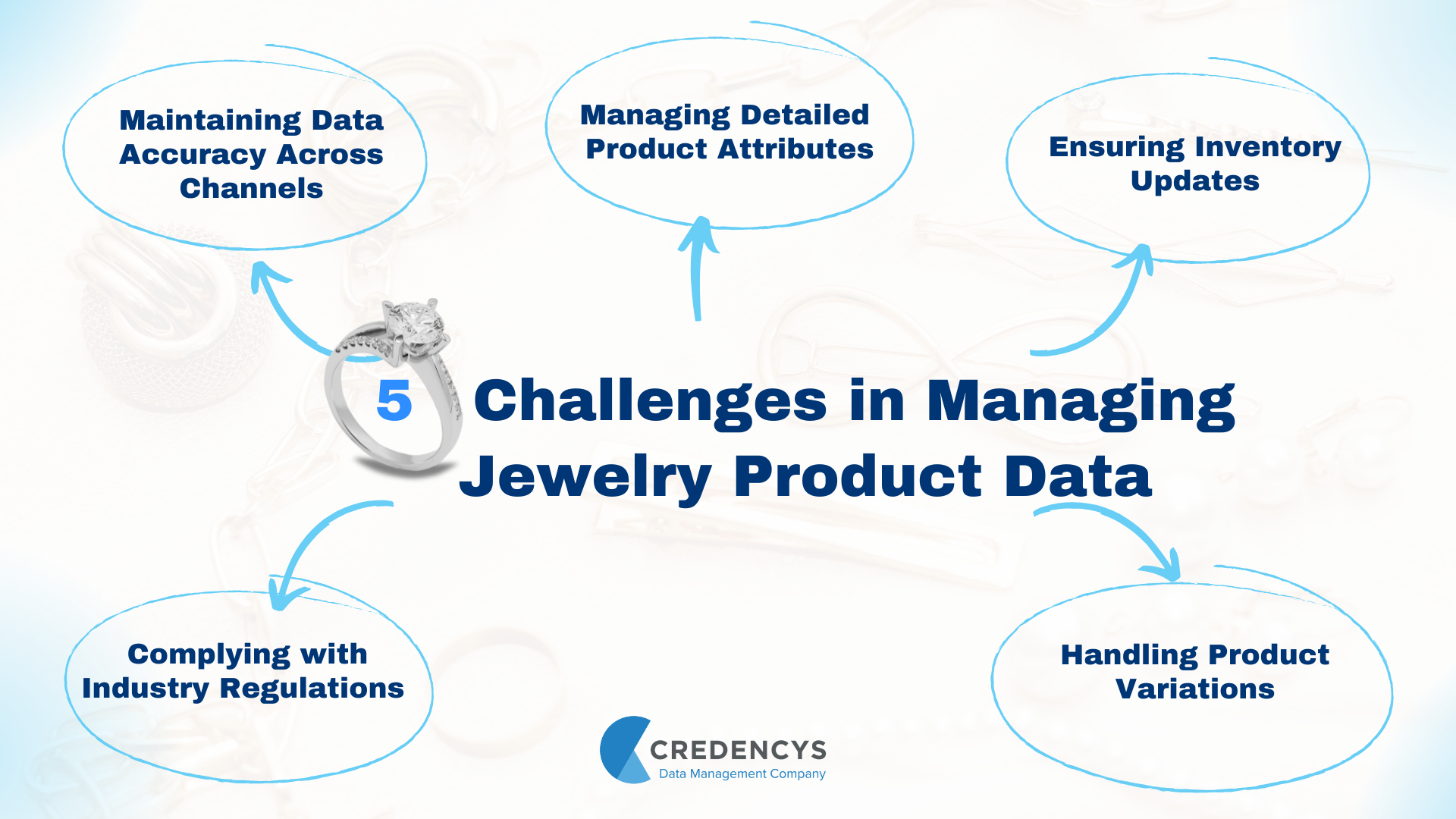
Top 5 Challenges in Managing Jewelry Product Data

From handling complex supply chains to meeting ever-evolving consumer expectations, the jewelry industry faces significant hurdles. Mismanagement of product data, in particular, is emerging as a critical barrier to growth, impacting sales and operational efficiency.

Market statistics highlight the urgency of addressing these challenges. Despite the global jewelry market’s value surpassing $340 billion in 2023, growth opportunities are often hindered by inefficiencies in data management. Inaccurate product descriptions, labeling errors, and slow adaptation to digital channels can lead to lost sales, decreased customer loyalty, and slower market expansion.

In this blog, we’ll explore the top five challenges in managing jewelry product data and how overcoming them can unlock opportunities for growth and success in this competitive industry.

jewelry data management challenges

Challenge 1. Maintaining Data Accuracy Across Channels

Jewelry businesses operate across multiple platforms, including physical stores, e-commerce websites, and marketplaces like Amazon or Etsy. Ensuring that product data—such as descriptions, prices, and specifications—is accurate and consistent across all these channels can be overwhelming.

Mistakes, such as outdated prices or incorrect gemstone details, can lead to customer dissatisfaction and even legal issues.

According to market research, 87% of customers abandon a purchase due to unclear or inaccurate product information. Investing in automated Product Information Management (PIM) systems is crucial to avoid such discrepancies.

How PIM Helps:

  • PIM centralizes product information, ensuring consistency across physical stores, e-commerce platforms, and marketplaces.
  • Automated updates prevent outdated or conflicting information from reaching customers.
  • Tools like bulk editing and data validation reduce manual errors.

Challenge 2: Managing Detailed Product Attributes

Unlike other industries, jewelry involves highly detailed product attributes. A single item may have attributes such as carat weight, gemstone type, metal purity, dimensions, and more. Manually managing this extensive data is time-consuming and error-prone.

For instance, a gold necklace with a diamond pendant might require atleast 15-20 unique attributes for proper cataloging. Without a robust data management strategy, keeping this information organized is a significant challenge.

How PIM Helps:

  • PIM allows easy customization and categorization of intricate attributes like carat weight, gemstone type, and metal purity.
  • Advanced search and filtering options streamline the process of finding and updating specific attributes.
  • Ensures comprehensive and accurate metadata for every product.

Challenge 3: Ensuring Inventory Updates

Inventory management is a critical aspect of jewelry retail. Products are often one-of-a-kind or made in small batches, making real-time inventory updates vital to avoid overselling.

However, many businesses struggle with outdated systems that fail to sync inventory data across sales channels.

A 2022 study revealed that 35% of jewelry retailers experience stock discrepancies due to poor data synchronization, leading to revenue loss and damaged customer trust.

How PIM Helps:

  • PIM integrates with inventory management systems to provide real-time updates across channels.
  • Alerts for stock level changes prevent overselling or underselling of unique items.
  • Facilitates seamless synchronization with ERP and CRM systems for better inventory visibility.

Challenge 4: Complying with Industry Regulations

Jewelry businesses must adhere to various regulations regarding materials, origins, and ethical sourcing. For example, certifications like Kimberley Process Compliance ensure that diamonds are conflict-free. Keeping track of these certifications and ensuring their inclusion in product data is challenging but essential for maintaining consumer trust.

Failure to comply can result in hefty fines or reputational damage. Moreover, as more consumers prioritize sustainability, having transparent product data can set a brand apart in a competitive market.

How PIM Helps:

  • PIM stores compliance certifications (e.g., Kimberley Process, ethical sourcing documents) alongside product data.
  • Ensures regulatory information is accurately included in product descriptions and documentation.
  • Simplifies auditing and compliance reporting processes.

Challenge 5: Handling Product Variations

Jewelry often comes with multiple variations, such as different sizes, metal types, or gemstone options. Managing these variations efficiently is no small task, especially when each variation needs unique data.

For example, a simple ring design might be available in three metals (gold, platinum, and silver) and five sizes. This results in 15 product entries, each requiring accurate details. Without an automated system, the manual effort to handle these variations increases exponentially.

How PIM Helps:

  • PIM for jewelry organizes product variations like size, metal type, or gemstone options under a unified parent product.
  • Streamlines the creation and management of multiple SKUs with shared core data.
  • Reduces duplication and manual effort by reusing and linking data effectively.

Wrapping Up

Managing jewelry product data is not just a logistical task but a strategic necessity. In a market projected to grow by 4.6% annually, efficient data management can be a key differentiator for brands. Whether it’s through automation tools, centralized data systems, or compliance frameworks, overcoming these challenges ensures that businesses can shine in a competitive marketplace.

By addressing these top five challenges, jewelry retailers can enhance customer trust, improve operational efficiency, and stay ahead in this glittering industry.

Role of Centralized Product Data in Scaling Auto Parts Manufacturing

The global auto parts manufacturing industry is expected to grow to $810 billion by 2027, driven by increasing demand for advanced vehicles and aftermarket products.

However, scaling operations to capture this growth presents significant challenges, particularly in managing the vast amount of product data required to support diverse offerings and multi-channel distribution. Efficient product data management is a critical enabler of scalability.

Auto parts manufacturers must juggle complex product catalogs, detailed specifications, regulatory compliance, and compatibility matrices. Without a centralized approach, these tasks often lead to inefficiencies, errors, and missed opportunities.

Centralized product data offers a transformative solution by consolidating information into a unified platform. It ensures consistency, enhances collaboration, and empowers manufacturers to scale their operations seamlessly.

This blog explores the challenges, benefits, and strategic role of centralized product data in driving growth for the auto parts manufacturing industry.

Challenges in Managing Product Data Without Centralization

Auto parts manufacturers often manage their product information across multiple disconnected systems, creating several inefficiencies.

1. Difficulty in Multi-Channel Data Distribution

Manufacturers must provide accurate, channel-specific data to eCommerce platforms, distributors, and retailers. Without centralized data, this process is prone to inconsistencies and delays, damaging relationships with partners and customers.

These challenges collectively hinder the ability to scale operations effectively.

2. Increased Errors and Delays in Product Launches

Launching new products or updating existing ones becomes a time-consuming task when data needs to be manually compiled from different sources. Errors in specifications can delay launches or even lead to product recalls.

3. Fragmented and Inconsistent Data

Product data is often spread across various departments engineering, procurement, marketing, and sales. These silos create discrepancies in product descriptions, specifications, and attributes, leading to errors in both internal processes and customer-facing outputs.

4. Compliance Challenges

Auto parts manufacturers operate in a highly regulated industry. Meeting standards such as ISO, SAE, or local government requirements becomes difficult without a centralized system to manage certifications and compliance documents.

Challenges in Managing Product Data Without Centralization

What Is Centralized Product Data?

Centralized product data refers to the consolidation of all product-related information into a unified repository that serves as a single source of truth. This repository houses everything from product descriptions and specifications to compliance documents and marketing assets.

A key enabler of centralized product data is PIM systems. These systems allow manufacturers to:

  • Collect data from multiple sources.
  • Enrich data with detailed attributes and metadata.
  • Ensure data consistency across teams and systems.
  • Distribute accurate data to multiple channels efficiently.

For auto parts manufacturers, centralized data management not only simplifies internal processes but also enables effective collaboration with external partners and stakeholders.

Benefits of Centralized Product Data for Auto Parts Manufacturers

Implementing centralized product data delivers a range of benefits that directly impact scalability, efficiency, and profitability.

1. Optimized Multi-Channel Distribution

Centralized data allows manufacturers to tailor product information for specific channels, such as eCommerce platforms, marketplaces, or distributor catalogs. This ensures consistent, high-quality data delivery, enhancing the brand’s reputation and increasing sales opportunities.

2. Improved Data Accuracy

Centralized systems eliminate redundancies and inconsistencies by consolidating data into a single source of truth. Accurate product information ensures that internal processes run smoothly, reducing errors and the risk of miscommunication.

3. Regulatory Compliance Made Easy

Auto parts manufacturers often need to meet stringent regulatory standards. Centralized systems store compliance documentation, certifications, and audit trails in one location, making it easier to maintain and prove compliance.

4. Faster Time-to-Market

Centralized data management simplifies product updates and new launches by automating data synchronization across systems. This efficiency helps manufacturers bring products to market faster, giving them a competitive edge.

5. Improved Customer Experience

Customers expect detailed and accurate product information. Centralized data systems ensure that the information presented whether on websites, catalogs, or packaging is consistent, enhancing trust and satisfaction.

6. Enhanced Collaboration Across Teams

With centralized data, all departments engineering, procurement, marketing, and sales can access the same information. This transparency fosters better collaboration, enabling faster decision-making and improved workflows.

Role of Centralized Product Data in Scaling Operations

As manufacturers scale, the complexities of managing larger product catalogs, expanding to new markets, and meeting diverse customer expectations grow exponentially. Centralized product data plays a crucial role in overcoming these complexities:

1. Supporting Global Expansion

Expanding into new markets requires localized product data, such as language translations, regional regulations, and currency-specific pricing. Centralized systems enable manufacturers to customize data for each region efficiently while maintaining overall consistency.

2. Delivering Consistent Information Across Channels

Inconsistent product data can confuse customers and harm brand reputation. Centralized systems ensure that every channel, whether an eCommerce platform or a printed catalog displays accurate and up-to-date information.

3. Managing Larger Product Catalogs Seamlessly

Scaling operations often involves introducing new product lines or variations. Centralized data systems make it easy to add, manage, and organize these new items without disrupting existing workflows.

4. Building Stronger Relationships with Partners

When manufacturers can deliver consistent, high-quality data to distributors and retailers, they strengthen their business relationships. This reliability often leads to preferential treatment and expanded opportunities with partners.

5. Leveraging Data Analytics for Strategic Decisions

Centralized data systems provide actionable insights by integrating analytics tools. Manufacturers can identify trends, optimize inventory, and forecast demand more effectively, making data-driven decisions that support growth.

Role of Centralized Product Data in Scaling Operations

Conclusion

Centralized product data is the backbone of scalable operations in the auto parts manufacturing industry. It addresses the inefficiencies of fragmented data management, ensuring that manufacturers can expand their product offerings, enter new markets, and meet customer expectations with confidence.

For auto parts manufacturers looking to scale, adopting a centralized approach to product data management is not just a smart move, it’s a necessary one. Solutions like PIM systems enable manufacturers to overcome challenges, streamline processes, and unlock new growth opportunities.

At Credencys, we specialize in implementing centralized product data solutions tailored to the unique needs of auto parts manufacturers. Let us help you transform your data management strategy and drive your business toward scalable success.

Top 5 Data Challenges Auto Parts Manufacturers Face Today

Data is the backbone of operations in the auto parts manufacturing industry. Accurate and organized product data ensures seamless processes, enhanced customer satisfaction, and regulatory compliance.

However, the growing complexity of product information and multichannel distribution creates significant challenges.

According to Deloitte, 49% of manufacturers struggle with data management complexity, impacting operational efficiency and customer satisfaction.

This blog explores the top five data challenges faced by the industry and highlights strategies to address them effectively.

Challenge 1: Managing High Volumes of Complex Data

Auto parts manufacturers handle a staggering volume of data. Each product comes with extensive attributes like compatibility, dimensions, materials, and SKUs.

This complexity increases when products are updated or new models are introduced. Without a centralized data management system, teams struggle to consolidate and organize information from various sources.

This inefficiency can lead to delays in product launches and operational errors. A robust data management solution can help streamline and simplify this process.

Challenge 2: Ensuring Data Accuracy and Consistency

Inaccurate product data can cause a domino effect of problems. For instance, incorrect fitment information might result in higher product returns, lost sales, and damaged customer trust.

Duplicate or outdated data can also create confusion across teams and systems. To maintain consistency, manufacturers must invest in validation processes and tools that regularly audit and cleanse data.

Real-time updates are key to ensuring accuracy at all times.

Enhancing Product Data Accuracy and Consistency in Automotive Aftermarket

Challenge 3: Data Syndication Across Sales Channels

With the rise of eCommerce, manufacturers must share product data across multiple platforms. Each channel, from Amazon to specialty automotive marketplaces, requires data in unique formats.

The process of adapting and distributing data manually is time-consuming and prone to errors. Delays in syndication can result in lost sales opportunities and reduced market reach.

Automated tools can ensure data consistency and timely updates across all channels.

Product Data Syndication for Automotive Parts Using PIM

Challenge 4: Data Integration Across Systems

Manufacturers rely on various platforms like ERP, PIM, CRM, and inventory management systems. Ensuring seamless data flow between these systems is crucial for maintaining a unified data view.

Lack of integration leads to silos, misaligned inventory levels, and poor decision-making. For instance, unsynchronized data between ERP and CRM systems can result in stockouts or overproduction.

Unified data integration enables better collaboration and operational efficiency.

Challenge 5: Adhering to Industry Standards and Regulations

Industry standards like ACES and PIES are essential for maintaining data uniformity across the automotive aftermarket. However, these standards frequently evolve, requiring manufacturers to stay updated.

Non-compliance can lead to fines, disrupted operations, or loss of partnerships. Manufacturers need to adopt tools and processes that ensure regulatory compliance while minimizing manual effort.

Data Challenges Auto Parts Manufacturers Face

Strategies to Overcome These Challenges

Auto parts manufacturers face a myriad of challenges in managing product data, but modern tools and best practices can help turn these hurdles into opportunities. Here’s how you can address the top data challenges effectively:

1. Centralize Data Management with a PIM Solution

A PIM system serves as a single source of truth for all product data. It centralizes and organizes information, making it accessible to all stakeholders.

This approach reduces errors, streamlines workflows, and ensures consistency across departments. Credencys’ DRIVE, a PIM solution tailored for the automotive industry, simplifies the management of complex product data.

DRIVE is specifically designed to handle the intricate attributes and hierarchies unique to auto parts, ensuring accurate and reliable data.

2. Automate Data Validation Processes

Manually identifying errors and inconsistencies in large datasets is time-consuming and prone to mistakes. Automation tools integrated into DRIVE enable real-time validation of product data, ensuring accuracy and completeness.

These tools identify issues such as missing attributes, duplicate entries, or outdated information, allowing teams to rectify problems quickly.

3. Streamline Data Syndication Across Channels

Distributing product data to various eCommerce platforms, marketplaces, and distributors is critical for reaching customers. DRIVE automates data syndication, adapting product information to meet the unique requirements of each sales channel.

This ensures consistent and up-to-date product listings, reducing the risk of lost sales or customer dissatisfaction.

4. Foster a Culture of Data Governance

Beyond tools and technology, adopting a culture of data governance is vital. This includes establishing clear policies for data quality, regular audits, and employee training.

With DRIVE, Product Data Managers can set predefined workflows and roles, ensuring accountability and maintaining high data standards.

5. Simplify Compliance with Industry Standards

Staying compliant with ACES, PIES, and other automotive standards is non-negotiable. DRIVE’s built-in compliance features help manufacturers stay aligned with evolving regulations.

Its automated processes reduce manual effort and ensure that your product data always meets industry standards.

6. Ensure Seamless Integration with Existing Systems

Data silos can cripple operational efficiency. DRIVE integrates seamlessly with ERP, CRM, and other systems, creating a unified data ecosystem.

By bridging gaps between platforms, DRIVE ensures consistent data flow, enhances collaboration, and supports better decision-making.

By leveraging a specialized solution like DRIVE, auto parts manufacturers can overcome the complexities of product data management. With features tailored to the unique demands of the automotive industry, DRIVE empowers Product Data Managers to focus on strategic tasks and drive business growth.

Conclusion

The data challenges faced by auto parts manufacturers are complex but manageable with the right strategies. Accurate and well-structured product data not only improves operational efficiency but also enhances customer satisfaction and market competitiveness.

To tackle these challenges head-on, explore solutions like Credencys’ DRIVE – a PIM solution designed to simplify data management for the automotive industry. Let’s empower your team to focus on growth, not data hurdles.

Why Data Silos Are Holding Back Manufacturers

Are Data Silos Stalling Your Manufacturing Business?

In an era where global manufacturing output exceeds $16 trillion annually, data is undeniably a key driver of efficiency and innovation.

Yet, over 80% of organizations cite data silos as a significant barrier to achieving operational excellence.

This challenge is particularly critical for manufacturers, where seamless data flow is essential for managing supply chains, production schedules, and customer relationships.

A Deloitte report revealed that manufacturers with integrated data systems are 2.5 times more likely to achieve cost and time efficiencies.

However, data silos—caused by isolated systems, departmental barriers, and outdated processes—often derail these benefits.

In this blog, we’ll explore what data silos are, why they hinder manufacturers, and how Product Information Management (PIM) solutions can unlock new opportunities by breaking down these barriers.

What Is a Data Silo?

A data silo is a repository of information that is isolated within a specific department, team, or software system and not easily accessible to others within an organization. This isolation occurs when data is stored in systems that are not integrated, making it difficult to share and utilize information across different parts of the business.

For example, in a manufacturing company, the production department might use a system to track machinery performance, while the sales team uses a CRM to manage customer relationships. If these systems are not connected, the data remains “siloed,” preventing cross-departmental insights and collaboration.

Key Characteristics of Data Silos:

  • Departmental Ownership: Data is owned and controlled by a specific team, limiting access for others.
  • System Fragmentation: Different software tools or platforms store information without integration.
  • Inconsistent Data Formats: Data in silos may be stored in unique formats, making sharing and analysis challenging.

Data Silos

Why Are Data Silos Bad for Your Manufacturing Business?

Data silos can significantly hinder the efficiency, innovation, and competitiveness of manufacturing businesses. Below are some key reasons why they are problematic, supported by real-world insights and examples:

Operational Inefficiencies

Data silos slow down processes by requiring manual data reconciliation and hindering collaboration between departments. For instance, if inventory data is isolated in one system while sales forecasts reside in another, production planning becomes cumbersome.

A Deloitte study highlights that businesses with integrated systems save 20-25% on operational costs compared to those plagued by siloed data.

Example:
A manufacturer using separate tools for quality assurance and production tracking may struggle to detect patterns in defective products, delaying corrective actions.

Poor Decision-Making

Disconnected data sources lead to incomplete or outdated information, which affects strategic decisions. A McKinsey report found that companies with unified data systems are 1.5 times more likely to outperform competitors in making data-driven decisions.

Scenario:
A supply chain manager may miss out on critical inventory shortages because purchasing data is siloed, leading to production halts.

Higher Costs

Data silos result in duplicated systems and redundant efforts. Organizations often incur extra expenses to consolidate fragmented data or purchase additional tools to “bridge the gap.” Gartner estimates that inefficiencies caused by data silos cost organizations millions annually in lost productivity and increased operational costs.

Example:
A manufacturing firm might employ separate teams to manually compile reports from siloed systems, increasing labor costs unnecessarily.

Hindered Customer Experience

Customers expect seamless service, but data silos create inconsistencies. For example, customer support teams might lack access to shipping or production data, leading to delays in resolving complaints or providing accurate delivery timelines.

According to a Forrester study, 62% of manufacturers struggle to meet customer expectations because siloed data prevents a 360-degree view of customer interactions.

Barriers to Innovation

Emerging technologies like IoT, AI, and predictive analytics require integrated data streams. Data silos prevent manufacturers from leveraging these advancements, leaving them behind competitors who have embraced Industry 4.0 principles.

Example:
A factory aiming to implement predictive maintenance may find it impossible to integrate IoT sensor data stored in siloed systems with their central ERP software.

How PIM Solutions Break Down Data Silos

A Product Information Management (PIM) system consolidates all product-related data into a single, accessible repository. This centralization eliminates silos, enabling smooth data flow across departments. Leading PIM solutions like Pimcore have proven transformative for manufacturing businesses.

According to a Forrester report, companies implementing PIM solutions see a 30% improvement in productivity and a 15% reduction in time-to-market.

Key Benefits of PIM for Manufacturers:

  • Unified Data Management
    By integrating data from multiple sources, manufacturers achieve a “single source of truth,” enhancing data reliability and reducing redundancies.
  • Faster Time-to-Market
    Automated workflows and centralized data accelerate product launches and improve responsiveness to market demands.
  • Enhanced Customer Experience
    PIM allows seamless data distribution across all channels, ensuring consistent messaging and superior customer engagement.
  • Cost Savings
    By eradicating inefficiencies caused by data silos, manufacturers significantly reduce operational costs and free up resources for innovation.

Data silos are more than an inconvenience—they are a roadblock to growth, efficiency, and customer satisfaction in manufacturing. By investing in a robust PIM solution, manufacturers can transform these challenges into opportunities, unlocking the full potential of integrated, data-driven operations.

Streamline Omnichannel Retailing in Manufacturing with the Power of PIM

Omnichannel retailing has become a game-changer for manufacturers striving to meet modern customer expectations. Buyers demand consistent and seamless experiences across online stores, marketplaces, and physical outlets.

Over 73% of consumers use multiple channels during their shopping journey, emphasizing the need for integrated and consistent experiences across touchpoints

However, achieving this consistency requires more than traditional data management practices. PIM systems offer a structured approach to managing and distributing accurate product data.

By streamlining data processes, PIM empowers manufacturers to deliver a cohesive omnichannel experience while overcoming challenges like data silos and inefficiencies.

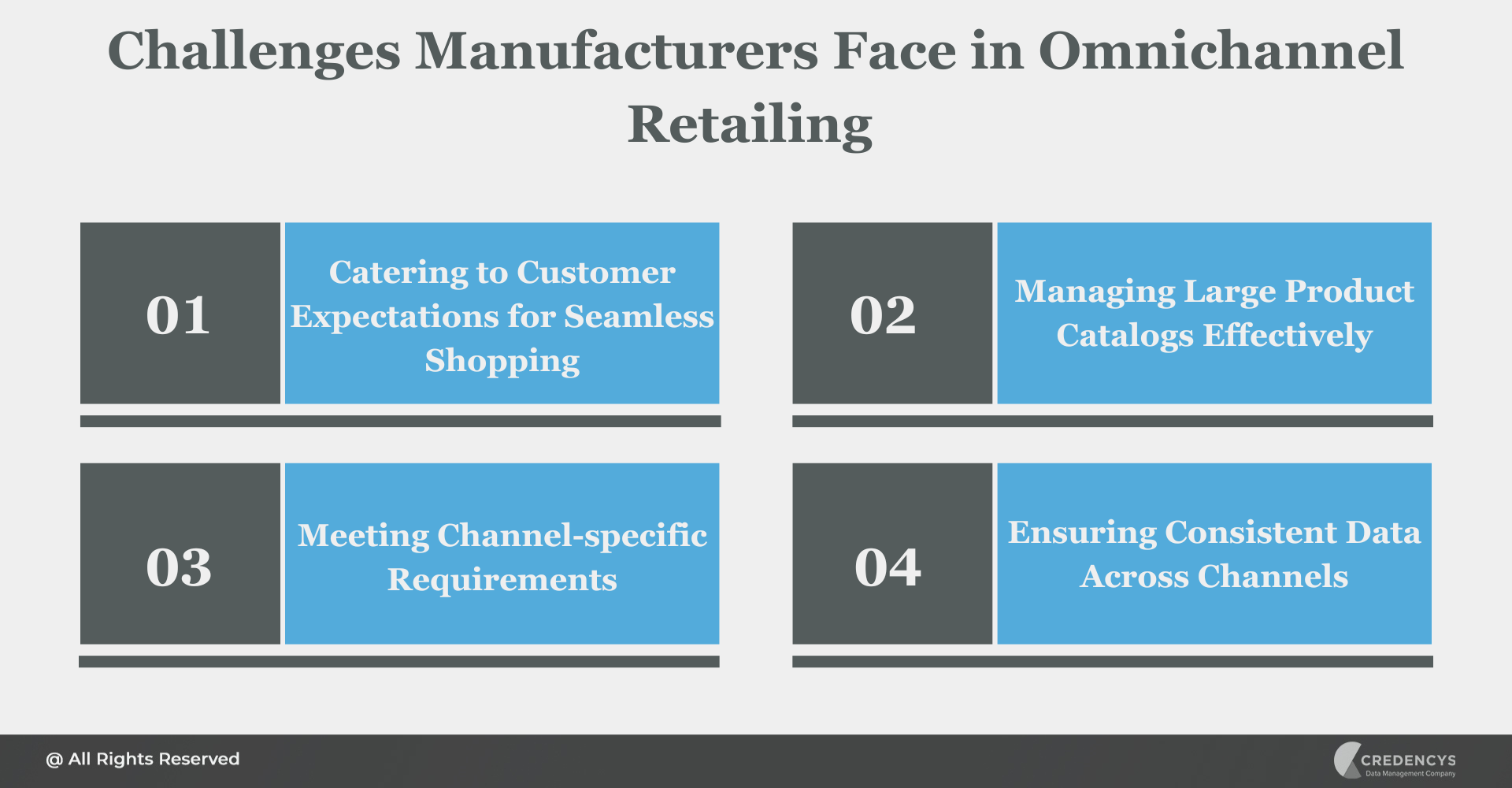
Challenges Manufacturers Face in Omnichannel Retailing

Omnichannel retailing offers immense opportunities but is fraught with challenges that manufacturers must address:

1. Catering to Customer Expectations for Seamless Shopping

Customers demand consistent product information, whether they browse on a mobile app, check details in a physical store, or compare options on an eCommerce platform. A lack of uniformity in product data often leads to frustration and lost sales.

2. Managing Large Product Catalogs Effectively

Manufacturers often handle thousands of SKUs with detailed specifications, images, and attributes. Organizing and updating this vast volume of data without errors becomes overwhelming, especially without a centralized system.

3. Meeting Channel-specific Requirements

Each sales channel – whether an eCommerce platform, marketplace, or retail partner has unique data formats, structures, and standards. Adapting to these requirements manually is time-consuming and prone to errors.

4. Ensuring Consistent Data Across Channels

Keeping product data accurate and uniform on multiple platforms is challenging. Discrepancies such as outdated pricing or mismatched descriptions can confuse customers and damage brand credibility.

Challenges Manufacturers Face in Omnichannel Retailing

Addressing these challenges is critical to thriving in an omnichannel retail environment, and this is where PIM systems shine.

Role of PIM in Omnichannel Success

PIM plays a pivotal role in helping manufacturers navigate the complexities of omnichannel retailing. Here’s how it contributes to success:

1. Faster Product Launches and Updates

By centralizing and automating data processes, PIM significantly reduces the time required to launch new products or update existing ones across all platforms. This agility is essential for staying competitive in a fast-paced market.

2. Centralized Product Data Management

PIM consolidates all product-related information into a single, unified system. This eliminates data silos, making it easier to manage and update information consistently across channels.

3. Streamlined Data Distribution

With PIM, manufacturers can automate product data distribution to multiple channels. The system ensures compliance with platform-specific requirements, reducing manual intervention and errors.

4. Consistency and Reliability

PIM ensures that every channel presents accurate, up-to-date, and consistent product information. This not only improves customer trust but also strengthens the brand’s reputation.

With these capabilities, PIM systems empower manufacturers to deliver a cohesive omnichannel experience while improving operational efficiency.

Key Features of PIM for Omnichannel Retailing

A robust PIM solution offers several essential features that cater to the unique needs of omnichannel retailing:

1. Scalability to Manage Extensive Catalogs

Whether a manufacturer deals with hundreds or thousands of SKUs, PIM systems are built to seamlessly handle large volumes of data. This scalability makes it easier to expand product lines without compromising data quality.

2. Multi-channel Syndication

PIM lets manufacturers distribute product information across diverse platforms, such as eCommerce websites, marketplaces, and physical retail systems. The system ensures each channel receives the required format and attributes without manual rework.

3. Real-time Data Updates and Analytics

PIM systems provide tools to monitor product data performance and make instant updates. Whether correcting an error or introducing a promotion, manufacturers can ensure accurate and timely information.

4. Localization and Translation Support

Manufacturers targeting global markets benefit from PIM’s ability to adapt product data for different regions. This includes translating descriptions, adjusting measurements, and adhering to local regulations.

Key Features of PIM for Omnichannel Retailing

These features make PIM a cornerstone for manufacturers looking to streamline their omnichannel retail operations.

Benefits of Using PIM for Manufacturers

PIM systems offer transformative benefits that directly address the pain points of omnichannel retailing:

1. Operational Efficiency and Cost Savings

Manufacturers reduce the time and resources spent on manual processes by centralizing and automating product data management. This frees up teams to focus on strategic initiatives rather than repetitive tasks.

2. Flexibility to Adapt and Scale

PIM provides manufacturers the tools to quickly adapt to new channels, market trends, or customer demands. It also allows for efficient scaling as product catalogs and channel requirements grow.

3. Enhanced Customer Experience

Customers enjoy seamless and consistent experiences across all touchpoints. With accurate descriptions, high-quality images, and detailed specifications, they can make informed purchase decisions, building trust in the brand.

4. Improved Competitive Positioning

Manufacturers who use PIM can consistently meet customer expectations and ensure uniformity across all platforms, giving them a significant advantage over competitors who struggle with fragmented data management.

By leveraging these benefits, manufacturers can position themselves as leaders in the omnichannel retail space.

Conclusion

Manufacturers must prioritize accurate and consistent product data in omnichannel retailing to meet customer expectations and stay competitive. PIM systems play a critical role in overcoming challenges like data silos, inconsistent information, and channel-specific complexities.

By centralizing product information, automating syndication, and ensuring consistency across all touchpoints, PIM empowers manufacturers to deliver seamless omnichannel experiences. Beyond operational efficiency, it also enhances customer trust, drives scalability, and provides a significant competitive edge in today’s dynamic market.

Adopting a PIM solution is not just an option for manufacturers aiming to thrive in an omnichannel landscape but a strategic necessity. Now is the time to explore how PIM can transform your operations and elevate your customer experience.

Mastering Catalog Management: Challenges, Solutions, and Winning Strategies

Did you know that businesses spend up to 30% of their time handling product-related data errors?

In a world dominated by e-commerce and omnichannel retail, efficient catalog management is more critical than ever. A well-structured product catalog not only enhances customer experience but also boosts operational efficiency and revenue.

This blog explores the essentials of catalog management, common challenges, tools to overcome them, and how to create winning strategies to keep your business competitive.

What Is Catalog Management?

Catalog management is the process of creating, organizing, maintaining, and distributing product information across all platforms and channels where products are sold. This includes e-commerce websites, marketplaces, mobile apps, physical stores, and marketing materials.

Key Components of a Product Catalog

A comprehensive product catalog should include the following:

  • Product Information:

    • Details such as product name, SKU, description, dimensions, weight, materials, and technical specifications.
    • Enhanced product storytelling to improve engagement.
  • Visual Assets:

    • High-quality product images, videos, and 360-degree views.
    • Consistency in style and branding for a professional look.
  • Pricing and Discount Information:

    • Accurate pricing, promotional details, and bundle offers.
    • Dynamic pricing models to reflect real-time changes.
  • Categorization and Taxonomy:

    • Logical grouping of products into categories and subcategories.
    • Use of attributes (e.g., color, size, material) for enhanced search and filtering.
  • Inventory and Availability:

    • Real-time stock updates to reflect current inventory levels.
    • Integration with supply chain systems to avoid overselling.
  • Regulatory and Compliance Information:

    • Region-specific labeling, safety warnings, or eco-certifications.
    • Adherence to local laws for global product distribution.

The Importance of Catalog Management in a Competitive Market

Did you know that 42% of shoppers abandon a purchase due to insufficient product information?

As the digital economy grows, managing product catalogs efficiently has become a vital part of e-commerce success. Customers expect clear, detailed, and consistent product data across all touchpoints. Failing to meet these expectations can result in lost sales, poor customer experiences, and operational inefficiencies.

The surge in omnichannel retailing and global e-commerce demands a robust approach to catalog management.

Benefits of Effective Catalog Management

Effective catalog management is a game-changer for businesses, providing a strong foundation for improved operations, customer satisfaction, and revenue growth. Here’s an in-depth look at the key benefits:

1. Enhanced Customer Experience

When customers can quickly find accurate and detailed product information, their shopping journey becomes more seamless and enjoyable. A well-maintained catalog offers:

  • Comprehensive Product Descriptions: Reduces confusion and builds buyer confidence.
  • High-Quality Visuals: Engages customers and helps them make informed purchasing decisions.
  • Personalized Experiences: Customizable catalogs cater to specific customer segments or regions, ensuring relevance and higher satisfaction.

2. Boosted Sales and Conversions

Accurate and compelling product data directly influences purchasing decisions. Catalog management can help achieve:

  • Higher Conversion Rates: Enriched and detailed product content leads to more confident purchases.
  • Reduced Cart Abandonment: Clear pricing and product details minimize last-minute hesitation.
  • Cross-Selling Opportunities: Well-organized catalogs highlight complementary products, increasing average order value.

3. Improved Operational Efficiency

Managing product data efficiently reduces manual errors and streamlines workflows, leading to:

  • Faster Product Launches: A centralized system ensures new products are listed quickly across channels.
  • Time Savings: Automation eliminates repetitive tasks, freeing up resources for strategic initiatives.
  • Seamless Collaboration: Teams across departments can access and update catalog data effortlessly.

4. Faster Time-to-Market

In competitive industries, speed is crucial. Effective catalog management:

  • Simplifies the process of updating product details across platforms.
  • Ensures timely launches for seasonal promotions or new product lines.
  • Adapts easily to the needs of various sales channels.

5. Consistency Across Channels

Maintaining consistent product information across all sales and marketing channels avoids confusion and enhances brand credibility. Benefits include:

  • Stronger Brand Image: Uniformity reinforces trust among customers.
  • Reduced Errors: Centralized catalog systems prevent discrepancies in pricing or specifications.

6. Cost Reduction and ROI Optimization

By reducing manual labor and operational inefficiencies, catalog management lowers costs. The results:

  • Fewer Returns: Accurate descriptions and visuals reduce the likelihood of mismatched customer expectations.
  • Higher ROI: Better management of product data leads to increased sales and customer retention.

Challenges of Product Catalog Management

Despite its importance, catalog management is often fraught with challenges that businesses must overcome to stay competitive. Here are some of the most pressing issues:

1. Managing Large Volumes of Data

As businesses grow, the number of products and variations increases exponentially. Challenges include:

  • Data Overload: Handling thousands of SKUs with diverse attributes can overwhelm systems and teams.
  • Complex Variants: Managing different sizes, colors, materials, or regional preferences adds layers of complexity.

2. Data Silos Across Departments

Disconnected systems and processes result in fragmented data. This can lead to:

  • Inconsistent Information: Variations in product details across platforms damage customer trust.
  • Inefficient Collaboration: Teams struggle to access and update information, causing delays.

3. Lack of Automation

Manual processes are prone to human error and inefficiencies. Businesses face:

  • Slow Updates: Delays in making changes to product catalogs across multiple channels.
  • Higher Error Rates: Typographical errors, missed updates, or incorrect details.

4. Omnichannel Complexity

With the rise of e-commerce, marketplaces, and social media, businesses must manage product data across multiple platforms. Challenges include:

  • Inconsistent Display: Variations in how product information is presented on different channels.
  • Integration Difficulties: Connecting legacy systems to modern platforms can be costly and time-consuming.

5. Regulatory and Compliance Requirements

Global markets require adherence to specific laws and standards, such as:

  • Product Labeling Laws: Region-specific requirements for health, safety, or environmental information.
  • Data Privacy Regulations: Ensuring compliance with standards like GDPR or CCPA when collecting customer data.

6. Scalability Issues

As businesses expand into new markets or add product lines, their catalog systems may not keep up. Issues include:

  • Limited Infrastructure: Outdated tools or systems unable to handle growth.
  • Resource Constraints: Insufficient staff or expertise to manage increasingly complex catalogs.

7. Customer Expectations for Rich Content

Modern customers expect engaging and interactive content, such as:

  • High-resolution images, videos, and 360-degree product views.
  • Comprehensive and tailored product details for informed decision-making.

PIM Solutions to Consider for Product Catalog Management 

When it comes to catalog management, choosing the right tool is crucial. Below are three powerful tools businesses can use to streamline their catalog management processes:

1. Pimcore

  • Features:
    • Open-source platform with product data management (PDM) and PIM capabilities.
    • Integrates Digital Asset Management (DAM) for centralized media storage.
    • Offers multi-channel publishing and workflow automation.
  • Pros:
    • Highly flexible and customizable.
    • Cost-effective due to its open-source nature.
    • Combines PIM, DAM, and CMS (Content Management System) in one platform.

2. Syndigo

  • Features:
    • Real-time content syndication across multiple channels and partners.
    • Advanced analytics for monitoring content performance.
    • Supports enriched content like videos, 3D product models, and interactive assets.
  • Pros:
    • Excellent for large enterprises with complex omnichannel needs.
    • Ensures compliance with global standards and marketplace requirements.
    • Streamlines collaboration with retailers and suppliers.

3. Semarchy xDM

  • Features:
    • Unified platform for master data management (MDM) and PIM.
    • AI-powered data quality and governance features.
    • Real-time collaboration and integration with third-party systems.
  • Pros:
    • Scalable and adaptable for businesses of all sizes.
    • Strong focus on data quality and compliance.
    • Intuitive user interface for ease of use.

Transform Catalog Management into a Competitive Advantage

Catalog management is no longer just a back-end operation—it’s a strategic driver of business success. By adopting best practices, leveraging the right tools, and learning from industry success stories, businesses can streamline their operations, enhance customer experiences, and scale efficiently.

Invest in smart catalog management today and unlock the full potential of your product data. Whether you’re a growing SMB or a global enterprise, the right strategies and tools can transform catalog management into a competitive edge.

How AI & ML in PIM are Changing the Game in Product Data Management

PIM has become crucial for businesses handling large volumes of product data. Whether its ensuring product details are accurate across channels or improving the customer experience, PIM plays an essential role.

Now, with the rise of Artificial Intelligence (AI) and Machine Learning (ML), PIM systems are evolving beyond traditional methods. AI and ML offer powerful tools for data-driven decision-making, helping businesses improve efficiency, accuracy, and speed.

This blog explores how these technologies are transforming PIM and the potential they hold for the future.

Role of AI and ML in PIM

AI and ML are reshaping the PIM landscape by addressing long-standing challenges. These technologies allow companies to manage massive data volumes with greater precision, reducing manual efforts and errors.

AI automates repetitive tasks, while ML learns from data to optimize future processes. Together, they create smarter PIM solutions that adapt to business needs, ensuring data quality, consistency, and relevancy across platforms.

Key Applications of AI and ML in PIM

1. Personalized Content Recommendations

With ML, PIM systems can personalize product content based on user behavior and preferences. By analyzing customer interactions, PIM platforms can recommend relevant products and content, enhancing the customer experience and increasing conversion rates.

2. Data Cleansing and Enrichment

Managing product data often involves dealing with inaccuracies and missing information. AI can automatically identify and correct inconsistencies, enriching data by filling gaps and ensuring uniformity across all product records.

This improves data reliability, which is essential for a positive customer experience.

What is Data Cleansing – From Chaos to Clarity

3. Improved Product Search and Filtering

AI-powered search and filtering capabilities can interpret customer intent more accurately, making it easier for users to find the products they want. By understanding context, synonyms, and related terms, AI-enabled PIM systems provide smarter search results that align closely with customer needs, enhancing satisfaction and reducing bounce rates.

4. Predictive Analytics for Inventory and Demand Forecasting

AI and ML bring predictive analytics to PIM, allowing businesses to forecast demand with higher accuracy. Machine learning algorithms analyze historical data and market trends to predict which products will be in demand.

This enables better inventory planning, reducing stockouts and overstock situations that could impact sales and profitability.

5. Automated Product Categorization and Tagging

AI and ML make it easier to categorize and tag products correctly by analyzing patterns and understanding product features. Machine learning algorithms can automatically assign categories and tags, allowing customers to find products more easily.

This process minimizes the time and effort required for manual categorization, making it faster to get products to market.

Key Applications of AI and ML in PIM

Benefits of Integrating AI and ML in PIM

Implementing AI and ML within a PIM system brings several advantages:

1. Enhanced Data Quality and Consistency

AI-driven automation ensures that product information is accurate and consistent across all channels, minimizing discrepancies that could lead to customer dissatisfaction.

What is Data Quality – Everything Businesses Need to Know

2. Reduced Manual Effort and Human Error

Automating data management tasks means less reliance on manual processes, which helps avoid errors and allows teams to focus on more strategic activities.

3. Faster Time-to-Market

With AI handling tasks like categorization and data cleansing, new products can be launched more quickly and seamlessly across multiple channels, giving companies a competitive edge.

4. Improved Customer Experience

Accurate and relevant product information helps customers make informed decisions, leading to higher satisfaction and loyalty. Additionally, personalized content and smart search functions create a more engaging shopping experience.

Challenges in Implementing AI and ML in PIM

While the benefits of AI and ML in PIM are clear, there are also challenges to consider:

1. Data Privacy and Security

AI-driven PIM solutions require access to vast amounts of data, raising concerns about data privacy and security. Ensuring compliance with data protection regulations is critical.

2. High-Quality Data for Training Models

AI and ML algorithms need high-quality data to be effective. Poor data quality can lead to inaccurate insights, limiting the value of these technologies in PIM.

3. Integration with Legacy Systems

Many companies have legacy systems that may not easily integrate with AI-powered PIM solutions. Transitioning to AI-based PIM requires careful planning to ensure compatibility and minimize disruption.

Challenges in Implementing AI and ML in PIM

Future Trends of AI and ML in PIM

The future of AI and ML in PIM is promising, with several emerging trends:

1. Adaptive Learning for Continuous Improvement

Machine learning models in PIM will become more adaptive, continuously learning from data to improve the accuracy of processes like categorization, tagging, and personalization.

2. Real-Time Personalization

As AI capabilities advance, PIM systems will be able to offer real-time personalization, delivering highly relevant content and recommendations based on up-to-the-moment user behavior.

3. Autonomous Data Management

The ultimate goal for AI in PIM is autonomous data management, where the system can make data-driven decisions independently, freeing up human resources for other business-critical tasks.

Conclusion

The rise of AI and ML in PIM represents a major shift in how businesses manage and use product data. By enhancing data accuracy, streamlining processes, and improving customer experience, these technologies are helping companies achieve new levels of efficiency and effectiveness.

As AI and ML continue to evolve, adopting an AI-powered PIM solution can be a strategic move for businesses looking to stay competitive. Investing in these advanced capabilities today can ensure long-term success in a rapidly changing digital landscape.