

The Scale and Complexity of Catalog Production
Catalog production requires product data, pricing, images, specifications, translations, layouts, and approvals to come together at the right time. As product portfolios, markets, and catalog versions expand, disconnected data sources and manual publishing processes make every catalog more difficult and expensive to produce.
Fragmented Product Data and Assets
Product information may come from ERP, spreadsheets, PIM, DAM, databases, and business teams, while images and documents are stored separately, forcing catalog teams to collect and reconcile content before layout begins.
Manual Data-to-Design Processes
Designers often spend time copying product descriptions, specifications, tables, prices, and images into layout files instead of focusing on catalog design and merchandising.
Last-Minute Product Changes
Specifications, prices, product availability, images, and descriptions may change after catalog layout has started, creating repeated corrections and increasing the risk of publishing outdated information.
Multiple Catalog Versions
Different countries, languages, currencies, customer groups, product lines, and price structures can require separate catalog versions that become difficult to maintain manually.
Complex Review and Approval Cycles
Product, marketing, sales, design, localization, and regional teams may all participate in catalog production. Without structured workflows, reviews happen through spreadsheets, PDFs, emails, and disconnected feedback loops.

How Much is Your Product Data Costing You?
Get Your Score + 90-day action plan in 3 minutes.
Check Your ScoreThe Strategic Role of PIM in Catalog Production
PIM gives catalog teams a governed product-data foundation for creating print catalogs, digital catalogs, price lists, brochures, datasheets, technical documents, and other product publications. It connects approved product information and digital assets with publishing workflows, helping organizations reduce manual production effort, manage catalog versions, and publish accurate product content faster.
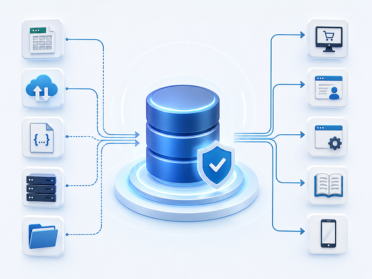
The Single Source of Truth
PIM centralizes product descriptions, specifications, attributes, pricing references, product relationships, images, documents, and other catalog content in one governed product-information layer. It enables product, marketing, sales, design, and publishing teams to work from consistent information.
- Consolidate product data from ERP, spreadsheets, databases, and legacy systems
- Reduce duplicate and conflicting catalog content
- Maintain approved information across products, markets, and publications

Catalog-Ready Product Information
Raw product data is rarely ready to move directly into a catalog. PIM structures, enriches, and validates product information according to the requirements of each product category and publication type.
- Define mandatory attributes for catalog publication
- Standardize descriptions, specifications, values, and units
- Apply completeness and validation rules before products enter production

Automated Data-to-Design Workflows
PIM can connect approved product information with catalog-publishing technologies and layout tools such as Adobe InDesign. Instead of manually copying data into layouts, structured product information and assets can populate predefined templates automatically or semi-automatically.
- Connect product information with InDesign and catalog automation tools
- Populate tables, specifications, descriptions, and images from governed data
- Refresh catalog content when approved product information changes
- Reduce repetitive manual page-building work

Catalog Versioning and Localization
Organizations often need multiple versions of the same catalog for languages, markets, currencies, price structures, brands, product ranges, or customer segments. PIM separates governed product content from presentation so information can be reused across multiple publications.
- Manage multilingual and market-specific content
- Support regional product assortments and publication rules
- Generate catalogs with different prices, currencies, and product selections
- Reuse approved product information without rebuilding each version manually

Print and Digital Publishing Consistency
The same product information may be required across printed catalogs, PDFs, price books, datasheets, eCommerce, dealer portals, and digital catalogs. PIM creates a shared product-data foundation, so publication teams do not maintain separate copies for every output.
- Generate print and digital product publications
- Connect approved images and media through DAM
- Maintain consistency between catalogs and digital channels
- Reuse product content across brochures, price lists, datasheets, and sales materials
Our Approach to PIM Implementation Services
From initial assessment to publishing automation, we follow a proven four-step process to deliver a scalable PIM solution aligned with your product-data, catalog-production, design, and publishing requirements.
01
Assessment and Planning
Analyze your catalog-production process, product-data sources, publication types, design workflows, templates, digital assets, systems, teams, and output requirements to define a clear PIM implementation roadmap.
02
Customization and Configuration
Design the product-data model, catalog attributes, categories, publication rules, templates, workflows, user roles, localization structures, DAM relationships, and publishing integrations required for your environment.
03
Enrichment and Workflow Automation
Cleanse and migrate existing product information, establish catalog-readiness rules, connect digital assets, and configure enrichment, validation, review, approval, and automated publishing workflows.
04
Deployment and Training
Integrate PIM with publishing and enterprise systems, launch priority catalog workflows, train product and publishing teams, monitor adoption, and provide ongoing post-deployment support.
Business Impact of PIM for Catalog Production
PIM transforms catalog production from a repetitive manual process into a governed, data-driven publishing workflow. It reduces production effort, improves accuracy, accelerates revisions, and enables organizations to create more publications without proportionally increasing design and catalog-management resources.



Ready to Automate Your Catalog Production?
Build a trusted product-data foundation that connects product information, digital assets, publishing workflows, and design tools—so your teams can create accurate catalogs faster without repeating the same manual work for every publication.
Book a Free ConsultationWhy Leading Enterprises Choose Credencys?
Credencys helps enterprises turn complex data into trusted insights, intelligent operations, and measurable business growth. Here’s what makes us a preferred data and AI partner:

End-to-End Data Expertise
From data strategy to AI deployment, we cover the entire spectrum—Data Management, Engineering, Insights, and Intelligence—to ensure your data drives measurable business outcomes.

Domain-Focused Solutions
Whether you're in retail, automotive, or manufacturing, our purpose-built platforms solve industry-specific challenges with precision and speed.

Enterprise-Grade Partnerships
We collaborate with the best in the business to deliver future-ready, scalable, and secure solutions.

AI-First
We help you move beyond dashboards—accelerating AI readiness, deploying GenAI and enterprise AI agents, and enabling intelligent automation across your data ecosystem.
50+
Enterprise Clients
100%
Certified Consultants
15+
Years Experience
4.9/5
Client Satisfaction
We Build PIM Solutions for


Frequently Asked Questions
PIM for Catalog Production is a centralized approach to managing the product information and digital content required to create catalogs, price lists, datasheets, brochures, technical publications, and other product materials. It enables organizations to structure, enrich, validate, approve, and reuse product information across print and digital publishing workflows.
PIM stores approved product information in a structured format and connects that data with catalog-production tools and predefined publication templates. Product descriptions, specifications, images, tables, prices, and other information can then be populated into layouts automatically or semi-automatically instead of being copied manually from spreadsheets and other systems.
Yes. PIM can integrate with Adobe InDesign through connectors, plugins, APIs, IDML-based workflows, publishing platforms, or catalog-automation technologies.
No. PIM manages and governs the product information used in the publication. Adobe InDesign remains a design and layout environment where creative teams control the visual presentation of the catalog.
Yes. The same governed product-data foundation can support printed catalogs, print-ready PDFs, digital catalogs, brochures, price lists, datasheets, technical documents, websites, and other product channels.
Trusted by Best
Choosing Credencys means partnering with a team that’s deeply committed to unlocking the true value of your data. Here’s why industry leaders trust us:
Our Valued Clientele


Send us a Message
