Leveraging PIM for Efficient Data Syndication Across Automotive Channels

The global automotive aftermarket industry loses approximately $1 billion annually due to issues related to inaccurate or inconsistent product information, such as incorrect parts data, which leads to increased returns, warranty claims, and customer dissatisfaction.

Inefficient data syndication across channels contributes significantly to these losses by causing errors in product listings and compatibility issues, resulting in lost sales opportunities and damaged brand reputation.

With the proliferation of digital touchpoints, automotive companies are challenged by managing vast amounts of product data while ensuring that it is correctly syndicated across all platforms.

So, grab a coffee and explore how Product Information Management (PIM) helps manage and syndicate automotive parts data.

The Challenge of Automotive Parts Data Syndication

The automotive industry is unique in its complexity. Its extensive range of products includes minute components and large assemblies. Each part has specific attributes, compliance requirements, and fitment details that must be meticulously managed.

The challenge is exacerbated when considering the various sales channels—both online and offline—where this data must be consistently accurate. Some key challenges include:

  • Vast Product Range: Managing an extensive range of products, from small components to large assemblies.
  • Detailed Specifications: Each part has unique attributes, compliance requirements, and fitment details that require precise management.
  • Multiple Sales Channels: Ensuring consistent and accurate data across various sales channels, both online and offline.

According to a report by Frost & Sullivan, the global automotive aftermarket is expected to reach $529.25 billion by 2026, driven by the growing demand for replacement parts and accessories.

This growth underscores the importance of efficient data syndication, as any discrepancies in product information can lead to significant operational inefficiencies, customer dissatisfaction, and, ultimately, lost sales.

The Role of PIM in Automotive Data Syndication

A robust PIM system is essential for automotive companies to manage and distribute product information efficiently. PIM centralizes all product data, ensuring consistency, accuracy, and up-to-date across all channels. This centralization is particularly crucial in the automotive industry, where the precision of information—such as part numbers, fitment data, and compliance details—is non-negotiable.

Streamlining Data Management

A study by Forrester found that businesses using PIM systems reported a 20% increase in operational efficiency and a 15% reduction in time-to-market for new products.

These improvements are crucial in the highly competitive automotive industry, where speed and accuracy can be the difference between winning and losing a sale. PIM enables automotive companies to:

  • Centralize Product Information: Create a single source of truth for all product data, simplifying management.
  • Manage Complex Catalogs: Handle extensive product hierarchies and thousands of SKUs easily.
  • Ensure Real-Time Updates: Reflect changes across every channel instantly, maintaining accuracy.

Enhancing Data Syndication Across Channels

One of the most significant advantages of PIM implementation for the automotive industry is its ability to enhance data syndication across multiple channels. Whether it’s e-commerce platforms, brick-and-mortar stores, or B2B portals, PIM ensures that product data is:

  • Consistent: Maintaining uniformity across all channels.
  • Tailored: Customizing information to meet the specific requirements of each platform.
  • Error-Free: Reducing the risk of inaccuracies and ensuring correct presentation to consumers.

For example, different e-commerce platforms may have varying requirements for product descriptions, images, and technical specifications. A PIM system can automatically:

  • Format Data: Adjust product data according to the guidelines of each platform.
  • Syndicate Information: Distribute this tailored data accurately across channels.

According to a study by Statista, 74% of global automotive parts buyers prefer to research and purchase parts online.

This trend highlights the importance of having accurate and consistent product information across digital channels, which can significantly influence purchasing decisions.

Real-World Impact: How PIM Transforms Automotive Data Syndication

A US-based automotive parts manufacturer with a vast catalog of over 50,000 SKUs faced significant challenges in maintaining accurate product information across its various sales channels. Inconsistent data led to frequent customer complaints, increased returns, and lost sales opportunities.

By implementing a PIM solution, the manufacturer could centralize its product information, streamline its data management processes, and automate the syndication of this data across all channels. As a result, the company saw a

  • 30% reduction in product returns
  • 25% increase in customer satisfaction
  • Significant improvement in sales performance

Introducing DRIVE: A Comprehensive PIM Solution for the Aftermarket Industry

DRIVE by Credencys Solutions is a comprehensive Product Information Management (PIM) solution specifically designed for the automotive aftermarket industry. It centralizes and manages complex parts and fitment data, ensuring compliance with industry standards like ACES and PIES.

DRIVE streamlines catalog management, enabling real-time collaboration across the automotive supply chain and facilitating data syndication to retailers and marketplaces such as Amazon and eBay Motors. The platform offers enhanced data onboarding, parts enrichment, and global data management, resulting in faster time-to-market and higher efficiency.

The Future of Automotive Parts Data Syndication

As the automotive industry continues to evolve, the need for efficient data management and syndication will only grow. With the rise of electric vehicles, autonomous driving technologies, and the increasing complexity of automotive parts, the demand for accurate, consistent, and timely product information will be more critical than ever.

PIM systems will play a pivotal role in meeting this demand, enabling automotive companies to stay competitive in a rapidly changing market. By leveraging PIM for automotive parts data syndication, companies can improve their operational efficiency, enhance customer satisfaction, and drive sales growth. Connect with our experts to learn more about the benefits of PIM for the automotive industry.

Managing Product Data in the Auto Parts Industry: A Deep Dive into ACES and PIES

The automotive aftermarket industry is a dynamic sector, encompassing all parts and services purchased for vehicles after the original sale.

According to recent reports, the global automotive aftermarket is expected to reach $1.4 trillion by 2027.

This growth is driven by

  • Increasing vehicle age
  • Technological advancements, and
  • Rising demand for customization and performance upgrades.

With this exponential growth comes the challenge of managing an ever-expanding array of products and their associated data. Accurate and consistent product information is essential for aftermarket businesses to enhance customer satisfaction and comply with industry standards.

This is where ACES (Aftermarket Catalog Exchange Standard) and PIES (Product Information Exchange Standard) come into play. Developed by the Auto Care Association, these standards provide a structured framework for exchanging product information across various channels, ensuring consistency, accuracy, and efficiency.

However, managing ACES and PIES data can be complex and resource-intensive, especially for businesses dealing with a vast product portfolio. Integrating a robust PIM system tailored for ACES PIES compliance can streamline these processes, reduce errors, and enhance overall operational efficiency.

Let’s dive deeper into understanding ACES and PIES, the challenges involved in managing them, and how integrating them with a PIM system can redefine product data management in the automotive aftermarket industry.

Understanding ACES and PIES

ACES (Aftermarket Catalog Exchange Standard) and PIES (Product Information Exchange Standard) are the backbone of product data communication in the automotive aftermarket industry. They serve as standardized formats for exchanging information between manufacturers, distributors, retailers, and other stakeholders, ensuring that everyone speaks the same language when it comes to product data.

Example Scenario:

An auto aftermarket manufacturer produces a new type of brake pad compatible with multiple vehicle models. Comprehensive and standardized information must be shared to ensure that distributors and retailers accurately list and sell this product. Here’s how ACES and PIES facilitate this process:

  • ACES would provide the application data detailing which vehicles the brake pad fits. This includes year, make, model, and other relevant vehicle attributes.
  • PIES would offer detailed product information such as part numbers, descriptions, dimensions, pricing, images, and other marketing data.

By utilizing ACES and PIES standards, the manufacturer ensures that all downstream partners have accurate and consistent information, reducing the risk of errors, returns, and customer dissatisfaction.

What is ACES?

ACES (Aftermarket Catalog Exchange Standard) is the North American industry standard for communicating product fitment data in the automotive aftermarket. Developed by the Auto Care Association, it provides a standardized format for conveying which vehicle’s specific parts and accessories are compatible, ensuring precise and consistent application data across the supply chain.

ACES

Critical Components of ACES:

  1. Vehicle Configuration Database (VCdb):
    • A comprehensive database that contains standardized vehicle information, including year, make, model, engine types, and other relevant attributes.
    • Ensures uniformity in vehicle descriptions, reducing ambiguity and errors in product listings.
  2. Product Classification Database (PCdb):
    • Categorizes products into standardized classes, facilitating more accessible organization and retrieval of product information.
  3. Qualifier Database (Qdb):
    • Provides additional details or conditions related to product fitments, such as specific trim levels or optional equipment requirements.

A company manufactures a headlight assembly suitable for multiple versions of the Ford F-150. Using ACES, the manufacturer can accurately specify all compatible models, including variations in year, engine type, and trim level. Distributors and retailers then receive this standardized data, ensuring that customers searching for a replacement headlight for their specific F-150 model find the correct product without confusion.

What is PIES?

PIES (Product Information Exchange Standard) complements ACES by providing a standardized format for communicating detailed product information in the automotive aftermarket industry. While ACES focuses on fitment data, PIES covers a product’s descriptive, pricing, and marketing aspects, ensuring comprehensive and consistent information across all channels.

PIES

Critical Components of PIES:

  1. Product Attributes:
    • Includes detailed specifications such as dimensions, weight, materials, and performance characteristics.
  2. Digital Assets:
    • Encompasses images, videos, technical documents, and other multimedia resources that support product marketing and customer understanding.
  3. Pricing and Packaging Information:
    • Details various pricing structures, packaging dimensions, and quantities.
  4. Marketing Descriptions:
    • Provides compelling product descriptions, features, benefits, and other marketing copy to enhance product appeal.

Let’s take an example, consider a company launching a new performance exhaust system. Using PIES, they can provide exhaustive details such as:

  • Product Specifications: Material type (e.g., stainless steel), dimensions, weight, and performance enhancements.
  • Digital Assets: High-resolution images from various angles, installation videos, and sound clips demonstrating the exhaust note.
  • Pricing Information: MSRP, dealer pricing, bulk purchase discounts, and packaging details.
  • Marketing Copy: Engaging descriptions highlighting the benefits, such as increased horsepower, improved fuel efficiency, and enhanced sound.

Challenges in Managing ACES and PIES for the Automotive Aftermarket Industry

While ACES and PIES standards significantly streamline product data management, implementing and maintaining these systems pose several challenges for businesses in the automotive aftermarket industry. Understanding these challenges is crucial for developing effective strategies to overcome them and achieve optimal ACES and PIES data management.

1. Complexity of Data Management

  • Vast and Diverse Product Range:
    • The automotive aftermarket comprises an extensive array of products, each with numerous specifications and fitment details. Managing and updating such a massive volume of data is inherently complex.
  • Frequent Updates and Changes:
    • Vehicle models and parts specifications continually evolve, requiring constant updates to ACES and PIES data to maintain accuracy and relevance.
  • Multiple Data Sources:
    • Data often originates from various sources, including manufacturers, suppliers, and internal databases, leading to inconsistencies and duplication if not managed properly.

2. Ensuring Data Accuracy and Consistency

  • Human Error:
    • Manual data entry and updates are prone to errors, leading to incorrect product listings, misfitments, and customer dissatisfaction.
  • Data Synchronization:
    • Ensuring that all stakeholders have access to the most current and consistent data across various platforms and systems is a significant challenge.
  • Standard Compliance:
    • Adhering strictly to ACES and PIES formatting and guidelines requires meticulous attention and expertise, which may be lacking in some organizations.

3. Resource Intensive Processes

  • Time Consumption:
    • Manually compiling, formatting, and updating ACES and PIES data is a time-consuming process that can strain organizational resources.
  • Cost Implications:
    • Investing in dedicated personnel and infrastructure to manage these standards can be financially burdensome, especially for small to medium-sized enterprises.

4. Integration with Existing Systems

  • Compatibility Issues:
    • Integrating ACES and PIES data with existing ERP, CRM, and e-commerce systems can present technical challenges due to compatibility issues.
  • Data Migration:
    • Transferring existing product data into ACES and PIES formats requires careful planning and execution to prevent data loss and maintain continuity.

5. Keeping Up with Market Trends and Customer Expectations

  • Demand for Real-Time Information:
    • Customers and partners increasingly expect real-time, accurate product information, putting pressure on businesses to maintain up-to-date ACES and PIES data.
  • Evolving Market Dynamics:
    • Rapid technological advancements and changing market trends necessitate agile and responsive data management systems.

6. Training and Expertise

  • Knowledge Gap:
    • Properly implementing and managing ACES and PIES standards require specialized knowledge and expertise, which may not be readily available within the organization.
  • Ongoing Education:
    • Continuous training is essential to keep up with updates and changes in the standards, adding to the operational burden.

Impact of These Challenges

Failure to effectively manage ACES and PIES data can lead to several adverse outcomes, including:

  • Reduced Operational Efficiency: Inefficient data management processes can slow down operations and hinder business growth.
  • Increased Errors and Returns: Inaccurate or inconsistent data leads to incorrect orders, increased returns, and additional costs.
  • Damaged Reputation: Persistent data inaccuracies can erode customer trust and damage the company’s reputation.
  • Lost Sales Opportunities: Poorly managed product information can result in missed sales opportunities and reduced competitiveness in the market.

Addressing these challenges is critical for businesses aiming to thrive in the competitive automotive aftermarket industry. This is where integrating a robust PIM system for ACES PIES compliance becomes indispensable.

How PIM Helps Overcome These Challenges

Product Information Management (PIM) systems are designed to centralize, manage, and distribute product information efficiently and accurately. Integrating a PIM system specifically tailored for ACES PIES compliance can significantly alleviate the challenges associated with managing complex product data in the automotive aftermarket industry.

1. Centralized Data Management

  • Unified Repository:
    • PIM systems provide a single source of truth by consolidating all product information, including ACES and PIES data, into one centralized platform.
  • Streamlined Updates:
    • Any changes or updates to product information are made in one place and automatically propagated across all channels and platforms, ensuring consistency and accuracy.

2. Enhanced Data Accuracy and Consistency

  • Automated Validation:
    • PIM systems often include validation rules and checks that ensure all data complies with ACES and PIES standards, minimizing errors and discrepancies.
  • Reduction of Manual Errors:
    • Automation of data entry and updates significantly reduces the likelihood of human errors, leading to more reliable and accurate product information.

3. Improved Efficiency and Productivity

  • Time Savings:
    • Automating repetitive and time-consuming tasks allows teams to focus on more strategic activities, enhancing overall productivity.
  • Resource Optimization:
    • Efficient data management reduces the need for extensive manual labor and dedicated resources, leading to cost savings.

4. Seamless Integration with Existing Systems

  • Compatibility and Flexibility:
    • Modern PIM systems are designed to integrate seamlessly with various ERP, CRM, and e-commerce platforms, ensuring smooth data flow across the organization’s ecosystem.
  • Easy Data Migration:
    • PIM solutions facilitate the straightforward migration of existing product data into standardized ACES and PIES formats, minimizing disruption and data loss.

5. Real-Time Data Distribution

  • Instant Updates:
    • PIM systems enable real-time distribution of updated product information across all sales and marketing channels, meeting the market’s demand for up-to-date data.
  • Multi-Channel Support:
    • Efficiently manages and distributes product information across multiple channels, including online marketplaces, catalogs, and partner platforms.

6. Scalability and Adaptability

  • Handling Growing Product Lines:
    • PIM systems can easily scale to accommodate expanding product portfolios and evolving market demands without compromising performance.
  • Adapting to Market Trends:
    • Flexible and customizable, PIM solutions can adapt to new market trends and requirements, ensuring long-term relevance and effectiveness.

7. Improved Customer Experience

  • Comprehensive and Accurate Information:
    • Providing detailed, accurate, and consistent product information enhances customer confidence and facilitates informed purchasing decisions.
  • Faster Time-to-Market:
    • Streamlined data management processes enable quicker product launches and updates, giving businesses a competitive edge.

8. Analytics and Insights

  • Data-Driven Decisions:
    • PIM systems often include analytics tools that provide insights into product performance, customer preferences, and market trends, informing strategic decision-making.
  • Continuous Improvement:
    • Regular monitoring and analysis of product data help identify areas for improvement and optimize product offerings.

9. Regulatory Compliance

  • Adherence to Standards:
    • Ensures that all product information meets industry and legal standards, reducing the risk of non-compliance penalties and reputational damage.
  • Simplified Auditing:
    • Centralized and well-organized data facilitates easier auditing and verification processes.

Integrating a PIM system for ACES PIES integration transforms the complex and resource-intensive task of product data management into a streamlined, efficient, and accurate process. It empowers businesses to maintain high-quality product information, enhance operational efficiency, and deliver superior customer experiences, ultimately driving growth and competitiveness in the automotive aftermarket industry.

Introducing DRIVE: Simplifying ACES and PIES Data Management

DRIVE is a comprehensive product information management (PIM) solution explicitly tailored to the automotive aftermarket industry. Powered by Syndigo, it centralizes and streamlines data management, ensuring compliance with industry standards like ACES and PIES.

DRIVE excels at integrating data from various sources, such as PLM, ERP, and digital assets. It facilitates efficient catalog management and data syndication across multiple channels. This solution helps businesses enhance customer satisfaction, achieve faster ROI, and maintain up-to-date, accurate product information.

For more details, visit DRIVE by Credencys.

Ensuring Data Security and Compliance in Fashion Retail with PIM

In addition to creating and selling stylish products; fashion retail involves managing a vast amount of sensitive data. Fashion brands handle various types of information, including customer details, payment information, product specifications, and supply chain data.

This wealth of data makes them prime targets for cyberattacks and increases the complexity of complying with data protection regulations.

According to a 2023 report by IBM, the average data breach cost in the retail industry is $3.28 million, with customer personal data being the most compromised type of information.

Understanding Data Security and Compliance in Fashion Retail

Data security refers to the practices and technologies implemented to protect sensitive information from unauthorized access, breaches, and other cyber threats. This includes safeguarding customer data, payment details, product information, and operational data.

Conversely, compliance refers to adhering to legal and regulatory requirements that govern how data should be handled, processed, and protected. In fashion retail, compliance involves aligning with various regulations and standards to ensure data management practices meet legal and ethical standards.

Fashion brands must navigate several regulations and standards to ensure they meet data security and compliance requirements:

  • General Data Protection Regulation (GDPR)
  • California Consumer Privacy Act (CCPA)
  • Payment Card Industry Data Security Standard (PCI-DSS)
  • Children’s Online Privacy Protection Act (COPPA)
  • Health Insurance Portability and Accountability Act (HIPAA)

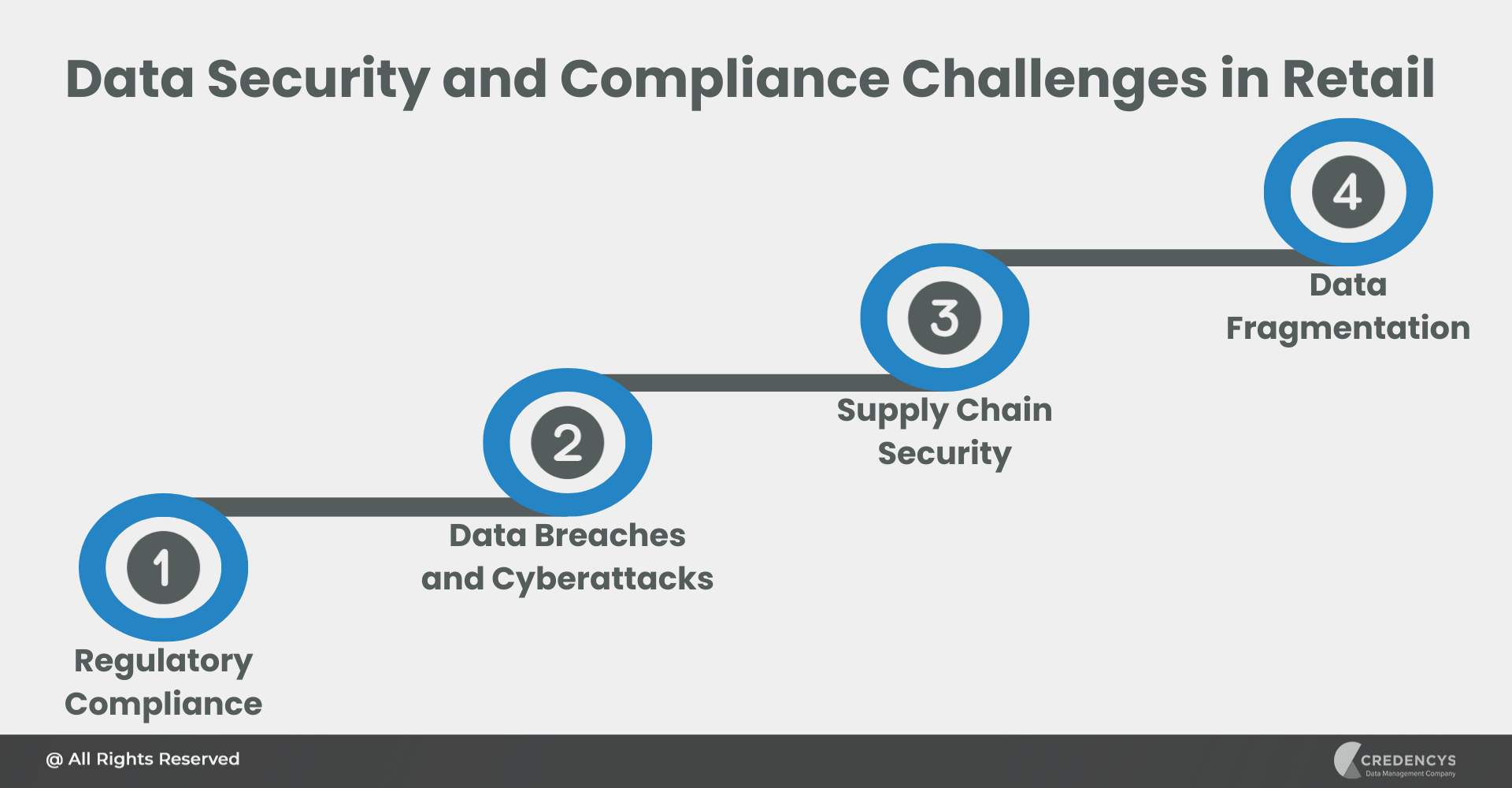
Data Security and Compliance Challenges

Fashion retailers face significant challenges when it comes to data security and compliance:

1. Regulatory Compliance

Fashion retailers must navigate a complex landscape of data protection regulations. Regulations such as the GDPR in Europe, the CCPA in the United States, and the Payment Card Industry Data Security Standard PCI-DSS impose strict requirements on how personal and payment data should be handled.

Non-compliance can lead to hefty fines and legal repercussions.

2. Data Breaches and Cyberattacks

The fashion industry is increasingly targeted by cybercriminals seeking to exploit vulnerabilities. Data breaches can result in the theft of sensitive customer information, such as payment details and personal identifiers.

This not only jeopardizes customer privacy but also exposes brands to financial losses and reputational damage.

3. Supply Chain Security

Fashion retail involves extensive supply chains that may include multiple vendors and partners. Ensuring that all parties comply with data security and privacy standards adds another layer of complexity.

Product Information Management for Supply Chain Empowers Suppliers

4. Data Fragmentation

Many fashion brands manage their data across multiple systems and platforms, leading to fragmented data repositories. This fragmentation complicates efforts to maintain consistent data security measures and ensures compliance with regulations.

Data Security and Compliance Challenges in Retail

Importance of Addressing These Challenges

Addressing data security and compliance challenges is crucial for fashion brands for several reasons:

1. Protecting Brand Reputation

A data breach or failure to comply with regulations can significantly damage a brand’s reputation. Customers are increasingly aware of data privacy issues and may lose trust in a brand that fails to protect their information. Maintaining robust data security practices helps safeguard the brand’s reputation and fosters customer loyalty.

2. Building Customer Trust

Consumers expect their personal and payment information to be secure. Demonstrating a commitment to data protection and compliance reassures customers that their data is handled responsibly, which can enhance customer trust and confidence.

3. Avoiding Financial Penalties

Regulatory bodies impose substantial fines for non-compliance with data protection laws. Investing in data security and compliance measures helps fashion brands avoid these financial penalties and mitigate the risk of legal action.

4. Ensuring Operational Continuity

Data breaches and compliance failures can disrupt business operations, leading to downtime and operational inefficiencies. A proactive approach to data security and compliance helps ensure smooth and uninterrupted operations.

By effectively managing data security and compliance challenges, fashion brands not only protect themselves from potential risks but also position themselves as trustworthy and reliable in the eyes of their customers. Implementing comprehensive solutions, such as PIM systems, can play a pivotal role in achieving these goals and ensuring long-term success.

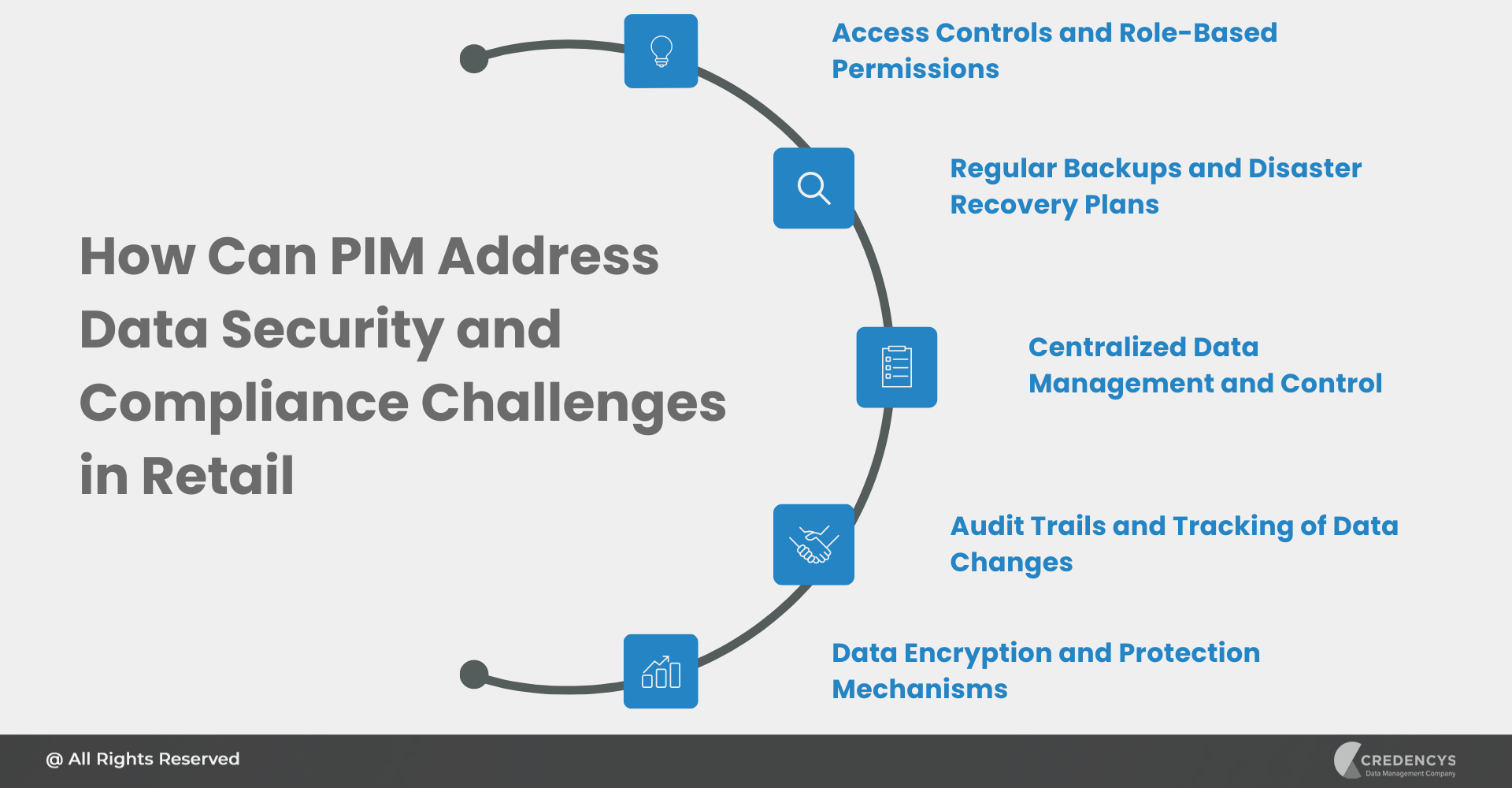
How Can PIM Address Data Security and Compliance Challenges in Retail

A PIM system can significantly improve data security in the fashion retail industry by providing a range of features that protect sensitive information and reduce the risk of data breaches. These features include:

1. Access Controls and Role-Based Permissions

PIM systems can implement granular access controls to ensure that only authorized individuals have access to sensitive data. Role-based permissions can be used to assign different levels of access to different users based on their job functions.

This helps to prevent unauthorized access and data breaches.

2. Regular Backups and Disaster Recovery Plans

Regular backups of product data are essential for data security and disaster recovery. PIM systems can be configured to automatically back up data to a secure location, ensuring that data can be restored in the event of a data loss or system failure.

3. Centralized Data Management and Control

A PIM system provides a centralized repository for all product information, making it easier to manage, protect, and control access to data. This centralized approach reduces the risk of data fragmentation and inconsistencies, which can make it more difficult to secure data.

4. Audit Trails and Tracking of Data Changes

PIM systems can track changes to product data, creating an audit trail that can be used to identify unauthorized access, data breaches, and other security incidents. This can help to investigate security incidents and take corrective action.

5. Data Encryption and Protection Mechanisms

PIM systems can encrypt sensitive data, such as customer information and financial details, to protect it from unauthorized access. Encryption algorithms can be used to scramble data, making it unreadable to anyone without the correct decryption key.

How Can PIM Address Data Security and Compliance Challenges in Retail

Final Thoughts

As the landscape of data security and compliance continues to evolve, fashion brands must stay informed about emerging trends and developments. This includes staying up to date on new regulations, best practices, and technological advancements.

Given the increasing importance of data security and compliance in the fashion industry, fashion brands must invest in a PIM solution. By adopting PIM, retailers can protect their brand reputation, customer trust, and financial performance.

Simplifying Supply Chain Management in CPG with MDM Solutions

The supply chain in the Consumer-Packaged Goods industry is inherently complex. With a wide range of products, frequent changes in demand, and numerous suppliers involved, managing the flow of information across these various touchpoints is challenging.

Around 60% of companies in the CPG industry report that poor data quality is a significant challenge in supply chain management, leading to inefficiencies and increased costs.

This complexity often leads to data fragmentation, inconsistencies, and duplication, all of which can disrupt the supply chain. Master Data Management provides a powerful solution to these challenges.

MDM centralizes and standardizes data across the supply chain, ensuring that all stakeholders are working with the same accurate and up-to-date information. CPG companies can reduce errors, enhance decision-making, and streamline operations, leading to a more efficient and resilient supply chain.

Challenges in CPG Supply Chain Management

Managing a CPG supply chain involves navigating numerous challenges, each tied to handling vast amounts of data. Understanding these challenges is key to improving efficiency and reliability in the supply chain.

1. Integration of Data Across Various Manufacturing Stages

  • Different Systems: Each manufacturing stage may use distinct systems and formats, complicating data integration and analysis.
  • Data Gaps: Integrating information from various stages can result in gaps or inconsistencies if not managed carefully.
  • Seamless Flow: Ensuring a smooth flow of data from raw material sourcing through production and quality control is crucial but difficult to achieve.

2. Managing Data from Multiple Suppliers

  • Diverse Data Sources: Suppliers often provide data in different formats and update schedules, making it challenging to consolidate and manage effectively.
  • Accuracy Issues: Outdated or incorrect information from suppliers can lead to discrepancies, affecting inventory and production schedules.
  • Coordination Challenges: Synchronizing data from multiple suppliers requires significant effort to ensure all information is current and reliable.

3. Issues with Data Consistency, Duplication, and Inaccuracies

  • Inconsistencies: Data inconsistencies arise when information from different sources does not align, leading to confusion and errors.
  • Duplicates: Duplicate data entries can occur when similar information is entered multiple times, causing redundancies and inefficiencies.
  • Manual Errors: Errors and outdated information often result from manual data entry, impacting the accuracy of the entire supply chain.

Challenges in CPG Supply Chain Management

How MDM Helps in Streamlining Supply Chain Management in CPG

MDM plays a crucial role in overcoming the data challenges in CPG supply chain management. By centralizing and standardizing data, MDM helps create a more efficient and connected supply chain, ensuring that all stakeholders have access to accurate, up-to-date information.

1. Ensuring Compliance with Supplier Requirements and Standards

  • Standardization of Data: MDM ensures that all supplier data is standardized according to predefined formats and compliance requirements. This is particularly important in the CPG industry, where suppliers must meet stringent quality and regulatory standards.
  • Automated Compliance Checks: MDM systems automatically check supplier data against regulatory and industry standards. This ensures that only compliant suppliers are onboarded and that their data is continually monitored for compliance, reducing the risk of violations that could lead to costly fines or supply chain disruptions.
  • Audit Trails and Documentation: MDM provides detailed audit trails that document every change or update made to supplier data. This transparency is crucial for demonstrating compliance during audits and for maintaining trust with regulatory bodies and stakeholders.

2. Automating Supplier Onboarding and Data Updates

  • Streamlined Onboarding Process: MDM automates the supplier onboarding process, reducing the time and effort required to bring new suppliers into the system. Automated workflows guide suppliers through the necessary steps, ensuring that all required information is collected accurately and efficiently.
  • Dynamic Data Updates: Once onboarded, supplier data often changes due to updates in product offerings, pricing, or contact information. MDM systems automate these updates, ensuring that all data remains updated without the need for manual intervention.
  • Continuous Data Quality Management: MDM continuously monitors and cleanses supplier data, automatically flagging inconsistencies or outdated information. This proactive approach ensures that supplier data remains accurate and reliable over time, further enhancing supply chain efficiency.

3. Centralized Data Management for Suppliers and Manufacturers

  • Single Source of Truth: MDM centralizes data from all suppliers and manufacturers into one unified system. This creates a single source of truth, reducing the risk of conflicting information and making it easier to manage data across the entire supply chain.
  • Streamlined Processes: With centralized data, processes such as procurement, production planning, and inventory management become more streamlined, leading to faster decision-making and fewer bottlenecks.

Approximately 54% of CPG companies have started implementing or plan to implement MDM to improve supply chain management within the next 3 years.

4. Real-Time Data Synchronization Across Different Stages of the Supply Chain

  • Up-to-date Information: MDM enables real-time data synchronization, ensuring that all parties have access to the most current information. This is critical for responding quickly to changes in demand, supply chain disruptions, or other unforeseen challenges.
  • Increased Agility: Real-time data allows the supply chain to be more agile and responsive, adjusting quickly to market conditions, supplier changes, or production needs without delays.

5. Ensuring Data Accuracy and Consistency Across the Supply Chain

  • Standardization: MDM ensures that data is consistent and standardized across all stages of the supply chain. This eliminates discrepancies that can arise from different formats, systems, or manual entry errors.
  • Improved Quality Control: Accurate and consistent data supports better quality control, ensuring that products meet specifications and reducing the risk of errors that could disrupt the supply chain.

6. Reducing Data Silos and Improving Collaboration Between Stakeholders

  • Breaking Down Silos: MDM breaks down data silos by integrating information across departments, suppliers, and manufacturers. This fosters better collaboration and communication among stakeholders, leading to more coordinated and efficient supply chain operations.
  • Enhanced Transparency: With data easily accessible across the supply chain, stakeholders can work together more effectively, making informed decisions that benefit the entire operation.

Final Thoughts

As the CPG industry continues to evolve, the importance of robust data management will only grow. Supply chains are becoming more interconnected and complex, and the demand for real-time, accurate data is higher than ever.

MDM is poised to play a pivotal role in the future of supply chain management, enabling companies to not only manage their current operations more effectively but also to innovate and adapt to new challenges. This will empower CPG companies to anticipate changes, mitigate risks, and maintain a competitive edge in this increasingly competitive market.

Streamline Product Syndication Across Multiple Channels: PIM for the Jewelry Industry

The jewelry industry, especially family-owned businesses, that have been around for decades has already realized that they need to expand their reach beyond their local store.

According to a 2023 report by Statista, global online jewelry sales are expected to reach $58.9 billion by 2025, up from $39.2 billion in 2020.

This growth is driven by the increasing number of traditional brick-and-mortar jewelry retailers, including many family-owned businesses, expanding into the digital marketplace to tap into a broader, global customer base.

Many jewelry retailers have started to venture into the digital world, setting up an online store and listing their products on multiple e-commerce platforms. However, many businesses are facing challenges in managing product information across different platforms. It is a time-consuming and error-prone task. Mismatched descriptions, inconsistent images, and outdated inventory data lead to customer dissatisfaction.

Product Information Management (PIM) solutions can optimize product syndication for jewelry retailers, helping them maintain consistency, improve efficiency, and achieve their growth ambitions. Let’s explore the role of PIM in omnichannel product syndication for the jewelry industry.

Understanding Product Syndication for the Jewelry Industry

Product syndication involves distributing product information across multiple sales channels, such as online marketplaces, e-commerce platforms, social media, and more. For jewelry retailers, product syndication actively ensures accurate representation of products across all channels, giving potential customers consistent information wherever they shop.

Product syndication not only helps maintain brand integrity but also plays a significant role in influencing purchase decisions. A consistent and accurate portrayal of products across all platforms can enhance trust and increase sales, while discrepancies can lead to confusion, lost sales, and damage to brand reputation.

The Challenges of Product Syndication in the Jewelry Industry

Managing product information across multiple channels is inherently challenging, but for jewelry retailers, the complexity is amplified. Here’s why:

1. Complex Product Data

Jewelry products often come with intricate details like material type, gemstone specifications, weight, size, and certifications. Ensuring that all this data is accurately represented across various channels is a daunting task.

2. High-Quality Visual Representation

Jewelry is a highly visual product category. Customers rely on images to make purchasing decisions, so maintaining high-quality, consistent visuals across all platforms is essential.

3. Frequent Updates

Jewelry collections frequently change with trends and seasons. Managing product information updates across multiple channels can be time-consuming and prone to errors.

4. Regulatory Compliance

Jewelry retailers must comply with various regulations, such as those related to the sourcing of materials. Ensuring that product information reflects these compliance standards across all channels is crucial.

Market Trends Driving the Need for Effective Product Syndication

The jewelry industry is undergoing significant changes, driven by shifts in consumer behavior and the rise of digital commerce. Here are some market trends highlighting the importance of effective product syndication:

  • Growth of E-commerce in Jewelry: The global online jewelry market is projected to reach $27.19 billion by 2027, growing at a CAGR of 15.1% from 2020 to 2027. This rapid growth is fueled by consumers’ increasing preference for online shopping, making effective product syndication essential for jewelry retailers to tap into this expanding market.
  • Omnichannel Shopping Experience: Today’s consumers expect a seamless shopping experience across multiple channels, whether browsing social media, visiting an online store, or shopping in a physical location. According to a recent study, 73% of consumers use multiple channels during their shopping journey, making it critical for retailers to provide consistent product information across all touchpoints.
  • Rise of Social Commerce: Social media platforms like Instagram and Pinterest are becoming powerful sales channels for jewelry retailers. By 2025, social commerce sales in the U.S. are expected to reach $79.64 billion. To capitalize on this trend, optimize your product information for these platforms.
  • Increasing Importance of Sustainability: Consumers are becoming more conscious of their purchases’ ethical and environmental impact. Jewelry retailers must actively provide detailed information about the sourcing and sustainability of their products and consistently communicate this information across all channels.

How PIM Optimizes Product Syndication for Jewelry Retailers

Product Information Management (PIM) systems offer a centralized solution to manage and syndicate product information across multiple channels. Here’s how PIM can address the challenges and trends mentioned above:

1. Centralized Data Management

A customized PIM solution provides a unified, authoritative source for all product information of a business. Jewelry retailers can manage product details, images, pricing, and inventory from one place, ensuring that all channels receive accurate and consistent information.

2. Automated Syndication

PIM systems can automatically distribute product information to various sales channels, reducing the time and effort required to manually update each platform. This ensures that you keep product information up-to-date and consistent, no matter where it is displayed.

3. Enhanced Visual Content Management

With a PIM system, jewelry retailers can manage high-resolution images and videos, ensuring that all platforms showcase products in the best possible light. This is particularly important for visual-driven channels like social media and e-commerce sites.

4. Scalability

As jewelry retailers expand their product lines or enter new markets, a PIM system can easily scale to accommodate the growing volume of product information. This scalability ensures that the syndication process remains efficient and manageable.

5. Compliance and Certification Management

PIM systems can store and manage compliance-related information, such as certificates of authenticity or material sourcing documentation. This ensures that you meet all regulatory requirements, and customers can easily access this information across all channels.

6. Personalized Product Information

PIM systems enable retailers to tailor product information for different channels. For example, the descriptions and images used on a luxury e-commerce site might differ from those on a social media platform, catering to the preferences and expectations of different audiences.

Embracing PIM for Optimal Product Syndication

For jewelry retailers aiming to thrive in the digital age, effective product syndication is not just an option—it’s a necessity. The ability to consistently and accurately present products across multiple channels can make or break a retailer’s success.

By leveraging a PIM system, jewelry retailers can streamline their product syndication processes, ensuring that they meet the demands of today’s omnichannel shoppers while positioning themselves for future growth

Streamlining Supplier Data Management for Jewelry Retailers with PIM

Supplier data management is crucial for every industry and jewelry retailers are no exception. Accurate and consistent data is essential for successful sales, happy customers, and efficient operations.

A report from McKinsey indicates that 60% of jewelry businesses experience inefficiencies in supply chain management due to poor collaboration with suppliers, often linked to inconsistent or incomplete data.

Management of supplier data involves gathering, organizing, and maintaining product information from various sources. Product Information Management is the solution.

It centralizes and standardizes product data, making it easier for jewelry retailers to manage their business.

Challenges of Supplier Data Management in Jewelry Retail

1. Maintaining Data Accuracy Across Channels

Jewelry retailers operate across multiple channels such as online stores, physical stores, and marketplaces. Ensuring consistent and accurate product information across all these channels is a complex task.

Errors or discrepancies can lead to customer confusion and lost sales.

2. Diverse Product Range

Jewelry is a product category with immense variety. Each item has unique characteristics, from simple chains to intricate, gemstone-studded pieces.

This diversity makes it challenging to standardize product information.

3. Inconsistent Data from Suppliers

Suppliers often provide product data in different formats (spreadsheets, PDFs, etc.) and with varying levels of detail. This inconsistency creates hurdles in data consolidation and accuracy.

Challenges of Supplier Data Management in Jewelry Retail

Role of PIM in Streamlining Supplier Data Management

1. Centralized Product Information Repository

A PIM system is a single source of truth for all product information. It consolidates data from various suppliers into a centralized location, ensuring consistency and accessibility.

This eliminates the chaos of managing multiple data sources.

2. Data Enrichment Capabilities

PIM empowers you to enhance product information with detailed descriptions, high-quality images, videos, and customer reviews. This enriched data creates a compelling product story, increasing customer engagement and conversions.

3. Ensuring Data Consistency Across Channels

PIM automatically distributes accurate and up-to-date product information to all sales channels, including online stores, physical stores, and marketplaces. This consistency enhances brand reputation and improves customer experience.

4. Enhancing Customer Experience Through Accurate Product Information

By providing comprehensive and accurate product information, PIM helps customers make informed purchasing decisions. Detailed specifications, high-quality visuals, and customer reviews build trust and loyalty.

5. Supplier Portal for Efficient Data Exchange

Many PIM systems offer a supplier portal, facilitating seamless data exchange. Suppliers can directly input and update product information, reducing manual data entry and errors.


Credencys: Your Partner in Data Management

Credencys is a leading data management company with a proven track record in implementing PIM solutions for businesses across various industries, including jewelry retail. Our deep understanding of the unique challenges faced by jewelry retailers allows us to deliver tailored PIM for jewelry solutions that drive growth and efficiency.

We offer a comprehensive range of PIM services, from initial consultation and system selection to implementation, integration, and ongoing support. Our experts work closely with you to understand your specific requirements and develop a customized PIM solution that meets your business objectives.

Final Thoughts

In today’s competitive jewelry market, efficient supplier data management is no longer a luxury but a necessity. Accurate, consistent, and readily accessible product information is the cornerstone of a successful omnichannel strategy.

PIM emerges as a powerful tool to transform how jewelry retailers manage their product data. By centralizing information, enhancing product details, and ensuring data consistency, PIM empowers businesses to improve operational efficiency, boost sales, and deliver exceptional customer experiences.

How Jewelry Retailers Can Seamlessly Implement an Omni-Channel Strategy with PIM

The jewelry industry, known for its intricate designs and luxurious appeal, is increasingly leaning toward digital transformation to meet the evolving demands of modern consumers. With the rise of e-commerce, social media shopping, and mobile-first browsing, jewelry retailers must adopt an Omni-Channel strategy to stay competitive.

By 2025, it is expected that 86% of retailers will have adopted an Omni-Channel approach to enhance customer experience across all touchpoints.

Is your business omni-channel ready? We understand managing product information across multiple channels can be challenging without a centralized system in place. This is where Product Information Management (PIM) becomes essential.

Understanding Omni-Channel Retail Solutions in the Jewelry Industry

An Omni-Channel strategy is all about providing a seamless shopping experience for customers, whether they’re browsing in a physical store, on a website, or through a mobile app. For the jewelry industry, implementing such a strategy means ensuring consistent product information, personalized customer experiences, and efficient inventory management across all platforms.

Omni-channel Jewelry Retail

Challenges in Implementing an Omni-Channel Strategy

Before diving into the solutions, it’s crucial to understand the challenges jewelry retailers face when trying to implement an Omni-Channel strategy:

Inconsistent Product Information

A study found that 87% of shoppers are unlikely to return to a brand after encountering inconsistent product information across channels.

With multiple channels to manage, ensuring consistent product descriptions, pricing, and availability can be daunting.

Complex Inventory Management

Jewelry items often come in various sizes, materials, and designs, making inventory management complex, especially when dealing with returns and exchanges across channels.

Customer Experience Fragmentation

Delivering a unified customer experience across online and offline channels is challenging due to data silos and lack of integration between systems.

Regulatory Compliance

Jewelry retailers must comply with various regulations related to material sourcing, pricing, and product labeling, which can vary by region and channel.

Why PIM is the Key to Successful Omni-Channel Jewelry Retail Solutions

To overcome these challenges, jewelry retailers need a robust PIM system. PIM acts as a central repository for all product-related data, ensuring that accurate and up-to-date information is available across all sales channels. Here’s how PIM can facilitate seamless Omni-Channel retail solutions:

1. Centralized Product Data Management

One of the biggest advantages of implementing a PIM system is the ability to centralize product data. This ensures that all product details, including descriptions, pricing, images, and specifications, are stored in one place. This centralized approach eliminates the risk of discrepancies across different channels. It ensures that customers receive consistent information, whether they’re shopping online or in-store.

Key Benefits:

  • Improved Data Accuracy: Centralized data reduces errors caused by manual data entry across multiple platforms.
  • Faster Time-to-Market: Launching new products across multiple channels becomes faster and more efficient with all product information in one place.

2. Streamlined Inventory Management

Managing inventory across multiple channels is a significant challenge for jewelry retailers. PIM systems help streamline inventory management by providing a unified view of stock levels across all sales channels. This ensures that customers can easily check product availability, reducing the chances of overstocking or stockouts.

Key Benefits:

  • Real-Time Inventory Updates: PIM integrates with inventory management systems to provide real-time updates on stock levels. It ensures that customers always have access to accurate information.
  • Efficient Order Fulfillment: With a clear view of inventory, retailers can efficiently manage orders, reducing delays and improving customer satisfaction.

3. Enhanced Customer Experience

In today’s competitive market, providing a personalized and consistent customer experience is key to building brand loyalty.

Omni-channel shoppers have a 30% higher lifetime value than those who shop using only one channel.

PIM systems enable retailers to deliver personalized product recommendations, targeted promotions, and tailored content across all channels.

Key Benefits:

  • Personalized Shopping Experience: PIM allows retailers to offer personalized product recommendations based on customer preferences and shopping history.
  • Consistent Brand Messaging: PIM ensures that all product-related content, including marketing materials, is consistent across all channels. It reinforces brand messaging and builds customer trust.

4. Regulatory Compliance and Quality Control

Jewelry retailers must comply with various regulations related to material sourcing, product labeling, and pricing. A PIM system can help ensure that all product information complies with regional regulations, reducing the risk of legal issues and fines.

Key Benefits:

  • Automated Compliance Checks: PIM can automate compliance checks, ensuring that all product information meets the required standards before it is published across channels.
  • Quality Control: PIM enables retailers to maintain high-quality product information, reducing the risk of errors and enhancing the overall customer experience.

5. Omni-Channel Marketing and Sales Alignment

A successful Omni-Channel strategy requires alignment between marketing and sales efforts. PIM systems enable seamless integration between marketing campaigns and sales channels, ensuring that all product-related content is consistent and up-to-date.

Key Benefits:

  • Coordinated Campaigns: PIM allows retailers to coordinate marketing campaigns across multiple channels, ensuring that customers receive consistent messaging and promotions.
  • Sales and Marketing Integration: PIM enables better collaboration between sales and marketing teams, ensuring that product information is aligned with sales goals and customer needs.

The Future of Omni-Channel Retail Solutions in the Jewelry Industry

As the jewelry industry evolves, adopting an Omni-Channel strategy is no longer a luxury but a necessity. With the right PIM system in place, jewelry retailers can overcome the challenges of managing product information across multiple channels and deliver a seamless shopping experience for their customers. By centralizing product data, streamlining inventory management, and enhancing customer experiences, PIM enables retailers to stay ahead of the competition and thrive in the digital age.

Investing in Omni-Channel retail solutions powered by PIM is the key to unlocking new opportunities for growth and success in the jewelry industry. Whether you’re a small boutique or a large retail chain, the benefits of implementing a PIM system are clear: improved efficiency, increased sales, and happier customers. The time to act is now—embrace the power of PIM and transform your Omni-Channel strategy today.

An Ultimate Guide to Enhancing Team Collaboration in Jewelry Retail with PIM

Jewelry retailers face unique challenges when managing product information. Each piece often involves complex details such as materials, gemstones, and precise measurements.

Additionally, selling across various platforms from physical stores to online marketplaces requires consistent and accurate product data. Without a centralized system, managing these complexities can be overwhelming, leading to inconsistencies, delays, and increased error rates.

According to a survey, over 40% of jewelry retailers reported facing challenges with inaccurate product data, which impacts inventory management and order fulfillment.

To overcome these hurdles, enhanced team collaboration is essential. By working together seamlessly, teams can ensure product information is accurate, up-to-date, and consistent across all channels.

Let’s explore how PIM can facilitate this collaboration and drive business success in the jewelry retail industry.

Understanding the Challenges in Jewelry Retail

Jewelry retail presents unique challenges that impact team collaboration and product information accuracy.

1. Multiple Sales Channels

Jewelry is often sold across various channels, including physical stores, online marketplaces, and the retailer’s own website. Managing product information consistently across these platforms is a formidable task.

Discrepancies in pricing, availability, or product descriptions can erode customer trust and hinder sales.

2. Diverse Teams

Jewelry retailers involve diverse teams, including merchandising, marketing, sales, and customer service. Each department has specific requirements for product information.

Without a centralized platform, teams often work in silos, leading to duplicated efforts, errors, and delays in bringing products to market.

3. Product Complexity

Each jewelry piece is a complex entity with numerous attributes. From precious metals and gemstones to intricate designs and varying sizes, capturing detailed product information is crucial.

Without a standardized approach, inconsistencies can arise, leading to confusion among teams and customers.

Challenges in Jewelry Retail Impacting Product Information

These challenges collectively impact team collaboration and product information accuracy. Inefficient data management hinders communication, slows down processes, and increases the risk of errors.

Ultimately, these issues can negatively affect customer satisfaction and overall business performance.

How PIM Enhances Collaboration Across Teams in Jewelry Retail?

1. Centralized Data Repository

A centralized data repository is the cornerstone of effective PIM. It acts as a single source of truth for all product information, ensuring that every team within the organization has access to the most accurate and up-to-date data.

Here’s how PIM facilitates this:

  • Unified Data Access: By consolidating all product information into a single repository, PIM ensures that design, marketing, sales, and inventory teams are working with the same data. This eliminates the discrepancies that can arise when different teams rely on separate data sources.
  • Improved Efficiency: With all product data in one place, teams can quickly access the information they need without having to search through multiple systems. This improves efficiency and allows teams to focus on their core tasks.
  • Consistency and Accuracy: A centralized repository ensures consistency in product information across all channels. This is particularly important in jewelry retail, where precise details about materials, gemstones, and designs are crucial.

2. Streamlined Workflows

PIM streamlines workflows and automates tasks, leading to more efficient operations and better collaboration among teams. Here’s how PIM achieves this:

  • Task Management: PIM provides tools for managing tasks and workflows, ensuring that product data is consistently reviewed and updated by the relevant teams. For example, when a new product is launched, the design team can upload the specifications, the marketing team can add descriptions and images, and the inventory team can update stock levels all within the PIM system.
  • Collaboration Tools: PIM systems often include collaboration features such as commenting, notifications, and version control. This enables teams to work together more effectively and ensures that everyone is on the same page.
  • Workflow Automation: PIM systems can automate routine tasks such as data entry, updates, and approvals. This reduces manual effort and minimizes the risk of errors.

3. Real-time Data Sharing

Real-time data sharing is crucial for effective collaboration in jewelry retail. PIM facilitates real-time collaboration among teams by:

  • Instant Updates: PIM systems allow teams to make instant updates to product information, which are immediately reflected across all channels. This ensures that everyone has access to the latest data at all times.
  • Improved Decision-Making: With real-time access to accurate product information, teams can make informed decisions quickly. This is especially important in the fast-paced jewelry industry, where trends can change rapidly.
  • Enhanced Communication: PIM systems often include communication tools that allow teams to share updates, feedback, and approvals in real time. This improves coordination and reduces the chances of miscommunication.

How PIM Enhances Collaboration Across Teams in Jewelry Retail

By facilitating centralized data management, streamlined workflows, and real-time data sharing, PIM significantly enhances collaboration across teams in jewelry retail. This leads to more accurate product information, improved efficiency, and a better customer experience.

Tips for Ensuring PIM Buy-in from All Stakeholders

1. Communicate the Benefits

  • Clearly articulate the benefits of PIM to all stakeholders, including how it will improve their workflows and contribute to the company’s success.
  • Use real-life examples and case studies to demonstrate the positive impact of PIM.

2. Highlight Quick Wins

  • Identify and showcase quick wins that can be achieved with PIM, such as improved data accuracy or faster product launches.
  • Use these early successes to build momentum and support for the system.

3. Involve Stakeholders Early

  • Engage key stakeholders from different departments (design, marketing, sales, inventory) in the planning and selection process.
  • Seek their input and address their concerns to foster a sense of ownership and collaboration.

4. Provide Regular Updates

  • Keep stakeholders informed about the progress of the PIM implementation through regular updates and meetings.
  • Share milestones, challenges, and successes to maintain transparency and engagement.

5. Address Resistance

  • Understand and address any resistance to change by providing clear explanations and addressing concerns.
  • Offer reassurance and support to help stakeholders transition smoothly.

Tips for Ensuring PIM Buy-in from All Stakeholders

Training and Support for Teams to Maximize the Benefits of PIM

1. Dedicated Support

  • Set up a dedicated support team to assist users with any issues or questions they may have.
  • Provide multiple support channels, such as email, phone, and chat, to ensure users can access help when needed.

2. Role-Specific Training

  • Provide role-specific training to ensure that each team understands how to use the PIM system effectively for their specific tasks.
  • Focus on practical applications and real-life scenarios relevant to their roles.

3. Comprehensive Training Programs

  • Develop and deliver comprehensive training programs tailored to the needs of different teams.
  • Include hands-on training sessions, user manuals, and online resources to cater to different learning preferences.

4. Feedback Mechanism

  • Implement a feedback mechanism to gather input from users about their experiences with the PIM system.
  • Use this feedback to make continuous improvements and address any pain points.

5. Continuous Learning

  • Establish a culture of continuous learning by offering ongoing training sessions and refresher courses.
  • Keep teams updated on new features, best practices, and industry trends.

6. Recognition and Incentives

  • Recognize and reward teams and individuals who effectively utilize the PIM system and contribute to its success.
  • Use incentives to encourage adoption and active participation.

Final Thoughts

In conclusion, the adoption and effective implementation of PIM systems are essential for jewelry retailers looking to enhance team collaboration, streamline operations, and provide superior customer experience. As technology advances and customer expectations continue to rise, PIM will remain a critical tool in the jewelry retail industry’s toolkit, driving innovation, efficiency, and growth.

By staying ahead of these trends and continuously improving their PIM strategies, jewelry retailers can ensure long-term success in a competitive and dynamic market.

Centralize Scattered Data: Boost Product Management for Jewelry Retailers

The cost of scattered data in the detail-oriented jewelry industry can be extremely high.

Recent market research reveals that retailers who struggle with disjointed product data management experience a 25% drop in operational efficiency and a 30% increase in time-to-market for new collections.

Furthermore, inconsistent product information across multiple channels leads to customer dissatisfaction, with 40% of consumers reporting abandoning a purchase if the product details were unclear or inconsistent. As jewelry retailers strive to meet the demands of an increasingly digital market, the need for centralized product management has never been more critical.

Understanding the Challenges: Why Scattered Data Is a Problem

Scattered data is a pervasive issue in the jewelry industry, where product information must be managed meticulously to meet customer expectations and regulatory standards. When product data is spread across multiple systems and formats, it leads to a host of challenges that can significantly impact a retailer’s operations and customer experience.

1. Inconsistent Product Information

Jewelry products require precise and consistent data, including details like metal type, gemstone characteristics, weight, and certifications. When this data is scattered across various systems without a unified approach, inconsistencies are inevitable.

  • Differing product descriptions across channels create customer confusion.
  • Inconsistencies in data damage brand credibility and trust.
  • Uncertain product details can lead to abandoned purchases and lost sales.

2. Inefficient Workflows

Managing product data manually across different platforms is inefficient and prone to errors. For instance, updating a product description or price may need to be done separately on the company’s website, in-store databases, and third-party marketplaces. These inefficiencies can delay time-to-market for new collections and reduce the retailer’s competitive advantage.

  • Manual data updates across platforms are time-consuming and error-prone.
  • Redundant processes slow down operations and delay product launches.
  • Inefficiencies reduce the retailer’s ability to quickly respond to market changes.

3. Compliance and Certification Issues

Jewelry retailers must adhere to strict industry regulations and standards, especially regarding certifications for precious metals and gemstones. When data is scattered, maintaining accurate records of these certifications across all sales channels becomes difficult. A missing or outdated certification can lead to legal complications, damage customer trust, and result in penalties.

  • Scattered data makes it difficult to maintain accurate certification records.
  • Missing or outdated certifications can lead to legal issues and penalties.
  • Lack of centralized control increases the risk of non-compliance and damages trust.

4. Limited Personalization and Missed Sales Opportunities

Today’s consumers expect personalized shopping experiences tailored to their preferences. However, scattered data makes it challenging to collect and analyze customer information effectively. Without a centralized system, retailers struggle to gain insights into customer behavior, making it difficult to offer targeted promotions or recommendations.

  • Scattered data hampers the collection and analysis of customer information.
  • Difficulty in offering personalized promotions and recommendations.
  • Missed sales opportunities and reduced customer loyalty due to lack of personalization.

5. Difficulty in Scaling Operations

As jewelry retailers expand, whether by opening new stores, launching new product lines, or entering new markets, the challenges of managing scattered data become more pronounced. Handling product information across multiple regions, currencies, and languages adds complexity that can overwhelm existing systems.

  • Expanding operations increases the complexity of managing scattered data.
  • Challenges arise in handling product information across regions, currencies, and languages.
  • Lack of a centralized approach makes it difficult to scale efficiently and compete globally.

The Solution: Centralized Product Management for Jewelry Retailers with PIM

Centralized product management offers a powerful solution for jewelry retailers grappling with the challenges of scattered data. PIM ensures all product information into a single, unified system, so retailers can streamline their operations. It also ensures consistency across all channels and improves overall customer satisfaction.

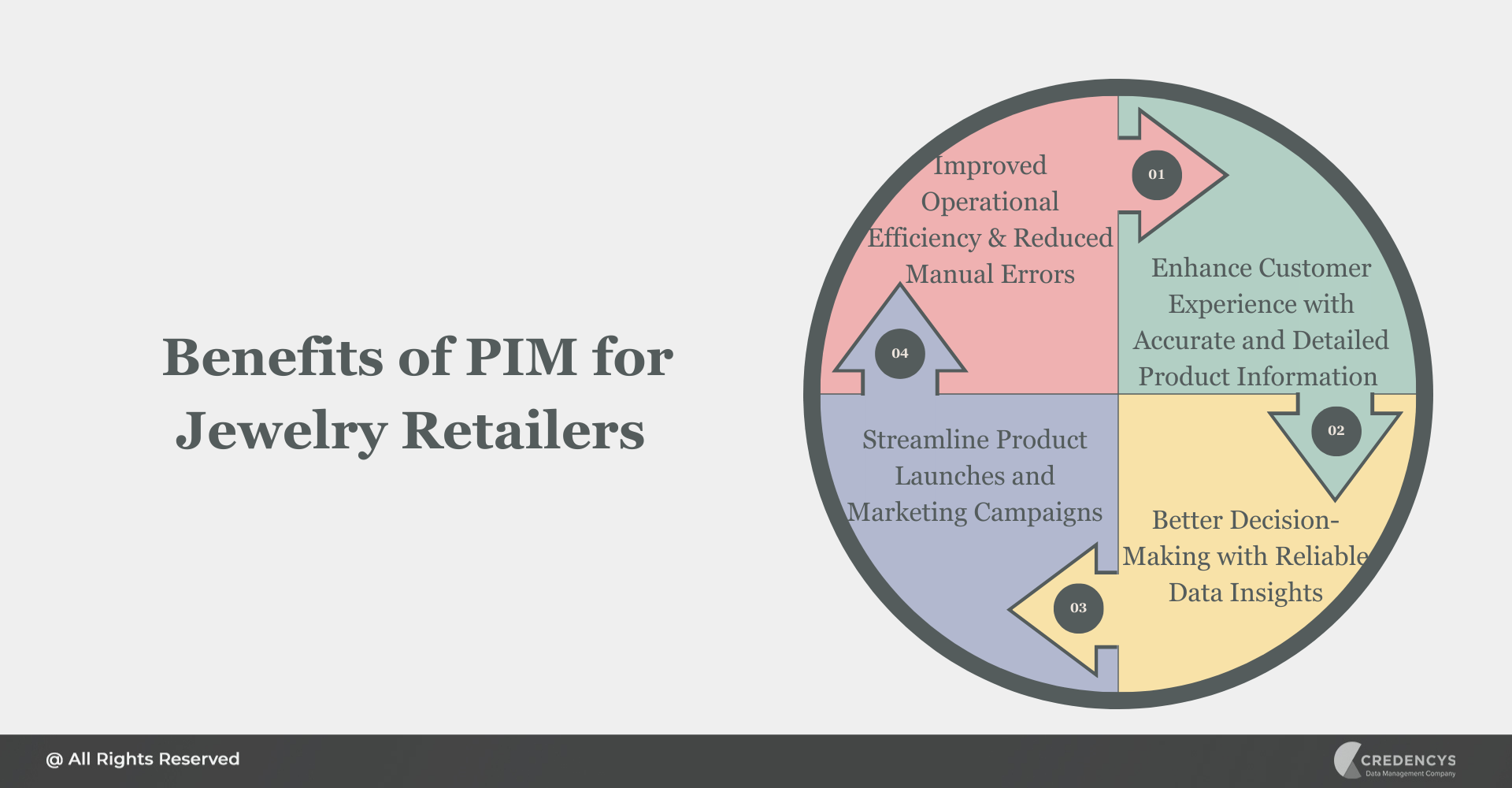
benefits of pim for jewelry

This approach not only addresses the immediate issues caused by disorganized data but also sets the foundation for sustainable growth and competitive advantage.

1. Consistency Across All Channels

PIM ensures that product information is consistent across every sales channel, whether it’s an online store, a physical showroom, or a third-party marketplace. This consistency builds trust with customers, who can be confident that they are receiving accurate and up-to-date information no matter where they shop. For jewelry retailers, this is particularly important, as customers rely on precise product details to make informed purchasing decisions.

  • Ensures consistent product information across all sales channels.
  • Builds customer trust by providing accurate and up-to-date details.
  • Critical for jewelry retailers, where precise product details are essential.

2. Improved Operational Efficiency

By centralizing product data with PIM, jewelry retailers can streamline their workflows and eliminate the need for manual data entry and updates. This efficiency allows for quicker product launches and updates, reducing time-to-market and enabling retailers to respond more rapidly to market trends. Centralized systems also minimize the risk of errors, freeing up staff to focus on more strategic tasks rather than repetitive data management.

  • Streamlines workflows and eliminates the need for manual data updates.
  • Reduces time-to-market by enabling quicker product launches and updates.
  • Minimizes errors and allows staff to focus on strategic tasks.

3. Enhanced Customer Experience

With PIM, retailers can offer a more personalized shopping experience. Accurate and detailed product information enables customers to make informed purchasing decisions, leading to higher satisfaction rates and increased sales. Moreover, centralized data allows retailers to gather insights into customer preferences and behavior, which can be used to tailor marketing efforts and create targeted promotions that resonate with their audience.

  • Facilitates personalized shopping experiences through accurate product data.
  • Increases customer satisfaction and boosts sales.
  • Provides insights into customer behavior for targeted marketing efforts.

4. Better Compliance and Certification Management

PIM systems make it easier to manage and track certifications and compliance documents, ensuring that all products meet industry standards and regulations. This not only protects the brand’s reputation but also reduces the risk of legal issues. For jewelry retailers, where adherence to certification standards is crucial, a centralized approach ensures that all necessary documentation is up-to-date and easily accessible across all channels.

  • Simplifies the management and tracking of certifications and compliance documents.
  • Ensures products meet industry standards, protecting the brand’s reputation.
  • Reduces the risk of legal issues by maintaining up-to-date documentation.

5. Data-Driven Insights

A PIM system allows retailers to collect and analyze data more effectively, providing insights into customer preferences, sales trends, and inventory management. These insights can inform business strategies, helping retailers optimize their product offerings and marketing efforts. By leveraging data-driven decision-making, jewelry retailers can stay ahead of market trends and better serve their customers.

  • Enables effective collection and analysis of customer and sales data.
  • Provides insights that inform business strategies and optimize offerings.
  • Helps retailers stay ahead of market trends and better serve customers.

The Future of Jewelry Retail Lies in Centralization

In today’s fast-paced retail environment, jewelry retailers cannot afford to let scattered data hinder their growth. PIM for jewelry retailers is not just a trend; it’s a necessity. By consolidating product data into a single, unified system, retailers can enhance operational efficiency, ensure consistency across all channels, and provide a superior customer experience.

As the jewelry industry continues to evolve, those who embrace product information management solutions will be better positioned to thrive in a competitive market. Investing in the right technology and following best practices will empower retailers to streamline their operations, boost sales, and maintain a strong brand reputation.

How PIM Simplifies Complex Product Data Classification for Jewelry Retailers

Managing product data is complex for any business. And when we talk about jewelry retail, it becomes even more complex because of the diverse materials, designs, and attributes of the jewelry items.

Additionally, the frequent updates driven by changing trends bring more challenges for the retailers. This complexity makes manual data management daunting, increasing the risk of errors that can harm sales and reputation.

A report highlighted that companies with complex product lines, like jewelry, see up to a 30% improvement in operational efficiency by implementing robust product information management systems.

This is where PIM systems provide a centralized solution. In this blog, we’ll explore how PIM transforms product data management for jewelry retailers, enhancing efficiency and customer satisfaction.

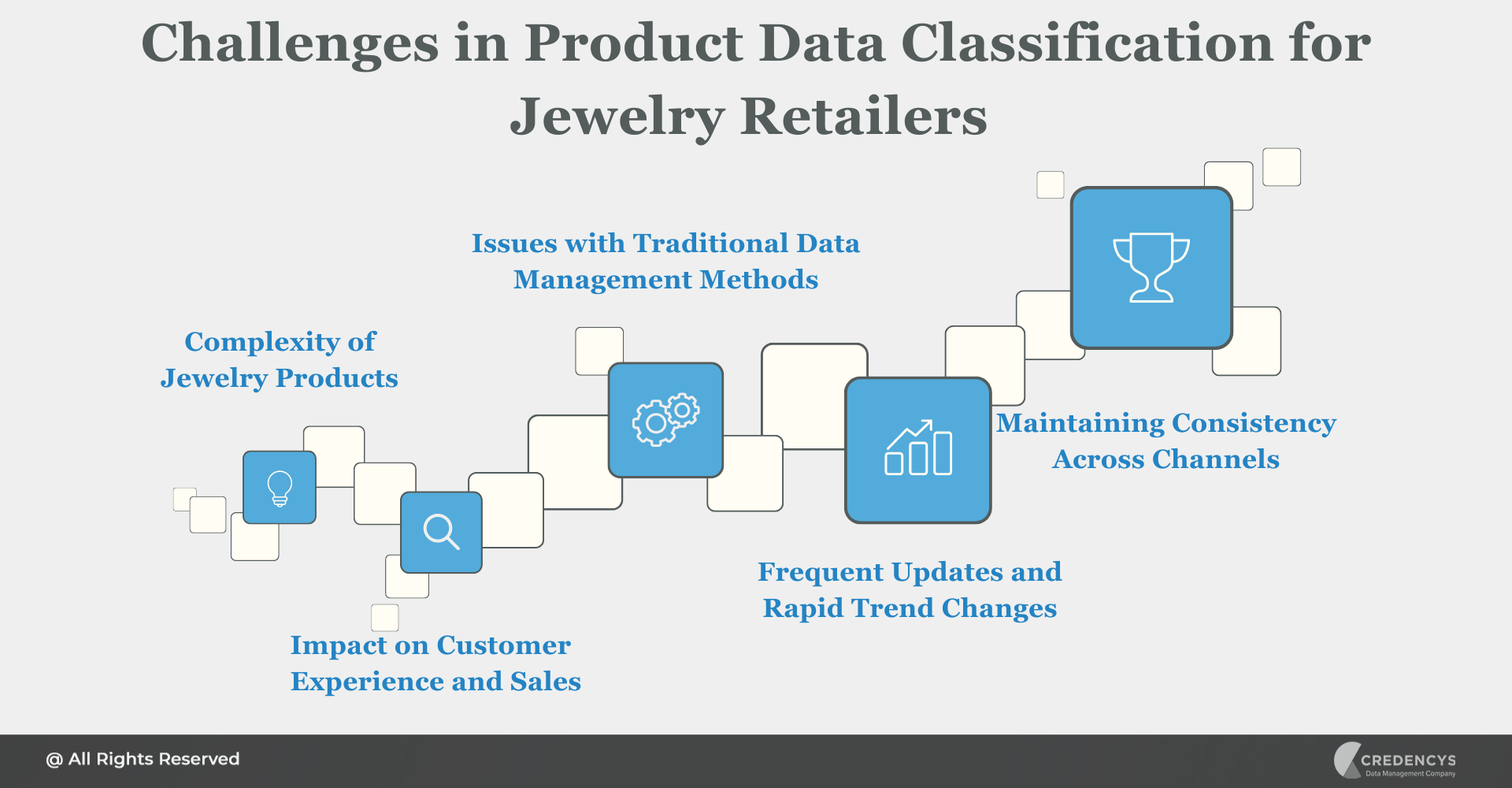
Challenges in Product Data Classification for Jewelry Retailers

Let’s start off by examining the key challenges that jewelry retailers face in effectively managing product data classification and attribution.

1. Complexity of Jewelry Products

Jewelry items feature a wide range of variations in materials, such as gold, silver, platinum, and gemstones. They also have diverse designs and intricate attributes like cut, clarity, weight, and size.

Each piece requires detailed descriptions and specifications, making product data management complex and demanding.

2. Impact on Customer Experience and Sales

Inaccurate or incomplete product information frustrates customers, leading to mistrust and abandoned purchases. Poor data management can also result in inaccurate pricing and misclassified products, causing lost sales opportunities and negatively affecting customer loyalty and the retailer’s bottom line.

3. Issues with Traditional Data Management Methods

Relying on manual entry systems and spreadsheets can result in inefficiencies and errors. The high risk of mistakes such as incorrect classification, duplicated entries, and inconsistent descriptions makes it difficult to keep product information accurate and up to date.

4. Frequent Updates and Rapid Trend Changes

The jewelry industry is influenced by rapidly changing trends, requiring frequent updates to product information. Keeping pace with these changes manually can be overwhelming and lead to outdated or irrelevant data being displayed to customers.

5. Maintaining Consistency Across Channels

Ensuring that product information is consistent across all retail channels, including online stores, physical locations, and third-party platforms, is challenging. Discrepancies in data can lead to confusion among customers and damage the brand’s reputation.

Challenges in Product Data Classification for Jewelry Retailers

How PIM Simplifies Product Data Classification and Attribution

PIM systems play a transformative role in simplifying the complexities of product data management for jewelry retailers. PIM systems address many of the challenges associated with managing intricate product details by centralizing and organizing product information, automating data processes, and ensuring consistency and accuracy.

1. Ensuring Consistency and Accuracy

PIM systems play a crucial role in maintaining consistency and accuracy in product data. By providing a single source of truth, PIM ensures that all product information is uniform across different sales channels, whether online, in-store, or through third-party platforms.

This consistency helps build trust with customers, as they receive reliable and accurate product details. Furthermore, PIM systems include validation checks and data governance features that help maintain high data quality standards, reducing the likelihood of errors and discrepancies.

2. Automation of Data Entry and Classification

One of the key advantages of PIM systems is their ability to automate data entry and classification. PIM platforms use predefined templates and rules to automatically categorize products based on their attributes, such as material, design, and size.

This automation reduces the need for manual data entry, minimizing the risk of human errors and inconsistencies. Additionally, automated processes speed up the updating of product information, allowing retailers to quickly adapt to new trends and inventory changes.

3. Centralization and Organization of Product Information

PIM systems consolidate product data from multiple sources into a single, unified repository. This centralization allows retailers to manage all product information from descriptions and specifications to images and pricing within one platform.

By organizing data in a structured and accessible manner, PIM systems streamline the process of updating and distributing product information across various channels. This ensures that retailers have a comprehensive and accurate view of their product catalog at all times.

4. Integration with Other Business Systems

PIM systems can seamlessly integrate with other business systems such as ERP, CRM, and eCommerce platforms. This integration ensures that product data is synchronized across all systems, providing a cohesive view of the business operations and facilitating efficient workflows.

It allows for better coordination between different departments, improving overall business performance.

Benefits of PIM for Jewelry Retailers

Implementing a PIM system offers a range of benefits for jewelry retailers, driving improvements across operations, customer interactions, and strategic decision-making.

1. Improve Operational Efficiency and Reduce Manual Errors

PIM systems significantly enhance operational efficiency by automating many aspects of product data management. This automation reduces the need for manual data entry, which minimizes the risk of human errors such as incorrect classifications, duplicated entries, and inconsistent information.

By streamlining data processes and centralizing information, PIM systems help retailers manage their product catalogs more effectively and allocate resources more efficiently, leading to smoother operations and reduced administrative burden.

2. Enhance Customer Experience with Accurate and Detailed Product Information

A core benefit of PIM systems is their ability to provide accurate, comprehensive, and consistent product information across all customer touchpoints. By ensuring that product descriptions, images, and specifications are detailed and up-to-date, PIM systems enhance the customer experience.

Shoppers receive reliable and complete information, enabling them to make informed purchasing decisions with confidence. This consistency not only improves customer satisfaction but also strengthens brand trust and loyalty.

3. Facilitate Better Decision-Making with Reliable Data Insights

PIM systems offer valuable data insights that facilitate better decision-making. By consolidating product information and providing analytical tools, PIM systems enable retailers to track key performance metrics, identify trends, and analyze customer preferences.

This data-driven approach allows retailers to make informed decisions about inventory management, pricing strategies, and marketing initiatives. Leveraging these insights can lead to more strategic business decisions, optimized product offerings, and enhanced competitive positioning.

4. Streamline Product Launches and Marketing Campaigns

With PIM systems, jewelry retailers can efficiently manage product launches and marketing campaigns. By having accurate and consistent product data readily available, retailers can quickly create promotional materials and ensure timely product releases.

This capability allows for more agile marketing strategies and can significantly reduce time-to-market, providing a competitive edge in the fast-paced jewelry industry.

Benefits of PIM for Jewelry Retailers

In Conclusion

In summary, PIM offers a transformative solution for jewelry retailers facing the complexities of product data management. PIM systems address critical challenges and enhance operational efficiency by centralizing and streamlining product information, automating data processes, and ensuring consistency.

Adopting a PIM system not only simplifies data management but also improves customer satisfaction through accurate and detailed product information. The strategic benefits of PIM include reduced manual errors, better decision-making with reliable data insights, and a competitive edge in the dynamic jewelry market.

Investing in PIM technology is a key step toward optimizing your retail operations and delivering an exceptional shopping experience. Embrace the power of PIM to drive growth, enhance efficiency, and stay ahead in the competitive world of jewelry retail.