Streamlining Regulatory Compliance in CPG with MDM Solutions

The CPG industry is highly competitive, and ensuring compliance with industry standards and government regulations is crucial. Non-compliance can lead to significant fines, product recalls, or even legal actions, damaging a brand’s reputation and profitability.

However, maintaining compliance is no easy task, especially as companies operate across multiple regions and categories with varying standards. This is where MDM solutions come into play.

According to Gartner, by 2025, 70% of organizations will have invested in Master Data Management solutions to improve data governance and compliance.

MDM centralizes product and customer data, ensuring consistency, accuracy, and accessibility across the organization. It is an essential tool for CPG brands that improves operational efficiency and simplifies complying with ever-evolving regulations.

Regulatory Compliance in the CPG Industry

The CPG industry is subject to a wide range of regulations, varying from country to country and product to product. Common regulatory requirements include:

  • Product Safety: Rules related to ensuring product quality and safety, including batch tracking, expiration dates, and handling of product recalls.
  • Sustainability Standards: Brands are increasingly being held accountable for ethical sourcing, environmentally friendly packaging, and other sustainability concerns.
  • Labeling and Packaging: Regulations regarding ingredient listings, nutritional information, and allergy warnings.

Regulatory Compliance in the CPG Industry

Given the complexity, brands must constantly adapt to these requirements. This is even more challenging for global businesses, as different countries impose their own standards.

Additionally, changing regulations means companies must stay vigilant to avoid unintentional non-compliance.

MDM’s Role in Ensuring Regulatory Compliance

Master Data Management is critical in ensuring CPG brands comply with the ever-evolving regulatory landscape. By maintaining clean, accurate, and up-to-date product information, MDM reduces the likelihood of errors leading to regulatory breaches.

Some key ways MDM supports compliance include:

1. Faster Regulatory Reporting

Regulators often require quick access to product information and historical data for audits or inspections. MDM allows companies to quickly generate reports that compile all necessary data in a standardized format.

This minimizes the time and effort spent on compliance reporting, reducing the risk of delays or incomplete submissions.

2. Accurate and Up-to-Date Information

With MDM, product information is stored centrally and can be updated in real-time. This is crucial when new regulations are introduced or products are reformulated.

For example, if an allergen becomes a regulated substance, MDM ensures that all packaging, marketing, and sales platforms reflect this update instantly.

3. Real-Time Alerts for Regulatory Changes

MDM solutions can be integrated with external databases and regulatory systems. The platform can notify users of impending regulatory changes, helping brands proactively update their product data, labels, and supply chain processes.

4. Data Consistency Across Channels

MDM ensures that all data across platforms, from marketing materials to product labels, remains consistent. This uniformity helps avoid discrepancies in information, such as incorrect ingredient lists or outdated nutritional facts.

Key Areas Where MDM Supports CPG Regulatory Compliance

1. Labeling and Packaging Regulations

One of the most critical aspects of regulatory compliance for CPG brands is ensuring that product labels and packaging meet local laws. These regulations govern what information needs to be displayed, including:

  • Ingredient Lists: Detailed information on ingredients must be listed in the correct order, with accurate weights or percentages.
  • Nutritional Data: Information such as calorie count, fat content, and vitamin values must be clear and truthful, adhering to regional standards.
  • Allergen Warnings: All allergens must be clearly labeled to avoid risks to consumers with allergies or intolerances.
  • Sustainability and Recycling Information: Packaging laws increasingly require companies to display information about recyclable materials or sustainability claims.

MDM allows CPG brands to manage these requirements by ensuring that all labeling information is consistent and accurate. If changes are made to ingredients or packaging, MDM automatically updates the data, ensuring compliance is maintained at every level.

2. Product Safety and Traceability

Ensuring product safety is another critical compliance requirement in the CPG industry. MDM is significant in helping brands manage traceability, particularly for food and beverage products, cosmetics, and pharmaceuticals.

  • Batch Number Tracking: MDM helps companies track the movement of products from manufacturing to distribution. Each batch number, expiration date, and production facility can be logged and easily traced in case of recalls or investigations.
  • Expiration Dates: MDM ensures that products with upcoming expiration dates are tracked and that retailers and consumers receive accurate information on product shelf life.
  • Product Recalls: In the unfortunate event of a product recall, MDM systems provide real-time access to critical data, such as batch numbers and distribution locations. This allows companies to act swiftly in removing unsafe products from shelves, thus limiting harm to consumers and reducing the legal risks of non-compliance.

3. Sustainability and Ethical Sourcing

Sustainability and ethical sourcing are increasingly becoming mandatory in regulatory frameworks worldwide. MDM helps companies manage data related to:

  • Supplier Compliance: Brands can track whether suppliers meet sustainability and ethical sourcing guidelines, ensuring their products comply with standards like Fair Trade or Organic certifications.
  • Environmental Regulations: MDM allows companies to track the materials used in packaging and ensures that they comply with regional laws regarding recyclability, use of plastics, and carbon footprint disclosure.

Key Areas Where MDM Supports CPG Regulatory Compliance

How MDM Improves Data Governance for CPG Companies

Data governance refers to managing the availability, usability, integrity, and security of data within an organization. Effective data governance is crucial for CPG companies to ensure regulatory compliance, as it helps maintain data accuracy and consistency across all channels.

MDM plays a pivotal role in strengthening data governance, particularly in the following ways:

1. Audit Trails and Reporting

MDM systems create a comprehensive audit trail of all changes made to product data. This transparency is invaluable during regulatory audits or inspections, as companies can provide detailed reports on when data was updated, by whom, and why.

These reports can be generated quickly, making compliance audits much more manageable.

2. Automated Data Updates

With MDM, updates to product data (such as ingredient changes, new packaging requirements, or regulatory shifts) are automated across all channels. This eliminates the risk of manual entry errors and ensures that all systems reflect the latest information, essential for maintaining compliance.

3. Centralized Control of Data

MDM provides a unified platform where all product-related data is stored and managed. This centralized control ensures that every department, from marketing to operations, has access to the same accurate data, reducing the likelihood of errors caused by fragmented or outdated information.

4. Improved Data Accuracy

MDM platforms enforce strict data validation rules, ensuring only verified, high-quality data enters the system. This helps CPG brands maintain the accuracy regulators require, reducing the risk of non-compliance due to incorrect or incomplete data.

5. Policy Enforcement

MDM platforms allow organizations to enforce data policies consistently across the board. Whether it’s ensuring the correct labeling format or maintaining proper safety records, MDM automates the process, minimizing the chance of human error.

Closing Thoughts

In the highly regulated CPG industry, ensuring regulatory compliance is complex and critical to a brand’s success. From labeling accuracy to product safety, sustainability, and ethical sourcing, CPG companies face a wide range of regulations that must be followed at all times.

MDM provides an effective solution by centralizing and standardizing data, ensuring consistency, accuracy, and governance across the organization. By implementing MDM, CPG brands can simplify their compliance processes, reduce non-compliance risk, and protect their brand reputation from the potentially costly consequences of regulatory breaches.

Moreover, as the regulatory landscape evolves, MDM will remain a crucial tool for adapting to new standards, improving data governance, and staying ahead of the curve. For any CPG business looking to improve its regulatory compliance strategy, investing in MDM is a strategic decision for future success.

FAQs

1. What are the key benefits of MDM for regulatory compliance in CPG?

MDM ensures data accuracy, consistency, and real-time updates, enabling CPG brands to maintain compliance with industry regulations. It also simplifies reporting, enhances traceability, and supports data governance.

2. How does MDM help with labeling and packaging compliance?

MDM ensures that all labeling information – ingredient lists, nutritional data, and allergen warnings – is accurate and up-to-date across all channels. This helps CPG brands meet local and global packaging regulations.

3. What role does MDM play in product safety and traceability?

MDM helps track batch numbers, expiration dates, and recall processes, ensuring full traceability from production to the consumer. This is critical for meeting product safety regulations.

4. How does MDM improve data governance for CPG brands?

MDM enforces data policies, centralizes data management, and provides audit trails for all data changes, improving governance and reducing non-compliance risks.

5. What challenges might a CPG company face when implementing MDM?

Common challenges include initial data quality issues, integrating MDM with legacy systems, and overcoming organizational resistance to change.

Overcoming Data Silos in Manufacturing: How MDM Drives Operational Efficiency and Innovation

Are your manufacturing teams stuck in silos with inconsistent data?  

Frustrated by how data fragmentation slows decision-making and efficiency? 

If you answered “yes” to any of these questions, you are not alone.

46% of organizations say their data resides in silos, creating major barriers to efficiency and innovation.

In manufacturing, where operational efficiencies and seamless communication are important, data silos are even more difficult. Master Data Management (MDM) can break down these barriers and keep your content at its best. 

In this blog, we’ll explore how overcoming data silos in manufacturing through MDM can transform how manufacturers work, improve decision-making and drive innovation. 

The Impact of Data Silos in Manufacturing

Data silos in the manufacturing industry occur when information is stored in isolated systems or departments, preventing a unified view of data across the organization. Each department—production, sales, supply chain, or inventory management—maintains its own data, which may conflict with others. This disconnect can lead to a myriad of issues, including: 

  • Inconsistent Data: Different versions of data across departments create confusion, leading to errors in reporting, production delays, and operational inefficiencies. 
  • Slower Decision-Making: Fragmented data forces teams to reconcile information manually, resulting in slower decision-making processes. 
  • Reduced Collaboration: Silos prevent teams from working together effectively, hindering innovation and cross-departmental synergy. 

According to a Forrester survey, nearly 40% of organizations report that data fragmentation significantly limits their ability to drive business growth.

This highlights the urgent need for manufacturers to adopt a unified approach to managing their data. 

Why Overcoming Data Silos is Essential for Manufacturers

As manufacturers face increasing competition and shifting market demands, the ability to operate efficiently and innovate quickly is crucial. Data silos stand in direct opposition to these objectives. Let’s take a look at why overcoming data silos is crucial for the manufacturing industry: 

1. Optimized Operations

Unified data enables manufacturers to streamline operations, reduce redundancies, and ensure that all departments access consistent and up-to-date information. Whether it’s production planning, supply chain coordination, or customer service, a centralized data hub ensures smoother workflows. 

2. Enhanced Decision-Making

With real-time, accurate data at their fingertips, decision-makers can act faster and more confidently. For example, production managers can quickly access information on raw materials, inventory levels, and sales forecasts to make informed decisions about manufacturing schedules. 

3. Data-Driven Innovation

Unified data allows manufacturers to identify trends and patterns across the production line, supply chain, and customer behavior. By breaking down silos, manufacturers can drive product innovation, adopt new technologies, and respond to market trends more efficiently. 

MDM: The Key to Overcoming Data Silos in Manufacturing

The manufacturing industry is undergoing significant transformation, driven by trends such as digitalization, Industry 4.0, and the need for real-time data insights.  

According to a McKinsey report, companies that leverage advanced data analytics see 15-20% productivity gains in manufacturing. These trends further underline the importance of overcoming data silos through MDM.  

MDM is a strategic solution that ensures the consistency, accuracy, and accessibility of critical business data across all departments and systems within an organization. By consolidating and managing a single source of truth, MDM eliminates data silos and empowers manufacturers to unlock the full potential of their data. 

Here are key ways MDM helps manufacturers overcome data silos: 

1. Centralized Data Governance

MDM establishes centralized data governance across all departments, ensuring data is maintained according to standard definitions and rules. This helps manufacturers prevent data fragmentation and inconsistency, as all information is managed and monitored from a single platform. 

For example, product data—such as SKUs, descriptions, or specifications—may reside in systems like ERP, PLM, or CRM. MDM brings all this data into one place, ensuring that everyone across the company works with the same accurate and up-to-date information. 

2. Improved Data Quality

With MDM, manufacturers can cleanse and standardize their data to improve its quality and accuracy. Data quality is vital for effective decision-making. Inconsistent or erroneous data can lead to mistakes in production, order fulfillment, or inventory management. MDM automates data quality checks, ensuring only valid, accurate information flows through the system. 

Research shows that poor data quality costs companies an average of $15 million annually. For manufacturers, MDM can mitigate these costs by providing a single source of high-quality data. 

3. Faster Time-to-Market

Manufacturers often face intense pressure to bring products to market quickly. With fragmented data, coordinating production schedules, supply chain logistics, and product launches can be slow and painful. MDM accelerates these processes by providing a unified view of all relevant data, ensuring teams can collaborate more effectively and make real-time decisions. 

A study by IDC found that companies with integrated data systems, such as those using MDM, achieve up to 50% faster time-to-market than those without MDM. 

4. Seamless Integration with Other Systems

MDM integrates seamlessly with other enterprise systems, such as ERP (Enterprise Resource Planning), PLM (Product Lifecycle Management), and CRM (Customer Relationship Management). This ensures that all systems work together and no department is left out of the loop when accessing or updating key information. 

For instance, integrating MDM with ERP systems allows manufacturers to better manage inventory levels, production schedules, and customer orders, helping avoid bottlenecks and delays. 

MDM Drives Operational Efficiency and Innovation for the Manufacturing Industry

Data silos are more than just an inconvenience—they’re a barrier to growth, efficiency, and innovation. Overcoming data silos in manufacturing with MDM provides manufacturers with the unified data framework needed to streamline operations, enhance decision-making, and accelerate innovation. 

By centralizing and governing data across all departments and systems, MDM eliminates inconsistencies, improves data quality, and empowers manufacturers to take full advantage of digital transformation. Key Takeaways: 

  • Data silos hinder operational efficiency, decision-making, and innovation in the manufacturing industry. 
  • MDM centralizes data governance, ensuring consistency and accuracy across all departments. 
  • Manufacturers can improve data quality, reduce errors, and enhance collaboration with MDM. 
  • MDM accelerates time-to-market by streamlining production, supply chain coordination, and decision-making. 
  • Seamless integration with ERP, PLM, and CRM systems helps manufacturers manage data across platforms efficiently. 

Optimizing Retail Inventory Management Solutions with PIM

Inventory management is a critical function for retail businesses, impacting profitability and customer satisfaction. Due to fragmented product data and manual processes, retailers often face challenges such as overstock, stockouts, and mismanagement.

A recent study found that retailers lose over $1 trillion annually due to stockouts, overstocks, and preventable returns, underscoring the need for better inventory management solutions.

PIM systems offer a solution by centralizing and streamlining product data, improving inventory control and reducing stock-related issues. This article explores how integrating PIM for retail operations enhances inventory visibility, optimizes stock levels, and improves overall inventory management.

Understanding the Role of PIM in Retail

A PIM system is a central platform for managing all the data associated with a retailer’s products, including descriptions, pricing, specifications, images, and stock levels. The key features of PIM include:

  • Centralized Data Management: All product data is stored in a single, easily accessible location.
  • Data Consistency: Ensures accurate, consistent product information across all sales channels.
  • Simplified Updates: Makes updating product details across platforms quick and efficient.

Key Features of PIM

How PIM Differs from Other Systems

PIM systems differ from other software solutions like Enterprise Resource Planning (ERP) and Warehouse Management Systems (WMS). While ERP and WMS focus on logistics and back-end processes like inventory levels and supply chain management, PIM specifically manages product data.

PIM complements these systems by providing consistent, accurate data that informs better decision-making in inventory control, supply chain planning, and sales forecasting.

Inventory Management Challenges in Retail

Common Stock Issues Faced by Retailers

Retailers frequently face a range of inventory management issues, including:

  • Overstocking: Excess inventory ties up capital and wastes warehouse space.
  • Stockouts: Running out of stock results in lost sales and dissatisfied customers.
  • Data Silos: Disconnected systems and manual processes create inaccurate stock levels and fragmented data.

Need for Accurate Product Data

Accurate and timely product data is essential for effective inventory management. Many retailers struggle with managing product information across multiple channels, leading to errors in stock levels, price discrepancies, and delayed updates.

This lack of real-time data makes it difficult to maintain optimal stock levels and avoid costly stockouts or overstocks.

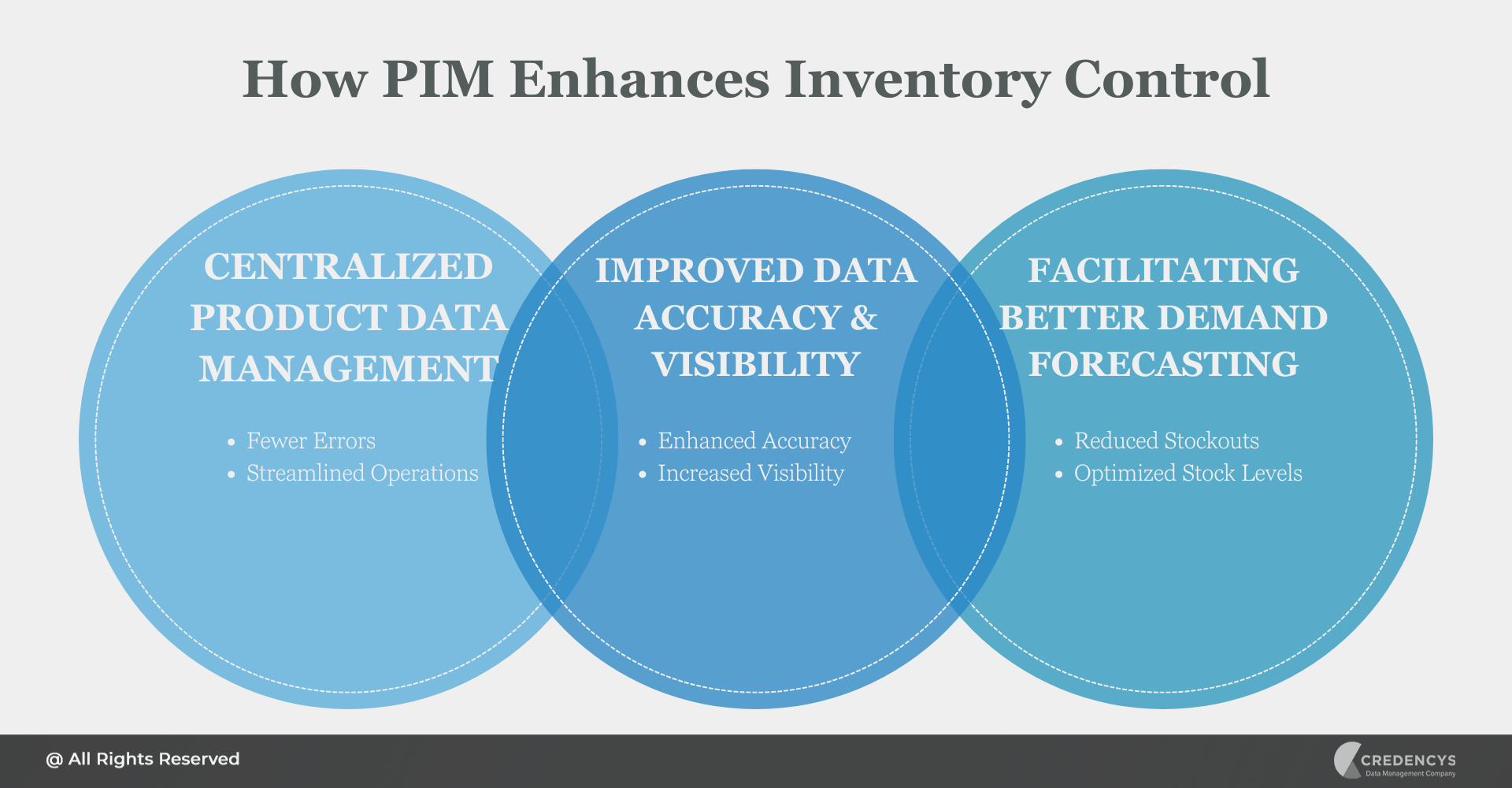
How PIM Enhances Inventory Control in Retail?

1. Centralized Product Data Management

PIM centralizes all product-related data into a single system, reducing the risk of errors caused by managing product data manually or across multiple platforms. This consolidation of information ensures that product details are consistent, up-to-date, and synchronized across all sales channels.

Key benefits include:

  • Fewer Errors: Minimizes discrepancies in product data across platforms.
  • Streamlined Operations: Allows teams to update product data in one place, saving time and reducing manual effort.

2. Improved Data Accuracy and Visibility

By integrating PIM with other systems like ERP and WMS, retailers can ensure real-time updates on inventory levels. This integration creates a continuous flow of accurate data between sales channels, warehouses, and distribution centers.

Key impacts include:

  • Enhanced Accuracy: Accurate stock levels help in making informed decisions on reordering and restocking.
  • Increased Visibility: Retailers gain better visibility into stock levels, preventing stockouts and overstock situations.

3. Facilitating Better Demand Forecasting

PIM systems help retailers analyze product performance and anticipate demand based on accurate and comprehensive product data. This data-driven approach to forecasting allows businesses to adjust their inventory levels based on customer preferences, market trends, and sales patterns.

The benefits of using PIM for forecasting include:

  • Reduced Stockouts: Anticipating demand reduces the likelihood of running out of popular products.
  • Optimized Stock Levels: Retailers can maintain ideal inventory levels without over-committing to stock.

How PIM Enhances Inventory Control

Enhancing Inventory Visibility Across Channels in Retail

1. Managing Omnichannel Retail Operations

As retailers adopt omnichannel strategies, managing inventory across various channels like online stores, brick-and-mortar locations, and third-party marketplaces becomes more complex. PIM simplifies this process by providing real-time visibility into inventory across all platforms.

Key benefits for omnichannel retail include:

  • Consistent Stock Information: Accurate stock levels displayed across all sales platforms, reducing confusion for customers.
  • Real-Time Updates: Instant synchronization of product data such as availability, pricing, and product descriptions across multiple channels.

Omni-channel Retail: Rethinking Retail Strategy for Growth

2. Enabling Faster Product Updates and Synchronization

With PIM, retailers can quickly update product information such as pricing or availability across all platforms. This ensures that customers always have access to the latest product data, and inventory levels remain accurate.

Advantages of faster updates include:

  • Improved Customer Experience: Customers receive accurate, up-to-date information on product availability and prices.
  • Reduced Stock Discrepancies: Updates to product information reflect instantly across all sales channels, minimizing errors and discrepancies.

Reducing Stock Issues in Retail with PIM

1. Optimizing Stock Levels

PIM’s accurate product data helps retailers maintain optimal stock levels. By centralizing product information, retailers can make informed decisions about restocking and allocation, ensuring that they carry the right amount of stock at the right time.

Key results of optimizing stock levels include:

  • Reduced Overstock: Prevents excess inventory that takes up space and ties up capital.
  • Increased Efficiency: Maximizes warehouse efficiency by keeping inventory levels lean and accurate.

2. Preventing Stockouts and Enhancing Replenishment Cycles

PIM systems provide automated alerts and better control over stock levels. This allows businesses to respond quickly to low stock levels and reorder products before they run out.

How PIM helps prevent stockouts:

  • Automated Alerts: Notifications when stock levels are low, allowing for timely reordering.
  • Improved Supplier Coordination: Better communication between retailers and suppliers ensures a smooth replenishment process, preventing stockouts.

Conclusion

Integrating a PIM system into retail operations significantly enhances inventory control. By centralizing product data, improving accuracy, and increasing inventory visibility, PIM reduces stock issues like overstock and stockouts.

Retailers can optimize stock levels, streamline their operations, and improve customer satisfaction, making PIM a valuable tool for modern retail inventory management.

Role of PIM in Enhancing Data Governance for Automotive Parts

Managing and governing data efficiently has become a critical priority for businesses across all industries. This is especially true for the automotive sector, where the availability of accurate, consistent, and timely data about automotive parts plays a pivotal role in maintaining operational efficiency and customer satisfaction.

According to a report by McKinsey, the global automotive aftermarket industry is expected to reach $1.4 trillion by 2030, with data management being a key enabler of this growth.

One of the most effective solutions to streamline data governance processes in this domain is Product Information Management. PIM systems enable automotive businesses, especially those dealing in aftermarket auto parts, to manage vast volumes of product data across various channels and platforms while ensuring high levels of data quality, security, and consistency.

In this article, we explore the role of PIM in enhancing data governance for automotive parts and how it aligns with industry-specific challenges and data standards.

Understanding Automotive Parts Data Governance

Automotive Parts Data Governance refers to the systematic approach of managing the availability, usability, integrity, and security of the data used in the automotive parts supply chain. It involves a set of policies, standards, and procedures to ensure data accuracy, consistency, and compliance with regulatory requirements.

For companies in the automotive industry, the quality and governance of data are essential for several reasons:

  • Interoperability Across Platforms: Automotive parts data is distributed across various eCommerce platforms and third-party vendors, so it is essential that the data is consistent across these channels to avoid confusion or miscommunication.
  • Customer Satisfaction: Inaccurate or inconsistent data can result in delivery delays, incorrect part orders, or product returns, negatively impacting customer satisfaction.
  • Compliance with Industry Regulations: Automotive parts data must comply with regional and international regulations such as the Motor Vehicle Safety Act and ISO standards.
  • Efficiency in Operations: Properly governed data helps businesses streamline inventory management, procurement processes, and distribution.

Given the complexity and scope of managing automotive parts data, the need for a robust system to ensure effective data governance is clear. This is where PIM solutions come into play.

What is PIM?

In the automotive industry context, where each part may have thousands of variations in specifications, compatibility, and standards, PIM systems play a crucial role in simplifying data management processes. A PIM solution typically includes the following features:

  • Workflow Management: PIM facilitates the creation of workflows for data validation, ensuring that data is reviewed and approved by relevant stakeholders before being published.
  • Data Enrichment: PIM allows users to add, edit, and enrich product data with attributes, descriptions, and multimedia assets such as images or manuals.
  • Multichannel Distribution: With a PIM system, automotive companies can seamlessly distribute their product data across eCommerce platforms, third-party marketplaces, and physical stores.
  • Centralized Data Management: All product-related information is stored and managed in a single location, ensuring consistency across multiple channels.

PIM Features

By implementing a PIM solution, automotive companies can enhance their data governance practices while reducing the complexity of managing large data volumes.

Challenges of Automotive Parts Data Management

Managing data for aftermarket auto parts and original equipment manufacturer (OEM) parts is fraught with several challenges. These include:

  • Complex Product Hierarchies: Automotive parts data includes information on various products such as engines, transmissions, tires, and electronics, each with unique attributes, compatibility information, and standards.
  • Frequent Updates: Automotive parts are subject to constant updates as new models and variants are introduced, making it essential for companies to update their data continuously.
  • Multiple Channels and Markets: Automotive companies often sell their products across different regions and channels, each with its own data requirements and formats.
  • Data Silos: In many companies, product data is spread across multiple systems and departments, making it difficult to maintain consistency and accuracy.

Addressing these challenges requires a solution to efficiently manage, update, and centrally distribute automotive parts data.

How PIM Enhances Data Governance for Automotive Parts

Automotive PIM solutions are vital in addressing the aforementioned challenges while enhancing data governance processes. Here’s how PIM can improve data governance for automotive parts:

1. Data Centralization and Standardization

One of the key features of PIM is the ability to centralize product data into a single, unified repository. This ensures that all data related to automotive parts is stored in one place, making it easier to manage and update.

For companies dealing with aftermarket auto parts data standards, this centralization ensures that the data adheres to industry standards such as ACES (Automotive Catalog Exchange Standard) and PIES (Product Information Exchange Standard), which are crucial for data exchange in the automotive aftermarket industry.

By standardizing the data, PIM helps businesses ensure that their product information is consistent, accurate, and compliant with these industry standards.

2. Improved Data Accuracy and Quality

PIM systems include built-in validation rules and workflows that allow businesses to review and approve data before publication. This reduces the chances of errors, duplicate entries, and inconsistencies, improving data quality.

For example, if a business sells engine parts, the PIM system can validate whether all necessary data fields, such as part number, compatibility details, and technical specifications, have been filled out correctly. This ensures that the data meets automotive parts data governance standards.

3. Compliance with Regulatory Standards

Automotive parts must comply with various safety, quality, and environmental regulations. PIM systems allow businesses to track and manage compliance-related information, ensuring that their product data is current and adheres to regional and international regulations.

For instance, if a company needs to comply with EU regulations on hazardous materials in automotive parts, a PIM system can store and manage all relevant documentation, making it easy to track compliance and audit the data when necessary.

4. Efficient Data Distribution Across Channels

In the automotive industry, businesses often distribute their products across various sales channels, including eCommerce platforms, distributors, and physical retail stores. Each channel may have its own data requirements, formats, and standards.

PIM systems enable businesses to automatically format and distribute their product data to multiple channels from a single platform. This ensures that the data is consistent across all channels, reducing the risk of errors and improving customer experience.

How PIM Enhances Data Governance for Automotive Parts

Role of PIM in Supporting Aftermarket Auto Parts Data Standards

The aftermarket auto parts sector is one of the most complex areas of the automotive industry due to the sheer number of parts, brands, and compatibility considerations. Data governance becomes even more critical in this context, as businesses must ensure that their product data meets industry-specific standards such as ACES and PIES.

ACES provides a standard format for conveying information about vehicle fitment, making it easier for companies to communicate which parts are compatible with specific vehicles. PIES standardizes the exchange of product information, such as part numbers, descriptions, prices, and packaging details.

A robust PIM system can support these standards by automatically formatting product data according to ACES and PIES requirements. This simplifies managing and sharing product information with distributors, retailers, and end customers.

Benefits of Automotive PIM Solutions for Data Governance

Implementing an automotive PIM solution can offer several key benefits for businesses, particularly in the area of data governance. These include:

  • Improved Compliance: By tracking regulatory requirements and automating compliance checks, PIM systems help businesses adhere to industry standards and avoid costly fines or penalties.
  • Increased Data Accuracy: PIM systems help ensure that all product data is accurate, consistent, and up to date, reducing the risk of errors.
  • Scalability: As the business grows and new products are introduced, PIM systems can easily scale to accommodate larger volumes of data.
  • Enhanced Efficiency: PIM streamlines data management processes, enabling businesses to update and distribute product data more efficiently across multiple channels.

Benefits of Automotive PIM Solutions for Data Governance

Conclusion

In the automotive industry, where data accuracy and consistency are crucial, implementing a PIM system is essential for effective data governance. From supporting aftermarket auto parts data standards to ensuring compliance with regulatory requirements, automotive PIM solutions provide businesses with the tools to manage their product data more efficiently and effectively.

By centralizing product information, improving data quality, and simplifying multichannel distribution, PIM solutions enhance automotive parts data governance. They ensure that businesses can meet the growing demands of the digital marketplace while maintaining operational excellence.

Scaling Fashion Retail: How Pimcore Optimizes Product Data Management for Global Apparel Businesses

The fashion industry has become a highly dynamic and competitive global marketplace, expected to grow over $1.7 trillion by 2027.

As consumers become increasingly demanding and expect seamless shopping experiences across online and offline channels, fashion retailers are pressured to scale their operations. However, scaling a fashion business globally presents challenges—especially in managing vast amounts of product data across regions, languages, and channels.

Effective Product Data Management (PDM) is the cornerstone of success. It enables brands to stay competitive while meeting localized demands.

The Challenge of Scaling in Global Fashion

Scaling a fashion business from local to global is no small feat. Businesses face many challenges while scaling, including:

  • Data Fragmentation: Managing product information across different regions, suppliers, and systems can quickly lead to inconsistent or incomplete data.
  • Localization Requirements: Each region has specific language, cultural, and regulatory needs that require tailored product data.
  • Supply Chain Complexity: Global supply chains introduce added layers of complexity, including diverse logistics, suppliers, and compliance standards.
  • Omnichannel Consistency: Customers expect a consistent experience across all channels, from physical stores to e-commerce platforms. Maintaining this omnichannel consistency requires unified and accurate product data.

The Consequence of These Challenges

Failing to address these challenges can have severe repercussions for fashion retailers looking to expand globally:

  • Lost Sales Opportunities: Inconsistent product information across channels can confuse customers, leading to abandoned purchases and missed sales.
  • Customer Dissatisfaction: Consumers today demand fast, accurate, and personalized shopping experiences. Inconsistent data or lack of localization can lead to a disconnect between brand and consumer, eroding trust and loyalty.
  • Increased Operational Costs: Disjointed data management often results in inefficiencies, with teams spending excessive time manually updating or correcting data across systems. This slows down time to market and increases operational overhead.
  • Non-Compliance Risks: Failure to comply with local regulations (such as labeling requirements or pricing laws) can result in fines, product recalls, and damage to brand reputation, particularly in new markets.

If left unresolved, these challenges hinder scalability, making it difficult for fashion retailers to effectively tap into new global markets.

How Pimcore Helps Global Fashion Retailers Overcome These Challenges

Pimcore, a powerful open-source digital platform, provides a holistic approach to product data management for global fashion brands, addressing the most critical pain points they face when scaling.

1.    Centralized Data Management

Pimcore serves as a centralized hub for all product-related information, ensuring that fashion brands have a single source of truth. With global fashion brands often managing thousands of SKUs, it is critical to ensure that data like prices, descriptions, sizes, and images are updated consistently across all regions and sales channels.

    • Ensures consistency across global product catalogs.
    • Reduces time spent on manually updating product data.
    • Eliminates data silos for streamlined operations.

2.    Localization and Customization

For fashion brands expanding into new markets, Pimcore provides the tools needed for localization. From managing translations and currencies to adjusting product attributes to meet local regulations, the platform ensures that each region gets tailored product data without duplicating efforts. This allows brands to maintain their global appeal while catering to local preferences and compliance requirements, ensuring they meet regional market demands efficiently.

    • Manages multilingual content and regional pricing.
    • Ensures compliance with local regulations.
    • Provides localized product data for better customer engagement.

3.    Omnichannel Distribution

Pimcore enables seamless omnichannel distribution by keeping product data consistent across every touchpoint—a physical store, an e-commerce platform, or social media. This ensures customers have a consistent and unified shopping experience, regardless of where they interact with the brand.

    • Ensures consistent product information across all channels.
    • Integrates easily with online and offline retail platforms.
    • Enhances customer experience with unified data.

4.    Agility in Supply Chain Management

Fashion brands need to be agile when managing complex global supply chains. Pimcore’s ability to integrate with suppliers and vendors in real time ensures that stock levels, lead times, and inventory information are always current. This agility helps fashion brands reduce delays, prevent stockouts, and quickly adjust to shifts in demand, ensuring smooth operations and timely fulfillment across markets.

    • Provides real-time integration with suppliers and manufacturers.
    • It helps brands respond quickly to demand shifts and avoid stockouts.
    • Enhances operational efficiency with up-to-date inventory data.

5.    Scalability

Pimcore is designed to grow with businesses. Its open-source architecture allows fashion brands to start small and expand into new regions and markets without overhauling their data management systems. Whether operating in a handful of markets or globally, Pimcore’s scalable infrastructure ensures that brands can handle increasing volumes of product data as they grow, providing the flexibility needed for future expansion.

    • Scales effortlessly as brands grow into new markets.
    • Provides modular architecture for customizable growth.
    • Handles increasing data volumes with ease.

Wrapping Up: Pimcore Addresses Global Fashion Retail Challenges

Pimcore offers a comprehensive solution that addresses the key challenges fashion retailers face when scaling globally:

  • Centralized product data management ensures all product information is consistent, accurate, and accessible across regions and sales channels.
  • Localization tools allow brands to customize product data for specific markets, languages, and cultural nuances.
  • Omnichannel distribution capabilities ensure seamless experiences across online and offline channels, boosting customer satisfaction.
  • Supply chain integration keeps brands agile, helping them efficiently manage inventory and vendor relations.

As global fashion retail continues to evolve, Pimcore’s robust Product Data Management (PDM) tools provide the scalability and flexibility needed to stay ahead of the competition, optimize operations, and deliver top-notch customer experiences worldwide.

Supplier Data Management for Automotive Parts Using PIM

In the competitive world of the automotive aftermarket, efficient supplier data management is crucial to maintaining operational excellence and ensuring smooth business transactions. Automotive aftermarket suppliers must manage vast amounts of product-related data, including parts specifications, certifications, and pricing, across multiple channels.

However, without a robust system in place, data management can quickly become overwhelming, leading to errors and inefficiencies.

A recent study found that 83% of companies face significant data management challenges due to increasing complexity in supply chains, especially when handling multiple suppliers and diverse data formats.

PIM systems offer a solution by centralizing supplier data, improving accuracy, and streamlining workflows.

Understanding Supplier Data Management in the Automotive Aftermarket

Supplier data management is the process of collecting, organizing, and maintaining all information related to products supplied by different vendors. In the automotive aftermarket, where thousands of parts and components are involved, managing this data is critical to ensure smooth operations.

Key types of data include:

  • Product specifications: Accurate information about part dimensions, weight, and compatibility.
  • Certifications: Safety and regulatory compliance data.
  • Pricing: Up-to-date pricing and discount structures for different suppliers.

Without an organized system like PIM, businesses often struggle with data inconsistencies, which can lead to delays, errors in order processing, and reduced customer satisfaction. Managing data without a centralized solution also increases the likelihood of manual errors, duplications, and miscommunication between departments.

Key Data Challenges in the Automotive Aftermarket Supply Chain

Managing supplier data in the automotive aftermarket is challenging due to the wide variety of parts and components involved. These challenges include:

  • Complexity of managing diverse components: A single car contains thousands of unique parts, and managing the data for each one requires precision.
  • Handling multiple suppliers: Different suppliers often provide data in various formats, making it difficult to standardize and organize the information.
  • Data inconsistency: Inconsistent product information can result in delays, errors, and miscommunications between suppliers, manufacturers, and distributors.

Data Challenges in the Automotive Aftermarket Supply Chain

By addressing these challenges through a robust system, businesses can improve data flow, reduce errors, and enhance the overall efficiency of their supply chain operations.

How PIM Enhances Supplier Data Management

PIM systems offer a powerful solution for managing supplier data more effectively in the automotive aftermarket. By providing a centralized repository for all product and supplier data, PIM ensures that all information is up-to-date, accurate, and accessible across departments and systems.

Here’s how PIM enhances supplier data management:

  • Automation of Updates and Synchronization: PIM automates the process of updating and synchronizing data between suppliers and retailers, eliminating the need for manual entry. This automation saves time and minimizes human error, ensuring that product data remains consistent across all channels.
  • Data Accuracy and Consistency: PIM enables real-time updates, ensuring that any changes made by suppliers are reflected immediately in the system. This enhances data accuracy, reducing errors caused by inconsistent data input.
  • Centralized Repository: PIM consolidates all product data, making it easier to manage and share across multiple platforms. This reduces the risk of duplication and outdated information.

Benefits of Using PIM for Supplier Data Management in the Automotive Aftermarket

Implementing PIM for supplier data management in the automotive aftermarket brings several key benefits:

  • Faster Time-to-Market: PIM streamlines the process of uploading and distributing product information, enabling businesses to get new products to market faster. By reducing the time spent on manual data management tasks, companies can accelerate product launches and updates.
  • Cost Savings through Operational Efficiency: Automating data management with PIM reduces the time and resources spent on manual processes. This leads to cost savings, as fewer errors and inefficiencies need to be corrected, improving overall operational efficiency.
  • Enhanced Collaboration: PIM facilitates better communication between suppliers, distributors, and retailers. Suppliers can easily share product updates and new specifications, while distributors and retailers can access the most current data without delays.
  • Improved Data Accuracy: With a centralized data repository, businesses can reduce errors associated with manual data entry, ensuring that product information is always accurate and up to date.

Benefits of Using PIM for Supplier Data Management in the Automotive Aftermarket

Common Pitfalls to Avoid When Managing Supplier Data with PIM

While PIM systems offer numerous benefits, businesses need to avoid certain pitfalls to maximize its potential:

  • Lack of Supplier Engagement: For PIM to be successful, suppliers need to actively engage with the system. A lack of supplier buy-in can lead to outdated or missing data, which in turn affects the accuracy and usefulness of the system.
  • Poor Data Input and Quality Control: Even the best PIM system is only as good as the data it manages. Poorly entered data or inconsistent data standards can compromise the system’s effectiveness. Implementing strict quality control measures is essential.
  • Failure to Integrate with Existing Platforms: PIM systems must be integrated with existing platforms like ERP or CRM systems. Without proper integration, data silos can form, leading to inefficiencies and redundancies.

DRIVE – Enhancing Supplier Data Management in the Automotive Parts Segment

One of the leading solutions revolutionizing supplier data management in the automotive aftermarket is DRIVE. Specifically designed for the automotive parts industry, DRIVE offers advanced capabilities that streamline the collection, organization, and distribution of product data. Its unique features make it a preferred choice for businesses looking to manage complex data with ease.

  • Automotive-Specific Data Management: DRIVE is tailored to the needs of the automotive industry, supporting intricate data fields like part numbers, vehicle compatibility, certifications, and pricing. This specialization ensures that the system can handle the complexity of automotive parts data more efficiently than generic PIM solutions.
  • Real-Time Data Updates: One of DRIVE’s standout features is its ability to provide real-time updates, allowing manufacturers, suppliers, and distributors to share and access the latest information instantly. This reduces the risk of outdated or incorrect data, improving decision-making and customer satisfaction.
  • Improved Collaboration and Compliance: By centralizing and standardizing data, DRIVE fosters better collaboration between suppliers and retailers. Additionally, DRIVE helps businesses stay compliant with industry regulations and standards, such as ACES and PIES, which are critical in the automotive parts segment.
  • Multi-Channel Distribution: DRIVE allows automotive businesses to distribute product information across multiple channels, including eCommerce platforms, online marketplaces, and traditional retail environments. This multi-channel capability enhances product visibility and ensures that customers always have access to accurate, up-to-date information.
  • Seamless Integration with Existing Systems: DRIVE is built to integrate seamlessly with existing ERP, CRM, and eCommerce platforms. This ensures that data flows smoothly between departments and external partners, creating a unified ecosystem for managing supplier data.

DRIVE is a comprehensive solution that addresses the unique challenges of managing automotive parts data, making it an essential tool for businesses looking to optimize their supplier data management processes.

DRIVE Architecture

Closing Thoughts

In the fast-paced and competitive world of the automotive aftermarket, supplier data management plays a crucial role in maintaining operational efficiency, accuracy, and customer satisfaction. By implementing a PIM system, businesses can centralize supplier data, ensure consistent updates, and improve collaboration across the supply chain.

PIM not only enhances data accuracy but also helps automotive companies reduce time-to-market, save on operational costs, and foster better relationships with suppliers. Avoiding common pitfalls, such as poor data input and lack of supplier engagement, is essential to fully leveraging the potential of PIM.

Ultimately, adopting a PIM solution provides a competitive edge, allowing businesses to stay ahead in the rapidly evolving automotive aftermarket industry. For businesses looking to streamline their supplier data management and drive growth, the time to invest in PIM is now.

FAQs

1. What is the role of PIM in the automotive aftermarket?

PIM centralizes and manages all product-related data, ensuring accurate, up-to-date information across the supply chain. It streamlines operations by automating data updates and enhancing collaboration between suppliers, distributors, and retailers.

2. How does PIM improve supplier data management?

PIM improves supplier data management by providing a centralized repository for all product data, automating updates, and ensuring data consistency across multiple channels.

3. What are the key challenges of supplier data management in the automotive industry?

Key challenges include managing a wide variety of parts and components, handling data from multiple suppliers in different formats, and ensuring data accuracy and consistency.

4. How can PIM help reduce time-to-market in the automotive aftermarket?

By automating data management and ensuring that product information is always up to date, PIM accelerates product listings and updates, helping businesses get products to market faster.

5. What features should I look for in a PIM solution?

Key features of PIM include scalability, multi-channel capabilities, customization for automotive-specific data fields, and integration with existing systems like ERP and eCommerce platforms.

Product Information Management for Vehicle Parts – How PIM Drives Accurate Fitment Data

Managing vehicle parts data is often complex and time-consuming in the automotive industry. The risk of inaccuracies is high with thousands of parts, each with different specifications, pricing, and compatibility.

Inaccurate data can lead to several issues, including incorrect shipments, customer dissatisfaction, and, ultimately, loss of sales.

According to a study by Gartner, companies that invest in proper product information management see up to a 25% increase in efficiency across their operations.

PIM systems provide an efficient solution to overcome these challenges. They centralize product data, ensuring that all relevant information is accurate, up-to-date, and readily available across all channels.

Whether for internal teams, online platforms, or customer-facing catalogs, PIM systems streamline the entire process of managing product information. In the context of vehicle parts, a PIM system helps manage extensive and complex data, such as:

  • Part numbers
  • Technical specifications
  • Pricing and availability
  • Compatibility with different vehicle models

Managing such detailed and ever-changing data can lead to inefficiencies and errors without a PIM system. In short, a PIM system is essential for any automotive business that deals with a wide range of vehicle parts and wants to ensure data accuracy across all channels.

Key Challenges in Managing Vehicle Parts Information

The vehicle parts industry is highly complex, with a wide range of products, from original equipment manufacturer (OEM) parts to aftermarket components. Each product has various specifications, compatibility details, and part numbers, making accurate data management crucial.

Here’s why PIM is a must for the vehicle parts industry:

1. Multiple Sales Channels

  • Automotive businesses often sell through platforms like eCommerce websites, brick-and-mortar stores, and third-party marketplaces.
  • PIM enables businesses to distribute accurate and consistent product information across all channels, maintaining data uniformity.

2. Complexity of Product Structures

  • Vehicle parts have intricate data structures, including technical specifications, fitments, and compatibility across various models.
  • PIM simplifies managing these complex structures by centralizing data, ensuring that each part’s details are organized and easy to access.

3. Constantly Changing Product Information

  • New vehicle models, updated parts, and discontinued items are common in the automotive industry.
  • A PIM system ensures that product information is always current across all channels, reducing the chances of outdated data affecting sales or customer trust.

4. High Volume of Data

  • With thousands of parts, managing data manually or through basic systems can lead to data silos, errors, and duplication.
  • As product catalogs grow, managing the sheer volume of data becomes overwhelming, requiring a more sophisticated system like PIM.

5. Global Market Standards and Regulations

  • Different regions may require compliance with unique product standards or industry-specific formats (e.g., ACES and PIES in North America).
  • Without automated, rule-based systems like PIM, meeting these standards and keeping information up to date across global markets is a major challenge.

6. Customer Experience and Satisfaction

  • Customers expect detailed and accurate product information to ensure they’re purchasing the correct part for their vehicle.
  • A well-maintained PIM system helps deliver this level of detail, enhancing customer confidence and satisfaction while reducing return rates due to wrong purchases.

Key Challenges in Managing Vehicle Parts Information

PIM not only helps automotive businesses manage complex data efficiently but also improves operational workflows, sales performance, and customer experience.

How Does PIM Manage Product Information of Vehicle Parts?

Vehicle parts often come in multiple variants, such as different sizes, fitments, or configurations specific to certain models or years. Managing these variations can be challenging without a structured system, but a PIM system simplifies this process.

Here’s how:

1. Handling Global Market Variants

  • Different regions may have unique vehicle models or part variations due to local regulations or preferences.
  • PIM systems can handle global product variants, ensuring each market sees the relevant products and specifications.

2. Centralized Management of Variants

  • PIM allows businesses to manage all product variants from a single platform, ensuring each variant has the correct data.
  • It stores data for different makes, models, and years, effectively organizing part numbers, descriptions, and fitment details.

3. Easy Handling of Aftermarket and OEM Parts

  • Whether it’s Original Equipment Manufacturer (OEM) parts or aftermarket components, a PIM system allows businesses to categorize and manage these variants efficiently.
  • This ensures accurate representation of both OEM and aftermarket products, helping customers choose based on their preferences.

4. Accurate Fitment Data

  • For compatibility, vehicle parts must match specific vehicle models, makes, and years, which can be a complex data matrix.
  • PIM systems help manage fitment details, ensuring that customers only see the parts compatible with their vehicles, reducing errors and returns.

5. Simplified Data Updates

  • If a specification changes for a specific variant, PIM systems allow quick bulk updates without manually altering each product entry.

In short, PIM simplifies the management of complex product variants, ensuring that every part has accurate and up-to-date information for compatibility, specifications, and availability.

Role of PIM in Compliance and Standardization

Compliance with regulatory standards and maintaining data consistency across markets are crucial in the vehicle parts industry. PIM systems play a vital role in ensuring that businesses meet industry regulations and follow standardized formats for product data.

Here’s how PIM supports compliance and standardization:

1. Industry-Specific Standards

  • The automotive industry adheres to specific data standards, such as ACES and PIES, especially in North America.
  • PIM systems can be configured to automatically structure product data according to these standards, ensuring compliance without manual intervention.

2. Global Compliance Management

  • Automotive businesses operating internationally must comply with different regulations across various regions.
  • PIM systems help ensure that product data complies with local laws and standards, managing certifications, safety requirements, and regional variations in product specifications.

3. Consistent Data Across Channels

  • Standardized data ensures uniformity across all platforms, whether it’s an internal database, eCommerce site, or third-party marketplace.
  • PIM ensures consistent product data, such as dimensions, technical specifications, and certifications, reducing errors and miscommunication between departments and external partners.

4. Managing Certifications and Documentation

  • Many vehicle parts require specific certifications, such as safety ratings or environmental compliance, to be legally sold or distributed.
  • PIM helps manage these documents, ensuring that each part has the necessary certifications and that this information is updated across all relevant channels.

5. Reducing the Risk of Non-Compliance

  • With the vast amount of data involved in vehicle parts, it’s easy to miss important updates or fail to meet regulatory requirements.
  • PIM automates data validation processes, ensuring that all product details are correct and adhere to industry standards, minimizing the risk of fines or penalties due to non-compliance.

How PIM Supports Compliance & Standardization in Vehicle Parts

In summary, PIM systems help automotive businesses manage product data efficiently and ensure compliance with industry standards and regional regulations. This reduces risks and ensures smooth market operations across multiple regions.

Wrapping Up

Vehicle parts is a highly competitive industry, and managing accurate, up-to-date product information is critical to success. A PIM system offers a powerful solution by centralizing data, ensuring consistency, and streamlining the flow of information across multiple platforms.

This is particularly valuable for businesses dealing with thousands of parts, various product variants, and changing regulations. By implementing a well-suited PIM solution, automotive businesses can improve operational efficiency, enhance the customer experience, and maintain a competitive edge in a rapidly evolving industry.

FAQs

1. What is a Product Information Management (PIM) system?

A Product Information Management system is a centralized platform that helps businesses manage, update, and distribute accurate product data across multiple sales channels. For the vehicle parts industry, a PIM system ensures that all product details—such as part numbers, compatibility, and specifications—are consistent and up to date.

2. Why is PIM important for the automotive industry?

The automotive industry has thousands of parts, each with different variants, fitment details, and specifications. PIM simplifies the management of these complex product catalogs, ensuring accurate data across all platforms. This reduces errors, speeds up product launches, and enhances customer satisfaction.

3. Can PIM handle product variations for different vehicle models?

Yes, PIM is highly effective in managing product variations, such as parts for different vehicle makes, models, and years. It ensures that each variant has accurate and specific data, helping customers find the right parts for their vehicles while simplifying updates for businesses.

4. How does PIM integrate with other systems in the automotive industry?

PIM can seamlessly integrate with systems like ERP (for inventory management), eCommerce platforms (for product listings), and PLM (for tracking product lifecycles). This ensures product data flows smoothly across different business operations, improving efficiency and accuracy.

5. What are ACES and PIES, and how does PIM help with compliance?

ACES and PIES are industry-specific data formats used in the North American automotive aftermarket. A PIM system helps businesses automatically structure product data according to these standards, ensuring compliance with industry regulations.

Product Data Syndication for Automotive Parts Using PIM

Product data syndication is becoming essential in the automotive parts industry due to the vast range of parts and the complexity of the data involved. Syndication ensures that accurate, updated, and standardized information is distributed across various platforms and marketplaces.

Given the volume and diversity of automotive parts data, an efficient system is necessary to manage and syndicate this information effectively. In this scenario, a PIM system plays a pivotal role.

What is a PIM and Why Do You Need a PIM?

PIM helps automotive parts manufacturers, retailers, and distributors organize, manage, and distribute product data to various channels consistently. By using PIM, businesses can avoid data errors, streamline their workflows, and enhance customer experience.

Understanding Product Data Syndication

Product data syndication refers to the process of distributing standardized product information across multiple channels, platforms, and marketplaces. For automotive parts, this could mean ensuring that part descriptions, numbers, images, and specifications are consistent on eCommerce sites, dealer networks, and other sales channels.

Product data syndication is crucial for businesses that rely on accurate and up-to-date product data to attract customers and boost sales. Inconsistent or outdated product information can lead to poor customer experiences, reduced sales, and damaged brand credibility.

An Essential Guide to Product Data Syndication

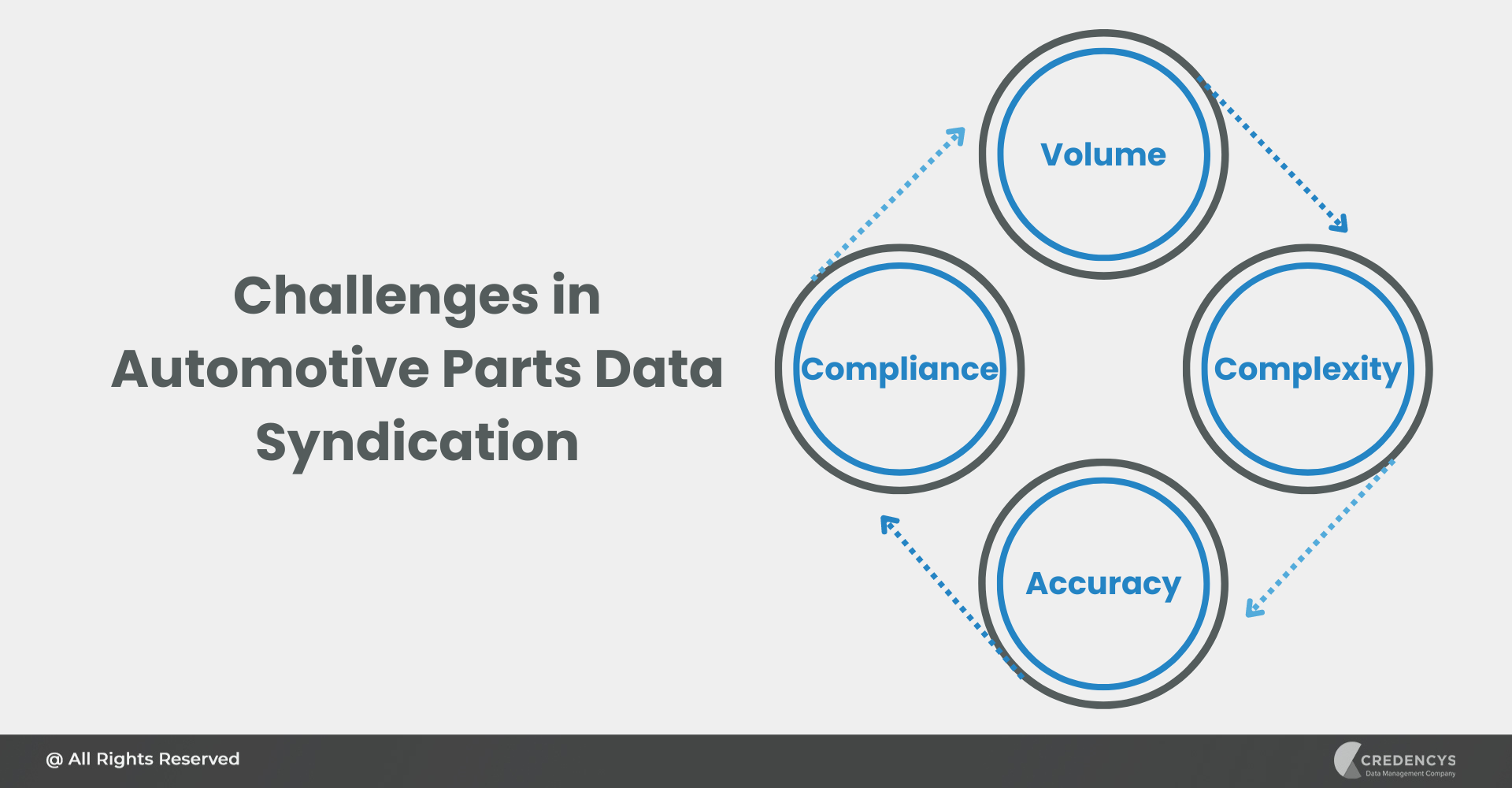
Challenges in Automotive Parts Data Syndication

The automotive parts industry deals with a highly complex set of data. Key challenges include:

  • Volume: Managing thousands of parts with distinct specifications.
  • Complexity: Handling detailed information such as part numbers, vehicle compatibility, and fitment data.
  • Accuracy: Ensuring data accuracy across all platforms to avoid errors in part selection.
  • Compliance: Adhering to industry standards like ACES (Aftermarket Catalog Exchange Standard) and PIES (Product Information Exchange Standard).

Challenges in Automotive Parts Data Syndication

These challenges make manual product data management highly inefficient, which is why automated syndication using a PIM system is a much more effective solution.

Key Benefits of Product Data Syndication Using PIM for Automotive Parts

Using PIM for product data syndication in the automotive industry offers numerous benefits, some of which are critical for success in a competitive market:

1. Enhanced Data Accuracy and Consistency

Ensuring that product information like part numbers, descriptions, and fitment data is accurate across all channels helps reduce errors, returns, and customer dissatisfaction. With a PIM system, businesses can maintain consistency in product data, which leads to better trust and reliability.

2. Faster Time-to-Market

By automating the syndication process, a PIM system accelerates the distribution of new product data to multiple sales channels. Automotive parts manufacturers and retailers can introduce products faster, giving them a competitive edge.

3. Improved Customer Experience

Accurate product data is directly tied to customer satisfaction. Customers are more likely to make a purchase if they find reliable, detailed, and consistent information about the automotive parts they need.

4. Reduced Operational Costs

Automating product data syndication reduces the need for manual processes and minimizes human errors. This, in turn, reduces costs related to data management, corrections, and product returns due to misinformation.

Role of PIM in Automotive Parts Data Management

A PIM system allows businesses to manage all product-related data in one place and distribute it across multiple sales and marketing channels without manual intervention. This centralization helps streamline operations, ensure data accuracy, and enhance the overall customer experience.

Key Features of PIM for Automotive Parts

A PIM system offers several features tailored to meet the needs of the automotive industry. These features are designed to handle the complexity and scale of automotive parts data:

  • Customization: PIM systems allow users to customize product information based on different sales channels and regions. This is particularly useful in the automotive sector, where parts may need different descriptions, prices, and attributes depending on the market.
  • Taxonomy Creation: Automotive parts need a well-organized taxonomy, especially with complex relationships such as fitment data (i.e., which parts are compatible with specific vehicles). PIM systems help create and maintain this taxonomy.
  • Data Enrichment: PIM tools enable businesses to enrich their product data by adding more detailed specifications, images, and descriptions. This helps improve the quality of product information across platforms.
  • Multi-Channel Distribution: A PIM system automatically syndicates product data to multiple channels—be it an e-commerce platform, a marketplace, or a dealer network.

Key Features of PIM for Automotive Parts

These features ensure that automotive businesses can efficiently manage the vast amount of data they deal with, minimizing errors and improving data accessibility.

Traditional Methods vs. Automated Syndication Using PIM

Traditionally, automotive parts data was managed manually through spreadsheets or standalone systems. This method was prone to errors, inconsistencies, and time delays, making it difficult to keep data synchronized across channels.

In contrast, a PIM system automates this process by:

  • Centralizing data from different sources.
  • Automatically syndicating it to relevant sales channels.
  • Maintaining data consistency across all platforms.

This automation reduces the risk of errors and ensures that updates are made in real-time, improving overall data accuracy and operational efficiency.

Common Pitfalls to Avoid in Automotive Product Data Syndication

While using a PIM system can greatly improve product data syndication, there are a few common pitfalls to be aware of:

1. Inconsistent Data Formats

Failing to standardize data formats across all channels can result in inconsistent information being displayed. It’s essential to ensure that product descriptions, part numbers, and specifications are uniform across platforms.

2. Underestimating Data Complexity

Automotive data can be highly complex, with thousands of SKUs, fitment data, and regional variations. It’s crucial to invest the time to properly set up and manage data within a PIM system to avoid issues in syndication.

3. Lack of Continuous Monitoring

Just setting up product data isn’t enough. Regular monitoring and updates are necessary to ensure that data remains accurate and consistent across all platforms. PIM systems allow for real-time updates, but it’s important to leverage this feature actively.

Conclusion

The complexity of the automotive parts industry makes efficient product data management essential. With increasing demand for accurate, consistent, and up-to-date product data, PIM systems have become indispensable.

PIM ensures that manufacturers and retailers can streamline their operations, reduce errors, and meet the expectations of modern consumers. For automotive businesses, this translates into improved efficiency, better data accuracy, and a faster time-to-market.

For any business dealing with automotive parts, investing in a PIM solution is not only a smart move but also a necessity for future growth and competitiveness.

Pimcore for Jewelry Businesses: The Best PIM Solution to Stay Competitive

The jewelry industry is witnessing rapid changes and is becoming more competitive than ever. Staying ahead in this industry requires much more than just beautiful designs.

Consumers now expect personalized experiences, detailed product information, and seamless shopping journeys.

80% of jewelry shoppers prefer detailed product information before making a purchase.

However, these trends bring challenges which include ensuring that your product information is accurate, detailed, and readily accessible across all channels. This is where a PIM comes into play.

Role of PIM Systems in the Jewelry Business

PIM systems are transforming the way jewelry businesses operate, offering a centralized solution for managing vast amounts of product data. By integrating a PIM system, jewelry businesses can not only enhance their operational efficiency but also provide superior customer experience, which are the two key factors in maintaining a competitive edge.

Key Functions of a PIM System

A PIM streamlines the collection, organization, and distribution of product data across various channels, ensuring consistency and accuracy. Key functions of a PIM system include:

  • Centralization: Collects product data from various sources and stores it on a single, accessible platform.
  • Organization: Categorizes and structures product data, including descriptions, specifications, images, and pricing.
  • Distribution: Automatically updates and synchronizes product information across all sales channels, from eCommerce sites to physical stores.
  • Customization: Allows for easy modification and updating of product data, tailored to different markets and customer segments.

How Does a PIM Work

By implementing a PIM system, jewelry businesses can reduce the time and effort required to manage product information, while also minimizing errors and inconsistencies.

Key Reasons Your Jewelry Business Needs a PIM System

1. Accelerating Time-to-Market for New Collections

In the fast-paced jewelry market, getting new collections to the market quickly is crucial. A PIM system helps by:

  • Speeding Up Product Launches: Streamlining the process of adding new products to your catalog and ensuring they are quickly available across all sales channels.
  • Facilitating Real-Time Updates: Allowing for immediate changes and updates to product information, ensuring that all platforms are always up to date.
  • Responding to Market Trends: Enabling faster adjustments to product offerings based on current market demands and consumer trends.

2. Streamlining Product Data Management

Managing product information can be daunting, especially with extensive inventories that include various metals, gemstones, and designs. A PIM system simplifies this process by:

  • Simplifying Updates: Allowing quick and easy updates to product information, ensuring that all channels reflect the latest details.
  • Automating Data Entry: Reducing manual work and human error by automating data input and updates.
  • Ensuring Consistency: Maintaining uniformity in product descriptions, images, and other data across all platforms.

3. Enhancing Customer Experience

Customer expectations are higher than ever, especially when purchasing luxury items like jewelry. A PIM system enhances the customer experience by:

  • Providing Detailed Information: Ensuring that customers have access to comprehensive and accurate product descriptions, enhancing their decision-making process.
  • Supporting Personalization: Allowing for the creation of personalized product recommendations and marketing campaigns based on accurate data.
  • Enabling Omnichannel Strategies: Ensuring a seamless shopping experience across all touchpoints, whether online or in-store.

Competitive Advantages of Implementing a PIM System

1. Supporting Global Expansion and Multi-Channel Retailing

Expanding into new markets and managing multi-channel retailing presents unique challenges. A PIM system supports these efforts by:

  • Scaling with Your Business: Allowing your PIM system to grow alongside your business, easily accommodating new products, markets, and channels.
  • Maintaining Consistency Across Channels: Guaranteeing that customers receive the same information and experience, no matter where they shop.
  • Handling Multi-Language and Multi-Currency Needs: Ensuring product information is correctly translated and priced for different regions.

2. Gaining Insights and Analytics

In today’s data-driven world, insights are crucial for success. A PIM system provides valuable analytics by:

  • Optimizing Product Offerings: Using data-driven insights to refine and optimize your product catalog, ensuring you meet market demand.
  • Tracking Product Performance: Monitoring how different products perform across various channels, helping to identify best-sellers and underperformers.
  • Understanding Customer Preferences: Analyzing customer behavior and preferences to inform product development and marketing strategies.

3. Improving Operational Efficiency

Efficiency is key to staying competitive. A PIM system enhances operational efficiency by:

  • Ensuring Compliance: Helping to maintain regulatory compliance by keeping product information accurate and up to date, reducing the risk of legal issues.
  • Enhancing Collaboration: Facilitating better communication and coordination between different departments, such as marketing, sales, and product development.
  • Reducing Manual Work: Automating repetitive tasks, freeing up time for more strategic activities.

Competitive Advantages of Implementing a PIM System

Why Pimcore is the Ideal PIM Solution for Jewelry Businesses?

Pimcore stands out as a leading PIM solution for the jewelry industry. Here’s why:

  • All-in-One Platform: Combines PIM with Digital Asset Management (DAM), Content Management (CMS), and Customer Data Platform (CDP) functionalities, providing a comprehensive solution.
  • Cost-Effective: Being open-source, Pimcore offers a cost-effective solution with no licensing fees, making it ideal for businesses of all sizes.
  • Customization: Pimcore can be tailored to suit the specific needs of your business, from custom jewelry to large-scale retail operations.
  • Rich Media Management: Efficiently handles images, videos, and 3D models, allowing you to showcase your jewelry in the best possible light.
  • Advanced Product Attributes: Manages complex product attributes like metal types, gemstones, and certifications, ensuring detailed and accurate product descriptions.
  • Open-Source Flexibility: Pimcore’s open-source nature allows for extensive customization, ensuring the system meets your specific business needs.
  • Flexibility: The platform’s flexibility allows for easy adaptation to the unique requirements of the jewelry industry.
  • Multi-Language and Multi-Currency Support: Easily manages global product information, helping you expand into new markets with ease.

Conclusion

In the competitive world of jewelry retail, having a robust PIM system is no longer a luxury, it’s a necessity. A PIM system not only streamlines product data management but also enhances customer experience, accelerates time-to-market, and provides valuable insights for better decision-making.

Pimcore, with its flexible, open-source platform, stands out as an ideal PIM solution for jewelry businesses of all sizes. By adopting Pimcore, you can ensure that your product information is always accurate, consistent, and tailored to the needs of your customers, helping you stay ahead in a fast-evolving market.

Meet Credencys Solutions at AAPEX 2024!

AAPEX 2024, one of the largest events for the automotive aftermarket industry, is around the corner. This annual event brings together industry leaders, innovators, and professionals from across the globe to showcase the latest advancements and trends in automotive technology and services.

Credencys Solutions, a leader in data management and PIM solutions, is excited to participate in AAPEX 2024. At this booth, attendees will have the chance to dive deep into Credencys’ innovative offerings, including their specialized solutions designed to meet the unique needs of the automotive aftermarket.

Credencys at AAPEX 2024

Credencys has established itself as a trusted partner in data management, offering solutions that empower businesses to harness the full potential of their data. The expertise of Credencys in the automotive aftermarket helps companies overcome challenges related to product information, customer data integration, and operational efficiency.

DRIVE – #1 Aftermarket PIM

Credencys will showcase DRIVE, its cutting-edge data management solution designed specifically for aftermarket parts manufacturers. It offers a comprehensive approach tailored to the needs of aftermarket businesses.

DRIVE streamlines the management of complex parts and components data across diverse industries. It ensures regulatory compliance and seamlessly integrates with leading eCommerce platforms.

Whether you’re selling to retailers or directly to consumers, DRIVE provides powerful data management capabilities and scalable solutions to meet your business needs.

What to Expect at the Credencys Booth?

Visit Credencys’ booth for a firsthand look at the future of data management in automotive technology. You’ll have the opportunity to:

  • Experience Interactive Demonstrations: Witness their all-in-one solution through engaging demonstrations highlighting its capabilities.
  • Explore Credencys’ Solutions: Discover the latest technological advancements and learn how their solution can benefit your business.
  • Consult with Experts: Get personalized advice and answers to your questions from their knowledgeable team of experts.

Stop by the Credencys booth and stand a chance to win some exclusive giveaways! Additionally, Credencys is hosting a special raffle contest, and the lucky winners will win BIG!