Augmented Reality Goggles For Skiers: The Future Ahead!

For adrenaline junkies, skiing is bliss!

It thrives them when they descend off from mountains.

In a heavy dose of rainfall or harshest conditions, navigating resort or tracking your friend with a map in a hand ruins the real fun of the sport.

Even sometimes, glasses gets fog up that leads to major accidents.

It’s really upsetting.

Augmented reality goggles can help in bringing back the thrill of sport even in extreme weather.

Deploying augmented reality, smart glasses are developed which allow skiers do everything without taking phone out of the pocket in their field of vision.

It seems fascinating!

Anti-fog Smart goggles can make this happen just at a glance away.

They are made especially for tough environmental conditions to remove all the hurdles that are worsening the pleasure of sport.

What is augmented reality goggles?

Augmented reality goggles or smart goggles look like snow goggles that enable the user view virtual information like- audio, video, or images over real-world information in real-time.

After wearing smart goggles, one can easily interact with the distant friends without wasting time in hunting them.

Different skiing smart goggles vary as some are controlled with eyes while some with a remote on the glove.

Let’s take a look at the advantages sports person’s best companion- Augmented snow goggles brought.

Get Instant information

Keeping the group together on the mountain during skiing is a hard nut to crack. Plus, tracking and locating different point of interest like- resort, lodges and more increases the difficulty of skier.

Using mobile app to track friend’s position or navigating different places along with gliding on snow is not enjoyable.

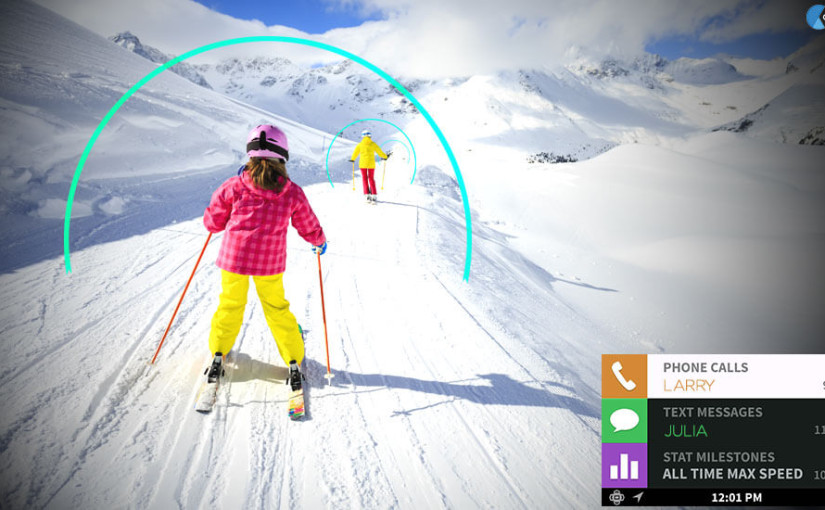
Smart snow goggles display required information in their field of view. Viewers can see the maps, find a way around and also view their friend’s position relative to the resort’s position dynamically.

Get connected without lifting a finger

In snowy winter, taking the gloves off and using mobile phone to listens songs, sending message or make a call set one’s teeth on edge.

Here, smart goggles would come to their rescue that enable calling, text messaging, sharing on social media or streaming music with gloves on.

The goggles are connected to smartphones via Bluetooth or Wi-fi and wearer can view the text messages, attend the calls and change the music playing on phone. New generation heads-up-display keep your phone safe, be connected and in control.

Track your performance

Measuring how good you are performing is nearly impossible without taking help of any guide. In addition, hiring a guide also costs pretty penny.

Snow goggles’ onboard GPS and sensors check every move, jump, run and turn the skiers made with high accuracy. One can detect the speed, distance, altitude they covered.

All the data is recorded and maintained to determine highest score and achievements of all the time. It can be shared with friends as well.

Play with yourself

Smart goggles supplement the fun of skiing on mountains by creating a virtual game play that only user can see and play.

Goggles create a virtual slalom track which remains visible to the wearer only and they can follow shadow of their favorite ski athlete.

The amazing game play engages the wearer and lets them compete against themselves or friends.

Wrap-up

Technology has gone an extra mile to whip-up the sports fans. It has not only helped in overcoming all the obstacles but enriched the skiing experience.

Some of the tech leaders leveraging the potential of augmented reality built augmented reality snow goggles like- Recon Snow2, Rideon, Oakley Airwave, Zeal Optics and pretty more.

Well, the possibilities to design new apps on these smart glasses are endless.

This knocks the opportunity at the door of developers to show their creativity and craft solutions which were never imagined before.

Here, at Credencys, the brilliant team of expertise is tuned up for building such smart snow goggle applications.

Get one solution built right away.

And, enjoy hi-tech snowboarding with AR goggles!

Leap Motion: The Technology That has Transfigured Health space!

Healthcare industry has experienced the pinnacle of innovations!

The seismic shift has occurred in the way operations are done, patients are treated, medical information is stored and yet, new inventions are on-the-go.

Medical technology and biotechnology are currently worth around £255 billion to the UK and the market is growing 10% every year

Today, operation theaters are equipped with all advanced equipment, tools, and machines required for the operation.

But, controlling all the machines like- CT scan or MRIs with hands, once physician initiated the surgery is nearly impossible unless they scrub-in in between.

And, if practitioner dares, then a little time gap and distraction may put patient’s life at stake.

That’s where the new wave of technology – LEAP MOTION comes in.

The technology provides a touchless interface to the user that is controlled by gestures. It allows people interact with computer via sensation of hands.

Leap motion controller is a piece of hardware, which is connected to the computer that tracks the movement of hands to one-hundredth of millimeter with a 150-degree field of view.

Harnessing the power of 3D technology, surgeons can use their hands in lieu of mouse.

Let’s take a glance at the potential applications of motion-tracking technology

Operation theaters become hi-tech

During the complex surgeries, surgeons are required to review and manipulate the important images before and during the surgery. It helps them to perform the operation with a great precision and accuracy while keeping patient’s safety.

For instance, while cardio surgeries, physicians have to repetitively view the implications of every step they are taking.

Plus, before taking the next step, they prefer to do that first virtually on the screens, but frequently taking gloves out is not advisable as it kills good amount of time.

Sterility concern limited the intra-operative use and manipulation of digital radiography.

Integrating leap motion in the operation theatres can wipe out all the worries of surgeons. It let them interact with the images while keeping their gloves sterile with no visible latency.

Revolutionize Rehabilitation

Well, no doubt recovering from the illness or major accident is arduous task and that’s the problem physical rehabilitation centers can solve. They help patients to get recovered by assisting and providing a set of tailored exercise that they need to do daily.

However, the burning problem- 70% of patients doesn’t do their exercise at home after rehab session.

The reason behind is physical therapy lacks enthusiasm, seems boring and do not intrigue the patients at all.

The rehab sessions last for weeks and months, and costs around $600 to $1000 a day, Connors, of the Brain Injury Association of America said.

It’s very expensive to afford.

Here, leap motion would be a game changer that gamifies the exercises and make them more enjoyable. Also, it lets patients do the exercise anywhere and distant therapist can easily tab on and measure the performance.

Employing it therapists can taste the progress of wellness of injured ones effortlessly.

A quick look at the amazing results leap motion brought at rehab.

In addition, a child suffering from neurological disorders like Cerebral Palsy which obstructs physical and mental development of child is very tough to cure.

Using leap motion technology, games like- Poo Blaster that Credencys built allow children to play with eyes and their hands’ coordination. The score of child help in checking their health status and then, they are treated accordingly.

The final words

Incorporating Leap motion in health regime appears a bit more like a magic. Budding technology has provided a high degree of freedom into the hands of practitioners and therapists.

Fascinating tech has the wider scope and will be very effective if aptly used in different segments of health space.

Maximize the benefits leveraging the enormous potential of leap motion.

If you had come across some more benefits of leap motion in the healthcare industry, then please do share in the comments given below.

Know The Pros and Cons of Using Bitcoins for Retail Space!

Bitcoin is really a tricky bubble to place the bet on!

Though tech race has fueled its adoption and the sheer number of retailers is hopping onto this bandwagon.

There is a lot of noise in the market regarding the acceptance of digital coins by the retail landscape.

Amidst several concerns like- security, charges and more, retailers struggle to decide internet-based currency is ideal to embrace or not.

However, the virtual currency has solved many problems that current payment option suffers from, but at the same time, one cannot deny the uncertainties it has put forth.

So, one should go deep down before getting their feet wet in Bitcoins.

Take a glance at the reasons that support and oppose the use of Bitcoins in retail landscape

Here are the Pros!

  • Unbeatable security

Bitcoins provide rock solid security during transactions made at any end and no fraudulent act would be possible.

Let’s see how transaction made with Bitcoins is more secured.

If Mr. James wants to transfer Bitcoins to Retailer, then

Firstly, Mr. James will inform Retailer, and then Mr. James needs to create a block that comes with a cryptographic key pair: a private key that is only retained by the Retailer and a public key for others.

Afterwards, Mr. James will tell the bitcoin client, software that mediates the transaction to transfer 10 Bitcoins to Retailer’s block. The client will transfer 10 Bitcoins to the new block.

The block can be accessed only with the private key that Retailer had and the public key for others to verify the transaction.

This way Bitcoins provide no single chance to the hackers to hack the system in any way. It will make the Bitcoins- future of money.

According to Juniper research, “Transactions via Bitcoins in retail space will double by 2017.”

Note: Retailer should use escrow services for payment transaction using Bitcoins, otherwise the transaction will remain no more secure.

  • Power cross-currency transactions

Ideally, every retailer accepts the same currency for the cross-border transactions. When the currencies are converted during the transaction, it is being said that no conversion fees is involved with foreign exchange market.

However, the truth is another way around as foreign exchange is a part of every cross-currency transaction and it incurs the cost of the conversion which adds up to as high as 10%.

Bitcoins are cost-efficient solution for the cross-currency transaction at cross-borders. They can be referred as natural payment product for the retailers across the globe and boost cross-border sale as well.

  • Low transaction rates

Truly said, money makes the world go round and when people get the same services at low or no cost, then they surely turn towards it.

And, Bitcoin comes with no exception.

Credit card companies would charge up to 3% for the transaction while Coinbase doesn’t charge anything until there is $1 million in sales. When it crosses $1 million, then it cuts just 1% only.

Low transaction fees in-person for merchants and customers enhancing its use in retail space.

For instance, Purse.io opened the bitcoin retail store in the San Francisco. The brick and mortar stores promoting the use of the currency by offering 5-20 percent discount on the items people buy using Bitcoins.

Well, using bitcoin is not all sunshine and rainbows, but there are some glaring setbacks associated with the use of Bitcoins at retail store that cannot be overlooked.

Cons

  • No chargeback allowed

Bitcoins prohibits the reversal of transaction, means no refunds are possible using this service.

For instance, if the customer made a purchase using Bitcoins from the retailer, but if the promised goods are not delivered or involved any issue, then retailer cannot send back the money.

However, the lack of chargeback option in Bitcoins turns out to be an appealing alternative for the retailers as according to Total Systems Services, credit card chargeback cost U.S. retailers an estimated $15 billion a year.

  • At the time of tax filing

As, uptill no government body accepts bitcoin payment, so tax filing process would be a bit murky for the retailers using bitcoins. It includes complicated conversion of bitcoin into the currency, fluctuating value of Bitcoins and federal income tax confusions.

Merchants need to convert bitcoin-based earning to local currency and should accurately track all bitcoin transactions.

Plus, at the time of tax filing, real time exchange rates of Bitcoins are considered and if the market is down, then the merchant will be at loss.

  • Impossible to retarget the customer

With credit card payment, retailers can get some information about the buyers and using that they can approach the customer again, but this opportunity is impossible with Bitcoins.

Retailer embracing Bitcoins would not be able to glean any data as it discloses no information about the customer during the transaction.

Is this the future?

Bitcoin is aimed to make buying and selling goods faster, safer and more convenient. Trading with virtual currency has big potential, but it swings in both directions.

Know more about the bitcoins, here.

Well, the alternative currency has started gaining momentum but is still far away from the mass adoption.

Recently, LazyCoins demoed their killer Bitcoin app LazyPay at the BitcoinExpo 2015 and debuted Bitcoin use a part of everyday life.

This all are the flurry of ideas roaming around the retail space across the globe.

Have you ever used Bitcoins? What do you think; bitcoin will create a new horizon in your business or turn away your customers? Share your views in the comments given below.

Mobile Surveys: It’s time for brands to know what customers really want or vanish

A UN Report recently stated that 6 out of the world’s 7 billion people have mobile phones. Hand-held devices are certainly outselling PCs and laptops.

Now, this has some serious implications for brand marketers. Mobile Marketing is something that has now become an integral part of any brand’s promotion strategy.

Brands, can, however ignore the mobile space but only at their own peril.

THE FACT IS :
Customers want brands to be present in the mobile world

Your competitors are constantly seeking new ways to reach more customers and retain existing ones. And, there’s no better way than being present on their mobile devices to catch their attention.

Infact, 35% of market retailers feel that they can differentiate their position in the consumer marketplace using mobile.

So, going mobile is just not a choice but mandatory if you want your brand to be alive.

Mobile surveys, have, recently seen a lot of interest from marketers. And, why not! These allow you to get rich insights about customers including how they behave, what kind of products and services they like and what’s the best time to send promotional messages to them.

These surveys aren’t just about answering a few questions on mobile devices. There’s a lot more to these. How are these actually conducted? What’s the kind of technology that’s used to make these surveys more impactful?

Let’s explore!!

Geo-Fencing: Taking your mobile surveys to a new level

Geo-fencing, if you think about it, is self-explanatory. Forget the word geo for a second and think what fence means. It means a boundary.

So, as a marketer, you can create virtual fences (in terms of longitude & latitude) in specific areas depending on your requirements. Once a customer (having your brand’s mobile app installed in his/her own device) enters that fence, a push notification/message gets triggered on his/her device.

Acting as a virtual barrier, Geofence is a feature in your application that uses the Global Positioning System (GPS) or Radio Frequency Identification (RFID) for defining geographical boundaries.

The geo-fencing feature is mainly used by marketers to send alerts on promotions like discount schemes to deliver highly targeted, personalized messages. These messages/alerts are sent by native messaging services.

Why implement these surveys?

Geo-Fencing based Mobile Surveys offer many advantages like:

  • Get feedback in real-time from your customers. This is especially helpful in restaurants and cafés. The feedback helps you improve on product offerings and services.
  • When you are able to get a customer’s shopping insight you are able to gauge their preferences better. This helps tailor your marketing messages in accordance with your customers’ liking.
  • Moreover, the kind of data that you get in real-time is simply a gold mine. It helps you make better business decisions too.

How do the surveys work?

You can easily create location aware surveys to conduct advanced research studies on your customers.

As an administrator, you can define a geographical boundary from the back-end of the application and trigger proximity-specific alerts when customers enter the pre-defined venue or area.

These surveys can be activated and deactivated depending on your need. You can even tag locations as customers move around a specific area/region.

Real World Examples

A major sporting organization used TolunaMobile™ Diary app (App by Toluna, a leading market research panel technology provider) to conduct real-time polling for gauging audience’s interest and preference in the midst of a sporting event’s interval time.

A food outlet conducted a similar survey to gather menu board feedback from customers once they are in-store. Customers could comment on their offerings, all in real-time and even upload photos for validating menu presentation and pricing.

Tips for success

Implementing geo-fencing based mobile surveys can be tricky. Keep in mind these points before planning such surveys.

  • Make sure that the virtual fence you create for your survey is between 50-100 feet for best results.
  • Considering the length of the survey is equally important. Too lengthy survey can dissuade your customers to complete the entire survey. Keep maximum 10 questions in your survey. Also, give no more than 7 answers to choose from.
  • Keep the size of your question to the size of a tweet (140 characters).
  • Don’t forget to reward your customers for their valuable time. Give reward points or similar another incentive for participation.
  • Respect their privacy and ask for their consent before the survey starts. Don’t divulge personal information and keep it safe and protected.

Conclusion

Research studies state that consumer expectations increase on an average 20% every year. However, brands fulfill these only upto 5%. This implies a huge gap but equally presents an opportunity also for every brand. Geo-fencing based mobile surveys can help you bridge this gap phenomenally with real-time insights and rich data.

Incorporate mobile surveys in your market research activities to understand your customers better and deliver an awesome experience to them.

3 Retailers That Gained An Extra Edge Using Bitcoins

Society is going cashless!

In the USA, only 7% of transactions are made with physical cash.

Don’t be too surprised!

Increasingly popular plastic money like credit cards, debit cards, gift cards and loyalty cards eliminating the transactions made through actual cash.

However, these cards also had some downsides. It involves the risk of fraud, optimum processing fees and pretty more.

So, what’s the solution?

That can keep transaction mechanism more safe, accessible and seamless.

BITCOINS, the decentralized cryptocurrency is the panacea!

The global digital currency worth eight billion dollars market value is reinventing the payment transaction world.

And now, it is catching many retailers’ eye.

According to Juniper research, 8% of the North American Retailers will begin accepting Bitcoin as full means of payment in 2015.

Let’s understand first, what is Bitcoins?

Bitcoins are a kind of digital coins that are not created by any bank, government or financial institution, but regulated by open-source software. The virtual currency can be exchanged through direct peer to peer transaction over the internet.

Bitcoins can be purchased or sold using different currencies through various bitcoin exchanges.

The Bitcoins are stored in digital wallets (virtual bank accounts) that are on the user’s computer or cloud location.

Thumb through the PPT to know more.
Also, the rate of virtual money fluctuates in the market depending on the number of Bitcoins in circulation.

Take a quick look at three retailers who stretch their reach to bitcoins

  • Overstock.com

The US-based leading online retailer Overstock.com that sells everything right from jewelry to furniture was surprised with the amazing growth in sales after accepting bitcoins.

Within 24 hours of the announcement, retailer had made $130,000 in Bitcoin sales spread over 840 orders from new customers. And, now its daily earning is $15,000 a day from bitcoin sales alone.

Overstock was the first to exceed $1 million in online bitcoin sales and saw 50% increase in sale after embracing the digital currency.

Overstock CEO Patrick Byrne said, “We are expecting jaw dropping $8 million sales with the digital currency by the end of the year.”

  • TigerDirect

Florida-based Tigerdirect, computers and consumer electronics e-retailer has taken the interest not only in using bitcoin as payment option but also sold bitcoin mining product on its site.

The retailer has brought in whopping $250,000 worth bitcoin payment just in the matter of 17 hours. It comes with a greater surprise when company broke the $1 million mark of Bitcoin sale in only three months.

Now, 80% of TigerDirect’s Bitcoin users are new customers, and they spend more per order than customers using traditional payment methods.

  • Newegg

Computer hardware and software e-retailer was partnered with Bitpay to roll out its transaction using bitcoins and allowed its customers to pay for more than 10.5 million products with virtual currency.

As, no chargeback is possible using bitcoins, so retailer declared that orders will be paid by Bitcoin, but cannot be returned for Bitcoin or hard currency. Instead, returns can be made to the consumers in the form of a Newegg Gift Card.

Well, no such number of unprecedented sales is disclosed by the firm, but Soren Mills, the company’s chief marketing officer said, “We’ve doubled our run-rate over the last three months. Bitcoin has brought us some new customers. It’s got a group of people that it’s really important to.”

Outlook

The digital currency has made a huge room in the market and more retailers are jumping on this bandwagon. The e-retailers who chased the digital spark are really paying off.

Widespread adoption of Bitcoins would be a game-changer for the firms.

The success story of online retailers shared above reveal the same fact.

Though, it’s not true bitcoins will always work like pro.

As, there are pros and cons associated with the potential use of bitcoins in retail space. In our next series, we will discuss the reason to favor and oppose the use of this cryptocurrency. So, keep in touch with us.

5 Ways Apple’s ResearchKit is Empowering Medical Research

It’s impossible to imagine clinical trials without humans. To introduce new drugs into the market, it’s imperative to test their effectiveness on humans.

However, this is easier said than done.

The challenge lies in finding volunteers who will risk their lives to see whether a particular drug is impactful or not.

According to Center Watch, 86% of US clinical studies fail to recruit the required number of subjects on time.

Professor Kathryn Schmitz from the University of Pennsylvania recently sent about 60,000 letters for participation in a breast cancer study.

Only 0.005% signed up.

That’s heartbreaking.

This is not something new for researchers and scientists. It has been going on for decades now.

Fortunately, this is also set to change. Thanks to Apple’s new baby ResearchKit.

This open source platform for medical research will make it easier for scientists to build apps that collect health-related data from volunteers via smartphones.

The sensors in iPhone and similar other devices (personal trackers) act as catalysts. Apps built using platforms like ResearchKit will deliver real-time data on health conditions and symptoms. This will help in clinical trials and developing custom therapies for various ailments.

Researchkit taps into the pool of data generated by Healthkit and making it accessible for medical studies.

Healthkit is Apple’s another platform for developers to build apps that gather health related data from healthkit compatible apps which track heart rate, calories burnt, blood sugar and cholesterol levels etc.

Learn more about HealthKit here.

Here’s how ResearchKit will revolutionize the medical research space

  • Access to Precise Data

In traditional researchers, researchers don’t have any proof of accuracy other than the snapshots of a participant’s health who wears a heart monitor for two or three times during a 24-hour period.

Also sometimes participants don’t provide correct data because of financial compensation issues.

While using iPhone, researchers may have more accurate data as ResearchKit the leverages the advantages of HealthKit to collect information on heart rate, activity level, and more in real-time

It also helps scientists avoid incurring extra money that needs to be paid to participants to extract right information.

  • Reduce The Research Timeframe

Well, moving to different hospitals or labs, and then completing the paperwork is very time-consuming process for a large-scale research. Moreover, it’s quite difficult to reach the large user base and collect data in less time.

Apps built using ResearhKit allow people to take part anytime, anywhere. The device (iPhone or iPad) is virtually in their pocket and they can volunteer easily.

Also, when it becomes easier to participate in the research, automatically larger sample sizes can be available.

LifeMap Solutions and Mount Sinai Icahn School of Medicine recently joined hands for a research. Using the Asthma Health App developed with ResearchKit, they ensured that over 3500 people participated in their research study in less than 72 hours. This, otherwise, would have been impossible.

  • Enable global research

Conducting the research across the globe is tricky. At many places, due to some restrictions or unfavorable conditions, participants won’t step in for clinical study.

With ResearchKit, geography and distance matter no more. Anyone, anytime and anywhere in the world can provide health-related data concerning specific problems or symptoms.

Also, the data from such apps helps researchers in understanding lifestyle and health behaviors of different people and its influence on their life.

  • Take actions swiftly

Medical research takes a long time to establish any result or draw out any conclusion. In that meantime, it may be possible the cause of the disease may increase at large scale and no appropriate action can be taken.

However, with iPhones when organizations get the data and if it requires any immediate action, then using iPhone’s GPS, it will become easy to track the pathogen’s location. And finally, prompt action and timely decision can be made accordingly.

  • Personalize the treatment

Self-managing the diseases and precautions to be taken by the patients is not an ordinary job. Also, they are sometimes walled off from the critical health information by the doctors.

For instance, asthma patient can consult the doctor and take the prescriptions provided by them, but unable to track which place they should not visit because of the poor quality of air or forget to take the medicines at right time.

Here, Asthma app on iPhone would help them by analyzing the GPS data, weather, air quality, and other factors to identify a probable cause. Also, reminds about the medicine that they have to take.

Conclusion

Apple’s latest offering not only eases the research, it even helps examine the patients in a far better way. Five apps as a part of Researchkit have already gone viral.

Well, there are many more possibilities yet to be discovered!

At Credencys, a proficient team of developers has expertise in crafting iOS apps and dealing with advanced technology, latest SDKs, APIs and much more.

Get ready to add new dimensions to your research with us!

Mbaas: The major Breakthrough in Enterprise Mobility!

Mobile is a digital tipping point for businesses!

And, now it’s become the hallmark for the enterprise services.

85% of organizations allow employees to bring their own mobile to work, predicted by IDG research.

The custom mobile application has added a new frontier in the enterprises.

According to Forrester research, 53% of work-related information is accessed by the employees with their own personal devices.

As, more people living in the mobile moments demand enterprises to make mobile apps out of the door today, not tomorrow.

“We are moving to a world where mobile is driving cloud adoption in the enterprise. So IT is looking for a cloud-based service that the line of businesses can use and consume in a completely self-service fashion.” — Kinvey

Developing and deploying the mobile apps quickly that also align with business requirements is very difficult.

Plus, the investment in mobility apps needs to be done in a strategic way as it will be liable to bring top line revenues.

Also, enterprises need to ensure that mobile app can be easily connected to back-end app & data services, secured, and pretty more.

The core premise

A lot of time and resources are wasted in arranging and maintaining this infrastructure.

So, is there any solution?

Yes, MBAAS perfectly fits the balls!

MBaaS- Mobile back end as a service meet the goals and addresses all concerns in an optimized way.

Take a glance, what MBaaS is?

Well, it works much like its full form and makes handling of back-end handy.

It is a specialized solution that provides pre-built APIs, custom SDKs, cloud-hosted components for developing the mobile app backend.

Highly scalable and innovative services enabled to store and link the applications to a backend cloud infrastructure with feature rich in data synchronization, push-notification support, user management and file-handling.

Doesn’t it sound like a fairy tale?

Yes, it is.

Before the enterprise could have even started designing any strategy for the mobile solution, the entire back end is ready. Moreover, MBaaS can be architected to create cross-platform native app seamlessly.

According to MarketsandMarkets forecast, the MBaaS market will be worth $7.7 billion by 2017, up from $216.5 million in 2012.

Now, let’s see how MBaaS can be a game changer for the enterprises to implement mobility solutions effortlessly

Making app development agile

In today’s competitive environment, enterprises are going mobile to prove their worth in the niche market.

Worth mentioning, enterprises are more focused on business needs and want to deliver the same experience to the customer quickly.

But during the development process, developers are left with no choice and have to use the specific tools, and deal with unfamiliar tool, API or SDK.

However, MBaaS create a great deal of freedom for enterprises by letting developers to choose any app development platform that organization team have expertise in.

It maximizes the flexibility and minimizes the time team take to deliver the mobile app that finely tuned with business needs.

The unparalleled technical tool turns out to be finest fabric of all businesses.

Presently, many applications depend on the MBaaS platforms provided by Kinvey, salesforce.com, Microsoft Azure and Parse.

More focus over UI/UX

Every enterprise creates more emphasize to have mobile app with an out-of-box User interface and user experience.

From the business perspective, it’s true, but when it comes to development part, the idea is put off.

Why?

Developers get into the weeds of back-end infrastructure. It demands huge effort and time, and team race against the clock to finish the task. Consequently, adjustments are made on UI/ UX side.

Leveraging MBaaS vendor, developers don’t need to manage cloud-based database, push notification server and user management system. Plus, the uptime and scalability of the backend is also handled by MBaaS.

Adoption of this platform will make the enterprises thrive as team can give more attention to the UI and UX.

Complexity of development Reduced

Application development leads to deal with complex server side programming, redundancy in creating back-end code blocks, integrating features and pretty more issues.

Deploying MBaaS require a little coding and maintenance as majority of the logic is available within native SDKs.

Moreover, for the app engineering across cross-platform using MBaaS become quite easy as it generates dynamic SDKs with custom object classes, native data caching, documentation, and test scripts.

Speed up app delivery

For the development of either cross-platform or native app, the core components or infrastructure have to keep in place that would require a good amount of time.

The total time it takes to develop the solution sometimes, reduces the value of the app over the period of time.

For instance, enterprises before building any strategic rationales analyzes the POC (Proof of concept) of the solution, but if the same POC will take months to build, then how long the whole strategy implementation and app crafting will take.

Instead, if in this mean time, technology changes and consumer demand altered, then the built solution will be of no use.

Here MBaaS would come to rescue. MBaaS makes the app out of the door swiftly along with robust security and scalability.

Conclusion

The landscape is changing by minutes; no enterprise can operate or reach out millions of customers without mobile. Instead, building enterprise solutions is not enough, while developing mobility app in an agile way and with secured back-end is of utmost importance.

MBaaS is the top line platform that mobilizes the organizations in an agile way and eases development process.

Leading enterprises are increasingly embracing the MBaaS to built apps quickly and connect to all back-end app and data services easily.

Make MBaaS, the DNA of your enterprise today!

Real – Time Marketing with Wearables: The Secret to Attracting Your Distracted Prospect

Ever since Sergey Brin’s Ted Talk on Google Glass hit the web, wearables have become the most talked after technology. And why not?

Swedish Market Research Firm Berg Insight predicts that the wearable shipments will hit 168 million units by 2019.

Technology has always made our lives better, hasn’t it?

While 2014 saw half of the world talk about Wearable, 2015 will be the year of mass adoption. Whether it is smart glass, smart watch or a clothing accessory, wearable will have a dominating presence in our lives this year.

Back in 2012, the wearable market was valued at around USD 75 million but come 2018 and the market will explode to a whopping USD 6 billion.

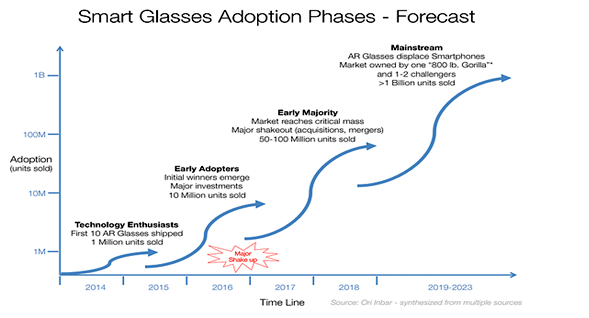
If we talk about smart glasses, its shipment is estimated to be around 1 million by this year’s end. At the end of the decade, the shipments are expected to cross 1 billion.

statistics

Despite the rumors that Google Glass will be dead, the shipments of smart glasses will show no signs of slowdown. Because, it’s pretty clear that whether it is an enterprise or a consumer, there will be no one who will not be impacted by this technology.

Whether it’s healthcare or real-estate, industries are gradually realizing how wearable are impacting the way they do business. And, even marketing one’s product/service is not left untouched by wearable.

To understand, how wearable will impact marketing, how one can utilize the power of wearable for real-time marketing, we will consider the Real-Estate Industry.

Going beyond Mobile Technology

Realtors and agents who have now realize the importance of having a mobile app to help prospects search their dream properties might find themselves a bit overwhelmed. For those who have just started with mobile technology, wearable technology might lead them to scratch their heads.

However, as a real-estate agent, if you want to get ahead of the pack, you should start contemplating on how you market your business differently. The hi-tech times ahead will test you brutally because just having a website or a mobile presence won’t be good enough. Plus, with prospects, today, becoming more informed than ever, you risk losing your business if you don’t stay ahead of times and become an early adopter of technology.

Getting Noticed: The Real-Estate Marketers Big Problem

With so much of competition brewing up in the real-estate market, how do you get your business/brand known to your prospects? There are countless, ruthless sharks waiting out there in the deep waters to eat your share. Remember, these are the times when your competitor’s site is just a click away. The way you market your business needs to be changed. Gone are the days, when you would just sit in your office and expect prospects to come over, inquire and buy properties. A little arrogance from your side, and your business goes to the graveyard.

The way your prospects feel when they interact with your brand matters the most. The way you make them feel about upcoming properties determines whether they will buy or not. Remember, purchase decisions are based on psychology and emotions. Information certainly plays a role in buying but deep inside there are the wants, needs, and concerns of prospects waiting to be addressed.

The entire experience of you showing them under-construction properties is going to play a huge role in deciding whether their core needs are addressed or ignored.

So, how is wearable going to help you solve this problem?

Let’s get going and enter the 21st century of marketing your real-estate business.

Provide Contextual Intelligence

If you have been implementing mobile marketing strategies for your business, you must be aware of location-aware marketing. It involves targeted offers and advertising messages based on the user’s location and his/her preference. Apply this to wearable

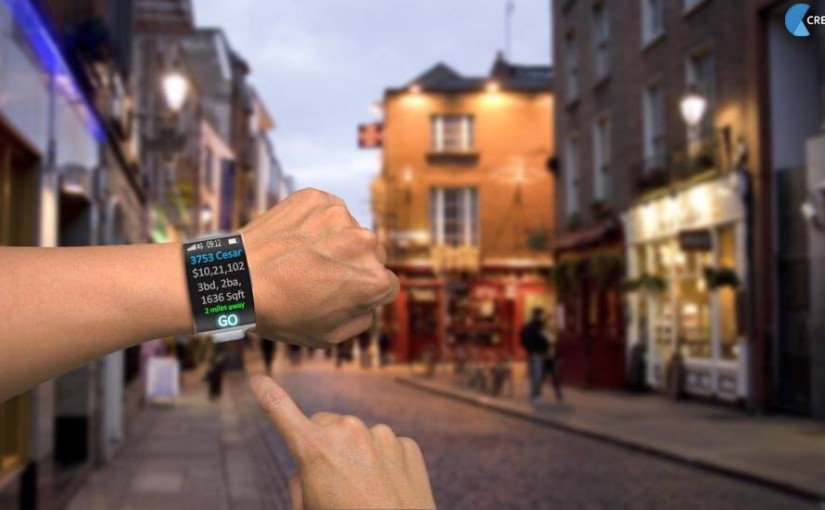
Let’s say your prospect is wearing a smart glass and has your company’s app installed on his/her device. When he/she enters a particular area, targeted information can be sent on the device relating to houses that are available for sale in that specific area based on their choice.

It’s like you have a virtual assistant with you which gives you information that’s rightly aligned to your needs.

Or consider this.

When a user steps into the area where she/she needs to purchase a property. With your app installed on glass, they can view your 30 second powerful elevator speech. It helps you deliver personalized messages to your audience as per their convenience and preference.

Trulia is a classic example of this.

The Google Glass App looks for property listings in a database, matches a user’s search preferences and renders data on the glass.preferences and renders data on the glass.

See it for yourself here.

Know Your Prospect Better

David Nichols rightly said, “If you use the standard research methods you will have the same insights as everyone else.”  Today, just tapping into the location of your prospect won’t win you games. It’s a standard practice that everyone follows. But, in order to understand and woo your prospects, you need to tap into their emotional state too. Wearables come equipped with minuscule sensors that give you insights on a user’s response while purchasing and using your product/service. Tracking such metrics in real-time will obviously help you deliver more impactful marketing messages.

Redefine your Selling Experience

Imagine this scenario. As a real-estate agent, you are wearing a glass. You get a call from a property-seller. You visit the site, take a video of the property in real-time and help evaluate its price. With glass by your side, you can create advertisements in real-time, push your messages on social media platforms with voice commands. And, all this happens in minutes as opposed to hours, wherein you go back to office, evaluate the property and send in the price details. Then, hunt for a buyer and blah blah.

Wearable like smart glasses helps you quote in real-time to a customer, reducing the turnaround time and thereby increasing the possibility of you making revenues quickly.

Road to Success

From managing and tracking your marketing campaigns to talking to your prospects and existing customers in real-time, wearable applications can turn your company’s fortunes like never before. However, the path you look to tread can be quite challenging.

The things discussed here are not as simple as they seem.

Remember, your prospects will keep you in mind, based on the initial experience you have delivered. The user experience has to be given the prime importance because if it’s intuitive and seamless, you have won your prospect’s heart and if not they will discard you without a second thought.

Beacon Technology : 3 Brands Share their Success Stories

Beacons have invaded every sphere of our lives.

You will find these in retail stores, football stadiums, airports, fashion outlets, libraries and now banks, too, have geared up for using this technology for improving in-branch experience.

The point is, Beacon Technology, is already been seen upto as the next big thing for brands that heavily rely on PROXIMITY MARKETING.

For those of you, who are not aware of this tech, head on to this article.

In 2014, 8% of US retail locations were equipped with beacon technology, according to BI Intelligence. This figure is expected to hit 32% in 2015 and 85% in 2016.

Half of the top 100 retailers in the U.S. were testing beacons in 2014. This new technology is expected to be found in 1/3 of their store locations by the end of 2015.

The beacon base in the US will consist of 4.5 million active beacons by the end of 2018, with 3.5 million of these devices in use by retailers.

Source: Business Insider

Beacon Technology is turning out to be a game-changer for multichannel retailers and fasion & electronic outlets as it allows sending custom notifications to customers while they are in-store. Now, these notifications could range from videos to product promotions to showcasing store maps.

It is even acting as a great tool to offer customized loyalty offers. Beacons help set up highly personalized messages by helping segment purchase behavior, demographics, heavy app users and returning visitors.

Here are 3 brands that are doing it RIGHT when it comes to BEACONS…

Hillshire Brands

As a distributor of cured meat products, Hillshire Brands, (in collaboration with inMarket and BPN) used the beacon technology to push notifications regarding their products and promotions to customers while they were inside the store.

And, the results were phenomenal.

The brand’s goal was to improve brand awareness for its product called American Craft Link Sausages.

There was a 20x increase in purchase intent when customers were exposed to in-store messaging on their mobile devices. It also saw over 500% increase over the CPG for average mobile ads.

The iBeacon campaign not only allowed them to improve sales, it also uplifted brand awareness by almost 36%. Studies, such as the one conducted by inMarket, clearly prove that customers are 19x more likely to engage with an advertised product in-store after receiving personalized messages.

By being an early adopter of this tech, Hillshire Brands, indeed saw huge returns coming in within a very short span of time.

McDonalds

This brand needs no introduction. We are all lovers of the BIG MAC.

The Fast Food Giant tested Apple’s iBeacons in some limited locations across Columbus. The campaign involved sending information on attractive deals via push notifications to customers who downloaded its mobile app.

The location-based message was sent once a customer came in contact with beacons. This was actually a four-week test conducted before rolling out the campaign to other locations.

The results were good enough.

McChicken saw an 8% increase in sales, where the same was 7.5% for McNuggets. There were almost 18,000 offer redemptions across the stores.

American Eagle

Back in January 2014, American Eagle Outfitters in collaboration with Shopkick installed the shopBeacon technology over 100 locations.

The initial test involved sending messages to customers when they entered into the store, which meant little incentive for visiting the fitting rooms. Subsequently, the data proved that the percentage of Shopkick users who went to the fitting room to try on clothes was more than twice for those who received the shopBeacon messages vis-a-vis for the ones who didn’t receive the message.

Offering timely rewards to customers impacted their sales significantly.

Lessons to Learn

  • Understand the nuances of implementing iBeacons. Don’t do it just for the sake of doing it. Just because your competitor rolled out the technology, does not mean you need it to.
  • Focus on improving the experience of your customers and addressing their real in-store problems. See if the Beacon Technology can, truly, help you answer the tough questions.
  • Deliver timely, contextual information that your customers are looking for. Give them what they want to see while they are in-store and you will do wonders.

Good luck

If you know of any other brand that has benefitted dramatically from iBeacons, please share in the comments below.

Top 10 Challenges of Engineering an iBeacon App

It’s handy to get a way to, say, nearest Dominos, but when it comes to navigating inside the shopping mall, GPS service won’t work.

What to do then?

How would you get the way?

iBeacons will take the charge of it by helping you navigate the indoor space hassle free!

When you step inside the shopping mall, you will be triggered about the events at the retail store, toy house, shoe store, sales rack or café promptly based on your distance from the beacons.

iBeacons- Get the inside scoop!

BLE Beacons are the piece of hardware that can be attached to the wall or anywhere and transmit messages to smartphones or tablets on Bluetooth connection. It is proximity based, so when user enters the zone of particular beacon, the message of that context is pushed to them.

Presently, iBeacon is in nearly 200 million devices around us.

Shop owners, leveraging the potential of this technology, are able to deliver an incredible experience to their customers by means of proximity marketing, frictionless payment and personalized shopping.

Remarkable technology, iBeacons is making things easier for customers.

However, developing an iBeacon app is not simple and presents unexpected challenges before a developer.

Here are the challenges that developers face for engineering an app that delivers a rewarding experience to your customers.

Frequency variance

All beacons do not have the same frequency and do not transmit signals of same power. It presents a challenge before the developers to make the beacon transmit messages to the users when they step in the proximity, even if the signals are weak.

Fluctuation in signal accuracy

Beacon signal quality is affected by weather conditions, temperature, device power and polling intervals. All this makes signal accuracy highly variable and user will not get the information when it has to be delivered.

For instance: users are getting the welcome message after completing their shopping in the shopping mall which has to be otherwise delivered when they are at the entrance.

Difficulty in tracking during triangulation

This problem arises when the three beacons are enough closer and the user comes in the vicinity of all the three. It creates difficulty for the app to find in which range user would fall and then messages are sent accordingly.

For instance, Mr. A visiting the store comes under the vicinity of these three beacons- B1, B2, & B3. Now, it becomes tricky to track that user is near to which beacon.

ibeacons process

Signal bouncing by physical space

An iBeacon app transmits signals using external radios based on proximity of the beacon. Radio waves bounce by the physical location and thereby find difficulty in detecting user’s presence.

Wi-fi creates interference

It’s not possible that one could find only one type of signal circling around the place. The spectrum band of wi-fi and Bluetooth LE is same, which may interfere with the signal. Consequently, it obstructs the context information to be delivered appropriately.

No way to check message recipiency

iBeacons are one-way radios, so no two-way communication is possible between an iBeacon and a user. It creates difficulty in knowing whether the user is getting the broadcasted message or not.

Arduous to maintain security

It is tough to maintain security because it is both hardware and software dependent and involves both physical device and authentication keys to change the settings on Beacon.

Addition of features

Developers need to carefully weigh which feature is to be kept in an app. As bombardment of so many messages will ruin the great experience, thus it’s good to push the message according to user preference and current conditions.

Avoiding identity theft

Also, when the user is notified about the list of all the users at the same beacon of matching interest, then keeping the identity of all the users confidential is essential. The major challenge is to provide the list of users with filtered data keeping the privacy of user intact.

Uploading on the app store

Make it on the app store, especially iTunes, it’s difficult for the developers to create a demo video of an iBeacon app of maximum time limit 30 seconds and of 500 MB memory.

Wrap up

Building an iBeacon app is not a run-of-the-mill job for developers as it requires them to do coding against unpredictable hardware conditions while maintaining users’ expectation and experience.

What can be done to overcome these challenges?

With the right pre-built tools, library extensions, SDKs, and APIs, developers can build an iBeacon app impeccably.

How do you deal with any such problems? And, what did you do to sort these out? If yes, then please share with us in the comments below.