eCommerce Product Catalog Management – Importance, Challenges, Practices, and Scopes

Product quality is a critical yet important factor, which determines the customer’s level of satisfaction after post-purchase from your brand. To ensure that your loyal customers keep on purchasing from your brand, you need to serve them with the highest product quality and high-quality product information.

Product quality is also one of the important contributors to more revenue and higher profitability. For higher product quality, the customer is willing to pay a higher price and something that can’t be overlooked.

What is eCommerce Product Catalog Management?

An e-commerce website contains the product name, price, description, the hierarchy of products, supplier information, product availability, and much more product-related information. Now, does the e-commerce website deal with just one single type of product? Of Course, not; the website handles thousands of different products and has millions of product-related data.

eCommerce Product Catalog Management is a dynamic process, in which products are categorized or organized in one specific way to ensure that customers get high-quality product data across all channels. With Product catalog management, your brand can deliver high-quality product data to customers in their desired format.

Why is eCommerce Product Catalog Management Important?

Product catalog management is important because it brings the below-mentioned perks for your e-commerce business.

1. To deliver a consistent and rich customer experience

Any business is incomplete without its customers. A customer can break or make the business in any way he/she wants. To keep your business away from customer’s unsatisfactory levels towards your business and to deliver a rich customer experience, you need to manage the product catalog.

The customer’s product purchase process is incomplete without an accurate product description. A customer does not entertain any factor that comes in their way to hinder this process. The accurate product description is available to customers with only product catalog management. With product catalog management, you are ensuring that your customers have rich and consistent product information.

2. Boost business expansion

Your business expansion is nothing but introducing a new product range to your business. With Product Catalog Management, you can manage new and existing products by assigning them to their respective categories.

You don’t longer need to worry about the chaos which new products may bring to your business. You can introduce new products and expand your business with ease, with the help of product catalog management. Newly introduced products will be categorized according to the state of the product, and into its respective field.

3. Categories products inefficient manner

With Product catalog Management, you can efficiently categorize products. Managing product information is a tedious task and mismanagement of product information may lead to the wrong categorization of products. This will cause trouble for your customers as they are not comfortable buying products with inaccurate descriptions.

With Product catalog management, you ensure that an accurate product description is attached with an accurate product and the product indeed belongs to the category, in which it is put forward. The efficient categorization will boost up customer’s confidence in your brand.

Challenges Of Product Catalog Management

There are some challenges, which you may face while managing your product catalog.

Involvement of Stakeholders

If the product units differ from what your supplier said and what is available in your system, then the management of the product catalog can be more complex for you to handle. The involvement of multiple stakeholders within the organization and outside the organization will be a challenging task to manage.

Usability

You might categorize the product in the way that is most suitable to your system. The same data format needs to be matched with the expectations of customers. i.e. For your customers, the usability of data could be different from the one you have managed for them. This challenge is crucial because there is no alternative to it.

Catalog Management tool

You are expected to have a deep understanding of the management tool; you must know the functions of the tool before choosing it for your business. Being a business owner, you may or may not sound with technical expertise and that is challenging itself.

Expansion of Catalog

As you expand your business, you also need to expand your product catalog. The expansion is critical because you don’t just have to manage the newly introduced products, but you also need to manage its impact on your existing product catalog system.

8 Best Practices for e-commerce catalog management in 2021

1. Create brand trust with quality product information

The first and foremost important thing for you to do is to gain the trust of your customers. You need to ensure that whatever product information you are putting forward in front of them is accurate and reliable. Accurate product information will boost up their trust towards your brand and that will encourage them to continue buying from your brand.

You can gain the trust of your customers if you are delivering what they have expected from you. To ensure that your customers don’t get roam around with inaccurate information, you need to update your data on a time-to-time basis; you need to include comprehensive information related to products, and you need to make sure that a high-quality product image is accessible to your customers.

2. Tag and categorize your digital product catalog

You can tag and categorize all your products so that your customers can browse and filter out the product. This will help them in buying the product much faster, as the product is sorted in its particular product catalog. When you tag and categorize products, keep in mind that the product tagging is for the customer’s ease.

The option of filtering the product will help your customers in the product purchase process and customers can even buy similar products from the catalog, which they might need along with their original product. Thus, you are generating revenue without pushing customers to buy the secondary product. Additional product attributes will help your customers and it will help your business too.

3. Map your catalog management process

The involvement of stakeholders will cause you to challenge the management of your product catalog. One of the ways to overcome this challenge is to map your catalog management process. While mapping, you can pinpoint the pain points that you come across in your process.

In mapping, you can have a clear understanding of the areas affected the most by catalog changes. You can know when your internal and external stakeholders are affected. The mapping process will elaborate when and how you should update your product catalog. Your mapping process will update you about the further steps that your business needs to take to attain maximum profit.

4. Upsell and cross-sell with related and alternative products

As stated earlier, once you tag and categorize your products, you are increasing the chances of product-related, secondary products getting sold along with the primary product. Thus, you are generating more revenues with minimal or no-added efforts. You are helping your customers in their crucial product purchase decision.

You are increasing your order value with upselling. In this, you are not just being biased for your benefit, but your customers are also getting the proper product, which they are going to need alongside the primary product. With upsell and cross-sell related products, you are guiding your customers in what to buy and what not to buy.

5. Easily manage your e-commerce product catalog database

For optimization of your catalog, you need to maintain a database and manage your e-commerce product catalog. eCommerce catalog management is an information catalog and you can keep a clean track of it by keeping a single source of truth for your various product catalogs. When the database is available in one single source, it is more efficient and effective.

To maintain the database safe and secure, do not forget to give authorization to concerned parties. You should also define the roles and responsibilities across all channels so there would not be any miscommunication or mismanagement of the database. When you expand your business and introduce new products, you also need to maintain and update your database accordingly.

6. Select a catalog management tool

Selecting the best catalog tools needs technical knowledge. Though, you can perform a little survey that helps you in determining a catalog management tool that fits best in your business requirement. There are many tools available in the market for product catalogs.

Based on the needs of your business, you need a management tool that takes care of your overall business activities and makes your workflow smooth. You should first examine the state of your business, the business’s needs, the complexity of the product catalog, and your future-long-term goals. Pick a tool that fits in all.

7. Personalize your B2B e-commerce product catalog

For B2B eCommerce, price and product complexity are more severe than B2C e-commerce, and that is why the need for a product catalog is more important in B2B business. When you try to provide personalized solutions to your B2B customers, then you need to keep on checking whether your personalized solutions are relevant to customer’s needs or not.

8. Balance your offline and online catalogs

If you keep track of your product catalog offline and online, then learn how to use these two as complementary to each other. Ensure that both online and offline product catalogs are going hand-in-hand.

5 Tips To Improve Your eCommerce Product Catalog

1. Choose the best category

You can’t put your product hierarchy too vast or too narrow. If you keep it too vast, then customers will not be able to reach the exact product, which they need. If you will keep your product hierarchy too narrow, then your customers will not be able to explore new products. So, choose the best category that lets your customers buy the product with minimal trouble.

2. Selling Strategies

Never bind your customers by letting them buy just one product from you, keep on suggesting to the various related products according to their products added in the cart. Make your customers buy the things, which they were not planning to buy in the first place.

3. SEO-rich content

Ensure that your content is SEO-rich and that you don’t have duplicate data. Try to keep your content unique and SEO-friendly, if you will imply the same product information on every related product; your customers are going to lose interest in a product and your brand.

4. Pruning

You need to perform the pruning process to help SEO. You need to remove or update pages that no longer fulfill your SEO requirement or are lagging in providing higher SEO-rich content. Remove unwanted content so that relevant content can take place to boost SEO ranking.

5. Product Description

A good product description is short, crispy, and yet informative. Write a short product description that has all relevant information in it, which customers are ever going to require. Include bullet points and bold, specific information, which can’t be overlooked by customers.

List of Top 6 Best Catalog Management Software

1. Pimcore

Pimcore is an open-source platform that enables brands with a highly advanced Product Information Management framework. PIM of Pimcore contains the capabilities of Product Catalog management.

It contains advanced features like centralized product catalogs, enriched product content, product feed management, digital asset management, and print catalogs.

2. ServiceNow IT Service Management

It is modern, cloud-based software that is faster, automated, and smarter Software. This silo-busting solution will boost your productivity up to 20% more and will take the burden away from your IT department. This software is the best software to improve customer experience and optimize shared data.

3. Syndigo Content Experience Hub

This software allows you to store all of your product-related information in one single location. Everyone has the same product-rich information with this software. With this software you can have a faster time-to-market, you can have standardized content, you can consume more data, and can have faster expansion of the product line.

4. Salsify Commerce Experience Management Platform

It is the best software that justifies the customer’s decision to purchase from an e-commerce platform. This software is best as it is a combination of product information management (PIM), digital asset management ( DAM), and thus it delivers the best customer experience to your customers.

5. Plytix

This software is PIM-product information management software that is user-friendly and has comparatively lower prices than others. It is a popular software amongst some small to medium e-commerce businesses. This software has great functions and those are easy to use, yet effective.

6. Flxpoint

This software connects your sales with eCommerce operations, so everything works on an automated process, and you don’t have any unwanted burden on yourself. Everything would be fully automated so that you no longer need to do any manual work.

Conclusion

Proper product catalog management will benefit both, your business and your customers. Your customers will have accurate product information that they are going to need to complete their product purchase decision, while you will have maximum profit with minimal effort.

What Is Digital Transformation? – An Ultimate Guide

The ensured success of any business is quite impossible due to increasing competition. To gain a competitive edge, companies have to go the extra mile by thinking of varied ways.

Digital Transformation is one of the widely adopted approaches in today’s business world due to the constantly growing significance of digital technologies and platforms. Startups to large-scale organizations need to consider digital transformation more or less to stay relevant.

Many enterprises underestimate the increasing essence of digital transformation and changing market needs in this digital space. Sticking to the conventional ways of doing business, they have to deal with business failure.

If you are one of the enterprises that are still not conceived for adopting digital transformation, this post is specifically for you. It provides you detailed insights into every aspect of digital transformation.

In case you are half-convinced to consider Digital Transformation, I ensure this post convinces you.

Core Values, Derived from Digital Transformation

Digital Transformation is about integrating advanced and emerging digital technologies in all business areas. It changes the way you operate various business processes and delivers value to the customers. It also empowers the cultural change in your organization that continually challenges the experiment and the status quo and makes you comfortable with fear of change.

In simple words, digital transformation allows companies to rethink their old operating models and experience new ones. It drives agility in your business and empowers your ability to respond to your rivals and customers.

Well, this is just an overview of Digital Transformation. Further, in this blog post, we will unveil almost all the essential aspects of the term.

Table of Content

  • What is Digital Transformation?
  • How Digital Transformation is Different from Digitization and Digitalization?
  • Different Types of Digital Transformation
  • 6 Stages of a Successful Digital Transformation for an Organization
  • What Are The Key Drivers of Digital Transformation?
  • Benefits of Digital Transformation
  • Digital Transformation Trends that Every Business Should Considers in 2021
  • 3 Digital Transformation Success Stories
  • How to Ensure Successful Digital Transformation? [Tips to Consider]
  • When You Need to Consider Adopting Digital Transformation
  • What are the Most Common Challenges of Digital Transformation?

Let’s get started!

What is Digital Transformation?

According to Wikipedia, “Digital Transformation is the adoption of digital technology to transform services or businesses, through replacing non-digital or manual processes with digital processes or replacing older digital technology with newer digital technology.”

If explained more easily, digital transformation is the process of creating new or modifying the existing business processes, customer experience, and culture to meet frequently changing market demands and address different business challenges by embracing modern digital technologies.

Thus, digital transformation is related to anything from IT modernization or digital optimization.

The core objective of digital transformation is about improving the experience of your customers and internal users. It transcends the way your different teams operate, such as marketing, sales, customer services, and more.

Businesses shifted from paper to spreadsheets to smart applications to manage the business more effectively. This process is called digital transformation. It allows you to reimagine how to improve customer engagement and conversion and simplify the business processes using advanced digital technologies.

Well, it is not a one-time process. Companies need to consider continual adaptation to a constantly changing environment.

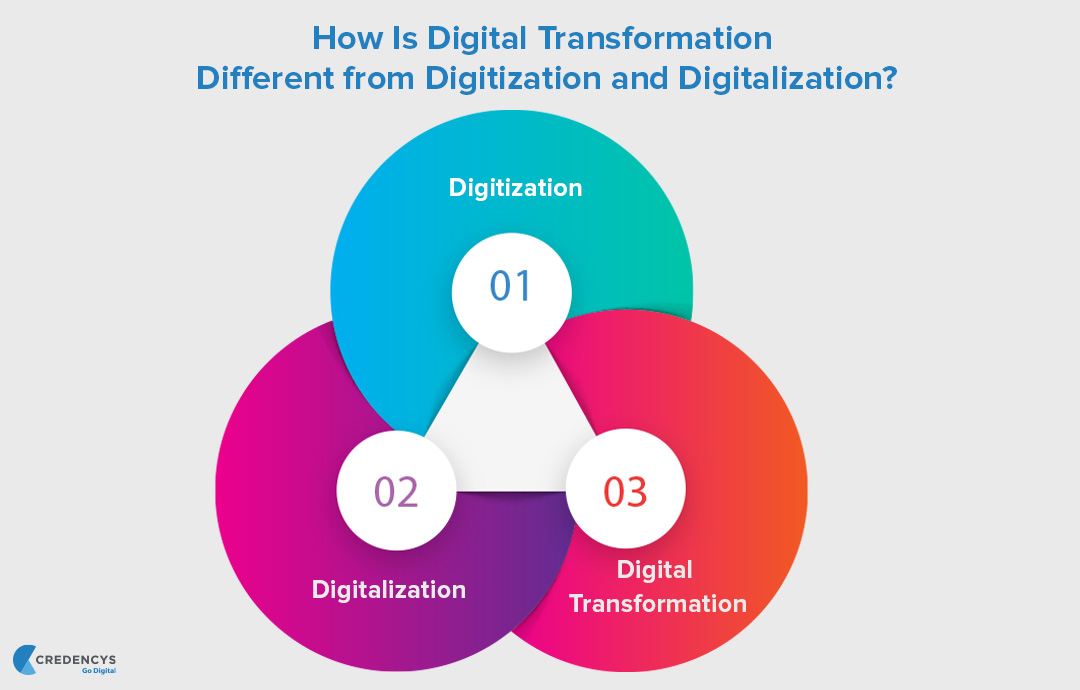
How Is Digital Transformation Different from Digitization and Digitalization?
How-Is-Digital-Transformation-Different-from-Digitization-and-Digitalization

Usually, people get confused between digitization, digitalization, and digital transformation. These terms seem similar until you are not aware of the difference between them. Though they are entirely different, they are connected. They are part of a digital process where a business transforms from these three stages.

Here you go to understand all of them in detail.

Digitization

Digitalization is a technical process of converting analog information into digital form.
Earlier, businesses used to manage all the records, including ledgers, documents, and other critical data on papers, in an analog form.

When the information is stored on paper, data sharing becomes a headache. For data gathering and sharing, companies have to deal with physical documents such as papers, photocopies, faxes, binders, and so on.

Since computers went mainstream, businesses have started converting analog information into digital ones. Computers allowed them to store the data either in the local folders on computers or in cloud storage.

When the information is available in digital form, it becomes easier to store, manage, search and share it. As we all know, it is proven that digital information is exponentially more efficient than analog data.

Digitalization

Digitalization is a business process or an organizational process that allows businesses to simplify their business processes using digital data.

By transforming analog and paper-based data into digital form, it becomes easier for companies to utilize the data whenever required. It helps you to define established ways to work more efficiently.

Be clear that digitalization is not about creating a new type of business or changing the way you operate your business. It is about performing the operations faster and better as the data is easily accessible.

Let’s take an example of the customer service department in a retail firm. Digitalization of customer data makes it simpler for your team to retrieve your customer data from the computer. Here, digitalization doesn’t affect your basic methodology of customer service. But, It simplifies varied processes of looking up the relevant data, responding to an inquiry, and providing a resolution becomes more efficient.

Imagine the scenario when you need to search the required data from the paper-based ledger. Instead, you manage the ledger on the computer, it becomes simpler to find the required data just by inserting required keywords.

With the emergence of new technologies, companies start generating ideas on how to utilize them to add value to the business, not just to perform old operations faster. Here’s the digital transformation that begins to take shape. New technologies open up new things and new ways of performing varied business operations.

Digital Transformation

Digital Transformation is described as the total societal effect of digitalization.

It transforms the way business gets done. Sometimes, it allows companies to create new classes of business.

In the process of digital transformation, companies take a step back and analyze every aspect of the business starting from customer interactions to internal systems both offline and online.

After this analysis, organizations need to ask a question: do we want to optimize our processes consistently to empower us with game-changing efficiency, create a better customer experience with effective personalization, and accurate decision-making.

Today, we are living in a digital world where advanced digital technologies and platforms disrupt the conventional ways industries operate.

Digital transformation is all about taking the benefits of existing technologies to inform you how your organization runs.

Now that you know what digital transformation is, it’s time to know what types of digital transformations are available.

Different Types of Digital Transformation

Adoption of digital transformation becomes imperative for organizations as the advanced digital technologies enable companies with modern ways to alter competitive landscapes, deliver value to customers, and change the underlying economics of the market.

Though digital transformation is trending these days, many enterprises underestimate its power. Here’re a few insights from them.

It won’t change your organization inside out. Various types of digital transformation impact your varied business areas. So you can pick a set of functions you want to transform.

  • It is multi-dimensional in nature, so its execution required cooperation from different departments of the company.
  • Many companies believe that digital transformation must start with organizational or cultural change. It’s not true. Organizational or cultural change is one part of digital transformation. The enterprises do not need to begin with them.
  • It’s time to understand what types of digital transformations are there and how they help transform your specific business areas.

Different Types of Digital Transformation

Business Process Transformation

Many activities and operations are involved to attain one specific business goal. Here the business process management, business process automation, and business process optimization come into the picture.

When it comes to transformation, companies give the first preference to business processes.

Levering advanced technologies such as Artificial Intelligence, Robotic Process Automation, Big Data, Machine Learning, Analytics, etc., brands are constantly embracing new ways to reinvent the existing business processes.

Adopting modern technologies, they want to attain various goals such as reduced cycle time, increased quality, lowering costs, and more.

Let’s understand process automation through the example of Domino’s. The brand has completely changed the food ordering process.

Using the Dominos AnyWare platform, customers can book orders from any device. Due to this innovative initiative, the brand has increased customer convenience tremendously. Later on, they experienced a boost in sales and revenue. It helps Domino’s to overtake Pizza Hut in sales.

Many organizations have started streamlining their several back-office processes by adopting cutting-edge technologies like Robotic Process Automation (RPA).

Process transformation delivers significant value to your overall business and diverse areas of your business.

Business Model Transformation

Many times, companies adopt digital transformation to transcend the conventional business models.

Process transformation mainly focuses on optimizing the process of different business areas. On the other hand, business model transformation allows companies to drive a drastic change in the fundamental building blocks of how value is delivered in the industry.

Examples of popular reinvention that occur as a result of Business Model Transformation are

  • Apple’s music delivery model
  • Netflix’s video distribution model
  • Uber’s cab-hailing model in the taxi domain

Another good example of Business Model Transformation is from the insurance industry.

Insurance companies like Metromile and Allstate have started utilizing analytics and data to charge customers by the mile and unbundle insurance contracts. This approach has introduced a change to the business model of the auto insurance industry.

Business model transformation is strategic and complex in nature. Thus, they need the involvement of leaders from different business units. These initiatives are usually launched separately while continuing to operate the traditional business.

As we discussed previously, Business Model Transformation changes fundamental building blocks of value so that companies can drive various new opportunities for growth.

Domain Transformation

In the domain transformation, companies focus on a niche market that contains enormous opportunities. Leveraging modern technologies, corporations can remove industry barriers, redefine products and services, and create new and non-traditional rivals.

When you implement highly advanced technologies, it opens up great opportunities that traditional businesses can’t even think of. It expands the boundaries of your business and allows you to reach an entirely distinct level to unlock new business opportunities.

Domain transformation helps you stay ahead in the competition by allowing you to serve beyond the current market. It also helps create new value for your business.

Amazon Web Services is the best example of Domain Transformation.

Amazon has started its business as an online retailer. They expanded their business by launching a new business in a new domain that is Amazon Web Services. Now, the brand is the largest cloud computing and infrastructure service provider across the globe. This domain was formerly ruled by IBM, Microsoft, and other technology companies.

To penetrate the new domain, Amazon has a powerful combination of advanced digital capabilities such as built-in storage and computing databases that support its retail business. Through the computing databases, Amazon manages relationships with thousands of young and growing companies that need computing services to grow and expand.

AWS is not a sister brand of Amazon. It is a wholly new business in a completely different market space. Amazon earns 60% of the revenue from AWS.

To ensure a successful domain transformation, you need to pick the right domains where you have less completion and high demand. By introducing the latest digital technologies in your niche, you can easily grab the market and rule over it.

Organizational/Cultural Transformation

Organizational/cultural transformation is a full and long-term digital transformation that requires redefining organizational processes, talents, mindsets, and capabilities for the digital world. Best brands know that digital transformation requires agile workflows, a greater reliance on business ecosystems, decentralized decision making, and more.

By embracing digital transformation, companies take active steps to bring change to their business.

Experian is the best example to understand how organizational/cultural transformation works.

It is a customer credit agency that has transformed its businesses by embedding agile development and collaboration into its workflows. It also drives a paradigm shift in employees’ focus from equipment to data across the organization.

The primary goal of this brand was not to forge organizational/cultural transformation. Their objective was to create value from digital technologies. For the successful digital transformation, the company pulled digital mindsets, agility, innovation, and skills in the organization. All these concrete initiatives towards the adoption of digital transformation have helped them drive tremendous business growth.

Business Functions/Activities Transformation

In an organization, multiple operations are going on including marketing, human resource, customer services, administration, production, etc.

By harnessing the potential of the latest technologies through a digital transformation, companies can streamline and automate mundane activities or business functions. It helps the businesses to improve overall productivity, focus more on strategic business areas, and boost the ROI.

Business Ecosystem Transformation

Many aspects affect a business such as stakeholders, partners, and more. They impact significantly on economic or regulatory priorities as well as evolution. Companies build and set up new ecosystems with different backgrounds using digital transformation and information. Also, data enable the brands with actionable insights and becomes innovative assets for them.

Partner, Customer, and Employee Approaches

Though digital transformation is driven by technologies, it puts people and strategy on top priority. It focuses on the behavior, needs, and expectations of the stakeholders. To address these requirements, brands need to start considering user experience, new workplace models, customer centricity, changing channel partner dynamics, work empowerment, and more.

In the process of digital transformation, technologies play a vital role but it is not the sole answer to manage all the human-related aspects such as customer experience enhancement, worker satisfaction, and so on.

Always remember people are empowered by other people. Technologies are value-added in the equation of fundamental requirements and choices.

Ecosystem and Partnership Model

The use of advanced technologies helps companies to build a collaborative, cooperative, and co-creating ecosystem. It leads you towards new revenue sources and business models. In the “as-a-service” economy, the ecosystem is the key to ensure the success of the digital transformation.

6 Stages of a Successful Digital Transformation for An Organization

The Digital Transformation of a business has its pros and cons. It is essential to understand the different stages of digital transformation to ensure the successful conversion of your offline business into a digital one. It also helps companies to develop a profound understanding of prioritizing digital transformation initiatives, set up efficient models and processes, and bring all the stakeholders on the same page.

By accelerating your digital transformation, you can give a powerful boost to your marketing initiatives. It helps you gain actionable marketing insights that allow you to design the marketing strategies in a better way.

It also gives a new direction to your business by allowing you to customize your model and attain your specific goals.

There are six stages of Digital Transformation. Let’s have a detailed understanding of each.

6-Stages-of-a-Successful-Digital-Transformation-for-an-Organization---Copy

Business as Usual

In the first stage of Digital Transformation, instead of experimenting with a new formula, companies prefer to consider a tried and tested one.

Companies are not ready to drive a drastic change in their operations due to their stiff mindset. This stops them from adopting digital transformation.

When you decide to digitally transform your business, you need to change your rigid mindset and adopt a flexible approach. You need to define goals and set perspectives about processes, business models, key performance indicators, and customers.

For example, Netflix and Blockbuster. Netflix adopted an “as-a-service” model and earned tremendous success. On the other hand, Blockbuster refused to adopt this change even after witnessing the increasing popularity of Netflix. Eventually, they pushed the brand into obsolescence.

In today’s highly competitive and dynamic business world, organizations need to build and implement the most advanced digital solutions that can adjust as per the rapidly evolving business needs.

Present and Active

In this stage, you should consider a set of experiments and analyze the results, whether they work out for you or not. If these experiments bring the best for your organization and team as well as help you to move one step nearer to your business objectives, then the experiment will be considered successful and you can spread it throughout your company.

In this phase, your focus should be on improving specific touchpoints and processes to boost the effectiveness of your business.

To gain optimum results through digital transformation, you can manage your digital products on a private server to handle spikes in traffic smartly and deliver a compelling customer experience. A better customer experience impacts positively on customer conversation. Thus, it is convincing for the management of the organizations as they can leverage the remarkable return on investment.

As your business grows, your digital transformation also extends. You need to consider more advanced technologies, buy more servers and create a network of servers across your different units and departments to achieve better results.

One more thing. Experiment with real-world situations so that when you implement it across the company, it delivers you expected results.

Formalized

As you have started experimenting more and more, at this stage, you become more adventurous with the experimentation. By this time, many organizations have become intentional and habitual with experimentation. It enables you with a great level of confidence and helps you make bold decisions that transform your business.

When experiments become frequent, they become habits. Moreover, more experimentation also boosts confidence and ensures a higher success rate. Eventually, you start getting the results.

The Formalized stage is the one in which businesses start conducting intentional experimentation with the latest technologies. At this stage, companies deal with the roadblocks created by company culture. To move beyond the limitations and gain success, organizations should focus on changing their culture.

Strategic

In the strategic stage of the digital transformation, different departments of the organization come together, collaborate, and share actionable insights that every unit of the organization can benefit from. This phase enables the firms with many different angles and perspectives.

There are chances that you get multiple solutions for the same problems as different departments see the same issue from different perspectives. Collect and analyze all these perspectives and select the best suitable ones. With the selected potential perspectives, you can create multiple new strategic roadmaps.

Once you have roadmaps in place, it becomes easier for you to define rules, plan the investment, and assign tasks or activities. While designing a digital transformation strategy, make sure you have considered all the factors that could hamper your journey towards success.

Converged

Based on the defined varied strategic aspects, you can define a strategy for digital transformation in the Strategic stage.

In the Converged stage, it’s time to form a dedicated team that executes your digital transformation strategy and ensures its success. Make sure that your team focuses on the customer and business-centric objectives and manages the various operations accordingly.

Converged is the phase where your new organizational structure starts to form. You need to define roles, processes, models, expertise, and systems that support your digital transformation. Here, you are ready to digitally transform your business and gain valuable benefits.

Innovative and Adoptive

In the last stage, you start getting the benefits of digital transformation. The top-level management also agrees that this change is significant. They adopt digital transformation as an integral part of the business.

With the new ecosystem, businesses identify market trends and act upon that data with the help of the latest technologies. Initially, the ecosystem is implemented in specific business areas. Later on, it can be implemented across the organization. It helps you to make the right decision at the right time.

What Are The Key Drivers of Digital Transformation?

What-Are-The-Key-Drivers-of-Digital-Transformation

Customer Expectations

These days customers can do almost anything and everything with a single click. There are no more geographical boundaries that limit organizations’ growth.

With the emergence of highly advanced technologies, companies can develop and implement various digital platforms that allow them to promote and sell products across the globe. For example, an Asian customer who wants to order some merchandise from North America can place an order.

Earlier, the shipping process used to take months. But, with the improved processes, customers receive the order within one or two weeks.

Online marketplaces such as Amazon enable the customers with the next level of convenience. As a result, if anyone buys a product online, they expect shortened shipping periods due to the high-level standards established by the leading marketplaces.

On the other hand, companies are forced to improve their business processes on a consistent basis by embracing modern digital platforms and delivering the best experience to their customers. Brands can utilize digital solutions not just to promote and sell the products but also to collect valuable feedback and information from the customers.

The essence of Artificial Intelligence

Artificial Intelligence is the most modern technology that has changed the way businesses operate. Thus, it becomes a key driver that pushes brands towards faster digital transformation. The increasing popularity of conversational interfaces such as Alexa and Siri has started contributing to businesses to drive success.

More than self-thinking robots, AI enables you with robust solutions that automate various business processes and operations once governed by humans. Importantly, it ensures for delivering the accurate output while the tasks performed human could be error-prone.

Almost all types of businesses and different industries have started considering AI as a part of their business. They have started focusing on defining the right AI strategy, selecting the right AI tools, and developing and implementing the tailored AI solutions that help them to meet changing market demands and business challenges.

Artificial Intelligence enables the business with the below-listed ideas at its core.

Comprehension – AI-based systems discern and analyze the data and transform the data into valuable information.

Sensing – Artificial Intelligence contains the components that collect text, images, voice, and various other forms of inputs from the systems.

Analysis – The AI components have problem-solving capabilities due to the implemented algorithm and a set of rules.

Guidance – The capabilities of components involve request verification, approval, or human assistance.

Action – AI contains the components that act automatically without any human intervention. The best example of this could be submitting reports or paying bills online to a company’s portal.

Increasing Importance of Customer Insights

To respond rapidly to today’s customers, brands need to set up a strong focus on customer insight. Understand the customers deeply and spend your time developing and executing strategy around that understanding. Companies need to study and understand the customers from many aspects instead of relying on some average facts that they find in surveys.

You need to analyze your customers from different levels.

  • Understand overall customer base
  • Understand the requirements of specific segments
  • Understand the needs of the individual customer to deliver the personalized experiences

Getting such a deep level of insights about customers, companies not only develop customer intuition and gather anecdotes but also leverage consistent customer conversion.

Innovation Becomes Necessity

These days, it is not a smart way to keep waiting for something to go wrong and then take the required steps to fix it.

This competitive era requires more advanced steps than the conventional wisdom of “what to fix something that is not broken”. It is so obsolete in today’s business context.

Buyers are looking for exciting and new experiences. Consideration of digital transformation allows you to leverage the innovation and facilitates business to open up to experimentations.

Be Open for Cultural Shift

In today’s tech-savvy business world, it becomes necessary for companies to look at leaner models. These models allow them to adopt a healthy attitude to risk.

According to Gartner, “By 2021, 80 percent of midsize to large enterprises will change their culture as a way to accelerate their digital transformation strategy.”

New Revenue Streams and Working Models

Don’t rely on conventional business models in a volatile market. It is not proactive to stick to them to meet the dynamic market needs. To gain success faster and consistent, businesses have to work hard to

  • Reinvent revenue models
  • Monetize the product and data faster
  • Identify the new income sources
  • Generate sustainable value

Improved Customer Experience

To meet the requirements and expectations of tech-savvy customers, businesses need to reinvent themselves in the digital age and need to grab the attention of buyers. Companies need to engage with the customers on a digital level and deliver deep, powerful, and lasting experiences.

Getting There First Fastest

Doing something right is not important in this era. Doing something right at the right time delivers you real value. By meeting customer expectations and making every digital interaction successful, you can boost the customer experience one level up.

Benefits of Digital Transformation

Benefits-of-Digital-Transformation

Improved Data Collection

Almost all businesses collect customer data. But, smart utilization of customer data is not considered by them on a serious note. To gain optimum results from the data, you need to keep optimizing the data, analyze the data, and redefine your strategies accordingly.

With the help of data, you understand your customers and provide them with the best products and solutions. Eventually, the brands will leverage increased customer engagement, improved conversions, and boosted ROI.

Digital Transformation enables you with a lot of advanced technologies that help you gather the right data and incorporate it fully to gain business intelligence at a great level.

Using the modern digital platforms, you allow your different business units to translate the raw customer data and get exclusive insights from varied touchpoints.

Many solutions enable you with a single view of all your crucial business data, including operations, sales, marketing, production, customer journeys, business opportunities, finance, and more. It gives you a holistic view of your organization in one go.

Enhanced Customer Experience

Every individual is getting obsessed with the latest technologies, apps, social media, and other platforms to make their life easier than ever before. Users want reliable and valuable digital solutions that address their challenges rapidly.

According to a Gartner report, “Two-thirds of marketers responsible for CX say their companies compete mostly based on CX”.

Thus, customer experience is the core of digital transformation. The primary goal of companies for adopting the latest technologies is to enable the customers with compelling experiences. Design and execute mature digital transformation strategies so that you can enhance the customer experience for sure.

As per McKinsey, in the digital transformation, the success factors of customer experience contains

  • Create and digitize the buyer’s journey
  • Increase agility and speed of insights
  • Understand customers’ digital journeys
  • Build agility in providing journey transformation

Companies that consider the digital revolution earn more trust, respect, and authority from the customers.

Improved Productivity

Considering the right set of digital tools, technologies, software, and solutions, companies can streamline and automate the workflows of different departments and help the employees improve their productivity.

By automating the varied manual activities and integrating different business data across the organization, you empower your team to work effectively and efficiently.

Enhanced Cross-Departmental Collaboration

While adopting digital transformation, many organizations fear organizational and cultural change. They think it drives massive change in the processes and strategies and it impacts the different levels of the workforce starting from leadership executives to entry-level staff.

When you modify the strategies and processes, make sure all the challenges and issues related to the core structure, company, and culture need to be addressed.

Along with the change, the adoption of digital transformation brings unity throughout the company. It strengthens the communication across the different teams and increases transparency. It encourages employees to break down social differences and age gaps to learn together and get engaged in exciting conversations.

Top management of the company can take advantage of this situation to improve the digital intelligence of the employees.

Digital transformation helps you to align your different departments and build a strong culture across the organization and ensures the confident and successful transition of manual processes to digital ones.

Get Data-Driven Customer Insights

To get exclusive insights about your customer preferences, needs, demographics, etc., every brand needs to collect and analyze the customer data. It helps you to design more customer-centric business strategies.

Consider both structured and structured data. Structured data could be the personal information of the customer. Untrusted data could be social media, websites, webshops, emails, etc. This data helps you define strategies that are more personalized, agile and drive immense business success.

Also, by tracking the metrics and analyzing the data, you can empower your digital marketing efforts. It also helps businesses optimize their processes and strategies to generate better results.

For every business, cost and revenue matter the most. You can reduce costs and generate better revenue by integrating data-based insights across your company culture. The data helps you in making accurate and right decision making that eventually contributes to overall business growth.

Improved efficiency

As we have already discussed earlier, digital transformation is about developing robust digital solutions using advanced technologies. Developing the right digital platform for your internal users, you can streamline and automate various business processes that improve the efficiency of your team dramatically.

By allowing your teams to collect, manage, and share the business data from a single platform and in a continuous flow, you ensure the seamless transition of critical business information. Digital transformation makes your business processes more time-saving, cost-effective, and requires fewer resources.

Increased Scalability and Flexibility

One of the major advantages of adopting digital transformation is to get free from the legacy systems that operate with limitations and implement more modern and scalable solutions.

Businesses that operate with legacy systems that are often based on old technology require manual inputs. When workload increases, manual processes create a bottleneck. Some manual processes won’t scale as a result, you need to engage the considerable workforce to manage such operations as processing claims, responding to service requests, providing quick customer support, and more.

Digital transformation allows you to build and set up new systems that effectively address the biggest change of any organization that is siloing the data by function or department. Modern software not only simplifies the business processes but also allows you to integrate various enterprise systems and third-party applications or software with them.

The modern digital platforms allow you to update, enrich and optimize the data in a single solution and then push the relevant data to the respective systems without human intervention.

Thus, transforming your business operations digitally, you can be more responsive and remain nimble to the latest trends and innovations available in the market.

Consolidation of different processes and operations

Another most important benefit of digital transformation is it helps companies to connect with the people, internal team, and customers. It does not just bring the workforce together but unites your entire architecture, including project management system, social media, analytics, and other such interfaces.

With the consolidated company processes and operations, businesses can connect with customers and address their needs successfully.

For example, Xylem, a leading water technology provider, has integrated all the legacy IT systems and created a single platform to improve customer engagement, business growth, and operational efficiency. They utilized various technology solutions such as IoT, analytics, mobile, social, and more. By considering all these solutions as an integral part of the business, Xylem has generated more than $30 million.

Update Knowledge and Skills of the Employees

As organizations continue to adopt advanced technologies, the team needs to update their skills and knowledge to meet the changing technological environment. There are a few highly buzzing technologies that are changing the industry and business landscape significantly. Some of the technologies that your teams need to consider and enhance the relevant skills are:

  • Artificial Intelligence
  • Machine Learning
  • Big Data
  • Cloud Computing
  • Augmented Reality
  • Data Analytics/Exploration, and more…

These days most of the organization is dealing with the lack of digital talent and experience amid their leadership and workforce. The core reason for the issue is they are fearful of the change. They consider digital transformation as a cost-carrying initiative rather than a smart investment.

By considering this change, you do not only empower your organization but also enrich the knowledge of your employees. As an organization, it helps you gain a competitive edge and leverage sustainable growth.

Product/Service Digitization

With the emergence of advanced technologies, customers’ buying patterns have changed significantly. They want things faster than before. They perform detailed research before considering any product or service, check out the reviews shared by other buyers, and analyze which brands can deliver the product or service faster.

Digital transformation allows companies to meet the requirements of the customers through advanced digital solutions.

Set Up a Digital Culture

Establishing a digital business environment, brands help their teams to improve their productivity. Beyond that, employees become flexible to adopt this technological change in the organization. Digital transformation automates various mundane activities and saves a lot of time for the staff. Your team can utilize this time to increase their creativity and design customer-centric business strategies.

It makes your teams adaptable and flexible in nature. Eventually, it helps organizations to build a stronger digital workplace. It also helps your workforce to be a part of transformation without feeling disconnected from the process.

Leverage Profitability

When you work with more efficiency, make a better decision, improve customer perception, and increase agility, it directly impacts your business bottom line. Thus, Digital Transformation helps you boost the profit margin.

If you earn a good profit, it motivates your employees and builds the feeling of trust and reliability across your customers. Once you have a good cash inflow in the business, you can focus more on improving business efficiency and process rather than just thinking of the way to make money to make your business profitable. Eventually, you will end up delivering an improved customer experience.

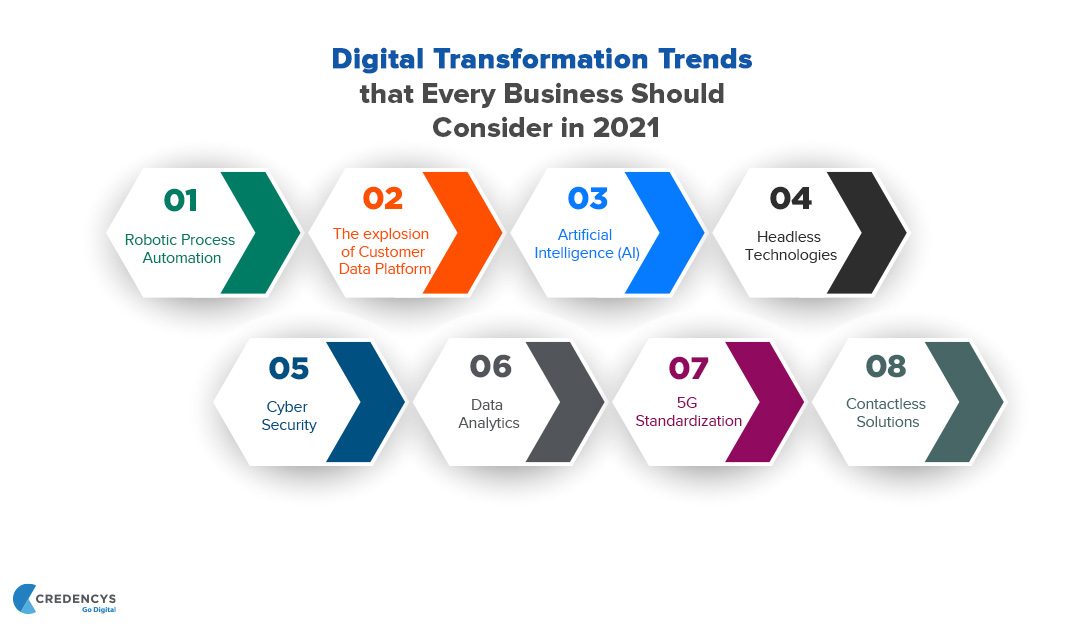
Digital Transformation Trends that Every Business Should Consider in 2021
Digital-Transformation-Trends-that-Every-Business-Should-Consider-in-2021

Robotic Process Automation

Automation of different business processes is much needed to stay highly productive and effective in today’s cutthroat competition. Surprisingly, digital transformation and automation tend to co-exist. Automation of certain processes impacts others too.

When a company adopts more and more automation in the processes, they are increasing the pace of digitalization across the organization. Automation is the process that enables you with digital transformation as a result.

Now, you might be thinking of how to achieve automation.

These days Robotic Process Automation (RPA) technology is getting immense buzz across the world for the automation of various business functions. It drives a paradigm shift in the way your employees work and spend the time performing different tasks.

The technology allows you to configure the robot into a digital system. These robots interact with the applications and gather the data just like humans by emulating human actions. More importantly, it boosts the performance of various activities with zero error. The robots do not need a break like a human does while performing multiple activities at a time.

Implementation of Robotic Process Automation technology enables you with:

  • The reduced labor cost associated with low-value work
  • Manual data entry is always error-prone. RPA eliminates the human errors
  • Process the data seamlessly between multiple systems

Robots help organizations automate mundane and time-consuming functions. Implementation of RPA requires less investment and provides more benefits in terms of improving employees’ productivity, efficiency, and job satisfaction at the same time.

The explosion of Customer Data Platform

The whole world is experiencing a radical change as billions of data are proceeding at a different scale. Knowing customers is the key crux for business success these days. Thus, brands need to keep analyzing customer interactions with the company, their buying journey, and their products and service preferences.

By collecting and analyzing all these data, companies can get exclusive insights about the customers. This applies to all sizes of organizations. Based on customer data analysis, you can define the personalization strategy for the target groups.

For small-scale companies that are having limited offerings and a restricted customer base, it is easy to understand and analyze the data. However, for large-scale organizations that offer thousands of products, handle a variety of marketing channels, and manage a huge bunch of customers, it becomes difficult to get insights out of such a large pool of data.

Here, you can consider a Customer Data Platform (CDP) that manages your customer information in a single system. You can utilize CDP to create and run more relevant and personalized marketing campaigns to attract and engage the target audience.

Along with marketing, CDP helps different departments of the organizations such as Information Technology, Finance, etc. It helps the companies to make quick and effective decisions about products, services, and other business functions.

Artificial Intelligence (AI)

Artificial Intelligence is also one of the highly admired technologies. It allows companies to collect, manage, analyze and recall the data on demand. This helps companies to make effective strategic business decisions and informed sales decisions faster.

Unlike RPA, AI-powered assistants take care of data-driven and repetitive work and save a lot of time for employees. But, AI has more power than RPA. It’s the future of the tech world. The technology is designed in such a way that it collects data like sales numbers and customer habits. It recalls the information instantly.

AI-based tools identify and analyze the patterns, learn, make decisions, predict, and improve. These days most companies, regardless of startups to large-scale organizations are tech-savvy. Every enterprise tries and integrates AI-based tools and platforms in its existing processes and systems.

There are so many vendors such as AWS, Google, Microsoft, and more that offer a wide range of AI solutions. With the help of modern AI platforms, enterprises can begin their AI journey and achieve immense success.

Usually, AI platforms are a bit expensive, thus organizations need to work on them to make the solutions cost-effective.

Headless Technologies

Headless technologies are getting popular day by day. With the help of such a kind of software architecture, brands can separate their front-end from the back-end.

Front-end: User interface where the user interacts and can find on the website or app.

Back-end: App and website for internal processes. It’s also known as server-side.

Headless technologies help organizations design extremely personalized shopping experiences for targeted customers. This technology also helps increase customer acquisition too.

The new customer acquisition increases the cash flow in the organization. This ultimately increases the ROI. Now, the companies can focus on designing strategies to retain engaged customers and their loyalty.

With the right digital transformation strategy, companies can deliver compelling shopping experiences that help you to gain competitive advantages over your competitors.

Cyber Security

A few years back, the digital transformation started as an innovative approach to improve products and processes. To support the improved time-to-market, companies have started considering advanced initiatives like DevOps. While performing all the advanced initiatives, they do not pay enough attention to the security aspects.

Avoidance of security aspects results in a major service failure while managing the digital risks.

Large-scale organizations have their IT teams who take care of the security aspects of all the digital solutions. They ensure to set the security practices within the company to match the speed of digital transformation.

When said this, it does not mean they should just focus on how to make processes faster. They need to take care of how to make the processes faster safely.

To meet the expectations of customers and the changing market scenario of the industry, brands need to adopt more and more digital platforms. For each digital solution, cybersecurity is the prime requirement. Thus, it is the most popular digital transformation trend in 2021.

It is also essential to train your internal team about the new technologies and their security aspects. It’s a highly competitive era, where companies are constantly embracing and integrating advanced technologies like Artificial Intelligence (AI), multi-cloud, Machine Learning (ML) into the security solutions that are used within an organization.

Data Analytics

The key aspect of digital transformation is the latest technologies that help them to collect and analyze the data to get meaningful insights out of it. In today’s time, data works as fuel for any business. They need to sort, process, and analyze them to gain value out of them.

Consider and implement smart data analytics platforms that process the raw data and extract valuable information out of it. With effective data analytics, companies enhance organizational productivity and foster better decision-making.

Data and analysis of the data help companies to accelerate a company’s transformation and digitization efforts.

According to Gartner, “By 2022, 90% of corporate strategies will explicitly mention information as a critical enterprise asset and analytics as an essential competency”.

Different types of data analytics solutions available in the market to address the varied requirements and challenges of your different departments.

Descriptive analytics helps companies analyze what happened. On the other hand, diagnostic analytics help in defining why it happened. Using the results of the data analytics, different departments of an organization can address the complex processes.

Harnessing the fullest potential of data analytics, brands can streamline supply chain processes, predict customer behavior, optimize sales pipelines, and more.

5G Standardization

5G has become one of the highly popular technologies in the last couple of years. In the upcoming time, this trend will go mainstream. Adoption of the 5G will accelerate digital transformation.

It is also expected that 5G also empowers the organizations and helps them redefine their business models and functional processes. This indirectly improves their customer services. The new technology brings lower latency, faster speed, and most importantly higher density than 4G networks.

To leverage the benefits of 5G technologies, companies need to invest more in cloud infrastructure and tie up with reliable Cloud Service Providers.

The Cloud Service Provider works out the best approach to deliver the best services using 5G. It helps companies to pave the path of success using the software-defined technology that can support both current 4G and 5G.

Contactless Solutions

In the upcoming time, contactless solutions such as digital payments and contactless dining are the key to digital transformation.

As an impact of COVID-19, contactless solutions are highly in demand. People are following the social distancing to staying safe during this pandemic time. Thus, restaurants, cafes, and other businesses started implementing contactless digital platforms to take customers’ orders and provide better services to them.

Along with these, they have started using platforms that provide an online mode of delivering food, takeout services, in-seat ordering, and more.

For example; in the case of in-seat ordering, some solutions allow customers to place orders using QR codes and mobile apps by sitting in their chairs. If we talk about other scenarios, they do not need to stand in a queue in the convention center and miss the show in the theater.

QR code is one of the extremely popular and widely accepted solutions as it facilitates people and companies to perform various jobs.

3 Digital Transformation Success Stories

McDermott

McDermott is an American multinational engineering, construction, procurement, and installation company. They operate in various countries of the Pacific Rim, America, the Caspian Sea, and the Middle East.

They have utilized a digital twin technology. It is a computer model of oil and gas platform facilities it delivers to the client.

Digital Twin connects the physical and digital world. It allows integrating the smart components into physical objects. These components contain sensors to gather data regarding working conditions, real-time status, or position.

Moreover, these components are connected with cloud-based systems that receive and process all the data that sensors have collected and monitored. The result is analyzed against business data and other contextual data. The brand gets better insights into the objects or processes, learns the various lessons, and embraces various opportunities that are uncovered within the virtual environment.

The brand has utilized all these insights, lessons, and opportunities in the physical world. This eventually transforms their business.

After the implementation of the digital twin approach, they achieved a 15% increase in operating margin in areas like predictive maintenance.

Rolls Royce’s

Rolls Royce is a leading brand of hi-tech and royal cars. They have started R2 Data Labs initiatives that use Artificial Intelligence, Machine Learning, and Data Analytics to create new services. Under this venture, they have 200+ employees that involve data architects, data scientists, engineers, and specialist managers. The Data Labs team enabled Rolls Royce with £250m in value by performing engine health monitoring activities for the cars.

NHS Blood and Transplant

It’s a public sector unit. They have implemented a digital transformation agenda. They are trying and testing various digital platforms. They conducted some interesting trials around the likely waiting time for an organ and predictive analytics. It is essential to get clarity on organ availability in the healthcare industry. They are doing exciting digital experiments in the medical domain.

How to Ensure Successful Digital Transformation? [Tips to Consider]

How-to-Ensure-Successful-Digital-Transformation-[Tips-to-Consider]

Define your Goals for Digital Transformation

Digital Transformation does not have a specific path or solution to approach that you can just follow or implement. It’s the result of multiple digital initiatives that you consider. Thus, it is very important to define your specific goals, requirements, and long-term vision for adopting digital transformation.

Companies are considering digital transformation to attain different business objectives such as

  • Reduce the operational cost
  • Making more profit
  • Explore new markets, and more…

Based on the requirement you can define what digital solutions you need and how they help you increase ROI.

Define a strategy across your business objectives that you can achieve through digital solutions. You need to communicate the same to your team members so they understand the essence of new platforms and adopt it.

You can also analyze how your competitors are successfully moving towards digital space and look at the latest technology trends to determine your requirements for digital transformation.

Most organizations consider Digital Transformation to deliver a better customer experience, improve customer relationships, reduce time-to-market, reduce operational costs, and earn ROI.

Involve Your Team of All Levels

Digital Transformation does not bring change to one single department. It impacts your entire organization at all levels. When you have tech-savvy decision-makers and leaders, then the adoption of digital transformation becomes way easier.

As per research conducted by McKinsey and Company, when the Chief Digital Officer of an organization is involved in the transformation process, it increases the chances of successful digital transformation.

When the entire organization is involved in digital transformation strategy planning and execution. It drives a cultural change in the organization. So make sure all your team members from different departments are on board, participate in the discussion, share their suggestions and options, in the process of defining and executing the right digital transformation strategy.

It also helps you define the roles of your employees based on their skills and assign them the relevant tasks.

Utilize and Update Your Existing Tech Stack

Once your entire staff, including the senior decision-makers and executive-level employees, are on board, the next step is to take inventory of your organization’s resources and tech stack before you start planning your digital transformation. In this inventory, you can consider

  • Potential gaps in the processes
  • Technical competencies

Analyze your existing tools and processes deeply. It helps you understand how to streamline your processes and make the functions more effective. Integration of advanced tools and smooth processes are essential for the various business areas such as

  • Customer relationship management
  • Product development
  • Employee experience and support
  • Internal collaboration
  • Sales and marketing

In most companies, digital transformation begins with re-developing the existing platform. After a certain time, if not enhanced regularly, the systems become obsolete. Thus, businesses need to re-engineer them to maintain their performance.

Moreover, you cannot reengineer the technologies that you have used previously. You need to consider modern technologies while developing new features and functionality for your applications. Integration of the latest technologies drives the immense transformation of your business.

Most of the time organizations consider digital transformation to develop a better customer experience. However, it is essential to take care that it supports the employees as well in improving their productivity.

While considering digital transformation for employees, you need to take care of all the essential data flows available across different departments and teams, all the required information is quickly accessible to the respective users, and more.

The inefficient digital experience of the employees will result in

  • Negative impact on the work culture
  • Poor customer experience

Transparent Communication

In the process of digital transformation, communication must be transparent and clear. The organization’s leaders need to make sure the digital transformation strategy is communicated to all the employees so that the company gains the ultimate benefits.

You need to explain to the team members why certain processes are being executed and what the end goals they achieve as an organization. The employees of different departments should communicate the issues and try to figure out the solution together. They should try to resolve the challenges as they arise.

To simplify communication across the teams, keep all the essential information quickly accessible. Organizations can implement reliable communication tools to do so.

Invest in the Right Digital Technologies

The digital space is flooded with a lot of tools and technologies. Thus, it becomes difficult to select the right set of technologies for your business.

Automation:

Automation is the latest technology trend that every organization is looking forward to achieving. It helps the employees to focus on more creative and essential tasks. All the mundane and repetitive tasks will be taken care of by the computer automatically.

Cloud Computing:

It works as the support system for many other technologies. The cloud platform allows companies to store, manage, process, and analyze massive data with next-level security. Most importantly, it manages the data in the internet server, so it is quickly accessible too.

Cloud computing technology enables you with the flexibility to update your obsolete IT infrastructure at any point in time. It also supports the most advanced technologies such as Artificial Intelligence (AI), Machine Learning (ML), Big Data, Internet of Things (IoT), and more.

Data Analytics:

Data Analytics is one of the highly followed technology trends. With the help of advanced analytics, businesses can gain all necessary insights related to finance, customer behavior, marketing processes, and more. It allows businesses to break their operations in silos. It becomes easy for your team to respond to challenges and changes in real-time.

Consider Data-driven Approach

To ensure success and growth, businesses need to be receptive to the changing market trends and customer demands. To do this, it is essential you spend time, money, and resources for data collection and data analysis.

Monitoring and analyzing the metric and data regularly is very important as it helps you to make more relevant and accurate business decisions in terms of your future digital initiatives.

With the help of data, you can understand your customers better and enable them with extremely personalized experiences in the future.

In case you find any issue in our digital strategy, you should consider the data-driven approach. Collect the data of specific areas and take insightful actions and decisions based on the findings.

Take the Help from an Outsourcing Partner

One of the key reasons companies considers digital transformation is they want to streamline their operations. To achieve your objective quickly and effectively, it is highly suggested to take the help of an experienced outsourcing partner for your digital initiatives.

You need to focus more on defining the procedures and methods as well as utilize the teams’ capabilities to improve your operational workflow. As you can experts in that part. Digital initiatives are not your forte. So just pass your expectations and objectives to an outsourcing partner and they will help you build advanced digital solutions that help achieve your goals and address challenges.

As they have proven experience in deploying tailored digital solutions, it will be a cost-effective decision for you. Moreover, it mitigates the risks for the companies. When you outsource digital initiatives, you can have access to good quality resources, scalability, and industry experts.

By considering the outsourcing partner, you allow your team to focus more on your core business activities. On the other hand, your digital transformation is taken care of by a reliable IT solution provider company.

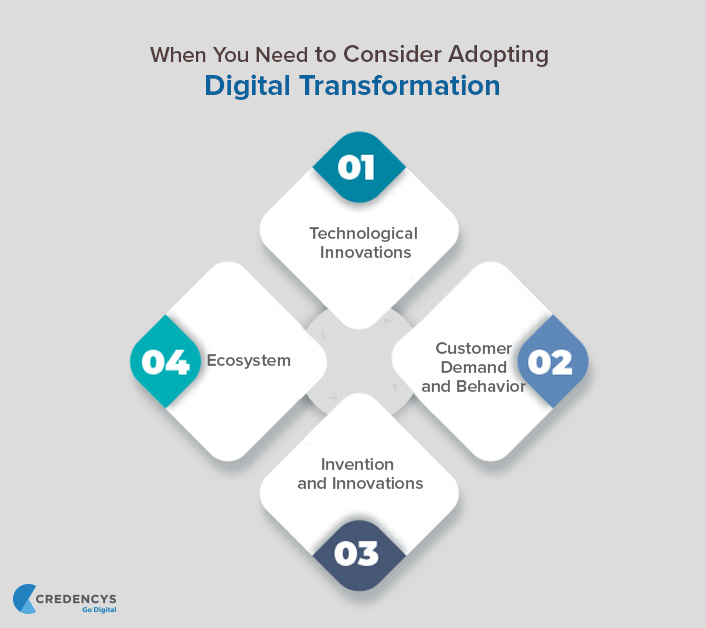
When You Need to Consider Adopting Digital Transformation
When-You-Need-to-Consider-Adopting-Digital-Transformation

Technological Innovations

It’s an era of technology. Emerging technologies encourage businesses to embrace digital transformation. Leveraging advanced technologies, you can transform the way you interact with your partners, customers, competitors, and other stakeholders.

These days, a lot of technologies are adopted by the companies such as Artificial Intelligence, Machine Learning, Internet of Things, Blockchain, Augmented Reality, Virtual Reality, mobility, edge computing, and more.

With the right amalgamation of technologies, you can build robust applications. For example; the mixture of AI, Big Data, Analytics, and IoT helps businesses to drive immense change in their conventional work culture.

Along with organizational change, such technologies drive an industrial transformation as well.

Customer Demand and Behavior

Today’s tech-savvy customers are exploring their required products or services through digital solutions. Well, customer-related transformation is not necessarily related to technology. It could be related to your business strategy. Consideration of digital technologies helps you to address many customer-related business challenges.

Decades ago, when technologies did not exist, the problems of customers were addressed. But, the emergence of the adoption of digital technologies has driven the transformation significantly.

Earlier, the problems of customers were taking too much time to get resolved. But, with the help of technologies, businesses can interact with the customers instantly and take action to address their issues quickly. Customer needs and behavior are also impacted by digital transformation.

Invention and Innovations

It’s a completely new approach to business challenges and humans. Invention and innovation together create a new reality in the areas of technology, science, business, or non-technological context. Invention and innovation in digital technologies transform many industries.

Leveraging the latest innovative technologies has transformed the way healthcare, manufacturing, engineering, transportation, and more.

Ecosystem

Organizations are a part of the broader ecosystem. Natural and social ecosystems as well as business ecosystems in which we live. In these ecosystems, various changes take place from time to time such as regulatory changes, demands for the partners who adopt the new change, innovation in collaboration and interaction with the transformational business ecosystem, economical changes, societal shift, geopolitical changes, and more. All these factors play a vital role in increasing the needs of digital transformation.

Especially, in this era of new normal, the importance and demand of digital transformation are constantly rising.

What are the Most Common Challenges of Digital Transformation?

What-are-the-Most-Common-Challenges-of-Digital-Transformation

Lack of Skilled IT Resources

The success of digital transformation relies on a dedicated and highly skilled IT team. Building a team of skilled IT resources is a tough job. Especially, when you don’t have profound knowledge of the domain. Moreover, to stay competitive, more and more businesses pursue advanced technologies to build next-generation business solutions. This causes the deficiencies of skilled IT professionals.

According to a recent survey, 54% of the organizations have reported that shortage of skilled IT resources holding them back from accomplishing their digital transformation objectives.

When I am saying the lack of expertise means fewer skills in the below areas:

  • Advanced Data Analytics
  • Cyber Security
  • Enterprise Architecture
  • Technical Architecture

How to overcome this challenge?

You can take the help of reliable and experienced IT solutions and service providers. They have highly skilled technology experts and consultants to support your in-house team.

Else, you need to understand your customers and tie a partnership with an IT service provider to build customer-centric solutions that satisfy the expectation of your target audience.

Organization Change Management is not in Focus

Most organizations fear change. Thus, they keep following rigid leadership styles, outdated organizational structures, and inefficient workflow that hinder the success of the digital transformation. All these businesses were struggling to survive and shift to remote business models quickly.

In such cases, if the business immediately adopts new tools and technologies, it negatively affects the team and processes.

Thus, every organization needs to follow change management when every new business and technological change takes place step by step. So that it becomes easy to adopt the new change across the organization seamlessly. It helps your staff to understand what lies ahead.

More than technology, change management impacts the people so change management is essential for successful digital transformation.

Constantly Changing Customer Needs

Modern customers do not prefer to visit physical stores to buy the products. They don’t buy any random product.

They conduct detailed online research before buying a product. Moreover, they utilize advanced digital platforms to purchase the products. With the invention of smartphones, customers’ lives have become easier than before. Thus, the customers are more demanding these days.

Now, the touchless checkout process is not considered a value-added feature. It becomes a necessity for every eCommerce platform as customers expect this feature as a default.

Absence of Well-defined Strategies

Digital transformation is not just a buzz word but it’s a present and future of many businesses. Still, people are struggling to get a clear definition of it.

Due to a lack of clarity about the concept, companies are sure that they want to and are moving towards digital transformation but they don’t have confidence where they are going.

Thus, it is essential to define a digital transformation strategy instead of implementing it randomly. It also enables companies with several benefits rather than creating chaos across the organization.

To have the right strategy in place, you need to be clear about some of your business aspects like what are the priorities and goals of my company? Are these goals consistent across the organization? Are there some stakeholders who are completely on different pages?

Based on the answers to these questions, you can design the digital transformation strategy that also ensures its success.

Limited Budget

In the absence of the right digital transformation strategy, you might face the issue of setting and sticking to your budget.

While responding to the evolving customer needs and customization requests, you might experience scope creep. If you do not have a proper strategy in place, you have to make the decisions that enable you with less or no benefits. Moreover, it increases your product timeline and budget too.

Try to focus on long-term goals for digital transformation rather than short-term objectives. Define the milestones for your long-term goals and develop a realistic project plan. To achieve these, it is very important that you understand what digital solutions you are implementing and the culture you are integrating them into.

Ineffective Business Processes

Once you set the business processes for your organization, you need to keep tracking its effectiveness. You need to analyze whether your current processes deliver you the expected results or your existing roadmap helps you to attain your long-term business objectives.

If you fail to attain these, you may need to work on your business processes. There are chances you need to change your business rules, adjust workflows, and leverage data in different ways than you previously envisioned while you implemented legacy systems. You can consider business process reengineering to make your business process more efficient.

Inefficient Data Management

There is a lot of data every business has for different purposes. Here we are talking about customer data specifically. Customer data is the key crux of digital transformation. It helps you get insights into a buyer’s behavior, preferences, and possible future decisions.

To gain the maximum benefits out of it, it is essential how you organize and capture the data. If you are using the siloed systems to manage customer data, it becomes challenging to consolidate the customer information, manage them centrally to make them accessible easily. If the data is managed in a single place, it becomes easy to perform this process.

With this data, you can learn about your customers and define strategies to serve them more effectively.

Summing Up

This post has covered every single aspect related to digital transformation. I hope this helps you define the digital transformation strategy and implement the right digital solutions to empower your business goals and objectives. If you still have any queries and concerns, feel free to connect with our experts to get personalized consultation and the right business solution that ensures immense growth and success of your businesses.

Role of DAM on Delivering Customer Experience Strategy

One loyal customer is better than ten new potential customers. Keeping a loyal customer loyal is not a piece of cake. As a business brand, you continuously need to serve the interest of customers. It is easy for customers to switch over to another brand or business, but it is not so easy for you to acquire a new customer in a short duration. Having a good customer experience is important for every business to survive in today’s heavy competitive market.

Let us here discuss the strategy of delivering a better customer experience and the role of Digital Assets Management- DAM in it.

What is a Customer Experience (CX) Strategy?

Customer experience is the wholesome amount of interaction of customers with your business in pre and post-sales. Whilst, Customer experience strategy is to be able to deliver a better, positive, and meaningful experience to customers across every interaction.

In simple terms, customer experience is the measurement of the involvement of business in a customer’s buying process. Customer experience is not just action but it states the relationship between business and customer and measures business involvement in customer’s marketing to sales journey.

Customer experience strategy, on the other hand, is a plan, design, or way of direction for your business to ensure that your customers are getting a better customer experience, which they deserve, and ensure that you are not lagging in delivering a rich customer experience.

Benefits of Having Good Customer Experience for Your Business

1. Higher Customer Lifetime Value

This value represents the amount of money your customers are willing to pay for your business. If you know the vague amount of this value, you can have a better idea of investing in retail customers and how much more needs to be invested in acquiring customers.

Your business can know this value if you in the first place have delivered a better customer experience. The stats of customer buying ratio state that there are 60-70% customers, which are willing to buy from the same business while there are 5-20% of chances for a business to acquire a new customer.

2. Reduced customer churn

The harder thing than acquiring a new customer is retaining those newly acquired customers. Reduced customer churn is the process in which loyal or potential customers are less likely to switch to any other similar business.

If you have delivered your customer a better experience, and if you are monitoring their level of satisfaction, then customers don’t have any reason to switch to other businesses.

3. Customer retention and brand name

By delivering a better customer experience, your business is not just favoring customers but you are also at a benefit. Those brands, who serve best to their customers, have a better brand name than those who do otherwise.

By delivering a better customer experience, your customers are going to be retained within your business only and that will boost up your brand name. It is a vice-versa situation in which both business and customer get to benefit from each other.

Ways To Drive Customer Experience Through Digital Transformation

Technology and digitalization have overpowered every manual strategy and plan. It is a fool’s choice to stay behind technology and try enhancing the customer experience without the help of any technology. Below are the ways to drive customer experience through digital transformation.

1. Equip Store Associates With Digital Tools

Remember the days, when customers used to visit the same local shop over and over because the shop owner made customers feel personalized with their choices? The same should be done in online business; you need to have tools that remind customers about their last purchase, their needs, and their unique preferences.

Some digital companies have built this strategy and have associates, who are guiding customers in their product buying process. These companies use mobile devices and other devices to keep track of product information and product-related other similar products.

2. Use Smarter Technology within Stores

You can use cloud and other predictive data analysis tools, which predict what customers would buy and how frequently they buy. This analytical tool is really important for businesses as you are running one step ahead of your customer and at times, you are making your customer buy the things, which they normally would not buy.

This digital transformation is more effective for business. Customers will feel more personalized and hence will continue working with your business. Ultimately, you will end up having profit in your hand.

3. Bridge the Gap between the Head Office and Store Associates

Through digital transformation, the communication barrier between head office and store associates is nearly not present. Through a digital platform, your business can effectively communicate about product information and product availability, and store in charge.

Your business will be more in control and less at risk. Your business department will be more collaborative and yet fully independent. You can make better decisions and let your customer leave you effective feedback.

4. Implement Digital Asset Management Into Your Strategy

DAM is the backbone of digital transformation. Digital transformation’s all business-related content comes to DAM in one way or the other. DAM is the system that holds every photo, video, documents, and related digital asset of your business. With an increase in demand for the integration of e-commerce platforms with social media, the need for DAM is more needed than ever.

When it comes to updated reports, training material, and other related important materials DAM plays an important role in withstanding all documents.

Thus, the need for DAM in digital transformation is as important as the need of customers in any business.

Importance of Digital Asset Management (DAM) and Customer Experience (CX)

Digital Asset Management (DAM) and customer experience are correlated. Your business cannot outrun the fact that you need DAM for delivering a better customer experience. DAM withholds the product-related digital assets, and your customer’s journey of product purchase is incomplete without those digital assets of the product.

With DAM, your business will have expanded market opportunities and your customers will be able to demand more transparently and more effectively. Your customers will be able to interact with your brand more frequently. With DAM, you can share, manage and collaborate with your customers in an advanced way.

DAM is an all-in-one solution that works as the backbone of digital transformation and also makes customers able to shop more freely and more in an advanced manner thus increasing their customer experience.

Both DAM and CX engage with the customers. Business owners can utilize the data collected through the engagement and develop a personalized touch and take a bold decision for the business improvement. Here are the benefits that business owners can get through DAM & CX.

  • Extension of Marketing Touchpoints
  • More Business Efficiency & Transparency
  • Consistent Brand Interaction
  • Better Data sharing, managing & collaborating
  • Flexibility to both Enterprise & Customer

Why Does Your CX Strategy Need a DAM Solution?

Those days no longer exist when DAM used to only mean the library of digital assets. With the increase in the demand for digital transformation and digitalization, DAM plays a vital role in delivering an accurate and powerful customer experience. Your CX strategy is incomplete without a DAM solution.

1. Brand Consistent and Decreased Time to market

DAM ensures that your brand name is safer at every given point and your brand is in a state to cope up with the trending changes of the market. DAM ensures that your brand name stays tranquil, with the assets it holds. With the help of assets and information of products, DAM delivers a rich customer experience.

DAM and CX strategy’s collaboration states that when the customer is highly likely to change his preference and hence, before the customer could demand a new product, with the help of your artificial intelligence and DAM; you will be able to deliver the new product and hence decreased time to market.

2. Decreased Cost of Production

Your business is no longer going to produce unnecessary or unwanted products, which your customers are not going to buy. Your business can take the insights from the DAM and can know what the customer’s preferences are at a given period. So your business will only produce the products that customers seek and you will save the cost of production on unwanted products.

3. Seamless integration with Market

Integration with the market is not as easy a process as you may think it is. It is a quite complex problem and needs a lot of your attention. With the DAM system, you can flawlessly integrate with the market and collaborate with the market and your business.

Thus, in keeping a consistent brand name, to have decreased time to market, to have decreased cost of production, and to integrate with the market in real-time you need DAM to enhance your CX strategy.

How DAM Solution Delivers Customer Experience?

So far as of now, we have discussed in detail the customer experience; now is the time to have a look into what DAM really is and how it impacts delivering customer experience.

DAM – Digital Asset Management is the system that is a single source of the platform, which holds all digital assets like images, audios, documents, presentations, PDF, and many more assets related to product information. Digital assets are stored in DAM so that, whenever the need for digital assets arises, they could be found easily in the DAM system.

DAM works in the following way for delivering a better customer experience

1. A Single Version Of The Truth

DAM is a single version of the truth that has digital assets stored in it, in a safer and secure place. Customers have a better journey with DAM because DAM ensures that there are not any duplicate product images or product files are accessible to customers.

If customers have duplicate images or irrelevant images of the product, then their product purchase process is going to hinder and there are chances that they may not buy the product from your business at all. DAM ensures that such a thing never happens and keeps the relevant product image ready for the relevant product.

2. Creative And Marketing Collaboration

DAM is a single source of truth and platform that holds important digital assets, yet it has the ability to give rights of the digital assets to specially authorized persons. Those authorized persons may vary from creative people to marketing people.

DAM ensures that every person works in collaboration and if any changes are made in any particular asset, then concerned parties will know about it. The collaboration between the inter-department brings a smooth workflow without any conflict and the productivity of every department will also get boosted up.

3. Content Enrichment

DAM not only holds the digital assets in the system but also makes sure that content is being a handful whenever it’s needed. DAM lets you use the stored content as and when you require. You can reuse the assets for various purposes.

Also, DAM has the ability to delete the assets, which are of no use or are in duplication. DAM sorts out the assets and leaves you with only important and meaningful assets.

4. Forging 360° Product Experiences

With DAM you can have global product insight and you can provide your retailers new, accurate, and actionable data. With DAM, Merchandisers and marketers have the opportunity to work in collaboration on the global launches.

5. Content Delivery

DAM ensures that only relevant, accurate, and approved content is roaming across the channels. DAM also makes sure that the content is not being wrongfully used than it should be. DAM seamlessly links the content with Omnichannel and commerce platforms.

Conclusion

Digital Asset Management is the backbone of digital transformation and is a key to having a better customer experience. DAM has many benefits over the business and one of the important benefits is the enhancement of customer experience. CX and DAM are correlated. DAM has a huge impact on CX and CX is incomplete without Digital Asset Management.

Role & Approaches of Master Data in Metadata Management You Must Know

In the present world, data and data management is very important. New records like agreements, introductions, photography, and imaginative documents are being added daily. When these documents are made, inalienably, so is their metadata. Metadata incorporates things actually like the record name, date, size, and maker.

Therefore, organizations are flooded with substance and its connected Metadata. They have a framework for keeping everything coordinated. That is the place where metadata management comes in.

What is Metadata Management?

Metadata management is the proactive utilization of metadata in a company to control data to empower very educated business choices and productivity in data dealing. It includes ingesting metadata to get some answers concerning the information a partnership claims it is worth, and along these lines, the advancement of information stockpiling and its retention.

Metadata management frameworks give start to finish data administration arrangements that cover source frameworks, data stockrooms, data management frameworks, and data pipelines that force endeavor applications.

Metadata Classification

Metadata comes in numerous shapes and flavors, conveying extra data about where an asset was delivered, what it is about, and loads of more subtleties around it. Like the library cards depicting a book, Metadata portrays articles and adds greater granularity to how they’re addressed.

1. Business metadata

It incorporates meanings of information documents and qualities in business terms. it will likewise contain meanings of the business decisions that apply to those credits, data proprietors and stewards, data quality measurements, and comparable data that aids business clients to explore the “data sea.” In addition, some revealing and business knowledge devices give and keep an indoor store of business-level metadata definitions utilized by these instruments.

2. Specialized Metadata

It is the commonest kind of metadata. Metadata is utilized by the apparatuses and applications that make, oversee, and use data. Specialized metadata might be a key metadata type wont to construct and keep up with the undertaking data climate. Specialized metadata normally incorporates database framework names, table and segment names, and sizes, data types and permitted values, and underlying data like essential and unfamiliar key credits and files. Inside the instance of CDI engineering, specialized metadata will contain branches of knowledge characterizing characteristics.

3. Operational metadata

will contain document size, date and season of last burden, updates, and reinforcements, names of the operational methodology and contents that should be wont to make, update, reestablish, or in any case access data, and so on.

Why is Metadata Management Important?

Having a metadata management framework set up permits those adding metadata to attempt so rapidly and precisely while guaranteeing that people all through a company can track down the substance they have effortlessly. Thus, at last, metadata management improves a decent scope of selling and creative work processes.

Dealing with your Metadata can appear to be overpowering if you’re not utilizing the appropriate apparatuses. An advanced resource management (DAM) stage can help. DAM frameworks work with metadata management for an inside and out the scope of substance — from photography to video and everything in the middle. They also offer many safety efforts to direct substance access and appropriation and devices to help innovative work processes.

Key Benefits of Metadata Management

Metadata gives an assortment of indispensable advantages to the undertaking, including:

  • Consistency of definitions Metadata contains data about data that accommodates the distinction in wording.
  • Lucidity of connections Metadata helps settle vagueness and irregularities while deciding the relationship between elements put away through data climate.
  • Clearness of information ancestry Metadata contains data about the starting points of a particular data set and might be sufficiently granular to characterize data at the property level; metadata may keep up permitted values for an information characteristic, its legitimate organization, area, proprietor, and steward.
  • Operationally, metadata may keep up auditable data about clients, applications, and cycles that make, erase, and thus the approval that was wont to play out these activities.

Various Approaches to Metadata Management

Topologically, metadata storehouse design characterizes one among the resulting three styles:

1. Centralized Metadata repository

The Centralized Metadata repository is the customary way to deal with assembling a metadata storehouse. It offers effective admittance to data, versatility to extra data stores, adaptability to catch extra Metadata, and elite.

In any case, similar to any remaining brought together design, concentrated metadata store might be a solitary mark of disappointment. It requires persistent synchronization with the members of the information climate, may turn into an exhibition bottleneck, and ought to influence the nature of metadata contrarily.

To be sure, the need to rehash data from different applications and data stores into the focal archive may bargain data quality if the correct data approval systems aren’t a neighborhood of the information procurement measure.

2. Distributed Metadata repository

A Distributed Metadata repository evades the worries and likely mistakes of keeping up duplicates of the source Metadata by continuously getting forward-thinking metadata from all frameworks’ metadata stores.

Furthermore, dispersed metadata storehouses offer unrivaled metadata quality since the clients see the first current data about the information. Notwithstanding, since appropriated design requires continuous accessibility of every single partaking framework, one framework disappointment may cut the metadata storehouse down.

Additionally, as source frameworks setups change or new frameworks become accessible, a disseminated design should adjust quickly to the new climate. This level of adaptability may require a fleeting closure of the vault.

3. Federated or Hybrid Metadata repository

A Federated or Hybrid Metadata repository uses the qualities and mitigates the shortcomings of both conveyed and incorporated models. Kind of a dispersed design, the unified methodology can uphold continuous access of metadata from source frameworks.

It likewise can midway and dependably keep up metadata definitions or references to the correct areas of the exact definitions to improve execution and accessibility.

4. The Data Catalog

The data management advantages of a Data inventory become clear by pondering the value of metadata and the capacities made with far-reaching metadata. The best worth, in any case, is generally seen inside the effect on investigation exercises. We add a period of self-administration examination.

IT associations can’t give the entirety of the information required by the consistently expanding quantities of people who break down data. Yet, the present business and data investigators are regularly working into the datasets that exist, the substance of these datasets, and hence the quality and helpfulness. They regularly work with lacking datasets prompting an insufficient and inaccurate investigation.

5. Unified Data Lineage

Unified Data Lineage might guide the information venture, which consolidates its starting point, each stop en route, and proof on how and why the data has moved over the long run. The information ancestry is frequently recorded outwardly from source to the possible objective — noticing stops, deviations, or changes en route.

The technique works on following operational perspectives like everyday use and blunder resolution. Unified Data Lineage ​assumes a significant part during this quickly evolving framework.

Following data’s starting point and the way through your business, including changes and targets, is that the lone gratitude for handling mistakes head-on and making administration gives a relic of times gone by through straightforwardness.

6. Understanding your ERP or CRM

The Metadata in your huge, complex, and tweaked ERP and CRM applications are simply excessively troublesome and tedious to search out and use inside your venture data models. In case you’re carrying out an information distribution center, data administration, data movement, or other data management project which joins SAP, Oracle, or Salesforce bundles, at that point approaching their data models is basic.

You’ll incorporate, oversee, and administer your ERP and CRM metadata inside your data models to complete the enormous image of your data engineering and heredity.

On the off chance that you’ll access and blend data from numerous sources, maybe during a data lake or undertaking data stockroom, your data researchers and examiners can utilize progressed instruments to spot examples and patterns that may help you expect the more extended term and decide.

Doing a comparable for an information inventory or data glossary task can assist with democratizing data and gives business clients admittance to precise data to help them to figure all the more adequately and decrease the amount of your time they extravagantly discover the information they have.

Role of Master Data Management in Metadata Management

The central objective of metadata management is to improve how individuals and projects find and use data.

  • Metadata gives the setting, assisting with orchestrating and supplying significance to the actual information.
  • Characteristics like document area, record size, data type, and creator are crucial signs that leave quicker questioning and replication of bits of knowledge.
  • Without these markers, inquiries regularly neglect to recover significant data, which may in some way or another change reports and discoveries.
  • For master data management, your business offers weight to your data and associates the entirety of the information your association discovers to be important. Compelling metadata management keeps data from surrendering to bedlam.
  • By getting sorted out and following data that upheld this relevant data, associations make a common guide legend that aides individuals across offices explore data with comparable effectiveness and exactness.

Also, metadata management is essential to make sound data ancestry (which incorporates data beginnings and moves over the long haul). Significant data keeps on remaining available because it moves and changes in a steadily evolving world.

1. Metadata & Master Data Management – An Overview

Without appropriate metadata management to make an exact data list, it’s close to difficult to decide data ancestry. It’s through nonstop data genealogy that medical services payors keep up full mindfulness and availability of their data resources, paying little heed to where it’s moved in data distribution centers or data lakes.

That is the reason metadata management is so significant on the off chance that you might want to shape upgrades to your association. Here are the undertakings where payers see the best outcomes with hearty data management:

A. Discovering Inefficiencies Faster

If terrible data risks your report, you will find the absolute bottom of the premise quicker. Envision that an EHR habitually displays inadequate or mistaken data. Surveying creator labels can decide whether a chosen representative routinely inputs mistaken data. That way, your association can decide any occurrences where a chosen client, office, or machine is diminishing your data’s norm and finding ways to cure the trouble.

B. Wiping out Costs

Information from your master data likewise can assist with downsizing costs for your association. For example, in case you’re running a mission to urge individuals to require the benefit of their yearly registration, appropriate master data management can assist with ensuring that copy mailers aren’t being sent bowing three individuals in a single family when one will do. Various revelations like this will wipe out budgetary waste and save your association millions.

2. Overlap Between Metadata and Master Data Management

A. Data Quality

Metadata Management prompts hierarchical comprehension of business terms and uses, expanding the egotism inside the association’s data and counteraction of outdated or erroneous utilization of that data. Metadata Management exercises like Metadata sewing and following the information Lineage better Data Quality outcomes because the legitimate data becomes associated effectively. Master Data Management gives stages to support Data Quality.

B. Data Governance

Organizations had the chance to control data resources through Data Governance, a bunch of practices, and cycles. Both Metadata and Master Data are incorporated during an organization’s data asset. Great management of each requires incorporating any Metadata Management into the bigger Data Governance structure and carrying out Data Governance into a Master Data Management Solution. Every one of those Data Management systems guarantees an organization’s capacity to master and control its data.

C. Administrative Compliance

Metadata Management requires making an information Lineage to encourage a precise comprehension of the association’s data. As a side advantage, Metadata Management creates a review trail for consistency. Master Data Management arrangements, as Naveego DQS, created for the Cloud, give understanding and permeability into basic data, prompting better underlying driver investigation and affirmation of meeting guidelines.

Concluding With

Progressed data security procedures, including covering, differential protection, data union, are frequently coordinated. As a result, the subsequent data lists will be extensive, and changes will quickly be reflected in reliance mappings between data resources. Accordingly, clients (examiners, data researchers, and designers) will be prepared to look and discover reliable data that agrees with inner and outer guidelines.

Digital Asset Management In 2023 – All You Need To Know

Digital Asset Management (DAM) provides an effective solution for companies to store, find, organize, share and retrieve digital content. A streamlined digital library offers employees, clients, key stakeholders, and contractors controlled access to digital assets such as images, photos, video, audio, presentations, documents, and more.

The term digital asset management covers an array of software solutions, including an individual’s digital file library, a photographer’s photo database, and more. The best DAM software has capabilities like cloud storage, how assets are retrieved and shared as well as features for brand management. Digital Asset Management ensures creative workflow automation, usage tracking, backup, e-commerce, and more.

Changes on Digital Asset Management (DAM) in 2023

The pandemic has put cloud technology on the priority lists of many organizations and businesses.

With DAM, one can easily access, share and edit data via a streamlined interface. With more businesses working online and remotely, Digital Asset Management is becoming even more integral to organizations.

DAM Software integrates with other systems such as content management systems that ensure a single source of cohesion. It is available in many forms and can be hosted either on-premises or in the cloud. It is imperative to compare different DAM software to find the right solution for your individual needs.

However, any high-quality DAM software should be able to simplify sharing of assets among internal members as well as external users, promote clear asset organization, eliminate duplicate assets, integrate with others to streamline workflows, and provide version control assistance.

1. Cross-platform Integration

Integration is essential to increase productivity. At a time when budgets are limited, stakeholders will seldom consider which add-ons or changes will stay for the Data Asset Management implementation to work.

If new DAM impacts the existing systems, they may be reluctant to commit. The best DAM software is useful in many different industries. For example, CMS platforms such as WordPress and other social media platforms are the most important integrations the DAM will offer.

Businesses generally look for a tried and tested single platform that can manage both digital assets and brand management effectively. An outdated software limits the efficiency of workflows that can be disastrous for organizations. DAM enables businesses to adapt to new requirements of the future. ResourceSpace is the go-to solution for organizations from marketing agencies to museums and educational institutions.

2. Automated Marketing

Pandemic has forced companies to expand their online marketing in 2023. Online marketing expansion means a lot of work. Social media presence has to increase, further analysis is required, adding more blog posts, and so on. Hence, marketing departments will be faced with more tasks to complete within the same resources and time.

A DAM system can save time and money by automating tasks and adopting user-friendly interfaces. Streamlining marketing through DAM software will become even more popular as companies will realize how helpful and powerful it can be.

3. Technology for Automatic Tagging

Digital Asset Management software uses metadata that enables users to find files easily. The core of metadata is automatic tagging. It’s simple to understand its working, modern systems acknowledge what is being depicted in images and automatically tags the content appropriately.

Similarly, the text files content can be automatically captured and tagged with the help of OCR technology. Shortly, audio and video files will also be automatically recognized with the help of natural language processing. These technologies are quickly evolving. Hence, manual tagging would soon become obsolete.

4. Blockchain Technology

DAM has a far-reaching capability than just tracking bitcoin development and its transactions. When blockchain gets implemented in DAM systems, users will get more control over their assets. In the future, that would lead to great things like one will be able to discover whether an image has been tampered with or not or whether its embedded data has been altered or not.

If you are looking for the right Digital Asset Management platform that helps you meet the changing business, technical and market needs, don’t miss to read A Brief About Digital Asset Management & Tips To Choose The Right One.

Top 5 Digital Asset Management (DAM) Trends in Happening in 2023

1. Mobility and Digital Asset Management

We learned the importance of dynamic work habits in 2020. Working remotely through a variety of devices has become an absolute necessity for many businesses and organizations.

DAM system has been helping people and organizations to work remotely for a long time. Now, it is expected that software providers will scale up the dynamic work to a larger degree. This means improvement in DAM functionalities including the use of mobile devices through apps, facilitating cloud storage via Software as a Service (SaaS) agreement.

FotoWare has already started preparing for greater mobility. In addition to increasing their focus on SaaS, they had also launched a mobile app in August 2020 that enabled teams to access and use their DAM software through their mobile devices.

2. Digital Asset Management Integration

The main function of DAM is to save time and effort. Therefore, integrations are crucial to DAM’s success since they help employees to retrieve assets directly from the platform while they are working in other programs.

However, only the right integrations will help companies to get the most out of their independent software. That is why APIs and plugins are crucial investments for any software provider wanting to stay relevant in 2023.

For example, in FotoWare, the plugins for Adobe Creative Cloud and Microsoft Office are popular amongst marketers. This is because marketers had to use different assets in different programs and software. Now by having the right integrations in place, we eliminate the need to constantly download and upload files.

3. Rights Management and Consent Forms

With EU GDPR regulations coming into force in 2018, there has been an increasing need for organizations to keep track of their content and approvals. Still, several organizations are struggling to comply with these regulations efficiently.

More organizations are prioritizing rights management and GDPR. Therefore, we believe consent forms will be the focus of many stakeholders.

The implementation of digital consent forms will help achieve that, not only in terms of managing GDPR but also for several kinds of image rights.

4. Artificial Intelligence and DAM

The most time-consuming task when working with Digital Asset Management has to do with adding metadata. Therefore by implementing AIs will cut time-related costs even further. As of now, only a few DAM users are taking advantage of this technology.

The FotoWare industry research from 2020 suggests only 6% of DAM users have invested in AI, however, 100% are planning to implement it in the future. 75% still don’t know when this implementation will take place suggesting that they are waiting for the technology to improve further or it could be that they are not aware of its possibilities in the market.

Imagga is available in FotoWare, integrations like this will increase in popularity in the future. Since AIs are continuously improving, they will be able to recognize more subjects in detail in the future.

5. Blockchain Technology and DAM

Due to the rise of bitcoins, it is necessary to track their development and transactions. We believe that this technology will become prominent in other areas, DAM being one of them.

By implementing blockchain technology to DAM platforms, users will get greater control of their assets. In the future, it will help people to find out whether an image has been tampered with or not or whether its embedded information has been changed or not.

How to Get the Most from a Digital Asset Management (DAM) Platform?

Without a unified approach, it’s difficult to know what assets are, why they exist, and how they should be used. The main issue with many businesses today is that they don’t have any DAM strategy. Digital assets have been created without any coordinated approach.

Hence, they don’t know what these assets are, where they are located and how they can use them effectively. There are many cases where there is no knowledge of what even digital assets are and what role they play for an organization.

This is extremely inefficient. This will eventually tear away the organization’s competitiveness where speed is of high value.

A DAM strategy provides a framework for organizing, protecting, and distributing digital assets. A DAM strategy must include editorial, production, and management activities including editing, enhancing assets, reviewing as well as approving final versions, channeling the distribution to marketers across the company, and the like.

There is also a matter of commercial rights and payments such as tracking how specific assets are being used, reviewing that usage terms are met, and detecting problems.

1. DAM frees up time for departments

DAM allows focusing on revenue-generating activities. When an IT department manages a cloud-based DAM, the marketing and other teams can convert files quickly.

They can get the content into consumers’ hands so that they can move on to their next task without manual requests and workflows to slow them down.

2. DAM democratizes access to content

A DAM can control access to content and can also democratize access to content. A DAM is a single repository where every work is stored, work that’s ready for distribution can be shared with others, while work that isn’t ready yet can be kept accessible to only the team.

3. DAM strategy gives companies a competitive edge

New DAM frameworks increasingly drive the high volume and diversity of decisions as well as actions that are informed by analytics. Companies are in a race to gather unique data assets and develop data exploitation methods to outpace and outperform their rivals. Those companies which are unable to develop a DAM Strategy are in danger of business failure.

To learn more about the benefits of the Digital Asset Management platform to your business, visit Why Do You Need a Digital Asset Management Platform?

Top 8 Digital Asset Management (DAM) Platform

1. Pimcore

Pimcore is an open-source platform that enables businesses with a robust Digital Asset Management framework. It allows companies to manage their all media assets including images, documents, graphics, videos, documents, and other media files centrally in a structured and organized manner. To get detailed insights about Picmore’s DAM, don’t miss to read Why You Should Consider Pimcore’s Digital Asset Management for Your Business?

Key Features

  • File Management
  • Metadata Management
  • Image and Video Conversion
  • Works with Any File Type
  • Workflow Management
  • Digital Asset Delivery

2. Infinity

It is a customizable DAM solution. You can organize your files with detail using some unique filtering, and searching capabilities.

Key Features

  • Multiple Views – Access to views such as List, Calendar, Table, and Form, to help you organize better.
  • Filters, Group & Sort- Will help you reach the exact information you’re looking for.
  • Activity Tracking- helps you to keep track of issues that pop during task execution.

3. Monday.com

Managing your digital assets is easy because of its intuitive interface, but its automation capabilities like setting up automatic reminders and due date notifications will make your team’s life easier.

Key Features

  • API
  • Third-Party Integrations
  • Access/Permissions Control
  • Data Import/Export
  • Categorization/Structuring
  • Team Collaboration
  • Timeline & Gantt Chart
  • To-do Lists

4. Canto

One of the DAM software pioneers, Canto is among the very best DAM solutions. Canto has managed to perfect the user interface as well as improved security. It runs on AWS, a flexible and fast cloud system.

Key Features

  • Simple Default Search
  • Advanced Search Tools
  • Filters
  • Facial Recognition
  • Custom Shared Libraries
  • Sharing Links
  • Expiring Share Links

5. Widen collective

You can incorporate other apps offered by the Widen Collective, like Marketing Resource Management, Brand Management, and PIM. Using these solutions in collaboration, you can create a uniform business environment for smooth operation.

Key Features

  • Quick Search
  • Predictive Search
  • Faceted Search
  • Automatic File Conversions
  • Share links and embed codes
  • Collections and Portals

6. Swivel DAM

This software was made with simplicity in mind. An intuitive interface, better security, one-click sharing ability of your files makes Swivel a great option for smaller businesses.

Key Features

  • Extensive Search Options
  • Drag-to-Upload
  • Granular Permission Management
  • One-click File Sharing
  • Brand Portals

7. MediaBeacon

This one is better suited for larger operations. You’ll find it easy to find assets and can also boast about its great user interface design.

Key Features

  • 3D Asset View
  • DRM Licensing Support
  • Import/Export
  • Organizational Interface
  • Great Search Capabilities
  • File Transformation

8. Libris

The user interface although familiar to many first-time users but getting the handle on various features might not be a breeze. Although it offers detailed search capabilities, a lot of the users have complained about menu navigation.

Key Features

  • Import/Export
  • Organizational Interface
  • Search
  • Asset Categorization
  • File Preview
  • Customizable Branding
  • File Conversion

9. MediaValet

This software boasts about its auto-tagging features which make the search for digital assets a lot easier. It has a good file sorting system. The cause of its wider use is its clean and straightforward user interface.

Key Features

  • Import/Export
  • Organizational Interface
  • Search
  • File Preview
  • Asset Categorization
  • Asset Library
  • File Conversion

To learn about more Digital Asset Management platforms, you can visit the 11 Best Digital Asset Management that You Shouldn’t Miss to Use.

Concluding with

DAM is a streamlined digital library that offers controlled access to digital assets such as images, photos, video, audio, documents, and more to employees, key stakeholders. DAM technology is the future as it is constantly evolving. Those companies which are unable to develop a DAM Strategy are in danger of decline and risk business failure.

All You Need to Know About Master Data Management (MDM) [Steps & Roadmap to Create Strategic MDM]

There are many definitions of Master Data Management because it’s still in its infancy. But let me put it in simple words, MDM is a process that creates a uniform set of data of products, suppliers, customers, and other business entities from different IT systems. So, your burden of managing complex data is taken care of by Master Data Management-MDM.

What is Master Data Management (MDM)?

MDM is a central data holder of all kinds of data, which eliminates the risk of losing important data. Master data represents the trans-active entities. Master Data is the entity that the organization tracks.

It is the entity subject to control. Master Data Management controls unstructured data, Metadata, Hierarchical Data, Transactional data, and Reference data.

Master data is a key, which manages all locks of complex data. Unstructured data is found in log files, XML documents, configuration files, etc. Metadata is a super MDM domain because it is critical to understanding the relationships between master data. Hierarchical data includes codes for countries, states, currencies, time zones, etc.

To learn about Master Data Management, don’t forget to visit What is Master Data Management & How Can It Benefit Your Business?

Why is Master Data Management Becoming So Popular?

Increased Globalization

Organizations have become united under central governments. They are now integrated globally and carry more information than ever. This globalization has increased complications from the data management perspective which include multilingual, multi-character issues, 24/7 data availability, which is only possible with MDM.

MDM Issues

Master data is the most important data that an organization holds. So, there is no choice but to fix even the smallest mistake of the past which might cause viral problems in this federated environment. Those who solve their MDM issues have been found to have a competitive advantage over others.

Opportunity for All

MDM is a big as well as a complicated problem. Therefore, it is an opportunity for product vendors and systems integrators. That is why MDM data hubs have been developed. Modern data hub technologies are SOA-enabled and benefit several other modern technologies as well. It is also a major opportunity for application-centric vendors to expand their application scope.

Compliance Initiatives

Whether it’s compliance with a law or regulation or it might rely on a system of internal controls, it surely adds corporate pressure. Without a sound MDM solution, enterprises face increasingly difficult problems.

Avoid Data Duplication

Data duplication leads to a lot of confusion which leads to errors. Not only in the master data process but also in other business processes that are dependent on master data.

Challenges of Master Data Management (MDM)

While most organizations are successful in collecting master data on their customers, suppliers, and products, a considerable number of organizations are still struggling with it. MDM is an emerging market and that is why educating the business on why MDM is so important can also become a challenge in itself.

Data Complexity

There are multiple versions of data sources used outside and within the organization due to which the data is maintained in legacy systems. This leads to duplications and errors.

Data Quality

Incomplete, inconsistent data is used throughout the business and pushed to various channels. Such unstructured data can complicate and even block your entry to new channels.

Data Errors

Data errors resulting from low-quality data sources and manual entries end up in all channels such as ERP to catalogs. As a result customer service, product returns, and communication suffer drastic damage.

Loss of Trust

Not knowing which elements of the data are outdated or incorrect can make one question its effectiveness. Loss of trust can cause you more trouble than you can think of.

Data Syndication

Lack of control on which data is being pushed to which channel results in a difference in product data information per retailer, and nothing is as scary as that.

Lack of Data Governance

The absence of a centralized system for data gives birth to compliance issues like safety regulations.

Modeling

Organizations typically lack a Data Mastering Model, which is important in defining the primary, secondary, and slaves of master data. Therefore, making integration of master data is complex.

To learn about more challenges that any data-driven organizations face in the absence of MDM, visit Top 10 Challenges that Businesses Can Address with Master Data Management.

How to Build a Strong Master Data Management (MDM) Program?

MDM is not just a technological problem. It would be easy to install a piece of technology and have everything sorted out but that doesn’t work here. So what does a strong MDM program entail?

Organization

Getting the right people in place throughout the MDM program is most important. Organization people include master data owners, data keepers, and governance participants.

Governance

Directives that manage the organizational policies, principles, and bodies to promote access to certified and accurate master data. This process helps the cross-functional team define the various aspects of the MDM program.

Measurement

Measurement should look at data quality and track continuous improvement to provide a sense of progress compared to your stated goals.

Process

There should be defined processes across the data lifecycle to manage master data effectively.

Technology

The master data hub and any other enabling technology work for MDM. Master data hub technologies are SOA-enabled and benefit several other modern technologies as well.

Policy

The requirements, standards, and policies to which the MDM roadmap program should adhere will give better clarity within your organization.

What Involves in a Master Data Management (MDM) Program?

Data Governance

Data governance users dictate data stewards on how data should be managed and hold them accountable for following those requirements. These users also dictate to administrators what to create during the implementation of the MDM solution, especially from a quality perspective.

Data Stewards

These are the individuals responsible for cleaning, fixing, and managing the data directly within the solution. Generally, data stewards come from departments such as finance and marketing but the activities that data stewards take on are defined by data governance users.

Administrators

These are individuals from IT who are responsible for setting up and configuring the solution.

Project Manager

Develops and manages project plans. They ensure timely, quality delivery and report project progress. They are responsible for risk and issue management. Although their level of involvement is close to zero.

Program Manager

Owns the data management strategy and platform. They are more involved than a project manager.

Developer

Developers implement custom SDK and workflow solutions to extend MDM platforms.

Benefits of Good Master Data Management Program

1. High Data Quality

As the MDM roadmap application streamlines the data, it helps in eliminating the unused, redundant data. Users can work with updated data that is of better quality. Thus, the efficiency of working performance gets boosted up.

If master data is stored in various channels, it increases the chances of data overlapping which might result in loss of trust in the user. Since various processes rely on the master data for their tasks, it is imperative to eliminate any inconsistencies and reduce different data sources.

2. Time and Cost

Managing the increasing volume of data without MDM can be challenging for companies. This complexity makes manual data processing time-consuming. And will also take a lot of money to process master data accurately.

This application automates most aspects of the data management process hence saving an enormous amount of time. The companies need to employ fewer resources to manage the data with MDM hence reducing the data management and processing costs.

3. Avoid Data Duplication

Redundancy is the biggest problem with decentralized data applications. Many data sources mean data overlapping which also results in data duplication. Data duplication leads to a lot of confusion which leads to errors not only in the master data process but also in other business processes that are dependent on master data.

An MDM solution helps build a single data source that eliminates the duplication of data.

4. Increased Data Accuracy

MDM eliminates duplication and inconsistencies in the data. Variances in master data are known to have a ripple effect on most business areas of the organization. Hence, it’s crucial to get it right at the master data level so that it reduces the risk of data inaccuracy. It also gives the data a proper structure which helps in avoiding any confusion while retrieving the data from the application.

5. Data Compliance

Regulations and policies around data are getting stricter by the day. Non-compliance with data regulations may lead to far-reaching implications including penalties and loss of reputation.

6. Decision Making

MDM offers better control over the organization’s data. Wrong, incomplete information would allow management to make misinformed decisions that would negatively impact the long-term growth of the company. Access to quality and updated data however would assist the managers to develop effective strategies. This application helps the leadership, senior management, and middle management to make informed and better decisions.

7. Handling Change Request

Master data is the single source of important data used by the departments across the organization. Therefore, it is vital to protect the data from misuse. MDM roadmap helps companies restrict access to change the master data to only specific individuals. Restricted access to change data helps ensure data security as well as enable data consistency.

8. Easy Data Edits

Without MDM roadmap , users would record data in multiple destinations. MDM helps to control and consolidate the master data. Therefore, any changes made to the master data will reflect across all the relevant data destinations. This will help in ensuring data consistency.

9. Single Source

MDM software is one of the best programs to overcome the challenges of manual data management, redundant data, and any data discrepancies in master data. There is no need for cumbersome spreadsheets anymore. It streamlines all the processes related to the master data management of the company.

Creating a Strategic Master Data Management Roadmap in Five Steps

1. Current State Assessment

This is the first step in the strategic MDM roadmap process. Within the context of MDM and data governance, review the organization’s people and culture and then subsequently review the business processes, technology, and information.

The review from this stage is referred to as the Findings and Recommendations document which is reviewed with the project sponsor as well as other core team members.

2. Define the Desired Future State

This includes a selected group of people from various parts of the business and IT. The first thing is to decide the appropriate time frame for the MDM roadmap. Usually, it ranges from short term i.e.1 to 2 years to long term i.e. 3 to 5 years.

Then look at these dimensions over time: Master data management, Data Quality, Data Integration, Data governance, and Data Enrichment

Find out what the organization’s overall strategic objectives are. Then see if it aligns with MDM roadmap strategy and supports those overall corporate objectives or not. The review will address how to deliver value to the business over the desired period.

3. Conduct Gap Analysis

Here, we figure out what are the gaps between who we are and what we want to become. Then subsequently we develop gap closure strategies to help move from the current state to the desired future state.

The gap closure strategies can be classified into four domains of enterprise architecture: Business, Application, Information, and Technology. The review here is a list of the gaps grouped by type with the corresponding gap closure strategies.

4. Prioritize and Sequence

Here we assign high, medium, and low priorities to each gap closure strategy. This helps in ensuring if we are covering the high-priority items first or not. However, do not discard the medium and low priority items as they may be needed as the predecessor to a high priority item.

5. Develop the MDM Roadmap

This roadmap ties together the deliverables from the previous steps:

  • The Findings and Recommendations document from the Current State Assessment summarizes the issues that need to be solved.
  • The Future State Definition document describes “when” i.e. the time frame, the vision for the initiative and how the MDM strategy supports, the “what” i.e. the overall corporate strategy, and the “why” i.e. the value and benefits of the program.
  • The “how” i.e. the list of gaps and corresponding gap closure strategies.

Conclusion

Thus, the importance of Master Data Management is gaining popularity and it sure does help businesses in growing the way they want. MDM is a single central platform that makes your working performance smooth and saves you from many hindrances that you may come across without MDM.

How AI & Automation Based Enrichment Of Product Data Enhance The Customer Experience Level?

Everyone in the business sector is willing to explore and use all opportunities for promoting their business. They have a reasonable financial plan and schedule to achieve their business development goals. As an owner of a business in any scale and niche, you have to concentrate on effective methods to increase your customer experience level and make your customers satisfied. The overall success of the business depends on the level of satisfaction to its customers. Thus, you have to make a well-informed decision to improve the customer experience.

What is Customer Experience?

Customer experience is the impression every customer has on your business as a whole in every aspect of the buyer’s journey. It results in your customers’ view of your business and impacts elements associated with the bottom, such as revenue. The two important things used for the creation of the customer experience are people and products. You can focus on the main things at play while creating a good customer experience. You can increase the success rate of your business when you improve the customer experience further. This is worthwhile to focus on the best and effective methods to improve the customer experience.

Importance of Having Good Customer Experience

A very good customer experience is an important thing to the continued growth of any business. You have to keep in mind that a positive customer experience does not fail to promote loyalty, encourage brand advocacy, and help you retain customers. Customers only have the power in our business world today. You may think about who gave them such power. Everyone in the customers’ category gets such power from the World Wide Web.

Customers have so many choices to select from at their fingertips. They also access the resources essential for educating themselves and make a well-informed decision about their purchases. This is the main reason why every business owner has to give a remarkable experience to every customer and make such customers want to continue doing business with them continuously.

There are so many methods to measure the customer experience. However, some of these methods are as follows.

  • Analyze the customer satisfaction survey results
  • Identify the rate of as well as reasons for customers churn
  • Ask customers for product or feature updates
  • Analyze customer support ticket trends

You can conduct customer satisfaction surveys regularly or especially after meaningful moments all through the customer journey. This approach provides insight into the experience of your customers with your business.

The net promoter score measures the customer experience. It is used to measure how likely your customers promote you to their kith-and-kin based on their experience with your business. You must learn from churn soon after it has happened and prevent it from happening again.

Key Advantages of Having Good Customer Experience

Everyone in the competitive business sector is determined to find and use every chance to enhance their business’s performance. They have to decide areas of the business to invest in after they have ensured that they have the limited time and budget. Customer experience is the main area to focus on. You can make a robust customer experience strategy and get the following advantageous things.

1. More customer acquisitions

The latest digital and social media made the word of mouth marketing powerful. Many companies worldwide in our time rely on their customers’ goodwill to spread the word about their products or services.

Residents of many countries rely on suggestions from their kith and kin to find and buy products and services. Digital mediums and social media are helpful in customer acquisition. You can leverage your business media presence for cultivating customer trust and make certain that your customers have a good experience with your business. You must do everything to build a long-term relationship with your customer and use every chance to get word-of-mouth recommendations.

2. Better customer engagement

Consumers are aware of the business and confident to engage in it. Customer engagement encourages maximum interactions and builds mutually beneficial associations. Many businesses reach out to existing customers with their value-added propositions. They use emails and social media to engage with their customers and get feedback on time.

Real-time interactions with customers make a good atmosphere in which every consumer is willing to share their requirements with companies. Thus, companies can provide enhanced products and services to customers.

3. Increased customer conversions

Satisfied customers of the business are more likely to buy than new prospects. You have to spend enough time to design a customer experience for creating a life cycle of feedback as well as product offerings. This approach maximizes the conversion rates. You have to concentrate on how to build and maintain customer relationships instead of increasing the revenue.

As compared to treating prospects as binary sales points, you have to provide value via campaigns and interactions. This method builds an association that converts prospects into happy and long-term customers.

4. Reduced cost of service and marketing

A customer experience-centric method helps businesses understand their customers better than ever. It leads to less than usual guesswork regarding what customers seek. This method can add up to potential savings in the overall marketing costs.

5. Improved crisis management

Trust is the core of very good customer experiences. You have to do everything to get your customers to trust your business. If your customers trust your brand, then they are likely to communicate any complaint directly. You can use this approach to manage your brand reputation devoid of public outrage.

6. Increased customer loyalty and retention

The best customer experience builds a foundation of loyalty and enhances customer retention. Everyone is looking for high-quality products as well as services at an optimal price. Customers wish to buy products and services again when they feel that such products and services provide them remarkable benefits.

Using Advanced Technologies For Better Customer Experience

Many companies worldwide nowadays experiment with artificial intelligence, advanced analytics, and machine learning to enhance the customer experience. These companies focus on how to leverage such technologies for automating labor and reducing operating costs.

Artificial intelligence is useful to cut costs as it automates manual and knowledge work. It supports different aspects of the business like marketing, services, sales, and other things. The latest developments in artificial intelligence and analytics give very good improvements in the quality as well as responsiveness through the automation of many manual tasks. New and intelligent technologies give exceptional benefits for business people to enhance the customer experience further.

Smart and experienced business people use the machine first method for transforming business processes associated with the customer experience. They not only improve the day-to-day customers’ experience but also increase the revenue and lower costs beyond their expectations.

What is Customer Experience (CX) Automation?

Customer experience (CX) automation is any technology designed to assist every customer with common tasks, replace the involvement of humans, and enhance customer interactions further. Customer experience refers to the touchpoints that every consumer uses for communicating with a brand. Some of these elements are the company website, social media account, and customer service and support channels.

Customer experience automation uses the latest systems and technologies for enhancing various aspects of the customer services like enhanced efficiency, fast response time, and incorporation of value-added elements.

Very good customer experience automation can be implemented during any component of the customer journey to improve the customer experience, boost retention, and increase engagement further.

There are so many benefits of customer experience automation. However, the main benefits are enhanced quality of service and reduced expenses associated with manual labor. Businesses of any size can reap benefits from customer experience automation because of the mobile applications and software-as-a-service solutions.

Ways Product Information Management Improves Customer Experiences

Product Information Management (PIM) is the successful technology-enabled discipline of centralizing, organizing, localizing, categorizing, synchronizing, and enriching the product data. It can enhance the customer experience in different aspects.

Product information management and customer experience are closely connected. Many companies get a good improvement in the customer experience as a benefit of using the best-in-class nature of the dedicated product information management technologies. These companies ensure that enhancing customer satisfaction and experience is very important for building a business case for product information management. The following details reveal the main ways PIM makes customers happy.

1. Customers have access to rich product information

If any consumer cannot find the information he or she requires for buying a product or service, then he or she will be moving on to the next website without delay. You must have a good PIM solution implemented and keep up-to-date with your business content for your customers. This is because rich product information reduces online shopping cart abandonment and improves the shopping experience.

PIM supports Omni-channel strategies and lets the product information be consistent all through the channels for a strong brand experience. You can enhance the quality of data and get complete control in the end customer experience.

2. Customers get the right product the first time

Consumers get a product that looks more different than what they have expected. Better than usual data quality reduces the amount of outdated, inconsistent, and straight-up wrong details. Smart business people link their product data to customer data and gain enhanced up-sell and cross-sell results.

3. Customers receive better service

As a business owner, you have to make certain that your team is publishing the product information consistently and seamlessly across all channels. Let all business systems and internal departments access reliable information regarding so many things like the stock status and next deliveries. Proper implementation of the PIM is very helpful to staff members to serve customers better than ever.

How AI Can Transform Customer Experience For Better?

Artificial Intelligence (AI) based customer experience enhancement activities give the best result for almost every business owner in our time. Many business people seek realistic methods to include AI in their business for providing a convenient, intelligent and informed customer experience at any point on the customer journey.

The AI has the overall power for analyzing and processing the maximum amounts of data from an array of sources like human behaviors and emotions for creating a meaningful customer experience. The three fundamental capabilities required for the successful inclusion of AI in customer experience are business integration, data unification, and real-time insights. The following details give you an overview of how artificial intelligence transforms the customer experience.

1. Enhanced CX with AI-powered virtual assistants and chatbots

The AI makes the customer experience-related things hassle-free, fast, and automated. Chatbots are Artificial Intelligence-based virtual conversion tools used in different customer-engagement situations. They are programmed for simulating human interactions and providing customized and immediate responses.

The AI in the customer experience enhancement efforts reduces the unnecessary delays and also errors in the customer service in particular while handling the customer complaints. Companies reduce training time for service representatives and increase revenue by automating responses to customer queries. Businesses effectively distribute content in different channels and cater it to the right audience with the help of AI-powered virtual assistants.

2. Predictive personalization

Predictive personalization is the ability for predicting the actions of users as per their previous behaviors. AI uses predictive personalization for enhancing the customer experience through integration with the everyday lives of consumers. This facility makes every customer feel that all products and brand experiences are customized just for them.

3. AI-enabled analytics for important customer insights

AI is very helpful to provide companies with actionable insights through the process of feeding intelligence into customer relationship management, marketing automation, and other important operational tools. It includes proven insights for enhancing customer engagement and empowering employees by supporting them in making informed decisions.

Bottom Line

Improving the customer experience is an easy thing for everyone who understands its basics. You can research the fundamentals of the customer experience and make certain of the overall significance of having a very good customer experience. Experts in customer experience enhancement techniques reveal easy-to-follow suggestions for improving the level of customer engagement and experience.

You can follow guidelines to enhance the customer experience and get remarkable benefits. You will make a good decision for the business development and achieve your goals in the competitive business sector.

A Brief About Digital Commerce & Trends To Watch in 2023

Digital Commerce analyzes the need for digital transformation; however, the first focus is to enable customers to purchase goods and services through an interactive and self-service experience. The internet’s influence is focused on pictures. Images make the net stunning, awe-inspiring, and unforgettable. Images move us in an exceedingly means that nothing else might.

Technically, eCommerce is important in electronic media. Therefore, eCommerce ordinarily refers to web commerce.

What is Digital Commerce?

Digital Commerce stands for electronic commerce. In today’s competitive scene, you need to be updated on the Digital Commerce platform to induce some favorable position from your competitors. Digital Commerce for business means that doing all of your business connected work with this digital medium. Digital Commerce in business provides all the tools that you will imagine to run a business with success. You can utilize any advanced Digital Commerce Platform to gain optimum results with minimum investment.

With the assistance of its different techniques, we can develop a brand new client base. Electronic commerce permits folks to try and do their business while not carrying loads of money at a time. It permits the client to check all the accessible possibilities with our even effort. Digital Commerce wants to add revenue with the assistance of the World Wide internet by building relationships between consumers and partners.

Digital commerce is making our world smaller. it is transporting our perception of life into a new era. Within the past, folks lived in their tiny communities for an entire period. They died in all probability among two hundred miles of their birth home.

NowadaysNowadays, the human race is a lot more broad-minded than ever.

Digital Commerce may be a new means of pinging consumers to new merchandise via email, desktop, and pop-up. Each of those areas of contact permit marketers to share new merchandise and ideas with consumers.

However, digital commerce has got to do one factor that each one marketing will. It should repeat itself. Marketing isn’t effective if it is not repeated.

Why is Digital Commerce Important For Business?

You can use email promoting to supply existing consumers with a reduction of the chosen product and guarantee they leave positive reviews on your website. you will update blogs with news updates to guide consumers to your website (even once not shopping) and encourage them to share with others on social media, increasing your pool of potential consumers another time.

Businesses who market their product or services online will live success by conniving the share of website traffic that gets reborn into leads, subscriptions, or inquiries that are inflated to support your website’s aim.

1. To Reach Additional People

Digital marketing makes it attainable to attach attainable consumers from across the globe with a straightforward Google search. Whether or not you are a neighborhood business wanting to push your providing to the broader community or a UK business with ambitions to create it massively worldwide, the employment of SEO ways can place your business firmly on the map.

For example, e-commerce businesses will use inward promotion to achieve on the far side the barriers of distance to serve consumers across the country, even globally. Digital promoting may be a tool that will expand your consumer base, permitting you to trounce your competitors.

2. Targeting Your Audience

A big part of digital marketing is research, knowledge assortment, and understanding your consumer’s wants/needs. You must apprehend your consumers’ favorite product. However, usually, they are creating purchases and what pages of your website are performing best.

Benefits of Digital Commerce For Business

In Digital Commerce, we tend to use different technologies to induce the most output and client satisfaction. These technologies include electronic information interchange systems, offer chain systems, online group action methods, inventory management systems. Of these, technique plays a vital half in business growth.

  • In electronic information interchange, information is transferred in encrypted form between organizations. It is documents or simply vital business information. Different vital technology being employed in Digital Commerce is inventory management.
  • Inventory management is an additional vital technique. As a result, it is useful to understand our smart stock and our client’s demand.
  • By keeping inventory up thus far, a business will eliminate the probabilities of products, stuff shortage, or over the accessibility of stuff. It additionally helps to keep the info synchronization within an exceedingly offered chain management system.
  • With the assistance of Digital Commerce, you will be able to build your business additional profitable and client familiarized. There is software accessible in the business world that is useful in running your business.
  • Digital Commerce software permits you to implement your plans and methods in an exceedingly higher method. You will be able to additionally keep watch on that enforced software that however they are operating.

Benefits of Digital Commerce For Consumers

Convenience & Easiness

For several folks globally, e-Commerce becomes one of the well-liked ways of looking as they fancy their online due to its Ease and convenience. They are allowed to shop for products or services from their home at any time of day or night. The simplest factor concerning it is shopping for fast, convenient, and easy choices with the power to transfer funds online. As a result of its convenience, shoppers will save their variant time as cash by looking at their product simply and getting online.

Locate the merchandise Quicker

It is not concerning pushing a handcart to the proper aisle or scouting for the specified product. Some websites keep in mind client preferences and looking lists to facilitate repeat purchases.

Eliminate period and Cost

It is commonplace for consumers to travel long distances to succeed in their most well-liked physical store. E-commerce permits them to go to the identical store just about, with simply many mouse clicks.

24/7 Shopping

One of the foremost vital advantages that Digital Commerce merchants will fancy is store timings are currently 24/7/365 as they will run e-commerce websites all the time. In this manner, they will increase their sales by boosting their range of orders. However, it is additionally useful for consumers as they will purchase products whenever they require, regardless of whether or not it is early morning or midnight.

Lucrative Offers

It keeps on running with exciting offers. Hence, consumers will avail themselves of the offers they could not get in the saleroom or any physical look. you will be able to buy your required product at the simplest value.

Top 10 Digital Commerce Trends You Should Follow

After the awakening of the pandemic Covid’19, the gradual advent began within the Digital Commerce trade. Most of the retailers are moving to on-digital Commerce. Eventually, each of the consumers and sellers is preferring online transactions. This ever-changing industry is quickly growing in 2023. By 2023, there will be expected e-retail revenues to become older to 6.54 trillion bucks jumping right from 3.53 trillion dollars in 2019.

1. Video Content

Smartphones are powerful. Wireless networks are quicker than anytime before. Quality video is cheap! Your audition is searching for one thing cool. What will it mean? It is time to form videos! Communicate together with your consumers via Instagram with 15-30 seconds recordings. Place video reviews on your website—stream unboxing of the new product. Honestly, we tend to like to see and to pay attention at once.

2. AR and VR

But what’s the foremost fascinating trend in Digital Commerce to emerge? it is increased Reality Shopping! Not solely games like Pokemon Go! may be designed with this technology. Imagine you would like to shop for a sofa. Nowadays, you have got to go to a store, pay for some hours with a yardstick, order samples of the canvas or animal skin to fulfill your style. However, individuals within the future would do many faucets on their smartphones and use AR technologies to create an alternative.

3. Voice

AI devices like Alexa, Amazon Echo, Google home assistant, the increase in the quality of voice channels for commerce attracts potential consumers quickly. By 2025, seventy-fifths of households will have sensible speakers. Optimizing this voice search in your online business is easy, however effective.

First of all, it is vital to urge organic Traffic from voice searches by providing partaking answers to the consumer’s queries. To focus on and attract potential consumers is by giving them engagement through higher content development. In and of itself, if they are checking out an answer to their question, they will twig from your blog posts.

A number of the ideas to extend your Traffic through this channel are optimizing your content, adding new skills within the voice channels, language support, voice navigation visibility on the websites or apps.

4. Multichannel support

You have supported a survey. It is often discovered that consumers are hopping on numerous channels to fancy online Commerce. Choices like purchase currently boost cart, checkout, etc., numerous ways to create it tangible for the customer by creating the mobile version easy. Additionally, adding choices like buy now, get home delivery, get delivered at your doorsteps, acquire future, etc.

5. AI and AR

The two gems of online purchase today are AI and AR. AI keeps within the record the history of or the tendency of the customer to buy specific classes of products. At the same time, increased Reality permits the client to fancy the expertise of the design once they fight that item on themselves. These can successively decrease the return rates and increase client satisfaction even sitting reception.

6. Upgrade payment choices

It is necessary to stay in ranges of payment choices; otherwise, if the patron feels inconvenienced, they are going to not look from your store any longer due to lack of payment choices being simply accessible. Besides the common ones in and of itself, Google Pay, Paypal, Apple pay, Paytm, there are more, so it is very important to stay on your list for the consumer’s profit. It is so greatly vital to keep your website updated concerning new payment ways with the upgrades.

7. Mobile Digital Commerce

There is expected to be an enormous rise in mobile Digital Commerce, even larger than e-commerce. Most folks are using smartphones, leading them to look at and look handily on mobile phones. So it is important to see whether or not the mobile website is well established or not—smoothening checkout choices. Also, crosscheck the total mobile version whether or not the images are often zoomed or not.

8. Image optimization

Within the current world of digital media, nothing attracts a picture. A robust tool to pull consumers to your website is by using pictures targeted on them for the primary purpose solely. It is often done by following quite easy steps in and of itself, utilizing high-resolution pictures because of the banner image for the online page and redirecting to the click choice to look.

9. Influencer ruling the social media

The largest platform to grow e-commerce is by promoting through social media videos, ads, then more particularly once it involves our favorite model – influencers execution within the style our needs for the item to buy increases chop-chop.

10. Environment friendly

The largest trend is to follow the green path on every side. So maintaining that, it is vital to line up a goal for your business. in and of itself; however, are you able to give one thing to the environment reciprocally for taking such a lot from it and using eco-friendly packaging. Lesser usage of paper slips instead of emails for that.

Bottom Line

With the assistance of Digital Commerce, we are currently able to initiate client relations. We can run our campaign with no reasonable delay. We can reach unlimited potential consumers with the assistance of Digital Commerce and the World Wide internet.

The invention of quicker internet connectivity and powerful online tools has resulted in a very new commerce arena. Today, e-Commerce has revolutionized the method companies do business.

Now, consumers should purchase virtually something online 24/7 every day and acquire final-looking expertise. Within the last decade, we have witnessed an explosion of e-Commerce websites showing on the internet.

Headless Commerce: All You Need To Know

When was the last time you wanted to leave behind and wait for one of your competitors to implement a new strategy so that you can follow them? I assume, never..!! No one wants to leave behind their competitor and be a copycat version of them.

Recent time pushes everyone to be three steps ahead of everything, and so is the need for Headless commerce. The wordless headless may sound scary at first, but it will make sure that you never get scared of any competition or any trending changes.

What is Headless Commerce?

Headless commerce is a process that gives you more flexibility, as it separates the front-end and back-end activities of your e-commerce. The separation of front-end activity and back-end activity allows each function to work independently and more precisely. Headless commerce gives retailers agility to customize the front end, the agility will give better tailoring to retailers, and they will be able to meet the needs of the customer.

Headless Commerce is a simpler concept; through which you can give your customers a better experience, and can meet up to their expectations in no time. Headless Commerce is another approach to give customers a better experience and customize customer journeys. Many Digital Commerce Platforms are available in the market that enables brands with highly advanced headless commerce abilities.

The API of Headless Commerce can deliver the right content to any screen or device, and then front-end developers can represent the right content to the customer in the form the customer wants.

Why Are People So Crazy Over Headless Commerce Right Now?

As stated earlier, Headless commerce brings agility and gives your business flexibility to cope up with trending changes and separate front-end activities with back-end activities; this makes Headless commerce one of its kind yet naturally fitting to all age business e-commerce. When something as headless commerce fits all business e-commerce; people are going crazy after this.

When retailers want to have access to content to deliver it to the right audience, Headless commerce pushes the content and architecture of headless commerce allows retailers to adapt to changes and make it available on a new platform.

The first motto of your business must be to earn as much profit as you can, and the second motto should be a happy customer. Meeting the customer’s needs is quite important when you want to sustain that customer. Customer convenience and comfort should be your top-most priority. Online customers want to have comfort which they do not get from traditional shopping.

The loyal customer’s expectations from retailers would keep on rising day by day; to meet up those expectations you need Headless commerce. To relieve the pressure of retailers to meet the needs of customers spontaneously, and to head start in fulfilling the needs of the customer you need headless commerce.

Thus, people are going crazy over headless commerce because it takes up the tension of retailers while allowing them to meet the needs of the customer. Headless commerce separates activity and API. Headless commerce pushes the right content to be delivered to the right audience at the right time.

How Headless Commerce Differs from Traditional Commerce

Three justifications prove that headless commerce is different from traditional commerce.

Traditional commerce vs. Headless commerce

1. Front-end Development

Front-end development in traditional commerce

There is no separation of front-end developers and back-end developers so that designs come with constraints. With constrained designs, you can only have access to those designs, which are compiled with back-end architecture.

Front-end development in headless commerce

In this, there is a clear separation of front-end and back-end activities and that separation allows you to have access to any design you want. The primary thing that you need to take care of is building the front end from scratch.

2. Customization

Customization in traditional commerce

Customization in traditional commerce is the pre-defined experience for customers and admin. There is a restriction of creating any new experience for your consumers.

Customization in headless commerce

In headless commerce, you can create your experience to satisfy your customers.

3. Flexibility

Flexibility in traditional commerce

In traditional commerce; the front-end and back-end are closely combined like a magnet. You are not allowed to pull them apart and hence making changes in either or both become difficult. Flexibility and adaptability are at their lowest in traditional commerce and that is one huge hindrance.

Flexibility in headless commerce

Due to its capability of working individually and efficiently, you can easily make changes in either or both of the front end and back end. There is a huge scope of adaptability due to individuality and hence there is a possibility of new applications and their usage.

How does headless commerce impact your customers?

Meeting customer expectations is a path to achieve your ultimate goal- Maximum profit. While your competitors might try hundreds of new things to sustain or attract the customer or apply different models; all you need to do is learn the impact of headless commerce and how it helps in meeting customer’s unique demands.

Instant changes and optimization

When new content is launched to the front end, traditional commerce takes longer than headless commerce to reflect the change. Headless commerce on the other hand takes updates in real-time and reflects them to customers instantly without any unwanted delay.

Rich Customer- Experience and User-Interface

You can implement experimental designs and be more creative with headless commerce. You can control elements that handle the user’s interface. You can publish creative content on your website real quick. Headless commerce also ensures that you have a seamless workflow in your work system.

The risk of missing important content from different devices and disappearing content from various devices is nearly minimal. Thus, the overall effect of headless commerce impacts customers and ensures that your customers’ needs are fulfilled.

5 Key Benefits of Headless Commerce

Headless commerce provides multiple benefits with some other e-commerce strategies.

1. Advanced technology for developing websites quickly

The front-end is decoupled from the back-end, so your brand can test other new technology. The front-end is the front face of your e-commerce that your customers see. Headless provides flexibility and lets you connect with CMS and other specially designed experience-led commerce.

The content is stored in the central platform of headless commerce and this content is available to deliver anywhere via API. The faster delivery of content brings you closer to delivering a better customer experience. You can interchange front-end and back-end without interrupting former with latter.

2. Agility for developers

Headless commerce gives you the adaptability of choosing a platform that works best for your eCommerce store. With front-end choice, you can also create a custom solution. Merchants can manage storefronts from the control panel.

Headless commerce does not intervene in the working pattern of developers. It lets them continue working on a certain technology or certain programs with language, which developers are comfortable with. So, your developers can work flawlessly and in a seamless work environment.

3. Time-to-market for international and Omni-channels

When advanced technology is present that can build a website real quick, when developers can create a program in their comfortable language with the support of headless commerce and when the individuality of the front-back end is there headless commerce gives you speed to market.

You can launch a new process in different geographical areas in real-time and you do not need to wait for launching new processes. Once the system is set up headless commerce takes care of the rest, so you can sit back and relax. Through headless commerce, you can have higher SEO internationally and overall data will stay connected.

4. Higher Conversion rates

As stated above, with headless commerce you are a step closer to a better customer experience. When you provide customers with what they ask for and when you fulfill their demands in real-time, you will have lower customer acquisition costs.

With a better customer experience and with the practice of delivering a better customer experience, you will have higher conversion rates with the help of headless commerce. Headless commerce is the best way to reduce acquisition costs and instead you can use that amount saved on some other important activities.

5. Complete Ownership

In headless commerce, the presence of individuality gives you complete control over site architecture and other things. Content management applications and content delivery applications are under great control.

Some e-commerce platforms prefer to have headless eCommerce because they have a front end, which is in complete control of the owner and they seek the same for the back-end. Headless commerce gives you complete control of the front-end and back-end system.

Key Drawbacks Of Headless Commerce

Every coin has two sides, likewise, headless commerce is also not a complete solution filled with a bag of advantages. It also has some limitations; below are the drawbacks of headless eCommerce that you should be aware of.

1. Headless commerce is accompanied by unwanted costs

One of the main drawbacks of headless commerce is that it does not come with a front end; developers need to create a frontend for the retailers. The creation of the front-end is not as simple as you may think it to be. Building the front-end requires a lot of time and money. For individual channels, costs even rise and these are unwanted costs, which you might want to avoid.

2. Implementation Time

Headless commerce takes time to implement. Front-end needs to be developed from scratch and rest building activities of headless commerce make it the system that requires time in implementation. It is convenient to find suppliers of headless commerce who take care of the implementation part.

3. Headless commerce can be complex at times

Retailers usually need to completely rely on front-end developers. Headless commerce gives flexibility and adaptability but that does not change the fact that headless commerce is a complex system. When changes need to be made in the system, the system becomes more complex.

However, while comparing the advantages of Headless commerce the drawback can be negligible. On knowing these many businesses are now switching to Headless commerce which is the latest trend in today’s market.

When Should an Ecommerce Retailer Go For Headless Commerce?

Now that you have measured the pros and cons of headless commerce, the next step is to know when to opt for headless commerce. It is not easy to know the need for headless commerce, so I have elaborated on important points that indicate the need for headless commerce.

1. Better Omni-channel Strategy

When you want a better Omni-channel strategy then headless commerce is the best option. When your brand utilizes more content or has the mindset of delivering a better customer experience, then headless commerce is the thing you want. AI capability of headless commerce can expand quickly and will give you a seamless workflow.

2. When you sell on multiple sites

When you sell on multiple sites, or when you have multiple websites for different countries then you need headless commerce. Headless commerce’s architecture will allow you to serve a different front-end system from one central back-end system. The central back-end system has all product content and product information live in it.

3. When you have a CMS setup

When you are already with the CMS setup and are just in need of commerce, then headless commerce is something you should consider. With setup CMS and headless commerce, you can decouple the front-end system and enjoy the perks of headless commerce.

4. When you want to merge content with commerce

Sometimes it does happen that you have an e-commerce website and content on two different websites. When you are tired of back and forth and want one system that takes care of content and commerce together, then you need headless commerce.

Summarize

Just like any other system, Headless commerce has advantages and disadvantages. You need to be smart and choose headless commerce because of the advantages it brings to your e-commerce business. For better customer experience and for the individuality of the front-end and back-end system you need headless commerce.

Headless commerce requires your developers to create websites and content from scratch for front-end systems, but headless commerce also gives your developers the flexibility to create content in their convenient language. Thus, you should overlook some minor drawbacks and should focus on the perks that Headless commerce brings.

Best Methods to Create an Outstanding Product Information Management Business Case

An effective Product Information Management (PIM) system is very important for the management of product information within a business by giving a single source for the overall data which can be organized, exported, and edited.

Business people worldwide are happy to use the PIM system and make certain improvements in their business development activities. They are aware of the role of this system to get the desired success rate in the competitive business sector within a short period.

What is Product Information Management (PIM)?

Product Information Management (PIM) is the method of managing the product master data related to information like labels and descriptions and digital assets like videos and pictures needed for successful multichannel selling.

A PIM is relevant to business-to-consumer and business-to-business companies worldwide with a specialization in marketing and selling products via a spectrum of channels like marketplaces, eCommerce websites, print catalogs, social media platforms, and distribution partners.

A good PIM system helps the business in different ways like product launches, campaign management, regulatory compliance, and data syndication. The two methods to build a business case and justify the reason to invest in PIM are a demonstration of the digital transformation return on investment with PIM and an assessment of PIM business value.

To get better insights about PIM, don’t miss to visit What is PIM? – An Ultimate Guide for Product Information Management.

Why Do Businesses Need a Product Information Management (PIM) System?

A successful Product Information Management system is very important for the management of product information within a company. It provides a single source for the entire data to be organized, edited and exported. It enhances the method the business runs. The following details explain why your business needs a PIM system.

1. A better organization of product data

Complex data organization for thousands of products is one of the most common problems for both manufacturing and retail companies.

A fully integrated product information management system stores the needed information of each product in one place with the category menu and search function to find any data on time. This system helps employees to save time and organize data better than before.

2. The ability to restrict access to information

Access to the product data may have to be closely controlled in small-to-medium-sized businesses. If the product data can be accessible during its development stage, then such data can be easily transferred to competitors and then end in loss to the business.

A good PIM system lets its users restrict access to product information and implement so many security features such as admin-only access to make certain sensitive information is not widely available. A robust permission system is very important for large and multinational businesses with any complex product line.

3. Increased customer satisfaction

Many people consider the customer experience as an important thing while deciding whether to choose a business or not. A well-integrated PIM system can enhance customer satisfaction in multiple ways. Business people who use the first-class PIM system ensure that they have one source of truth for the overall product information and their customers never get out-of-date information regarding any product.

4. Compatible with the biggest eCommerce platforms

Having information-rich, easy-to-navigate, and clean product pages across different marketplaces is an expectation of almost every owner of the eCommerce business to enhance the customer experience. You can prefer and use a PIM system to store the overall data and export data to SquareSpace, Amazon, Shopify, and other businesses. You can provide all the information required by potential buyers of your products.

Listing a product on platforms such as Amazon is time-consuming. You can use the PIM system in which product descriptions, titles, identifiers, and other information are stored and useful to add an item onto Amazon almost immediately.

5. Reduces employees’ stress

Successful and smart business people have a stress-free and motivated workforce. Everyone in the business can make use of the PIM and make a good decision on time. There is no need to finish via so many spreadsheets to find the unique identifying number of the product or ask the marketing team whether they have the up-to-date product information.

A fully integrated PIM system improves the company’s efficiency and increases the level of customer satisfaction. You can focus on the important features and remarkable benefits of this system. You will make a good decision to use it and be encouraged to develop your business further.

Read Product Information Management (PIM) System: What is it? Why PIM Solution Is Important for Business? to understand the essence of PIM for your business.

Business Benefits of a Modern Product Information Management (PIM) System

There are several business benefits of an advanced product information management system. However, the most important benefits are as follows.

  • Increased turnover
  • An expanded product range
  • Reduced costs
  • Extension of supply chain
  • Short time to market
  • A uniform customer experience
  • An engaging customer journey
  • Controlled content distribution
  • Managed complexity

A good PIM transforms the method a company does business. It not only presents the product to customers but also be the catalyst to any change within a company. You must be aware of the business benefits of the PIM and the importance of making a business case PIM.

To learn more about PIM benefits, you can read What Are the Benefits of PIM (Product Information Management) Systems?

Building the Business Case for Product Information Management (PIM)

Customers enhance their way to research and shop around online for successful purchases. They wish to get all the product information easily and make a good decision. They are eager to have an enjoyable and consistent shopping experience. A product information management business case is created to fulfill such things.

A good PIM helps every business to make rich product data. The product data gives confidence for potential customers to buy the product. This approach increases the leads and sales within a short time. You can use the professional guidelines and customized services for building an effective business case PIM.

Ways to Creating a Product Information Management Business Case

Almost every organization across industries plans to increase its efforts and reap benefits from the digital transformation. This is because digital channels are more important than ever to business growth, resiliency, and profitability. The following details explain to you how to create a product information management business case.

1. Personalizing the online customer experience

The majority of the digital transformations include customer-centric initiatives but are not limited to customization, digital marketing, and enhancing the customer experience as their business goals. A PIM helps a lot to customize descriptions, product suggestions, and interactive media as per the customer profiles, location, channel activity, and other individual-specific attributes.

2. Bringing speed and agility to digital commerce

The speed of digital transformation in recent years has increased. A good improvement in the level of online purchasing, direct-to-customer initiatives, and changing consumer brand preferences, and other favorable things encourages business people to use the PIM system.

The best PIM system enhances eCommerce via very good assortment planning to get the right combination of products into various channels. It brings speed as well as agility to digital commerce.

3. Improving supply chain visibility and proactively mitigating risk

The overall transparency of the supply chain is very important for business people to make an informed decision. The main topics under discussion among business people worldwide in recent times are supply chain transparency, resiliency, risks, and balancing costs.

A PIM lets accurate risk assessment and remediation planning through the improvement of visibility into materials needed to manufacture products, suppliers provide such materials in different regions, the volume being bought via suppliers across divisions and plants, and other things.

A PIM automates the data collection, classification, cleansing, harmonization, and distribution to several downstream systems like inventory management, financial, marketing, and warehousing systems. The consistent information across the business supports a good improvement in the accuracy and speed of activities like production planning, financial reporting, and demand forecasting.

4. Revenue management

A PIM can help to acquire net new customers, retain profitable customers, and grow the wallet share of existing and happy customers. A PIM business case’s details are specific to the business.

5. Cost management

A PIM system reduces the expenses in so many areas like customer service & support, customer acquisition, procurement, inventory, and shipping. The overall value chances for cost management can be expressed in the efficiency gains.

Users of the PIM reduce the expenses related to data management and analytics. An outstanding PIM system delivers value across a wide range of industries, not only for companies in the wholesale and retail value chains.

6. Risk management

A PIM system reduces different types of risks like supply chain disruption, customer churn, and regulatory compliance. You can take your own time and concentrate on how to successfully build a good PIM business case right now. You will get complete guidance and be encouraged to use the PIM system.

Dos and Don’ts of Building a Successful Product Information Management (PIM) Business Case

The overall success of a company’s project depends on the business cases developed during the early stages of a project to outline who, how, and what are necessary for finding whether the plan is a valuable undertaking in the first place.

Business cases are different from project proposals. This is because the project proposal is focusing on why a company requires a particular project. The project sponsor and key stakeholders review the business cases before being accepted, canceled, rejected, deferred, or revised.

The main things to be addressed in a business case are the goal of the company in pursuing the project, potential challenges which prevent the company from attaining the goal, things to be done to overcome potential challenges, whether the company is well-equipped to deal with potential challenges.

1. Create a good PIM case

The best business case communicates the entire benefits as well as the potential of the proposed project. You must be clear on what and how a case for a product information management system can benefit your company. The following details explain some do’s and don’ts while making a good PIM business case.

2. Do talk about trends

PIM is usually related to the retail business. However, there are so many needs to have PIM in the manufacturing industry. Industry experts are willing to use the first-class PIM in the manufacturing business and succeed in it. The Internet of Things directly affects how popular manufacturing brands communicate with customers.

Advanced eCommerce fulfillment centers and the digitization of the distribution influence the manufacturers to shift from one warehouse model to another direct-to-consumer model. An outstanding PIM is vital to manage such a process efficiently and communicate consumer-facing information.

3. Do talk about numbers

Business cases do not project proposals. They highlight the potential gains for implementing the product information management solution. You can get a PIM and have a central repository of product information which supports a lot of speed time-to-market.

You can save time and manage the product information from several sources as well as systems. This system reduces the time companies take to produce new and updated product information. This system ensures consistent, complete, accurate, and up-to-date information across several touchpoints.

4. Do talk about the difference

Focus on the customer experience trend as it is very helpful to succeed in the competitive business sector. Many users of the Internet expect hyper-personalized experiences across various channels. These consumers become accustomed to brands and reach out to them in so many choices like the product suggestions based on previous purchases. An excellent PIM solution is cleansing and transforming data, and offering customized and contextual customer experience capabilities.

5. Don’t make the audience feel you are only after their money

Present the business case and be mindful of the goals of the business. Many people expect a complete customer-centric approach. For example, stakeholders like to prefer companies providing solutions appropriate for customers not just because of money.

6. Don’t leave out the details

A PIM business case must emphasize details like the specific PIM’s features, the implementation time, and the product information processes required to be reassessed.

Concluding with

Every user of the best-in-class nature of the product information management business case can get a good improvement in their business sector as expected. Regular and excellent updates of facilities related to the PIM give you different benefits and encourage you to choose and use the effective PIM business case.

Proper use of the PIM business case is very important to get the desired benefits regularly. You must remember it and make a good decision to develop the business further.