Why PIM Is Better For Enterprises Depending on Product Data?

Looking for crystal clear aspects of Product Information Management (PIM) and Master Data Management (MDM) for choosing the right solution for your enterprise?

Well, you are in the right place. Here, we briefed PIM and MDM in detail and what to look for before picking the right one for your enterprise.

Both PIM and MDM play an important role in the growth of an organization. MDM helps businesses or enterprises to improve their operation by eliminating all data inconsistencies. Similarly, the centralized storage of product data provided by the PIM system allows enterprises or businesses to improve productivity and allows them to access product data at the right moment.

However, many enterprises prefer PIM because of its ease and cost-effective implementation of the ambitious MDM system.

Let’s take a deep look in-depth!

What is Product Information Management (PIM)?

Product Information Management (PIM) is a tool that allows an enterprise or an organization to collect and manage all data/information related to products in a centralized database. In simple words, a PIM system acts as a Single Source of Truth (SSOT) for all product data. PIM allows an enterprise to enrich and distribute accurate product data to a multichannel marketing environment.

To get better insights about the different aspects of product information management, don’t miss to read the post What is PIM? – An Ultimate Guide for Product Information Management.

Core Capabilities of a PIM System

  • Centralized database for storing/managing product data
  • Seamless Integrating with multiple systems/database/tools
  • Structured and logical type of managing product data/information
  • Get rid of the data duplication problem
  • Effective product data management and sharing

Who Can Choose a PIM System?

A PIM system helps to enrich their product data quality and also for conducting better omnichannel marketing. The goals of the enterprises fall in the below-listed categories means you can surely go for a PIM solution.

  • An enterprise that looks to organize and refine its product data is suitable for conducting a better marketing campaign.
  • Enterprise collaborating product data/information with the marketing promotional data for covering customers can go for a PIM solution.
  • An enterprise that looks to enrich product data quality for achieving optimal workflow. And to empower the functions of the marketing team can opt for a PIM tool.
  • Businesses that depend upon commerce operation, experience management, and managing product standards can prefer PIM.

What is Master Data Management MDM?

Master Data Management (MDM) offers a solution to manage all critical data in a single platform with optimal security. The MDM platform manages all that data related to each other and helps an organization to drive business operations smoothly and efficiently.

To learn more about Master Data Management, visit What is Master Data Management & How Can It Benefit Your Business?

Core Capabilities of an MDM System

  • Correcting improper/error data
  • Effective data governance
  • Relating products through data matching
  • Managing business hierarchy effectively
  • Easy reporting and monitoring data quality
  • Prevents data obfuscation
  • Offers organized data structure for relationship analysis

Who Can Choose an MDM system?

MDM system helps an organization or an enterprise to conduct an excellent back-end operation. The goals of the enterprises fall in the below-listed categories means you can surely go for the MDM solution.

  • An enterprise that mainly depends upon its data by pulling all its elements together can go for an MDM solution.
  • An enterprise looks to refine its master data for developing an accurate and updated version of it from multiple sources.
  • An enterprise looks to empower its operation by building relationships within its master data.

What To Choose: PIM Or MDM for Your Enterprise?

It doesn’t matter what type of business you run, each business has its own set of high-value information/data that plays a key role in making vital decisions and transactions. Both Master Data Management (MDM) and Product Information Management (PIM) systems are essential tools to manage data effectively.

If you are in a situation of picking either a PIM or MDM tool for managing and handling your enterprise data then this section will be helpful to identify the key differences between them.

PIM & MDM

Master Data Management (MDM) is designed to address issues-oriented with analytical and operational requirements of an enterprise. Here the term analytical refers to business analysis, business insight, and predicting the future of business based on its performance. And the term operational requirement refers to the technology stack that an organization requires to improve its overall function and process.

Product Information Management (PIM) system is a data management platform that allows an enterprise or an organization to collect, manage, and enrich the product information/data in such a way as to improve product sales. In simple words, the PIM solution will help organizations or enterprises to address the needs of the marketing or sales team by providing enriched product data/information.

Having both systems will add extra benefits to organizations or enterprises by accessing the features of MDM and PIM solutions. PIM solution consolidates all your product information/data and distributes it to all channels accurately. On the other hand, having an MDM system helps an organization to establish the relationship between products, end-users, and suppliers/vendors.

Here are the questionnaires you need to ask yourself before picking PIM or MDM systems for your enterprise.

1. Do you need a tool for management or promoting your product?

MDM system plays a key role in offering better data management. However, the PIM system allows an enterprise to manage and enrich product information suitable for doing exceptional promotional/marketing campaigns.

2. To address what type of problems you seek data management tools?

In today’s market, it is essential to make necessary changes in product data to address the expectation of modern customers. MDM systems handle those data changes pretty effectively within internal systems/departments. The PIM system helps enterprises to enrich product data according to both internal and external systems/departments.

3. Platform/Channel Supportability

An MDM system offers limited support to channels or platforms. PIM system allows enterprises to connect with numerous channels/platforms and deliver content/data accordingly.

Understanding both systems in depth becomes essential before picking the right one from these for your enterprise. Determining the goals of your enterprise is key to deciding on choosing the right data management solution.

To get exclusive insights about the difference between PIM and MDM, you must read PIM vs. MDM: A Detailed Comparison that Leaves You with No Confusion.

Why PIM is Considered Better than MDM For Enterprises Depending on Product Data?

Picking the right data management tool for your enterprise is always going to be a headache. Especially, if you ended with these two at the end PIM or MDM. The above-illustrated definitions and differences of these two data management solutions might give you a clear thought on the features, functions, and capabilities.

In this section, we have briefed about why many enterprises prefer PIM to MDM. On what basis do they judge the PIM tool is better than MDM. MDM solution could be more appealing when it comes to managing all information of your enterprise, however, if you are planning to manage product information then you should prefer using the PIM solution.

Here are the key factors that make the PIM solution far better than the MDM solution.

1. Built-in Connectivity for Handling Multiple Channels

Unlike the old days, where manufacturers or retailers used a single printed catalog for handling merchant’s sales channels, now they are forced to meet the customer from different channels. In recent years, the number of channels used to handle B2C and B2B customers are increasing in a significant manner.

Based on the recent study, it is found that an average potential buyer/customer uses a minimum of 6 different channels to buy a product and the majority of those prefer the digital mode of shopping. So, the enterprise would require using a tool that has built-in connectivity features.

Considering those facts, many top enterprises prefer PIM solutions for managing their product information to utilize a wide range of channels to cover potential buyers/customers. PIM tool offers an excellent solution to manage and deliver product information on an accurate, complete, and consistent basis.

With its built-in connectivity, PIM delivers appropriate product information to relevant channels to attract potential customers. Apart from that, PIM gives the enterprise complete control over their product information by storing it in a centralized database.

On the other hand, MDM doesn’t have the capabilities of PIM solutions to manipulate the product information and deliver according to an eCommerce store needs. Moreover, it simply provides you with common data records which can be effective for carrying internal operations and analytical systems.

2. Strengths of Supporting Product Attributes

New age customers seek more from the manufacturers/enterprise to make sure they are purchasing the right product for their needs. So, apart from just using multiple channels to buy a product, they seek more product information like specifications, size, color, materials used to manufacture, and so on. A recent study shows, around 90% of buyers prefer to do online research on products before making a purchase decision.

This indicates the importance of having the right solution for managing multiple attributes of a product. Well, when it comes to managing multiple product attributes PIM stands tall by beating all other tools.

PIM can handle a huge number of product attributes like technical data, usage details, enriched product description, product image, size, specification, and so. In addition, all that information can be manipulated easily in such a way to deliver according to the demands of the local market/channels.

On the other hand, the MDM tool is designed to handle not more than a dozen product attributes that too needed an SKU for easy identification. PIM is the best when it comes to delivering an excellent product experience and making sure customers get what they want.

3. Ability to Handle Product’s Digital Asset

Though product attributes are vital for convincing buyers to make positive purchase decisions, you still need to deliver appealing effects to your products for making customers look into your product in this omnichannel age. To drive customers’ attention towards your product you need to ensure your products are in action through its digital assets. Here product digital assets are photos and videos.

No other solution will offer better asset management capabilities than PIM. PIM offers a superior solution when it comes to digital asset management. PIM tool is specifically designed to assist the developing team or production team to manage digital assets of a product along with its product information.

On the other hand, MDM systems fail to provide better asset management capabilities just like PIM. A PIM system has the upper hand with this high flexibility, because of that enterprises can easily manage, organize and manipulate their product digital assets according to their needs of different channels.

4. Data Onboarding and Management

Managing product information isn’t about gathering, storing, and enriching product data/information from the internal system/department of an enterprise. The data management solution needs to collect and manage the data/information from the external systems/departments like distributors or suppliers as well.

For your information, managing product information/data from external systems like distributors or suppliers could be a time-consuming process, it doesn’t matter whether it’s a new supplier or existing suppliers it always consumes a lot of time to collect and manage data from external sources.

A PIM solution offers an easy and effective onboarding and managing of data from the supplier end. It allows suppliers to onboard product data directly to the manufacturer or supplier; this eliminates the painful and time-consuming factor of managing or handling product data from external systems.

On the other hand, an MDM system lacks the ability of handling product information/data from the external systems as the PIM tool provides. PIM tools help enterprises to collaborate with external departments like distributors or suppliers to provide better product experiences to a customer and make sure products reach markets faster.

Conclusion

Both PIM and MDM offer a complementary solution when it comes to handling and managing product data or information. However, determining the goals of the enterprise is very important to pick the right data management solution in-between PIM and MDM systems.

If you need a system to deliver a business-centric marketing solution, by collaborating with the marketing and merchandising team to increase sales and a better product experience along with better management of digital assets, then you should prefer PIM.

Why B2B Healthcare Ecommerce Evolving Towards Unified Process of Content Management?

B2B eCommerce solution gives a golden opportunity to the healthcare industry to stay ahead of the challenges which customers are facing during this COVID-19 pandemic and to tackle those demands of customers.

Recent study reports show around 85% of B2B buyers interact and purchase products from the healthcare product manufacturers through digital. As the consumer prefers to engage with the companies in the healthcare industry digitally, companies are trying to satisfy their potential consumers to gain their loyalty and to improve their shopping experience.

This article elaborates why and how companies using B2B healthcare commerce adapt towards a unified process of managing their product content.

B2B Ecommerce in Healthcare Industry

B2B eCommerce leverages companies in the healthcare industry to sell their products worldwide. Apart from allowing consumers to buy products from healthcare companies, B2B eCommerce solutions offer a lot.

  • B2B eCommerce solutions reduce the time to process B2B orders.
  • Delivers better customer experience.
  • Improves customer interactions with companies.
  • Increases business sales and the company’s ROI.
  • Delivers optimized and personalized content to consumers.

Apart from that, B2B Ecommerce solution transforms Healthcare Industry by solving the common challenges of the healthcare industry through the below-given 5 ways.

  1. Delivering a suitable solution to all the pain points of healthcare companies.
  2. Delivers exceptional online shopping experience to enterprises.
  3. Buyers can buy products at a reduced cost.
  4. The flexibility and audit ability of B2B Commerce supports companies to carry out regulatory entitlements.
  5. Improves sales in different channels.

In addition, unifying B2B healthcare commerce allows companies to gain a competitive edge in today’s dynamic market.

Unifying B2B Healthcare Commerce

The growth of eCommerce development leads to rapid and dynamic changes in the B2B Healthcare Commerce industry. Manufacturers in the healthcare industry are selling their products to both customers and also to businesses in large numbers this forces manufacturers to adapt to a unified platform that can support both B2B and B2C sides.

Here are lists of few vital reasons that manufacturers in the healthcare industry prefer the Unified process of content management.

  • To simplifying branding and marketing
  • To reduce operational cost
  • To easy business operations
  • To reduce purchasing time for B2B Customers
  • To Improve Shopping Experience

Well, before getting into the core topic, let’s discuss the unified commerce platform and how it is beneficial.

Unified Commerce Platform – A Brief

Unified commerce can be defined as the process of integrating all backend systems/channels of a business in a single platform where the potential buyers/customers interact. This kind of setup supports an omnichannel journey and delivers a unified view of the product content via a centralized platform.

This unified commerce platform allows businesses to collect consolidated data insights, end-to-end growth and delivers a seamless shopping experience to potential consumers.

The Importance of Unified Commerce

Unified commerce is the right set of technology for the healthcare industry to invest in, to get the ultimate results of loyalty from the potential customer, improve the efficiency of business operation, and take a vital decision in today’s data-driven market.

Well, many business people in the healthcare industry are aware of omnichannel commerce and its benefits. This unified commerce goes ahead of omnichannel commerce when it comes to gathering and managing all data under a single platform. By implementing a unified commerce solution, businesses in healthcare eCommerce can improve their customer experience by offering comprehensive profiles to potential customers to improve their business sales.

Unified commerce offers a centralized eCommerce platform for integrating multiple software and to enable operational efficiency. Here are the Interactional benefits B2B Healthcare eCommerce can get through unified commerce

API Integration

Integrating multiple singles to collect data under a single platform is one of the magical benefits B2B Healthcare eCommerce can get from API Integration. API (Application Program Interfaces) is a term that is specifically used to create a certain workflow by using which multiple systems can communicate with each other.

Business Process Integration

Business Process Integration commonly termed as BPI is a platform in which business operational data is collected and shared automatically among multiple applications/systems. ERP (Enterprise Resource Planning) is the perfect software example when it comes to illustrating the BPI (Business Process Integration).

Data Integration

Apart from just integrating systems and business applications, unified commerce integrated data at the database level. Unified commerce solution carried ETL process to integrate data from the different databases in three steps, data extraction, data transformation, and data loading to target systems.

Meanwhile, ETL transfers data in batch by batch which is not ideal for real-time applications, in such a scenario unified eCommerce offers an alternative platform iPaaS (Integration Platform as a Service) which performs the data transfer automated among different systems.

User Interface Integration

The user interface (UI) brings the integrated data to the presentation level. The presentation level plays a key role in delivering integrated data from the different systems/databases to offer a consolidated view to the potential consumers to interact with them.

Many B2B Healthcare eCommerce suffer due to clunkier and less effective UI due to the integration of many systems. However, a cloud-based unified commerce platform offers high flexibility to the business involved in the healthcare industry to carry out various integration and implementation methods without any hassles.

Benefits of Unified Commerce Solution in B2B Healthcare Industry

  • B2B Healthcare Industry can deliver strategic, and fully AI-based personalized content to their potential buyers at every touchpoint. This boosts the shopping experience of the customers on all devices.
  • The unified commerce solution helps businesses in the B2B healthcare industry to implement innovative business operational ideas continuously without causing any disruptions or delays.
  • Unified commerce solutions help eCommerce businesses to launch new sites in quick time and to roll out the necessary promotional activities faster, thanks to the simplified data integration. Apart from that, it helps the online store to manage complete eCommerce operations including orders effectively.
  • Cloud-based Unified commerce solution delivers robust, reliable, and highly stable IT operations to the businesses involved in the B2B healthcare industry. Also, the scalability of Unified cloud solutions helps businesses to expand their business operation easily.
  • Centralized data storage offered by a unified commerce solution maximizes business productivity through automation. This helps B2B healthcare businesses to cover new regions and go globe time in a short time.

Unified Omnichannel Experience for B2B Business

Digitalization has boosted the digital marketing experience allowing the public to shop online. This online shopping has made it easier for the public to select the products and services of their choice at a click of a single button. Different items from pins to a car all can be shopped online. For such a time of business organization, it is important to provide the best and the truest details to their customer.

The organizations should provide the best e-commerce platform for extending B2B sales. The omnichannel solutions help the organization to enhance the customer experience. It helps them to target a wide range of audiences. Understanding the customer’s needs and providing them with customized or personalized service will help to satisfy their needs. This helps the organization in retaining its customers and attracts new ones.

Factors affecting the growth of B2B e-commerce

Few key distinctive factors play a crucial role in shaping the growth process of B2B e-commerce providers. These include:

Decision process

B2B sales take a long time and money for attracting the right kind of customers. The decision process involved more than one member before finalizing the product purchase. These decisions are dependent on the business needs. The product purchase cycles take a long time and involve nurturing leads and relationships with the clients and customers.

These prospects of the decision process are time and cost-intensive. Outsourced providers help to bridge the gaps and provide valuable insights and solutions. For enterprise sales, these decision processes are very common. These demands are increased for entry-level, small to medium-sized businesses.

Marketing process

The marketing of any product is a very important process as it helps in creating the recognition platform for the product. A proper marketing process or strategy helps in reaching the larger crowd most effectively. During the B2B sales, more brands are involved, thus making the sales difficult.

The use of different types of marketing strategies helps to get better results. The contents for the products help in defining the marketing strategy. The main focus for the consumer-focussed environment is building trust within customers and creating brand awareness. B2B e-commerce aims for educating and informing the clients and customers.

Unified experience

For most companies having a product-based business, it is important for having a unified user experience. This helps in creating a clear distinction by separating the B2C and B2B markets and e-commerce platforms. This helps the organization in targeting the right type of audience by unifying the shopping experiences.

The different e-commerce platforms allow the customers to switch from B2C experience to B2B using the same platform. The different sales platforms adapt them from time to time to provide the best seamless shopping experiences to their customers.

Personal touch

Most of the B2C e-commerce sites have evolved from Artificial intelligence (AI) and provide AI-based support experience to their customers. These techniques help in creating automated touchpoints that enhance the customer’s shopping experience.

The automated solutions implemented by the B2B e-commerce platform help to target the right type of audience and also depends on the product value. Personal contact plays a key indicator and a supporting factor leading to long-term progress and success.

Mutual benefit

Using B2B e-commerce helps to focus on proving the mutual benefit to the buyer as well as the seller. The B2B providers allow maintaining a long-term relationship that adds value to the client folio. Valuable feedback from the customers helps the business in the development of the new products and can encourage various innovations.

The use of automation and data mining process together and continuously leads to gathering more and adequate details regarding the user behavior. The unified process of managing product content data in the e-commerce environment will allow in improving the sales experience for the customers as well as for the business.

Creating a Unified Process For Better Product Content Management In B2B Healthcare Ecommerce

In recent years, B2B Healthcare eCommerce witnessed tremendous growth especially in COVID-19 pandemic B2B healthcare companies were forced to adapt and to elevate digital technology. Growing competition in the global B2B Healthcare eCommerce business in today’s market has forced them to offer seamless customer experience and to introduce transparency on their business operation, especially in product manufacturing and pricing.

This drives businesses in the B2B healthcare eCommerce industry towards a unified process to manage product content effectively. Here are the few aspects that businesses in B2B healthcare eCommerce can do for creating a unified process of data management.

Sourcing Data From Various Systems

Companies or businesses can create and own Product Information Management platforms to gather and distribute optimized product content to manufacturing and distribution units. Because they require a single source of truth to consolidate product information consistently.

Product Syndication

Syndicating product information with the aid of a PIM system to multiple channels will help consumers to receive accurate product data. However, there are few challenges that companies face when serving syndicated data to different channels in multiple categories.

To get rid of such challenges, companies and businesses need to develop a new kind of strategy for mapping and to carry out the automated configuration of data syndications of their product data in the PIM system.

Personalized Content

Implementing a PIM system offers a centralized location for storing and sharing optimized and personalized content to multiple channels. Though end users/buyers don’t interact with the company’s PIM systems, still they get personalized content through different channels. However, this kind of personalized content delivery can be provisioned by setting rules and building efficiency in PIM systems.

Conclusion

B2B Healthcare companies and distributors need to evaluate and keep ready their unified commerce solution to keep up with digital maturity on handling and managing their product content across multiple channels to witness growth in their business in the post-pandemic period of COVID-19.

Importance of Transparent Product Information for The Pharmaceutical Manufacturing Industry

The healthcare industry is experiencing data evolution in recent times, this forces medical device manufacturers to understand and master their product information/data to gain a competitive edge in today’s highly competitive market.

PIM solution offers complete business transparency starting with data transparency. This article elaborates on the importance of having a PIM solution in the pharmaceutical manufacturing industry.

PIM Solution in the Healthcare Industry

In today’s growing demand for health and safety requirements all over the globe, healthcare professionals are forced to set up the right provisions to supply all the products and also to comply with future demands. When it comes to the distribution and supply of medical devices or any other healthcare products, product information is the key.

Apart from the manufacturers, even the distributors, purchasing agencies, pharmacies, and healthcare units should maintain strong and traceable details of the healthcare products or medical devices. Almost every medical device or healthcare product has a direct impact on a patient’s health, keeping proper and detailed records of devices and products of the healthcare industry becomes necessary.

To gather and manage all those details, manufacturers of medical devices or healthcare products would need a single source of truth (SSOT). So, the product information management (PIM) system comes to play at a high level in the healthcare industry.

Here are the two vital actions carried by the healthcare professional using a PIM system

  • Managing detailed descriptions of the healthcare products/medical devices complying with the standards.
  • Distribution of healthcare products/medical devices to all commercial partners or departments involved in the healthcare ecosystem.

In addition, the PIM solution helps manufacturers in the healthcare industry to manufacture quality products by implementing the Medical Device Regulation (MDR). Also, PIM solutions guide manufacturers in a path where they can focus more on documentation of master data and enable transparency of product information in the healthcare industry through its centralized database.

Benefits of Transparent Product Information in Healthcare Device Manufacturers

With the increasing prevalence of the ever-growing online supply chain, manufacturers of medical devices are using new tools and software that connect their back and front office to the customers. In the world of digitalization, the medical device manufacturing industry has become data-intensive and digitally enabled.

What are the challenges in the medical device manufacturing sector where transparency of data can help?

  • To identify new ways of offering value to the customers
  • To ensure the safety of the patient by keeping knowledge of recent evolutions in the regulations and compliance of industry codes of practice
  • Building cost-effective supply chains by investing in digital evolution for addressing any changes in the procurement or delivery models

Importance of data transparency

To act confidently on certain crucial business data facts like customer or product data needs transparency of data. To achieve data transparency, implementation of business-led processes such as the ability to collect, share and enrich accurate information across the company and beyond is important.

However, product information can be fragmented as despite having advantages of data transparency, organizations, technologies or applications have their versions of the truth. In addition, there is no clear organization that is accountable for its accuracy, construction, or coherence.

Different ways to boost the medical device business with product information management (PIM) lifecycle

1. Improve the safety of the patient

It is crucial to have access to complete product information. This is important as it plays a role in the prevention of adverse events that might be linked to mishandling of the information. In case of malfunction of the medical device, it is required that regulators should inform their agencies through centralized reporting systems in digital format. These electronic systems ensure a prompt and suitable response.

A PIM solution helps in adverse event management by offering centralized controls on the accuracy, comprehensiveness, and availability of the product information.

2. Offer new ways for customers to use products and services

In the competitive industry, medical device manufacturers are always finding new and better ways to engage with their customers. It creates valued customer services along with the existing products portfolios. For instance, putting suitable products together in packages that are generally consumed by care environments or are used in certain medical procedures.

With a PIM solution, it is easy to configure, define and pack the services or products that are new delivery models or are solution-centric packages.

3. Minimize data errors expenses in regulatory requirements

With the advancement in technology and the healthcare industry, the codes for industry ethics relating to patient safety and care have become more important than ever. It demands business transparency. To establish the current basis for reporting, Regulatory information management (RIM) systems require accurate and compliant product information.

Information declared to any regional or local authorities should abide by certain organizational structures and rules. It must be established in a unified way to ensure comprehensiveness and coherence. Some examples of spending reporting associated with the pharmaceutical sector which is also into the medical device industry are the Sunshine Act and EFPIA code. Spending analytics needs reliable product information along with healthcare organizations and professionals.

In such a scenario, a PIM solution can help by offering business-led controls in the data of the products or services that feed compliance functions. This further helps to avoid expenses and penalties related to data errors.

4. Improve business transparency with product traceability of medical devices.

Medical device manufacturers are using global standardization efforts like IVDR/MDR. The adoption of such efforts increases product traceability as well as the safety of the patient. With the help of the Unique Device Identification (UDI) system, standardized identification formats are used that are generally represented by barcodes or RFID. This helps to track medical device manufacturers and their locations accurately.

With the help of a PIM solution, one can ensure that the packaging and product description have compliance with standards for identification, traceability, and patient safety.

5. Help the customer to find and order products easily

Make the ordering process easy for the customers and for which normalized product coding can help. Some organizations like healthcare and group purchasing organizations are using automated e-procurement processes. Such digitized transformations help to increase efficiency and minimize expenses.

In the medical device industry, it is important to have normalized data of the product that is obtained from data pools. It helps to reduce ordering errors. Some healthcare organizations are now making it mandatory for their suppliers to adopt GS1. In some cases, the buying organizations impose penalties for providing wrong information that results in a delay in their procurement operations.

A PIM solution in such cases can help by harmonizing accurate and clear product information with GS1-certified data pools and/or e-procurement platforms of the customer.

6. Educate the staff and customers

Providing up-to-date knowledge and accurate product reference data in a unique format ensures better learning management systems. It serves internal employees, other staff members, distributors, patients, and customers.

With the help of a PIM solution, organization and making the availability of information becomes easier. It helps in identification, packaging, description, digital assets, imagery, etc.

7. Make data-driven decisions

Making better business decisions and taking immediate action on the received data is crucial in this demanding industry. It helps in growth and has the power to change the business outcome. It is possible to gain better insights into the business with the help of transparent product data. With accurate, clear, and insightful data, businesses can anticipate many things rather than reacting as per the demand.

A PIM solution in such situations helps to organize products into various categories and several hierarchies. This further aids in a better decision.

8. Build better efficiency with electronic supply chains

Atomization helps in normalizing product descriptions across the company and customer portals. A unified PIM process helps to automate digitizing operations and internal processes along with other important processes like on-boarding of supplier catalog, e-procurements, remote management of inventory, e-sales, etc.

Top 5 Product Information Management Platforms for Medical Device Manufacturers

Product Information Management tools for Medical Device offers a single, centralized solution for compliance and quality of the product information throughout the manufacturing process of the device. These solutions are modern software that facilitates data-driven improvement efforts. The product information provided by PIM solution helps manufacturers in improving the quality, testing, and safety monitoring or re-testing of a device once its design is completed.

The PIM software solution acts as a quality management system for the Pharmaceutical Manufacturing Industry. It aids to improve all stages of the device lifecycle, including its design, testing, regulatory needs, and commercialization.

Here are some best PIM tools for medical device manufacturing:

1. PIMCore

PIMCore is the best open source PIM software you can find in today’s market. PIMCore’s PIM comes with the capability of integrating both 3rd party applications and marketplaces effectively. The community version of PIMCore allows enterprises to add unlimited product entities, product data, and users.

Strengths of PIMCore

  • Enterprise-grade quality Open source community software is free of cost.
  • Best in delivering quality WYSIWYG CMS, Web CMS, and MDM solutions along with PIM Solution.
  • Provides Strong ACL (Access Control List) & RBAC (Role-based Access Control)
  • Highly Scalable/Extensible

2. Akeneo

Akeneo is a popular open-source PIM software, allows enterprises and organizations to utilize it free of cost. The Akeneo system comes with excellent built-in task management features that make it outstanding when compared with many other PIM systems.

Strengths of Akeneo

  • Extremely User Friendly & Easy to use
  • Comes with robust functionality
  • Easy export-import wizards
  • Easy to add new product attributes
  • Highly flexible & featured rich

3. Syndigo

Syndigo delivers optimized PIM solutions by uniting manufacturers, suppliers, vendors, distributors through their contents. Syndigo acts as a content experience hub (CXH) and monitors all product contents efficiently.

Strengths of Syndigo

  • One-stop tool for webpage content
  • Best in data syndication
  • Highly Scalable
  • Easy integration with 3rd party tools

4. Agility Multichannel

Agility software is pretty simple to use yet it delivers a sophisticated PIM solution. Agility PIM solution comes with strict data quality and governance. The most highlighting feature of Agility PIM system is it puts your most valuable product information in stable

In short, Agility delivers offers powerful and adaptable PIM solution suits well for enterprises.

Strengths of Agility Multichannel

  • Lightening fast speed to market
  • Delivers quality content for promotional aspects
  • Supports boundless productivity
  • Increases internal and external promotional channels

5. Widen Collective

Widen Collective offers a cloud-based PIM solution and is a crowd leader in delivering the best DAM solution. Widen collective is best at serving mid-to-large companies with an excellent data-driven platform.

By using widen collective companies can enjoy seamless content/data distribution of data to any person through its unlimited portal. Widen collective can integrate with more than 50 apps and act as creative suites for project management.

Strengths of Widen Collective

  • Good & highly effective built-in features
  • Powerful API
  • Unlimited Portals
  • Intuitive User Interface
  • Excellence in customer support & user engagement
  • Best in offering supreme DAM solution

Bottom Line

Medical devices have a critical role in saving patient lives and hence, having transparent product information on them is crucial. With transparent product information, people can understand the specifics of the medical devices like manufacturing location, third-party supplier, etc. A PIM solution offers product information in a simple format for use by all applications and systems within the supply chains.

Holiday Season Coming Soon… How Retailers Boost Sales through PIM?

What ensures the success of an online business?

The answer is seamless customer experience. Today, customers are not just focusing on product quality and price. They give equal importance to experiences they receive from the brands during the buying journey.

Integration of tailored Product Information Management solutions helps create excellent customer experiences. Beyond that, it helps to create amazing omnichannel and multichannel experiences by distributing the product content with consistency across different channels.

I guess we should move ahead step by step.

So let’s get started.

Transformation of Retail Domain Impacts the Holiday Season

The retail industry has witnessed some rapid and significant changes in the last few years, especially the last two years. People have started preferring online shopping rather than visiting the physical store. Almost all the retail sectors have experienced this change and the increase in online sales.

As per the prediction made by eMarketer, “Total US holiday retail sales in 2021 will rise 2.7% to $1.093 trillion, while the season’s eCommerce sales will rise 11.3% to $206.88 billion. Ecommerce will account for a record 18.9% of total holiday season retail sales.”
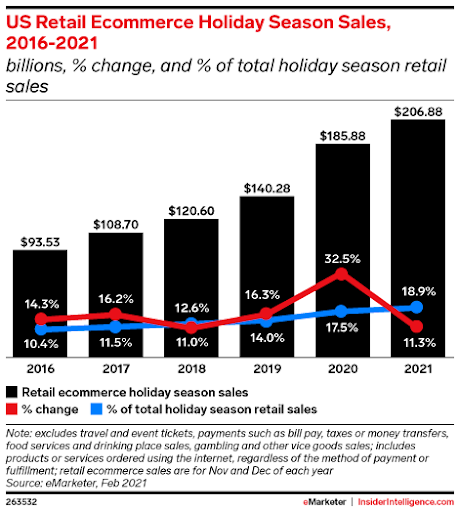
US Retail eCommerce Holiday Season

Image Credit: eMarketer

Though it’s more than one and half years since the pandemic approached, it is still hampering human life. We can experience this in every area of business as well. The continuously growing online sale proves that people are not ready to go out shopping yet.

There are more interesting facts too. In a survey, it is mentioned that 43% of the consumers are willing to continue online shopping instead of returning to the pre-pandemic shopping behaviors.

If retail brands need to stay ahead in competition during the holiday season, it is crucial to stay updated about the recent shopping trends and define their strategy accordingly.

Do you want to understand how you can be a part of the digital transformation that the retail domain is passing through these days? – Let’s connect

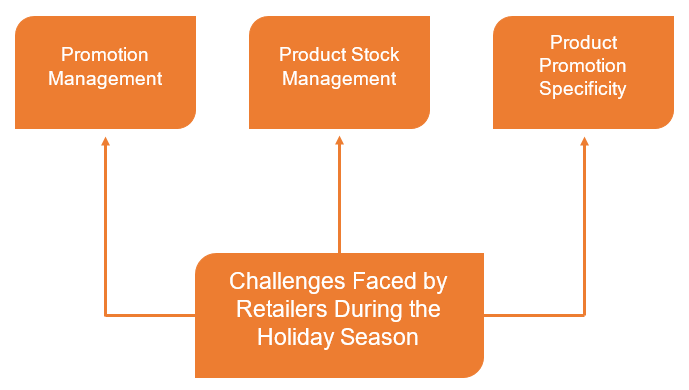
Challenges faced by retailers during the holiday season
Challenges faced by retailers during the holiday season

Promotion management

Retailers create a variety of campaigns, promotions, and messages to attract a different set of target audiences. But that’s not enough, they have to roll out these campaigns across all the potential output channels at the same time to establish coherence.

Most of the retailers manage the promotions manually from the different sales and marketing tools. This requires a lot of time, effort, and money to run a campaign effectively across all the customer touchpoints. With the right digital solution, you can address these challenges and push out the promotions at the exact time.

Product stock management

In the holiday season, it is obvious that the sales increase significantly. When the sales boost, online retailers have to increase their stock. The increase in stock will increase the product volume you already have. It also helps in branching out into new product lines.

Eventually, you have to manage more products and promotions during the buying season. Moreover, tracking product data will be challenging for the retail business when the sale is at a peak.

Product promotion specificity

When you have a wide range of products to sell, you need to have a great strategy in place. Moreover, for the success of your seasonal campaign, it is very important to define the set of products that you want to promote. Of course, you cannot and do not want to promote all the products as it will be a quite expensive initiative for you.

Especially, on Black Friday, when the sale is on the hype, you need to choose your products for promotions carefully and set discounts that you are willing to give to the shoppers. To maximize sales effectiveness, you need to define and manage the promotions of potential products.

Holiday eCommerce shopping trends

Holiday eCommerce shopping trends

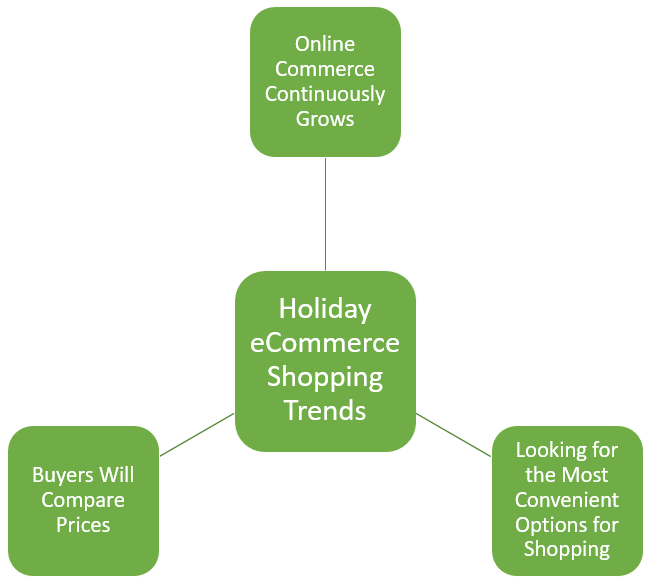
Online commerce continuously grows

Many pieces of research have clearly depicted that even if the world returned to normal, the essence of eCommerce will continue to thrive.

Here are some facts that support the above statement.

As per McKinsey, “As economies reopen, 73 percent of consumers are still hesitant to resume regular activities outside the home.”

Mobile eCommerce is also rising. According to a prediction of Mordor Intelligence, the growth rate of mobile eCommerce will reach nearly 27% from 2021 to 2025. Such increase in the usage and popularity of mCommerce is thanks to the leading brands that have allowed consumers to pay through mobile payments such as Amazon Pay, Apple Pay, PayPal, and more.

Social commerce is also a growing trend these days. Technavio recently reported that the social commerce market is poised to grow by $2,051 billion during 2020-2024, progressing at a compound annual growth rate of almost 31 percent.

Buyers will compare prices

Whether it’s offline shopping or online, finding good deals is always in customers’ interest. So, of course, this trend will continue in 2021.

Almost all the shoppers prefer to compare prices across the different retail platforms such as eCommerce stores, marketplaces, and so forth. They make a buying decision after analyzing the price and customer reviews.

A few surveys were conducted in 2020 to understand the shopping trends. One of the surveys reported that 41% of respondents replied they prefer to use holiday discounts. Another survey that is specifically conducted for Back Friday reveals that 44% of respondents look for special deals on Black Friday.

One more survey also showed that 74% of customers actually do not want to buy products through a tablet or mobile. But, they would like to buy through mobile devices just to redeem a discount.

All these data provide clear insights that while preparing for the Holiday season, it is important for the brands to consider the holiday discount.

Looking for the most convenient options for shopping

With each passing day, we are getting closer to the holiday season. Consumers still prefer to avoid crowded shopping places.

A recent survey reported that 49% of respondents prefer to shop holiday gifts from different online platforms to avoid traffic, crowded areas, and cramped parking lots.

The same survey also communicated the fact about online shopping where they mentioned 75% of the respondents purchased at least half of their holiday purchase through an online platform and 26% of the respondents bought all the gifts through digital platforms.

One of the prime reasons for considering online platforms is convenience. According to another survey, 77% of the buyers accepted that convenience is the prime reason for online shopping. Also, online shopping enables the buyers with easy payment options including BIPOD, buy now and pay later, and subscription services.

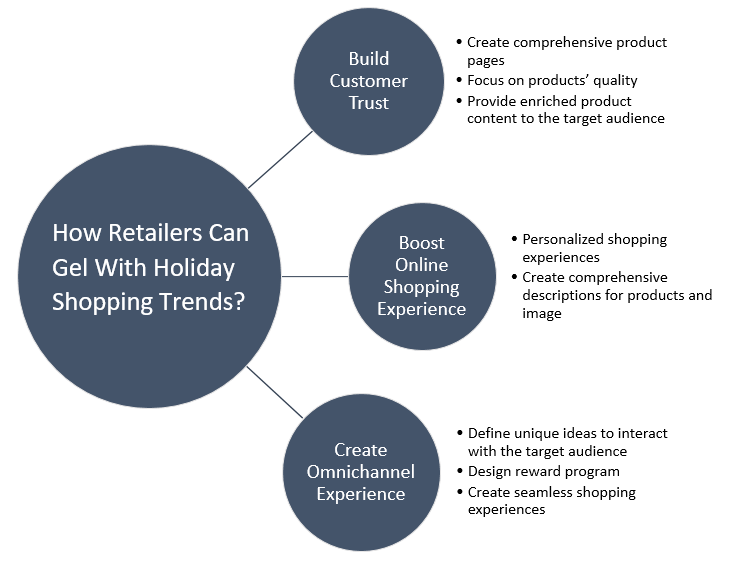
How retailers can gel with holiday shopping trends?

Understand the existing shopping trends and customers’ buying behavior to create the right strategy for the upcoming holiday season.
How retailers can gel with holiday shopping trends
Build customer trust

As we have discussed earlier, the growth of the eCommerce sector increases immensely. This has also raised the level of competition. Even though there is tough competition, there are more opportunities for businesses to embrace.

A survey reported that 86% of the customers are ready to spend more with a brand they trust.

Create comprehensive product pages

Before buying any product, consumers study the information available on the product pages. It helps them a lot in making the final buying decisions. Spend some time creating the content for your products.

While distributing product-related information across the different digital platforms, make sure there is consistency in the message. Also, consider presenting reviews and provide answers preemptively to the buyers’ queries.

Focus on products’ quality

High-quality product information, ingredients, craftsmanship, materials, and other rich content help retailers build trust across the customers.

Spread awareness about your products across your shoppers. Show them how the products are made, what they are made of, and your business practices by harnessing the potential of different digital platforms.

Provide enriched product content to the target audience

Enable the consumers with enriched content such as 360-degree image views, stunning product images, videos, comparison charts, and so forth. Offering detailed information about the product, you help buyers to know what they are purchasing.

Enhanced content helps improve your customer conversation. As per a survey, the enriched content improves customer conversion from 10% to 30% across different product categories.

Boost online shopping experience

Convenience is essential to impress and engage the customers during the highly competitive time of holiday shopping. It is difficult to try new experiences every time but with the right digital platform, you can deal with this requirement up to some extent. Here’re some ways that help you create memorable shopping experiences for your target audience.

Personalized shopping experiences

To create everlasting experiences, you need to enable the buyers with personalization. Provide relevant product information to the shoppers that they are looking for. Share the relevant product content, images, videos, reviews, etc.

With a robust digital solution, you can create and deliver highly personalized experiences to your buyers that help you boost brand engagement and increase conversion rates.

Create comprehensive descriptions for products and images

Provide detailed product descriptions and high-resolution products images to the buyers. It helps in earning customers’ trust. If you want to gain more customer attention with fewer efforts, then you should focus on product content.

Create an amazing omnichannel experience

During the holiday season, every retailer invests all their efforts and money into eCommerce initiatives to increase online sales. Along with digital stores, brick-and-mortar stores can also create an amazing buying journey for the customers by introducing omnichannel experiences.

Define unique ideas to interact with the target audience

Buyers interact with your brand either through the online store or mobile app or social media or physical store. By implementing cross-promotional customer experiences across the different output channels, you can improve customer engagement with your brand.

Let’s understand this through an example.

In our brick-and-mortar store, create a holiday-themed area where the buyers can click pictures and share them across different social media platforms with their preferred hashtags.

Design reward program

Create a customer loyalty program that encourages your target audience to engage with your brand through different touchpoints. Consider linking a member’s reward number that is accessible through your website, mobile app, and physical store.

Create seamless shopping experiences

As we discussed earlier, customers love conveniences regardless of how and where they want to shop. To enable them the best buying experiences, ensure you provide them online shopping, same-day shipping, BIPOS, and other options that are accessible across the different customer touchpoints.

What is Product Information Management (PIM)?

As the name itself suggests, Product Information Management (PIM) is a platform that allows you to manage all types of product data in a centralized location. It allows you to collect, manage, enrich, syndicate, aggregate, and distribute product information across different sales and marketing channels in a consistent way.

Along with that, PIM allows companies to create product catalogs and distribute them across different output channels. The platform manages all the product-related data that you need to sell and promote the products.

To learn about product information management in detail, visit What is PIM? – An Ultimate Guide for Product Information Management.

How to define a holiday eCommerce strategy with a Product Information Management platform?
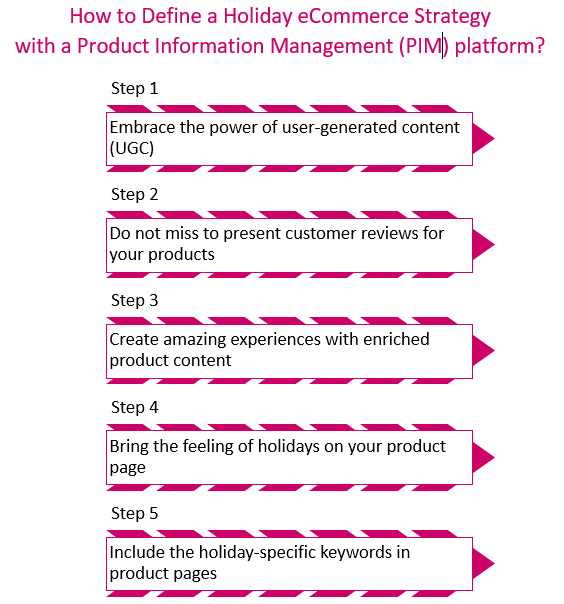
How to Define a Holiday eCommerce Strategy with a Product Information Management (PIM) platform

Digital shopping is gaining tremendous popularity with each passing day. Especially in the holiday season, people go crazy to shop online on special days like Black Friday, Christmas, Kwanzaa, Cyber Monday, New Year’s, etc.

If you want to capture the opportunity to drive tremendous customer engagement and win over the competition with your competitors, you should start working on your holiday eCommerce strategy right now. Said that you also start defining the required tools and technologies that help you attain immense growth and success.

One of the surest ways to gain success is to consider the latest eCommerce holiday trends that we have covered in this post previously. Retailers need to analyze the trends and learn from them which one is more effective for the business in their defined budget. These trends help you understand the behavior, requirements, and challenges of digital customers through the way they interact with your brand.

If you want to stay ahead in the competition, stand out from the industry crowd and gain customers’ attention, you have to work on defining powerful, emotional, and unique ways to connect with your target audience by creating engaging product content.

Leveraging the right product information management platform, you can easily optimize your product content. Here are the essential steps to optimize your product content.

Step 1: Embrace the power of user-generated content (UGC)

As we have already discussed, digital trends are changing with the passing of time. Nowadays, user-generated content has gained immense popularity across digital marketers. The incremental demand of UGC is the primary reason that the apps like Instagram, Snapchat, TikTok, etc. are constantly working to cater more and more innovative and creative features to the creators.

It is proven that before buying any product, the shoppers go through the creators’ content. They find it useful while making the purchase decision. As creators’ content influences most buyers’ decisions, it is essential for businesses to define a strategy accordingly.

Utilize the creator content in your product pages and D2C (direct-to-consumer) website across the digital shelf.

How to transform your user-generated content into product content?

Video testimonials: While creating product pages, consider the video testimonials along with other product descriptions. Video testimonials add more value to your brand’s credibility.

Brand advocates: Take help from brand advocates to curate a collection of your products and share it on your site.

Unique hashtags: Create and share unique hashtags on your site. Your customers can use these hashtags to generate excitement about your products.

Authentic visuals: Collect the authentic visuals of your products from the social media influencers’ accounts and include those visuals on your website.

Social media challenges: People share a lot about their experiences in social media these days. You can analyze their challenges and include their issues in your product content. This encourages brand and product engagement.

Step 2: Do not miss to present customer reviews for your products

We all know that today’s tech-savvy customers prefer to buy a product after performing detailed research. In this research journey, they give prime importance to the rating and reviews shared by other customers who have already bought and used the products. These reviews give them a more realistic view of the product from the buyers like them.

If your product reviews tell a powerful and consistent product story, then there is a maximum chance that your shoppers make a purchase decision.

Various researches are conducted around the essence of customer reviews. It is proven that buyers trust the customers more than the brand voices. All the eCommerce websites typically present high-resolution product images in the well-presented form. They create product copies like take our word for that. Many times, it happens shoppers purchase the product based on this information but they do not get the product they ordered.

As reviews are playing a vital role in making buying decisions. It is important for the brands to invest some time and energy in capturing more and more customer reviews. Present the product reviews and ratings on the product description page on your website when customers are exploring the products and are ready to buy.

Reviews on your product detail page work as 3rd party endorsement and add incentives to persuade customers to buy.

Step 3: Create amazing experiences with enriched product content

Converting your prospects into a buyer through purchasing funnel is all about enabling them with the outstanding user and customer experience. You can mimic your in-store experience by creating a digital platform that helps you achieve similar types of shopping experiences as a part of your customer experience strategy.

While creating the digital platform for your products make sure to provide the same product detail and customer experience that they get from your physical store. It gives the same feeling of physically walking into the store and picking the products up off the shelf.

To create the ultimate product experience, it is essential to create visual details with enriched content that involves engaging graphics, comparison charts, image galleries, videos, and more. With the enhanced content, you can increase the conversion rate of almost all your categories and deliver compelling customer experiences.

As you prepare your digital shelf for the coming holidays, you need to consider different types of product content and add them to your product pages. Create better customer experiences by telling your brand story and presenting the product use and functions through visual content. It helps stand out from the other retailers during this holiday season.

Cover below listed points and enrich your product content for the product description page

  • Image galleries
  • Professional product images
  • Engaging and helpful brand videos
  • Images of varied fabric, colors, etc.
  • Close-up and product shots
  • Detailed information about the product and its use
  • Zoom-in and zoom-out functionality
  • Rotating image to show how the product looks on different models
  • How-to videos
  • Downloadable manuals and other content
  • 360-degree image spin

Step 4: Bring the feeling of holidays on your product page

A picture is worth a thousand words. This is a true saying. But do not mistake it by considering the power of words less than image.

Similarly, by presenting visually rich product images, you can definitely engage the buyers but that’s not enough. Buyers won’t make a purchase decision on the basis of images. They also need product information to understand every aspect of the product. So, provide every detail to the consumers. Enable them with your unifying product description across all your commerce platforms.

If your eCommerce platform is not converting the visitors to buyers, then one of the possibilities is that there are some issues with product content.

To encourage customers to make a buying decision in this holiday season, you need to organize, optimize, and prioritize the different product content including manuals, copy, etc. across the digital shelf. It helps you gain a competitive edge that other brands don’t.

Do you want to improve product content copy? Here are a few tips to consider.

Important tips for creating a product description

Consider all the relevant product information

While exploring your product page, the customers wanted to know every information about the product. So make sure your product description page covers the information like product name, title, and brand name.

It should also cover product-specific information such as colors, sizes, dimensions, sustainability practices, product categories, ingredients, and more.

Write that consumers demand

It is essential to cover all the product information on the product description page. But, the most important part is to focus and include the content that is most valuable for your target audience. Enable the buyer with the information that they want to know. Later on, preemptively answer the questions raised by the prospects on your product pages.

Centralized management of your product copy

All the leading brands manage their product content copy in a centralized repository in order to create a consistent and complete product story across the different output channels.

Creating the detailed product copy for each product and managing the product-related information into Product Information Management (PIM) is a highly effective strategy. The tailored PIM solution allows you to manage and distribute product content across different sales and marketing channels from a single platform.

Another most important thing is once you create the product content copy, keep updating it regularly. The holiday season is about to come. Start creating amazing product copy, rewrite your copy and make it SEO-friendly by including holiday-focused keywords.

Step 5: Include the holiday-specific keywords in product pages

Search Engine Optimization (SEO) plays a vital role to make your product searchable. Using holiday-specific keywords, you help the consumer to find the products during the holiday season. These days, when buyers want to buy anything they do the online research first and then make a purchase decision.

As shoppers prefer to perform online research before buying a product, brands have to optimize their product description page to make their products searchable on different search engines. By making your product information search engine friendly, you can earn more sales and profit.

You can also hyper-targeting your product description pages for the holiday season. It helps you beat your competitors and gain the attention of your targeted customers.

How to optimize your product description pages for the holiday season?

Incorporate the voice of your customers

Keywords: For successful SEO, it is very essential to consider the keywords that are highly searched by the customers during the holiday season. So, select the right keywords and optimize our product description page accordingly.

Interviews: You can conduct interviews with customers to understand their experiences with the product.

Customer reviews: You should include the customer reviews on the product description page. It influences the buying decision of the customers.

Keep updating product content on the product description pages where you present what your customers are talking about your product. This will be the most influential strategy during the holiday season.

Identify and use seasonal keyword research

Collect your product data and analyze the product name, titles, and description you have mentioned. Make sure you have added all the trending keywords in your product description such as gifts for women, gifts for dad, great stock stuffers, and more.

Consider the more search engine results pages (SERP)

Have you added schema markup on your product description pages?

If not, then do it right now.

This is one of the most underrated SEO strategies. Schema markup helps you implement structured data on your product pages. This helps search engines like Google to understand your product details in a better way. You can add structured data that involves product price, availability, style, and more.

In this information, Google adds more value. When you integrate SERP on your product page, it provides a more detailed, more exclusive, and more compelling Google product listing.

How Product Information Management (PIM) helps you boost your revenue during the holiday season?
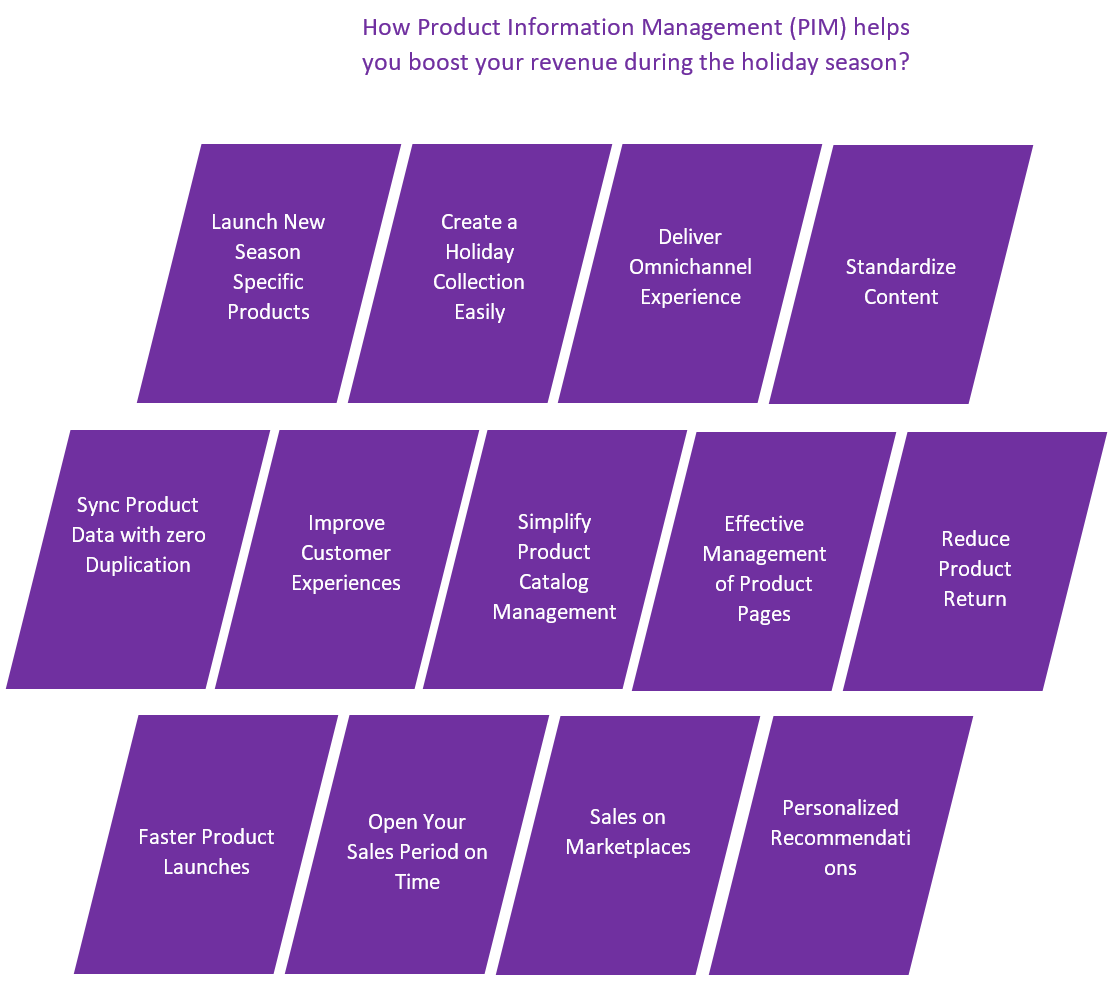
How Product Information Management (PIM) helps you boost your revenue during the holiday season

Launch new season-specific products

In the festive seasons, people feel totally different vibes around. They meet and greet relatives, have fun, do parties, go out on a vacation, and whatnot. To make these moments memorable, they spend more on different products. This is why shopping is increased immensely in the festive season. Especially on Christmas.

During the holiday season, to be different from others, customers look for new products, seasonal discounts, and have fun out of the shopping. Many pieces of research proved that most of the shoppers buy gifts for their relatives as well as near and dear ones only in a week before Christmas.

Retailers can grab this opportunity for product innovation and partnerships that are available in the market.
Implementation of a product information management platform empowers you by allowing you to launch the products faster. Not just that, PIM helps retailers to understand buyers’ behavior and streamline their purchase preferences based on shopping history, existing stock, and topography.

With this data, it becomes easier for retailers to plan their product launches smartly by establishing guidelines and timelines for collecting and delivering the content elements. Moreover, with an advanced PIM, you can gather and manage the detailed product attributes that work as a significant differentiating factor for your product.

Create a holiday collection easily

While creating the product catalogs, keep your customers in mind and design your catalog accordingly. The way your catalog is organized and provides all the small details to the customers makes a huge difference when it comes to making a buying decision.

In the holiday season, you can beat your competitors by having an important product line that helps you to grab customer attention significantly like pre-Christmas flash sales.

PIM helps you in creating a compelling product catalog by presenting your products in a collection list. To manage your new collection catalog strategically, you need a powerful system in place that comes with no restrictions in terms of the expansion in size and rate.

Implementing the ultra-modern PIM, you can streamline various business operations such as updating stock numbers, handling product catalogs based on in-stock availability, managing a catalog, and adding new versions.

Deliver omnichannel experience

The millennials interact with your brand from various platforms. By focusing on a single output channel, you won’t ensure growth and success for the business. Furthermore, modern customers are looking for omnichannel experiences so enable them with a solution that helps you to engage them.

By creating and delivering omnichannel experiences, you can set up the backbone for the success of your retail business.

In today’s words, buyers are moving between offline and online channels interchangeably. Thus, make sure the product information they receive at different customer touchpoints is timely and consistent.

Retailers have started understanding the impotence of this process. They have realized that buyers purchase the products from different output channels. Once this is clear, they can think beyond product sales and focus on creating product experiences and presentations.

PIM allows retailers to enable the users with a smooth cross-channel experience. By providing accurate and consistent product information. It ensures that business persona is an integral part of customers’ decision-making journey along with their purchase.

Standardize content

It’s very important to provide product information to the buyers effectively and efficiently regardless of any specific season or festival, including the holiday season. Retailers have to run a variety of offers simultaneously across different channels. Additionally, they have to keep introducing new products and product ranges with content consistency.

One of the researches conducted for holiday-specific shopping has revealed that most of the shoppers prefer product-related advice from family and friends. There is a user base who prefer to take advice from retailers where they may discuss which product they should buy.

Through these researches, it is proven that word of mouth strongly influences buyers’ behavior. But, content consistency is the paramount need to convert your customers into your influencers. They share their positive experiences with your brand in the market and impact the buying decisions of other users.

Achieve seamless synchronization with zero duplication

Product Information Management handles all the product data in a centralized repository. It enables your teams with a single interface to access all the product data. This helps to avoid the situation of data duplication that occurs with multiple entries of the same product data.

Implementation of PIM ensures that all the product information is latest and updated. They can share these details across their online and offline channels.

Improved customer experiences

Considering an avant-garde PIM platform, you can create customer-centric product categories and structures independently without following the ERP system. This helps you create the site navigation more intuitive and user-friendly.

Moreover, when customers search for a product by defining different parameters such as technical specification, category, size, color, etc., the platform provides a list of all the relevant products.

Enables the buyers with a short search process, helps them find their preferred products quickly, and allows them to purchase their selected products faster. Integrating PIM, you can leverage easy navigation, effective search results, and relevant product information that helps you boost your brand confidence and buyers’ shopping experience.

Simplified product catalog management

During the festive season, retailers try hard to attract buyers. One of the most effective ways to get customer attention is by creating exclusive product catalogs. Before making a purchase decision, the buyers pay considerable attention to read and interpret the product information described in the product catalog.

PIM allows retailers to identify and filter important product attributes. This process simplifies the complex and confusing product catalogs and eliminates the possibilities of product data duplication. Create a categorized product catalog with the help of PIM and allow the buyers to make intelligent buying decisions.

Effective management of product pages

During the holiday season, retailers launch varied offers and discounts for the customers. These offers are available for a limited span. Buyers tend to make instant buying decisions and take advantage of these offers.

To make quick buying decisions, they want retailers to present the product information in such a way that can view and analyze the essential info swiftly and make the buying decisions. While buying a product, the most important aspects of a product that shoppers need to know are product price, description, technical specification, customer reviews, quality, usefulness, return conditions, shipping information, etc.

Include all the above-listed details on your product description page and convert your product page into a conversion-driven product page.

Reduce product return

Product return is one of the biggest challenges in the eCommerce domain compared to brick-and-mortar stores.

Most of the returned products are non-liquidated inventory that could be a reason for loss for the retailers. It costs retailers 20% to 30% of the sales price of the product.

The most common reasons for product return are products not matching descriptions, incorrect sizing information, and general unfamiliarity of the customers with the products. Inaccurate and incomplete product information is the root of these issues.

With PIM, you can standardize the product content and present all the details on the product description page that helps in reducing the product returns. Include customer ratings and reviews as well as how-to videos on the product page that helps buyers to make a well-informed purchase decision.

Faster product launches

The holiday season is the prime time for retailers to launch new products and roll out exclusive offers for shoppers. It is essential for them to spread the news about newly launched products quicker in the market. PIM allows them to distribute new product-related content across the different sales and marketing channels.

PIM platform streamlines the product data management and distribution process. You also need to make sure that when the product information gets updated in the system, it gets distributed across all the output channels.

Improve your sales by harnessing the multichannel marketing capabilities of PIM that allows you to run your bundled offers and seasonal campaigns seamlessly.

Open your sales period on time

It is a common scenario that retailers pressurize their sales and marketing teams to keep their product information and product catalog updated while launching new products. Implementation of PIM allows your departments to work with unpublished data. Not only that, you have the freedom to make the necessary edits and revisions in the product information before making it live across different platforms.

Define a workflow for your different teams and team members in the PIM as per their roles and responsibility. You can provide access to the users you want. It allows to define and organize the editing rules as well as supervise all the changes before the product content goes live.

Additionally, you can schedule the time and date when to go live with new or different product pages. Thus, during every holiday season or festive period, the sales begin at the exact time you want and distribute the product data across different channels at the same moment.

Program-specific products and sales on marketplaces

To save time and effort, most organizations prefer to have a single eCommerce strategy and implement it for different output channels. Well, honestly, it won’t work. You cannot satisfy the requirements of different sales and marketing channels through a single eCommerce strategy.

Brands also sell the products on the leading marketplaces such as Amazon, eBay, Flipkart, Rakuten, etc. You can launch your products on a very niche platform like Newegg. Implementation of PIM allows you to differentiate easily how you want to sell the product catalog on the marketplaces and in your own channels like eCommerce store or website or mobile apps.

Selling the products on marketplaces at the same prices and adding your products to your marketplace page adds value to your business. It allows you to launch your new collection and sell your best seller products on the marketplace.

You need to tailor the products as per the specific taste and preferences of the marketplaces’ target audiences and product niche by considering the traffic volume of the specific platform.

One of the drawbacks of considering marketplaces is the profit that you earn from marketplaces will be lower than your own channels if you are a big brand. But, for small and medium scale businesses, it’s easier to reach a larger customer base through marketplaces.

Implementation of the PIM platform allows you to select and explore the required product information in just a couple of clicks to sell the products on marketplaces. To upload the product data easily, PIM allows for the integration of any specific connectors and plugins for the largest and the most reputed marketplaces.

Personalized recommendations

In a conventional method, sales representatives need to pass the information to the owners about the previously purchased items and the products that are sold immensely in the last Holiday season.

They also analyze the discounts offered on the high-performing products and propose the relevant discounts for the same product lines. They provide an overview of top-selling products that complement their existing product lines. Moreover, analysis of the past year helps retailers to produce the future trends of the coming year.

Retailers can earn customers’ trust by offering personalized recommendations by considering their demographics and preferences. To attain this, you need to equip your sales reps with the right tools and technologies.

With the right PIM solution, you can get insights into recent product purchases, personalized product recommendations, and more. Personalization is the most essential feature these days that ensures the success of your business during the holiday season.

Closing Lines

Happy Holidays to all the readers in advance!

I really wish that the small to large-scale retailers have a blast in the holiday season. Considering the right PM solution you cannot only increase the revenue but also boost the customer experiences that help you stay ahead in the competition.

Many product information management platforms are available in the market, you need to make the right choice as per your specific business needs. If you are in a dilemma of which one is right for you, feel free to connect with our PIM experts to get exclusive guidance on PIM.

A Brief about Digital Commerce (D-commerce) & Why PIM is Essential to it?

When compared with a few years back, Digital commerce (D-commerce) has a new face. In recent years, D-commerce is considered as the successor to eCommerce by top businesses and companies who utilize commerce platforms for selling their products and services.

This article will elaborate on digital commerce in detail along with the information on why PIM is essential for businesses preferring the D-commerce business model.

What is Digital Commerce?

Digital Commerce (D-commerce) is a business model that facilitates the business process involved in purchasing or selling products/services via multiple digital channels like mobile gadgets, the internet, or through any commerce platform.

D-commerce delivers an interactive and positive customer experience to the buyers/users. Apart from that, digital commerce eases the working operation of marketers to create and execute digital commerce strategies by offering personalized content. Mainly personalized content and mobile gadgets drive the D-commerce business model.

Being consistent on data governance and meeting the expectation of the buyers through optimizing the product information/data are the main things delivered by digital commerce to the businesses. Digital commerce is an omnichannel that carries functions through an automated process.

By keeping automation as its core feature, the digital commerce business model achieves its success when it is supported by relevant data.

Aspects of Digital Commerce

Well, digital commerce is bundled with the elements which play a vital role in triggering consumers to make a purchase decision. D-commerce is an amalgamation of the elements which are essential for strategists to create an effective business strategy by mapping all the activities and journeys of a buyer.

In simple words, digital commerce acts as a power source for businesses and provides a seamless buying experience to potential consumers.

Here are the lists of a few key aspects covered by the digital commerce business model.

  • Effective content marketing through personalized content
  • Well-optimized product content, images, and other assets
  • Creates efficient marketing strategies, promotional campaigns, and social media engagement by providing accurate data/content in time
  • Perfect data Analytics
  • Seamless customer service
  • Effective supply chain management

The Need for Digital Commerce

The commerce platform keeps evolving every single day which leads to changes in consumer behavior. To satisfy potential buyers with the modernization of technology, companies prefer digital commerce also known as D-commerce.

Study report shows smartphone users view 48% of the web pages. The scope of digital marketing turns towards mobile gadgets, the online retail world prefers to satisfy the needs of smartphone customers. This clearly shows how mobile gadgets play a vital role in commerce platforms.

Here are a few things companies/businesses can achieve through digital commerce.

  • To deliver better customer experience consistently
  • To Keep up with the evolving market challenges
  • To ease the customer data collection and storage process
  • To deliver more personalized content
  • To drive more visibility to the products through multiple channels
  • To gain authenticity to brands by generating reviews and content on social media

Benefits of Digital Commerce

Digital Commerce plays a vital role in all business aspects starting from its strategy, administration, revenue, and many more. Take a look over the below-given few attractive benefits of Digital commerce.

Seamless Business Process

When it comes to successful business strategy, every potential customer needs to be mapped in well-advanced, and product information should be provided accordingly. It is well-carried in D-commerce through automation.

D-commerce predicts the customer’s next move and provides the answers in such a way that matches their expectation. By doing so, the buying time of a potential consumer reduces significantly.

Less Manpower

Since Digital Commerce is relying on automation, business owners need not depend on heavy manpower. Also, an automated process eliminates the risk of human errors and saves a lot of time.

This allows a business owner to focus on the business growth rather than focusing their attention on the workforce. Apart from that, D-commerce handles business/product data effectively, this allows business owners to take care of repetitive processes.

Easy to Scale

Digital commerce uses an automated business model, because of that, businesses can be easily scalable. Because of automation, the challenges involved in business expansion in managing customers, consolidating sales, managing employees/product performance, and so on can be eliminated in digital commerce.

Enhance User Experience

Digital commerce delivers a personalized experience to potential consumers which leads to the growth of positive consumer experience. As a result, potential buyers will keep coming back to purchase more products. This will eventually increase business revenues.

Digital Commerce Trends 2021

In today’s digital world, everything is in the state of evolution; digital commerce is not an exception to it. Even marketing experts would find difficulties in keeping up with the world of digital commerce innovation.

Here are the lists of a few trends which are popular in the world of digital commerce.

API Based Commerce

API-based commerce is also well-known as headless commerce offers a platform to develop unique experiences and business growth through API interface with various business systems.

Subscription Commerce

The subscription commerce model delivers constant and recurring revenue to both sellers and merchants. This model saves a lot of cost on the administrative level by predicting the cash flow and budget.

Unlike other commerce business models, this subscription commerce is the perfect one that suits well for doing repeat business. Many companies in the field of cosmetics, food, health, and more prefer this model.

Progressive Web Apps (PWAs)

PWA apps are highly reliable, secured, and more engaging that users will feel the native-live experience. Moreover, when compared with native app development, PWA app development costs much less. That’s the main reason modern companies mostly prefer developing Progressive Web Apps to developing native apps.

Reasons Why PIM Is Essential for Digital Commerce (D-commerce) Business

When it comes to digital commerce (D-commerce) business, managing and aggregating the data/information of the product is the cornerstone that every owner needs to pay attention to. To make things right, digital commerce businesses require a proper data management technique, as a result, product information management (PIM) becomes critical.

A good PIM system offers a wide range of benefits to businesses especially in the digital platform like improving the quality of the product data, better data governance, and so on. In simple terms, a PIM system helps businesses to grow with full potential by responding to the evolving market condition.

Apart from that, here are a few more vital points that make PIM solutions mandatory for every business digital commerce (D-commerce) or electronic commerce (E-commerce) journey.

1. Data Quality Enhancement

In today’s heavy competitive market, having low-quality product data will surely impact customer’s interaction with your products which may lead to a loss in the business sale. In a digital platform maintaining, high-quality data is essential and critical. Also, government regulations and legal requirements are changing constantly. To maintain the changing compliances of modern-day regulations business owners need to update their product data on a regular basis.

Introducing a PIM system will help E-commerce or D-commerce business owners to address those issues easily. In addition, the PIM solution eliminates incomplete data attribution and offers full control over the data values.

2. Creates Effective Marketing Strategies

Modern-day businesses in digital commerce platforms use multiple channels for promoting and selling products/services. It doesn’t matter what products/services are being offered by a business, having a better and effective marketing strategy plays a key role in reaching target audiences/customers. To create such an effective marketing strategy and to achieve a unified customer experience in multiple channels a proper data management is required for providing accurate data in a timely manner.

A PIM system establishes one source of product data for multiple channels helps marketers to create effective marketing strategies that will enhance customer experience uniformly. Having a unified customer experience across multiple customer touchpoints will make sure the product/services of an E-commerce or D-commerce business growth rate rises steeply.

3. Improves Product Position in Search Result Page

Google’s bot and other search engine programs prefer products with detailed information or data to be listed on the result page. So that users of search engines will find it more useful. Having a good PIM system will provide accurate and extensive information to search engines and enable search engine users to view 90% of the product content.

Also, the PIM system provides enriched product content that will increase your website page density and makes your pages more appealing to search engine’s site crawlers.

In addition, the PIM solution enables business owners to concatenate product data attributes and generate attractive Titles, Meta tags, and catchy Alt tags for images this makes SEO professional’s work easier to optimize web pages more search engine friendly.

4. Makes New Product To Reach Market Faster

The time taken by the new product or sales channel of your digital commerce business to the market will determine when you can start experiencing the profit revenue through it. Generally, the marketing team will take time on seeking detailed information/data from the E-commerce or D-commerce teams to create an effective marketing strategy for the particular new product.

But in the case of having a PIM Solution, business owners can manage the product data/information efficiently and send more accurate detailed product information to the marketing team. This eliminates the confusion and time delay caused by raising requests and sending product data. The fully automated workflow of the PIM system gets rid of the possibilities of human error while doing manual data entry.

5. Business Growth

It doesn’t matter what kind of E-commerce or D-commerce business you are doing, if you want to expand and start witnessing business growth, you need to comply with the evolving market conditions and react quickly. In addition, you need to be aware of the importance of providing syndicated product content to multiple sales channels to grab the opportunities caused by raising demands.

A good PIM system will offer a wide range of integration tools by using which you can easily create a product portfolio according to the expectation of the buyers. Also, a PIM system enables you to translate and manage product content in multiple languages. This feature of PIM enables business owners to attract more overseas customers by providing optimized product content in the local language and to carry out the business’s geographic expansion.

6. Increases Performance

Many believe that a PIM system is just better data management, but it’s not true. PIM plays a major role in maximizing business productivity and offers more work satisfaction among employees. A good PIM system will eliminate the complexity of manual mode of data entry and manual maintenance of data in a spreadsheet and so.

Instead, the PIM system helps business management to streamline the business process and improves the work effort of employees. Moreover, it enables business owners to store and maintain business data/product content in a centralized trustworthy location where data can be retrieved easily at any time.

7. Better Customer Experience

Having loyal customers is a key for every business, to have loyal customers’ businesses need to satisfy their customers. In today’s growing competition providing customer satisfaction and maintaining loyalty among potential buyers becomes harder and harder. Apart from providing various value-added features like hassle-free shopping and free shipments by digital commerce businesses, it is important to provide accurate and enriched product content constantly to customers.

A PIM system has the personalization capabilities through which businesses can provide personalized product content to the individual customer to gain their loyalty. Also, the PIM system allows management to quickly correct the issues raised by customers and gain their trust. This set of actions will surely improve customer experiences.

Bottom Line

Meeting the requirements and expectations of modern digital consumers will become easy with a good PIM system. So, what you are waiting for is to implement a PIM solution to your digital commerce business and start witnessing the positive changes it brings to your business. PIM offers a flexible content strategy that will lead your business growth in digital commerce.

All You Need To Know About Hyper-Personalized Customer Experiences, Benefits, Frameworks & Why It Needs Multidomain MDM?

In this world of growing business, every organization needs to develop themselves as per the customer needs. They need to develop and update their products based on their customer demands to gain their trust and confidence.

The organization can attract its customer’s attention by providing personalized communication and through customized experience. The customers prefer accepting the service from the organization that provides personalized care, products, and services.

What is hyper-personalization?

Due to digitalization, the organization can gather a lot of data related to their products and services as well as the data specific to their customers. The organization can make use of this advancement to collect the behavioral data of the customers to understand their needs and requirements.

It becomes possible to interpret the customer characteristic and develop product-centric marketing strategies. With this data, the organization can develop better personalized customer-centric marketing.

Hyper-personalization allows the gathering of real-time behavioral data from the customers related to the services, tailored products, and their experience based on their requirements.

For making this purpose easy, the organization needs to combine the product and customer data to collect data from multiple channels regarding their product experience, their needs, and requirements.

Hyper-personalization will allow in the collection of relevant accurately that will be the same in a lot of time. This helps in collecting efficient details related to the customer’s requirements and accordingly provides personalized products to them.

How does hyper-personalization differ from personalization?

It is important to understand how hyper-personalization is different from personalization. There are different forms of personalization definitions where the organization understands their customers and recognizes them by the different products they purchased and reviewed. Hyper-personalization is a more advanced technique that makes the use of artificial intelligence-driven methods for personalization.

The personalization that interacts with the customers with their emails or other contact details obtained from their previous purchases. Hyper-personalization gathers the customer needs and requirements from various sources. These details are in context from the different channels, locations, product categories, different brand interactions, etc.

Hyper-personalized framework & its benefits

There are different important steps involved in forming the best framework for this hyper-personalization. The essential steps required for designing the blueprint for the best hyper-personalized framework include:

Data collection

This is the first and the most important step responsible for identifying the audience. It is essential to understand all the customers distinctly based on their requirements. Having adequate details about the target customers will help in better personalization.

Customer segmentation

In this step, the customer data is split into various sub-segments for better personalization. These subgroupings are based on spending, demographics, contentment, location, and past interaction with the customers. This helps in improving customer engagement and adherence to the band.

Target exploration

After the segmentation, the next step involves setting the communication facet. There are different factors involved in engaging the customers.

Analysis

The final step of the framework includes the implementation of the calculation and examining the different measures for making this campaign successful.

The different benefits gained by an organization from the hyper-personalization include:

  • It allows in removing the different obstacles in their sales channels that can lead to various complications in customer’s shopping experience. It helps to decrease the efforts and search time by the customers to get as per their requirements.
  • It eases the burden from the customers and helps them in selecting the items that they want. This hyper-personalization uses the recommendation algorithm that allows displaying the products to the customers based on their needs.
  • It is the best path that helps any brand to attract customers promptly and also retain the already existing ones. This is possible as it allows them in recognizing their customer’s interests and requirements. This helps the customers by saving time by providing the best and relevant solutions.

Creating a hyper-personalized customer experience

The customers while shopping prefers the business partners that will allow them to buy the best possible product or services based on their requirements. There is an increase in the targeted or personalized strategies that help in attracting customers. These techniques help the organization in taking their business to a higher level.

This hyper-personalization helps to enhance the real-time marketing of the products. This helps in improving the customer connection and leaving a better impression.

1. Understand real-time marketing

Real-time marketing is the best strategy that will help any business to target its customers. Based on the location, the customers can be prompted with the current sales and offers. This will trigger the customers to visit the store for making the purchase.

2. Know the customer

Based on the customer data, the marketing team can get an idea of the items or product category that the customer is currently focussing on. Based on their needs based on the category search, the customer can be prompted the details of related products that might interest them.

Sending out the survey sheets, polls and getting their responses will help in creating the detailed requirements. These will also help in understanding the customers and increasing the conversations. Based on the search details from customers will help to target the different customers.

3. Rapid follow-ups

Certain customers add their product of interest into their shopping cart but due to certain reasons, abandon their carts. They visit the product site but do not complete the purchase procedure. This customer can be prompted to purchase their selected product by giving them a helpful nudge to look into their filled cart and proceed with the purchase.

Based on the customer’s previous purchases, the company can prompt the customer for the upgraded or latest product belonging to a similar category that the customer prefers. If the customer is suggested with the trending product based on their likes and interests, they will be prompted to make the purchase.

4. Personalization

For providing hyper-personalization, it is essential to update the data and response from the customers. For this, they send out the survey sheets on a regular basis to understand the customer needs and requirements. Marketing the products that the customers are looking for is the best way to attract customers and increase the business.

Understanding the customers is essential for marketing. If the customer product list includes the makeup items related to the cruelty-free items, then suggesting similar types of products to the customers makes them feel that they are heard and their requirements are considered.

This will help to retain the customers and increase their purchases. Better understanding the customers helps in providing them the best services and products.

Why do hyper-personalized customer experiences need multidomain MDM?

Attracting more customers and retaining the original one is the most important task that the organization needs to take up. Customers prefer online shopping for the product of their desire.

There are various channels where the customers can search their requirements. It will be beneficial if these customers get hyper-personalized services on the various domains. The different factors that need to be considered while making personalization are available on multiple domains.

Multi-domain Master Data Management (MDM) provides personalization strategies:

The customer experience helps the organization to understand the customer needs. These details help in setting up the hyper-personalization strategies. The different ways that allow the multidomain MDM in achieving hyper-personalization include:

Governance capability

Multidomain MDM helps the business owner by providing them the important data elements required for personalization like product data, customer data, location data, channel data, etc.

Data quality

Multidomain MDM makes sure that all the data related to the customers, products, and other data used for the hyper-personalization is accurate, coherent, and complete.

Generate new data insight

Multidomain MDM does not generate any data on its own. It uses all the data that is readily available. It helps to compile all the data efficiently to yield new insights. This will help to generate information that will be helpful in hyper-personalization.

Different sources of data

MDM compiles the data from different sources like social media data, census data, etc. Combining these data efficiently with the master data records can help in revealing newer insights.

Use of analytics for personalization

Efficient customer interaction can help in generating a lot of crucial data that will help in understanding the customer demands and needs. It can be done based on direct interaction or the basis of various sources like surveys, channels, reviews, etc. MDM helps in generating the repository for collecting and sharing all this data. This will allow the business owner to create a coherent customer-centric experience for purchasing desired products.

Proper data collection

There are certain problems faced by the organization in collecting the customer’s data as there are different challenges. These include non-disclosure due to no consent to use the information, insufficient or lack of tools for collecting the data, management, and organization of the ill-defined objectives. MDM supports in overcoming these challenges. It helps in collecting all the data in a safe place and then collates the data efficiently. MDM ensured keeping the process of data collection transparent.

Multidomain MDM helps in moving from segmentation to personalization to hyper-personalization:

  • Segmentation allows addressing a wider set of public or customers based on the set of demographic similarities like gender, demographic location, or region, etc. On the other hand, personalization takes into consideration the individual customers by understanding their needs and providing them the best suitable products and services.
  • The personalization process is a very data-intensive process. The different aspects that define the customer experience are based on personalization accuracy, coherence, relevance, pertinence, timeliness, etc. Different recommendations tools that can adjust the experience will help them to prompt the relevant products to the customer based on their interests.
  • Multidomain MDM helps to define the different zones of insight. It allows defining the unique cross-domain governance that leads to the development of effective hyper-personalization. These zones of insight are formed by the intersection of the different data domains like customer data, product data, location data, and supplier data.

The multidomain MDM makes use of and relies on the different types of data essential for hyper-personalization. These types of data include:

Event-based data

This includes the real-time data that directly impacts the individual and is related to the local information, local weather, device usage, behavior, etc.

Configuration-based data

This information is based on the individual configuration settings adapted by the user. This depends on their aspirations, needs, product preferences, content appearance, information alerts, consent information, etc.

Deduction-based data

This data includes the results based on the analytics. Based on the previous behavior or purchase of the customer, the next offer, eligibility, sentiment is considered.

The multidomain MDM helps to achieve the hyper-personalization in the following ways:

  • It is important to have the governance strategy in place for an effective hyper-personalization. This required data transparency, relevance, better quality, coherence, etc. across the different channels. Multidomain MDM helps in having data transparency.
  • It allows managing the different data domains and this information directly impacts the customer experience.

Brands doing hyper-personalization

There are some top brands like Amazon, Starbucks, Spotify, etc. that have gained their current positions in the market due to this hyper-personalization. These brands use machine learning and artificial intelligence techniques for setting up their privilege recommendation engine. These techniques help these brands to keep their customers engaged and attracted to their products.

Amazon

They provide a hyper-personalized experience for each of their customers. They have access to huge data regarding the search query, search history, brand fondness, category browsing, etc. They propose the items to their customers based on their previous browsing and items in the shopping cart.

Starbucks

They boost hyper-personalization by using real-time data and deliver the messages related to the different offers on the food and beverages based on their preferences and past activities.

Spotify

It understands the individual music selection and based on the category suggests some details by mails or text for similar live events.

Bottom line

Providing personalized service to the customers is beneficial to the business in many ways. This hyper-personalization includes several steps added to the conventional. This personalization helps in creating a better experience for each of their customers as their expectations keep growing with the increase in digital competence.

The organizations need to adopt the new techniques, approaches, and plan accordingly to make this personalization experience and achieve their goals.

How A Better Product Experience Builds A Brand Experience?

When you make any product of course it should be of your interest and should make you happy in the process of making but the very second thing to know or to keep in mind will be customer satisfaction, their happiness, and their ease of accessibility. And this is where the concept of product experience starts its play.

What is Product Experience? And How Is It Important?

Product information is the journey of the product with the customer, throughout the lifetime of the product. All the motives, emotions, and feelings of the customer regarding the product are called the product experience.

And why is it so important?

Many of us ask this question quite often when new to the business, well no worries I have got you.

It builds a trust bridge between customer and company

If there are two brands in front of you, one with the best ratings and the other one with poor ratings, which one of you would choose for you? It is obviously the one with good reviews.

Exactly, that is the mindset of this generation you see, they keep more of their heart towards positive customer reviews because they know it will bring them good comfort and ease.

Previous good reviews make more sales of other products of the same brand

When you have purchased some item from a particular brand, you will have some sort of expectations or good recall about the same brand product that you have used, so you will bend more toward the same brand for another product purchase.

Client preservation

As the client has interest and trust in your company or business, they will be there with you for a longer time or maybe throughout your whole journey.

It feels nice to have someone looking out for your new adventures and new releases and being blissful after using them, doesn’t it?

Who is Involved in the Product Experience?

The product-based organization needs to focus on the development of the product. The product experience helps the organization to focus on the customer journey that depends on the product. It includes the path from the first login of the customer to the product website till they quit the application.

There is a dedicated team involved in defining the product experience. The integral part of the team involves the graphic design staff and user interface as they provide the customer perspective. The customer support team helps by providing customer input based on their feedback. Customers play a crucial role by providing data through surveys and experience.

Tips To Improve Product Experience

As a business, you should try every possible way to treat your client very delightedly and to make them comfortable in using your products. It may be through your website, your company advertisements, or referrals.

So, here are some tips to please your customers and to improve product experience:

1. Always provide the best customer service

Service that your company provides should never be company based but customer-based, that is you should provide answers to every queries your customers have about your product be it hundred times but you should not get annoyed but instead you should be very peaceful and polite and make them understand the answer to their questions.

Digital engagement tools can genuinely help you in doing this kind of engaging work.

This will build a good impression of your company in their eyes and they will feel more connected and at ease. This is one of the best tips, to increase customer satisfaction.

2. Always take customer reviews seriously and post them on your social media controls

Okay, so for this step first of all your company should have a social media platform with your company’s name to promote your company digitally. You can make one page for your company on Instagram or Facebook or even on Twitter. And if you have a website you can make them purchase your products online.

Now that you have a social media account the customers who have bought your product can contact you with their reviews on your product, be it bad or good you should take them in your mind and if they are bad try to improve those parts in your product.

If the review is good, you can screenshot that review and post it on your story and make a highlight for your future customers to read them and make them trust in your company. This is a good way to increase your company followers and make them stay for a long time.

3. Make your customers and followers part of your success

This is the part your followers love most about following any brand or company.

Make sure to check up on their comments and their congratulations for you from time to time and reply to them, be engaged with them.

4. Arrange giveaways for them

Yes, this is the easiest way to make your customer happy. For example, you have a makeup business then you could do a giveaway of the best lipsticks you have in your brand and you should make some conditions to make them participate in your giveaways, like following your page and comment down.

After all this, you randomly choose some of the followers who have completed all your conditions and give them all the lipstick you mentioned in the giveaway for free.

5. Make available them early access to your products

This will make them feel so special, all you have to do is before officially launching keep them early available on your website for some time and they will be more than content to shop for them before it is launched. This builds a healthy relationship between the customer and the company.

6. Make offers, keep discounts on higher spending customers

Women shop when there is a discount. That is the universal truth. Jokes apart but really, these tricks do make them joyful and very excited for shopping. And happy customers mean happy you. Because their happiness increases product experience which gets your company profit in pockets.

7. Advertise your product with some known face

This is like the mega trick, if you make your product’s advertisement with a known face in it like some actress or model, people who trust that model or actress will also trust you and this will make them try your product, which they will review and that will be it for you. You will get a review that will either make you improve your product or will increase the product experience.

8. Make your products available at more sites:

This one is such a simple thing. Making your product available to more sites will increase its sales and your profit. And also product reviews you get, which eventually increases your product experience.

To learn about PIM’s contribution in creating a global product experience, visit How to Create Global Product Experience Using PIM’s Product Data Syndication (PDS)?

How Does PIM Provide The Best Product Experience?

For enhancing the business, it is essential for creating a product experience that is convincing to the customers. The Product Information Management software allows managing the product information and enabling proper distribution of this information over the different channels targeting various locations in several languages.

Enhanced customer satisfaction

The product content plays a crucial role and is considered very important in helping the customers in making their purchase decisions. The true and accurate product data drives the customers towards purchase. The true data will help in the enhanced sale of the product. Enhanced customer satisfaction will lead to a better review by the customers thus attracting more customers that will eventually lead to increased business.

Creating positive emotions

Customer satisfaction directly depends on the quality of the product information provided over the different channels. This product information depends on the actual quality of the product.

The customers purchase the product depending on the description provided. As the product matches the description given on the website, this will enhance customer satisfaction and will prompt the customers to make more purchases.

Meeting customer satisfaction

As the competition in the market increases, the customers prefer comparing all the available products and then selecting the best one based on their requirements. While considering the different products, the customer checks the reviews for the products and compares based on other customer’s feedback.

The consistent and accurate product description will drive the customer to select the product based on their expectations. The PIM allows the customers to get the product information at any geological location, in different languages, considering the local currency, and marketing norms. These parameters allow selecting the best product based on their expectations.

Generating successful customer experience using PIM

An active product experience management is important for generating a successful customer experience. Managing the product details over the different channels, in different countries, or for targeting a specific crowd becomes difficult.

Using the product information management (PIM) software helps in solving all these issues. This software allows removing the data errors thus ensuring accurate product data reaching the customers. The product development and marketing teams keep the product information updated. A well-developed PIM will help the organization to stay ahead in this competitive business.

Providing the best customer experience

A good PIM allows access to the centralized data source to all the stakeholders. The different stakeholders can access and modify the product data based on their rights and position. This helps in ensuring good quality data for circulation to all the customers through different channels.

The PIM allows data transparency thus encouraging the customers to trust the product specification. This leads to increased sales and in turn enhancing the business.

How is PxM Related to PIM?

The product information management (PIM) solution helps the organization to have a centralized system to record and store all the product information. This provides access to all the stakeholders for updating, managing, and enriching all the product-related information. PxM helps in delivering the product details to the shoppers.

PxM allows integration of the data from different sources and touchpoints like ERP, CRM, marketing automation solutions, and contextual data like reviews and ratings. All these details help the potential customers in better understanding the product. The clarity regarding the relevant product information allows the customers to select and finalize their purchasing decision.

If you want to learn about the Product Experience Management (PxM) platform, don’t miss to read What Is Product Experience Management (PxM)? Explore Everything About PxM.

Benefits of Having Better Product Experience Management (PxM)

The organization can better understand its customers by enhancing its services, communication, and interaction at the individual level. The different benefits gained by the organization from the improved product experience management (PxM) include:

  • Helping in understanding the customer’s needs helps the PxM in allowing them to make more meaningful recommendations to their customers for the purchase of the relevant products.
  • Leads to improvised omnichannel customer experience ensure providing the accurate and true product information at every correct touchpoint to their every customer at all times.
  • Provides accurate data effectively and precisely to the customers based on the factors like the device currently used by them to access the product information.
  • Considering the margins and earning supplier volumes, discounts can be provided on the relevant product. This discounting will depend on the best margin and the stock availability.
  • It helps in improving supplier relationship management as it efficiently connects the product information with the supplier information.

PIM & PxM Creates Perfect Brand Experience

The organization needs to maintain highly structured and consistent product information. This is essential for providing optimal user experience and the best products to the customers based on their needs.

An efficient PIM system makes data entry and maintenance easy. It allows easy sharing of the data with various personnel involved in the product supply chain by maintaining the data at a centralized location.

PIM allows compiling the attributes, categorizing products, and the addition of images as digital assets. These data can be adapted and sent to various customers through various channels to target the specific market.

The PxM enables adequate interaction with the customers to understand their needs and provide the products to satisfy their demands. The PxM allows providing the rewards to their customers depending on their purchases. It also leads to an increase in sales and reducing the returns and incorrect purchases. PxM allows faster marketing and enhances the speed of product launching.

Conclusion

Customer experience is a kind of strategy to make your company come on top, to get you on the topmost you can use these tricks and make your patrons cheerful.

In the end, you will have to be respectful and upright to them in every way. Do not make them upset or embarrassed at very low-key issues.

A Brief About MDM & How It Fuels Your Business Success

Various organizations provide different products and services to their customers. These organizations need to keep upgrading their products and services to retain their customers and also to attract new ones. For the growth of the business, the organization needs to keep all its business-related data safe and secured.

What is a Master Data Domain (MDM)?

Master Data Management (MDM) helps businesses to enrich their data through effective organizing, centralizing, categorizing, and synchronizing. This is done based on the rules set for the sales, operations, and marketing in the business.

MDM is a form of tool, technology, and process that helps in coordinating the master data. It ensures that the data provided is accurate, complete, and consistent across all the channels for the business partners and customers.

How MDM fuels Your Business Success?

It is essential to manage the master data efficiently. Using a central repository enables having a single commanding view of all the available information.

The different disciplines involved in building the MDM that helps in successful business includes:

Governance: MDM enables managing the polities, organizational bodies, principles, and qualities. This provides access to certified and accurate data.

Measurement: It helps the organization in understanding the quality of the data and enables them to continuously improve the data. This leads to the development of the organization and moves towards the stated goals.

Organization: The MDM program enables the organization to include the right people like the data stewards, master data owners, etc. in enhancing the business.

Policy: MDM enables the organization to adhere to the right standards and policies.

Process: It enables the organization to define the proper process for data lifecycle management.

Technology: It enables the organization to use the updated technology to keeps its business upgraded.

Master Data Management Challenges & How It Solves?

The different challenges involved in the master data management include:

Data silos: The presence of multiple versions of the data increases the data bulk and leads to the generation of duplicates, errors, and data inefficiency.

Data quality: Erroneous, incomplete, inaccurate, and inconsistent data in the business over the multiple channels complicates the business and can lead to loss.

Data errors: Errors resulting from manual entry and poor data quality can lead to product return and can hamper business growth.

Data organization: Lack of control over data organization can result in variation of data over the various channels leading to confusion.

Loss of trust: If the data provided on the channel differs from the actual data, the customers tend to lose trust in the organization.

Customer experience: Lack of inconsistent data leads to improper interaction with the customers. It is difficult to create an omnichannel experience.

Lack of data governance: Lack of a centralized system leads to inadequate data governance. It prevents the organization from meeting regulatory and safety compliance.

It is important to overcome these challenges and try to solve the issues. The different techniques to overcome these issues include:

  • Eliminate data silos and collecting reliable data from various sources
  • Create a single source for true data
  • Enhance the quality of data by reducing the errors
  • Collection, consolidation, and cleaning of disconnected data
  • Maintenance of proper data while reducing manual work and saving time and resources.
  • Improve the collaboration between the external and internal data users
  • Improving the business process and enhancing operational efficiency

5 Benefits Of Using MDM

The master data management system allows collecting all the data together and generating a 360-degree view of available information. The different benefits of using the MDM include:

Improved data quality

Improper or inadequate data can lead to issue and affect the customer relationship. It can affect and break down the supply chain. MDM enables ineffective consolidation of the data. Whenever there is a need for editing, deleting, or making additions to the data.

MDM allows making the amendment that can be reflected at all locations simultaneously. This helps in saving time and money. Maintaining a proper MDM helps in improving the quality of data at a lower cost.

Faster launch of new products

MDM allows improving the efficiency of the product and supply chain. It enables in effectively organizing, cleaning, and enriching every aspect of product information while introducing the new product across all the channels.

It allows setting up product deadlines, establishing milestones, and handling order changes efficiently. These changes are coordinated to the manufacturers, suppliers, and other relevant members with few seconds thus providing updated and accurate details.

Enhanced customer services

A well-maintained MDM system helps to gain the confidence of the existing customers and attract new ones. It also allows the organization to focus on supplying personalized products and customer-centric targeting. This leads to improving the business. MDM allows collecting customer data from different sources and understanding the needs of their customers.

Providing outstanding services

MDM enables getting their customer details from different departments. The customer support data is accessible to all departments and thus when one customer gets transferred from one department to the other, they will not require to answer the same repeated questions. This helps in providing efficient service to the customers.

Achieving regulation and compliance

MDM enables meeting the various regulations from the different regulatory authorities. It includes organizations like the European Food Safety Authority (EFSA) for food safety and also for the privacy laws like General Data Protection Regulation (GDPR). MDM enables the organization to access, edit, or delete the location details, customer data, and other information from a centralized location.

Difference between Multi-Domain and Multiple Domains MDM

To support the Master Data Management and data governance of your business, you need to evaluate many things among those ‘multidomain’ MDM is one of the vital things. A Domain plays a vital role in referring to a type of master data that you need to focus more on.

In general, a domain includes information about customers, products, suppliers, business assets, and so on. An effective way of handling the customer data domain will lead to a unique way of identifying the potential customers through various attributes.

Multidomain MDM and MDM for Multiple Domains

Many often confuse the term multidomain MDM and MDM for multiple domains. But in practical terms, both are inherent and have important differences between them. In simple words, it can be termed as a solution that manages multiple domains and a solution itself a multidomain.

The upcoming table will elaborate on the difference between multidomain MDM and MDM for multiple domains.

Multidomain MDMMDM for Multiple Domains
Multidomain MDM offers integrated, native governance functionality to all domains.Meanwhile, in MDM for multiple domains, it requires an additional set of modules or tools to provide seamless support to all domains.
It has the ability to mix the implementation styles and use cases for all domains.Lacks in the ability to manage domain implementation styles as combined.
For effective data modeling and data governance, it utilizes a configuration-based approach.To manage multiple domains, significant or complex configuration techniques requires.
The Multi-domain solution offers identical data governance functionality for all domains.MDM for multiple domains offers unique data governance for every domain it manages.
Allows governance policy to the relationship between data and domains.No such policy for the relationship between data and domains.
Offers better support for data stewardship when complementary data domain sources are provided.Requires more significant changes for data governance and data stewardship when more complementary data domain sources are provided.
Focus domains that have access rights to secondary domains get increased data quality.Reconsideration is required for the focus domain on data integration and data quality rules when they gain access rights to secondary domains.
Offers a reliable and actionable insight at the point of intersection of the data domains.Lack of data governance capabilities at the point of intersection of the data domains.
Plays a vital role in data analytics and taking data-driven decisions making.Lack of data governance creates an impact on data analytics and may lead to a typical situation where you can’t make a confident decision.

Well, the above-listed difference table points out multidomain MDM reveals more actionable insights when compared with MDM for multiple domains, especially on making a data-driven decision for business success.

Owing to that, many businesses which are involved in big data, data inferring patterns, depending on data relationships for fundamental capabilities prefer multidomain MDM solutions.

Points to Consider for Selecting Multidomain MDM or MDM for Multiple Domains

  • Test MDM solution with multi-domain and multiple domains with your business RFP for finding its flexibility.
  • Integrate MDM solutions to your business case to check the benefits they offer on data governance.
  • Use the ADM approach to check whether multi-domain MDM or MDM for multiple domains gives you more advantage for your business objective destination.

Getting Started with MDM project

Once the organization secures the MDM program, they need to follow different steps while starting the MDM project that includes:

Identify sources of master data

There are many databases having customer data, the organization needs to identify and locate these sources.

Identify the producers and consumers of the master data

This step allows the organization to understand which applications are responsible for producing the master data and which applications make use of these data.

Collect and analyze metadata for your master data

Repositories having metadata makes the collection of information easier like attribute name, data type, constraints, etc.

Appoint data stewards

The owner needs to appoint the stewards that are responsible and have the knowledge of the current data source.

Implement a data governance program and data governance council

It involves the group of people having knowledge and authority of making decisions regarding the maintenance of master data.

Develop the master data model

Includes selection of the best model based on the data available. It should allow mapping of the current data source with the master data model. This is the most important and also the difficult step involved in the setup.

Choosing a toolset

There are different categories of tools available like Customer Data Integration (CDI) tools for generating the customer data and Product Information Management (PIM) tools for the product data.

Design the infrastructure

The infrastructure should be designed based on the different applications and platforms available.

Generate and test the master data

This step includes using the selected tools and merging the source data to the master data list. This step needs manual inspection for ensuring data accuracy.

Modify the producing and consuming systems

These systems should be checked to ensure that the quality of data generated is good. The main pillars of robust data management include data orientation, data management, and consumption of data.

Implement maintenance processes

It must include the data steward that looks into the quality of the data. They review the items and update when needed. It is important to maintain the details of the changes made to the data by the MDM software.

How to Achieve Master Data Management Success?

The essential considerations important for gaining success using the master data management include:

Building business case

The growth of the organization depends on the support of its stakeholders and many other factors involved in the large-scale project. MDM guides the organization to build its business case.

Selecting the right approach

MDM helps the organization to consider and evaluate all the delivery options available for their products and services. It allows them to analyze and select the right approach.

Aligning mission

It is necessary to understand different strategies and align the plans for the growth of the business. It enables the organization to develop the roadmap for highlighting various obstacles within the path and also provide the solutions to overcome those.

Quantification of business value

It enables the organization to have a clear view of their goal, attainable metrics to measure and track the results for business growth.

Bottom Line

MDM program helps the organization to improve the operations and quality of the data that is essential for business development. This enables the organization to rely on a single source of data across multiple systems. It allows the organization in data cleaning, transforming, integrating, and enabling them in generating accurate, updated, and consistent data.

How A Digital Experience Platform Helps Businesses to Deliver Omnichannel Experiences?

The world is constantly moving towards digital transformation with the emergence of highly advanced technologies. Businesses have started considering the latest technology trends to meet the customers’ expectations.

Creating and delivering omnichannel experiences is the most recent and extremely popular trend that every business wants to achieve. Adoption of omnichannel experience is the subject of interest for every domain due to several lucrative benefits. By developing and implementing a tailored Digital Experience Platform, you can easily create and deliver omnichannel experiences.

To meet the changing market demands, many brick-and-mortar stores have started considering online retail channels. In 2020, this change became universal due to the COVID-19 pandemic.

Almost every country of the world declared a lockdown to control the spread of the coronavirus and suggested people stay at home and maintain social distance from each other. In this situation, it becomes difficult for the customer to visit the store and get a physical experience.

Thus, business turns towards adopting multichannel and omnichannel approaches to deliver compelling digital experiences to the tech-savvy customers and keep them happy and satisfied.

In this post, we are going to discuss how a robust Digital Experience Platform helps you in creating omnichannel experiences. But, before that, you need to have a brief understanding of both the terms “Omnichannel Experiences” and “Digital Experience Platform”.

Let’s get started.

What is the omnichannel experience?

Omnichannel experiences are also popular as omnichannel customer experience (CX). It allows the companies to streamline their interactions with the target audience across multiple touchpoints in a unified way in order to deliver a consistent and exciting brand experience.

These days, all the customers are looking for omnichannel experiences with seamless services and transparent communication.

While defining an omnichannel strategy for your organization, you need to consider multiple output channels to empower your sales, marketing, and customer support teams. With the right omnichannel strategy, you can deliver a cohesive customer experience across any channel. It becomes easier for customers to reach out to your brand too.

From the customer’s point of view, every interaction they make with your brand should be part of a singular experience. Thus, it should not be repetitive and siloed. To enable your target audience with a consistent omnichannel experience, make sure you provide them seamless journey across all the touchpoints regardless of online and offline.

Why should businesses consider Omnichannel experiences?

Once you have a well-designed omnichannel strategy in place, you can definitely deliver a great customer experience. To create and provide a consistent customer experience, you need to understand customer journeys across varied channels and devices.

Implementing an omnichannel approach, brands can have

Improved customer life value

Over a period of time, omnichannel customers are more valuable to your business than physical store buyers. Through this approach, you can interact with your audience and vice versa in a simple and intuitive way.

When you ensure your customers receive consistent responses from you, in turn, you will get a loyal customer base that prefers your brand first while making a purchase.

Increased customer retention

The true essence of omnichannel experience lies in it allows your customers to connect with your brands through their preferred channels or devices. This makes customer transition and interaction easier for you. In the long run, it will be the best customer retention strategy as it directly or indirectly improves customer satisfaction too.

Better tracking of the customer journey

If you want to have a birds-eye view of your customer’s buying journey, you must consider an omnichannel strategy. Enabling you with the customer journey map and customer experience map, omnichannel helps you understand the buying journey of your customers.

With omnichannel, it becomes easier to work with a multichannel system. Moreover, it helps you identify customer-facing issues. Through a customer journey map, you can understand the customers’ buying patterns across the different touchpoints and analyze their interaction with your brand.

Increased sales

By creating omnichannel experiences, brands can increase customer engagement and conversion that impacts positively on the sales and eventually increase the ROI.

As per a study conducted by Harvard Business Review, omnichannel buyers spend 10% more online than single-channel customers. It also reveals that the omnichannel strategy is widely adopted by the leading brands. The medium and small-scale businesses are not taking it seriously.

Considering the omnichannel strategy the leading companies are prioritizing long-term growth. They are interested and want to embrace the omnichannel strategy for strategic and structural benefits.

Reach out to new customers

An omnichannel strategy helps brands reach out to the new target audience. Deliver amazing customer experiences by channelizing the sales and marketing efforts. With an omnichannel strategy, leading brands to small and medium scale retail businesses can increase the number of customers’ footfalls in their physical stores as well as online stores.

Deliver better customer experiences

Do you know the expectations of your customers?

You might have a long list of it. But, out of all, the most important desire of buyers is a unified experience.

With the increasing number of customer touchpoints, the process of buying and selling the products becomes more complex. This has raised the need for seamless integration from one channel to another. Create and deliver consistent customer experiences through a mobile push notification, a social ad, a conversation with your chatbot, or an in-person meeting with your store executives.

Break down the wall amongst the different channels of your business and empower your customers by interacting with them in such a way that they feel natural to them.

Boosted customer loyalty

Earlier, we have seen that the customers who receive the omnichannel experiences tend to spend more. Moreover, they also prefer to stay more loyal to the brands.

The same study also reveals that after getting the omnichannel experiences, the shoppers have paid 23% more repeat shopping visits to the retail stores compared to those buyers who did not get omnichannel experiences.

Additionally, the buyers with omnichannel experiences are more likely to recommend your brands to their friends and families than the customers who prefer to buy the products through a single channel.

With a tight omnichannel strategy you can create and communicate an engaging brand story that helps you to drive customer loyalty. It is more impactful compared to the traditional marketing strategy that involves mid-sale campaigns, discount coupons, and more.

Awesome!

By creating an omnichannel strategy, you can kill two birds with one stone. Yes, it allows you to leverage increased sales as well as customer loyalty.

Sounds good, right?

Improved operational efficiency

A well-defined omnichannel strategy allows brands to reduce overhead costs and improve operational efficiency. Collect the data of customers’ interaction on different channels, create a holistic view of all the data, and analyze them to get meaningful insights out of it.

It helps businesses to save time, money, and effort for creating and executing separate strategies for every channel.

What is a Digital Experience Platform?

Digital Experience Platform is also known as DXP. It is an emerging category of enterprise systems and becomes essential for the brands which are undergoing digital transformation. The ultimate goal that any organization can attain through DXP is to deliver better customer experiences.

DXP can be a single platform but is often a suite of solutions that work together to create amazing customer experiences. It provides a progressive architecture that helps organizations deliver connected experiences, gather actionable customer insights, and digitize the varied business operations.

To get exclusive insights about Digital Experience Platform, don’t miss reading An Ultimate Guide to Digital Experience Platform (DXP).

Why should brands go for a reliable Digital Experience Platform?

Identify immediate needs

The digital business becomes more unified and personalized with each passing day. Thus, it is essential to interact with the target audience at every stage of their buying lifecycle. Managing the data in a structured and sophisticated way, you can have a streamlined process for identifying the customers’ pain points and communication gaps.

Leverage digital transformation with the help of Digital Experience Platforms to reduce communication gaps and meet the expectations of the buyers. It also helps to prioritize the customers’ wants without adopting any specific type of interaction or technology.

When brands are aware of the immediate needs of the customers for digital experiences, they can act based on their knowledge base rather than defining and executing the digital transformation strategies with incomplete data.

A digital experience platform offers a wide range of tools that can be integrated with third-party software or applications to address the dynamic needs of buyers.

Accurate marketing and improved customer engagement

You can improve customer experience and engagement by considering the below steps

  • Provide omnichannel interactions
  • Constant tracking, measuring, and analyzing the buyers’ behavior

With the right Digital Experience Platform, you can track the buyers’ behavior across the different customer touchpoints and define personalization strategies for the target audience. Harnessing the potential of the latest technologies such as the Internet of Things (IoT), companies can access more channels to collect customer data and get better insights into their behavior.

Discover buying patterns of the shoppers and understand the customer behavior with your brand to improve their experiences, even before they ask.

To collect the basic information of your target audience, you can utilize the DXP. It helps you gather and manage different data related to the shoppers such as

  • Demographics
  • Basic contact information
  • Communication history with the brands
  • Psychographic data points such as lifestyles or personalities
  • Responses to marketing campaigns
  • Transactional data
  • Site engagement through social media sharing, browsing time, number of clicks, and more

DXP pulls the customers’ data from varied sources and manages them in a centralized repository so that the different departments of the organization can access them as needed through a customized view. This makes sure your entire company is on the same page, working with updated information, and making digital transformation-related decisions with holistic insights and greater accuracy.

Flexible architecture

A common problem with technology is that every technology gets upgrade as time passes. It results in unforeseen costs as the implementation of the new updates may take longer or can be more expensive than expected.

Select a Digital Experience Platform that enables you flexibility and integration so that the solution will be cost-effective to you over time.

Industry experts for digital transformation are well aware of the truth that technology upgrades can take months and years. Sometimes, until you receive technology upgrades and define the right strategy, the trend is about to end because of the increasing popularity of other technologies. Another possibility is, the industry veterans are already gearing up for the next digital change.

This risk is associated with every technology trend that you are interested in. It may be evaporated by the time your company gets ready to configure it.

In today’s frequently changing digital environment, implement a Digital Experience Platform that allows for seamless integration with any of your existing enterprise systems or third-party software and applications.

Digital Experience Platform manages the core components in a single location so that it will be a cost-effective and long-term investment for the businesses that reduce the risk of matching the digital trends.

Adopting DXP helps companies to create excellent customer experiences within a small budget. Additionally, they can quickly respond to the changing market trends.

Better personalization

As discussed earlier, advanced Digital Experience Platforms offer integration flexibility. You can integrate DXP with different systems and platforms such as social media, CRMs, contact centers, etc. to get a 360-degree view of each customer. Modern DXPs support machine learning, artificial intelligence, and an intuitive dashboard to get exclusive insights about the customers.

It helps to drive the right values from each customer touchpoint. The brands can collect customer data from different sources and analyze them to understand customer preferences and buying behavior. Based on the insights gained, they can define a personalization strategy for each customer. Eventually, you can improve customer engagement and increase conversion rate.

Improved productivity

With the right Digital Experience Platform, you can influence the working process within the organization that helps attain better productivity. Here’re the reasons how DXP impacts employee productivity.

  • Employees have quick access to all the essential information whenever needed
  • Built-in language and currency tools make multi-lingual and multi-currency management easier than ever before
  • Better and transparent communication and collaboration boosts efficiency
  • Inter-departmental barriers and silos are eliminated

Leveraging customization, employees have all the basic details of customers and are aware of their preferences. They can offer the specific products and services that the buyers are looking for. It saves a lot of time and effort for your teams to drive tremendous customer engagement.

DXP allows your team to change the setting and upgrade the tools when required in accordance with their needs. The flexibility ensures a better outcome.

Single control center

By managing all the core components on a single platform, you can have holistic control over all the related processes. To create better customer experiences, you can track customer behavior across the different channels, collect the data, analyze the data, deliver the relevant and contextual content by offering customer support at the same time.

You might be thinking of using different software to achieve these different objectives. Well, consideration of the multiple software is insanely expensive and tough.

DXP provides you built-in solutions so that you do not need to switch between different platforms to perform multiple tasks. When you have the luxury to manage all the data in a single platform, you can simplify the optimization of processes with all possible implications.

Implementation of DXP helps you get better insights, save time & effort, happier customers and employees, and more. Ultimately, it supports your customer-centric approach to doing business.

Rich customer experience with touchpoints optimization

Gain comprehensive optimization across all the intended channels with the help of a Digital Experience Platform. It also allows for creating and delivering personalized experiences through customer interactions.

Do you want to explore how DXP can do this?

DXP allows companies to track and analyze customer behavior on multiple output channels, identify customers’ requirements, and perform user profiling and data prediction in real-time. This results in more effective and faster customer journeys.

Allowing brands to access a higher number of channels for customer information, DXP empowers them to get exclusive insights. It collects the data from different customer touchpoints at regular intervals and updates the data in one place so that all your departments can access it.

It ensures that the updated data is available with your entire team and they are making critical business decisions based on accurate facts.

Customer-centric approach

To earn customer loyalty, it is very important to trigger their emotions. By establishing an emotional connection with your customers, you can leverage the improved brand identity. We all know that today’s tech-savvy buyers are looking for solutions that are uniquely defined for them.

If you are selling products and services, then it is not enough to meet the dynamic needs of modern customers. You need to pay special attention to the customers’ requirements and expectations. Not only that, you need to go the extra mile and provide original, relevant, and personalized content for the specific target audience.

The best examples of customer-centric approaches are Amazon and Netflix.

  • Based on the previous purchase of the customers, Amazon advises them to buy a book.
  • Netflix suggests the movies to the users based on their preferences.

How a Digital Experience Platform helps you create and deliver omnichannel experiences to the customers?

In today’s dynamic business world, the real asset for any organization is brand value. To establish a strong brand value, it is essential to create a frictionless customer experience.

To create an excellent customer experience, companies pay extensive attention to implement different management systems such as product information management, customer relationship management, and content management systems. Implementation of these platforms is not enough. Seamless connection between these systems is equally important to eliminate data inconsistencies.

Modern buyers have growing exposure to a wide range of media platforms and technologies. This has raised their expectations and demands from the brands.

According to a survey conducted by Hubspot, ‘93% of the buyers are more likely to make a repeat purchase from the companies that enable them with great customer experience.’

It is essential for the brands to take the customer experiences seriously and adopt the relevant solutions. Implementation of different systems has its own challenges and obstacles including lack of customer behavior, rigidly coupled applications, and obstructed capability enhancement.

Eventually, brands can streamline their efforts for user experience. The conventional CMS and other web management solutions won’t help to serve the purpose. You need to look beyond the traditional platform.

Boost omnichannel experiences with Digital Experience Platform

Digital Experience Platform helps businesses to design the perfect customer journeys and aggregate the content organization-wide. Allow your different departments to share their knowledge and keep every team member updated with the latest information.

It works as an experience and interaction layer in an extensive, interconnected, and complex technology landscape. It is a myth that DXP helps in creating only web and mobile solutions. But, the power of the platform is beyond this limit.

Harnessing the potential of Application Programming Interface (API), DXP allows building hi-tech solutions where you can consider voice assistance or chatbots on varied devices ranging from desktop, laptop, mobile, kiosk, IoT based smart devices, and more across varying channels. Offering the unified approach, DXP ensures brands create and deliver an omnichannel experience.

With the right DXP, you can deliver a consistent omnichannel experience to the customers in many ways. Here you go.

Single-layer experience orchestration

Digital Experience Platform supports different methodologies such as persona-based modeling, user-centered design, and customers’ journey mapping across their buying lifecycle. Implementation of DXP allows you to access the different types of methods to create better customer experiences.

The platform enables brands with a single interaction layer that allows them to harmonize and reuse the content across different output channels and devices. To achieve this, all you need to do is decouple the customer-facing layer from metadata and content. As a result, companies will be able to deliver an enhanced customer experience that leads to improving customer retention, satisfaction, and acquisition.

Break down functional silos

To create and deliver a relevant and consistent customer experience, it is very important to have seamless interoperability amongst different technologies within the company. It allows buyers to search, navigate, and discover the products and services they are looking for while accessing consistent information during their buying journeys.

It reduces the incompatibilities between different pieces of technologies and systems in a company. With the right Digital Experience Platform, you can integrate different systems and information sources, transfer digital assets, and drive products effectively across varied sales, marketing, and eCommerce channels.

DXP automatically classifies the information coming from disparate channels. Most of the DXP solutions available in the market offered federated search and dynamically generated navigation based on information graphs and metadata.

In addition, the users can have personalized navigation based on their roles and responsibilities. It also allows availing conversational interface and natural language queries.

Multi-channel support

The number of customer touchpoints is rapidly increasing. It’s a good part for the buyers but to manage all these points effectively is a major challenge for the companies. DXP is the right solution to meet such requirements as it offers contextualized digital experiences.

The core capabilities of DXP are not only focusing on maintaining the information quality and fidelity to various channels and devices but also produce the information that meets the users and channels’ requirements.

Digital Experience Platform has much more potential than just providing interactive templates and APIs that are geared towards making clients self-sufficient. It helps brands create alternative user interfaces.

Seamless integration

While implementing any software or application, the speed and effectiveness of the integration are very crucial. With the constantly expanding arsenal of data, companies cannot afford to waste time in the integration process.

The conventional DXP enables the users with pre-integrated components and expedites the deployment. Focusing on improving digital experience effectiveness, DXP provides pre-built integration with 3rd party applications or software such as Content Management System (CMS), Product Information Management (PIM), etc. as well as the existing enterprise systems such as Enterprise Resource Planning (ERP), Human Resource Management (HRM), Customer Relationship Management (CRM), and more.

Considering modern DXP like Pimcore, you can easily integrate your legacy enterprise systems and platforms. Being an open-source experience platform, Pimcore allows organizations to integrate different systems and departments with ease. Leverage the advanced abilities of DXP for creating personalized customer experiences as well.

Cross-departmental collaboration

The whole team of an organization works around a common mission and goal. To attain the ultimate organizational objective, it is essential for the companies to facilitate them with standardized forums and portals where they can communicate effectively.

DXP helps companies to set up a powerful collaboration platform for their different departments. It offers a conducive environment for your team members so that they can work in groups towards the specific mission.

These days, the virtual workplace is gaining tremendous popularity. Implementation of DXP allows your team to communicate effectively and exchange information seamlessly.

All the data and information that is available on these portals simplify the collaboration amongst the different departments. Not only that, it also helps in creating and delivering a consistent user experience. Enabling transparent cross-departmental communication, DXP helps brands to accomplish their business objectives holistically.

Closing lines

This is an era of the digital revolution. Companies are embracing digital transformation not only to improve productivity but also to deliver consistent, relevant, and personalized customer experiences. Pick the right Digital Experience Platform that helps you explore new opportunities and expands your business.

One of the most important tools for any organization is DXP as it retains the consistency of customer experiences across a wide range of devices, channels, and modalities. The right implementation of DXP helps you manage, monitor, and maneuver your CX by meeting customer expectations at the same time.

Harness the potential of DXP to design a perfect customer journey and aggregate connections throughout the organization by permitting your departments to share knowledge. Thus, it allows connecting the most important dots of your business such as clients, employees, and vendors.

Before selecting a digital experience platform, you need to explore the capabilities of all the leading platforms available in the market and pick the one that best suits your business needs. Choose a DXP that helps you create seamless customer experiences while sharing the content with varied teams.

DXP aims to create a frictionless omnichannel experience along with multichannel customer journeys that help businesses to establish a strong brand value.

A Complete Guide to Multi-channel Attribution for Marketers

For the growth and development of any business, the organization must provide the best products and services to its customers. The organization needs to use a proper channel for the marketing of their business to attract more customers to their products and services. Marketing creates a proper base for launching and advertising the products and services thus enhancing the sale. It also allows interacting with the customers.

What is Multi-Channel Attribution?

The organization needs to track the marketing tactics used for the sale of its products. An organization relies on several channels for the marketing of its products. Multi-channel attribution is a type of process used by the organization for tracking the various marketing channels for the sales of the product.

The marketing members use a set of rules that allow them to allocate appropriate values for each of these marketing channels based on their contribution to the sales cycle. These help the marketers in generating high-quality leads for managing the budget in areas of potential revenues.

The Importance of multi-channel attribution

These multi-channel attributes play a very important role and help in evaluating the effectiveness of the marketing. The different beneficial gains of this multi-channel marketing include:

Expanded reach

This helps to reach out to a larger and potential audience. Using this multi-channel marketing technique, there are increased chances of interacting with customers to convert them into potential customers

Enhanced engagement

Using multiple channels allows having communication without any interruption. Increased modes of communication keep the customers engaged.

Reach out to the customers

The customers do not have to wait for their favorite brands to communicate with them. Having increased channels allows them in noticing brand awareness and attract customers.

Multi-channel Attribution Model Types

The multi-channel attribution allows the organization to create a set of rules based on the buyer experience and the sales funnel. It helps to efficiently manage the different marketing and sales channels to gain revenue. There are different types of multi-channel attributions to select from. These include:

1. Linear Attribution

It is one of the most common types of attribution. Mostly the seller who likes to have a clear picture over their customer prefers this. This attribution assigns equal credit to the different channels engaged by the customer before making the purchase. Using linear attribution, the targeted advertising gets equal attribution for the sale of the product.

Example: If the customer visited the product website through different sources like Instagram, email for or even through YouTube, etc, then each of these channels will get paid for the advertising of the product. All the channels involved in the customer’s product journey will get paid.

2. First-Order Attribution

For this type of attribution, the entire credit is given to the first channel that encourages the customer in purchasing for this sale as well for all future sales. For first and the subsequent purchases, the attribution that helped in connecting the customer, gets paid for the same.

Example: If the customer at first visits the product website through Instagram but does not make a purchase. Later if he visits the website through YouTube and then makes the purchase. In this case, as the customer visited the website for the first time through the link via Instagram, it will be paid for the purchase as it was the first to encourage the customer for the product purchase.

3. First-Click Attribution

This attribution gives all the credit for the sales to the channel that helps customers to connect to the product. This does not concern how the customer purchased the product. The first click on the advertisement done by the attribution gets paid for the sales.

Example: If the customer has come across the product website through multiple channels say 3 different channels Instagram, YouTube, and Facebook respectively, the first one that prompted the customer to visit the product site to view the product will get the credit. As in this case, Instagram will get the credit for the purchase.

4. Last-Click Attribution

As the name of this attribution suggests, then click on the type of attribution that the customer clicked just before purchasing the product and get the credit for the sale of the product.

Example: If the customer comes to the product website through multiple channels like Instagram, YouTube, and Facebook respectively; the last channels used by the customer to reach the product website before making the product purchase will get paid for the sale of the product. As in this case, Facebook gets the benefit.

5. Position-Based Attribution

This attribution is similar to the linear attribution model and it assigns the credit to all the channels that are included in the customer’s entire journey for the product. It gives proportional credit to all the attributes based on the touchpoint falls. The first and the last touchpoints get 40 % of attribution while the others get the 20 %.

Example: If the customer has come across the product website through multiple channels, say 5 different channels, then the first and the last channel will get 40% attribution each, while the remaining 20% will be distributed amongst the remaining 3 channels.

6. Time-Decay Attribution

This attribution is similar to the position-based model. It gives credit to all the channels that are involved in the customer’s journey for the product purchase. More attribution is provided to the channels that are close to the point of purchase. If there are 2-3 different channels responsible for getting the customer to the product website, the channels that encouraged the purchase, get the maximum credit.

Example: If the customer has come across the product website through multiple channels like Instagram, YouTube, and the campaign email. If they click on the email to make the purchase, then under this attribution, 50% credit is given to the email followed by Instagram and YouTube.

7. Algorithmic Attribution

The most commonly used method for attribution is algorithmic attribution. This is gaining popularity and is more feasible for eCommerce retailers. It uses advanced technology to track sales metrics. It analyses all the touchpoints to determine the channel that is more predictive for sales. This attribution is useful for businesses that use many channels and campaigns for marketing and have a complex customer journey.

8. Custom Attribution

One of the above-mentioned attributions doesn’t need to be best for the business. The seller can design their attribution model that will be specific for their sales cycle. It can be a combination of 2-3 attributions based on their requirement.

The Challenges of Multi-Channel Attribution

Marketing attribution is very important for the sales of the products and services. Proper strategy and tools should be incorporated while selecting the multi-channel attributions. The different challenges to the multi-channel attribution include:

Online-to-offline attribution

Most consumers still prefer the traditional forms of communication. They prefer face-to-face and telephonic conversation before taking the final purchasing decisions. Marketers lack the tools and facilities to connect to the customers via online and offline touchpoints. Online attributions help in tracking all the details and proper documentation. It becomes impossible to import the data and correlate the offline data with the website usage.

The 90-day window for attribution

Google Analytics supports and has a look-back window of 90-days. This causes an issue for businesses that have a long and complicated sales cycle. It only considers the channels reflecting in this 90-day window for assigning the credits to the channels for the sales of the product.

Lack of data conversion

Google Analytics allows tracking the conversions for observing the marketing activities. tracking the conversion goals helps in understanding the website performance but does not consider the growth.

Getting started with multi-channel attribution

The seller at first needs to decide the type of multi-channel attribution that is best suited for their product. Once the attribution is set, then they have to follow some steps for preparing the data and the business. The step-to-step guide to set up the multi-channel attribution includes:

Step 1: Defining the questions

The seller has to think rationally and then define the questions that will help in gathering the required details. They should think about the customer journey, sales funnel, and other details regarding the channels for sales and marketing. There are different questions for the different business types. These questions will help to define methods to increase their sales and revenues. Some examples of the potential questions that the seller needs to define include:

  • What revenue share comes from different channels in the omnichannel strategy?
  • When should the customer be encouraged to purchase the buyer journey? which channels suit best for encouraging the customer?
  • How many offline customers are influenced by online campaigns?

Step 2: Finding relevant data

Once the set of potential questions are ready, the next step is to answer these by collecting the relevant data. This data can be achieved using different sources, platforms, and tools. The relevant data can be collected from various advertisement platforms like Google Ags, Twitter, Facebook, Instagram, mobile analytics system, email marketing platform, call tracking, CRMs, etc.

Step 3: Choosing a multi-channel attribution model

Once the potential questions are defined and the relevant data is compiled, the next step is the selection of the best suitable multi-channel attribution model. The seller can select the best suitable model from the available models. If none of the models is a good fit, then based on the sales cycles the model can be custom designed for the best fit.

Step 4: Tracking results

The next step includes collecting the data from the selected multi-channel model. It becomes easy to track the pattern and observe the performance and check the working of the approach or strategy selected. The multi-channel attributes generate a lot of data and that needs to be organized properly and analyzed to make it useful.

Step 5: Acting on the results and iterate

The data obtained from the multi-channel attribution should be turned into revenue-boosting value. It is important to analyze the data to obtain the results and iterate in improving the sales and revenue.

How PIM System Becomes Essential for Business Using Multi-Channel Attribution?

Product Information Management (PIM) helps in collecting, managing, and enriching the data essential for the development of the product catalog for its sales and distributions through the eCommerce channel. Not every business needs to always have a PIM, but at a certain stage, PIM will be helpful for the business. For multi-channel marketing, the product will have a bigger catalog with a larger database and extensive details. For the management of all these details, PIM will help inadequately organize all these details.

1. Exchanging product information In Formats and Structures

The data required for the PIM should be relevant and consistent with the whole process. The organization contains various departments and it is essential to compile all the data efficiently. Using the PIM system, different departments within the organization come together to collate accurate data.

2. Challenges over the diversity of Product Information Standards

The organization has diverse products and that leads to the collection of diverse product information. Collection of the data from various sources leads to the collection of data in different formats. While exchanging the data with the suppliers, partners, and customers, their format and data structure may be completely different. PIM will help in sorting the diverse data and compiling it through data mapping. This will help to sort the data in the required format.

3. Method of Exchanging Information

The exchange of information can be done using different techniques like using text, voice data, visitor ID, visitor comment data, barcode system, etc. For sharing the different data, the PIM system comes in handy in managing all types of data from a different source. PIM holds the product-related details in the standard format and can be easily shared or exchanged in a consistent data format.

Bottom Line

By considering the types of multi-channels attributes for the marketing, an organization can select the best possible type for the marketing of their product. The organization should also consider the different challenges they have to overcome to get their product in the market in the best possible manner and increase their sales.