


Master Data Management for Manufacturing - How MDM Drives Value to Your Organization?
According to McKinsey, data-driven manufacturers can boost productivity by up to 30% and reduce operational costs by 20%, yet most still struggle to access reliable, unified data across systems.
In today’s hyperconnected manufacturing ecosystem, disconnected product, supplier, and customer data create inefficiencies that cost millions each year. From fluctuating supply chains to evolving customer demands, manufacturers are under growing pressure to operate with agility and precision.
But when critical data lives in silos spread across ERP systems, PLM tools, spreadsheets, and legacy databases, leaders can’t make fast, informed decisions. This is where Master Data Management (MDM) becomes a game-changer.
MDM provides a single, trusted source of business-critical data covering products, customers, suppliers, assets, and locations, so every department operates from the same version of truth. It helps manufacturers simplify complex operations, strengthen supplier relationships, and accelerate digital transformation with confidence.
In an industry where even small data inconsistencies can disrupt production schedules or lead to compliance risks, MDM enables data reliability at scale. It ensures that every part, product, and partner record aligns perfectly across systems fueling smarter decision-making, operational resilience, and faster go-to-market execution.
What You’ll Learn in This Blog
- What Master Data Management (MDM) means for manufacturers
- The business challenges it solves across operations and supply chains
- Real-world use cases and success stories
- Key benefits of implementing MDM in manufacturing
- How to get maximum ROI from your MDM initiative
Impact of Master Data Management on the Manufacturing Business
Modern manufacturers rely on a web of interconnected data from supplier contracts and production schedules to quality control records and customer feedback. Yet, without a single source of truth, even leading manufacturers face delays, compliance risks, and missed opportunities.
By implementing MDM, manufacturers can eliminate fragmented data silos and gain a 360° view of operations, enabling smarter decisions at every level, from the factory floor to the executive boardroom.
1. Enabling Data Transparency and Traceability
In industries like automotive, aerospace, and consumer goods, traceability is a compliance necessity. MDM ensures every part, supplier, and production batch can be traced across the value chain.
Transparent and traceable data empowers manufacturers to:
- Simplify audits and regulatory reporting
- Quickly identify the source of quality issues
- Build customer trust with accurate product information
According to PwC, 70% of manufacturing leaders consider traceability a top priority for digital transformation initiatives.
MDM makes it possible by providing a clear data lineage that connects every operational element.
2. Driving Agility and Faster Decision-Making
When supply chain disruptions or material shortages strike, manufacturers need to react fast. MDM provides real-time, reliable insights into supplier performance, production status, and demand forecasts, allowing for agile decision-making.
Organizations using MDM report:
- 40% faster product launches
- 25% improvement in forecast accuracy
This agility helps manufacturers optimize production planning, adjust sourcing strategies, and respond proactively to market shifts.

Ready to Make Faster, Data-Driven Decisions Across Your Manufacturing Operations? Discover How MDM Can Power Agility at Scale.
3. Establishing a Single Source of Truth
In many manufacturing enterprises, product specifications, supplier data, and production parameters exist in multiple versions across systems. MDM consolidates this scattered information into a unified, trusted repository.
With a single source of truth, teams can:
- Avoid duplication and rework
- Ensure consistency across ERP, CRM, and PLM systems
- Accelerate collaboration between procurement, production, and distribution
4. Powering Digital Transformation and AI Readiness
As manufacturing becomes increasingly data-driven, technologies like AI, IoT, and predictive analytics rely on clean, consistent data. MDM ensures that foundational layer.
It enables manufacturers to:
- Feed accurate data into AI and machine learning models
- Automate repetitive data management tasks
- Streamline Industry 4.0 initiatives across plants and regions
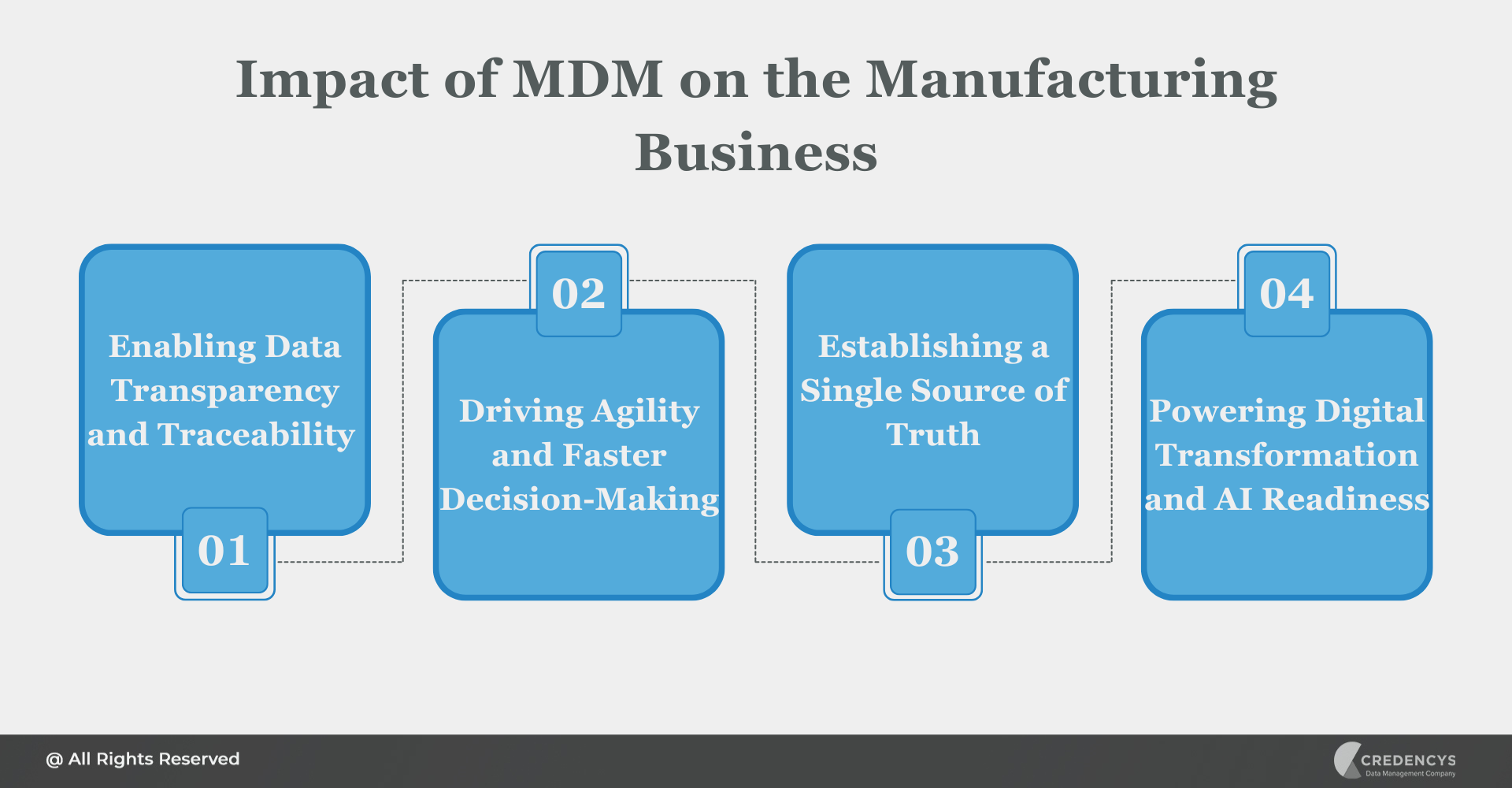
MDM transforms how manufacturing organizations operate. It connects systems, aligns teams, and enables proactive, data-driven decisions that enhance agility, profitability, and long-term competitiveness.
Benefits of Master Data Management for the Manufacturing Industry
Manufacturers today are expected to deliver faster, cheaper, and higher-quality products while navigating global supply chain disruptions and regulatory pressures. Yet, many struggle with inaccurate or inconsistent data across systems, which leads to delays, cost overruns, and poor customer experiences.
A well-implemented MDM system changes this reality. It unifies critical business data from products and materials to customers and suppliers into a single, trusted view that drives better decisions across the value chain.
According to Deloitte, companies that use centralized data management achieve 20–30% higher operational efficiency and up to 50% fewer product data errors.
Let’s explore how MDM delivers value for customers, enterprises, and suppliers within the manufacturing ecosystem.
1. Benefits for the Enterprise
Faster Time to Market
MDM helps manufacturers accelerate new product introductions by synchronizing data across design, engineering, and sales systems. This eliminates manual data entry bottlenecks and ensures faster approval cycles.
Consistent and Accurate Business Data
Inaccurate product or supplier data can lead to costly errors. With MDM, all departments, from R&D to logistics work from the same, verified data source.
This reduces duplication, simplifies reporting, and supports strategic planning.
Stronger Internal Collaboration and Partnerships
Unified master data fosters collaboration across departments and business partners. Procurement teams can better evaluate supplier performance, while finance and operations can make aligned, data-backed decisions.
The result: improved operational transparency and stronger supplier relationships.
2. Benefits for Suppliers and Partners
Improved Data Sharing and Collaboration
Suppliers often interact with multiple systems and stakeholders within a manufacturer’s network. MDM simplifies collaboration by creating a consistent framework for sharing accurate product, pricing, and inventory data.
Accelerated Supplier Onboarding and Management
By centralizing supplier records and integrating them into enterprise workflows, MDM reduces onboarding time and ensures compliance with vendor policies and certifications.
Higher Customer Satisfaction and Retention
When product data flows seamlessly from suppliers to end customers, the entire ecosystem benefits. Suppliers can meet delivery commitments more reliably, and customers enjoy a smoother experience, driving repeat business and long-term loyalty.
3. Benefits for Customers
Building Trust and Reliability
When customers receive accurate and consistent product information across catalogs, websites, and invoices, they build confidence in your brand. MDM ensures that product data, such as dimensions, materials, and certifications, is consistent everywhere, improving the buying experience and post-sale satisfaction.
Want to Deliver Consistent, Trusted Product Information Across Every Channel? Build Brand Reliability with a Unified Data Foundation.
Enhancing Product Quality and Compliance
MDM ensures only validated, up-to-date data enters your production and quality systems. This improves quality assurance, minimizes rework, and helps you meet industry and regional compliance requirements.
Master Data Management in manufacturing goes beyond data organization; it drives tangible business outcomes. From improved quality assurance and operational efficiency to faster product launches and stronger supplier relationships, MDM helps manufacturers unlock measurable value at every stage of the production lifecycle.
Key Aspects to Consider When Implementing Master Data Management in Manufacturing
Implementing MDM in a manufacturing environment is a business transformation. The goal isn’t only to centralize data, but to make it actionable, scalable, and aligned with global manufacturing realities.
To succeed, manufacturers must consider several key aspects that define how MDM should be structured, governed, and integrated across plants, suppliers, and digital systems.
1. Leveraging IoT and Industrial IoT (IIoT) Data
Modern factories are powered by connected machines and IoT-enabled devices that generate massive amounts of data, from temperature readings and equipment status to energy consumption and maintenance logs.
MDM acts as the foundation of this ecosystem, ensuring that data from sensors, PLCs, and connected assets is standardized, governed, and integrated with enterprise systems. This allows manufacturers to:
- Gain real-time visibility into operations
- Reduce downtime with predictive maintenance
- Improve production efficiency through data-driven insights
2. Balancing Global Consistency with Local Flexibility
Global manufacturers operate across regions with varying regulations, product specifications, and languages. A successful MDM strategy must balance central governance with localized control.
Global data models ensure consistency for corporate-level analytics and reporting, while localized data governance allows regional plants to adapt to unique operational needs. This hybrid model, often referred to as federated MDM, helps maintain both compliance and agility.
It allows headquarters to define master standards while empowering local teams to manage context-specific attributes such as regional product variations or supplier certifications.
3. Choosing the Right Implementation Style
Not all MDM deployments are the same. Manufacturers typically adopt one of three models:
- Centralized MDM, where a single authority manages all master data across domains.
- Coexistence MDM, where systems share synchronized data but maintain some autonomy.
- Federated MDM, combining the strengths of both for global consistency and local agility.
Selecting the right style depends on organizational complexity, data volume, and existing IT landscape. Many manufacturers start with coexistence and gradually move toward a hybrid model as data maturity grows.
4. Enabling 360-Degree Customer and Partner Views
In manufacturing, “customers” aren’t always end consumers; they include distributors, wholesalers, retailers, and service partners. Each interaction generates valuable data that, when unified, provides a 360-degree customer view.
With MDM, manufacturers can integrate data across CRM, ERP, and after-sales systems to:
- Improve distributor management and partner engagement
- Enable more accurate demand forecasting
- Personalize after-market services and upselling opportunities
Looking to Unlock a 360° View of Your Customers and Partners? See how MDM Helps Manufacturers Turn Fragmented Data into Meaningful Relationships.
5. Data Governance and Compliance Readiness
Data without governance can quickly become a liability. Manufacturers dealing with global supply chains must comply with standards like ISO 9001, RoHS, and REACH.
MDM establishes clear governance rules, ownership structures, and audit trails to ensure compliance with both internal policies and international regulations. It also strengthens data security by defining access controls and version histories.
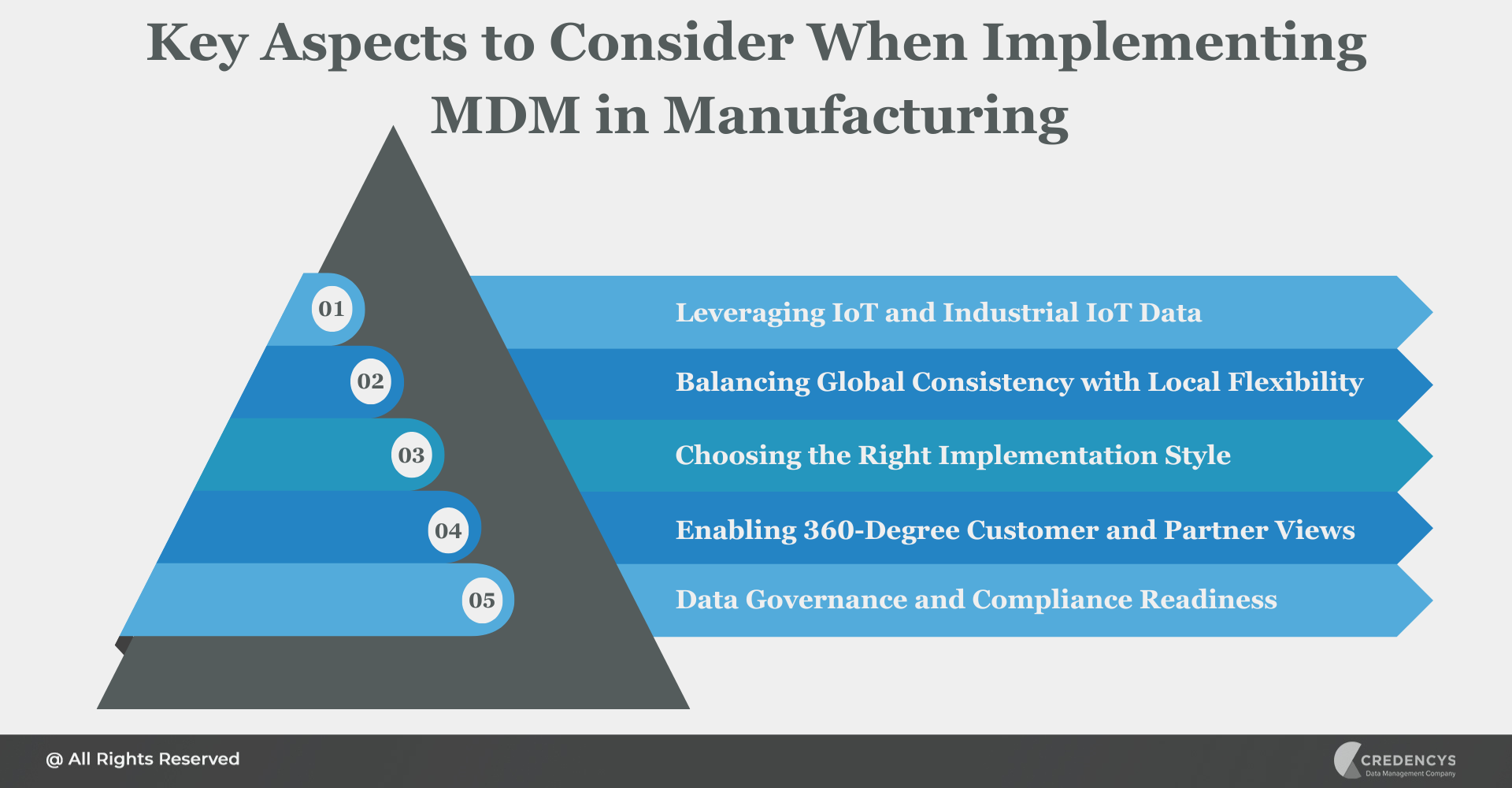
For manufacturers, implementing MDM is a continuous improvement journey instead of a one-time IT initiative. By aligning IoT data, balancing global and local needs, and enforcing data governance, manufacturers can create a scalable foundation for digital transformation and Industry 4.0 success.
How to Get the Most Out of Master Data Management for Manufacturing Business
Implementing MDM isn’t just about choosing the right technology; it’s about aligning people, processes, and systems around a shared vision of data excellence. To maximize ROI from your MDM investment, manufacturers need to approach it strategically and holistically.
1. Define Clear Data Ownership and Governance
Establish data stewardship roles across departments: production, procurement, logistics, and sales. A clear governance framework ensures accountability for data accuracy, consistency, and security throughout the organization.
2. Start with High-Impact Data Domains
Instead of tackling everything at once, begin with the data domains that drive the most value, such as product master, supplier master, or asset master. Quick wins in these areas help build momentum and organizational buy-in.
3. Integrate MDM with Existing Systems
For MDM to deliver value, it must seamlessly connect with ERP, PLM, CRM, MES, and eCommerce platforms. This integration ensures every team works with synchronized, up-to-date information across the entire value chain.
4. Standardize and Enrich Data Continuously
MDM is not a one-time project. Continuously monitor data quality, resolve duplicates, and enrich records with accurate attributes, taxonomy, and classifications.
This ensures your data remains trustworthy as business operations evolve.
5. Leverage Analytics for Data-Driven Insights
Once MDM establishes a reliable data foundation, layer analytics and AI on top. Predictive models can identify production inefficiencies, optimize sourcing decisions, and improve demand forecasting accuracy.
6. Align MDM with Business Objectives
Tie your MDM initiative directly to measurable business goals, reducing time-to-market, improving supplier performance, or minimizing production errors. This keeps your data strategy aligned with business value, not just technical implementation.
7. Partner with an Experienced MDM Provider
Choosing the right implementation partner is critical. Experienced MDM consultants can help manufacturers design scalable data models, integrate complex systems, and implement best practices tailored to their industry.
MDM – The Foundation of a Smarter Manufacturing Future
In the manufacturing world, data drives every decision from what to produce and when to how efficiently resources are used. Yet without MDM, that data remains fragmented, unreliable, and underutilized.
By creating a single, trusted source of truth, MDM helps manufacturers streamline operations, enhance collaboration across departments, and respond faster to market changes. It empowers leaders to shift from reactive to proactive decision-making, driving measurable improvements in efficiency, profitability, and customer satisfaction.
As Industry 4.0 and digital transformation accelerate, manufacturers that invest in robust MDM frameworks today will be the ones leading tomorrow’s smart factories.
Ready to Build a Data-Driven Manufacturing Ecosystem?
FAQs
1. What is Master Data Management in manufacturing?
MDM in manufacturing is a centralized approach to managing key business data, including product, supplier, and customer information, to ensure accuracy, consistency, and reliability across systems.
2. Why is MDM important for manufacturers?
Manufacturers rely on accurate data for production planning, supply chain visibility, and compliance. MDM eliminates data silos, reduces errors, and supports faster, more informed decision-making.
3. How does MDM improve supply chain operations?
By consolidating supplier and material data, MDM provides end-to-end visibility into sourcing and inventory. This helps manufacturers anticipate disruptions, improve supplier performance, and optimize procurement.
4. What types of data can manufacturers manage through MDM?
Manufacturers can manage multiple data domains, including product master, supplier master, customer master, asset master, and location data, all in one unified platform.
5. How can manufacturers start their MDM journey?
Start by identifying key data domains, setting clear data governance policies, and partnering with an experienced MDM consultant like Credencys to design and implement a scalable solution.





Tags: