


What is Data Mesh? A Beginner’s Guide to Decentralized Data Management
Data Mesh is a modern approach to data architecture that decentralizes data management. Unlike traditional centralized models, which rely on monolithic data warehouses or lakes, Data Mesh distributes data ownership across domain teams.
This shift enables organizations to scale their data operations while improving accessibility and usability efficiently.
Key Differences from Traditional Data Architectures
- Data Mesh distributes ownership, allowing domain teams to manage their data.
- It promotes a product-oriented mindset, ensuring data is reliable, discoverable, and usable.
- Traditional models consolidate data into a single repository, leading to bottlenecks and inefficiencies.
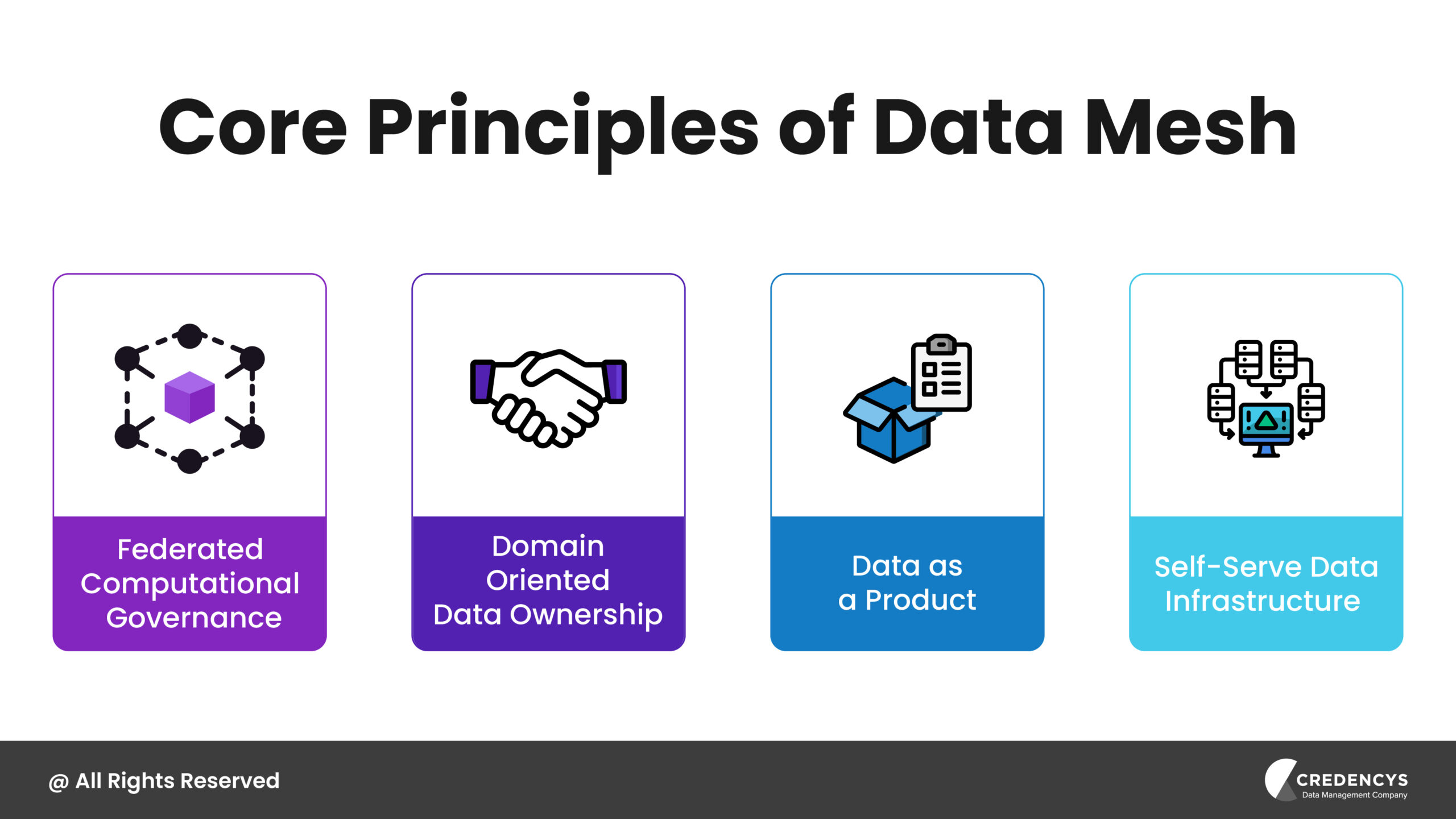
Four Core Principles of Data Mesh
1. Domain-Oriented Data Ownership
Data ownership is delegated to domain-specific teams rather than a centralized IT function. This ensures that the teams most familiar with the data are responsible for its quality, governance, and accessibility.
By decentralizing ownership, businesses reduce bottlenecks, improve real-time data availability, and foster a culture of innovation.
2. Data as a Product
Organizations must treat data like a product, meaning it should have clear ownership, well-defined service-level agreements (SLAs), and established quality standards. Data should be easily discoverable, well-documented, and consumable by various teams.
A structured approach to metadata, documentation, and versioning increases the trust and usability of data products across the organization.
3. Self-Serve Data Infrastructure
Domain teams should have the necessary tools and infrastructure to manage their own data instead of relying solely on a central IT team. A self-serve approach allows teams to ingest, store, process, and share data independently, improving operational efficiency.
This reduces delays in accessing data and empowers teams to leverage data for faster decision-making.
4. Federated Computational Governance
While Data Mesh decentralizes ownership, governance and compliance remain standardized across the organization. Federated governance ensures data security, privacy, and regulatory compliance without restricting usability.
Organizations achieve this by setting global policies while allowing teams to implement governance frameworks tailored to their specific needs.
Challenges That Data Mesh Solves
Despite organizations having access to vast amounts of data, the real challenge lies in processing, analyzing, and deriving actionable insights. Traditionally, businesses rely on a centralized team of data engineers and scientists to manage data operations.
This team oversees a monolithic data platform responsible for:
- Ingesting data from various business units and consolidating it within a central repository.
- Transforming data into a standardized and reliable format, such as unifying date formats or summarizing daily reports.
- Preparing data for consumption by generating reports for stakeholders or formatting data for application integration.
However, as data volumes grow, maintaining agility within a centralized system becomes increasingly expensive and inefficient. Organizations face several challenges that hinder scalability and operational efficiency:
1. Slow Responsiveness to Change
Data engineers design and manage complex data pipelines that involve multiple transformation steps before data is stored in a central data lake. When business units request modifications, the entire pipeline must be adjusted, leading to delays.
Additionally, the central team must juggle multiple priorities while lacking direct visibility into business requirements, further slowing response times.

Accelerate your Data Processes with a Flexible and Responsive Data Mesh Strategy
2. Siloed Data Teams
A central data team typically consists of highly specialized engineers and data scientists with deep technical expertise but a limited understanding of specific business domains. Since they must cater to a wide range of analytical and operational needs, they often lack the contextual knowledge to provide the most relevant and meaningful data to different business units.
3. Reduced Data Accuracy
Business units operate separately from the data consumers and the data management team in a centralized data structure. This disconnect often results in inconsistencies, errors, and a lack of accountability for data quality.
Since business units do not directly own their data, they have little incentive to ensure its accuracy, completeness, or relevance for downstream users.
By addressing these challenges, Data Mesh fosters a decentralized approach where domain teams take ownership of their data, ensuring greater accuracy, faster adaptability, and improved collaboration between business units and data consumers.
Why Businesses Need Data Mesh?
Traditional data management approaches, such as data warehouses and lakes, have long been the backbone of enterprise data strategies. However, they come with significant challenges:
- Governance Concerns: Ensuring compliance and security across a single, monolithic data structure is complex and prone to bottlenecks.
- Slow Insights: Dependence on a central data team can cause delays in accessing and analyzing data, slowing decision-making.
- Scalability Issues: As data volumes grow, centralized architectures struggle to keep up with processing demands, leading to slow performance.
- Data Silos: Centralized models often lead to isolated data pockets, making it difficult to access and integrate data across teams.
Benefits of Adopting Data Mesh
Data Mesh architecture offers several advantages. It decentralizes data ownership and enables domain teams to manage their own data assets effectively.
This approach enhances flexibility, reduces bottlenecks, and improves overall data accessibility.
1. Interoperability
A key aspect of Data Mesh is ensuring consistency across domains by standardizing data structures, metadata, and governance rules. This alignment facilitates interoperability between different business units, allowing for easier data integration and collaboration.
By applying predefined rules to structure datasets, teams can seamlessly link and share data across various domains without friction.
2. Data Democratization
By enabling self-service data access, Data Mesh broadens the availability of data beyond technical users such as data engineers and scientists. This decentralized approach eliminates data silos and operational bottlenecks, allowing business users to access relevant data quickly and make informed decisions.
Additionally, technical teams can focus on higher-value tasks rather than managing repetitive data requests.
3. Cost Efficiency
Unlike traditional batch data processing methods, Data Mesh leverages cloud-native platforms and real-time streaming pipelines to optimize data collection and storage. Cloud-based storage models allow businesses to scale resources dynamically, ensuring they pay only for the storage and compute power they use.
This results in improved budget visibility, better resource allocation, and overall cost savings for data operations.
Optimize your Data Strategy with a Scalable and Cost-Efficient Data Mesh Approach
4. Enhanced Security and Compliance
Data Mesh promotes a robust governance model that enforces security policies, data access controls, and compliance with industry regulations. Organizations can implement audit mechanisms to monitor data usage, track access logs, and ensure regulatory adherence, such as HIPAA and GDPR.
By embedding observability into the architecture, businesses can maintain visibility over who accesses specific data and how frequently it is used.
5. Reduced Technical Debt
Centralized data infrastructures often create technical debt due to the complexity involved in managing and maintaining a monolithic system. As data volumes grow, performance issues emerge, leading to slower processing times.
By distributing data ownership to domain teams, Data Mesh reduces reliance on a central data repository and minimizes system strain. Additionally, APIs enable seamless data access, reducing the need for individual data requests.

Use Cases of Data Mesh
While Data Mesh adoption is still evolving, many industries are leveraging its capabilities to enhance data-driven decision-making and scale their big data initiatives. Some of the key use cases include:
1. Business Intelligence Dashboards
Organizations often require customized dashboards to analyze key performance metrics for new initiatives. Data Mesh supports this need by making real-time, domain-specific data readily available, allowing teams to generate insights without dependencies on a central data team.
2. Automated Virtual Assistants
Enterprises increasingly rely on AI-powered chatbots and virtual assistants to enhance customer service. Since these systems pull data from multiple sources to respond to user queries, a decentralized data architecture ensures that the necessary datasets are accessible, improving the chatbot’s accuracy and efficiency.
3. Customer Experience Personalization
Businesses across industries, from retail to healthcare, leverage customer data to deliver personalized experiences. Data Mesh enables organizations to access unified customer insights by decentralizing data ownership and integrating multiple touchpoints, leading to improved customer engagement and satisfaction.
4. Machine Learning and AI Applications
Data Mesh accelerates AI and machine learning initiatives by standardizing domain-agnostic data. By ensuring interoperability across different data sources, data scientists can reduce preprocessing efforts and focus more on building and deploying machine learning models, leading to faster innovation and automation.
By leveraging Data Mesh for these use cases, businesses can enhance agility, optimize resource utilization, and unlock the full potential of their data assets.
Over to You
Data Mesh is transforming the way businesses manage and utilize data. By decentralizing data ownership, organizations can improve agility, collaboration, and scalability while ensuring data quality and compliance.
Enterprises looking to modernize their data strategy should consider adopting Data Mesh to stay competitive in a data-driven world. Implementing Data Mesh requires the right approach, technology, and expertise to be successful.
Credencys helps businesses navigate the complexities of Data Mesh implementation, offering strategic consulting, technology solutions, and hands-on support. Partnering with Credencys ensures a smooth transition to a decentralized data architecture, unlocking the full potential of data assets.
Unlock the Full Potential of your Data with Data Mesh! Partner with Credencys to Seamlessly Transition to a Decentralized Data Architecture




Tags: