



How Manufacturers Can Drive Operational Efficiency with the Databricks Data Intelligence Platform
Today’s landscape is hyper-competitive, where operational efficiency is a necessity. With rising production costs, unpredictable supply chain disruptions, and increasing customer expectations, manufacturers are under immense pressure to do more with less.
However, traditional systems often fall short when it comes to unifying data and driving real-time insights across departments and processes.
According to a McKinsey report, manufacturers that invest in advanced analytics and AI can reduce machine downtime by up to 50% and increase productivity by up to 20%.
These numbers underscore the transformative potential of data-driven operations, but only if organizations have the right platform in place.
Databricks Data Intelligence Platform is a powerful, AI-native solution built to help manufacturers harness the full potential of their data. By consolidating information from disparate sources such as ERP systems, IoT sensors, production lines, and supply chain platforms, Databricks enables smarter decision-making, predictive capabilities, and end-to-end visibility.
This blog explores how manufacturers can leverage the Databricks Data Intelligence Platform to drive operational efficiency, from predictive maintenance and production line optimization to smarter inventory forecasting and unified KPI monitoring.
The Manufacturing Efficiency Challenge
Manufacturers operate in complex environments where even minor inefficiencies can lead to significant losses in time, money, and productivity. Despite the abundance of data generated by machines, supply chains, and enterprise systems, most organizations struggle to use that data effectively.
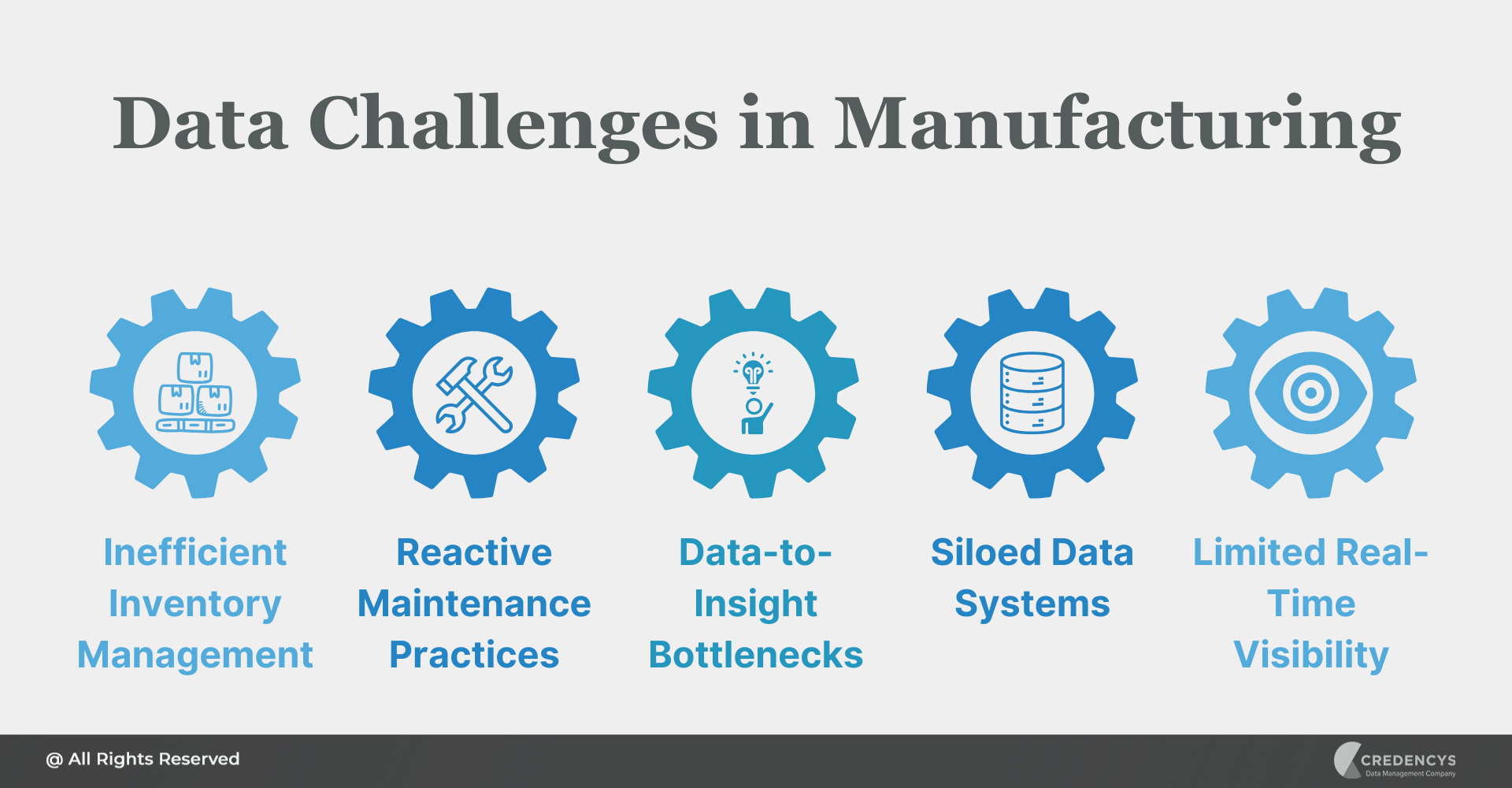
Some of the most common challenges include:
- Inefficient Inventory Management: Poor forecasting and lack of visibility often result in overstocking, stockouts, or excess carrying costs.
- Reactive Maintenance Practices: Many factories still rely on scheduled or reactive maintenance, which leads to unexpected equipment failures and costly downtime.
- Data-to-Insight Bottlenecks: Traditional tools can’t keep up with the speed, scale, and variety of manufacturing data, slowing down innovation and decision-making.
- Siloed Data Systems: Critical data lives in disconnected systems; ERP, MES, IoT platforms, quality management systems making it difficult to get a unified view of operations.
- Limited Real-Time Visibility: Without live dashboards and unified analytics, managers lack the insights needed to make timely decisions on the shop floor or across the supply chain.
To overcome these barriers, manufacturers need a platform that doesn’t just store data but makes it intelligent, connected, and actionable. That’s where the Databricks Data Intelligence Platform comes into play.
What Is the Databricks Data Intelligence Platform?
The Databricks Data Intelligence Platform is a unified, AI-native platform designed to help organizations turn massive volumes of data into meaningful insights and intelligent action. It combines the power of a data lake and a data warehouse into a single Lakehouse architecture, offering the flexibility of data lakes with the performance and governance of traditional warehouses.
What sets Databricks apart is its ability to bring together data engineering, machine learning, business intelligence, and data governance all in one place. This makes it especially valuable for manufacturers looking to modernize and scale their operations.
Key components of the platform include:
- Lakehouse Architecture: Consolidates structured and unstructured data into a single source of truth for analytics and AI workloads.
- Real-Time Data Processing: Ingest and process high-velocity data streams from IoT sensors, machines, and production lines for immediate insights.
- Unity Catalog for Governance: Provides centralized data access controls, lineage tracking, and auditing, ensuring data is secure, compliant, and well-managed.
- AI & Machine Learning Capabilities: Built-in tools like AutoML, MLflow, and large language model integration help manufacturers build predictive and generative models with ease.
- Scalability & Cloud-Native Flexibility: Built on open standards and compatible with all major cloud platforms, enabling easy scaling as data and use cases grow.
By unifying data across the value chain, the Databricks platform empowers manufacturers to break down silos, accelerate innovation, and drive efficiency from the shop floor to the boardroom.

Ready to Transform Your Manufacturing Operations? Discover How to Drive Efficiency and Innovation with Databricks
Key Ways Databricks Drives Operational Efficiency in Manufacturing
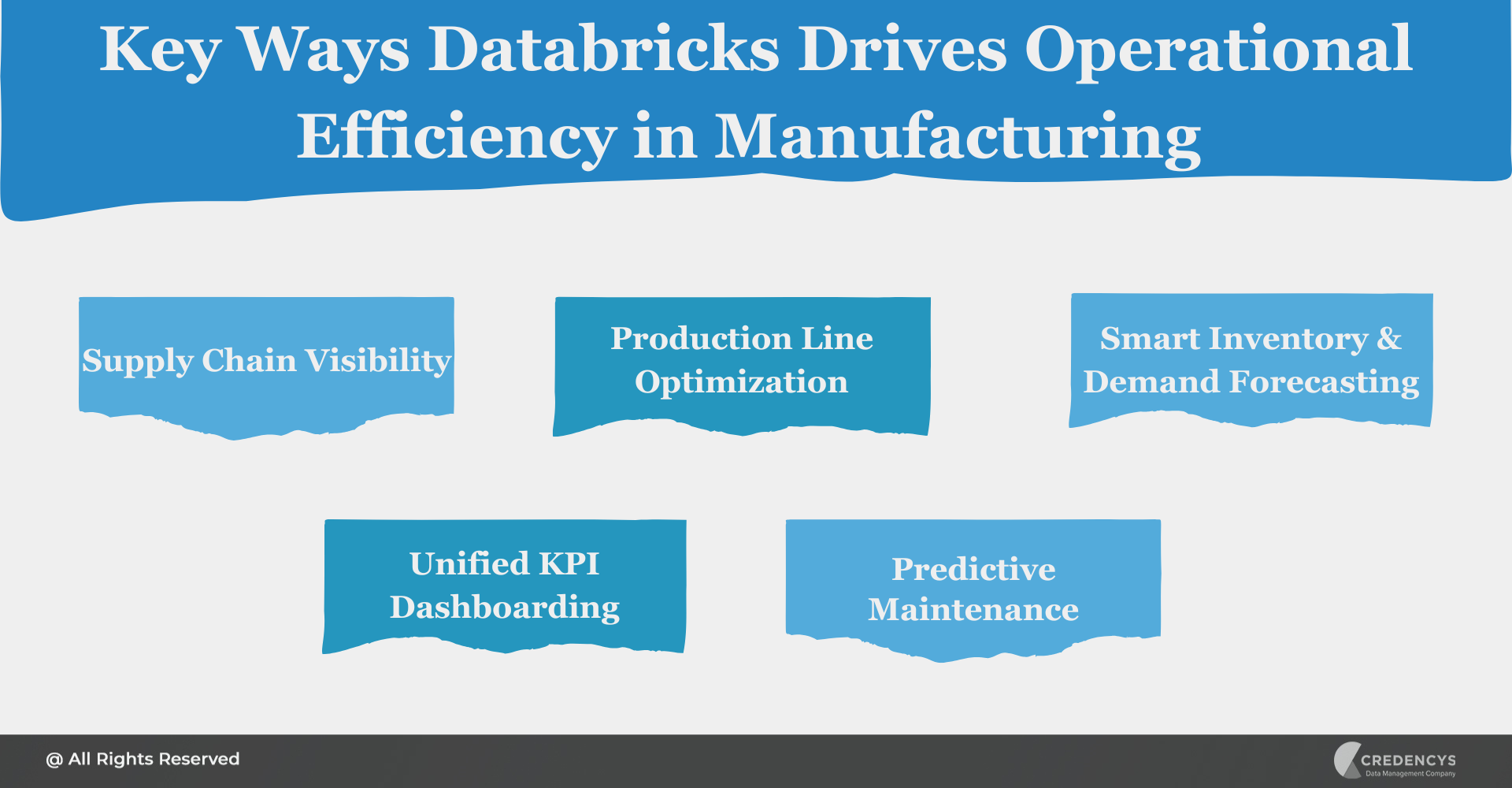
The Databricks Data Intelligence Platform gives manufacturers a powerful and unified foundation to optimize their operations. From predictive maintenance to supply chain visibility, here’s how it delivers tangible efficiency gains across the production lifecycle:
1. Supply Chain Visibility
Supply chain disruptions can occur without warning unless you have the data to detect them early. Databricks enables manufacturers to aggregate data from suppliers, logistics providers, and warehouses into a single, unified platform.
With real-time dashboards tracking lead times, order statuses, and delivery KPIs, organizations gain greater transparency and control over their supply chains. AI models can flag early indicators of delays or deviations and suggest alternative actions, helping manufacturers build more resilient and responsive supply networks.
2. Production Line Optimization
Even minor inefficiencies on the factory floor can snowball into large-scale productivity losses. Databricks helps manufacturers analyze production data across shifts, machines, and processes to uncover bottlenecks and underperforming areas.
AI-driven analytics can detect anomalies in performance, highlight process variations, and recommend adjustments that improve throughput and reduce defects. Some manufacturers also integrate computer vision data into Databricks workflows to automate quality inspections and flag issues in real-time.
These optimizations lead to better yields, fewer reworks, and higher overall equipment effectiveness (OEE).
3. Smart Inventory & Demand Forecasting
Accurate demand forecasting is critical for effective inventory management, yet many manufacturers still rely on outdated models or siloed data. With Databricks, businesses can unify sales history, supplier lead times, seasonality trends, and even external factors like market shifts or weather data.
Using time-series forecasting and machine learning, they can generate more accurate demand predictions. These forecasts help optimize inventory levels, reduce overstocking or stockouts, and improve working capital efficiency.
Manufacturers leveraging this approach have reported a 10–30% reduction in excess inventory.
4. Unified KPI Dashboarding
Data without visibility offers little value. Databricks bridges this gap by enabling manufacturers to create dynamic dashboards that provide real-time insights into key performance indicators across operations.
Whether integrated with visualization tools like Power BI or Tableau or built directly into the Databricks interface, these dashboards allow leaders to monitor production performance, track costs, and visualize predictive insights in one centralized location. Role-based access ensures that each stakeholder from plant managers to executives sees the metrics most relevant to their function, enabling faster, data-driven decision-making.
5. Predictive Maintenance
Unplanned equipment failures are one of the biggest causes of production downtime and lost revenue in manufacturing. With Databricks, manufacturers can ingest and process real-time sensor and telemetry data from machines and production lines.
By training machine learning models on historical failure patterns, the platform enables teams to predict when equipment is likely to malfunction. These predictive insights allow maintenance teams to intervene before issues escalate, dramatically reducing unexpected breakdowns and extending the life of critical assets.
As a result, organizations can achieve up to a 30-50% reduction in unplanned downtime.
By integrating these capabilities, the Databricks Data Intelligence Platform empowers manufacturers to shift from reactive processes to predictive, optimized operations, setting the stage for scalable growth and sustainable competitiveness.
Unlock the Full Potential of Your Manufacturing Data with Databricks. Start Building Smarter, Faster, and More Resilient Operations Today
Benefits for Manufacturing Organizations
Adopting the Databricks Data Intelligence Platform brings measurable, enterprise-wide benefits to manufacturing operations:
- Scalable, Cloud-Native Architecture: Easily scale with increasing data volumes and evolving use cases without infrastructure constraints or vendor lock-in.
- Real-Time Performance Monitoring: Unified dashboards give visibility into key metrics across manufacturing, logistics, and quality functions, enabling proactive management.
- Improved Production Efficiency: Optimize throughput, eliminate bottlenecks, and reduce rework through real-time analytics and AI-driven insights across the production line.
- Reduced Unplanned Downtime: Predictive maintenance powered by real-time sensor data and ML helps prevent unexpected equipment failures, reducing downtime and associated costs.
- Cross-Departmental Data Collaboration: Enable engineering, operations, and executive teams to work from a single, governed data environment, improving alignment and accelerating decision-making.
- Smarter Inventory Management: Use advanced forecasting models to maintain optimal inventory levels, reduce excess stock, minimize stockout, and improve overall supply chain responsiveness.
- Faster Time to Insight: Leverage built-in AI/ML tools to rapidly develop, test, and deploy models, turning raw data into actionable intelligence faster than traditional systems.
- Future-Readiness: Be prepared for emerging technologies like generative AI, digital twins, and smart factories with a platform designed to evolve with your needs.
Getting Started: How Manufacturers Can Adopt Databricks
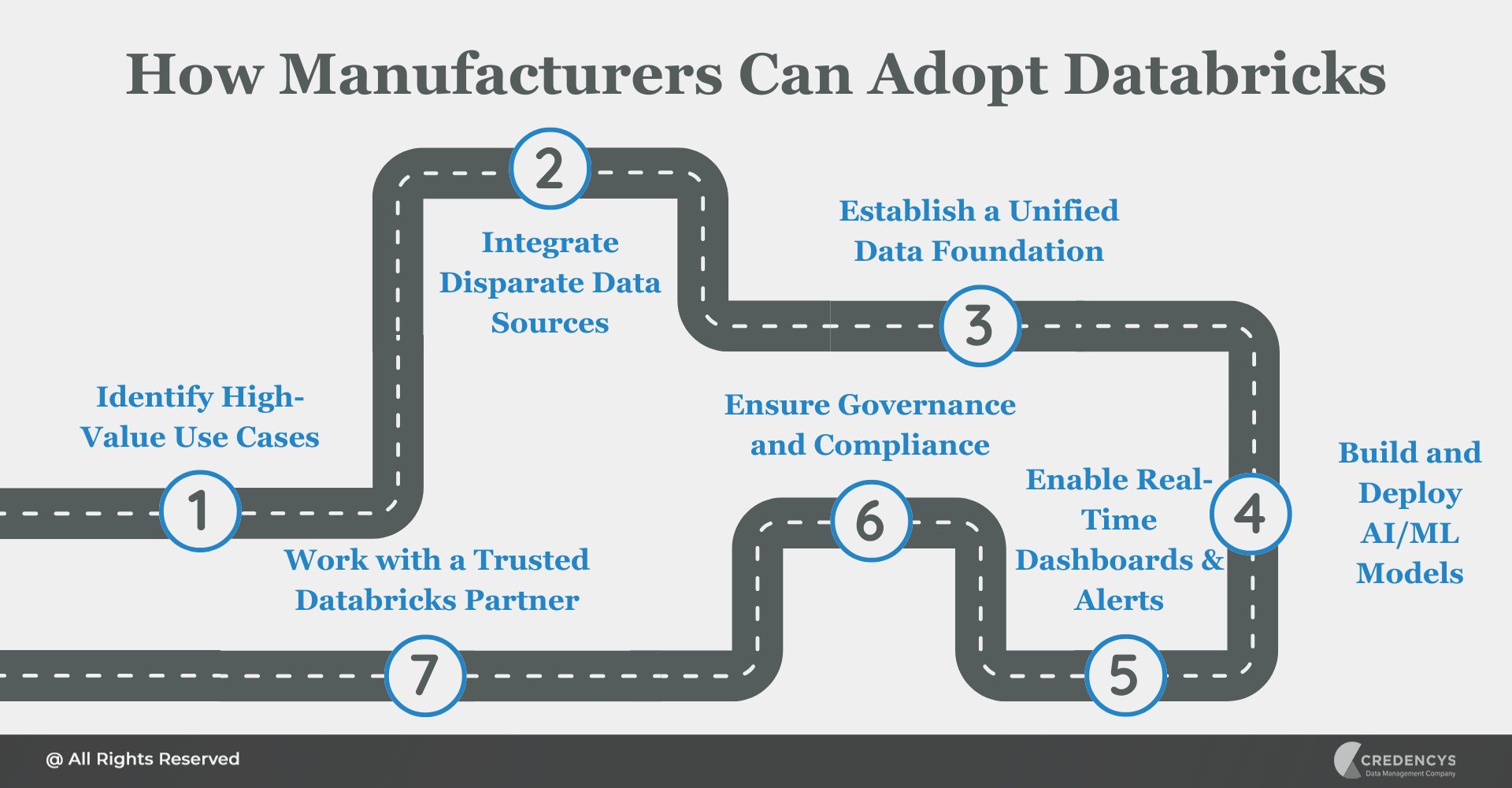
Transitioning to the Databricks Data Intelligence Platform doesn’t require a complete overhaul; it starts with identifying high-impact use cases and scaling from there. Here’s a practical roadmap for manufacturers ready to embrace data-driven operations:
- Identify High-Value Use Cases: Start with pain points that offer the biggest ROI, such as predictive maintenance, production bottlenecks, or inventory inefficiencies. Focus on one or two pilot projects with clear goals and measurable outcomes.
- Integrate Disparate Data Sources: Connect data from ERP systems, MES platforms, IoT sensors, quality control tools, and supply chain databases. Databricks supports structured and unstructured data, making it easier to consolidate everything into a unified Lakehouse.
- Establish a Unified Data Foundation: Use the Lakehouse architecture to centralize data in an open, scalable format. This step sets the stage for consistent analytics, ML model training, and real-time insights across the business.
- Build and Deploy AI/ML Models: Utilize built-in tools like AutoML, MLflow, and collaborative notebooks to develop machine learning models. These can be used for forecasting, anomaly detection, quality prediction, and more.
- Enable Real-Time Dashboards & Alerts: Create role-based dashboards for plant managers, supply chain leads, and executives. Integrate alerts and visualizations to enable proactive decision-making across teams.
- Ensure Governance and Compliance: Implement Unity Catalog to manage data access, enforce policies, track lineage, and ensure compliance with industry regulations without compromising agility.
- Work with a Trusted Databricks Partner: Partnering with an experienced Databricks consulting firm like Credencys can accelerate adoption, reduce technical risk, and ensure your implementation is aligned with your business goals.
Conclusion
Manufacturers today face a growing imperative to modernize operations, reduce inefficiencies, and make smarter, faster decisions, all while managing increasing complexity. The Databricks Data Intelligence Platform offers a unified solution that brings together data, AI, and governance to drive real, measurable improvements across the manufacturing value chain.
From predictive maintenance and production line optimization to smarter inventory planning and real-time visibility, Databricks empowers manufacturers to move from reactive problem-solving to proactive, intelligent operations. With its scalable, cloud-native architecture and built-in machine learning capabilities, it’s a long-term strategic asset.
Ready to Transform Your Manufacturing Operations and Explore How we Can Support Your Digital Transformation Journey


Tags: