


Generative AI for Retail Personalization: The 2026 Playbook
Retail is no longer just about selling products; it’s about delivering experiences. Today’s consumers expect brands to understand their preferences, anticipate their needs, and engage them with highly relevant interactions across every touchpoint.
Yet, most retailers struggle to deliver this consistently.
- Customer data is fragmented across systems
- Personalization engines are rule-based and limited
- Content creation cannot scale with demand
This is where generative AI changes the game.
Generative AI acts as a “creativity engine” for personalization, enabling retailers to generate tailored content, recommendations, and interactions in real time. It transforms personalization from a static, rules-driven process into a dynamic, AI-powered experience layer.
Why Personalization is a Revenue Imperative
Personalization is no longer optional; it directly impacts revenue, retention, and customer lifetime value. Consider this:
- 80% of consumers are more likely to purchase from brands that offer personalized experiences
- AI-driven personalization can improve marketing ROI by 10-20%
- Retailers using advanced analytics are significantly more likely to acquire and retain customers
However, there’s a gap. Despite heavy investments in data and analytics:
- Only a fraction of customers feels truly understood
- Poor data quality continues to cost enterprises millions annually
- Many personalization efforts remain superficial (e.g., “Customers also bought…”)
The real issue isn’t intent, it’s execution. Retailers need:
- Unified customer and product data
- Scalable AI models
- Real-time decisioning capabilities
Generative AI addresses all three by combining data, intelligence, and content generation into a single layer.
What Makes Generative AI Different
Traditional AI focuses on prediction, what a customer might do next. Generative AI goes a step further; it creates.
Instead of just recommending products, it can:
- Generate personalized product descriptions
- Craft tailored marketing messages
- Simulate conversations with customers
- Produce contextual recommendations based on real-time behavior
This is powered by technologies like:
- Large Language Models (LLMs)
- Retrieval-Augmented Generation (RAG)
- Vector search and embeddings
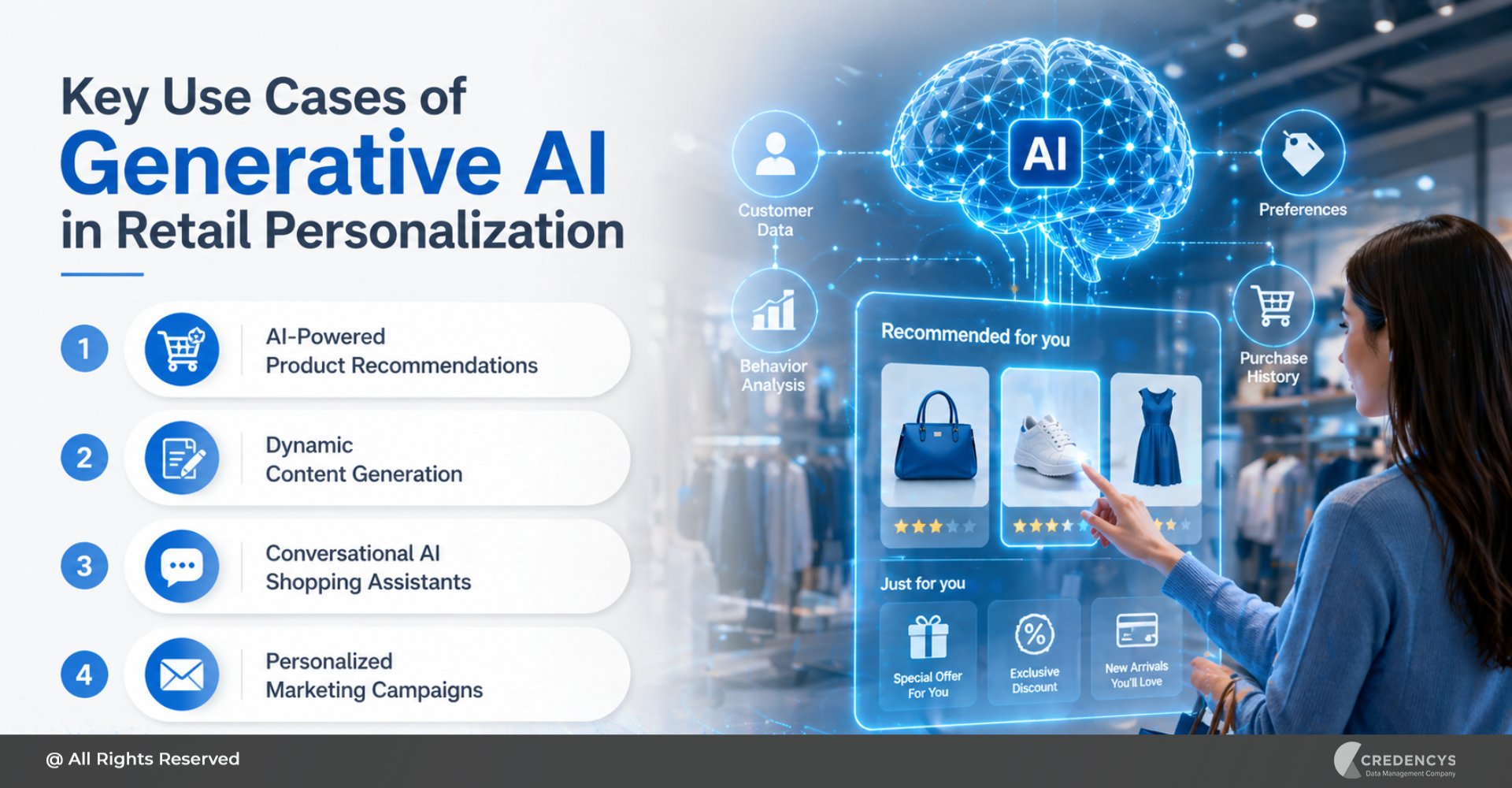
Key Use Cases of Generative AI in Retail Personalization
Generative AI unlocks multiple high-impact use cases across the retail value chain.
1. AI-Powered Product Recommendations
Traditional recommendation engines rely on collaborative filtering or simple rules. Generative AI enhances this by:
- Incorporating real-time customer context
- Understanding intent through natural language
- Combining behavioral, transactional, and product data
Using RAG pipelines, retailers can:
- Retrieve relevant product data from catalogs
- Combine it with customer profiles
- Generate highly contextual recommendations
Instead of “Customers also bought,” shoppers receive, “Based on your recent purchase and upcoming travel plans, here are lightweight, weather-resistant jackets you might like.” This level of personalization significantly improves conversion rates and engagement.
2. Dynamic Content Generation
Creating personalized content at scale has always been a challenge. Generative AI solves this by automatically producing:
- Product descriptions
- Email campaigns
- Ad creatives
- Landing page content
For example:
- A single product can have multiple descriptions tailored to different audiences
- Marketing emails can be dynamically generated based on customer behavior
- Localization becomes effortless with AI-generated variations
This reduces content production time while improving relevance.
3. Conversational AI Shopping Assistants
AI-powered chatbots are evolving into intelligent shopping assistants. These systems can:
- Answer product queries in natural language
- Provide personalized recommendations
- Assist in product discovery
- Support post-purchase interactions
Unlike traditional bots, generative AI enables:
- Context-aware conversations
- Memory of past interactions
- Human-like responses
For example, when a customer asks, “I need a gift for a 10-year-old who loves science”, the AI assistant can generate:
- Curated product suggestions
- Explanations for each recommendation
- Add-to-cart options
This creates a seamless and engaging shopping experience.
4. Personalized Marketing Campaigns
Marketing teams can now move from segmentation to true 1:1 personalization. Generative AI enables:
- Automated campaign creation
- Personalized messaging for each user
- Real-time A/B testing and optimization
Retailers can generate:
- Email subject lines tailored to individual preferences
- Social media ads customized by demographic
- Promotions aligned with purchase history
The result:
- Higher engagement
- Lower customer acquisition cost (CAC)
- Faster campaign execution
5. Additional Emerging Use Cases
- Sentiment-driven personalization from reviews and feedback
- AI-powered search (text, voice, image)
- Automated review summarization
- Dynamic pricing and promotions
How to Implement Generative AI Personalization
Implementing generative AI requires more than just plugging in an LLM; it demands a structured architecture. Here are three proven implementation patterns:
1. GenAI-Powered Recommendation Engine
This approach combines data platforms, AI models, and retrieval systems.
How it works:
- Customer and product data are unified in a data platform
- Data is converted into embeddings and stored in a vector database
- RAG pipelines retrieve relevant context
- LLMs generate personalized recommendations
Key benefit: Highly contextual, real-time personalization at scale.
2. Conversational AI Layer
This pattern focuses on customer interaction.
How it works:
- LLMs are integrated into chat interfaces (web/app)
- Connected to customer data platforms and CRM systems
- Real-time data (inventory, orders, preferences) is accessed
- AI generates tailored responses
Key benefit: Enhanced customer engagement and guided selling.
3. Automated Content Generation Pipeline
This approach transforms content operations.
How it works:
- Product data flows from PIM systems
- AI generates descriptions, ads, and content
- Outputs are reviewed (human-in-the-loop)
- Content is published via CMS or marketing tools
Key benefit: Scalable, consistent, and high-quality content production.
Privacy, Ethics & Compliance
With great personalization comes great responsibility. Generative AI introduces challenges around:
- Data privacy
- Bias
- Transparency
Retailers must ensure:
- Use of consented, first-party data
- Compliance with regulations (GDPR, CCPA)
- Explainable AI decisions
- Bias detection and mitigation
Responsible AI is not just a compliance requirement; it’s a trust builder.
Real-World Examples of Generative AI in Retail
Women’s Specialty Apparel Brand
A leading women’s specialty apparel leader unified customer and other data from multiple sources, including on-premises, cloud, and third-party systems, to deliver a seamless shopping experience.
Outcome:
- 24% increase in online sales
- 31% improvement in customer satisfaction
- Significant reduction in stockouts
How Credencys Helps Retailers Scale GenAI Personalization
Credencys enables retailers to move from data chaos to AI-driven personalization at scale. Key offerings include:
- Customer 360 (Custonomy CDP): Unified customer profiles
- Product Data Management (RetailOne): Clean, enriched product data
- Generative AI Solutions: Custom AI models and integrations
With deep expertise in data engineering, AI/ML, and retail domain solutions, Credencys helps organizations:
- Build scalable AI architectures
- Integrate GenAI into existing ecosystems
- Accelerate time-to-value
Final Thoughts
Generative AI is redefining what’s possible in retail personalization. From intelligent recommendations to real-time content generation, it enables retailers to deliver truly individualized experiences at scale.
Those who adopt early will gain a significant competitive advantage. With the right strategy, technology, and partner, retailers can turn generative AI into a powerful growth engine, and Credencys is well-positioned to help make that transformation a reality.







Tags: