


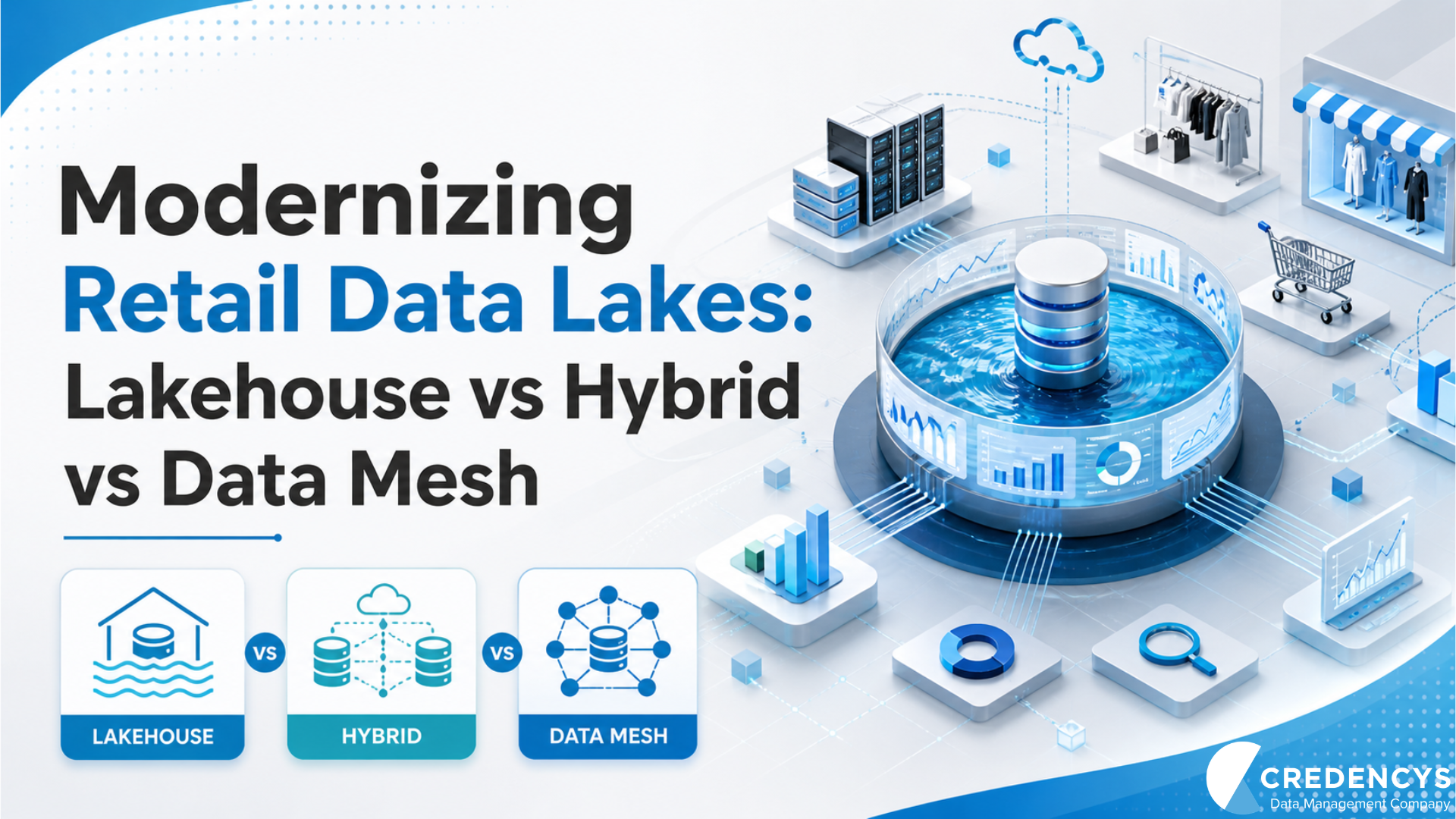
Modernizing Retail Data Lakes: Lakehouse vs Hybrid vs Data Mesh
Retailers today are no longer struggling with a lack of data; they are overwhelmed by it. From POS systems and eCommerce platforms to IoT sensors, mobile apps, and social media, retail organizations generate massive volumes of data every second.
However, many legacy data lakes, often built on Hadoop or on-prem systems, have evolved into fragmented “data swamps” that are difficult to manage, govern, and extract value from. The result?
Delayed insights, poor personalization, and stalled AI/ML initiatives. As real-time analytics and omnichannel experiences become business-critical, modernizing retail data lakes is no longer optional; it’s a competitive necessity.
This blog explores three key approaches: data lakehouse, hybrid architectures, and data mesh to help retailers build a future-ready data foundation.
Drivers for Modernization: Why Retailers Must Evolve
Several business and technology trends are pushing retailers to rethink their data architecture:
- Omnichannel Competition: Customers expect seamless experiences across online, in-store, and mobile channels.
- Demand for Real-Time Insights: Delayed analytics can lead to missed sales opportunities and poor decision-making.
- AI/ML Adoption: Advanced use cases like demand forecasting and personalization require unified, high-quality data.
- Seasonal Demand Spikes: Retailers need scalable infrastructure to handle peak events like Black Friday.
- Data Privacy & Compliance: Regulations demand stronger governance, data lineage, and control.
- Legacy System Limitations: High costs, inflexibility, and poor performance hinder innovation.
The payoff of modernization is significant:
- Faster time-to-insight
- Reduced infrastructure costs
- Improved customer intelligence
- Scalable analytics and AI capabilities
Approach 1 – Data Lakehouse: A Unified Architecture for Modern Retail
The data lakehouse architecture is rapidly becoming the default for modern retail data platforms. It combines the flexibility and scalability of data lakes with the performance and governance of data warehouses, offering a unified system for structured, semi-structured, and unstructured data.
Key Capabilities
- ACID Transactions for reliable data operations
- Schema Enforcement to maintain data quality
- Open Formats like Parquet for interoperability
- Unified Storage Layer for all data types
- SQL + AI/ML Support in a single platform
Technologies such as Delta Lake and Apache Iceberg enable these capabilities by providing reliability and structure for cloud-based data lakes. Modern platforms such as Databricks and Snowflake further accelerate adoption by integrating storage, compute, and governance into a single ecosystem.
Benefits for Retailers
- Single Source of Truth for customer, product, and transaction data
- Real-Time Personalization across channels
- Improved Demand Forecasting using unified datasets
- Lower Costs with scalable cloud object storage
- Streamlined Data Governance
Considerations
- Requires migration from legacy systems
- Needs strong governance frameworks
- Involves upskilling teams on modern tools
Many retailers partner with experienced data engineering firms like Credencys to accelerate lakehouse adoption, ensuring the right architecture, governance, and migration strategy from day one.
Approach 2 – Hybrid Data Lake + Data Warehouse: A Transitional Model
A hybrid architecture combines a data lake for raw data storage with a data warehouse for structured analytics. This approach allows retailers to modernize incrementally while continuing to use existing investments.
Typical Architecture
- Data Lake: AWS S3, Azure Data Lake, or Google Cloud Storage
- Data Warehouse: Snowflake, Amazon Redshift, or BigQuery
- ETL/ELT Tools: AWS Glue, Azure Data Factory, Databricks
Benefits
- Leverages existing BI systems
- Optimized performance for SQL analytics
- Cost-effective storage for raw data
- Suitable for compliance and historical data retention
Challenges
- Data Duplication across systems
- Complex Pipelines for data movement
- Latency Issues between ingestion and analytics
- Multiple Governance Layers
Best Fit For: Retailers looking for a phased modernization approach without a complete architectural overhaul.
Approach 3 – Data Mesh: Domain-Centric Data Ownership
Data mesh is less about technology and more about how organizations manage and scale data. It shifts ownership from centralized teams to domain-specific teams (e.g., marketing, supply chain), enabling them to create and manage “data products.”
Core Principles
- Domain-oriented ownership
- Data as a product
- Self-service data infrastructure
- Federated governance
Benefits
- Faster innovation and decision-making
- Domain expertise embedded in data
- Scalability across large organizations
Challenges
- Requires significant cultural and organizational change
- Complex governance across distributed teams
- Risk of inconsistent standards without strong controls
Best Fit For: Large retail enterprises with multiple business units and mature data capabilities.
Comparing Modernization Approaches
| Approach | Benefits | Challenges | Tech Stack | Retail Use Cases | Best Fit For | Migration Complexity |
|---|---|---|---|---|---|---|
| Lakehouse | Unified storage, real-time analytics, and strong governance | Requires migration, new skills | Delta Lake, Iceberg, Databricks, Snowflake | Personalization, forecasting, and inventory optimization | AI-driven retailers | Medium–High |
| Hybrid | Cost-efficient, leverages existing systems | Data duplication, latency, pipeline complexity | S3/ADLS + Snowflake/Redshift | BI reporting, compliance | Legacy-heavy organizations | Low–Medium |
| Data Mesh | Decentralized agility, domain ownership | Cultural shift, governance complexity | Databricks/Snowflake + dbt/Kafka | Omnichannel analytics, domain-specific insights | Large enterprises | High |
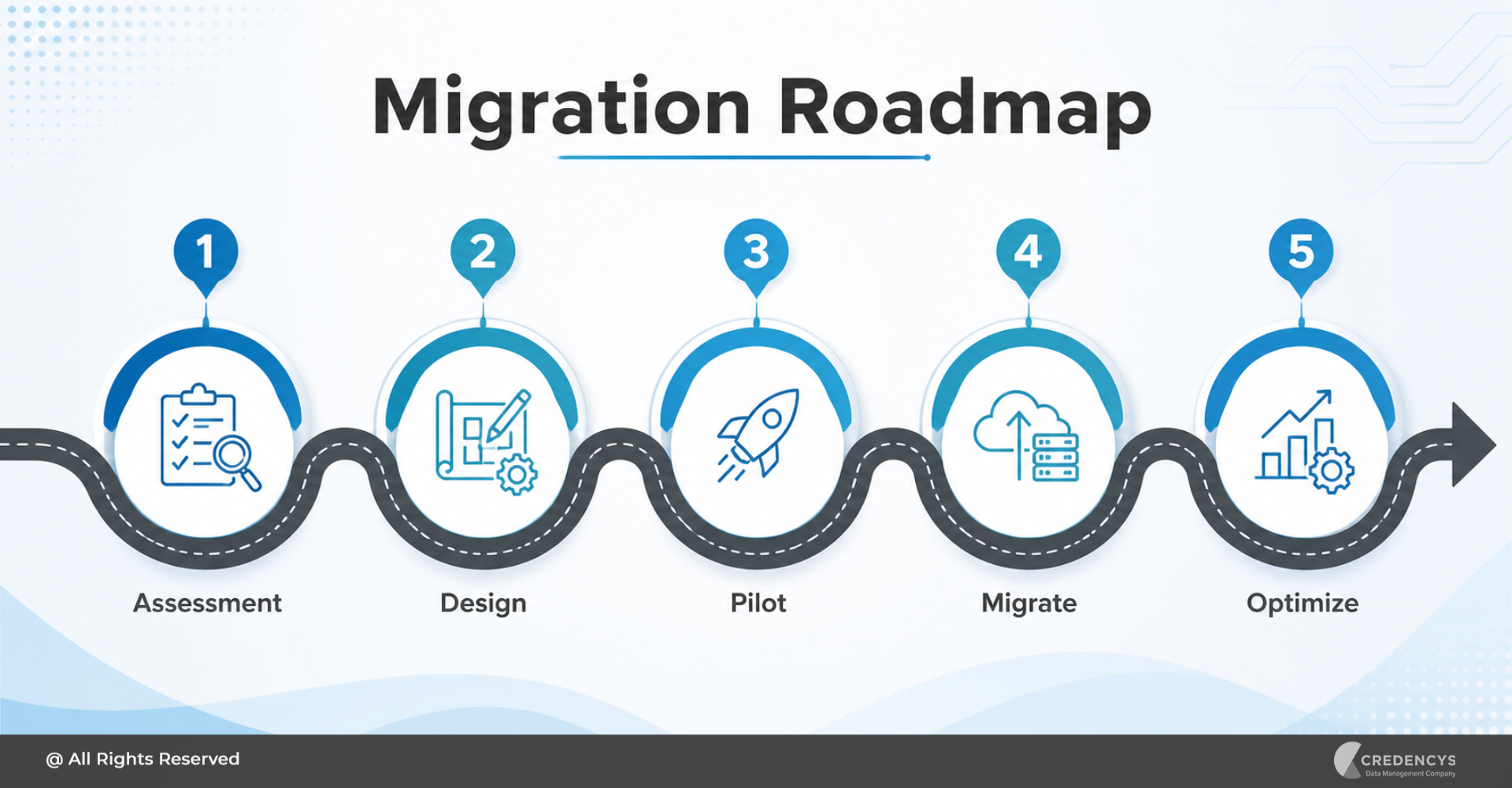
Migration Roadmap: From Legacy to Modern Data Platform
Modernizing retail data lakes is a structured, phased transformation that balances risk, cost, and business value. A well-defined roadmap ensures minimal disruption while delivering incremental wins.
1. Assessment
- Evaluate Current Data Landscape: Conduct a comprehensive audit of existing data sources, pipelines, storage systems, and tools. Identify data silos, redundancies, quality issues, and performance bottlenecks that impact business outcomes.
- Align Business & Data Priorities: Map data capabilities to business goals such as personalization, supply chain optimization, or forecasting. This ensures modernization efforts are tied directly to measurable ROI.
- Identify High-Impact Use Cases: Prioritize 1–2 use cases (e.g., customer 360, demand forecasting) that can demonstrate quick value and build internal momentum for broader transformation.
2. Design
- Select the Right Architecture: Choose between lakehouse, hybrid, or data mesh based on organizational maturity, scalability needs, and existing technology investments. Define how data will be ingested, stored, processed, and consumed.
- Define Governance & Security Frameworks: Establish policies for data access, lineage, quality, and compliance. Incorporate role-based access control, data cataloging, and audit mechanisms from the start.
- Create a Scalable Data Model & Pipeline Strategy: Design data models that support both analytics and AI workloads. Plan batch and real-time pipelines, ensuring flexibility to handle future data growth and new use cases.
3. Pilot
- Build a Proof of Concept (PoC): Implement the chosen architecture using a limited dataset or business domain. Validate data ingestion, transformation, and analytics capabilities in a controlled environment.
- Measure Performance & Business Impact: Track metrics such as query speed, data freshness, and usability. Compare outcomes against legacy systems to quantify improvements and justify further investment.
- Gather Stakeholder Feedback: Involve business users, data engineers, and analysts early. Their feedback helps refine data models, dashboards, and workflows before scaling.
4. Migrate
- Execute Incremental Data Migration: Move data in phases rather than a full lift-and-shift. Start with prioritized datasets and gradually migrate less critical historical data to reduce risk.
- Rebuild and Optimize Pipelines: Transition from legacy ETL to modern ELT or streaming pipelines. Optimize transformations for cloud-native performance and scalability.
- Enable Change Management & Training: Upskill teams on new tools and processes through structured training programs. Ensure clear communication to drive adoption across technical and business users.
- Leverage Expert-Led Migration Support: Partnering with experienced firms like Credencys accelerates migration while minimizing risks. With proven frameworks, pre-built accelerators, and deep expertise in platforms like Databricks and Snowflake, we help streamline data movement, pipeline modernization, and governance implementation.
5. Optimize
- Enhance Performance & Cost Efficiency: Continuously monitor workloads, optimize queries, and right-size compute resources. Implement cost governance practices to avoid cloud overspending.
- Implement DataOps & Automation: Introduce CI/CD pipelines, automated testing, and monitoring for data workflows. This ensures reliability, faster deployments, and reduced manual effort.
- Scale Across Use Cases & Domains: Expand the platform to additional business areas, integrating more data sources and enabling advanced analytics and AI initiatives.
Retail Use Cases & Business Benefits
Modernizing retail data platforms directly impacts revenue, customer experience, and operational efficiency. By unifying and activating data, retailers can unlock high-value use cases across the business.
1. Personalized Customer Experiences
- Unified Customer 360 View: Combine data from CRM systems, purchase history, website interactions, mobile apps, and in-store behavior to create a single, accurate customer profile. This eliminates fragmentation and enables consistent engagement across all touchpoints.
- AI-Driven Recommendations & Targeting: Use machine learning models to deliver personalized product recommendations, promotions, and content in real time. This significantly improves conversion rates, average order value, and customer retention.
- Omnichannel Journey Optimization: Track and analyze customer journeys across channels to identify drop-offs and optimize experiences. Retailers can deliver seamless transitions between online and offline interactions.
2. Inventory & Supply Chain Optimization
- Real-Time Inventory Visibility: Integrate sales, warehouse, and logistics data to gain up-to-date visibility into stock levels across locations. This helps prevent stockouts and overstocking.
- Demand-Supply Alignment: Use integrated data to align procurement, distribution, and replenishment strategies with actual demand patterns. This reduces waste and improves margins.
- Supplier & Logistics Performance Insights: Analyze supplier reliability, delivery timelines, and logistics efficiency. Retailers can proactively address bottlenecks and optimize supply chain operations.
3. Demand Forecasting & Pricing Optimization
- AI-Powered Demand Forecasting: Leverage historical sales data, seasonal trends, promotions, and external factors (weather, events) to generate accurate forecasts. This enables better planning and inventory allocation.
- Dynamic Pricing Strategies: Adjust pricing in real time based on demand, competition, and inventory levels. Retailers can maximize revenue while remaining competitive.
- Promotion Effectiveness Analysis: Evaluate the impact of discounts and campaigns across channels. Insights help refine future promotions and improve ROI.
4. Omnichannel Analytics & Business Intelligence
- Cross-Channel Data Integration: Break down silos between eCommerce, physical stores, marketplaces, and mobile platforms. This provides a holistic view of business performance.
- Real-Time Dashboards & Reporting: Enable business users with self-service analytics and live dashboards for faster decision-making. Executives gain immediate visibility into KPIs.
- Improved Customer Attribution: Understand which channels and campaigns drive conversions. This helps optimize marketing spend and channel strategy.
5. AI/ML Innovation & Advanced Analytics
- Advanced Predictive Models: Build models for churn prediction, customer lifetime value (CLV), and recommendation engines. These insights drive proactive business decisions.
- Fraud Detection & Risk Management: Identify anomalies in transactions and customer behavior using real-time analytics. This reduces fraud losses and improves security.
- Experimentation & A/B Testing at Scale: Run controlled experiments across pricing, promotions, and user experiences. Data-driven experimentation accelerates innovation.
6. Scalability & Peak Performance
- Handle Seasonal Demand Spikes: Cloud-based modern data platforms scale automatically during peak events like Black Friday or festive sales. This ensures uninterrupted performance.
- Elastic Compute & Storage: Dynamically allocate resources based on workload requirements, optimizing both performance and cost.
- Future-Ready Data Foundation: A modern architecture supports new data sources, technologies, and use cases without major rework.
Conclusion: Turning Retail Data into a Competitive Advantage
Retailers can no longer afford to operate on fragmented, slow, and unreliable data systems. As customer expectations rise and competition intensifies, the ability to harness data in real time has become a defining factor for success.
Modernizing retail data lakes, whether through a lakehouse, hybrid architecture, or data mesh, is not just a technology upgrade. It’s a strategic shift toward building a scalable, AI-ready data foundation that powers personalization, optimizes operations, and drives smarter decision-making.
Each approach has its place:
- Lakehouse for unified, future-ready analytics
- Hybrid for gradual, low-risk transformation
- Data Mesh for large-scale, domain-driven agility
The key is to align your data strategy with business goals, start with high-impact use cases, and adopt an incremental, well-governed migration approach. Retailers that get this right don’t just improve analytics, they unlock new revenue opportunities, enhance customer experiences, and build a long-term competitive edge.
FAQs
1. What is retail data lake modernization?
It is the process of upgrading legacy data lakes to modern architectures such as lakehouses, hybrid systems, or data meshes to improve analytics, governance, and scalability.
2. What is the difference between a lakehouse and a data warehouse?
A lakehouse combines the flexibility of data lakes with the performance and governance of data warehouses in a single platform.
3. Is data mesh suitable for mid-size retailers?
Typically, data mesh is better suited for large enterprises due to its organizational complexity.



Tags: