


How AI Is Reshaping the CPG Industry Today (and What to Expect Tomorrow)
Artificial Intelligence (AI) has rapidly evolved from a futuristic concept to a real-world growth driver for the Consumer-Packaged Goods (CPG) sector. From product ideation and supply chain visibility to consumer personalization, AI is redefining how CPG companies operate, compete, and innovate.
The CPG market is projected to grow by USD 1.5 trillion between 2024 and 2029, at a CAGR of 4.9% (Infosys). Meanwhile, AI has the potential to unlock USD 500 billion in value for global CPG companies (Market.us).
With rising consumer expectations, tightening margins, and unpredictable supply dynamics, the CPG industry must evolve — and AI is quickly becoming the backbone of this evolution.
What You Will Learn
In this blog, you’ll discover:
- Why has AI become a business-critical investment in the CPG space?
- Five key ways AI transforms CPG operations, marketing, and innovation.
- What’s next for AI in CPG?
Why AI Matters Now for CPG Companies
The CPG industry faces unprecedented pressure: consumers are demanding personalization, supply chains are strained, inflation squeezes margins, and retail competition is intensifying. Traditional ways of working — driven by historical data and static forecasts — no longer cut it.
AI enables companies to make faster, data-driven decisions and adapt to market changes in real time.
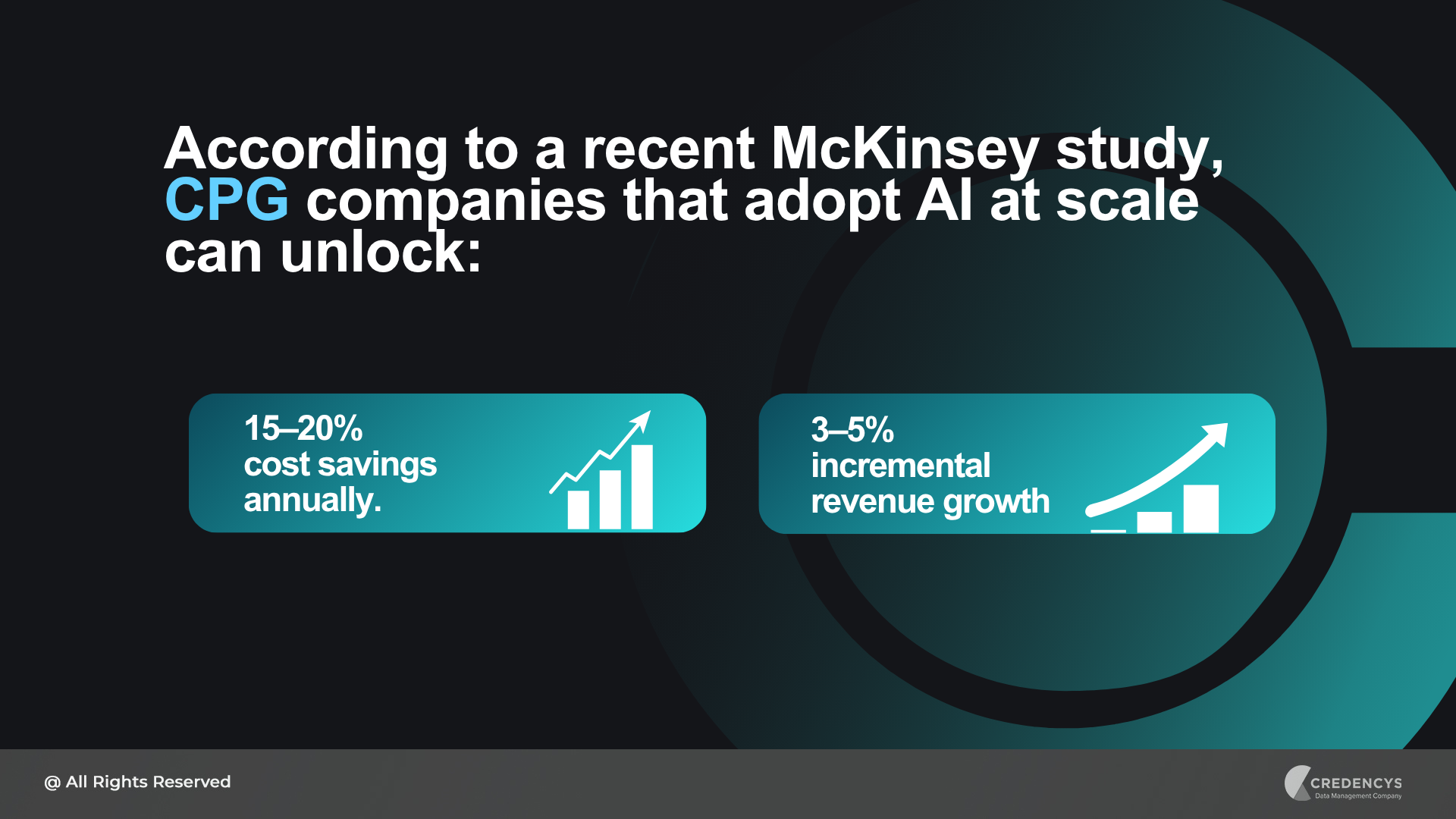
Key Technologies Powering the AI Revolution in CPG
The AI transformation in CPG is driven by a convergence of technologies. Each plays a unique role in enabling smarter decisions and automated workflows:
- Machine Learning (ML): Powers predictive analytics for forecasting, pricing, and inventory.
- Natural Language Processing (NLP): Enables social listening, sentiment analysis, and consumer feedback interpretation.
- Computer Vision: Enhances quality control, packaging inspection, and shelf monitoring.
- Generative AI: Speeds up product design, marketing content creation, and new product development.
- Agentic AI: Deploys autonomous AI “agents” to handle complex, multi-step tasks without human intervention.
Below are the five biggest ways AI is transforming the CPG landscape—with real-world outcomes and examples.
1. Smarter Demand Forecasting & Inventory Optimization
AI helps CPG companies move beyond historical trend-based planning toward real-time, predictive intelligence. By analyzing internal and external data, AI forecasts demand at the SKU level with greater accuracy.
This enables companies to reduce stockouts, lower waste, and optimize working capital. For example, a global snack manufacturer achieved a 10% improvement in forecast accuracy, saving millions in inventory costs.
AI-based demand forecasting can improve accuracy by up to 20% in many CPG scenarios.
AI also powers dynamic inventory balancing—shifting products between locations based on local demand patterns and avoiding excess stock in low-demand regions.
2. Trade Promotion and Pricing Intelligence
Trade promotions can make or break profitability. AI enables companies to predict promotional lift, test “what-if” scenarios, and deploy data-backed pricing strategies that protect margins.
By combining machine learning with retailer and consumer data, AI helps teams choose the right product, price, and timing for each campaign.
AI-driven promotion strategies deliver 15–25% higher incremental volume than traditional methods.
AI also supports dynamic pricing—continuously adjusting based on competitor moves, stock levels, and demand signals—helping CPG firms stay agile and profitable in volatile markets.
3. Consumer Insights, Personalization & New Product Innovation
Understanding the evolving consumer is the lifeline of CPG success. AI revolutionizes how brands listen to, analyze, and act on consumer sentiment.
From social listening and predictive trend detection to generative AI for product ideation, companies are using data to anticipate what customers want next. Personalized recommendations, packaging, and offers are now standard expectations.
71% of CPG leaders adopted AI in at least one function in 2024, with 56% using generative AI for innovation and design. (McKinsey)
One beverage brand reduced its time-to-market by 60% using generative AI for concept testing and packaging design.
4. Supply Chain Resilience & Logistics Intelligence
Modern CPG supply chains span continents—and disruptions are inevitable. AI makes these networks smarter, more resilient, and predictive.
It can analyze vast streams of real-time data, such as supplier performance, geopolitical risks, and weather patterns, to proactively adjust logistics plans and reduce delays. AI also optimizes routes, load planning, and fuel efficiency for greener operations.
AI-enabled logistics can cut transportation costs by up to 15%, while improving on-time delivery by 20%. (Deloitte)
Leading brands are even deploying autonomous AI agents that monitor exceptions and auto-correct disruptions without human input.
5. AI-Powered Autonomous Agents & Commercial Operations
The next wave of innovation lies in AI agents that act autonomously—not just provide insights. These systems can handle routine tasks like generating promotional calendars, drafting product briefs, or optimizing sales calls.
AI-powered assistants now support sales reps with data-driven negotiation recommendations, monitor competitor pricing, and even suggest retailer-specific offers in real-time.
66% of CPG companies have already scaled generative AI in operations.
As Bain notes, companies that fail to modernize may lose ground to retailers and startups leveraging AI-native models. (Bain)
What the Future Holds
The CPG industry is moving toward an AI-native era, where insights and actions flow seamlessly across departments.
Expect hyper-personalized experiences, real-time consumer engagement, and predictive product lifecycles. Smart packaging and IoT will feed real-world data into AI systems, fueling continuous optimization.
As regulatory frameworks evolve, ethical and transparent AI will be the differentiator that builds consumer trust.

Unlock the power of AI in your CPG strategy. Speak to our experts today to discover how we can help you modernize operations and build data-driven customer experiences that fuel growth.
5 Frequently Asked Questions (FAQs)
1. How soon can a CPG company see ROI from AI?
Meaningful gains—like better forecasting and optimized promotions—can appear within 6–12 months, with early wins often seen in just 3–6 months.
2. Is generative AI more valuable than traditional ML?
Both have roles. Traditional ML drives operational accuracy, while Generative AI enhances creativity—from new product ideation to campaign content. McKinsey estimates gen AI can boost AI’s economic impact by 15–40%.
3. What’s the biggest barrier to AI adoption?
Data readiness. Many CPG firms lack unified, high-quality data pipelines. Organizational alignment and skill gaps also hinder progress.
4. Should CPG companies build or buy AI solutions?
A hybrid approach works best—partner with AI vendors for pilots while building in-house expertise for long-term scalability.
5. How can companies ensure ethical AI usage?
Implement model explainability, perform bias audits, maintain data transparency, and always keep human oversight in critical decisions.





Tags: