


Top Data Management Companies 2026 [Complete List]
Today, enterprise data is exploding in volume, in variety, in velocity. Structured. Unstructured. Streaming in real time. Spread across ERPs, CRMs, eCommerce platforms, supplier portals, warehouses, IoT systems, and cloud applications. And every department wants access to it.
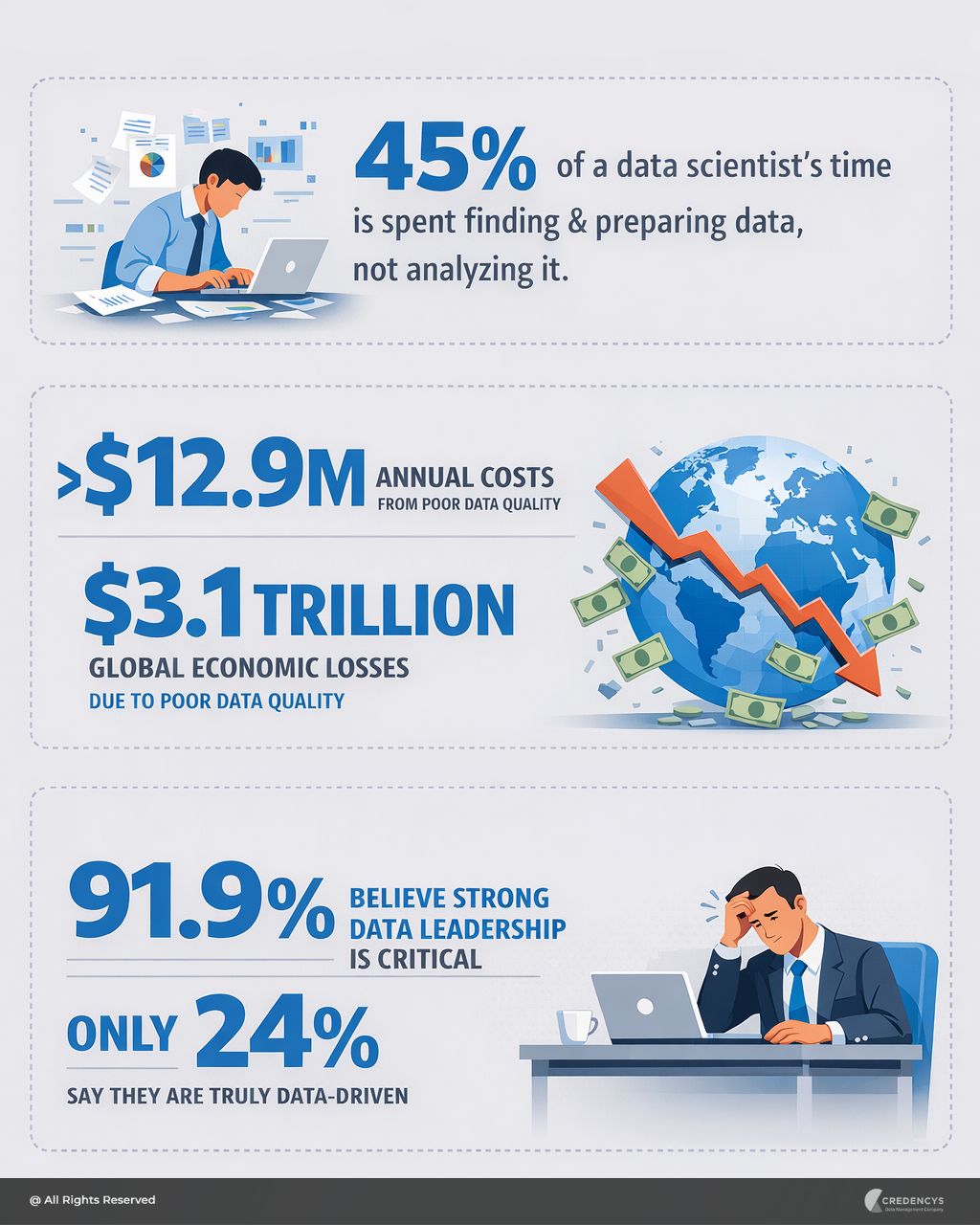
But here’s the catch. More data doesn’t automatically mean better decisions.
In fact, for many enterprises, it means the opposite: fragmented systems, inconsistent master records, duplicate customer profiles, conflicting product data, and governance chaos. And that’s why data management has become a priority.
Because analytics, AI, personalization, demand forecasting, and dynamic pricing, none of it works without trusted, governed, consistent data foundations. That’s why data management companies are in high demand in 2026.
Enterprises aren’t just looking for tools anymore. They’re looking for partners who can unify, govern, modernize, and scale their data across domains: customer, product, supplier, material, while aligning everything with long-term analytics and AI goals.
In this guide, we’ve curated a list of leading data management companies based on their service breadth, industry expertise, technology ecosystem strength, and delivery capabilities. If you’re evaluating partners to bring order to your data ecosystem, this list is a strong place to start.
What Do Data Management Companies Do?
At a glance, “data management” sounds simple. But in reality, it’s far more strategic and far more complex.
Modern data management companies don’t just handle databases. They design the foundation that analytics, AI, reporting, automation, and digital experiences are built on.
And when that foundation is weak, everything built on top of it wobbles. Here’s what leading data management partners actually do:
1. Master Data Management
Master Data Management ensures that core business entities, customers, products, suppliers, materials, and locations are consistent and unified across systems. It gives:
- One version of the truth for customer data
- Standardized product information across eCommerce and ERP
- Clean supplier records across procurement systems
Without MDM, every department works off a slightly different dataset. And small inconsistencies snowball into reporting errors, compliance risks, and poor customer experiences.
2. Data Integration & ETL
Data management companies build integration pipelines and ETL (Extract, Transform, Load) frameworks that:
- Consolidate siloed data
- Transform it into standardized formats
- Load it into data warehouses, lakehouses, or analytics platforms
The goal isn’t just movement. It’s a meaningful movement, making data analytics ready.
3. Data Quality & Governance
Dirty data is expensive. Duplicates. Missing fields. Incorrect hierarchies. Non-standard formats.
These issues quietly break dashboards and corrupt AI models. Strong data management partners implement:
- Data profiling and cleansing
- Validation rules and workflows
- Governance frameworks and approval processes
- Role-based access controls
- Compliance alignment
Because trust in data doesn’t happen by accident. It’s engineered.
4. Domain-Specific Data Management
Not all data is the same. Managing product data is very different from managing customer data.
And supplier or materials data comes with its own complexity, especially in industries like retail, manufacturing, and distribution. Leading firms offer domain-focused expertise such as:
- Product Information Management (PIM)
- Customer Master Data Management
- Supplier & Vendor Master Data
- Parts & Materials Data Management
This domain depth matters. A generic approach rarely works.
5. Cloud Data Modernization
Legacy systems are holding many enterprises back. Data management companies help organizations migrate from fragmented, on-premises setups to scalable cloud-based ecosystems, whether that’s modern data warehouses, lakehouses, or hybrid architectures.
And it’s not just about moving data. It’s about redesigning architecture to support real-time analytics, AI workloads, and composable systems.
How We Evaluated the Top Data Management Companies
Not every company that “does data” truly does data management. Some specialize in analytics dashboards.
Some focus purely on engineering. Others resell tools.
So before putting together this list, we looked beyond marketing claims. We evaluated firms based on practical capability, delivery strength, and long-term enterprise value.
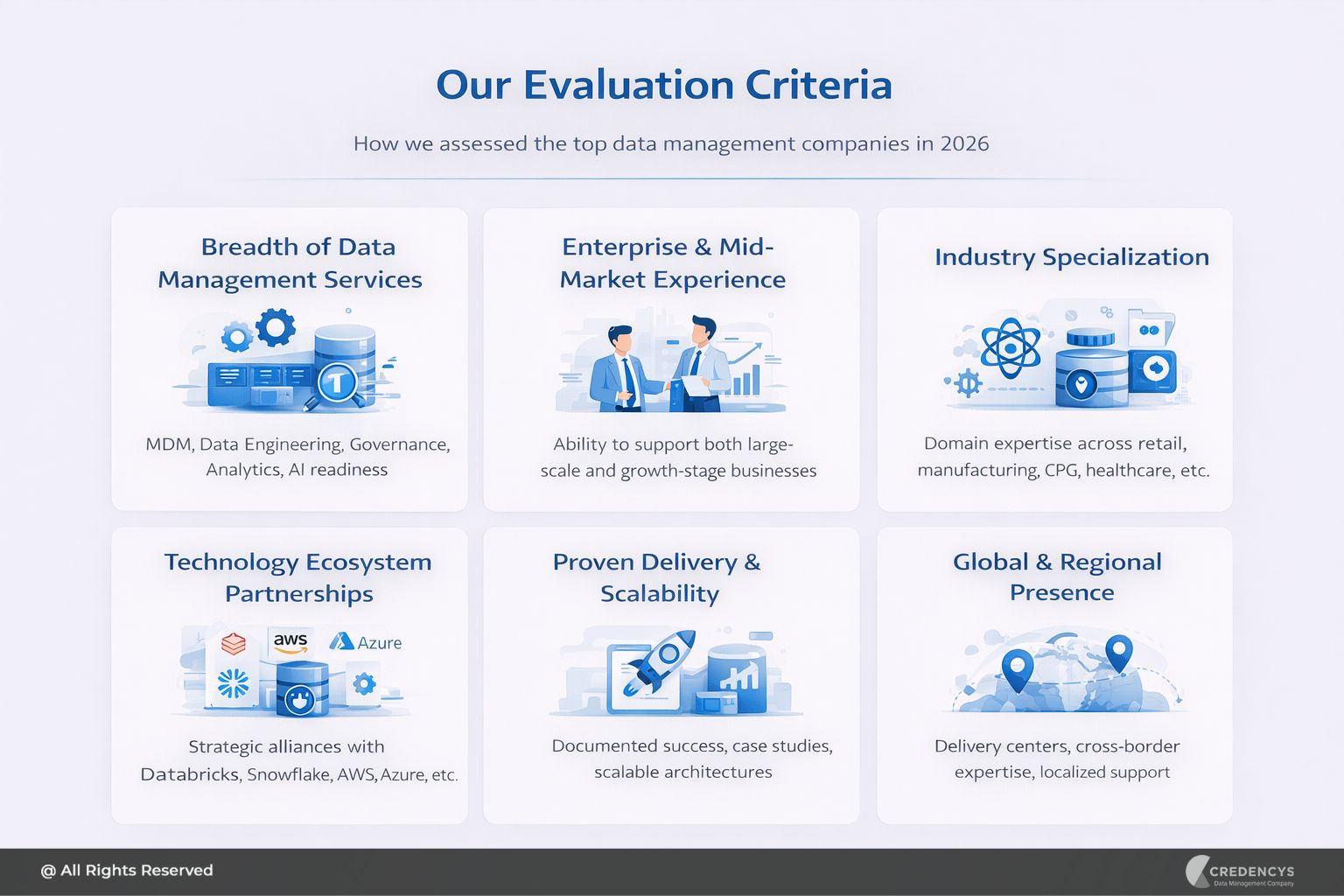
Here’s the lens we used:
1. Breadth of Data Management Services
True data management isn’t one-dimensional. We prioritized companies that offer a wide spectrum of services from master data management and data governance to integration, modernization, and domain-specific data solutions.
Because enterprises rarely need a single-point solution. They need an interconnected data ecosystem.
2. Enterprise and Mid-Market Experience
Handling data for a startup is very different from running a global MDM program across multiple geographies. We considered:
- Experience with complex enterprise environments
- Multi-system integrations
- Large-scale governance rollouts
- Cross-functional stakeholder management
At the same time, flexibility for mid-market organizations also matters. Scalability is key.
3. Industry Specialization
Data models aren’t generic. Retail has product hierarchies and omnichannel challenges.
Manufacturing deals with parts, materials, and supply chain complexity. Distribution businesses rely heavily on supplier and inventory accuracy.
Companies with industry depth tend to design far more effective data frameworks. So, specialization is an important factor.
4. Technology Ecosystem Partnerships
Strong partnerships signal credibility. We looked at companies aligned with leading data platforms, MDM tools, cloud ecosystems, and analytics technologies.
These partnerships often reflect certified expertise and hands-on implementation experience. But again, tools alone weren’t enough.
The focus remained on delivery capability.
5. Proven Delivery and Scalability
Case studies. Program maturity. Long-term client relationships.
We assessed whether firms have successfully delivered governed, scalable data programs, not just pilot projects. Because data management isn’t a one-time initiative.
It’s an ongoing discipline.
6. Global and Regional Presence
Some enterprises need global delivery models. Others prioritize strong regional expertise, especially in India and APAc markets.
We considered both. The result?
A curated mix of consulting-led data management firms with strong service portfolios, industry alignment, and proven execution capabilities.
Now, let’s look at the companies leading the space in 2026.
Top Data Management Companies to Partner With
The data management landscape is crowded. But not everyone operates at the same level of depth, consulting maturity, or domain expertise.
Below are companies that stand out in 2026 for their capabilities, delivery strength, and strategic approach to enterprise data.
1. Credencys Solutions – Enterprise Data Management Consulting Company
Credencys Solutions is one of the best data management companies that helps enterprises build trusted, scalable, and business-ready data foundations. With a strong consulting-led approach, Credencys works closely with organizations to align data strategy, governance, and execution with long-term analytics and digital transformation goals.
Rather than focusing on isolated tools or technologies, Credencys emphasizes end-to-end data management, ensuring that enterprise data is accurate, consistent, governed, and usable across business functions.
Core Data Management Services at Credencys
- Data Management Consulting: Data strategy definition, architecture design, and roadmap development tailored to business objectives.
- Master Data Management (MDM): Implementation and optimization of master data solutions across key domains, including:
- Customer Master Data Management
- Product Information Management (PIM)
- Supplier Master Data Management
- Parts and Materials Master Data Management
- Data Quality Management: Data profiling, cleansing, validation, and continuous monitoring to ensure reliable and trusted data.
- Data Governance Services: Establishment of data governance frameworks, policies, ownership models, and controls to support compliance and enterprise-wide data consistency.
Why Credencys Stands Out
- Strong focus on consulting and business alignment, not just technology implementation
- Deep experience across retail, manufacturing, supply chain, and distribution domains
- Proven expertise in enterprise master data and governance programs
- Emphasis on building analytics- and AI-ready data foundations
Success Stories
Success Stories #1: Accelerating Time-to-Market with AI-Powered PIM for a Leading Fashion Retailer
A leading Southeast Asian retail conglomerate, managing over 100 fashion, beauty, and lifestyle brands, was struggling to manage massive volumes of product information. With disconnected systems, inconsistent product content, and manual processes, the client faced slow product publishing and delayed time-to-market, which impacted their operational efficiency and sales performance.
Credencys implemented an AI-Powered PIM solution using Pimcore to centralize product and media data and automate key workflows.
Business Impact:
- Improved accuracy and consistency of product information across channels
- Reduced manual effort and operational cost through automated workflows
- Enhanced customer experience with richer and more reliable product content
Success Stories #2: Centralized Customer Data Management Driving Operational Efficiency
A division of a leading global pharmaceutical company, specializing in advanced treatments across multiple geographies, depended on an outdated customer management system that resulted in fragmented customer records, manual data processes, and integration gaps. These issues slowed operations, reduced data accuracy, and hindered regulatory compliance and customer trust.
Credencys provided the client with a scalable Customer Data Management solution that centralized customer profiles and automated data lifecycle processes.
Business Impact:
- Centralized customer data improved accuracy and reduced manual errors.
- Automated workflows accelerated data processing and lowered operational costs.
- Seamless integration with third-party systems unified the data ecosystem and improved visibility.
Ideal For: Mid-sized and large enterprises looking to unify, govern, and scale their data across multiple domains while supporting analytics, AI, and operational use cases.
2. Kanerika
Kanerika is known for its strong presence in data engineering and analytics-driven data platforms. The company focuses on building modern, cloud-based data ecosystems that support analytics and BI initiatives.
Its services span data integration, engineering, governance, and performance optimization.
Strengths include:
- Modern cloud data architecture
- Analytics-ready data platforms
- Strong BI and reporting enablement
- Enterprise-grade delivery capabilities
Kanerika is often engaged by organizations looking to modernize legacy data infrastructure and accelerate analytics adoption.
3. N-iX
N-iX has a strong global presence and works extensively with enterprise clients across North America and Europe. The company offers comprehensive data management and analytics services, including:
- Data integration
- Governance frameworks
- Data modernization
- Enterprise analytics support
With a focus on scalability and enterprise architecture, N-iX supports organizations navigating large-scale digital and data transformation programs. Its strength lies in combining technical depth with global delivery capabilities.
4. Complere Infosystem
Complere Infosystem specializes in ETL, data integration, and analytics enablement. The company has strong capabilities in:
- Data warehousing
- ETL pipeline development
- Reporting and business intelligence support
- Data migration and transformation
With a global clientele, Complere is often selected by enterprises seeking structured data integration and reporting-focused solutions. Their approach tends to be execution-driven, with emphasis on structured data consolidation and analytics support.
5. Codewave
Codewave blends data management with broader digital transformation initiatives. The firm focuses on enabling enterprises to leverage data for product innovation and digital growth. Its services include:
- Data platform implementation
- Integration services
- Analytics enablement
- Cloud modernization
Codewave brings a strong product and UX-oriented mindset to data initiatives, which can be valuable for organizations aligning data strategy with customer-facing digital experiences.
6. DevsData
DevsData provides data management, engineering, and analytics services for both startups and enterprise clients. The company is known for:
- Flexible engagement models
- Strong technical expertise
- Cloud and AI-driven data modernization
- Enterprise and Fortune 500 clientele
DevsData supports organizations building modern data pipelines and scalable architectures, particularly those investing in AI-powered analytics. Each of these companies brings distinct strengths, whether consulting depth, engineering execution, or cloud modernization expertise.
How to Choose the Right Data Management Company
Choosing a data management partner isn’t just a procurement decision. It’s a long-term commitment.
The wrong partner leaves you with disconnected tools and half-implemented frameworks. The right one builds a scalable, governed data foundation that supports analytics, AI, and growth for years.
So how do you choose wisely?
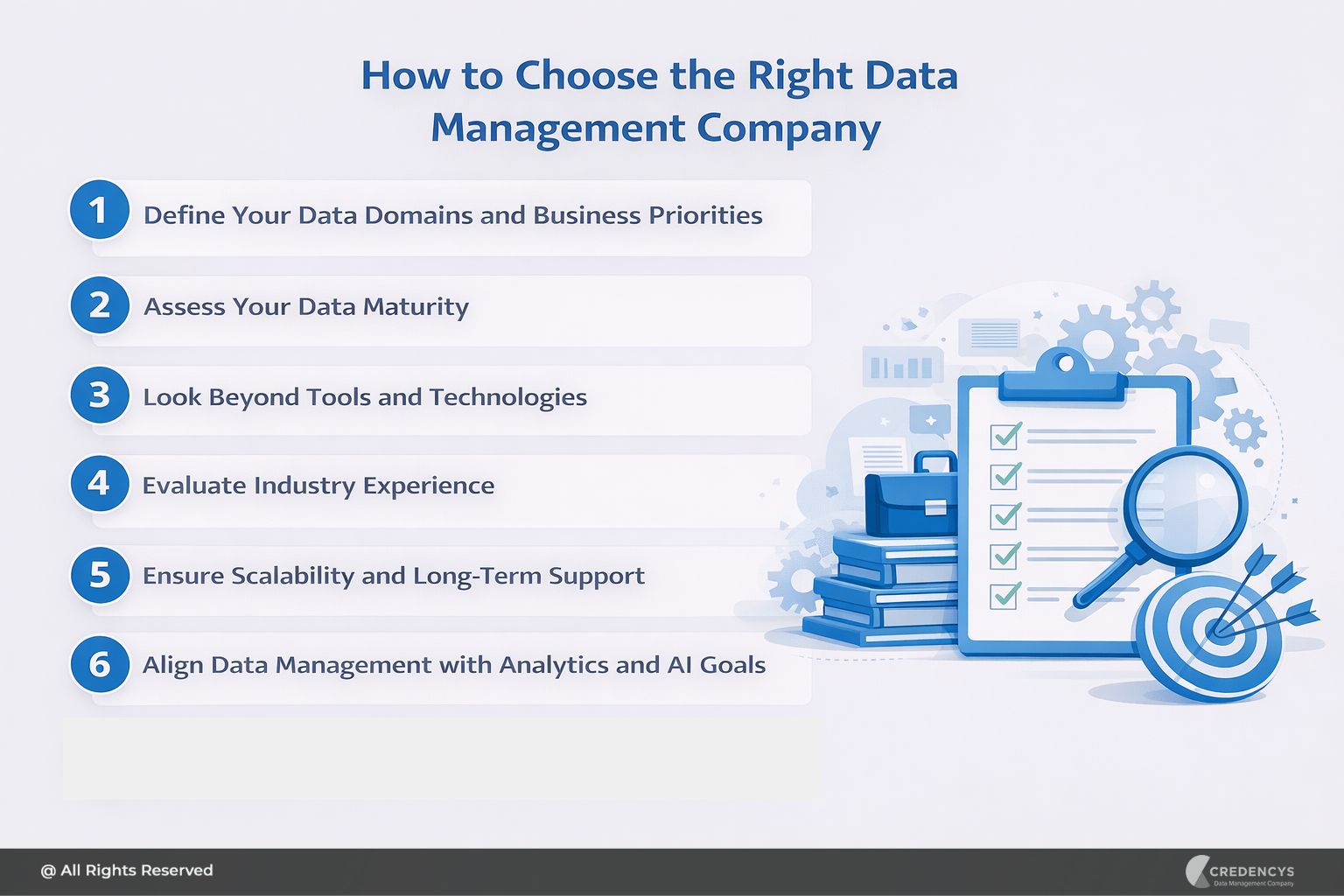
1. Define Your Core Data Domains
Start with clarity. Are you struggling with:
- Customer data inconsistencies?
- Product information chaos across channels?
- Supplier and vendor duplication?
- Parts and materials master complexity?
Not every company has deep experience across all domains. Some specialize in PIM.
Others focus on customer MDM. A few handle multi-domain enterprise programs.
Be specific about what you need unified and governed.
2. Assess Your Current Data Maturity
Where are you really? Do you have documented governance policies?
Defined data ownership? Standardized hierarchies?
Automated validation rules? Or are most processes manual and reactive?
A strong partner won’t jump straight into implementation. They’ll assess your maturity, identify structural gaps, and design a phased roadmap.
If someone promises instant transformation without discovery, pause.
3. Look Beyond Tools
Tools are necessary. But they’re not strategy.
Ask:
- Will this partner define governance frameworks?
- Can they align business and IT stakeholders?
- Do they redesign processes, or just configure platforms?
- Are they thinking about long-term scalability?
Data management fails when it’s treated as a software installation instead of an organizational shift. And you need a partner who understands that.
4. Evaluate Industry Experience
Retail data challenges are not the same as manufacturing. Supply chain data complexity is very different from digital commerce ecosystems.
Look for proven experience in your industry. It shortens implementation cycles.
It reduces rework. It improves governance design because the partner understands real-world domain structures.
Industry context speeds everything up.
5. Ensure Scalability & Long-Term Support
Data management is not a one-time initiative. Choose a partner that can support enterprise-scale growth, evolving data needs, and long-term governance.
Ensure Alignment with Analytics & AI Goals
This is critical in 2026. Your data foundation should directly support:
- Advanced analytics
- Demand forecasting
- Personalization engines
- AI-driven automation
- Executive reporting
If the partner cannot articulate how data management feeds into analytics and AI readiness, you’re building a silo. And that defeats the purpose.
The best data management companies don’t just clean data. They create clarity, consistency, and confidence.
And when those three exist, digital transformation becomes far more than a buzzword.
Conclusion
Data management is no longer optional. It’s infrastructure, governance, and strategy.
And in 2026, it’s the quiet engine behind analytics, AI, personalization, supply chain optimization, and every serious digital transformation initiative. Without clean, unified, governed data, even the most advanced AI models collapse under inconsistency.
Dashboards lose credibility. Teams stop trusting numbers.
Decisions slow down. Everything moves faster.
The right data management partner doesn’t just implement tools. They design scalable data programs.
They align business and IT. They define governance frameworks.
They build foundations that last.






Tags: