


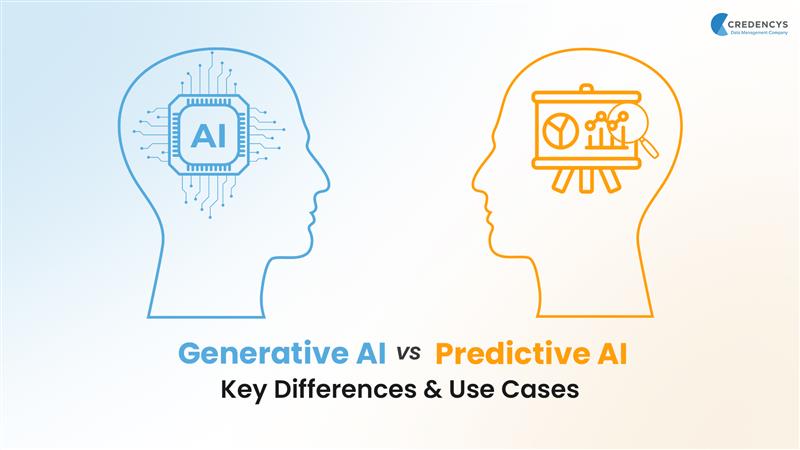
Generative AI vs Predictive AI: Understanding the Key Differences & Business Use Cases
Artificial Intelligence (AI) is transforming the business landscape at an unprecedented pace. From automating repetitive tasks to making data-driven decisions, AI is becoming a game-changer across industries. But not all AI systems are created equal. Two of the most powerful AI categories—Generative AI and Predictive AI—serve distinct purposes, each offering unique advantages for businesses.
The AI market is expected to reach $1.8 trillion by 2030, with companies leveraging advanced AI models to optimize operations, enhance customer experiences, and unlock new revenue streams.
However, many business leaders struggle to differentiate between Generative AI and Predictive AI, often leading to inefficient AI adoption.
A common challenge businesses face is choosing the right AI technology for their needs.
Do you need AI to generate human-like text, images, and designs?
Or do you need AI to forecast sales, detect fraud, and anticipate customer behavior?
Without a clear understanding, companies risk investing in the wrong solutions, leading to wasted resources and missed opportunities.
In this blog, we’ll break down the key differences between Generative AI vs Predictive AI, explore how each can drive business value, and highlight real-world use cases to help you make informed decisions.
What is Generative AI?
Generative AI is a subset of artificial intelligence that focuses on creating new content, rather than just analyzing existing data. Using advanced machine learning models like Generative Adversarial Networks (GANs) and transformer-based architectures, Generative AI can produce human-like text, realistic images, code, music, and even synthetic data.

Learn how artificial intelligence driven solution can transform your business
At its core, Generative AI learns patterns from massive datasets and generates new outputs that mimic human creativity. Unlike traditional AI systems that follow predefined rules, Generative AI can think outside the box, making it a powerful tool for businesses looking to enhance creativity, automation, and customer engagement.
How Generative AI Works
Generative AI relies on deep learning techniques such as:
- Transformer Models (e.g., GPT-4, BERT, and LLaMA): Used in natural language processing (NLP) to generate human-like text.
- Generative Adversarial Networks (GANs): Utilized in image and video generation, creating hyper-realistic visuals.
- Diffusion Models (e.g., DALL·E, MidJourney): Specialized in generating high-quality images from text prompts.
Use Cases of Generative AI for Businesses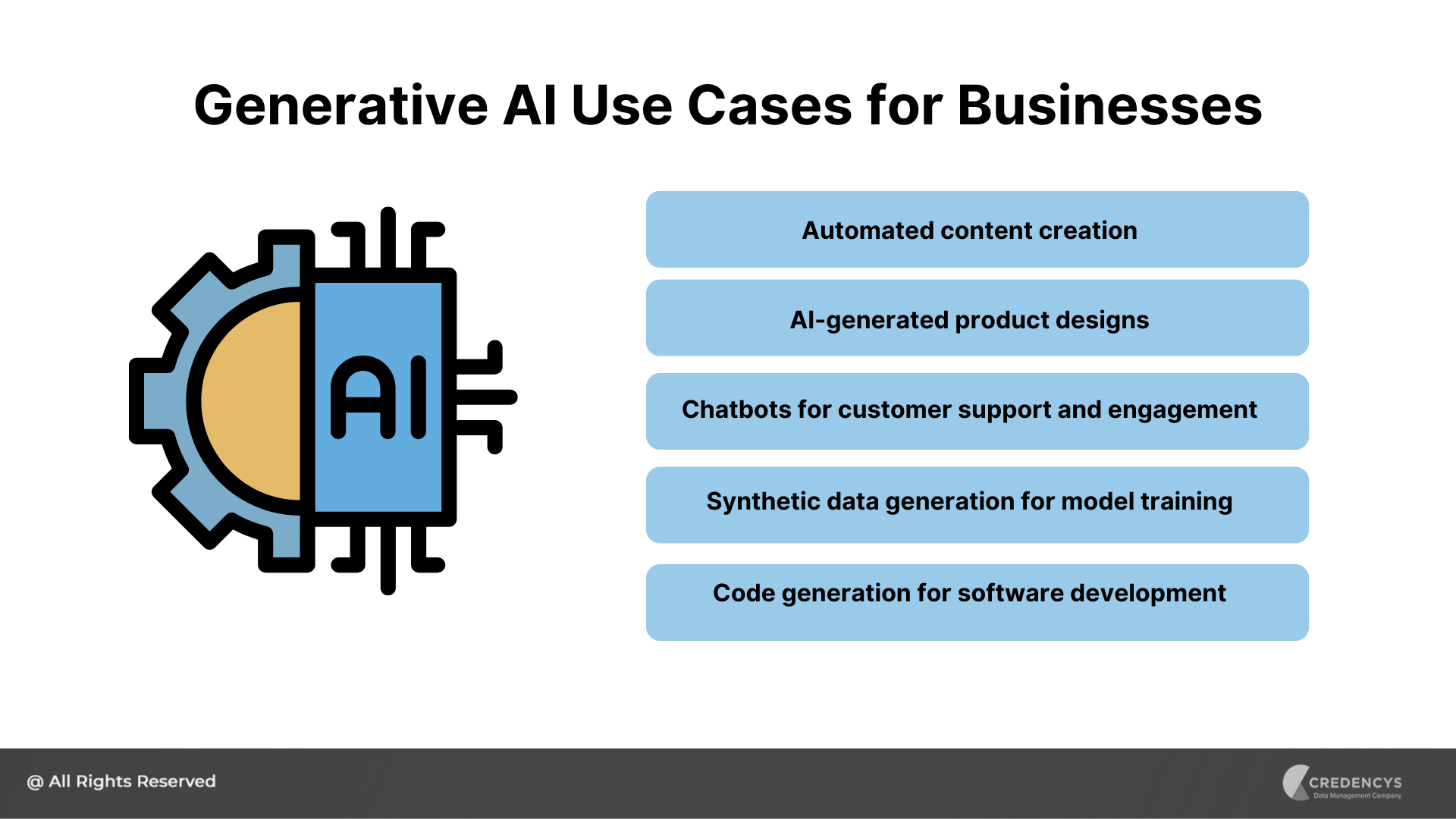
Generative AI is revolutionizing industries by automating content creation and enhancing personalization. Here’s how businesses are leveraging it:
1. Marketing & Content Creation
Brands use AI to generate blog articles, ad copies, and social media posts. According to a McKinsey report, AI-driven content marketing can boost productivity.
2. Product Design & Prototyping
Companies like Nike and Adidas leverage AI to generate unique sneaker designs, reducing development cycles by months.
3. Customer Support Automation
AI-powered chatbots enhance customer interactions with human-like responses, reducing support costs.
4. AI-Powered Art & Creativity
Graphic designers and game developers use tools like Stable Diffusion and Runway ML to generate hyper-realistic visuals and animations.
5. Software Development
Developers leverage AI tools like GitHub Copilot to auto-generate code, improving efficiency significantly.
What is Predictive AI?
While Generative AI creates new content, Predictive AI focuses on forecasting future outcomes based on historical data. It leverages machine learning (ML), statistical modeling, and data analytics to identify patterns, make predictions, and drive data-informed decisions.
Predictive AI is widely used in industries where anticipating trends, behaviors, or risks can provide a competitive advantage. Businesses rely on it for sales forecasting, fraud detection, customer behavior analysis, and operational efficiency improvements.
How Predictive AI Works
Predictive AI models process vast amounts of structured and unstructured data to detect patterns and relationships. Here’s a breakdown of the core techniques used:
- Regression Analysis – Estimates relationships between variables to predict outcomes (e.g., revenue forecasting).
- Classification Algorithms – Categorizes data into different groups (e.g., fraud vs. legitimate transactions).
- Time-Series Forecasting – Analyzes trends over time (e.g., stock price prediction, demand forecasting).
- Neural Networks & Deep Learning – Mimics human decision-making to enhance prediction accuracy (e.g., personalized product recommendations).
Use Cases of Predictive AI for Businesses
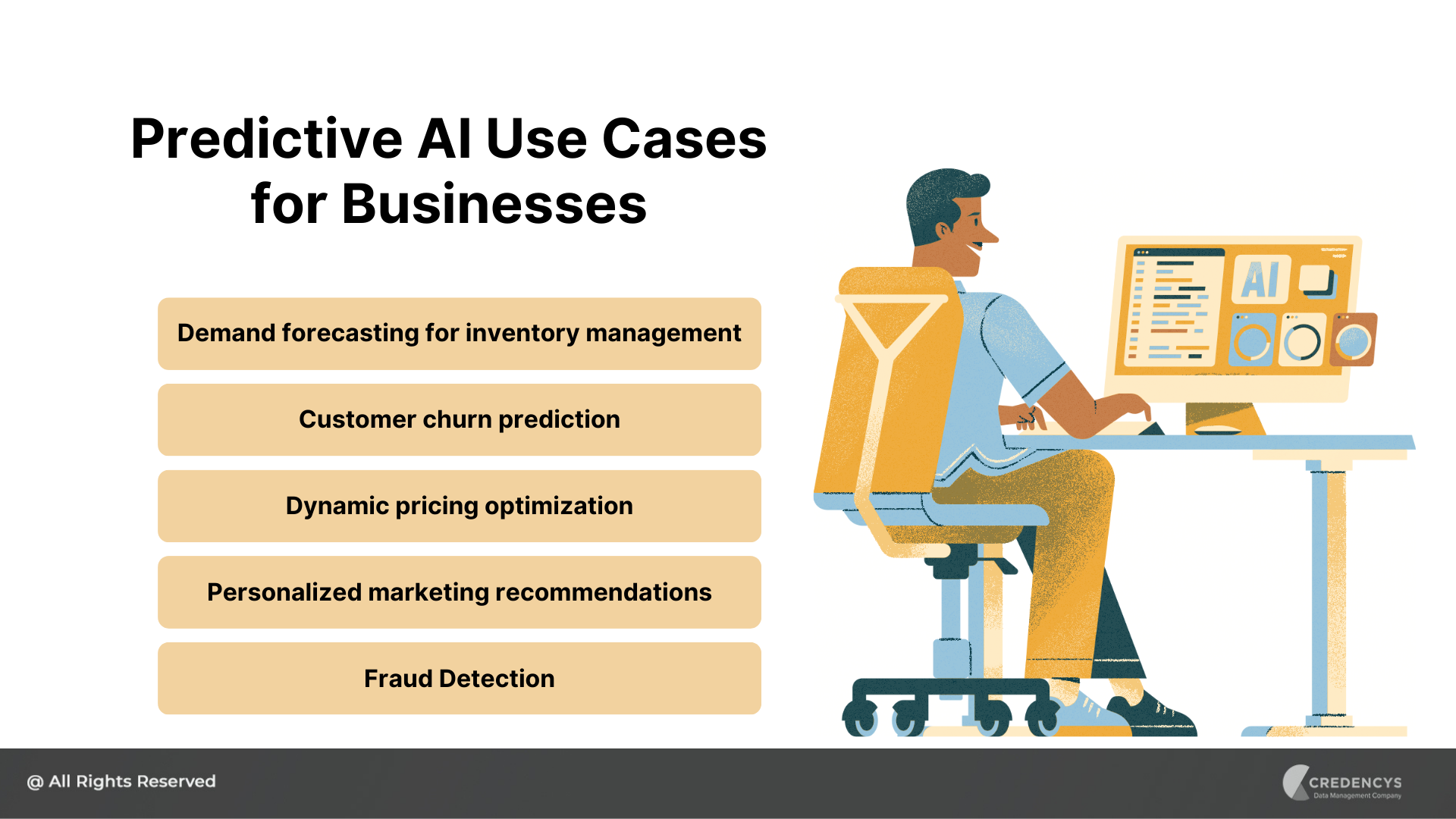
Predictive AI is already transforming industries by helping businesses anticipate risks, improve efficiency, and optimize decision-making. Here’s how companies are using it:
1. Sales & Demand Forecasting
Retailers like Walmart and Amazon use Predictive AI to forecast inventory demand, reducing stock shortages and minimizing losses.
2. Customer Behavior Analysis
E-commerce platforms analyze browsing history, purchase patterns, and engagement metrics to predict customer preferences and recommend personalized products.
3. Fraud Detection & Risk Assessment
Banks and financial institutions rely on Predictive AI to identify suspicious transactions, reducing fraud-related losses.
4. Predictive Maintenance
Manufacturing companies use AI to analyze machine performance data, preventing unexpected breakdowns and cutting maintenance costs.
With its data-driven approach, Predictive AI helps businesses make smarter, faster, and more accurate decisions—giving them a significant edge in today’s competitive landscape.
Generative AI vs Predictive AI: Key Differences
| Aspects | Generative AI | Predictive AI |
|---|---|---|
| Definition | A type of AI that generates new content, such as text, images, music, and videos. | A type of AI that analyzes historical data to forecast future trends, behaviors, and outcomes. |
| Primary Function | Creates original, human-like content. | Predicts future events and trends based on past data. |
| How It Works | Learns from large datasets to recognize patterns and generate new outputs. | Identifies trends and relationships in historical data to make informed predictions. |
| Core Technologies | Transformer models (GPT, BERT), Generative Adversarial Networks (GANs), Diffusion models, Variational Autoencoders (VAEs). | Machine learning, statistical models, decision trees, neural networks, time-series forecasting. |
| Business Use Cases | Content generation, chatbots, product design, AI-powered art, software development automation. | Sales forecasting, fraud detection, customer behavior analysis, predictive maintenance, risk assessment. |
| Input & Training Data | Requires large, diverse datasets containing millions of content samples. | Works with smaller, structured datasets focused on historical trends and patterns. |
| Output | Produces new, unique content such as text, visuals, audio, and code. | Provides data-driven insights, probability-based forecasts, and trend analysis. |
| Algorithms & Architectures | Uses GANs, transformers, VAEs, and diffusion models for creative generation. | Uses clustering, regression, decision trees, time-series analysis, and neural networks for forecasting. |
| Explainability & Interpretability | Often lacks transparency, making it difficult to explain how outputs are generated. | More interpretable since predictions are based on statistical relationships and historical data. |
Conclusion: Choosing the Right AI for Your Business
Both Generative AI and Predictive AI offer transformative capabilities, but their applications are fundamentally different.
Generative AI excels in creativity and automation, helping businesses produce content, enhance design workflows, and improve customer engagement through AI-driven interactions.
On the other hand, Predictive AI is a powerhouse for data-driven decision-making, enabling companies to forecast trends, optimize operations, and mitigate risks effectively.
For businesses, the choice between Generative AI vs Predictive AI depends on specific goals:
- If you need content generation, automation, and creative innovation, Generative AI is the right fit.
- If your focus is on forecasting trends, identifying risks, and making data-backed decisions, Predictive AI is the better option.
- In many cases, combining both AI technologies unlocks even greater potential—allowing businesses to make smarter decisions while automating creative processes.
As AI continues to evolve, companies that strategically integrate these technologies will gain a competitive advantage, driving efficiency, innovation, and long-term success. The key is to understand your business needs and choose the right AI solution to power your growth.






Tags: