


Hidden Cost of Running Legacy MDM in a Cloud World
Enterprises across the U.S. have rapidly made Snowflake the backbone of their modern data architecture.
As of 2025, over 14,500 companies, predominantly in the United States, are verified Snowflake users, with manufacturing and retail sectors among the largest adopters.
Yet despite this migration toward cloud-native platforms, many enterprises still run legacy MDM systems, tools built for a disconnected, on-prem IT era that clash with today’s unified, agile data stacks. This post exposes the hidden burden of legacy MDM in the cloud era and explores why moving MDM into Snowflake isn’t just smart, but inevitable.
What You’ll Learn
By the end of this post, you’ll understand:
- Why legacy MDM is out of sync with the cloud-first world and how it drags down Snowflake modernization initiatives.
- The hidden costs of running traditional MDM hubs from infrastructure overhead to governance gaps.
- How legacy MDM creates bottlenecks for analytics, AI, and compliance.
- The advantages of moving MDM directly inside Snowflake, including lower TCO, faster governance, and simplified data pipelines.
- Practical takeaways for CIOs, CDOs, and CTOs to rethink MDM strategy in a Snowflake-first environment.
The Promise vs. Reality of Legacy MDM
When MDM systems first emerged, they promised enterprises a “single source of truth”, a hub to manage golden records, enforce governance, and maintain consistency across scattered applications. And for a while, they worked well enough in traditional IT environments.
But in a cloud-first world, the reality is very different. Legacy MDM tools were built for on-premises or hybrid stacks.
They weren’t designed to integrate seamlessly with platforms like Snowflake, where enterprises are now centralizing their data. Instead of delivering simplicity, legacy MDM creates friction, such as:
- Complex Integrations: Multiple connectors and data pipelines are needed to keep Snowflake and external MDM hubs in sync.
- Costly Duplication: Data is copied and stored twice: once in Snowflake, and again in the MDM hub.
- Rigid Workflows: Stewardship and governance models are built around outdated, manual processes.
- Slower Modernization: Snowflake migration projects get bogged down by external dependencies.
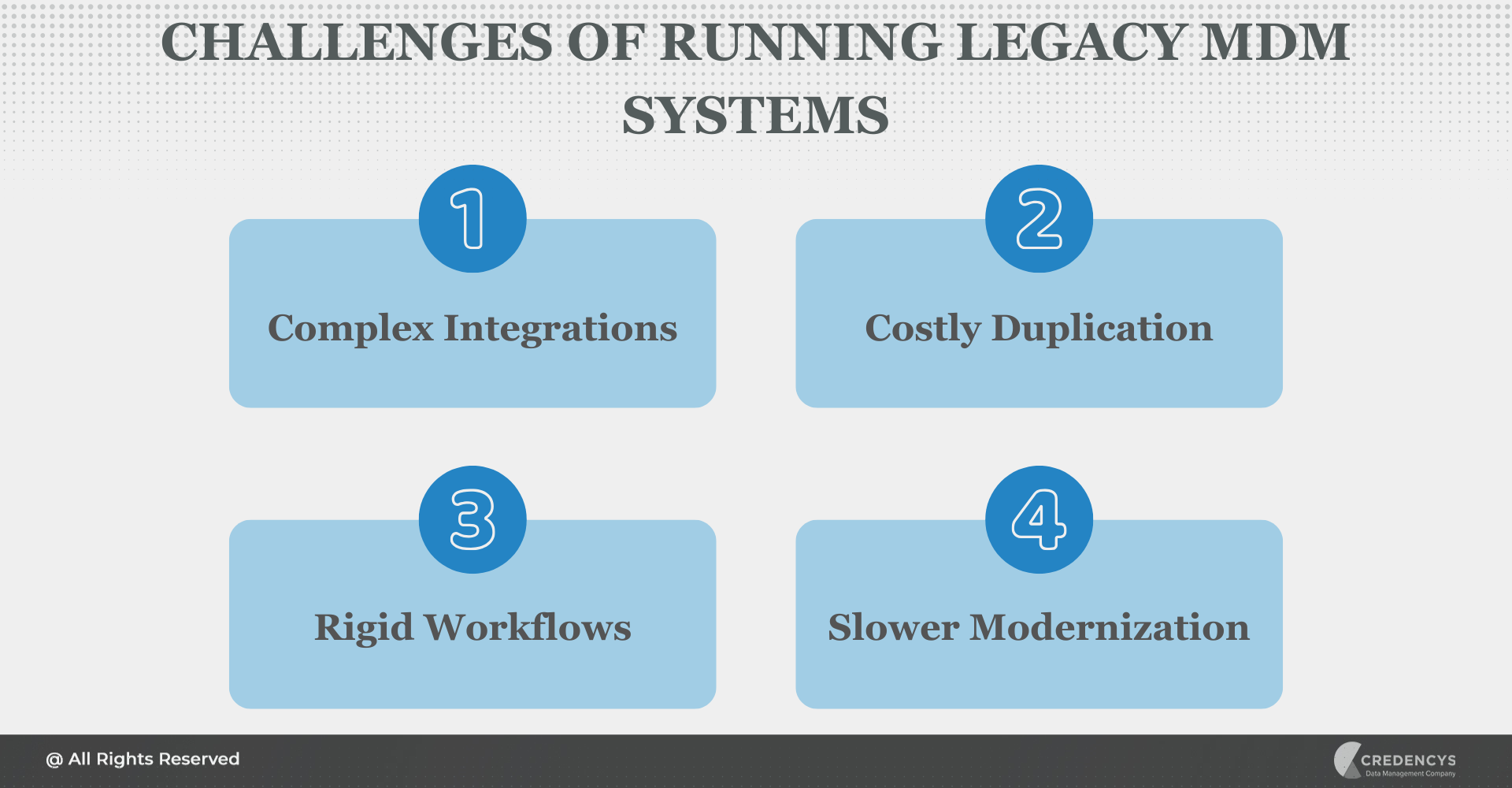
What was once a strategic advantage has now become a hidden liability, making it harder for enterprises to achieve agility, efficiency, and trusted insights in their cloud ecosystem.
The Hidden Costs of Running Legacy MDM
On paper, legacy MDM may seem like a sunk cost; already purchased, already deployed. But in the cloud era, the true cost runs much deeper than license fees.
Enterprises are paying for inefficiencies they don’t always see on the balance sheet. Here’s where the hidden costs add up:
1. Infrastructure & Integration Overhead
- Maintaining two environments, Snowflake and a separate MDM hub, means paying for duplicate storage and compute.
- Data pipelines constantly shuttle records back and forth, adding latency and integration complexity.
2. Total Cost of Ownership (TCO)
- For mid-market enterprises, this creates a disproportionate financial burden, reducing ROI on Snowflake investments.
- Beyond licenses, costs pile up from infrastructure, integration, and skilled staff.
3. Operational Inefficiency
- Every change (new data domain, schema update, governance rule) requires custom development and ongoing maintenance.
- IT teams spend countless hours keeping systems in sync.
4. Innovation Bottlenecks
- Duplicate or inconsistent records block initiatives like personalization, demand forecasting, or dynamic pricing.
- Analytics and AI teams don’t trust master data scattered across systems.
5. Governance & Compliance Blind Spots
- Stewardship workflows live outside of Snowflake, creating fragmented audit trails.
- Compliance reporting is delayed, exposing enterprises to regulatory risk.
The irony? Enterprises moved to Snowflake to simplify and cut costs, yet legacy MDM does the exact opposite.
Why Legacy MDM and Snowflake Don’t Mix Well
Snowflake was designed to simplify the data ecosystem, consolidating workloads that were once spread across multiple databases, warehouses, and lakes. It thrives on centralization, scalability, and low-maintenance architecture.
Legacy MDM, on the other hand, was designed in a completely different era. Its DNA is built around separation and control, housing master data in a standalone hub and pushing cleansed data back into operational systems.
The result? A fundamental mismatch!
- Data Lives in Two Places: Every record must be duplicated between Snowflake and the MDM hub, breaking the promise of a single source of truth.
- Innovation Slowdown: AI/ML and advanced analytics rely on timely, trusted data, but legacy MDM inserts friction at the very point where speed is most needed.
- Pipelines Everywhere: Custom ETL/ELT jobs are required just to keep Snowflake and MDM aligned. These pipelines are brittle and expensive to maintain.
- Latency by Design: Master data updates flow through external systems before becoming available in Snowflake, creating delays that undermine real-time analytics.
- Cloud vs. on-prem Mindset: Snowflake is elastic and pay-as-you-go; legacy MDM is static, infrastructure-heavy, and rigid.
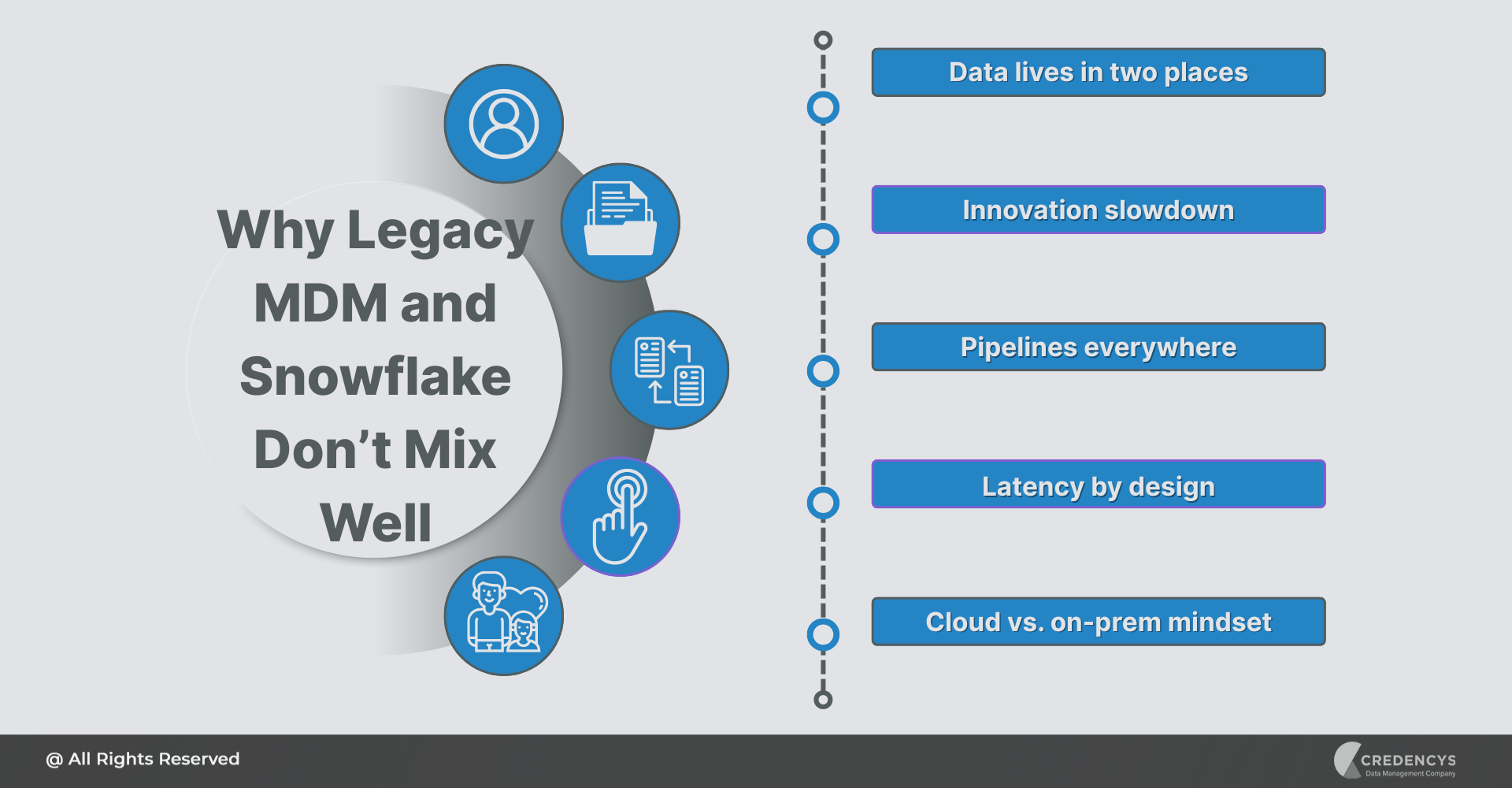
In short, while Snowflake simplifies, legacy MDM reintroduces complexity. Enterprises that keep both are essentially paying for two data strategies at once, and only one of them is future-ready.
Enter the New Era: MDM Inside Snowflake
The next phase of enterprise data strategy is clear: if Snowflake has become the center of gravity for your data, your MDM should live there too. Instead of running an external hub, organizations can now manage, govern, and steward master data natively inside Snowflake.
This cloud-native approach eliminates the friction between your data warehouse and your MDM system, creating one unified platform for both analytics and governance.
Why MDM Belongs Inside Snowflake
- One platform, one truth: No more duplicate storage or synchronization pipelines. Master data, transactional data, and reference data all live together in Snowflake.
- Real-time availability: As soon as master data is updated, it’s instantly available for analytics, AI, and downstream systems.
- Seamless governance: Stewardship workflows run directly where the data resides, ensuring faster remediation and cleaner audit trails.
- Cloud-native agility: Take advantage of Snowflake’s elasticity, performance, and ecosystem integrations without legacy bottlenecks.
- Cost efficiency: Eliminates the infrastructure overhead of maintaining an external MDM hub.
This shift is about rethinking the role of MDM in the modern data stack. Instead of being a detached system, MDM becomes a native service inside your core data platform, aligned with the same principles of scalability, simplicity, and speed that drive Snowflake adoption in the first place.
Real-World Impact for Enterprises
Bringing MDM inside Snowflake delivers tangible business impact across industries. By unifying master data with operational and analytical data in a single platform, enterprises unlock measurable benefits:
- Future-Ready AI & Analytics: Clean, harmonized master data fuels advanced use cases like predictive demand forecasting, customer 360, or AI-driven pricing strategies, helping enterprises stay competitive in a rapidly evolving market.
- Stronger Business Agility: Whether it’s responding to supply chain changes, improving personalization, or enabling new digital channels, enterprises gain the agility to act on accurate, consistent master data without friction.
- Lower Total Cost of Ownership: Eliminating duplicate infrastructure and integration reduces licensing, storage, and maintenance costs. Mid-market and enterprise organizations finally get a leaner, more predictable cost model.
- Faster Time-to-Insight: With trusted master data instantly available in Snowflake, analytics and AI teams can move faster, no more delays waiting for external systems to catch up.
- Simplified Governance and Compliance: Data stewardship workflows run natively in Snowflake, creating a single audit trail that strengthens compliance and reduces risk exposure.
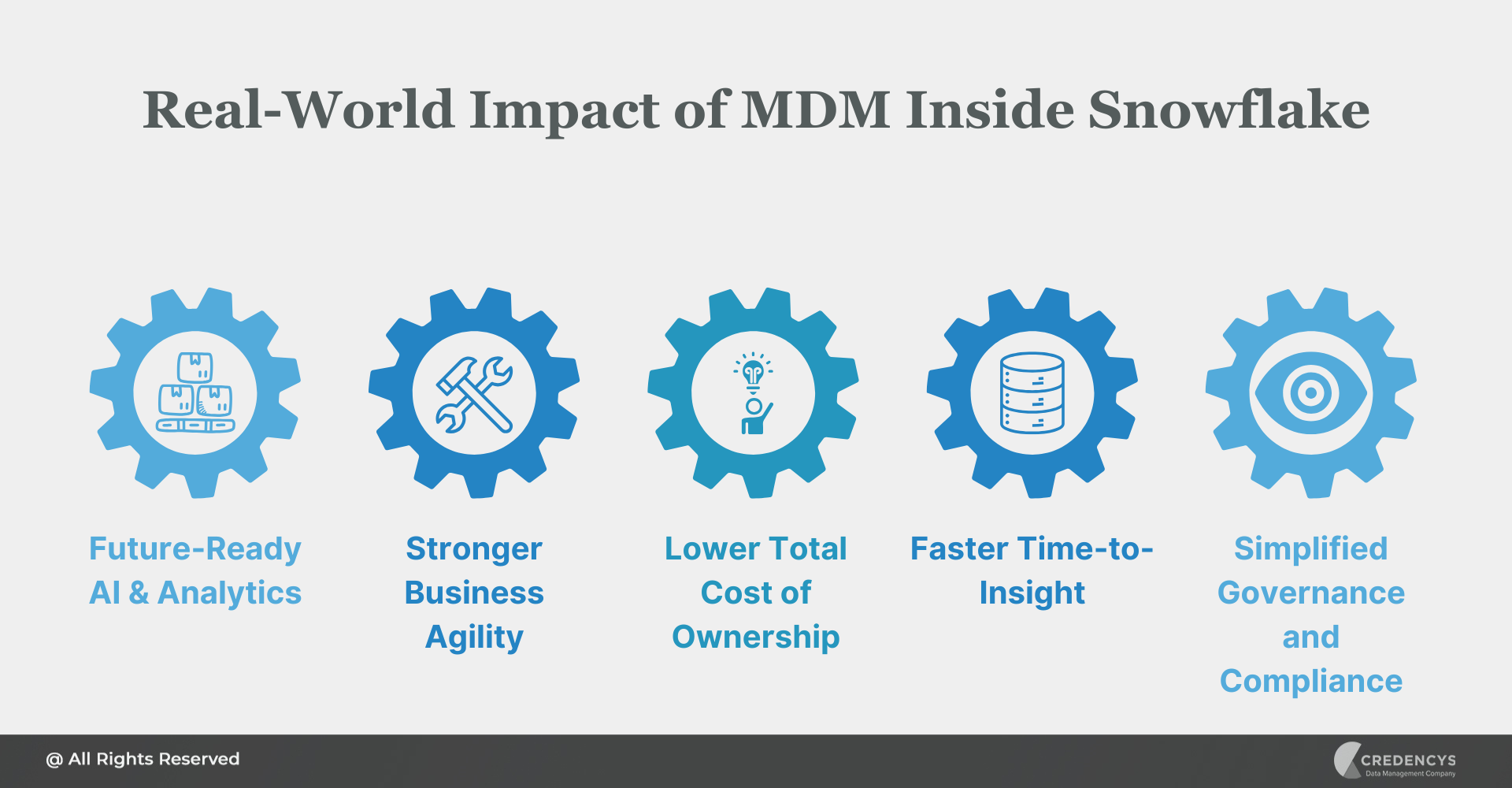
The bottom line: MDM inside Snowflake removes the drag of legacy systems, empowering organizations to operate with the speed, trust, and efficiency the cloud era demands.
Conclusion: Stop Paying for Hidden Costs
Legacy MDM may have delivered value in the past, but in today’s cloud-first world, it has become a silent tax on modernization. Every duplicated pipeline, every delayed governance process, every siloed system adds up to wasted cost and lost agility.
Snowflake has already simplified how enterprises manage data at scale. Now, bringing MDM inside Snowflake extends that same simplicity to governance and master data, removing duplication, cutting hidden costs, and delivering trusted data where it’s needed most.
The takeaway is clear: the future of MDM is not outside your cloud platform, but inside it. For CIOs, CDOs, and CTOs driving digital transformation, the question isn’t if legacy MDM should be replaced; it’s how soon you can make the shift.





Tags: