Harnessing the Power of Cloud in Data Management – Cloud Master Data Management Explained

In the age of digital transformation, data stands as the lifeblood of modern enterprises, propelling informed decision-making, operational efficiency, and customer engagement. Amid this data-driven revolution, the concept of Master Data Management has emerged as a pivotal strategy for organizations striving to establish a single, authoritative source of truth for their critical business data.

As technology advances, so do the methods of managing this data, and the cloud has taken center stage. Cloud Master Data Management (Cloud MDM), a game-changing paradigm marries the prowess of MDM with the scalability, flexibility, and accessibility of cloud computing.

This integration of cloud technology and MDM principles is reshaping how organizations not only govern their master data but also utilize it to drive strategic growth. In this blog post, we embark on a journey to uncover the dimensions of Cloud MDM.

What is Cloud Master Data Management?

As organizations embrace cloud computing to streamline their operations, Cloud MDM emerges as a logical extension of traditional MDM practices. Cloud MDM harnesses the power of cloud technology to store, manage, and distribute master data.

This approach leverages the inherent advantages of the cloud, such as scalability, accessibility, and cost-efficiency, to enhance MDM capabilities. Cloud MDM solutions are hosted on cloud platforms like AWS, Azure, or Google Cloud, allowing organizations to offload infrastructure management and focus on data management strategies.

Key Components of Cloud MDM

Master Data Repository

At the core of Cloud MDM is the master data repository, a centralized storage system that houses accurate and authoritative master data records. This repository serves as the single source of truth for all master data entities, ensuring consistency across the organization.

Data Integration and ETL

Cloud MDM integrates data from various sources, both internal and external, through Extract, Transform, Load (ETL) processes. These processes clean, validate, and transform incoming data to align with standardized formats and rules, enhancing data quality.

Data Governance Framework

A robust data governance framework is vital for maintaining data quality, security, and compliance. Cloud MDM incorporates governance mechanisms that define roles, responsibilities, data stewardship, and approval workflows for managing master data.

Data Enrichment

Cloud MDM can enrich master data by incorporating external data sources, such as social media, demographic information, and market trends. This enrichment enhances the value and context of master data for better decision-making.

What Is Data Enrichment: A Complete Guide

Metadata Management

Metadata, or data about data, plays a crucial role in Cloud MDM. It provides insights into data lineage, transformations, and relationships, aiding data stewards in understanding and managing the master data ecosystem.

Security and Access Control

Cloud MDM platforms prioritize data security by implementing access controls, encryption, and authentication mechanisms. These measures ensure that only authorized personnel can access and modify master data.

Scalability and Performance

Cloud MDM solutions offer the advantage of scalable infrastructure, allowing organizations to handle growing volumes of data without compromising performance. Cloud resources can be dynamically allocated based on demand.
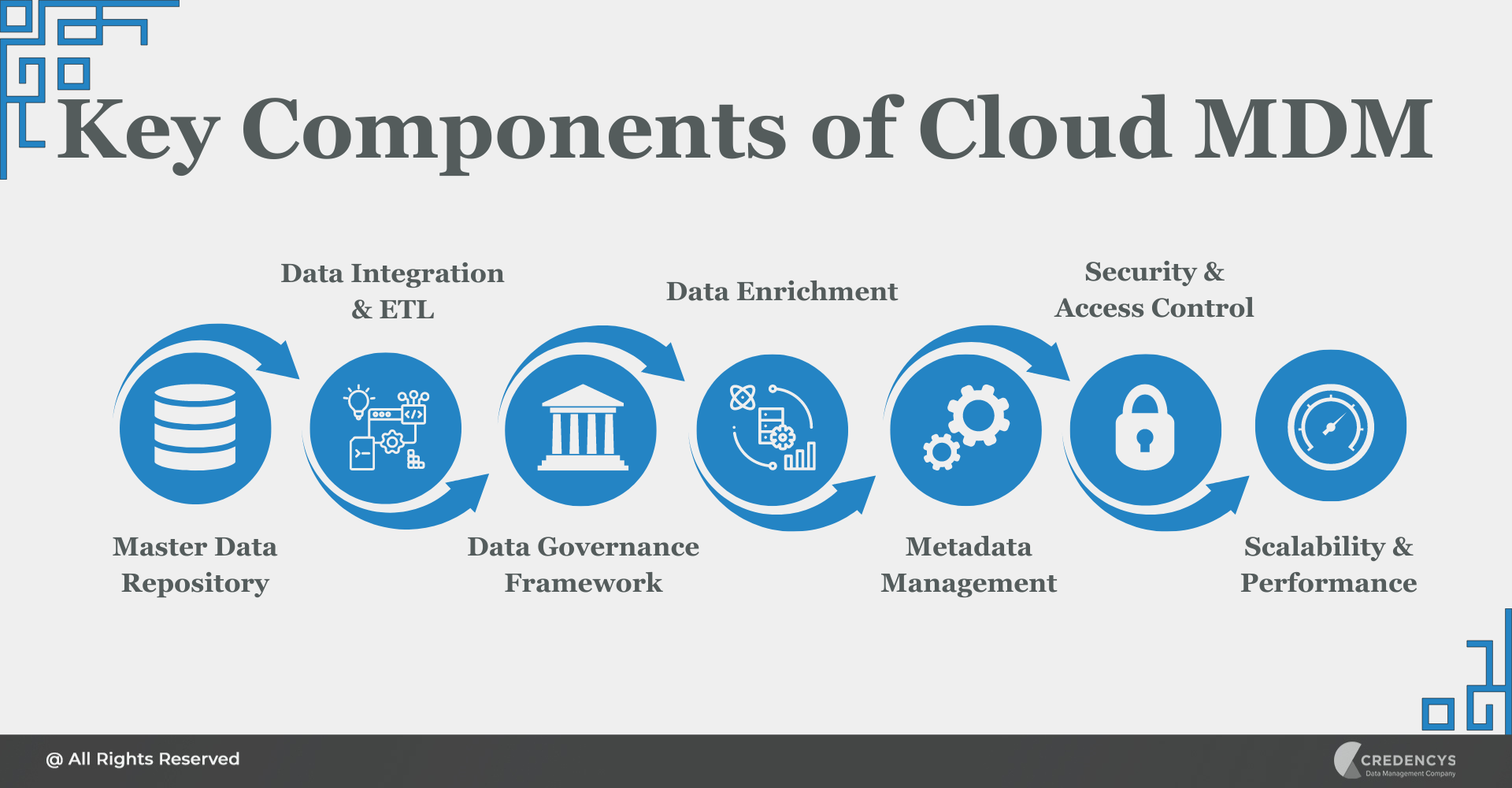
Key Components of Cloud MDM

Understanding these key components lays the foundation for comprehending the intricate interplay between Cloud MDM’s architecture and its transformative potential.

Cloud Master Data Management Architecture

Cloud Master Data Management architecture refers to the underlying framework and structure that enables organizations to manage and govern their master data in a cloud-based environment. This architecture encompasses various components, processes, and interactions that facilitate the storage, integration, governance, and accessibility of master data.

Here’s a high-level overview of the typical components and elements of Cloud MDM architecture:

Data Sources

Cloud MDM architecture starts with data sources, which can include various systems, applications, databases, and external data feeds that generate or store master data. These sources contribute data to the Cloud MDM platform for consolidation and management.

Cloud Infrastructure

Cloud MDM leverages cloud infrastructure provided by platforms like AWS, Azure, or Google Cloud. This infrastructure ensures scalability, availability, and performance for managing large volumes of master data.

Security and Access Control

Robust security measures are essential to protect sensitive master data. Access control mechanisms, encryption, and user authentication ensure that only authorized users can access and modify data within the Cloud MDM system.

APIs and Integration Services

Cloud MDM architecture often includes APIs and integration services that facilitate seamless data exchange between the Cloud MDM platform and other applications or systems in the organization’s ecosystem.

User Interface and Analytics

Cloud MDM architecture includes user interfaces for data management, allowing users to view, search, update, and manage master data records. Analytics and reporting capabilities provide insights into data quality, usage, and trends.

Change Management and Workflow

Change management processes enable the tracking and approval of changes made to master data. Workflow capabilities ensure that changes follow predefined approval processes before being applied to the master data repository.

Cloud Master Data Management architecture is a dynamic and evolving concept, with variations based on the specific cloud platform, technologies, and organizational requirements. It aims to streamline data management, improve data quality, and empower organizations to make informed decisions based on accurate and consistent master data.

Benefits of Cloud Master Data Management

Cloud Master Data Management ushers in a new era of data management, capitalizing on cloud technology’s capabilities to enhance data governance, accessibility, and utilization. Let’s delve into the remarkable benefits that organizations can reap by embracing Cloud MDM.

Scalability and Flexibility

Traditional on-premises data management solutions often face limitations in handling increasing data volumes. Cloud MDM, on the other hand, thrives on the cloud’s inherent scalability.

Organizations can effortlessly scale their data infrastructure up or down based on demand, accommodating growing datasets and fluctuating workloads without the need for extensive hardware investments. This elasticity ensures that Cloud MDM remains agile and adaptable to changing business needs.

Accessibility and Collaboration

Cloud MDM dissolves geographical barriers by offering ubiquitous access to master data. This fosters seamless collaboration across dispersed teams, departments, and external partners.

With master data residing in the cloud, authorized users can access, update, and share accurate information in real-time, promoting synchronized decision-making and reducing data discrepancies caused by isolated systems.

Cost-Efficiency

Embracing Cloud MDM introduces cost efficiencies by eliminating the need for substantial upfront investments in hardware, infrastructure, and maintenance. Cloud providers offer pay-as-you-go pricing models, allowing organizations to pay only for the resources they consume.

This shifts the financial burden from capital expenditures to operational expenditures, enabling businesses to allocate resources strategically while benefiting from state-of-the-art infrastructure.

Enhanced Data Security

Security concerns are paramount in today’s digital landscape. Cloud MDM addresses these concerns by implementing robust security measures, including encryption, access controls, and compliance certifications.

Cloud providers invest heavily in cybersecurity, often offering security features that surpass what organizations can achieve on-premises. By safeguarding master data against unauthorized access and breaches, Cloud MDM enhances data integrity and maintains customer trust.

Real-time Data Updates

Master data is subject to constant changes due to business operations, customer interactions, and market dynamics. Cloud MDM’s real-time data updates ensure that authorized users always have access to the latest and most accurate information.

This feature accelerates decision-making processes and minimizes the risk of outdated or inconsistent data proliferating across the organization.

Benefits of Cloud Master Data Management

The benefits of Cloud MDM extend beyond these points, touching upon improved disaster recovery, faster time-to-market, and a reduced burden on internal IT teams. As organizations continue to digitize their operations and seek agility in the data-driven landscape, Cloud MDM emerges as a strategic enabler, propelling them toward efficient, collaborative, and secure data management practices.

Challenges in Cloud MDM Adoption

While Cloud Master Data Management (Cloud MDM) offers a plethora of benefits, its adoption is not without its challenges. Navigating these obstacles is essential to ensure a successful implementation that maximizes the potential of Cloud MDM. Let’s explore the key challenges organizations may encounter:

Data Governance and Quality

Maintaining data governance and quality in a cloud environment requires careful planning. Cloud MDM involves consolidating master data from various sources, and ensuring its accuracy, consistency, and compliance can be complex.

Organizations must establish clear data governance policies, data stewardship roles, and data quality processes to ensure that the data remains trustworthy and valuable.

Integration Complexities

Integrating Cloud MDM with existing systems and applications can be intricate. Organizations often have a diverse ecosystem of applications, databases, and platforms that require seamless integration to ensure consistent master data across the board.

Ensuring data flows smoothly between Cloud MDM and other systems demands robust integration strategies, APIs, and middleware solutions.

Vendor Selection

Selecting the right cloud service provider or Cloud MDM vendor is a critical decision that impacts the success of your implementation. Organizations need to evaluate factors such as the vendor’s reputation, security measures, scalability, pricing model, and alignment with business needs.

Failure to choose the right vendor can lead to compatibility issues, security vulnerabilities, and potential migration challenges.

Change Management

Introducing Cloud MDM often brings about changes in workflows, roles, and processes. Employees must adapt to new ways of accessing and managing master data.

Change management is vital to ensure a smooth transition and minimize resistance. Providing training, communication, and addressing concerns will help employees embrace the new system and processes effectively.

Data Privacy and Compliance

Cloud MDM involves storing sensitive master data in a cloud environment, which raises concerns about data privacy and compliance with regulations such as GDPR, HIPAA, and industry-specific mandates. Organizations must ensure that the chosen cloud provider adheres to the necessary data protection regulations and implement appropriate security measures to safeguard sensitive data.

Cultural Shift and Adoption

Shifting to Cloud MDM requires a cultural change within the organization. Employees may need to adjust to new data management practices, access methods, and collaborative processes.

Overcoming resistance and encouraging adoption is essential for reaping the full benefits of Cloud MDM.

Data Migration Challenges

Migrating existing master data from on-premises systems to the cloud can be challenging. Data mapping, cleansing, and transformation are crucial to ensure that data maintains its quality and integrity during the migration process.

Navigating these challenges demands careful planning, a well-defined strategy, and collaboration between IT teams, data stewards, and business units. Addressing these challenges proactively sets the stage for a successful Cloud MDM implementation that optimizes data management, enhances decision-making, and fuels business growth.

Implementing Cloud Master Data Management

Implementing Cloud Master Data Management (Cloud MDM) is a transformative journey that requires careful planning, strategic decision-making, and cross-functional collaboration. To ensure a successful implementation, organizations must navigate several crucial steps.

Let’s explore these steps in detail:

Assessing Organizational Readiness

Before embarking on a Cloud MDM implementation, it’s essential to assess the organization’s readiness for such a change. This involves evaluating the existing data management processes, identifying pain points, and understanding the business objectives driving the adoption of Cloud MDM.

Key stakeholders, including IT teams, data stewards, and business leaders, should be engaged to define clear goals and expectations.

Data Mapping and Integration Strategies

Data integration is a cornerstone of Cloud MDM. Start by mapping the various data sources and understanding the relationships between different master data entities.

Determine integration points and define data transformation and cleansing requirements. This phase requires close collaboration between technical teams to ensure that data flows smoothly between different systems and the Cloud MDM platform.

Selecting the Right Cloud MDM Vendor

Choosing the appropriate Cloud MDM vendor is a pivotal decision that impacts the success of the implementation. Consider factors such as the vendor’s expertise in MDM, cloud security measures, scalability, integration capabilities, and pricing models.

Conduct thorough research, request demos, and engage with vendors to assess their alignment with your organization’s needs and goals.

Building Data Governance Framework

Effective data governance is vital for maintaining data quality, compliance, and security. Develop a comprehensive data governance framework that outlines roles, responsibilities, data ownership, data stewardship, and approval workflows.

This framework ensures that the master data remains accurate, consistent, and trustworthy throughout its lifecycle.

Change Management and Training

Introducing Cloud MDM often requires a shift in processes and workflows. Implement a robust change management strategy that includes communication plans, training sessions, and user support.

Employees need to understand the benefits of Cloud MDM and feel confident using the new system to ensure smooth adoption.

Data Migration and Testing

Migrating existing master data to the cloud is a critical phase. Plan and execute data migration strategies, including data validation and cleansing to ensure data accuracy during the transition.

Rigorous testing is essential to identify any issues before the system goes live.

Rollout and Continuous Improvement

As the Cloud MDM solution goes live, monitor its performance and gather feedback from users. Address any teething issues promptly and continue refining the system based on user experiences.

Regularly assess data quality, security measures, and alignment with business goals.

Data Stewardship and Ownership

Assign data stewardship responsibilities to individuals or teams who will be responsible for managing and maintaining master data. Data stewards play a crucial role in ensuring data accuracy, quality, and adherence to governance policies.

Implementing Cloud Master Data Management

By following these steps, organizations can navigate the complexities of Cloud MDM implementation, from assessing readiness to establishing a robust data governance framework. A well-executed implementation sets the stage for leveraging Cloud MDM’s benefits, driving data excellence, and fueling strategic decision-making.

Best Practices for Successful Cloud MDM Implementation

Implementing Cloud MDM requires a strategic approach to ensure its effectiveness and alignment with organizational goals. By following best practices, organizations can streamline the implementation process and maximize the benefits of Cloud MDM.

Here are the key best practices to consider:

Establishing Clear Objectives

Before embarking on a Cloud MDM implementation, define clear and measurable objectives. Understand what you aim to achieve with Cloud MDM, whether it’s improving data accuracy, enhancing decision-making, or enabling better collaboration.

Clearly defined objectives provide a roadmap for the implementation process and help measure its success.

Involving Key Stakeholders

Engage stakeholders from various departments and levels of the organization in the implementation process. This includes IT teams, business leaders, data owners, data stewards, and end-users.

Involving stakeholders ensures that the Cloud MDM solution meets diverse needs and garners support throughout the organization.

Prioritizing Data Quality

Data quality is paramount in Cloud MDM. Begin by cleansing and standardizing existing data before migrating it to the cloud. Define data quality rules, establish data validation processes, and implement mechanisms to detect and rectify data anomalies. Data stewards play a critical role in monitoring data quality and ensuring that data remains accurate and consistent over time.

Ensuring Continuous Monitoring and Improvement

Cloud MDM is not a one-time implementation; it’s an ongoing process. Implement continuous monitoring mechanisms to track data quality, system performance, and user satisfaction.

Regularly review and refine your Cloud MDM strategy based on feedback and changing business needs. This iterative approach ensures that the solution remains aligned with your organization’s evolving requirements.

Change Management and User Adoption

Effective change management is key to user adoption and success. Communicate the benefits of Cloud MDM to users and provide comprehensive training to ensure they are comfortable with the new system.

Address concerns and challenges promptly and involve users in the decision-making process where appropriate.

Data Security and Compliance

Prioritize data security and compliance throughout the implementation. Ensure that the chosen cloud vendor adheres to stringent security measures and compliance regulations.

Implement encryption, access controls, and regular security audits to safeguard sensitive master data.

Aligning with Business Processes

Integrate Cloud MDM seamlessly with existing business processes and applications. The solution should complement your organization’s workflows rather than disrupt them.

Map out how Cloud MDM will fit into various departments’ operations and ensure that data flows smoothly between systems.

Scalability and Futureproofing

Design your Cloud MDM solution with scalability in mind. As your organization grows and data volumes increase, the solution should be able to accommodate changing demands.

Choose a cloud platform and architecture that can scale easily to support future requirements.

Measuring and Communicating Success

Regularly measure the outcomes and impact of your Cloud MDM implementation against the established objectives. Communicate the successes achieved, such as improved data accuracy, reduced redundancies, and enhanced decision-making.

Share these achievements with stakeholders to build support for the solution.

By adhering to these best practices, organizations can navigate the complexities of Cloud MDM implementation more effectively, ensuring a smooth transition, maximizing the benefits, and paving the way for a data-driven future.

Future of Data Management: Cloud MDM Trends

As organizations continue their digital transformation journeys, Cloud Master Data Management remains at the forefront of modern data management strategies. The future of Cloud MDM is marked by exciting trends that leverage cutting-edge technologies to further enhance data governance, accessibility, and insights.

Let’s delve into these trends that are shaping the future of data management:

AI and Machine Learning Integration

Artificial Intelligence and Machine Learning are becoming integral components of Cloud MDM solutions. AI can automate data cleansing, matching, and enrichment processes, improving data quality and accuracy.

ML algorithms can identify patterns, anomalies, and correlations within master data, enabling organizations to uncover valuable insights for informed decision-making.

Hybrid Cloud MDM Solutions

Hybrid Cloud MDM is gaining traction as organizations seek to strike a balance between on-premises and cloud-based solutions. Hybrid approaches allow organizations to keep sensitive data on-premises while leveraging cloud capabilities for scalability, collaboration, and accessibility.

This trend offers the flexibility to tailor data management strategies based on specific data requirements.

Blockchain for Data Integrity

Blockchain technology is increasingly recognized for its potential to enhance data integrity and traceability. By implementing blockchain within Cloud MDM, organizations can ensure the immutability of master data records.

This level of transparency and security is particularly beneficial for industries that require auditable and tamper-proof data histories, such as supply chain management and healthcare.

Advanced Analytics and Insights

Cloud MDM solutions are evolving to provide advanced analytics and insights capabilities. By integrating analytics tools, organizations can extract actionable insights from their master data, uncovering trends, customer behavior patterns, and business opportunities.

These insights empower organizations to make data-driven decisions that drive innovation and growth.

Data Democratization and Self-Service

The future of Cloud MDM includes empowering non-technical users to access and utilize master data without extensive IT involvement. Self-service data access and visualization tools allow business users to create their own reports, dashboards, and visualizations, democratizing data access and fostering faster decision-making.

Internet of Things (IoT) Integration

As the Internet of Things (IoT) continues to expand, Cloud MDM will play a crucial role in managing the vast amounts of data generated by connected devices. IoT integration will enable organizations to leverage Cloud MDM to centralize and manage device-generated data, ensuring its accuracy and accessibility.

Personalization and Customer 360 Views

Cloud MDM will further enable organizations to create comprehensive customer profiles by integrating data from various sources. This holistic view, often referred to as a “Customer 360” view, allows organizations to personalize customer interactions, tailor marketing efforts, and enhance customer satisfaction.

Cloud MDM Trends

The convergence of these trends signifies a dynamic future for Cloud MDM, where technology-driven innovations combine with effective data management practices to unlock new possibilities. By embracing these trends, organizations can position themselves at the forefront of data-driven decision-making, differentiation, and innovation in an increasingly competitive landscape.

Security & Privacy Considerations in Cloud Master Data Management

As organizations migrate their data management processes to the cloud, ensuring robust security and safeguarding data privacy becomes paramount. Cloud Master Data Management solutions handle critical master data, making security measures and privacy considerations even more crucial.

Let’s delve into the key aspects of security and privacy in Cloud MDM:

Encryption and Data Protection

Encryption serves as the first line of defence against unauthorized access to sensitive master data. Data should be encrypted both in transit and at rest.

Transport Layer Security (TLS) or Secure Sockets Layer (SSL) protocols ensure data integrity during transmission, while encryption algorithms like Advanced Encryption Standard (AES) secure data when stored in the cloud. This safeguards master data from potential breaches and unauthorized interception.

Compliance with Data Regulations

Adhering to data regulations is imperative in Cloud MDM to avoid legal and reputational risks. Regulations such as the General Data Protection Regulation (GDPR), Health Insurance Portability and Accountability Act (HIPAA), and industry-specific standards mandate strict data handling and protection practices.

Cloud MDM solutions must ensure compliance with these regulations, including data localization, consent management, and the right to erasure.

User Access Control

Controlling user access to master data is fundamental to preventing unauthorized data manipulation and breaches. Implement role-based access controls (RBAC) to define who can access, modify, and delete master data records.

Multi-factor authentication (MFA) adds an extra layer of security by requiring users to provide multiple forms of verification before gaining access.

Audit Trails and Logging

Cloud MDM platforms should offer comprehensive audit trails and logging mechanisms. These logs capture every interaction with master data, including data modifications, access attempts, and administrative actions.

Audit trails provide a forensic trail that aids in identifying unauthorized activities and tracking changes for compliance purposes.

Data Residency and Sovereignty

Different regions have varying data residency and sovereignty requirements. Cloud MDM solutions must allow organizations to specify where their data is stored to comply with local regulations.

The ability to choose data centers in specific geographical locations ensures data sovereignty and minimizes the risk of legal disputes.

Vendor Security Measures

When selecting a Cloud MDM vendor, evaluate their security practices rigorously. Assess their certifications, compliance reports, and security audits.

Understand the vendor’s data protection mechanisms, intrusion detection systems, and incident response protocols to ensure that your master data remains secure within their environment.

Data Masking and Anonymization

For scenarios where sensitive master data needs to be shared for testing or analysis, data masking or anonymization techniques can be employed. These methods ensure that the data retains its format and structure while concealing sensitive information, mitigating the risk of exposing confidential data.

Disaster Recovery and Business Continuity

Effective security and privacy strategies extend to disaster recovery and business continuity planning. Cloud MDM solutions should offer robust backup and recovery mechanisms to ensure that master data can be restored in case of data loss or system failures.

By diligently addressing these security and privacy considerations, organizations can confidently embrace Cloud MDM while safeguarding their most valuable asset—master data. Implementing comprehensive security measures not only protects sensitive information but also fosters customer trust and ensures compliance with evolving data protection regulations.

Credencys – Your Trusted Cloud Master Data Management Partner

Organizations around the world are embracing Cloud MDM solutions to harness the power of cloud technology for optimal data governance, accessibility, and utilization. In this realm, Credencys emerges as a trusted and innovative partner, dedicated to delivering top-tier Cloud MDM solutions that empower businesses to thrive in the digital age.

About Credencys: Credencys is a forward-thinking data management company that specializes in providing cutting-edge solutions to address complex business challenges. With a strong focus on cloud-based technologies and data management, Credencys stands as a beacon of expertise in the realm of Cloud MDM.

With a diverse team of skilled professionals, Credencys is committed to delivering bespoke Cloud MDM solutions tailored to the unique needs of each client.

Why Choose Credencys for Cloud Master Data Management

Expertise

Credencys boasts a team of seasoned experts who understand the intricacies of data management and cloud technology. Their in-depth knowledge allows them to design and implement robust Cloud MDM solutions that align with your business goals.

Custom Solutions

No two businesses are the same. Credencys recognizes this and offers customized Cloud MDM solutions tailored to your specific requirements. From data integration to security and analytics, their solutions are designed to fit seamlessly into your ecosystem.

Cutting-Edge Technology

Credencys stays at the forefront of technology trends. Their solutions incorporate the latest advancements, ensuring that your Cloud MDM system is equipped with the tools needed to excel in an ever-evolving digital landscape.

End-to-End Services

Credencys offers comprehensive services that cover every aspect of Cloud MDM implementation. From initial consultation and planning to deployment and ongoing support, they guide you through the entire journey.

Client-Centric Approach

At Credencys, clients are more than just customers; they are partners in success. They prioritize open communication and collaboration, ensuring that your vision and requirements are at the forefront of every decision made.

Proven Track Record

Credencys has a proven track record of successfully delivering technology solutions to businesses across industries. Their portfolio showcases the depth of their expertise and their commitment to driving tangible results for clients.
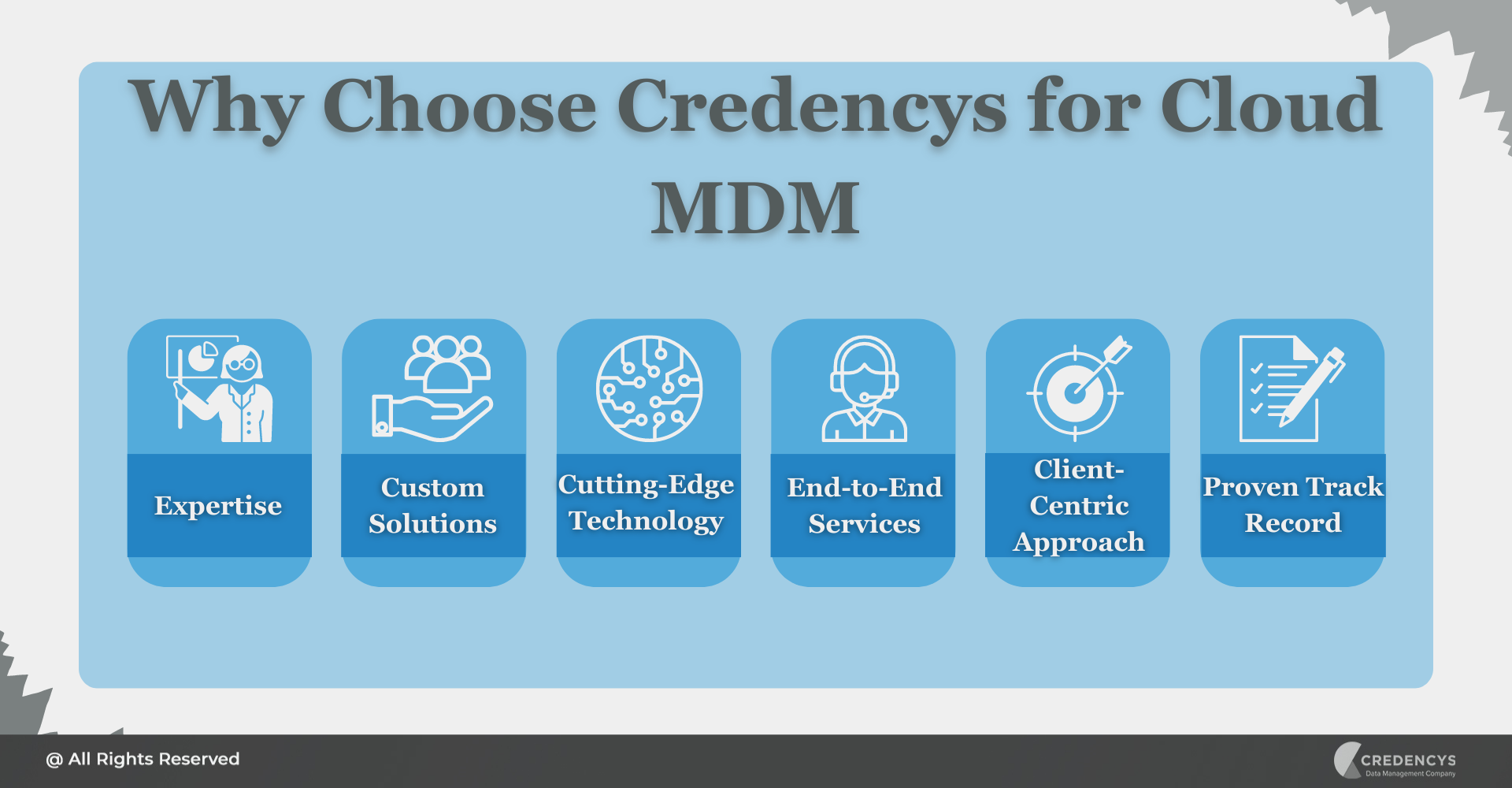
Why Choose Credencys for Cloud MDM

Embracing Cloud Master Data Management for Data Excellence

Embracing Cloud MDM is not just a technological advancement; it’s a strategic shift toward optimizing data management practices. Organizations that harness the power of Cloud MDM position themselves at the forefront of innovation, equipped to navigate the complexities of the modern business landscape with confidence.

The future beckons with opportunities to revolutionize how data is harnessed and utilized. As Cloud MDM continues to evolve, organizations can shape the trajectory of data management practices, promoting efficiency, collaboration, and informed decision-making.

In closing, the journey to data excellence through Cloud MDM is ongoing. By implementing best practices, prioritizing security, and embracing emerging technologies, organizations can unlock the full potential of their master data.

As data continues to drive business success, Cloud MDM stands as a beacon, guiding organizations toward a future where data is not just managed, but harnessed as a strategic asset.

What is Product Taxonomy for eCommerce Businesses?

In the vast realm of online shopping and digital marketplaces, finding the perfect product amidst a sea of choices can often feel like searching for a needle in a haystack. This is where the concept of product taxonomy steps in, like a guiding light in the labyrinth of eCommerce.

At its core, product taxonomy might sound like a technical term, but in reality, it’s the art and science of organizing and categorizing products in a way that makes them not only easily discoverable but also comprehensible to shoppers. In an era where consumers have come to expect seamless and personalized online shopping experiences, product taxonomy plays a pivotal role.

It forms the backbone of efficient navigation, enabling shoppers to swiftly filter through products, explore relevant categories, and narrow down their choices based on specific attributes. From fashion to electronics, from groceries to gadgets, the concept of product taxonomy is universal, shaping the way we browse, search, and ultimately purchase items online.

Throughout this article, we will delve deep into what is product taxonomy, unravelling its layers and uncovering its significance. We will explore the benefits it brings to both businesses and consumers, understand how it impacts search engine optimization (SEO), and uncover the best practices for creating and maintaining an effective product taxonomy

Defining Product Taxonomy

At its core, product taxonomy is the systematic framework used to classify and organize products within a digital or physical inventory. Think of it as a sophisticated filing system designed to bring order to the vast array of products available for consumption.

This organizational structure serves as a bridge between the complexities of a diverse product range and the ease with which consumers seek and discover these products. The primary purpose of product taxonomy is to simplify and streamline the browsing experience for both businesses and consumers.

It is about transforming chaos into coherence, enabling users to navigate effortlessly through a multitude of offerings. In the digital realm, where attention spans are fleeting, providing users with a clear and intuitive path to their desired products is paramount.

A well-constructed product taxonomy guides users from broader categories down to specific items, eliminating confusion and enabling them to swiftly locate what they are seeking. This enhanced user experience translates into increased engagement, reduced bounce rates, and ultimately, higher conversion rates for businesses.

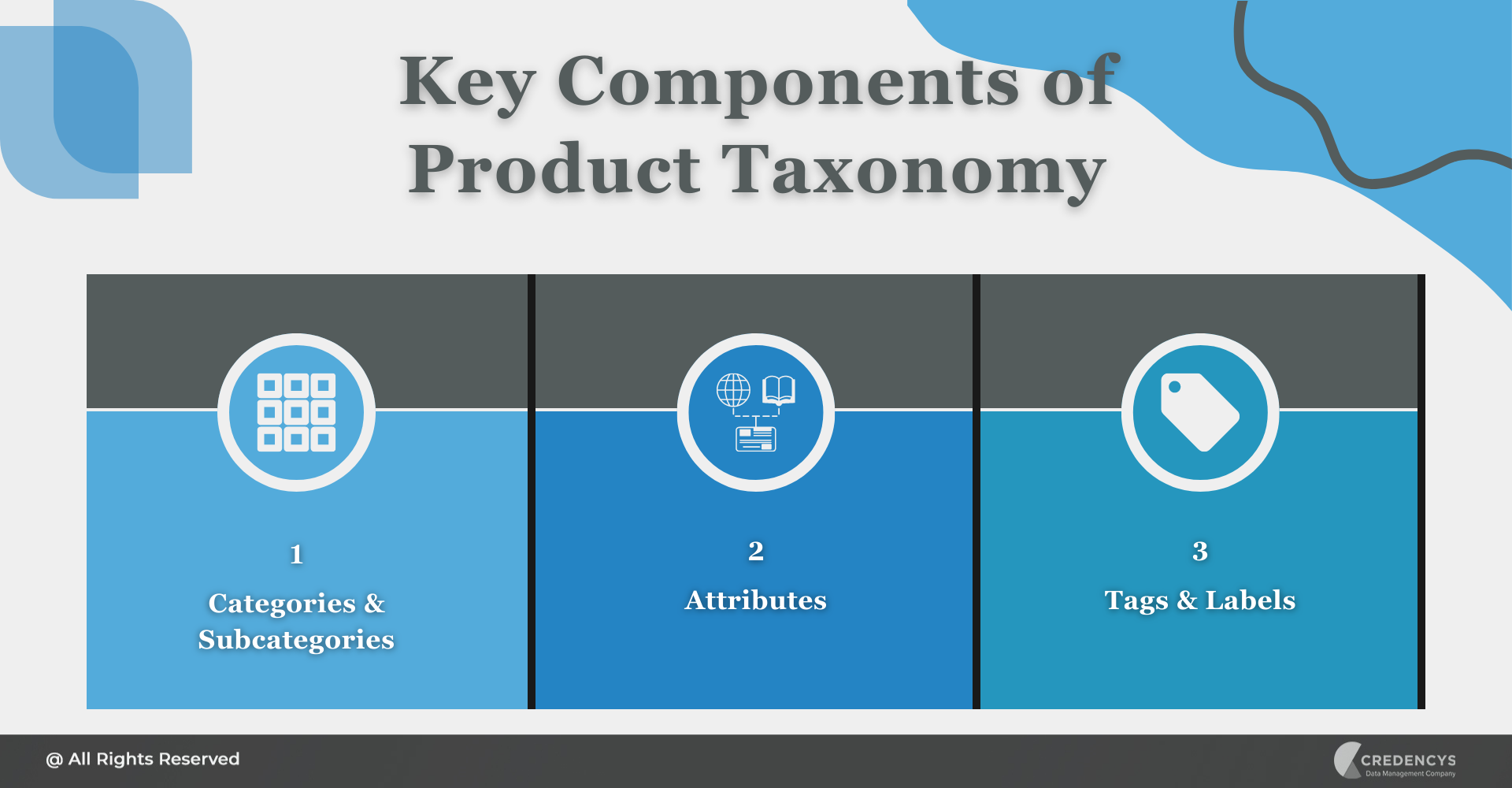
Key Components of Product Taxonomy

A robust product taxonomy comprises several crucial components that work in harmony to create a coherent system:

Categories and Subcategories

Categories serve as the main branches of the taxonomy tree, encompassing broad groups of products. Subcategories, on the other hand, branch out from categories, offering more focused divisions.

For instance, in an online bookstore, “Fiction” could be a category, with subcategories like “Mystery,” “Romance,” and “Science Fiction.”

Attributes

Attributes are the defining characteristics that distinguish one product from another within the same category. These could be size, color, material, and other features that impact a customer’s decision-making process.

For instance, when shopping for a camera, attributes like “Megapixels,” “Zoom Range,” and “Video Resolution” are critical attributes that help narrow down options.

Tags and Labels

Tags are descriptive labels or keywords associated with products. They provide additional context and facilitate cross-category discovery.

Tags help users find products based on specific features or themes, even if those products span different categories. For instance, a “Back-to-School” tag could apply to items in categories like clothing, electronics, and stationery.

Key Components of Product Taxonomy

By integrating these components effectively, businesses can create a navigational framework that transforms browsing into a streamlined journey, catering to the diverse needs and preferences of their customers.

Benefits of Implementing a Solid Product Taxonomy

Implementing a well-structured and comprehensive product taxonomy brings a plethora of advantages for both businesses and customers alike. This organization goes beyond mere convenience; it’s a strategic move that significantly enhances the entire shopping experience.

Improved Search Functionality and Filtering

In the online world, a coherent product taxonomy acts as a digital map, guiding users through a seamless journey. When customers can effortlessly narrow down their search using filters based on attributes like size, color, price, and more, they’re more likely to find products that match their preferences, reducing frustration and increasing the likelihood of making a purchase.

Consistent and Intuitive Browsing Experience

Customers today demand a user experience that mirrors the ease of physical shopping. A well-structured taxonomy ensures that products are logically categorized and presented.

This consistency enhances user trust and encourages them to explore different categories without feeling overwhelmed. Customers can effortlessly transition from a broad category to a specific product without any disorientation, fostering a sense of familiarity and comfort throughout their shopping journey.

Better Data Management and Analytics

For businesses, a solid product taxonomy extends beyond customer experience. It lays the foundation for robust data management and analysis.

When products are neatly categorized and tagged, businesses can gain valuable insights into customer preferences, popular attributes, and emerging trends. This data can be used to refine inventory management, personalize marketing efforts, and make informed decisions about product offerings.

Steps to Develop a Product Taxonomy

Creating an effective product taxonomy is akin to crafting an intricate piece of art – it requires meticulous planning, attention to detail, and a deep understanding of the audience you are serving. This section outlines a step-by-step process to guide you through the creation of a cohesive and user-friendly taxonomy.

Research and Analysis

Market Research and Understanding Target Audience

Start by researching your target audience’s preferences, behaviors, and expectations. What are they looking for? What attributes matter most to them? This insight will help you tailor your taxonomy to their needs.

Analyzing Competitor Taxonomies

Study how your competitors have organized their products. This analysis can provide valuable insights into industry standards, common practices, and potential gaps in the market that you can exploit.

Defining Categories and Subcategories

Determining Main Product Categories

Divide your product range into high-level categories that reflect user intent. For example, an electronics store might have categories like “Mobile Devices,” “Laptops,” and “Accessories.”

Creating Relevant Subcategories for Each Main Category

Break down each main category into focused subcategories. This hierarchical approach ensures that users can navigate to specific products with ease.

Under “Mobile Devices,” subcategories could include “Smartphones,” “Tablets,” and “Feature Phones.”

Attribute Mapping

Identifying Essential Product Attributes

Determine the attributes that matter most for each category. Attributes could encompass size, color, brand, material, and any other characteristic that influences purchasing decisions.

Mapping Attributes to Respective Categories

Assign attributes to their relevant categories. For instance, “Color” might be an attribute under both “Apparel” and “Footwear,” while “Resolution” could be an attribute under “TVs” and “Monitors.”

Tagging and Metadata

Importance of Metadata and Descriptive Tags

Metadata and descriptive tags provide additional context to products. Craft clear and concise metadata that accurately represents each product.

Utilize descriptive tags that highlight unique features or benefits.

How to Apply Tags Effectively

Apply tags consistently and sparingly. Don’t overwhelm products with an excessive number of tags; instead, focus on tags that enhance discoverability and resonate with customers.
Steps to Develop a Product Taxonomy

Product Taxonomy – Best Practices

Keeping it Simple and Intuitive

Simplicity is key. Avoid overcomplicating your taxonomy with too many categories or subcategories. A cluttered taxonomy can confuse users and hinder their browsing experience.

Regularly Reviewing and Updating the Taxonomy

The world of products and consumer preferences is dynamic. Regularly review and update your taxonomy to accommodate new products, trends, and changes in user behavior.

This ensures your taxonomy remains relevant and effective.

Consistency Across Platforms and Channels

Maintain consistency in your taxonomy across all your digital touchpoints – website, mobile app, social media, and more. Consistency fosters familiarity and prevents confusion for customers who interact with your brand across various platforms.

As you embark on the journey of creating your product taxonomy, remember that flexibility is key. It’s an ongoing process that requires fine-tuning based on user feedback and evolving market dynamics.

A well-structured product taxonomy not only enhances user experience but also forms the backbone of effective marketing, personalization, and data analysis strategies.

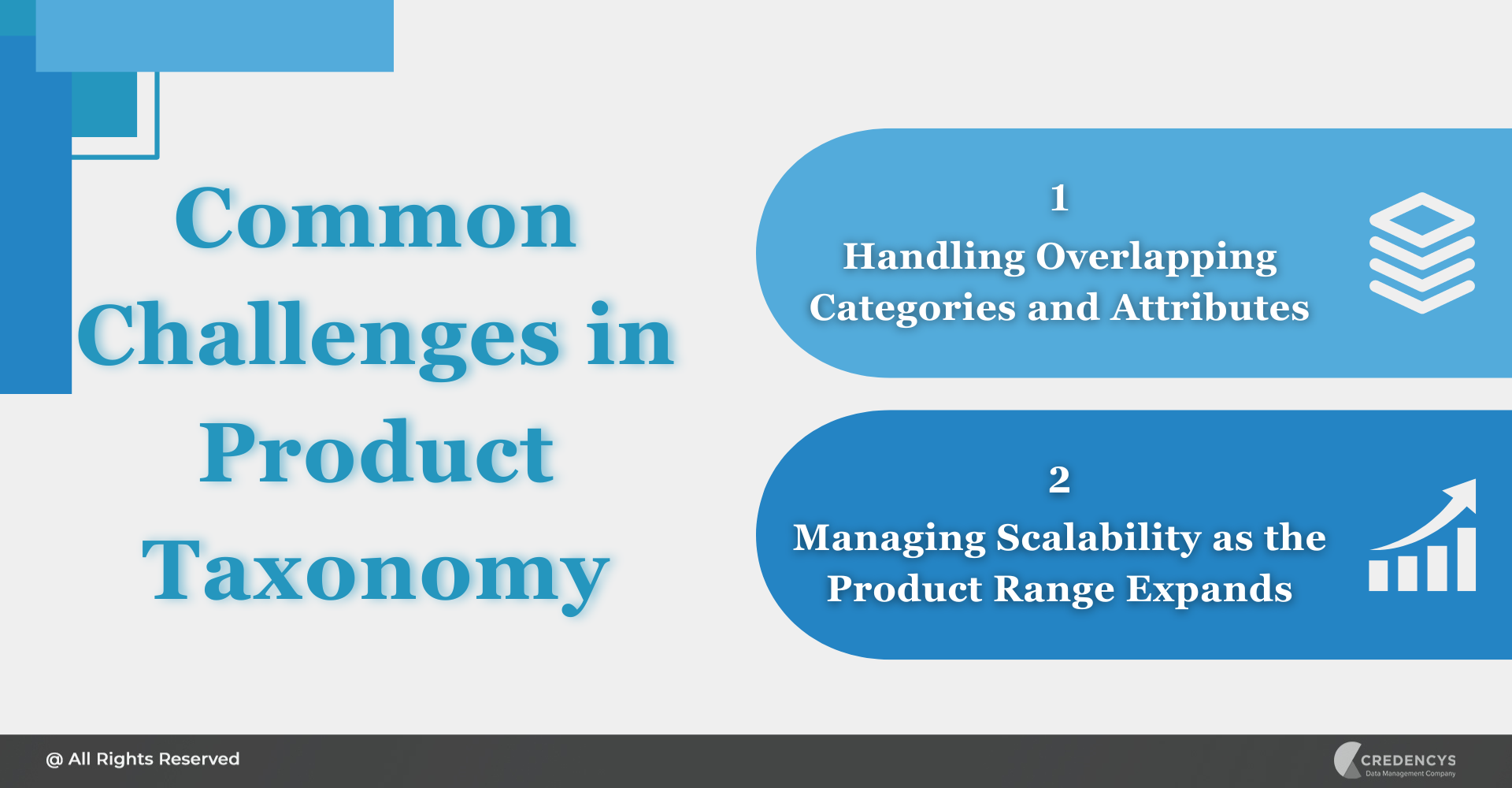
Common Challenges & Strategies to Overcome in Product Taxonomy

As businesses strive to create a seamless and user-friendly online shopping experience, they often encounter a range of challenges during the implementation of product taxonomy. Understanding these challenges is essential for devising effective solutions.

Challenge: Managing Scalability as the Product Range Expands

As your business grows and introduces new products, maintaining a coherent taxonomy becomes increasingly complex. Without a proper plan, your taxonomy might become convoluted, making it harder for customers to navigate and find products.

Solution: Embrace automation and machine learning. These technologies can assist in categorizing products, assigning attributes, and even predicting customer preferences. Automated tools can ensure that taxonomy remains organized and up to date, regardless of the scale of your product range.

Challenge: Handling Overlapping Categories and Attributes

In some cases, products may belong to multiple categories or share similar attributes. This overlapping can create confusion for both customers and the internal management of products.

Solution: Foster cross-functional collaboration. Regular communication and collaboration among teams can ensure that everyone’s needs and perspectives are considered during the taxonomy development process. This alignment guarantees a more cohesive and user-centric taxonomy.

Common Challenges in Product Taxonomy

By addressing these challenges head-on and implementing the suggested solutions, businesses can create a product taxonomy that adapts to their growth, caters to customer needs, and provides a foundation for effective data management.

Future Trends & Technologies in Product Taxonomy

The landscape of eCommerce and digital experiences is ever-evolving, and product taxonomy is no exception. As businesses strive to stay ahead of the curve, emerging technologies are reshaping how taxonomies are developed and utilized.

Let’s delve into two prominent trends shaping product taxonomy’s future.

AI-Driven Taxonomy Optimization

Impact of AI: Artificial Intelligence (AI) is revolutionizing many aspects of business, and taxonomy management is no different. AI algorithms can analyze vast amounts of data, helping businesses refine their taxonomy based on customer behavior, preferences, and market trends.

Benefits: AI-driven taxonomy optimization enhances the accuracy and relevance of product categorization and attribute assignments. It can automatically identify patterns, cluster similar products, and recommend improvements to the taxonomy structure, all of which contribute to an improved user experience.

Example: An online fashion retailer might use AI to analyze customer clicks, searches, and purchases. The AI system can then suggest reclassifying certain items, creating new subcategories, or highlighting attributes that customers find most relevant.

Personalized Taxonomies Based on User Behavior

Tailoring the Experience: The future of product taxonomy lies in creating personalized experiences for individual users. By leveraging data on user behavior and preferences, businesses can dynamically adjust their taxonomy to present the most relevant products to each customer.

Benefits: Personalized taxonomies reduce decision fatigue by presenting users with items that align with their past interactions. This level of customization enhances user engagement, reduces bounce rates, and boosts conversion rates.

Example: An online bookstore could dynamically adjust its taxonomy based on a user’s reading history and preferences. A science fiction enthusiast might see “Sci-Fi” as a top-level category, while a history buff might have “Historical Fiction” as their primary category.

By embracing these emerging trends and technologies, businesses can not only meet the expectations of modern consumers but also stay ahead in a competitive market. As AI continues to evolve and personalization becomes more refined, the boundaries of what’s possible with product taxonomy will expand, enabling businesses to provide highly tailored and engaging shopping experiences.

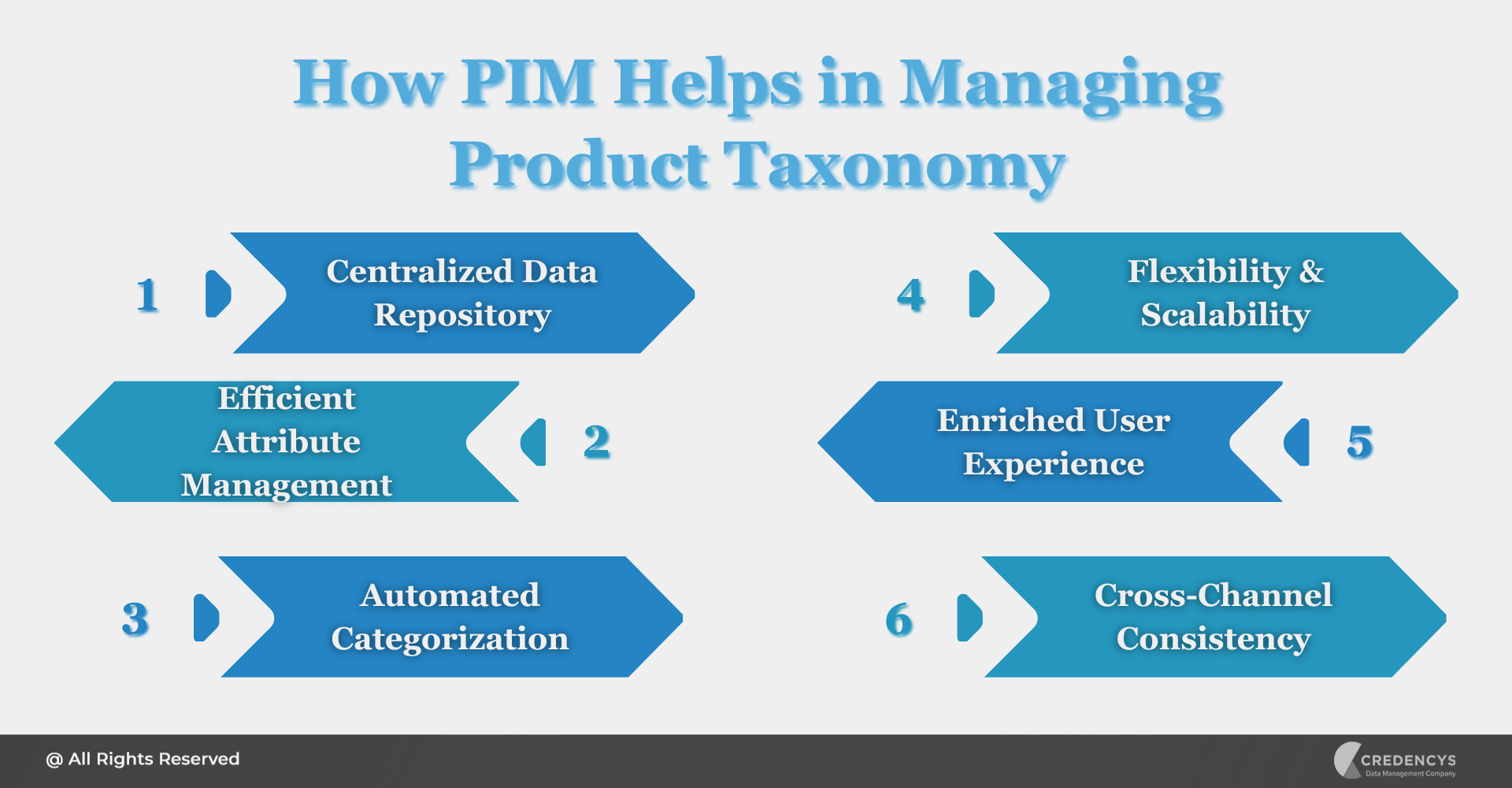
How Does PIM Help in Managing Product Taxonomy?

In the intricate world of eCommerce, managing a comprehensive and coherent product taxonomy can be a daunting task, especially as businesses expand their offerings. This is where a PIM for eCommerce system steps in to streamline the process and maximize the benefits of a well-structured taxonomy.

Centralized Data Repository

A PIM system acts as a centralized hub for all product-related information. It allows businesses to manage and update their product taxonomy from a single location, ensuring consistency across various channels and platforms.

Efficient Attribute Management

With a PIM, businesses can easily define and manage product attributes that matter most to customers. The system enables the creation, mapping, and modification of attributes across categories, eliminating the hassle of manual updates.

Automated Categorization

PIM systems often incorporate AI and machine learning algorithms that can automate the categorization of products based on attributes and historical data. This feature not only saves time but also ensures accurate and relevant categorization.

Flexibility and Scalability

As businesses grow and introduce new products, a PIM system offers scalability. New categories and subcategories can be added seamlessly, and attributes can be adjusted without disrupting the entire taxonomy structure.

Enriched User Experience

PIM systems contribute to a richer shopping experience by allowing the attachment of detailed product information, images, and videos to each item. This data enrichment enhances customer understanding and engagement.

Cross-Channel Consistency

With PIM, businesses can ensure that the same taxonomy is applied consistently across various sales channels, websites, and platforms. This cohesiveness enhances brand identity and customer trust.

How PIM Helps in Managing Product Taxonomy

By integrating a PIM system with your product taxonomy strategy, you can take taxonomy management to a new level. This synergy ensures that your taxonomy remains dynamic, relevant, and adaptable to the ever-changing landscape of products and customer preferences.

As businesses navigate the complexities of taxonomy creation and management, consider how a PIM system can be a powerful ally in your journey. The collaboration between well-structured taxonomy and a robust PIM solution sets the stage for exceptional user experiences, improved data management, and increased business efficiency.

Conclusion

In the ever-expanding digital marketplace, where products abound and attention spans are fleeting, the role of product taxonomy shines as a guiding beacon, helping both businesses and customers navigate the vast sea of choices. Throughout this article, we’ve embarked on a journey to explore the depths of product taxonomy, unearthing its intricacies and unveiling its significance in the realm of eCommerce and digital engagement.

So, whether you are an online retailer, a service provider, or a business venturing into the digital world, remember that product taxonomy is not just about organizing products; it is about creating a harmonious symphony of user experience, discoverability, and data-driven insights.

What Is Data Enrichment: A Complete Guide

Are you making the most of your data with data enrichment?

Are you capitalizing on the wealth of information to make informed decisions?

Is your data helping you drive your business forward?

In today’s data-driven landscape, these questions hold the key to success.

But with data pouring in from various sources and formats, how can you ensure your product information data is accurate and enriched with valuable insights?

This is where data enrichment emerges as a powerful solution, transforming ordinary data into a treasure trove of valuable knowledge.

According to an Acumen Research and Consulting report, Global data enrichment solutions market revenue was valued at USD 1.7 Billion in 2021, with an 8.5% CAGR from 2022 to 2030.

Data Enrichment empowers businesses to enhance the value of their raw data. Businesses can augment the original dataset with additional and missing data, making it more comprehensive and valuable.

An interesting fact about enriching data is that it enables companies to tailor their offerings and marketing efforts, enhancing customer satisfaction and loyalty.

Sounds interesting?

Then grab a cup of coffee while we cover, what is data enrichment and why your business needs it. We will explore the very essence of data enrichment, understanding what it entails, and the myriad of ways it propels businesses forward.

Let’s get started!
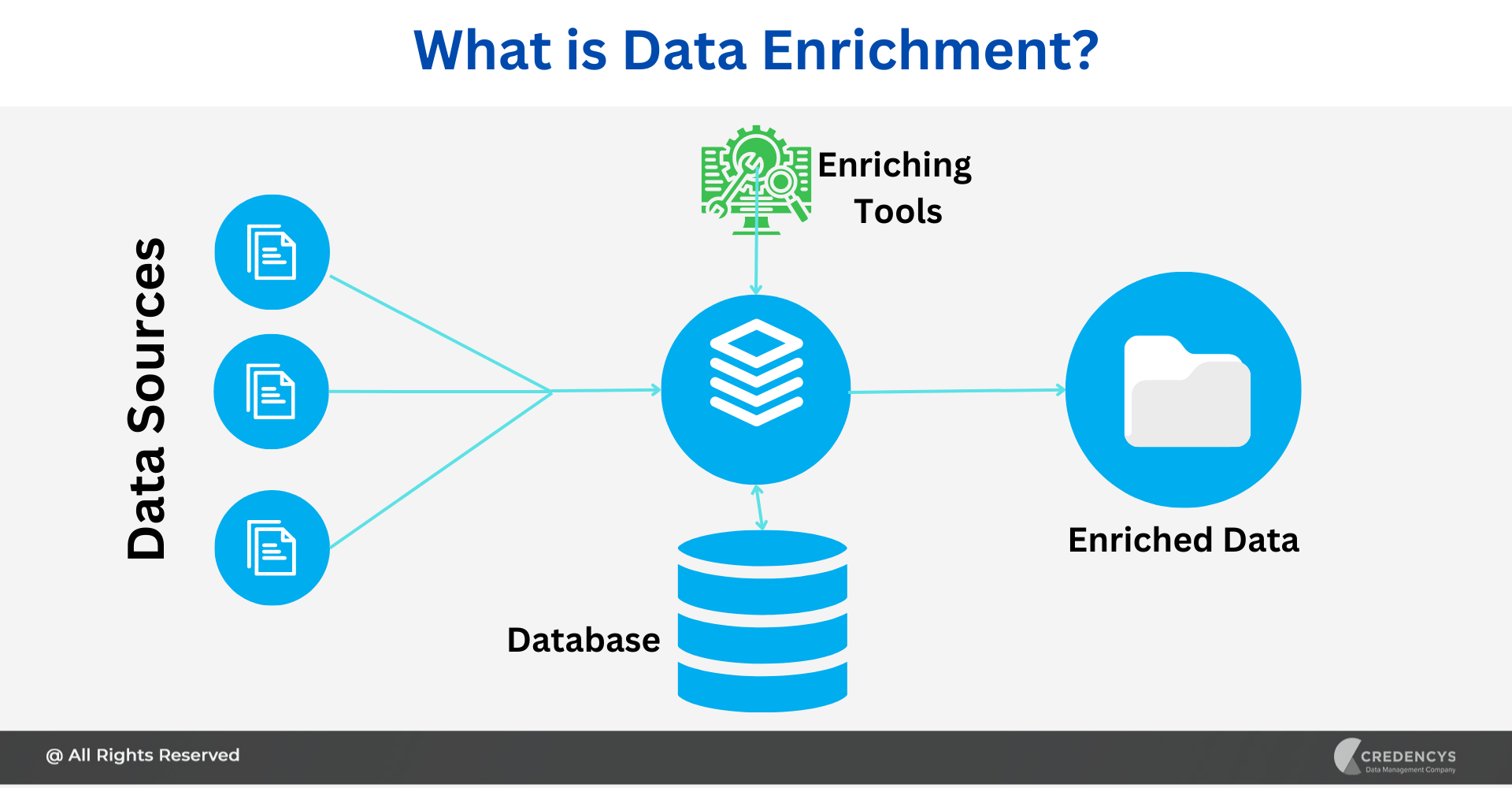
What Is Data Enrichment?

Data enrichment is the process of enhancing and improving raw data by adding relevant information, correcting errors, and ensuring its completeness and accuracy.

So basically, it involves enriching the original dataset with additional data from various sources, such as third-party databases, social media, and external APIs.

Data enrichment aims to make the data more valuable, comprehensive, and actionable, enabling businesses to gain deeper insights, make informed decisions, and improve customer experiences. By refining and augmenting the data, organizations can optimize their operations, personalize marketing efforts, and drive better business outcomes.

What is data enrichment - definition

To keep the definition simple,

Data enrichment is the process of merging first-party data from internal sources with diverse data from other internal or third-party sources. The result is enriched data, which becomes a highly valuable asset for organizations due to its enhanced usefulness and insights.

Types of Data Enrichment

Data enrichment can be achieved through various methods and techniques, resulting in different types of enriched data.

types of data enrichment

So, some common types of data enrichment include:

  • Geographical Data Enrichment: Adding geographical information to the data, such as latitude, longitude, postal codes, or addresses, to enable location-based analysis and geospatial insights.
  • Demographic Data Enrichment: Enhancing data with demographic attributes such as age, gender, income level, education, and occupation, providing deeper insights into customer profiles and behaviors.
  • Firmographic Data Enrichment: Enriching business-related data with firmographic attributes, such as industry type, company size, revenue, and location, for B2B marketing and sales targeting.
  • Social Media Data Enrichment: Integrating data from social media platforms to gain insights into customer sentiments, interests, and social interactions.
  • Behavioral Data Enrichment: Analyzing and enriching data with customer behavior patterns, such as purchase history, website interactions, and engagement metrics, to personalize marketing efforts and predict future actions.
  • Technographic Data Enrichment: Enriching data with information about the technology and software used by businesses or individuals, which is valuable for targeting technology-related products and services.
  • Intent Data Enrichment: Utilizing intent data, which indicates the likelihood of a potential buyer’s interest in a product or service, to prioritize and customize marketing and sales efforts.
  • Data Normalization and Standardization: Standardize data formats, units, and structures to ensure consistency and compatibility across different datasets.
  • Data Cleansing: Removing duplicates, correcting errors, and handling missing or irrelevant data to improve data quality and reliability.
  • Real-Time Data Enrichment: Enriching data in real-time as it is generated or received, allows businesses to act quickly on up-to-date insights.

Data enrichment encompasses various methods to enhance raw data, resulting in different types of enriched data. The main types include geographical enrichment, demographic enrichment, social media enrichment, behavioral enrichment, and real-time data enrichment.

Each type serves unique purposes, providing businesses with valuable insights to make informed decisions and improve customer experiences.

Benefits of Data Enrichment

Data enrichment offers numerous benefits to businesses, enabling them to make the most of their data and gain a competitive edge in the market.


benefits of data enrichment

Some key benefits of data enrichment include:

Enhanced Data Quality:

The process improves the quality of raw data by adding missing information, correcting errors, and ensuring data consistency. This leads to more accurate and reliable insights, allowing businesses to make informed decisions.

Deeper Customer Insights:

Enriched data provides a comprehensive view of customers, including demographic details, behavioral patterns, and preferences. This enables businesses to understand their customers better and create personalized experiences, leading to increased customer satisfaction and loyalty.

Improved Targeting and Personalization:

With enriched data from customer data enrichment, businesses can segment their audience more effectively and deliver targeted marketing campaigns. Personalized offers and recommendations resonate with customers, leading to higher conversion rates and improved engagement.

Better Sales and Marketing Strategies:

Enriched data helps businesses identify potential sales opportunities and leads. It enables more effective lead generation, customer profiling, and sales forecasting, streamlining sales and marketing efforts.

Optimal Inventory Management:

For retail and e-commerce businesses, enriched data assists in inventory forecasting and demand prediction. By knowing what products are in demand, companies can optimize their inventory levels, reducing stockouts and excess inventory costs.

Enhanced Business Intelligence:

It contributes to better business intelligence, enabling businesses to extract meaningful insights from complex datasets. These insights support strategic planning, trend analysis, and identifying growth opportunities.

Real-time Decision-making:

Real-time data enrichment allows businesses to access up-to-date information, enabling quick decision-making and responsiveness to market changes.

Risk Mitigation and Compliance:

Enriching data aids in risk management by identifying potential fraud, security threats, or compliance issues. It ensures that businesses stay compliant with data protection regulations and industry standards.

Data-driven Innovation:

Enriched data serves as a foundation for data-driven innovation. By leveraging enriched insights, businesses can develop innovative products, services, and customer experiences that meet evolving market demands.

Competitive Advantage:

Businesses that utilize the process effectively gain a competitive advantage. Enriched data supports a deeper understanding of the market, customer behavior, and emerging trends, helping businesses stay ahead of their competitors.

Data enrichment offers significant advantages to businesses, including improved data quality, deeper customer insights, better targeting and personalization, optimized inventory management, and enhanced business intelligence.

It enables real-time decision-making, supports risk mitigation and compliance, drives data-driven innovation, and provides a competitive advantage in the market. By leveraging enriched data, businesses can make informed decisions, create personalized experiences, and stay ahead of the competition.

Now that we have a better understanding of what is data enrichment, the benefits of enriched data, and the types of data enrichment, let’s dive into the difference between data enrichment vs data cleaning.

Data Enrichment VS Data Cleansing

People often get confused between the two terms, data enrichment, and data cleansing. But, many assume that both processes are the same. However, data enrichment vs data cleansing is two distinct processes in data management, each serving specific purposes. The below table gives an overview:

Key Aspects Data Enrichment Data Cleansing
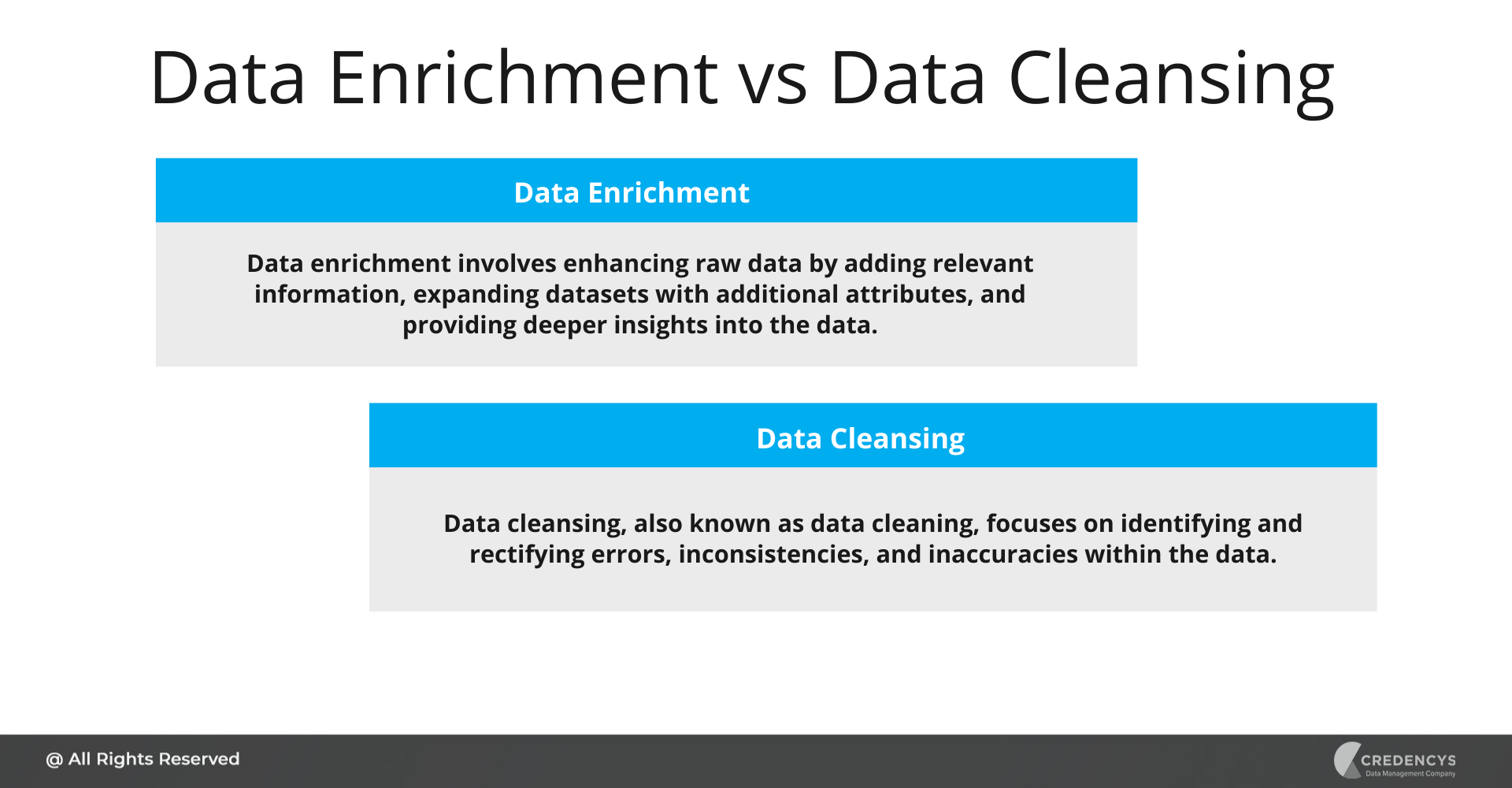
PurposeData enrichment involves enhancing raw data by adding relevant information, expanding datasets with additional attributes, and providing deeper insights into the data.Data cleansing, also known as data cleaning, focuses on identifying and rectifying errors, inconsistencies, and inaccuracies within the data.
MethodsEnrichment is achieved by integrating data from external sources, such as third-party databases, social media, and web scraping, to supplement existing data.Cleansing involves removing duplicate records, standardizing data formats, handling missing values, and resolving inconsistencies in data entries.
BenefitsData enrichment improves the value and usefulness of data, enabling businesses to gain a comprehensive view of customers, personalize marketing efforts, and make informed decisions based on more detailed and relevant information.Data cleansing ensures that data is accurate, consistent, and reliable. By eliminating errors and redundancies, it provides a clean and trustworthy dataset for analysis, decision-making, and other data-related processes.

Both processes are essential for effective data management, enabling businesses to work with high-quality data that supports accurate insights, informed decisions, and reliable business operations.

data enrichment vs data cleansing

How Is Data Enrichment Done?

Data enrichment involves systematically integrating additional data from external sources into the original dataset to enhance its value and insights. The process includes gathering external data, transforming and cleaning the data, and applying specific enrichment techniques based on the desired goals.

It improves data accuracy, completeness, and relevance, providing businesses with deeper customer insights and supporting informed decision-making. It is an iterative process that may involve data verification and continuous improvement over time. Data enrichment can be done manually or using automated tools and platforms.

Why You Need Data Enrichment

Data enrichment is crucial for businesses as it enhances raw data, providing deeper insights, accurate decision-making, and personalized customer experiences.

By adding demographic, behavioral, and other relevant information, businesses gain a comprehensive view of their customers. So, it enables targeted marketing campaigns and improved customer engagement.

Enriched data supports better product development and risk management by identifying trends, assessing risks, and ensuring compliance. Real-time customer data enrichment allows businesses to access up-to-date information promptly, aiding quick decision-making and adaptability to market changes.

Ethical data usage is upheld as it ensures privacy and compliance, fostering customer trust. Ultimately, it empowers businesses with a competitive edge, driving growth, efficiency, and success in a data-driven landscape.

Example of Data Enrichment

Let’s consider an e-commerce company that is planning a marketing campaign to promote its new line of athletic shoes. The company’s existing customer database includes basic information such as names, email addresses, and past purchase history. However, the company lacks detailed insights into its customers’ preferences and interests, making it challenging to target the right audience effectively. So, they need customer data enrichment to make their campaigns more effective.

Data Enrichment Process:

  • Demographic Enrichment: The e-commerce company decides to enrich its customer data enrichment with demographic attributes, including age and gender. To achieve this, they leverage a third-party data provider that offers demographic data based on email addresses.
  • Behavioral Enrichment: By analyzing customers’ browsing behavior, cart abandonment, and purchase patterns, the company enriches the data with behavioral attributes. This information helps identify which customers have shown interest in athletic shoes or similar products.
  • Social Media Enrichment: The company integrates social media data into customer profiles to gain insights into their interests and preferences beyond the e-commerce platform. This data includes likes, shares, and interactions related to athletic shoes or related topics.

Result:

After the data enrichment process, the e-commerce company now has enriched customer profiles with detailed demographic information, behavioral patterns, and social media engagement data. Armed with this enriched data, the marketing team can now create a targeted campaign for the new athletic shoes line.

Both processes are essential for effective data management, enabling businesses to work with high-quality data that supports accurate insights, informed decisions, and reliable business operations.

Data Enrichment Best Practices

Though each company’s data enrichment process may vary based on the data they collect and their business objectives, there are essential best practices that can be beneficial to all brands, regardless of their approach.

Define Clear Enrichment Goals

Before starting the enrichment process, clearly define the objectives and goals you want to achieve through data enrichment. Identify the specific attributes and information you need to enrich to support your business objectives effectively.

Choose Reliable Data Sources

Select reputable and reliable data sources for the process. Ensure that the data providers adhere to data privacy regulations and provide accurate, up-to-date information. Choose sources that align with your enrichment goals and industry requirements.

Implement Data Validation and Quality Checks

Data validation and quality checks are essential to ensure the accuracy and reliability of enriched data. Implement validation processes to identify and rectify errors, duplicates, and inconsistencies during and after the enrichment process. Regularly monitor data quality to maintain the integrity of the enriched dataset.

Remember, Data enrichment is an ongoing process.

Regularly monitor and update the enriching data to keep it accurate and relevant. Implement data maintenance practices to address changes in the underlying data sources.

I hope the article helped you understand what is data enrichment, and how it can help your business grow.

How We Can Help?

Credencys Solutions Inc. has expertise in Data Management, helping organizations of all sizes in implementing data enrichment through custom solutions, integration with third-party data sources, data cleansing, and real-time enriching data capabilities.

With a blend of globally leading solutions and data management expertise, we prioritize data security and compliance and offer scalable solutions that integrate seamlessly with existing systems. Connect with us to discuss how high data quality can benefit your business.

What is Data Stewardship – A Comprehensive Guide for Modern Businesses

In the vast landscape of today’s digital world, where data flows ceaselessly like rivers, the role of data stewardship has emerged as a guiding light for organizations striving to navigate these uncharted waters. Data stewardship, at its core, is the careful and responsible management of data throughout its lifecycle.

As we witness an unprecedented explosion of data generation and consumption, the importance of effective data stewardship has never been clearer. In this era where data is often referred to as the “new oil,” organizations face a multitude of challenges when it comes to managing and safeguarding their valuable assets.

The rapid accumulation of data, coupled with the diverse sources from which it originates, has given rise to concerns about data quality, security, and compliance. As organizations grapple with these challenges, the need for a structured and strategic approach to data stewardship becomes evident.

This blog post delves deep into the realm of data stewardship, uncovering its significance in a world where data fuels innovation and competitiveness. We will dissect the key principles that underpin effective data stewardship, explore the step-by-step process of implementing it, and shed light on the role that technology plays in shaping modern data stewardship practices.

So, whether you’re a business leader seeking to optimize data-driven decision-making or simply curious about the mechanisms that safeguard our digital landscape, this blog post will serve as your compass, guiding you through the intricacies of data stewardship and empowering you to steer your organization toward success in the dynamic seas of data management.

What is Data Stewardship?

At its essence, data stewardship embodies the philosophy that data is not just a resource but a critical asset that demands careful oversight, maintenance, and protection. Data stewardship encompasses the strategic and operational processes that ensure data’s accuracy, reliability, and security, enabling organizations to extract meaningful insights, drive informed decisions, and maintain a competitive edge.

Without effective data stewardship, organizations risk making decisions based on inaccurate or incomplete data, which can lead to misguided strategies, operational inefficiencies, and damaged reputations.

Key Principles of Data Stewardship

Effective data stewardship is underpinned by a set of core principles that form the foundation for responsible and successful data management. These principles ensure that data remains accurate, trustworthy, and valuable throughout its lifecycle.

Let’s delve into some of the key principles that guide data stewardship:

Accountability

Data stewards take ownership of the data under their purview, ensuring its quality and integrity. They are accountable for adhering to data governance policies and standards, as well as collaborating with relevant stakeholders to resolve data-related issues.

Transparency

Transparency in data stewardship involves open communication regarding data usage, lineage, and changes. Data stewards provide clear documentation and metadata to enable others to understand the data’s context and origins.

Collaboration

Data stewardship is a collaborative effort involving various departments and roles within an organization. Effective data stewardship requires close collaboration between data creators, users, IT teams, compliance officers, and business units to ensure data quality and compliance.

Data Quality

Maintaining data quality is a fundamental principle of data stewardship. Stewards work to eliminate errors, inconsistencies, and redundancies in data to ensure its accuracy and reliability for decision-making.

What is Data Quality – Everything Businesses Need to Know

Data Privacy and Security

Data stewards play a critical role in protecting sensitive information and ensuring compliance with data privacy regulations. They implement access controls, encryption, and other security measures to safeguard data from unauthorized access.

Key Principles of Data Stewardship

Data Stewardship Process

Data Identification

The data stewardship journey begins with identifying the data assets within an organization. This involves understanding what data is collected, where it resides, and its significance for business processes.

Key steps include:

  • Inventory Creation: Compile a comprehensive inventory of data sources, databases, and datasets.
  • Metadata Cataloging: Document metadata—data about data—to describe data attributes, origins, and usage.
  • Collaboration: Engage with data creators and users to gain insights into data’s value and relevance.

Data Classification

Once data is identified, it needs to be classified based on its sensitivity, usage, and compliance requirements. This classification informs subsequent data handling practices.

  • Sensitive Data Identification: Identify personally identifiable information (PII), financial data, and other sensitive categories.
  • Usage Classification: Categorize data based on its purpose—operational, analytical, regulatory reporting, etc.
  • Access Levels: Assign access levels (read, write, delete) based on data sensitivity and user roles.

Data Documentation

Data stewardship relies on clear and comprehensive documentation to ensure data is understood and utilized effectively.

  • Metadata Enrichment: Enhance metadata with business context, data definitions, and data lineage.
  • Data Cataloging: Create a central repository (data catalog) for metadata, making it easily accessible to stakeholders.
  • Version Control: Maintain records of changes and updates to data and metadata.

Data Access Management

Controlling who has access to data and how it is accessed is crucial for data security and privacy.

  • Access Authorization: Assign permissions based on job roles and data requirements.
  • Access Auditing: Monitor data access and usage to identify anomalies and potential security breaches.
  • Data Masking: Implement techniques like data masking to protect sensitive information during testing and development.

Data Quality Assurance

Data quality is a cornerstone of data stewardship. Ensuring data accuracy and integrity involves continuous monitoring and improvement:

  • Data Profiling: Analyze data for anomalies, inconsistencies, and completeness.
  • Data Cleansing: Remove or correct errors and inconsistencies in the data.
  • Data Validation: Implement validation rules to ensure data adheres to predefined standards.

Data Lifecycle Management

Throughout its lifecycle, data needs to be managed, archived, and eventually retired.

  • Data Retention Policies: Define how long data is retained based on legal, regulatory, and business requirements.
  • Archiving Strategies: Move inactive or less frequently used data to lower-cost storage options.
  • Data Deletion: Safely and securely delete data that is no longer needed.

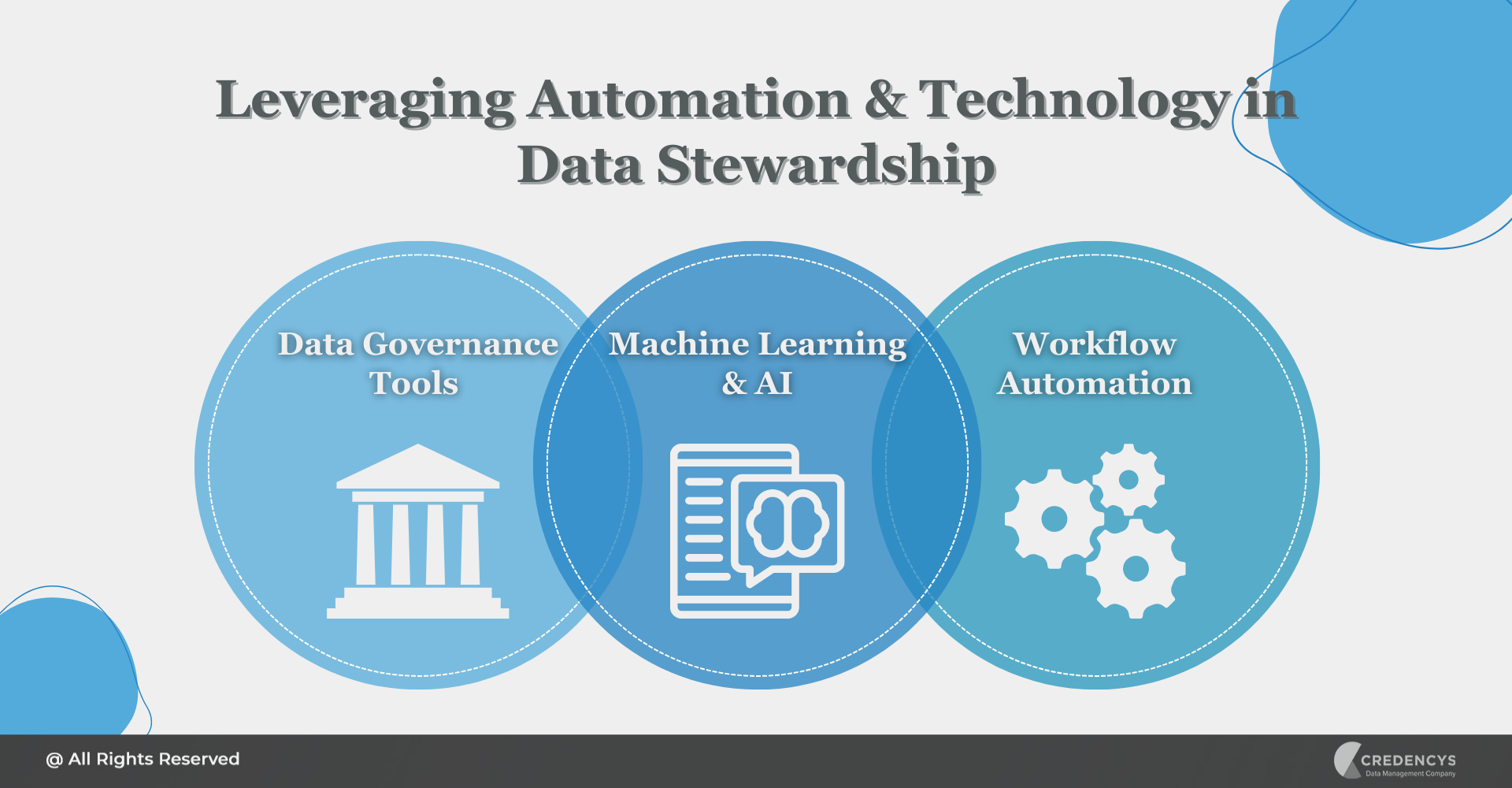
Leveraging Automation and Technology

Automation and technology play a pivotal role in enhancing the efficiency and effectiveness of the data stewardship process.

Data Governance Tools

Implement data governance platforms that automate data profiling, metadata management, and data lineage tracking.

Machine Learning and AI

Utilize AI algorithms to identify data quality issues, predict anomalies, and suggest corrective actions.

Workflow Automation

Automate approval processes, access requests, and data lineage documentation.

Leveraging Automation and Technology in Data Stewardship

By following these stages and incorporating automation and technology, organizations can establish a robust data stewardship process that ensures data quality, security, and integrity throughout its lifecycle.

The Role of Technology in Data Stewardship

In the digital age, the complexity and scale of data have led to a burgeoning ecosystem of technology solutions designed to streamline and enhance data stewardship efforts. These tools not only simplify data management but also amplify the ability of data stewards to ensure data quality, security, and compliance.

Data Cataloging

Data cataloging tools provide a central repository for metadata, making it easier for data stewards to document and manage data assets. Catalogs enable quick data discovery, understandability, and collaboration among stakeholders.

What is a Data Catalog? Definition, Benefits, Features, & More

Metadata Management

Metadata tools help track and document data lineage, definitions, and usage. They provide a holistic view of data, aiding in maintaining data consistency and ensuring accurate decision-making.

Data Lineage Tracking

These tools map the journey of data from its origin to its destination. They help visualize data flows, dependencies, and transformations, crucial for maintaining data integrity and compliance.

Advanced Analytics and AI

Utilizing advanced analytics and AI techniques offers numerous advantages for data stewardship:

  • Anomaly Detection: AI can identify unusual patterns and outliers, helping detect data quality issues or potential breaches.
  • Data Profiling: Automated data profiling tools analyze data to reveal inconsistencies and inaccuracies.
  • Predictive Analytics: AI algorithms can predict data quality issues before they escalate.

Benefits of Advanced Analytics and AI

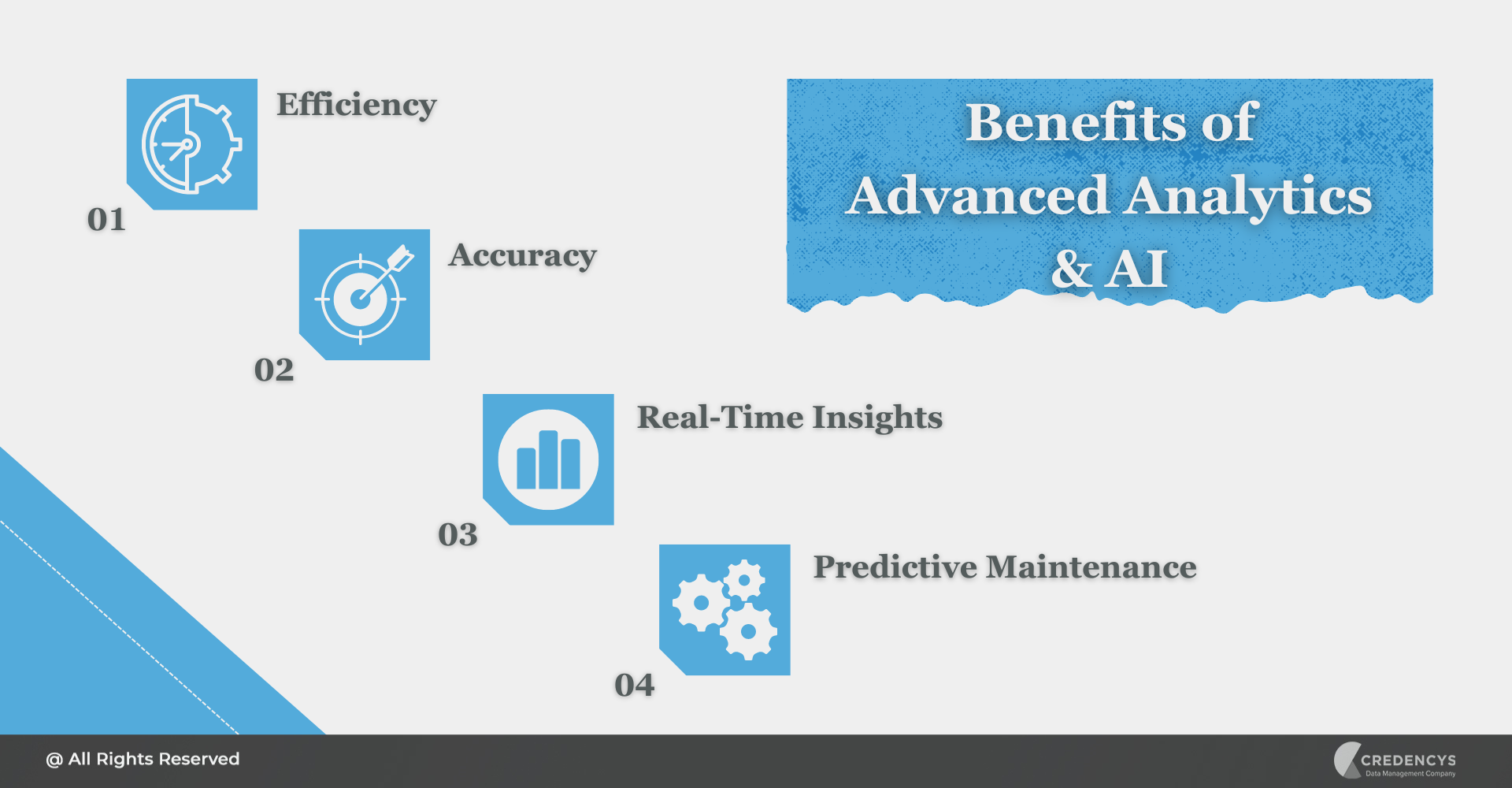
Efficiency

Automation reduces manual effort, allowing data stewards to focus on higher-value tasks.

Accuracy

AI-driven tools can detect data anomalies that might go unnoticed by human oversight.

Real-time Insights

Rapid analysis and reporting enable quick response to data quality issues.

Predictive Maintenance

AI can anticipate data quality problems before they disrupt operations.

Benefits of Advanced Analytics and AI

Limitations and Considerations

While technology brings transformative benefits to data stewardship, there are considerations to bear in mind:

Complexity

Implementing and managing new tools can be intricate and require a learning curve for teams.

Data Privacy and Security

Technology must align with data privacy regulations to avoid compliance breaches.

Data Overload

Too many tools can lead to data fragmentation and confusion.

Human Expertise

Technology is a tool, not a replacement for human expertise. Data stewards’ knowledge remains essential for effective decision-making.

Incorporating technology into data stewardship practices requires a balanced approach that leverages the advantages while addressing potential challenges. The integration of these tools can empower data stewards to more effectively manage data assets, ensure data quality, and drive meaningful insights for organizational success.

Significance of Data Privacy Regulations in Shaping Data Stewardship Best Practices

In today’s interconnected digital landscape, data privacy regulations have emerged as fundamental cornerstones that shape the practices of data stewardship. Regulations like the General Data Protection Regulation (GDPR) in Europe and the California Consumer Privacy Act (CCPA) in the United States have set a global precedent for how organizations handle sensitive information.

These regulations dictate that organizations must safeguard personal data, provide transparency in data usage, and offer individuals control over their data. Data stewardship, with its focus on accountability, transparency, and data quality, aligns perfectly with the principles of data privacy regulations.

Organizations must not only manage data efficiently but also ensure its security and privacy throughout its lifecycle.

Significance of Data Stewardship for Security & Risk Mitigation

Data stewardship plays a pivotal role in maintaining data security and mitigating the risks of data breaches. By implementing robust data governance practices, organizations can:

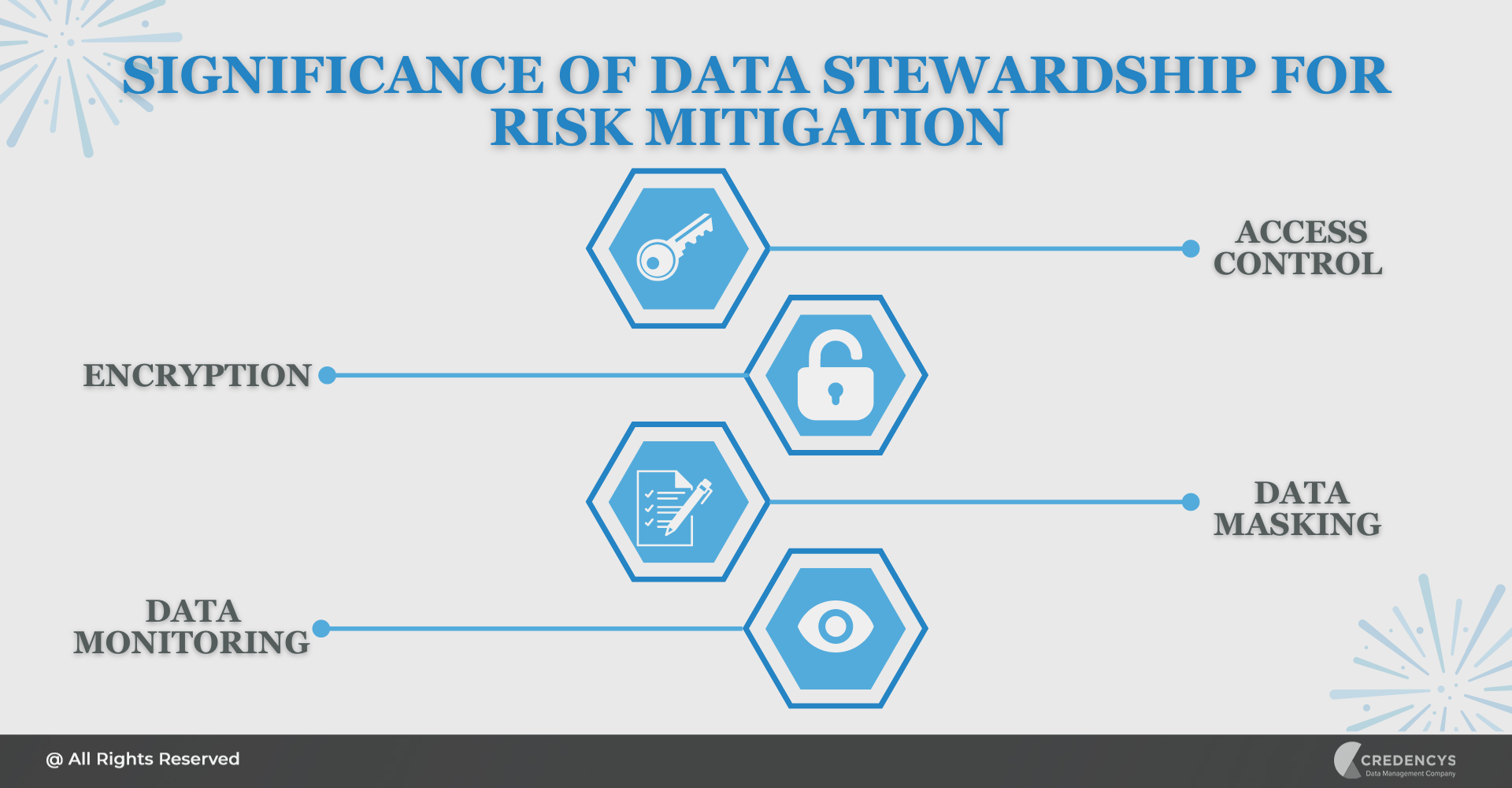
Access Control

Data stewards manage and enforce access controls, limiting data access to authorized personnel only.

Encryption

Stewards work to ensure that sensitive data is encrypted both at rest and during transmission, preventing unauthorized access.

Data Masking

Techniques like data masking are employed to protect sensitive information in non-production environments.

Data Monitoring

Data stewards oversee data access, monitor for anomalies, and detect potential security breaches.

Significance of Data Stewardship for Security & Risk Mitigation

Through these practices, data stewardship contributes to creating a secure environment for sensitive data, reducing the chances of unauthorized access, breaches, and subsequent reputational damage.

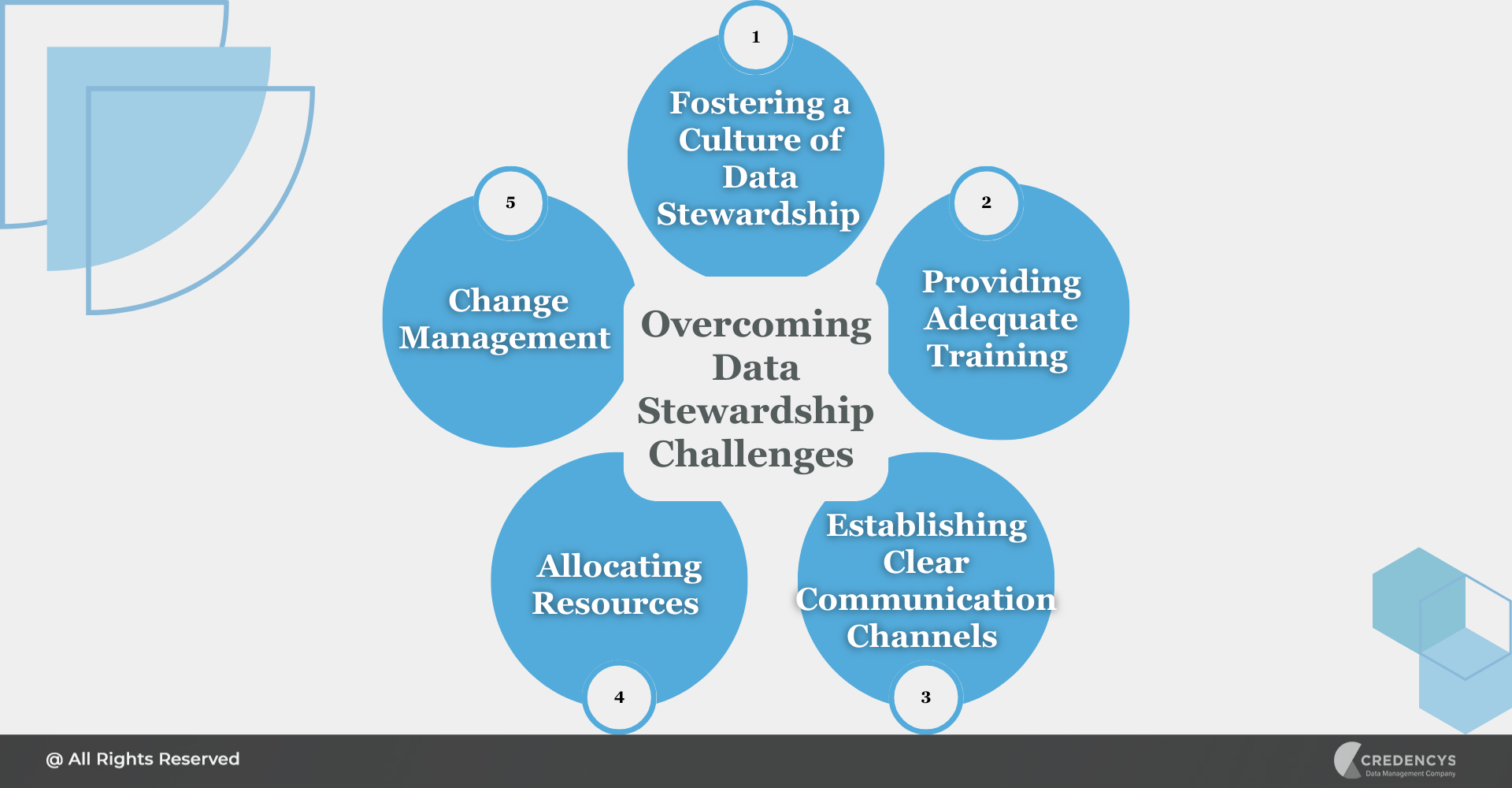
Challenges in Implementing Data Stewardship

Effective data stewardship is not without its challenges, as organizations navigate the intricate landscape of data management, security, and compliance. Identifying and addressing these challenges is essential for successfully implementing data stewardship best practices.

Lack of Awareness

Many employees, especially outside the IT and data departments, might not fully understand the significance of data stewardship or their role in it.

Siloed Data

Data spread across various departments and systems can lead to inconsistent practices and difficulty in maintaining data quality and accuracy.

Resistance to Change

Introducing new processes, tools, or responsibilities can face resistance, particularly if they disrupt established routines.

Insufficient Resources

Effective data stewardship requires time, tools, and skilled personnel, and organizations might face challenges in allocating these resources.

Strategies and Solutions for Overcoming Data Stewardship Challenges

Fostering a Culture of Data Stewardship

  • Leadership Support: Senior management should actively endorse data stewardship practices, creating a top-down commitment to data quality and security.
  • Employee Engagement: Educate employees about the value of data stewardship and their role in maintaining data quality.

Providing Adequate Training

  • Data Literacy Programs: Offer training sessions to improve employees’ understanding of data concepts, usage, and their role in data stewardship.
  • Technical Training: Provide training on data governance tools and technologies to empower data stewards with the necessary skills.

Establishing Clear Communication Channels

  • Cross-Department Collaboration: Encourage collaboration between departments to break down data silos and ensure consistent data practices.
  • Regular Updates: Provide frequent updates on data stewardship initiatives, changes in policies, and best practices.

Allocating Resources

  • Resource Allocation: Allocate dedicated resources, both human and technological, to support data stewardship efforts effectively.
  • ROI Demonstration: Showcase the potential return on investment from improved data quality and security to justify resource allocation.

Change Management

  • Gradual Implementation: Introduce data stewardship practices gradually, allowing teams to adapt and integrate the changes smoothly.
  • Clear Roadmap: Provide a clear roadmap for implementing data stewardship, highlighting milestones and expected outcomes.

Overcoming Data Stewardship Challenges

By addressing these challenges proactively and implementing these strategies, organizations can lay the foundation for effective data stewardship. A culture that values data quality, security, and ethical data handling can lead to improved decision-making, enhanced customer trust, and long-term business success.

Future Trends in Data Stewardship

The field of data stewardship is not static; it evolves alongside advancements in technology, changing business landscapes, and shifting regulatory environments. Exploring emerging trends and technologies in data stewardship is crucial for organizations aiming to stay ahead in the ever-evolving data-driven world.

Artificial Intelligence (AI) and Machine Learning (ML)

AI and ML technologies are transforming data stewardship. They can predict data quality issues, automate data classification, and enhance anomaly detection, reducing manual effort and improving accuracy.

Blockchain Technology

Blockchain’s immutable and transparent nature has the potential to enhance data lineage tracking and ensure the integrity of data records, particularly in industries with strict compliance requirements.

Data Ethics and Bias Mitigation

With increasing awareness about data ethics and bias, organizations are integrating ethical considerations into data stewardship practices, ensuring data fairness, diversity, and inclusion.

Data Governance as a Service

Cloud-based solutions are making data governance more accessible. Organizations can now implement data stewardship best practices using scalable, subscription-based services.

IoT Data Management

As the Internet of Things (IoT) grows, managing the massive influx of data from devices becomes vital. Data stewardship will play a key role in ensuring the quality and usability of this data.

Impact of Innovations on Data Stewardship Practices

Efficiency and Automation

AI and ML will streamline data stewardship processes, automating tasks like data profiling, quality assessment, and even decision-making.

Enhanced Accuracy

Technologies like blockchain can provide an indisputable record of data changes, ensuring data integrity and accuracy.

Real-Time Insights

IoT and advanced analytics will provide real-time data insights, allowing data stewards to respond promptly to quality issues or anomalies.

Impact of Innovations on Data Stewardship Practices

Staying Adaptable in the Evolving Landscape

As technology and trends continue to shape data stewardship, it’s imperative for individuals and organizations to remain adaptable:

Continuous Learning

Stay updated on emerging technologies, trends, and best practices through courses, webinars, and industry events.

Agile Implementation

Be open to embracing new technologies and adapting data stewardship processes to accommodate innovative tools.

Collaboration

Engage with industry peers, experts, and thought leaders to exchange insights and experiences in the ever-changing data landscape.

Regulatory Awareness

Stay informed about evolving data privacy regulations to ensure compliance while managing data effectively.

Elevating Your Data Stewardship with Credencys

In an era where data fuels every aspect of business, ensuring its accuracy, reliability, and security is paramount. This is where Credencys Data Stewardship Services step in, offering a comprehensive suite of solutions designed to empower you with meticulous data oversight, quality assurance, and compliance. Credencys offers:

Expert Data Guardianship

Our dedicated team of data stewards are seasoned experts in data management. With their deep understanding of data lifecycle and governance, they are your partners in ensuring the highest standards of data quality and integrity.

Holistic Data Oversight

We believe in holistic data stewardship that spans from data creation to archiving. Our services cover data identification, classification, documentation, access management, quality assurance, and lifecycle management.

Data Governance Framework

We seamlessly integrate data stewardship into a robust data governance framework, ensuring that your data management practices align with industry regulations, compliance standards, and best practices.

Tailored Solutions

Recognizing that every organization’s data landscape is unique, our data stewardship services are tailored to your specific needs. We work closely with you to develop strategies that fit your business objectives.

Elevating Your Data Stewardship with Credencys

At Credencys, we understand that your data is more than just numbers; it’s the foundation of your decision-making, growth, and success. Our Data Stewardship Services go beyond managing data – they ensure your data assets are trusted, secure, and optimized for maximum value.

With a focus on precision, compliance, and reliability, Credencys is your partner in elevating your data stewardship practices to new heights.

Closing Thoughts

From the foundational principles that drive data stewardship to the practical implementation of processes and technologies, we’ve explored the multifaceted nature of this crucial practice. Data stewardship’s role in compliance, security, and ethical handling underscores its significance in the interconnected world where data breaches and privacy concerns are ever-present.

As organizations adapt to the data-driven age, they are faced with choices—choices that can shape their future. By embracing data stewardship principles, leveraging technology, fostering collaboration, and upholding ethical considerations, organizations can navigate these choices with confidence.

They can seize the opportunities that data presents, unlock insights that fuel innovation, and build a foundation of trust with their stakeholders. With the compass of knowledge and the sails of adaptability, you are equipped to navigate the vast seas of data stewardship and steer your organization toward success in the digital age.

What is Customer Master Data Management?

In today’s business landscape, customer data holds immense value, making it one of the most precious assets for any company. Go through what is a customer master data management post, where we facilitate businesses with the essence of customer MDM in consistent business growth and success.

Extensive research by McKinsey & Co. reveals that organizations that effectively leverage insights from high-quality customer data outperform their competitors, achieving an impressive 85% increase in sales growth and a substantial 25% or more boosts in gross margin.

Customer data plays a pivotal role in shaping strategies such as upselling, targeted marketing, and delivering exceptional customer support.

Furthermore, it serves as a critical element in the successful execution of large-scale digital transformations. Consequently, considerable efforts have been devoted to maximizing the value derived from customer data.

One approach that unlocks the true potential of customer data and ensures its quality and usability across an entire organization is known as customer master data management.

This post aims to provide a comprehensive understanding of customer master data management, its significance, and the key components necessary for effectively addressing it on an enterprise scale.

What is Customer Master Data?

The customer master data definition serves as a vital component of the accounting database, housing unique information specific to each customer. It encompasses various essential data points, including:

  • Customer name
  • Customer identification number
  • Customer address
  • Contact name and phone number
  • Sales representative name
  • Customer tax identification number
  • Customer credit limit
  • Customer credit score
  • Customer payment terms
  • Customer ship-via settings
  • Past due notification flag
  • Monthly statement flag
  • Taxable flag
  • Tax-exempt ID number

This comprehensive collection of information plays a crucial role in automatically populating fields within new transactions, such as customer sales orders.

To uphold the integrity of the stored data, strict access controls and restrictions should be implemented to ensure that only authorized personnel can retrieve and modify the customer master file.

By safeguarding the confidentiality and accuracy of this data, companies can maintain the reliability and effectiveness of their accounting processes.

What is Customer Master Data Management?

Customer Master Data Management (MDM) aims to establish a cohesive, precise, and enduring collection of identifiers and attributes that comprehensively depict a customer. This unified dataset is instrumental in bridging customer data across disparate organizational divisions, business processes, and units.

By attaining a state of “live” and consistently updated information, this mastered data can be seamlessly integrated into operational and analytical systems to drive impactful business outcomes.

The customer master data management process mastering begins with the consistent and continuous integration of customer data from various sources within the enterprise. This integration serves to trace the customer’s journey, spanning from initial lead generation to the point of sale and through to after-sales services.

Achieving this requires the matching and unification of customer records across different systems, ultimately creating a cluster that generates a golden record customer view. Through this unified view, a persistent customer 360-degree perspective is established, bolstered by a unique identification system.

Why is Customer Master Data Management Essential?

1. Absence of a Unified Customer View

The absence of a centralized and reliable source of customer information hampers informed decision-making across the organization.

Business development teams lack essential insights to effectively convert opportunities, sales teams struggle to inform expansion strategies and prioritize their efforts, marketing teams are unable to recommend actions based on the most up-to-date customer interactions and behavior, and risk and compliance teams face challenges in meeting know-your-customer (KYC) standards.

Furthermore, customers experience fragmented service due to disjointed accounts within the same vendor.

2. Persistent Data Errors

Data inaccuracies can lead to detrimental sales outcomes and unnecessary expenditures incurred in rectifying mistakes.

These errors range from incorrect customer deliveries to campaign bounce-backs. Sales teams are forced to devote valuable time to fixing errors and addressing customer complaints, diverting their focus from business expansion.

Inaccurate data also hinders lead conversion, as reaching out to customers with incorrect or outdated contact information becomes increasingly difficult.

3. Limited Insight into Corporate Hierarchies

Particularly relevant in B2B contexts, the inability to accurately position a customer within their corporate hierarchy diminishes the benefits of consolidating information across various business units and functions.

The absence of hierarchy information restricts the effectiveness of decision-making throughout the customer journey, from lead conversion to customer retention and growth initiatives.

While some customer grouping requirements can be addressed through attribute-based reporting or data visualization tools, complex customer relationships often demand a more consistent and structured approach to be reflected in the mastered data.

Benefits of Implementing Customer Master Data Management

Exploring the Benefits of an Effective Customer Master Data Model

1. Enhanced Personalization

Delivering a personalized customer experience is a fundamental element in today’s business landscape. Surveys indicate that 20% of consumers are willing to pay a premium for a more tailored approach.

Marketing and sales teams strive to incorporate personalization into their strategies while keeping campaign costs under control.

Implementing a high-quality customer data model serves as a crucial step toward achieving personalized interactions.

By leveraging existing customer records, businesses can make informed predictions about future behaviors, enabling them to personalize their approach most efficiently and effectively as possible.

Every piece of customer master data meaning, from their interactions to their online behavior, holds a wealth of valuable information that can fuel further personalization efforts. Ensuring data quality and accuracy becomes paramount for driving improved personalization.

2. Reduced Marketing Costs

In today’s fiercely competitive landscape, businesses across industries constantly seek ways to differentiate themselves.

However, developing truly unique offerings demands significant time and financial investments. To stand out from the crowd, companies need to devise successful marketing strategies.

Many small and midsize businesses face the challenge of reducing their marketing expenses while still achieving effective results. This is because sophisticated marketing campaigns often require substantial costs, making it difficult for smaller businesses to compete with larger companies in terms

One strategy to enhance customer data is by focusing on both its quantity and quality. By utilizing Customer Master Data Management (MDM), organizations can collect, scrutinize, and implement top-notch information pertaining to their customers.

This technique results in monetary savings as it streamlines the overall process and delivers insights that are more accurate:

  • Connecting with customers at the right stages of the sales funnel.
  • Accelerating the customer journey.
  • Avoids wasteful efforts in promoting products and services to low-potential customers.
  • Gaining a deeper understanding of customer accounts.
  • Preventing unnecessary expenditures on paid search marketing.

Understanding the target audience is vital to simplify sales and marketing efforts, resulting in reduced costs and improved efficiency. By utilizing customer insights effectively, businesses can optimize their processes while staying ahead of the competition.

3. Enhanced Time Efficiency

Managing customer data can be a daunting task, especially when it comes to locating and analyzing relevant information.

Without proper handling, it may take days or even weeks to complete this process. This time delay can negatively impact timely decision-making and potentially harm the business’s market share.

A reliable MDM solution and a robust strategy for managing customer master data can save significant time. This allows the sales and marketing teams to concentrate on their core tasks, which ultimately leads to improving the company’s bottom line.

For instance, in email marketing, utilizing low-quality data may result in sending messages to outdated email addresses, wasting marketing resources without achieving desired goals.

Employing simple tools like an email validator, which automatically checks email address data, helps circumvent such issues. Having a reliable customer data management system ensures the availability of important customer data tools, avoiding missed opportunities.

Customer MDM also helps mitigate duplicate data problems, further optimizing team efficiency.

4. Building Meaningful Relationships

Customer MDM enables businesses to forge meaningful relationships with their clients and customers.

By gaining a comprehensive understanding of customers through data integration into the customer retention system, businesses can deliver personalized experiences that drive customers down the sales funnel.

Connecting with the audience across various touch points not only facilitates successful sales but also enhances customer satisfaction and fosters customer loyalty.

Since a significant portion of sales typically comes from existing customers, building and nurturing meaningful relationships becomes a crucial driver of business success.

5. Improved Compliance

Maintaining compliance with rules and regulations requires implementing customer master data management. To achieve this, it is necessary to understand which data can be utilized for specific purposes as it is vital in adhering to legal requirements.

Certain industries require specific tools to safeguard sensitive client data, and customer MDM addresses these concerns, ensuring compliance.

Many companies face challenges in comprehending how to gather and maintain customer data appropriately, leading to compliance issues. Implementing an effective MDM system mitigates these risks, ensuring adherence to regulations.

6. Enhanced Customer Segmentation

Customer segmentation enables businesses to construct highly personalized and targeted offers for their audience. Effective customer segmentation relies on having sufficient information about all customer groups, which is facilitated by customer master data management.

Insufficient information about customer preferences and behavior can result in misguided marketing efforts. Sending emails to the wrong recipients or duplicating emails sent to the same address can lead to unnecessary expenses and reduced marketing return on investment (ROI).

Collecting comprehensive core data about the audience simplifies segmentation, significantly improving sales and marketing endeavors, and ultimately delivering more excellent value to customers.

7. Effective Decision-Making

Access to comprehensive and timely data is essential for effective decision-making in business operations. Without the right approach to data management, critical information may be overlooked, leading to poorly-supported decisions.

Having master records analyzed and readily available when needed is crucial for efficient decision-making. Customer master data management ensures that relevant data is accessible and supports quick decision-making processes.

3 Most Common Data Sources for Customer Master Data Management?

1. ERP

Enterprise Resource Planning (ERP) software plays a crucial role in facilitating the seamless management of various business activities, including accounting, procurement, project management, risk management and compliance, and supply chain operations.

In addition, a comprehensive ERP suite encompasses enterprise performance management software, which aids in financial planning, budgeting, forecasting, and reporting.

By integrating diverse business processes, ERP systems establish a cohesive framework that enables the smooth flow of data between different departments and functions.

These systems gather an organization’s transactional data from multiple sources, eliminating data redundancy and ensuring data integrity by providing a unified and reliable source of information.

In today’s business landscape, ERP systems have become indispensable tools for managing businesses of all sizes and across diverse industries.

They are akin to the essentiality of electricity that powers and sustains operations. Organizations rely on ERP systems to streamline their operations, enhance efficiency, and facilitate informed decision-making processes.

2. CRM

Customer Relationship Management (CRM) is a powerful software system designed to facilitate the effective management of customer interactions and relationships for business owners. By replacing the reliance on numerous spreadsheets, databases, and disjointed applications, CRM software streamlines the process of tracking and organizing client data, resulting in enhanced organization, efficiency, improved time management, and ultimately, satisfied clients.

With CRM, all relevant data of sales leads and customers are consolidated and centralized in one location. This includes comprehensive information about communication channels such as form fills, calls, emails, text messages, and meetings.

Additionally, it encompasses critical documents, quotes, purchase history, and associated tasks linked to each lead and client. This consolidated repository ensures that your entire team has access to the necessary details at the right time, whether it’s to close a sale or deliver exceptional service.

CRM software helps businesses optimize customer interactions and streamline their internal processes by providing a unified platform.

With easy access to a comprehensive overview of customer interactions, businesses can create personalized experiences that foster relationships and drive overall customer satisfaction. Additionally, seamless team collaboration is promoted leading to efficient management.

3. Marketing automation

Marketing automation is a powerful software tool that allows companies to personalize and automate their marketing messages, reaching customers on multiple platforms such as email, social media, websites, and text messaging.

By harnessing the capabilities of this technology, businesses can effectively generate leads while improving customer relationship management practices. Marketing departments primarily utilize these platforms for streamlining workflows and increasing overall efficiency by eliminating repetitive tasks.

Typically, organizations employ multiple marketing automation tools, collectively known as the marketing technology stack or martech stack. These platforms play a pivotal role in lead generation through various means such as email marketing, chatbots embedded in social media or websites, and additional channels like SMS or text messaging.

By utilizing marketing automation tools, businesses can expand the reach of their marketing campaigns and foster inbound marketing strategies. Inbound marketing refers to the approach of attracting prospects through personalized pitches derived from insightful analytics tools.

These tools enable the segmentation of customers into distinct groups, allowing for tailored and targeted marketing approaches at different stages of the customer journey. Ultimately, marketing automation empowers businesses to deliver relevant and engaging content to their audience, enhance lead-generation efforts, and drive business growth.

3 Essential Components of Customer Master Data Management

Persistent IDs

Establishing unique identifiers that connect customer records both within individual systems and across multiple systems, facilitating a comprehensive and unified view of customers. This approach ensures that accurate and consistent information is available, enabling the creation of a golden record that represents the complete customer profile.

Deduplication

Identifying and resolving duplicate customer records to ensure that multiple instances of the same customer are correctly merged into a single entity. This process eliminates data redundancy and ensures that all interactions and information associated with a customer are consolidated for accurate analysis and decision-making.

Data aggregation

In the world of customer management, organizations need to consolidate customer information from various systems and business units. This amalgamation aims to create a unified and comprehensive perspective of customer interactions.

By integrating customer data with operational and analytical systems, organizations can effortlessly include updates in customer information and behavior into their enterprise-wide reporting and subsequent actions.

Developing a robust Customer In the world of data management, organizations striving to maximize the value of their digital assets while adhering to key DataOps principles should prioritize the establishment of a master data set.

By creating a comprehensive and precise repository of customer data, businesses can unlock invaluable insights, optimize operational efficiency, and enable informed decision-making.

Customer Master Data Attributes

In the modern business landscape, understanding your customers at a granular level is pivotal for success. This is where customer master data attributes play a crucial role. These attributes provide a detailed profile of each customer, offering valuable insights that can drive targeted strategies, personalized experiences, and informed decision-making.

Let’s delve into the key customer master data attributes that are shaping the way businesses engage with their audience:

1. Basic Identification Attributes

Name: The customer’s full name is essential for personalized communication and addressing them correctly.

Contact Details: Phone numbers, email addresses, and physical addresses allow you to reach out through preferred channels.

Gender and Age: These attributes provide insights into demographics, enabling targeted marketing campaigns.

Date of Birth: Helps you send birthday wishes, discounts, and offers, fostering customer loyalty.

2. Demographic Attributes

Location: Geographic data helps in regional targeting, and tailoring promotions based on local preferences.

Language Preferences: Communicate in the customer’s preferred language for a more engaging experience.

Marital Status: Useful for promoting relevant products or services like wedding planning or family vacations.

3. Transactional Attributes

Purchase History: Knowing what customers buy, how often, and their spending patterns enables personalized product recommendations and upselling.

Order History: Provides insights into the customer’s preferences, helping optimize inventory and demand forecasting.

Returns and Refunds: Understanding return patterns can lead to product quality improvements and better customer service.

4. Behavorial Attributes

Website Interactions: Analyzing page visits, time spent, and products viewed helps in optimizing website design and content placement.

Search History: Identifying what customers are searching for can guide product development and content creation.

Clickstream Data: Understanding the customer journey helps in creating more intuitive user experiences.

5. Engagement Attributes

Communication Preferences: Respecting customer communication preferences enhances engagement and reduces opt-outs.

Subscription History: Analyzing subscription changes helps you refine your content and offers.

6. Social Attributes

Social Media Handles: Linking social profiles provides insights into customer interests and allows you to engage on social platforms.

Social Activity: Monitoring customer posts and interactions can uncover trends and sentiment around your brand.

7. Preferences and Interests

Product Preferences: Tailoring recommendations based on past purchases or interests increases the likelihood of conversion.

Personal Hobbies: Understanding hobbies can help you offer relevant products and services.

8. Customer Value Metrics

Customer Lifetime Value (CLV): Knowing a customer’s potential value guides resource allocation for retention efforts.

Churn Probability: Identifying at-risk customers allows you to implement strategies to reduce churn.

9. Segmentation Attributes

Market Segments: Segmentation based on industry or company size enables targeted B2B marketing.

Behavioral Segments: Understanding customer behaviors helps create more personalized experiences

10. Custom Attributes

Additional Fields: Customized attributes capture unique customer characteristics that are specific to your business.

Customer Master Data Management Process

Data Collection and Integration

The process begins with the collection of customer data from various sources, including online forms, point-of-sale systems, CRM platforms, and external databases.

This raw data is then integrated and consolidated into a central repository, eliminating duplicate records and ensuring a single source of truth for customer information.

Data Cleansing and Standardization

To ensure data accuracy, the collected information undergoes data cleansing and standardization. This involves identifying and rectifying inconsistencies, inaccuracies, and formatting issues.

By applying data quality rules and validation procedures, businesses can eliminate errors that could negatively impact decision-making and customer interactions.

Data Enrichment

Enrichment involves enhancing customer data with additional attributes and insights. This could include appending demographic information, social media profiles, purchase history, and behavioral data.

Enriched data provides a deeper understanding of customer preferences and enables more personalized interactions.

Data Governance and Stewardship

Establishing data governance policies and assigning data stewards is crucial for maintaining data quality and integrity. Data stewards are responsible for overseeing data quality, resolving data-related issues, and ensuring compliance with data privacy regulations.

Master Data Storage and Management

The consolidated and cleansed customer data is stored in a master data repository. This repository serves as a single point of reference for all customer-related information.

It includes attributes such as contact details, purchase history, interaction history, and preferences.

Data Access and Security

Access controls and security measures are implemented to regulate who can access and modify customer data.

Role-based permissions ensure that only authorized personnel can view and update specific data elements, safeguarding customer privacy.

Data Integration and Distribution

The enriched and standardized customer data is integrated with other systems and applications across the organization, such as CRM, marketing automation, and sales tools.

This integration ensures that consistent and accurate customer information is accessible to various departments.

Continuous Monitoring and Maintenance

Customer data is dynamic and subject to change. Regular monitoring and maintenance processes are essential to identify and rectify data anomalies or inconsistencies.

Data quality checks, audits, and updates ensure that customer information remains accurate and up-to-date.

Data Usage and Analysis

Once the customer data is well-managed, businesses can leverage it for analytics and reporting. Insights derived from customer data analysis enable organizations to understand customer behavior, preferences, and trends, empowering data-driven decision-making.

Compliance and Regulatory Adherence

Compliance with data protection regulations, such as GDPR or CCPA, is a critical aspect of the customer MDM process. Adhering to privacy laws ensures that customer data is handled ethically and transparently, building trust and maintaining regulatory compliance.

Customer Master Data Best Practices

In today’s data-driven world, mastering your customer data is no longer just an option; it’s a strategic imperative. Customer master data forms the backbone of successful business operations, driving personalized experiences, informed decision-making, and enduring customer relationships.

To harness its full potential, adopting best practices is essential. Here’s a comprehensive guide to elevate your customer master data management to new heights:

Data Governance and Stewardship

Establish clear ownership and accountability for customer data. Implement robust data governance practices to define data standards, policies, and processes. Appoint data stewards to ensure data accuracy, consistency, and compliance.

Data Quality Assurance

Regularly cleanse, validate, and enrich customer data. Utilize automated tools and algorithms to detect and rectify errors, duplicates, and inconsistencies. High-quality data ensures reliable insights and enhances customer interactions.

Standardization and Normalization

Create a uniform format for customer data elements like names, addresses, and contact details. Standardization prevents data fragmentation and improves data consistency across systems.

Data Integration

Seamlessly integrate customer data from various touchpoints and channels, such as CRM, sales, marketing, and customer service platforms. A unified view of customer interactions empowers comprehensive analysis and personalized engagement.

Data Security and Privacy

Safeguard customer data with stringent security measures and compliance with data protection regulations like GDPR. Prioritize data privacy, obtain explicit consent for data usage, and enable customers to control their preferences.

Master Data Unification

Integrate customer data silos into a single, authoritative source of truth. A consolidated view ensures accurate, real-time insights and minimizes data redundancy.

Cross-Functional Collaboration

Foster collaboration between departments that rely on customer data. Encourage data sharing and communication to ensure a holistic understanding of customer interactions and needs.

Data Enrichment

Enhance customer profiles with additional data attributes to gain deeper insights. Enrichment could include demographic information, purchase history, social media activity, and more.

Change Management

Implement changes to customer data processes and systems with careful planning. Communicate changes across the organization, provide training, and address concerns to ensure smooth adoption.

Continuous Monitoring and Improvement

Regularly audit and assess your customer master data for accuracy and relevance. Continuously refine your processes based on evolving business needs and industry trends.

8 Most Common Customer Master Data Management Use Cases

1. Retail and E-commerce

In the retail and e-commerce sector, effective customer master data management is essential for creating personalized shopping experiences.

By maintaining a comprehensive customer profile, e-commerce platforms can analyze purchase history, browsing behavior, and demographic information. This enables them to recommend products tailored to individual preferences, enhancing the likelihood of conversions.

Additionally, accurate customer data assists in targeted marketing campaigns, ensuring that promotions and offers are sent to the right audience, resulting in higher engagement and sales.

2. Manufacturing

In the manufacturing sector, customer master data management streamlines supply chain operations and enhances product customization. Manufacturers utilize accurate customer data to optimize inventory levels, predict demand, and ensure on-time delivery of products.

By analyzing customer preferences and historical purchasing behavior, manufacturers can customize products to meet individual requirements, strengthening customer satisfaction and loyalty.

Furthermore, effective customer data management assists in offering after-sales services and managing warranty information.

3. Automotive

Automotive companies rely on customer master data management for efficient vehicle maintenance and warranty management.

Detailed customer profiles containing vehicle ownership history, service records, and preferences enable manufacturers to offer timely maintenance reminders and optimize after-sales services.

Furthermore, accurate customer data assists in managing warranty information, ensuring that customers receive prompt support and replacements when needed. This approach enhances customer trust and loyalty, contributing to long-term brand reputation.

4. Energy and Utilities

Utility companies harness customer master data management to optimize energy consumption and billing accuracy.

By analyzing usage patterns, energy providers can offer customized energy-saving solutions to customers, driving environmental sustainability.

Additionally, accurate customer data ensures precise billing based on actual consumption, reducing disputes and enhancing customer satisfaction. This proactive approach promotes energy efficiency and supports customer engagement initiatives.

5. Banking and Financial Services

In the banking and financial services industry, customer master data management is pivotal for risk assessment and customer engagement.

Financial institutions rely on accurate customer profiles to evaluate credit risk, determine loan eligibility, and establish appropriate interest rates. By analyzing transaction history and financial attributes, banks can tailor financial products and services to specific customer needs, enhancing customer satisfaction and loyalty.

Furthermore, comprehensive customer data enables cross-selling and up-selling opportunities, driving revenue growth.

6. Healthcare

Customer master data management is of paramount importance in healthcare for seamless patient care coordination and informed decision-making. Hospitals and healthcare providers maintain accurate patient profiles encompassing medical history, treatment plans, and insurance details.

This ensures efficient care delivery, accurate billing, and timely follow-ups. Moreover, customer data facilitates health trends analysis, enabling healthcare organizations to identify patterns and proactively address public health concerns. This approach enhances patient outcomes and supports data-driven medical interventions.

7. Telecommunications

Telecom companies leverage customer master data management to provide personalized services and minimize churn rates.

Telecom providers design customized subscription plans and service bundles by analyzing communication patterns, usage behavior, and preferences. This enhances customer engagement and loyalty.

Additionally, accurate customer data aids in identifying potential churners, allowing targeted retention strategies to be implemented. This proactive approach helps reduce customer attrition and supports revenue growth.

7. Hospitality and Travel

In the hospitality and travel industry, customer master data management enhances guest experiences and supports strategic decision-making.

Hotels maintain detailed guest profiles, including room preferences, special requests, and loyalty program information. This enables personalized service delivery and ensures guest satisfaction.

Moreover, accurate customer data aids in analyzing booking patterns, enabling hotels and travel agencies to tailor offerings to specific market segments. By offering personalized recommendations and promotions, organizations can attract new customers and retain existing ones.

Conclusion

Effective customer master data management (MDM) is a crucial strategy for businesses seeking to optimize their customer data and gain a competitive edge.

Recognizing the immense value of high-quality data, organizations must prioritize the implementation of robust MDM practices to drive their success and establish themselves as industry leaders.

By adopting customer MDM, businesses can unlock numerous benefits. They can ensure data accuracy and integrity, enabling reliable insights that inform strategic decision-making.

MDM allows for a unified and comprehensive view of customers, empowering teams to deliver personalized experiences, targeted marketing campaigns, and exceptional customer service.

Moreover, customer MDM facilitates efficient data integration across various systems and departments within the organization, fostering seamless collaboration and enhancing operational efficiency. It minimizes data duplication, streamlines workflows, and optimizes resource allocation.

PIM vs PDM: Understanding Key Differences For Efficient Product Data Management

In the age of digital transformation, businesses face the relentless challenge of managing vast amounts of product data.

From marketing and sales teams striving to deliver captivating product experiences to engineering and manufacturing departments working tirelessly to ensure precise designs, effective product data management is the backbone of success. For effective product data management, it’sit’sential to understand the differences between PIM and PDM.

We all have travelled in a Boeing airplane at least once. Right?

But, do you know how Boeing manages product information and launches?

Boeing stands as a pioneer in the aerospace industry. It harnesses both Product Information Management (PIM) and Product Data Management (PDM) to lead the aviation field.

With a diverse aircraft portfolio and intricate engineering data, BoBoeing’sIM and PDM systems work harmoniously. These systems manage product information and engineering designs throughout the product lifecycle.

This streamlined approach ensures that aircraft specifications, maintenance records, and technical data are accurate, accessible, and up to date. As a result, BoBoeing’sIM and PDM strategies contribute to safer, more efficient aircraft designs. It sets new benchmarks in aerospace innovation.

In this blog, we will discuss what PIM is, what PDM is, and cover the key differences between PIM and PDM. So, grab your coffee while we get started.  

But before we dig into PIM and PDM, let’s also discuss what product information is.

What is Product Information?

Think about a product like a T-shirt. There are many details about it, like its name, colour, size, material, and more. A single product has anywhere from 50 to 100 data points. 

Companies deal with many products, and each product has a lot of information. For example, a company selling 1,000 products might have to manage 50,000 to 100,000 pieces of data. 

Some companies have even more products, so they handle millions of pieces of data. With all this data, you might wonder how they keep things organized and up to date.  

The answer is PIM/PDM.

Now that you understand product information, lelet’sxplore Product Information Management.

What is PIM

PIM stands for Product Information Management. It is a system or software solution designed to centralize and manage product-related information within a company or organization.  

PIM systems are used to collect, store, organize, enrich, and distribute product data in a structured manner. 

According to a report by MarketsandMarkets, the global PIM market size was valued at USD 7.0 billion in 2020 and is projected to reach USD 15.8 billion by 2025, with a compound annual growth rate (CAGR) of 17.6% during the forecast period. 

In e-commerce, retail, and other industries where businesses handle numerous products, PIM is crucial for maintaining accurate, consistent product information across channels and touchpoints.  

It serves as a single source of truth for product data, ensuring that all stakeholders (e.g., marketing, sales, suppliers, and customers) have access to up-to-date, reliable information. 

What-is-PIM

How PIM Works

Product Information Management (PIM) centralizes and manages all product-related data in a single location, serving as a single source of truth. It begins by gathering data from various sources and categorizing it using attributes such as name, colour, size, and price.  

PIM systems allow users to enrich the data with descriptions, images, and marketing content. Data governance tools ensure consistency and accuracy. 

PIM facilitates multi-channel distribution, enabling seamless dissemination of product information across e-commerce websites, marketplaces, mobile apps, and social media. Real-time updates synchronize changes made to the PIM database across all connected channels. 

Integration capabilities also enable PIM to work with other enterprise systems, such as ERP and CRM. Collaboration features enable teamwork on product data, while approval workflows ensure proper review and publication. 

The system also provides analytics and reporting tools to monitor product performance, data quality, and customer preferences. 

Benefits Of PIM

PIM offers a comprehensive solution for efficiently managing product data, leading to improved data quality, faster time-to-market, multi-channel consistency, cost savings, and enhanced customer experiences. Embracing PIM can significantly benefit businesses by streamlining product management processes and driving growth in a competitive market. 

According to Forrester, businesses that implement PIM solutions can achieve up to a 30% reduction in product returns and a 25% increase in sales. 

5 Key Benefits Of Product Information Management (PIM)

Now that you have an idea of product information management, let’s discuss what PDM is. 

What is PDM (Product Data Management)?

PDM stands for Product Data Management. It is a system or software solution designed to manage and control the entire lifecycle of a product and related information within an organization.  

It centralizes data from various sources, such as design specifications, CAD files, and bills of materials, into a single database. PDM ensures proper version control, enabling teams to work with the most up-to-date information and to track changes to product data.  

According to a report by Statista, the global PDM software market was valued at USD 24.04 billion in 2020 and is projected to reach USD 48.04 billion by 2027, with a CAGR of 10.3% during the forecast period. 

It also facilitates collaboration among cross-functional teams by streamlining workflows and providing tools for efficient communication. 

PDM plays a crucial role in change management by documenting and approving modifications to product data in accordance with established processes. It enforces access controls to maintain data integrity and confidentiality, ensuring only authorized personnel can view, edit, or approve specific data.  

PDM often integrates with CAD software and PLM systems, creating a seamless product development environment. 

What-is-PDM

How PDM Works?

Product Data Management (PDM) is a system that centralizes and organizes product-related data throughout its lifecycle. It ensures proper version control, tracks changes, and facilitates collaboration among teams.

PDM Implementation Benefits

PDM enforces access controls to maintain data security and integrates with CAD and PLM systems. PDM’s structured approach improves efficiency, reduces errors, and enhances decision-making. It contributes to faster time-to-market, better product quality, and increased competitiveness. 

Benefits Of PDM

Product Data Management (PDM) offers a range of significant benefits to organizations. It centralizes product data, providing a single source of truth and ensuring data consistency.  

With version control, teams can collaborate, access the latest information, and reduce duplication of effort. PDM enforces data security, safeguarding sensitive information from unauthorized access. 

A survey by Tech-Clarity found that 55% of manufacturing companies reported that using PDM solutions resulted in reduced product development time. 

The system enables better decision-making by providing accurate, up-to-date data. Faster time-to-market is achievable through PDM’s streamlining of product development cycles. Compliance and traceability are also facilitated, ensuring adherence to industry standards and regulations. 

5-Key-Benefits-Of-Product-Data-Management-PDM

PIM vs PDM: WhWhat’she Key Difference

PDM and PIM may sound similar, but they serve different purposes in managing product-related information. PDM handles product data during development, while PIM handles product information for marketing and sales. 

Both systems store, organize, and update product details in one central place, benefiting various departments in a company. For instance, the marketing team can use PIM to ensure consistent product information across channels, while the design team can use PDM to manage technical product data. 

Here are the key differences between PDM vs PIM: 

Key AspectsProduct Information Management (PIM)Product Data Management (PDM)
PurposePIM is designed to manage and organize product information for marketing and sales purposes. It focuses on enriching product data, maintaining consistency, and distributing information across various sales channels.PDM, on the other hand, is intended for product development and engineering teams. It handles technical product data, such as design specifications, CAD files, and bills of materials, to streamline the product development process.
Type of Data ManagedPIM manages product information, including product descriptions, images, videos, pricing, and marketing content, to deliver a compelling presentation to potential customers.PDM manages technical product data, including design files, engineering specifications, and related documentation, to support product development and manufacturing processes.
Key UsersPIM is primarily used by marketing, sales, and e-commerce teams to ensure product information is consistent and accurately presented to customers across all sales channels.PDM is primarily utilized by product development, engineering, and manufacturing teams to collaborate on product design, improve efficiency, and reduce errors during development.
FocusPIM’s primary focus is to enhance customer experiences, increase sales, and improve marketing efforts by presenting products with enriched, consistent information.PDM’s focus is on optimizing the product development lifecycle, ensuring proper version control, collaboration, and traceability during the design and manufacturing processes.

Leveraging PIM vs PDM For Business Benefits: Some Real-World Examples 

Amazon Leverages PIM for Seamless E-commerce

Amazon, the woworld’sargest online retailer, has mastered the art of delivering seamless e-commerce experiences to its vast customer base. Behind the scenes, AmAmazon’success is fueled by a robust Product Information Management (PIM) system.

By meticulously managing product information, such as titles, descriptions, images, and specifications, Amazon ensures that customers have access to accurate and comprehensive details for every product listed on its platform. This attention to detail enhances customer trust, reduces returns due to mismatched expectations, and ultimately drives higher customer satisfaction and loyalty. 

Tesla uses PDM for Innovation in Electric Vehicles

Tesla, the trailblazer in electric vehicle (EV) technology, relies on cutting-edge Product Data Management (PDM) solutions to stay at the forefront of automotive innovation. With complex engineering data for its revolutionary EV designs, TeTesla’sDM system streamlines collaboration among engineers and manufacturing teams, ensuring precision in product designs and manufacturing processes.

Basically, this data-driven approach not only accelerates the development of innovative vehicles. It also enhances quality control, resulting in groundbreaking electric cars that have reshaped the automotive industry. 

Apple uses PIM for Impeccable Product Launches

Apple, renowned for its sleek and groundbreaking product launches, utilizes a powerful Product Information Management (PIM) system to orchestrate seamless product releases. From iPhones and iPads to MacBooks and other devices, Apple centralizes and manages product data across its vast global supply chain.

This enables efficient communication among design, marketing, and manufacturing teams, ensuring accurate and consistent product information across various channels. Also, ApApple’sIM-driven approach plays a key role in creating the buzz and anticipation that surrounds every new product launch, driving sales and brand loyalty. 

Nike Uses PDM for Customization and Faster Time-to-Market

Nike, a global leader in athletic apparel and footwear, harnesses Product Data Management (PDM) to stay agile in a rapidly changing market. With a vast product catalogue and a commitment to customization, NiNike’sDM system enables swift collaboration between designers, engineers, and manufacturers.

This agility allows Nike to respond quickly to consumer preferences, launch new styles, and deliver personalized products. As a result, NiNike’sDM-driven approach not only accelerates time-to-market but also fosters a deeper connection with customers seeking unique and tailored experiences. 

PDM vs PIM: Which One To Choose

Basically, deciding which system is best for your company depends on your specific needs. PDM focuses on improving product development and reducing errors and costs. On the other hand, PIM also enhances marketing and sales processes by efficiently managing and maintaining consistent product information. 

Both PDM and PIM work together with other systems, like PLM and ERP, to streamline internal processes and save labour costs accordingly. 

PIM vs PDM: Key Takeaways

  • In the digital age, effective product data management is crucial for business success, with both marketing and sales teams and engineering departments relying on it. 
  • Product Information Management (PIM) focuses on managing product information for marketing and sales, while Product Data Management (PDM) handles technical product data for product development and engineering. 
  • PIM centralizes and manages product information, allowing for enriched and consistent data across various sales channels. 
  • PDM centralizes technical product data, ensuring version control and collaboration during product development. 
  • Both PIM and PDM offer benefits to various departments in a company, contributing to improved efficiency, reduced errors, and better decision-making. 
  • PDM and PIM work together with other enterprise information systems to streamline internal processes and cut labour costs. 
  • Choosing between PDM and PIM depends on the specific needs of the company. The focus of the decision should be on either product development or marketing and sales. 

As a trusted and certified technology partner, Credencys helps organizations in successful PIM and PDM implementation, leading to better product data management, improved operational efficiency, and enhanced customer experiences. Connect with our consultants for details.  

What is Data Cleansing – From Chaos to Clarity

In today’s data-driven world, the phrase “garbage in, garbage out” holds more truth than ever. The insights and analyses you derive from your data are only as reliable as the data itself.

Inaccurate or inconsistent data can lead to flawed conclusions, misguided decisions, and missed opportunities. And as the volume of available data continues to surge, so does the potential for errors and inconsistencies within that data.

This is where data cleansing steps in as an essential practice to elevate the quality of data and, consequently, the decision-making processes.

What is Data Cleansing?

Data cleansing involves the meticulous process of detecting and rectifying corrupt, imprecise, or insignificant data. This pivotal phase in data processing plays a crucial role in enhancing the uniformity, dependability, and worth of your organization’s data assets.

Typical inaccuracies found in data encompass absent values, mislaid entries, and typographical blunders. Depending on the scenario, data cleansing may necessitate the addition or correction of specific values, or alternatively, the elimination of certain values altogether.

Data that harbors errors and disparities is commonly referred to as “dirty data,” and its implications are tangible. Studies indicate that a mere 3% of data conforms to fundamental quality standards, while the ramifications of unclean data translate to a staggering cost of over $3 trillion annually for U.S. companies.

Why is Data Cleansing Important?

The significance of data cleansing lies in its ability to guarantee the attainment of top-tier data quality. This practice doesn’t merely stave off errors but also acts as a shield against potential sources of annoyance for both customers and employees.

It elevates productivity levels, enhances the precision of data analysis, and cultivates a more informed decision-making environment. This rationale becomes evident when considering the repercussions of neglecting data cleaning.

A dataset left uncleansed is prone to inaccuracies, disarray, and incompleteness. As a consequence, any attempts at data analysis become encumbered, resulting in outcomes that are challenging to decipher, less coherent, and diminished in accuracy.

The decisions formulated based on such analyses subsequently suffer the same setbacks. Having established the essence of data cleansing and its importance, the following sections delve into types, benefits, specific data cleaning steps and techniques to provide a comprehensive understanding of this essential process.

Types of Data Cleansing

There exist two primary categories of data cleansing:

  • Traditional
  • Big Data Cleansing

Traditional Data Cleansing

This approach proves insufficient when handling massive volumes of data. In earlier times, when organizations weren’t generating data records by the thousands or millions, these methods held their utility.

Within the realm of cleansing smaller data sources, two principal strategies are at play. The first method involves an interactive system that amalgamates error detection and data transformation, utilizing an interface resembling that of a spreadsheet.

Users can establish custom domains and then define algorithms to enforce domain rules. This demands meticulous and precise manual interventions.

While there are other methods, they largely center on eliminating duplicates. This framework follows a systematic process of:

  • Pre-processing: Detection and removal of data anomalies.
  • Processing: Application of rules, like identifying duplicates.
  • Validation: Human oversight of processing outcomes.

While these strategies may have sufficed in the past, they are labor-intensive and fail to ensure data quality to the extent that modern data cleansing tools do.

Data Cleansing for Big Data

Cleansing big data presents the most significant challenge across numerous industries. With the data volume already colossal, unless proactive measures are taken, this challenge will only magnify.

Various potential approaches exist to tackle this issue, demanding complete automation devoid of human intervention to achieve effectiveness and efficiency.

Specialized Data Cleansing Tools

These tools often cater to specific domains, primarily dealing with name and address data or focusing on duplicate removal. Numerous commercial tools specialize in cleansing such data.

They extract data, segment it into individual elements like phone numbers, addresses, and names, validate address details and zip codes, and subsequently match the data. Once records are aligned, they merge into a unified entity.

Extract Transform and Load (ETL) Tools

Many organizational tools support the ETS process for data warehouses. In the “transform” step, which is the cleansing phase, these tools remove inconsistencies, errors, and detect missing information. The diversity of cleansing tools within the transform step depends on the software used.

These methods further branch into distinct error detection approaches:

  • Statistical Method for Error Detection: This technique involves spotting outlier records by employing mathematical principles like averages, means, standard deviations, and ranges. When records deviate significantly from anticipated norms or fail to conform to existing data patterns, they are identified as outliers. While this approach might yield false positives, it’s quick and straightforward, often complementing other methods.
  • Pattern-Based: Here, outlier fields that don’t conform to established data patterns are identified. Techniques like partitioning, clustering, and classifying are employed to spot patterns that are prevalent among the majority of records.
  • Association Rules: Utilizing “if-then” statements, association rules indicate the probability of relationships between records. Data that doesn’t adhere to these rules is regarded as outliers.

In essence, the data cleansing landscape encompasses both traditional methods, suitable for smaller datasets, and sophisticated techniques tailored to address the challenges posed by big data.

Benefits of Data Cleansing

The advantages of data cleansing extend across various facets of an organization’s operations, data-driven strategies, and overall success. Here are the key benefits that data cleansing brings:

Enhanced Data Accuracy

Data cleansing rectifies errors, inconsistencies, and inaccuracies within datasets, ensuring that the information you work with is dependable and trustworthy.

Reliable Decision-Making

Clean data forms the basis for making well-informed decisions. It leads to more accurate insights, reducing the likelihood of misguided choices based on faulty information.

Improved Customer Relationships

Clean data enables personalized interactions with customers, fostering positive experiences and stronger relationships due to accurate information about their preferences and needs.

Operational Efficiency

Clean data streamlines processes by minimizing the need for error correction and troubleshooting. This improves overall efficiency and productivity across various functions.

Effective Analytics

High-quality data is essential for accurate data analysis and meaningful insights. Clean data ensures that your analytical models produce reliable and actionable results.

Cost Savings

By preventing errors and inaccuracies, data cleansing prevents costly mistakes, such as targeting the wrong audience in marketing campaigns or investing in erroneous market trends.

Compliance and Security

Data cleansing ensures compliance with data protection regulations by maintaining accurate and up-to-date records. It also contributes to data security by minimizing vulnerabilities.

Optimized Marketing Campaigns

Clean data enables precise audience segmentation and targeting, leading to more successful and efficient marketing campaigns.

Minimized Redundancy

Data cleansing identifies and eliminates duplicate entries, reducing redundancy and optimizing storage resources.

Strategic Insights

Accurate data allows organizations to uncover trends, patterns, and opportunities that might otherwise remain hidden in a sea of inaccuracies.

Effective Cross-Functional Collaboration

Clean data fosters better communication and collaboration among teams, as everyone is working with the same accurate information.

Higher Customer Satisfaction

Clean data leads to accurate order fulfillment, timely customer service, and reduced errors, contributing to a higher level of customer satisfaction.

Long-Term Data Value

Maintaining data quality through cleansing ensures that historical data remains valuable and usable for future analysis and decision-making.

Competitive Advantage

Organizations that prioritize data quality through cleansing gain a competitive edge by making well-grounded decisions and providing superior customer experiences.

Components of Clean Data

Clean data is characterized by several essential components that collectively contribute to its accuracy, reliability, and usability. Here are the key components of clean data:

Accuracy

Clean data is free from errors, inaccuracies, and inconsistencies. It provides a faithful representation of the real-world entities and attributes it aims to describe.

Completeness

Clean data contains all the necessary and relevant information without missing values or incomplete records. It ensures that no crucial details are omitted.

Consistency

Clean data adheres to standardized formats, units, and conventions. It maintains uniformity throughout the dataset, preventing variations that could lead to confusion or misinterpretation.

Validity

Clean data satisfies predefined validation rules and criteria. It meets the established constraints and business rules, reducing the presence of outliers or improbable values.

Reliability

Clean data can be trusted to accurately represent the information it stands for. It’s free from fabricated or manipulated values that could skew analyses or decisions.

Timeliness

Clean data is up-to-date and relevant for the intended purpose. It reflects the current state of affairs and is void of obsolete or outdated records.

Uniqueness

Clean data eliminates duplicate entries, ensuring that each entity or record appears only once within the dataset. This prevents overcounting and redundancy.

Standardization

Clean data adheres to a consistent structure, naming conventions, and units. It minimizes variations that could arise from different sources or entry methods.

Contextual Relevance

Clean data is contextually relevant to the objectives of analysis or decision-making. Irrelevant or extraneous information is removed to maintain focus.

Data Integrity

Clean data is safeguarded against unauthorized modifications, ensuring that its quality and accuracy remain intact over time.

Auditability

Clean data is traceable, allowing for the tracking of changes and modifications. This is crucial for maintaining transparency and accountability.

Data Governance

Clean data is managed and maintained through established data governance practices, ensuring continuous quality and adherence to standards.

Usability

Clean data is easily accessible, understandable, and usable by various stakeholders within the organization. It supports effective decision-making and analysis.

Incorporating these components into data cleaning processes ensures that the resulting data is of high quality and can be relied upon for accurate insights and informed decisions.

Components of Clean Data
Data Cleansing Challenges

Data cleansing presents various challenges that organizations must navigate. Chief among these is the significant time investment it demands due to the multitude of issues that arise in numerous datasets, along with the intricate nature of identifying the origins of certain errors.

Alongside this, several other common challenges come to the forefront, including:

Resolving Missing Data Values

Determining how to address missing data values effectively without impinging on the accuracy of analytics applications poses a substantial challenge.

Tackling Inconsistent Data

Rectifying inconsistent data scattered across systems managed by distinct business units requires intricate coordination and alignment.

Addressing Diverse Data Quality in Big Data Systems

Overcoming data quality challenges in expansive big data systems housing a blend of structured, semi-structured, and unstructured data introduces complexities in the cleansing process.

Resource Allocation and Organizational Backing

Garnering sufficient resources and garnering comprehensive support from the organization is essential for executing successful data cleansing initiatives.

Navigating Data Silos

Confronting the complexities introduced by data silos, which hinder the seamless flow of data and exacerbate the intricacies of the data cleansing process, presents its own set of obstacles.

These formidable challenges accompany the journey of data cleansing. However, understanding and strategizing around these issues can empower organizations to undertake effective data cleansing processes that lead to improved data quality and better decision-making outcomes.

Data Cleansing Process

Data cleansing constitutes a vital phase within any analytical procedure, often encompassing a sequence of six distinctive stages:

Deduplication – Eliminating Duplicate Entries

Duplicates frequently emerge when amalgamating data from various origins like spreadsheets, websites, and databases, or when a customer interacts with a company through multiple channels or submits redundant forms. The repetition of such data engenders the consumption of server resources and processing power, leading to larger files and less efficient analysis.

The deduplication process tailors its rules based on an organization’s intended outcome. For instance, if a customer provides varying email addresses across different sections of a website, a cautious approach will discard data rows only when every field is an exact match.

Exclusion of Irrelevant Observations – Removing Impertinent Data Points

Data points that hold no relevance to the specific problem being addressed can impede processing speed. Excluding these irrelevant observations doesn’t entail erasing them from the source; rather, it omits them from the ongoing analysis.

For instance, when scrutinizing campaigns from the previous year, data beyond that timeframe need not be included. However, it’s essential to recognize that even variables seemingly unnecessary might exhibit a correlation with the investigated outcome (e.g., a customer’s age potentially influencing the success of an email campaign).

Management of Incomplete Data – Addressing Incomplete Data

Data might exhibit missing values due to various factors like customers omitting certain information. Tackling this issue is pivotal for accurate analysis, as it forestalls bias and erroneous calculations.

Following the isolation and examination of incomplete values, which might manifest as “0,” “NA,” “none,” “null,” or “not applicable,” it’s essential to ascertain if these values are plausible or stem from absent information. While discarding incomplete data might be the simplest solution, the potential for bias arising from such action must be acknowledged.

Alternatives encompass substituting null values through statistical or conditional modeling, or annotating the missing data for transparency.

Outlier Identification – Detecting Outlying Data Points

Data points that significantly deviate from the rest of a dataset can distort the overall data representation. Visual or numerical techniques such as box plots, histograms, scatterplots, or z-scores aid in identifying these outliers.

When integrated into an automated process, these techniques facilitate prompt assumption testing and subsequent resolution of data anomalies with a higher degree of certainty. Once detected, the decision to include or exclude outliers hinges on their extremeness and the statistical methodologies employed in the analysis.

Rectification of Structural Errors – Addressing Inaccuracies in Structure

Rectifying errors and inconsistencies, encompassing typographical errors, capitalization inconsistencies, abbreviations, and formatting discrepancies, assumes paramount significance. Examining the data type for each column and ensuring entries are accurate and uniform involves standardizing fields and eliminating extraneous characters like additional whitespaces.

Validation – Ensuring Accuracy and Uniformity

Validation constitutes the process of verifying data for accuracy, completeness, consistency, and uniformity. Although inherent within an automated data cleansing process, it remains crucial to execute a sample run to confirm alignment.

This phase also provides an opportunity to document the tools and techniques utilized throughout the data cleansing process.

Data Cleansing Process
Closing Thoughts

In a landscape where data drives innovation, disruption, and growth, the steps outlined in this journey exemplify the synergy between human intelligence and cutting-edge technology. Data cleansing is not a mere technical chore but a strategic imperative that underpins business success.

It’s a commitment to accuracy, a pledge to transparency, and a dedication to ensuring that data tells a reliable story—one that guides decisions, builds trust, and shapes the future. As we conclude this exploration of data cleansing, let’s embrace the lessons learned and the methodologies unveiled.

Let’s harness the power of clean data to elevate our organizations, foster meaningful relationships with customers, and pioneer solutions that stand the test of time. With data cleansing as our compass, we embark on a path of discovery where every insight gleaned, and every decision made is fortified by the unwavering commitment to data quality.

Unleash the Power of eCommerce PIM to Boost Your Online Business

Nowadays, Product Information Management (PIM) has become increasingly popular among e-commerce businesses worldwide, and its significance is continuously growing. Considering eCommerce PIM, online businesses can drive immense success and growth.

According to extensive research conducted by AlliedMarketResearch, the global PIM market was valued at an impressive $9.90 billion in 2019. Furthermore, it is projected to reach a staggering $59.25 billion by 2027, exhibiting a remarkable compound annual growth rate (CAGR) of 25.2% from 2020 to 2027.

As a company expands and grows, it becomes imperative to implement more advanced solutions to ensure unparalleled user experiences.

Modern product information management software goes beyond basic functionality. It not only collects and manages product information but also enriches and distributes it seamlessly across various distribution channels. From your e-commerce storefront to social sales channels, marketplaces, and even advertising networks, a robust PIM system serves as a comprehensive hub.

By acting as a centralized source of truth for your product content management, an e-commerce pim empowers you to synchronize information effortlessly across your entire technology stack. This includes your e-commerce platform, ERP, OMS, and other vital third-party integrations, creating a harmonious and efficient workflow.

What is Product Information Management (PIM)?

Product Information Management refers to the comprehensive management and optimization of product information across various selling platforms. It oversees all aspects of product content and digital assets, such as images, videos, personalization renderings, and categorization. This intricate process is critical for businesses that want to manage their products and target customers across different channels effectively.

The primary objective of implementing a robust product information management system is to enhance selling performance across multiple touch points, including Omni channel and multichannel platforms. By leveraging PIM effectively, businesses aim to not only drive sales but also deliver a captivating and immersive shopping experience to their customers.

To explore more about Product Information Management, do not miss visiting, What is PIM. Unveil the essence of PIM by reading What is a PIM and Why Do You Need a PIM? Unlock every aspect of PIM by going through Product Information Management – An Exclusive Guide.

Constantly Increasing Essence of eCommerce PIM

Aspiring e-commerce businesses must be cautious while scaling up since it involves managing a host of potential pitfalls that arise as the business grows. Efficient management of product information becomes crucial in this journey.

As your operations grow, the risk of encountering incorrect, outdated, or scattered product information becomes more pronounced. Managing various elements such as item numbers, references, catalogs, SKUs, images, videos, translations, localizations, documentation, and custom attributes can become a daunting task over time.

When data quality suffers, rectifying the situation becomes increasingly arduous. Discrepancies emerge workarounds are implemented, and workflows begin to slow down.

This predicament is particularly perilous for mid-market and enterprise organizations that grapple with large, intricate product catalogs while rapidly adding and modifying products across multiple channels.

Furthermore, when additional factors like managing multiple price lists, geographic locations, languages, currencies, promotions, and more come into play, the following issues may arise:

Product launches or updates marred by errors and inaccuracies.

  • Higher rates of erroneous orders and returns, negatively impact the bottom line.
  • Inefficient business processes lead to increased costs.
  • Customer dissatisfaction due to incomplete, outdated, or inconsistent data across channels.
  • Inventory imbalances, resulting in stock shortages or overstocking.
  • Ineffective product branding and merchandising efforts.

Maintaining consistency and accuracy in product information across all channels is crucial for effectively conveying the value of your offerings to customers. This necessitates providing comprehensive descriptions alongside high-quality images.

As your business scales, the reliance on outdated tools like Excel spreadsheets becomes inadequate. Instead, synchronized back-office systems are necessary to effectively manage product details, execute targeted marketing campaigns, and expand into new sales channels.

Benefits of eCommerce PIM

1. Enhanced Data Organization and Quality

To install confidence in customers, e-commerce brands must provide detailed and accurate product information. Visitors seek maximum information in minimal time, and consistency across all sales channels is crucial.

Implementing a pim ecCmmerce solution is an effective way to ensure high-quality and reliable data throughout your business. Instead of having data scattered across various emails, systems, and files, a PIM centralizes all information in one place.

This eliminates errors and duplicate data, while validation, enrichment, and distribution processes are seamlessly executed from a single platform.

By utilizing a pim for eCommerce, data accuracy and consistency are significantly improved, optimizing the customer journey and enhancing their overall product experience.

2. Enhanced SEO Performance

Accurate and consistent product data also facilitates the success of your SEO efforts.

With a PIM platform, your product data is automatically updated across all sales channels, ensuring that meta fields are correctly completed. Consequently, search engines can readily access and interpret the data.

Moreover, the organizational benefits of a PIM solution streamline product data, enabling search engine algorithms to better comprehend the product information presented on your website.

This advantage not only enhances product visibility in comparison to competitors but also improves search result rankings, giving your products a competitive edge.

3. Streamlined Data Management

The utilization of a PIM solution brings about efficient data management, eliminating the need to search for the right product information. This time-saving advantage allows teams across various departments (e-commerce, product, R&D, digital, marketing, etc.) to allocate their time more effectively to their daily tasks.

Tailored workflows, optimized processes, and automation enable data contributors to reclaim valuable time. Consequently, each department can redirect its efforts towards tasks that deliver higher value.

For instance, Lalique, a luxury crystal brand, experienced a significant reduction in product referencing time, from 8 hours a day to just 2 hours per day, after implementing Quable’s PIM solution. Similarly, De Neuville gained a Full-Time Equivalent (FTE) by adopting a PIM system.

4. Accelerated Time-to-Market

A notable advantage of pim commerce is its ability to ensure swift time-to-market. In the race to outperform competitors, the ability to launch products quickly becomes a crucial asset, particularly during peak sales periods. Whether you operate in fashion, food, and beverage, or household appliances, time-to-market serves as a key success indicator.

A PIM solution is a useful tool in the world of e-commerce as it simplifies new product launches. By centralizing all product data in one place, you can easily access necessary information for any new launch. The PIM platform serves as your reference and ensures the efficient delivery of accurate data to all e-commerce channels without delays.

With the capability to swiftly and effortlessly push new products online, your teams will be empowered to gain a competitive edge in the online market, especially during high-demand periods like Christmas, Black Friday, and other seasonal sales, ultimately positively impacting your revenue.

5. Facilitation of Omnichannel Strategy Implementation

Implementing an omnichannel strategy is a popular approach to bolster online sales. However, effectively managing a wide array of distribution channels often necessitates the adoption of a product data management tool beforehand.

A PIM system seamlessly supports the implementation of a cohesive omnichannel strategy, ensuring a consistent customer experience across all channels. It grants you complete control over product information, empowering you to determine which data should be delivered to each specific sales channel, market, region, and beyond.

PIM solutions offer various features specifically designed to support omnichannel strategies. These include interactive dashboards and workflows that track the progress of each product as different team members contribute relevant data or assets. You can monitor the completion status of fields required for each channel and even automate the go-live process once the data is complete.

6. Enhanced Conversions

Accurate product information plays a pivotal role in accelerating customers’ purchase decisions. Conversely, the absence of information, contradictory details, or false information across channels can impede or even prevent conversions.

When e¬commerce brands implement a reliable PIM system, they remove conversion barriers by providing their customers with accurate and timely information. This helps customers make better purchasing decisions quickly and confidently. Ultimately, this leads to increased conversions and customer satisfaction.

Additionally, PIM e-commerce ensures a standardized and seamless online experience across all channels. This consistency guarantees that prospective buyers encounter a uniform product and customer experience, regardless of whether they are on your website, in a marketplace, or purchasing through a wholesaler.

7. Internationalization and Multi-Market Expansion

A platform equipped with PIM tools can help you expand your brand across borders and tap into new markets effortlessly.

By seamlessly integrating with e-commerce giants like Shopify, your PIM software empowers you to upload product data efficiently to multiple stores. This enables you to filter and customize the product offerings for each region with ease.

8. Increased Revenue and ROI

As we have explored, the benefits of adopting a PIM solution extend beyond enhancing customer experiences and optimizing team efficiency.

These advantages, in conjunction with key e-commerce metrics such as improved conversion rates, culminate in increased revenue and substantial return on investment across your entire business.

The strategic implementation of a PIM system can drive significant financial gains and contribute to long-term business success.

How Does eCommerce PIM Work?

The e-commerce PIM process encompasses several key stages:

Data Input

To begin utilizing an e-commerce PIM system, you must gather product details from various sources such as catalogs, lists, and supplier information. Consolidating this information into a single repository enables easy access to comprehensive product information.

Data Classification

The PIM system effectively organizes and classifies product information, streamlining search, retrieval, and management processes.

  • Categorization 

Grouping product information into logical categories, such as clothing, electronics, or toys.

  • Tagging

Assigning descriptive keywords to the product information, such as “red,” “size 10,” or “smartphone.”

  • Hierarchy

Organizing product information in a hierarchical structure with higher-level categories containing relevant sub-categories. For example, under the “clothing” category, sub-categories may include “women’s clothing,” “men’s clothing,” and “children’s clothing.”

Data Validation

The PIM system verifies the accuracy and completeness of the data, ensuring that all required information, such as product name, description, price, and image, is present. If any essential data is missing, the PIM system flags it for correction.

Data Enrichment

The product information management (PIM) system enhances the details of the products by including more relevant and comprehensive data. This augmented information not only adds to the relevance but also

  • Translations

Adding translations of the product information for international markets.

  • Product Attributes and Specifications

Including detailed attributes and specifications to provide in-depth product information.

  • Images and Videos

Incorporating high-quality images and videos to enhance the visual representation of the products.

Data Distribution 

The PIM system helps streamline the distribution of product info to multiple sales and marketing channels such as e-commerce platforms such as Shopify, Magneto, Big Commerce, and WooCommerce. With its help, creating digital catalogs for customers across different channels becomes easy-peasy.

By effectively managing the input, classification, validation, enrichment, and distribution of product data, an e-commerce PIM system streamlines operations and enhances the overall efficiency of your e-commerce business.

Advantages of Having An eCommerce PIM

A Product Information Management (PIM) system provides a range of advantages to online retailers by effectively managing and maintaining their inventory with less time and effort. Marketers, retailers, data teams, and managers can track the product’s impact on sales and update their stock continuously.

PIM systems offer exceptional capabilities in handling various types of data such as technical specifications, ingredients, descriptions, usage instructions, and product stories alongside media files like images or videos.

PIM software is a tool that efficiently handles product data and enriches product information and descriptions while establishing seamless connections to e-commerce platforms for swift and accurate information transfer. It can also integrate with ERP systems and other interconnected platforms to manage the wealth of information available.

It is important to ensure that your product data system is capable of importing data from diverse sources such as ERP systems, Digital Asset Management (DAM) systems, Box folders, and spreadsheets, and accepting file transfers through FTP protocol. Equally crucial is the compatibility of your eCommerce system with open API integrations to enable direct connections.

In practice, PIM streamlines catalog management processes by consolidating data from multiple sources. Marketers, who often deal with numerous spreadsheets containing various types of information for multiple products, benefit greatly from PIM’s ability to unite disparate data sources within a single software application.

This empowers marketers to collaborate effectively by leveraging all available databases, including ERP systems, spreadsheets, and third-party databases like CSV files.

PIM systems have the capability to effectively handle data by aiding in various processes such as import, classification, enrichment, translation, and quality control. What’s more is that these systems provide a seamless pathway for enriched data to be distributed across multiple channels including catalogs, mobile apps, and eCommerce websites.

Additionally, PIM entails effortless integration into numerous popular eCommerce platforms like Magento.

Disadvantages of Not Having An eCommerce PIM

You may already be familiar with Product Information Management (PIM) and its potential benefits. However, you might still be wondering if it’s truly worth implementing in your company. After all, couldn’t the traditional methods, though a bit laborious, achieve similar results?

Allow us to present the advantages you stand to gain by adopting Product Information Management, and you will lose all those benefits if you prefer to choose not to implement PIM for your business.

Control over data for all eCommerce products

PIM provides a centralized hub for managing and organizing product information, ensuring comprehensive control and visibility over your entire product catalog.

Consistency of information across all sales channels

With PIM, you can maintain uniform and accurate product information across multiple sales channels, guaranteeing a consistent brand experience for your customers.

Improved and accelerated information flow

PIM streamlines the flow of information within your company and facilitates seamless communication with business partners, enhancing collaboration and efficiency.

Simultaneous product launches on multiple channels

PIM enables faster and synchronized product launches across various sales channels, allowing you to expand your reach and increase market responsiveness.

Reduced customer service inquiries

By providing comprehensive and accurate product information, PIM minimizes customer inquiries and alleviates the burden on your customer service department, freeing up their time for more value-added tasks.

Decreased returns and abandoned carts

The enhanced product information and improved purchase experience facilitated by PIM contribute to lower return rates and reduced instances of abandoned shopping carts, boosting your conversion rates.

Enhanced purchase experience for customers

PIM ensures that your customers receive consistent, detailed, and accurate product information, leading to a more satisfying and informed buying experience.

Time savings for you and your team

By streamlining and automating data management processes, PIM saves valuable time for you and your team, allowing you to focus on strategic initiatives and high-priority tasks.

Reduced labor costs

‘The efficiency and automation provided by PIM translate into reduced labor costs as manual data management tasks are streamlined, reducing the need for extensive human intervention.

Elimination of errors

PIM minimizes the risk of errors and inconsistencies in product information, ensuring data accuracy and integrity across all channels.

Enhanced data security

PIM systems provide robust security measures to safeguard your valuable product information, protecting it from unauthorized access and ensuring data privacy and compliance.

Is PIM a necessity in today’s eCommerce landscape? While there is no one-size-fits-all solution for every business, implementing a Product Information Management system can be particularly advantageous for larger eCommerce companies, manufacturers, and distributors dealing with extensive product catalogs.

Such organizations can benefit from PIM’s error elimination, consistency enforcement, and workflow acceleration.

Additionally, PIM is recommended for companies focused on international expansion, where multilingual product data management is crucial, as well as for businesses handling data from various sources or managing multiple sales channels.

When Is It Time to Implement eCommerce PIM?

Here are key indicators that your business could benefit from implementing a PIM system:

1. Increasing product SKUs

As your e-commerce business expands, and your product range grows, managing and organizing information for each product becomes increasingly challenging.

A PIM system offers a solution by efficiently handling and maintaining accurate, up-to-date product information.

2. Manual data management

Relying on manual methods such as spreadsheets or shared documents for product information management can lead to inconsistencies and errors.

By automating data management processes, a PIM system ensures data accuracy and reduces the risk of mistakes.

3. Inefficient product data management processes:

When product data is scattered across multiple systems and processes, maintaining consistency and accuracy becomes difficult.

Implementing a PIM system centralizes product information, streamlines data management, and enhances efficiency, reducing the likelihood of errors.

4. Inefficient cross-border sales

Selling products in different countries involves considerations such as varying languages, currencies, and regulations.

Managing all these factors can be time-consuming and complex. However, an e-commerce PIM system simplifies the process by providing tools to handle multilingual data, manage currency conversions, and comply with regional regulations.

By recognizing these signs and adopting a PIM system, you can streamline your operations, improve data accuracy, and ensure consistent product information management, ultimately driving the success of your e-commerce business.

How to Implement eCommerce PIM in Your Online Business?

Here are the key phases to consider when deploying an e-commerce PIM system:

1. Planning

Careful planning is essential to implement the PIM system successfully. This requires setting clear goals and objectives, identifying key stakeholders, and assessing necessary resources like budget and manpower.

2. Preparation

In the preparation stage, the current product information management processes of the e-commerce business are assessed. Areas for improvement are identified, and the required data structure for the PIM system is defined.

A suitable PIM system is selected, considering factors like scalability, functionality, and integration capabilities with existing systems such as the e-commerce platform and CMS.

3. Execution

The execution phase involves the actual implementation of the PIM system. This includes migrating and populating the PIM system with accurate and complete product information.

Rigorous testing is performed to ensure the system’s functionality and compatibility with other systems. Staff members are trained on how to effectively use the PIM system, ensuring a smooth transition and adoption across the organization.

4. Evaluation

The final stage is evaluating the effectiveness and impact of the implemented PIM system. Performance metrics are monitored to assess the system’s performance and track the benefits achieved, such as improved data accuracy, increased efficiency, and streamlined processes.

Feedback from users and stakeholders is gathered to identify any areas that require further optimization or enhancement. Continuous evaluation helps in refining the PIM system and maximizing its benefits for the e-commerce business.

Essential Features of PIM eCommerce

A comprehensive PIM software is vital in today’s sophisticated corporate setting. If you’re thinking of building a customized PIM solution with the help of professionals, it’s crucial to examine the key features that would work best for your unique needs.

Here are the typical 7 characteristics to consider while choosing a PIM system for eCommerce:

1. Seamless Data Importation

Efficient data importation is a vital aspect of PIM systems, especially when dealing with multiple devices, operating systems, and data sources. Ensuring a smooth import process without technical glitches is essential.

With well-designed PIM software, you can conveniently import data from various sources into a unified location. This eliminates the need to search through multiple databases and significantly reduces wait times when providing specific information to customers.

2. Channel-Specific Data Viewing

A mobile-friendly interface that allows viewing content across different channels from a single database is invaluable. It is necessary to assess how your data appears on various channels and review channel-specific requirements for optimizing content that enhances the consumer experience.

An omniscient digital view facilitated by an integrated search engine is a critical feature that should be considered.

3. Bulk Editing Functionality

Editing data that is distributed across multiple platforms becomes a daunting task without the capability for bulk editing. Opting for a PIM software that offers bulk editing capabilities allows you to make comprehensive edits across all channels simultaneously. This feature saves significant time for both you and your marketing team.

It also helps maintain consistency in branding or thematic elements. Whether you’re implementing a rebranding initiative or simply need to align data across various channels, bulk editing is indispensable, particularly for e-commerce businesses managing extensive product catalogs.

4. Channel Readiness

Preparing data for multiple channels can be challenging, especially when stored in different databases. Fortunately, a dependable PIM system with digital asset management features simplifies this task. By enabling access and control over images, videos, user manuals, buying guides, and more within the platform.

You can quickly modify and optimize these assets to suit their intended purposes, even if it requires transforming them from their original format. Integrated editing tools enable tasks like resizing, cropping, renaming, and image rotation, saving you time and effort, especially when working with a large volume of assets.

5. Efficient Category Creation and Management

Effective data management for your e-commerce products requires a PIM solution designed with organization in mind. The ability to create and manage categories becomes paramount, ensuring that your data is stored in a structured manner for easy retrieval and editing.

By centralizing your data and categorizing it based on the channels where it will be published, you enhance the organization not just for yourself but also for your marketing team. This clarity enables seamless collaboration and streamlines content management processes.

Furthermore, organizing your products becomes crucial for an online store, as you may need to disseminate product data across multiple platforms to reach a broader customer base. Implementing PIM software simplifies this task significantly.

6. Content Analytics

Incorporating analytics into your PIM system empowers you to make data-driven decisions efficiently. Quality PIM software provides user-friendly analytics that leverages machine learning and provides real-time insights.

These analytics allow you to monitor the performance of your products online, enabling you to identify areas that require attention and take immediate corrective action.

With easy-to-understand analytics, you gain valuable visibility into the representation and performance of your products, enabling you to make informed strategic choices and optimize your offerings effectively.

7. Global Governance Management

As your company expands globally, ensuring compliance and governance becomes increasingly crucial to avoid fines and legal complications. A valuable feature to consider in your PIM software is the ability to manage global governance locally. This feature allows you to customize and adapt your data in one central location to comply with various local regulations.

Empowering your marketing teams in different countries with local control over content optimization streamlines content management processes and maintains consistency while adhering to regional legal requirements. By leveraging your PIM as a powerful governance tool, you mitigate the risk of expensive fines and potential legal disputes in the future.

Best 4 PIM Platforms that Empower the eCommerce Businesses

1. Pimcore

Pimcore Product Information Management

The Pimcore Platform™, an open-source solution, has gained immense popularity worldwide and is highly acclaimed among developers, agencies, and enterprises.

With over 110,000 companies trusting it for their digital operations, Pimcore offers a comprehensive range of cutting-edge functionalities to manage your digital assets (DAM), product information (PIM), master data (MDM), experience management (DXP/CMS), multi-channel publishing (CDP), and digital commerce needs. All critical business aspects are covered by Pimcore.

Renowned in the industry and chosen by Fortune 100 companies like Pepsi, Sony, and Audi, Pimcore stands out as an exceptional open-source platform. Its flexibility, driven by a 100% API-based architecture, allows seamless customization and integration with existing systems

The composable technology empowers businesses to build tailored solutions to suit their unique requirements. With Pimcore, companies experience rapid time-to-market, enabling them to stay ahead of the competition.

Features

  • User, Role, and Access Management
  • Import/Export
  • Organizational Interface
  • Search File Preview
  • Asset Management
  • Content Authoring
  • Rich Text Editor
  • Versioning
  • Asset Management
  • Internal Search
  • Content Repository

Advantages

  • Offers complete data management.
  • Easy to integrate with other systems.
  • Improves customer experiences.
  • Boost business ROI.
  • Faster time-to-market.

2. Syndigo

Syndigo Product Information Management

Syndigo now offers even more robust product data and content management solutions following its recent acquisition of Riversand. We are committed to delivering real-time value by ensuring seamless connectivity of information across the entire commerce ecosystem. That’s where Syndigo’s Active Content Engine comes in.

With our cutting-edge Master Data Management (MDM), Product Information Management (PIM), content creation, syndication, and analytics capabilities, we provide accurate information that enhances decision-making, mitigates risks, and drives sales growth.

As the largest two-sided network, Syndigo serves over 12,000 manufacturers, as well as 1,750 retailers and distributors worldwide across diverse industries such as grocery, food service, hardlines, and home improvement/DIY.

Features

  • Import/ExportSearch
  • Images
  • KPIs Performance
  • Data Management
  • Collection
  • Cleansing
  • Classification
  • Access Rights
  • Versioning
  • Publication
  • Digital Assets

Advantages

  • Offers end-to-end content management solutions.
  • Content analytics.
  • Seamless data reporting.
  • Offers integrated platform.
  • Brings more collaborations.

3. Semarchy xDM

Semarchy xDM

The Semarchy xDM system is a complete solution for managing and regulating various types of data such as customer, supplier, employee (HR), product, finance, asset, location, supply chain, and reference data. As part of the Intelligent Data Hub™ platform, it serves as a centralized hub.

By leveraging xDM, users regain control and ownership over their organization’s vital data. They can effortlessly define and enforce corporate policies, ensuring data governance and compliance.

Regardless of the size or industry, organizations can take advantage of the extensive feature set offered by xDM to develop operational and analytical applications within a unified environment.

Features

  • Hierarchy Management
  • Reference Data Management
  • Data Lineage
  • Metadata Management
  • Multi-Domain
  • Match & Merge
  • Relationship Mapping
  • User Interface
  • Data Governance
  • Data Masking

Advantages

  • Offers a more flexible PIM solution.
  • Straightforward UI.
  • Easy to use, access, and manage.
  • Versatile use cases.
  • Measurable ROI.

4. Informatica

Informatica Product Information Management

Empower exceptional omnichannel business experiences through effective Product Information Management (PIM). Provide your customers with compelling and consistent product information, regardless of the channel they engage with.

PIM involves managing the structured data necessary for marketing and selling products across various distribution channels.

Features

  • Flash storage vendors
  • Software of backups and recovery
  • EDR Tools
  • Firewalls
  • RPA Tools
  • Various security tools for applications
  • Service API
  • Source File Contents preview

Advantages

  • It ensures the safety and security of the organization.
  • Gives assurance to the business growth and success.
  • Offers a single view of data.
  • Eliminates data duplicity.

Final Verdict

A robust PIM system is an indispensable tool for running a successful e-commerce business.

By seamlessly integrating PIM with E-commerce, you can unlock numerous benefits that contribute to operational excellence. The convergence of PIM and Ecommerce empowers your business to operate seamlessly, paving the way for elevated performance and customer satisfaction.

These include reducing product lead times, minimizing product returns, increasing cross-selling and upselling opportunities, improving data accuracy and completeness, and optimizing the overall user experience.

PIM systems play a vital role in the efficient generation and maintenance of product data. They serve as a centralized data source accessible to all members of your organization, enabling seamless distribution across various media channels. This automation streamlines processes and eliminates manual efforts, allowing your team to focus on strategic growth initiatives.

PIM systems are akin to dynamic “urban planners” and powerful catalysts that drive sales growth. These robust systems furnish the essential infrastructure required for scaling your business and executing expansion strategies.

With their unwavering support, you gain the ability to proficiently manage and fully capitalize on your e-commerce potential, thus paving a smooth path toward sustained success.

By leveraging the capabilities of PIM systems, you empower your enterprise to thrive in the ever-evolving digital landscape.

What is a Data Catalog? Definition, Benefits, Features, & More

These days, businesses face an overwhelming amount of data from various sources, making it challenging to efficiently manage and extract valuable insights. Amidst this data chaos, the concept of a data catalog emerges as a beacon of order and clarity. What is data catalog post provides you a profound understanding of data catalog and many other aspects related to it?

A data catalog is a sophisticated solution that streamlines the management, organization, and discovery of vast amounts of data, empowering businesses to harness the true potential of their information.

What is a Data Catalog? – An Overview

At its core, a data catalog is a comprehensive and centralized repository that acts as a cataloging system for an organization’s diverse datasets, metadata, and related information.

It serves as a searchable inventory of data assets, providing a detailed and structured inventory of all data sources within an organization. Think of it as a library catalog for data, offering a holistic view of available data, its location, and its attributes.

A data catalog goes beyond mere storage; it helps users understand and access data efficiently by offering a clear description of datasets, data lineage, relationships, and contextual information.

Using such a wealth of knowledge, data professionals can locate relevant datasets promptly, assess data quality, and ensure data governance compliance.

Benefits of Data Catalog: Navigating Towards Informed Decisions

Benefits of Data Catalog

A data catalog offers numerous advantages that propel an organization toward making informed decisions based on accurate and trustworthy data. Some key benefits include:

Data Discovery Made Easy

With a data catalog in place, finding and accessing relevant datasets becomes effortless. Data professionals can explore the catalog, understand the data assets’ context, and select the most suitable datasets to fulfill their analytical needs.

The ease of data discovery saves valuable time and resources that can be redirected toward data analysis and strategic decision-making.

Enhanced Data Quality and Consistency

Data catalogs provide a platform to assess data quality, enabling data stewards to monitor and improve data integrity. By promoting standardized data definitions and formats, the catalog fosters consistency across the organization.

Maintaining high-quality data ensures that decisions are based on accurate information, reducing the risk of errors and costly mistakes.

Increased Time and Cost Efficiency

Searching for data is a time-consuming task without a data catalog. By saving time on data discovery and preparation, organizations can expedite analytical processes, leading to cost savings and increased productivity.

Data teams can focus on value-added tasks, such as data analysis, rather than spending hours manually searching for relevant datasets.

Improved Knowledge Sharing

It promotes knowledge sharing, ensuring that everyone leverages a single source of truth. With a centralized repository of data assets, teams can collaborate more effectively, leading to cross-functional insights and better decision-making across the organization.

Facilitated Data Governance and Compliance

Data catalogs facilitate regulatory compliance and data governance by offering insights into data lineage, access controls, and data usage. This transparency aids in identifying potential data risks and ensuring data privacy.

Data stewards can enforce data policies, maintain data security, and demonstrate compliance with industry regulations.

Accelerated Data-Driven Decision Making

A data catalog empowers organizations to become truly data-driven. Access to trusted and reliable data fosters confidence in decision-making processes, leading to better strategic outcomes.

Data-driven decision-making ensures that choices are based on evidence and insights, resulting in more accurate predictions and improved business performance.

Enhanced Data Collaboration

A data catalog fosters collaboration between business users and data teams. Business users can access the data they need through self-service capabilities, reducing their reliance on IT teams.

This collaboration bridges the gap between business objectives and data availability, resulting in faster and more effective decision-making.

In the ever-expanding realm of data, finding, understanding, and effectively utilizing information assets can be a daunting challenge. As data volumes increase and data sources diversify, organizations need a robust solution to streamline data management and empower users with self-service access to data insights.

Here comes the role of a data catalog – an indispensable tool that revolutionizes how organizations manage, govern, and leverage their data assets.

What Does Data Catalog Do? Key Features of Data Catalogs

Key Features of Data Catalog

Centralized Data Inventory: A Single Source of Truth

At its core, a data catalog serves as a centralized inventory of an organization’s diverse datasets, offering a holistic view of all available data assets. It acts as a virtual library for data, providing a structured repository of datasets, data sources, and metadata.

With a single source of truth, users can easily locate and access relevant data, leading to enhanced productivity and efficient data-driven decision-making.

Data Discovery Made Effortless

Data catalogs simplify data discovery by providing detailed descriptions, classifications, and relationships between datasets. Users can explore the catalog, understand data context, and assess data quality before integrating it into their analysis.

It comes with a self-service capability that accelerates insights generation, empowering users with instant access to valuable data without relying on IT or data experts.

Metadata Management and Data Lineage

Metadata, the data about data, plays a crucial role in data understanding and governance. Data catalogs capture essential metadata, such as data definitions, formats, and data lineage, providing valuable insights into data origin and transformations.

Data lineage visualizations enable users to trace data’s journey from source to destination, enhancing data trustworthiness and transparency.

Collaboration and Data Governance

Data catalogs foster collaboration among teams by offering a platform for knowledge sharing and data governance. Data stewards can enforce data policies, access controls, and privacy rules, ensuring data integrity and regulatory compliance.

The catalog becomes a hub for data-related rules, fostering cross-functional collaboration while maintaining data consistency.

Data Quality and Integrity Assurance

Data catalogs support data quality initiatives by enabling data profiling and validation. Data stewards and analysts can assess data quality metrics, identify data anomalies, and take corrective actions to maintain high-quality data.

Improved data quality ensures that organizations make decisions based on accurate, reliable information, avoiding costly errors and inefficiencies.

Improved Data Usage Insights

Understanding data usage is vital for optimizing data investments and eliminating data redundancies. A data catalog captures usage statistics, providing valuable insights into popular datasets and underutilized assets.

Organizations can optimize data storage costs, reduce data duplication, and prioritize high-value data assets based on user demand.

Empowering Data Governance Compliance

Data catalogs play a critical role in achieving and demonstrating data governance compliance. With clear visibility into data access controls and data usage, organizations can adhere to data privacy regulations and industry standards.

The ability to audit data access and maintain an authoritative record of data activities enhances trust in data governance practices.

Types of Metadata Stored in Data Catalog

Types of Metadata Stored in Data Catalog

Data is the lifeblood of organizations, driving critical business decisions and strategies. However, the sheer volume and complexity of data can be overwhelming without proper organization and understanding.

This is where data catalogs shine, acting as powerful tools that capture and present metadata – essential data about data.

By collecting various types of metadata, data catalogs unlock the richness of data insights and streamline data management processes. Let’s explore the key types of metadata collected in data catalogs:

1. Technical Metadata: Understanding Data Structures

Technical metadata provides intricate details about data structures and formats. It includes information on data tables, database schemas, data types, field lengths, and encoding.

Understanding technical metadata is crucial for data integration, data transformation, and database management. It enables data professionals to work with data more effectively, ensuring seamless data processing.

2. Descriptive Metadata: Contextualizing Data

Descriptive metadata adds context and meaning to raw data. It includes data descriptions, tags, and annotations that provide a clear understanding of the data’s content and purpose.

It facilitates data discovery and enhances data understanding for both technical and non-technical users, fostering better data collaboration and utilization.

3. Business Metadata: Aligning Data with Business Goals

Business metadata establishes the connection between data and business goals. It encompasses information about data owners, data stewards, data usage policies, and data classifications.

By aligning data assets with business objectives, business metadata empowers organizations to prioritize data management efforts and ensure data governance compliance.

4. Data Lineage: Tracing Data Provenance

Data lineage captures the complete journey of data from its source to its destination. It includes details about data origins, transformations, and dependencies, providing a clear understanding of data provenance.

Data lineage is instrumental in ensuring data accuracy, assessing data quality, and enhancing data transparency and trustworthiness.

5. Usage Metadata: Understanding Data Utilization

Usage metadata tracks how data is accessed, modified, and utilized across the organization. It includes data access logs, data modification history, and data usage patterns.

By analyzing usage metadata, organizations gain insights into data popularity, data relevance, and data consumption trends, supporting informed data management decisions.

6. Data Quality Metadata: Assessing Data Reliability

Data quality metadata assesses the quality and integrity of data. It includes data quality metrics, data validation rules, and data quality scores. By analyzing data quality metadata, organizations can identify data anomalies, address data issues, and ensure data consistency and reliability.

7. Security Metadata: Safeguarding Data Assets

Security metadata governs data access and ensures data security. It includes access control lists, data encryption status, and data access permissions. Security metadata plays a critical role in protecting sensitive data from unauthorized access and safeguarding data assets from potential threats.

8. Relationship Metadata: Connecting Data Entities

Relationship metadata establishes connections between different data entities. It includes information on data relationships, data associations, and data dependencies.

Relationship metadata allows users to explore the connections between various datasets, facilitating comprehensive data analysis and insights generation.

Key Ingredients of a Successful Data Catalog

Key Ingredients of a Successful Data Catalog

Organizations are recognizing the pivotal role of data catalogs in taming the vast and complex data landscape. A well-crafted data catalog acts as a vital tool that empowers users to discover, understand, and effectively utilize data assets.

However, the success of a data catalog lies in its key ingredients – the essential components that collectively create a foundation for data excellence. Let’s delve into the key ingredients of a successful data catalog:

Comprehensive Data Discovery: Enabling Data Accessibility

A successful data catalog must possess robust data discovery capabilities. It should provide an intuitive and user-friendly interface that allows users to easily search and find relevant data assets.

With efficient data discovery, users can access the data they need swiftly, promoting data accessibility and usability.

Rich Metadata Collection: Unlocking Data Insights

Metadata serves as the backbone of a data catalog, adding context and value to raw data. A successful data catalog collects a diverse range of metadata types, such as technical, descriptive, business, data lineage, usage, data quality, security, and relationship metadata.

Rich metadata empowers users with a comprehensive understanding of data assets, enabling them to make informed decisions.

Data Governance and Security: Ensuring Data Integrity

Data governance and security are paramount to the success of a data catalog. Implementing strong data governance practices ensures data accuracy, consistency, and compliance.

A successful data catalog adheres to data governance policies, assigning data ownership, defining data quality standards, and implementing access controls to safeguard sensitive data.

Data Lineage and Provenance: Building Trust in Data

Data lineage provides a transparent view of data origins, transformations, and dependencies, establishing data provenance and reliability.

A successful data catalog includes comprehensive data lineage tracking, allowing users to trace data back to its sources and understand its transformations, building trust in the data’s accuracy and credibility.

Collaborative Data Environment: Fostering Teamwork

A successful data catalog promotes data collaboration and teamwork. It should facilitate data sharing, data annotation, and data collaboration among users, enabling cross-functional teams to work together effectively.

Collaboration features enhance data understanding and encourage knowledge sharing within the organization.

Scalability and Performance: Accommodating Growing Data Needs

As data volumes grow exponentially, a successful data catalog must be scalable to accommodate expanding data assets. It should be capable of handling large datasets without compromising performance.

Scalability ensures that the data catalog remains a reliable and efficient tool for data management, even as data grows.

Integration Capabilities: Connecting Data Silos

A successful data catalog integrates seamlessly with various data sources and systems. It should be able to connect and retrieve metadata from different data repositories, databases, and applications.

Integration capabilities bridge data silos, enabling users to access a unified view of all relevant data assets.

User Training and Support: Empowering Users

A successful data catalog invests in user training and support. It should offer comprehensive training materials, tutorials, and user guides to help users effectively navigate and utilize the data catalog.

Adequate support channels, such as user forums or help desks, empower users to address any challenges and maximize the data catalog’s potential.

Data Catalog Best Practices: Enhancing Data Discovery and Collaboration

Data Catalog Best Practices

In the ever-expanding world of data, organizations face the challenge of efficiently managing and utilizing their data assets. Data catalogs have emerged as a crucial tool to address this challenge by providing a centralized repository for metadata and facilitating data discovery and collaboration across the organization.

However, to maximize the value of a data catalog, it is essential to adopt best practices that ensure its effectiveness and usability. Here are some data catalog best practices that can help your organization harness the full potential of its data:

Comprehensive Data Documentation

Documenting data assets thoroughly is the foundation of a successful data catalog. Ensure that metadata is captured comprehensively, including data source, data quality, data lineage, data owner, and data usage. This detailed documentation enhances data understanding and ensures data accuracy, making it easier for users to find and utilize the right data.

Clear and Consistent Data Classification

Implement a clear and consistent data classification framework in the data catalog. Categorize data assets based on attributes like data sensitivity, data type, and data access permissions. This classification enables users to access data based on their roles and privileges, ensuring data security and compliance.

User-Friendly Search and Navigation

A user-friendly search and navigation system is vital for an efficient data catalog. Implement intuitive search functionalities that allow users to discover data assets based on various criteria, such as keywords, tags, or data attributes. Easy navigation ensures that users can quickly find the information they need, promoting widespread adoption of the data catalog.

Data Lineage Visualization

Incorporate data lineage visualization capabilities in the data catalog. Data lineage helps users trace the origin of data, understand data transformations, and assess data quality. By providing a visual representation of data lineage, users can trust the data’s credibility and make more informed decisions.

Collaborative Data Governance

Foster a collaborative data governance model within the data catalog. Encourage data stewardship and data ownership, empowering users to contribute and validate metadata. Collaborative governance ensures data accuracy and ownership accountability, promoting data trustworthiness.

Regular Data Catalog Maintenance

Data catalogs should be regularly maintained and updated to ensure data accuracy and relevance. Implement automated processes for metadata updates whenever data changes occur, reducing manual efforts and minimizing the risk of outdated information.

Integration with Data Tools and Workflows

Integrate the data catalog with various data tools and workflows used within the organization. Seamless integration enhances data utilization by allowing users to access and analyze data directly from their preferred tools, reducing data silos.

Training and User Adoption Programs

Conduct comprehensive training sessions and user adoption programs for data catalog users. Educate users about the data catalog’s features, benefits, and best practices to encourage widespread adoption and ensure maximum utilization.

Data Security and Access Controls

Implement robust data security measures and access controls to safeguard sensitive data within the catalog. Utilize encryption, role-based access controls, and multi-factor authentication to protect data from unauthorized access.

Regular Monitoring and Performance Optimization

Continuously monitor the data catalog’s performance and usage patterns. Analyze user behavior and feedback to identify areas for improvement and optimize the catalog’s performance for enhanced user experience.

By adhering to these data catalog best practices, your organization can streamline data discovery, collaboration, and decision-making processes. Embracing a well-designed data catalog as a core component of your data management strategy will empower your organization to harness the true potential of its data and drive meaningful insights for business growth and success.

Data Catalog Adoption Strategy: Accelerating Data-Driven Decision-Making

Data Catalog Adoption Strategy

As organizations recognize the importance of data as a strategic asset, data catalogs have become an integral part of their data management initiatives. Data catalogs play a crucial role in facilitating data discovery, data understanding, and collaboration among stakeholders, ultimately leading to data-driven decision-making.

However, successfully implementing and adopting a data catalog requires a well-defined strategy to ensure its effective utilization across the organization. Here are some essential steps for devising a robust data catalog adoption strategy:

Define Clear Objectives

Start by establishing clear objectives for adopting a data catalog. Identify the specific pain points and challenges the data catalog aims to address.

Whether it is improving data accessibility, enhancing data quality, or fostering data collaboration, defining precise goals will serve as a guiding light throughout the adoption process.

Get Leadership Buy-In

Secure support from key stakeholders and leadership for the data catalog adoption initiative. Executive buy-in is crucial for securing the necessary resources, budget, and organizational commitment for successful implementation.

Conduct a Data Catalog Assessment

Evaluate your organization’s current data landscape to identify existing data assets, data sources, and data challenges. This assessment will help you understand the scope and scale of the data catalog implementation and tailor it to meet specific organizational needs.

Involve Data Stewards and Data Owners

Involve data stewards and data owners in the data catalog adoption process. Their insights and expertise are valuable in identifying relevant metadata, defining data governance policies, and ensuring data accuracy and compliance.

Select the Right Data Catalog Solution

Choose a data catalog solution that aligns with your organization’s requirements and data ecosystem. Consider factors like scalability, integration capabilities, ease of use, and security features while selecting the appropriate data catalog tool.

Pilot and Test

Conduct a pilot implementation of the data catalog with a limited set of data assets and users. Test its functionality, user-friendliness, and performance to identify any potential challenges or areas for improvement.

Develop Training Programs

Provide comprehensive training programs for data catalog users. Offer workshops, webinars, and one-on-one sessions to familiarize users with the data catalog’s features, navigation, and data discovery capabilities.

Promote User Adoption

Encourage user adoption by highlighting the benefits and value of the data catalog. Showcase success stories and real-life examples of how the data catalog has empowered teams to make data-driven decisions and achieve business objectives.

Monitor and Measure

Continuously monitor data catalog usage, user feedback, and key performance indicators (KPIs). Regularly assess the impact of the data catalog on data accessibility, data quality, and decision-making to track its effectiveness.

Evolve and Improve

Keep the data catalog adoption strategy agile and adaptable. Act on user feedback and incorporate lessons learned from the initial implementation to continuously improve the data catalog’s usability and functionality.

Foster a Data-Driven Culture

Integrate the data catalog adoption into your organization’s culture. Emphasize the value of data-driven decision-making and encourage data literacy among employees at all levels.

A well-crafted data catalog adoption strategy is essential for the successful implementation and utilization of a data catalog. By aligning business objectives with user needs and ensuring seamless integration into existing data workflows, organizations can harness the full potential of their data and drive data-driven insights for better decision-making and business growth.

Data Catalog Users: Empowering Data Exploration and Collaboration

Data Catalog Users

A data catalog is a powerful tool that enables users across an organization to explore, discover, and utilize data effectively. Its user-friendly interface and comprehensive metadata provide valuable insights into the organization’s data assets, fostering data-driven decision-making and promoting a data-centric culture.

Let’s take a closer look at the different types of data catalog users and their roles in the data exploration process:

Data Analysts and Data Scientists

Data analysts and data scientists are among the primary users of a data catalog. They rely on the catalog’s advanced search and filtering capabilities to quickly find relevant datasets for their analyses.

With detailed metadata, data analysts can assess data quality, understand data lineage, and determine data suitability for their analytical projects.

Business Users

Business users, including managers, executives, and business analysts, benefit greatly from the data catalog’s user-friendly interface. They can easily browse and access curated datasets relevant to their specific business needs.

The catalog’s visualizations and data previews help business users gain quick insights, empowering them to make data-driven decisions.

Data Stewards and Data Governance Teams

Data stewards and data governance teams play a crucial role in maintaining data quality and ensuring data compliance. They use the data catalog to enforce data governance policies, validate data accuracy, and monitor data usage patterns.

The catalog’s data lineage and data profiling features assist data stewards in identifying potential data issues and resolving them promptly.

IT and Data Management Teams

IT and data management teams are responsible for managing data infrastructure and ensuring data security. The data catalog streamlines its tasks by providing a centralized view of data assets, simplifying data management, and reducing data redundancy.

IT teams can leverage the catalog’s integration capabilities to connect with various data sources and systems.

Data Engineers and Data Architects

Data engineers and data architects use the data catalog to gain a comprehensive understanding of the organization’s data landscape. They can assess data relationships, identify data dependencies, and collaborate with other teams on data modeling projects.

The catalog assists them in creating data models and maintaining data consistency.

Data Consumers

Data catalog users also include various data consumers across the organization, such as marketing teams, sales teams, finance teams, and more. These users rely on the data catalog to access trusted data quickly, ensuring consistency in reporting and analysis across departments.

Data Collaborators

The data catalog encourages data collaboration and knowledge sharing among teams. Users can leave comments, ratings, and feedback on datasets, fostering data-driven conversations and enhancing data collaboration.

Data Governance Committee

A data governance committee may include representatives from different business units and data-related teams. They use the data catalog to establish governance policies, set data access controls, and monitor data usage to ensure compliance with data regulations.

A data catalog serves a diverse set of users, from data analysts and data scientists to business users and data stewards. By providing a unified and accessible view of data assets, the catalog empowers users to explore data, gain insights, and make informed decisions.

It fosters data collaboration, promotes data governance, and drives data literacy across the organization, ultimately leading to better data utilization and business outcomes.

Data Catalog Use Cases

Data catalogs have become indispensable tools for organizations seeking to harness the full potential of their data assets. These versatile platforms offer a wide range of use cases that benefit various teams and departments within an organization. Let’s explore some key data catalog use cases that demonstrate how it revolutionizes data discovery, accessibility, and collaboration:

Enhanced Data Discovery

Data catalogs enable users to explore and discover datasets quickly and efficiently. By providing a comprehensive and searchable inventory of data assets, data analysts, scientists, and business users can easily find the relevant data they need for their projects.

The catalog’s intuitive interface, advanced search functionalities, and metadata tagging facilitate seamless data discovery.

Improved Data Collaboration

Data catalogs foster a culture of data collaboration within organizations. Users can leave comments, ratings, and reviews on datasets, allowing teams to share insights and knowledge about specific data assets.

This collaborative approach encourages data-driven discussions and accelerates the decision-making process.

Data Governance and Compliance

Implementing a data catalog promotes data governance and compliance. Data stewards and data governance teams can define data access policies, monitor data usage, and ensure data quality and security.

The catalog’s role-based access controls and data lineage tracking help maintain data integrity and meet regulatory requirements.

Data Lineage and Data Quality

Data catalogs provide visibility into data lineage, illustrating the origin and transformations of data throughout its lifecycle. This feature is critical for data governance and helps maintain data quality.

Users can track the sources of data, understand any changes or derivations made, and assess data reliability for decision-making.

Self-Service Analytics

With a data catalog in place, organizations can empower their users with self-service analytics capabilities. Data analysts and business users can access curated and trusted datasets without heavy reliance on IT teams, reducing data bottlenecks and accelerating data-driven initiatives.

Data Catalog for Data Science

Data catalogs play a pivotal role in supporting data science projects. Data scientists can easily explore and access relevant datasets, collaborate with peers, and utilize high-quality data for machine learning and AI models.

The catalog’s metadata enrichment and version control assist data scientists in managing complex data assets effectively.

Impactful Business Intelligence

Business intelligence teams can leverage data catalogs to enhance their BI initiatives. The catalog’s data lineage and data profiling features ensure that BI dashboards and reports are built on reliable and accurate data. This leads to more impactful insights and strategic decision-making.

Data Integration and ETL Workflows

Data catalogs simplify data integration and ETL workflows. Data engineers can identify suitable datasets, understand their structure and schema, and integrate them seamlessly into data pipelines. The catalog’s data compatibility mapping and data transformation details streamline the ETL process.

Data Catalog for Data Lakes

Organizations with data lakes can use data catalogs to catalog and organize data stored in various formats and systems. The catalog acts as a data lake management tool, enabling users to discover and access data residing in the lake efficiently.

In conclusion, data catalogs are versatile platforms that cater to various data-related needs within an organization. From data discovery and governance to self-service analytics and data lake management, data catalogs play a central role in unlocking the value of data assets and transforming them into actionable insights for business success.

In the Nutshell

The blog “What is a Data Catalog?” delves into the world of data catalogs, shedding light on their definition, benefits, and key features. It highlights how data catalogs serve as a central repository, organizing and providing crucial insights into an organization’s data assets.

With a user-friendly interface, advanced search functionalities, and robust metadata tagging, data catalogs empower users to discover, access, and collaborate on datasets seamlessly. By providing data lineage, data catalogs ensure data accuracy and enable users to trace data origins and transformations, building trust in data for informed decision-making.

Data catalog use cases illustrate the platform’s versatility, from fostering data collaboration and self-service analytics to supporting data science and BI initiatives. Organizations can integrate data catalogs into data lakes, ETL workflows, and data integration processes, further streamlining data management and analysis.

Data catalogs have emerged as essential tools for organizations seeking to maximize the value of their data. By promoting data discovery, access, and collaboration, data catalogs pave the way for a data-driven culture, unlocking new insights, efficiency, and innovation for businesses in today’s data-rich landscape.

How Reference Data Management Streamlines Data Landscape for Businesses?

In this digital age, organizations increasingly rely on data-driven decision-making, and reference data management has emerged as a cornerstone of success. Reference data, often called the “glue” that holds data together, serves as a fundamental building block upon which various business processes, analytics, and reporting depend.

From product codes and customer classifications to geographic constants, reference data forms the backbone of data integrity and consistency. In this blog post, we will delve into the world of reference data management, unraveling its significance and exploring the multitude of benefits it brings to organizations.

Whether you are a business leader seeking to optimize your data processes or a data enthusiast eager to unlock the true potential of information, this guide will equip you with valuable insights and best practices to implement effective reference data management.

So, if you’ve ever wondered how reference data can elevate your data management strategy and positively impact your bottom line, you’re in the right place. Throughout this blog, we will navigate the key elements of reference data management, share real-world success stories, and present the tools and technologies that can streamline this crucial aspect of your data ecosystem.

Let’s dive in and unlock the full potential of your data!

What is Reference Data Management?

Reference data, often referred to as static data, is the set of values or codes that provide context and meaning to other data in a system. Unlike transactional data, which changes frequently, reference data remains relatively stable over time.

It acts as a foundation for data integrity, enabling seamless integration and analysis across various business processes and applications. The significance of reference data lies in its ability to establish a common language across an organization.

Whether it’s product codes, customer classifications, country or currency constants, or any other standardized information, reference data ensures consistency in data interpretation, reducing the likelihood of errors and discrepancies in decision-making.

Types of Reference Data

Reference data can be categorized into several types, each serving a specific purpose in data management:

Codes

Codes represent unique identifiers for entities or attributes, facilitating the efficient storage and retrieval of related information. For instance, a product code can uniquely identify a particular item in an inventory database.

Classifications

Classifications organize data into predefined categories based on specific criteria. Examples include industry classifications (e.g., NAICS or SIC codes) or customer segments based on demographics.

Constants

Constants are unchanging values that provide context and meaning to data. These include geographic constants like country codes, time zones, or currency symbols, which are essential for cross-border operations.

What is Reference Data Management?

Reference data management is the process of organizing, maintaining, and ensuring the accuracy and consistency of essential static data used within an organization. It acts as a foundational building block that supports data integrity, data integration, and data analysis across various business processes and applications.

In simpler terms, reference data management involves managing data elements that remain relatively constant over time, such as product codes, customer classifications, country codes, time zones, and currency symbols. These data elements are fundamental to data precision and are vital for accurate reporting, analytics, and decision-making within an organization.

Importance of Reference Data Management

Before commercial Reference Data Management (RDM) solutions became available, organizations used to develop custom solutions by utilizing existing software like RDBMS, spreadsheets, workflow software (Business Process Management or BPM), and other tools. However, these systems often lacked essential features such as change management, audit controls, and detailed security permissions.

Consequently, these legacy solutions have become increasingly problematic in terms of compliance risks. Since reference data plays a crucial role in driving key business processes and application logic, any errors in reference data can have significant and cascading negative effects on the business.

Mismatches in reference data not only impact data quality but also compromise the integrity of Business Intelligence (BI) reports and frequently lead to application integration failures. Just as organizations no longer build their own Customer Relationship Management (CRM), Enterprise Resource Planning (ERP), and Master Data Management (MDM) systems, they are now turning to acquiring commercial RDM or Reference Data Governance (RDG) solutions.

These commercial solutions offer the benefit of being easily tailored or configured to meet specific organizational needs and come with comprehensive ongoing support from major software vendors. This transition allows organizations to ensure data accuracy, compliance, and data-driven decision-making in a more efficient and risk-free manner.

Benefits of Reference Data Management

Effective reference data management can be a game-changer for organizations, revolutionizing the way they operate and make decisions. Let’s explore the key benefits of maintaining accurate and consistent reference data:

Impact on Business Processes

Accurate and reliable reference data forms the foundation of seamless business processes. When employees can rely on consistent information, it minimizes errors, enhances productivity, and streamlines operations.

Order Processing

With standardized product codes and customer classifications, order processing becomes more efficient, reducing the risk of shipping incorrect products or pricing discrepancies.

Inventory Management

Properly managed reference data enables precise tracking of inventory levels and locations, leading to optimized stock control and improved supply chain management.

Regulatory Compliance

Compliance with various regulations requires consistent reporting and adherence to specific standards. Reference data ensures compliance by providing the necessary information in a standardized format.

Benefits of Reference Data Management

Consequences of Poor Reference Data Management

The misalignment of data and the manual management of reference data give rise to numerous challenges and real-world consequences, including:

Inadequate Governance

With multiple applications holding data used by different teams, fragmented data, and applications lead to misalignment across the organization. This lack of standardization makes it challenging to formalize information, establish consistent standards, and define cohesive processes.

Since data governance activities are often handled manually, changes are slow and error-prone, resulting in fragmented and inconsistent reference data throughout the enterprise.

Inaccurate Reporting and Analytics

Inconsistent code values in reference data lead to inaccurate and untrustworthy reporting and analytics. For instance, when business analysts examine data and base critical decisions on reports categorized by regions, business units, or territories, variations in code value sets from different sources necessitate manual intervention to ensure data aggregation and business analytics accuracy.

Inefficient Operations

Data stewards must consistently monitor and update reference data to maximize its potential. However, manual reference data management is slow, error-prone, and lacks scalability.

As organizations grow, managing reference data becomes increasingly burdensome and complex, resulting in operational inefficiencies and financial implications.

Challenges Organizations Face in Managing Reference Data

While reference data plays a crucial role in maintaining data integrity, managing it effectively can be a complex endeavor for organizations. Some common challenges include:

Data Quality

Ensuring the accuracy and completeness of reference data can be challenging, especially when data is sourced from various systems or external providers.

Data Governance

Establishing clear ownership and governance of reference data is essential to maintain consistency and prevent conflicting definitions across departments.

Scalability

As organizations grow, the volume and complexity of reference data can increase significantly, requiring scalable solutions and robust management practices.

Integration

Integrating reference data across multiple systems and applications can be intricate, especially when dealing with legacy systems or data silos.

Challenges in Managing Reference Data
Best Practices for Implementing Reference Data Management

Implementing a robust reference data management strategy is essential to harness the full potential of data and ensure the accuracy and consistency of critical information. Let’s explore the best practices that can guide in building an effective reference data management framework:

Identify Reference Data Elements

Begin by identifying the key reference data elements relevant to your organization. Understand the specific codes, classifications, and constants that are essential for your business processes and data analysis.

Define Data Governance Structure

Establish a clear governance structure to manage reference data. Define roles, responsibilities, and ownership of reference data assets within your organization to ensure accountability and consistency.

Establish Data Standards

Develop and document data standards for reference data. These standards should cover naming conventions, formatting guidelines, and rules for data updates and maintenance.

Implement Data Versioning

Implement versioning mechanisms for reference data to track changes and maintain historical records. This ensures transparency and allows for easy rollback in case of issues.

Establish Data Change Management Processes

Set up robust processes for managing changes to reference data. This includes defining approval workflows, change tracking, and ensuring proper communication with stakeholders.

Utilize Automation

Leverage automation tools and workflows to streamline reference data management processes, reducing manual errors and increasing efficiency.

Aligning Reference Data Management with Overall Data Management Initiatives

Integrate Reference Data with Master Data Management

Integrate reference data management with your MDM strategy to ensure a holistic view of data across the organization. MDM provides a framework for managing critical data entities and their relationships.

Collaborate Across Departments

Foster collaboration between IT, business, and data management teams. Align reference data management with various business units to ensure its relevance and accuracy.

Consider Future Needs

Anticipate the future data requirements of your organization and design a reference data management strategy that is scalable and adaptable to changing business needs.

Data Governance Framework

Ensure that your reference data management aligns with the broader data governance framework of your organization. This alignment ensures consistency in data management practices and supports data-driven decision-making.

How to Align RDM

Reference Data Management Tools and Technologies

In today’s data-driven world, the demand for effective reference data management tools and technologies has grown significantly. These solutions are designed to streamline data governance, ensure data quality, and maintain the accuracy and consistency of reference data.

Let’s explore an overview of some modern tools and technologies available for reference data management:

Master Data Management (MDM) Platforms

MDM platforms offer comprehensive solutions for managing reference data and other critical master data entities. These platforms provide centralized data governance, data quality management, and data integration capabilities.

With MDM, organizations can create a single source of truth for reference data, ensuring consistency and eliminating data silos.

Features and Benefits

  • Centralized Data Governance: MDM platforms enable organizations to establish a robust governance framework for reference data, ensuring data ownership, data stewardship, and adherence to data standards.
  • Data Quality Management: MDM tools incorporate data profiling and data cleansing capabilities to maintain the accuracy and reliability of reference data.
  • Data Integration: MDM facilitates seamless data integration across various systems and applications, allowing for a holistic view of data.

Data Quality Management (DQM) Tools

Data Quality Management tools focus on ensuring the accuracy, completeness, and consistency of data, including reference data. These tools perform data profiling, data cleansing, and data enrichment to improve data quality.

Features and Benefits

  • Data Profiling: DQM tools analyze reference data to identify data quality issues, such as duplicates, missing values, and inconsistencies.
  • Data Cleansing: These tools automate the process of cleansing reference data, eliminating errors and redundancies.
  • Data Enrichment: DQM tools enrich reference data with additional attributes, providing more context and value to the information.

Reference Data Management Software

Dedicated reference data management software offers specialized features for managing reference data elements efficiently. These solutions often come with data versioning, change management, and data validation capabilities.

Features and Benefits

  • Versioning and Change Management: Reference data management software allows organizations to track changes to reference data over time, providing a history of data updates.
  • Data Validation: These tools validate reference data against predefined data standards, ensuring data consistency and compliance.

Challenges and Pitfalls to Avoid in Reference Data Management

While reference data management holds immense value in data-driven decision-making, its implementation is not without its challenges. Navigating these obstacles effectively is crucial to ensuring a successful reference data management project.

Let’s explore some common challenges and pitfalls to be aware of, along with insights on how to overcome them:

Data Quality Issues

Inaccurate or incomplete reference data can undermine the integrity of the entire data ecosystem. Data quality issues may arise from data entry errors, lack of data validation, or poor data governance.

Data Governance Complexity

Establishing a well-defined data governance structure for reference data can be challenging. It requires clear roles, responsibilities, and processes, as well as cooperation between IT and business stakeholders.

Integration Complexity

Integrating reference data across various systems and applications may encounter technical complexities, especially when dealing with legacy systems or data silos.

Scope Creep

Expanding the scope of reference data management projects beyond their initial objectives can lead to resource constraints and delays in project completion.

Pitfalls to Avoid in Reference Data Management
Overcoming Reference Data Management Challenges

Data Profiling and Cleansing

Prioritize data profiling and cleansing efforts to identify and rectify data quality issues at the early stages of the project. Regular data audits and validation can help maintain data accuracy and consistency.

Data Governance Framework

Establish a robust data governance framework that defines data ownership, data stewardship, and data standards for reference data elements. Ensure clear communication and buy-in from all relevant stakeholders.

Data Integration Strategy

Develop a comprehensive data integration strategy that takes into account data mappings, data transformations, and data validation to ensure seamless integration of reference data across systems.

Clearly Defined Project Scope

Clearly define the scope and objectives of the reference data management project at the outset. Avoid scope creep by staying focused on the project’s original goals and prioritizing tasks accordingly.

Potential Pitfalls and Mistakes to Avoid During Implementation

Insufficient Data Validation

Failing to implement robust data validation processes can lead to inaccurate reference data, impacting downstream data processes and analysis.

Lack of Data Documentation

Inadequate documentation of reference data definitions, data transformations, and data mappings can hinder future data governance and maintenance efforts.

Ignoring Data Governance Best Practices

Neglecting to follow data governance best practices can lead to inconsistent data interpretations, data conflicts, and a lack of data accountability.

Overlooking Change Management

Neglecting to communicate the importance of reference data management and involving relevant stakeholders can result in resistance to change and limited adoption of new practices.

Realizing the Future of Reference Data Management

As technology continues to evolve at a rapid pace, the future of reference data management is set to undergo significant transformation. Advancements in artificial intelligence (AI), machine learning, and other emerging technologies are poised to revolutionize how organizations handle reference data.

Let’s explore these trends and their potential impact on reference data management:

Data Quality and Cleansing

AI algorithms can automatically identify and correct data quality issues in reference data, such as duplicates, inconsistencies, and missing values, leading to improved data accuracy.

Automation and Efficiency

Machine learning can automate data profiling, data validation, and data cleansing tasks, significantly reducing the manual effort required in managing reference data.

Data Classification and Enrichment

AI-powered algorithms can classify reference data elements into predefined categories and enrich data with additional attributes, enhancing the context and value of the information.

Impact of Technological Advancements on Reference Data Management

Real-time Data Processing

Advancements in technology will enable organizations to process reference data in real time, ensuring up-to-date information is readily available for decision-making.

Internet of Things (IoT) Integration

As IoT devices generate vast amounts of data, integrating IoT-generated reference data into existing systems will be essential to unlock its potential in various industries.

Blockchain for Data Integrity

Blockchain technology has the potential to enhance data integrity by providing an immutable and transparent record of reference data changes and updates.

Cloud-Based Solutions

Cloud-based reference data management solutions will offer greater scalability, accessibility, and cost-efficiency, allowing organizations to adapt quickly to changing data needs.

Impact of Technological Advancements on Reference Data Management
Embracing Innovation for Data-Driven Success

To stay ahead in the data-driven world, organizations must embrace innovation in reference to data management. Here’s why:

Data-Driven Decision-Making

Effective reference data management is at the core of data-driven decision-making. Accurate and consistent reference data forms the basis for reliable analytics, reporting, and insights.

Competitive Advantage

Organizations that leverage advanced reference data management technologies will gain a competitive edge by making faster, data-backed decisions.

Scalability and Adaptability

As data volumes and complexities increase, innovative reference data management solutions will ensure scalability and adaptability to meet future data demands.

Customer Experience

With AI and machine learning, businesses can better understand customer behavior, preferences, and needs, leading to improved customer experiences and personalized services.

Implement Reference Data Management with Credencys

At Credencys, we recognize the critical role that reference data management plays in shaping successful data strategies. As a leading data management company, we stand ready to guide organizations on their journey to data precision and excellence.

Let us be your partner in implementing robust reference data management practices, ensuring compliance, and unleashing the true potential of your data. The power of reference data management cannot be underestimated.

It is the bedrock upon which data-driven decisions are made, and it propels businesses toward growth and success. Embrace the future of reference data management and let Credencys be your trusted ally in unleashing the true potential of your data.

Together, we will navigate the complexities of data management, transforming data into insights and unlocking new possibilities for your organization’s journey to success.