What is Data Pipeline – An Ultimate Guide to Transforming Data Management

In the digital age, data has become the lifeblood of businesses across all industries. The ability to harness, analyze, and derive insights from data has become a crucial competitive advantage.

However, with the ever-expanding volume, variety, and velocity of data being generated, managing this wealth of information has become a daunting task for many organizations.

This is where data analysts and data engineers resort to data pipelining.

Data Pipeline – Definition

To address the challenges of data management, the use of a Data Pipeline – a dynamic and efficient mechanism that orchestrates the flow of data from diverse sources to target destinations is recommended. The Data Pipeline acts as a conduit, facilitating the movement, transformation, and processing of data in a systematic and automated manner.

Role of the Data Pipeline

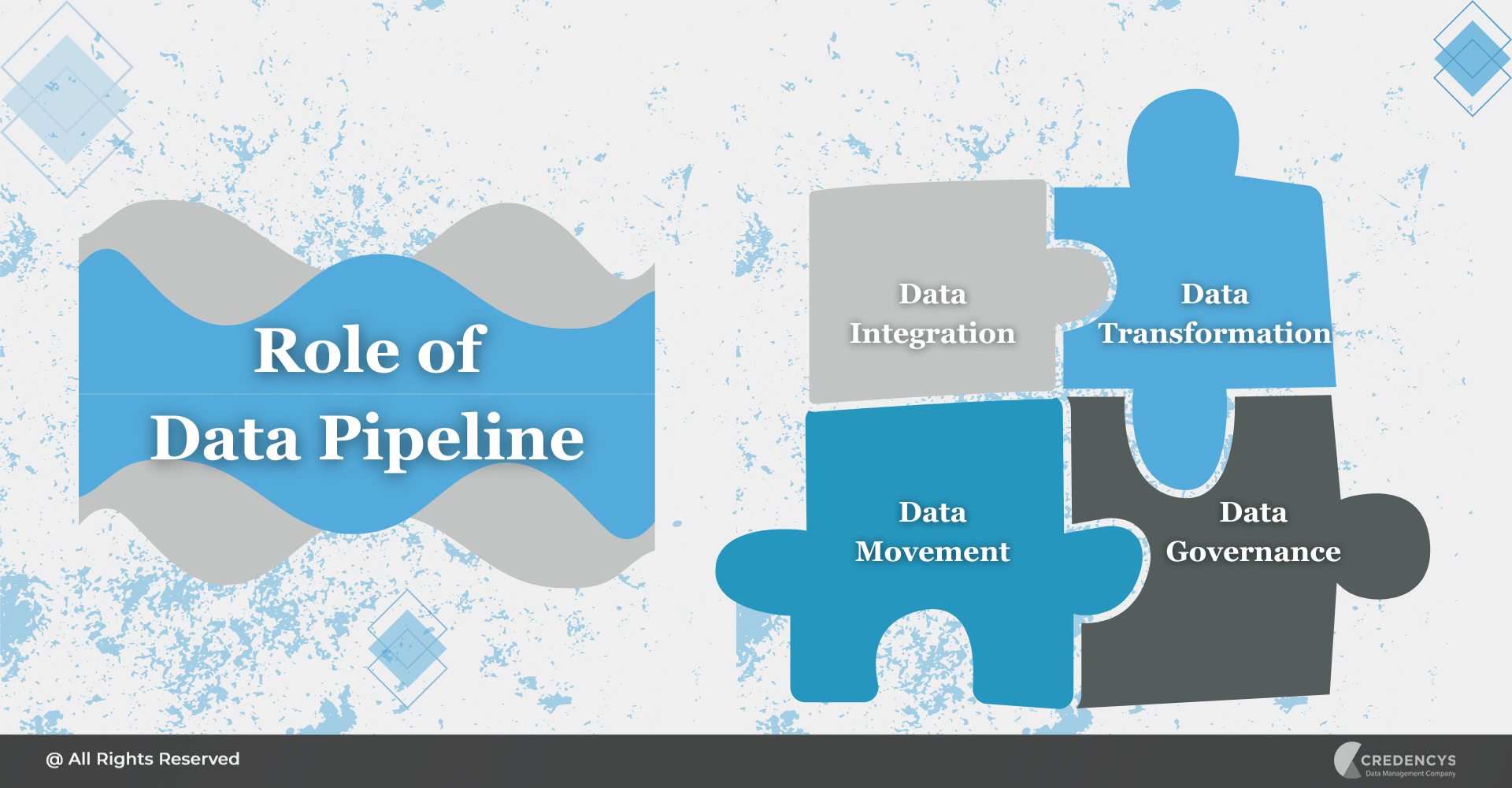
The Data Pipeline plays a pivotal role in optimizing data management processes and streamlining the flow of information. Its key functions include:

Data Integration

Aggregating data from various sources, regardless of its format or location, into a unified and accessible environment.

Data Transformation

Applying data transformations and enrichment to ensure data consistency, quality, and relevance.

Data Movement

Seamlessly moving data between systems, databases, and applications, enabling real-time or batch data processing.

Data Governance

Implementing data governance policies to maintain data accuracy, security, and compliance throughout its journey.
Role of Data Pipeline
In the world of data management, a Data Pipeline emerges as a powerful and indispensable tool that revolutionizes the way organizations handle their data. Understanding the essence of a Data Pipeline and its functionalities is crucial for businesses seeking to streamline their data flow and optimize their data management processes.

What is Data Pipeline?

At its core, a Data Pipeline can be envisioned as a series of interconnected stages through which data flows, undergoing transformation and processing along the way. It acts as a structured pathway that facilitates the movement of data from diverse sources to specified target destinations, ensuring data accessibility and availability for various use cases.

Just like a physical pipeline carries and channels liquids from one point to another, a Data Pipeline carries and directs data, making it an essential component of efficient data management.

Purpose of Data Pipeline

The primary purpose of a Data Pipeline lies in automating and orchestrating the complex process of data movement, transformation, and processing. By leveraging a Data Pipeline, organizations can:

Transform Data

Data may come in various formats and structures from multiple sources. A Data Pipeline allows organizations to apply data transformations, standardizations, and enrichments, ensuring data consistency and quality throughout its journey.

Process Data in Real-time or Batch

Depending on the nature of the data and business requirements, a Data Pipeline can process data in real-time, enabling immediate insights and actions, or in batches, optimizing the utilization of resources for larger datasets.

Move Data Seamlessly

Data can flow through a network of systems, applications, and databases. A Data Pipeline simplifies the movement of data, allowing smooth data transfer between these interconnected components.

Enable Data Integration

In a modern data landscape, data resides in multiple sources and systems. A Data Pipeline integrates data from diverse sources, eliminating data silos and creating a unified view of information.

Purpose of Data Pipeline
Key Components of a Data Pipeline

To comprehend the workings of a Data Pipeline, it is essential to grasp its key components, each playing a critical role in managing the flow of data:

Data Sources

Data Pipelines start with data sources, which can include databases, cloud storage, applications, APIs, log files, and more. These sources act as the origins of data that need to be collected and processed.

Data Transformations

The Data Pipeline includes mechanisms for data transformations, where data undergoes cleansing, enrichment, aggregation, and other manipulations to ensure its relevance and reliability.

Data Storage

During its journey, data might be stored temporarily or permanently at various points within the Data Pipeline. This storage can be in the form of databases, data lakes, data warehouses, or cloud storage.

Data Destinations

The Data Pipeline directs data towards specific destinations or target systems where it will be used for analysis, reporting, visualization, or other purposes.

Key Components of a Data Pipeline
Benefits of Implementing a Data Pipeline

In the realm of modern data management, the implementation of a Data Pipeline brings forth a myriad of advantages that revolutionize how businesses handle their data and make informed decisions. Let’s explore the transformative benefits of incorporating Data Pipelines into data management processes.

Advantages in Data Management and Decision-Making

Streamlined Data Flow

A Data Pipeline establishes an organized and structured pathway for data to flow seamlessly from source to destination. By automating data movement, businesses can efficiently manage data pipelines, reducing manual intervention and human errors.

Real-time Insights

With real-time data processing capabilities, Data Pipelines enable businesses to access and analyze up-to-date information. This empowers decision-makers to respond rapidly to changing trends, customer behaviors, and market conditions, fostering a competitive edge.

Enhanced Data Quality and Consistency

Data Pipelines enforce data transformations, cleansing, and validations, ensuring data quality and consistency across all stages. As a result, businesses can rely on accurate and reliable data for making critical decisions.

Efficient Resource Utilization

Data Pipelines optimize resource utilization by automating data processing tasks, thus freeing up human resources for more strategic and value-added activities.

Data Governance and Compliance

Implementing Data Pipelines facilitates the enforcement of data governance policies throughout the data journey. This ensures compliance with data regulations and fosters data security and privacy.

Enhanced Data Quality, Reliability, and Consistency

Data Pipelines play a pivotal role in enhancing data quality, reliability, and consistency through various mechanisms:

Data Validation

Data Pipelines validate incoming data against predefined rules, identifying and handling erroneous or inconsistent data to maintain data accuracy.

Data Enrichment

By enriching data with relevant information from external sources, Data Pipelines enhance the value and context of the data.

Error Handling

Data Pipelines are equipped to handle data processing errors effectively, ensuring data consistency and integrity.

Version Control

With Data Pipelines, organizations can maintain version control of data, enabling accurate historical analysis and comparison.

Efficiency and Scalability from Automating Data Workflows

Data Pipelines introduce significant efficiency gains by automating repetitive data processing tasks:

Faster Data Processing

By automating data workflows, Data Pipelines enable faster data processing, resulting in timely insights and quicker decision-making.

Scalability

As data volumes grow, manual data processing becomes impractical. Data Pipelines offer scalability, accommodating larger datasets without compromising performance.

Resource Optimization

Automation reduces the need for human intervention in data processing, leading to cost savings and improved resource allocation.

Curating an Effective Data Pipeline Design

Designing a well-structured and efficient Data Pipeline is crucial for businesses to leverage the full potential of their data and drive meaningful insights. This section outlines the essential steps, best practices, and common challenges in curating a Data Pipeline design that aligns with the organization’s data requirements and objectives.

Define Data Requirements and Objectives

Begin by understanding the specific data requirements of your organization. Identify the sources of data, the desired data transformations, the frequency of data updates, and the target destinations.
Clearly define the objectives you aim to achieve through the Data Pipeline, whether it’s real-time data analysis, improved decision-making, or enhanced data integration.

Map the Data Flow

Create a detailed data flow diagram that illustrates the journey of data from its sources to its destination, including all intermediate steps and transformations. This mapping will provide a clear overview of the entire data pipeline process.

Data Transformation and Cleaning

Implement data transformation and cleaning processes at various stages of the pipeline to ensure data consistency, quality, and relevance. Use industry-standard data cleaning techniques to handle missing values, duplicates, and outliers.

Choose the Right Tools and Technologies

Select appropriate tools and technologies that align with your data pipeline requirements. Consider factors such as scalability, real-time processing capabilities, compatibility with existing systems, and ease of maintenance.

Data Governance and Security

Incorporate data governance practices into the design to maintain data security, privacy, and compliance with relevant regulations. Implement access controls and encryption methods to protect sensitive data.

Test and Monitor

Thoroughly test the Data Pipeline at each stage to identify and resolve any issues before deployment. Implement robust monitoring and logging mechanisms to track the performance and health of the Data Pipeline continuously.

Effective Data Pipeline Design
Selecting Appropriate Data Pipeline Tools and Technologies

Data Integration Platforms

Consider using data integration platforms that offer features for connecting and transforming data from multiple sources. Popular choices include Apache NiFi, Talend, and Informatica.

Distributed Data Processing Frameworks

For handling large-scale data processing tasks, distributed data processing frameworks like Apache Spark and Apache Flink provide high performance and scalability.

Cloud Services

Cloud-based services such as AWS Data Pipeline, Azure Data Factory, and Google Cloud Dataflow offer fully managed data integration and processing capabilities, allowing organizations to focus on data insights rather than infrastructure management.

Message Brokers

Utilize message brokers like Apache Kafka or RabbitMQ to enable real-time data streaming and ensure data continuity in case of system failures.
Data Pipeline Tools and Technologies

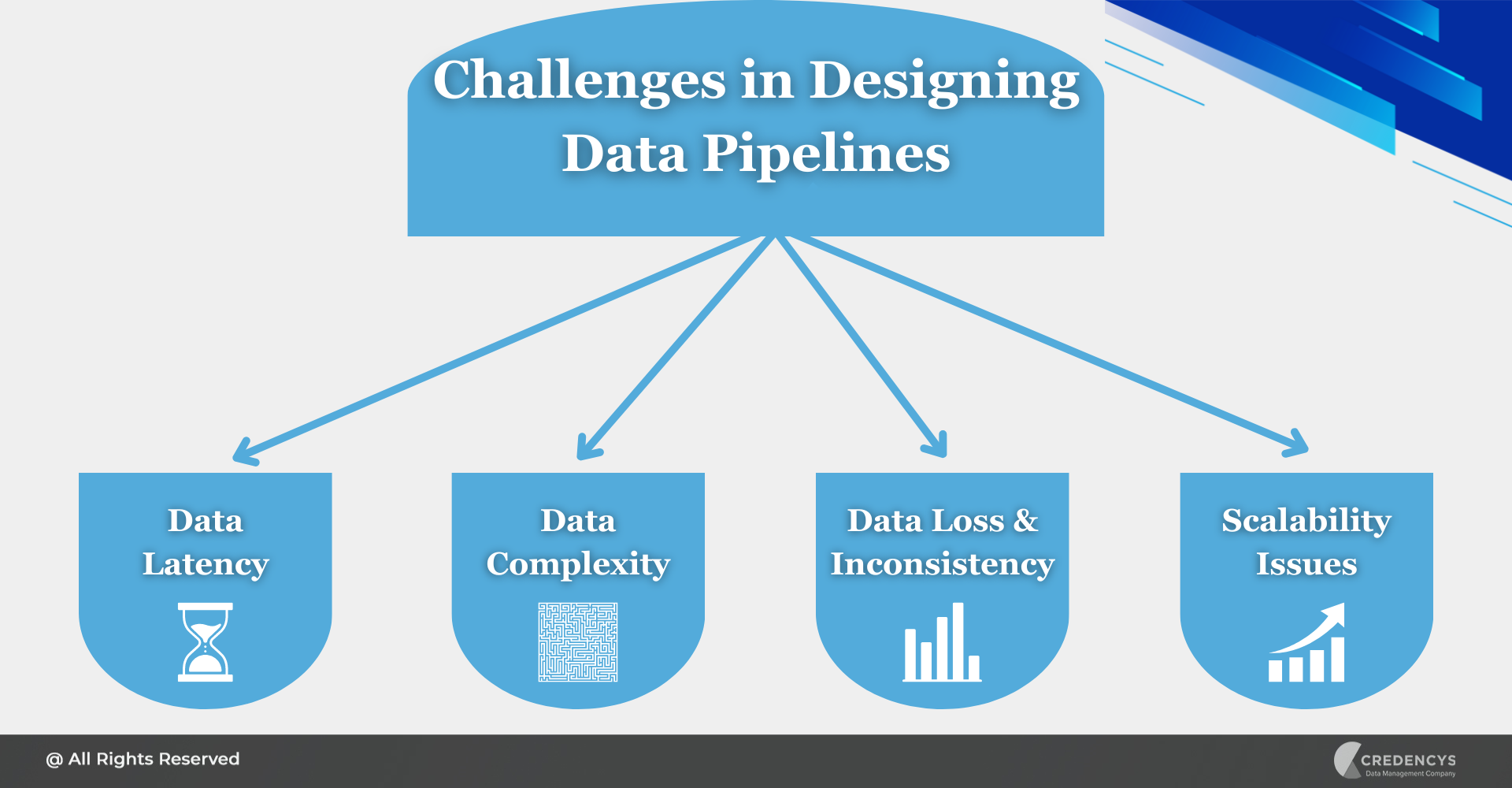
Addressing Common Challenges in Designing Data Pipelines

Data Latency

Minimize data latency by optimizing the data pipeline architecture and using appropriate tools for real-time data processing.

Data Complexity

Break down complex data transformations into smaller, manageable tasks to simplify the pipeline design and improve maintainability.

Data Loss and Inconsistency

Implement data checkpoints and error handling mechanisms to prevent data loss and maintain data consistency in case of failures.

Scalability Issues

Design the Data Pipeline with scalability in mind, leveraging distributed computing and cloud resources to handle increasing data volumes.
Challenges in Data Pipelines
Data Security and Compliance in Data Pipelines

Data security and privacy considerations are of paramount importance in the design and implementation of Data Pipelines. As data continues to play a critical role in driving business decisions, safeguarding sensitive information and complying with data regulations have become non-negotiable priorities for organizations.

Importance of Data Security and Privacy Considerations in Data Pipelines

Protecting Sensitive Information

Data Pipelines often handle vast amounts of sensitive data, including customer information, financial records, and proprietary business data. Any unauthorized access or data breach could lead to severe consequences, including financial loss and reputational damage.

Regulatory Compliance

With data protection and privacy regulations becoming more stringent worldwide (such as GDPR, CCPA, and HIPAA), businesses must adhere to these laws to avoid hefty fines and legal implications.

Maintaining Customer Trust

Data breaches can severely impact customer trust and loyalty. A robust Data Pipeline with strong security measures assures customers that their data is handled with utmost care and confidentiality.

Role of Encryption, Access Controls, and Data Monitoring in Securing Data Pipelines

Encryption

Data encryption ensures that data remains secure both during transit between different pipeline components and when stored in databases or data repositories. It serves as a strong safeguard against data interception and unauthorized access.

Access Controls

Implementing access controls helps prevent unauthorized access to sensitive data. By setting granular access permissions based on user roles and responsibilities, it is recommended to ensure that data is accessible only to authorized personnel.

Data Monitoring

Data monitoring allows businesses to track data movement throughout the Data Pipeline in real-time. This monitoring enables rapid detection of any anomalies or suspicious activities, enabling prompt action to mitigate potential threats.

Future Trends in Data Pipeline Technology

In the rapidly evolving landscape of data management, Data Pipeline technology continues to witness groundbreaking advancements that shape the future of data-driven decision-making. As organizations seek to harness the full potential of their data, staying informed about emerging trends and potential innovations becomes critical for staying ahead in the industry.

Emerging Trends and Advancements in Data Pipeline Technology

Real-time Data Processing

The demand for real-time data processing is on the rise. Future Data Pipelines will focus on reducing data latency to provide up-to-the-moment insights, enabling businesses to make instant decisions based on the most current information.

Event-driven Architectures

Event-driven Data Pipelines leverage events and triggers to process data as it is generated or received. This approach ensures efficient handling of large-scale data streams and facilitates event-based data integration.

Serverless Data Pipelines

Serverless computing eliminates the need for managing infrastructure, allowing Data Pipelines to automatically scale based on demand. This results in cost efficiency and increased agility.

Federated Data Pipelines

The emergence of distributed data sources requires Data Pipelines to adopt federated approaches. Future Data Pipelines will seamlessly integrate data from various data stores, cloud services, and edge devices.

AI and Machine Learning Integration

Incorporating AI and machine learning models within Data Pipelines will enable intelligent data transformations, anomaly detection, and predictive analytics.

Potential Innovations Revolutionizing Data Management

Blockchain in Data Pipelines

The integration of blockchain technology into Data Pipelines can enhance data security, traceability, and transparency, making it ideal for industries like supply chain management and healthcare.

Data Privacy Enhancements

Future Data Pipelines may feature enhanced data privacy mechanisms, such as differential privacy, to protect sensitive data while still providing valuable insights.

Data Lineage and Governance

Innovations in data lineage tracking and governance tools will improve data traceability, enabling businesses to better manage data provenance and comply with regulatory requirements.

Leverage Credencys’ Expertise in Implementing Effective Data Pipelines

Credencys, a leading data management company, is here to empower your business with cutting-edge solutions and expertise in implementing effective Data Pipelines.

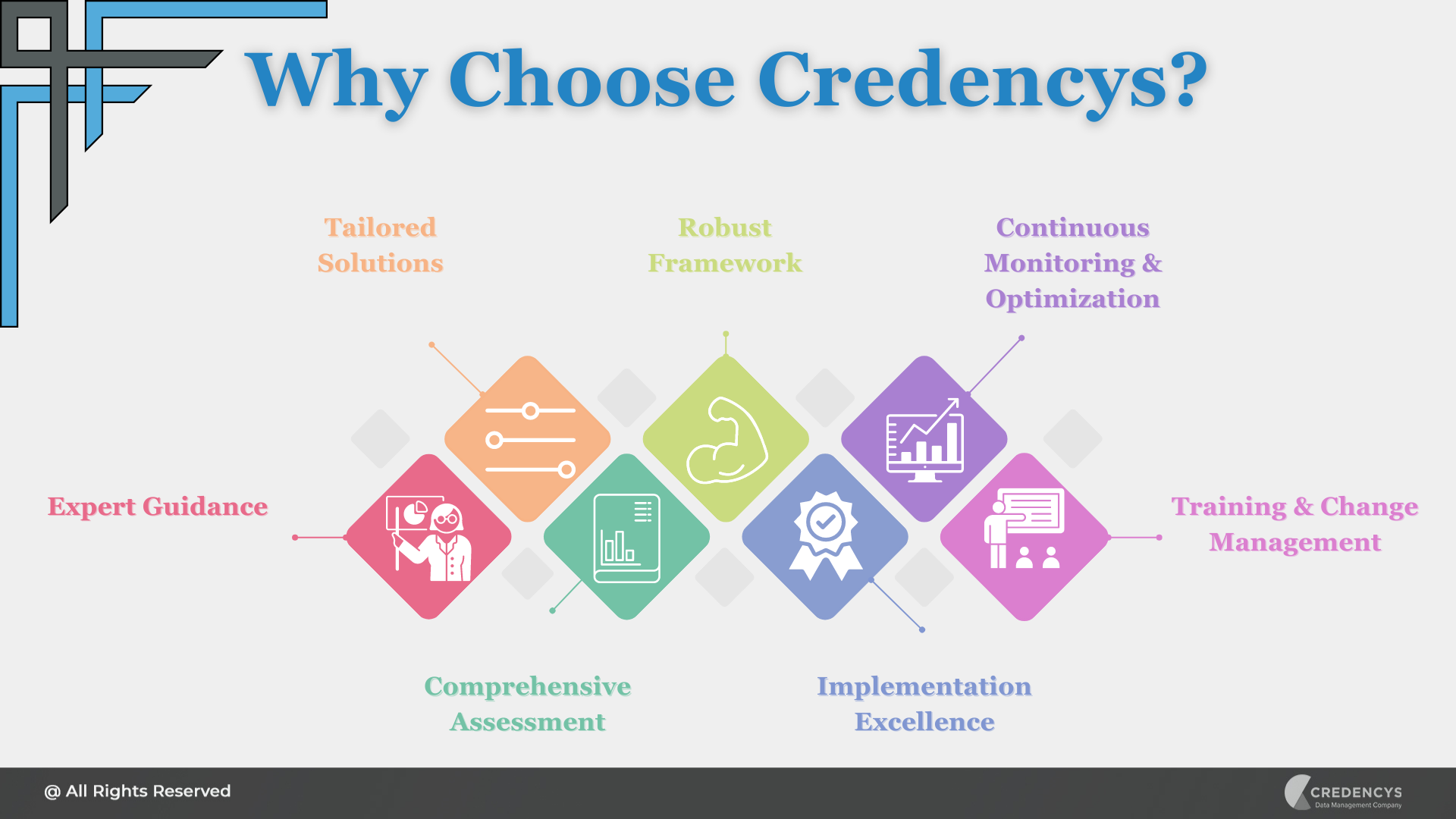
Why Choose Credencys?

Proven Track Record

With a proven track record of delivering top-notch data management solutions, Credencys has earned the trust of numerous clients across diverse industries. Our success stories are a testament to our commitment to excellence and innovation.

Expert Team

At Credencys, we boast a team of seasoned experts well-versed in the latest trends and advancements in data management and Data Pipeline technology. Their expertise ensures that your Data Pipeline is designed and implemented to meet your specific data requirements and business objectives.

Tailored Solutions

We understand that each organization’s data needs are unique. Therefore, our solutions are tailored to address your specific data challenges and help you derive maximum value from your data assets.

Security and Compliance

Data security and compliance are at the core of our Data Pipeline solutions. With robust encryption, access controls, and data monitoring, we ensure that your data is safeguarded against potential threats and remains compliant with relevant regulations.

How Credencys Empowers Your Business?

Streamlined Data Management

Our Data Pipeline solutions establish a well-structured pathway for data to flow seamlessly from diverse sources to target destinations, simplifying data management and enhancing data accessibility.

Real-time Insights

With real-time data processing capabilities, our Data Pipelines provide up-to-the-moment insights, enabling faster and data-driven decision-making for your business.

Enhanced Data Quality

We implement data transformation and cleansing processes to ensure data consistency, reliability, and accuracy, empowering you to trust the insights derived from your data.

Scalable and Efficient

Our Data Pipelines are designed for scalability, ensuring smooth handling of increasing data volumes without compromising on performance.

Take the Next Step

To experience the transformative power of Data Pipelines and data management, we invite you to explore Credencys’ range of data solutions. Our team is eager to understand your unique data challenges and collaboratively design a Data Pipeline that empowers your organization to thrive in the data-centric future.

Real-time Analytics in Manufacturing: Optimizing Your Business Decisions

In today’s hyper-connected world, where time is of the essence and information is at our fingertips, the manufacturing industry is embracing the power of real-time data analytics to stay ahead of the game. Leveraging the real-time analytics in manufacturing industry, businesses understand customer behavior, market trends, and more.

Imagine a manufacturing environment where data flows seamlessly, like an orchestra playing in perfect harmony. Real-time analytics conducts this symphony, extracting valuable insights from the different data domains. It’s like having a crystal ball that empowers manufacturers to predict, optimize, and seize opportunities as they happen.

Gone are the days of relying on hindsight to make critical decisions. Real-time analytics paints a vivid picture of the present moment, empowering manufacturers to make informed choices that can alter the course of their business.

In this article, we will dive deep into the significance of real-time analytics in the manufacturing industry. We’ll explore how it enhances operational efficiency, revolutionizes quality control, optimizes supply chain management, and empowers manufacturers to make agile, data-driven decisions.

So, buckle up and get ready to witness the power of real-time analytics as we embark on a journey to reshape the future of manufacturing.

What is Real-Time Analytics?

Real-time analytics refers to the process of collecting, analyzing, and interpreting data as it is generated, enabling immediate insights and actions.

Unlike traditional batch processing, which involves analyzing data after it has been collected, real-time analytics provides up-to-the-minute information that empowers organizations to respond quickly to changing conditions.

By leveraging advanced technologies such as master data management, real-time analytics enables the processing and analysis of vast amounts of data in real-time.

Significance of Real-Time Analytics in Manufacturing

Improved Operational Efficiency

Real-time data analytics offers manufacturers the ability to monitor and optimize various data driven operational processes in real-time.

By capturing and analyzing data from production lines, equipment, and supply chain, manufacturers can identify bottlenecks, track performance, and make immediate adjustments to enhance efficiency.

Real-time insights enable proactive decision-making, reducing downtime, improving resource utilization, and minimizing production errors.

Supply Chain Optimization

In the complex manufacturing ecosystem, real-time analytics provides valuable insights into the supply chain. Manufacturers can track inventory levels, monitor demand fluctuations, and optimize logistics and distribution processes based on real-time data.

By improving supply chain visibility and agility, manufacturers can minimize inventory costs, streamline procurement, and respond quickly to changing market dynamics.

Improved Decision-Making

Real-time analytics equips decision-makers with a wealth of timely and accurate insights. By continuously monitoring and analyzing data in real-time, organizations can identify patterns, trends, and anomalies as they occur.

This empowers decision-makers to respond swiftly to changing market conditions, customer demands, and operational challenges.

With real-time analytics, Master Data Management professionals can make data-driven decisions that are aligned with organizational goals, leading to improved efficiency, productivity, and profitability.

Enhanced Customer Satisfaction

In today’s customer-centric world, organizations must prioritize customer satisfaction to thrive. Real-time data analytics plays a pivotal role in this endeavor.

By leveraging real-time insights, organizations can gain a deeper understanding of customer behavior, preferences, and sentiment. This enables them to personalize experiences, anticipate customer needs, and deliver tailored solutions in real-time.

Whether it’s proactively addressing customer issues or offering personalized recommendations, real-time analytics empowers MDM professionals to create exceptional customer experiences that drive loyalty and satisfaction.

Cost Reduction

Real-time analytics is a powerful tool for identifying cost-saving opportunities in Master Data Management. By monitoring data in real-time, organizations can detect inefficiencies, bottlenecks, and wasteful practices.

Leveraging real-time analytics in manufacturing allows businesses with proactive interventions to optimize processes, reduce waste, and streamline operations. This can lead to significant cost savings, improved resource allocation, and enhanced overall profitability.

From inventory management to supply chain optimization, real-time analytics enables organizations to make data-driven decisions that result in cost reduction without compromising quality or customer satisfaction.

Real-time data analytics is revolutionizing the manufacturing industry, enabling manufacturers to transform their operations and drive better business outcomes.

By harnessing the power of real-time data, manufacturers can enhance operational efficiency, optimize equipment utilization, improve product quality, streamline supply chain processes, ensure safety, and make agile decisions.

Embracing real-time analytics in manufacturing is no longer an option but a necessity for manufacturers looking to ensure business success.

Real-Time Analytics Tracks Key Performance Indicators (KPIs) in Manufacturing

Tracking Key Performance Indicators (KPIs) is essential for organizations to measure their progress, evaluate performance, and make informed decisions.

Real-time analytics plays a pivotal role in this process, offering numerous benefits and empowering organizations to effectively track their KPIs. Let’s explore the key role of real-time analytics in tracking KPIs:

Timely Performance Monitoring

Real-time analytics provides organizations with the ability to monitor KPIs in real-time. This means that performance metrics and data are continuously updated, allowing stakeholders to have immediate visibility into the current state of affairs.

With real-time monitoring, organizations can promptly identify any deviations or issues and take proactive actions to address them.

Rapid Decision-Making

In today’s fast-paced business environment, quick and informed decision-making is crucial. Real-time analytics enables organizations to access up to date KPI data, empowering decision-makers with real-time insights.

With the ability to track KPIs in real-time, stakeholders can make data-driven decisions promptly, without having to wait for periodic reports or manually compile data.

This agility in decision-making ensures that organizations can respond swiftly to changing circumstances, optimize their strategies, and drive better results.

Data-Driven Insights

Real-time analytics provides organizations with rich and detailed insights into KPI performance. By analyzing real-time data, organizations can uncover trends, patterns, and correlations that may not be apparent in traditional periodic reports.

These data-driven insights allow stakeholders to gain a deeper understanding of performance drivers, identify areas for improvement, and make informed decisions to optimize KPIs.

Real-time analytics equips organizations with the power to dig deeper into their KPIs and extract actionable insights that drive continuous improvement.

Accountability and Transparency

Real-time analytics fosters a culture of accountability and transparency within organizations. When KPIs are tracked in real-time, performance data becomes more visible and accessible to relevant stakeholders.

This transparency promotes accountability as individuals and teams can monitor their progress and take ownership of their performance.

Real-time analytics also enables organizations to share performance data with relevant stakeholders, fostering transparency and alignment across the organization.

Real-time analytics plays a vital role in tracking KPIs by offering timely performance monitoring, facilitating rapid decision-making, providing data-driven insights, and promoting accountability and transparency.

By leveraging real-time analytics in KPI tracking, organizations can optimize their performance, make informed decisions, and drive continuous improvement towards their strategic objectives.

How Do Real-Time Analytics Businesses Identify Trends in Manufacturing Industry?

Real-time analytics plays a crucial role in identifying trends and patterns within data, enabling organizations to gain valuable insights and make informed decisions. Let’s explore the role of real-time analytics in identifying trends:

Immediate Detection of Emerging Trends

Real-time analytics allows organizations to detect emerging trends as they happen. By continuously analyzing data in real-time, organizations can identify sudden shifts, changes, or patterns that may indicate emerging trends.

This immediate detection empowers organizations to stay ahead of the curve and capitalize on new opportunities or address potential challenges promptly.

Faster Response to Changing Market Dynamics

In today’s dynamic business landscape, being able to respond quickly to changing market dynamics is essential. Real-time analytics provides organizations with the ability to monitor data streams, social media feeds, customer interactions, and other relevant sources in real-time.

By analyzing these real-time data sources, organizations can identify trends, such as shifts in customer preferences, market demands, or competitor activities, and respond swiftly with appropriate strategies or actions.

Actionable Insights for Business Growth

Real-time analytics helps organizations gain actionable insights by identifying trends that can drive business growth. By analyzing real-time data, organizations can uncover patterns, correlations, and outliers that highlight market trends, customer preferences, or operational inefficiencies.

These insights enable organizations to take proactive steps to capitalize on positive trends, mitigate risks associated with negative trends, and optimize their overall business performance.

Personalized Customer Experiences

Real-time analytics allows organizations to track and analyze customer behavior and preferences in real-time. By identifying trends in customer interactions, purchases, or engagement patterns, organizations can personalize customer experiences in real-time.

This can include offering targeted product recommendations, delivering personalized marketing messages, or providing real-time customer support, all tailored to individual customer preferences and current trends.

Real-time analytics plays a vital role in identifying trends by enabling immediate detection of emerging trends, facilitating faster response to changing market dynamics, enhancing predictive capabilities, improving decision-making, providing actionable insights for business growth, and enabling personalized customer experiences.

By harnessing the power of real-time analytics, organizations can stay ahead of the competition, capitalize on emerging opportunities, and drive sustainable business success.

Semarchy MDM: Empowering Real-Time Analytics in Manufacturing

In today’s fast-paced and data-driven world, the manufacturing industry faces the challenge of effectively managing and leveraging vast amounts of data. Master Data Management (MDM) has emerged as a critical discipline to address this challenge and ensure data consistency, accuracy, and reliability across the organization.

One such leading provider of MDM solutions that empowers real-time analytics in manufacturing is Semarchy.

Semarchy is a renowned master data management platform provider that offers robust and comprehensive solutions to help organizations harness the power of their data. With a focus on real-time analytics, Semarchy enables manufacturing companies to derive valuable insights, make data-driven decisions, and drive operational excellence.

As a leading MDM platform provider, Semarchy offers a range of features and capabilities that are specifically designed to empower real-time analytics in the manufacturing industry.

Don’t miss visiting, What is Semarchy? to have exclusive insights into every aspect of Semarchy. It helps you understand the platform inside out and explore its advanced capabilities that transform the digital journey for your manufacturing organization.

Real-time Analytics Capabilities of Semarchy MDM

Data Consolidation and Integration

Semarchy MDM allows manufacturing organizations to consolidate and integrate data from multiple sources, such as ERP systems, CRM platforms, supply chain systems, and IoT devices.

By bringing together disparate data sources in real-time, Semarchy Master Data Management enables a unified view of data, providing a solid foundation for real-time analytics.

Data Quality Management

Real-time data analytics heavily relies on the quality of data. Semarchy MDM offers robust data quality management capabilities, including data cleansing, validation, and enrichment.

By ensuring data accuracy, consistency, and completeness, Semarchy enhances the reliability of real-time analytics, enabling organizations to make informed decisions based on trustworthy data.

Data Governance and Security

With data privacy and compliance becoming increasingly important, Semarchy MDM provides robust data governance and security features.

Manufacturing organizations can establish data governance policies, define access controls, and ensure data protection to comply with industry regulations. This enables secure and reliable real-time analytics, giving organizations peace of mind while leveraging their data.

Real-Time Data Integration and Processing

Semarchy Master Data Management enables real-time data integration and processing, ensuring that the analytics insights are generated promptly.

Manufacturing companies can leverage Semarchy’s real-time data integration capabilities to capture, transform, and analyze data in real-time, allowing them to respond swiftly to changing market conditions and operational requirements.

Advanced Analytics and Machine Learning

Semarchy MDM platform incorporates advanced analytics and machine learning capabilities. This empowers manufacturing organizations to perform sophisticated data analysis, predictive modeling, and trend identification.

With real-time analytics powered by Semiarch, manufacturing companies can uncover hidden patterns, identify emerging trends, and gain a competitive advantage in the market.

Self-Service Data Exploration and Visualization

Semarchy Master Data Management offers intuitive self-service data exploration and visualization tools that empower business users to explore and analyze data in real-time.

Manufacturing professionals can easily access and interact with data through intuitive dashboards, charts, and reports, enabling them to gain valuable insights without relying on IT or data science teams.

Semarchy is a leading master data management platform provider that empowers real-time analytics in manufacturing.

By offering comprehensive data consolidation, data quality management, data governance, real-time integration and processing, advanced analytics, and self-service data exploration capabilities, Semarchy enables manufacturing organizations to unlock the full potential of their data.

Agile Data Modeling

By harnessing the power of Semarchy’s real-time data analytics in manufacturing, organizations can have access to agile data modeling capabilities, allowing organizations to adapt quickly to changing business requirements.

The platform offers a flexible and user-friendly interface for data modeling, enabling users to define and modify data models on-the-fly.

This agility ensures that organizations can incorporate new data sources and analytics requirements in real-time without disrupting ongoing operations.

Real-Time Monitoring and Alerts

Semarchy’s real-time analytics tools provide real-time monitoring and alerting capabilities, enabling organizations to proactively track key metrics and identify anomalies.

Users can set up customizable alerts based on predefined thresholds or business rules, ensuring that critical issues or opportunities are promptly detected and addressed.

This real-time monitoring capability allows organizations to take immediate action and optimize their operations based on real-time insights.

Scalability and Performance

Semarchy’s real-time analytics tools are designed to handle large volumes of data and deliver high-performance analytics. The platform is built to scale, ensuring that organizations can process and analyze data in real-time, even as data volumes and complexity increase.

Semarchy’s performance capabilities enable businesses to keep pace with the speed of their data-driven operations.

Enhanced Visibility and Control

Semarchy MDM provides manufacturing businesses with enhanced visibility and control over their data. By centralizing and managing master data across the organization, Semarchy ensures that all stakeholders have access to accurate, consistent, and reliable information in real-time.

This increased visibility into data empowers decision-makers to understand the impact of their choices on different aspects of the manufacturing process, from production to inventory management to customer satisfaction.

Performance Monitoring and Optimization

Semarchy’s real-time analytics tools enable manufacturing businesses to monitor key performance indicators (KPIs) in real-time.

By tracking metrics such as production output, cycle time, quality control, and equipment utilization, businesses can identify bottlenecks, inefficiencies, and areas for improvement.

Real-time performance monitoring allows manufacturers to proactively address issues, optimize processes, and drive operational excellence.

Cost Reduction and Efficiency Gains

Semarchy’s real-time analytics capabilities help manufacturing businesses reduce costs and improve efficiency. By identifying inefficiencies, optimizing production processes, and minimizing waste, manufacturers can enhance resource utilization and reduce operational expenses.

Real-time insights enable businesses to make data-driven decisions that lead to cost savings and improved profitability.

In today’s fast-paced manufacturing environment, Semarchy’s real-time analytics tools provide the essential capabilities needed to drive data-driven decision-making.

With features such as real-time data integration, enhanced visibility and control, performance monitoring, predictive analytics, collaborative decision-making, agile data modeling, and cost reduction, Semarchy MDM empowers manufacturing businesses to make timely and informed decisions that drive operational excellence, customer satisfaction, and business growth.

Benefits of Semarchy’s Real-Time Analytics

Semarchy, a leading provider of master data management (MDM) solutions, offers robust real-time analytics capabilities that deliver significant advantages to manufacturing businesses.

By harnessing the power of Semarchy’s real-time analytics tools, manufacturers can unlock valuable insights from their data, streamline operations, and gain a competitive edge in the industry.

Let’s explore the benefits of using Semarchy for real-time analytics in manufacturing.

Make Informed Decisions

Semarchy’s real-time analytics tools provide manufacturing businesses with timely and accurate information to support decision-making. By analyzing data in real-time, businesses can make informed choices based on up-to-date insights.

Whether it’s optimizing production schedules, responding to market demand fluctuations, or identifying areas for process improvement, Semarchy empowers decision-makers with the knowledge they need to drive strategic and operational decisions.

Streamlined Operations

Real-time analytics is instrumental in improving operational efficiency within manufacturing organizations. Semarchy enables businesses to monitor key performance indicators (KPIs) in real-time, identify bottlenecks, and optimize processes.

By tracking metrics such as production output, equipment utilization, and quality control, manufacturers can proactively address issues and streamline operations. This leads to increased productivity, reduced downtime, and enhanced overall efficiency.

Accurate and Consistent Data

Semarchy ensures that manufacturing businesses have access to accurate, consistent, and reliable data in real-time. By centralizing and managing master data, Semarchy eliminates data silos and provides a single source of truth.

Real-time data integration and validation capabilities ensure that data remains consistent across different systems and departments. This data integrity ensures that decisions are based on reliable information, reducing the risk of errors and improving overall data quality.

Predictive Insights for Demand Forecasting

Semarchy incorporates advanced analytics and machine learning capabilities that enable manufacturers to gain predictive insights for demand forecasting. By analyzing historical and real-time data, Semarchy’s real-time analytics tools can identify trends, patterns, and demand fluctuations.

This empowers manufacturers to anticipate market needs, optimize inventory levels, and ensure timely delivery of products. Accurate demand forecasting helps businesses meet customer expectations, reduce inventory holding costs, and maximize revenue opportunities.

Seamless Collaboration and Data Sharing

Semarchy facilitates seamless collaboration and data sharing within manufacturing organizations. Its real-time analytics tools provide a unified platform where stakeholders from different departments can access and analyze data together.

This promotes cross-functional collaboration, breaks down data silos, and fosters a culture of data-driven decision-making. With Semarchy, teams can work together efficiently, align their strategies, and leverage collective insights for better business outcomes.

Scalability and Adaptability

Semarchy’s real-time analytics tools are designed to scale with the evolving needs of manufacturing businesses.

As data volumes grow and new data sources emerge, Semarchy provides the flexibility to handle increasing data complexities. Its agile data modeling capabilities enable organizations to adapt quickly to changing requirements without disrupting operations.

This scalability and adaptability ensure that manufacturers can stay ahead of industry trends, incorporate new data streams, and drive continuous innovation.

Semarchy’s real-time analytics capabilities offer a multitude of benefits for manufacturing businesses. By enabling enhanced decision-making, improving operational efficiency, ensuring data accuracy, facilitating proactive issue detection, providing predictive insights, fostering collaboration, and offering scalability, Semarchy empowers manufacturers to thrive in a data-driven world.

By leveraging Semarchy MDM for real-time data analytics in manufacturing, businesses can unlock the full potential of their data and gain a competitive advantage in the industry.

Industry Use Cases of Semarchy’s Real-Time Analytics in Manufacturing Industry

Numerous manufacturing businesses across different sectors have experienced tangible benefits from Semarchy’s real-time analytics capabilities. Let’s explore a few notable use cases where Semarchy has made a significant impact:

Automotive

A leading automotive manufacturer implemented Semarchy’s real-time analytics to optimize its supply chain operations.

By monitoring real-time data on inventory levels, production schedules, and customer demand, the manufacturer achieved better inventory management, reduced stockouts, and improved on-time delivery performance.

The result was enhanced customer satisfaction and increased operational efficiency.

Pharmaceutical

A pharmaceutical company utilized Semarchy’s real-time analytics tools to improve its quality control processes. By monitoring and analyzing real-time data from production lines, the company detected deviations and anomalies in the manufacturing process, enabling prompt corrective actions.

As a result, product quality improved, and costly recalls were minimized, leading to substantial cost savings and enhanced brand reputation.

Consumer Electronics

A consumer electronics manufacturer leveraged Semarchy’s real-time analytics to optimize its production efficiency.

By monitoring real-time data on machine performance, equipment utilization, and production output, the manufacturer identified bottlenecks and inefficiencies in the manufacturing process.

This allowed them to optimize production schedules, reduce cycle times, and increase overall productivity, resulting in cost savings and improved competitiveness.

Operational Use Cases of Semarchy’s Real-Time Analytics in Manufacturing Business

Semarchy’s real-time analytics capabilities have proven instrumental in improving manufacturing operations across various domains. Here are a few examples of how Semarchy has contributed to operational improvements:

Supply Chain Optimization

By integrating real-time data from suppliers, distributors, and production facilities, Semarchy enables manufacturers to optimize their supply chain operations.

Real-time analytics allows businesses to track inventory levels, monitor demand fluctuations, and identify potential supply chain disruptions. With this information, manufacturers can make proactive decisions, ensure timely deliveries, and minimize inventory holding costs.

Quality Management

Semarchy’s real-time analytics tools help manufacturers enhance their quality management processes. By analyzing real-time data from quality control systems, sensor networks, and production lines, businesses can identify quality issues and deviations in real-time.

This enables prompt corrective actions, reduces waste, and improves overall product quality and compliance.

Conclusion

Semarchy’s real-time analytics capabilities have revolutionized decision-making, customer satisfaction, and cost reduction in the manufacturing industry.

By harnessing the power of real-time insights, manufacturing businesses can make informed decisions, meet customer expectations, and optimize operational costs.

Semarchy’s real-time analytics tools offer valuable features and functionality that empower manufacturers to gain real-time visibility, track key performance indicators, and identify trends critical to their success.

With Semarchy, manufacturing businesses can achieve operational excellence, enhance customer satisfaction, and gain a competitive edge in today’s data-driven landscape.

What is Data Lineage? – A Comprehensive Guide

In the vast landscape of data management, where information flows like a river, understanding the lineage of data has become a paramount necessity. This is why I would like to help organizations to understand what is data lineage and the different aspects associated with it.

Data lineage acts as a guiding thread that unravels the intricate story behind the origin, evolution, and journey of data within an organization.

It paints a vivid picture of how data is created, transformed, and utilized across various systems, processes, and departments. This in-depth comprehension of data lineage holds immense significance in the realm of data management and decision-making, paving the way for improved data quality, compliance, and informed strategic choices.

Let’s get started with data lineage.

What is Data Lineage?

If I talk about the definition of data lineage, it refers to the ability to track and trace the origin, flow, and transformations of data as it moves through various systems, processes, and entities. It provides a comprehensive record of the data’s journey, capturing information such as its source, transformations applied, and destinations.

It offers a detailed understanding of how data is created, modified, and used within an organization, enabling stakeholders to have complete visibility and accountability.

Data Lineage vs. Data Provenance vs. Data Governance

Data Lineage, Data Provenance, and Data Governance are all related concepts in the field of data management, but they serve different purposes. Here’s a comparison of these terms:

Data Lineage

Data lineage refers to the historical and logical documentation of the movement and transformation of data from its origin to its destination. It traces the data flow, transformations, and dependencies across various systems and processes.

With the help of data lineage, organizations understand the origin, quality, and impact of data, supporting data governance, compliance, and decision-making processes.

Data Provenance

Data provenance focuses on capturing the complete history and metadata about the origin, ownership, and changes made to a particular data asset. It provides a detailed record of the sources, processes, and transformations applied to the data.

Data provenance is crucial for ensuring data quality, auditability, and traceability. It helps in understanding the authenticity, reliability, and trustworthiness of data.

Data Governance

Data governance is a set of processes, policies, and controls that ensure the effective management, protection, and utilization of data within an organization. It involves defining data standards, roles, responsibilities, and processes to ensure data quality, security, privacy, and compliance.

Harnessing the potential of data governance, companies encompass various activities, including data lineage and data provenance, to establish accountability, enforce policies, and ensure data integrity across the organization.

While data lineage focuses on documenting the movement and transformations of data, data provenance captures the complete history and metadata of a specific data asset. Data governance, on the other hand, encompasses a broader set of practices and controls to manage data assets effectively.

Data lineage provides insights into the flow and transformations of data, data provenance captures the complete history of a specific data asset, and data governance encompasses practices and controls for managing data assets across the organization.

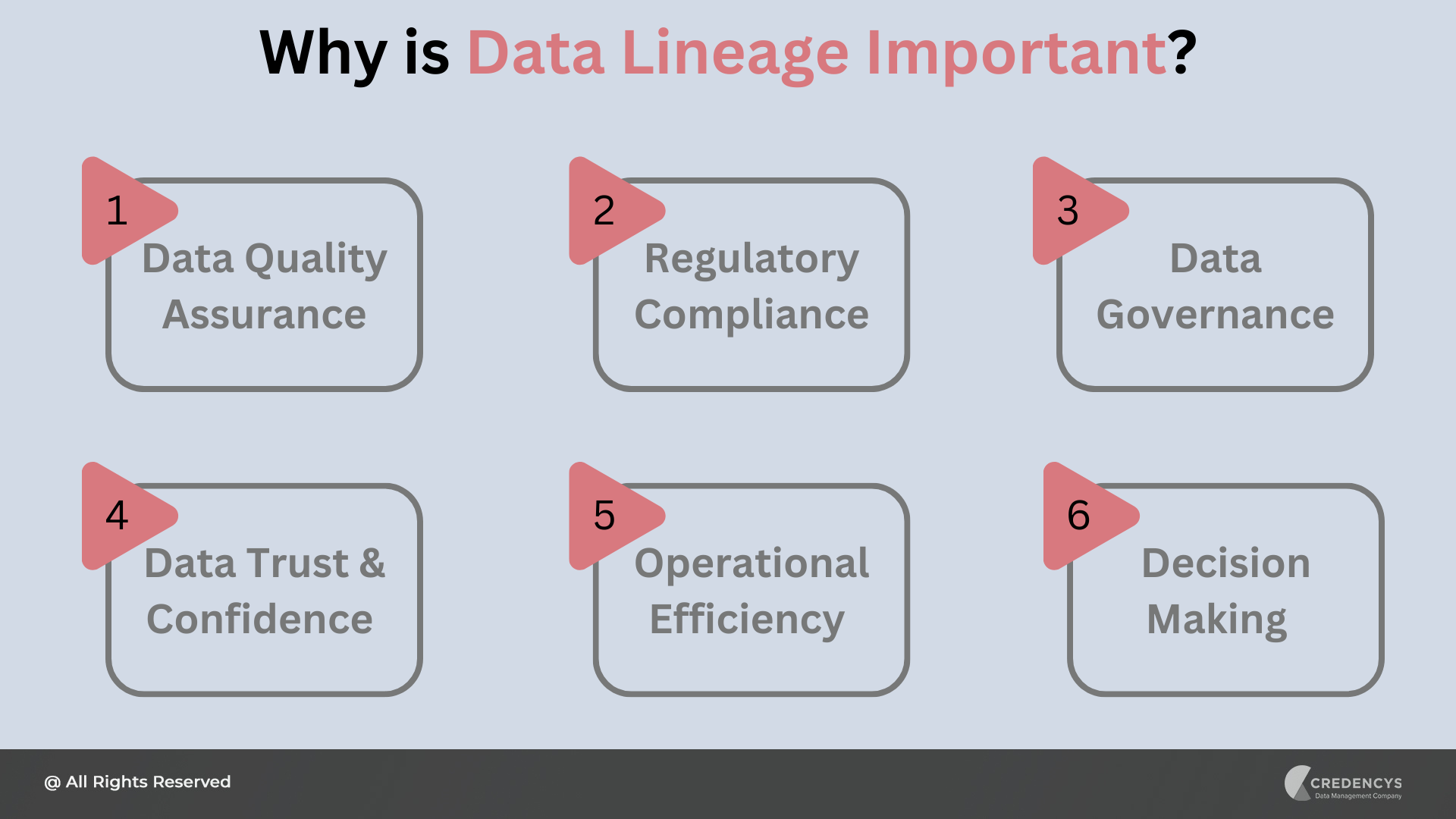
Why Is Data Lineage Important?

Why is Data Lineage Important

Data Quality Assurance

Data lineage provides organizations with the ability to trace the origin and movement of data, allowing them to identify potential data quality issues or inconsistencies.

By understanding the data lineage, organizations can implement measures to improve data quality, ensure accuracy, and maintain data integrity throughout its lifecycle.

Regulatory Compliance

In industries with strict regulatory requirements, such as healthcare and finance, data lineage plays a crucial role in demonstrating compliance.

It allows organizations to track and document the lineage of sensitive data, ensuring transparency and accountability in data management practices. This is particularly important for data governance and privacy regulations like GDPR, HIPAA, or SOX.

Data Governance and Risk Management

Data lineage supports effective data governance by providing a clear understanding of how data is created, modified, and used within the organization. It helps establish data ownership, define data stewardship responsibilities, and enforce data policies and standards.

By implementing data lineage, companies can have better risk management by identifying potential bottlenecks, data dependencies, or vulnerabilities in the data flow.

Data Trust and Confidence

Data lineage provides transparency and visibility into the data flow, giving stakeholders confidence in the accuracy and reliability of the data.

It helps build trust among data users, data analysts, and decision-makers by providing a clear understanding of how data is transformed, ensuring that decisions are based on reliable and trusted information.

Operational Efficiency

By understanding the data lineage, organizations can identify redundant or unnecessary data transformations, streamline data processes, and optimize data flows.

It leads to improved operational efficiency, reduced data complexity, and faster data delivery for analytical purposes or business operations.

Decision-Making and Analytics

Data lineage enhances the reliability and trustworthiness of data used for decision-making and analytics. It provides insights into the data’s origin, context, and transformation history, allowing analysts and data scientists to understand the data’s reliability and suitability for specific analyses.

Data lineage enables better data-driven decision-making by ensuring the use of accurate, up-to-date, and relevant data. It offers numerous benefits to organizations, ranging from ensuring data quality and compliance to enabling effective data governance, risk management, and decision-making.

By leveraging data lineage, organizations can gain a comprehensive understanding of their data ecosystem, improve operational efficiency, and make informed decisions based on trusted data.

How Does Data Lineage Work?

Data lineage works by tracing the journey of data from its source to its destination, capturing the various transformations, processes, and entities it encounters along the way. It provides a detailed record of the data’s origin, movement, and transformations, enabling organizations to understand how data flows through their systems and processes.

Process of Data Lineage

Why is Data Lineage Important

Data Source Identification

The first step is to identify the original source of the data. This could be a database, application, file, or any other data repository.

Data Capture

Once the data source is identified, it is necessary to capture relevant metadata and information about the data. This includes attributes such as data type, format, timestamp, and any transformations applied.

Data Movement and Transformations

As data flows through different systems, applications, and processes, it undergoes various transformations and manipulations. Data lineage tracks these transformations, recording the steps taken to modify or enrich the data.

Data Lineage Mapping

Data lineage involves mapping data elements from one system or process to another. This mapping helps establish relationships between different data sources and destinations, allowing organizations to understand data dependencies.

Documentation

Throughout the data lineage process, it is crucial to document each step, including the source, transformations, and destination of the data. This documentation serves as a comprehensive record that can be used for analysis, troubleshooting, and compliance purposes.

Visualization

Data lineage information is often visualized using diagrams or flowcharts, making it easier to understand the data’s journey and its interactions with various systems and processes. These visual representations provide a clear overview of data lineage and aid in identifying bottlenecks, inconsistencies, or areas for improvement.

By implementing data lineage best practices and tools, organizations can gain insights into data quality, ensure regulatory compliance, facilitate data governance, and improve decision-making processes. It enables organizations to have a holistic view of their data landscape, empowering them to make informed data-related decisions and address any issues that may arise along the data’s journey.

Data Lineage Techniques Explained with Examples

Popular Data Lineage Techniques

Pattern-Based Lineage

This technique involves using predefined patterns or templates to infer data lineage. It relies on recognizing specific patterns within data transformations, such as SQL queries or ETL (Extract, Transform, Load) processes.

By identifying and mapping these patterns, organizations can establish lineage relationships between source and target data.

Example

In a financial organization, pattern-based lineage can be used to identify data transformations within complex financial models. By recognizing specific calculation patterns, such as interest calculations or risk assessments, the lineage can be established from input data to the final financial results.

Data Tagging

Data tagging involves assigning metadata tags or labels to data elements as they flow through various stages of processing. These tags capture information about the data’s origin, transformations applied, and destination.

By tagging data at each step, organizations can track the lineage of individual data elements and understand how they have been manipulated or combined.

Example

Data tagging can be employed in a healthcare setting to track the lineage of patient data as it moves through different systems and applications. By tagging each data entry with metadata indicating its source, transformation history, and usage, healthcare providers can ensure data integrity and comply with privacy regulations.

Self-Contained Lineage

Self-contained lineage focuses on embedding lineage information directly within the data itself. This can be achieved by including metadata tags or annotations within the data files or using specialized data formats that support lineage tracking.

With self-contained lineage, data carries its lineage information wherever it goes, making it easier to trace and understand its origins and transformations.

Example

Self-contained lineage can be utilized in a manufacturing company to track the lineage of product data. By embedding metadata within product specifications, including details on raw materials, manufacturing processes, and quality control, the data lineage of each product can be traced from its creation to the final product delivered to customers.

Parsing

Parsing involves analyzing data processing logic, such as SQL queries or program code, to extract lineage information.

By parsing the code, organizations can identify data sources, transformations, and targets. This technique is commonly used in data integration and ETL tools to automatically capture and document data lineage.

Example

Parsing can be applied in a data integration scenario where data is extracted from various sources, transformed, and loaded into a data warehouse. By analyzing the ETL processes and code, organizations can capture the lineage of data elements, including the source systems, transformations applied, and target data warehouse tables.

What are the Different Types of Data Lineage?

Different Types of Data Lineage

Descriptive Data Lineage

Descriptive data lineage focuses on capturing the historical flow and transformation of data within an organization. It provides a detailed account of how data is created, modified, and used across various systems and processes.

It helps in understanding data dependencies, data quality issues, and the impacts of changes on downstream systems.

Automated Data Lineage

Automated data lineage is the process of automatically capturing and documenting data lineage using tools and technologies. It involves analyzing data flows, system metadata, and process logs to track the movement and transformation of data.

With automated data lineage, organizations reduce manual effort and provide real-time visibility into data lineage, making it easier to maintain and update lineage information.

Design Lineage

Design lineage focuses on capturing the intended data flows and transformations during the design phase of data integration or ETL processes. It documents the logical mapping of data elements and their transformations from source to target systems.

Leverage design lineage to ensure that data integration processes align with business requirements and compliance regulations.

Business Lineage

Business lineage emphasizes the understanding of data lineage from a business perspective. It traces the origin and transformation of data in terms of business concepts, rules, and decisions.

Embracing the potential of business lineage, business stakeholders gain insights into how data is used for decision-making, regulatory compliance, and performance monitoring.

Operational Lineage

Operational lineage provides visibility into the execution and operational aspects of data flows. It tracks the actual execution of data integration processes, capturing information about system interactions, data movement, and transformations in real time.

Operational lineage helps troubleshoot data issues, identify bottlenecks, and ensure data processes’ reliability and efficiency.

These different types of data lineage provide organizations with various perspectives and levels of detail on how data moves, transforms, and is used within their environments. Combining these types can help organizations gain a holistic understanding of data lineage, supporting data governance, data quality, compliance, and decision-making processes.

Key Components of Data Lineage

Data lineage typically consists of several components and elements contributing to a comprehensive understanding of the data flow. These include:

Data Sources

The initial systems, applications, or databases where data originates.

Data Transformation

The processes and operations applied to data undergo various transformations, such as filtering, aggregating, cleansing, or joining.

Data Movement

The paths and channels through which data moves from one system to another, including data integration tools or ETL (Extract, Transform, Load) processes.

Data Storage

The repositories or databases where data is stored at different stages of its journey.

Data Attributes

The characteristics and properties of the data, such as data types, formats, and metadata.

Data Dependencies

The relationships and dependencies between different data elements or entities.

Data Lineage Tools

The software or tools used to capture, document, and visualize data lineage, provide a graphical representation of the data flow.

By understanding the concept of data lineage, the types of lineages, and the various components and elements involved, organizations can gain valuable insights into their data ecosystem.

This knowledge enables them to ensure data accuracy, identify data issues or bottlenecks, improve data quality, and make informed decisions based on a complete understanding of their data flow and dependencies.

Advanced Features of Data Lineage

Key Features of Data Lineage

End-to-End Traceability

Data lineage provides a complete end-to-end view of data, allowing organizations to trace its journey from its original source to its final destination. It captures and visualizes data flow across systems, processes, and transformations, highlighting the relationships and dependencies between different data elements.

Granularity and Detail

With data lineage, companies can have detailed information about each data transformation, including the specific operations, calculations, or modifications performed on the data at each stage.

It offers granular insights into data changes, such as data cleansing, aggregation, filtering, or joining, ensuring a comprehensive understanding of data transformations.

Data Lineage Visualization

Data lineage tools often offer visual representations, such as flow diagrams or graphical maps, to depict the data flow and relationships.

These data lineage visualizations make it easier to comprehend complex data flows and dependencies, providing a clear and intuitive overview of data lineage.

Metadata Management

Data lineage is closely linked to metadata management, as it relies on capturing and storing metadata information about the data elements, systems, and processes involved.

It includes metadata about data sources, data formats, data structures, data transformations, and data ownership, among other relevant details.

Versioning and Historical Tracking

Track and maintain historical versions of data using data lineage. It allows organizations to understand how data has changed over time.

This feature is particularly valuable for auditing purposes, compliance requirements, and tracking the impact of changes or updates to data.

Impact Analysis

Data lineage enables impact analysis by identifying the downstream effects of changes to data sources, structures, or processes.

It helps organizations assess the potential impact of changes on data quality, system performance, downstream applications, and decision-making processes, facilitating risk assessment and decision-making.

Data Lineage Documentation

Data lineage tools often provide documentation capabilities, allowing organizations to capture and store detailed lineage information for future reference, audit, or compliance purposes. This documentation helps in maintaining a comprehensive record of data lineage, ensuring transparency, and supporting data governance initiatives.

By leveraging these key features, organizations can gain a deep understanding of their data landscape, improve data quality and reliability, ensure regulatory compliance, and make informed decisions based on trusted and well-managed data.

How to Get Started with Data Lineage Implementation?

How to Implement Data Lineage

Identify Data Sources

Begin by identifying all the data sources within your organization. This includes databases, applications, file systems, data warehouses, and external sources.

Understand the types of data being collected, the format in which it is stored, and the systems responsible for capturing and managing the data.

Define Data Elements

Determine the key data elements that are critical to your organization’s operations and decision-making processes. This could include customer information, product data, financial data, or any other data that is relevant to your business.

Clearly define and document these data elements, including their definitions, formats, and relationships.

Map Data Flows

Analyze and document how data flows through your organization’s systems and processes. Identify the transformations, aggregations, or modifications that occur at each step.

It involves mapping the movement of data from its source to its destination, including any intermediate stages or data transformations.

Capture Metadata

Implement a metadata management system to capture and store relevant metadata about the data sources, data elements, transformations, and relationships.

Metadata can include information such as data definitions, data quality rules, data lineage documentation, and data ownership details. This metadata will serve as the foundation for establishing data lineage.

Utilize Data Lineage Tools

Explore data lineage tools and technologies that can automate the process of capturing, visualizing, and managing data lineage. These tools can help you trace data flows, map dependencies, and create visual representations of data lineage.

Choose a tool that aligns with your organization’s needs and can integrate with your existing data infrastructure.

Establish Data Governance Practices

Implement data governance practices and policies to ensure the ongoing management and maintenance of data lineage.

It includes assigning data stewards responsible for overseeing data lineage, defining data quality standards, establishing data lineage documentation guidelines, and regularly reviewing and updating the lineage information.

Conduct Regular Audits and Validation

Periodically audit and validate the accuracy and completeness of your data lineage. This involves cross-referencing the documented lineage with the actual data flows and performing data quality checks. Regular audits ensure that the data lineage remains up-to-date and reliable.

Communicate and Educate

Foster a culture of data lineage awareness within your organization. Communicate the importance of data lineage to stakeholders, data users, and decision-makers.

Provide training and education to relevant teams on understanding and utilizing data lineage for better data management, decision-making, and compliance.

By following these steps, organizations can establish a robust data lineage framework that provides visibility, transparency, and trust in their data. This enables better data management, improved decision-making, and enhanced compliance with regulatory requirements.

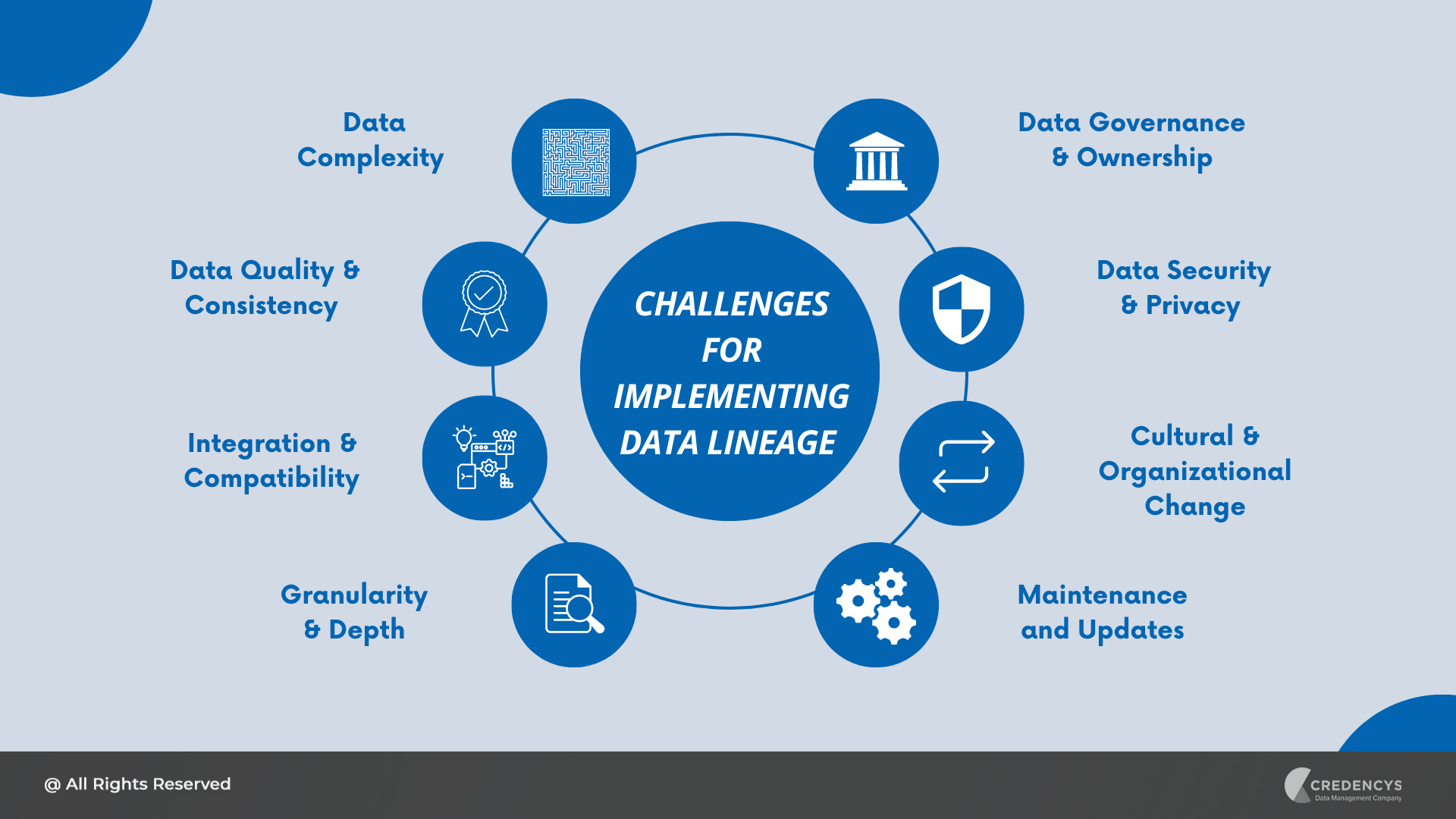
Challenges and Considerations for Implementing Data Lineage

Challenges for Implementing Data Lineage

Data Complexity

One of the main challenges in implementing data lineage is dealing with the complexity of modern data environments.

Organizations often have vast amounts of data stored in various formats, across multiple systems, and with different data integration techniques. Managing and tracking the flow of data across these complex ecosystems can be challenging.

Data Quality and Consistency

Ensuring data quality and consistency is crucial for effective data lineage. Inaccurate or inconsistent data can lead to unreliable lineage information. Organizations must establish data quality standards and implement data cleansing and validation processes to address these challenges.

Integration and Compatibility

Implementing data lineage requires integrating with existing data systems, applications, and tools. Compatibility issues can arise when trying to connect different data sources or when integrating with legacy systems.

Companies must carefully consider the integration requirements and ensure that the data lineage solution is compatible with their existing infrastructure.

Granularity and Depth

Determining the appropriate level of granularity and depth for data lineage can be a challenge. Too much detail can lead to overwhelming and complex lineage diagrams, making them difficult to interpret and analyze.

On the other hand, insufficient detail may not provide the necessary insights. Striking the right balance is essential to ensure the lineage information is meaningful and useful.

Data Governance and Ownership

Data lineage requires clear data governance practices and well-defined data ownership. Establishing data governance frameworks, assigning data stewards, and ensuring accountability for data accuracy and lineage management are important considerations.

Brands must address data governance challenges to maintain data lineage integrity.

Data Security and Privacy

Implementing data lineage requires handling sensitive and confidential data. Ensuring data security and privacy is crucial to protect the integrity and confidentiality of the data.

Organizations must implement appropriate security measures, access controls, and data protection mechanisms to safeguard the data used in the lineage process.

Cultural and Organizational Change

Implementing data lineage often requires cultural and organizational change. It may involve breaking down data silos, fostering collaboration among different teams, and promoting data-driven decision-making.

Companies must consider the impact on employees, provide training and education, and create a culture that embraces data lineage practices.

Maintenance and Updates

Data lineage is not a one-time effort but an ongoing process. Data systems, processes, and sources evolve over time, and keeping the lineage information up-to-date requires regular maintenance and updates.

Organizations must allocate resources and establish processes to ensure that the data lineage remains accurate and reflects any changes in the data environment.

Addressing these challenges and considerations requires careful planning, collaboration among stakeholders, and a comprehensive approach to implementing data lineage.

By overcoming these obstacles, organizations can unlock the full potential of data lineage to enhance data management, decision-making, and regulatory compliance.

Best Practices for Successful Data Lineage Implementation

Best Practices for Successful Data Lineage Implementation

Define Clear Goals and Objectives

Start by defining the goals and objectives of implementing data lineage in your organization. Identify the specific use cases and business requirements that data lineage will address. Having a clear vision of what you want to achieve will guide the implementation process.

Establish Data Governance Framework

Data lineage requires a strong data governance framework to ensure data quality, consistency, and ownership. Establish data governance policies, roles, and responsibilities. Define data standards, data classification, and data stewardship practices to support data lineage initiatives.

Identify Critical Data Elements

Identify the critical data elements that are important for your organization’s operations, decision-making, and regulatory compliance. Focus on capturing the lineage of these key data elements to derive maximum value from your data lineage implementation.

Implement Data Quality Controls

Ensure that your data is of high quality and accuracy before capturing data lineage. Implement data quality controls and data cleansing processes to address any inconsistencies or errors in the data. This will enhance the reliability and credibility of the lineage information.

Map Data Flows

Understand the flow of data within your organization. Identify the data sources, systems, applications, and processes involved in generating, transforming, and consuming the data. Map the data flow to capture the lineage information accurately.

Choose the Right Tools and Technologies

Select the appropriate tools and technologies that align with your organization’s data lineage requirements. Consider factors such as scalability, compatibility with existing systems, ease of use, and reporting capabilities.

Leverage data lineage software or platforms that provide robust features for capturing and visualizing lineage information.

Collaborate Across Departments

Implementing data lineage often requires collaboration across different departments and teams. Foster cross-functional collaboration to gather input from various stakeholders, including IT, data management, business analysts, and compliance teams. Collaborative efforts will ensure that the data lineage implementation meets the needs of all relevant stakeholders.

Provide Training and Education

Conduct training programs and workshops to educate employees about the importance of data lineage and how to utilize the lineage information effectively. Increase awareness of data lineage practices and promote a data-driven culture within the organization.

Perform Regular Audits and Reviews

Continuously monitor and review the data lineage information to ensure its accuracy and relevance. Conduct regular audits to identify any gaps or inconsistencies and take corrective actions. Regular reviews will help maintain the integrity of the lineage information and identify areas for improvement.

Evolve and Adapt

Data lineage is not a one-time project but an ongoing initiative. Embrace a mindset of continuous improvement and adaptability. Stay updated with the evolving data landscape, technological advancements, and regulatory changes to enhance your data lineage implementation over time.

By following these best practices and tips, you can lay a solid foundation for successful data lineage implementation in your organization. It will enable you to gain insights, enhance data management practices, and make informed decisions based on accurate lineage information.

Data Lineage Use Cases

Organizations have utilized data lineage for data management in various ways. Here are some examples:

Ensuring Data Quality

Data lineage helps organizations identify the origin of data and track its transformation throughout its lifecycle. By understanding the lineage, organizations can identify potential issues and discrepancies in data quality. They can trace back to the source of data and address any data quality issues, ensuring that accurate and reliable data is used for decision-making.

Regulatory Compliance

Many industries are subject to strict regulatory requirements, such as financial services, healthcare, and pharmaceuticals. Data lineage helps organizations demonstrate compliance by providing a clear trail of data from its source to its use. It enables organizations to track and validate data used for regulatory reporting, audits, and compliance purposes.

Data Governance and Stewardship

Data lineage plays a crucial role in data governance and stewardship initiatives. It helps organizations establish data ownership, accountability, and responsibility. By mapping data lineage, organizations can identify data stewards who are responsible for the quality, integrity, and governance of specific data elements.

Data Integration and Consolidation

Organizations often have multiple data sources and systems that need to be integrated or consolidated. Data lineage helps organizations identify redundant or overlapping data sources, understand data dependencies, and design effective data integration strategies.

It ensures that data integration efforts are based on accurate and up-to-date lineage information, leading to streamlined and efficient data consolidation.

Root Cause Analysis and Issue Resolution

In the event of data issues or discrepancies, data lineage helps organizations perform root cause analysis. By tracing the data lineage, organizations can identify the source of the problem, whether it’s data transformation errors, system glitches, or manual entry mistakes. This information enables organizations to address the root cause and resolve data issues more effectively.

Data Lifecycle Management

Data lineage provides insights into the lifecycle of data, from creation to archival or deletion. Organizations can use data lineage to define data retention policies, manage data obsolescence, and ensure compliance with data privacy regulations. It helps organizations understand when data becomes obsolete or no longer needed, supporting efficient data lifecycle management practices.

These are just a few examples of how organizations have utilized data lineage for data management. By leveraging data lineage, organizations can enhance data governance, improve data quality, ensure regulatory compliance, and make more informed decisions based on reliable and traceable data.

Future Trends in Data Lineage

Data lineage continues to evolve alongside advancements in technology and the increasing complexity of data management. Here are some future trends and innovations to watch out for in the field of data lineage:

Future Trends in Data Lineage

Automation and AI

As data volumes grow, manual data lineage tracking becomes more challenging. Automation and artificial intelligence (AI) technologies will play a crucial role in capturing and documenting data lineage automatically.

AI algorithms can analyze data flows, identify patterns, and generate lineage mappings, saving time and effort for data professionals.

Real-time Data Lineage

Traditional data lineage focuses on static snapshots of data flows. However, as organizations increasingly rely on real-time data analytics and streaming data, the need for real-time data lineage becomes essential.

Innovations in capturing and visualizing real-time data lineage will enable organizations to have a dynamic view of data flows, supporting more agile and responsive decision-making.

Blockchain for Data Lineage

Blockchain technology provides an immutable and decentralized ledger, making it an ideal candidate for ensuring the integrity and trustworthiness of data lineage information.

Implementing blockchain-based data lineage solutions can enhance data transparency, security, and auditability, particularly in industries with strict regulatory requirements or sensitive data.

Extended Data Lineage

Traditional data lineage focuses on tracing data within an organization’s boundaries. However, with the increasing adoption of cloud services, hybrid environments, and data-sharing partnerships, there is a need for extended data lineage that encompasses data flows across different organizations and systems.

Innovations in extended data lineage will provide a holistic view of data movement, even across disparate systems and data ecosystems.

Integration with Data Catalogs and Metadata Management

Data lineage is closely related to data catalogs and metadata management. Future trends will focus on integrating data lineage with metadata repositories and data records, creating a comprehensive and interconnected view of data assets.

This integration will enable organizations to have a unified understanding of data lineage, metadata, and data usage, supporting better data governance and data-driven decision-making.

Visualizations and Interactive Tools

Data lineage visualizations will continue to evolve, becoming more intuitive, interactive, and user-friendly. Advanced visualization techniques, such as graph-based representations, will make it easier to explore and understand complex data flows.

Interactive tools will enable users to drill down into specific data elements, view detailed lineage information, and perform impact analysis more efficiently.

Enhanced Data Lineage Governance

Data lineage governance will become an integral part of data governance frameworks. Organizations will establish policies, standards, and controls specifically for data lineage management. This includes defining roles and responsibilities, ensuring data quality in lineage information, and establishing lineage validation and certification processes.

These future trends and innovations in data lineage will shape the way organizations capture, manage, and utilize data lineage information.

By staying abreast of these advancements, organizations can effectively leverage data lineage to improve data management, enhance decision-making, and ensure the integrity and trustworthiness of their data assets.

Final Thoughts

Data lineage plays a critical role in data management, governance, and decision-making. It provides organizations with a comprehensive understanding of the origin, movement, and transformation of their data, ensuring data accuracy, reliability, and compliance.

By documenting data lineage, organizations can gain insights into data dependencies, identify data quality issues, and mitigate risks associated with data errors or inconsistencies.

What is Data Quality – Everything Businesses Need to Know

The modern world is inundated with data, serving as a valuable resource for individuals and organizations to make well-informed decisions, greatly enhancing the chances of success. This suggests that having copious amounts of data is generally beneficial.

Nevertheless, this isn’t an absolute truth, as data can sometimes be flawed, inadequate, repetitive, or irrelevant to the user’s specific requirements. According to a Gartner report, poor data quality costs organizations an average of USD 12.9 million annually.

Fortunately, the concept of data quality comes to our rescue, simplifying the task at hand. Therefore, let’s delve into the definition of data quality, examine its attributes and best approaches, and understand how it can be employed to enhance the overall quality of data.

What is Data Quality?

Data quality evaluates the extent to which a dataset fulfils criteria related to the accuracy, completeness, validity, consistency, uniqueness, timeliness, and suitability for its intended purpose. It holds paramount importance in all data governance initiatives undertaken by an organization.

By adhering to data quality standards, companies can ensure that their decisions are based on reliable data, aligning with their business objectives. Neglecting data issues like duplicate entries, missing values, or outliers poses a significant risk to businesses, potentially leading to unfavourable outcomes.

In simpler words, data quality refers to the overall goodness and usefulness of data for a specific purpose. However, it also encompasses the process of strategizing, executing, and overseeing activities that involve essential quality management practices and techniques.

These measures are put in place to guarantee that the data is not only usable but also valuable and relevant for the data consumers.

Why is Data Quality Important?

Data quality is of paramount importance for several reasons:

Informed Decision Making

High-quality data ensures that decisions made by organizations are based on accurate and reliable information. This leads to better-informed choices and more effective outcomes.

Trust and Credibility

Data of good quality builds trust and credibility among stakeholders. It instills confidence in the data’s accuracy and encourages its use for decision-making purposes.

Avoiding Costly Errors

Poor data quality can lead to erroneous conclusions and decisions, resulting in costly mistakes and missed opportunities. Organizations can mitigate the risks of making incorrect choices by maintaining data quality.

Enhanced Efficiency

Clean and accurate data streamlines processes and operations. It reduces the time wasted on dealing with data errors, inconsistencies, and redundancies, leading to improved overall efficiency.

Data Integration

High-quality data facilitate the smooth integration of information from various sources. It ensures that different data sets can be combined accurately, providing a comprehensive view of the situation.

Regulatory Compliance

Many industries and sectors are subject to regulations that mandate data quality standards. Compliance with these standards is essential to avoid legal and financial repercussions.

Customer Satisfaction

Data quality plays a crucial role in customer-facing applications and services. Accurate customer data leads to personalized and targeted experiences, fostering customer satisfaction and loyalty.

Better Analytics and Insights

Reliable data is the foundation for meaningful analytics and insights. High-quality data allows for accurate trend analysis, pattern recognition, and predictive modeling.

Effective Data Sharing

When data is of good quality, it can be safely shared and utilized across departments or organizations, promoting collaboration and knowledge sharing.

Long-Term Value

Data is an asset that can retain its value over time. By maintaining data quality, organizations can ensure the longevity and usefulness of their data for future decision-making and planning.

Importance of Data Quality
Dimensions of Data Quality

Data quality assessment involves the consideration of various dimensions, which may vary depending on the source of the data. These dimensions serve as criteria to categorize and measure data quality metrics.

Completeness

Completeness refers to the proportion of missing data within a dataset. In the context of products or services, data completeness plays a vital role in aiding potential customers in making informed comparisons and decisions.

For example, if a product description lacks an estimated delivery date while all other product descriptions include it, then that specific “data” is considered incomplete.

Timeliness

Timeliness evaluates the age of data at a particular moment. For instance, if you possess customer information from 2020, and it is now 2023, both the completeness and timeliness of the data become problematic.

When assessing data quality, the timeliness dimension wields significant influence, either positively or negatively, on the overall accuracy, usefulness, and dependability of the data.

Validity

Validity pertains to data that does not conform to the prescribed formats, rules, or procedures set by the company. For instance, when collecting customer data, a system may request the birthdate, but if the customer enters the birthdate in an incorrect format, it adversely affects the data quality.

To address this, many organizations have implemented systems that reject birthdate information unless it adheres to the pre-defined format.

Integrity

Data integrity concerns the reliability and trustworthiness of information. It questions whether the data is accurate and factual.

For instance, if your database contains an email address assigned to a specific customer, but it turns out that the customer deleted that account years ago, both data integrity and timeliness issues arise.

Uniqueness

Uniqueness is a vital data quality aspect, particularly significant in customer profiles. It can be the decisive factor that sets your company apart, leading to eCommerce sales and triumphing over competitors.

Achieving higher accuracy in compiling unique customer information, along with individual performance analytics related to your company’s products and marketing campaigns, serves as the foundation for long-term profitability and success.

Consistency

Consistency in data is primarily linked to analytics, guaranteeing that the information collected from various sources aligns accurately with the specific objectives of the department or company.

Dimensions of Data Quality

Problems With Poor Quality Data

Data quality poses a significant challenge for many companies, and the extent of the problem is often underestimated. In their eagerness to swiftly collect and utilize data for real-time program optimization, organizations may overlook essential data quality assurance practices, such as setting standards and criteria.

This oversight can lead to reliance on inaccurate, incomplete, or redundant data, triggering a chain reaction of decisions based on unreliable numbers and metrics. Moreover, dealing with massive sets of big data, many organizations lack sufficient in-house data science resources to sort and correlate this information effectively.

As a result, they risk missing out on time-sensitive opportunities for optimization. A study revealed that only a mere 3 percent of executives surveyed had data records falling within an acceptable range.

Furthermore, 65 percent of marketers expressed concerns about the quality of their data, with 6 out of 10 prioritizing the improvement of data quality. The implications of bad data are far-reaching:

High Costs

Bad data quality resulted in organizations losing a staggering $3.1 trillion in 2016, according to IBM. Nearly 50 percent of newly acquired data contained errors that could negatively impact the organization’s performance.

MIT research suggests that bad data can cost organizations up to 25 percent of their total revenue.

Wrong Decisions

Relying on faulty or incomplete data for business decisions can cause teams to overlook critical information. For example, inaccurate attribution models might misallocate funds to fewer effective media vehicles, leading to reduced ROI.

Strained Customer Relationships

Bad data not only affects advertising budgets but also impacts customer relationships. Targeting customers with irrelevant products and messaging due to bad data can alienate them from the brand, resulting in opt-outs or disregard of future communication.

Problems With Poor Quality Data
To mitigate these risks and harness the true potential of data-driven decision-making, organizations must prioritize data quality, invest in proper data management tools, and adhere to best practices in data collection and validation. Only then can they unlock the value of data and gain a competitive edge in the dynamic business landscape.

Impact of Having Poor Data Quality & Importance of Data Quality Management System (DQM)

Data Quality Challenges

Data quality becomes a crucial consideration when dealing with large amounts of data, as the sheer volume of new information can impact its trustworthiness. To address this, forward-thinking companies implement robust processes for data collection, storage, and processing.

In the rapidly advancing technological revolution, the top three data quality challenges are:

Privacy and Protection Laws

Regulations like the General Data Protection Regulation (GDPR) and the California Consumer Privacy Act (CCPA) intensify the demand for accurate customer records. Organizations must swiftly access complete individual information without any inaccuracies or inconsistencies.

Artificial Intelligence (AI) and Machine Learning (ML)

The adoption of AI and ML for business intelligence leads to continuous surges of Big Data, making it challenging for data users to keep up. The real-time data streaming platforms introduce more opportunities for mistakes and data quality issues.

Additionally, managing data systems across on-premises and cloud servers poses challenges for larger corporations, necessitating efficient monitoring practices.

Data Governance Practices

Data governance involves internal standards and policies for data collection, storage, and sharing. It ensures data consistency, trustworthiness, and compliance across company departments.

Proper data governance is essential to resolving inconsistencies within different systems, such as variations in customer names, which can lead to customer confusion.

Data Quality Challenges
By tackling these data quality challenges, companies can ensure trustworthy and reliable data, compliance with regulations, and more effective decision-making, ultimately gaining a competitive edge in today’s dynamic business landscape.

How to Improve Data Quality

For businesses seeking ways to enhance data quality, data quality management offers valuable solutions. The objective of data quality management is to implement a balanced set of strategies to prevent future data quality issues and cleanse or remove data that fails to meet data quality Key Performance Indicators (KPIs).

These actions enable businesses to achieve their current and future objectives effectively. Data quality management goes beyond data cleaning, encompassing eight essential disciplines to prevent data quality problems and improve data quality by purging inaccurate data:

Data Governance

Establishing data policies and standards to define required data quality KPIs and prioritize specific data elements. This includes defining business rules to ensure data quality.

Data Profiling

Employing a methodology to understand all data assets involved in data quality management. Data profiling is crucial due to multiple contributors adhering to different standards over the years.

Data Matching

Utilizing data matching technology with match codes to identify if multiple data pieces describe the same real-world entity. For example, recognizing that “Michael Jones,” “Mike Jones,” and “Mickey Jones” all refer to one individual.

Data Quality Reporting

Using information from data profiling and data matching to measure data quality KPIs. Reporting also involves maintaining a quality issue log to document known data issues and track data cleansing and prevention efforts.

Master Data Management (MDM)

Implementing MDM frameworks to prevent data quality issues. MDM deals with various types of master data, such as product, location, and party data.

Customer Data Integration (CDI)

Compiling customer master data from various sources, such as CRM applications and self-service registration sites, into a single source of truth.

Product Information Management (PIM)

Aligning data quality KPIs among manufacturers and sellers to maintain consistency in product data throughout the supply chain. Standardizing the receipt and presentation of product data is a significant part of PIM.

Digital Asset Management (DAM)

Ensuring the quality and relevance of digital assets, such as videos, images, and text documents, used alongside product data.

An Ultimate Guide to Digital Asset Management (DAM)

By adopting these eight disciplines, organizations can proactively address data quality challenges, optimize their data management practices, and pave the way for more reliable and valuable data-driven insights.

Data Quality Best Practices

For data analysts aiming to enhance data quality, adhering to best practices is crucial to achieving their goals. To accomplish this, they must adopt a pervasive, proactive, and collaborative approach to data quality within the organization. Here are ten essential best practices to follow:

  • Ensure active involvement of top-level management. Cross-departmental participation by data analysts can effectively resolve numerous data quality issues.
  • Integrate data quality activity management into your data governance framework. This framework establishes data policies, standards, roles, and includes a comprehensive business glossary.
  • Perform root cause analysis for every raised data quality issue. Addressing the underlying cause is essential to prevent the issue from recurring and not just treating its symptoms.
  • Maintain a data quality issue log containing details like assigned data owner, involved data steward, impact, final resolution, and timing of necessary actions.
  • Assign data owner and data steward roles from the business side and data custodian roles from either business or IT, depending on what makes the most sense.
  • Utilize data quality disasters as examples to highlight the significance of data quality. However, rely on fact-based impact and risk analysis to justify solutions and funding.
  • Build metadata management upon your organization’s business glossary, using it as a foundational reference.
  • Minimize manual data entry where possible. Explore cost-effective solutions for data onboarding using third-party data sources that provide publicly available data, such as names, locations, company addresses, and IDs. For product data, consider using second-party data from trading partners.
  • Implement processes and technology close to the data onboarding point to prevent data issues, rather than relying solely on downstream data cleansing.
  • Establish data quality Key Performance Indicators (KPIs) aligned with general KPIs for business performance. Data Quality Indicators (DQIs) can be linked to dimensions like uniqueness, completeness, and consistency to measure and monitor data quality effectively.

Benefits of Data Quality

Organizations that invest in creating high-quality data gain a significant advantage in leveraging data to make informed business decisions.

High-Quality Data Enhances Decision-Making

In today’s consumer-centric market, businesses equipped with high-quality data can make better decisions. For instance, analyzing data showing increased customer activity outside on Thursdays compared to Fridays can lead businesses to extend operating hours or offer unique promotions to attract more customers.

Improved Team Collaboration

When different departments within an organization have access to consistent and high-quality data, communication becomes more effective, leading to better team collaborations. This alignment in priorities, messaging, and branding contributes to achieving superior results.

Enhanced Customer Understanding

Good quality data enables companies to gain a deeper understanding of customer interests and requirements. This valuable insight allows organizations to develop better products tailored to meet customer needs.

Marketing campaigns can then be driven by data-based insights and customer feedback, rather than relying solely on educated guesses.

Benefits of Data Quality
Elevate Your Data Quality Strategy with Credencys

In today’s fast-paced and data-driven business landscape, the importance of high-quality data cannot be overstated. Organizations that harness the power of accurate and reliable data gain a competitive advantage, make better-informed decisions, and deliver superior customer experiences.

At Credencys, we understand the critical role that data quality plays in driving business success, and we offer transformative solutions to help organizations elevate their data quality strategy.

Comprehensive Data Quality Assessment

The first step in transforming your data quality strategy is conducting a comprehensive data quality assessment. Our team of experts collaborates closely with your organization to understand your data infrastructure, data sources, and data management practices.

Through in-depth analysis, we identify data quality issues, inconsistencies, and gaps in data governance.

Tailored Data Quality Solutions

We recognize that every organization has unique data quality challenges. Based on the findings of the data quality assessment, we tailor data quality solutions that align with your specific requirements and business objectives.

Whether it’s improving data accuracy, enhancing data completeness, or ensuring data consistency, our solutions are designed to deliver tangible and sustainable results.

Data Governance and Standards

A robust data governance framework is essential to maintaining data quality over time. We help you establish and implement effective data governance practices, including defining data policies, data standards, and data ownership responsibilities.

This framework ensures that data is managed consistently across your organization, leading to improved data integrity and reliability.

Advanced Data Profiling and Cleaning Techniques

Our data quality transformation involves advanced data profiling techniques to gain deep insights into your data assets. We identify data anomalies, duplicates, and outdated records, which could be affecting the overall data quality.

Using cutting-edge data cleaning tools and methodologies, we then cleanse and enrich the data, ensuring it meets the highest quality standards.

Integration with Existing Systems

We understand the importance of seamless data integration with your existing systems and applications. Our data quality solutions seamlessly integrate with your data infrastructure, allowing a smooth flow of data across different departments.

This integration ensures that high-quality data is readily available to support various business processes and decision-making.

Continuous Monitoring and Reporting

Data quality is an ongoing endeavor, and we implement real-time data monitoring and reporting mechanisms. Our comprehensive reporting provides actionable insights into data quality KPIs, enabling you to proactively address any emerging data quality issues.

With our continuous monitoring approach, you can ensure that data quality remains a top priority for your organization.

Closing Thoughts

In conclusion, data quality is a paramount aspect of modern business success. Organizations that invest in creating and maintaining high-quality data reap numerous benefits, including making better-informed decisions, improving customer understanding, and fostering more effective collaborations among teams.

What is Data Governance – A Comprehensive Guide

Data is now more valuable than ever, with a strong emphasis on digital content. According to industry experts, the amount of data generated globally is projected to increase significantly by 181 zettabytes by 2025.

To put it into perspective, a single zettabyte has the capacity to store a staggering 7.5 trillion MP3 songs. Such an immense quantity of data is truly remarkable.

As the production of data continues to surge, the associated security risks and the importance of management are also on the rise. To effectively handle and protect the data and content, it is crucial to implement data governance strategies in businesses.

Definition of Data Governance?

Data governance refers to the overall management framework, principles, processes, and controls that organizations establish to ensure the effective and responsible handling of data assets. It involves defining and implementing policies, procedures, and guidelines that govern the collection, storage, usage, sharing, and protection of data throughout its lifecycle.

Data governance aims to ensure data quality, accuracy, integrity, security, and compliance with regulatory requirements. It provides a structured approach to data management, establishing roles, responsibilities, and accountability for data-related activities within an organization.

The ultimate goal of data governance is to enable organizations to derive value from their data assets while maintaining data privacy, security, and integrity.

Why is Data Governance Important?

Data governance is crucial for several reasons:

Data Quality and Integrity

Effective data governance ensures that data is accurate, reliable, and consistent across the organization. It establishes processes for data validation, cleansing, and standardization, improving the overall quality of data assets.

Regulatory Compliance

Data governance helps organizations meet legal and regulatory requirements related to data privacy, security, and confidentiality. By implementing proper controls and policies, organizations can ensure compliance with laws such as the General Data Protection Regulation (GDPR), Health Insurance Portability and Accountability Act (HIPAA), or other industry-specific regulations.

Data Security

Data governance establishes security measures and controls to protect sensitive data from unauthorized access, breaches, or cyber threats. It includes defining access controls, encryption methods, and data classification protocols to safeguard data assets.

Decision-Making and Analytics

Reliable and well-governed data ensures that decision-makers have access to accurate and relevant information for analysis and decision-making processes. Data governance ensures data consistency, traceability, and validity, enabling informed and data-driven decision-making across the organization.

Data Sharing and Collaboration

Data governance facilitates data sharing and collaboration within and between organizations. It establishes data-sharing policies, protocols, and data exchange standards, enabling effective collaboration while maintaining data privacy and security.

Cost Efficiency

Data governance helps organizations avoid redundant data, eliminate data silos, and streamline data management processes. By having a clear understanding of data assets, organizations can optimize storage, reduce duplication, and minimize the costs associated with data management.

Organizational Alignment

Data governance aligns data-related activities with the overall business strategy and objectives. It establishes roles, responsibilities, and accountability for data management, fostering a data-driven culture within the organization.

Overall, data governance provides a structured and strategic approach to managing data assets, ensuring data quality, security, compliance, and maximizing the value and utility of data within an organization.

Importance of Data Governance

What are the Business Benefits of Data Governance?

Implementing a strong data governance approach is crucial for organizations to unlock the value of data, which is a vital asset. By establishing effective data governance, businesses can harness the potential of their data assets, gain a competitive advantage, and earn and sustain customer trust through responsible data and privacy practices.

Better Analysis

With the aid of data governance, data quality and discoverability are improved, enabling analysts to efficiently locate, comprehend, and analyze data in a prompt and compliant manner.

Transform the Business

Strong data governance plays a central role in digitization, analytics, the implementation of artificial intelligence, and the democratization of data. It is crucial for ensuring data consistency and accurate usage.

By establishing robust data governance practices, organizations pave the way for increased innovation, automation, and competitiveness, driving transformative advancements in these areas.

Increased Operational Efficiency and Reduced Costs

By implementing effective data governance, organizations can establish a centralized and authoritative data source, preventing data sprawl and silos while minimizing duplication. As a result, this enhances operational efficiency, reduces costs, and simplifies the management of security and governance aspects across the entire data estate.

Informed Decision Making & Collaboration

Inadequate governance poses challenges to accurate decision-making, as employees lack timely access to necessary information or appropriate data formats. Collaboration becomes arduous, both internally and externally, due to inconsistent and untrusted data.

On the other hand, sound governance establishes the foundation for consistent data sharing in formats that are universally usable and comprehensible, enabling effective collaboration and informed decision-making.

Consistent Compliance

Data governance assists data users in maintaining regulatory compliance, mitigating the risk of incurring penalties and safeguarding against reputational harm.

Enhanced Collaboration & Value Realization

By establishing a robust data governance program, organizations establish a solid groundwork for improved collaboration and data sharing among teams, business units, and partners. This fosters a culture of knowledge sharing and promotes a data-driven mindset within the organization.

As a result, it fuels innovation, enhances decision-making capabilities, and maximizes the value derived from data assets.

Improved Data Management

Through effective governance, duplicative efforts are minimized, leading to increased operational efficiency.

Ensuring Compliance with Increasing Data Regulations

Data governance acts as a safeguard against regulatory compliance issues that can result in substantial fines and severe damage to a company’s reputation. When sharing data, it is essential to have unified rules and processes established through a governance program.

This ensures that all individuals using data, both externally and internally, comply with relevant regulations and adhere to internal best practices.

Enhanced Security & Privacy

By implementing controls and processes, data governance mitigates security and privacy risks associated with unauthorized access and misuse of sensitive data. It fosters a culture of trust and transparency among stakeholders, ensuring the protection of data assets and maintaining privacy standards.

Business Benefits of Data Governance

Key Elements of Data Governance

Data Cataloging

To establish effective data governance, it is essential to have a comprehensive understanding of an organization’s data landscape. This is where a data catalog plays a crucial role by serving as a centralized repository of metadata for all data assets.

The data catalog enables stakeholders to efficiently discover, comprehend, and access the required data, thereby enhancing data-related activities such as discovery, governance, and analytics. Acting as a searchable index, the data catalog provides valuable semantic information about the format, structure, location, and usage of data, transforming a vast sea of information into an identifiable resource.

By incorporating a data catalog into a governance program, organizations can improve data management practices, foster collaboration, minimize redundancy, and ensure proper access controls and audit information retrieval.

Data Quality

In the data-driven world, we inhabit today, ensuring high data quality is paramount for accurate analytics, informed decision-making, and cost-effectiveness. Data quality directly influences the reliability of data-driven decisions and represents a fundamental aspect of data governance.

To uphold effective data governance, organizations must prioritize the assessment of key data quality attributes, including accuracy, completeness, freshness, and compliance with data quality standards. Hence, a robust emphasis on data quality is indispensable within any data governance strategy.

It aids in tracing data lineage, enforcing data quality rules, and tracking changes. It is recommended to not let subpar data quality compromise the business decisions and resource allocation.

Data Classification

Data classification is an integral component of data governance, encompassing the organization and categorization of data based on its sensitivity, value, and criticality. As the volume of data continues to surge, businesses are becoming more focused on safeguarding sensitive data, mitigating risks, and upholding data quality.

Through classification, organizations can effectively identify and categorize data according to its risk level and significance, enabling the implementation of suitable security measures and policies. A robust data classification system enhances data governance practices, reduces risks, and ensures scalability in terms of data quality and protection.

Data Security

Organizations recognize the importance of providing their teams with access to high-quality data to drive insights and business value, while simultaneously safeguarding sensitive data against unauthorized access. Efficient management of data access plays a crucial role in data security and governance.

A robust data security governance program should incorporate access controls that clearly define which groups or individuals can access specific data. These controls can be finely tailored, extending to individual records or files.

With the increasing risks associated with data breaches and regulations like GDPR and CCPA, businesses must establish comprehensive governance policies that outline who can access sensitive data sets and establish mechanisms for tracking and detecting any misuse. The occurrence of unauthorized access to private or sensitive information must be prevented, and the implementation of effective access management strategies is essential to protect data and uphold customer trust.

Auditing Data Entitlements and Access

Data governance and security governance programs, particularly in regulated industries, rely heavily on effective data access auditing. Understanding the individuals or groups with data access and monitoring recent access activities allows organizations to proactively identify cases of excessive access and make necessary adjustments, thereby minimizing the risk of data misuse.

In the absence of robust auditing mechanisms, organizations may lack a comprehensive understanding of their risk exposure, making them susceptible to data breaches and noncompliance with regulations. Hence, having a well-structured audit team within the framework of data governance or security governance is vital in ensuring data security and compliance with regulations such as GDPR and CCPA.

By implementing robust data access auditing strategies, organizations can preserve customer trust, safeguard data from unauthorized access or misuse, and maintain regulatory compliance.

Data Lineage

Data lineage serves as a valuable tool for organizations to ensure data quality and reliability by offering insights into data sources and utilization. It captures essential metadata and events throughout the lifecycle of data, providing a comprehensive view of how data traverses across an organization’s data estate.

As a fundamental element of a practical data governance strategy, data lineage enables organizations to achieve compliance and readiness for audits, while reducing the manual effort involved in creating audit trails. It also provides trusted sources for audit reports.

Furthermore, data lineage empowers data consumers to conduct more effective analyses and enables data teams to perform root cause analysis, thereby reducing the time spent on debugging and issue resolution.

Data Discovery

In the era of accumulating vast volumes of data from diverse sources, the easy discoverability of this data is increasingly crucial for analytics, AI, and ML use cases. This plays a vital role in expediting data democratization and unlocking the full potential of the data.

Additionally, as modern data assets such as dashboards, machine learning models, queries, libraries, and notebooks emerge, data discovery becomes a pivotal pillar of a robust data governance strategy. Organizations should recognize data discovery as a foundational element of their data governance approach.

It empowers data teams to effortlessly locate data assets across the organization, collaborate on diverse projects, and drive rapid and efficient innovation. This, in turn, aids in mitigating data duplication, which can be problematic in terms of cost and governance challenges across various security levels.

Data Sharing & Collaboration

In today’s dynamic business environment, data sharing and collaboration have become indispensable elements. Organizations engage in the exchange of data with internal teams, external partners, and customers across various cloud platforms, data repositories, and geographical regions.

As the demand for external data continues to rise, it becomes paramount for organizations to securely share data while retaining control and visibility over the usage of sensitive information. Data cleanrooms play a pivotal role in enabling secure and controlled data collaboration, ensuring compliance with data privacy regulations.

It is imperative for organizations to invest in technologies that support open formats, interoperability, and multicloud environments to fulfill their data-driven innovation requirements. Additionally, data marketplaces serve as a facilitator, bridging the gap between data providers and consumers, enabling the discovery and distribution of data sets.

Therefore, it is crucial to redefine data sharing as not only a business necessity but also a fundamental pillar of a robust data governance strategy.

Key Elements of Data Governance

Misconceptions in Data Governance

The concept of data governance often intersects with various other data-related terms. While these functions are interdependent, it is crucial to comprehend their distinct capabilities and the synergy they create when integrated.

Let’s elucidate this further:

Data Stewardship

Data stewardship is a facet of data governance. Data stewardship makes sure that data is accurate, controlled, easy to find, and processed by authorized parties. Data governance supports this by making sure the right people are assigned to the right data responsibilities.

Master Data Management

Master data management (MDM) focuses on harmonizing data from essential entities, allowing for its widespread usability within the organization. These entities typically encompass customers, buyers, product data, or other data types that are collected by multiple business departments but lack consistency in their formats.

MDM tackles this challenge by constructing a cohesive perspective of such shared data. To achieve successful MDM implementation, it is imperative to have data governance in place.

Data governance plays a critical role in clarifying the purpose and interpretation of master data. It establishes defined roles and responsibilities for data authorization, curation, and access, ensuring that data is comprehensible and effectively managed within the organization.

Data Management

Data management encompasses various disciplines, with governance being a fundamental component within this framework. It encompasses the holistic management of data throughout its entire lifecycle.

Data management serves as a connecting force for other disciplines, including data quality, data security, reference and master data management, metadata management, data warehousing, and database operations. Within this context, data governance establishes the foundational principles and guidelines governing the collection, storage, and utilization of data.

It provides the overarching framework for effective data management practices.

Data Governance Challenges

In the realm of data governance, encountering challenges is inevitable. Navigating issues related to data responsibility, quality, and security can make the management of data governance complex. The primary challenges of data governance include:

Limited Resources

Organizations face difficulties in establishing clear ownership and accountability for data handling, leading to significant pressure on the IT department to manage data access. This burden on IT can result in substantial time and labor losses for the business, spanning across several months.

No Business Glossary

Given the inherent variations in terminology across departments, it is essential to create a comprehensive glossary that establishes standard terms and their usage. Without a shared language, confusion may arise within your organization, hindering effective communication and collaboration.

Data in Silos

When data is siloed, it restricts data management to a single group, resulting in a range of cultural, structural, and technological disadvantages.

Sporadic Implementation

In the scenario where data governance policy is adopted by only certain parts of the organization, there is a risk of encountering security breaches and duplicate files. To mitigate these issues, it is crucial to ensure that the implementation of the policy encompasses the entire enterprise rather than select branches.

If there is hesitancy among certain parts of the organization to adopt the policy, it may be necessary to develop a well-defined adoption strategy.

No Data Leadership

Lack of strong data leadership results in mismanagement and a misunderstanding of data. Leaders need to educate themselves around data governance to understand the risks it mitigates and the value it brings to their business.

No Designated Data Steward

In the absence of a dedicated individual or group responsible for administering and managing data within your organization, it becomes crucial to appoint someone for this role. Having a designated data steward is essential for implementing an effective governance strategy.

Negative Experiences

Implementing data governance can be a challenging endeavor, with a significant number of initiatives failing on the first attempt. This failure rate can be as high as 80%.

Those who have personally witnessed governance failures may be skeptical about its potential for success and difficult to persuade otherwise.

Too Many Data Stewards

Within your organization, a single person or team is sufficient to fulfill the data stewardship function. Having multiple data stewardship teams can lead to fragmented communication between groups.

This lack of cohesion can cause confusion across departments and increase the risk of data loss or incorrect deletion.

Data Quality

Data quality is a subjective concept, but in the present day, several catalogs employ crowdsourced feedback to assess quality. Similar to platforms like Yelp or Amazon where users provide reviews and ratings for restaurants or gadgets, a data catalog may invite users to review and rate data.

Neglecting the importance of data quality can result in the diminished usefulness, relevance, and accuracy of the data over time.

Lack of Communication

When implementing a data governance strategy, it is crucial to ensure that all stakeholders are aligned and working towards the same goals. To achieve this, it is essential to provide training for staff members across all departments and management levels who are involved in data handling.

Furthermore, regular check-ins should be conducted to address any misconceptions or concerns, particularly during the initial stages of implementation. This ensures that everyone is informed and on the same page throughout the data governance journey.

Lack of Control

Insufficient control over data governance within a business can lead to noncompliance with regulations. When data consumers unlawfully handle data, the organizations employing them may face severe penalties and consequences, including substantial fines.

Unclear Data Stewardship Protocol

It is crucial to ensure that your data handling and organization procedures are easily comprehensible. While training can assist in clarifying any confusion, it may be necessary to review your governance protocols if widespread issues persist.

With adequate documentation, you can seek to rephrase or provide clearer explanations for your procedures, making them less challenging to understand. However, if the current procedure proves to be ineffective, further revisions might be required.

Collaborating with your data governance committee can help in developing a more functional and practical solution.

Preventing the various challenges encountered in data governance is entirely feasible. However, it is crucial to recognize that these challenges often arise due to a lack of understanding of data and misinformed leadership.

This not only puts the business at a disadvantage but also affects the roles within the organization that stand to benefit from effective data governance. By addressing these knowledge gaps and ensuring informed leadership, organizations can overcome these challenges and unlock the full potential of successful data governance.

Data Governance – Best Practices

After assembling a data governance team, it is crucial to adhere to best practices to achieve success. These approaches include:

Gain Senior Management Acceptance

To secure buy-in and approval from senior leaders for a data governance program, it is crucial to articulate its significance in business terms. Instead of presenting it solely as a regulatory cost or an IT function, emphasize how data governance serves as a vital foundation for key projects.

Link it to existing initiatives, such as digital transformation, and clearly outline the benefits it will deliver. Demonstrate the concrete business value it brings, educating management on its potential impact and involving them in driving the project forward.

Establishing a senior data council can further engage leadership and foster their active participation in advancing the data governance initiative.

Bring Data Owners Onboard

While obtaining buy-in from senior management is crucial, it is equally important to ensure that data owners across the organization understand and appreciate the benefits of data governance. Engage them in the process of setting the data governance strategy to make them feel valued and empowered.

By including them as active members of the data governance team, acceptance of the initiative can be fostered, avoiding the perception that it is solely a compliance project overseen by IT. It is essential to involve data owners from relevant departments, seeking their input and securing their support to cultivate a data-driven culture throughout the organization.

Apply the Right Governance Model

Data governance requirements can significantly differ among organizations. While it is evident that personal data must be protected in all cases, the specific compliance needs may vary.

For instance, banks or healthcare providers are typically subjected to more stringent requirements compared to retailers. Furthermore, within a business, the sensitivity of different datasets will vary.

Some datasets may be shared without necessitating anonymization, while others may require extensive preparation before they can be published. Therefore, it is crucial to adopt a data governance model that aligns with the specific industry and datasets, striking the right balance between adequate protection and meeting the unique business requirements.

Set Clear Principles & Processes

To establish a robust governance framework, begin by defining a clear and transparent set of principles. These principles should cover areas such as ethics, security, and compliance, and should be effectively communicated throughout the organization and beyond.

It is essential to outline how policies will be applied, audited, and enforced, ensuring clarity and consistency. Developing a business glossary that includes data definitions can foster a shared understanding of key terms and concepts.

As an example, UK Power Networks, an electricity distribution network and system operator, has demonstrated this approach by setting explicit principles for evaluating data and making them publicly available for adoption across the broader sector.

Prioritize the Right Data

Organizations often possess a vast array of diverse data assets. Attempting to apply governance to all of these simultaneously in a holistic approach can impede progress and hinder the realization of tangible value.

Instead, it is advisable to adopt a phased approach that begins by focusing on the critical data within the business, typically constituting around 10-20% of the total. These datasets should be prioritized based on their ability to deliver significant value and possess clear use cases and benefits.

As the project progresses and use cases are identified, the scope of governance can gradually expand to encompass other data assets and domains over time. This phased approach ensures a more manageable and impactful implementation of data governance within the organization.

Build a Vibrant Data Culture

The implementation of governance and the provision of self-service data catalogs and portals are only the initial steps towards achieving data democratization. The subsequent goal is to ensure widespread data utilization and foster enthusiasm about its potential.

To accomplish this, it is crucial to cultivate a strong data culture through comprehensive education and training initiatives. Emphasize how data enhances employees’ work, facilitates collaboration, and promotes innovation, generating excitement that encourages buy-in and greater data utilization.

Moreover, it is essential to ensure that the tools and platforms used for data access and analysis are user-friendly for non-specialists. This user-friendliness supports data democratization efforts and maximizes the benefits that can be derived from data across the organization.

Best Practices - Data Governance

Transform Your Data Governance Strategy with Credencys

At Credencys, we understand the significance of effective data governance in today’s data-driven business landscape. With our expertise and comprehensive solutions, we can help you transform your data governance strategy and unlock the full potential of your data assets.

Why Choose Credencys for Implementing Data Governance?

Expert Guidance

Our team of experienced data governance consultants will guide you through the entire transformation process. We bring deep industry knowledge and best practices to ensure that your data governance strategy aligns with your business goals and compliance requirements.

Tailored Solutions

We recognize that every organization has unique data governance needs. Our approach is tailored to your specific requirements, enabling us to design and implement a customized data governance framework that suits your organization’s size, industry, and data landscape.

Comprehensive Assessment

We conduct a thorough assessment of your current data governance practices, policies, and technologies. This assessment provides valuable insights into areas of improvement and helps us develop a roadmap for enhancing your data governance capabilities.

Robust Framework

Leveraging industry-leading tools and methodologies, we build a robust data governance framework that encompasses data policies, roles and responsibilities, data quality management, data lifecycle management, and compliance measures. This framework ensures consistent data management practices across your organization.

Implementation Excellence

Our team excels in implementing data governance solutions efficiently and seamlessly. We work closely with your stakeholders to ensure smooth integration with your existing systems and processes, minimizing disruptions and maximizing the value of your data assets.

Continuous Monitoring and Optimization

We believe that data governance is an ongoing process. We establish monitoring mechanisms to continuously evaluate the effectiveness of your data governance strategy and make necessary adjustments to optimize its performance.

Training and Change Management

We provide comprehensive training programs to empower your employees with the knowledge and skills needed to embrace and leverage the new data governance practices. Our change management strategies ensure smooth adoption and alignment throughout your organization.

Why Choose Credencys

Closing Thoughts

In today’s data-centric business landscape, an effective data governance strategy is essential for organizations to maximize the value of their data assets, ensure compliance, and drive informed decision-making. With Credencys as your trusted partner, you can confidently transform your data governance strategy and unlock the full potential of your data.

Our experienced consultants will guide you through the process, providing tailored solutions that align with your unique business requirements. We conduct a comprehensive assessment, design a robust framework, and seamlessly implement data governance practices.

Continuous monitoring and optimization, along with training and change management initiatives, ensure long-term success. By choosing Credencys, you embark on a journey towards enhanced data management, improved compliance, and a data-driven culture that empowers your organization to thrive in the digital age.

From Chaos to Control: The Role of Data Governance Framework

For many modern businesses, the key to success or failure lies in their ability to collect, control, and utilize data effectively. While data is recognized as a fundamental asset in nearly every industry, understanding its nature and maximizing its potential to achieve company objectives can still be a challenge for many organizations. Unleash the potential of data governance framework for secure data management.

The data governance framework encompasses the processes involved in managing the security, integrity, availability, and usability of company data. It ensures that essential data is not only reliable, consistent, and well-defined but also utilized in a manner that drives effectiveness.

Data governance encompasses the set of processes that revolve around managing the security, integrity, availability, and usability of an organization’s data. Its primary objective is to ensure that critical data is not only reliable, consistent, and well-defined but also utilized efficiently to drive business outcomes.

However, data governance alone cannot operate in isolation. To deliver tangible value, data governance relies on well-established structures, rules, and processes, which are encapsulated in data governance frameworks.

These frameworks serve as a comprehensive solution to streamline complex governance tasks, scale essential processes, foster collaboration in data management, and ensure compliance with data management standards and regulations. Essentially, data governance frameworks empower businesses to define and document how data is managed across the entire enterprise.

What is Data Governance Framework?

A data governance framework encompasses a set of rules, processes, and role assignments that are crucial in upholding privacy and compliance standards within an organization’s enterprise data management.

Every organization is guided by specific business drivers that are essential factors that significantly contribute to its ongoing success. These unique business drivers determine the data that requires careful control and the level of control needed within the organization’s data governance strategy.

For instance, in a healthcare organization, ensuring the privacy of patient-related data assets may be a critical business driver. This would necessitate the secure management of sensitive data as it traverses through the organization to comply with relevant government and industry regulations.

Simultaneously, healthcare providers need to have readily accessible patient data. These requirements shape the provider’s data governance strategy and serve as the foundation for its data governance framework.

Why Do You Need Data Governance Framework?

The way organizations leverage, store, and analyze data has revolutionized how valuable information can be. This has led to enhanced agility and competitiveness in the dynamic global business landscape.

However, this ability comes with a significant responsibility – ensuring the protection of stored data.

While laws and regulations have made strides in enhancing data security and compliance, breaches that compromise the personal information of consumers still regularly make headlines. Consequently, companies are increasingly compelled to adopt additional strategic measures to safeguard their data.

By implementing data governance initiatives, businesses can strengthen their security measures and gain access to valuable benefits.

Key Advantages of Effective Data Governance Framework

Enhanced Decision Support

Data governance ensures consistency and high quality of data throughout the organization, instilling confidence and generating more reliable insights to support decision-making processes.

Risk Reduction

By promoting regulatory compliance, data governance helps to mitigate risks that could otherwise pose threats to the long-term sustainability and security of a business.

Improved Scalability

Master data governance framework enables seamless growth and adaptation, regardless of exponential increases in data volume, ensuring that the organization can effectively handle expanding data requirements.

Increased Operational Efficiencies

By establishing transparent processes and policies for data strategy and management, data governance empowers businesses and their IT departments to be more agile and scalable, leading to improved operational efficiency.

Cost Reduction

Data governance centralizes the control of data, reducing costs associated with fragmented or siloed data management practices and streamlining data-related expenses.

Enhanced Collaboration

Data governance fosters a collaborative culture by providing consistent and accurate data across the organization, promoting better communication, cooperation, and alignment among teams.

Leveraging data governance enables businesses to optimize data assets, mitigate risks, enhance operational efficiency, and promote collaboration. This drives success in the modern landscape where data is paramount.

Who is Involved in Data Management Frameworks?

Data governance frameworks play a crucial role in facilitating collaboration across the entire organization. As a result, key stakeholders involved in data governance can be found at various levels of the enterprise.

Data Owners

Data owners are responsible for overseeing the strategic management of data assets. They play a vital role in ensuring that data governance practices align with established policies and standards.

Data owners may either directly manage the data or take on an administrative role by providing guidance and training to others on data management practices.

Data Stewards

Data stewards are the champions of the data governance framework. They are responsible for ensuring that day-to-day data practices within the organization adhere to established guidelines. Data stewards may take an active role in caring for the data themselves or act as consultants, providing expertise and support to others in managing data assets.

Data Custodians

The technical aspects of the data governance framework are managed by data custodians. Their responsibilities include activities like data onboarding, maintaining accuracy, and managing updates throughout the lifecycle of data assets.

Data Governance Committee

The data governance committee serves as the governing body of the data governance framework. This group collaboratively establishes and approves data standards, policies, and procedures.

They also act as the authoritative body when addressing emerging data issues. In larger enterprises, subcommittees may be established to address specific data domains within the organization. It is beneficial to have a dedicated data governance team to support these roles.

Organizations that involve key stakeholders and establish a sturdy data governance framework can efficiently handle their data assets. This ensures compliance, transparency, and alignment with business goals.

What are the Pillars of Data Governance Readiness?

The core purpose of an enterprise data governance framework is to optimize the value and yield of data by identifying and mitigating risks, ensuring compliance, and capturing valuable opportunities that might otherwise be overlooked.

When evaluating the effectiveness of data governance frameworks in achieving these objectives, it is essential to consider key factors that form the pillars of data governance readiness. These pillars encompass critical elements that play a pivotal role in the success of data governance initiatives.

Given below are the four data governance pillars

1. Processes

Effective data governance relies on well-defined and properly implemented data processes. These processes ensure that data is managed and utilized correctly, guaranteeing the accuracy and reliability of data supporting critical business functions.

By establishing robust data processes, organizations can maintain data integrity and enable informed decision-making.

2. Technology

Appropriate technology plays a crucial role in supporting data governance efforts. This includes leveraging tools, programs, platforms, and technological expertise that align with the organization’s data governance objectives.

By deploying suitable data governance technology, businesses can automate key processes, expedite time to value, and scale data governance solutions to meet growing demands effectively.

3. People

People are an integral component of any successful data governance framework. Engagement and support from individuals at all levels of the organization are essential. Collaboration among stakeholders helps conceptualize and define data governance processes, while also providing the necessary backing for strategic initiatives.

Without the commitment and involvement of individuals across the enterprise, data governance is unlikely to achieve the desired outcomes.

4. Contributors

While contributors fall within the “people” pillar, they carry additional responsibilities in providing vital context and aligning initiatives with established processes.

These individuals actively contribute their expertise, knowledge, and insights to enhance the effectiveness of data governance efforts. Their contributions help ensure that data governance initiatives align with organizational objectives and deliver the desired outcomes.

By addressing these four pillars of data governance readiness—processes, technology, people, and contributors—organizations can establish a strong foundation for effective data governance implementation, enabling them to harness the full potential of their data assets.

What is the Maturity Model for Data Governance Frameworks?

A data governance maturity model serves as a valuable tool for assessing an organization’s data governance framework and initiatives, enabling effective communication across the entire company.

By benchmarking their data governance practices against a maturity model, organizations can gain a comprehensive understanding of the effectiveness of their data management efforts.

In mature data governance frameworks, robust processes are firmly established to ensure secure access, efficient management, and continuous improvement of business functions through reliable data.

The fundamental maturity model for data governance frameworks is the progressive model, which encompasses distinct phases that enable organizations to track their progress toward achieving true data maturity:

Phase 0: Unaware

During Phase 0, the organization has limited awareness of the data initiative and its significance. Data processes are primarily reactive and lack standardization. To progress to the next phase, it is crucial to establish relevant goals and educate stakeholders and decision-makers about the importance of data.

Phase 1: Aware

In phase 1, the organization starts recognizing the importance of the data initiative. Existing data practices are documented, and pain points become evident, prompting the initial development of data governance frameworks to address these challenges.

Phase 2: Reactive

Phase 2 involves laying the foundation for future data governance. Information sharing among internal teams increases, and an information management system is implemented, although adoption may not be widespread. Collaboration between teams reveals additional issues that need attention.

Phase 3: Proactive

The organization has embraced data governance across all its projects. Efforts are in place to implement a comprehensive framework that covers the entire organizational structure, including information owners’ assignments and a dedicated governance team’s establishment. The information management system is also widely utilized to support these initiatives.

Phase 4: Managed

In phase 4, Data and data insights are recognized as valuable company assets. Data management policies are well understood and followed throughout the enterprise. Meaningful information metrics are defined, and data is correctly categorized.

The organization can now identify and address inefficiencies or weaknesses in the governance framework through collaborative efforts.

Phase 5: Effective

In the final phase, effective data management is achieved as the data governance framework becomes an integral part of business decisions. The organization acknowledges and values data insights as significant assets for staying ahead in the competition and securing future growth. At this point, the company wholeheartedly adopts sound data management practices.

When considering maturity models, it’s crucial to keep in mind that there isn’t a one-size-fits-all solution for every business. Decision-makers must assess multiple variations of maturity models and pinpoint the one that best aligns with their requirements. Afterward, customization is necessary to ensure compatibility and meet specific needs.

How Do Data Governance Frameworks Operate?

Data governance frameworks are guided by seven fundamental principles that underpin their operation:

Value and Outcomes

Aligning the data governance framework with the organization’s business goals, objectives, and desired outcomes. It involves evaluating and determining the value derived from data governance through effective analysis processes that ensure reliable insights.

Accountability and Roles

Establishing clear roles and responsibilities for decision-making within the data governance framework. Promoting accountability ensures that individuals are assigned specific responsibilities and are answerable for their actions.

This includes defining authorization protocols for data access and implementing auditing mechanisms to track and monitor changes to permissions.

Trust

Ensuring a solid foundation by understanding the source, lineage, and history of data. Trustworthy data sources are essential for effective data management, setting the stage for reliable outcomes and decision-making.

Transparency

Promoting open and accessible data governance analytics. Clearly defined decision-making processes eliminate ambiguity and ensure ethical handling of data, fostering trust and confidence in the framework.

Risk and Security

Addressing known threats and potential risks to secure the data governance framework. Considering risk and security within data governance is crucial for supporting desired outcomes and protecting sensitive data.

Encryption requirements and compliance with information security protocols must be identified and adhered to, especially for personally identifiable information (PII) in regulated industries such as healthcare and finance. Protection of the IT environment and assets against unauthorized access is also paramount.

Education and Training

Providing training to data owners and other stakeholders responsible for building and working within the data governance framework. Effective educational resources and training programs emphasize the importance of data governance and reduce the likelihood of human errors that may compromise data integrity.

Collaboration and Culture

Fostering a collaborative culture where data governance is recognized as a strategic advantage within the organization. By establishing a culture of data governance, organizations encourage the widespread adoption of essential data governance practices, facilitating cooperation and alignment across departments and teams.

How Are Data Governance Frameworks and Regulatory Compliance Related?

Achieving regulatory compliance and meeting industry mandates are vital considerations for your organization.

Regulatory compliance encompasses various mandates, such as the European Union General Data Protection Regulation (GDPR) and the California Consumer Privacy Act (CCPA), which ensure the protection of personal data and privacy rights. Similarly, industry mandates like Sarbanes-Oxley (SOX) for financial reporting and accounting transparency, or the Health Insurance Portability and Accountability Act (HIPAA) for healthcare data privacy, impose specific requirements on organizations.

A data privacy governance framework facilitates regulatory compliance by addressing policy mandates in the following ways:

  • Defining and classifying regulated data within the scope of applicable regulations.
  • Determining the methods, purposes, and locations of accessing, transferring, and utilizing regulated data within your organization.
  • Managing appropriate access rights and permissions, including obtaining data subject consent when necessary.
  • Evaluating and assessing risk exposure to effectively mitigate risks and take necessary measures to protect and handle data appropriately.

Identifying and comprehending the crucial compliance and regulatory mandates play a pivotal role in assessing the readiness of your data governance. Failure to acknowledge the industry regulations and regional laws that apply to your business puts you at risk of non-compliance. Non-compliance exposes your company to potential consequences like fines, penalties, and the need for remediation.

Once you have a clear understanding of the regulatory compliance requirements, you can develop a robust data governance program tailored to meet those specific needs. Enhancing your program with features such as data discovery, data masking for anonymization, and metadata management allows for its continuous evolution and adaptability.

A deeper understanding of one’s data and improving data literacy have significant advantages. It significantly enhances the ability of your data governance program to support various data governance initiatives, including::

  • Cleansing customer data to enhance marketing efforts.
  • Streamlining sales reporting processes.
  • Launching comprehensive analytics initiatives across the organization.

5 Data Governance Framework Examples

Numerous well-established and proven data governance framework examples are widely implemented across businesses all over the world. Here are a few data governance frameworks examples for your reference:

Let’s take a closer look at each of these models to understand their similarities and differences.

1. DGI

The DGI framework consists of ten universal components that address the why, what, who, and how of data governance. Let’s explore some of these components:

Goals, Metrics, and Funding

This component focuses on defining the objectives and measures of success for the data governance program. It also includes securing the necessary resources and funding to support the program’s implementation.

Controls

Controls are instrumental in keeping risks associated with data governance under control. These controls can be either preventive or corrective and are applied across different levels of the framework to ensure that data management is compliant, secure, and resilient.

Data Governance Office (DGO)

The data governance program is overseen by the DGO, which acts as the central authority. It works closely with all stakeholders to ensure alignment and adherence to data-related policies and standards. The program’s progress, including detailed records and documentation, is thoroughly maintained by the DGO.

Within the DGI framework, each component is further categorized into core areas, namely rules, people, and processes. This categorization simplifies the understanding and implementation of the framework’s concepts.

2. DAMA DMBOK

DAMA DMBOK is a widely recognized data governance framework that presents data management as a wheel, with data governance at the center (the hub) surrounded by nine knowledge areas. This framework emphasizes that effective data management requires proper data governance as the foundation.

Each knowledge area within DAMA DMBOK delves into a specific aspect of data governance. Here are a few examples:

Data Architecture Management

This area of expertise is dedicated to establishing the framework, structure, and relationships among data elements that inform how multiple applications operate within a complex data ecosystem. It encompasses designing effective data models and integrating disparate sources of information while prioritizing business goals.

Data Development

Data development involves activities such as data modeling, requirement analysis, design, implementation, and maintenance of data storage elements like databases. It encompasses the processes necessary to create and manage data assets effectively.

Metadata Management

Metadata management involves the collection, categorization, integration, and maintenance of high-quality metadata. Metadata provides context and insights about the data, enabling better understanding and governance of the data assets.

In addition to the knowledge areas, the framework defines environmental elements that provide structure to each area. These elements encompass processes, roles, technologies, and deliverables that guide the planning and execution of data governance initiatives within each knowledge area.

3. McKinsey

The McKinsey data governance framework emphasizes the importance of rethinking organizational design to achieve successful data governance. Their framework template comprises three core components:

Data Management Office (DMO)

The role of the DMO in the organization’s framework is crucial. It defines policies and standards, provides guidance and training to data leaders, and ensures that all functions integrate data governance seamlessly. Essentially acting as a hub for coordinating these activities.

Domain-Based Roles

These roles are responsible for the day-to-day execution of the data governance program within specific domains or areas of the organization. They work closely with the DMO to implement data governance policies and standards effectively.

Data Council

The data council takes on the strategic oversight of the data governance program. It brings together the DMO and domain leaders to review progress, make decisions regarding funding, and address any issues or roadblocks that may hinder effective governance. The data council provides leadership and direction for the overall data governance strategy.

4. Eckerson

The Eckerson Group presents a comprehensive data governance framework that comprises six layers and 39 components. In this narrative, let us explore some of the essential layers together:

Goals and Standards

This layer focuses on establishing the objectives and standards for implementing a data governance program. It outlines the purpose and desired outcomes of data governance initiatives.

Processes

The process layer ensures that data governance initiatives are executed efficiently to achieve their goals. This involves managing data quality, cataloging metadata, and adhering to policies and procedures for data governance.

Culture

The culture layer focuses on the collaborative and transparent work environment that organizations ought to cultivate. It encourages data democratization, promoting a data-driven culture where all stakeholders understand the value of data governance without creating conflicts.

The Eckerson framework has a unique emphasis on people, recognizing their pivotal role in data governance. The framework defines various roles such as data owners, stewards, curators, and stakeholders to clarify their responsibilities related to accessing, using, and modifying data. This approach ensures accountability and promotes effective data management practices.

5. PwC

The PwC enterprise data governance framework is an innovative approach that enhances traditional models like DAMA DMBOK and DGI, ensuring adaptability to the future’s ever-evolving data landscapes.

Data governance by the PwC framework consists of five key components. First is the data governance strategy, which sets the direction and goals for the governance program. Next, the management layer encompasses various elements of the data ecosystem, ensuring comprehensive oversight and management.

The lifecycle management layer addresses the policies and practices necessary to facilitate the smooth flow of data throughout its entire lifecycle. The stewardship layer focuses on enforcing governance by assigning roles and responsibilities and ensuring compliance with established policies.

Lastly, the governance enablers component incorporates the essential elements of people, processes, and technologies that enable effective data governance within the organization.

Best Practices for Creating a Data Governance Framework

While every organization has its unique characteristics, there is no need to start from scratch when establishing your data governance framework. Instead, you can rely on proven data governance framework best practices to provide guidance and ensure a successful implementation.

1. Set a clear vision, but begin with small steps

Establishing a robust data governance framework requires time and careful consideration to align with business objectives and foster adoption among data users.

By starting with small, achievable goals, such as enhancing data quality in key business processes, you can demonstrate the tangible benefits of implementing data governance throughout the organization.

2. Find professionals and champions

Educating key stakeholders about the tangible business advantages of data governance is crucial for gaining their support.

Translate technical concepts into meaningful business language to identify and engage advocates from different functional areas within the organization. Their endorsement will help drive the success of the data governance program.

3. Define clear roles and responsibilities

Assigning specific tasks and ownership responsibilities across the organization provides a solid foundation for navigating the cultural and procedural changes that often accompany data governance initiatives.

Establishing key roles early on in the process, such as data stewards, data owners, and data custodians, ensures accountability and facilitates effective governance practices.

4. Develop a compelling business case

To secure stakeholder commitment and garner support for a data governance program, it is crucial to present a strong business case. This involves dedicating adequate time and resources to highlight the enterprise-wide benefits that can be achieved through effective data governance.

Start by identifying the critical data elements and associated business processes they support. Quantify the costs and inefficiencies of managing and validating these elements using existing manual processes.

Emphasize the potential business impact and risks of relying on manual processes to underscore the value of implementing a robust data governance strategy.

5. Track progress using meaningful metrics

Consistently measuring and collecting relevant metrics is key to monitoring the progress and success of a data governance program. These metrics provide valuable insights into the effectiveness of processes, policies, and data management practices.

They also serve as a tangible way to showcase the program’s impact and identify areas that require improvement. By maintaining transparency and sharing metric-driven updates, you can reinforce stakeholder buy-in and demonstrate the tangible benefits of data governance.

6. Incentivize participation and celebrate successes

To foster a culture of active participation and sustain long-term success, it is important to reinforce the importance of data governance within the organization. Regularly communicate and celebrate achievements and milestones reached through the program.

Consider implementing an incentive-based reward system to motivate and recognize individuals and teams for their contributions to the data governance initiative. This approach encourages active engagement and ensures maximum benefits realization from the data governance program.

Conclusion

Establishing a robust data governance framework is a significant endeavor that requires the involvement and commitment of individuals across the entire organization. However, with a well-thought-out plan and effective execution, you can achieve data governance maturity and widespread adoption sooner than expected.

Are you prepared to elevate your organization with industry-leading data governance practices? Begin by conducting a thorough audit of your marketing data taxonomy to ensure its accuracy and relevance.

Additionally, explore the benefits of leveraging The Data Standards Cloud, an innovative solution that can enhance your data integrity efforts. By utilizing these valuable resources and other data integrity tools at your disposal, you can propel your organization toward a successful data governance journey.

Master Data Governance – A Complete Guide

In 2017, The Economist presented a captivating proclamation: “Data, Not Oil, Is Now the World’s Most Valuable Resource.” In the present era, businesses are fueled by the power of data. This intangible asset serves as the bedrock of analytics, propelling organizations to new heights and granting them a significant advantage over their competitors. Master data governance helps companies to manage the data effectively.

Obtaining valuable insights into the overall trajectory, consumer demand, operational efficiency, and sustainability of your company can be the key determinant of success or failure. To enable management to make informed decisions, data analysts dedicate substantial time and effort to meticulously process and analyze vast amounts of information daily.

In the world of data acquisition, companies strive to answer crucial questions: How exactly do they acquire data? And, more importantly, how do they guarantee the integrity and accessibility of that data?

The master data governance function has emerged as a highly valuable resource in this regard.

What is Master Data Governance?

Master data governance establishes a framework of rules, policies, and procedures aimed at ensuring the quality and consistency of data. It encompasses various components, including definitions, policies, workflows, and the delineation of roles and responsibilities for data stewards and users.

The primary objective of MDM data governance is to maintain the accuracy, completeness, and interconnectedness of data across the entire organization.

It is an ongoing process, which involves aligning new data with existing records, validating its accuracy, and structuring it appropriately to derive valuable insights and achieve business objectives.

Although complex in nature, certain master data management (MDM) platforms, such as Reltio Connected Customer 360, leverage the power of machine learning to streamline MDM governance and simplify the process.

Why Do You Need Master Data Governance?

The saying “garbage in, garbage out” is a familiar refrain, emphasizing the critical importance of data quality. Numerous studies consistently highlight that poor data quality poses the most significant obstacle to the success of any big data initiative within a business.

When crucial business decisions are driven by data that is disconnected, disjointed, and riddled with inaccuracies, the outcome is highly likely to be erroneous. The true extent of these errors may only become apparent after losing customers and market share, leading to severe consequences for the organization.

Given that, master data permeates every facet of your business, the presence of data silos or subpar data quality yields unfavorable outcomes across the board:

  • Marketing fails to capitalize on valuable customer insights.
  • Financial reporting becomes compromised and lacks accuracy.
  • Supply chains experience disruptions and inefficiencies.
  • Customer orders suffer from inaccuracies or delays in fulfillment.
  • Operational costs exceed their optimal levels.

The absence of master data governance introduces inefficiencies into your business, leading to financial setbacks and hindering your agility. Master data management and data governance serve as fundamental requirements for harnessing cutting-edge technologies such as IoT and Big Data within your MDM platform.

Without proper data governance, the ability to establish the essential connections required to thrive in the experience economy is compromised.

Effective master data governance offers a range of valuable benefits, including:

  • The enterprise is striving to establish a single, authoritative version of the truth that encompasses all stakeholders.
  • Standardized definitions and business rules are being implemented for creating and categorizing data in a comprehensive manner.
  • To ensure accuracy and transparency, all changes to the master data are meticulously documented through comprehensive audit trails.
  • To help your organization achieve its business goals and extract valuable insights, our team delivers accurate and high-quality data that is precisely aligned with ours.

Problems that Businesses Face with Ungoverned Master Data

MDM governance, including all forms of data governance, is frequently perceived as the responsibility of the Chief Data Officer (CDO) and is sometimes regarded as a mere administrative and compliance burden.

However, it is crucial to recognize that master data governance is far more than a checkbox exercise. It directly influences an organization’s capacity to scale and attain new objectives.

Moreover, it serves as a proactive measure to prevent financial losses in the present. Neglecting proper governance leads to the wastage of valuable time on manual processing and reactive problem-solving.

By implementing robust data governance practices, businesses can streamline operations, optimize resource allocation, and proactively address challenges, ultimately enabling them to thrive and stay ahead of the competition.

When master data management governance is left ungoverned, it can lead to instances where goods are erroneously dispatched to incorrect addresses, or customers receive items that do not align with the advertised descriptions. These occurrences result in negative customer experiences, damage to reputation, and a loss of customer loyalty.

Poor data quality can have subtle yet impactful consequences, such as:

  • Missed opportunities for upselling to customers due to the inability to accurately identify their preferred product categories.
  • Wasted time spent on correcting and reprocessing erroneous data.
  • Inability to negotiate purchasing discounts due to duplicate supplier information, making it difficult to determine the total expenditure.
  • Loss of web sales caused by inaccurate sizing data, leading to a negative portrayal on comparison sites.
  • Limited visibility into the supply chain, including sourcing, manufacturing methods, and subcontractor usage, resulting in expensive recalls and damage to the brand.
  • Inability among manufacturers to create and share accurate information between distributors and retailers because of ungoverned master data.
  • Lack of defined rules on setting data compliance standards and meeting the regulations set by government authorities.
  • Inconsistency of data across systems and processes erodes confidence in analytics, rendering intelligence subjective and decision-making based on opinions rather than factual insights.

Master Data Management vs Data Governance: What are the Key Differences?

Data governance plays a critical role in the world of master data management vs data governance. MDM serves as a comprehensive framework that unifies master data, establishes meaningful connections, structures the data to unveil valuable business insights, and ensures its accessibility for users. However, to achieve these objectives, the underlying data must be organized and defined consistently.

  • Master Data Management encompasses a comprehensive set of processes that span from data creation to its ultimate delivery.
  • Master Data Governance encompasses a robust framework of rules and policies aimed at ensuring the cleanliness and consistency of data.

Effective management of master data necessitates the implementation of proper data governance practices. Master data governance establishes a set of rules to govern the quality, consistency, and security of master data.

It governs the process of data changes and ensures that incoming data adheres to predefined rules, thereby enhancing its usefulness. An advanced MDM platform incorporates built-in tools that streamline data governance vs master data management, enabling businesses to seamlessly integrate data from multiple domains.

What is Master Data Management?

Master data management (MDM) is far more than a mere checkbox during the SQL Server installation process. It represents a crucial practice aimed at establishing a singular and reliable source of truth for vital business data, such as customers, products, and locations.

At the heart of MDM lies the concept of constructing a trusted master data store, which other systems can query to ensure consistency and accuracy. This central repository contains data at a detailed level, catering to varying levels of granularity required by different systems.

For example, the finance department may prioritize tracking the cost of goods sold, while the shipping department focuses on optimizing pallet capacity.

MDM initiatives should be driven by the business rather than solely by the IT organization. Firstly, IT teams often lack the domain expertise necessary to fully comprehend the intricacies of business data. Secondly, these projects typically demand significant investment and go beyond the scope of traditional technology resources.

However, despite the required investment, the benefits of MDM projects are substantial, delivering exceptional business value. Consider the potential consequences of an inaccurately calculated margin across thousands or millions of units—the cost implications can be substantial.

To explore more about MDM, don’t miss visiting What is Master Data Management (MDM)? that helps you understand the technology effectively. Also, read Master Data Management – An Ultimate Guide to explore all the different aspects of master data management.

What is Data Governance?

Master Data Management (MDM) is an integral component of a broader solution that works collaboratively with data governance.

Data governance encompasses the processes involved in managing the integrity, security, usability, and availability of data within enterprise systems, based on the standards and policies established by your organization. The significance of robust governance processes cannot be emphasized enough.

For instance, the initial step of data governance, which involves cataloguing your data, can provide vital protection in the event of a data breach and greatly simplify reporting projects by enabling a clear understanding of the location of mission-critical data.

While various tools can facilitate data cataloging, their true value is diminished without the foundational principles of data governance in place.

To truly appreciate the value of data, organizations must prioritize and allocate resources toward data governance efforts. Typically, this entails establishing a dedicated governance team whose primary responsibility is to ensure that data sets align with the business objectives of the data governance project.

These desired business outcomes encompass the following:

  • Mitigating the existence of inconsistent data silos across different departments.
  • Establishing agreement on common data definitions to foster shared understanding and interpretation of data.
  • MDM ensures data compliance matching with the existing privacy laws.

Effectively dismantling these data silos poses a significant challenge without the support of a dedicated enterprise architecture organization. Assembling such a team requires a diverse range of expertise. Your data quality teams should consist of both IT and business professionals who possess a deep understanding of the organization’s data and common data structures.

Both data governance and master data management share similar objectives, necessitating close collaboration between the two projects to ensure the consistent and secure management of data.

Master Data Management and Data Governance: Together They Create Magic

Alignment between the two processes, Master Data Management (MDM) and data governance, is crucial for achieving business goals. MDM’s effectiveness is compromised when data accuracy is uncertain or when changes can be made without following a defined process. On the other hand, data governance establishes data stewards across the organization to ensure that data changes adhere to a predetermined process.

As the maturity of these processes progresses, it becomes essential to introduce dispute resolution and escalation mechanisms to address inevitable conflicts that may arise between different departments. Data stewards must have a deep understanding of both the primary objectives of the MDM process and the specific business needs of the organization, which may present resistance to change.

Investing in these skilled individuals will significantly contribute to the fulfillment of your data quality objectives. Moreover, it is essential to coordinate these projects harmoniously to deliver high-quality business intelligence to the organization as a whole.

10 Steps to Follow for Effective Master Data Governance

Master data governance cannot be approached with a one-size-fits-all mentality. However, by adhering to the following steps, which are applicable to any business, you can construct a methodology that is tailored to your specific needs and requirements.

1. Identify the range

To embark on a successful governance initiative, it is crucial to first identify the range of your endeavor. This involves defining the scope and understanding the specific needs that drive the necessity for governance.

By establishing clear boundaries and objectives from the outset, you lay the foundation for a focused and effective governance initiative.

2. Develop a mission statement

Crafting a well-defined mission statement for your data initiatives is essential. This statement serves as the guiding beacon that aligns the entire organization toward a common goal.

It clearly communicates the purpose and significance of the work being undertaken, fostering a shared understanding of the desired outcomes and the underlying motivations driving the data-related efforts.

By establishing a compelling mission statement, everyone involved will have a clear understanding of the collective objectives and the rationale behind their pursuit, creating a sense of purpose and unity within the organization.

3. Build your team

Achieving successful data governance requires equal attention to both people and the components of technology and process. It is crucial to assemble a dedicated team that will serve as champions of the data cause throughout the entire business.

This team will play a pivotal role in driving the data governance initiative, advocating for its importance, and ensuring its successful implementation.

By bringing together individuals who are passionate about data and possess the necessary expertise, the team can effectively lead the organization in embracing and prioritizing data governance as a key strategic initiative.

4. Identify your stakeholders

Understanding the roles of data owners and data stewards is crucial in establishing effective data governance. Data owners are responsible for the overall management and accountability of specific data domains or set within an organization. They possess the authority and knowledge to make decisions regarding data governance, ensuring its completeness and accuracy.

5. Run data quality assessments

Conducting this analysis will provide you with a clear snapshot of your current position, serving as a foundation for establishing data quality metrics and defining the rules that govern data storage and maintenance.

By gaining a comprehensive understanding of your existing data landscape, you can identify areas that require improvement and implement effective strategies to enhance data quality and integrity. This process empowers you to make informed decisions about what data to retain, how to ensure its accuracy, and the measures needed to sustain its quality over time.

With well-defined metrics and robust governance principles in place, you can optimize the management of your data, ensuring its reliability and usability for driving successful business outcomes.

6. Draw a data map

Analyze your data access points to determine the generated data, authorized users, data flow, utilization, and purpose.

7. Implement a business risk register

Conducting scenario planning and developing contingency plans based on different potential situations can enhance your decision-making capabilities, enabling swift and effective responses to changing circumstances.

8. Define business processes

Create data models and document business processes to maintain consistent and traceable governance levels.

9. Share responsibility

Incorporate master data governance into employees’ tasks and objectives to enhance awareness and foster a data-driven culture.

10. Provide education

Consistently communicate the mission and vision behind the implementation of new policies, highlighting the significance of master data governance and its potential positive impact on the organization and individual roles. Elaborate on the specific benefits and elucidate how each individual can actively contribute to the success of master data governance.

What is Data Governance Framework?

A data governance framework comprises a comprehensive set of data rules, roles, processes, and policies that establish a shared understanding and alignment across the organization. It serves as the blueprint for effective master data governance and guides leveraging MDM platforms to achieve optimal data quality.

Implementing a robust data governance framework can be a complex endeavor, but advanced tools like the Reltio platform can simplify the process and streamline operations.

Who Are All Responsible for Data Governance?

Every individual involved in creating or updating your business’s master data bears the responsibility for MDM and data governance. The greater the adherence of stakeholders to the guidelines of master data governance will reduce the burden of data stewardship.

Consequently, it is prudent to engage your business stakeholders in establishing the data governance framework, particularly during the initial phases of developing a data strategy. Their participation ensures alignment and ownership, fostering a culture of data-driven decision-making throughout the organization.

To empower business stakeholders as effective stewards of data quality, it is essential to incorporate a business glossary and data dictionary within your data governance framework.

  • Data dictionary: The data dictionary defines master data elements and elucidates their relationships, including how they are used in conjunction, their origins, and their comprehensive descriptions.
  • Business glossary: The business glossary bridges the gap between the elements outlined in the data dictionary and business terms, enhancing the business’s comprehension of how data is utilized.

Despite achieving user alignment on the data governance strategy, data errors are bound to occur, and the analysis, matching, and merging of external data sources are necessary. Reltio’s platform streamlines this process, but adhering to MDM governance best practices entails assigning key roles and responsibilities:

  • Data Owner: The data owner possesses extensive knowledge about specific data sets within your business and is capable of making governance decisions. Typically, data owners are strategic individuals within their respective functions who understand the desired state of the data and have the authority to be accountable for its quality.
  • Data Steward: Data stewards act as policy enforcers, ensuring that records adhere to data standards. They are typically subject matter experts within their functions and engage with the data on a daily basis. Data stewards shoulder the responsibility of maintaining data quality and making judgment calls when data deviates from policy norms.
  • Data custodians: Data custodians play a crucial role in post-processing tasks. They handle updates and maintenance of data assets, ensuring that records are properly updated across all sources and facilitating the onboarding of new data assets.

When it comes to MDM data governance, business owners, data stewards, and customers have defined roles. These roles are from the MDM user and owner environment, and it is uncommon for stakeholders to solely assume these responsibilities. In contrast, organizations embarking on comprehensive digital transformation often establish data governance offices and/or data governance committees as dedicated business roles.

A data governance office typically includes the following roles:

  • Manager of Master Data Governance: Leads the data governance team in implementing the MDM governance framework and overseeing its execution.
  • Data Strategists & Analysts: Analyze data trends to develop innovative governance strategies and provide insights on business implications.
  • Compliance Specialists: Monitor data quality to ensure adherence to regulatory standards and compliance requirements.

Master Data Management Solution Empowers Your Data Governance Strategy

Having an MDM solution, along with an excellent data governance strategy will pave a path for businesses to achieve their goals easily and quickly. In fact, the presence of MDM solutions will enhance the accuracy of the business data and improve the operational efficiency of a business.

Moreover, with the presence of MDM solutions businesses can easily dispute resolutions between the departments and help data stewards to develop highly efficient data governance strategies. But to leverage such aspects from MDM, business leaders should be very careful in picking the right MDM solution for their business according to their requirements.

1. Tips on Choosing The Right MDM Solution That Suits Your Strategy

When selecting a master data management (MDM) solution for your organization, there are several important factors to consider. It’s crucial to evaluate the capabilities of the tools available, ensuring that they align with your specific requirements.

It’s not uncommon for some tools to have overlapping capabilities or integrations with your existing Extract, Transform, Load (ETL) processes. While a certain level of overlap is expected, it’s essential to avoid duplicating functionalities across your toolset.

In addition to core capabilities, there are other beneficial features to look for in an MDM solution. Automated approval workflows can streamline the process of approving changes to customer master data, ensuring that updates go through the appropriate channels efficiently.

It’s also important to ensure that the solution enables subject matter experts to review and approve data changes, guaranteeing that updates are complete, accurate, and free of errors.

When it comes to the format of master data, hierarchical structures can often be encountered, such as the hierarchy from continents to countries, states/provinces, postal districts, and streets.

While traditional MDM tools can support these data structures, custom development may involve utilizing a graph database. A graph database consists of nodes (representing entities) and edges (representing relationships), making it particularly well-suited for representing hierarchies. This can be challenging to model in a relational database, but a graph database can handle it effectively.

2. Consolidation and Data Integration

A master data management (MDM) project encompasses multiple objectives, one of which is the consolidation of diverse data sources into a centralized hub that serves as the ultimate source of truth.

A common challenge encountered in many business intelligence initiatives is the tendency for projects to experience delays, not necessarily due to technical difficulties, but rather due to the involvement of numerous individuals and groups.

Any measures that can alleviate the associated overhead and streamline the workflow can significantly reduce the overall project duration. Integration of Master Data processing is one such measure that is essential for downstream operational systems.

Getting Started with Master Data Management (MDM)

In today’s data-driven business landscape, ensuring the quality of organizational data has never been more crucial. Establishing data quality practices, conducting validation testing, and aligning data with the organization’s master data (including products, customers, assets, and locations) are essential to maintain consistent and accurate reporting.

Whether you are developing cutting-edge container applications or constructing a data warehouse, data consistency, and high quality are paramount. While data quality may not be the most glamorous topic in technology, it holds immense significance for any data-driven organization.

Data quality serves as the foundation for reliable insights, informed decision-making, and successful business operations. It safeguards against risks associated with erroneous or incomplete data, enabling organizations to confidently rely on their data assets for strategic initiatives, operational efficiency, and regulatory compliance.
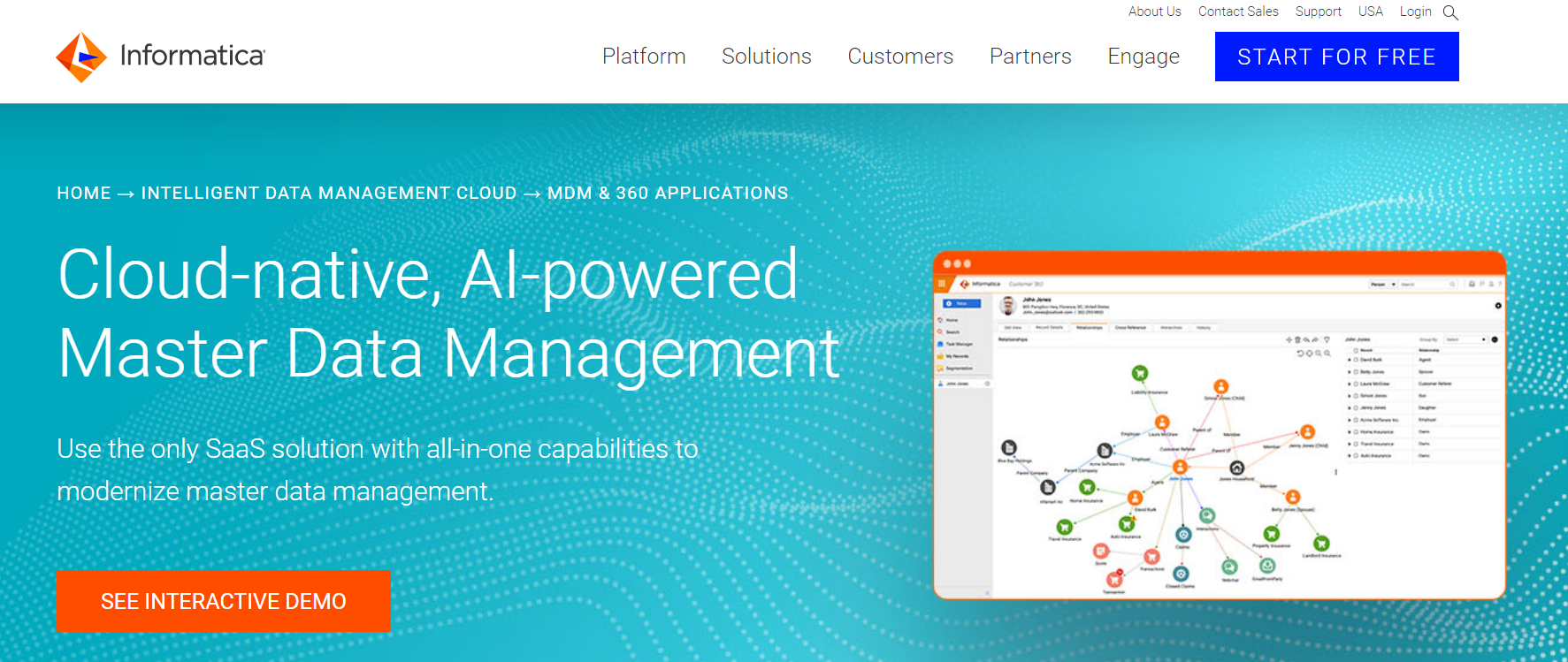
Must visit How to Get Started with Master Data Management? to explore about the MDM implementation process.

Conclusion

Having a well-defined MDM strategy is one of the essentials for modern-day businesses to witness success in the current evolving market condition. It serves as a cornerstone for obtaining high-quality data that is consistent, easily accessible, and properly categorized.
Without such data, any benchmarking or analytical endeavor would be rendered meaningless. In today’s fiercely competitive business landscape, companies that fail to embrace business analytics risk falling behind their rivals.

The value of actionable data insights cannot be overstated. They have the power to enhance operational efficiency, mitigate business risks, foster competitiveness, and streamline overall business operations.

However, harnessing the full potential of data analytics requires a combination of expertise in business analytics and specialized knowledge tailored to your organization’s unique needs.

Master Data Management in Healthcare: Optimizing Data for Smarter Decision-Making

In the healthcare industry, the effective management of data is crucial for providing quality patient care, ensuring regulatory compliance, and driving operational efficiency. Introducing Master Data Management in healthcare, organizations unravel the key obstacles that hinder efficient data management.

Healthcare companies often face significant challenges in managing their data effectively, resulting in fragmented information, data quality issues, compliance concerns, and much more.

Master Data Management (MDM) – a powerful solution that transforms the way healthcare data is managed and utilized.

MDM revolutionizes data management in healthcare by providing a comprehensive framework to tackle the complexities of data integration, data quality, and data governance. It serves as the bedrock for unified, accurate, and actionable information that empowers healthcare providers to deliver exceptional patient care.

In this post, we delve into the world of Master Data Management in healthcare and explore the data management challenges in the healthcare industry and how MDM can address those challenges effectively.

Moreover, you will discover the benefits, essential components, implementation process, key applications, and more of MDM in healthcare.

So, let’s get started.

What is MDM in Healthcare?

MDM in healthcare refers to Master Data Management, which is a discipline focused on managing and harmonizing critical data within an organization.

In the healthcare industry, MDM involves centralizing and standardizing master data, such as patient, provider, product, and organization data, to ensure accuracy, consistency, and integrity across various systems and applications.

MDM in healthcare aims to address the data management challenges faced by healthcare organizations, including data fragmentation, inconsistencies, and duplication. By implementing MDM, healthcare organizations can establish a single source of truth for their master data, enabling better data governance, data quality, and data-driven decision-making.

The purpose of Master Data Management in healthcare is to improve operational efficiency, enhance patient care and safety, support clinical and administrative processes, and enable strategic initiatives such as population health management, analytics, and personalized medicine.

Master Data Management enables healthcare organizations to have a comprehensive and reliable view of their data, ensuring that the right data is available to the right people at the right time.

Benefits of Master Data Management in Healthcare

Master Data Management (MDM) is a game-changer for the healthcare industry that addresses all data management-related challenges effectively. MDM implementation offers numerous benefits that can transform the way data is managed and utilized.

By considering MDM, healthcare organizations can experience significant advantages that improve patient care, operational efficiency, regulatory compliance, and overall decision-making. Here are six key benefits of adopting Master Data Management in healthcare:

Improved Data Quality

MDM ensures data accuracy, completeness, and consistency by establishing standardized data models, data validation rules, and data governance processes.

By maintaining high-quality master data, healthcare organizations can enhance patient safety, reduce medical errors, and improve clinical outcomes.

Enhanced Data Integration

Master Data Management enables seamless integration of data from various sources, systems, and departments within the healthcare organization. It breaks down data silos and creates a single source of truth, allowing for better data sharing, collaboration, and interoperability.

With the integrated view of data, healthcare companies improve efficiency, reduce redundant data entry, and facilitate comprehensive patient care.

Streamlined Data Governance

MDM establishes robust data governance frameworks and processes that ensure data privacy, security, and regulatory compliance. It enables healthcare organizations to define data ownership, enforce data access controls, and monitor data usage.

Effective data governance enhances data integrity, protects sensitive patient information, and mitigates compliance risks.

Enhanced Decision-Making

With accurate and timely master data, healthcare organizations can make data-driven decisions with confidence. MDM provides a holistic view of patient data, provider data, medical codes, and other critical information, enabling better clinical decision-making, resource allocation, and strategic planning.

Real-time access to reliable data empowers healthcare professionals to provide personalized and informed care.

Efficient Operations and Cost Savings

MDM optimizes operational efficiency by reducing manual data entry, eliminating duplicate records, and automating data processes. This improves productivity, minimizes errors, and saves time and resources.

By leveraging Master Data Management, healthcare organizations can achieve cost savings through streamlined data management, reduced administrative overhead, and improved revenue cycle management.

Improved Patient Experience

MDM enables healthcare organizations to provide a seamless and personalized patient experience.

By having a comprehensive view of patient data, including medical history, allergies, medications, and preferences, healthcare professionals can deliver tailored care, improve care coordination, and enhance patient satisfaction.

Master Data Management also facilitates accurate patient matching, reducing the risk of identity errors and improving patient safety.

Considering Master Data Management in healthcare, organizations offer numerous benefits that are crucial for delivering high-quality patient care, driving operational efficiency, and meeting regulatory requirements.

By implementing MDM, healthcare organizations can unlock the full potential of their data, make informed decisions, and ultimately improve patient outcomes and experiences. It is a strategic investment that paves the way for a data-driven healthcare ecosystem.

Key Components of Master Data Management in Healthcare

Master Data Management (MDM) is a comprehensive approach to managing and integrating critical data within an organization. In the healthcare industry, MDM plays a crucial role in maintaining accurate, consistent, and reliable master data across various systems and applications.

Let’s explore the key components of MDM in healthcare and how they contribute to effective data management:

1. Data Governance

Data governance is the foundation of MDM in healthcare. It involves establishing policies, procedures, and frameworks for data management, ensuring data quality, privacy, and security. It helps define roles and responsibilities, establish data standards, and ensure compliance with regulatory requirements.

2. Data Integration

Healthcare organizations generate a vast amount of data from multiple sources, such as electronic health records (EHRs), laboratory systems, billing systems, and more.

Data integration involves consolidating and merging data from disparate sources into a unified view, eliminating data silos and inconsistencies. It enables a comprehensive understanding of patient information, enabling better care coordination and decision-making.

3. Data Quality Management

Ensuring data quality management is a critical component of MDM in healthcare. It involves data cleansing, validation, standardization, and enrichment processes.

By implementing data quality rules and workflows, organizations can identify and resolve data issues, improving the accuracy and reliability of master data. This leads to better clinical outcomes, improved patient safety, and reduced errors.

4. Master Data Repository

The master data repository is the central storage for all critical healthcare data, such as patient demographics, provider information, medical codes, and more. It serves as a single source of truth for master data, ensuring data consistency and eliminating data duplication.

The repository provides a unified view of data across the organization, facilitating efficient data access and retrieval.

5. Data Security and Privacy

Healthcare data is highly sensitive and subject to strict privacy regulations. Master Data Management in healthcare includes robust security measures to protect patient data from unauthorized access, breaches, and cyber threats.

It involves implementing encryption, access controls, audit trails, and data masking techniques to safeguard patient information and maintain compliance with privacy regulations like HIPAA.

6. Data Stewardship

Data stewardship is the ongoing management and maintenance of master data. It involves assigning data stewards responsible for overseeing data quality, integrity, and governance.

It ensures adherence to data management policies, resolves data-related issues and acts as subject matter experts in their respective domains. They play a crucial role in ensuring the accuracy and reliability of master data.

7. Data Integration and Interoperability

MDM in healthcare enables seamless integration and interoperability between different systems and applications. It ensures that master data is consistent and synchronized across various healthcare IT systems, including EHRs, billing systems, practice management systems, and more.

It enables healthcare providers to access comprehensive and up-to-date patient information, improving care coordination and continuity.

8. Data Analytics and Reporting

Leverage a robust master data management solution that facilitates data analytics and reporting capabilities by providing clean, accurate, and reliable data. With integrated master data, healthcare organizations can generate meaningful insights, perform data analysis, and create reports for operational, clinical, and financial decision-making.

Data analytics empowers healthcare professionals to identify trends, monitor performance, and drive continuous improvement.

9. Data Migration and Conversion

MDM in healthcare involves data migration and conversion processes when transitioning from legacy systems to new platforms or during system upgrades. It ensures a smooth transfer of data, maintaining data integrity and preserving the quality of master data.

Proper data migration and conversion minimize disruptions, mitigate risks, and ensure a seamless transition to new systems.

10. Change Management

Implementing Master Data Management in healthcare requires effective change management practices. It involves managing the people, processes, and technologies involved in the adoption of MDM.

Change management ensures that stakeholders understand the benefits of MDM, receive adequate training, and are actively engaged in the transformation process. It helps drive acceptance, adoption, and successful implementation of MDM initiatives.

The key components of MDM in healthcare encompass data governance, integration, quality management, master data repository, security and privacy measures, data stewardship, interoperability, analytics, migration, and change management.

By implementing these components effectively, healthcare organizations can achieve comprehensive and reliable master data management, leading to improved patient care, operational efficiency, and data-driven decision-making.

How to Implement Master Data Management in Healthcare?

Master Data Management (MDM) is a strategic initiative that can revolutionize data management in the healthcare industry.

By implementing MDM, healthcare organizations can achieve accurate, consistent, and reliable master data, leading to improved patient care, operational efficiency, and data-driven decision-making. If you’re considering getting started with MDM in healthcare, here are the key steps to guide you:

Step 1: Define Your Objectives

Clearly identify your objectives for implementing Master Data Management in healthcare. Determine what specific data challenges you want to address, such as improving data quality, enhancing data integration, or streamlining data governance.

Understanding your goals will help you establish a clear vision and direction for your Master Data Management initiative.

Step 2: Assess Your Current State

Conduct a thorough assessment of your existing data management practices and systems. Identify data sources, data quality issues, data silos, and any inefficiencies in data processes.

Assess the maturity level of your data management capabilities to understand the gaps that need to be addressed with Master Data Management.

Step 3: Establish Data Governance

Data governance is a critical component of MDM in healthcare. Define data governance policies, procedures, and frameworks that align with your organization’s goals and regulatory requirements.

Establish data stewardship roles and responsibilities to ensure accountability for data quality, privacy, and security.

Step 4: Identify Data Domains

Identify the key data domains that are critical for your healthcare organization, such as patient data, provider data, medication data, or facility data.

Determine the attributes and relationships within each data domain that require standardization and integration. This will help you focus your efforts and prioritize your MDM implementation.

Step 5: Select an MDM Solution

Choose an MDM solution that suits your healthcare organization’s specific needs and requirements.

Evaluate vendors and solutions based on factors such as data integration capabilities, data quality management features, scalability, security, and interoperability. Ensure that the chosen solution aligns with your long-term data management strategy.

Step 6: Develop a Data Model

Design a comprehensive data model that represents the structure, attributes, and relationships within your data domains.

Define the data elements and their definitions, data hierarchies, and data validation rules. The data model will serve as the foundation for managing and governing your master data effectively.

Step 7: Implement Data Integration

Establish data integration processes to consolidate and integrate data from various systems and sources.

Implement data integration technologies and tools that enable seamless data exchange and synchronization. Ensure that data is accurately mapped, transformed, and loaded into the master data repository.

Step 8: Cleanse and Validate Data

Cleanse and validate your data to ensure its accuracy, completeness, and consistency.

Implement data quality processes and tools to identify and resolve data issues, such as duplicate records, missing values, or inconsistent formats. Regularly monitor and maintain data quality to sustain high-quality master data.

Step 9: Establish Data Stewardship

Appoint data stewards who will take ownership of the master data within specific data domains. Data stewards will be responsible for data quality monitoring, resolving data issues, and enforcing data governance policies. Provide them with the necessary training and tools to perform their roles effectively.

Step 10: Monitor and Continuously Improve

Implement monitoring mechanisms to track the performance of your MDM solution and the quality of your master data. Continuously measure and analyze data metrics, such as data accuracy, completeness, and timeliness. Use these insights to identify areas for improvement and refine your MDM processes over time.

Step 11: Foster Collaboration

Encourage collaboration and communication among different stakeholders involved in Master Data Management, including data stewards, IT teams, business users, and executives.

Establish cross-functional teams and regular meetings to discuss data-related challenges, share best practices, and align Master Data Management initiatives with business goals.

Step 12: Evolve with Changing Needs

Recognize that Master Data Management in healthcare is an ongoing journey. Stay abreast of industry trends, evolving regulations, and technological advancements. Continually adapt and enhance your MDM strategy to meet the changing needs of your healthcare organization and the evolving data landscape.

By following these steps, you can lay a strong foundation for implementing MDM in healthcare and embark on a transformative journey towards efficient data management, improved patient care, and enhanced operational outcomes.

Key Applications of Master Data Management in Healthcare

Master Data Management (MDM) has several key applications in the healthcare industry, which play a crucial role in improving data quality, operational efficiency, and patient care. Let’s explore some of the key applications of MDM in healthcare:

Patient Master Data Management (PMDM)

Patient Master Data Management focuses on managing patient data, creating a centralized and accurate repository of patient information. It ensures that patient data is consistent, complete, and up-to-date across various systems and healthcare facilities.

The solution facilitates patient matching and de-duplication, reducing the risk of duplicate records and improving data integrity. It enables healthcare providers to have a holistic view of each patient, leading to improved care coordination, personalized treatment plans and enhanced patient satisfaction.

Provider Master Data Management (ProvMDM)

Provider Master Data Management involves managing provider data, including information about physicians, specialists, and healthcare organizations. It ensures that provider information is accurate, standardized, and easily accessible across the healthcare ecosystem.

With Provider Master Data Management, healthcare organizations streamline processes such as provider enrollment, credentialing, and network management. By maintaining reliable provider data, healthcare organizations can enhance provider directory services, improve referral management, and optimize care delivery networks.

To get better insights into provider data management, dont’s miss visiting Provider Data Management – How to Manage Provider Data into Master Data Management?

Product Master Data Management (ProdMDM)

Product Master Data Management focuses on managing product data related to pharmaceuticals, medical devices, and supplies. It involves maintaining accurate and up-to-date product information, such as drug classifications, specifications, and pricing.

Product Master Data Management ensures that healthcare organizations have a comprehensive view of their product catalogs, enabling effective inventory management, procurement, and supply chain optimization.

By maintaining data accuracy and consistency, Product MDM supports patient safety, regulatory compliance, and streamlined procurement processes.

Organization Master Data Management (OrgMDM)

Organization Master Data Management involves managing organizational data within the healthcare industry. It includes information about hospitals, clinics, healthcare systems, and other healthcare entities. The platform ensures that organizational data is accurate, standardized, and integrated across various systems and departments.

By centralizing and harmonizing organizational data, organization Master Data Management enables efficient reporting, analytics, and decision-making. It facilitates strategic planning, resource allocation, and performance management at the organizational level.

Clinical Trial Master Data Management (CTMDM)

Clinical Trial Master Data Management involves managing data related to clinical trials, including study protocols, patient eligibility criteria, and trial outcomes. It ensures that clinical trial data is accurate, standardized, and accessible for analysis and reporting.

The solution facilitates efficient trial design, patient recruitment, and data integration across multiple sites, leading to improved clinical research outcomes and faster time-to-market for new treatments.

Reference Data Management (RefDM)

Reference data management focuses on managing reference data, which includes medical codes, classifications, and terminologies. It involves standardizing and harmonizing reference data to ensure consistency and interoperability across healthcare systems.

It plays a crucial role in accurate coding, billing, and clinical documentation, supporting efficient reimbursement processes and enabling meaningful data exchange and analysis.

Future Trends and Innovations in Healthcare MDM

Future Trends and Innovations in Healthcare Master Data Management (MDM) are poised to revolutionize the way healthcare organizations manage and leverage their data assets. As technology continues to advance and healthcare evolves, here are some key trends and innovations to watch out for:

Artificial Intelligence (AI) and Machine Learning (ML)

AI and ML are transforming the healthcare landscape, and their integration with Master Data Management is expected to bring significant advancements. AI-powered algorithms can automate data cleansing, matching, and enrichment processes, improving data quality and accuracy.

ML algorithms can also analyze vast amounts of patient and clinical data to identify patterns, predict outcomes, and optimize treatment plans.

Blockchain Technology

Blockchain technology holds immense potential in healthcare MDM. Its decentralized and secure nature can ensure data integrity, immutability, and interoperability across various healthcare systems and stakeholders.

Blockchain can enhance patient data privacy and consent management, streamline data exchange, and facilitate seamless integration of data from multiple sources.

Internet of Medical Things (IoMT)

The IoMT, consisting of interconnected medical devices and wearable technologies, generates massive amounts of patient-generated health data (PGHD). Master Data Management can play a crucial role in integrating and managing this diverse data.

By leveraging Master Data Management, healthcare organizations can harness the power of PGHD for personalized medicine, remote patient monitoring, and population health management.

Big Data Analytics

The healthcare industry is experiencing an explosion of data from various sources. Big Data analytics, coupled with Master Data Management, enables healthcare organizations to derive valuable insights from large datasets.

By analyzing structured and unstructured data, organizations can identify trends, patterns, and correlations, leading to improved clinical decision-making, research, and population health management.

Cloud-Based Healthcare MDM Solutions

Cloud computing offers scalability, flexibility, and cost-efficiency, making it an ideal platform for healthcare MDM solutions. Cloud-based MDM system enables organizations to securely store, manage, and access their data from anywhere, anytime.

With the increasing adoption of cloud technology in healthcare, future trends will see more organizations embracing cloud-based Master Data Management solutions.

Personalized Healthcare

Master Data Management combined with patient-centric initiatives can pave the way for personalized healthcare.

By integrating patient data from various sources, including EHRs, wearable devices, and genetic data, healthcare organizations can gain a holistic view of each patient. This enables personalized treatment plans, targeted interventions, and improved patient outcomes.

The future of healthcare MDM is driven by advancements in AI, blockchain, IoMT, big data analytics, interoperability, cloud computing, personalized healthcare, and data privacy.

By embracing these trends and innovations, healthcare organizations can unlock the full potential of their data, enhance patient care, and drive better outcomes in the rapidly evolving healthcare landscape.

How Does Credencys Help Develop Healthcare MDM Solutions?

Credencys is your trusted partner in developing robust Master Data Management (MDM) solutions tailored for the healthcare industry.

Our experienced team understands the unique challenges and complexities of healthcare data management, and we have the expertise to deliver scalable and secure MDM solutions that address your specific needs.

We work closely with healthcare organizations to centralize and govern critical data, ensuring data accuracy, completeness, and consistency. Our MDM solutions enable you to create a unified view of patient data, provider information, product cataloging, and organization data, empowering you to make informed decisions and drive operational efficiency.

With Credencys, you benefit from our deep domain knowledge, advanced technologies, and industry best practices. We follow a systematic approach to MDM implementation, starting from strategy development and data profiling to data integration, data quality management, and ongoing maintenance.

Our MDM solutions not only streamline data management processes but also enhance patient care, optimize workflows, and improve data-driven decision-making. We prioritize data governance, data stewardship, and compliance with industry regulations to ensure the integrity and privacy of sensitive healthcare data.

Partner with Credencys to leverage our expertise in developing customized MDM solutions that transform your healthcare organization. With our support, you can overcome data management challenges, achieve data interoperability, and unlock the full potential of your healthcare data.

Choose Credencys as your MDM partner and embark on a journey of efficient data management, improved patient outcomes, and enhanced operational excellence in the healthcare industry. Together, let’s harness the power of MDM to drive your healthcare organization forward.

In the Nutshell

In conclusion, Master Data Management (MDM) is playing a vital role in transforming the healthcare industry by addressing data management challenges, improving data quality, and enabling data-driven decision-making.

With the increasing volume and complexity of healthcare data, implementing healthcare MDM solutions has become a necessity for healthcare organizations to effectively manage and leverage their data assets.

By centralizing and standardizing master data across various domains such as patients, providers, products, and organizations, healthcare organizations can achieve data consistency, accuracy, and integrity.

This not only improves operational efficiency but also enhances patient care, enables better clinical decision-making, and supports strategic initiatives.

What is Data Mapping – Everything Retailers Need to Know About It

In today’s digital era, businesses across industries are grappling with the immense challenge of managing large volumes of product information or master data. This data serves as the backbone for various business processes, such as eCommerce, supply chain management, customer experience, and more. However, the complexity and heterogeneity of data sources make it difficult to integrate and consolidate information effectively. This is where data mapping comes into play.

What is Data Mapping?

Data mapping is the process of establishing relationships and connections between source data elements and their corresponding target data elements. It provides a structured approach to transform and align data from diverse sources into a unified format that can be efficiently managed within a PIM or MDM system.

One of the key reasons why data mapping is crucial in PIM and MDM implementations is its ability to streamline data integration. With multiple data sources, such as ERP systems, spreadsheets, databases, and external vendors, businesses often face the challenge of integrating these disparate data sets.

Data mapping allows businesses to define clear mappings between source and target fields, ensuring a smooth flow of information across systems and applications. Moreover, it plays a pivotal role in improving data quality.

Inaccurate or inconsistent data can have detrimental effects on business operations, customer satisfaction, and decision-making. By mapping data elements, businesses can identify data quality issues, standardize data formats, and cleanse or enrich the information as required.

This results in reliable and high-quality data that can be leveraged for better insights and business outcomes. Data mapping also enhances overall data management efficiency.

With a well-defined mapping strategy, businesses can automate the process of transforming and loading data into their PIM or MDM system. This automation eliminates manual data entry errors, reduces data processing time, and improves productivity.

Additionally, data mapping enables businesses to establish data governance policies and enforce data standards consistently, ensuring data integrity and compliance with industry regulations.

Why is Data Mapping Important?

Accurate data mapping is essential for achieving successful PIM and MDM implementations. Here are some reasons why this practice holds significant importance:

Improved Data Quality

Data mapping allows businesses to standardize and cleanse data by defining data transformation rules and applying data quality measures. Businesses can enhance the overall quality and integrity of their data.

This ensures that the data within the PIM or MDM system is reliable, consistent, and free from errors.

Increased Productivity

Data mapping streamlines data integration and reduces manual data entry efforts. With well-defined mappings, retailers can automate the process of transforming and loading data, saving time and effort.

This automation minimizes the risk of human errors and allows employees to focus on value-added tasks rather than repetitive data entry.

Enhanced Decision-Making

Accurate and consistent data mapping enables businesses to gain a comprehensive view of their product or master data. With mapped and integrated data, retailers can generate meaningful insights, perform data analysis, and make informed decisions.

Access to reliable and up-to-date information empowers stakeholders across the business to drive strategic initiatives, improve customer experiences, and respond quickly to market demands.

Data Consistency and Compliance

Data mapping helps enforce data governance and compliance policies. By mapping data fields, retailers can ensure consistency in data formats, naming conventions, and business rules.

This consistency ensures that data is standardized across the business, adheres to industry standards, and complies with regulatory requirements.

Seamless System Integration

Data mapping facilitates seamless integration between various systems, databases, and applications. By establishing relationships between source and target data elements, businesses can achieve interoperability and data synchronization.

This enables the flow of accurate and updated information across systems, supporting efficient business processes and enabling real-time data availability.

Importance of Data Mapping

Key Components of Data Mapping

Source Data Analysis

Before initiating the process, it is crucial to thoroughly analyze the source data. This analysis involves several important steps, including data profiling, data cleansing, and data enrichment.

Data Profiling

Data profiling involves examining the source data to gain insights into its characteristics, structure, and quality. It helps identify data patterns, distributions, and anomalies.

By understanding the source data’s properties, businesses can make informed decisions about data mapping strategies and transformations.

Data Cleansing

Data cleansing is the process of identifying and rectifying errors, inconsistencies, and inaccuracies within the source data. This may include removing duplicate records, standardizing data formats, correcting misspellings, and resolving data conflicts.

Data cleansing ensures that the source data is clean and reliable, enhancing the accuracy and effectiveness of the data mapping process.

Data Enrichment

Data enrichment involves enhancing the source data with additional relevant information. This could include appending missing attributes, enriching data with external sources, or standardizing values to improve data quality.

By enriching the source data, businesses can augment the completeness and usefulness of their data, leading to more robust mappings and improved downstream processes.

Understanding the Data Structure, Format, and Quality

It is vital to have a comprehensive understanding of the source data’s structure, format, and quality before mapping. This includes identifying the data fields, their relationships, and any dependencies.

Understanding the data structure ensures that the data mapping process accurately represents the relationships between source and target data. Additionally, understanding the data format and quality helps in determining the necessary data transformations and cleansing operations required during the mapping process.
Steps of Source Data Analysis

Target Data Definition

Defining the target data structure, format, and quality requirements is equally important as analyzing the source data. The target data definition establishes the guidelines and specifications for the mapped data.

Importance of Defining Target Data

Defining the target data structure ensures consistency and standardization within the PIM or MDM system. It outlines the fields, attributes, and relationships that need to be established in the target system.

Additionally, defining the target data format helps ensure data compatibility and interoperability with other systems and applications.

Quality Requirements

Defining quality requirements for the target data sets expectations for the accuracy, completeness, and integrity of the mapped data. It helps establish data governance policies, data validation rules, and data quality measures to ensure high-quality data within the PIM or MDM system.

Clearly defined quality requirements assist in maintaining data consistency and compliance with industry standards and regulations.

Impact on Data Mapping

The target data definition significantly influences the data mapping process. It provides a clear roadmap for mapping source data elements to their corresponding target fields.

By aligning the source and target data structures, businesses can ensure accurate and seamless data transformation and integration.

Data Mapping Rules

Data mapping rules govern the transformation and mapping of source data to the target. These rules define how the data should be converted, manipulated, or validated during the mapping process.

Several common types of data mapping rules include:

Direct Mapping

Direct mapping involves a straightforward one-to-one relationship between source and target fields. The source data is directly copied or mapped to the corresponding target field without any transformations or modifications.

Transformation Mapping

Transformation mapping involves applying data transformations during the mapping process. This may include data format conversions, calculations, concatenations, or aggregations to transform the source data into the desired format in the target system.

Value Mapping

Value mapping is used when the source and target data have different value representations. It involves mapping specific values or ranges of values from the source to their corresponding values in the target.

Value mapping is useful for standardizing data or aligning data across systems with varying value conventions.
Data mapping rules play a vital role in ensuring accurate and meaningful data mappings. They help retailers achieve data consistency, ensure data integrity, and enable proper data transformations based on the requirements of the target system.

By defining and implementing appropriate mapping rules, businesses can achieve effective data mapping that aligns with their business needs and objectives.

Effective Data Mapping – Best Practices

Establishing Clear Objectives

Defining clear objectives for data mapping is crucial for a successful PIM and MDM implementation. These objectives encompass data integration goals, data quality standards, and business requirements.

Here’s why establishing clear objectives is essential:

Data Integration Goals

Clearly defining data integration goals helps businesses identify the desired outcomes of the data mapping process. It involves determining how data from various sources will be consolidated, harmonized, and synchronized within the PIM or MDM system.

Establishing data integration goals provides a framework for mapping strategies, transformations, and data flow, ensuring a seamless integration process.

Data Quality Standards

Defining data quality standards is vital for maintaining accurate and reliable data within the PIM or MDM system. Businesses need to establish specific criteria for data accuracy, completeness, consistency, and timeliness.

By setting clear data quality standards, businesses can ensure that the data mapping process includes appropriate cleansing, validation, and enrichment data mapping techniques to achieve the desired level of data quality.

Business Requirements

Aligning data mapping with business requirements is crucial for driving value and achieving business objectives. Understanding the specific needs of different business functions and stakeholders helps prioritize data elements and mapping rules.

By aligning data mapping with business requirements, businesses can enhance decision-making, improve operational efficiency, and support strategic initiatives.

Collaborative Data Mapping Process

A collaborative approach to data mapping involving cross-functional collaboration between business users, IT teams, and data experts is essential for accurate mapping and alignment with business needs. Here’s why collaboration is crucial:

Subject Matter Expertise

Collaboration allows the integration of domain knowledge and technical expertise. Business users understand the context and requirements of the data, while IT teams and data experts possess the technical knowledge to implement the mapping rules effectively.

Collaboration ensures that the data mapping process incorporates both business and technical perspectives, resulting in accurate and meaningful mappings.

Data Validation and Feedback

Collaborative data mapping allows for continuous validation and feedback loops. Business users can review and validate the mapped data against their requirements, providing valuable insights and identifying any discrepancies or gaps.

IT teams and data experts can address these feedback points, ensuring that the mappings align with business needs and objectives.

Change Management

Collaboration facilitates effective change management during the data mapping process. As business requirements evolve or new data sources emerge, cross-functional collaboration ensures that the mappings can be updated and modified accordingly.

Collaboration also helps manage expectations, resolve conflicts, and ensure that the data mapping process remains flexible and adaptable to changing business dynamics.

Data Mapping Documentation

Maintaining detailed documentation throughout the data mapping process is essential for clarity, consistency, and future reference. The key elements of data mapping documentation include:

Mapping Rules

Documenting mapping rules ensures that there is a clear understanding of how source data elements are transformed and mapped to target fields. Mapping rules should describe the specific transformations, calculations, validations, and business rules applied during the data mapping process.

Well-documented mapping rules facilitate transparency, ease of maintenance, and knowledge sharing among team members.

Data Dictionaries

Data dictionaries provide a comprehensive description of the source and target data elements, including their definitions, attributes, data types, and relationships. Documenting data dictionaries helps maintain a common understanding of data semantics, ensuring consistency and accuracy during the mapping process.

Data dictionaries also serve as a reference for future mapping activities and data-related discussions.

Transformation Logic

Documenting the transformation logic helps in capturing the rationale behind specific data transformations. It provides insights into why certain mappings and transformations were chosen, facilitating traceability and auditability.

Well-documented transformation logic aids in troubleshooting, debugging, and ensuring consistency in future data mapping initiatives.

Data Mapping Tools and Technologies

Utilizing the right data mapping tools and technologies can significantly enhance the efficiency and effectiveness of the data mapping process. Here are some popular data mapping tools and technologies available in the market:

Data Integration Platforms

Data integration platforms provide robust data mapping capabilities. These platforms offer graphical interfaces, drag-and-drop functionality, and pre-built connectors for seamless integration of diverse data sources.

They often support data profiling, data quality assessment, and data transformation features, streamlining the mapping process.

Data Mapping Tools

There are specific tools designed specifically for data mapping. These data mapping tools provide graphical interfaces that simplify the creation and management of data mappings.

They often support various data formats, including XML, CSV, or JSON, and offer advanced features like data validation, data enrichment, and complex transformation rules.

Open-Source Tools

Open-source tools offer powerful data mapping capabilities without the cost of commercial tools. These tools provide a wide range of connectors, transformations, and mapping functions.

They offer flexibility, customizability, and an active community for support and updates.

Data Mapping Challenges and Solutions

Handling Complex Data Structures

Businesses often encounter challenges when dealing with complex data structures during the data mapping process. These structures can include hierarchical, nested, or multi-level data.

Challenges:

  • Understanding the relationships and dependencies within complex data structures can be daunting.
  • Mapping data elements across different levels of hierarchy or nesting can be time-consuming and error-prone.
  • Handling large volumes of data within complex structures can impact performance and efficiency.

Overcoming these challenges requires careful consideration and effective strategies. Here’s how businesses can tackle complex data structures:

Solutions:

  • Thoroughly analyze and comprehend the complex data structure before mapping. This includes understanding the relationships, hierarchies, and dependencies within the data.
  • Break down the complex structure into smaller, manageable components. Identify and focus on mapping one level or section at a time to simplify the process.
  • Utilize graphical data mapping tools that provide visual representations of the complex data structure. These data mapping tools can simplify the mapping process and help visualize the relationships between different elements.
  • Consider using data modeling techniques to represent and map complex data structures. This can involve using entity-relationship diagrams, XML schemas, or JSON schemas to define the structure and relationships.

Maintaining Data Integrity and Consistency

Maintaining data integrity and consistency is crucial throughout the data mapping process. Ensuring accurate data transformation and validation helps retailers achieve reliable and high-quality data mappings.

Here’s how businesses can address data integrity and consistency challenges:

Importance of Data Integrity and Consistency:

  • Inaccurate or inconsistent data mappings can lead to erroneous data in the target system, impacting decision-making and business processes.
  • Data validation is essential to identify and address data quality issues during the mapping process.
  • Consistent data mappings enable seamless integration and synchronization between systems, ensuring data integrity across the business.

Data Mapping Techniques for Accurate Data Transformation and Validation:

  • Establish clear mapping rules and guidelines to ensure consistent and accurate data transformation during the mapping process. This includes defining transformation logic, data format conversions, data standardization, and any business rules applied to the data.
  • Implement data validation checks during the mapping process to identify and address data quality issues. This can involve data profiling, data cleansing, and data enrichment techniques to ensure the accuracy, completeness, and consistency of the mapped data.
  • Regularly monitor and review data mappings to maintain data integrity and consistency over time. Implement data governance practices to enforce data standards, conduct data audits, and address any inconsistencies or discrepancies that may arise.

Managing Data Mapping Updates

Managing data mapping updates can be a challenge as business requirements or data sources change. Retailers need strategies to maintain flexibility and scalability in data mapping configurations.

Here’s how to address this challenge:

Challenges:

  • Changing business requirements may necessitate updates to existing data mappings.
  • Data sources might evolve, requiring adjustments to the mapping configurations.
  • Managing a large number of mappings across various systems can be complex and time-consuming.

Solutions:

  • Establish a robust change management process to handle data mapping updates effectively. This process should include proper documentation, version control, and approval workflows for making changes to data mappings.
  • Implement a centralized repository or metadata management system to store and manage data mappings. This ensures that mappings are easily accessible, traceable, and can be updated efficiently.
  • Adopt agile methodologies for projects, allowing for iterative and incremental updates. This approach enables businesses to respond quickly to changing business needs and incorporate updates into the mapping process efficiently.
  • Maintain a collaborative environment involving cross-functional teams, including business users, IT teams, and data experts. Regular communication and coordination ensure that updates are aligned with business requirements and properly implemented across systems.

Conclusion

Data mapping is a vital component of PIM and MDM implementations. It enables businesses to integrate data from diverse sources, improve data quality, and make informed decisions based on reliable information.

By adopting best practices, businesses can optimize the data mapping process and achieve successful outcomes. As businesses embark on their data mapping journey, it is recommended to adopt these best practices and leverage the right data mapping tools and technologies for their specific needs.

By doing so, they can unlock the full potential of their data assets, drive operational efficiency, and gain a competitive edge in the market. Remember, data mapping is not a one-time activity but an ongoing process.

Continuously reviewing and updating data mappings to align with changing business requirements and data sources ensures that the PIM and MDM implementations remain robust, flexible, and aligned with business goals. Embrace the power of data mapping and witness the transformative impact it can have on data management practices.

21 Best Master Data Management Tools You Should Consider!!

With each passing day, it becomes difficult for organizations to keep customers engaged with the brand for the long term and empower the business processes. Data is the most reliable and efficient way to stay updated about customers changing requirements and gaps in your internal workflows. Advanced master data management(MDM) tools not only manage your structured, unstructured, operational, and analytical business data but also enable organizations with actionable insights that help in making the right business decisions.

With a master data management platform, companies can store and manage customer data, employee data, location data, reference data, supplier data, vendor data, and more. This post will help you select the most suitable Master Data Management (MDM) tool for your organization by analyzing the features and benefits offered by the different MDM tools.

What are Master Data Management Tools?

Master Data Management (MDM) tools are sophisticated software solutions designed to identify, connect, and synchronize crucial organizational data, known as master data, from various disparate sources. Through semantic reconciliation, these tools enable the recognition of unique data elements even when they are described differently.

By consolidating these disparate data points into a unified master data file, master data management tools provide seamless access to stakeholders across the organization.

The best master data management tools should cater to three primary user groups.

Data Governance: Data governance users have a comprehensive understanding of the desired outcomes of the solution. Data governance users also play a crucial role in guiding data stewards on optimal system management practices.

IT professionals: They articulate to IT professionals, the second user group, and users MDM for specific requirements on matching and generating high-quality insights from data.

Data Steward: Data stewards are responsible for the day-to-day management of the business systems.

Top 22 Master Data Management Tools

#1. Pimcore

Pimcore

Pimcore is an advanced digital platform and has robust Master Data Management capabilities. It allows organizations to manage their product data, customer, data, employee data, asset data, vendor/supplier data, reference data, partner data, location data, and other related information. Pimcore is an open-source platform and is available at no licensing fee.

Pimcore MDM allows businesses to store and manage all operational and analytical data in a single place. Skilled Pimcore developers help you to manage your organizational data in one place and enable business with a holistic view of structured or unstructured data.

Credencys is an end-to-end Pimcore development service provider and has a team of 20+ Pimcore developers who have successfully delivered next-gen digital solutions to small to large-scale organizations of varied industry domains. Connect with us to explore our success stories.

Key Features

  • Maintain data quality
  • Hierarchy management
  • Workflow management
  • Rich content integration
  • Audit trail
  • Third-party integration (software, applications, and APIs)

Benefits

  • Improved time to market (for meeting governance, managing the risks, and addressing the compliance requirements)
  • Accelerated digital transformation
  • Reduced cost (custom MDM development and deployment)

#2. Semrachy

Semarchy

Semarchy xDM platform offers a comprehensive solution for multi-vector Master Data Management (MDM). With a focus on collaboration and usability, Semarchy leverages advanced algorithms and material design principles to facilitate efficient data stewardship. The company adopts an agile and iterative implementation approach, ensuring flexibility and responsiveness throughout the deployment process.

Key Features

  • Multi-vector MDM
  • Collaborative data stewardship
  • Advanced algorithms
  • Material design principles
  • Agile implementation approach

Benefits

  • Improved data management
  • Enhanced data quality
  • User-friendly interface
  • Agile implementation
  • Efficient data processing
  • Scalability
  • Cost savings

#3. Syndigo

Syndigo

Syndigo, a renowned global software company, provides a diverse range of solutions specifically crafted to empower organizations in gaining mastery over their data. At the forefront of their offerings is their MDM software, which presents an all-encompassing, cloud-native platform for multi-domain Master Data Management (MDM).

This comprehensive solution incorporates vital components such as data governance, data quality, reporting, and more, enabling organizations to seamlessly manage and optimize their data assets. With this free master data management tool, businesses can achieve enhanced data control, improved data quality, streamlined reporting processes, and unlock valuable insights to drive informed decision-making.

Key Features

  • Data governance
  • Reporting
  • Data quality

Benefits

  • Multiple-domain MDM support
  • Deterministic data matching
  • Excellent product information management
  • Robust process orchestration

#4. Informatica

Informatica

Informatica MDM is a modular and end-to-end solution that connects your systems and information. It provides an accurate, complete and trusted for your digital transformation. The data helps organizations in omnichannel retailing, customer experience programs, supply chain optimization, sales and marketing operations, compliance initiatives, and more.

Key features

  • Data quality
  • Data integration
  • Data security & governance
  • Data acquisition (from 3rd party sources, on-premises & cloud)
  • Data Enrichment
  • Data analysis (to identify the relationship patterns and variance among different data)
  • Data deployment (cloud & on-premises)

Benefits

  • A 360-degree view of the data relationship
  • A single view of all your business-critical data
  • A complete view of customer behavior

#5. Profisee

Profisee

Profisee is a full-fledged master Data management platform that is available at the lowest cost of ownership compared to its competitive MDM solutions. It contains all the important components, features, and functionality of the best MDM tools. It is a multi-domain MDM platform that allows you to model and manage any reference data and master data domain virtually.

Key Features

  • Data stewardship
  • Data modeling
  • Enterprise workflow
  • Data governance
  • Data integration
  • Golden record management
  • Metadata management
  • Industry data models

Benefits

  • Provides a single and standardized view of all data
  • Highly scalable solution with a great level of performance
  • Zero coding

#6. Ataccama

Attaccama

It’s a data curation platform that provides solutions for data quality and governance, master data management, and data profiling and cataloging. Ataccama supports reference data management, multiple domains, hierarchy management, and more.

Key Features

  • Data discovery & profiling
  • Data catalog & business glossary
  • Data quality management
  • Master data management
  • Reference data management
  • Big data processing
  • Data integration
  • Multiple deployment options
  • Collaborative data stewardship
  • Data processing engine

Benefits

  • Multi-domain management
  • Highly scalable solution
  • Contains advanced capabilities of identity management, data matching, and hierarchy management
  • Provides end-to-end data quality activities
  • Robust big data connectivity

#7. Stibo Systems

Stibosystems

Stibo Systems manages all the operational information about your organization. It’s a multi-domain MDM to manage the data of customers, employees, products, references, location, and supplier data. They have separate MDM solutions to manage customer and product data.

Key Features:

  • Data onboarding
  • Data Sharing
  • Data cleansing
  • Data governance
  • Data Enrichment
  • Multi-domain data management

Benefits:

  • Improved compliance
  • Time to Value
  • Time to market
  • Ensured data quality
  • Deliver personalized experiences

#8. Tibco

Tibco

Tibco EBX is one of the leading Master Data Management tools, designed by Orchestra Networks. It offers varied solutions to organizations to manage their different data assets. The platform provides reference data management, hierarchy management, taxonomy management, multi-domain master data management, and data governance.

Key Features

  • Flexible data models
  • Collaborative workflow
  • Data quality
  • Real-time and batch integration
  • Business user interface
  • Data profiling, matching, cleansing, and validation

Benefits

  • Advanced hierarchy management capabilities
  • Proactive data governance and multi-domain MDM
  • Robust workflow and visualization capability
  • A consolidated platform for master data management, reference data management, and master data governance

#9. SAS

SAS

SAS, an enterprise analytics solutions provider, has developed a robust master data management tool named SAS MDM. It is a multi-domain MDM. It is an end-to-end data management software that mainly focuses on data governance and data quality. The tech giant also provides consulting services for its MDM product.

Key Features

  • Best-in-class data quality
  • Master data repository
  • Enterprise data governance
  • Multiple domain data models
  • Intuitive interface
  • Browser-based stewardship
  • Data resolution and matching
  • Batch and real-time deployment
  • Data stewardship console

Benefits

  • Provide trusted and unified data for use
  • Advanced governance capabilities and reduced the compliance risk
  • Enhanced customer relationship
  • Improved revenue generation
  • A unified view of products, customers, employees, suppliers, and other business entity
  • Make face-based and informed decisions

#10. Teradata

Teradata

Teradata is a single platform that supports multiple domains. The master data management tool helps businesses reduce the cost of buying multiple products, solutions, and reference data. To optimize and define master data, the tool relies on a process-driven environment and a workflow.

Key Features

  • Multiple domain management
  • Business user control
  • Enterprise analytical accuracy
  • Comprehensive data consolidation
  • Enterprise agility

Benefits

  • Enterprise data warehouse and reference data management capabilities
  • Multi-entity and multi-domain MDM
  • Supports operational and analytical MDM
  • Data matching engine

#11. Oracle

Oracle MDM

Oracle provides a multiple domain and enterprise-level Master Data Management tool. It helps organizations improve customer experience, reduce risk of compliance, and improve time-to-market. Oracle MDM is a comprehensive platform that provides consistent, consolidated, and authoritative master data across organizations and distributes relevant information to all analytical and operational applications.
The MDM platform contains five different modules such as product hub, customer hub, supplier hub, site hub, and higher education constitute hub.

Key Features

  • Data quality
  • Data cleansing and standardization
  • Multi-domain data management
  • Customer data management
  • Configurable workflows
  • Data governance

Benefits

  • Advanced capabilities for reference data management
  • Proactive data governance

#12. NetWeaver

SAP NetWeaver MDM

NetWeaver is developed by SAP, a global leader in enterprise application software development. NetWeaver is a master data governance solution that provides domain-specific MDM along with pre-built and collaborative workflows.

Key Features

  • Data cleansing (enrichment, profiling, standardization, and matching
  • Audit trails
  • Role-based user interface
  • Automated routing
  • Pre-configured data models with built-in data governance

Benefits

  • Extensible and pre-configured data models
  • SAP NAHA integration
  • Multi-mode data replication
  • Flexible workflows

#13. InfoSphere

InfoSphere

InfoSphere is one of the renowned master data management tools, developed by IBM. The platform allows you to access the orchestration and data governance capabilities of IBM. It manages all your organizational data regardless of any model or system and delivers it to the users in a unified and trusted view.

It enables enterprises with actionable insights, instant business value alignment, rules and policies across the organization, and compliance with governance.

Key Features

  • 360-degree view of critical enterprise data
  • End-to-end Master Data Management solution
  • Allows to extend MDM architecture in the cloud
  • Advanced analytical capabilities
  • Supports virtual or registry-style implementations

Benefits

  • MDM on Cloud reduces the overall cost
  • Intuitive and user-friendly interface
  • Provide accurate master data near real-time
  • Data deployment (on-premises, cloud & hosted)
  • Access to new analytical capabilities

#14. SAP Master Data Governance

SAP Master Data Governance

SAP Master Data Governance software empowers users to streamline and centralize the governance of their master data, guaranteeing impeccable data quality and consistency throughout their organization. This open-source master data management tool enables the consolidation of master data from both SAP and non-SAP systems, resulting in the creation of a single, authoritative record.

Furthermore, it facilitates the centralized creation and maintenance of master data across diverse systems within the enterprise.

Key Features

  • Consolidates and governs the master data
  • Integration capability with SAP and non-SAP systems
  • Creation of a single, comprehensive record for master data
  • Centralized management of master data across heterogeneous systems
  • Verifiable audit trail to track changes made to master data
  • Automated workflow routing and notification functionality
  • Time-dependent version control for easy access to previous data versions
  • Pre-built workflows and user interfaces for user convenience

Benefits

  • Maintains quality of data and its consistency across the organization
  • Reduces data duplication and enhances data accuracy
  • Streamlines data governance processes and improves efficiency
  • Enhances data transparency and accountability
  • Simplifies master data management across different systems
  • Provides a robust audit trail for compliance and traceability
  • Supports seamless integration with SAP and non-SAP systems
  • Offers a user-friendly experience with pre-built workflows and intuitive interfaces
  • Increases overall effectiveness and efficiency of data governance practices

#15. Boomi

Boomi

Dell Boomi is a comprehensive MDM solution that operates seamlessly within the cloud environment. With its robust capabilities in application integration, master data management, and domain-specific data quality, Dell Boomi provides organizations with a powerful toolset for managing their data effectively.

The platform’s multi-tenant architecture enables seamless integration across various deployment models, including cloud-to-cloud, cloud-to-on-premise, and on-premise-to-on-premise. Dell Boomi excels in real-time integrations and is designed to scale elastically, ensuring that it can handle increasing data volumes with ease.

Key Features

  • Cloud-native MDM solution designed for seamless operation within cloud environments
  • Comprehensive capabilities for application integration, master data management, and domain-specific data quality
  • Multi-tenant platform supporting various integration scenarios, including cloud-to-cloud, cloud-to-on-premise, and on-premise-to-on-premise
  • Real-time data integration capabilities for up-to-date information exchange
  • Elastic scalability to handle increasing data volumes with ease
  • Visual data modeling and definition tools for easy understanding and management of data structures
  • Data synchronization across multiple systems and integrations
  • Data stewardship features empower users to create business rules and alerts for effective data governance

Benefits

  • Simplified management of master data in the cloud environment
  • Streamlined application integration and data synchronization processes
  • Enhanced data quality and accuracy through domain-specific data quality features
  • Flexible integration options, including cloud and on-premise connectivity
  • Real-time data integration for up-to-date information exchange
  • Scalable solution to accommodate growing data volumes effectively

#16. IBM Infosphere Master Data Management

InfoSphere

Master Data refers to essential and commonly shared information concerning products, customers, partners, materials, suppliers, accounts, and other significant entities. It serves as the foundational data that is stored and replicated across various IT systems.

MDM tools in the market have immense value as it supports critical processes throughout the entire company. It forms the bedrock of every business transaction, application, decision-making, and reporting.

Key Features

  • Data matching and deduplication
  • Configurable framework (on-premise or cloud-based)
  • Policy management capabilities for data quality control
  • Graph-based representation for master and transactional data
  • Flexible data governance and integration
  • High performance and scalability
  • Improved data stewardship and governance
  • Integration with other applications and systems
  • Simplified reference data management
  • Centralized stewardship, auditing, and security

Benefits

  • Multi-domain MDM support
  • Flexible deployment options: on-premise and cloud
  • Seamless support for governing big data
  • Scalable solution with proven performance, particularly in data matching

#17. Omni-gen

Omni-Gen is a high-quality, comprehensive platform that revolutionizes the process of generating applications combining data integration, data quality, and master data management. With Omni-Gen, organizations can significantly reduce the time and effort required for such projects.

Omni-Gen offers three editions to cater to diverse needs:

Integration Edition

Empowers users with powerful application and data integration capabilities, enabling seamless access to any application or data store. This facilitates the rapid creation of integration architectures with extensive breadth and depth.

Data Quality Edition

Extending the capabilities of the Integration Edition, this edition ensures information completeness, validity, consistency, timeliness, and accuracy across all systems, individuals, and processes. It incorporates advanced data quality management functionality to deliver comprehensive data governance.

Master Data Management (MDM) Edition

The MDM Edition of Omni-Gen focuses specifically on managing master data, allowing organizations to establish a unified, reliable, and accurate view of their critical data assets. It provides robust MDM capabilities to streamline data consolidation, standardization, and synchronization.

Key Features

  • Creates a single unified view of data by blending and relating master data, transaction data, interaction data, reference data, and social data
  • Data as a Service capability for accessing third-party data sets
  • Data auditing and change tracking functionality
  • Big data insights for gaining valuable insights from large data sets
  • Recommended actions based on data analysis
  • Built-in analytics tools for data analysis and visualization
  • Collaborative workflows for streamlined collaboration and task management

Benefits

  • Supports multi-domain Master Data Management (MDM)
  • Enables collaborative data stewardship, rating, and segmentation
  • Native data visualization, and excellent data search functionality
  • Robust compliance capabilities with field-level audit history

#18. VisionWare MDM

VisionWare MDM creates a single view of customer data and Influence MultiVue, this offers a lot of benefits to the new age business. By leveraging MultiVue, you can make better strategic and operational decisions based on trusted and readily available customer data.

Having a comprehensive understanding of your customers allows you to tailor your proposals and offerings more effectively. By analyzing historic connections and communication preferences, you can enhance customer proposals and provide a more personalized experience.

MultiVue also enables you to tap into cross-sell and upsell opportunities. With improved selection and segmentation capabilities, you can identify the most relevant offerings for each customer, maximizing revenue potential.

Additionally, MultiVue facilitates seamless cross-channel activities when interacting with customers. This integration of employees and systems enables a cohesive and consistent customer experience across various touchpoints.

Key Features

  • Audit trail on master data to monitor changes
  • Collaborative and pre-built workflows
  • Data profiling, data matching, data enrichment, data cleansing, and standardizing
  • Automated routing
  • Built-in data governance
  • Pre-configured data models
  • Role-based user interfaces

Benefits

  • Cloud platform built on SAP HANA, enabling in-memory data processing for data cleansing and analytics
  • Flexible workflows with pre-built options
  • Pre-configured and extensible data models for efficient data management
  • Support for multi-mode data replication efforts

#19. Enterworks

EnterWorks

EnterWorks (MDM) is a comprehensive framework with the latest technologies designed to empower organizations with a reliable central data repository and to keep master data up-to-date.

By consolidating data from across all enterprise applications, Enable facilitates a unified view of complex data domains. It equips users with powerful MDM management tools to enhance data quality and implements data governance mechanisms to ensure the consistent and effective utilization of that data.

The Enable platform is purpose-built to master multiple domains, including materials, products, suppliers, customers, locations, and more, while also capturing the relationships between them.

This flexibility allows domains to be tailored to align with the unique business models and preferences of users, rather than forcing companies to conform to a rigidly predefined data structure.

Key Features

  • A framework of technologies and processes
  • A central repository of reliable and up-to-date master data
  • Consolidation of data across enterprise applications
  • Comprehensive support for complex data domains
  • One of the top master data management tools for improving data quality
  • Prescribed data governance mechanisms
  • Adaptability to meet specific business models and preferences

Benefits

  • Centralized and reliable master data
  • Improved data quality
  • Enhanced data governance
  • Flexibility and adaptability
  • A holistic view of complex data domains
  • Improved operational efficiency

#20. Syniti

Syniti’s master data management (MDM) solution is a vital component of the comprehensive Syniti Knowledge Platform software stack, which encompasses a wide range of advanced data management capabilities.

The MDM functionality, known as ‘Orchestrate,’ is specifically designed to ensure the highest quality of master and application data within business systems. By leveraging Syniti’s MDM capabilities, organizations can effectively enforce data governance and maintain data integrity across their entire data landscape.

Key Features

  • Integration with Syniti Knowledge Platform
  • Data Management Capabilities
  • Orchestrate Functionality
  • High-Quality Data Entry
  • Data Governance
  • Data Integration

Benefits

  • Improved Data Quality
  • Enhanced Data Governance
  • Streamlined Data Management
  • Increased Efficiency
  • Enhanced Decision-Making
  • Seamless Integration
  • Comprehensive Solution

#21. Contentserv

Contentserv

Contentserv’s Product Experience Cloud offers a high-quality, cloud-based PIM/DAM solution that empowers companies to deliver exceptional buying experiences.

With centralized product information and automation capabilities, Contentserv enables brands and retailers to leverage the power of content to make informed decisions, provide relevant information, deliver personalized product experiences, and enhance the overall customer experience.

Key Features

  • Cloud-based Solution
  • PIM/DAM Integration
  • Frictionless Buying Experiences
  • Personalization Capabilities
  • Automation and Integration
  • Data-Driven Decision Making

Benefits

  • Enhanced Customer Experience
  • Streamlined Data Management
  • Improved Decision-Making
  • Consistent and Relevant Information
  • Increased Sales and Conversions
  • Scalability and Flexibility

Well, there are many other master data management tools available in the market. So, making the right choice might be difficult for you. More options, more confusion. Every Master data management tool has different features and functionality to manage multi-domain data.

But if you ask, which one is the best out of these 21 Master Data Management tools?

We recommend Pimcore as the technology delivers a complete digital experience by offering Product Information Management (PIM), Master Data Management (MDM), Customer Data Platform (CDP), Web Content Management (WCM), Content Management System (CMS), Digital Asset Management (DAM), Digital Commerce Platform (B2C, B2B, B2B2C).

Along with Master Data Management, you can use any or all of the above platforms to complete your digital experience.

Frequently Asked Questions on Master Data Management Tools

What is the purpose of Master Data Management tools?

Data is considered the key crux for the organization to get detailed insights about different business aspects and make the right business decisions. Master Data Management is a method to define and manage the business-critical data of an enterprise and integrate it into a single platform to have a single point of reference.

What is a master data management system?

The Master Data Management tool allows organizations to store and manage all the business data in a common point of reference. The MDM platforms allow you to integrate different architecture, applications, and platforms as per your growing business requirements.

How many types of master data are there?

There are four types of master data that involve transaction data, log data, master data, and reference data.

What is MDM and why is it important?

A multi-domain master data management tool allows organizations to store and manage all different types of operational and transactional data in a single place. Companies can manage the data of their customer, employee, product, asset, reference, location, and more. It provides a consolidated view of data and synchronizes the information across different yet relevant systems and applications. It provides reliable and authentic data that drives operational efficiency.