Informatica MDM – A Comprehensive Overview

Effective data management is the key to success in today’s fast-paced business world. Companies must understand how to utilize platforms like Informatica MDM for optimal results.

The software provides a complete and unified view of critical aspects such as customer data and product details, empowering organizations to make informed decisions that improve customer experiences and drive new opportunities, and positive outcomes for the organization.

Informatica MDM has become an essential tool relied upon by organizations worldwide for its ability to help businesses gain comprehensive perspectives on their most valuable data assets.

To leverage the benefits of Informatica MDM, it is important to delve into the finer details of this powerful tool.

What is Master Data Management (MDM)?

Master Data Management (MDM) is a process that involves consolidating and maintaining accurate records of individuals, places, things, and other entities within a business. This is achieved by gathering and merging relevant information from both internal and external sources, including various applications.

The resulting master data undergoes intensive scrutiny for duplication, rectification, and enhancement to ensure accuracy and consistency.

Once the master data has been established, it serves as a trustworthy representation of critical business data that can be accessed, managed, and shared across the organization.

It promotes accurate reporting, minimizes errors, eliminates redundancy, and enables workers to make well-informed business decisions based on reliable information.

To explore more about the MDM, you must visit What is Master Data Management (MDM)? that facilitates you with all essential aspects related to the technology. Also, Don’t miss seeing Master Data Management – An Ultimate Guide to explore the hidden potential of the MDM platform.

What is Informatica MDM?

Informatica MDM is a sophisticated data management solution that streamlines and secures business data using a variety of methods.

Its primary objective is to serve as a centralized point of control to enable crucial business decisions. The process begins with data cleansing, followed by transformation and integration, and includes data repair and enrichment as well.

The focus of Informatica master data management is to safeguard business data from all potential risks during the vulnerable stages of data transformation and integration between different software applications.

The platform utilizes advanced data cleansing and repair techniques to minimize the possibility of errors and inconsistencies.

Key Capabilities of Informatica MDM

  • Informatica MDM has a neutral data model that can be configured to meet specific business needs.
  • The solution is metadata-driven and rules-based and comes with a configurable framework.
  • Informatica MDM supports dynamic cell-level survivorship for maintaining the most accurate and up-to-date information.
  • Advanced data cleansing and transformation features allow for enriching source data through various functions, custom procedures, and user exits.
  • Out-of-the-box integration with third-party data providers, such as D&B and Acxiom, enables matching common records within the user interface.
  • Hierarchy management features allow users to define and configure business rules for data cleansing, matching, and merging.
  • Security Access Manager (SAM) enables users to create rules for data access authorization and sensitive details masking.
  • Informatica MDM supports real-time, near real-time, and batch-mode synchronization with source systems.
  • Unified customer views can be integrated with business processes through browser applications for real-time and near-real-time decision-making.

Why Informatica MDM?

Informatica MDM solution facilitates business processes in many ways. An organization can able to achieve high performance, easy maintenance, and error-free handling of data through the MDM solution provided by Informatica.

Apart from that, here are some key benefits an organization can get through the deployment of the Informatica MDM.

1. Business Integrity

Master data management in Informatica provides a reliable data ownership framework that promotes accountability and responsible data sharing. With this solution, businesses can establish an integral and trustworthy data management system that identifies data owners and their respective responsibilities.

2. Standardizing Data with Informatica MDM

Informatica MDM offers comprehensive data standardization features that support enterprise-level and data-at-rest or in-transit standardization. The solution enables businesses to standardize data accurately and thoroughly, including data cleansing, a critical step for ensuring data accuracy.

Furthermore, Informatica MDM facilitates transforming raw data into usable formats for various analyses, enabling businesses to derive meaningful insights from their data.

3. Data Governance

Data governance is crucial for any business to manage its valuable asset – data. MDM in Informatica provides a robust framework to create a sound data management plan that sets priorities and accountability around data sharing.

4. Data Metadata Management

Metadata management is an essential component of data management that helps organizations protect and safeguard their data. With Informatica MDM, managing data metadata is easy and hassle-free.

The solution offers rich metadata that can be leveraged for data analytics and searches, making it a key database component that enables many critical functions. The importance of metadata in data management cannot be overstated, and Informatica MDM makes it simple and accessible for businesses.

This comprehensive framework guarantees data integrity, thanks to its enterprise-wide management policies that ensure high-quality information for users.

The framework includes Data Analytics functionality and standard tools such as Excel and Data Analyst to help transform and analyze data. Additionally, there are various data management options available within the framework.

The data governance system is highly scalable and boasts excellent performance across web, mobile, and social platforms. Its XML interface or SOAP API allows for seamless scaling. Additionally, sensitive information remains secure thanks to its encrypted cloud connection.

This solution, offered by an established vendor, fully supports Hadoop Distributed File System (HDFS) and significantly accelerates data processing.

The platform boasts advanced data management capabilities and flexible architecture, making it highly versatile for various needs.

Efficient data warehousing requires centralized data storage, replication in Data Integration centers, and efficient storage in data marts. These components work together to ensure effective management of large datasets and streamline the process of business intelligence.

Informatica MDM Process Steps

In the recent past, the MDM system has been one of the most popular products among industries from various verticals. The MDM solution provided by Informatica offers various benefits to organizations by understanding the requirements.

Informatica MDM Process Steps

Here are the steps, which describe the MDM process in detail.

1. Land

To begin the data processing, the first step is to download the input table files from external sources and transfer them to the master data management Informatica Center. This is known as the grounding phase, as the data is collected into a table in the node repository known as the grounding table.

A dedicated ETL tool executes the process of data collection data from external sources. This ensures the accurate and efficient transfer of data to the Informatica MDM Center for further processing.

2. Stage

The process of extracting meaningful and relevant information from the grounding table is known as data cleansing. The cleaned data is then loaded into the corresponding one-step table.

Whenever there is a modification or initiation of data detection, the CDP (Cleanse, Match, and Merge) process is executed. The data is written, and then only the modified CDP is run with a subsequent write, while the unchanged write remains unchanged.

3. Load

At this stage, the corresponding table in the central memory, commonly referred to as the base or dependent object, is populated with data from the configuration table. Trust rules are then applied to ensure the accuracy and reliability of the data.

4. Tokenise

The process of matching utilizes a special token created through a set of keys that help the system locate and compare pertinent objects. This streamlined approach ensures an exact match, improving accuracy and efficiency in identifying items based on their unique traits.

5. Match

At this stage, the records undergo a matching process where they are compared against the matching rules. By using distinct flags, duplicate records can be identified.

6. Consolidate

A consolidated record is generated by merging the values of duplicate records, incorporating the most accurate cell values from either the original record or the record in the level table. This process helps in removing redundancy and ensuring data consistency.

7. Publish

After completing the batch processing in the Informatica MDM solution, the next step is to publish the Batch Application Toolkit (BAT) to other systems as needed. In Informatica MDM, this is accomplished through a stored database that can be accessed either from the Hub console or from a user script.

8. Real-time processing

In the current phase, external applications communicate with Informatica MDM Hub via the Service Integration Framework (SIF) interface. It involves real-time processing using various APIs provided by SIF for reading, cleaning, appending, matching data, and more.

This processing is useful when there are updates or deletions in any record from the source system. The central warehouse also facilitates real-time incremental processing for newly added, updated, or deleted data from a source system.

Informatica MDM Architecture

The MDM solution provided by Informatica is designed for mastering business information by involving business data in several processes. With the help of the Informatica MDM solution, businesses carry out data governance practices easily and effectively.

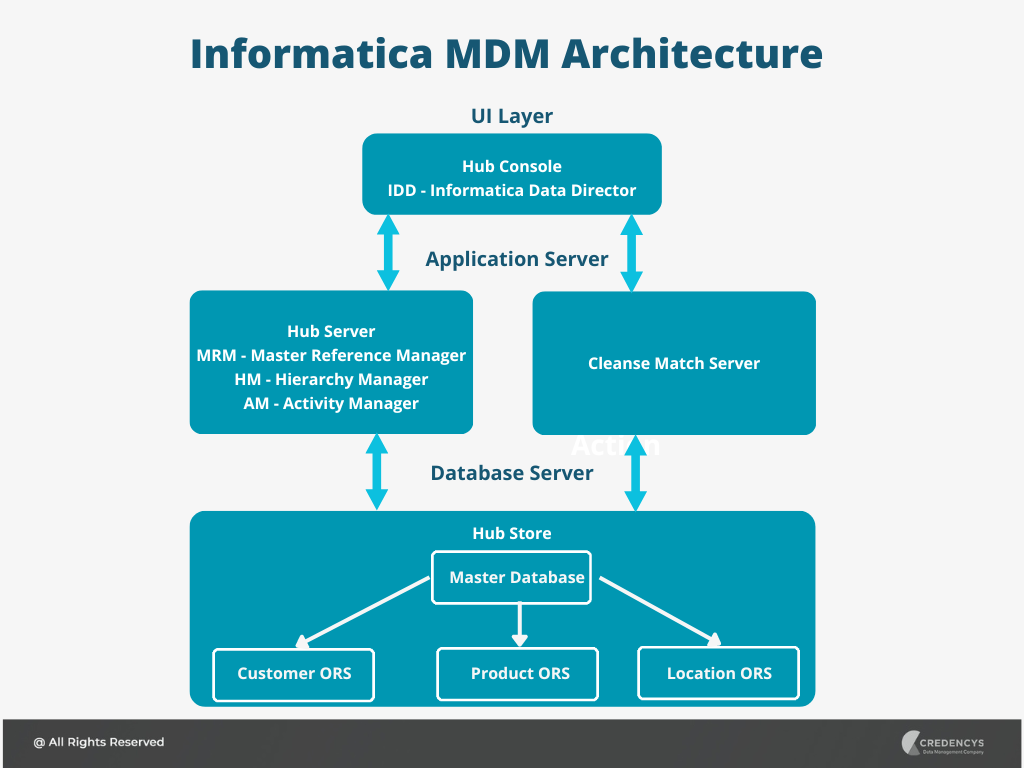
The architecture of the Master Data Management System provided by Informatica is a service-oriented architecture (SOA). This SOA is a group of services that communicate with each other through simple data transfer.

Take a look over the Informatica MDM architecture diagram.

3-Tier Model of Informatica MDM Architecture

Informatica MDM Architecture

The architecture of Informatica MDM MDE follows a 3-tier model. The essential components of this model are the Hub Store, Hub Server, Process Server, and Web Console UI.

Database Layer

  • The Hub Store is where all business data and metadata resides
  • Relational DBMS supported are Oracle, DB2 UDB, and SQL Server
  • Two types of schemas are available – MDM Master Schema and ORS Schema
  • CMX_SYSTEM is the default and easily configurable Master Schema.
  • Master Schema contains details about defining user, tool for user permissions, ORS permissions for users, and ORS connection.
  • ORS means Operational Repository Store, and CMX_ORS is the default ORS schema created and is configurable
  • MDM Hub installation can have more than a single ORS. And the ORS can be created in the same database server or a different database server
  • ORS schema contains data objects and storage repositories. Which are for managing master data, business data, and metadata.

Application Layer

Informatica MDM Hub is composed of several logical components that work together to provide comprehensive data management. These components include:

Hub Server

This run-time component handles core and common services for the MDM Hub. It processes client requests for data and offers data access in multiple modes. The Hub Server is a J2EE application that runs on the application server and coordinates data processing within the Hub Store and integration with external applications.

Process Server

This component includes Cleanse and Match Server, which are responsible for data cleansing and matching operations, respectively. The Process Server applies data quality rules, corrects invalid data, and merges duplicate records.

Master Reference Server

This server manages the data within the MDM Hub and ensures data consistency and integrity. It provides a central repository for storing and managing master reference data.

Hierarchy Manager

This component manages hierarchical relationships between records and supports data hierarchy management.

SAM

Security Access Manager (SAM) ensures secure access to MDM Hub services and data by managing user authentication and authorization.

BDD/IDD

Business Data Director (BDD) and Informatica Data Director (IDD) are user interfaces used to manage and manipulate master data in the MDM Hub.

SIF

Service Integration Framework (SIF) provides a set of APIs that allow external applications to interact with the MDM Hub in real-time. SIF enables applications to read, clean, append, match, and update data.

Process Server

The Process Server is a crucial role that maintains data quality, consistency, and accuracy by performing multiple tasks. These tasks include data cleansing, matching, and executing batch jobs such as loading data, recalculating BVT (Business Validation Test), and revalidating the collected information.

Its primary objective is to interact with cleanse engines to establish uniformity in the data while optimizing its performance for proper matching and consolidation purposes.

The Process Server works alongside the cleanse engines to standardize and enrich data for better matches and consolidation. This ensures that all information is accurate, consistent, and reliable for all users.

UI Console

  • Provides a user-friendly interface for managing data in Informatica MDM MDE.
  • Includes tools for configuring the environment, with access permissions based on user roles and responsibilities.
  • The system provides users with the necessary tools to set up their environment. Access permissions are granted based on user roles and responsibilities, ensuring a secure and efficient
  • The Java Swing library offers programmers a versatile tool for creating applications. By using the included consoles, developers can design intuitive graphical user interfaces (GUI) for their software
  • Examples of these tools include IDD (Informatica Data Director), MDM Hub Console, and Provisioning Tool.

Informatica MDM Use Cases

Retail and E-commerce

Customer 360 View

Informatica MDM consolidates customer data from multiple sources, providing a comprehensive view of each customer. This unified view allows retailers to deliver personalized experiences, targeted marketing campaigns, and seamless omnichannel interactions.

Product Data Optimization

Informatica MDM ensures consistent and accurate product information across retail channels, facilitating efficient product catalog management, improved search capabilities, and enriched customer experiences.

Healthcare

Patient Data Integration

Informatica MDM enables healthcare providers to integrate patient data from disparate systems, ensuring a complete and accurate patient record. This unified view improves care coordination, enables better clinical decision-making, and enhances patient safety.

Provider Data Management

Informatica MDM helps healthcare organizations manage provider data, ensuring accurate and up-to-date information on physicians, specialists, and healthcare facilities. This facilitates network management, contract compliance, and effective provider relationship management.

Financial Services

Know Your Customer (KYC) Compliance

Informatica MDM assists financial institutions in establishing a comprehensive view of customer data to meet regulatory requirements. It streamlines KYC processes, enhances risk management, and ensures compliance with anti-money laundering (AML) regulations.

Reference Data Management

Informatica MDM helps financial organizations manage reference data, such as currency codes, security identifiers, and industry classifications. This ensures accurate and consistent reference data for financial transactions, reporting, and regulatory compliance.

Manufacturing

Supply Chain Data Integration

Informatica MDM enables manufacturers to integrate data from suppliers, distributors, and partners, enhancing supply chain visibility and collaboration. This results in streamlined procurement, optimized inventory management, and improved production planning.

Product Lifecycle Management

Informatica MDM supports end-to-end product lifecycle management, from ideation to retirement. It ensures consistent product information across systems, accelerates new product introductions, and enables efficient product data governance.

Energy and Utilities

Asset Data Management

Informatica MDM facilitates the management of asset data in the energy and utilities sector, including equipment, infrastructure, and maintenance records. This enables organizations to optimize asset performance, schedule maintenance activities, and ensure regulatory compliance.

Meter Data Management

Informatica MDM helps utilities manage meter data, including consumption, billing, and meter readings. This ensures accurate billing, improves customer service, and enables efficient energy management.

Conclusion

Data security and privacy are significant concerns for organizations globally, regardless of their size or location in today’s technological era. To enhance industry data engagement and protect against external threats, investing in Informatica MDM tools is essential.

These tools offer various methods to secure data, increase research, and ensure business success and growth in the long run. Therefore, prioritizing investment in Informatica MDM tools is crucial for organizations to stay ahead in the evolving technological landscape.

The Benefits of Integrating PIM with Other Retail Systems

In today’s fast-paced and highly competitive retail landscape, managing product information efficiently and effectively has become a critical factor for success. This is where Product Information Management (PIM) comes into play.

PIM is a comprehensive system that allows retailers to centralize, organize, and optimize their product data across various channels and touchpoints. At its core, PIM serves as a centralized repository for all product-related information, such as descriptions, specifications, images, pricing, and availability.

It ensures that accurate and consistent product data is readily available to both internal teams and external stakeholders, including customers. The importance of PIM in the retail industry has grown significantly in recent years.

With the rise of eCommerce, omnichannel strategies, and the increasing demand for personalized experiences, retailers must have a robust PIM solution in place to effectively manage their product data. PIM acts as the foundation for delivering consistent, accurate, and up-to-date product information across all channels, whether it’s an online store, mobile app, social media platforms, or physical retail locations.

It enables retailers to streamline their operations, improve customer experiences, and drive sales. In addition to managing product data, PIM also facilitates collaboration and integration with other retail systems.

By integrating PIM with various systems, retailers can unlock a multitude of benefits that go beyond just managing product information. This integration enables seamless data flow, enhanced customer experiences, streamlined processes, and improved operational efficiency.

What is PIM Integration?

PIM integration refers to the process of connecting and synchronizing Product Information Management (PIM) systems with other retail systems, such as eCommerce platforms, content management systems (CMS), order management systems (OMS), customer relationship management (CRM) software, and point of sale (POS) systems. It involves creating seamless data flow and communication between these systems to ensure that accurate and consistent product information is shared across all channels.

PIM Integration

PIM integration is crucial because product information is not limited to a single system or department within a retail organization. Instead, it needs to be accessible and synchronized across various touchpoints to provide a unified and cohesive customer experience.

When PIM is integrated with other retail systems, it becomes the central hub for managing and disseminating product data, while other systems leverage that data for their specific functions.

PIM Integration – All You Need To Know

Need for Seamless Data Flow Between PIM and Other Systems

The need for seamless data flow between PIM and other systems stems from the desire to deliver a consistent and unified customer experience. Customers expect consistent product information regardless of where they encounter a product—whether it’s on a website, a mobile app, or in a physical store.

PIM integration ensures that accurate and up-to-date product details, such as descriptions, images, pricing, and inventory, are consistently shared across all channels. Furthermore, PIM integration enables retailers to leverage the power of interconnected systems.
Integration between PIM and OMS ensures that orders placed by customers are seamlessly processed, and inventory levels are updated in real-time. This integration helps prevent overselling, improves order fulfilment accuracy, and enhances customer satisfaction.

Integration between PIM and OMS ensures that orders placed by customers are seamlessly processed, and inventory levels are updated in real time. This integration helps prevent overselling, improves order fulfilment accuracy, and enhances customer satisfaction.

Moreover, integrating PIM with CRM systems enables retailers to gather valuable customer insights based on their product preferences and purchase history. This data can then be used to personalize marketing campaigns and provide personalized recommendations, fostering stronger customer relationships and driving repeat business.

Key Retail Systems to Integrate With PIM

When it comes to PIM integration, there are several retail systems that can greatly benefit from the seamless flow of product information. Let’s explore some of these systems in detail:

eCommerce Platforms

eCommerce platforms serve as the digital storefront for retailers, allowing them to showcase and sell products online. Integrating PIM with eCommerce platforms ensures that accurate and up-to-date product information is automatically synchronized between the PIM system and the online store.

This integration reduces manual data entry, minimizes errors, and enables retailers to provide consistent product details across their digital channels.

Content Management Systems

Content Management Systems are used to create and manage digital content, including website pages, blogs, and landing pages. By integrating PIM with CMS, retailers can seamlessly incorporate accurate and comprehensive product information into their content.

This integration ensures that product details, images, and descriptions are consistent across all marketing and promotional materials, providing a cohesive brand experience.

Order Management Systems

Order Management Systems handle the end-to-end processing of customer orders, including order capture, inventory management, and order fulfillment. Integrating PIM with OMS enables real-time synchronization of product data, inventory levels, and pricing information.

This integration ensures that customers can place orders based on accurate and up-to-date product information, while retailers can efficiently manage order fulfilment and maintain inventory accuracy.

Customer Relationship Management Software

CRM software is designed to manage customer interactions, track customer preferences, and improve customer relationships. By integrating PIM with CRM, retailers can gather valuable insights into customers’ product preferences, purchase history, and engagement levels.

This integration enables retailers to create personalized marketing campaigns, recommend relevant products, and provide a tailored shopping experience, ultimately enhancing customer satisfaction and loyalty.

Point of Sale Systems

Point of Sale systems are used in physical retail stores to process transactions and manage inventory. Integrating PIM with POS systems ensures that product data, pricing, and inventory levels are consistent across both online and offline channels.

This integration enables retailers to provide accurate product information, manage inventory in real time, and offer a unified shopping experience, regardless of the customer’s preferred shopping channel.

By integrating PIM with these key retail systems, retailers can establish a robust infrastructure for managing and distributing product information. This integration streamlines processes, reduces manual effort, minimizes errors, and ensures consistent and accurate product data across all touchpoints.

It empowers retailers to deliver a seamless and unified customer experience, regardless of the channel or system used by the customer.

Benefits of Integrating PIM With Other Retail Systems

Improved Data Accuracy and Consistency

Integrating PIM with other systems ensures consistent and accurate product information across all channels. By centralizing product data in the PIM system and synchronizing it with other retail systems, retailers can eliminate data discrepancies and inconsistencies.

Any updates or modifications made in the PIM system automatically propagate to all integrated systems, ensuring that customers receive accurate and up-to-date information, regardless of the channel they interact with. This leads to improved customer trust, reduces returns and customer complaints, and enhances overall brand reputation.

Enhanced Omnichannel Experience

PIM integration enables retailers to deliver a seamless experience across multiple channels, including online and offline. With integrated PIM, retailers can maintain consistency in product information, pricing, and availability across various touchpoints.

Customers can access the same level of information and experience whether they browse products on the website, mobile app, or visit a physical store. This integration eliminates silos, ensures a unified customer journey, and allows customers to seamlessly switch between channels without any disruption, resulting in a cohesive and satisfying omnichannel experience.

Streamlined Product Catalog Management

Integrating PIM with other systems simplifies the process of adding, updating, and managing product catalogs. Instead of manually entering and updating product information in each system, retailers can leverage PIM as the central source of truth for product data.

When a new product is added or changes are made in the PIM system, those updates are automatically synchronized with other integrated systems. This integration streamlines catalog management, reduces manual effort and minimizes the risk of errors or inconsistencies in product information across channels.

Retailers can quickly and efficiently expand their product offerings, launch new campaigns, and respond to market demands in a timely manner.

Efficient Inventory and Order Management

PIM integration helps in real-time inventory management, order processing, and fulfilment, resulting in improved operational efficiency. By integrating PIM with order management systems (OMS) and inventory management systems, retailers can maintain accurate inventory levels across all sales channels.

When an order is placed, the integrated systems automatically update inventory information in real time, preventing overselling and stockouts. This integration enables retailers to efficiently process orders, optimize fulfilment processes, and deliver a seamless customer experience.

With streamlined inventory and order management, retailers can reduce costs, improve inventory accuracy, and enhance customer satisfaction.

Personalization and Targeted Marketing

Integrated PIM data enables personalized marketing campaigns, targeting specific customer segments based on their preferences and behavior. By integrating PIM with customer relationship management (CRM) software, retailers can gather insights into customer purchase history, preferences, and interactions with specific products.

This data can be used to create targeted marketing campaigns and promotions that resonate with customers’ interests. This integration allows for effective personalization, fostering stronger customer relationships, increasing customer engagement, and driving higher conversion rates.

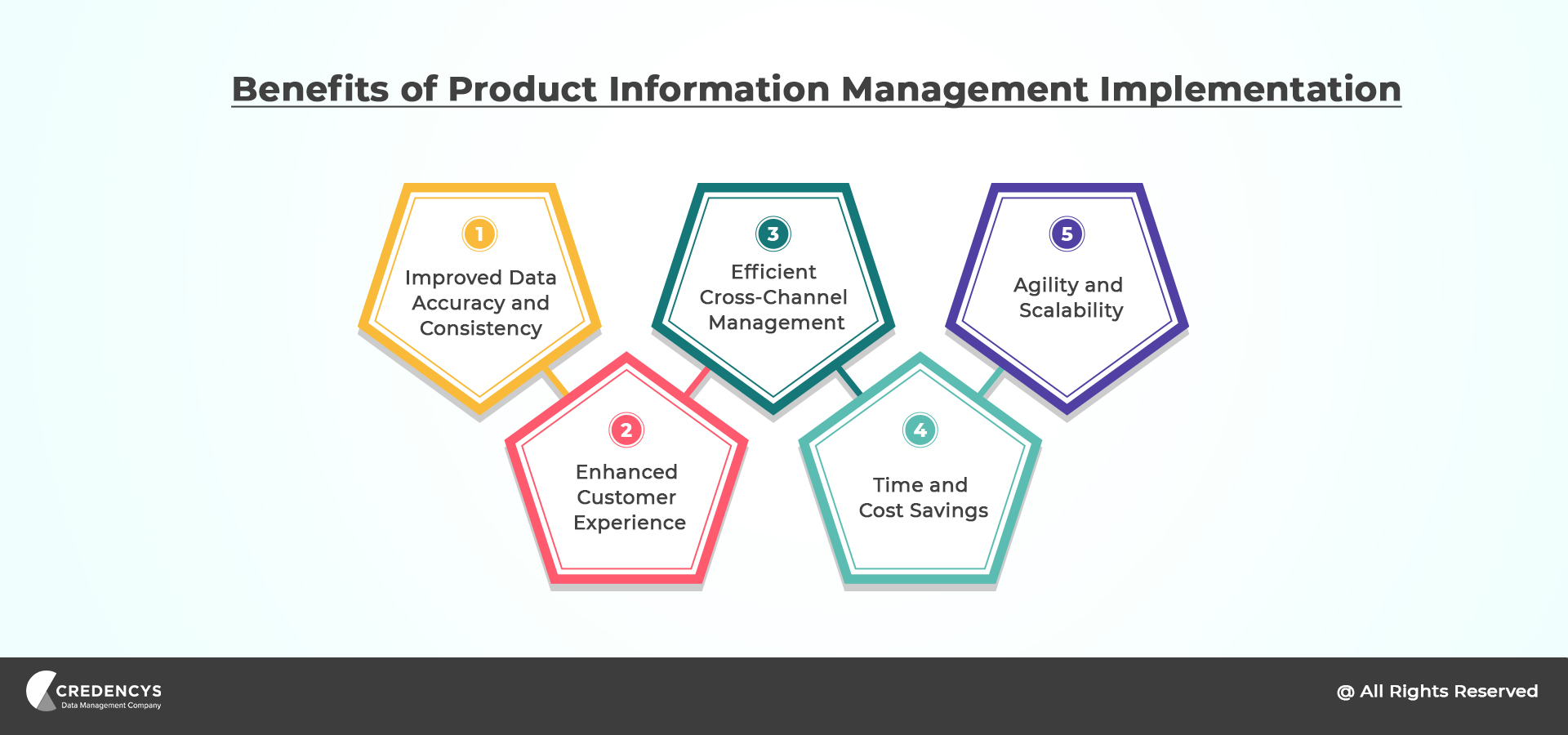
Benefits of Integrating PIM With Other Retail Systems

Best Practices for PIM Integration

Integrating Product Information Management with other retail systems requires careful planning and execution. To ensure successful integration, retailers should follow these best practices:

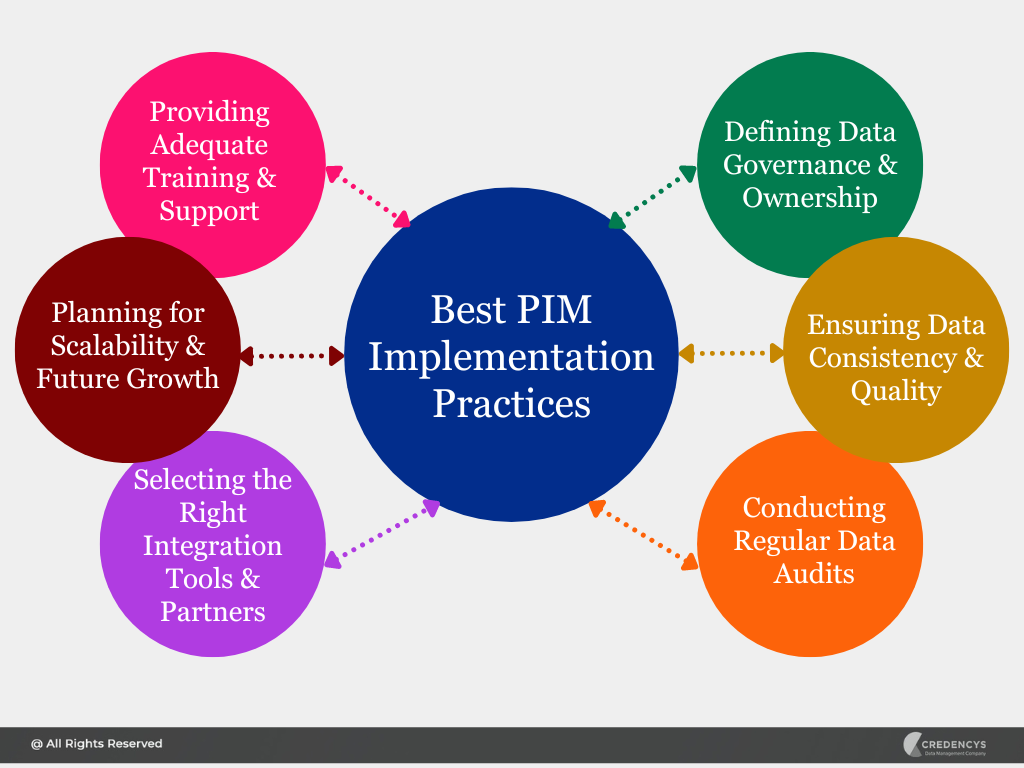
Clearly Define Data Governance and Ownership

Establish clear guidelines for data governance and ownership. Define roles and responsibilities within the organization for managing and maintaining product data.

This includes determining who has the authority to make updates and changes in the PIM system and how data ownership is shared across different departments. By establishing a clear governance framework, retailers can ensure accountability, data consistency, and minimize conflicts or duplication of efforts.

Ensure Data Consistency and Quality

Data consistency and quality are crucial for successful PIM integration. Establish data standards and enforce them across all integrated systems.

This includes standardizing data fields, naming conventions, and formats. Implement data validation rules to ensure that only accurate and complete data is entered into the PIM system.

Regularly review and clean up data to eliminate duplicates, inconsistencies, and outdated information. By maintaining high-quality data, retailers can provide accurate and reliable product information to customers across all channels.

Conduct Regular Data Audits

Regular data audits are essential to identify and rectify any issues or discrepancies in the integrated systems. Perform periodic checks to ensure that data is synchronized correctly between PIM and other systems.

Verify that product information, pricing, and inventory levels are consistent across all touchpoints. Identify and resolve any data integration errors or gaps promptly.

Data audits help maintain data integrity, improve system reliability, and prevent potential customer dissatisfaction or operational inefficiencies.

15 Best Practices for Successful Product Information Management (PIM) Solutions

Select the Right Integration Tools and Partners

Choose the appropriate integration tools and partners to ensure a seamless and efficient integration process. Evaluate integration solutions that are compatible with both PIM and the other retail systems you intend to integrate.

Consider factors such as ease of implementation, scalability, and compatibility with your existing IT infrastructure. Collaborate with experienced integration partners who have a proven track record in PIM integration projects.

Their expertise can help streamline the integration process, mitigate risks, and maximize the benefits of PIM integration.

Plan for Scalability and Future Growth

Anticipate future business needs and plan for scalability. Select a PIM solution and integration approach that can accommodate the growth of your product catalog and evolving business requirements.

Consider factors such as multi-channel expansion, internationalization, and potential integration with emerging technologies. Future-proof your integration strategy by choosing flexible solutions and designing an architecture that can adapt and scale as your business grows.

Provide Adequate Training and Support

Ensure that relevant stakeholders, such as product managers, content creators, and IT teams, receive proper training on PIM integration processes and usage. Provide comprehensive documentation and user guides to facilitate understanding and efficient utilization of the integrated systems.

Establish a support system that allows users to seek assistance or resolve any integration-related issues promptly. Ongoing training and support enable teams to leverage the integrated systems effectively and maximize the benefits of PIM integration.

Best Practices for PIM Integration

Credencys – A Reliable PIM Implementation Partner

When it comes to integrating PIM with other retail systems, selecting the right implementation partner is crucial for a successful and smooth integration process. Credencys is a trusted and experienced PIM implementation services provider that can be your reliable partner in this journey.

With years of experience in the retail industry, Credencys understands the unique challenges and requirements of PIM integration. They have a team of skilled professionals who specialize in PIM implementation and have in-depth knowledge of various retail systems.

Choosing Credencys as your PIM implementation partner brings several advantages. They possess a deep understanding of PIM and its role in retail. They can guide you through the entire integration process, from defining integration strategies to selecting the right integration tools and partners.

Moreover, Credencys follows industry best practices and methodologies to ensure a seamless integration experience. They conduct thorough analysis and planning, taking into consideration your specific business needs and objectives.

With their expertise, they can provide tailored solutions that align with your unique requirements. Credencys has a proven track record of successful PIM implementations.

They have worked with numerous retailers across different industries, helping them achieve efficient data management, improved customer experiences, and streamlined operations. Their experience and domain knowledge enable them to navigate potential challenges effectively and deliver solutions that drive tangible results.

Over to You

In today’s competitive retail landscape, providing a unified and seamless customer experience is paramount. Customers expect consistent and accurate information regardless of the channel they interact with.

By integrating PIM with other retail systems, retailers can exceed these expectations and gain a competitive edge. We encourage retailers to explore PIM integration as a strategic advantage.

Embracing this integration not only enhances operational efficiency and data accuracy but also strengthens customer relationships and drives business growth. By investing in the integration of PIM with eCommerce platforms, CMS, OMS, CRM, and POS systems, retailers can unlock the full potential of their product data and deliver exceptional customer experiences.

Integrating PIM with other retail systems is a game-changer for retailers. It empowers them to provide consistent and accurate product information, deliver a seamless omnichannel experience, streamline catalog management, optimize inventory and order processes, and create personalized marketing campaigns.

By embracing PIM integration, retailers can position themselves for success in an increasingly competitive retail landscape.

PIM vs DAM: What’s the Difference? 

Digital asset management (DAM) and product information management (PIM) are the most common systems that are used in organizations for handling and managing large volumes of digital assets. The most typical PIM DAM definition includes both systems’ provision of centralized content management and their facilitation of users’ easy access to their material.

The act of arranging and keeping all the data needed to market and sell items through distribution channels is known as product information management (PIM). An internal team produced this data to support a multichannel marketing plan. Additionally, PIM plays a vital influence in lowering the abandonment rate by providing better product information.

Digital asset management (DAM) is the process of organizing, managing, and disseminating all of your digital data, including text, photographs, and other types of material. Additionally, a good DAM system will safeguard your files.

What is PIM (Product Information management)?

PIM solutions are process-driven applications for working together on product content that is powered by master data. A single hub of product data may be used to disseminate information to sales channels including online shops, printed catalogs, online stores like Amazon and Google Shopping, social media sites like Instagram, and trade partners that receive electronic data feeds.

Business-to-business and business-to-consumer companies that sell goods through a variety of sales channels in several sectors may benefit the most from Product Information Management solutions.

PIM handles the maintenance and update of product information within a central product library, as well as customer-facing product data needed to serve numerous geographic locations.

PIM can serve as a center for keeping track of product information from all channels. PIM helps businesses improve their conversion rate optimization by fostering consistent branding and reducing abandonment rates. Additionally, it makes it possible for the bulk of product creation processes to be automated.

To explore more about Product Information Management, don’t miss reading What is PIM? Also, to get exclusive insights into all the aspects related to PIM, you should visit Product Information Management – An Exclusive Guide.

What is Digital Asset Management (DAM)?

Digital Asset Management (DAM) is a computer software that is required to make sure the owner of the digital asset, and maybe their deputies, can perform operations on the data files.

The group of digital assets that are commonly referred to as media that are handled via digital asset management includes audio recordings, pictures, and videos. You may better organize your information for quicker, safer searches by grouping related content into projects, groups, or categories using a digital asset management system. Metadata and other tags can be added to content to enhance it and further refine search results.

Smaller DAM systems are employed, for example, in video production systems, in a specific operational setting.

The types of input encoders used to produce digital copies of assets to bring them under management and the output decoders used to make them useful as papers and/or online resources are the main differences between them.

Visit What is Digital Asset Management? to discover all the essential elements of DAM solutions. Moreover, read An Ultimate Guide to Digital Asset Management (DAM) to unveil the full potential of Digital Asset Management and its essence in your business.

PIM vs DAM: Key Differences Between PIM and DAM

When it comes to spotting the key differences between dam pim, you need to be aware of the primary goals of both systems. Without those details, it will be hard to select the right system for your business.

The primary goal of a PIM system is to integrate product-related information in a centralized place, optimize it according to the evolving market condition and share them across the organization.

On the other hand, the primary goal of the DAM system is to organize and optimize the digital assets of an organization in a single location and drive more value to the business by allowing all departments to access digital media assets easily and quickly.

DAM may have some internal product information or data managed by a PIM, but it is impossible to deal with external product-related information.

Despite certain similarities, PIM and DAM systems are used as different platforms with different functions. DAM systems are made to manage digital assets like product images and logos, whereas PIM systems are made to handle product information on them.

1. Purpose

PIM systems compile all product data onto one location. It links channels for production and commerce to address difficult issues in controlling and preserving the integrity of product data.

The purpose of PIM for a company can be decided depending on various factors. It can be their large volume of product items or a complicated set of regularly changing product attributes. The typical impact of a company’s often evolving product features on PIM use for

  • A growing number of sales channels,
  • Non-uniform IT infrastructure,
  • Online business and electronic ordering,
  • Diverse locations
  • Localization needs
  • Support SEO strategies of the business

Access and user authorizations for all database information, ordering procedures connected to inventory management systems, and the methods for modular expansions are all controlled by PIM solutions via a web-based administrative interface.

A DAM system’s primary purpose is to provide users with quick access to assets through the provision of a searchable index that enables retrieval of assets based on their content. Typically, the cataloging procedure is included in the intake of new materials.

These software applications are intended to provide entire organizations with the information they need to manage all of the related operations. Ensuring that all digital files and data have been adequately backed up is another crucial aspect of a digital asset management strategy.

2. Content

In today’s marketing, producing content is a key component. DAM will save time by enabling you to more readily reuse the material if you establish a system that makes it simple to locate the content you have previously developed and can utilize.

Additionally, you may add PowerPoint decks, templates, branded materials, and any other stuff that you commonly utilize to the files. When you implement the best DAM procedures and systems, everything will be correctly organized and simpler to discover.

The following content types are managed by using the DAM system.

  • Podcasts
  • Client testimonials
  • Product pictures
  • Promotional videos
  • Branding templates
  • Logos for brands

PIM systems are used to manage structured data given through a variety of distribution channels, including print catalogs, online stores, and electronic catalogs.

You can store a variety of content types in Product Information Management (PIM), including product identifiers, technical specifications, media asset management, languages, marketing messaging, sales and marketing materials, stock availability, product descriptions, and sale information and listings.

3. Integrations

Integrating the PIM DAM system enables ambitious companies to operate more quickly and effectively by making handling vast amounts of product data and digital assets simpler.

By automating workflows and removing bottlenecks in the content supply chain, it delivers material swiftly, precisely, and reliably across a variety of channels. As a result, there is a shorter time to market, reduced expenses, and ultimately a competitive edge.

So, the integration of PIM DAM solutions enables speedy data transfer across systems, enhancing productivity and the accuracy of the product content.

PIM vs DAM: A Tabular Comparison

Key AspectsProduct Information Management (PIM)Digital Asset Management (DAM)

Data Focus

PIM manages and enrich product-related data like attributes, variants, and SKUs.

DAM centralizes and organize digital media assets like images, videos, documents.

Core Functionality

PIM prioritizes product data accuracy, consistency, and syndication across channels.

DAM prioritizes media storage, search, retrieval, and distribution.

Data Types

PIM handles structured data like product attributes, specifications, and pricing.

DAM manages unstructured digital files, including images, videos, documents.

Data Enrichment

PIM enriches product data with comprehensive attributes, descriptions, and metadata.

DAM catalogs media assets with metadata for easy retrieval and usage.

Workflow Automation

PIM streamlines product data enrichment, validation, and syndication workflows.

DAM automates media asset tagging, approval, and distribution processes.

Data Governance

PIM ensures consistent, accurate, and compliant product data across channels.

DAM enforces proper rights management, version control, and usage policies.

Collaboration

PIM enables teams to collaborate on product information, ensuring data accuracy.

DAM facilitates collaboration on media assets, improving creative workflows.

Asset Storage

PIM stores product-related assets like images but with less focus on media management.

DAM focuses on secure storage, organization, and accessibility of media assets.

Media Management

PIM handles media as part of product information for e-commerce presentation.

DAM focuses on media asset management, search, metadata, and distribution.

Metadata & Search

PIM provides attributes for products and support basic search functionalities.

DAM excels in metadata tagging, advanced search, and content discovery.

Integration with E-commerce Platforms

PIM integrates with e-commerce systems to deliver accurate product data.

DAM integrates with content creation tools, CMS, and marketing platforms.

ROI & Impact

PIM improves product data quality, leading to higher sales and customer satisfaction.

DAM enhances creative workflows, reducing asset search time, and improving brand consistency.

Industry-specific Fit

PIM systems are crucial for industries with complex product attributes like fashion, electronics.

DAM systems are essential for marketing-heavy industries, media, agencies, and creative sectors.

Focus on Digital Media

PIM treats media as part of a product, supporting e-commerce presentation.

DAM focuses solely on managing digital media, ensuring efficient usage and storage.

Content Creation

PIM manages attributes for product specifications, not media asset creation.

DAM supports content creation workflows with versioning and collaboration features.

Targeted Audience

PIM caters to product managers, marketers, e-commerce teams, and sales.

DAM serves creative teams, designers, marketers, and media content producers.

PIM vs DAM: Benefits of PIM and DAM

Take a look over the key benefits offered by both systems PIM and DAM for a better understanding of the differences between those.

A. Benefits of Product Information Management

1. Shorten time-to-market

A unified platform that integrates all product data and related information can significantly enhance a business’s flexibility in responding to market changes.

With such a platform in place, introducing new products to a market or updating an existing product portfolio becomes a much smoother process.

The product catalogs and portfolios can be quickly extended, making it easier to keep up with the rapidly changing market dynamics.

Additionally, changes made to products across different channels can be reflected almost instantly, ensuring real-time synchronization of product information. By leveraging a unified platform for product data management, businesses can remain agile, responsive, and competitive in the market.

2. Operation excellence

Businesses can boost their efficiency and accuracy by centralizing product information in one place. They achieve this through a PIM system working alongside an ERP system, which combines internal and external data to ensure consistency and transparency in product-related processes.

This integration streamlines operations while minimizing errors, ultimately improving overall productivity.

3. Improve the customer journey

Reducing the time to market for new products can significantly enhance the customer experience by providing them with the latest products at a much faster pace.

Furthermore, businesses can offer high-quality and timely product information that ensures a consistent brand experience across all touchpoints, including online and offline channels.

Factors like stock availability and delivery time are crucial considerations for customers when making purchasing decisions, and providing accurate and up-to-date information on these factors can go a long way in influencing their choices.

By prioritizing reduced time-to-market, businesses can stay ahead of their competitors and provide an exceptional customer experience that fosters loyalty and trust.

If you are interested in exploring more benefits of PIM, check out the Top 15 Benefits of Product Information Management (PIM) for Your Business. It helps you to get clarity on how PIM impacts your business growth and success.

B. Benefits of Digital Asset Management

1. Build an ecosystem for your assets

Implementing a Digital Asset Management (DAM) solution brings diverse advantages to businesses seeking to optimize their digital asset management processes.

The solution offers seamless integration with other systems, resulting in a dynamic ecosystem for your digital assets. You can effortlessly retrieve data from various programs, thanks to DAM’s advanced metadata capabilities.

Consequently, the value of your digital assets increases significantly as managing them becomes more efficient and streamlined.

With a DAM solution in place, you can enjoy easy data retrieval, simplified asset handling, and enhanced asset value – making it an astute investment for progressive organizations.

2. Brand consistency & protection

In addition to the above-mentioned benefits, a Digital Asset Management (DAM) system can help businesses maintain brand cohesiveness and ensure that all assets are up-to-date, regardless of where they are used.

This is made possible by restricting access to brand assets to a limited number of authorized users, enabling businesses to safeguard sensitive assets and copyrighted material effectively.

Even when sharing access with external parties like partners, suppliers, or distributors, businesses need not worry about illegitimate use of their assets.

By leveraging a DAM system’s robust security features, businesses can ensure that their brand assets are always under their control, regardless of how they are being used, thus providing peace of mind and enhanced brand integrity.

3. Streamlined marketing efforts

Another significant advantage of a Digital Asset Management (DAM) system is its ability to enhance efficiency and speed-to-market through advanced workflow capabilities and automation.

These systems are designed to integrate seamlessly with relevant applications like production systems or CMS(s), which can significantly increase the speed at which visuals are published.

By streamlining the workflow process and automating repetitive tasks, businesses can expedite the delivery of their products and services, enabling them to stay ahead of the competition.

With a DAM system in place, businesses can focus on innovation and creativity rather than wasting time and resources on manual processes, thus allowing them to achieve their business objectives quickly and efficiently.

Read Why Do You Need a Digital Asset Management Platform? to explore more benefits of Digital Asset Management and understand how DAM fuels your business by managing digital assets centrally.

PIM vs DAM: How Do You Know If Your Business Needs A PIM or DAM?

Digital Asset Management (DAM) and Product Information Management (PIM) are two essential components of an organization’s digital infrastructure. However, the key difference between the two lies in their scope of operation. While DAM systems deal with all of an organization’s digital assets, PIM systems focus primarily on a product’s lifespan. To elaborate further:

Pim dam integration systems hold the key to an orderly, interconnected digital universe, one where images, movies, presentations, papers, marketing materials, and more coexist seamlessly. They simplify retrieval, search, and collaboration on a large scale while boosting asset value.

This holds true, especially for businesses that handle loads of digital assets that need efficient distribution in-house or externally. Streamlining DAM processes also increases productivity and facilitates close collaboration among team members.

PIM systems are the superhero of product management. They can handle everything from birth to death, so to speak! With the power to combine all product data and information into one centralized system, they help businesses maximize their sales for various channels.

The primary aim of PIM is to effectively manage and organize your product-related data – that’s all you need to kickstart a successful marketing and sales strategy. By utilizing a PIM system, especially for large SKUs or dynamic product ranges with frequent changes – any business can track and manage its products with ease!

With a PIM system in place, businesses can streamline their product management processes, reduce errors, and ensure data accuracy, ultimately leading to increased efficiency, productivity, and profitability.

PIM vs DAM: Which Information You Can Manage in PIM and DAM

Before finalizing between the two systems PIM and DAM, you should be aware of what kind of information both systems handle. This section elaborates on the kind of information stored and managed by PIM DAM systems in detail.

1. PIM Manages Product Information

Product information management systems are specifically designed for the effective management of product data, it helps team members to collect, organize, enrich, and store product-related information in a central location.

From that centralized repository, teams can easily share those optimized data across the organization.

Let us take a deeper look at the variety of product-related information stored and managed in the PIM system.

  • Crucial product data (product names, product titles, product descriptions, product SKUs, and so)
  • Product taxonomy and relationships (product category, product label, product variation/version, and so)
  • Product technical information (product material, product ingredients, product warranty, and so)
  • Product marketing information (buyer’s journey, product keywords, personalization and so)
  • Product sales details (Product cost, customer reviews on the product, and so)
  • Information related to product design (product dimension, product size, product assembly info, and so)
  • Product localization (copy of multilingual product content)

To explore the data that PIM stores effectively and in a standardized way, must visit Types of Data that You Can Store in Product Information Management (PIM) Solution.

2. DAM Manages Digital Assets

The digital asset management system is specifically designed for the effective management of digital assets.

It helps team members to organize the scattered digital assets in a single location and make them easier to access by all the teams/departments of an organization.

Let us take a deeper look at the variety of digital assets organized and managed in the DAM system.

  • Media files of a business website (Logo, web images, text elements, videos and so)
  • Business files (files related to business operations, employee details, and so)
  • Business vendor relationship (essential information vendors required during the product production)
  • Setting user roles and permission on accessing media assets (essential employees details, defining permissions to access media files)

PIM vs DAM: Which One Businesses Should Choose?

Trying to choose between a PIM and DAM integration system can be quite a challenge. To help you make an informed decision, it’s essential to clearly define your objectives and identify which system will best suit your needs.

Fortunately, the following checklists can assist you in selecting the right solution:

1. When Do I Need a DAM System?

If your company can relate to most of the following points, a DAM solution may be the best fit:

  • Your organization has a significant number of digital assets, especially visual assets.
  • You require an official, centralized repository for your digital files.
  • Searching for and utilizing digital assets is a critical aspect of your daily operations.
  • Sharing digital files both internally and externally is a common occurrence.
  • Many employees, both internal and external, are involved in different content-related processes.
  • Your brand communication is spread across several channels.
  • You frequently employ your assets in other applications like Adobe InDesign and PowerPoint.

Go through Signs That Proves Your Business Needs a Digital Asset Management (DAM) Solution to understand the needs of DAM in your business to automate the varied processes related to digital assets.

2. When Do I Need a PIM System?

Implementing a PIM system would be advantageous in the following circumstances:

  • You have an extensive range of products with numerous article numbers.
  • Your product portfolio is intricate and frequently updated.
  • A significant proportion of the product data is from diverse sources.
  • You operate through multiple sales and marketing channels.
  • Quick turnaround times are critical for your organization.
  • You provide customers with an extensive amount of product information, particularly online.
  • Consistent and up-to-date product data is required throughout the company.

To explore more visit, When Your Business Requires a PIM Software? you will get clarity on whether your business needs a PIM solution or not.

3. Using Both PIM and DAM Software

It’s common for companies offering products and services to need both pim dam functionalities. They usually require DAM features because they have digital assets that are not directly related to specific products.

Choosing between the two, however, is not mandatory since a combination of systems can be used to meet their needs in a more personalized way.

When utilizing both DAM and PIM software together, it’s highly recommended to obtain pim and dam solutions systems from the same vendor and ensure that they are built on the same platform.

Tight integration between the two components guarantees a seamless workflow without any disruptions or redundancies. Opting for identical systems ensures an efficient collaboration between both platforms.

PIM vs DAM: Who Benefits from PIM or DAM in Your Organization?

Both PIM and DAM solutions offer significant benefits to almost all the teams of an organization. This section highlights those teams that leverage more from the respective systems.

A. Who Uses PIM?

1. E-commerce Team

Embrace a new era of efficient product onboarding with automated workflows, and say goodbye to time-consuming spreadsheet management.

By automating up to 80% of manual product data management processes, you can significantly increase your SKU counts while improving your omnichannel strategy.

Streamline the setup of new sales channels and customize your product data and digital assets to meet specific requirements. You can even set up validation rules to ensure that all product content is complete and accurate.

When information is missing, relevant team members are immediately notified to ensure compliance with SEO standards and criteria.

2. Product and Category Managers / Product Merchandisers

Achieve complete transparency over your products as they progress through the development lifecycle, allowing you to track which teams are responsible for their management. Segment product data, enabling you to view only the items that are pertinent to your role or marketing campaign.

Automate your campaign workflows by establishing rules that govern when excess stock should be cleared through discount channels. Apply discounts automatically when stock levels reach a predetermined threshold.

Respond quickly to potential stock shortages by temporarily disabling other sales channels when inventory levels are low.

4. Sales & Marketing Team

Make sure your team is armed with accurate and updated product intel that’ll help them spruce up sales. By automating campaign planning and execution, you can even give discounts on the best price.

Create captivating product descriptions that cater to both search engines and your target audience. Ensure maximum visibility for your entire product range, and guaranteed unparalleled customer experiences.

5. IT Teams

Enable your business to streamline workflows and increase productivity with no-code automation engines that allow business functions to automate their processes. You’ll have more time to focus on high-value tasks that help your business grow instead of wasting it on low-value administrative duties.

With an open API architecture, the software can integrate with your entire tech stack, and employees can securely access everything they need from anywhere with an internet connection.

Eliminate the risks associated with managing mission-critical data and processes on spreadsheets by implementing PIM software. With data backups, you can rest assured that your information is secure.

You can also set permissions and user access levels at the field and attribute levels to ensure data is only accessible by authorized personnel. PIM solutions offer a complete audit trail of any changes made, giving you full visibility into the modification history of your product data.

B. Who Uses DAM?

1. Creative Teams Leverage DAM for Workflow Efficiency

Copywriters, photographers, and designers usually create the majority of assets. Designers, specifically, consistently strive to enhance brand experience by offering more value in less time.

They use their creative minds to conceive innovative ideas and generate captivating artwork such as images, videos, presentations, or ads to form a coherent message through visual media that appeals to the audience.

2. Marketers Easily Access Content From The Centralized Location

Marketers are responsible for developing various promotional materials that utilize assets to maintain brand consistency and promote the company. Sharing creative files with agencies, internal stakeholders, or media contacts for news coverage is a crucial aspect of marketing.

Product, e-commerce, and brand-experience teams need to access assets for different projects, which requires them to locate, track, and modify pre-approved files with ease.

3. Developers Streamlines Asset and Optimizes Delivery Processes

Developers, like their marketing counterparts, need a centralized asset source. They must build and deliver visuals online, regardless of the asset’s stage.

However, developers often face tedious responsibilities that take away from innovation and advancing knowledge surrounding new technologies.

4. Legal Team Ensures Data Compliance According To Guidelines 

Legal approval is often required for new assets or designs requested by marketing, creative, and development teams. The legal department plays a crucial role in ensuring that images and videos comply with company and brand guidelines before approving them for use.

5. Sales Teams Locate Final Assets From DAM

Sales representatives have to frequently search and assemble documents and presentations to showcase to potential customers. As deals move through various stages of the sales pipeline, sales reps must efficiently find and use final and approved assets for internal and external use.

To aid this process, DAMs offer strong, guided search features via metadata, which results in quick and accurate locating of content.

Conclusion

Finally, many PIM programs inherited the DAM features. The PIM vs DAM systems are a trustworthy source of information about online platforms or organizations.

The DAM system is the only reliable source for digital assets like product photos, owner manuals, and quick-start guides. The DAM system distributes these items to the PIM system by connecting the two.

Both DAM PIM systems play a crucial role in keeping businesses on a successful track of their product data and digital assets. With these two systems, any business can improve its work efficiency and productivity without spending a lot of money.

It is better to pick a reliable system offering both functionalities and meets your business requirements.

How Can PIM Help Fashion Retailers in Adapting to Changing Customer Behavior

The fashion industry is no stranger to the ever-changing landscape of consumer behavior. With the advent of technology, shifting demographics, and evolving social and environmental consciousness, fashion retailers are faced with the imperative to adapt in order to thrive in a competitive marketplace.

With the global fashion eCommerce market forecasted to reach $820 billion in 2023 and $1.2 trillion in 2027, it becomes crucial for fashion retailers to stay relevant and meet the evolving expectations of their target audience. Consumer behavior in the fashion industry is influenced by various factors, including personalization, omnichannel experiences, online research, and sustainability considerations.

Worldwide Fashion eCommerce Market Size

Today’s consumers seek personalized experiences, tailored recommendations, and brands that align with their values. They expect seamless shopping experiences across multiple channels, from browsing products online to trying them in-store.

Online research plays a vital role in the decision-making process, with consumers relying on product information, reviews, and social media to inform their fashion choices. Furthermore, sustainability has become a key consideration, as consumers increasingly prioritize ethical sourcing, eco-friendly materials, and transparent supply chains.

Factors Affecting Consumer Behavior

Fashion retailers must adapt to these changing consumer behaviors in order to meet their customers’ expectations and remain competitive in the market. Failure to adapt can lead to missed opportunities and loss of market share.

This is where Product Information Management (PIM) plays a crucial role. PIM is a software solution that enables fashion retailers to effectively manage and distribute their product information across multiple channels.

By implementing a robust PIM system, fashion retailers can streamline their operations, improve customer experiences, and align their offerings with the evolving demands of the modern consumer. By leveraging the power of PIM, fashion retailers can position themselves as industry leaders, connect with their target audience on a deeper level, and thrive in the ever-changing landscape of consumer behavior.

10 Benefits of PIM for Fashion Industry

Understanding Changing Consumer Behavior

In the fast-paced fashion industry, understanding and adapting to changing consumer behavior is vital for fashion retailers to remain competitive and meet the evolving needs of their target audience. Let’s explore some key aspects of changing consumer behavior in the fashion industry:

Demand for Personalized Experiences

Modern consumers crave personalized experiences that cater to their individual preferences and lifestyles. They seek brands that understand their unique tastes and offer tailored recommendations.

Personalization goes beyond just addressing customers by name; it involves curating product assortments, suggesting relevant styles, and providing personalized offers based on individual preferences and purchase history. Consumers want to feel understood and valued by the brands they engage with, and fashion retailers need to adapt to this demand for personalized experiences.

Shift Towards Omnichannel Shopping

Gone are the days when consumers exclusively shopped at physical stores. The rise of digital technology has led to a significant shift towards omnichannel shopping, where consumers seamlessly navigate between online and offline channels.

Today’s consumers expect a cohesive experience across multiple touchpoints, whether it’s browsing products online, visiting a physical store, or interacting with brands through mobile apps and social media platforms. Fashion retailers need to adapt their strategies to provide a consistent and integrated shopping experience across all channels.

Omnichannel eCommerce: The Secret Mantra For Your Success In eCommerce Business

Increasing Reliance on Online Research

The internet has transformed the way consumers make purchasing decisions, and the fashion industry is no exception. Consumers now conduct extensive online research before making fashion-related purchases.

They compare prices, read product reviews, and seek detailed information about products such as sizing, materials, care instructions, and more. Online platforms, social media influencers, and fashion blogs play a significant role in shaping consumer opinions and preferences.

Fashion retailers must recognize the importance of online research in the customer journey and ensure that their product information is accurate, comprehensive, and readily available across digital channels.

Sustainability Considerations

Sustainability and ethical considerations have gained significant prominence in recent years. Consumers are increasingly mindful of the environmental and social impact of their fashion choices.

They seek brands that demonstrate a commitment to sustainability through responsible sourcing, eco-friendly materials, fair labor practices, and transparent supply chains. Consumers want to align themselves with brands that share their values and contribute to a more sustainable future.

Fashion retailers must adapt by providing transparency in their sourcing and production practices, communicating their sustainability initiatives, and offering eco-friendly product alternatives.

Understanding these key aspects of changing consumer behavior is essential for fashion retailers to effectively adapt their strategies and offerings. By recognizing the demand for personalized experiences, embracing omnichannel approaches, optimizing online presence, and incorporating sustainability practices, fashion retailers can better cater to the evolving needs and expectations of their target audience.

Challenges Faced by Fashion Retailers in Adapting to Changing Consumer Behavior

As fashion retailers strive to adapt to changing consumer behavior, they encounter several challenges that require strategic solutions. Let’s explore some of the key challenges faced by fashion retailers in responding to these changes:

Managing Large Volumes of Product Data

Fashion retailers deal with an enormous amount of product data, including attributes such as sizes, colors, materials, pricing, images, descriptions, and more. With an extensive product catalog and frequent updates, manually managing and organizing this data becomes a daunting task.

Ensuring data accuracy, consistency, and completeness across various channels can be time-consuming and prone to errors. Retailers need a solution to efficiently handle and organize this vast amount of product information.

Maintaining Consistency Across Channels

As consumers increasingly engage with fashion brands through multiple channels, maintaining consistency in product information becomes challenging. Inconsistencies in pricing, availability, or product descriptions across channels can confuse and frustrate customers.

Retailers need to ensure that the information presented to customers is accurate and consistent, regardless of the channel they use. Without a centralized system to manage product data, maintaining this consistency can be a significant hurdle.

Ensuring Personalized Experiences

The demand for personalized experiences poses a unique challenge for fashion retailers. Providing tailored product recommendations, customized offers, and personalized marketing messages requires a deep understanding of individual customer preferences and behaviors.

Without a comprehensive system to collect and analyze customer data, it can be difficult for retailers to deliver personalized experiences at scale. Retailers must find ways to gather and utilize customer data effectively to provide the level of personalization that consumers expect.

Adapting to Rapidly Changing Trends

Fashion trends come and go at a rapid pace. To stay relevant, fashion retailers need to quickly adapt their product offerings to align with changing consumer preferences. This requires keeping a pulse on emerging trends, monitoring competitor strategies, and identifying opportunities to introduce new styles and collections.

Without efficient processes and systems in place, responding to these trends can be a complex and time-consuming task, potentially resulting in missed opportunities.

Integrating Online and Offline Experiences

The rise of omnichannel shopping presents a challenge in seamlessly integrating online and offline experiences. Consumers expect a consistent brand experience across various touchpoints, whether they are browsing products online or visiting a physical store.

Ensuring inventory accuracy, synchronized pricing, and a cohesive brand message can be a logistical challenge. Fashion retailers need to find ways to bridge the gap between online and offline channels, providing customers with a seamless and integrated shopping journey.

Addressing these challenges is crucial for fashion retailers to successfully adapt to changing consumer behavior.

Challenges Faced by Fashion Retailers

8 Most Common Product Information Management Challenges

How an Efficient PIM System Helps Fashion Retailers Adapt to Changing Consumer Behavior

Centralized and Enriched Product Information

In the rapidly evolving fashion industry, managing and enriching product information is a critical task for fashion retailers. PIM serves as a centralized repository for fashion product data, providing retailers with a robust platform to manage, organize, and enrich their product information efficiently.

Let’s delve deeper into how PIM helps fashion retailers adapt to changing consumer behavior through centralized and enriched product information.

Centralization of Product Data

PIM consolidates all product information into a single, unified system. Retailers can store a wide range of data, including product attributes, descriptions, images, pricing, inventory levels, and more in a structured and easily accessible manner.

By centralizing product data, fashion retailers can eliminate data silos and ensure that the most up-to-date and accurate information is readily available to all teams and channels. This centralized approach enhances data integrity and streamlines the entire product management process.

Efficient Data Management

PIM simplifies the management of large volumes of product data. Retailers can leverage intuitive interfaces and workflows to easily update, categorize, and manage product information.

With PIM, retailers can quickly add new products, modify existing ones, or retire outdated items, ensuring that the product catalog remains current and accurate across all channels. By eliminating manual data entry and minimizing the risk of errors, PIM empowers retailers to efficiently manage their vast product portfolios.

Enrichment of Product Information

PIM enables fashion retailers to enrich their product information with additional attributes, specifications, and media assets. Retailers can include detailed descriptions, size charts, care instructions, fabric composition, styling tips, and other relevant information that enhances the customer’s understanding of the product.

Additionally, PIM supports the association of related products, enabling cross-selling and upselling opportunities. By enriching product information, retailers can provide customers with a comprehensive and engaging shopping experience, ultimately driving conversion and customer satisfaction.

Consistency Across Channels

With PIM, fashion retailers can ensure consistency in product information across multiple channels. Any updates made to product data in the PIM system are automatically synchronized across all channels, including eCommerce websites, mobile applications, social media platforms, and physical stores.

This consistency in product information enhances the customer experience by providing accurate and coherent details, regardless of the channel they choose to engage with. PIM eliminates the risk of conflicting or outdated information, fostering trust and confidence among customers.

Localization and Global Expansion

For fashion retailers operating in multiple regions or expanding globally, PIM facilitates efficient localization of product information. Retailers can easily manage translations, localized descriptions, and regional pricing variations within the PIM system.

By tailoring product information to specific markets, fashion retailers can provide a personalized and culturally relevant experience to customers worldwide. PIM’s ability to handle multilingual and multi-currency data ensures that retailers can adapt to diverse consumer preferences and effectively cater to global audiences.

Personalization & Customer Segmentation

In the era of changing consumer behavior, personalization has become a key driver of customer satisfaction and loyalty. PIM empowers fashion retailers to create detailed customer profiles and leverage data for personalized product recommendations and targeted marketing campaigns.

Customer Profiling

With PIM, fashion retailers can collect and analyze customer data to build comprehensive customer profiles. This includes demographic information, purchase history, browsing behavior, preferences, and more. By understanding individual customer preferences, retailers can segment their audience into specific groups based on factors such as age, gender, style preferences, and purchasing habits.

Personalized Product Recommendations

PIM enables retailers to leverage customer data and product attributes to provide personalized product recommendations. By analyzing customer profiles and their purchase history, retailers can suggest relevant and complementary products to individual customers. This personalized approach enhances the shopping experience, increases customer engagement, and drives conversion rates.

Targeted Marketing Campaigns

By integrating PIM with marketing automation tools and CRM systems, fashion retailers can create targeted marketing campaigns. Using customer segmentation, retailers can tailor their messaging, promotions, and offers to specific customer groups.

This personalized marketing approach enhances customer engagement, improves campaign effectiveness, and fosters long-term customer relationships.

Omnichannel Consistency

In the omnichannel retail landscape, maintaining consistency in product information across multiple channels is crucial. PIM ensures that fashion retailers provide a seamless and consistent customer experience, regardless of the channel they choose to engage with.

Centralized Product Information

PIM serves as a single source of truth for product data, ensuring that any updates or changes made to the product information are reflected across all channels in real time. This eliminates discrepancies and ensures that customers receive accurate and up-to-date information, regardless of their preferred channel.

Channel-specific Customization

While maintaining consistency, PIM also allows fashion retailers to customize product information for specific channels. Retailers can optimize the presentation of product data to suit the unique requirements of each channel, such as formatting for eCommerce websites, mobile apps, or in-store displays.

This customization enhances the customer experience and aligns with the expectations of each channel’s audience.

Synchronized Inventory Management

PIM integrates with inventory management systems, enabling retailers to keep inventory levels in sync across all channels. This prevents situations where customers encounter out-of-stock items or conflicting information about product availability.

By providing accurate inventory information, fashion retailers can avoid customer disappointment and maintain trust in their brand.

A Brief About Unified Omnichannel Experience – Why Is It Essential For Your Business In 2023 & Beyond?

Efficient Product Launches & Updates

The fashion industry thrives on new product launches and frequent updates. PIM streamlines the process of launching new products and managing updates, enabling fashion retailers to respond quickly to changing consumer demands.

Streamlined Product Data Entry

With PIM, retailers can efficiently enter and manage product data during the launch of new products. PIM’s intuitive interfaces and workflows simplify the process, reducing manual effort and potential errors.

This allows retailers to bring new products to market faster and more efficiently.

Rapid Updates and Price Changes

Fashion trends and consumer demands can change rapidly, requiring retailers to make swift updates to their product information and pricing. PIM enables retailers to update product data and pricing across all channels simultaneously, ensuring consistency and accuracy.

This agility allows retailers to respond promptly to market dynamics and stay competitive.

Versioning and Approval Workflows

PIM offers versioning and approval workflows that streamline the process of managing product updates. Retailers can easily track changes, manage different versions of product information, and ensure proper approval processes are followed before updates go live.

This helps maintain data integrity and prevents errors during the update process.

Enhanced Transparency and Sustainability Communication

In today’s socially conscious landscape, transparency and sustainability have become paramount in the fashion industry. PIM enables fashion retailers to effectively communicate their sustainability initiatives and ethical practices, building trust and loyalty among consumers.

Sustainability Attribute Management

PIM allows retailers to manage sustainability-related attributes and certifications for their products. Retailers can include information about materials, manufacturing processes, certifications, and eco-friendly practices.

By highlighting these attributes, fashion retailers can communicate their commitment to sustainability and appeal to environmentally conscious consumers.

Storytelling and Content Management

PIM enables retailers to associate rich media assets, such as images, videos, and articles, with their products. This allows retailers to effectively tell the story behind their products, including the sustainability initiatives and ethical practices employed throughout the supply chain.

By sharing compelling content, fashion retailers can engage customers and build a sense of trust and transparency.

Data-Driven Insights & Analytics

PIM provides fashion retailers with valuable data-driven insights and analytics, empowering them to understand consumer preferences, identify trends, and make informed business decisions.

Consumer Behavior Analysis

By leveraging customer data stored in the PIM system, retailers can gain insights into consumer behavior patterns. Analyzing purchase history, browsing behavior, and engagement metrics helps retailers understand customer preferences, identify popular product categories, and optimize their product assortment.

Trend Identification

PIM enables retailers to monitor and analyze market trends in real time. By tracking sales data, customer feedback, and external market research, retailers can identify emerging fashion trends and respond proactively.

This allows retailers to adapt their product offerings and stay ahead of the competition.

Performance Measurement

PIM integrates with analytics tools, providing retailers with comprehensive performance metrics. Retailers can track product performance, conversion rates, customer engagement, and other key performance indicators (KPIs).

These insights help retailers evaluate the success of their product strategies, marketing campaigns, and customer engagement initiatives.

Integration with Other Systems

PIM can be seamlessly integrated with other systems used by fashion retailers, such as e-commerce platforms, CRM systems, and marketing automation tools. This integration creates a cohesive and efficient workflow, enabling retailers to maximize the benefits of PIM.

eCommerce Integration

By integrating PIM with e-commerce platforms, retailers can automatically sync product data, inventory levels, pricing, and promotions. This integration eliminates manual data entry, reduces errors, and ensures that the eCommerce website reflects accurate and up-to-date product information.

CRM Integration

Integrating PIM with CRM systems allows retailers to enrich customer profiles with product-related data. Retailers can track customer preferences, purchase history, and product interactions, providing a comprehensive view of each customer’s journey. This integrated data enables personalized marketing efforts, tailored product recommendations, and targeted customer communications.

Marketing Automation Integration

PIM integration with marketing automation tools enables retailers to create automated and personalized marketing campaigns based on product data and customer profiles. By leveraging PIM data, retailers can trigger automated email campaigns, personalized product recommendations, and targeted promotions, enhancing customer engagement and driving conversion rates.

Future Trends in PIM and Changning Consumer Behavior

As consumer behavior in the fashion industry continues to evolve, Product Information Management (PIM) systems are also advancing to meet the changing needs of retailers. Let’s explore some of the emerging trends in PIM that align with evolving consumer behavior in the fashion industry.

AI-driven Personalization

Artificial Intelligence (AI) is revolutionizing the way fashion retailers personalize the customer experience. PIM systems are incorporating AI capabilities to analyze vast amounts of customer data and generate personalized recommendations in real-time.

AI algorithms can analyze customer preferences, purchase history, browsing behavior, and social media interactions to deliver tailored product suggestions, promotions, and offers. By leveraging AI-driven personalization, fashion retailers can enhance customer satisfaction, increase engagement, and drive conversions.

Voice Commerce

The rise of voice assistants and smart speakers has given birth to a new trend in consumer behavior – voice commerce. PIM systems are adapting to this trend by enabling voice-enabled product searches, purchases, and interactions.

By integrating PIM with voice commerce platforms, fashion retailers can provide customers with a seamless and convenient shopping experience. Consumers can use voice commands to search for products, receive personalized recommendations, and make purchases, all through their preferred voice assistant.

Voice commerce simplifies the shopping process, enhances convenience, and aligns with the growing preference for hands-free and frictionless interactions.

Virtual Try-On Experiences

Virtual try-on experiences have gained popularity in the fashion industry, allowing customers to virtually try on clothes, accessories, and even makeup before making a purchase. PIM systems are evolving to support the integration of virtual try-on technologies, enabling retailers to provide immersive and interactive experiences to customers.

By integrating PIM with augmented reality (AR) or virtual reality (VR) platforms, fashion retailers can allow customers to visualize how products will look on them, enhancing their confidence in purchasing online. Virtual try-on experiences cater to the demand for personalized and engaging interactions, providing customers with a unique and interactive shopping experience.

Sustainability and Ethical Considerations

Consumer awareness and demand for sustainable and ethically produced fashion products are on the rise. PIM systems are adapting to this trend by incorporating sustainability attributes and certifications within the product information.

Retailers can use PIM to highlight sustainable materials, ethical sourcing practices, supply chain transparency, and environmental impact information. By integrating sustainability-related data into their product information, fashion retailers can effectively communicate their commitment to sustainability and appeal to environmentally conscious consumers.

PIM enables retailers to meet the growing demand for transparency and ethical considerations, fostering trust and loyalty among consumers.

Real-time Data and Analytics

To stay competitive in the rapidly changing fashion industry, retailers need access to real-time data and analytics. PIM systems are incorporating advanced analytics capabilities to provide retailers with valuable insights into consumer behavior, market trends, and product performance.

Real-time data and analytics enable retailers to make informed business decisions, identify emerging trends, optimize product assortments, and enhance marketing strategies. By leveraging the power of real-time data and analytics, fashion retailers can adapt quickly to changing consumer preferences, stay ahead of the competition, and drive business growth.

By embracing these trends and leveraging the capabilities of PIM, fashion retailers can meet the evolving needs of their customers, deliver personalized and engaging experiences, and stay at the forefront of the industry. PIM serves as a powerful tool for fashion retailers to adapt to changing consumer behavior and drive success in the dynamic and competitive fashion market.

Future Trends in PIM

9 Product Information Management Trends to Watch Out

Closing Thoughts

PIM plays a vital role in helping fashion retailers adapt to changing consumer behavior and remain competitive in the industry. PIM empowers retailers to navigate the evolving landscape of consumer behavior with confidence.

As consumer expectations continue to evolve, fashion retailers must embrace the capabilities of PIM to meet these changing demands effectively. By leveraging the power of PIM, fashion retailers can stay ahead of the curve, deliver exceptional customer experiences, drive customer loyalty, and ultimately thrive in the ever-changing fashion industry.

What is Master Data Management (MDM)?

How well do you truly know your business data?

Can you confidently say that every department within your organization is working with accurate and consistent information?

These questions become increasingly pertinent as businesses continue to drown in a sea of data.

89 percent of professionals admit that inaccurate data is largely affecting their ability to provide a satisfying customer experience.

Whether it’s customer information, product details, or employee records, the quality and accuracy of data play a pivotal role in driving business success. However, as data proliferates across various systems and departments, maintaining consistency, integrity, and reliability becomes increasingly complex.

So, what is Master Data Management?

Master Data Management (MDM) – a strategic approach to managing and harmonizing critical data assets across an organization. MDM is not merely about storing data; it’s about ensuring that organizations have a single, accurate, and consistent version of their most important data elements, often called “master data.”

In this blog, we delve into the world of Master Data Management, exploring its definition, significance, benefits, challenges, best practices, real-world examples, and future trends. So, grab a cup of coffee while we get started!

What is Master Data?

Master Data refers to the core data entities that are essential to the operations of an organization and are typically shared across multiple business processes and systems. These data entities serve as the foundational building blocks upon which business transactions, analysis, and decision-making are based.

Types of Master Data

Here are the types of Master Data commonly found in organizations:

1. Customer Master Data: Information about customers, including contact details, purchase history, and preferences.

2. Product Master Data: Details about products or services, such as descriptions, pricing, and inventory.

3. Supplier Master Data: Information about vendors, including names, contact details, and contracts.

4. Asset Master Data: Information about physical assets, including descriptions, location, and maintenance schedules.

5. Location Master Data: Details about operational locations, including addresses and geospatial coordinates.

6. Others: It covers all the other crucial business-related data such as employee master data and financial master data.

Managing master data poses several challenges for organizations.

Managing master data presents numerous challenges. Data complexity, quality issues, and governance are primary concerns. Integrating data across systems, dealing with legacy systems, and ensuring user adoption are also challenging. Resource constraints, compliance requirements, and technological limitations further complicate matters. Overcoming organizational silos is crucial for effective data management.

What is Master Data Management?

Master Data Management  (MDM) is a strategic approach to managing and harmonizing critical data assets across an organization. It involves the processes, policies, technologies, and practices aimed at ensuring the accuracy, consistency, and integrity of master data entities throughout their lifecycle.

  • Some notable objectives of MDM for any organization are:
  • Establishing a single, authoritative source of truth for master data.
  • Improving data quality and consistency across the organization.
  • Enhancing decision-making by providing reliable and accurate data.
  • Facilitating data-driven initiatives and digital transformation efforts.
  • Ensuring compliance with regulatory requirements and industry standards.

Key Components of MDM

The key components collectively form the foundation of a comprehensive Master Data Management strategy, enabling organizations to harness the full potential of their data assets and drive business success.

Master Data Management Capabilities

1. Data Governance

Establishing policies, procedures, and controls for managing and governing master data effectively. This includes defining data ownership, stewardship roles, and data quality standards.

2. Data Quality Management

Implementing processes and tools to assess, cleanse, and enhance the quality of master data. This involves identifying and resolving data errors, duplicates, inconsistencies, and inaccuracies.

3. Data Integration

Integrating master data from disparate sources and systems to create a unified and consistent view of information. This may involve data mapping, transformation, and synchronization across different data domains and applications.

4. Data Security and Compliance

Implementing measures to ensure the confidentiality, integrity, and availability of master data, while also adhering to regulatory requirements and industry-specific regulations. This includes data encryption, access controls, audit trails, and compliance monitoring.

To get exclusive insights into the advanced aspects related to MDM, explore Master Data Management – An Ultimate Guide.

Why is Master Data Management Important?

Master Data Management (MDM) serves as the linchpin of effective data governance within organizations, ensuring that critical data entities are standardized, consistent, and accurate across systems and departments. By providing a unified view of information, MDM enables stakeholders to make informed decisions confidently, driving operational efficiency and productivity.

Moreover, MDM plays a crucial role in regulatory compliance, mitigating risks associated with data security and privacy. It also supports digital transformation initiatives by laying the groundwork for innovation and growth in an increasingly data-driven business landscape.

  • Ensures consistency and accuracy of critical data entities.
  • Provides a single, authoritative source of truth for informed decision-making.
  • Streamlines processes and reduces manual effort, driving productivity.
  • Mitigates risks associated with data security and privacy, ensuring compliance with regulations.
  • Facilitates innovation and growth in a data-driven business environment.

What Are Some Common Challenges that Master Data Management Overcomes?

Master Data Management (MDM) addresses several common challenges that organizations face in managing their data effectively. Here are some of the key challenges MDM helps overcome:

1. Data Silos: MDM resolves the issue of data silos by consolidating data from disparate sources and providing a unified view of information across the organization.

2. Data Inconsistency: MDM ensures data consistency by standardizing data formats, definitions, and business rules, thereby minimizing discrepancies and errors.

3. Duplicate Data: MDM eliminates duplicate data by identifying and merging redundant records, preventing data redundancy, and ensuring a single source of truth.

4. Poor Data Quality: MDM improves data quality by implementing data cleansing, validation, and enrichment processes, leading to more reliable and accurate data.

5. Lack of Data Governance: MDM establishes robust data governance frameworks, including policies, procedures, and controls, to ensure data integrity, security, and compliance.

6. Complex Data Integration: MDM simplifies data integration by providing tools and technologies to harmonize data from various systems, applications, and sources seamlessly.

7. Inefficient Data Access: MDM enhances data accessibility by centralizing data repositories and providing efficient mechanisms for data retrieval and distribution.

8. Limited Data Visibility: MDM enhances data visibility by providing comprehensive dashboards, reports, and analytics capabilities, enabling stakeholders to gain insights into critical data elements.

9. Data Security Risks: MDM mitigates data security risks by implementing access controls, encryption, and auditing mechanisms to protect sensitive data from unauthorized access or breaches.

10. Compliance Challenges: MDM facilitates regulatory compliance by maintaining accurate and auditable records, and ensuring adherence to data privacy laws, industry standards, and regulatory requirements.

By addressing these challenges, MDM enables organizations to unlock the full potential of their data assets, driving business growth, innovation, and competitive advantage.

Benefits of Master Data Management for Your Business

Master Data Management (MDM) offers organizations streamlined processes, accurate decision-making, and regulatory compliance. By ensuring data consistency, enhancing quality, and centralizing customer information, MDM drives operational efficiency and personalized experiences. It also aids in regulatory adherence, ultimately fostering business success.

Benefits of Master Data Management for Your Business

Also read: What is Multi-Domain MDM?

FAQs about Master Data Management

Q:1 – What is master data management?

Ans: Master data management is the process used for organizing, categorizing, localizing, centralizing, managing, and synchronizing master data by the business rules of operational, sales, and marketing strategies of an enterprise.

Q:2 – Why master data management is important for organizations?

Ans: Master data management practice arose out of necessity for medium and large businesses to improve the quality and consistency of their key data assets, which generally include customer data, product data, employee data, asset data, etc.

Q:3 – What are MDM solutions?

Ans: A Master Data Management solution is a software product that binds all systems, applications, and information together. It helps with the global identification and synchronization of master data from various data sources through semantic identification.

The Role of PIM in Enhancing Customer Experience for Fashion Retailers

In today’s highly competitive fashion retail industry, delivering an exceptional customer experience has become paramount for success. Consumers have grown accustomed to seamless, personalized interactions across multiple channels, and their expectations continue to rise.

To meet these demands, fashion retailers must embrace innovative strategies and technologies that enhance their customer experience. One such technology that has gained significant importance in recent years is Product Information Management (PIM).

Understanding PIM

Product Information Management (PIM) is a system or software solution that plays a crucial role in retail operations. Its primary function is to centralize and manage all product-related information in a structured and organized manner.

By doing so, PIM enables fashion retailers to streamline their product information processes, ensuring consistency, accuracy, and efficiency throughout the retail ecosystem. This organization facilitates efficient search, filtering, and retrieval of product information, making it easier for retailers to manage large catalogs and quickly update details as needed.

Significance of Delivering a Personalized Customer Experience

At its core, customer experience encompasses every touchpoint a consumer has with a brand, from browsing a website to trying on clothes in a physical store. It involves providing personalized recommendations, relevant product information, and a seamless purchasing journey.

The fashion industry, in particular, relies heavily on visual elements, storytelling, and emotional connections with customers. Delivering a memorable and delightful experience has the potential to foster loyalty, drive sales, and differentiate a fashion retailer from its competitors.

This is where Product Information Management (PIM) comes into play. By adopting a PIM solution, fashion retailers can effectively tackle the challenges associated with managing vast amounts of product information and deliver an elevated customer experience.

Challenges Faced by Retailers Without a PIM System

Managing product information without a dedicated PIM system can pose significant challenges for retailers. These challenges include:

Data Fragmentation

Fashion retailers often have to deal with disparate sources of product information scattered across various systems, departments, and spreadsheets. This fragmentation makes it difficult to maintain consistency and accuracy, as different teams might use different formats or have varying levels of access to product data.

Manual and Time-consuming Processes

Without a PIM system, fashion retailers typically rely on manual processes to gather, update, and distribute product information. This manual effort is not only time-consuming but also prone to errors and inconsistencies. Fashion retailers may find it challenging to keep up with the speed and volume of product information required in today’s fast-paced market.

Inconsistent Product Information

In the absence of a centralized system, inconsistencies in product information can occur across different channels. Fashion retailers may struggle to maintain accurate and up-to-date details about product attributes, descriptions, pricing, or availability.

Such inconsistencies can confuse customers, erode trust, and lead to subpar customer experiences.

Inefficient Collaboration

Collaboration between different teams involved in managing product information, such as marketing, sales, and product development, becomes more challenging without a shared platform. Communication gaps and delays can occur, leading to delays in launching new products or updating existing ones.

Lack of Scalability

As fashion retailers grow their product offerings and expand into new channels or markets, managing product information becomes increasingly complex. Without a scalable system like PIM, retailers may find it difficult to handle the growing volume of data and meet the demands of an expanding customer base.

By implementing a PIM system, fashion retailers can overcome these challenges and enhance their ability to deliver accurate, consistent, and timely product information across various channels, ultimately contributing to a seamless customer experience.

8 Most Common Product Information Management Challenges

What Constitutes a Seamless Shopping Experience

It is important to understand that customer experience can be influenced by various factors. Outlined below are important factors that significantly contribute to the customer experience and require careful attention.

Efficient Data Synchronization

This ensures that the product information is synchronized accurately and efficiently, preventing data discrepancies and ensuring the smooth functioning of your online store.

Enhanced Performance and Loading Speed

Improved loading speed ensures that the website loads quickly, reducing bounce rates and enhancing the overall customer experience.

Enriched Product Information

Clear and comprehensive product information allows to easily manage and enrich product descriptions, images, videos, and other attributes, ensuring that the customers have the relevant details they need to make informed purchasing decisions.

Intelligent Search and Filtering Capabilities

Advanced search and filtering functionalities enable your customers to find products quickly and efficiently, improving their overall shopping experience. The robust search algorithms and intuitive filtering options enhance product discoverability and customer satisfaction.

Personalization & Recommendations

Enabling personalized shopping experiences for customers by utilizing customer data and behavior insights implements intelligent recommendation engines that suggest relevant products, upsells, and cross-sells. Personalization fosters customer engagement increases conversions and strengthens brand loyalty.

By focusing on these factors, online retailers can create a seamless shopping experience that promotes customer satisfaction, encourages repeat purchases, and boosts brand loyalty.

Syndigo – A Lifeline for Fashion Retailers

Syndigo is a leading product content management platform that provides solutions to retailers across various industries, including fashion. Its platform enables retailers to manage and enhance their product information and content, ensuring consistent and engaging experiences for customers.

By leveraging Syndigo’s comprehensive features, fashion retailers can provide detailed product information, incorporate rich media content, maintain consistency across channels, personalize experiences, and ensure compliance and safety. These capabilities help fashion retailers enhance the customer experience, build trust, and drive conversions.

Syndigo - Lifeline for Fashion Retailers

Enhancing Customer Experience with Syndigo – Key Strategies for Fashion Retailers

Syndigo, a product content management platform, can assist fashion retailers in enhancing customer experience in several ways. Here are some keyways in which Syndigo can be beneficial:

Comprehensive Product Information

Syndigo enables fashion retailers to provide detailed and accurate product information to customers. This includes essential details such as product descriptions, dimensions, fabric composition, care instructions, and more.

By ensuring that customers have access to comprehensive and reliable information, Syndigo helps retailers build trust and transparency, leading to an enhanced customer experience.

Rich Media Content

Syndigo allows fashion retailers to incorporate rich media content, such as high-quality images, videos, and 360-degree product views, into their product listings. Visual content plays a crucial role in the fashion industry, as customers often rely on visuals to make purchase decisions.

By providing engaging and immersive experiences, Syndigo helps retailers captivate customers, increase product engagement, and drive conversions.

Consistent Omni-channel Experience

Syndigo enables fashion retailers to maintain consistency across various sales channels, including online marketplaces, social media platforms, mobile apps, and brick-and-mortar stores. By managing product information and content centrally, Syndigo ensures that customers receive consistent and accurate details, regardless of the channel they choose.

This consistency creates a seamless shopping experience and prevents customer confusion or dissatisfaction.

Personalization and Localization

Syndigo allows fashion retailers to tailor their product information and content based on customer preferences and regional requirements. Retailers can customize product descriptions, sizing charts, and marketing messages to cater to specific customer segments or geographic locations.

By providing personalized and localized experiences, Syndigo helps retailers connect with customers on a deeper level, increasing engagement and satisfaction.

Compliance and Safety Information

Syndigo assists fashion retailers in meeting regulatory requirements and ensuring product safety. It enables retailers to include important compliance details, such as material certifications, manufacturing origins, and safety warnings.

By providing transparent and up-to-date information, Syndigo helps build trust and reassures customers about the quality and safety of the products they purchase.

Overall, Syndigo empowers fashion retailers to deliver accurate, engaging, and personalized product experiences to their customers. By leveraging Syndigo’s capabilities, retailers can enhance customer satisfaction, drive conversions, and build long-lasting relationships with their audience.

Credencys – A Reliable Syndigo Implementation Partner

When it comes to implementing Syndigo, choosing a reliable implementation partner is crucial for success. Credencys is an esteemed and trusted Syndigo partner that offers expertise and experience in its implementations. Let’s discuss why Credencys is a reliable Syndigo implementation partner and highlight the benefits they bring to businesses.

Extensive PIM Expertise

Credencys boasts extensive expertise in Syndigo implementation, with a team of skilled professionals who understand the complexities and intricacies of implementing a successful PIM system. Their deep knowledge of PIM technologies, industry best practices, and emerging trends ensures that businesses receive comprehensive guidance and support throughout the implementation process.

Tailored Solutions

Credencys recognizes that every business has unique requirements and objectives. As a reliable Syndigo implementation partner, they take a personalized approach, working closely with clients to understand their specific needs and tailor the PIM solution accordingly.

This customized approach ensures that the implemented PIM system aligns perfectly with the business processes, products, and goals, resulting in seamless integration and optimized performance.

End-to-End Implementation Services

Credencys offers end-to-end Syndigo implementation services, covering all stages of the implementation lifecycle. From initial planning and strategy development to data migration, system configuration, and user training, they provide comprehensive support at every step.

Their well-defined implementation methodology ensures efficient project management, timely delivery, and smooth collaboration with the client’s team.

Integration Capabilities

Credencys understands that a PIM system does not operate in isolation. They have extensive experience in integrating PIM systems with other business-critical applications, such as Enterprise Resource Planning (ERP), Customer Relationship Management (CRM), or eCommerce platforms.

This expertise enables businesses to achieve seamless data flow, streamlined processes, and a unified ecosystem, maximizing the value of their PIM investment.

Post-implementation Support and Maintenance

As a reliable Syndigo implementation partner, Credencys offers comprehensive post-implementation support and maintenance services. They provide ongoing assistance, troubleshooting, and system enhancements to ensure the PIM system continues to perform optimally.

This proactive approach minimizes disruptions, addresses evolving business needs, and allows businesses to leverage the full potential of their PIM solution.

Proven Track Record

Credencys has a proven track record of successful Syndigo implementations across diverse industries and business sizes. They have delivered robust and scalable PIM solutions that have helped businesses streamline their product information management processes, enhance customer experiences, and drive growth.

Client testimonials, case studies, and industry recognition validate their expertise and reliability as a PIM implementation partner.

Over to You

Delivering a seamless and personalized customer experience has become imperative for fashion retailers in today’s competitive landscape. By leveraging the power of Product Information Management (PIM), fashion retailers can centralize and streamline their product data, ensuring accuracy, consistency, and relevance.

This, in turn, enhances the overall customer experience by providing up-to-date information, personalized recommendations, and a cohesive shopping journey. In the following sections, we will delve deeper into the benefits of PIM for fashion retailers and explore how it enables them to excel in a customer-centric market.

How to Ensure Effective Data Governance in Manufacturing MDM?

In today’s rapidly evolving manufacturing landscape, the importance of accurate and reliable data cannot be overstated. Manufacturers deal with vast amounts of information, ranging from product specifications and inventory data to supply chain details and customer information. Leveraging data governance in manufacturing MDM, companies ensure access to accurate and updated business data.

Harnessing the power of this data is critical for driving operational efficiency, maintaining regulatory compliance, and delivering exceptional products and services to customers. However, the sheer volume and complexity of data in the manufacturing industry pose significant challenges.

Without proper governance in place, data can become fragmented, inconsistent, and prone to errors. This is where data governance steps in as a strategic approach to managing data effectively and ensuring its integrity throughout the manufacturing process.

What is Data Governance?

If we talk about the data governance definition then data governance in manufacturing MDM refers to the strategic framework and set of practices that ensure the effective management, control, and utilization of data assets within the manufacturing ecosystem.

It involves defining policies, procedures, and guidelines to govern data-related activities, including data creation, maintenance, access, security, and compliance.

Data Governance in manufacturing MDM aims to establish accountability, data consistency, and data integrity across various domains, such as product data, customer data, supply chain data, and more.

Benefits of Implementing Data Governance in Manufacturing MDM

Benefits of Implementing Data Governance in Manufacturing MDM

In the manufacturing industry, effective data governance is crucial for maintaining data integrity, driving operational efficiency, and ensuring regulatory compliance.

With the increasing complexity and volume of data, manufacturers need a comprehensive solution to govern their data assets.

Let’s explore the benefits of data governance practices for manufacturing Master Data Management (MDM).

Improved Data Quality and Consistency

Implementing Semarchy data governance practices enables manufacturers to ensure high-quality data across their Master Data Management systems.

With robust data validation rules, data profiling capabilities, and data cleansing techniques, manufacturers can identify and rectify data errors, redundancies, and inconsistencies.

This leads to accurate and reliable data that supports informed decision-making, improves operational processes, and enhances overall business performance.

Improved Data Accuracy

Accurate data is the foundation of informed decision-making and operational excellence. Data governance practices help manufacturers maintain data accuracy by implementing validation rules, data cleansing processes, and ensuring consistent data entry standards. It results in improved product quality, reduced rework, and enhanced customer satisfaction.

Enhanced Regulatory Compliance

Regulatory compliance is a significant concern in the manufacturing industry. Non-compliance can lead to legal penalties, reputational damage, and loss of customer trust.

Effective data governance practices assist manufacturers in adhering to industry-specific regulations and standards.

By establishing data governance policies, access controls, and data privacy measures, manufacturers can ensure compliance with data protection regulations such as GDPR, industry certifications like ISO, and product safety standards. This fosters trust with customers, suppliers, and regulatory bodies.

Improved Data Security

Data security is paramount in the manufacturing industry, where the protection of intellectual property, trade secrets, and customer information is critical. Semarchy data governance practices enable manufacturers to implement robust data security measures.

This includes role-based access controls, data encryption, data masking, and monitoring mechanisms to safeguard sensitive data. By protecting data confidentiality, integrity, and availability, manufacturers can mitigate the risks of data breaches and maintain the trust of their stakeholders.

Streamlined Data Integration and Interoperability

Manufacturers often operate with multiple systems, databases, and applications that generate and consume data. Semarchy data governance practices facilitate seamless data integration and interoperability across these diverse systems.

By establishing data integration standards, data mapping rules, and data synchronization processes, manufacturers can achieve a unified and consistent view of their data assets. This enables efficient data exchange, streamlined business processes, and improved decision-making based on accurate and up-to-date data.

Data Ownership and Accountability

Proven data governance practices help manufacturers establish clear data ownership and accountability within their organizations.

By designating data stewards and data custodians, manufacturers can ensure that responsible individuals or teams are accountable for data quality, maintenance, and compliance.

This fosters a culture of data accountability and empowers stakeholders to take ownership of data-related activities, leading to improved data governance and overall data asset management.

Increased Operational Efficiency

By implementing data governance practices, manufacturers can streamline their MDM processes and enhance operational efficiency.

With standardized data governance workflows, data lifecycle management, and automated data validation, manufacturers can eliminate manual and time-consuming tasks, reduce data errors and redundancies, and improve overall productivity.

This enables employees to focus on value-added activities and ensures that the right data is available to the right stakeholders at the right time.

Enhanced Data Ownership and Accountability

Data governance involves clearly defining data ownership, roles, and responsibilities.

It establishes data stewardship programs, where designated individuals or teams are responsible for managing and maintaining data quality, consistency, and compliance.

Data governance in manufacturing MDM fosters a culture of data accountability, where stakeholders understand their roles in data management and take ownership of data-related activities.

Effective Data Lifecycle Management

Effective data governance in manufacturing MDM encompasses the entire data lifecycle, from data creation to archiving or disposal. It involves establishing data governance processes and workflows, including data capture, validation, enrichment, storage, retrieval, and archival.

Manufacturers can leverage data governance practices to ensure data relevance, reduce data redundancy, and optimize data storage and retrieval.

Implementing data governance practices for manufacturing MDM brings numerous benefits to manufacturers. From improved data quality and consistency to enhanced regulatory compliance, data security, streamlined data integration, and increased operational efficiency, data governance empowers manufacturers to govern their data effectively.

By leveraging a comprehensive data governance platform like Semarchy, manufacturers can unlock the full potential of their data assets, make informed decisions, and gain a competitive advantage in the dynamic manufacturing landscape.

Best Data Governance Practices in Manufacturing MDM

Best Data Governance Practices in Manufacturing MDM

Establishing Policies and Procedures

Developing a data governance framework and implementing comprehensive policies and procedures serve as the foundation for effective data governance. This includes data classification, access controls, data quality standards, and data retention guidelines.

Identifying Data Stewards and Their Roles

Data stewards play a crucial role in managing and governing data. Their responsibilities include data ownership, data quality assurance, and ensuring compliance with data governance policies.

Ensuring Regulatory Compliance

Manufacturing companies operate in a highly regulated environment. Implementing strategies to ensure regulatory compliance, such as monitoring and auditing data activities, helps safeguard against legal and reputational risks.

Leveraging Semarchy for Effective Data Governance

Semarchy offers a data governance platform that empowers manufacturers to establish and enforce policies, manage data access and security, and ensure regulatory compliance. The platform provides robust features for data classification, workflow management, data lineage, and audit capabilities.

To explore the most common master data management practices for the security and access to accurate and authentic business data, don’t miss visiting Master Data Governance: 21 Best Master Data Governance Practices.

How to Establish Data Governance Policies and Procedures?

How to Establish Data Governance Policies and Procedures

Data governance is the foundation of a successful data management strategy, providing structure, accountability, and control over an organization’s data assets.

Establishing data governance policies and procedures is a crucial step in ensuring data integrity, consistency, and compliance. In this article, we will explore a step-by-step guide on how to establish effective data governance policies and procedures.

Define Data Governance Framework

To begin the process of establishing data governance policies and procedures, it is essential to define a data governance framework. This framework serves as a blueprint for the overall governance structure within the organization.

It includes identifying key stakeholders, defining roles and responsibilities, and establishing the organizational structure for data governance. The framework should align with the organization’s goals, objectives, and industry-specific regulations.

Develop Data Governance Policies

Data governance policies serve as guidelines and rules that govern the management and use of data across the organization. These policies should be developed in collaboration with key stakeholders and should align with industry best practices and regulatory requirements.

Some essential data governance policies to consider include data quality standards, data classification and sensitivity, data privacy and security, data retention and archiving, and data access and authorization. Each policy should clearly define the expectations, responsibilities, and procedures related to data governance.

Implement Data Governance Procedures

Once the data governance policies are established, it is crucial to implement procedures that operationalize those policies. Data governance procedures define the step-by-step processes and actions required to adhere to the established policies.

These procedures should cover areas such as data collection, data validation and cleansing, data integration and interoperability, data stewardship and ownership, data access controls, and data compliance monitoring.

It is important to involve relevant stakeholders in defining these procedures to ensure their effectiveness and practicality.

Communicate and Train

Effective communication and training are vital to ensure that all employees understand and adhere to the data governance policies and procedures.

Develop a communication plan to educate employees about the importance of data governance, the benefits it brings, and their roles and responsibilities in the process.

Conduct training sessions or workshops to provide employees with the knowledge and skills required to implement data governance procedures effectively. Regular communication and ongoing training initiatives will foster a data-centric culture within the organization.

Monitor and Evaluate

Data governance is an ongoing process that requires continuous monitoring and evaluation. Establish mechanisms to monitor adherence to data governance policies and procedures, identify any gaps or issues, and take corrective actions as necessary.

Implement regular audits and assessments to measure the effectiveness of the data governance framework and identify areas for improvement. Solicit feedback from stakeholders and incorporate their inputs to refine the policies and procedures over time.

Establishing data governance policies and procedures is a critical step in ensuring data integrity, consistency, and compliance within an organization.

By defining a data governance framework, developing comprehensive policies, implementing procedures, and fostering effective communication and training, organizations can establish a robust data governance program.

This will enable them to manage their data assets efficiently, make informed decisions, and gain a competitive edge in today’s data-driven landscape. Remember, data governance is an ongoing journey, and continuous monitoring and evaluation are key to its success.

Data Stewards: An Essential Part of Data Governance in Manufacturing MDM

Data stewards is an integral part of data governance. In the realm of manufacturing Master Data Management (MDM), the role of data stewards is instrumental in ensuring the integrity, accuracy, and security of critical data assets. Data stewards act as custodians of data, responsible for its governance, quality, and compliance within the organization.

Role of Data Stewards in Manufacturing MDM

Data stewards play a pivotal role in manufacturing MDM by overseeing the lifecycle of data from creation to retirement. They act as advocates for data quality, ensuring that data adheres to established standards, policies, and regulations.

Data stewards collaborate closely with business users, IT teams, and other stakeholders to ensure data accuracy, consistency, and usability across various systems and processes. Their expertise in data management practices, combined with their deep understanding of business requirements, allows them to bridge the gap between data governance and operational needs.

Key Responsibilities of Data Stewards

Key Responsibilities of Data Stewards

Data Governance

Data stewards are responsible for defining and implementing data governance policies and procedures.

They collaborate with cross-functional teams to establish data standards, naming conventions, data models, and data quality rules. They ensure compliance with industry regulations and best practices to maintain data integrity.

Data Quality Management

Monitor and improve data quality by identifying and resolving data issues using data stewards. They perform data profiling, data cleansing, and data enrichment activities. They work closely with data owners and subject matter experts to validate data accuracy and completeness.

Metadata Management

Data stewards oversee metadata management, including data documentation, data lineage, and data dictionary maintenance. They ensure that metadata is accurate, up-to-date, and readily accessible to stakeholders. This enables better data understanding, impact analysis, and decision-making.

Data Security and Privacy

Additionally, data stewards play a critical role in data security and privacy. They define access controls, permissions, and data classification levels to protect sensitive data. They ensure compliance with data privacy regulations such as GDPR or CCPA and establish procedures for data breach response and mitigation.

Selection and Training of Data Stewards

Selecting and training competent data stewards is vital for the success of data governance initiatives in manufacturing MDM. Consider the following steps:

Identify Subject Matter Experts

Identify individuals with a deep understanding of the organization’s business processes, data domains, and relevant regulations. Look for individuals who possess strong analytical skills, attention to detail, and a passion for data integrity.

Define Roles and Responsibilities

Clearly define the roles and responsibilities of data stewards to align them with organizational goals and objectives. Specify the required skills, knowledge, and expertise for the role.

Training and Skill Development

Provide comprehensive training programs to enhance the data steward’s understanding of data governance principles, data management best practices, and relevant technologies.

Offer workshops or certifications to strengthen their skills in data profiling, data quality assessment, and metadata management.

Collaboration and Communication

Foster collaboration and communication between data stewards and other stakeholders. Encourage regular interactions, knowledge sharing, and cross-functional collaboration to ensure a holistic approach to data governance.

Data stewards play a vital role in manufacturing MDM, ensuring the integrity, quality, and security of critical data assets. By identifying competent individuals, defining their roles and responsibilities, and providing comprehensive training, organizations can establish an effective data stewardship program.

With data stewards in place, organizations can streamline data governance processes, improve data quality, and drive informed decision-making, ultimately leading to enhanced operational efficiency and competitiveness in the manufacturing industry.

Regulatory Compliance: A Cornerstone of Data Governance in Manufacturing

In the dynamic landscape of the manufacturing industry, regulatory compliance is of paramount importance. The industry operates under a plethora of regulations and standards aimed at ensuring product safety, data security, and ethical practices.

In the context of data governance, compliance with these regulations is crucial to maintain data integrity, protect sensitive information, and build trust with customers and regulatory bodies.

Let’s the regulatory landscape in the manufacturing industry, highlights the significance of compliance in data governance, and provide strategies for ensuring regulatory compliance within manufacturing organizations.

Regulatory Landscape in the Manufacturing Industry

The manufacturing industry is subject to a multitude of regulations that vary based on factors such as geographic location, industry sector, and product type. These regulations include, but are not limited to:

Product Safety Regulations

Manufacturers must comply with regulations governing product safety standards, certifications, and labeling requirements. These regulations are designed to protect consumers from potential harm and ensure the quality and safety of manufactured goods.

Data Protection and Privacy Laws

Manufacturers handle vast amounts of sensitive data, including customer information, proprietary designs, and manufacturing processes.

Compliance with data protection and privacy laws such as the General Data Protection Regulation (GDPR) or the California Consumer Privacy Act (CCPA) is essential to safeguard customer data and maintain trust.

Environmental Regulations

Manufacturing processes often have environmental implications. Compliance with environmental regulations, such as emission standards, waste management protocols, and sustainability initiatives, ensures responsible and sustainable manufacturing practices.

Importance of Compliance in Data Governance

Compliance with regulatory requirements is an integral part of data governance in the manufacturing industry. It serves several crucial purposes:

Data Security

Compliance ensures the implementation of adequate data security measures to protect sensitive information from unauthorized access, breaches, or misuse. This includes encryption, access controls, and data retention policies.

Risk Mitigation

Regulatory compliance helps mitigate legal and financial risks associated with data breaches, non-compliance penalties, and reputational damage. By adhering to industry-specific regulations, organizations can minimize the risk of legal disputes and financial loss.

Customer Trust and Reputation

Compliance demonstrates a commitment to ethical practices, customer privacy, and data protection. By safeguarding customer data and complying with regulations, manufacturers can foster trust and build a positive reputation among their customers, partners, and stakeholders.

Strategies for Ensuring Regulatory Compliance

Strategies for Ensuring Regulatory Compliance

Stay Informed

Stay updated on the evolving regulatory landscape in the manufacturing industry. Monitor changes in regulations, standards, and industry best practices to ensure compliance.

Conduct Compliance Audits

Regularly conduct compliance audits to assess the organization’s adherence to regulations and identify areas of improvement. This includes evaluating data security measures, data handling practices, and internal processes.

Establish Data Governance Policies

Develop comprehensive data governance policies that align with regulatory requirements. These policies should clearly define data handling procedures, data retention periods, data access controls, and breach response protocols.

Implement Data Privacy Measures

Implement robust data privacy measures to protect personal information. This includes obtaining consent for data collection, implementing privacy-by-design principles, and providing mechanisms for data subjects to exercise their rights.

Educate and Train Employees

Provide training programs to educate employees on compliance requirements and data protection best practices. Ensure that employees understand their roles and responsibilities in maintaining regulatory compliance.

Collaborate with Industry Experts

Collaborate with industry experts, consultants, or legal professionals specializing in regulatory compliance. Seek their guidance to navigate complex regulations and implement effective compliance strategies.

Data Security: Leverage Efficient Data Governance in Manufacturing MDM

In the manufacturing industry, ensuring the security of data is of utmost importance to protect sensitive information, maintain customer trust, and comply with regulatory requirements.

Manufacturing Master Data Management (MDM) systems store and manage critical data such as product designs, customer information, and supplier details, making them a prime target for cyberattacks and internal breaches.

Let’s understand the key challenges faced by the manufacturing industry in data security, provides insights into implementing robust data security measures, and emphasize the importance of protecting data from both external threats and internal breaches.

Data Security Challenges in the Manufacturing Industry

Increased Cybersecurity Risks

The manufacturing industry is becoming more digitized, with interconnected systems and the adoption of Internet of Things (IoT) devices. This connectivity increases the risk of cyber threats, including data breaches, ransomware attacks, and intellectual property theft.

Complex Supply Chain Networks

Manufacturers often rely on extensive supply chain networks involving multiple vendors and partners. This complexity introduces additional data security challenges, as it becomes essential to protect data throughout the supply chain and ensure secure data exchange.

Insider Threats

Internal breaches and data leaks pose a significant risk to data security in manufacturing. Malicious insiders or unintentional mistakes by employees can compromise sensitive data, leading to financial losses and reputational damage.

Implementing Robust Data Security Measures

Implementing Robust Data Security Measures

Data Classification and Access Controls

Start by classifying your data based on its sensitivity and criticality. Implement role-based access controls (RBAC) to ensure that only authorized individuals have access to specific data sets. Regularly review and update access permissions to maintain data confidentiality.

Encryption

Employ encryption techniques to protect data both at rest and in transit. Utilize industry-standard encryption algorithms for sensitive data such as customer information, financial records, and intellectual property. This ensures that even if data is intercepted, it remains unreadable and secure.

Regular Security Audits and Penetration Testing

Conduct regular security audits and penetration testing to identify vulnerabilities in your systems and networks. This proactive approach helps discover and rectify security flaws before they are exploited by malicious actors.

Employee Training and Awareness

Provide comprehensive cybersecurity training to employees and create awareness about data security best practices. Educate them on identifying phishing attempts, using strong passwords, and reporting suspicious activities promptly. Regularly reinforce security protocols to keep data security top of mind.

Protecting Data from External Threats and Internal Breaches

Firewalls and Intrusion Detection Systems

Deploy robust firewalls and intrusion detection systems (IDS) to monitor network traffic and identify potential threats. Implementing next-generation firewalls with advanced threat detection capabilities enhances your defense against evolving cyber threats.

Endpoint Security

Secure all endpoints, including computers, laptops, mobile devices, and IoT devices, with up-to-date security solutions. Endpoint protection software, data loss prevention (DLP) tools, and device encryption help safeguard data stored on these devices.

User Behavior Analytics

Leverage user behavior analytics (UBA) tools to detect unusual or suspicious user activity within your MDM system. UBA can identify anomalies, such as unauthorized access attempts, data exfiltration, or unusual data transfer patterns, enabling proactive response to potential breaches.

Incident Response and Data Recovery

Develop an incident response plan to handle data breaches effectively. This plan should include steps to mitigate the impact of a breach, contain the incident, and recover data swiftly. Regularly back up data and test data recovery procedures to ensure the ability to restore operations in case of a security incident.

Policy Management in Manufacturing MDM: Ensuring Effective Data Governance

In manufacturing Master Data Management (MDM), policy management plays a critical role in establishing a strong foundation for data governance. Policies serve as guiding principles that define how data should be managed, protected, and shared within an organization.

Explore the importance of policy management in data governance for the manufacturing industry, outlines the key steps in developing and implementing data governance policies, and emphasize the significance of monitoring and enforcing policy compliance to ensure data integrity and security.

Importance of Policy Management in Data Governance

Consistency and Standardization

Policies provide a framework for consistency and standardization in data management practices across the organization.

By clearly defining rules, procedures, and responsibilities, policies help ensure that data is handled consistently, reducing errors and discrepancies.

Risk Mitigation

Effective policy management mitigates the risk of data breaches, non-compliance with regulations, and potential reputational damage.

Policies establish guidelines for data access, usage, and security, enabling proactive measures to safeguard sensitive information and comply with industry-specific regulations.

Data Quality and Integrity

Policies focus on maintaining data quality and integrity by setting standards for data validation, cleansing, and enrichment. With well-defined policies, organizations can improve the accuracy, completeness, and reliability of their data, leading to informed decision-making and better business outcomes.

Developing and Implementing Data Governance Policies

Developing and Implementing Data Governance Policies

Assess and Understand Data Needs

Begin by assessing your organization’s data needs and identifying critical data elements. Understand the specific requirements and regulatory compliance obligations applicable to the manufacturing industry. This forms the foundation for developing data governance policies.

Involve Stakeholders

Collaborate with key stakeholders, including data owners, business units, IT teams, and legal and compliance departments, to gather insights and perspectives on data governance requirements. Engage in discussions to ensure that policies align with organizational goals and address specific industry challenges.

Define Policy Framework

Establish a comprehensive data governance framework that outlines the objectives, scope, and principles of data governance in manufacturing MDM. Identify the key policy areas, such as data classification, data privacy, data retention, data sharing, and data access controls.

Draft Policies

Develop data governance policies that are clear, concise, and aligned with industry best practices and regulatory requirements. Include details on roles and responsibilities, data handling procedures, data classification criteria, data retention periods, and guidelines for data access, sharing, and security.

Monitoring and Enforcing Policy Compliance

Policy Communication and Training

Effectively communicate data governance policies to all employees and stakeholders. Conduct training sessions to ensure that individuals understand their roles and responsibilities in policy compliance.

Regularly reinforce policy awareness through internal communications, workshops, and ongoing education programs.

Policy Implementation and Monitoring

Implement appropriate technological solutions, such as data governance platforms or MDM systems, to enforce policy compliance.

Monitor data activities, access logs, and user behavior to detect any deviations from established policies. Regularly review and audit data governance processes to identify areas of improvement.

Consequences and Accountability

Clearly define the consequences of policy violations and establish a mechanism for reporting and addressing policy breaches. Hold individuals accountable for their actions and ensure that appropriate disciplinary measures are taken when necessary.

Continuous Improvement

Data governance policies should be dynamic and adaptive to evolving business requirements and regulatory changes. Continuously evaluate and update policies to reflect industry best practices, emerging technologies, and new compliance regulations.

Role of Semarchy in Enabling Effective Data Governance

How Semarchy Can Help Manufacturers Achieve Effective Data Governance

Semarchy, a leading provider of data management solutions, empowers manufacturers to achieve effective data governance within their manufacturing MDM initiatives.

With its robust data governance platform, Semarchy enables manufacturers to establish, enforce, and sustain data governance practices tailored to their specific needs.

Here’s how Semarchy contributes to effective data governance in the manufacturing industry:

Data Governance Framework

The Semarchy MDM provides a comprehensive framework for creating and implementing data governance policies, procedures, and guidelines. Manufacturers can define data ownership, establish data quality standards, and align governance practices with their organizational goals and industry best practices.

Data Quality Management

With the help of advanced features and functionality of Semarchy data quality management, the platform helps manufacturers improve data quality by implementing data validation rules, data profiling, and data enrichment techniques.

By ensuring data accuracy, completeness, and consistency, Semarchy enables manufacturers to make confident decisions based on reliable information.

Data Access and Security

Semarchy enables manufacturers to enforce data access controls and implement robust security measures. With fine-grained access permissions and role-based authentication, manufacturers can safeguard sensitive data, prevent unauthorized access, and maintain data privacy and security.

Compliance and Auditability

Using the data governance platform of Semarchy that includes features such as data lineage, data tracking, and audit trails. These capabilities facilitate regulatory compliance by providing visibility into data changes, ensuring data traceability, and enabling efficient auditing processes.

Collaboration and Workflow Management

Semarchy fosters collaboration and communication among data stakeholders and data stewards. The platform enables manufacturers to define data stewardship roles, establish workflows for data governance tasks, and facilitate seamless collaboration across teams and departments.

In the manufacturing industry, managing and leveraging data effectively has become a strategic imperative. With the increasing complexity and volume of data, manufacturers need a structured approach to ensure data integrity, quality, and compliance.

How Semarchy Can Help Manufacturers Achieve Effective Data Governance?

Semarchy is a leading provider of data governance solutions that are specifically designed to meet the unique needs of the manufacturing industry. Their data governance platform empowers organizations to establish a robust data governance framework, enforce policies, and ensure compliance.

With Semarchy, manufacturers can gain full control over their data, streamline data processes, and achieve data integrity across the organization.

Semarchy’s platform offers key features such as data classification, data lineage, metadata management, and workflow automation. It enables manufacturers to centralize data management, improve data quality, and enhance collaboration between different teams and departments.

With Semarchy, manufacturers can confidently navigate the complexities of data governance and unlock the true potential of their data assets.

Data governance is vital for manufacturing MDM. By implementing best practices, manufacturers can establish a solid foundation for data integrity, security, and compliance.

With Semarchy’s data governance platform, manufacturers can take their data governance initiatives to the next level, ensuring efficient data management, and regulatory compliance, and driving business growth in the ever-evolving manufacturing landscape.

Embrace data governance as a strategic asset and harness the power of your data to fuel success in the manufacturing industry.

Conclusion

Data governance is no longer a luxury; it has become a critical necessity for manufacturing organizations. Effective data governance practices enable better decision-making, improved operational efficiency, enhanced data quality, and increased customer satisfaction.

By implementing data governance, manufacturers can address challenges such as data silos, inconsistencies, and security breaches, ultimately driving business success and maintaining a competitive edge in the industry.

PIM Implementation Challenges in Retail – How to Overcome Common Hurdles

Product Information Management (PIM) is a crucial aspect of modern retail operations. It involves the centralization, organization, and distribution of product data across various channels and systems.

PIM solution provides retailers with a comprehensive solution to manage their product information efficiently, ensuring accuracy, consistency, and timeliness. According to a study by Forrester, companies that implemented a PIM solution experienced a 20% reduction in time spent managing product data.

In today’s retail landscape, where consumers have access to vast amounts of information, implementing a robust PIM solution has become essential. In fact, according to a study by Salsify, 87% of consumers rate product content as extremely important when making a purchase decision.

It allows retailers to deliver compelling and consistent product information to customers, regardless of the sales channel they choose. Whether it’s an eCommerce website, a mobile app, or a brick-and-mortar store, a PIM solution ensures that the right product information reaches the customer at the right time.

Benefits of Product Information Management Implementation in Retail

The benefits of implementing a PIM in retail are numerous and can have a significant impact on a retailer’s operations. Let’s explore some key advantages:

Improved Data Accuracy and Consistency

Implementing a PIM system ensures that product data is accurate, up-to-date, and consistent across all channels. It eliminates the risk of displaying outdated or conflicting information, which can lead to customer confusion or lost sales.

Enhanced Customer Experience

Consumers today demand detailed, accurate, and engaging product information. A PIM in retail enables retailers to enrich their product listings with high-quality images, detailed descriptions, specifications, and other relevant attributes.

This rich product content enhances the customer experience, reduces purchase hesitation, and boosts conversion rates.

Efficient Cross-Channel Management

With the proliferation of multiple sales channels, managing product data can become complex. A PIM system provides a centralized repository for all product information, making it easier to manage and distribute across various channels. Whether it’s an online marketplace, social media platform, or offline store, a PIM system ensures consistent and accurate product data delivery.

This efficiency in cross-channel management enables retailers to expand their reach and tap into new markets effectively.

Time and Cost Savings

Manual product data management can be time-consuming and prone to errors. Implementing a PIM system automates many of the processes involved in managing product information, such as data entry, updates, and distribution.

This automation saves time, reduces human errors, and allows retailers to allocate resources more effectively.

Agility and Scalability

As retailers grow and introduce new product lines or expand into new markets, scalability becomes crucial. A PIM system provides the flexibility to accommodate increasing data volumes, diverse product catalogs, and evolving business needs.

PIM for retailers allows them to adapt quickly to market changes, launch new products faster, and stay ahead of the competition.

Benefits of PIM Implementation

Implementing a robust PIM for retailers is essential to streamline their product data management processes, enhance the customer experience, and drive business growth. By leveraging a PIM system’s capabilities, retailers can ensure data accuracy, deliver consistent and compelling product information, and efficiently manage their cross-channel operations.

PIM Implementation Challenges in Retail and Strategies to Overcome Them

However, implementing a Product Information Management (PIM) system comes with its fair share of challenges. It is crucial to recognize and address these hurdles proactively to ensure a successful implementation journey.

Let’s explore some common challenges that businesses may face during PIM implementation:

Data Quality & Governance

Data quality is of paramount importance in a Product Information Management (PIM) system. High-quality product data ensures accuracy, consistency, and reliability across all channels, ultimately leading to improved customer experiences and increased sales.

Let’s delve into the significance of data quality management in a PIM system and explore common data quality challenges along with strategies to overcome them.

Significance of Data Quality in a PIM System

Data quality directly impacts the effectiveness of a PIM system. When product data is inaccurate, incomplete, or inconsistent, it can lead to a range of issues, including customer dissatisfaction, decreased trust, and reduced sales.

In contrast, high-quality data provides a solid foundation for delivering accurate and compelling product information across various channels, positively impacting customer experiences and brand reputation.

Common Data Quality Challenges

Several challenges can hinder data quality in a PIM system. These challenges include:

  • Incomplete or Inconsistent Data: Incomplete product data, such as missing attributes or descriptions, can create confusion and frustrate customers. Similarly, inconsistent data, where the same attribute is recorded differently across products, can lead to discrepancies and inaccuracies.
  • Outdated Information: As product information constantly evolves, maintaining up-to-date data becomes challenging. Outdated information can mislead customers and cause frustration. It may include discontinued products, pricing changes, or outdated specifications.
  • Data Silos: Data silos occur when different departments or systems store and manage product data separately, leading to duplication, inconsistency, and difficulty in data synchronization. Silos can hamper the overall data quality and hinder a unified view of product information.

Data Quality Challenges

Strategies to Overcome Data Quality Challenges

To overcome this challenge, businesses need to establish robust data governance processes, define data validation rules, conduct regular data audits, and invest in data cleansing and enrichment efforts. By ensuring high-quality data, retailers can enhance customer experiences and drive sales.

System Integration Complexities: Integrating a PIM system with existing enterprise systems, such as Enterprise Resource Planning (ERP), Customer Relationship Management (CRM), and eCommerce platforms, can be a complex task. Different systems may have varying data structures, formats, or APIs, making data synchronization and real-time updates challenging.

This integration complexity can hinder the seamless flow of information across systems. To overcome this challenge, businesses should consider using Application Programming Interface (API) integrations, middleware solutions, or pre-built connectors that facilitate data exchange between systems.

Choosing a PIM system with strong integration capabilities and flexibility can also simplify the integration process.

Resistance to Change: Introducing a new PIM system often requires changes in processes and workflows. This can be met with resistance from employees who are accustomed to existing practices.

Overcoming resistance to change is crucial for successful PIM implementation. Businesses should invest in change management strategies, involving key stakeholders from the outset.

Clear and frequent communication about the benefits of the PIM system, comprehensive training and education programs, and ongoing support for users are essential to address resistance and foster user adoption. By engaging employees in the implementation process and emphasizing the value of the new system, organizations can increase acceptance and drive successful adoption.

Lack of User Adoption: Even with proper training and support, some employees may be hesitant to adopt the new PIM system. This lack of user adoption can hinder the system’s effectiveness and ROI.

To overcome this challenge, businesses should involve end-users in the decision-making process, addressing their concerns and incorporating their feedback. Providing intuitive and user-friendly interfaces, offering ongoing training and support, and highlighting the benefits of the PIM system can encourage user adoption.

Additionally, organizations should designate internal champions who can advocate for the system and help others embrace its usage.

Scalability Concerns: As businesses grow and expand, scalability becomes a significant consideration in PIM implementation. Organizations need a PIM system that can handle increasing data volumes, accommodate expanding product catalogs, and support future growth.

Planning for scalability from the outset, such as choosing a flexible PIM platform and designing a scalable architecture, is crucial. Cloud-based solutions offer scalability advantages, allowing businesses to scale their PIM system as their needs evolve without significant infrastructure investments.

System Integration & Compatibility

Integrating a Product Information Management (PIM) system with existing enterprise systems, such as Enterprise Resource Planning (ERP), Customer Relationship Management (CRM), and eCommerce platforms, can present complex challenges. Seamless integration is crucial to ensure efficient data synchronization, real-time updates, and a unified view of product information across systems.

Let’s explore the significance of system integration and the complexities associated with it and discuss solutions to overcome these challenges.

Importance of System Integration

Seamless integration of a PIM system with existing systems is vital for several reasons:

  • Data Synchronization: Seamless integration enables product data synchronization across systems, ensuring consistency and accuracy. It allows information to flow seamlessly between the PIM system, ERP, CRM, and eCommerce platforms, providing a unified view of product information.
  • Real-Time Updates: Real-time integration ensures that changes in product data are reflected immediately across all systems. This is especially crucial for eCommerce platforms, where customers expect accurate and up-to-date information. Real-time updates help prevent discrepancies and improve customer trust and satisfaction.
  • Operational Efficiency: Integrating systems streamlines processes, reduces manual data entry, and minimizes the risk of errors. It eliminates the need for duplicate data entry, saving time and effort for employees. A seamlessly integrated system allows for efficient data sharing, automating workflows, and enabling cross-functional collaboration.

Complexities Associated with System Integration

Integrating a PIM system with existing systems involves dealing with various complexities, including:

  • Data Structure and Format Differences: Different systems often have different data structures and formats, making it challenging to map and synchronize data accurately. Fields and attributes in one system may not align with those in another system, requiring careful mapping and transformation.
  • Real-Time Data Synchronization: Maintaining real-time data synchronization between systems is critical for ensuring up-to-date product information. Achieving real-time synchronization requires establishing efficient communication channels, handling data conflicts, and resolving inconsistencies promptly.
  • APIs and Connectivity: Integrating systems often rely on Application Programming Interfaces (APIs) to exchange data. However, not all systems may have well-documented or easily accessible APIs, making integration more challenging. In some cases, legacy systems may lack API support altogether.
  • Middleware Compatibility: Integrating multiple systems may require employing middleware solutions that act as intermediaries between systems. Ensuring compatibility between the PIM system, middleware, and other enterprise systems can be complex, requiring careful planning and configuration.

Complexities Associated with System Integration

Solutions to Overcome Integration Challenges

To overcome the complexities associated with system integration and compatibility, businesses can consider the following solutions:

  • API Integrations: API integrations enable direct communication between systems, facilitating data exchange and synchronization. Utilizing well-documented APIs provided by the PIM system and other enterprise systems can simplify integration efforts. By leveraging APIs, businesses can establish seamless connections and automate data flows.
  • Middleware Solutions: Employing middleware solutions can simplify the integration process, acting as intermediaries between systems with varying data formats. Middleware platforms offer features like data mapping, transformation, and message routing, ensuring compatibility between the PIM system and other systems. Selecting a middleware solution that supports both the PIM system and existing systems can simplify integration complexities.
  • Pre-built Connectors: Some PIM systems and enterprise platforms offer pre-built connectors that facilitate integration between systems. These connectors provide out-of-the-box integration capabilities, reducing the need for custom development. Leveraging pre-built connectors saves time, minimizes complexities, and ensures smoother integration between the PIM system and other systems.
  • Custom Development: In cases where APIs or pre-built connectors are unavailable, custom development may be required. This involves developing custom code or scripts to enable data exchange and synchronization. Engaging experienced developers or working closely with integration experts can ensure successful custom integration.

User Adoption & Change Management

Implementing a Product Information Management (PIM) system brings about significant changes to processes, workflows, and technologies within an organization. It is essential to address resistance to change and promote user adoption to ensure the success of the PIM implementation.

Let’s explore the challenges associated with change management and user adoption and discuss strategies for navigating this crucial aspect of PIM implementation.

Addressing Resistance to Change

Resistance to change is a common challenge encountered during PIM implementation. Employees may be accustomed to existing processes and may feel uncertain or skeptical about adopting a new system.

Addressing this resistance is crucial for a smooth implementation journey. Common reasons for resistance include fear of the unknown, lack of understanding about the benefits, and concerns about increased workload.

By acknowledging these concerns and addressing them proactively, organizations can overcome resistance and promote user adoption.

Importance of Involving Key Stakeholders & Fostering a Culture of Change

Involving key stakeholders from the outset is vital for successful change management and user adoption. Key stakeholders may include department heads, managers, and end-users who will be directly impacted by the PIM system.

By involving them in the decision-making process and gathering their input, organizations can ensure that their concerns are addressed, and their expertise is leveraged. Fostering a culture of change within the organization, where employees are encouraged to embrace innovation and adapt to new technologies, creates a positive environment for PIM implementation.

Tips For Successful Change Management

  • Training and Education Programs: Comprehensive training programs are essential to equip employees with the necessary knowledge and skills to use the PIM system effectively. Training should be tailored to different user roles and should cover both technical aspects and practical use cases. Ongoing education programs can also help users stay updated on new features and best practices.
  • Clear Communication: Effective communication is crucial throughout the implementation process. Clear and consistent messaging about the benefits of the PIM system should be communicated to all stakeholders. Regular communication updates, such as newsletters, town hall meetings, or intranet updates, help keep employees informed about the progress of the implementation and address any concerns or questions.
  • Ongoing Support: Providing ongoing support to users is essential for successful adoption. This can include dedicated support channels, such as help desks or support tickets, where users can seek assistance and get their queries resolved promptly. Assigning internal champions or super-users who can provide guidance and support to their peers can also foster user adoption and drive engagement.
  • User Involvement and Feedback: Involving end-users in the implementation process and seeking their feedback is crucial. User feedback can provide valuable insights into areas of improvement, identify usability issues, and ensure that the PIM system aligns with their specific needs. Engaging users through focus groups, surveys, or user acceptance testing helps create a sense of ownership and empowerment.
  • Recognize and Celebrate Success: Celebrating milestones and successes throughout the implementation journey reinforces positive behavior and motivates users. Recognizing and rewarding individuals or teams who actively participate in the implementation process and demonstrate effective use of the PIM system encourages broader adoption and creates a positive culture around the new system.

Tips for Successful Change Management

Scalability & Future Proofing

When implementing a Product Information Management (PIM) system, it is essential to consider scalability and future-proofing. The retail industry is dynamic and continuously evolving, with growing product catalogs, expanding sales channels, and changing customer expectations.

Organizations need to anticipate these challenges and ensure that their PIM implementation can accommodate future growth and adapt to emerging trends. Let’s delve into the importance of scalability and future proofing in PIM implementation and explore solutions to address these challenges.

Need for Scalability & Future Proofing

Scalability refers to the ability of a PIM system to handle increasing data volumes, accommodate growing product catalogs, and support expanding sales channels. Future-proofing involves implementing solutions that can adapt to changing business needs, technologies, and market trends. Scalability and future-proofing are crucial for the following reasons:

  • Accommodating Growth: As businesses expand and introduce new product lines or enter new markets, their product catalogs grow. A scalable PIM system can handle a larger volume of product data without compromising performance or data integrity. It allows organizations to accommodate growth seamlessly.
  • Expanding Sales Channels: With the proliferation of digital channels, organizations need to support multichannel sales. A scalable PIM system ensures that product information can be easily syndicated to various sales channels, including eCommerce platforms, marketplaces, social media, and offline stores. It enables organizations to effectively reach customers across different touchpoints.
  • Changing Customer Expectations: Customer expectations are constantly evolving. Organizations must adapt to changing customer needs by providing personalized, relevant, and engaging product experiences. A future-proof PIM system allows businesses to adapt their product information management strategies to meet evolving customer expectations and preferences.

Challenges Related to Scalability & Future Proofing

Implementing a scalable and future-proof PIM system comes with its own set of challenges:

  • Data Volume and Complexity: As product catalogs grow, the volume and complexity of product data increase. Managing large volumes of data efficiently can strain system resources and impact performance. Handling complex relationships between products, attributes, and variants requires a robust and scalable PIM architecture.
  • Performance and Response Time: With more products and channels to manage, the PIM system must deliver optimal performance and fast response times. Slow system performance can hinder productivity, lead to customer dissatisfaction, and impact sales. Ensuring scalability and future-proofing helps maintain high-performance levels even as the system grows.
  • Integration with Third-Party Systems: Scalable PIM implementation often involves integrating with various third-party systems such as ERP, CRM, and eCommerce platforms. Ensuring seamless integration and data synchronization across these systems can be complex and challenging, requiring careful planning and consideration.

Challenges in Scalability

Solutions for Scalability & Future Proofing

To address scalability and future-proofing challenges in PIM implementation, consider the following solutions:

  • Selecting a Flexible PIM Platform: Choose a PIM platform that offers flexibility and scalability to accommodate growing product catalogs and changing business needs. Look for features like robust data architecture, efficient data indexing and search capabilities, and the ability to handle complex relationships between products and attributes.
  • Considering Cloud-Based Solutions: Cloud-based PIM systems provide scalability by allowing organizations to scale resources up or down based on demand. Cloud infrastructure offers the advantage of elasticity, enabling organizations to handle peak loads and accommodate future growth without the need for significant upfront investments in hardware or infrastructure.
  • Designing a Scalable Architecture: Develop a scalable architecture for your PIM system, considering factors such as data storage, processing capabilities, and integration requirements. Implementing a distributed architecture that can handle increased data volumes and provide high availability ensures scalability and future-proofing.
  • Embracing API-First Approach: An API-first approach enables seamless integration with other systems and allows for future-proofing.

Best Practices and Tips on Successful PIM Implementation for Retail

Implementing a Product Information Management (PIM) system comes with its share of challenges. To ensure a successful implementation and maximize the benefits of PIM, organizations should follow best practices and consider the following actionable tips to overcome common implementation challenges:

  • Define Clear Project Goals: Clearly define the objectives and goals of your PIM implementation project. Identify the specific pain points and business needs that the PIM system will address. Having clear project goals provides direction, aligns stakeholders, and helps measure the success of the implementation.
  • Involve Cross-Functional Teams: PIM implementation involves various departments and stakeholders across the organization. Involve cross-functional teams from the beginning, including representatives from marketing, sales, IT, product management, and customer support. This ensures that the PIM system meets the needs of different departments and fosters buy-in and collaboration.
  • Conduct Thorough Data Cleansing: Data quality is critical for the success of a PIM system. Before migrating data to the PIM system, conduct thorough data cleansing. Identify and address data inconsistencies, duplicates, and inaccuracies. Establish data governance processes and implement data validation rules to maintain data quality and integrity.
  • Plan for Data Migration and Integration: Develop a well-defined data migration strategy, including mapping data from existing systems to the PIM system. Consider the format, structure, and relationships between data fields. Plan for system integration to ensure seamless data flow between the PIM system and other enterprise systems like ERP and CRM.
  • Conduct User Acceptance Testing: Involve end-users in the testing phase to ensure the PIM system meets their requirements. Conduct comprehensive user acceptance testing to identify any usability issues, validate system functionalities, and gather feedback. Address user concerns and make necessary improvements before launching the system.
  • Provide Comprehensive Training and Support: Offer comprehensive training programs to educate users about the PIM system’s features, functionality, and best practices. Tailor training sessions for different user roles and provide ongoing support through help desks, user forums, or dedicated support channels. Empower users to leverage the full potential of the PIM system.
  • Establish Change Management Processes: Implement change management processes to address resistance to change and foster user adoption. Communicate the benefits of the PIM system and involve employees in the decision-making process. Develop a clear communication plan to keep stakeholders informed about the progress, challenges, and successes of the implementation.
  • Continuously Monitor and Optimize the System: PIM implementation is an ongoing process. Continuously monitor the system’s performance, data quality, and user feedback. Regularly review and optimize data governance processes, workflows, and system configurations to ensure optimal efficiency and address evolving business needs.
  • Seek External Expertise: Consider partnering with external PIM implementation experts or consultants who have experience in successful PIM deployments. Their expertise can help navigate challenges, provide best practices, and ensure a smooth implementation journey.
  • Learn from Industry Case Studies and Best Practices: Stay informed about industry case studies and best practices in PIM implementation. Learn from organizations that have successfully implemented PIM systems in the retail industry. Understand their challenges, strategies, and lessons learned to gain insights and avoid common pitfalls.

Credencys – A Trusted PIM Implementation Partner

At Credencys, we understand the complexities and challenges involved in implementing a robust Product Information Management (PIM) system for the retail industry. With our expertise and experience in PIM implementation, we are the trusted partner you need to ensure a successful implementation journey.

Our team of seasoned professionals has a deep understanding of the retail landscape and the intricacies of PIM systems. We work closely with our clients to understand their unique business requirements, challenges, and goals.

By leveraging our industry knowledge and technical expertise, we help organizations overcome PIM implementation challenges and achieve their desired outcomes. When you choose Credencys as your PIM implementation partner, you gain a trusted ally dedicated to your success.

We bring our passion and commitment to help you overcome PIM implementation challenges and unlock the full potential of your product data management.

Closing Thoughts

A successful PIM implementation requires a deep understanding of the challenges involved and a proactive approach to address them. By leveraging the strategies, best practices, and tips discussed in this blog post, organizations can navigate common hurdles and ensure a successful PIM implementation journey.

Embracing these approaches will enable businesses to unlock the full potential of their PIM system, drive operational excellence, and deliver exceptional product experiences to customers. Every organization’s PIM implementation journey is unique, and it’s recommended to tailor these strategies to your specific needs and requirements.

By staying informed, adapting to change, and continuously optimizing your PIM system, you can stay ahead in the competitive retail landscape and reap the benefits of effective product information management.

Semarchy xDM – A Complete Guide

In today’s rapidly evolving business landscape, organizations are inundated with vast amounts of data. To succeed in this data-driven era, efficient and effective data management is crucial. This is where Semarchy xDM (Extended Data Management) comes into play as a comprehensive solution to master the complexities of data management.

It is a powerful platform designed to empower businesses with superior data agility, accuracy, and insights. It goes beyond traditional data management approaches by providing an integrated and holistic solution that combines data governance, data integration, data modeling, and data security into a single unified platform.

Organizations can overcome the challenges of data silos, streamline data processes, and achieve a 360-degree view of their data assets using Semarchy xDM.

xDM focuses on data management of multi-domain data and provides critical practices for managing core business data, such as customer, product, and supplier information. By leveraging Semarchy xDM’s advanced features and capabilities, organizations can ensure data consistency, integrity, and quality across all their systems and applications.

Moreover, xDM enables agile data modeling, allowing businesses to adapt and evolve their data structures to meet changing requirements. It empowers organizations to integrate data from disparate sources, breaking down data barriers and uncovering valuable insights.

With robust data governance and security features, Semarchy xDM ensures compliance with regulations and protects sensitive information.

In this Semarchy xDM complete guide, we will explore its key features, benefits, best practices for xDM implementation, real-world use cases, success stories, and more. Get ready to unlock the true potential of your data with Semarchy xDM as your ultimate data management solution.

Semarchy xDM – A Comprehensive Overview

Semarchy xDM (Extended Data Management) is a robust and comprehensive platform that revolutionizes data management practices for organizations. It facilitates companies with an integrated solution that combines master data management (MDM), data governance, data integration, data modeling, and data security into a unified ecosystem.

Harnessing the advanced capabilities of Semarchy xDM, businesses can achieve unparalleled control, agility, and insights over their data assets.

Semarchy xDM focuses on MDM, which involves managing the critical data entities that drive business operations, such as customer, product, and supplier information. By establishing a single source of truth for master data, xDM enables organizations to ensure data consistency, accuracy, and integrity across multiple systems and applications.

One of the key strengths of Semarchy xDM lies in its holistic approach to data management. It breaks down data silos and integrates data from various sources, allowing organizations to gain a comprehensive and unified view of their data. This 360-degree perspective provides valuable insights, enabling informed decision-making and driving business growth.

The platform also emphasizes the importance of data governance, ensuring that data is governed by defined rules, policies, and workflows. This promotes data quality and compliance with regulatory requirements, mitigating risks associated with data inconsistencies and inaccuracies.

Leverage agile data modeling capabilities of the platform that enables organizations to adapt quickly to changing business needs. With xDM, businesses can easily configure and customize data models to accommodate evolving data structures and relationships. This flexibility enables faster time-to-market for new products, services, and initiatives.

Furthermore, Semarchy xDM prioritizes data security and privacy. It incorporates robust security measures to protect sensitive data, ensuring compliance with data protection regulations. By providing comprehensive security features, including access controls, encryption, and data masking, xDM safeguards organizations’ valuable data assets.

Semarchy xDM Architecture

Semarchy xDM

The Semarchy xDM architecture is designed to provide organizations with a flexible and scalable framework for managing their essential master data. It consists of various components that work together to deliver comprehensive data management capabilities.

Semarchy xDM Ecosystem

Semarchy xDM offers a comprehensive ecosystem that enables organizations to manage their master data and drive data-driven decision-making effectively. This ecosystem encompasses various aspects, including architecture, components, integration capabilities, and customization options.

Semarchy xDM Components

Semarchy xDM Components

The architecture of Semarchy xDM is designed to provide a scalable and flexible foundation for master data management. It consists of several key components that work together seamlessly to ensure the accuracy, consistency, and accessibility of master data. These components include:

Data Modeling

Semarchy xDM allows organizations to define and manage their data models, enabling them to structure and organize master data according to their specific requirements.

Data Quality

This component focuses on ensuring the quality and integrity of master data through data cleansing, validation, and enrichment techniques. It helps organizations maintain high-quality data throughout the data lifecycle.

Data Governance

Semarchy xDM provides robust data governance capabilities, allowing organizations to establish policies, rules, and workflows to govern master data. It enables data stewardship, data lineage tracking, and data policy enforcement.

Data Integration

xDM facilitates seamless integration with third-party systems and technologies, enabling organizations to connect and exchange data with other applications, databases, and systems. It supports various integration methods, including API integration, data connectors, and ETL (Extract, Transform, Load) processes.

Integration with Third-Party Systems and Technologies
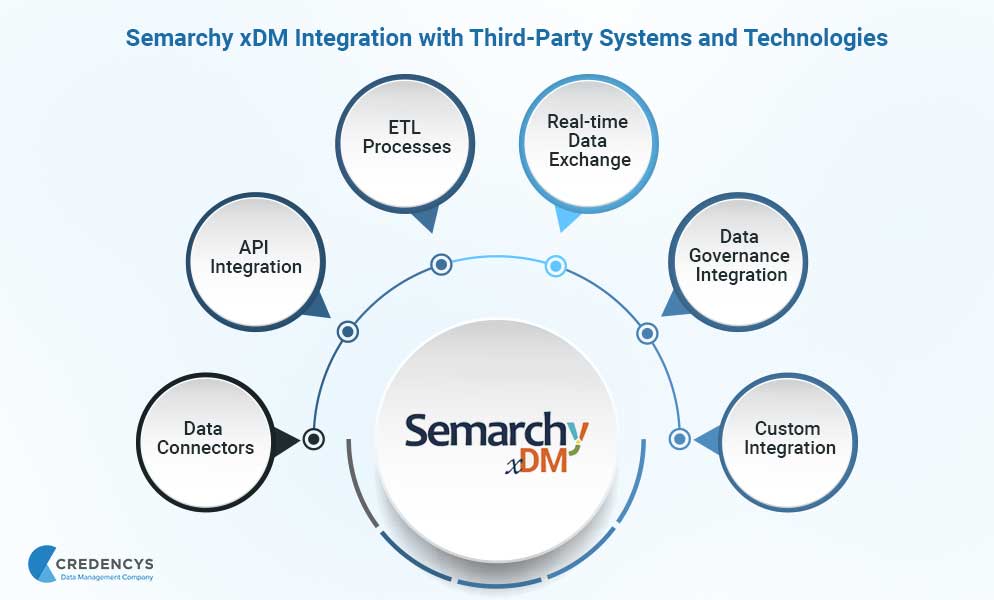
Semarchy xDM Integration with Third-Party Systems and Technologies

Semarchy xDM provides robust integration capabilities, enabling organizations to seamlessly connect and exchange data with a wide range of third-party systems and technologies.

This integration plays a crucial role in ensuring the effectiveness and efficiency of master data management within the organization.

Let’s explore the key aspects of Semarchy xDM’s integration capabilities:

Data Connectors

Semarchy xDM offers pre-built data connectors that simplify the integration process with popular third-party systems. These connectors facilitate the seamless exchange of data between xDM and systems such as ERP, CRM, BI, and data warehouses.

By leveraging these connectors, organizations can streamline data synchronization and eliminate manual data entry, reducing the risk of errors and ensuring data consistency.

API Integration

xDM provides a robust set of APIs (Application Programming Interfaces) that enable organizations to integrate the solution with their existing systems and technologies.

These APIs allow for bidirectional data exchange, enabling real-time data updates and synchronization between Semarchy xDM and other applications.

Organizations can leverage APIs to automate data integration processes, trigger data validation and enrichment, and ensure data integrity across systems.

ETL Processes

Semarchy xDM supports integration through Extract, Transform, and Load (ETL) processes commonly used for data integration and transformation.

Organizations can leverage ETL tools or platforms to extract data from various sources, transform it according to business rules and mappings, and load it into xDM.

This approach enables organizations to integrate data from disparate systems, databases, and file formats, ensuring a comprehensive and unified view of master data.

Real-time Data Exchange

Semarchy xDM enables real-time data integration, allowing organizations to have up-to-date and accurate master data across systems.

Real-time integration ensures that changes made in one system are immediately reflected in xDM and vice versa, enabling timely decision-making and reducing data latency.

Data Governance Integration

Semarchy xDM can integrate data governance tools and platforms, enabling organizations to align master data management with their data governance practices.

This integration ensures that data governance policies, rules, and workflows are enforced within xDM, enabling organizations to maintain data quality, consistency, and compliance across the enterprise.

Custom Integration

Semarchy xDM offers flexibility for custom integration with specific third-party systems and technologies.

Organizations can leverage custom development and configuration options to integrate Semarchy xDM with proprietary or industry-specific systems, ensuring a seamless flow of data and information.

By integrating Semarchy xDM with third-party systems and technologies, organizations can achieve a unified and synchronized view of master data across the enterprise.

This integration enables efficient data exchange, eliminates data silos, enhances data quality, and facilitates informed decision-making based on accurate and up-to-date information.

Semarchy xDM’s integration capabilities empower organizations to leverage their existing IT landscape and maximize the value of their master data.

Extending Semarchy xDM with Customization and Configuration
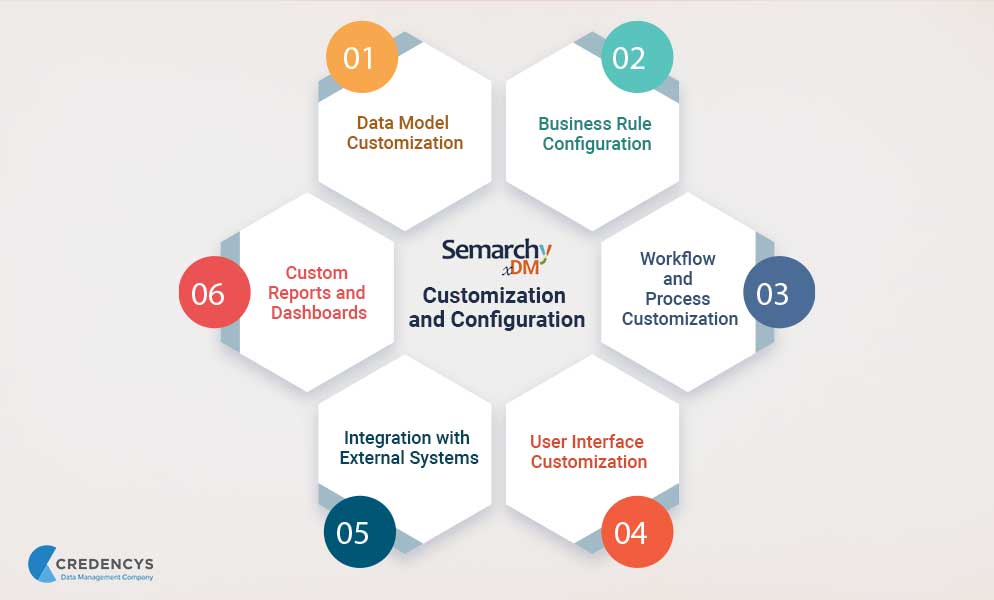
Semarchy xDM Customization and Configuration

Semarchy xDM offers a high degree of flexibility and customization, empowering organizations to tailor the solution to their specific business requirements. By leveraging customization and configuration capabilities, organizations can extend the functionality of xDM to meet their unique needs.

Let’s explore how Semarchy xDM can be extended through customization and configuration:

Data Model Customization

Semarchy xDM allows organizations to customize the data model to align with their specific master data requirements. Organizations can define custom entities, attributes, relationships, and hierarchies within the data model.

This flexibility enables organizations to capture and manage master data in a way that reflects their unique business processes and data structures.

Business Rule Configuration

Semarchy xDM enables the configuration of business rules to enforce data validation, data quality checks, and data enrichment.

Organizations can define custom business rules based on their specific data governance policies and requirements. This configuration ensures that data entered into Semarchy xDM meets predefined criteria, enhancing data quality and accuracy.

Workflow and Process Customization

Semarchy xDM provides a configurable workflow engine that allows organizations to define and automate data governance processes, approval workflows, and data stewardship tasks.

Organizations can customize these workflows to align with their specific business processes and organizational structure. This customization ensures that data management processes follow the organization’s established procedures and adhere to compliance requirements.

User Interface Customization

Semarchy xDM offers customizable user interfaces that can be tailored to match the organization’s branding and user experience preferences.

Organizations can configure the layout, design, and navigation of the user interface to provide an intuitive and user-friendly experience for data stewards and end-users. This customization enhances user adoption and productivity.

Integration with External Systems

Semarchy xDM can be extended through integration with external systems and technologies. Organizations can integrate Semarchy xDM with other applications, such as CRM, ERP, or BI systems, to enable seamless data exchange and ensure consistency across systems.

This integration extends the reach and impact of Semarchy xDM, enabling organizations to leverage master data in their broader IT ecosystem.

Custom Reports and Dashboards

Semarchy xDM offers the flexibility to create custom reports and dashboards based on specific business requirements. Organizations can configure reports and dashboards to visualize key master data metrics, performance indicators, and data quality insights. This customization allows stakeholders to gain valuable insights into master data and make informed decisions.

By leveraging customization and configuration capabilities, organizations can extend the functionality of Semarchy xDM to fit their unique business needs. This flexibility ensures that xDM aligns with the organization’s processes, data structures, and compliance requirements.

Organizations can maximize the value of xDM by tailoring it to their specific master data management objectives and operational workflows.

Key Features of Semarchy xDM

Key Features of Semarchy xDM

Semarchy xDM offers a comprehensive set of features and functionalities that empower organizations to effectively manage their data.

From data modeling to data governance, data quality to data integration, Semarchy xDM provides a robust ecosystem for organizations to achieve data agility, accuracy, and insights.

With its focus on data integrity, xDM ensures that data remains reliable and consistent, enabling organizations to make informed decisions and drive business success.

Data Modeling

Providing powerful data modeling capabilities, xDM allows organizations to design and manage their data structures efficiently. With a user-friendly interface, users can define data entities, attributes, and relationships, creating a logical representation of their data.

Leveraging data modeling features businesses can adapt and evolve their data models to meet changing requirements, ensuring flexibility and scalability. By establishing a solid foundation for data structure, organizations can achieve better data consistency, accuracy, and integrity.

Data Quality & Enrichment

Semarchy xDM puts a strong focus on data quality and enrichment. It offers comprehensive features to ensure data accuracy and completeness. Users can define data validation rules, perform data profiling, and implement data standardization processes to maintain high-quality data.

It also offers data enrichment by allowing integration with external data sources. By enriching data with additional information, such as geolocation data or demographic data, organizations can enhance their data insights and make more informed decisions.

Data Governance

Data governance is a critical aspect of effective data management, and Semarchy xDM provides robust tools and capabilities to support data governance practices. It enables organizations to define data policies, rules, and workflows, ensuring adherence to regulatory requirements and internal standards.

With xDM, data stewards can enforce governance policies by monitoring data quality, resolving data issues, and managing data change requests. This promotes data consistency, reliability, and accountability throughout the organization.

Data Stewardship

By facilitating data stewardship, xDM empowers organizations to involve data stewards in the data management process. Under data stewards, companies can review, validate, and approve data changes, ensuring data accuracy, integrity, and alignment with business rules.

Moreover, xDM provides collaboration features, task management, and workflows that enable data stewards to perform their responsibilities efficiently. By involving data stewards, organizations can leverage their expertise to drive data governance and ensure the reliability of data assets

Dashboarding

The xDM offers intuitive dashboards and reporting capabilities that provide users with a visual representation of key data management metrics. Users can monitor data quality, governance, and performance through interactive charts, graphs, and customizable dashboards.

Using Semarchy xDM’s dashboarding features, organizations enable users to track data trends, identify exceptions, and measure the overall health of their data. This data visualization enhances data-driven decision-making and helps stakeholders gain actionable insights from their data assets.

Data Management

Offering comprehensive data management functionalities, Semarchy xDM streamlines data operations. It includes features such as data profiling, which enables users to analyze the quality and structure of their data.

It also offers data lineage, allowing users to track the origin and transformations applied to their data. Versioning capabilities ensure the preservation of historical data states, while data lifecycle management features enable organizations to manage data retention, archiving, and purging. These data management capabilities promote data integrity, traceability, and compliance.

Data Discovery

Semarchy xDM facilitates data discovery by providing users with powerful search and exploration capabilities. Users can search for specific data assets, metadata, or relationships within the platform.

The data cataloging feature of xDm enables users to find relevant data quickly, improving data accessibility and understanding. This empowers users to locate the right data for their analyses, fostering data-driven insights and informed decision-making.

Data Integration

Semarchy xDM supports seamless data integration with various systems and data sources. It offers connectors, APIs, and Extract, Transform, Load (ETL) capabilities that simplify data ingestion, transformation, and synchronization processes.

By integrating data from disparate sources, Semarchy xDM breaks down data silos, ensures data consistency across systems, and provides a unified view of the data. This promotes data integration and interoperability, enabling organizations to leverage the full potential of their data assets.

Workflows & Processes

Semarchy xDM enables organizations to define and automate workflows and processes related to data management. Users can design custom workflows to support data governance, data stewardship, and data change management.

These workflows ensure that data operations follow predefined rules and policies, streamlining data management processes and promoting efficiency. By automating tasks and approvals, Semarchy xDM facilitates collaboration and accelerates the execution of data-related activities.

Data Security

Data security is a top priority in today’s data-driven landscape, and Semarchy xDM offers robust security features to protect sensitive data. It includes access controls, allowing organizations to define user roles and permissions. Encryption mechanisms safeguard data in transit and at rest, ensuring confidentiality and integrity.

It also provides data masking capabilities to anonymize sensitive data, minimizing the risk of unauthorized access. By incorporating comprehensive security measures, the xDM helps organizations meet regulatory requirements and safeguard their data assets.

Data Integrity

Semarchy xDM places a strong emphasis on data integrity. It ensures that data remains accurate, consistent, and reliable throughout its lifecycle. Implementing data validation rules, constraints, and referential integrity checks, prevents the introduction of incorrect or inconsistent data.

It helps organizations maintain data integrity by ensuring that data meets predefined standards and aligns with business rules. This promotes data reliability and enhances the overall trustworthiness of the data assets.

Role of Semarchy xDM in Semarchy Master Data Management

Role of Semarchy xDM in Semarchy Master Data Management

Semarchy xDM plays a crucial role in Master Data Management (MDM), offering organizations a comprehensive platform to effectively manage their master data. It encompasses key functionalities such as data modeling, data quality, data governance, data integration, and data management.

With xDM, organizations can create accurate and consistent data models that align with their business requirements. It enables data profiling, enrichment, and validation to ensure high data quality.

The platform facilitates data governance by defining and enforcing policies, enabling data stewards to review and approve changes.

Semarchy xDM also supports data integration, allowing organizations to consolidate and reconcile master data from different sources. It offers data management capabilities such as data lineage and versioning, ensuring data accuracy and providing an audit trail.

Furthermore, it provides powerful dashboarding and reporting features for monitoring data quality and performance metrics. It prioritizes data security and privacy, implementing access controls, encryption, and data masking to protect sensitive information.

Overall, Semarchy xDM plays a critical role in MDM by empowering organizations to establish a trusted source of master data, driving data-driven decision-making, enhancing operational efficiency, and ensuring data consistency.

How Semarchy xDM Differs from Traditional Data Management Approaches

Semarchy xDM sets itself apart from traditional data management approaches through its innovative and agile approach to managing master data. Here are some key differences:

Data-Centric Approach

Unlike traditional approaches that focus on application-centric or system-centric data management, Semarchy xDM takes a data-centric approach. It emphasizes the master data itself, treating it as a valuable enterprise asset.

This approach enables organizations to establish a single, unified view of master data across the entire organization, breaking down data silos and promoting data consistency and accuracy.

Agility and Flexibility

Traditional data management approaches often involve rigid structures and predefined data models that are difficult to adapt and change.

Semarchy xDM offers a highly flexible and agile environment. It allows organizations to define and modify data models, attributes, and relationships based on evolving business needs.

This adaptability ensures that master data can keep up with changing requirements and supports business agility.

Iterative and Collaborative Data Governance

Semarchy xDM promotes iterative and collaborative data governance practices. Traditional approaches often involve lengthy and complex governance processes that hinder agility.

In contrast, xDM facilitates the involvement of data stewards, business users, and subject matter experts in the data governance process. It enables collaborative decision-making, streamlines approvals, and promotes faster data governance cycles.

Business User Empowerment

Traditional data management approaches often require specialized technical skills, limiting the involvement of business users in data management activities. Semarchy xDM aims to empower business users by providing intuitive and user-friendly interfaces.

It allows them to actively participate in data modeling, data governance, and data stewardship tasks, reducing dependence on IT and fostering collaboration between business and IT teams.

Fast Time-to-Value

Semarchy xDM offers rapid implementation and deployment capabilities. It leverages prebuilt templates, configurable workflows, and data connectors, enabling organizations to quickly set up and start managing their master data.

Traditional approaches typically involve lengthy implementation cycles and complex customization efforts, delaying the realization of business value.

Data Integration and Interoperability

Semarchy xDM supports seamless data integration and interoperability with various systems and data sources. It provides connectors, APIs, and data integration capabilities that enable organizations to integrate and reconcile master data from disparate sources. This ensures a holistic view of master data and facilitates data-driven decision-making.

The xDM differentiates itself from traditional data management approaches through its data-centricity, agility, collaborative governance, data stewardship focus, business user empowerment, fast time-to-value, and seamless data integration capabilities.

These features enable organizations to effectively manage their master data, drive data quality, and achieve a unified and accurate view of critical business information.

Key Benefits of Semarchy xDM

Key Benefits of Semarchy xDM

Increased Operational Efficiency

Semarchy xDM streamlines and automates various data management processes, reducing manual effort and improving operational efficiency. It enables organizations to automate data validation, enrichment, and integration tasks, saving time and resources.

The platform also facilitates workflow management, task assignment, and approval processes, ensuring efficient collaboration and faster data governance cycles. Increased operational efficiency allows organizations to focus on strategic initiatives and drive productivity.

Enhanced Data Insights and Decision-Making

By providing comprehensive data discovery and visualization capabilities, Semarchy xDM empowers organizations with actionable insights from their master data.

The platform offers powerful dashboarding and reporting features that enable users to monitor data quality, performance metrics, and key indicators.

These insights support data-driven decision-making, allowing organizations to make informed strategic and operational choices based on accurate and up-to-date information.

Scalability and Adaptability

Semarchy xDM is designed to scale and adapt to evolving business needs. It offers a flexible data model and data integration capabilities, enabling organizations to accommodate new data sources, entities, and attributes as their business grows.

The platform can handle increasing volumes of data without sacrificing performance or data quality, providing a scalable solution for organizations of all sizes.

Improved Customer Experiences

With a unified and accurate view of customer data, using Semarchy xDM helps organizations deliver personalized and exceptional customer experiences.

By leveraging the 360-degree view of customers, organizations can better understand their preferences, behaviors, and needs, enabling targeted marketing campaigns, personalized offers, and improved customer service.

Enhanced customer experiences lead to increased customer satisfaction, loyalty, and ultimately, business growth.

Enhanced Business Agility

Semarchy xDM’s agile approach enables organizations to respond quickly to changing business requirements and market dynamics.

With its flexible data model, configurable workflows, and adaptability to evolving needs, organizations can make timely adjustments to their master data management strategies.

This agility empowers businesses to stay competitive, seize new opportunities, and adapt to market disruptions.

Cost Savings

Implementing Semarchy xDM can result in significant cost savings for organizations. By improving data quality, organizations reduce the costs associated with data errors, rework, and inefficiencies caused by poor data.

Semarchy xDM also streamlines data management processes, automates tasks, and reduces manual effort, leading to operational cost savings.

Additionally, the platform’s scalability and flexibility eliminate the need for costly infrastructure investments and allow organizations to scale their data management capabilities as needed.

Improved Collaboration and Data Governance

Semarchy xDM fosters collaboration between business users, IT teams, and data stewards. The platform provides a centralized environment where stakeholders can collaborate on data modeling, data governance workflows, and data quality initiatives.

This collaborative approach ensures that data governance processes are efficient, transparent, and involve input from all relevant parties. Improved collaboration leads to better decision-making, consensus-building, and a stronger data governance culture within the organization.

3 Most Common Use Cases of Semarchy xDM

Use Case 1: Transforming Customer Data Management with Semarchy xDM

Semarchy xDM empowers organizations to transform their customer data management practices. By consolidating customer data from various sources, businesses can gain a unified and accurate view of their customers, leading to enhanced customer experiences and business growth.

With data quality management and data governance features, xDM ensures the accuracy, consistency, and completeness of customer data, while enabling organizations to enforce data governance policies and comply with regulations.

Use Case 2: Optimizing Supplier Data Management with Semarchy xDM

The xDM optimizes supplier data management, allowing organizations to centralize and standardize supplier data. With a comprehensive data model and data quality management capabilities, businesses can ensure reliable and up-to-date supplier data.

The platform’s data governance and stewardship features enable efficient collaboration between procurement teams and data stewards, while advanced data discovery and visualization capabilities provide insights into supplier performance and risks, supporting informed decision-making.

Use Case 3: Achieving Regulatory Compliance through Semarchy xDM

Semarchy xDM helps organizations achieve regulatory compliance by providing essential features for data lineage, audit trails, and privacy management.

The platform enables businesses to track data origins, enforce data policies, manage consent preferences, and monitor data usage to comply with regulations such as GDPR, CCPA, and HIPAA.

With data quality management and reporting capabilities, xDM simplifies compliance reporting, ensuring organizations meet regulatory requirements and mitigate legal risks.

Success Stories of Semarchy xDM

Red Wing Shoes

Red Wing Shoes, a renowned manufacturer and retailer of purpose-built footwear, garments, and accessories, recognized the importance of managing its customer data effectively amidst the continued growth of the retail and e-commerce sectors. To meet this need and create a comprehensive 360° view of their customers across all divisions, Red Wing Shoes turned to Semarchy xDM.

Semarchy xDM empowered Red Wing Shoes to establish a central data hub that served as a collaborative platform for managing and governing customer data.

By leveraging the capabilities of Semarchy xDM, Red Wing Shoes gained valuable insights into customer behavior and preferences, enabling them to enhance their customer knowledge and ultimately improve the overall customer experience.

With Semarchy xDM, all business units within Red Wing Shoes were able to access and contribute to a unified and accurate customer database. This collaborative approach to data management fostered cross-departmental collaboration and ensured that every division had a holistic view of customers’ interactions and preferences. As a result, Red Wing Shoes could tailor their offerings and services to meet individual customer needs effectively.

The implementation of Semarchy xDM allowed Red Wing Shoes to streamline its data management processes, ensuring data consistency and accuracy across the organization. The centralized data hub facilitated efficient data governance, enabling Red Wing Shoes to comply with data privacy regulations and maintain data integrity.

By embarking on their data journey with Semarchy xDM, Red Wing Shoes demonstrated their commitment to providing an exceptional customer experience. With collaborative data management and governance at the core of its operations, Red Wing Shoes is poised for continued growth and success in the highly competitive retail industry.

Semarchy xDM enabled Red Wing Shoes to harness the power of their customer data, driving personalized interactions, and building lasting relationships with their customers. With enhanced customer knowledge and a centralized data hub, Red Wing Shoes remains at the forefront of innovation and excellence in the footwear industry.

Chipotle

Chipotle Mexican Grill, a renowned restaurant chain with over 2,500 stores, faced the challenge of gaining full visibility and control of their supply chain data. They needed a solution that could provide accurate and up-to-date information on menu ingredients, tax regulations, and management specifics for each location.

Chipotle turned to Semarchy xDM for their master data management (MDM) needs. Semarchy xDM empowered Chipotle to centralize and manage its data, allowing them to shift control from IT to business users. This shift enabled faster reaction times, improved data accuracy, and enhanced customer service.

By implementing Semarchy xDM, Chipotle gained full visibility and control over its supply chain data. They mastered their restaurant locations, global products, and menus through an iterative approach. This digital transformation improved operational efficiency and facilitated data-driven decision-making.

With xDM, Chipotle achieved a more streamlined and efficient data management process. They now can deliver the freshest ingredients, comply with tax and regulatory requirements, and provide exceptional customer service across their extensive restaurant network.

Semarchy xDM played a vital role in empowering Chipotle’s digital transformation journey and ensuring its success in a highly competitive industry. By leveraging better data management practices, Chipotle continues to deliver high-quality food experiences to its customers while maintaining control and agility in its supply chain operations.

Semarchy xDM, as a leading master data management solution, is expected to continue evolving and adapting to emerging trends and technologies in the data management space. Here are some future trends that can be anticipated for Semarchy xDM:

Future Trends of Semarchy xDM

Future Trends of Semarchy xDM

Artificial Intelligence (AI) and Machine Learning (ML) Integration

As AI and ML technologies continue to advance, integrating them with Semarchy xDM can enhance data quality management, data enrichment, and data governance processes.

AI and ML algorithms can help automate data cleansing, anomaly detection, and predictive analytics, enabling organizations to make more informed decisions based on their master data.

Cloud-Based Deployment

The adoption of cloud computing is rising, offering scalability, flexibility, and cost efficiency.

Semarchy xDM is likely to embrace cloud-based deployment models, allowing organizations to leverage the benefits of cloud infrastructure, such as elastic scalability, easy integration with other cloud services, and simplified maintenance and updates.

Data Privacy and Compliance

With the increasing focus on data privacy and compliance regulations, Semarchy xDM is expected to enhance its capabilities in this area.

The solution may incorporate features like data masking, consent management, and privacy by design principles to ensure compliance with regulations such as GDPR (General Data Protection Regulation) and CCPA (California Consumer Privacy Act).

Data Catalog and Data Discovery

To facilitate data exploration and self-service analytics, Semarchy xDM might incorporate data catalog and data discovery functionalities.

These features would enable users to search, explore, and understand the available master data assets, improving data accessibility and fostering data-driven decision-making across the organization.

Integration with Data Governance Frameworks

As data governance becomes more critical for organizations, Semarchy xDM can be expected to integrate with established data governance frameworks and standards.

This integration would enable seamless collaboration between xDM and other data governance tools, facilitating end-to-end data governance practices and ensuring data quality, compliance, and accountability.

Advanced Analytics and Insights

Semarchy xDM is likely to enhance its analytical capabilities by providing built-in or integrated analytics tools. This would enable organizations to gain deeper insights from their master data, identify patterns, trends, and correlations, and uncover valuable business intelligence that can drive strategic decision-making and improve operational efficiencies.

Wrapping Up

In conclusion, Semarchy xDM is a robust and comprehensive master data management solution that empowers organizations to effectively manage their critical data assets. With its flexible architecture, extensive set of components, and seamless integration capabilities, Semarchy xDM provides businesses with the tools they need to achieve data quality, governance, and integration objectives.

The architecture of Semarchy xDM offers a scalable and modular framework that supports the management of master data across multiple domains. Its components, including data modeling, data quality, data governance, data stewardship, dashboarding, and data integration, work together harmoniously to ensure the accuracy, consistency, and accessibility of master data.

Moreover, xDM facilitates integration with third-party systems and technologies, allowing organizations to leverage their existing infrastructure and maximize their investments. It also enables customization and configuration to meet specific business requirements, providing a tailored solution that aligns with unique needs.

Looking ahead, Semarchy xDM is poised to embrace future trends in the data management landscape. These trends include the integration of AI and ML for enhanced data management processes, cloud-based deployment for scalability and flexibility, and increased focus on data privacy and compliance.

Additionally, xDM is likely to incorporate features such as data cataloging, advanced analytics, and seamless integration with data governance frameworks.

By staying at the forefront of emerging technologies and industry demands, Semarchy xDM will continue to empower organizations to unlock the full potential of their master data. With improved data visibility, control, and insights, businesses can make informed decisions, drive operational efficiencies, and gain a competitive edge in today’s data-driven landscape.

Overall, Semarchy xDM is a powerful solution that empowers organizations to harness the true value of their data, achieve data-driven excellence, and propel their digital transformation journeys.

15 Best PIM Tools in Market to Consider for Your Business

Though the concept is similar for all eCommerce businesses, they are unique and different in many ways such as the type of product they sell, the business nature, the number of SKUs – Stock Keeping Units they deal with, and the number of channels cater to. Harness the potential of PIM tools to manage your products with all the exclusive data.

What are your ways to address all the unique and different needs of your business? Are you managing it manually? Do you use different tools to manage various activities?

If you are following the exact work approaches that I mentioned earlier, then I guess you are not aware of Product Information Management (PIM) tools. Are you?

Let’s start with the definition.

What is a PIM Tool?

PIM is a centralized repository of essential product information that enables you with a real-time, precise, and full view of our product along with other data related to it.

The Product Information Management system is popular as a Product Resource Management (PRM) System and a Product Lifecycle Management (PLM) system. It allows you to expand your product offerings, move into a new sales channel, keep all the product information up-to-date with extensive accuracy, analyze sales and marketing metrics, and boost the revenue stream.

I guess now you have better clarity about the capabilities and benefits of the PIM system and how it helps you to bring your eCommerce business to the next level.

To explore more about the hidden potential of product information management, you must visit What is PIM and Product Information Management – An Exclusive Guide.

Why Do You Need a PIM Tool?

After gaining knowledge about what a PIM tool is, it is time to be aware of why you need a PIM tool for your business’s growth.

Let’s discuss in detail the essentials of having a good PIM tool for your business.

Having a good PIM solution for your business helps you maintain the quality of your product data for your internal business processes and also for multichannel distribution. As the PIM system maintains all the consolidated product data on a single centralized platform, it acts as a single source of truth for the data.

In addition, the PIM solution helps businesses expand their sales channels and connect easily with multiple channels to share quality data instantly.

Here are some key capabilities of PIM solutions that will be helpful for your business’s growth.

  • Enhancing product data quality across the sales channels.
  • Tracking the product lifecycles.
  • Easy management and modifying the product data.
  • Creating relationships between the products.
  • Ability to collect relevant product data from external sources.
  • Collecting, cleaning, and centralizing the data scattered across various sources.
  • Setting priorities for the data.
  • Enriching the product data according to the evolving market conditions.
  • Localization of product data through effective translation.
  • Linking digital product assets with relevant products.
  • Creating custom-tailored product feeds.
  • Creating and managing the product sheets.
  • Ability to analyze and track the product’s performance.

Marketers, data managers, and data analytics professionals can improve their work efficiency with the presence of a good PIM tool.

How to Choose The Right PIM Tool for Your Business?

Well, if you are new to product information management, then it will be tough for you to choose a reliable PIM platform. There are a lot of PIM solutions offered by so many companies but you need to find the right match for your business needs.

Moreover, you need to make sure the platform you are selecting is compatible with the latest PIM trends or not. We understand it seems challenging.

In this post, we are going to unlock the top PIM tools that help you in managing your product data and gain better insights into sales and marketing efforts.

Most of the PIM solutions are expensive as they come with licensing costs and of course, you need to pay to develop custom features and functionality.

All the PIM platforms listed here have different features, functionality, and capabilities to address the same purpose and that is effective product information management. So, are you ready to take a ride and make the best suit for your business?

Benefits of Using PIM Tools

The different benefits gained by the organization by implementing the product information management tools include

Improves Personalization

The PIM system supports and works with customer-centric data models. This allows potential buyers to access all the relevant information about the products before making a purchase decision. Due to this, buyers can gain full knowledge about the products and be aware of the products they buy. This significantly reduces product returns.

Apart from that, having a customer-centric data model will encourage systems to have a recommendation mechanism. This mechanism helps businesses provide a list of products to customers based on their interests and previous purchase history. This leads to better-personalized sales for brands and improved customer satisfaction.

High level of automation

A product information management (PIM) system plays a major role in eliminating errors in product cards or out-of-date price lists for your products on sales channels. The PIM system brings a high level of automation to the business process, particularly in handling product-related information. No more daunting task of manually updating product details in spreadsheets; PIM synchronizes the data automatically across all available sales channels from its centralized data repository.

Implementation of the PIM solution ensures that all your product-related information is updated automatically and regularly on all online platforms. Overall, the presence of a PIM system eases the workload of employees handling manual product updating tasks through automation.

Improves Team Satisfaction

PIM tools are specially designed to adapt easily to the ongoing work style of the team. PIM is often considered a new ergonomic work tool that improves team collaboration. Through collaboration, teams can easily get rid of bottleneck situations on their projects by acting quickly and remedying them.

The PIM solution acts as a centralized hub for product data, which allows users to manage and create effective product templates and catalogs. Also, it helps data managers link all the relevant products that are important for today’s dynamic and competitive environment.

Complete product data management

PIM tools help in product data management by maintaining accurate and consistent product information across all channels. It enables editing, managing user rights, data validation, controlled publishing, tracking versions, etc.

It also helps in data modeling by maintaining the relationship and associations with the different data sets. It enables creating data categorization, classifying data based on hierarchies, etc.

PIM helps 2wwin enhancing data quality, enrichment, completeness, etc. It leads to efficient management of the product life cycle and tracking the modification at any given time.

Integration with other systems

Several other applications are used in the organization for the smooth working of their various functions. All these applications generate data related to their individual operations and process.

PIM tools enable easy integration with the different applications thus directly importing the data generated by these applications into PIM. The different systems with which product information management tools are compatible include CRMs, ERPs, relational databases, existing product catalogs, Mainframe legacy systems, partner data systems, tracking and logistics systems, business intelligence software, etc.

PIM has the capability of integrating with several existing or new technology thus leading to real-time and two-way interaction at any time. Effective integration with the different systems eases data import, data search, and retrieval.

Digital asset management

The digital assets include the product details in digital format like product images, videos, audio files, graphics, animations, podcasts, and many other rich media-rich content in different formats.

These digital assets help the customer in effective product visualization thus leading to a better connection with the product. This plays a major role in driving customers to make their product purchase.

The PIM system includes the digital asset management platform that incorporates these files while sharing them across different channels. The DAM enables providing the right media asset to the right target audiences vis the different channels for achieving brand consistency.

This DAM helps in enhancing the customer experience and thus building their trust in the product and the brand.

Product data syndication

PIM tools enable connecting to several external channels by providing product information and publishing on various global shopping networks like Google, Alibaba, Amazon, Facebook, Instagram, etc.

These channels allow the gathering of the audiences of enterprises for social listening, shopping, interactions, etc. PIM tool collects and standardizes the product information irrespective of the format and syndicates it effortlessly to the different channels based on their requirements.

It can also allow for auto-generating creatives and including dynamically in promos, logos, titles, etc. Product data syndication enables the distribution of the product catalog to different channels in any format irrespective of the market.

Supporting vendors and suppliers

PIM tool has the capability of supporting the entire organizational ecosystem as well as the outside teams like the vendors, suppliers, partners, etc. It allows for easy sharing of all the information with them through the portals.

This data sharing is fast, and accurate and helps in developing good relationships and understanding. PIM tool helps in consolidating the supply chain, enhancing demand forecast, improving operational efficiency, minimizing overheads, and accomplishing goals.

Customer experience

PIM enables consolidating product information as a single repository. It provides the best, most accurate, and updated product information to the customers’ thus maintaining transparency.

This helps in reducing product returns and cart abandonment. It also created attractive product campaigns like flash sales, clearance sales, bundled product offers, etc. This leads to enhancing the customer experience and building brand confidence.

Faster time-to-market

PIM helps in connecting the different teams within the organization leading to improved communication. This helps in faster collaborations resulting in enhanced workflows, better operational efficiency, improved performance, and faster time-to-market.

Best 15 PIM Tools to Consider for Effective Product Data Management

1. Pimcore

Pimcore

Pimcore is an open-source platform and is available at zero licensing cost.

Offering a combination of experience manager and data management, Pimcore helps your sales and marketing team in creating contextual and compelling web content by breaking up the data in silos.

It’s an ecosystem that enables you with consolidated product data and digital assets to attain optimal user experience across the website, mobile, and eCommerce store. It can manage, integrate, and consolidate any amount and any type of product data.

PIM platforms of Pimcore allow you to harmonize and centralize all your technical and marketing product information by permitting you to promote high-quality user experience across all customer touchpoints and deliver data to the output channels.

Features:

  • Data Modeling
  • Workflow Management
  • Data Management
  • Data Quality and Semantics
  • Data Integration and Data Delivery
  • Multi-Domain and Multi-Vector

Pros:

  • Create a new product data model quickly with the help of a web-based data modeling engine
  • Monitor and maintain the quality of product information using data validation
  • Organize, aggregate, classified, and translate the product information through the flexible and agile product data model
  • Define editorial workflows and business processes using robust workflow management
  • Enterprise-class data governance and quality.

2. Syndigo

Syndigo

Syndigo is a renowned content experience hub that allows retailers, manufacturers, and distributors to optimize product content seamlessly. The tool is designed to monitor all the product content and facilitate brands with business-critical product KPIs (Key Performance Areas), actionable customer insights, improvement alerts, and more.

Features:

  • Account-Based Marketing
  • Content Marketing
  • Conversion Rate Optimization
  • Customer Data Platform (CDP)
  • Demand Generation
  • Digital Analytics
  • Email Marketing
  • Event Management

Pros:

  • Create a unified experience for all channels, so you win the sale.
  • Empower customers to make great choices more easily
  • Harness data to personalize and customize offerings
  • Create a seamless system, both internally and externally

3. Semarchy

Semarchy

Semarchy, one of the best PIM tools on the market, provides a platform with intelligent data hubs that benefit businesses in a variety of ways. The Semarchy data hub platform handles all aspects of the information management process and streamlines the data flow by increasing the overall quality of the data.
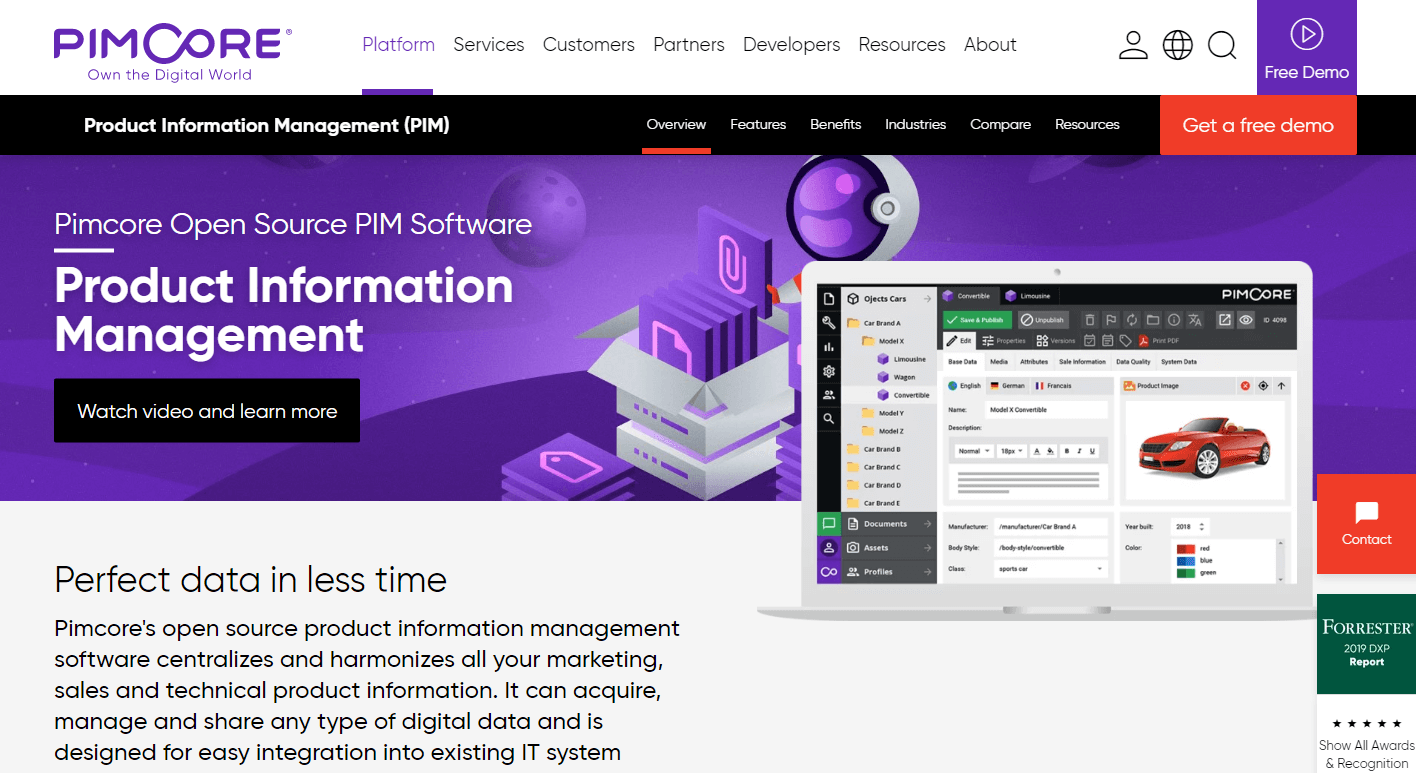
Businesses can create highly effective, production-ready operational and analytical applications in a single environment with the aid of Semarchy’s data solution. The unique set of well-structured data filters of the Semarchy PIM tool plays a handy role in the MDM (master data management) system, ADM (application data management) system, and collaborative data governance operations of an organization.

Features:

  • Data analysis tools
  • Access controls/permissions
  • Data integration
  • Data migration
  • Data security
  • Data mapping
  • Version control
  • Metadata Management

Pros:

  • Helps businesses know more about their customers.
  • Reaching out the businesses’ presence to potential customers at the right time
  • Assists business leaders to predict the future by staying ahead of the marketplace.
  • Businesses can build a data-driven culture with more data accuracy through Semarchy.

4. Infromatica

Informatica

Infroamtica has a flexible and scalable PIM tool. It allows businesses to have efficient collaboration between internal and external resources.

Moreover, you can leverage the seamless management of complex product information and digital assets regardless of the format. Infromatica ensures the enrichment and standardization of product information by providing automated data quality checks.

Features:

  • Omnichannel Commerce
  • Business Process Management
  • Supplier Relationship Management
  • Information Audit Trials
  • Roles & Permissions
  • On-premises and Cloud-based Deployment
  • Digital Asset Management

Pros:

  • Boosted product information quality due to automated data quality check
  • Centralized management of complex product information and digital asset
  • The embedded self-service portal allows for superior supplier collaboration

5. Akeneo

Akeneo

Akeneo is an open-source PIM system that is designed to address the multichannel needs of brands and retailers. Based on Symphony, the platform is highly customizable and extendable. It allows you to integrate your third-party software, import the data from excel or CSV files, and onboard your suppliers to get an exclusive view of all the imports.

It consists of an extensible import engine that streamlines data onboarding from virtual sources. You can organize and classify the product without using the tabular method. It allows you to translate your product information in multiple languages, complete the product sheet, keep track of any modifications, add media files, define data attributes, and more.

Features:

  • Data Organization & Classification
  • Data Enrichment
  • Data Import and Export
  • Rule Engine
  • Validation Workflow
  • Advanced Rights Management
  • Data Quality Review, and more…

Pros:

  • Store and manage all kinds of data including videos, files, images, and product data asset manager
  • Allows checking the previous versions with “History Version Reverse”
  • Advanced security standards by defining the right of the company’s internal and external resources

6. EnterWorks

EnterWorks

EnterWorks create differentiated customer experiences using Product Information Management and Master Data Management solutions. It’s a comprehensive solution that aggregates product data from different sources and manages them in a centralized repository. The platform offers you a 360-degree PIM platform that allows for data onboarding, synchronizing, cleansing, and publishing.

Features:

  • Dynamic Data Modeling
  • Digital Channel Accelerator
  • Geographic Localization
  • Workflow and collaboration
  • Constituent Content Exchange
  • Digital Asset Management
  • Data syndication and publishing

Pros:

  • Store, manage and categorize the digital assets
  • Update and syndicate product information to different channels
  • With the help of digital channel accelerators, you can reach multiple touchpoints, social networks, and marketplaces
  • A simple drag-and-drop user interface easily manage the content and complex business processes
  • Leverage third-party software integration
  • Establish a powerful collaboration between internal, external, business, and technical users

7. Agility Multichannel

Agility Multichannel

Agility contains the Product Information Management and Master Data Management capabilities to manage the data in a centralized repository and have a consolidated view of it. It allows the brand to deliver the right content in the right content to the right customer at the right time.

Using the dynamic workflow of the Agility PIM, you can leverage smooth collaboration. The platform allows to streamline processes for content enrichment, data aggregation, and data syndication to multiple channels. Data validation allows to syndicate of accurate content to multiple channels.

Features:

  • Product Information Intelligence
  • Data Modeling and Manipulation
  • Data Quality Control
  • Business Intelligence
  • Data Quality Support
  • Data Integration
  • Agility Modular Interface and more…

Pros:

  • Harmonize the process of product information sourcing, syndication, and enrichment to multiple channels
  • Allows expanding product SKUs and ranges rapidly
  • Enable you with real-time performance analytics of brand and product range
  • Help in creating contextualized content for different channels

8. PIMworks

PIMworks

PIMworks is an advanced product experience management platform that helps retail businesses and brands to create and deliver personalized shopping experiences. It manages all the product information in a centralized location to simplify the syndication of the data.

By offering workflow management, it also provides an effective collaboration platform for your team, vendors, and other internal as well as external resources.

Features:

  • Documentation Management
  • Digital Asset Management
  • Collaboration
  • Record Management
  • Data and Information Management

Pros:

  • Establish a powerful collaboration with your internal team and vendors by creating a new workflow
  • With the help of ready-made templates, you can ensure compliance with varied channel guidelines
  • Collect the product information from different sources and manage them in a centralized repository
  • Product data onboarding allows you to expand the sales channel quickly
  • Harness the potential of data enrichment to create rich product experiences
  • Leverage data syndication to different channels

9. Salsify

Salsify

Salsify helps the brand in creating and delivering digital experiences by offering Product Information Management and Digital Asset Management solutions. It allows the management of the content in a centralized location to help the companies understand the customer’s journey and provide insight into what they need to do to achieve better results.

Allowing the creation of an advanced workflow, Salsify can improve the time-to-market of the product and increase sales. The platform offers a 30-day free trial so that you can check and try the product before purchasing it.

Features:

  • Product Information Management
  • Product Content Creation and Publication
  • Content Collaboration and Syndication
  • Content Onboarding and Optimization
  • Content Readiness and Analytics
  • Digital Asset Management
  • Digital Product Catalog and more…

Pros:

  • Manage all the product content in a centralized location
  • Enabling actionable analytics, the platform allows you to monitor the market changes and accordingly respond to the changing business needs
  • Import digital assets and product information from multiple sources to meet the channel requirements
  • Leverage content syndication in the right format to multiple channels

10. inRiver

inRiver

inRiver offers flexible and scalable PIM software. It is a Software-as-a-Service platform that contains four core applications within the software: Plan, Supply, Release, and Enrich. inRiver supplied the data to the PIM platform from your existing third-party software such as Product Lifecycle Management and ERP.

Using the data, you can create engaging product descriptions and push it to any of your sales channels including e-catalog, print catalog, eCommerce store, and more.

Features:

  • Content Planning and Publishing
  • Multichannel Sales Management
  • Product Information Updates
  • Backend Data Source Integration
  • Catalog Production & Management
  • Product Creation Template

Pros:

  • Improve time to market by connecting with your sales channels and data source in order to push the product information rapidly
  • Easy to connect the software with multiple sales channels, collect data from all customer touchpoints and get unified marketing information
  • Create compelling product stories
  • Deliver an optimized shopping experience to the customers

11. Plytix

Plytix

Plytix is an easy-to-use and intuitive PIM solution that allows businesses to manage product experience across different channels. Moreover, you can create a customized and error-prone product catalog using the software.

It contains product analytics that helps marketing teams to make an informed decisions about product promotions. Moreover, it allows B2B businesses to create a product catalog and sell the product effectively.

Features:

  • E-Catalog Online Content Management Platform
  • Variation Handling
  • Product Performance Analytics
  • Build Editing Capabilities
  • Product Performance Analytics
  • Custom Data Outputs
  • User Access Permission and more…

Pros:

  • The PIM solution is useful to both B2B and B2C businesses
  • Quick syndication of optimized and contextual content
  • Edit the product labels with the help of the Edit on the Fly feature
  • Multiple users can work on a single data at the same time
  • Product-level metrics gather data from all channels and analyze them to enable you with profound insights

12. Stibo Systems

Stibo System

Stibo Systems offers Product MDM that allows businesses to acquire, manage, and share product data across the organization. It allows to the management of all the product data in a single place. Moreover, Product MDM allows you to share the content with your targeted customers in real-time. To maintain operational integrity and efficiency, the PIM solution of Stibo offers data governance protocols.

Features:

  • Localized Data
  • Asset Sharing
  • Categorization
  • Products and Digital Assets Linking
  • Asset Preview
  • Streamlined Digital Assets Approval/Review

Pros:

  • User roles-based configuration for data modeling, business rules, and workflows.
  • Effective and centralized management of master records such as versioning, validation, structure, hierarchy, approvals, and master data enrichment
  • Allows to configure business processes of content creation, approval, publishing, and maintenance
  • Data consolidation from multiple sources and metadata setup

13. Syndigo PIM

Riversand

Syndigo enables the business with an enterprise-class PIM solution that allows brands to manage, review, and govern product information from a centralized repository. It also allows you to build an efficient and collaborative supply chain and speed up the launch of your product to the market. For faster onboarding of product content, you can use the Match & Merge features of the Syndigo PIM software.

Features:

  • Supplier Onboarding Platform
  • Robust Data Quality & Approval Engine
  • Product Information Synchronization across Third-party Software
  • Streamlined and Optimized the New Product Introduction
  • New Product Introduction and Old Product Update Workflows
  • Product Updates through Dynamic Governance and more…

Pros:

  • Faster product onboarding by pairing them with the right digital assets
  • Create a product catalog using a match and merge feature
  • Integrate and synchronize the product information from multiple channels to build a collaborative and visible digital supply chain
  • Customized recommendations and personalized product content

14. Catsy

Catsy

Catsy is one of the highly reliable product information management tools that come with built-in product information management and digital asset management capabilities. It is a single source of truth for all product data and asset data.

Features:

  • Metadata Tagging
  • Catalog Design & Publication
  • Digital Assets Import & Export
  • Data Validation & Completion
  • Field Consistency
  • Digital Assets Management
  • Task Management & Notifications

Pros:

  • Improved time-to-market
  • Deliver consistent content across different channels
  • Simplified penetration to new market
  • Improved customer engagement
  • Automation increases agility

15. Feedonomics

Feedonomics

The Feedonomics PIM tool is exclusively used as a structural link for companies engaged in eCommerce activities. Feedonomics can be used by business owners to automate their product listings and manage orders effectively.

Unlike the other best PIM tools on the market, the Feedonomics platform additionally assists data managers in improving the sales conversion rate and optimizing their product catalog according to SEO relevance.

It is a fully integrated software tool for managing products and data feeds that includes all crucial PIM features. However, unlike other PIM tools, Feedonomics is incredibly user-friendly and intuitive in comparison to other PIM solutions.

Features:

  • Product data syndication
  • Automatic product data catalog
  • Exceptional inventory management
  • AI-based automated product categorization

Pros:

  • Offers a centralized dashboard to the business leaders for effective management of all the data management operations.
  • Easy integrate all the existing top eCommerce platforms like Shopify, Magneto, Salesforce, BigCommerce, WooCommerce, and so on.
  • Flexible, low-cost, and easy to use
  • Imports a wide range of data instantly.

Verdict

Too much information. Isn’t it?

You might be confused about what to choose and what to avoid.

Well, Credneus helps startups to large-scale organizations in developing an ultimate product information management solution harnessing the potential of Pimcore. Utilizing a whole range of Pimcore development services as well as the advanced features and functionality of the platform, we helped organizations to

  • Store and manage their product data in a centralized repository
  • Collect and syndicate the data from a different platform
  • Analyze customer behavior, interests, and preferences
  • Deliver the right content in the right content to the right customer at the right time, and more…

Are you ready to rock in the eCommerce business space with Pimcore? Let’s connect to build a next-generation PIM solution for you.

Frequently Asked Questions on Product Information Management

What is PIM software used for?

The PIM software allows the management of all the product data in a single location and enables businesses with a consolidated view of the product information by collecting the data from different sources and analyzing them effectively.

What are the benefits of considering PIM Tools?

A good PIM tool offers full control over the product data by storing them in a centralized data storage location.

In addition, here are the key benefits your business can get through a PIM tool.

  • Product data syndication
  • Improving customer experience
  • Faster time-to-market
  • Improves team satisfaction
  • Brings a high level of automation
  • Improves Personalization
  • What is PIM in business?

Product Information Management (PIM) allows businesses to manage product data that help to sell and promote the products on different distribution channels. PIM solution allows for media-independent and centralized data maintenance. It also performs data collection, management, output, and refinement efficiently.

What is a PIM solution?

PIM solution allows businesses to create a product catalog, collect, manage, and enrich their product information in a single place, and distribute it across the different eCommerce and sales channels.