Unlocking Customer Satisfaction: The Power of PIM for Exceptional Product Experiences

Are you reading this blog post from an Apple product (from an iPhone or an iPad or even a macOS)?

Apple is a prime example of a brand that excels in delivering a superior product experience. From the moment you unbox an Apple product, the design, simplicity, and functionality create a sense of delight. This exceptional product experience has cultivated a loyal customer base that eagerly anticipates new product releases.

So, have you ever wondered what makes a product truly exceptional?

It’s not just the quality or functionality; it’s the entire product experience that surrounds it. From the moment a potential customer encounters your product, to the point of purchase, and beyond, creating an unforgettable product experience is paramount.

In this blog post, we delve into the world of Product Information Management (PIM) and how it can help you provide the best product experience for your customers.

Understanding PIM for Product Experience Management

Product Information Management, or PIM, is the process of managing and organizing all the information related to your products. This includes product descriptions, images, prices, specifications, and more. PIM centralizes this data, making it easier to update and distribute across various sales channels, both online and offline.

One of the primary benefits of PIM is data consistency. When your product information is consistent across all touchpoints, it eliminates confusion, builds trust, and enhances your brand image.

Imagine a customer seeing a product description on your website and then visiting your physical store to find conflicting information – it doesn’t inspire confidence. PIM solves this problem.

What is Product Experience (PX)

Product experience (PX) is basically the complete journey that a customer undergoes when interacting with a product, from initial awareness to post-purchase engagement. It’s about more than just using the product; it includes every touchpoint, interaction, and impression formed during the entire lifecycle.

Let’s take an example.

Imagine a customer’s journey with a smartphone. It starts with researching online, visiting a store to see the device, purchasing it, setting it up, and then continuously engaging with it through software updates, apps, and customer support. Every aspect of this journey contributes to the overall product experience.

So, what are the stages of product experience lifecycle?

The product experience categorizes users based on their journey stage, aiding in creating a compelling, end-to-end experience that onboards, converts, educates, retains, and delights customers. Below image shows the 5 different stages of Product Experience Lifecycle:

product experience lifecycle

But, is product experience similar to user experience?

Absolutely No.

How Does Product Experience Differ from User Experience?

While user experience (UX) is a crucial component of product experience, they are not one and the same. User experience focuses primarily on the usability, accessibility, and satisfaction of a user when interacting with a product’s interface. In contrast, product experience is broader and encompasses the entire relationship between the customer and the product. It includes aspects beyond the interface, such as marketing, support, and brand interactions.

To explain it in a better way, consider an e-commerce website.

The UX deals with the ease of navigation, product search, and checkout process. On the other hand, the product experience also includes the pre-purchase phase, post-purchase support, and the product’s performance after it’s in the customer’s hands.

Why Does Product Experience Matter?

Product experience matters because it significantly influences customer satisfaction, brand loyalty, and business success. A positive  experience can lead to higher customer retention, increased sales, and positive word-of-mouth marketing. It helps businesses differentiate themselves in a competitive marketplace and builds long-term relationships with customers.

Its importance becomes even more pronounced when considering Generation Z (Gen Z), the digital-native demographic.

Building Brand Loyalty

A remarkable product experience is the cornerstone of brand loyalty. When customers have a positive and seamless interaction with a product, they are more likely to return, make repeat purchases, and become loyal advocates for the brand. Gen Z, in particular, is known for its brand loyalty, especially when they feel a genuine connection with a brand’s products and values.

Enhancing Customer Satisfaction

A satisfying product experience directly correlates with higher customer satisfaction. When Gen Z consumers encounter products that meet their expectations, they are more likely to share their positive experiences, both in person and on social media. This word-of-mouth marketing is a powerful tool, especially for a generation known for its influencer culture.

Differentiation in a Crowded Marketplace

In today’s saturated marketplace, it’s challenging for businesses to stand out. A memorable product experience sets your brand apart from competitors and helps establishes a unique identity. Gen Z values authenticity and unique offerings, and an exceptional experience is an effective way to deliver on these expectations.

Nurturing Customer Relationships

Gen Z seeks genuine connections with brands. A product experience that goes beyond the transactional and engages with customers on a personal level can foster long-term relationships. By providing an experience that resonates with Gen Z’s values and preferences, businesses can create lasting bonds with this influential generation.

Amplifying User-Generated Content

Gen Z loves to share their experiences and opinions online. A remarkable product experience encourages Gen Z consumers to generate user content, such as reviews, unboxing videos, and social media posts. This content can act as authentic endorsements that attract more Gen Z customers.

Anticipating Future Trends

Understanding and adapting to the experience preferences of Gen Z is a forward-looking strategy. This generation’s unique behaviors and values shape the future of consumer trends. Staying attuned to their preferences allows businesses to proactively innovate and meet the ever-evolving demands of the market.

Product experience matters not only because it fosters customer satisfaction and loyalty but also because it aligns with the values and behaviors of Gen Z, a generation that has a significant influence on the direction of commerce and marketing.

By prioritizing and optimizing the product experience for Gen Z, businesses can position themselves for long-term success in the dynamic world of modern consumerism.

The Elements of an Outstanding Product Experience

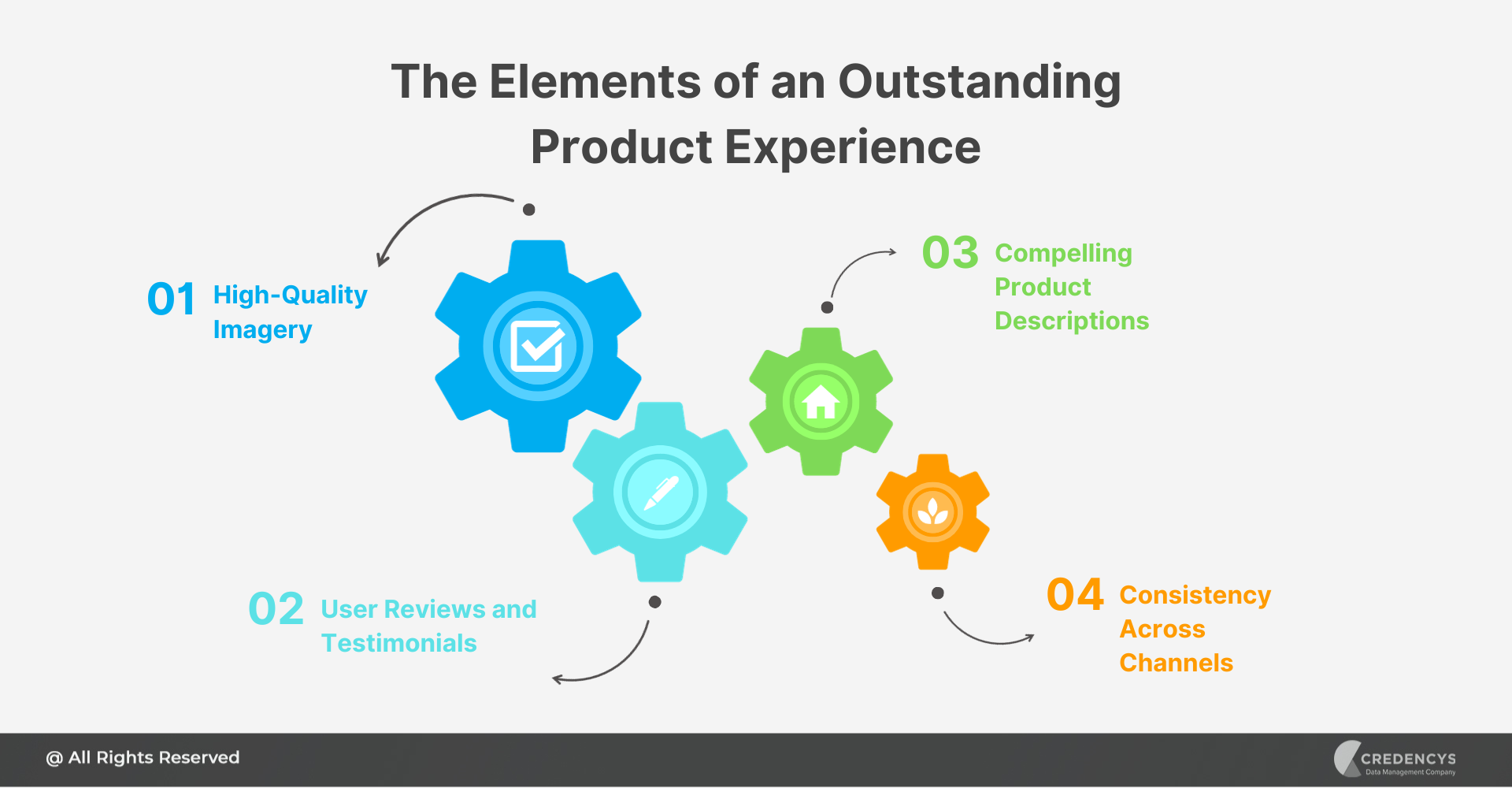
To provide the best product experience, you need to focus on several key elements:

Elements of product experience

High-Quality Imagery:

Visuals play a crucial role in product experiences. High-resolution images, 360-degree views, and zoom-in capabilities allow customers to get a comprehensive look at your products. Investing in professional product photography can significantly impact how customers perceive your offerings.

Compelling Product Descriptions:

Words matter. Your product descriptions should be clear, concise, and persuasive. Highlight the features and benefits of your products while addressing potential pain points that customers may have. Effective product descriptions guide customers in making informed decisions.

User Reviews and Testimonials:

Positive customer reviews and testimonials can build trust and credibility. Encourage customers to share their experiences and provide feedback. Respond to reviews, both positive and negative, to show that you value customer input and are committed to continuous improvement.

Consistency Across Channels:

Regardless of where a customer interacts with your products – your website, social media, or in-store – they should encounter consistent product information. This ensures a seamless, coherent experience and prevents any confusion that could deter potential buyers.

Implementing PIM Strategies for better Product Experience

You may wonder how to start implementing PIM in your business. Here are some steps to get you on the right track:

Step 1: Identify Your Data Sources

Determine where your product data is stored and collect it into a central repository.

Step 2: Clean and Standardize Data

Ensure that the data is accurate, consistent, and follows industry standards. Eliminate duplicate entries and errors.

Step 3: Choose the Right PIM Software

There are various PIM software solutions available. Select one that aligns with your business needs and budget.

Step 4: Data Enrichment

Enhance your product data by adding relevant information, such as keywords, attributes, and images.

Step 5: Integration

Integrate your PIM system with other systems, such as your e-commerce platform, to ensure data is synchronized.

Step 6: Train Your Team

Provide training to your team on how to use the PIM system effectively.

Challenges and Solutions

While PIM offers significant benefits, businesses may face challenges during its implementation:

Common Challenges:

  • Data Silos: Many businesses store product information in multiple locations, making it challenging to centralize and manage.
  • Data Quality: Inaccurate or incomplete product information can lead to misinformation and customer dissatisfaction.
  • Integration Issues: Integrating PIM with existing systems can be complex and time-consuming.

Solutions:

  • Data Governance: Establish clear data governance policies and assign responsibility for data quality and accuracy.
  • Continuous Training: Ensure that your team is well-trained and updated on the latest PIM software features.
  • Consult Experts: Seek help from PIM experts or consultants for seamless integration.

Tools and Resources: How Credencys Can Help

In the digital age, providing the best product experience is essential for building brand loyalty and driving sales. PIM simplifies the process of managing and distributing product information, ensuring that your customers receive a consistent and enticing the experience. As you embark on your PIM journey, remember that challenges may arise, but with the right strategy and tools, you can overcome them and reap the rewards of a stellar experiences.

Credencys can help you choose and implement the right PIM tool that will help you in elevating your product experience and boost customer trust. It’s time to take your product experience to the next level. Contact us to talk to a certified PIM expert.

Fashion PIM for Omnichannel Marketing

In today’s digitally connected world, the fashion industry is constantly evolving to meet the ever-changing demands of consumers. One of the key strategies that has gained prominence in recent years is omnichannel marketing.

Customer Retention Rate

Businesses with omnichannel marketing strategies retain 89% of their customers while companies with weak or no omnichannel strategy are stuck at a 33% retention rate.

HubSpot claims:

At its core, omni-channel is a multi-channel sales approach providing an integrated customer experience. The customer can be shopping online from a desktop or mobile device, by telephone, or in a brick-and-mortar store and the experience would be seamless.

But what exactly is omnichannel marketing in the context of the fashion industry, and why is it crucial for fashion businesses to embrace this approach?

Omnichannel Marketing in the Fashion Industry

Omnichannel marketing is a comprehensive approach employed by fashion businesses to create a seamless and integrated shopping experience for consumers across various touchpoints. It breaks down the barriers between online and offline channels to provide a consistent, cohesive, and personalized shopping journey for customers.

In the context of fashion, omnichannel marketing means that whether a customer interacts with your brand through your website, mobile app, social media, in-store, or any other channel, they receive a consistent and unified experience. The essence of omnichannel marketing lies in the elimination of silos between these different channels.

For example, if a customer browses a product online, adds it to their cart, and later visits a physical store, they should be able to pick up where they left off, finding the same product information and availability.

Customer Journey Across Various Touchpoints

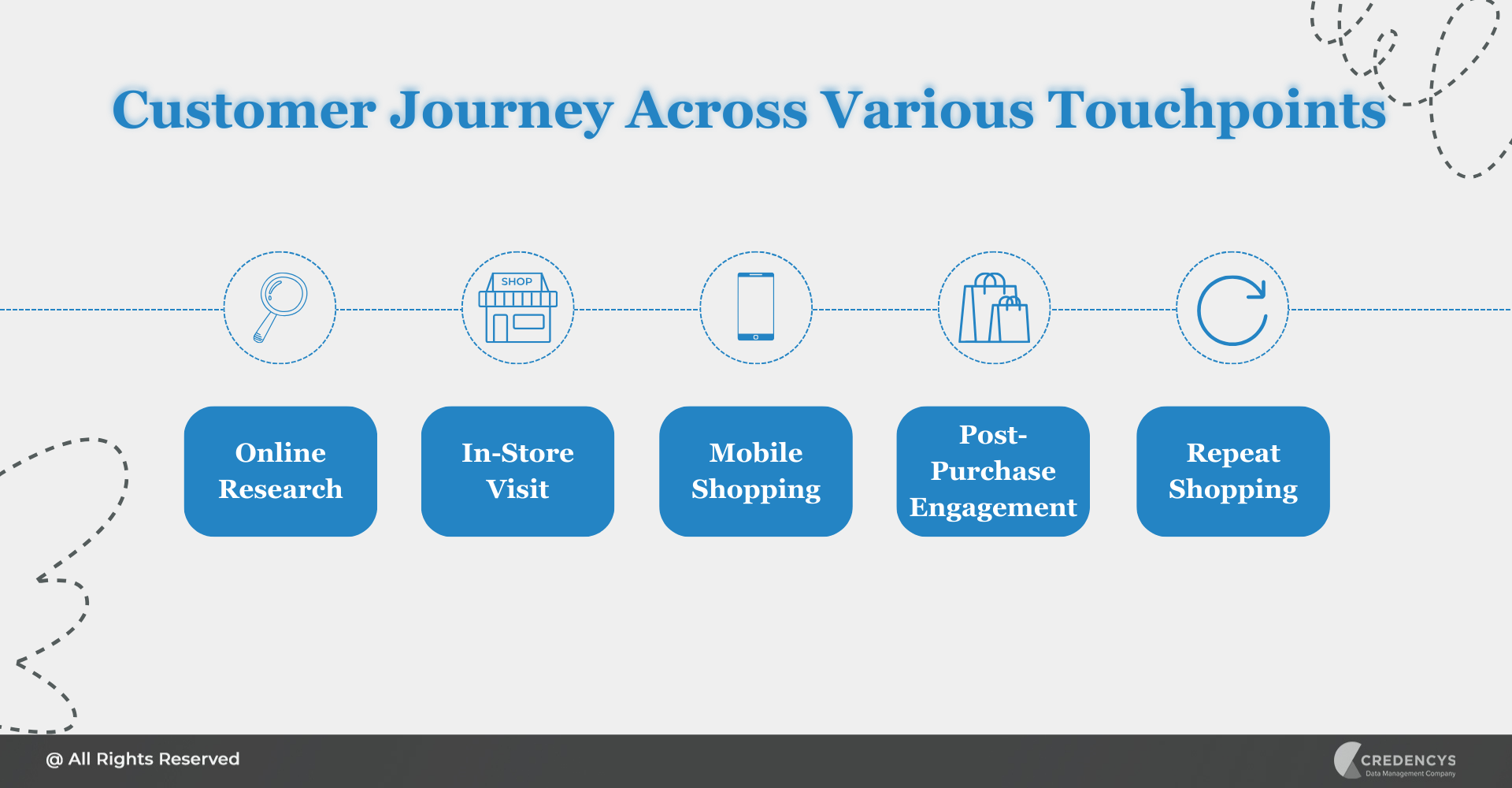
Understanding the customer’s journey across various touchpoints is pivotal in comprehending the significance of omnichannel marketing in the fashion industry. Consider the typical scenario of a shopper searching for a new outfit:

  • Online Research: The journey often starts with online research, where the customer may browse fashion websites, read reviews, and explore social media for inspiration.
  • In-Store Visit: The customer might then visit a physical store to try on clothes, feel the fabric, and seek advice from knowledgeable sales staff.
  • Mobile Shopping: On the go, they might use their mobile device to compare prices, check for promotions, and make a purchase.
  • Post-Purchase Engagement: After buying the outfit, they may engage with the brand through social media, leaving reviews or sharing their new look.
  • Repeat Shopping: If the experience was positive, they are likely to return for future purchases through any of the available channels.

Customer Journey Across Various Touchpoints

Throughout this journey, the customer expects a consistent and cohesive experience. For instance, the product details they saw online should match what they found in the store, and the brand’s messaging should remain uniform across all interactions.

Significance of Adopting an Omnichannel Strategy for Fashion Businesses

The significance of adopting an omnichannel strategy in the fashion industry cannot be overstated. Today’s consumers expect convenience, personalization, and consistency throughout their shopping journey.

They no longer distinguish between online and offline channels; instead, they view your brand as a whole. Failing to meet these expectations can result in lost opportunities, reduced customer loyalty, and missed revenue.

By embracing omnichannel marketing, fashion businesses can:

  • Enhance Customer Satisfaction: Delivering a seamless and consistent experience across all touchpoints can significantly improve customer satisfaction and trust in your brand.
  • Increase Sales: Omnichannel shoppers tend to spend more, making it a lucrative strategy for increasing revenue.
  • Boost Brand Loyalty: Providing a cohesive experience encourages customers to return and remain loyal to your brand.
  • Gain Valuable Insights: An omnichannel approach allows for better data collection and analysis, helping you understand customer behavior and preferences.

Challenges in Maintaining Consistency Across Channels

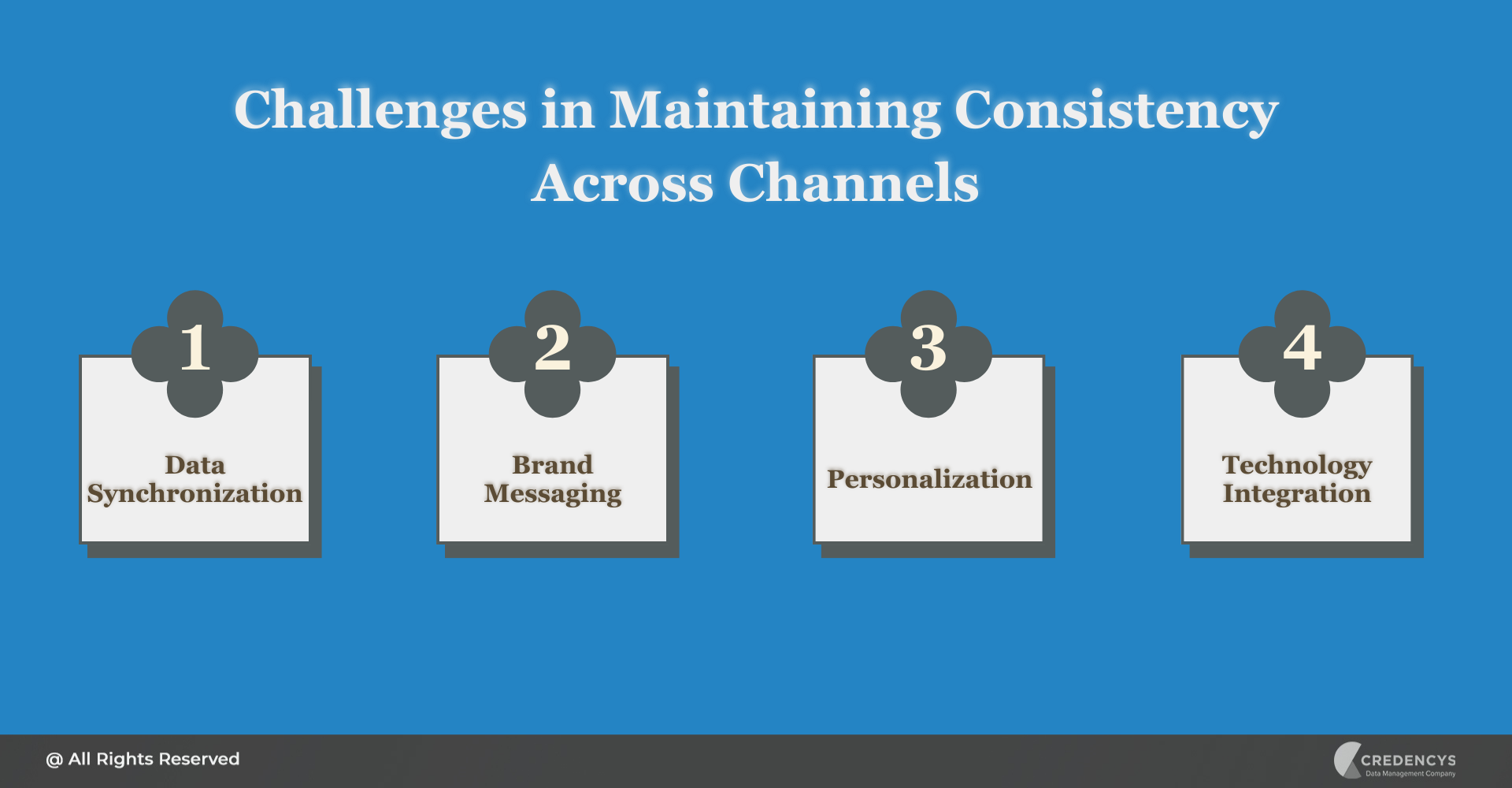
Achieving and maintaining consistency across channels poses several challenges for fashion brands:

  • Data Synchronization: Ensuring that product data, inventory levels, and pricing are consistent across online and offline channels can be complex without the right tools and systems.
  • Brand Messaging: Keeping brand messaging, tone, and visuals uniform across all platforms and channels requires meticulous attention to detail.
  • Personalization: Balancing consistency with personalization is challenging, as each customer expects a tailored experience while still feeling part of a larger brand narrative.
  • Technology Integration: Integrating various technologies and systems (e.g., eCommerce platforms, POS systems, PIM) to enable omnichannel experiences can be technically demanding.

Challenges in Maintaining Consistency Across Channels
How does PIM Help in Centralizing, Organizing, and Distributing Product Data?

PIM is the solution to the intricate challenges of handling vast volumes of diverse product data for fashion brands. It acts as a centralized hub where all product information is stored, ensuring that every detail about each garment, accessory, or footwear item is accurate, up-to-date, and readily accessible to anyone within the organization.

Centralization

PIM serves as a single source of truth for all product data. Instead of having information scattered across various systems, spreadsheets, or databases, PIM consolidates everything in one location.

This centralization ensures that everyone across the organization is working with the same, accurate information.

Organization

PIM allows for the structured organization of product data. Information is categorized and classified, making it easy to find and update.

Attributes like product descriptions, images, pricing, and inventory levels are all meticulously organized within the PIM system.

Enrichment

PIM systems enable the enrichment of product data. This includes adding high-quality images, detailed descriptions, sizing charts, and any other information that enhances the customer’s understanding of the product.

Product data can also be enriched with SEO-friendly keywords to improve discoverability.

Distribution

Perhaps one of the most critical functions of PIM is data distribution. It ensures that the enriched, organized, and accurate product data is effortlessly distributed across all sales and marketing channels, both online and offline.

Whether a customer is browsing the website, using a mobile app, or visiting a physical store, they encounter consistent and compelling product information.

Exploring the Advantages of PIM in Omnichannel

PIM is the linchpin of delivering a seamless omnichannel experience for fashion consumers. Here’s how:

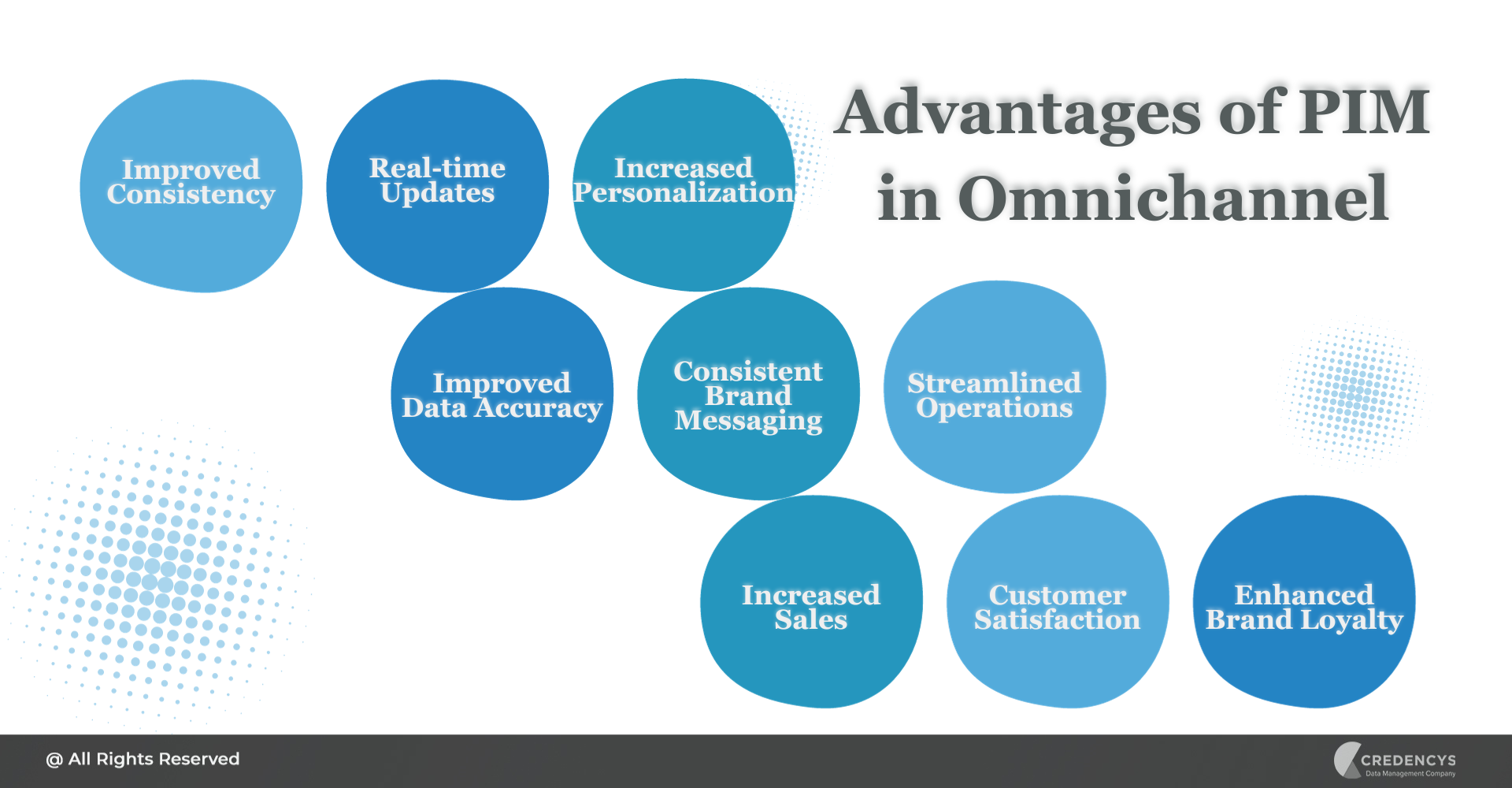
  • Improved Consistency: In an omnichannel approach, maintaining consistent product information is non-negotiable. PIM ensures that product descriptions, images, pricing, and inventory levels are uniform across all channels, eliminating confusion and boosting customer confidence.
  • Real-time Updates: PIM allows for real-time updates, ensuring product information remains accurate and current. This is crucial in a fashion landscape where trends, availability, and pricing can change rapidly.
  • Increased Personalization: PIM supports personalization by providing a robust foundation of accurate data. It enables fashion brands to tailor recommendations and offers based on individual customer preferences and behavior.
  • Improved Data Accuracy: One of the primary benefits of integrating PIM into an omnichannel strategy is the dramatic improvement in data accuracy. PIM systems act as a central repository for all product data, minimizing the risk of data errors and inconsistencies that can occur when managing data across multiple systems or spreadsheets.
  • Consistent Brand Messaging: Maintaining consistent brand messaging and product information is vital for fashion brands across all channels. PIM ensures that your brand’s voice, imagery, and product details are uniform whether customers are shopping online on mobile devices, or in physical stores.
  • Streamlined Operations: PIM streamlines operational processes by automating data management tasks. This reduces manual workloads, minimizes the potential for human error, and frees up resources to focus on more strategic activities.
  • Increased Sales: When customers receive accurate and consistent product information, they are more likely to make a purchase. Fashion brands can capture more sales opportunities by providing a seamless shopping experience across all channels.
  • Customer Satisfaction: Consistency and reliability in product information foster trust and satisfaction among customers. When they know they can rely on your brand for accurate details, they are more likely to return for future purchases.
  • Enhanced Brand Loyalty: Omnichannel strategies powered by PIM contribute to brand loyalty. Customers who have positive and consistent experiences with a brand across channels are more likely to become loyal advocates, promoting your products through word-of-mouth and social media.

Advantages of PIM in Omnichannel
Integrating PIM with eCommerce Platforms

Now that we’ve understood the significance of PIM for fashion businesses, let’s elucidate how fashion businesses can seamlessly integrate PIM systems with their chosen eCommerce platforms.

  • Choose the Right PIM System: The integration journey begins with selecting the appropriate PIM system for your fashion business. Ensure that it aligns with your specific needs, and scalability requirements, and offers compatibility with the eCommerce platform you use.
  • Data Mapping and Configuration: Once you’ve chosen your PIM system, the next step is to configure it to align with your eCommerce platform’s data structure. This involves mapping the fields and attributes in your PIM to those in your eCommerce platform to ensure seamless data flow.
  • Real-time Data Synchronization: Integration typically involves establishing a real-time data synchronization process. This ensures that any changes made in the PIM system, such as updated product descriptions or pricing adjustments, are automatically reflected in your eCommerce platform without delays.
  • Product Listing Management: PIM allows you to efficiently manage your product listings. This includes creating and enriching product listings, assigning categories and attributes, and defining product relationships (e.g., suggesting related products or upselling).
  • Multi-channel Distribution: Beyond your primary eCommerce platform, PIM can facilitate the distribution of product data to various other channels, such as marketplaces (e.g., Amazon, eBay), social media, and physical stores.
  • Automated Updates: With the integration in place, routine updates, such as inventory levels, availability, and pricing, are automated. This prevents discrepancies between your PIM system and your eCommerce platform, reducing the risk of errors that can harm your brand’s reputation.

Integrating PIM with eCommerce platforms is not just a technical detail; it’s a strategic move that empowers fashion businesses to provide a superior shopping experience, maintain data accuracy, and drive efficiency in their operations. The seamless flow of product information across channels is central to delivering a consistent and compelling brand experience in the ever-evolving fashion landscape.

Best Practices for Implementing PIM in Omnichannel Marketing

Implementing a Product Information Management (PIM) system successfully in the realm of omnichannel marketing requires strategic planning, meticulous execution, and attention to critical best practices. Let’s discuss the actionable tips and guidelines for fashion businesses seeking to implement PIM effectively, driving omnichannel success.

Strategic Alignment

Before embarking on a PIM implementation, it’s vital to align the project with your overarching business goals. Define clear objectives for the PIM system, such as improving data accuracy, streamlining operations, or enhancing the customer experience.

These objectives will serve as guiding principles throughout the implementation process.

Cross-functional Collaboration

PIM implementation often involves multiple teams and departments, including marketing, IT, sales, and product management. Foster collaboration and open communication among these teams to ensure everyone is aligned with the project’s goals and requirements.

Data Quality Assessment

Begin by assessing the quality of your existing product data. Identify areas of improvement and establish data quality standards that the PIM system will help you achieve.

Cleaning and standardizing data before migration can save time and prevent complications later.

Select the Right PIM Solution

Choose a PIM system that aligns with your business needs, scalability requirements, and long-term vision. Consider factors such as the ease of integration with your eCommerce platforms, real-time data synchronization, and the flexibility to adapt to changing business needs.

Data Mapping and Configuration

During the implementation process, pay meticulous attention to data mapping and configuration. Ensure that the PIM system aligns with your eCommerce platform’s data structure and accurately reflects your product attributes, categories, and relationships.

Change Management

Recognize that the introduction of a PIM system can be a significant change for your organization. Prioritize change management efforts, including training and communication, to ensure that employees are comfortable with the new system and processes.

User Training

Invest in comprehensive training programs for users across different departments. Training should encompass both technical aspects of using the PIM system and how it aligns with their specific roles and responsibilities.

Ensure that users understand how to effectively use the system for maximum benefit.

Data Governance Policies

Establish robust data governance policies and practices to maintain data accuracy and consistency over time. Regularly review and update these policies to adapt to evolving business needs and changing data regulations.

Continuous Improvement

PIM implementation is not a one-time effort but an ongoing process. Continuously monitor and evaluate the performance of the system.

Solicit feedback from users and make iterative improvements to enhance efficiency and data accuracy.

Testing and Quality Assurance

Implement thorough testing and quality assurance processes to identify and resolve any issues or discrepancies before the system goes live. Rigorously test data flows, integrations, and user interfaces to ensure a smooth transition.

Best Practices for Implementing PIM in Omnichannel Marketing

In conclusion, implementing a PIM system for omnichannel success is a strategic endeavor that can transform how fashion businesses manage product data and deliver consistent, engaging customer experiences. By adhering to best practices and recognizing the importance of training and change management, fashion businesses can ensure a successful transition and maximize the benefits of PIM in their multichannel marketing efforts.

Successful PIM implementation can lead to improved data accuracy, streamlined operations, and enhanced brand loyalty, positioning your fashion brand for long-term success in the digital age.

Credencys’ Expertise in PIM Implementation for Fashion Omnichannel Marketing

Implementing PIM for fashion businesses requires not only a deep understanding of the fashion industry but also a mastery of the technology that powers it. Credencys, a leader in PIM implementation, has consistently demonstrated its expertise in empowering fashion businesses to excel in the complex landscape of omnichannel marketing.

Credencys boasts a team of experts who possess an in-depth understanding of the fashion industry. We recognize that fashion retail is not just about selling products; it’s about creating captivating brand experiences and delivering an emotional connection to the customer.

Therefore, we approach PIM implementation for fashion with a unique blend of creativity, industry knowledge, and technical proficiency. Our expertise in PIM implementation extends to the fashion sector, where unique challenges require tailored solutions.

We understand the intricate nuances of managing product data for fashion brands, including the vast array of product attributes, dynamic pricing strategies, seasonality, and the need for real-time updates. Our PIM implementations are designed to handle these complexities, ensuring data accuracy and consistency.

Credencys’ expertise in PIM implementation for fashion omnichannel marketing is driven by a profound understanding of the fashion industry’s unique needs and challenges. With a proven track record of success, a commitment to training and change management, and a focus on seamless multichannel integration, Credencys is the partner of choice for fashion businesses looking to excel in the dynamic landscape of omnichannel marketing.

Retail PIM: Managing Data from a Single Source of Truth

You are shopping online – looking for the perfect pair of running shoes. You come across a product page with a sleek design, crisp images, and a detailed description of the shoes’ features. The pricing fits your budget, and the reviews are overwhelmingly positive.

You’re almost ready to click that “Add to Cart” button, but then you notice something troubling – the shoe’s specifications don’t match the product images, and there’s a glaring typo in the description.

Chances are, you’d abandon that purchase faster than you can tie your shoelaces. This is a classic example of how poor data management can cost retailers customers and revenue.

Bad retail data management can cost you more than you expect. As per a report by CNBC,

86% of consumers are unlikely to buy products after experiencing inaccurate product information. They return items or post negative reviews instead.

Retail Product Information Management (PIM) can transform the way retailers manage product information and, in turn, enhance customer experiences and streamline operations.

In this article, we’ll delve into how retail PIM is transforming the retail industry. We’ll explore real-world examples from retail giants and uncover the tangible benefits that PIM brings to the table. So, let’s lace up our data management shoes and take a step into the world of PIM in retail.

What is a Product Information Management (PIM) System

Product Information Management, or PIM, is a comprehensive solution designed to centralize, organize, and manage all product-related data within an organization. This data encompasses everything from product descriptions and specifications to pricing, images, videos, and more.

Retail PIM solutions act as a single source of truth for product information, ensuring consistency and accuracy across all channels and touchpoints.

A PIM system serves as the nerve center for product data, allowing businesses to:

  • Centralize product information from various sources, including suppliers, manufacturers, and internal teams – eliminating data silos.
  • Provide a unified repository for all product-related data.
  • Enhance product information with rich content like high-resolution images, detailed descriptions, and technical specifications.
  • Ensure data standards and rules, preventing inconsistencies in product information across websites, catalogs, marketplaces, and more.
  • Simplify the process of updating and distributing this information across all relevant channels in real-time
  • Manage multilingual product data, localization, and compliance with regional regulations.
  • Foster collaboration among teams responsible for product management, marketing, and sales.
  • Expedite the time it takes to launch new products or update existing ones, giving businesses a competitive edge.

Now that we know about Retail PIM, but what does a PIM in retail do? Let’s get a better understanding of how PIM works in the next section.

What does a PIM System Do

A PIM system centralizes, enriches, and manages product information to ensure consistency, accuracy, and efficiency across all channels.

It accomplishes this by integrating data from various sources, facilitating collaboration, enforcing data standards, and streamlining the process of updating and distributing product information in real-time.

Data Integration:

The first step in using a PIM in Retail is to integrate it with various data sources. This may include importing data from suppliers, manufacturers, existing databases, or other systems such as ERP or CRM. Integration ensures that the PIM system has access to all relevant product information.

Data Enrichment:

Once the data is in the PIM system, users can enrich it by adding attributes, images, videos, and other content. This process enhances the quality and completeness of product information.

Data Governance:

PIM systems allow users to define data quality standards, validation rules, and workflows. These rules help maintain data accuracy and consistency.

Collaboration and Workflow:

Users collaborate within the PIM system to manage and approve changes to product data. Workflow automation ensures that the right people review and authorize updates.

Publication and Distribution:

After data is enriched and approved, the PIM system can publish it to various channels and platforms. This can include eCommerce websites, print catalogs, mobile apps, and more. The PIM system ensures that the data is formatted correctly for each channel.

Real-time Updates:

When changes are made to product data within the Retail PIM, they are instantly propagated to all connected channels. This ensures that customers always see the most up-to-date and accurate product information.

How does PIM works

Now, let’s try to understand what are the data management challenges that the Retail Industry is facing and how adopting a PIM system can help resolve them.

Data Management Challenges Retail Industry Is Facing

While effective data management is crucial for retailers, many encounter challenges in this area. Here, we’ll explore some common issues retailers face and how adopting a PIM system can help resolve them.

Data Silos

Challenge: Retailers often store product data in multiple systems, leading to data silos. Different departments may maintain their own spreadsheets or databases, resulting in inconsistent and fragmented information.

Solution: PIM centralizes all product information, breaking down data silos. With a single source of truth, departments can access accurate and consistent data, ensuring that everyone works with the same information.

Inaccurate Data

Challenge: Manual data entry and updates are prone to errors, leading to inaccurate product listings, which can confuse customers and negatively impact sales.

Solution: PIM systems offer data validation and enrichment features. They automatically check and standardize data, reducing errors and ensuring data accuracy. Retailers can also implement approval workflows to maintain quality.

Time-Consuming Manual Processes

Challenge: Without a PIM system, creating and updating product listings across various channels is a labor-intensive process, causing delays in time-to-market.

Solution: PIM streamlines product management by automating many tasks. Retailers can bulk upload product information, update pricing and inventory levels, and even schedule product launches, saving time and reducing manual effort.

Multichannel Consistency

Challenge: Maintaining consistent product information across online and offline channels can be challenging. Discrepancies can confuse customers and erode trust.

Solution: PIM ensures multichannel consistency by serving as the central hub for product data. Any updates made in the PIM system are reflected immediately across all channels, guaranteeing that customers receive the same information, whether they shop online or in-store.

Lack of Data Insights

Challenge: Without a PIM system, retailers may struggle to extract valuable insights from their product data, missing out on opportunities for growth and optimization.

Solution: PIM systems offer robust analytics and reporting capabilities. Retailers can gain insights into product performance, customer behavior, and market trends. Armed with this data, they can make informed decisions to improve their offerings and strategies.

Scalability Issues

Challenge: As a retailer’s product catalog grows, managing data becomes increasingly complex. Traditional data management methods may not scale effectively.

Solution: PIM systems are designed to handle large and growing product catalogs. They are scalable and can accommodate thousands or even millions of products, ensuring that retailers can expand without worrying about data management challenges.

Compliance and Regulation

Challenge: Retailers must adhere to various regulations regarding product information, such as ingredient disclosure for food products or safety standards for toys.

Solution: PIM systems can include compliance features that help retailers track and adhere to relevant regulations. They can also facilitate audits and reporting to ensure that products meet all legal requirements.

While retailers face several challenges in data management, adopting a Product Information Management (PIM) system can help overcome these obstacles. PIM empowers retailers to enhance their operations, deliver better customer experiences, and drive growth in the competitive retail landscape. It’s clear that PIM is not just a tool but a strategic asset for modern retailers aiming for success.

So, what does Retail PIM solutions offer? Let’s explore more about what PIM system has to offers.

Benefit of PIM for Retailers with Real World Examples

Managing product information efficiently is essential to stay competitive and meet the ever-evolving needs of consumers. Product Information Management (PIM) has emerged as a must-have tool for retailers looking to streamline their operations, enhance customer experiences, and managing data from a single source of truth.

Benefits of PIM

Let’s explore how Retail PIM can transform your retail business and provide real-world examples of its impact.

1. Centralized Data Management

One of the primary benefits of PIM is centralized data management. This means that all product information, including descriptions, images, specifications, and pricing, is stored in a single repository. This centralized approach eliminates data silos and ensures consistency across all sales channels.

Nike Leverages PIM to Manage Extensive Product Catalog

The global sportswear giant Nike utilizes PIM to manage its extensive product catalog. With thousands of products and variations, Nike’s PIM system allows them to maintain consistency in product data across their website, mobile app, and physical stores. This ensures that customers receive accurate and up-to-date information, enhancing their shopping experience.

2. Improved Data Accuracy

Inaccurate product information can lead to customer dissatisfaction and increased return rates. PIM systems offer robust data validation and enrichment capabilities, reducing errors and enhancing data accuracy.

Home Depot Improved its Data Quality with Retail PIM

Home Depot, a leading home improvement retailer, implemented a PIM solution to improve data accuracy. By ensuring that product descriptions, dimensions, and pricing are consistently accurate, Home Depot has reduced returns and increased customer trust.

3. Efficient Multichannel Marketing

Retailers today need to reach customers through multiple channels, including websites, marketplaces, social media, and physical stores. PIM systems enable seamless multichannel marketing by providing a single source of truth for product data.

Retail PIM helped Best Buy in Multichannel Marketing

Best Buy, a prominent electronics retailer, leverages PIM to manage product information across its e-commerce platform, mobile app, and brick-and-mortar stores. This consistency ensures that customers receive the same product details and pricing information, regardless of where they shop.

4. Faster Time-to-Market

Introducing new products or updating existing ones can be a time-consuming process without a PIM system. PIM accelerates time-to-market by simplifying the process of creating and publishing product listings.

Zara uses PIM to Swiftly Update Product Information across all Channels

The fashion retailer Zara is known for its ability to quickly respond to fashion trends. Zara’s PIM system allows them to swiftly update product information and launch new collections across their online and offline channels, giving them a competitive edge in the fast-paced fashion industry.

5. Enhanced Customer Experience

In the age of e-commerce, customer experience is paramount. PIM contributes to an improved customer experience by providing consistent, accurate, and detailed product information.

Sephora offers Comprehensive Product Information with Retail PIM

Sephora, a global beauty retailer, uses PIM to provide customers with comprehensive product information, including ingredient lists, usage instructions, and customer reviews. This wealth of information empowers customers to make informed purchasing decisions, fostering trust and loyalty.

6. Data-Driven Decision-Making

PIM systems generate valuable insights through data analytics. Retailers can analyze product performance, customer preferences, and market trends to make data-driven decisions, such as pricing adjustments and inventory management.

Amazon Optimizes Pricing Dynamically with PIM

Amazon, the world’s largest online retailer, utilizes PIM-derived data to optimize pricing dynamically. By analyzing market trends and competitor pricing, Amazon adjusts its prices in real-time to remain competitive while maximizing profitability.

Key Takeaways: Managing Single Source of Truth with Retail PIM

Poor Data Management Can Cost Retailers: Inaccurate product information can drive away customers and harm revenue. According to CNBC, 86% of consumers are unlikely to purchase products with inaccurate information.

PIM Enhances Customer Experience and Efficiency: Retail Product Information Management (PIM) solutions are transforming the retail industry by centralizing and managing product data, thereby improving customer experiences and operational efficiency.

What a PIM System Does: PIM in Retail centralizes product data, enhance content, ensure data consistency, simplify updates, manage multilingual data, foster collaboration, and expedite product launches.

How a PIM System Works: Retail PIM solutions integrate data from various sources, enrich the data, enforce data governance, facilitate collaboration, publish data to different channels, and provide real-time updates.

Challenges in Retail Data Management: Retailers face challenges like data silos, inaccurate data, manual processes, multichannel consistency issues, lack of data insights, scalability concerns, and compliance requirements.

Benefits of Adopting a PIM System: Adopting a PIM system helps retailers centralize data, improve data accuracy, streamline multichannel marketing, speed up time-to-market, enhance customer experiences, make data-driven decisions, and ensure compliance.

Product Information Management (PIM) is no longer a luxury but a necessity for retailers aiming to thrive in the digital age. The benefits of centralized data management, improved data accuracy, efficient multichannel marketing, faster time-to-market, enhanced customer experiences, and data-driven decision-making are clear indicators of PIM’s importance. To remain competitive and meet the ever-evolving demands of consumers, adopting a Retail PIM should be a top priority for retailers in today’s market.

Credencys is trusted by some of the global Retail leaders for implementing Retail PIM solutions tailored for Retail industry. Connect with us for more details.

How is PIM Reshaping Grocery Retail Operations?

In today’s rapidly evolving business landscape, the efficient management of product data has become an indispensable element of success. This is where Product Information Management, or PIM, steps into the spotlight.

Introduction to PIM

PIM is not just another acronym in the world of business technology; it’s a game-changer, especially when it comes to managing the intricate web of data in the grocery industry. Product Information Management, or PIM, is a comprehensive solution designed to centralize and streamline the management of product data.

The product information management market was valued at USD 12.8 billion in 2022 and is expected to record a CAGR of 23.3% during the forecast period to reach USD 45 billion by 2028. From detailed descriptions and images to pricing, SKU numbers, and other essential attributes, PIM systems act as a centralized repository for all product-related information.

What is PIM

Global PIM Market

But why is PIM so crucial in the context of grocery businesses? To answer this question, we must first acknowledge the unique challenges that the grocery industry faces in managing product data.

Overview of the Grocery Industry

The grocery sector is undoubtedly one of the most vital and dynamic components of the retail landscape. Every day, countless consumers rely on their local grocery stores or online platforms to access fresh produce, pantry staples, and a wide array of other essentials.

As a result, the grocery industry plays a pivotal role in meeting the daily needs of communities worldwide. The significance of the grocery industry is not limited to its economic impact.

It’s deeply intertwined with the fabric of our daily lives. Groceries are not merely products on a shelf; they are sustenance, nourishment, and even a source of comfort.

This unique role underscores the importance of managing product data in the grocery sector with the utmost precision.

Challenges in Managing Product Data in the Grocery Industry

In a grocery store, product data management isn’t a straightforward task. It’s a complex juggling act, involving a multitude of products, suppliers, variations, and constantly changing consumer demands.

Here are some of the key challenges the grocery industry faces with data management:

Diverse Product Range

Grocery stores stock an extensive range of products, including perishables like fruits and vegetables, non-perishables such as canned goods, and specialized items like organic or gluten-free products. Managing information for such diverse items can be overwhelming.

Frequent Updates

Product information in the grocery sector needs constant updates due to changing prices, seasonal availability, and recalls. Keeping this data current is crucial for customer satisfaction and compliance.

Supplier Relationships

Grocery stores work with numerous suppliers, each with its own data format and standards. Consolidating this data can be challenging, leading to data discrepancies and inaccuracies.

Consumer Expectations

Today’s consumers demand transparency and accuracy when it comes to product information. Mistakes in labeling or pricing can erode trust and harm a brand’s reputation.

In the face of these challenges, PIM emerges as a lifeline for grocery businesses. It provides a structured, centralized, and efficient way to manage the wealth of product data, ensuring that customers receive accurate information and seamless shopping experiences.

Significance of PIM in Grocery Retail

In the dynamic world of grocery retail, where products continuously flow in and out of stores, the accuracy and timeliness of product information are paramount. Let’s explore why precise and up-to-date product information is not just beneficial but absolutely critical for the success of grocery businesses.

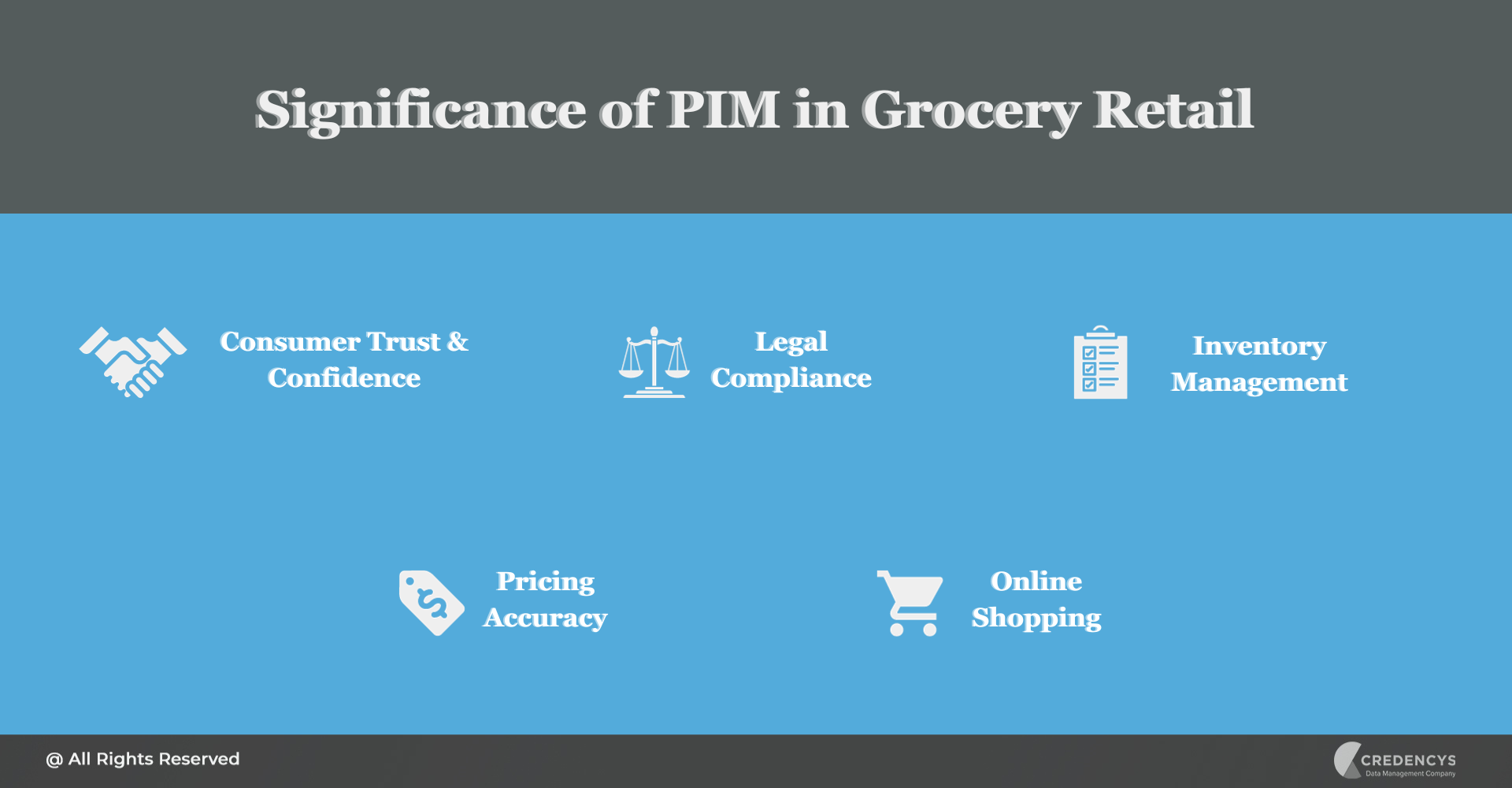
Consumer Trust and Confidence

Accurate product information is the foundation of trust between consumers and grocery retailers. Shoppers rely on product labels and descriptions to make informed choices about the food they purchase.

When consumers can trust that the information provided is accurate, they are more likely to return as loyal customers.

Legal Compliance

The grocery industry is subject to numerous regulations and standards related to product labeling, nutritional information, allergen declarations, and more. Failure to comply with these regulations can result in costly fines and damage to a grocery store’s reputation.

Inventory Management

Precise product information is essential for effective inventory management. Grocery stores need to know which products are in stock, their location within the store, and their expiration dates.

Inaccurate data can lead to overstocking, understocking, and product spoilage.

Pricing Accuracy

Pricing errors can be a major source of customer frustration. Accurate product data ensures that prices are displayed correctly, reducing the likelihood of pricing disputes and customer dissatisfaction.

Online Shopping

With the growth of eCommerce in the grocery sector, accurate product information is critical for online shopping experiences. Customers expect consistency between online product listings and the actual products they receive.

Poor data management can lead to discrepancies and disappointed online shoppers.

Significance of PIM in Grocery Retail

Consequences of Poor Product Data Management

Customer Dissatisfaction

Inaccurate product information can result in customer frustration and disappointment. Whether it’s receiving products that don’t match their descriptions or finding pricing errors at the checkout, dissatisfied customers may not return to the store.

Lost Sales Opportunities

Grocery businesses may lose sales opportunities when customers can’t find the products they want due to inaccurate inventory information. Out-of-stock items can lead to missed sales and customer dissatisfaction.

Operational Inefficiencies

Poor data management can lead to operational inefficiencies. For example, if store employees spend excessive time searching for products due to inaccurate location data, it can impact overall store productivity.

Regulatory Penalties

Non-compliance with regulations can result in penalties, recalls, and damage to a store’s reputation. These consequences can have long-lasting financial and operational impacts.

Brand Reputation Damage

Inaccurate or misleading product information can harm a grocery store’s brand reputation. Negative reviews and word-of-mouth can spread quickly in the digital age, impacting a store’s image.

In summary, the accuracy and timeliness of product data are vital to the success and reputation of grocery businesses. Inaccurate information can lead to a cascade of negative consequences, from customer dissatisfaction to regulatory issues.

It is within this context that PIM emerges as a powerful solution to tackle these challenges head-on, ensuring that grocery businesses thrive in the competitive retail landscape.

Benefits of PIM for Grocery Businesses

In an era where data reigns supreme and customer expectations continue to rise, grocery retailers are increasingly turning to PIM systems to gain a competitive edge. PIM systems offer a plethora of advantages tailored specifically to the unique needs of the grocery industry.

Let’s discuss these benefits in detail and provide real-world examples illustrating how PIM can significantly enhance grocery operations, elevate the customer experience, and boost sales.

Enhanced Data Accuracy and Consistency

PIM ensures that product information is accurate, consistent, and up to date across all sales channels, be it in-store, online, or through mobile apps.

Efficient Product Listing and Onboarding

PIM streamlines the process of adding new products to the inventory or catalog. This efficiency is invaluable, especially when dealing with a high turnover of products in the grocery sector.

Improved Customer Experience

Accurate and comprehensive product data leads to a better shopping experience. Customers can trust that the information they see aligns with the products they receive.

Efficient Inventory Management

PIM helps grocery retailers track inventory levels in real time, reducing the risk of overstocking or understocking products.

Rapid Response to Market Trends

Grocery retailers can quickly adapt to changing consumer preferences and market trends with PIM systems.

Cost Reduction

PIM can significantly reduce manual data entry and correction efforts, resulting in cost savings over time.

Compliance with Regulations

PIM systems help grocery businesses stay compliant with complex regulations, ensuring accurate labeling and information.

Benefits of PIM for Grocery Businesses

These benefits illustrate how PIM can be a game-changer for grocery retailers. Whether it’s ensuring data accuracy, improving the customer experience, or adapting to market changes, PIM systems empower grocery businesses to thrive in a competitive and ever-evolving industry.

PIM Implementation in Grocery Business

Implementing a PIM system in a grocery business is a transformative endeavor that requires careful planning and execution. Let’s walk through the process of implementing PIM systems in grocery businesses, from the initial stages to successful integration.

We will also address potential challenges that may arise during implementation and provide strategies to overcome them.

Assessment and Planning

Process: The implementation journey begins with a comprehensive assessment of the grocery business’s current data management processes and needs. This includes identifying the types of product data, sources of data, and integration requirements.

Challenges: One challenge during this phase is accurately assessing the scale of data that needs to be managed. Additionally, aligning the PIM system with existing IT infrastructure and processes can be complex.

Solution: Engage with experienced PIM consultants who can help conduct a thorough assessment and develop a well-defined implementation plan. Ensure that the chosen PIM solution is flexible enough to integrate with your existing systems.

Vendor Selection and Customization

Process: After identifying the PIM system that best fits the grocery business’s requirements, the next step is vendor selection. Once selected, the PIM system may require customization to align with specific grocery industry needs.

Challenges: Selecting the right vendor can be challenging, and customization may add complexity and time to the implementation process.

Solution: Involve key stakeholders in the vendor selection process, and carefully evaluate the vendor’s experience with grocery businesses. When it comes to customization, work closely with the vendor to ensure that the PIM system aligns with your specific needs without excessive complexity.

Data Migration and Integration

Process: Migrating existing product data to the PIM system and integrating it with other systems, such as the point of sale (POS) and eCommerce platforms, is a critical step.

Challenges: Data migration can be prone to errors, and integration with existing systems may face technical challenges or data format mismatches.

Solution: Plan for extensive testing during data migration and integration phases to identify and resolve any issues promptly. Engage technical experts who specialize in data integration to ensure seamless connections between systems.

Training and Change Management

Process: Preparing the grocery store’s employees for the new PIM system is essential. Training programs and change management strategies should be developed to ensure a smooth transition.

Challenges: Resistance to change from employees and the need for comprehensive training programs are common challenges during this phase.

Solution: Address employee concerns through clear communication about the benefits of the PIM system and how it will streamline their work. Provide extensive training and ongoing support to ensure a successful transition.

Data Governance and Quality Control

Process: Establish data governance policies and quality control mechanisms to maintain data accuracy and consistency within the PIM system.

Challenges: Ensuring that data remains accurate and up to date over time can be a challenge. Without proper governance, data quality can deteriorate.

Solution: Implement strict data governance policies, assign data stewards responsible for data quality, and regularly audit and clean the data within the PIM system to maintain its integrity.

Monitoring and Continuous Improvement

Process: After implementation, continuously monitor the PIM system’s performance and gather feedback from users to identify areas for improvement.

Challenges: Neglecting ongoing monitoring and improvement can lead to inefficiencies and missed opportunities.

Solution: Establish a feedback loop with users to identify pain points and areas for enhancement. Regularly assess the system’s performance against key performance indicators (KPIs) and make necessary adjustments.

PIM Implementation Guide: How to Implement a PIM System?

By following these implementation steps and proactively addressing potential challenges, grocery businesses can successfully integrate PIM systems into their operations, ensuring data accuracy, efficiency, and competitiveness in the dynamic retail landscape. PIM implementation, when executed thoughtfully, can lead to significant long-term benefits for grocery retailers.

Choosing the Right PIM Solution

Choosing the right PIM solution for your grocery business is a critical decision that can significantly impact your data management capabilities, operational efficiency, and customer satisfaction. Let’s walk through the process of selecting the ideal PIM vendor, offering criteria to consider and questions to ask during evaluation.

Define Your Requirements

Before diving into the vendor selection process, it’s essential to have a clear understanding of your grocery business’s specific needs and goals for implementing a PIM system. Here are some questions to help you define your requirements:

  • What types of products does your grocery store sell (e.g., perishables, non-perishables, fresh produce)?
  • Do you operate both physical stores and an e-commerce platform?
  • What are your data integration requirements (e.g., POS system, e-commerce platform, supplier databases)?
  • Are there specific regulatory compliance requirements for your products (e.g., nutritional labeling, allergen information)?
  • What is your budget for PIM implementation and ongoing maintenance?

Assess Vendor Experience and Reputation

Once you have a clear understanding of your requirements, it’s time to evaluate potential PIM vendors. Consider the following criteria:

  • Experience: Look for vendors with experience working with grocery businesses or similar industries. Their familiarity with the unique challenges of grocery data management can be invaluable.
  • Reputation: Research the vendor’s reputation in the market. Read customer reviews and case studies to gauge their track record for delivering successful PIM solutions.
  • References: Request references from the vendor and contact other businesses that have implemented their PIM solutions. Ask about their experiences and outcomes.

Evaluate PIM Features and Capabilities

Assess the features and capabilities of each PIM solution to ensure they align with your grocery business’s requirements. Here are key areas to consider:

  • Data Centralization: Does the PIM system provide a centralized repository for all product data, including images, descriptions, pricing, and nutritional information?
  • Integration: Can the PIM system seamlessly integrate with your existing systems, such as POS, e-commerce, and supplier databases?
  • Scalability: Is the PIM solution scalable to accommodate your business’s growth? Ensure it can handle an expanding product catalog and increasing data volumes.
  • Data Governance: Does the PIM system include robust data governance features to maintain data accuracy and compliance with industry regulations?
  • Usability: Evaluate the user-friendliness of the PIM system. Is it intuitive for your team to use, or does it require extensive training?
  • Customization: Can the PIM solution be customized to meet your specific needs and workflows within the grocery sector?

Consider Support and Maintenance

A successful PIM implementation requires ongoing support and maintenance. Inquire about the vendor’s support services:

  • Technical Support: What level of technical support does the vendor offer? Is it available 24/7?
  • Software Updates: How frequently does the vendor release updates or patches to ensure the PIM system remains secure and up-to-date?
  • Training: Does the vendor provide training programs for your team to become proficient in using the PIM system?

Pricing and ROI

Obtain detailed pricing information from each vendor, including licensing fees, implementation costs, and ongoing maintenance expenses. Consider the long-term return on investment (ROI) of each PIM solution.

Calculate how the benefits of improved data management, efficiency, and customer satisfaction will outweigh the costs.

Request Demos and Trials

Before making a final decision, request demos and, if possible, trial periods for the PIM solutions you are considering. This hands-on experience will help you assess usability and functionality, ensuring the solution aligns with your grocery business’s needs.

Choosing the Right PIM Solution

The Future Landscape of Grocery PIM

As the world of grocery retail is evolving at a rapid pace, driven by changing consumer preferences, technological advancements, and the need for greater efficiency, let’s explore how PIM is poised to adapt and thrive in the coming years, particularly with the integration of AI, machine learning, and big data analytics.

AI-Enhanced Data Management

As grocery retailers continue to manage vast amounts of product data, AI will play an increasingly significant role in enhancing data quality and accuracy. AI algorithms can automatically classify and categorize products, extract valuable information from unstructured data sources, and even predict changes in consumer demand.

AI-powered PIM can enable personalized shopping experiences. By analyzing customer preferences and purchase history, AI can suggest products tailored to individual shoppers, enhancing customer satisfaction and increasing sales.

Machine Learning for Predictive Insights

Machine learning algorithms can analyze historical sales data, seasonality, and external factors like weather, holidays, etc. to provide accurate demand forecasts. Grocery stores can optimize inventory levels, reducing waste and ensuring product availability.

Machine learning can help grocery retailers optimize their relationships with suppliers. By analyzing supplier performance, lead times, and costs, retailers can make informed decisions on supplier selection and inventory management.

Enhanced Product Content

In the future, grocery PIM systems may incorporate visual search capabilities. Shoppers could use their smartphones to take pictures of products, and the PIM system, powered by image recognition technology, would provide detailed information about the item.

AR applications in grocery shopping may become more prevalent. Grocery PIM can provide the necessary data to AR apps, allowing customers to point their devices at products and receive real-time information, including pricing, nutritional facts, and product reviews.

Big Data Analytics for Market Insights

Grocery PIM systems will leverage big data analytics to monitor market trends. By analyzing data from various sources, including social media, consumer reviews, and industry reports, retailers can adapt quickly to changing consumer preferences.

Big data analytics can provide valuable competitive intelligence. Grocery retailers can monitor the pricing, promotions, and product assortments of their competitors, enabling them to adjust their strategies for a competitive edge.

IoT Integration

IoT sensors on store shelves can transmit data about product availability, expiration dates, and consumer interactions. Grocery PIM systems can use this real-time data to optimize store layouts and product placements.

IoT devices in the supply chain can provide real-time tracking of products from farm to shelf. This data can be integrated into PIM systems, ensuring transparency and traceability for consumers and regulators.

Credencys’ Expertise in Implementing PIM Solutions for Grocery Businesses

At Credencys, we understand the unique challenges and opportunities that grocery businesses face in the ever-evolving retail landscape. With years of experience and a deep understanding of Product Information Management (PIM) solutions, we are proud to be at the forefront of helping grocery retailers transform their operations through efficient data management.

Here’s why you can trust Credencys as your partner in implementing PIM solutions tailored to the grocery industry:

Industry-Specific Knowledge

We recognize that the grocery sector has its own set of intricacies, from managing diverse product categories to handling perishable items and adhering to strict regulatory requirements. Our team of experts is well-versed in the nuances of grocery retail, allowing us to tailor PIM solutions that align seamlessly with your unique needs.

Proven Track Record

Credencys has a proven track record of successfully implementing PIM solutions for grocery businesses of all sizes. Our portfolio includes case studies and success stories that demonstrate how our expertise has driven efficiency, accuracy, and profitability for our clients in the grocery industry.

Customization and Integration

We understand that one size does not fit all. Credencys specializes in customizing PIM solutions to match the specific workflows and requirements of your grocery business.

Whether it’s integrating with your existing systems or developing features unique to your operation, we ensure that your PIM solution is a perfect fit.

Support and Ongoing Maintenance

Our commitment to your success extends beyond implementation. Credencys offers comprehensive support and ongoing maintenance services to ensure that your PIM system remains efficient, up-to-date, and aligned with your evolving business needs.

Innovation and Future-Readiness

We stay at the forefront of technology trends, including AI, machine learning, and big data analytics, and their applications in PIM. This ensures that your grocery business is not only equipped with a cutting-edge PIM solution today but is also prepared for the challenges and opportunities of tomorrow.

Closing Thoughts

As we conclude our exploration of the transformative power of PIM in the grocery industry, it’s clear that the future of grocery retail lies in efficient data management, personalized customer experiences, and staying ahead of market trends. The advantages of implementing PIM systems in grocery operations are substantial and can shape the success of your business in an increasingly competitive landscape.

The future belongs to those who embrace innovation and adapt to changing landscapes. PIM is not just a tool; it’s a strategic asset that can propel your grocery business to new heights.

Take the first step towards a more efficient, customer-centric, and competitive future by considering PIM solutions today. Your success is our priority, and we are here to help you every step of the way.

Data Governance Framework – A Comprehensive Guide

As enterprise data continues to experience exponential growth and with the significant rise in GDPR enforcement fines, it’s evident that prioritizing investments in data governance has become a pressing strategic imperative for businesses reliant on data. In 2023, the data governance market is valued at approximately $2.73 billion, with projections indicating it will reach a value of $6.71 billion by 2028.

Stats_Data_Governance

If your organization has not yet implemented a data governance framework, the time to act is now. This blog post comprehensively outlines the necessary steps to establish a forward-looking data governance framework capable of enhancing revenue generation.

What is a Data Governance Framework?

A data governance framework encompasses a set of regulations, processes, and responsibilities designed to guarantee privacy and adherence to regulations within an organization’s management of enterprise data. Even as the volume of data continues to grow, a data governance framework facilitates the following:

  • Efficiently expand and standardize core data governance practices.
  • Sustain compliance with policies and regulations.
  • Enable wider access to data.
  • Foster collaboration among stakeholders.

This framework offers a clear roadmap for ensuring the quality, integrity, security, discoverability, accessibility, and usability of an organization’s data assets. By implementing the appropriate framework, businesses can transform their data into a valuable, influential asset capable of meeting and potentially surpassing their business objectives and goals.

Components of Data Governance Framework

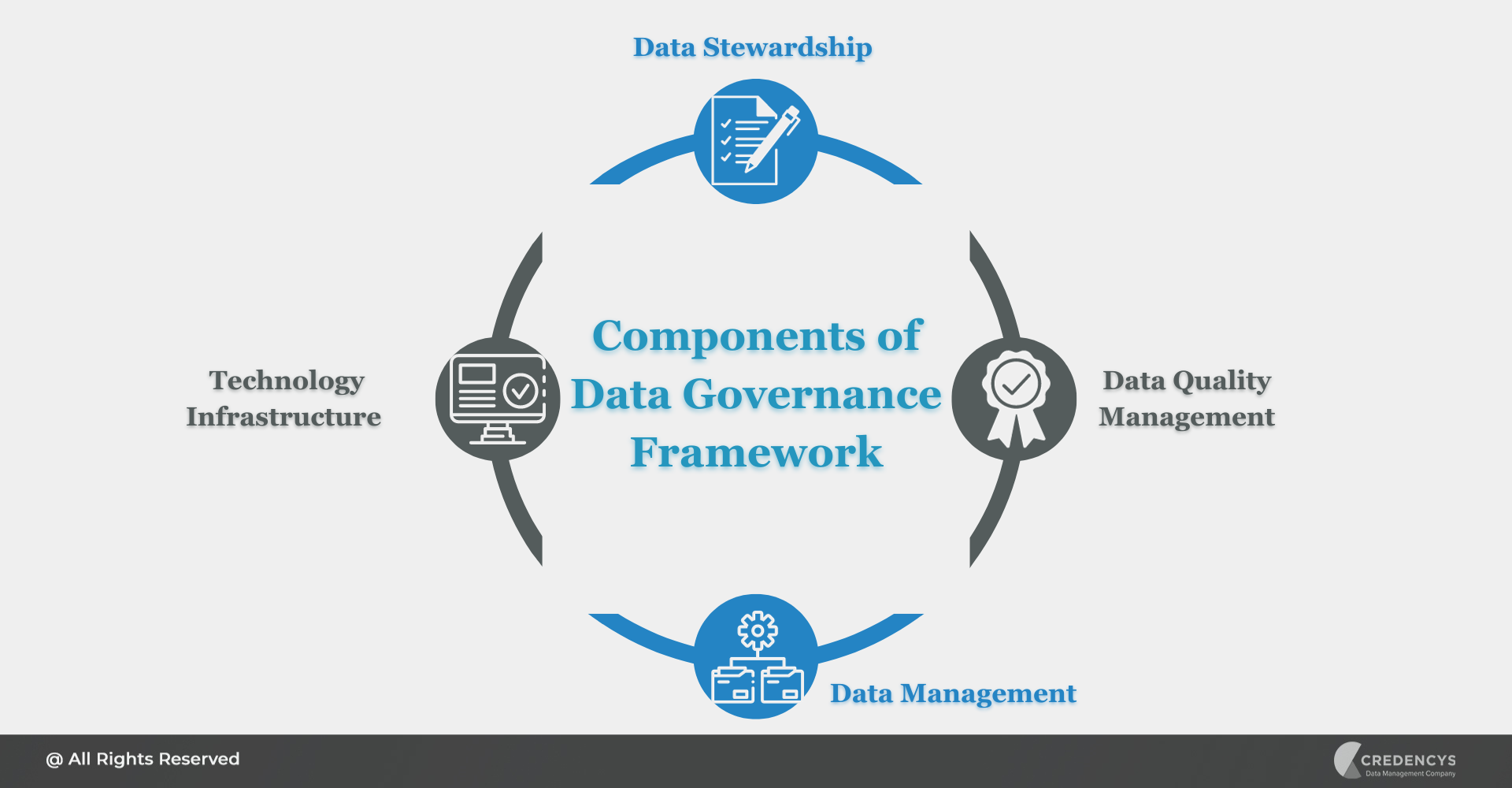
A data governance framework consists of four key elements:

Data Stewardship

Data stewards play a crucial role in ensuring that an organization’s data assets remain accurate, consistent, and compliant with relevant regulations, particularly during company projects.

Data Quality Management

Data quality management encompasses the processes and procedures employed to maintain the integrity of an organization’s data assets, ensuring they are free from errors and inaccuracies. It also involves techniques for identifying and rectifying any errors or inaccuracies that may arise.

Data Management

Data management processes establish how an organization’s data assets are generated, stored, accessed, and utilized. These processes also set the guidelines for sharing these assets with both internal and external stakeholders.

Technology Infrastructure

This component pertains to the hardware and software systems used for data collection, storage, and management. It includes databases, enterprise resource planning systems, data warehouses, and network connections that facilitate the exchange of information among stakeholders.

Components of Data Governance Framework

Importance of Data Governance Framework

Without the establishment of a data governance framework, businesses cannot ensure data quality or compliance with privacy regulations. This leaves them vulnerable to mishandling customer data, potentially leading to severe legal consequences such as substantial fines and harm to their reputation.

In the absence of a data governance framework, different departments within an organization tend to adhere to their own standards and procedures, which ultimately give rise to data silos. These silos, over time, lead to operational inefficiencies.

Rather than having access to a centralized, reliable source of information, employees are restricted to the data confined within their respective tools and systems. This situation results in gaps in understanding and, at times, discrepancies in reporting across databases.

Consequently, it erodes trust in the data as a whole.

Data Governance Framework Models

Before we dive into specific examples of data governance frameworks, we should first touch on the five main data governance models. The models are based on how data governance decisions will flow through your organization.

  • Top-down: Company leadership implements data governance policies that are then passed down to individual business units and shared with the rest of the company.
  • Bottom-up: Employees at the lower levels implement data governance practices, such as standardizing naming conventions, which spread to the higher levels of the organization.
  • Center-out: The team or individual responsible for data governance sets data standards that the entire organization follows.
  • Silo-in: Various departments come together to align on data governance while keeping in mind the needs of each group.
  • Hybrid: Data governance decisions involve different levels of the organization. For example, a company uses a center-out model to suggest a course of action but employs a top-down model to make the final decision.

Benchmark of a Good Data Governance Framework

An effective enterprise data governance framework should:

  • Enhance decision-making capabilities.
  • Minimize operational obstacles.
  • Safeguard the interests of data stakeholders.
  • Educate management and employees in adopting uniform strategies for addressing data-related challenges.
  • Establish consistent and replicable procedures.
  • Drive cost reduction and enhanced efficiency by orchestrating collaborative efforts.
  • Assure transparency in processes

Advantages of Data Governance Framework

A data governance framework facilitates cross-organizational collaboration in overseeing all data assets, aligning them with your company’s overarching corporate goals. The benefits of such a framework include:

  • Enhanced clarity in coordinating data governance initiatives
  • A structured strategy for overseeing and gaining insight into your complete data portfolio
  • Inherent transparency in data management practices
  • Efficient monitoring of data usage, guided by the established blueprint
  • A robust foundation for compliance with regulatory requirements

How to Create a Data Governance Framework?

Here are five steps to guide you in establishing an enterprise data governance framework:

Reevaluate Your Data Governance Definition

As data volumes expand and new data sources and access points emerge, it’s crucial to periodically review your data governance structure, essentially governing the process itself. Ask questions like:

  • What is the core purpose of our data governance?
  • Does it encompass all data assets across the entire organization?
  • Does our governance framework encourage widespread data sharing and collaboration within the organization?

Identify and Define Data Domains

Given that your data management framework should encompass all data assets, the next step involves identifying and standardizing data domains throughout the organization. These domains can correspond to various functions generating data, such as finance, marketing, and sales. Consider questions like:

  • Which data domains are prominent within our organization?
  • What types of data do these domains generate?
  • Where is this data currently located?
  • Who are the primary consumers of this data?

Identify Domain Data Owners and Consumers

Modern data governance emphasizes shared responsibility for data. Thus, assign data owners to each domain and understand data consumption patterns to ensure appropriate access to data by the relevant parties.

Begin by asking questions such as:

  • Who is responsible for generating data within each domain?
  • How do data consumers within these domains utilize the data in their daily workflows?
  • What are the current access dependencies for domain-specific data?

Validate and Document Data Details

At this stage, you should have a clear understanding of data flow within your organization. Standardize definitions for data domains, establish data flow rules and workflows, outline access policies, and thoroughly document these aspects.

Your documentation should address questions like:

  • Where does data originate?
  • What is its significance?
  • How does it traverse through the organization?
  • Does it contribute to the goals of each domain?
  • Does it align with the broader business objectives of the organization?

Consider setting up a modern data workspace that utilizes active metadata to maintain relevant, up-to-date, and useful documentation.

Conduct Data Security and Risk Assessments for Each Domain

The final step involves implementing processes for conducting regular data security and risk assessments for each domain. Recognize that enabling data governance is an ongoing journey rather than a one-time project. Start by inquiring about:

  • Existing data access policies and security measures for each domain.
  • Permissions for data access and their justifications.
  • Whether these policies effectively mitigate risks without hindering data discovery, access, and collaboration.

How to Create a Data Governance Framework
By following these steps, you can embark on the development of a decentralized, community-driven data governance framework that caters to the needs of everyone within your organization.

Pillars of Data Governance Frameworks

Data governance frameworks rest upon four fundamental pillars that are instrumental in ensuring the efficient management and utilization of data throughout an organization. These pillars serve to guarantee data accuracy, facilitate seamless integration from diverse sources, enforce data protection and regulatory compliance, and oversee data storage and management tailored to the organization’s requirements.

Data Quality

Data quality serves as the bedrock of any data governance framework. It guarantees the precision, consistency, and dependability of data used in decision-making processes. Additionally, data quality management encompasses the establishment of guidelines and procedures for data validation, cleansing, and profiling.

Data Integration

Data integration entails the harmonization of data originating from various sources to create a unified perspective. This pillar ensures the effective merging of data from different departments, business units, or external partners, facilitating its utilization in analysis and decision-making.

Data Privacy and Security

Data privacy and security hold paramount significance in the contemporary digital landscape. This pillar involves the implementation of policies and procedures to safeguard sensitive data and adhere to data protection laws and regulations. It encompasses measures such as data encryption, access control, and data anonymization techniques.

Data Architecture

The fourth pillar, data architecture, pertains to the design and structure of data systems. It encompasses the planning and design of data systems to align with the organization’s specific needs. This includes the design of databases, data warehouses, and data lakes, ensuring they meet the organization’s requirements effectively.

Data Governance Framework – Best Practices

Every organization aspires to harness the advantages of becoming more data-driven. However, achieving this goal entails more than mere data collection; it necessitates the establishment of a well-structured data governance framework to ensure effective data management while remaining in alignment with applicable laws and regulations.

There is no one-size fits all solution when it comes to data governance frameworks, as the most suitable approach for an organization depends on its unique requirements and objectives. By adhering to data governance best practices, organizations can construct a data governance framework tailored to their precise needs and industry specifications, thereby aiding them in attaining their desired business outcomes.

Define the Framework’s Purpose

The inaugural step in crafting a data governance framework involves defining its purpose. A comprehensive understanding of enterprise-wide data management goals is a critical initial phase in the framework’s development.

Understand the Current Organizational State

It is imperative to grasp the current state of an organization’s data management processes and technological infrastructure before formulating the framework. Employing a data maturity model as a benchmark and improvement guide helps identify any existing gaps that the framework needs to address.

Engage Stakeholders Early and Continuously

When creating a governance framework, a vital consideration is engaging stakeholders from the outset and maintaining ongoing involvement throughout the process. This ensures that everyone comprehends the framework’s objectives and commits to its successful implementation.

Additionally, it guarantees that all prevailing data usage and management best practices are considered and optimized for integration into the new framework, irrespective of the department utilizing the data.

Maintain Simplicity

While the temptation to incorporate numerous rules and procedures into a governance framework may arise, it is crucial to maintain simplicity. A straightforward approach fosters enterprise-wide adoption and compliance.

Plan for Adaptability

Regardless of how meticulously a governance framework is crafted, unforeseen circumstances may arise. Consequently, it is essential to design a flexible framework capable of adapting to evolving organizational needs over time.
Data Governance Framework – Best Practices

Credencys – Your Trusted Data Governance Partner

Credencys, a leader in the field of data governance and management, stands as a trusted partner for organizations seeking to navigate the complex landscape of data-driven transformation. With a deep understanding of the intricacies involved in crafting effective data governance frameworks, Credencys brings a wealth of expertise to the table.

Our track record of successful implementations and commitment to staying at the forefront of industry best practices ensures that clients receive tailored solutions that not only meet but exceed their unique data governance needs. Credencys’ dedication to simplicity, adaptability, and stakeholder engagement aligns perfectly with the core principles outlined in this blog post, making us a valuable resource for organizations looking to unlock the full potential of their data assets and drive strategic success in the digital era.

Closing Thoughts

The journey toward becoming a more data-driven organization is a path paved with immense potential for growth and success. However, this transformation demands more than just collecting data; it requires a well-structured data governance framework that aligns with your specific objectives and industry requirements.

As we have explored in this blog post, there is no one-size-fits-all solution for data governance frameworks. The process begins with a clear definition of your framework’s purpose, understanding your organization’s current data landscape, and continuous engagement with stakeholders.

Simplicity in design and planning for flexibility are essential elements to ensure the framework’s effectiveness. Remember, data governance is not a one-time project; it’s a journey of continuous improvement and adaptation to meet evolving needs.

By following these best practices and tailoring your data governance framework to your organization’s unique needs, you can unlock the true potential of your data assets, foster a culture of data-driven decision-making, and ultimately achieve your desired business outcomes. So, as you embark on your data governance journey, keep these principles in mind, and watch as your organization transforms into a data-driven powerhouse poised for success in the digital age.

Everything You Need to Know About Classification Standards – ETIM & ECLASS

In today’s data-driven world, where information flows seamlessly across industries and borders, the need for standardized data management has never been more critical. Imagine a world where every product, service, or component is classified, labeled, and communicated in a universal language, ensuring precision, interoperability, and efficiency.

This is precisely where two key players in the realm of data standardization step into the spotlight: ETIM and ECLASS. ETIM, the European Technical Information Model, and ECLASS, the Global Classification and Labeling Standard, represent two formidable pillars of data management, setting the stage for enhanced collaboration, innovation, and data integrity across a myriad of industries.

From improved data quality to streamlined communication, these standards hold the promise of transforming the way we manage, share, and leverage data. Whether you are in manufacturing, construction, healthcare, or any other sector, understanding the significance of ETIM and ECLASS is akin to unlocking the doors to a world where data becomes a seamless conduit for progress.

Understanding ETIM (European Technical Information Model)

ETIM is essentially a structured taxonomy or classification system that categorizes a vast array of products, parts, and components into a well-organized hierarchy. This hierarchy encompasses categories, groups, and classes, each serving a distinct purpose in the classification process.

Born out of this necessity, ETIM was officially established in the early 2000s. At its core, ETIM serves as a standardized language for describing technical products across various industries, encompassing everything from electrical and HVAC equipment to plumbing supplies.

It accomplishes this by providing a structured taxonomy that categorizes products based on their technical attributes, features, and functions. This meticulous classification ensures that data is not only consistent but also interoperable, allowing for seamless communication and integration across different systems, companies, and regions.

Primary Industries Where ETIM Finds Prevalent Use

While the applications of ETIM have expanded over the years, it originally found its niche in the following industries:

Electrical

ETIM was initially developed to address the complex product data needs of the electrical engineering sector. It plays a pivotal role in standardizing the description of electrical components, ensuring that specifications, technical characteristics, and documentation are clear and consistent.

Plumbing

The plumbing industry, with its diverse range of products and components, benefited greatly from ETIM’s classification system. It enables plumbing professionals to access accurate information about pipes, fittings, valves, and more, streamlining their processes and minimizing errors.

HVAC (Heating, Ventilation, and Air Conditioning)

In the HVAC sector, where precise specifications and compatibility are paramount, ETIM ensures that data related to heating, ventilation, and air conditioning components is uniform and reliable.

Other Industries

Over time, ETIM’s utility has expanded to include other industries, such as building automation, technical trade, and even eCommerce, where standardized product data is essential for efficient operations and customer satisfaction.

Primary Industries

ETIM Classification Structure

ETIM’s classification structure is the backbone of its standardized data management system. It is designed to bring order to the vast and diverse world of products, components, and technical information.

This structure consists of multiple categories each serving a specific purpose in organizing products and data.

  • Product Groups: The primary function of these groups is to establish a structured arrangement for product classes and their respective attributes.
  • Product Classes: Within this category, you’ll find products that share similarities and detailed technical specifications for those products within the same class.
  • Synonyms (Keywords): This category refers to alternative names for product classes, allowing for cross-references between multiple product classes. It’s worth noting that product classes may have multiple synonyms that are not necessarily related to one another.
  • Features: This category is characterized by a comprehensive description, feature type, unit of measurement, and value. Various feature types exist, including alphanumeric (e.g., color, material), logic (e.g., “Yes/No” questions), numeric (e.g., length, voltage), and ranges of values.
  • Values: This category enforces the prohibition of free-text entries to maintain data consistency. Instead, ETIM provides an extensive built-in list of over 7.5k predefined values for selection.
  • Units: Numerical and range-based features always require specific units of measurement to define the expected value. There is a single exception, which pertains to features such as “number of,” which do not necessitate a unit of measurement.

Significance of ETIM’s Multilingual Support

Multilingual support is a crucial feature of ETIM, particularly in the diverse European market, where various languages are spoken across different regions. This feature ensures that product information can be presented accurately and effectively in multiple languages, catering to a wide range of users.

  • Market Expansion: Many businesses operate across borders within Europe. Multilingual support allows them to enter new markets and engage with customers and partners who speak different languages.
  • Compliance: In regions where multiple languages are official, complying with local regulations often requires providing information in the local languages. ETIM’s multilingual capabilities help businesses meet these compliance requirements.
  • User-Friendly Interfaces: Multilingual support enhances user experiences by making product information accessible and understandable to a broader audience. This is particularly important for eCommerce platforms and online catalogs.

Significance of ETIM’s Multilingual Support
Understanding ECLASS (Global Classification and Labeling Standard)

ECLASS is another formidable player in the field of data management. It emerged from a similar desire for standardized data representation but on a global scale.

Originally founded in Germany in the late 1990s, ECLASS has evolved into a worldwide standard with broad industry adoption. ECLASS provides a universal framework for classifying products and services across industries, transcending geographical boundaries and industry silos.

It’s not limited to technical attributes but encompasses a broader spectrum, including product characteristics, environmental information, and safety data. This holistic approach ensures that data associated with products and services is not only standardized but also enriched with essential details, making it a valuable resource for decision-making, regulatory compliance, and supply chain management.

Classification Structure of ECLASS

ECLASS’s classification structure is a key component of its data management prowess. It shares some similarities with ETIM while bringing its unique features and organization into play.

At the core of ECLASS lies a hierarchical structure, much like ETIM’s. This hierarchy comprises categories, classes, and characteristics:

  • Categories: These represent the broadest product groupings, providing an overarching context for the products they encompass.
  • Classes: Within categories, classes narrow down the classification, offering detailed descriptions and specifications for products and components.
  • Characteristics: These attributes provide granular information about individual products or components, such as dimensions, materials, and technical properties.

Multilingual Capabilities

ECLASS’s prowess extends to multilingual capabilities, a vital aspect of international data exchange and global business operations. Let’s explore how ECLASS handles multiple languages to facilitate seamless communication and enhance clarity in a global context.

Handling Multiple Languages

ECLASS understands that in the global marketplace, language diversity is the norm. To accommodate this reality, it offers multilingual support, allowing product information and technical data to be presented in a multitude of languages.

This feature ensures that businesses can engage with partners, clients, and stakeholders from various linguistic backgrounds.

Importance of Clear Communication

Clear communication is the cornerstone of effective global business operations. ECLASS’s multilingual capabilities promote transparency, enabling all parties to access and comprehend product data without language barriers.

This, in turn, fosters trust, streamlines collaboration, and opens doors to international opportunities.

ECLASS and International Standards

ECLASS’s alignment with international standards is a testament to its commitment to facilitating global trade and ensuring data consistency. Let’s discuss how ECLASS seamlessly integrates with standards like ISO and IEC, making it a preferred choice for businesses operating on an international scale.

Alignment with International Standards

ECLASS doesn’t exist in isolation; it harmoniously aligns with widely recognized international standards, including ISO (International Organization for Standardization) and IEC (International Electrotechnical Commission). This alignment ensures that product data adheres to universally accepted norms and regulations, promoting interoperability and compliance.

Aiding Global Trade and Data Consistency

The alignment with ISO and IEC standards is a boon for businesses engaged in global trade. It simplifies cross-border transactions by providing a common framework for product data.

This alignment fosters data consistency, ensuring that technical information is accurate, reliable, and compliant with international regulations.

ECLASS transcends geographical boundaries, offering a comprehensive solution for data management and communication in technical and engineering industries. Its classification structure, multilingual capabilities, and alignment with international standards make it a powerhouse for businesses seeking to optimize data and thrive in the global marketplace.

Key Role of ETIM and ECLASS in Data Management

ETIM and ECLASS play pivotal roles in modern data management. They act as common languages that bridge the gap between diverse data sources and systems.

Here’s how they contribute:

  • Consistency: These standards ensure that data is consistently structured and classified, reducing ambiguity and errors in product descriptions.
  • Interoperability: By providing a standardized framework, they enable different systems and organizations to exchange data seamlessly, fostering collaboration and integration.
  • Efficiency: Standardized data accelerates processes such as procurement, inventory management, and eCommerce, resulting in cost savings and increased operational efficiency.
  • Compliance: ETIM and ECLASS help companies meet regulatory requirements by providing standardized product information, safety data, and environmental attributes.

Key Role of ETIM and eCl@ss in Data Management

ETIM and ECLASS are the cornerstones of effective data management, offering a structured approach to organize, share, and leverage data across industries and borders. Their significance extends far beyond technical jargon, making them essential tools for businesses and organizations striving for data excellence.

Significance of ETIM and ECLASS in Data Management

ETIM and ECLASS stand as formidable allies in the quest for effective data management. Let’s delve into why these standards are indispensable and how they shape the landscape of data management.

Standardization and Consistency

One of the foremost challenges in data management is ensuring consistency across diverse data sources and systems. ETIM and ECLASS provide a structured and standardized language for describing products, services, and technical attributes.

This uniformity ensures that data is consistently classified and labeled, eliminating ambiguity and confusion. Consider a scenario where multiple suppliers provide data to a procurement department.

Without standardized classification, the same product may have different descriptions, making it challenging to compare, evaluate, and make informed decisions. ETIM and ECLASS bridge this gap by offering a common vocabulary, reducing errors, and streamlining processes.

Enhanced Data Quality

Data quality is paramount in data management. Poor-quality data can lead to costly errors, misinformed decisions, and operational inefficiencies.

ETIM and ECLASS elevate data quality by enforcing rigorous standards. They provide a structured framework for data input, ensuring that product and technical information is accurate, complete, and up to date.

Moreover, these standards facilitate data enrichment. Beyond basic product attributes, they incorporate details such as safety information, environmental specifications, and compliance data.

This enrichment enhances the value of data, making it a valuable resource for regulatory compliance, product development, and supply chain management.

Industry-Specific Data Requirements

Different industries have unique data requirements. For example, the technical attributes essential in the automotive sector may differ significantly from those in the healthcare or construction industries.

ETIM and ECLASS recognize these nuances and offer industry-specific classifications. This industry specificity is a game-changer.

It enables companies to tailor data management practices to their sector’s precise needs, resulting in more relevant and actionable information. Whether you’re a manufacturer, distributor, or service provider, these standards allow you to align your data with industry standards and regulations seamlessly.

Improved Interoperability and Efficiency

In our interconnected world, businesses rely on various systems and partners to operate efficiently. ETIM and ECLASS foster interoperability by providing a common language for data exchange.

This means that your data can seamlessly integrate with partners, suppliers, and customers’ systems. The result is enhanced efficiency.

Procurement processes become faster and more accurate, inventory management gains precision, and eCommerce platforms operate smoothly. These standards break down the barriers that once hindered data flow, enabling businesses to operate with agility and competitiveness.

ETIM and ECLASS are not just acronyms in the data management lexicon. They are the pillars that support consistent data, quality information, industry relevance, and efficient operations.

By embracing these standards, organizations can unlock the full potential of their data, setting the stage for innovation and success in an increasingly data-centric world.

Benefits of ETIM and ECLASS

Embracing ETIM and ECLASS goes beyond compliance; it’s an investment in efficiency, accuracy, and competitive advantage. Here’s how a solid grasp of these standards can yield significant benefits for organizations.

Improved Data Quality and Consistency

Implementing ETIM and ECLASS ensures that product and technical data is standardized, consistent, and accurate. This leads to improved data quality, reducing errors, and enhancing decision-making processes.

Streamlined Processes and Increased Efficiency

With standardized data, organizations experience streamlined processes in areas like procurement, inventory management, and eCommerce. This leads to increased operational efficiency and cost savings.

Enhanced Interoperability and Collaboration

ETIM and ECLASS facilitate seamless data exchange and integration with partners, suppliers, and customers. This fosters greater interoperability, allowing for smoother collaboration across the supply chain.

Regulatory Compliance and Risk Mitigation

Adhering to ETIM and ECLASS standards ensures compliance with industry regulations and standards. This reduces the risk of non-compliance penalties and safeguards the organization’s reputation.

Competitive Advantage and Market Expansion

Companies that embrace ETIM and ECLASS often gain a competitive edge. They can respond more quickly to market demands, adapt to industry changes, and expand into new markets with confidence.

Innovation and Product Development

Access to standardized data through ETIM and ECLASS enables organizations to innovate and develop products more efficiently. It accelerates the product development lifecycle and allows for faster time-to-market.
Benefits of ETIM and eCl@ss
Understanding and implementing ETIM and ECLASS standards is not just a matter of compliance; it’s a strategic decision that offers a multitude of benefits. From improved data quality to streamlined operations and enhanced market competitiveness, the advantages are substantial.

Individuals and organizations that grasp the power of these standards are poised for success in today’s data-driven landscape.

Implementing ETIM and ECLASS with Credencys

At Credencys, we understand that successful data management and classification are not one-size-fits-all endeavors. Our expertise and customized solutions in handling ETIM and ECLASS data management projects can revolutionize business processes.

Credencys stands at the forefront of data management, with a track record that speaks volumes. Our team comprises experts who have honed their skills and expertise in handling ETIM and ECLASS data management projects across a spectrum of industries.

Our experience spans not only the successful implementation of these classification systems but also their continuous optimization for businesses seeking to stay ahead of the curve. Our proficiency in these systems allows us to provide you with comprehensive solutions that go beyond mere data classification.

We are committed to transforming your data into a strategic asset that propels your business forward. Credencys is not just a data management company; we are your strategic partner on the journey to data excellence.

Our expertise in handling ETIM and ECLASS data and our ability to tailor solutions to your unique needs position us as the catalyst for your business transformation. With Credencys by your side, you are not just managing data; you are harnessing the power of data for sustainable growth and success.

A Definitive Guide to Product Information Management (PIM) for Fashion Retail

In the fast-paced world of fashion retail, where trends evolve in the blink of an eye and consumer expectations soar higher than ever, staying ahead requires more than just the latest styles. It demands accurate, consistent, and compelling product information that resonates with your audience. In this comprehensive guide of PIM for fashion retail, we delve into the core of modern fashion retailing – the art of managing product information.

Let’s embark on this journey together and discover how Product Information Management can transform your approach to product information and elevate your fashion brand in an increasingly competitive market.

The Role of Accurate and Rich Product Information in Fashion Retail

In the world of fashion retail, where trends change with the seasons and consumer preferences are as diverse as the runway itself, the role of accurate and rich product information cannot be overstated.

It’s not just about selling clothes; it’s about creating an experience, a connection, and a story that resonates with your audience. This is where accurate and rich product information steps into the spotlight.

Imagine browsing an online store for a new outfit. You’re not just interested in the image; you want to know the fabric, the fit, the color options, and even the inspiration behind the design.

This is where product information plays a pivotal role. Let’s dive into why accurate and rich product information is the lifeline of fashion retail:
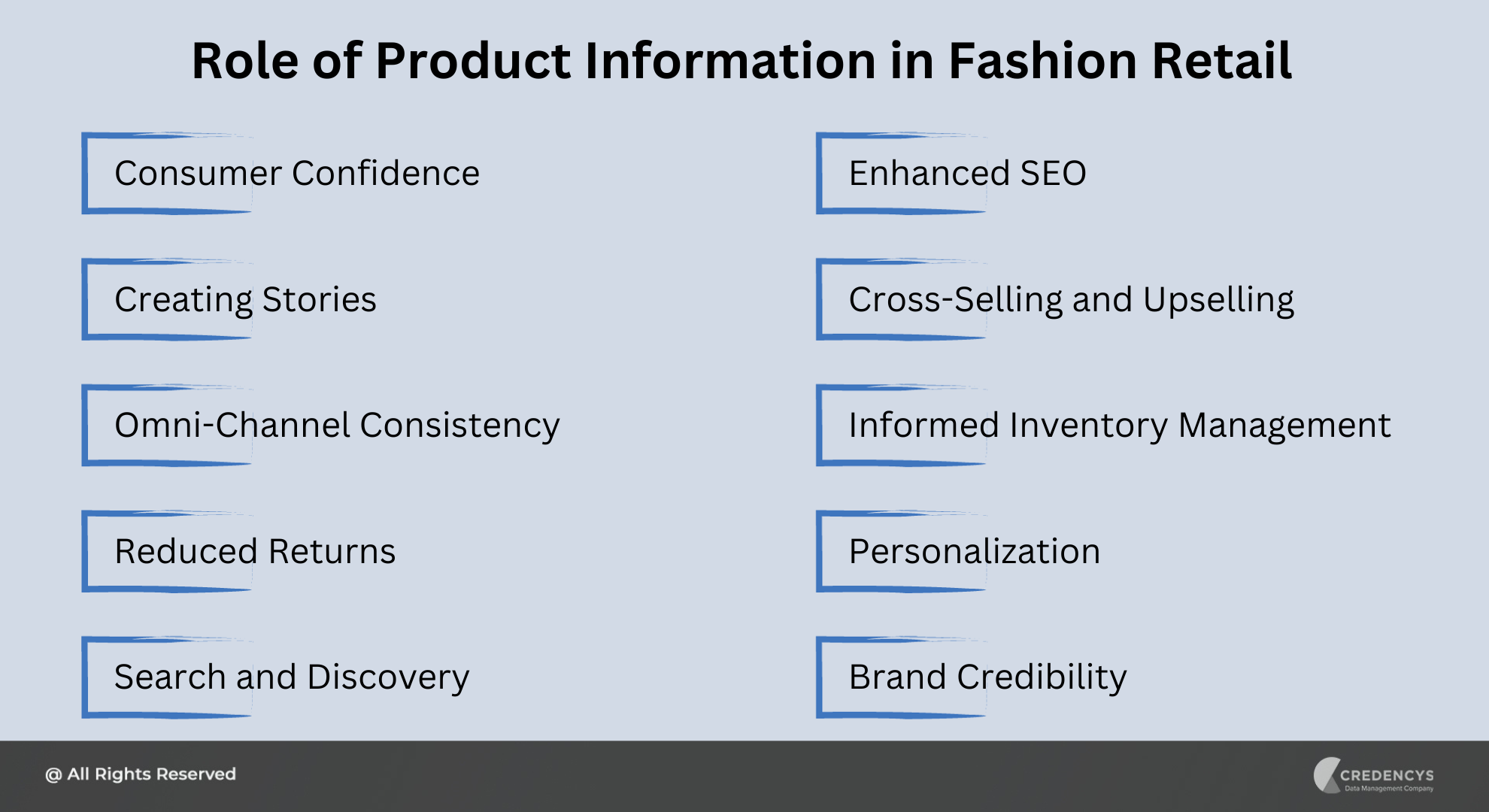
Role of Product Information in Fashion Retail

Consumer Confidence

In the digital realm, customers don’t have the luxury of physically touching or trying on the products. They rely on product information to make informed decisions.

Accurate information about materials, sizes, and care instructions builds confidence in their purchase.

Creating Stories

Fashion is an art form, and every piece has a story. Whether it’s the inspiration behind a collection or the intricate details of a design, rich product information helps you communicate the narrative that sets your brand apart.

Omni-Channel Consistency

Fashion retail spans across various channels – from your e-commerce store to social media and brick-and-mortar locations.

Consistent and accurate product information across all these touchpoints ensures a seamless and trustworthy brand experience.

Reduced Returns

Ill-fitting clothes are a common woe in online shopping. Accurate sizing information significantly reduces the likelihood of returns, benefiting both customers and retailers.

Search and Discovery

Online shoppers often search for specific attributes like “floral summer dress” or “vegan leather boots.”

Rich product information, including detailed descriptions and attributes, makes your products easily discoverable in search results.

Enhanced SEO

Detailed product descriptions, user-generated content, and other rich data contribute to improved search engine visibility.

This is particularly important in fashion, where trends and styles are actively searched for.

Cross-Selling and Upselling

Rich information allows for effective cross-selling and upselling.

When customers can see matching accessories, coordinating pieces, and styling suggestions, they’re more likely to add more items to their carts.

Informed Inventory Management

Accurate product information enables better inventory management.

Knowing which items are popular, which sizes are in demand, and which colors are trending helps in making informed restocking decisions.

Personalization

In the age of personalization, tailored recommendations are gold. Rich product data helps algorithms suggest products based on individual preferences and past behaviors.

Brand Credibility

Consistently providing accurate and detailed information establishes your brand as reliable and trustworthy. This credibility fosters customer loyalty and repeat business.

In a dynamic industry like fashion, where emotions and aesthetics intertwine, accurate and rich product information is the bridge that connects your creations to the hearts of your customers. It’s not just data; it’s the story you tell, the confidence you build, and the experiences you offer.

In the age of digital shopping, where every click counts, having the right product information is the difference between fleeting interest and a lifelong customer.

The Crucial Role of Product Information Management in the Fashion Retail Industry

In the ever-evolving world of fashion, staying ahead requires more than just keeping up with the latest trends. It requires precision, efficiency, and an unerring ability to connect with consumers. This is where Product Information Management (PIM) steps in as a game-changer.

The fashion industry, with its intricate designs, diverse collections, and rapid market shifts, benefits immensely from effective PIM. Let’s delve into the significance of PIM for fashion retail landscape.

Role of PIM in Fashion Industry

Diverse Product Range

From dresses to accessories, footwear to handbags, a fashion brand’s product range can be extensive.

Centralize all product data, make it manageable and accessible, and ensure that every item’s details are consistent and up to date by implementing PIM.

Consistency Across Channels

In today’s omnichannel environment, customers interact with brands through various touchpoints – online stores, social media, physical outlets, and more.

With the help of PIM, fashion retailers ensure uniform product information across all these platforms, providing a seamless and coherent brand experience.

Accurate Descriptions

Fashion relies heavily on visual appeal, but accurate and detailed descriptions enhance the purchasing experience.

Leverage PIM for fashion retail to ensure that each product is accompanied by comprehensive information about materials, care instructions, sizing guides, and more.

Visual Assets

High-quality images, videos, and other visual assets are vital in fashion retail.

PIM allows these assets to be organized, tagged, and linked to specific products, ensuring that the right media is presented to the right customers.

Personalized Recommendations

Take benefit of data-driven personalization using PIM. By understanding customer preferences and purchase history, brands can recommend products tailored to individual tastes, boosting engagement and sales.

Quick Time-to-Market

Fashion is fast-paced. With PIM, launching new collections becomes more efficient.

Centralized data management means that product information can be swiftly updated and propagated across channels, reducing time-to-market.

Efficient Collaboration

Collaborative workflows are common in fashion, involving designers, marketers, suppliers, and retailers.

Streamlines these processes, and ensures that everyone works with accurate and consistent information with the tailored PIM development and implementation.

Reduced Errors

Manual data entry is prone to errors, which can lead to costly mistakes. PIM minimizes human error by automating data entry, validation, and distribution.

Customer Trust

In the age of transparency, customers expect authenticity. Product Information Management ensures that all product claims are accurate, fostering trust and credibility among consumers.

Global Reach

Fashion transcends borders. PIM for fashion retail allows brands to localize product information, ensuring that each market receives accurate translations, pricing, and compliance information.

In a world where competition is fierce and consumer expectations are soaring, harnessing the power of PIM is no longer optional for fashion businesses – it’s a necessity.

From enhancing customer experiences to streamlining operations, from reducing errors to accelerating growth, the role of PIM in the fashion industry is pivotal. It’s the thread that weaves together creativity, efficiency, and success in the dynamic world of fashion.

Product Information Management (PIM): An Overview

In today’s fast-paced digital world, where the marketplace is crowded and competition is fierce, effectively managing product information has become a crucial aspect of successful business operations. This is where Product Information Management (PIM) steps in as a comprehensive solution.

What is PIM?

Product Information Management, often abbreviated as PIM, is a centralized system that allows businesses to collect, manage, enrich, and distribute accurate and consistent product information across various channels.

It serves as a single source of truth for all product-related data, ensuring that the information is up-to-date, relevant, and coherent, regardless of where and how it is accessed.

To get a better understanding of Product Information Management, don’t forget to visit What is PIM? Also, read Product Information Management – An Exclusive Guide to get a profound understanding of PIM and the different aspects related to it.

How Does Product Information Management (PIM) Work?

Product Information Management (PIM) is a sophisticated solution that operates at the heart of modern commerce, facilitating the efficient handling and distribution of accurate and consistent product data.

But how does it work?

How Does Product Information Management (PIM) Work

Let’s delve into the mechanics of PIM to understand its functioning and significance in the business landscape.

Centralized Data Repository

At its core, PIM serves as a centralized repository for all product-related data.

The repository holds an extensive range of information, including product attributes, descriptions, images, videos, technical specifications, pricing, inventory levels, and more.

It is a comprehensive dataset that is the foundation upon which PIM builds its functionalities.

Data Collection

Collect data from various sources, including suppliers, manufacturers, internal teams, and external databases and import the data in bulk in PIM.

This data is often diverse and may come in different formats and structures. PIM employs tools to standardize, cleanse, and structure this data, ensuring uniformity and accuracy.

Data Enrichment

One of the primary advantages of PIM is its ability to enhance product data. This enrichment involves adding valuable details that elevate the customer’s understanding of the product.

This can include high-quality images, videos showcasing product features, customer reviews, user manuals, and cross-selling suggestions. PIM enables businesses to enrich data based on the unique needs of their target audience.

Mapping and Taxonomies

PIM systems employ mapping and taxonomies to organize product data in a logical and structured manner. These frameworks define relationships between different attributes, ensuring that data is consistent and coherent.

Mapping also aids in categorizing products and attributes, simplifying navigation for both businesses and customers.

Data Governance

Effective data governance is a cornerstone of PIM for fashion retail. It involves establishing rules, standards, and workflows to maintain data quality and consistency.

PIM allows businesses to define and enforce data governance policies, ensuring that the information remains accurate, up-to-date, and compliant with industry regulations.

Integration with Multiple Channels

The goal of PIM is to ensure that accurate product data reaches customers through various channels seamlessly. PIM systems integrate with e-commerce platforms, websites, mobile apps, marketplaces, and even print catalogs.

This integration guarantees that customers receive consistent, reliable, and engaging product information regardless of where they engage with the brand.

Localization

Take advantage of localization with the right PIM implementation. Localization ensures that product data is adapted to suit specific markets, languages, and regions, enhancing the customer experience and relevance.

Workflow Collaboration

Encourage collaboration among different teams involved in the product lifecycle, such as marketing, sales, and product management by harnessing the power of Product Information Management.

Workflow tools within PIM systems allow teams to review, edit, and approve product data before it’s published, minimizing errors and discrepancies.

In summary, Product Information Management is a comprehensive solution for fashion retail that streamlines the intricate process of managing, enhancing, and distributing product data.

By centralizing data, ensuring accuracy, and facilitating seamless integration with various channels, PIM empowers fashion retail businesses to provide exceptional customer experiences, improve operational efficiency, and stay competitive in the ever-evolving world of commerce.

PIM for Fashion Retail: How Does Product Information Management Manage Fashion Retail Product Data?

In the dynamic landscape of modern commerce, where competition is fierce and customer expectations are higher than ever, effective management of product data has become paramount.

This is where Product Information Management (PIM) steps in as a game-changer, revolutionizing how businesses organize, enrich, and distribute their product information.

Let’s delve into the significance of PIM in these critical areas.

How Does PIM Manage Product Data for A Fashion Retail Company

1. Organizing Product Data

In the sprawling realm of e-commerce, businesses deal with an overwhelming volume of product data. This data comes from diverse sources, including suppliers, manufacturers, and internal teams.

Without a unified system in place, this data often resides in silos, leading to confusion, inconsistencies, and inefficiencies. PIM acts as a centralized repository, providing a structured framework to organize all product-related information.

It not only enhances data accessibility but also ensures that accurate and up-to-date data is readily available to all stakeholders.

2. Enriching Product Data

Effective product data goes beyond basic descriptions and specifications. It involves enriching the data with high-quality images, engaging videos, comprehensive technical details, customer reviews, cross-selling suggestions, and much more.

PIM allows fashion retail businesses to collate all this information and present it coherently. This enriched data not only aids customers in making informed decisions but also elevates the overall shopping experience.

3. Maintaining Data Consistency

Maintaining consistency across multiple channels is a challenge business often faces. Discrepancies in product information can lead to confusion among customers and erode trust.

PIM for fashion retail ensures that product data remains consistent across all touchpoints, be it e-commerce platforms, mobile apps, marketplaces, or physical stores. This consistency fosters brand credibility and enhances customer satisfaction.

4. Streamlining Distribution

Gone are the days when product distribution was confined to a single channel. Today, businesses must reach customers through various avenues.

PIM integrates seamlessly with different platforms, ensuring that accurate and relevant product data is distributed across all channels simultaneously.

This eliminates the need for manual data entry and reduces the risk of errors, thereby enhancing operational efficiency.

5. Enhancing Customer Experience

In the age of empowered customers, providing an exceptional experience is non-negotiable. PIM contributes significantly to this by ensuring that customers access accurate, enriched, and consistent product information.

This enables customers to make well-informed purchase decisions, reducing the likelihood of post-purchase dissatisfaction due to inaccurate expectations.

6. Adapting to Market Changes

Market trends and customer preferences evolve rapidly. PIM equips fashion retail businesses with agility by allowing them to swiftly adapt to these changes. Whether it’s introducing new attributes, modifying descriptions, or responding to market demands, PIM for fashion retail ensures that the product data remains adaptable and relevant.

In conclusion, Product Information Management is more than just a tool; it’s a strategic asset that empowers businesses to tame the complexities of modern commerce.

By organizing, enriching, and distributing product data effectively, PIM enhances customer experiences, streamlines operations, and ultimately, positions businesses for success in an ever-evolving marketplace.

The Fashion Retail Landscape

Overview of the fashion industry

The fashion industry, with its kaleidoscope of trends, styles, and expressions, stands as one of the most dynamic and influential sectors in the global economy.

Spanning across clothing, accessories, footwear, and more, the industry doesn’t just clothe people but also shapes cultures, defines identities, and reflects societal shifts.

Let’s take a closer look at this captivating realm.

1. A Creative Powerhouse

At its core, the fashion industry is a creative powerhouse, where designers and artists channel their imaginations into wearable art. From haute couture runways to ready-to-wear collections, the industry thrives on innovation, constantly pushing boundaries and redefining aesthetics.

2. Trends and Cycles

Fashion is a perpetual cycle of trends and counter-trends. What’s in vogue today might become passé tomorrow, only to resurface as a nostalgic revival years later.

These trends are not restricted to clothing alone but extend to color palettes, fabrics, patterns, and even cultural influences.

3. Influential Brands

Iconic brands, often built around a compelling narrative, wield significant influence.

Brands like Chanel, Gucci, and Nike have become cultural touchstones, transcending mere products to become symbols of aspiration and identity.

4. Fast Fashion vs. Sustainable Fashion

The industry is characterized by the dichotomy of fast fashion and sustainable fashion.

While fast fashion caters to quick turnovers of inexpensive styles, sustainable fashion emphasizes ethical practices, eco-friendly materials, and durability.

5. Global Supply Chain

Fashion is a global affair, with supply chains that span continents.

From sourcing raw materials to manufacturing and distribution, the industry involves intricate processes involving suppliers, manufacturers, wholesalers, retailers, and e-commerce platforms.

6. Retail Revolution

The advent of e-commerce has transformed the retail landscape. Online platforms offer consumers a virtual runway to explore and purchase fashion from across the globe. The rise of direct-to-consumer brands and influencer collaborations has further disrupted traditional retail models.

7. Fashion and Identity

Fashion is an expression of identity, enabling individuals to communicate their beliefs, affiliations, and aspirations. Clothing choices can reflect cultural heritage, personal aesthetics, and even socio-economic status.

8. Sustainability Imperative

With growing awareness of environmental and ethical concerns, sustainability has become a central focus. Consumers demand transparency about sourcing, production processes, and the ecological impact of fashion products.

9. Technological Disruption

Technology has left an indelible mark on the industry, from 3D printing and virtual reality fashion shows to AI-driven design and blockchain-backed supply chain transparency.

10. Fast-Revolving Seasons

The fashion calendar, once defined by spring and fall collections, has expanded to include pre-fall, resort, and capsule collections. This rapid turnover keeps the industry in a constant state of evolution.

11. Inclusivity and Diversity

The industry is gradually embracing inclusivity and diversity. Brands are recognizing the importance of representation and body positivity, leading to a more varied and representative portrayal of beauty.

12. Cultural Crossroads

Fashion is a melting pot of cultures, often drawing inspiration from diverse traditions, history, and contemporary influences. This fusion has led to the emergence of unique and eclectic styles.

In conclusion, the fashion industry isn’t just about clothes; it’s a reflection of society, an art form, a driver of cultural change, and an economic powerhouse. It thrives on creativity, innovation, and the ever-evolving nature of human expression.

From the runway to the streets, fashion is an integral part of our lives, shaping how we present ourselves to the world.

Unique Challenges of Fashion Retail Businesses

The world of fashion retail is a captivating blend of creativity, trends, and consumer desires. However, beneath the glamour and allure lie a set of unique challenges that fashion retailers must navigate to succeed in this dynamic industry. Let’s delve into these challenges that make fashion retail both exciting and demanding.

Challenges of Fashion Retail Businesses

1. Rapidly Changing Trends

The fashion industry is characterized by its ever-changing trends. Staying ahead of these shifts requires constant vigilance, as what’s in vogue today might be out of favor tomorrow. Retailers must keep a finger on the pulse of fashion to curate the right products.

2. Seasonality and Timing

The fashion calendar operates on a tight schedule, with seasons dictating collections months in advance. Retailers must align their inventory with seasonal demands, ensuring products hit the shelves at the right time to capture consumer interest.

3. Inventory Management

Managing inventory is a delicate balancing act. Overstocked items lead to markdowns, while understocked products result in missed sales opportunities. Fashion retailers must maintain accurate forecasts and optimize inventory levels to strike the right balance.

4. Size and Fit Variability

The challenge of size and fit is ever-present in fashion retail. Consumers expect products to fit perfectly, but size standards can vary across brands. Retailers must provide detailed size charts and options for easy returns to accommodate diverse body types.

5. Trend of Returns

The convenience of online shopping comes with a downside—higher return rates. Fashion items, in particular, have a higher return rate due to fit issues and personal preferences. Retailers must implement seamless return processes while managing associated costs.

6. Sustainability Pressure

Growing environmental awareness has placed sustainability at the forefront. Consumers expect brands to adopt ethical practices and eco-friendly materials. Fashion retailers must source responsibly, reduce waste, and communicate their sustainability efforts.

7. Omni-channel Expectations

Consumers demand a seamless shopping experience across channels—online, offline, and mobile. Retailers must integrate their operations to provide a consistent and engaging experience at every touchpoint.

8. Fickle Consumer Loyalty

Brand loyalty in fashion retail can be fickle. Consumers are always on the lookout for the latest trends and may switch allegiances quickly. Building a loyal customer base requires consistent innovation and personalized engagement.

9. Intense Competition

The fashion retail landscape is saturated with brands vying for attention. Retailers must differentiate themselves through unique branding, product offerings, and exceptional customer experiences.

10. Margin Pressure

Discount-driven consumer behavior and competition from fast fashion brands can erode profit margins. Retailers need to strike a balance between offering competitive prices and maintaining profitability.

11. Visual Appeal and Presentation

Fashion is as much about aesthetics as it is about functionality. Retailers need to invest in visually appealing store layouts, online product imagery, and packaging to create a memorable brand experience.

12. Influencer Culture

Influencer endorsements and social media play a significant role in shaping consumer perceptions. Retailers must navigate partnerships and collaborations with influencers while ensuring authenticity and alignment with their brand values.

In conclusion, the challenges faced by fashion retail businesses are as diverse and vibrant as the industry itself. Navigating these challenges requires a combination of strategic foresight, agility, and an unwavering commitment to delivering value and satisfaction to the ever-discerning consumer.

Despite the hurdles, fashion retail remains a captivating arena where innovation and creativity hold the key to success.

PIM for Fashion Retail: How Product Information Management Empowers Fashion Retail?

In the intricate world of fashion retail, where trends change at a rapid pace and consumer expectations are soaring, the quality and management of product information hold paramount importance.

Product Information Management (PIM) has emerged as a game-changer for the fashion industry, revolutionizing the way retailers handle their product data.

Let’s delve into the profound impact of PIM on fashion retail.

Benefits of PIM for Fashion Retail

1. Improved Productivity

Without a structured system, managing vast amounts of product data can be overwhelming.

PIM streamlines this process by providing a single platform for data entry, enrichment, and updates. This efficiency frees up valuable time for teams to focus on innovation and strategic tasks.

2. Personalized Marketing

PIM facilitates the creation of detailed customer personas based on product preferences, sizes, and buying history.

This data fuels targeted marketing campaigns, enabling retailers to deliver personalized recommendations and promotions that resonate with individual consumers.

3. Enhanced Data Quality

Fashion retailers deal with a myriad of product attributes, from color variations to intricate design details.

PIM ensures that this data is accurate, consistent, and free of errors. High-quality data minimizes returns due to incorrect product information, thus boosting customer satisfaction.

4. Efficient Catalog Management

Managing catalogs with numerous SKUs can be complex. PIM simplifies catalog management by allowing retailers to categorize, organize, and tag products systematically.

This enables easy navigation for customers and efficient management for retailers.

5. Seamless Supplier Collaboration

Fashion retail involves a network of suppliers, manufacturers, and vendors. PIM facilitates collaboration by providing a centralized platform where partners can update product information directly.

This ensures that everyone is on the same page, minimizing miscommunications.

6. Agility in Adapting Trends

The fashion industry thrives on adapting to new trends.

PIM’s flexibility allows retailers to swiftly introduce new attributes or modify existing ones to align with emerging fashion trends. This agility is crucial in staying relevant and appealing to consumers.

7. Improved Data Accuracy

In the fashion retail realm, accurate product information is the bedrock of success. PIM ensures that every piece of data – from measurements and materials to colors and care instructions – is standardized and error-free.

This meticulous attention to detail eliminates confusion, reduces returns due to misinformation, and builds trust with customers who rely on accurate descriptions for their purchasing decisions.

8. Efficient Product Launches and Updates

The fashion industry operates in a dynamic environment where new collections need to be launched promptly.

PIM simplifies this process by providing a centralized platform for product data management. Design teams can collaborate seamlessly, inputting details, uploading images, and finalizing descriptions. This streamlines the launch process, reducing the risk of errors and delays.

9. Strategic Decision-Making

In the fashion industry, data-driven decisions are key to success. PIM provides comprehensive insights into product performance, customer preferences, and market trends.

Retailers can analyze which products resonate with customers, allowing for better inventory management and informed decisions about future collections.

To explore more benefits of PIM for the fashion business, don’t miss visiting 10 Benefits of PIM for the Fashion Industry. It gives a broad view of the essence of PIM for a fashion business.

Key Features of a Fashion-Centric PIM for Fashion Retail Business

In essence, Product Information Management is not just a tool; it’s a transformative force for fashion retail. From elevating customer experiences to streamlining internal processes, PIM empowers retailers to navigate the challenges of the industry with precision and finesse.

As fashion continues to evolve, those who embrace the potential of PIM are poised to lead the way with innovation and efficiency.

Key Features of PIM for Fashion Retail Business

Centralized Product Data Repository

At the core of a fashion-centric PIM system lies a centralized repository that serves as the single source of truth for all product-related information.

This repository organizes and stores every detail, from product descriptions and specifications to pricing and availability.

Having a unified data hub ensures consistency across all touchpoints and simplifies data management.

Product Categorization and Taxonomy Management

In the diverse world of fashion, effective categorization is essential for navigation and searchability.

A robust PIM system allows fashion retailers to create and manage intricate product categories and taxonomies.

This feature enables customers to browse seamlessly and find what they’re looking for, contributing to a user-friendly shopping experience.

Digital Asset Management for Images and Media

Visual appeal is paramount in fashion retail.

A fashion-centric PIM for fashion retail offers advanced digital asset management capabilities, allowing retailers to store and manage a vast library of images, videos, and other media.

High-quality visuals enhance product listings, provide accurate representations, and entice customers to explore further.

Support for Multiple Languages and Currencies

Fashion is a global industry, and catering to diverse audiences requires the ability to present product information in multiple languages and currencies.

A PIM system tailored to fashion accommodates this need by enabling the creation of product listings in various languages and displaying prices in different currencies, facilitating international trade.

Integration with E-commerce Platforms and Marketplaces

Seamless integration with e-commerce platforms and online marketplaces is crucial for fashion retailers.

A fashion-centric PIM system streamlines this process by connecting with various online sales channels. This integration ensures that product information remains consistent across all platforms, reducing errors and optimizing customer experiences.

Rich Product Data Enrichment

Fashion products often require detailed and varied information, such as size charts, fabric details, care instructions, and fit descriptions.

A fashion-focused PIM system enables retailers to provide comprehensive and accurate product data, helping customers make informed decisions. This feature enhances the overall shopping journey and minimizes returns due to misinformation.

Workflow and Collaboration Tools

Fashion product management involves collaboration among diverse teams, including designers, marketers, and content creators.

A fashion-centric PIM system offers robust workflow management systems and collaboration tools. These tools facilitate communication, streamline approval processes, and ensure that everyone involved has access to the latest product information.

Real-time Inventory Management

Fashion inventory fluctuates rapidly due to changing trends and customer demand. A PIM system designed for fashion enables real-time inventory tracking and management.

This feature empowers retailers to maintain accurate stock levels, update availability status in real-time, and avoid disappointing customers with out-of-stock items.

Personalization and Customer Insights

Personalization is a hallmark of modern fashion retail. A fashion-centric PIM system helps deliver a personalized shopping experience by supporting customer segmentation based on preferences, demographics, and behaviors.

By delivering personalized recommendations, retailers can enhance customer engagement, increase conversions, and foster brand loyalty.

Reporting and Analytics

In the dynamic fashion industry, data-driven insights are invaluable. A fashion-focused PIM system provides reporting and analytics features that offer visibility into product performance, sales trends, and customer behavior. Retailers can make informed decisions, optimize inventory, and strategize for growth based on these insights.

12 Steps to Successfully Implement a PIM for Fashion Retail

Steps to Implement PIM for Fashion Retail

Implementing a Product Information Management (PIM) for fashion retail businesses is a strategic move that can transform the way a fashion business manages and presents its products.

To ensure a successful PIM implementation, several key steps need to be taken. Here’s a comprehensive guide to navigating through the process:

1. Assess Your Needs

Begin by understanding your specific business needs and challenges. Evaluate your existing data management processes, pain points, and areas that require improvement.

Identify the goals you aim to achieve with a PIM system, such as enhanced data accuracy, improved customer experiences, and streamlined product launches.

2. Define Clear Objectives

Set clear and measurable objectives for your PIM development.

Define what success looks like for your business – whether it’s reducing data errors, increasing operational efficiency, or enabling faster time-to-market for new products. These objectives will guide your implementation strategy.

3. Choose the Right PIM Solution

Selecting the right PIM for fashion retail is crucial. Look for a solution that aligns with your business size, industry, and unique requirements.

Consider factors such as scalability, flexibility, integration capabilities, and user-friendliness. A fashion-centric PIM system that caters to the nuances of your industry is ideal.

4. Data Gathering and Mapping

Collect all your product data from various sources – spreadsheets, databases, ERP systems, and more. Cleanse and standardize the data to ensure consistency.

Then, map this data to the fields and attributes within the PIM solution. Accurate data mapping is vital for smooth data migration.

5. Data Migration

Move your cleansed and mapped data into the PIM system. This step requires careful attention to detail to avoid errors and discrepancies. Ensure that the data maintains its integrity and structure during migration. Test the migrated data thoroughly to verify its accuracy.

6. Customization and Configuration

Customize the PIM system to align with your specific business processes and workflows. Configure product categories, attributes, and taxonomies according to your industry’s standards.

Tailor the user interface to match your team’s needs for efficient data management.

7. Integration with Existing Systems

Integrate your PIM system with existing software, such as e-commerce platforms, ERPs, CRMs, and more.

Seamless integration ensures data consistency across all systems and prevents manual data entry errors. APIs and connectors play a crucial role in achieving this integration.

8. Data Enrichment

Enrich your product data with comprehensive information that enhances customer experiences. Include high-quality images, detailed descriptions, size charts, care instructions, and more.

Ensure that all product information is accurate, consistent, and up to date.

9. User Training

Train your team members on how to use the PIM system effectively. Provide comprehensive training sessions that cover data entry, data management, collaboration features, and reporting functionalities.

Ensure that everyone is comfortable navigating and utilizing the system.

10. Testing and Quality Assurance

Thoroughly test the PIM system before full implementation. Perform testing scenarios to identify any bugs, glitches, or potential issues.

Quality assurance is essential to ensure that the system operates smoothly and meets your business requirements.

11. Launch and Monitor

Launch the PIM system in stages or as a whole, depending on your implementation strategy. Monitor its performance closely and gather feedback from users.

Address any concerns promptly and make necessary adjustments based on user experiences.

12. Continuous Improvement

PIM implementation is an ongoing process. Continuously evaluate the system’s performance against your defined objectives.

Gather insights from user feedback and data analytics to identify areas for improvement and optimization.

Successfully implementing a PIM system requires a well-defined strategy, careful planning, and collaboration among various teams.

By following these steps, fashion businesses can harness the power of PIM to streamline operations, enhance product data quality, and elevate customer experiences.

Selecting the Right PIM for Fashion Retail Businesses

Selecting the right Product Information Management (PIM) solution for your fashion retail business is a critical decision that can significantly impact your operations, data management, and customer experiences.

With the array of options available, it’s essential to approach the selection process strategically.

How to Select a PIM for Fashion Retail

Here’s a comprehensive guide to help you choose the right PIM solution tailored to your fashion retail needs:

1. Define Your Requirements

Begin by identifying your specific requirements and challenges. What are the pain points you want the PIM system to address?

Do you need to manage a vast range of product attributes, handle multiple languages and currencies, or integrate with various e-commerce platforms?

Make a comprehensive list of features and functionalities you need.

2. Industry Expertise

Look for a PIM solution that specializes in the fashion industry. Fashion retail comes with unique challenges such as managing diverse product attributes, variant sizes, colors, and styles.

A fashion-centric PIM solution understands these nuances and offers tailored features to meet your needs.

3. Scalability

Ensure that the PIM solution can grow with your business. As your product catalog expands, the PIM system should handle increased data volumes without compromising performance.

Scalability is crucial to accommodate future growth and product diversification.

4. Flexibility and Customization

Fashion retail often requires flexibility to manage varying product data structures.

Choose a PIM solution that allows customization to match your unique product taxonomy, categories, and attributes. This ensures that the system aligns with your specific business processes.

5. Integration Capabilities

Seamless integration with your existing systems is vital. The PIM solution should connect with your e-commerce platforms, ERP systems, CRM software, and more.

Look for a PIM solution with pre-built connectors or robust APIs that facilitate easy data flow.

6. User-Friendly Interface

An intuitive and user-friendly interface is essential for user adoption. The PIM system should empower your team to efficiently manage product data without extensive training.

A clutter-free and well-organized interface enhances productivity.

7. Multi-Language and Multi-Currency Support

Given the global nature of the fashion industry, choose a PIM solution that supports multiple languages and currencies.

This feature enables you to provide accurate and consistent product information to diverse audiences worldwide.

8. Digital Asset Management

Fashion retail heavily relies on visual content. Look for a PIM solution with robust digital asset management capabilities.

It should allow you to store, organize, and distribute high-quality images, videos, and other media assets.

9. Workflow Management

Effective collaboration is crucial in fashion retail.

Choose a PIM solution that offers workflow management features, allowing different teams to collaborate seamlessly on product data creation, approval, and updates.

10. Reporting and Analytics

Data-driven insights are invaluable in making informed decisions.

Opt for a PIM solution that provides advanced reporting and analytics tools. This enables you to monitor data quality, track performance metrics, and identify opportunities for improvement.

11. Vendor Support and Training

Evaluate the level of support and training offered by the PIM vendor.

A responsive support team and comprehensive training resources ensure that your team can maximize the benefits of the PIM system.

12. Total Cost of Ownership

Consider not only the initial cost but also the long-term expenses associated with the PIM solution. This includes licensing fees, implementation costs, ongoing maintenance, and potential customization expenses. A clear understanding of the total cost of ownership is essential.

Selecting the right PIM solution is a pivotal decision that can impact your fashion retail business’s efficiency, data accuracy, and customer experiences. By evaluating these factors and aligning them with your unique business needs, you can confidently choose a PIM solution that empowers your fashion retail operations.

PIM for Fashion Retail: How to Build a PIM Team and Assigning Responsibilities?

Building a successful Product Information Management (PIM) team and assigning clear responsibilities is crucial for the effective implementation and ongoing management of your PIM system.

A well-structured team ensures that your PIM initiative runs smoothly, data quality is maintained, and your product information is consistently accurate and up-to-date.

How to Build a PIM Team

Here’s how to build a strong PIM team and define their responsibilities:

1. PIM Team Structure

Create a team structure that suits your organization’s size and complexity. While the exact roles may vary, the core positions in a PIM team typically include:

PIM Manager/Owner

Oversees the entire PIM initiative, sets the strategy, and ensures alignment with business goals.

Data Stewards

Responsible for data accuracy, consistency, and quality. They ensure that product information is up-to-date, properly categorized, and follows established standards.

Content Creators

Create and update product descriptions, images, videos, and other content. They collaborate with various departments to gather accurate information.

IT/Technical Team

Manages the technical aspects of the PIM system, including implementation, integration with other systems, and maintenance.

Business Analysts

Bridge the gap between business requirements and technical implementation. They gather and document business needs, translate them into technical requirements, and ensure the PIM system aligns with those needs.

2. Assigning Responsibilities

PIM Manager/Owner

  • Develops a clear PIM strategy aligned with the organization’s goals.
  • Identifies key stakeholders and secures their buy-in.
  • Ensures that the PIM system’s implementation and maintenance align with business objectives.
  • Oversees the entire PIM team and project.

Data Stewards

  • Define and enforce data governance policies and standards.
  • Ensure data accuracy, consistency, and compliance with industry regulations.
  • Collaborate with content creators to ensure accurate and complete product information.
  • Monitor data quality metrics and resolve any issues.

Content Creators

  • Create and maintain accurate and compelling product descriptions, images, videos, and other content.
  • Collaborate with various departments such as marketing, design, and sales to gather necessary information.
  • Ensure that all product information is consistent and aligned with the brand’s tone and style.

IT/Technical Team

  • Implement the PIM system and integrate it with other relevant systems (e-commerce platforms, ERPs, etc.).
  • Maintain the technical infrastructure of the PIM system, including upgrades and troubleshooting.
  • Collaborate with data stewards and business analysts to implement data models and workflows.

Business Analysts

  • Gather and document business requirements related to product information and data management.
  • Collaborate with the technical team to translate business requirements into technical specifications.
  • Ensure that the PIM system’s functionality meets business needs.
  • Support data governance initiatives and process improvements.

3. Cross-Functional Collaboration

Effective PIM management requires close collaboration between departments. Ensure that your PIM team works closely with departments such as marketing, sales, design, and operations to ensure that the product information is comprehensive and accurate.

4. Continuous Training and Development

PIM technologies and best practices evolve over time. Invest in regular training and development for your PIM team members to keep their skills up-to-date and aligned with industry trends.

5. Communication and Reporting

Establish clear communication channels within the PIM team and with other relevant departments. Regularly report on data quality, system performance, and progress toward PIM goals.

Building a PIM team and defining their responsibilities sets the foundation for a successful PIM implementation. With the right roles, clear responsibilities, and effective collaboration, your team can ensure that your product information is accurate, and consistent, and enhances your customers’ experiences.

How to Deliver Omnichannel Experience Using PIM for Fashion Retail?

In today’s retail landscape, where customers engage with brands through various channels, the need for seamless and consistent product information across all touchpoints has become paramount.

This is where Product Information Management (PIM) emerges as a powerful solution, enabling retailers to provide a unified and exceptional shopping experience regardless of the channel customers choose.

How to Deliver Omnichannel Experience Using PIM for Fashion Retail

Let’s delve into how PIM strengthens omnichannel retail by ensuring consistency, enhancing in-store experiences, and enabling personalized marketing.

1. The Role of PIM in Improving In-Store Experiences

While online shopping has gained prominence, the physical store remains a vital touchpoint for customers. PIM extends its benefits to brick-and-mortar stores by arming sales associates with comprehensive and accurate product data.

With instant access to enriched product details, store staff can offer better assistance to customers, answer queries, and provide valuable insights. This not only enhances customer satisfaction but also creates a more personalized and informed in-store experience.

2. Enhancing Cross-Selling and Upselling

PIM’s centralized repository of product information enables retailers to identify opportunities for cross-selling and upselling.

By analyzing customer preferences and purchase history, you can strategically suggest relevant products, creating a more fulfilling shopping experience and increasing average order value.

3. Supporting Agile Adaptation to Trends

The retail landscape is constantly evolving, with new trends emerging rapidly. PIM empowers retailers to swiftly adapt to these trends by facilitating quick updates and changes to product data.

This agility ensures that your offerings stay relevant and align with changing customer demands.

In the era of omnichannel retail, where customers demand a seamless and personalized experience, PIM emerges as a critical tool for retailers. It not only ensures consistent product information across channels but also enhances in-store experiences and enables personalized marketing efforts.

By leveraging PIM’s capabilities, retailers can build a robust foundation for delivering exceptional shopping experiences that resonate with customers across all touchpoints.

Vendor and Partner Collaboration: Enhancing Supply Chain Efficiency through Streamlined Communication and Real-Time Data Sharing

How Does PIM Enhance Supply Chain Efficiency

In the dynamic world of modern business, effective vendor and partner collaboration plays a pivotal role in ensuring the success of any organization. This is particularly true in the context of the fashion industry, where a seamless supply chain is essential to deliver products to consumers promptly.

A robust Product Information Management (PIM) system not only facilitates the management of product data but also empowers retailers to enhance their collaboration with vendors, manufacturers, and partners.

Let’s explore how PIM for fashion retail streamlines communication, enables real-time data sharing and supports integration for efficient supply chain management.

1. Streamlining Communication with Suppliers and Manufacturers

Successful collaboration with suppliers and manufacturers requires clear and efficient communication. PIM serves as a centralized hub for all product-related information, including specifications, pricing, availability, and changes.

This eliminates the need for back-and-forth communication via emails or calls, reducing the chances of miscommunication or errors.

By providing vendors and manufacturers with access to the PIM system, they can access the most up-to-date information directly, ensuring accurate data is shared among all stakeholders.

2. Real-Time Data Sharing for Efficient Supply Chain Management

Efficiency in supply chain management hinges on real-time visibility into product data. PIM offers a platform where vendors and partners can access accurate and current product information as it evolves.

This real-time data sharing ensures that everyone involved in the supply chain is working with the same information, minimizing discrepancies and delays.

Whether it’s changes in product specifications or pricing updates, all stakeholders can access the latest data in real time, streamlining decision-making processes.

3. Enabling Dropshipping and Third-Party Integration

Dropshipping and third-party integration have become integral components of the fashion retail ecosystem. PIM plays a crucial role in enabling seamless integration with third-party systems, allowing retailers to effortlessly incorporate dropshipping models.

By maintaining a centralized repository of product data, retailers can efficiently share relevant information with dropshipping partners, ensuring that accurate and consistent data reaches end customers.

This integration also extends to other third-party services like marketplace platforms, further expanding a retailer’s reach.

4. Minimizing Errors and Discrepancies

Miscommunication or errors in product information can lead to supply chain disruptions, customer dissatisfaction, and financial losses.

PIM’s centralized data management minimizes the chances of errors, as all parties work with the same set of accurate and updated information. This not only streamlines operations but also fosters trust and collaboration among all stakeholders in the supply chain.

5. Speeding Up Time-to-Market

Collaboration that’s characterized by real-time data sharing and streamlined communication translates to quicker time-to-market.

As product information is readily available to all stakeholders, from designers to manufacturers to marketers, the entire product lifecycle becomes more efficient. This agility enables fashion retailers to capitalize on market trends swiftly and stay ahead of the competition.

6. Strengthening Vendor Relationships

Smooth collaboration and effective communication contribute to building strong relationships with vendors and partners.

When suppliers see that their product data is managed efficiently and communicated accurately, it fosters a sense of trust and reliability. This positive relationship can lead to better terms, improved negotiations, and a more collaborative approach to business growth.

In the intricate web of the fashion supply chain, vendor and partner collaboration is the cornerstone of success. A comprehensive PIM system not only ensures clear communication and real-time data sharing but also strengthens relationships, reduces errors, and accelerates time-to-market.

By embracing PIM’s capabilities, fashion retailers can establish a well-coordinated and efficient supply chain that benefits all stakeholders involved.

Future Trends in PIM for Fashion Retail: Transforming the Shopping Experience with AI, Virtual Reality, and Blockchain

The fashion industry has always been at the forefront of innovation, and the evolution of Product Information Management (PIM) is no exception.

As technology continues to advance, the future of Fashion PIM promises exciting developments that will reshape the way consumers interact with products and brands.
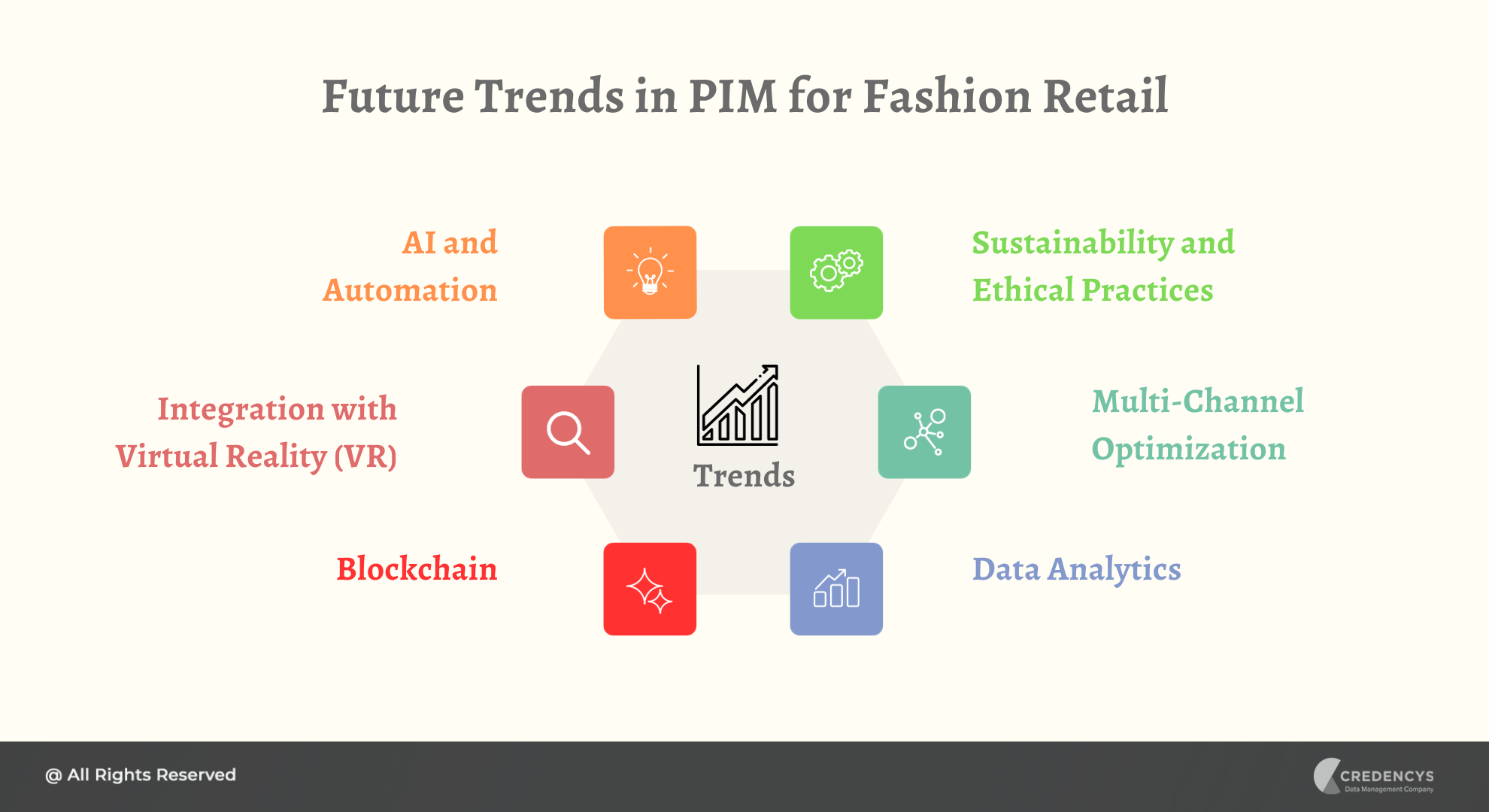
Future Trends in PIM for Fashion Retail

Let’s delve into three significant trends that are set to revolutionize the landscape of Fashion PIM.

1. AI and Automation for Predictive Product Recommendations

Artificial Intelligence (AI) and automation are poised to redefine the shopping experience in the fashion world. PIM systems are increasingly integrating AI algorithms to analyze consumer preferences, purchase history, and behavior patterns.

This enables the generation of personalized and predictive product recommendations. Imagine a scenario where a customer’s style, color preferences, and sizing are analyzed by AI to curate a selection of items they’re likely to love.

This not only enhances customer engagement but also drives higher conversion rates and customer satisfaction.

2. Integration with Virtual Reality (VR) for Immersive Shopping Experiences

Virtual Reality is unlocking new dimensions in shopping experiences, and PIM is set to leverage this trend for fashion retail.

Imagine trying on clothes virtually before making a purchase, visualizing how a dress fits, or experimenting with different styles and combinations—all from the comfort of your own home.

Fashion PIM systems are incorporating VR capabilities to allow customers to interact with products in an immersive way, thereby bridging the gap between online and offline shopping.

This level of engagement enhances customer confidence and reduces returns, resulting in a win-win for both retailers and shoppers.

3. Blockchain for Transparent and Secure Product Information

Transparency and authenticity are crucial in the fashion industry, and blockchain technology is emerging as a powerful tool to achieve this.

Blockchain’s decentralized and tamper-proof nature ensures that product information, from manufacturing details to supply chain origins, remains secure and unalterable.

Fashion PIM systems are integrating blockchain to provide consumers with a transparent view of a product’s journey, building trust and loyalty. Moreover, this technology can combat issues like counterfeit products, ensuring that customers receive genuine items.

4. Sustainability and Ethical Practices

In an era of heightened awareness about sustainability and ethical practices, Fashion PIM is poised to align with these values. PIM systems will likely incorporate features that allow retailers to highlight eco-friendly materials, ethical sourcing, and sustainable production methods.

Consumers are increasingly seeking products that align with their values, and PIM will play a pivotal role in conveying these attributes accurately.

5. Multi-Channel Optimization

The future of Fashion PIM involves ensuring consistency and excellence across various channels. With the rise of omnichannel retail, PIM systems will evolve to ensure that product information remains accurate and coherent across different platforms.

This will enable customers to seamlessly transition between online and offline touchpoints, fostering a unified shopping experience.

6. Data Analytics for Trend Forecasting

Data is a goldmine in the fashion industry, and PIM systems are poised to harness its potential.

By analyzing buying trends, customer preferences, and emerging fashion movements, Fashion PIM systems will empower retailers to anticipate market shifts and align their product offerings accordingly.

This proactive approach to trend forecasting will give fashion brands a competitive edge in a fast-paced industry.

The future of Fashion PIM is nothing short of transformative. AI-powered recommendations, VR-enhanced experiences, blockchain-secured information, sustainability integration, multi-channel optimization, and data-driven trend forecasting are just a few of the remarkable trends that will shape the way we shop for fashion.

As these innovations converge, fashion retailers are poised to deliver unparalleled experiences, cultivate customer loyalty, and stay ahead in an ever-evolving industry.

Do you want to uncover the hidden gems of the fashion industry by exploring future trends in fashion PIM? – Let’s connect

Use Cases of PIM in Fashion Retail: Elevating Customer Experience and Operational Efficiency

Product Information Management (PIM) systems have become indispensable tools for the fashion retail industry. By centralizing and optimizing product data, PIM empowers fashion brands and retailers to deliver a seamless shopping experience while streamlining their internal operations.

Let’s explore some compelling use cases of PIM in the realm of fashion retail:

1. Unified Product Data Management

In the world of fashion, where products often come in various colors, sizes, and styles, managing product data can quickly become complex. PIM allows fashion retailers to create a single repository of product information, ensuring consistency and accuracy across all channels.

This unified data management eliminates discrepancies, enhances data accuracy, and reduces errors stemming from manual data entry.

2. Efficient Catalog Management

Fashion retailers deal with extensive product catalogs that are constantly evolving with new arrivals, seasonal collections, and discontinued items.

PIM simplifies catalog management by providing tools to categorize, organize, and present products in an intuitive manner. This ensures that customers can easily navigate through products, leading to improved browsing experiences and increased sales.

3. Seamless Multichannel Experience

The modern fashion shopper engages with brands across multiple channels—online stores, social media, physical stores, and more. PIM enables fashion retailers to deliver consistent and accurate product information across all touchpoints.

Whether a customer is browsing a mobile app, or website, or visiting a brick-and-mortar store, they receive the same up-to-date and reliable product details.

4. Personalized Customer Experiences

Personalization is a hallmark of successful retail, and PIM plays a pivotal role in achieving this. With rich and organized product data, fashion retailers can create personalized recommendations based on customer preferences, purchase history, and browsing behavior.

By tailoring product suggestions to individual tastes, retailers can increase customer engagement and drive conversions.

5. Enhancing SEO and Digital Marketing Efforts

Search Engine Optimization (SEO) and digital marketing are vital for driving online visibility and traffic.

PIM systems allow fashion retailers to optimize product descriptions, titles, and metadata for search engines. This boosts the discoverability of products online and improves the effectiveness of digital marketing campaigns.

6. Seasonal Campaign Management

Fashion retailers often roll out seasonal campaigns and promotions. PIM simplifies the management of these campaigns by enabling retailers to update product information, pricing, and promotions across all channels simultaneously.

This ensures that customers receive accurate information and consistent messaging during special campaigns.

7. Enhanced Customer Service

Accurate product information is essential for providing exceptional customer service.

With PIM, customer service representatives have instant access to comprehensive product data, enabling them to address customer inquiries quickly and accurately. This leads to improved customer satisfaction and loyalty.

From unifying product data to enhancing customer experiences and streamlining operations, the use cases of PIM in fashion retail are vast and transformative.

By adopting PIM, fashion brands and retailers can navigate the dynamic industry landscape with agility, while delivering remarkable shopping experiences that resonate with today’s tech-savvy and discerning consumers.

Credencys: A True Technology Partner to Leverage PIM for Fashion Retail

Credencys specializes in helping fashion retailers harness the power of Product Information Management (PIM) to enhance their operations, streamline processes, and ultimately boost their success in the fashion industry.
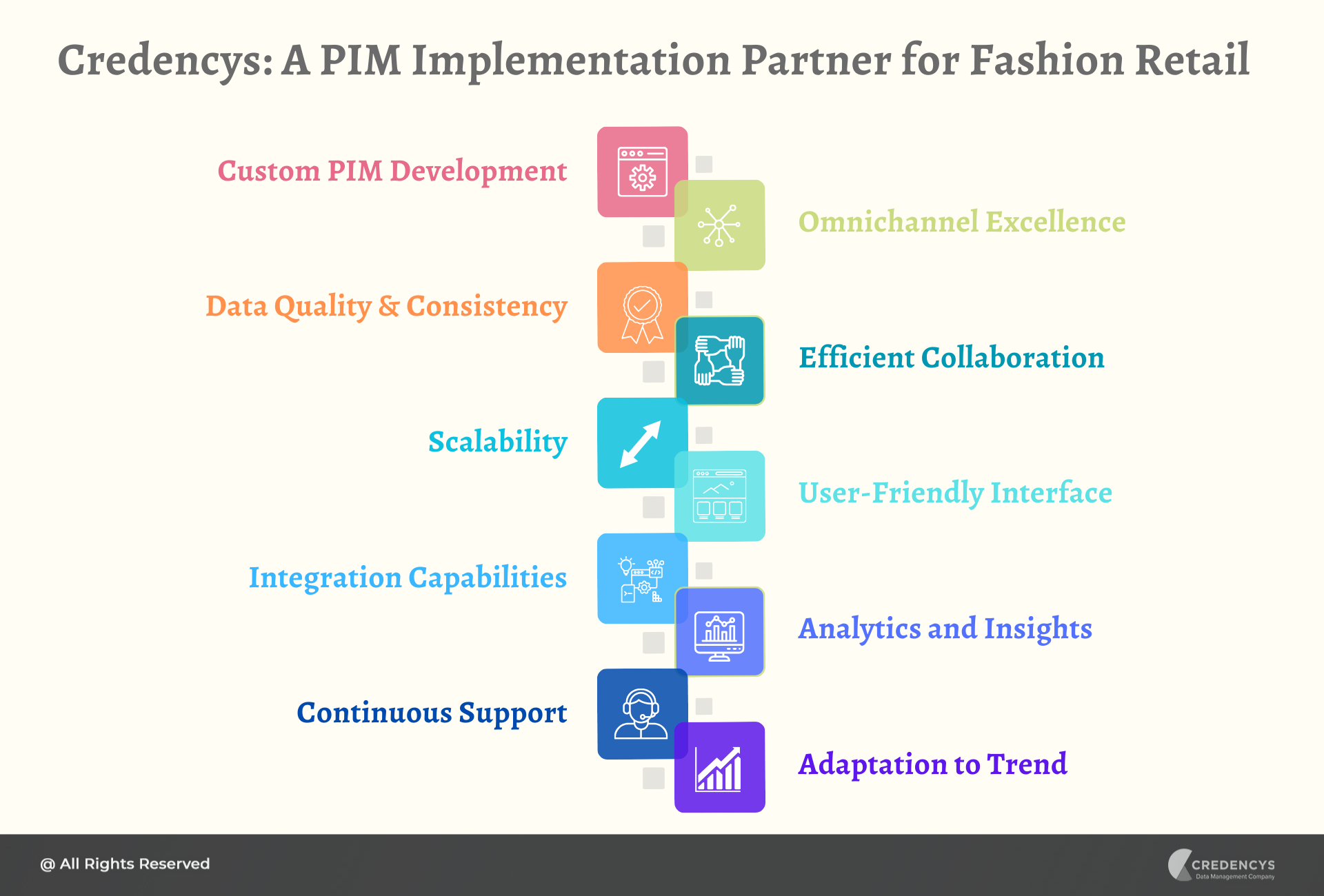
Credencys A PIM Implementation Partner for Fashion Retail

Here’s how we can assist fashion retailers with developing a PIM solution tailored to their unique needs:

Custom PIM Development

We understand that every fashion retailer is unique, with specific requirements.

Credencys develops customized PIM solutions that align with your brand’s distinct needs, ensuring that the system enhances your efficiency and meets your goals.

Omnichannel Excellence

In the age of digital transformation, it’s crucial to have a consistent brand presence across all channels. We help fashion retailers implement PIM solutions that enable seamless omnichannel experiences, ensuring your brand is well-represented everywhere.

Data Quality & Consistency

Maintaining accurate and consistent product data is paramount in fashion retail.

Credencys ensures that your PIM system is designed to maintain data quality, reducing errors and ensuring that your customers receive reliable information.

Efficient Collaboration

Collaboration among various stakeholders, from designers to marketers, is key to successful fashion retail.

We build PIM solutions that facilitate efficient collaboration, making it easier for teams to work together and bring products to market faster.

Scalability

As your fashion retail business grows, so do your data management needs. Our PIM solutions are scalable, allowing you to accommodate more products, SKUs, and data sources without disruptions.

User-Friendly Interface

We design PIM interfaces that are intuitive and user-friendly. This ensures that your team can quickly adapt to the system, minimizing training time and maximizing productivity.

Integration Capabilities

Fashion retail often involves multiple systems like ERP, CRM, and e-commerce platforms.

Credencys ensures seamless integration between your PIM system and other software, reducing data silos and enhancing efficiency.

Analytics and Insights

We incorporate robust analytics and reporting features into your PIM solution, giving you valuable insights into your product data’s performance and helping you make data-driven decisions.

Continuous Support

Our commitment to your success doesn’t end with development. We offer ongoing support and maintenance to ensure your PIM system operates at its best.

Adaptation to Trends

The fashion industry is evolving rapidly. We help you stay ahead by building PIM solutions that can adapt to emerging trends, whether it’s AI-driven personalization or sustainability initiatives.

With Credencys as your technology partner, you can count on us to deliver a PIM solution that empowers your fashion retail business to thrive in a competitive market.

Conclusion: Embrace PIM for Fashion Retail to Revolutionize Your Business

In the ever-evolving landscape of fashion retail, success hinges on a delicate balance between creativity and efficiency.

The fashion industry demands a dynamic approach to both customer engagement and internal operations. This is where Product Information Management (PIM) emerges as a game-changer.

PIM isn’t just a tool; it’s a strategic investment that empowers fashion brands and retailers to transcend traditional boundaries and embrace new horizons.

From organizing intricate product data to delivering personalized experiences, PIM holds the key to meeting the demands of today’s savvy consumers while driving operational excellence.

By unifying product information across diverse channels and touchpoints, PIM ensures consistency and accuracy—critical components of building trust and loyalty. It transforms the way fashion retailers manage catalogs, streamline supply chains, and interact with customers.

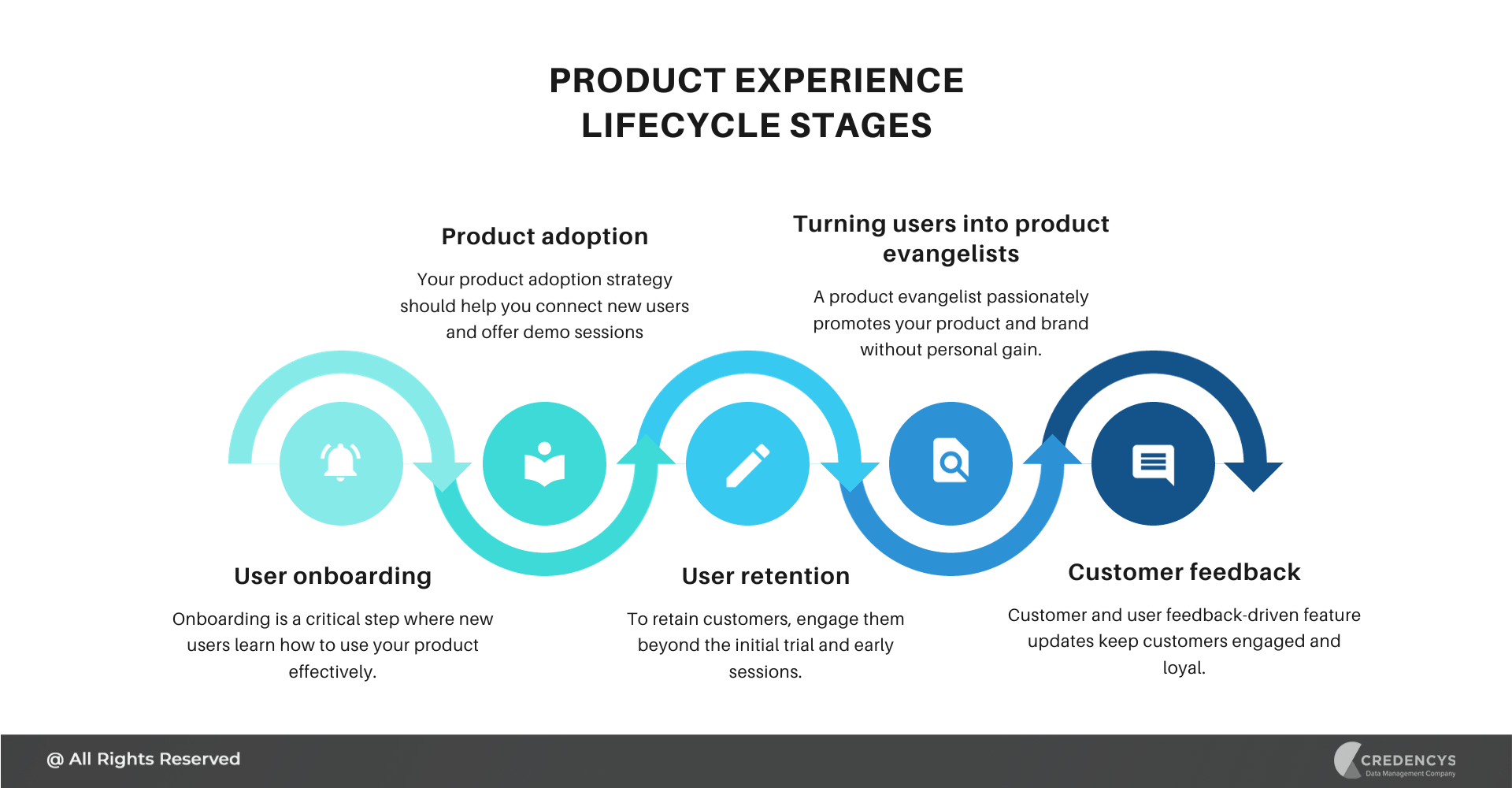
Navigating Retail Success – The Crucial Role of Supplier Data Management

The retail industry, a bustling landscape driven by consumer demands and trends, is no stranger to cutthroat competition. With consumers having more choices than ever and the rise of online shopping, retailers constantly strive to offer unique experiences, superior products, and unbeatable prices.

In this dynamic environment, staying ahead requires not only an acute understanding of consumer preferences but also a finely tuned supply chain that can respond with agility to changing market conditions.

Introducing Supplier Data Management: A Retail Imperative

At the heart of every retail operation lies a network of suppliers, manufacturers, and distributors that form the backbone of the products that line store shelves and eCommerce platforms. This intricate web of relationships serves as the lifeline connecting retailers to their sources of inventory.

Enter the concept of Supplier Data Management – a strategic approach that holds the potential to revolutionize the way retailers interact with their suppliers and, consequently, the way they serve their customers. Supplier Data Management involves the systematic collection, organization, validation, and utilization of data from suppliers.

This data encompasses a wide array of information, from product specifications and pricing details to inventory levels and lead times. The effective management of this data empowers retailers to respond rapidly to market shifts, maintain optimal inventory levels, and enhance collaboration with suppliers.

Core Components of Supplier Data in Retail

In the intricate tapestry of retail operations, supplier data serves as the threads that weave together the seamless experience customers expect. From the moment a product is conceived to the instant it lands in the hands of a consumer, supplier data guides its journey.

Let’s unravel the key components of this critical data that lay the foundation for retail success:

Product Information: SKUs, Descriptions, Specifications, etc.

Imagine walking into a store or browsing an online shop, drawn by a product that resonates with your needs and desires. What draws you in is not just the physical appearance, but the information that paints a complete picture of the product.

Supplier data encompasses this crucial product information:

  • Stock Keeping Units (SKUs): Unique identifiers that track products throughout the supply chain, helping retailers manage inventory and sales.
  • Product Descriptions: Clear and accurate descriptions that inform customers about the product’s features, benefits, and intended use.
  • Specifications: Detailed technical information that helps customers make informed purchasing decisions.
  • Images and Videos: Visual assets that showcase the product from various angles, enhancing the customer’s understanding.

Pricing and Terms: Cost, Wholesale Pricing, Discounts, Payment Terms, etc.

Pricing is a delicate dance in retail, one that directly impacts profit margins and customer perceptions. Supplier data management plays a pivotal role in ensuring that pricing information is consistent and transparent:

  • Cost: The price at which retailers purchase products from suppliers, directly influencing profitability.
  • Wholesale Pricing: Special pricing offered to retailers who buy in bulk, allowing them to set competitive retail prices.
  • Discounts: Special offers or negotiated discounts that impact the final price paid by the retailer.
  • Payment Terms: The agreed-upon timeline for payment between the retailer and the supplier.

Inventory and Lead Times: Stock Levels, Reorder Points, Delivery Times, etc.

In the world of retail, timing is everything. Efficient inventory management relies on accurate and up-to-date inventory and lead time information:

  • Stock Levels: Real-time data on the quantity of products available in the inventory.
  • Reorder Points: A predefined inventory level that triggers the need for a replenishment order.
  • Delivery Times: The estimated time it takes for products to be delivered from the supplier to the retailer’s location.
  • Lead Times: The time it takes for an order to be processed and delivered, including both production and transportation times.

These core components of supplier data might seem like mere details, but they hold the power to make or break retail operations. Accurate product information guides customers’ purchase decisions, transparent pricing ensures trust and efficient inventory management prevents stockouts or overstock situations.

Essentially, these components are the gears that keep the retail machine running smoothly, from the back-end supply chain to the front-end customer experience.

Key Supplier Data Management Business Processes

Here, we examine the five business processes that constitute a robust supplier master data management solution, along with the broader advantages it brings.

Supplier Onboarding

This particular operational procedure is commonly known as supplier or vendor onboarding. It essentially involves how a business initiates a new partnership with a supplier or vendor.

If this process is entirely new to the enterprise, it commences from the ground up. However, if the supplier has prior dealings with any of the client’s entities, it evolves into a supplier extension process.

Supplier onboarding initiates when a particular business division requests services or products from a supplier. This request can come from any department, whether it be marketing, research, finance, or supply chain.

The workflow components of the supplier onboarding process encompass the approval of the request, data collection, evaluation of the provided information, business approval, and the subsequent integration into the target systems.

Update Supplier

This involves the procedure of modifying an existing record. Updating an existing supplier’s information can have ramifications on both central and global data, necessitating a form of global governance for efficient execution.

The process of having every team that utilizes the supplier approve their details often proves to be ineffective. Additionally, there are instances where the supplier’s data is strictly localized.

For example, data related to bank accounts, payment terms, and reconciliation accounts specific to a particular business unit. Managing such data should be handled at the local or central level.

Divisional offices must retain control over local data to ensure accessibility and enhance operational flexibility. Changes within this process can be initiated either internally or externally through a vendor’s portal.

Over time, this process can extend beyond vendor data management and encompass modifications to other categories of information, such as social responsibility, information security, health and safety, and other pertinent data.

Deactivate Supplier

This process, referred to as supplier off-boarding, is initiated when a user opts to deactivate a supplier. Two primary components are involved in this procedure:

  • The subsequent approval.
  • Updating the information to prevent access in the relevant P2P (Procure-to-Pay) and ERP (Enterprise Resource Planning) systems.

Deactivation may be necessary due to duplicate entries of suppliers. Alternatively, it may be warranted for suppliers with whom the business no longer intends to engage in future transactions, such as those that have ceased operations or declared bankruptcy.

Reactivate Supplier

Reactivation represents the final stage in the effective management of supplier master data. It entails the process of re-establishing a relationship with a supplier after a period of inactivity.

During this dormant period, a substantial amount of information—pertaining to both the supplier and the business—may have undergone changes. Therefore, it is of paramount importance to ensure that all data and information are not only valid but also up to date.

Undoubtedly, the most crucial process in this chain is supplier onboarding. This is because it sets the stage for subsequent tasks.

For example, once a supplier contract has been established, evaluating risks and compliance becomes a more logical step. Therefore, it is advisable to conduct a comprehensive supplier onboarding process to mitigate unforeseen risks in the vendor relationship later down the line.

Key Business Processes for Supplier Data Management

Challenges of Retailers Without Effective Supplier Master Data Management

Picture a retailer grappling with outdated or inaccurate supplier information. The consequences are far-reaching, extending well beyond the confines of the stockroom.

Inaccurate product descriptions might lead to customer dissatisfaction and returns. Poorly managed pricing data could result in inconsistencies between online and in-store prices, eroding trust among customers.

Furthermore, improper coordination of inventory and lead times might lead to stockouts or excess inventory, causing financial strain and operational inefficiencies. Without an effective supplier data management strategy, retailers face an uphill battle in a rapidly evolving landscape.

The challenges are multifaceted:

  • Inefficiency: Manual data entry and inconsistent information lead to inefficiencies across the supply chain. Miscommunications and errors can ripple through the entire process.
  • Inaccuracies: Without a centralized system to validate and update supplier data, inaccuracies become commonplace. This leads to confusion, loss of sales, and a tarnished brand reputation.
  • Missed Opportunities: Inaccurate demand forecasting due to unreliable supplier data can result in missed sales opportunities or overstock situations.
  • Customer Dissatisfaction: Inaccurate product information and pricing can disappoint customers, eroding their trust and loyalty.
  • Operational Costs: Constantly firefighting data discrepancies can divert valuable resources and time away from strategic initiatives.

In the face of these challenges, it becomes evident that effective supplier data management isn’t just a choice; it’s a necessity for retailers aiming to thrive in the modern retail landscape.

Benefits of Supplier Master Data Management in Retail Operations

Supplier Data Management provides the lifeblood of products that populate the shelves, from the latest gadgets to the trendiest fashion pieces. The availability, quality, and pricing of these products are intricately tied to supplier performance.

Efficient supplier data management empowers retailers to optimize these critical aspects:

Product Availability

When a customer walks into a store or visits an online shop, they expect the products they desire to be available. Suppliers play a pivotal role in ensuring that the right products are in stock when and where they are needed.

Effective supplier data management streamlines inventory updates, reducing the likelihood of frustrating stockouts or overstock situations.

Product Quality

Customers associate the quality of products directly with the retailer’s brand. Suppliers provide crucial information about product specifications, ingredients, and manufacturing processes.

Accurate and up-to-date supplier data enables retailers to maintain quality standards and promptly address any quality-related issues.

Pricing Accuracy

Supplier data management ensures that pricing information is accurate and consistent across all channels, be it the physical store or the online platform. This consistency boosts customer confidence and reduces friction in the buying process.

Significance of Supplier Data Management in Retail Operations

Ripple Effects of Poor Supplier Data Management

In a highly interconnected retail ecosystem, the impact of poor supplier data management reverberates far and wide. It’s like a stone thrown into a calm pond – the ripples touch every corner of the business:

Customer Satisfaction

Picture a scenario where a customer orders a product online based on incorrect information, only to find out upon delivery that the product doesn’t meet their expectations. Such instances erode trust and lead to dissatisfied customers, affecting not only the current sale but also potential future business.

Brand Reputation

Retail success hinges on building a strong brand reputation. Incorrect product information, mismanaged pricing, or supply chain disruptions due to outdated supplier data can tarnish this reputation and push customers towards competitors.

Operational Efficiency

Poor supplier data management leads to inefficiencies in inventory management. Retailers might overstock items that aren’t in demand or struggle to meet customer needs due to understocking.

This inefficiency affects operational costs, tying up capital in excess inventory or resulting in lost sales opportunities.

Decision-Making

Strategic decisions, like inventory planning, pricing strategies, and expansion plans, rely heavily on accurate supplier data. Without reliable data, retailers are essentially navigating blindfolded, making decisions based on incomplete or inaccurate information.

Streamlining Retail Operations with Effective Supplier Data Management

Every step must be choreographed to perfection in the complex realm of retail operations. From the moment a customer places an order to the time they walk away with their purchase, a symphony of processes comes into play.

Effective supplier data management takes on the role of the conductor, orchestrating the harmony of various operations and ensuring that the retail experience is flawless. Let’s explore how well-managed supplier data impacts key retail operations:

Inventory Management: Ensuring Optimal Stock Levels, Reducing Overstock or Stockouts

Inventory management is the art of maintaining the delicate balance between having enough products to meet demand without tying up excess capital in overstock. Supplier data management provides the crucial insights necessary to achieve this balance:

  • Optimal Stock Levels: Accurate and real-time data about stock levels empowers retailers to make informed decisions about when to replenish inventory.
  • Reorder Points: Using supplier data on reorder points ensures that products are restocked at the right time, preventing stockouts without accumulating excess inventory.
  • Efficient Reordering: Supplier data streamlines the reordering process, reducing manual efforts and potential errors.

Demand Forecasting: Leveraging Historical Supplier Data for Accurate Predictions

Forecasting customer demand is a challenge that retailers face daily. Effective supplier data management adds a layer of precision to these predictions:

  • Historical Data Analysis: Supplier data holds historical records of past orders, allowing retailers to identify patterns and trends in customer demand.
  • Seasonal Variations: Leveraging supplier data, retailers can anticipate and prepare for seasonal spikes in demand, aligning inventory accordingly.
  • Minimizing Surpluses and Shortages: By forecasting demand accurately, retailers can minimize situations of excess stock or unmet customer demand.

Pricing Strategy: Using Supplier Cost Data for Competitive Pricing

Pricing products competitively is a constant juggling act. Supplier data management equips retailers with the data needed to formulate a strategic pricing strategy:

  • Supplier Cost Data: Accurate cost data from suppliers forms the foundation for determining the right retail price that balances profitability with market competitiveness.
  • Real-Time Updates: Supplier data management ensures that pricing information is up to date, enabling retailers to respond quickly to market changes.
  • Dynamic Pricing: With reliable supplier data, retailers can implement dynamic pricing strategies that adjust prices based on real-time market conditions.

Streamlining Retail Operations with Effective Supplier Data Management
When these operations align seamlessly, the result is a harmonized retail experience that benefits both the retailer and the customer.

Supplier Master Data Management in Retail – Best Practices

To compose a symphony of success, retailers must embrace best practices in supplier data management. Here are the key practices that can elevate the retail performance:

Data Standardization: Establishing Consistent Formats for Supplier Information

Standardizing the way supplier data is collected and presented brings coherence to the performance:

  • Unified Data Fields: Define clear and consistent fields for supplier data such as product names, SKUs, and specifications. This creates a structured foundation for information.
  • Uniform Coding: Implement universal codes or identifiers for products and categories, simplifying data management and search processes.

Regular Updates: Ensuring Data Accuracy Through Routine Validation and Updates

Supplier data is like a living entity, evolving over time. Keeping it accurate requires regular care and attention:

  • Scheduled Reviews: Establish a regular review cadence to assess the accuracy and relevance of supplier data. This prevents the accumulation of outdated or irrelevant information.
  • Automated Validation: Employ automated tools to cross-check data against predefined standards, flagging inconsistencies for manual review.

Data Integration: Integrating Supplier Data Across Systems for Real-time Insights

In the grand symphony of retail, real-time insights are the conductor’s baton, guiding every move with precision. Integrating supplier data across systems empowers retailers to make informed decisions:

  • Centralized Data Repository: Create a single source of truth for supplier data accessible to all relevant departments. This reduces data silos and promotes consistency.
  • API Integration: Leverage Application Programming Interfaces (APIs) to enable seamless data flow between different systems, ensuring up-to-date information across the board.

Collaboration: Effective Communication with Suppliers for Data Accuracy

No symphony can be performed without communication among musicians. Similarly, collaboration with suppliers is paramount for accurate data:

  • Clear Expectations: Establish clear guidelines with suppliers about the quality, format, and frequency of data updates. Define roles and responsibilities for data maintenance.
  • Open Channels: Maintain open communication channels to swiftly address any discrepancies or changes in supplier data.

Enhancing Relationships Through Supplier Data Management

Effective supplier relationships are the cornerstone of a successful and resilient business. The way businesses manage and leverage supplier data can significantly impact the strength and longevity of these partnerships.

Let’s delve into how proper supplier data management can fortify these relationships:

Effective Communication and Transparency

Communication is the lifeblood of any relationship, including those in the business world. Proper supplier data management facilitates effective communication and transparency in several ways:

  • Real-time Updates: Maintaining accurate and up-to-date supplier data ensures that both parties are working with the most current information. This reduces misunderstandings and errors caused by outdated or conflicting data.
  • Order Tracking: Transparency in the supply chain allows for real-time tracking of orders, shipments, and deliveries. Suppliers can provide accurate status updates, enhancing trust and reliability.
  • Issue Resolution: When issues or discrepancies arise, clear and transparent data enables quicker and more efficient resolution. Both parties can access the same data, making it easier to pinpoint the root cause and find solutions.

Collaborative Product Development and Innovation

Innovation often flourishes when businesses and suppliers collaborate closely. Supplier data management plays a pivotal role in fostering these partnerships:

  • Shared Product Information: Effective data management allows for the sharing of product specifications, design changes, and quality standards. This collaborative approach can lead to the development of better products.
  • Market Insights: Suppliers can provide valuable market insights and trends based on data analysis. This information can inform product development strategies and help both parties stay competitive.
  • Cost Efficiency: Collaborative efforts can also identify cost-saving opportunities, leading to more efficient production processes and improved profit margins.

Mutual Growth Through Data-Driven Insights

Supplier data is a goldmine of information that can be harnessed to drive growth for both your business and your suppliers:

  • Performance Metrics: Supplier data can be used to track and evaluate supplier performance against key performance indicators (KPIs). This data-driven approach can highlight areas for improvement and optimization.
  • Demand Forecasting: Accurate supplier data aids in demand forecasting, allowing suppliers to better align their production with your needs. This reduces the risk of overstock or stockouts, benefiting both parties.
  • Strategic Planning: Supplier data can inform strategic decisions, such as expanding into new markets or diversifying product offerings. These insights enable mutual growth strategies.

Enhancing Relationships Through Supplier Data Management

Proper supplier data management is not just about data accuracy and compliance; it’s about nurturing strong, collaborative, and mutually beneficial relationships. By emphasizing effective communication, fostering innovation, and leveraging data-driven insights, businesses can enhance their supplier partnerships, ultimately leading to sustainable growth and success for all parties involved.

Future of Retail Supplier Data Management

In the ever-evolving landscape of retail, staying ahead of the curve is paramount. Supplier data management, a linchpin of successful retail operations, is not exempt from this imperative.

Let’s explore the emerging trends and technologies that are poised to shape the future of supplier data management in retail:

AI-Driven Demand Forecasting

In the age of data, artificial intelligence is proving to be a game-changer for demand forecasting. AI algorithms, fueled by vast datasets and real-time information, can predict customer preferences and market trends with unprecedented accuracy.

Here’s how AI-driven demand forecasting is revolutionizing supplier data management:

  • Predictive Analytics: AI can analyze historical data, market trends, and even external factors like weather and social media sentiment to forecast demand more accurately. This not only reduces the risk of overstock or stockouts but also optimizes inventory levels.
  • Dynamic Pricing: AI can dynamically adjust pricing based on real-time demand, competitor pricing, and inventory levels, maximizing revenue while offering competitive prices to customers.
  • Personalization: By analyzing customer data and purchase history, AI can recommend products to individual customers, enhancing their shopping experience and increasing sales.

Blockchain for Transparent Supply Chains

Blockchain technology is making significant inroads into supply chain management, promising unprecedented transparency and traceability. In retail supplier data management, blockchain offers several transformative benefits:

  • End-to-End Visibility: Blockchain creates an immutable ledger that records every transaction, from the sourcing of raw materials to the delivery of finished products. This ensures transparency throughout the supply chain, reducing the risk of fraud and counterfeiting.
  • Supplier Accountability: Smart contracts on the blockchain can automatically enforce supplier agreements and payments when predefined conditions are met. This enhances trust and accountability.
  • Traceability: In the event of recalls or quality issues, blockchain allows retailers to quickly trace the source of a problem, minimizing the impact on consumers and brand reputation.

Personalized Customer Experiences Powered by Supplier Insights

Customers today expect personalized experiences, and supplier data can play a pivotal role in delivering just that. By leveraging supplier insights, retailers can create tailored shopping experiences:

  • Product Recommendations: Supplier data can inform product recommendations based on factors like customer preferences and trending products. This enhances cross-selling and upselling opportunities.
  • Inventory Availability: Real-time inventory data from suppliers can be integrated into online and in-store shopping experiences, allowing customers to check product availability accurately.
  • Customized Offers: Supplier insights can help retailers create personalized promotions and discounts that align with customer preferences and purchasing history.

To thrive in this dynamic landscape, retailers must embrace these emerging trends and technologies, transforming supplier data management from a mere necessity into a strategic advantage that fuels growth and innovation. As we look forward, the integration of these advancements will undoubtedly redefine the way retailers manage their supplier relationships and deliver unparalleled value to customers.

Takeaway

In closing, the future of retail lies in the hands of those who can harness the power of supplier data. It’s not merely a management task; it’s a strategic imperative that can transform retailers into industry leaders.

By embracing these key takeaways and making prudent investments in supplier data management, retailers can not only survive but thrive, delivering exceptional value to customers and securing their place at the forefront of the retail renaissance.

A Detailed Roadmap to eCommerce Product Data Management

In the bustling world of eCommerce, where businesses compete for the attention of digital consumers, the management of product data becomes paramount. eCommerce Product Data Management (PDM) refers to the holistic approach of collecting, organizing, enriching, and maintaining product-related information within an online store’s ecosystem.

This involves the technical aspects of handling data and the strategic understanding of how accurate and consistent data can influence customer engagement, brand reputation, and overall sales performance.

Types of Data Involved in eCommerce

Product data encompasses a variety of attributes that collectively define a product within an online store. This includes:

  • Basic Information: Product name, SKU, manufacturer details, etc.
  • Descriptive Content: Product descriptions, specifications, features, and benefits.
  • Visual Assets: High-quality images, videos, and 360-degree views.
  • Pricing and Availability: Regular and discounted prices, special offers, stock status.
  • Categorization and Taxonomy: How products are organized and presented to customers.
  • Variants and Options: Different sizes, colors, models, and customizable features.
  • User Reviews and Ratings: Customer feedback and opinions.
  • Metadata and SEO: Keywords, meta descriptions, and search engine optimization elements.

PIM vs PDM: Understanding Key Differences For Efficient Product Data Management

Importance of Accurate and Consistent Product Data for eCommerce

Accurate and consistent product data is the foundation of a successful eCommerce operation. Here’s why:

Customer Trust and Credibility

Inaccurate data erodes customer trust. Accurate product details build credibility and help customers make informed purchasing decisions.

Enhanced Customer Experience

Rich, comprehensive product information improves the shopping experience, reducing uncertainty and improving customer satisfaction.

Reduced Returns and Customer Queries

Precise data minimizes misunderstandings, reducing returns and inquiries about product specifications.

Effective Search and Navigation

Well-structured data aids in search and filtering, making it easier for customers to find the products they’re looking for.

SEO and Discoverability

Accurate data improves search engine rankings, increasing the visibility of products to potential customers.
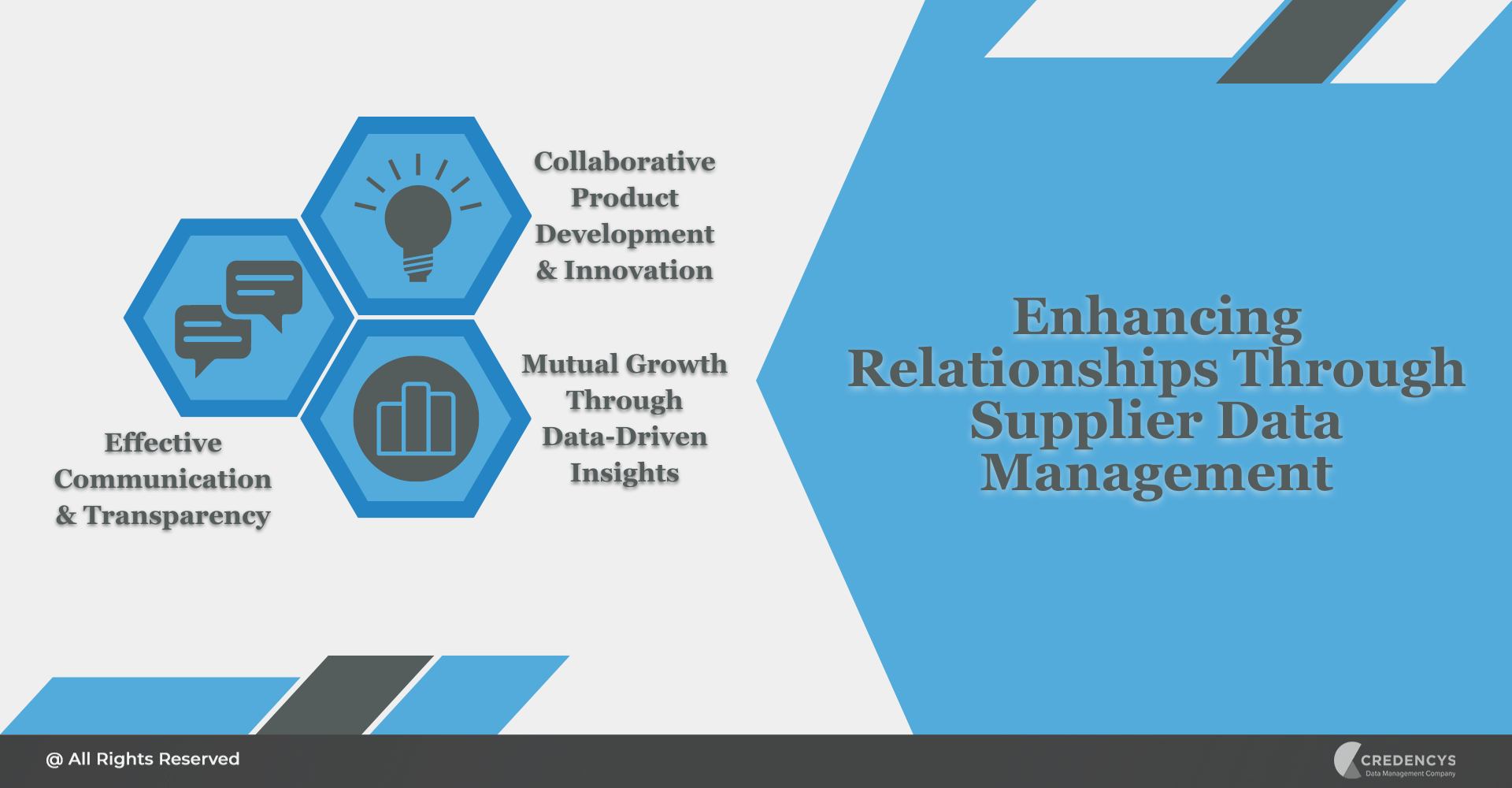
Importance of Accurate and Consistent Product Data for eCommerce

The Role of Product Data in eCommerce

Influencing the Customer Experience

Product data directly impacts the way customers interact with an online store. It sets the first impression and provides essential information.

If a product lacks clear details or images, customers might hesitate to buy. On the other hand, well-presented data makes customers feel confident in their purchases.

Impact on Conversions and Customer Trust

High-quality product data has a significant correlation with conversion rates. When customers can easily access comprehensive information, they are more likely to convert.

Accurate data also reduces the likelihood of negative surprises upon product delivery, enhancing trust in the brand.

Key Components of Effective Product Data Management in eCommerce

Centralized Data Repository

In the realm of eCommerce, where product information can be extensive and diverse, a centralized data repository stands as the cornerstone of efficient product data management. This repository serves as a single source of truth, housing all product-related information in a structured and organized manner.

Product Data Taxonomy & Hierarchy

In the vast expanse of eCommerce, proper categorization and structuring of products are vital for customer navigation and user experience. A well-organized product taxonomy helps customers find products quickly, leading to improved satisfaction and higher conversion rates.

eCommerce Product Data Enrichment & Enhancement

Enriching product data goes beyond the basics, providing customers with a deeper understanding of products. Techniques include adding detailed attributes, such as materials, dimensions, and usage instructions, which help customers make more informed decisions.

What Is Data Enrichment: A Complete Guide

eCommerce Product Data Cleansing

Inaccurate and messy data can lead to customer dissatisfaction and operational inefficiencies. Challenges include duplicate entries, incomplete information, and inconsistencies.

What is Data Cleansing – From Chaos to Clarity

Key Components of Product Data Management in eCommerce

The key components of effective product data management revolve around centralizing data, creating an organized taxonomy, and enriching data for better customer understanding, and ensuring data quality through validation and maintenance. These components collectively contribute to a seamless and satisfying customer experience while optimizing internal operations.

Benefits of eCommerce Product Data Management

Effectively utilizing the PDM system in your eCommerce business opens the door to a diverse array of advantages. These advantages extend beyond a single group; customers, business proprietors, and staff members alike can reap their rewards.

Automates the Processes

Automation acts as a propulsive factor for numerous industries across the spectrum, and particularly within the eCommerce sector, it emerges as an essential cornerstone due to its reliance on automated operations. In an evolving and profitable eCommerce landscape, the importance of process automation becomes evident, serving as a means to optimize efficiency and attain a competitive edge.

This is where PDM assumes a pivotal role by deftly organizing product data, enabling the automation of a majority of operations. With an accurate repository of the entire inventory, the setup of automated orders for replenishing stock levels falling below a predefined threshold becomes feasible.

Furthermore, in the context of introducing new products, automated descriptions are seamlessly incorporated. The intricate task of inputting product attributes and specifications no longer necessitates manual intervention, as the PDM system already houses these details.

As a result, employees can expeditiously establish product listings, swiftly appending features and specifications, and leveraging the data readily available within the PDM system.

Improves Data Management

The readily apparent advantage of utilizing a PDM lies in its facilitation of effective data management. The PDM system serves as a centralized repository that houses a comprehensive spectrum of business-related information.

Data frequently flows in and out of a business while undergoing continuous modifications. To secure the trajectory of business expansion, the importance of maintaining accurate and up-to-date data becomes paramount.

Accomplishing this objective without the aid of a PDM system presents a formidable challenge, given that dispersed data translates into useless data.

Enhances Customer Experience

Enhancing customer experience stands as a paramount priority for modern businesses, particularly in the realm of eCommerce. Given the profusion of choices available today, customers possess the flexibility to swiftly transition to alternative brands.

Hence, ensuring the provision of an optimal experience becomes pivotal. By leveraging PDM systems, businesses can guarantee the infusion of pertinent, systematically organized, and accurate product particulars into their website.

This approach not only equips customers with comprehensive insights into the product but also furnishes them with ready solutions to their inquiries. This, in turn, elevates the overall customer experience, as customers are spared the need to embark on information scavenger hunts.

Furthermore, incorporating relevant product details has the potential to amplify the conversion rate. When customers find comprehensive product information consolidated in one place, their likelihood of proceeding to checkout increases significantly.

In essence, PDM systems ensure an elevated customer experience, effectively guiding them through the trajectory of the sales process.

Improves Inventory Management

Utilizing PDM also facilitates seamless inventory management. By integrating your product data management software with complementary software, it can adeptly monitor inventory levels, streamlining the process.

Consequently, you’ll have a clear understanding of which products necessitate replenishment. What’s even more advantageous is that you possess comprehensive insights into the specifics of the products requiring restocking.

Incorporating details encompassing product manufacturers, pricing, suppliers, and more, orchestrating inventory management via eCommerce product data management becomes an effortless endeavor.

Furthermore, this framework empowers you to conduct demand forecasting, a strategic maneuver that readies you for potential surges in orders. This proactive approach not only bolsters your operational preparedness but also furnishes you with a competitive edge within the market.

Enhances Marketing Strategies

PDM contributes to the refinement of the marketing strategies. Acquiring precise insights into the products enables businesses to execute marketing endeavors with precision.

Given that PDM guarantees the precision and contemporaneity of all product-related data—ranging from specifications and images to product descriptions and beyond—the capacity to craft compelling and trustworthy marketing collateral is significantly elevated.

Consequently, retailers are empowered to generate captivating and credible marketing materials, thereby establishing a foundation of reliability that customers can readily place their trust in.

Improves Productivity & Cycle Time

One of the remarkable attributes of the PDM system lies in its capacity to amplify overall productivity and operational efficiency in data management. It simplifies the storage of data and intricate details related to a product from diverse sources including product manufacturers and suppliers.

With the comprehensive reservoir of data already at their disposal within the system, businesses are liberated from embarking on product listings from scratch. It’s highly plausible that the quintessential details essential for product listing are well within your grasp.

The system adeptly furnishes you with insights concerning raw materials integral to the manufacturing process, precise measurements, and other pivotal data points. Although some fine-tuning might be required to ensure user-friendly product descriptions, the main framework is readily established.

This translates into saving valuable time and exertion that would otherwise be expended in crafting product pages from the ground up. Furthermore, the velocity of the product cycle experiences an acceleration as you speed up making product listings live online.

Most significantly, your workforce is now liberated to channel their efforts into elevating the customer experience rather than being occupied with data entry tasks. They can channel their energy towards tasks like search engine optimization (SEO), incorporating pertinent content onto product pages, and employing tactics that captivate and engage customers.

Minimizes Errors

Relying on manual processes leaves room for human errors, creating a vulnerable space. Conversely, an automated process significantly diminishes the likelihood of mistakes.

Through the implementation of the PDM system, you can clearly understand the product’s specifications and materials instead of trying to figure them out manually. The system adeptly extracts and imports all the required details from credible sources, such as manufacturer or supplier guides.

The outcome is a marked reduction in the inaccuracies within the product descriptions. The presence of precise and comprehensive product descriptions equips customers with a complete understanding of their purchases.

Consequently, instances of product returns are minimized. Moreover, accurate stock records are sustained, facilitated by the synchronization between the PDM system and the inventory system.

By virtue of this synchronization, a real-time awareness of inventory levels is maintained, seamlessly updating the information on the eCommerce platform. This preventive measure shields customers from the exasperation of placing an order only to later discover that the desired product is out of stock.

Improves Compliance

Managing data in a consolidated manner can potentially simplify your adherence to business regulations. With all pertinent information readily accessible, you gain the capacity to uphold transparency and dependability.

This approach facilitates the alignment with sanitary regulations, circumvents inadvertent violations of advertising guidelines, enables vigilant tracking of alterations in product data, and offers various other regulatory advantages. Collectively, this culminates in an enhancement of your business’s legal compliance efforts, effectively safeguarding your brand’s reputation.

Improves Searchability

Lastly, a meticulously precise product description holds the potential to amplify the discoverability of your products in the online realm. Consequently, it seamlessly complements your SEO endeavors without necessitating any extraordinary measures.

Incorporating a relevant product description significantly enhances the probability of your product emerging at the top of search engine results. This, in turn, draws potential customers to your product offerings.

This amplified visibility subsequently translates into escalated traffic and heightened sales figures.

Challenges in eCommerce Product Data Management

Adapting a system to align with evolving demands and emerging threats is an important undertaking. Nevertheless, this ongoing transformation is more complex in practice than in theory, often giving rise to a distinctive array of challenges specific to PDM systems.

The following are the most prevalent among them:

Unnecessary Wastage of Time

Many eCommerce enterprises adopt PDM systems, expecting that these platforms will comprehensively resolve their product data challenges. However, this ideal scenario is seldom the reality, as most PDM systems excel in addressing certain tasks while performing others less effectively.

To optimally support business operations, human engagement is necessary. However, the introduction of human involvement brings forth the potential for errors and inefficiencies stemming from time constraints.

Increase in Operational Costs

The majority of PDM systems necessitate supplementary solutions, such as personal information management systems (PIMs), to address potential gaps. Incorporating these supplementary systems entails additional financial investment for companies.

Online data management systems demand regular updates and maintenance, prompting businesses to onboard specialists proficient in managing such systems. Moreover, if businesses base decisions on flawed or insufficient product data, they risk enduring revenue losses that can substantially impact their profitability.

Multiple Sources of Information

Information holds true value only when it is effectively put into action. PDM systems offer a consolidated reservoir of standardized data, necessitating comprehensive consideration when making business decisions.

Consequently, altering a single variable could potentially trigger a misjudgment, yielding adverse effects on the desired outcome. The saying “less is more” is particularly apt in this context.

An excess of information sources tends to inundate personnel, diverting their attention from the vital application of creativity. Without a nurturing environment for creativity, the pathway to innovation is blocked – a progression that can eventually render a business obsolete or unable to compete within a saturated market.

Poor Customer Experiences

While PDM systems offer access to product data, they cannot consistently assure the accuracy of the interpreted data. Data that hasn’t undergone thorough cleansing often harbors duplicate entries, which detrimentally impact product optimization.

Consequently, customers might find themselves investing more time in reviewing redundant information, resulting in frustration and disengagement. This, in turn, diminishes the likelihood of them offering referrals to the business, thereby impeding potential avenues for generating revenue.

Poor Communication Between Teams

Businesses typically function as a collective effort, with individuals striving towards a shared objective, aiming at the envisioned scale. In this context, a PDM system assumes paramount importance, acting as a conduit for seamless communication and fostering collaborative endeavors.

Should a PDM system encounter failure, it is probable that information exchange will encounter delays. Consequentially, the repercussions of such an occurrence would invariably impede collaboration, leading to the erosion of adherence to established deadlines set by businesses.

The process of introducing a product to the market is of as significance as the product itself. In situations where demand for a particular product has largely been fulfilled by competing entities, a delayed introduction could significantly decrease the likelihood of customer adoption.

Such timing misalignments directly impact sales figures, subsequently undermining business profits and casting shadows over the future trajectory of the product.

Challenges in eCommerce Product Data Management

Best Practices for eCommerce Product Data Management

To get the most from eCommerce data, businesses should follow these practices:

Investing in Right Resources and Tools

In order to ensure the efficacy of PDM, it becomes imperative to allocate resources towards acquiring the appropriate tools and resources. This encompasses collaboration with experts in product data management or the allocation of resources towards availing product data management services.

Establishing Data Governance System

Regardless of whether businesses opt for cloud storage or an on-site server, it’s imperative to institute security protocols like data encryption, firewalls, SSL certificates, and two-factor authentication to safeguard sensitive information. Consistently assess your policies to ensure alignment with industry benchmarks and regulatory mandates.

Furthermore, maintain vigilant surveillance and keep your system up to date to prevent potential security breaches.

What is Data Governance – A Comprehensive Guide

Ensuring Data Accuracy and Completeness

Ensure that the information you input into your system is both precise and current, leaving no gaps. This practice not only fortifies your product management system but also enhances overall accuracy across all your platforms.

Leveraging a Data Management Tool

Use a holistic PDM system with a CDM system for proficient data management. Such adept systems streamline the process of automating data ingestion and structuring data to establish a single source of truth.

These data management systems further empower businesses to ensure data security, purification, filtration, and visualization, ultimately extracting valuable insights.

Appointing Data Stewards

Choose a proficient and well-informed team comprising data security or data governance experts to oversee data. Their responsibilities encompass establishing security protocols, granting permissions to stakeholders, and effectively managing the data.

Businesses have the option to either manage the data internally or entrust this responsibility to a specialized firm focusing on security and governance.

Future Trends in eCommerce Product Data Management

In the rapidly evolving landscape of eCommerce, product data management is poised to undergo transformative shifts driven by emerging technologies and innovative practices. This section delves into the key trends that are set to shape the future of eCommerce product data management.

AI and Automation

Artificial Intelligence is set to play a pivotal role in optimizing various aspects of product data management. AI-driven algorithms can automate data categorization, enriching data with relevant attributes, and validating the accuracy of information.

This not only enhances the efficiency of data processing but also minimizes the occurrence of errors. AI-powered tools can generate product descriptions dynamically based on the available data.

This streamlines the process of crafting compelling and accurate product narratives, saving time and ensuring consistency across product listings. Predictive analytics driven by AI can forecast demand patterns and optimize inventory levels.

By analyzing historical data and market trends, businesses can avoid stockouts and overstock situations, leading to improved inventory management and cost efficiency.

Augmented Reality (AR) and Virtual Reality (VR)

Augmented Reality and Virtual Reality are poised to revolutionize the way customers interact with products online. By providing immersive experiences, customers can visualize products in real-world settings before making a purchase decision, enhancing their confidence and reducing returns.

Integrating product data with AR/VR experiences adds an extra layer of information for customers. Essential product details, specifications, and user reviews can be seamlessly accessed during these interactions, providing customers with a holistic understanding of the product.

AR and VR technologies have the potential to significantly boost customer engagement and influence purchasing decisions. The interactive and immersive nature of these technologies enhances the overall shopping experience, potentially leading to increased conversion rates.

Blockchain and Data Transparency

Blockchain technology is emerging as a robust solution for ensuring data accuracy and transparency in eCommerce. It provides an immutable and tamper-proof ledger for recording product information and transactions, minimizing the chances of data manipulation or fraud.

Blockchain’s inherent security features can foster customer trust by offering verifiable and tamper-proof records of product data. Customers can be confident in the accuracy and origin of the information provided, enhancing brand reputation and loyalty.

Blockchain has the potential to revolutionize supply chain transparency by providing real-time tracking of products from manufacturer to end consumer. This transparency can help combat counterfeit products, improve traceability, and enhance the overall integrity of the supply chain.

Future Trends in eCommerce Product Data Management

Summing Up

In the dynamic realm of eCommerce, effective product data management stands as a linchpin for success. Throughout this exploration, we’ve journeyed through the core aspects of eCommerce Product Data Management, from its definition and role in the customer experience to the strategies that ensure seamless operations and scalability.

By comprehending the significance of centralized data repositories, taxonomies, enrichment, and quality control, businesses can navigate the complexities of today’s competitive landscape. Incorporating the wisdom shared in this blog post can help businesses harness the true potential of their product data.

From optimizing marketing strategies to enhancing customer experiences and ensuring compliance, the benefits of proficient data management are extensive and impactful. By nurturing well-structured data ecosystems, businesses can stay agile, customer-centric, and primed for growth.

What is Product Master Data Management?

Product Master Data Management (PMDM) represents a domain within the broader scope of Master Data Management (MDM) that specifically focuses on managing product-related information. The What is Product Master Data Management provides you with exclusive insights into the product domain.

By consolidating all product data into a centralized repository, Product Master Data Management establishes a single, reliable source of truth. This centralization enables the seamless distribution of consistent, precise, and timely product data across various systems, customers, retailers, and partners.

Through PMDM, businesses can ensure that their customers can access accurate and comprehensive product details within their catalogs, webshops, and sales channels. Previously known as product information management (PIM), product master data management has evolved to become an integral part of the overall MDM framework. It no longer operates as a standalone solution solely dedicated to product management.

Instead, it is now seamlessly integrated with other MDM components, such as customer data, supplier data, location data, and asset data. This integration allows for a holistic approach to managing master data across different domains.

Now, let us delve into the precise nature of product master data.

What is Product Master Data?

Product master data covers extensive product information, such as its purpose, characteristics, applications, and arrangement. This data can include textual content, numerical information, predefined value lists, hierarchical structures, and relational associations. It also includes various assets like images, videos, certificates, and documents along with other media files.

To ensure accessibility and usability, the product master data is available in multiple languages, accommodating the diverse needs of users. Furthermore, changes made to the product master data are meticulously preserved through versioning, allowing for traceability and maintaining a historical record of modifications.

It is important to note that managing product master data can present challenges due to the vast number of attributes, relationships, and records residing in disparate and isolated systems, applications, and locations throughout the enterprise value chain.

Where is Product Master Data Used?

Product data plays a pivotal role across various platforms and channels, spanning from webshops and physical stores to printed catalogs, order confirmations, invoices, marketing campaigns, data pools, warranty claims, and even searches for replacement parts.

Consequently, the centralized management of product data becomes a necessity for organizations of all sizes. Even small businesses with a single platform or distribution channel may find themselves handling thousands upon thousands of products that require effective management and enrichment.

Where is Product Master Data Used

Product Master Data Management (PMDM) provides additional value in several scenarios:

1. Retail and Distribution Channels

The PMDM platform makes it easy for organizations to collaborate with suppliers and swiftly onboard new products. This seamless process enables the efficient movement of products and data across multiple channels, creating strong connections with end consumers.

2. E-commerce and Content Management Systems (CMS)

With PMDM, omnichannel or online retail teams can effortlessly distribute accurate and up-to-date product information to multiple channels from a centralized repository, ensuring consistency and timeliness.

3. Digital Asset Management (DAM)

PMDM integrates with Digital Asset Management solutions, where marketing departments primarily manage and reference digital assets like product images, videos, metadata, and rich content. The DAM functionality can be part of the MDM system or a separate but integrated solution.

4. External Data Channels

Retailers and their vendors can find collaboration opportunities by using content service providers, data pools, and marketplaces to share and onboard product data and content more efficiently.

5. Internal Channels

The product master data model permeates various dynamic functions within an organization, starting from production, sales, and marketing to customer support, operations, logistics, and finance. By working with accurate and reliable product data, organizations can minimize product returns and enhance customer service.

6. Print

Some customers prefer having tangible documentation, such as concise product sheets, comprehensive price lists, or intricate catalogs. However, producing printed catalogs that encompass a broad range of products in multiple languages can present significant challenges.

7. Regulatory Repositories

GS1 and government agencies like the FDA ensure compliance with industry standards and regulations by enforcing them. Their actions prioritize consumer safety, and upholding health standards, within the food industry.

Throughout the lifecycle of a product, data may be scattered across spreadsheets or isolated product databases within different systems and departments. The existence of multiple versions of a single product poses numerous risks.

These range from inaccurate product descriptions that lead to returns and customer complaints to ineffective marketing efforts and overall inefficiency within the enterprise. Poor quality product data negatively impacts various aspects of the business, with the product itself being the most affected.

Having disparate and inconsistent product data can result in serious consequences. Therefore, it is imperative to establish robust processes and systems that centralize and harmonize product data, ensuring its accuracy, completeness, and reliability.

By doing so, organizations can mitigate risks, enhance operational efficiency, and deliver a superior customer experience.

What is Product Master Data Management?

Product data management involves the utilization of advanced systems and software to effectively monitor and manage specific data associated with a product. Within a Product Data Management (PDM) module, a diverse range of data points can be meticulously tracked. Among the commonly monitored variables in a product master data system are:

  • Brand name
  • The part number and detailed part description
  • Supplier or vendor information
  • Unit of measurement for the product
  • The unit cost of the product
  • Schematics and comprehensive data sheets

Product data management aims to systematize the process of recording and accounting for any modifications made to a product or its related information. Its implementation can render numerous benefits to businesses.

  • Comprehensive record keeping of all changes made to a product’s data, ensuring transparency and traceability.
  • Reduction in time spent on retrospective data tracing, as a clear data chain-of-custody is readily available.
  • Streamlined manufacturing processes through the ability to reuse product designs and schematics, enabling efficiency gains.
  • Improved collaboration among different business units or functions, facilitated by easy sharing of information.
  • Enhanced data security when sharing information outside the organization, protecting intellectual property.

Product data management is essential for effective management of the entire product lifecycle. It helps companies promote efficiency, accuracy, and collaboration while ensuring data security throughout the organization.

8 Business Benefits of Product Master Data Management

Having a single source of truth for product data is essential as it integrates knowledge from across the enterprise, enabling actionable insights, informed decision-making, and ultimately driving success in the digital landscape.

Business Benefits of Product Master Data Management

Implementing Product Master Data Management (PMDM) brings forth numerous business benefits for your organization, including:

1. Superior Experiences

By leveraging accurate and up-to-date product information, you can enhance engagement and foster customer loyalty. Consistently displaying reliable data across all channels significantly improves the customer experience, leading to better customer retention rates (up to 8% improvement).

2. Faster Time-to-Market

PMDM facilitates the swift launch and onboarding of new products and services, enabling your organization to gain a competitive advantage as a first-mover in the market. Implementing PMDM can reduce time-to-market by as much as 80%. Moreover, PMDM supports global growth and market expansion by facilitating localized content and targeted promotions.

3. Revenue Growth

With PMDM, you can optimize revenue generation through effective upselling and cross-selling strategies. Studies suggest that organizations implementing PMDM can experience revenue increases of up to 30%.

4. Inspire Innovation

By harnessing high-quality data, PMDM empowers agility and drives innovation within your organization. Accurate and reliable product data serves as a foundation for insightful decision-making and inspires creative solutions.

5. Improved Collaboration

PMDM is a powerful tool that fosters collaboration, enhances relationships, and builds trust among different departments and teams. This centralized platform manages and shares product data efficiently across various organizational levels, allowing seamless information exchange, which improves overall productivity.

6. Risk Reduction

PMDM enables organizations to comply with regulatory and industry standards, thereby reducing the risk of non-compliance. Specifically, PMDM addresses food health safety regulations so that organizations can meet the required standards and mitigate potential risks.

7. Empower Transformation

Through the consolidation of processes, PMDM drives digital business performance and delivers value across the entire enterprise value chain. It enables organizations to embrace digital transformation initiatives and achieve operational excellence.

8. Cost Savings

By implementing PMDM, organizations can lower costs associated with data management inefficiencies. Without a holistic view of data sources, product teams often spend valuable time searching across systems, and departments, and reconciling disparate spreadsheets.

Research from Experian suggests that this data cleanup process can consume 15-25% of a company’s revenue. PMDM helps mitigate these costs by providing a centralized, efficient data management solution.

How does Product Master Data Management Ensure Product Data Quality?

How does Product Master Data Management Ensure Product Data Quality

MDM for product data plays a pivotal role in enhancing data quality by employing various effective techniques:

1. Continuous Data Validation

Traditional approaches to data validation are limited to point-in-time accuracy checks, neglecting ongoing errors.

Master data management addresses this challenge by consolidating data into a single, authoritative source, also known as the “golden record.” This enables organizations to apply consistent business rules and processes to all data, ensuring uniformity across different business units.

Through continuous validation, master data management identifies and flags errors, while also offering built-in capabilities for data cleansing and transformation.

2. Data Cleansing

Data cleansing is an essential step in improving data quality. It involves rectifying common inaccuracies such as typos, misspellings, and formatting inconsistencies. Master data management solutions facilitate automated data cleansing by performing necessary corrections on the source data before it is loaded into the master dataset.

Advanced master data management software provides pre-built features for data cleansing, allowing organizations to improve the quality of their data immediately.

3. Automated Matching

Duplicate data is a prevalent issue that undermines data quality. According to research, the cost of not addressing duplicate data can be significantly higher than preventing it. Master data management mitigates this problem through automated matching and merging capabilities.

By employing matching algorithms, duplicates are identified, and a merging process consolidates multiple records into a single, accurate representation. This not only enhances data quality but also reduces storage costs and processing overhead.

4. Managing Reference Data

Reference data is instrumental in improving data quality as it provides context and enhances data usability. It helps establish common metrics, hierarchies, and accountability within an organization for efficient operations.

Master data management systems incorporate dedicated reference data management processes that facilitate mapping and standardizing data across different domains.

By maintaining high-quality reference data, business users develop trust in the information, enabling them to derive insights and make informed decisions swiftly.

5. Data Quality Dashboards

Modern master data management solutions offer data quality dashboards, providing users with enhanced visibility into the overall health of their data. These dashboards present real-time information, allowing organizations to identify data patterns and trends effectively.

Leveraging machine learning capabilities, data quality dashboards identify errors and provide insights into areas that require improvement for better data quality.

Top 8 Technical Capabilities of Product Master Data Management

Technical Capabilities of Product Master Data Management

MDM, also known as Product Master Data Management, is a powerful tool that allows businesses to achieve greater transparency and efficiency while providing valuable insights and experiences.

By utilizing MDM, organizations gain:

1. Seamlessly Integrate and Consolidate Data

With Product MDM, businesses can identify, link, and source data from various disconnected internal and external sources. It provides a unified platform to bring together diverse data sets, ensuring comprehensive and accurate product information.

2. Optimize Digital Assets

Leveraging advanced technologies such as Digital Asset Management (DAM), machine learning (ML), and deduplication, Product MDM enables businesses to efficiently manage and optimize their digital assets. This ensures that marketing efforts are streamlined, eliminating duplicate content and maximizing the impact of assets across multiple channels.

3. Integrate and Synchronize Product Data

Product MDM facilitates the integration of product data across different touchpoints, ensuring consistency and synchronization with the system of record. This seamless integration enhances operational efficiency and enables businesses to deliver a cohesive and unified product experience to customers.

4. Ensure Compliance and Agility

By conforming to industry standards, Product MDM enables businesses to maintain compliance and adaptability across borders, systems, and markets. It provides the necessary tools and processes to ensure agility and regulatory compliance in an ever-changing business landscape.

5. Establish a Single Source of Truth

Through robust workflows and rules, Product MDM helps businesses manage, model, and govern their product data.

By establishing a single source of truth, organizations can ensure data consistency, accuracy, and reliability, leading to improved decision-making and operational efficiency.

6. Enable Data Sharing and Syndication

Product MDM allows businesses to easily share, syndicate, and onboard data to all stakeholders across multiple channels.

This ensures that accurate and up-to-date product information is accessible to partners, customers, and internal teams, driving collaboration and empowering stakeholders with the information they need.

7. Enhance Content Quality and Audience Engagement

Product Master Data Management (PMDM) enables businesses to maintain and enrich content quality, ensuring that product information is engaging and relevant to the target audience.

By delivering consistent and compelling content across various channels, businesses can enhance customer engagement and satisfaction.

8. Seamless Print Publishing Integration

Product MDM supports integration with print publishing, enabling businesses to effectively manage both digital and traditional channels.

This integration ensures that product information is efficiently utilized across different mediums, reaching a broader audience and maximizing the impact of marketing efforts.

13 Product Master Data Management (MDM) Best Practices

Product Master Data Management Best Practices

In today’s rapidly evolving business landscape, effective product master data management is not just a choice but a necessity. Managing product data efficiently can significantly impact various aspects of your business, from customer satisfaction to operational efficiency.

To help you navigate this essential practice, we’ve compiled a set of best practices that can propel your product management to new heights.

1. Data Quality Assurance

Data quality assurance goes beyond just error detection; it ensures your data is reliable, accurate, and consistent. Implementing data validation rules during data entry prevents erroneous information from entering the system.

Regular data profiling and cleansing identify patterns of inaccuracies, enabling targeted corrections. High-quality data leads to more reliable insights, enhances customer trust, and supports informed business decisions.

2. Centralized Data Repository

A centralized repository isn’t just about data storage; it’s about efficient data access and collaboration. It simplifies data updates, as changes are made in a single location and propagated across systems.

This reduces time wasted searching for data and minimizes data silos, fostering interdepartmental collaboration. Employees can rely on up-to-date information, leading to improved operational efficiency.

3. Standardized Data Formats

Standardized data formats foster seamless data exchange and comparability. Consistency in attributes and naming conventions ensures that systems can easily interpret and process the information.

This practice also improves searchability, as standardized attributes enable accurate filtering and sorting. Clear, standardized data formats lead to better data integration and more reliable analytics.

4. Data Enrichment

Data enrichment transforms basic information into a valuable resource for customers and partners. Rich product descriptions, detailed specifications, and multimedia content provide a comprehensive view of each product.

This not only empowers customers to make informed purchases but also improves SEO and drives higher traffic to your products, translating to increased sales opportunities.

5. Data Governance

Data governance isn’t just about rules; it’s about ensuring data remains accurate, trustworthy, and compliant. Clearly defined roles and responsibilities help maintain data ownership.

Implementing data quality rules and approval workflows minimizes the chances of errors entering the system. This practice safeguards against data breaches, enhances customer confidence, and supports regulatory compliance.

6. Regular Data Cleansing

Regular data cleansing isn’t a one-time event; it’s an ongoing process that maintains data health. By regularly identifying and correcting inconsistencies, you prevent data degradation. Clean data ensures accurate reports and insights, enabling well-informed decision-making.

It also reduces the risk of incorrect shipments or customer disappointments due to inaccuracies.

7. Data Security

Data security isn’t just about safeguarding sensitive information; it’s about building trust. Implementing stringent access controls and encryption measures ensures unauthorized personnel cannot access sensitive product data.

This instills confidence in customers, partners, and regulatory bodies that your business values their privacy and security.

8. Integration Capabilities

Integration capabilities ensure a seamless flow of product data across systems. This leads to consistent, up-to-date information available wherever it’s needed.

Integrated systems support efficient order processing, accurate inventory management, and personalized customer experiences. Customers see unified product information regardless of where they engage, enhancing their satisfaction.

9. Scalability

Scalability prepares your MDM solution for growth. As your product range expands, your MDM system should gracefully handle the increased data volume without compromising performance. Scalability ensures you’re ready to cater to more customers and accommodate new products without disruptions.

10. Data Analytics

Data analytics unlocks insights from your product data that guide strategic decisions. Monitoring KPIs like sales trends and customer preferences informs inventory management and pricing strategies.

Predictive analytics helps you anticipate demand fluctuations, enabling proactive responses. Informed decisions backed by data improve resource allocation and ultimately contribute to business growth.

11. User Training

User training is an investment that pays off in data accuracy. Educating users about proper data entry and management practices reduces the chances of errors at the source.

Well-trained users understand the significance of accurate data and are more likely to follow best practices consistently.

12. Change Management

Change management ensures smooth transitions when introducing new products, updates, or discontinuations. Communicated changes prevent confusion and errors.

Well-managed changes also help prevent stockouts or overstock situations due to incorrect product data, thereby reducing costs and improving customer experiences.

13. Continuous Improvement

Continuous improvement fosters adaptability and innovation in your MDM processes. Regularly assessing your practices and identifying areas for enhancement prevents stagnation.

Embracing emerging technologies, like AI or machine learning, can further automate data quality assurance and analytics, leading to even greater efficiencies.

In the Nutshell

In today’s digital landscape, the importance of high-quality product data cannot be overstated. It serves as a cornerstone for achieving success in the digital realm. By embracing a Product Master Data Management (PMDM) strategy, your business can unlock a plethora of benefits, including cost reduction, empowered employees, and strengthened customer relationships.

PMDM empowers you to enhance your e-commerce capabilities and achieve operational excellence by ensuring that your product data is readily accessible to all stakeholders across the value chain.

Recognizing the strategic value and numerous advantages of product data master, you may be eager to embark on this transformative journey but unsure of where to begin or how to justify the investment.

Rest assured, hire an expert team of PMDM specialists who are well-equipped to engage in meaningful discussions with you, understanding your unique product data challenges, and providing tailored solutions to drive your business forward.