Top MLOps Companies in 2026: How to Choose the Right Partner for Scalable AI Deployment

Machine learning is no longer experimental; it’s mission-critical. Yet, most enterprises still struggle to move models from experimentation to production.

Despite heavy investments in AI, only a small percentage of models deliver real business value. This is where MLOps (Machine Learning Operations) becomes essential.

And more importantly, choosing the right MLOps company can make or break your AI success. In this blog, we’ll explore:

  • The top MLOps companies in 2026
  • What makes them stand out
  • How to choose the right partner for your business

Why MLOps Is Critical for Enterprises in 2026

Building ML models is just the beginning. The real challenge lies in:

  • Deploying models reliably
  • Monitoring performance over time
  • Managing data and model drift
  • Ensuring governance and compliance

Without MLOps, organizations face:

  • Fragmented workflows
  • Delayed deployments
  • Inconsistent model performance
  • High operational costs

MLOps bridges the gap between data science and production systems, enabling scalable, repeatable, and governed AI operations.

What to Look for in an MLOps Company

Choosing an MLOps partner is a strategic one that directly impacts how effectively your organization can scale AI initiatives. The right partner should not only understand machine learning but also how to operationalize it across complex enterprise environments.

Here are the key factors to evaluate in detail:

1. End-to-End MLOps Capabilities

Many vendors claim MLOps expertise but only specialize in isolated parts of the lifecycle, such as model development or infrastructure setup. A strong MLOps company should support the entire lifecycle, including:

  • Data ingestion and preprocessing
  • Feature engineering and versioning
  • Model training and experimentation
  • Model deployment (batch and real-time)
  • Continuous monitoring and retraining

This end-to-end ownership ensures there are no gaps between stages, reducing friction and accelerating time-to-production. It also eliminates the need to coordinate multiple vendors, thereby reducing inefficiencies.

2. Deep Platform and Ecosystem Expertise

Modern MLOps is heavily dependent on tools and platforms. However, simply knowing tools isn’t enough; your partner should have hands-on experience integrating and optimizing them within enterprise ecosystems.

Look for expertise in:

  • Unified platforms like Databricks (Lakehouse architecture)
  • Orchestration tools like Kubernetes and Airflow
  • ML lifecycle tools such as MLflow or Kubeflow
  • Cloud ecosystems (AWS, Azure, GCP)

More importantly, they should know when to use what and how to design a cohesive architecture rather than a fragmented toolchain.

3. Strong Data Engineering Foundation

MLOps is only as good as the data that powers it. A capable MLOps company must have strong data engineering capabilities, including:

  • Building scalable data pipelines
  • Ensuring data quality and consistency
  • Managing large-scale structured and unstructured data
  • Supporting real-time and batch processing

Without this foundation, even the most advanced ML models will fail in production due to unreliable data.

4. Industry-Specific Experience

AI is not one-size-fits-all. The challenges faced in retail (e.g., demand forecasting), manufacturing (e.g., predictive maintenance), or supply chain (e.g., inventory optimization) are fundamentally different.

An experienced MLOps partner brings:

  • Pre-built accelerators and frameworks
  • Understanding of domain-specific KPIs
  • Faster implementation cycles

This reduces experimentation time and increases the likelihood of success.

5. Scalability, Automation, and Performance Optimization

As organizations mature, they move from managing a few models to hundreds or even thousands. Your MLOps partner should design systems that:

  • Automatically scale infrastructure based on demand
  • Enable CI/CD pipelines for ML models
  • Reduce manual intervention through automation
  • Optimize performance and cost across environments

This ensures your AI initiatives remain sustainable as they grow.

6. Governance, Security, and Compliance

With increasing regulations around AI, governance is no longer optional. A mature MLOps company should provide:

  • Model explainability and transparency
  • Version control for models and datasets
  • Audit trails for compliance
  • Role-based access controls and security frameworks

This is especially critical for enterprises operating in regulated industries or across multiple geographies.
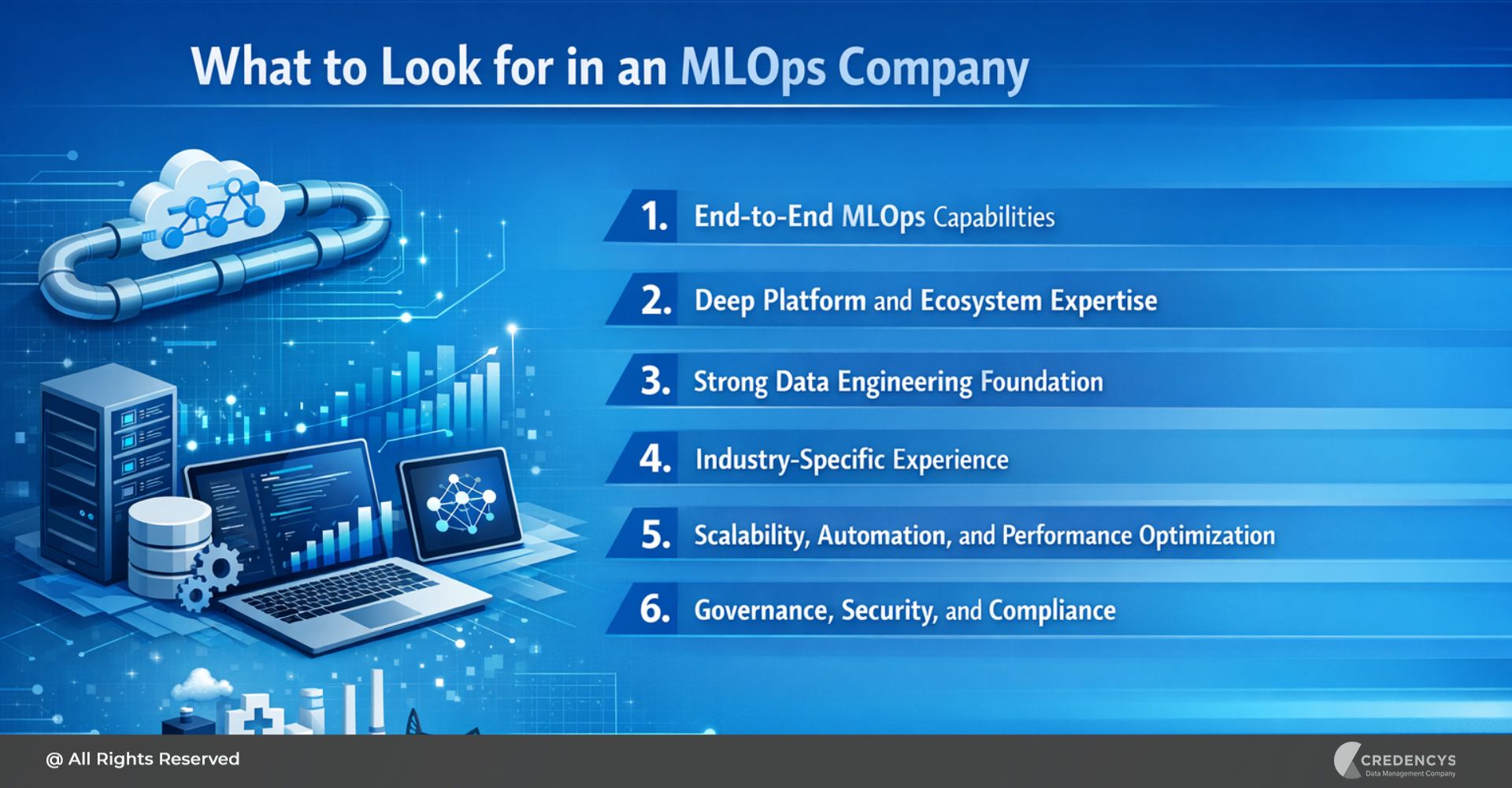
What to Look for in an MLOps Company

Top MLOps Companies in 2026

Here are the top MLOps service providers helping enterprises operationalize AI at scale:

1. Credencys Solutions

Credencys stands out as a strategic MLOps partner for enterprises looking to scale AI initiatives, not just implement tools. With strong expertise in Databricks and modern data architectures, Credencys helps organizations move from fragmented ML efforts to fully operationalized AI ecosystems.

Key Strengths

  • End-to-end MLOps implementation (data → model → deployment → monitoring)
  • Deep expertise in Data Engineering + AI + Lakehouse architecture
  • Custom ML pipelines tailored for retail, CPG, and manufacturing
  • Strong focus on governance, model monitoring, and optimization

What Sets Them Apart

Credencys doesn’t just deploy models; they build scalable AI foundations that align with business outcomes.

Best for: End-to-end MLOps + Data Engineering + AI transformation

2. Turing

Turing provides enterprises with access to vetted remote AI engineers and MLOps specialists.

Key Strengths

  • Large pool of AI/ML talent
  • Flexible engagement models
  • Quick team scaling

Best for: Access to global AI/ML talent and MLOps engineers

Limitations

  • More talent-focused than full lifecycle MLOps consulting
  • Limited strategic transformation capabilities

3. Markovate

Markovate focuses on building AI-powered applications and integrating MLOps practices into product development.

Key Strengths

  • Strong AI product engineering
  • MLOps integration for startups and mid-market
  • Focus on innovation and rapid development

Best for: AI product development with MLOps integration

Limitations

  • Less focus on large-scale enterprise transformation
  • Limited depth in data engineering ecosystems

4. Intellias

Intellias brings strong engineering capabilities and supports MLOps within broader digital transformation initiatives.

Key Strengths

  • Enterprise IT and engineering expertise
  • Scalable architecture design
  • Strong delivery capabilities

Best for: Enterprise-grade digital transformation with MLOps

Limitations: MLOps is part of broader services, not always the core focus

5. Accenture

Accenture is a global consulting giant offering comprehensive AI and MLOps services.

Key Strengths

  • Global scale and resources
  • Strong governance and compliance frameworks
  • Extensive industry experience

Best for: Large-scale enterprise AI transformation

Limitations

  • High cost
  • Less flexibility compared to niche MLOps specialists
CompanyBest ForStrengthLimitation
CredencysEnd-to-end MLOps transformationData + AI + MLOps expertiseMore specialized and agile
TuringTalent sourcingFast scalingLimited strategy
MarkovateAI product developmentInnovation-focusedNot enterprise-heavy
IntelliasDigital engineeringScalable systemsMLOps is not the core focus
AccentureEnterprise transformationGlobal reachExpensive

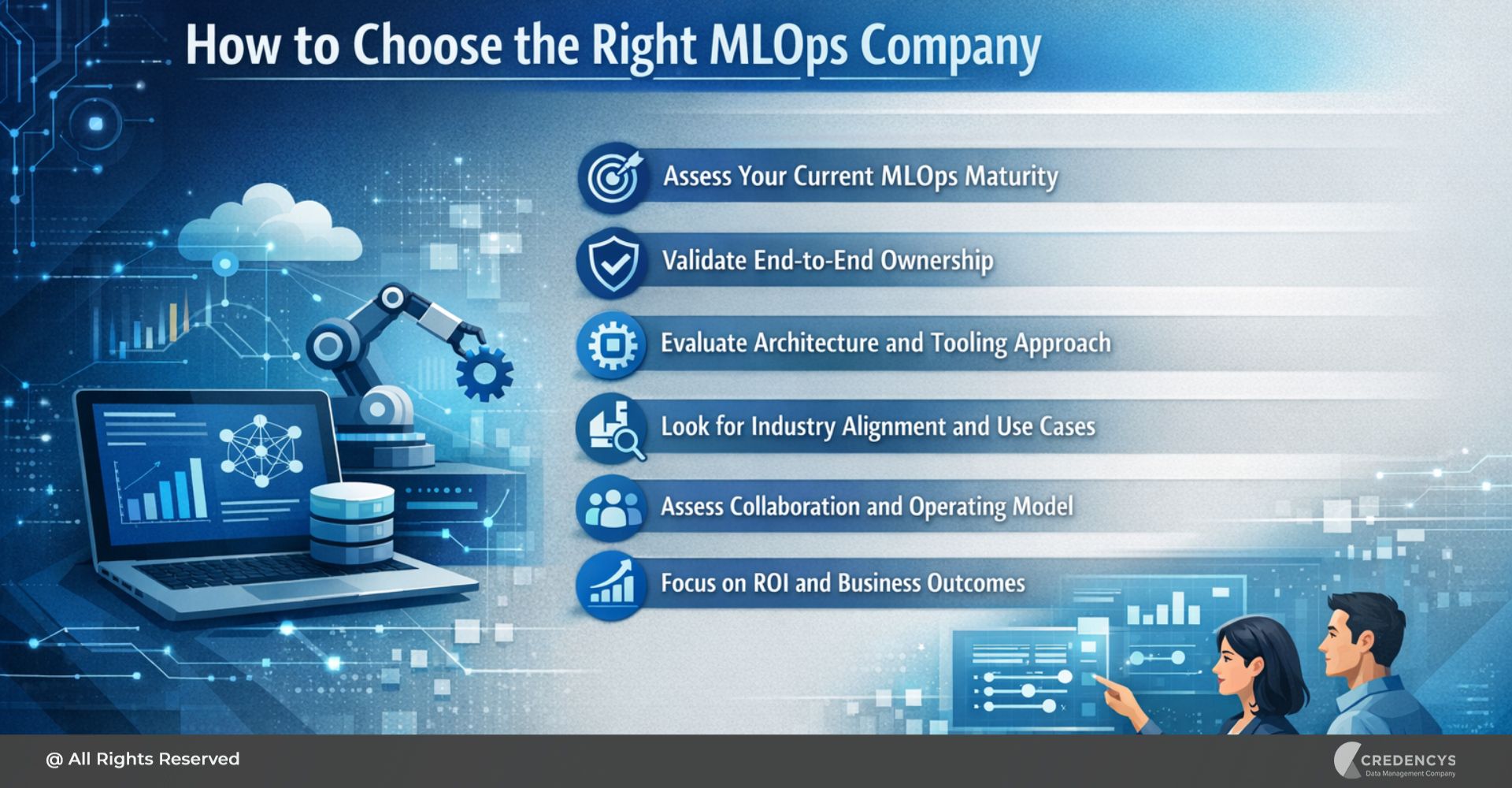
How to Choose the Right MLOps Company

Selecting the right MLOps partner requires a structured approach. Beyond evaluating capabilities, you need to ensure alignment with your organization’s current maturity, future goals, and operational complexity.

Here’s a step-by-step framework to guide your decision:

1. Assess Your Current MLOps Maturity

Before evaluating vendors, you need clarity on where you stand. Ask:

  • Are your data science teams still experimenting in silos?
  • Do you have models in production but struggling with monitoring?
  • Are you scaling AI across multiple business units?

Your answers will determine whether you need:

  • Foundational MLOps setup
  • Optimization and scaling
  • Enterprise-wide governance and standardization

Choosing a partner aligned with your maturity prevents overengineering or under-delivery.

2. Validate End-to-End Ownership

Many organizations make the mistake of hiring separate vendors for:

  • Data engineering
  • Model development
  • Deployment

This often leads to misalignment and delays. Instead, prioritize partners who can own the entire MLOps lifecycle. This ensures:

  • Faster implementation
  • Better accountability
  • Seamless integration across stages

Ask for case studies that demonstrate full lifecycle delivery, not just isolated capabilities.

3. Evaluate Architecture and Tooling Approach

A good MLOps company doesn’t just implement tools; it designs future-proof architectures. During evaluation:

  • Ask how they select tools and platforms
  • Understand how they avoid vendor lock-in
  • Evaluate their approach to integrating with existing systems

The goal is to ensure flexibility, scalability, and long-term sustainability.

4. Look for Industry Alignment and Use Cases

Generic AI expertise is not enough for enterprise success. Request:

  • Industry-specific case studies
  • Demonstrations of similar use cases
  • References from companies in your domain

This helps you gauge how quickly the partner can deliver value in your specific context.

5. Assess Collaboration and Operating Model

MLOps is not a one-time project; it’s an ongoing capability. Your partner should:

  • Work closely with your internal teams
  • Provide knowledge transfer and training
  • Offer flexible engagement models (project-based, managed services, etc.)

Strong collaboration ensures long-term success rather than short-term delivery.

6. Focus on ROI and Business Outcomes

Ultimately, MLOps should drive measurable business value. Evaluate partners based on their ability to:

  • Reduce model deployment time
  • Improve model accuracy and performance
  • Lower operational costs
  • Increase business impact (e.g., revenue, efficiency)

Avoid vendors who focus only on technical metrics without linking them to business outcomes.
How to Choose the Right MLOps Company

Common MLOps Challenges Enterprises Face

Even with the right intent and investment, many organizations struggle to operationalize machine learning effectively. These challenges often stem from a lack of structured processes, fragmented tooling, and limited operational expertise.

Let’s explore the most common issues in detail:

1. Model Deployment Bottlenecks

One of the biggest gaps in AI adoption is the transition from experimentation to production. Data scientists often build models in isolated environments, but:

  • Deployment requires coordination with engineering teams
  • Infrastructure dependencies create delays
  • Lack of standardized processes leads to inconsistencies

As a result, models remain stuck in development, delaying business impact.

2. Limited Visibility and Monitoring

Once models are deployed, many organizations lack proper monitoring mechanisms. This leads to:

  • No visibility into model performance over time
  • Inability to detect issues early
  • Reactive rather than proactive maintenance

Without monitoring, even high-performing models can silently degrade, impacting business outcomes.

3. Data Drift and Model Drift

Real-world data is constantly changing. Over time:

  • Input data distributions shift (data drift)
  • Model accuracy declines (model drift)

Without automated detection and retraining pipelines, models become unreliable and produce inaccurate predictions.

4. Fragmented Tooling and Workflows

Many enterprises use multiple tools across the ML lifecycle: data processing, training, deployment, and monitoring. This creates:

  • Integration challenges
  • Data silos
  • Increased operational complexity

A lack of unified architecture leads to inefficiencies and higher costs.

5. Lack of Standardization and Reusability

In many organizations, ML workflows are built from scratch for each use case. This results in:

  • Duplication of effort
  • Inconsistent practices across teams
  • Difficulty scaling AI initiatives

Standardized pipelines and reusable components are essential for scaling efficiently.

6. Governance and Compliance Challenges

As AI adoption grows, so do regulatory requirements. Organizations often struggle with:

  • Explaining how models make decisions
  • Tracking changes to models and datasets
  • Ensuring compliance with industry regulations

Without proper governance frameworks, AI initiatives can introduce significant risk.

7. Talent and Skill Gaps

MLOps requires a combination of skills:

  • Data engineering
  • Machine learning
  • DevOps

Finding professionals with this hybrid expertise is challenging.

This often leads to:

  • Overburdened teams
  • Delayed implementations
  • Suboptimal solutions

Final Thoughts

MLOps is no longer a “nice-to-have” capability; it has become the backbone of successful AI adoption in modern enterprises. While many organizations have made significant investments in data science and machine learning, the real challenge lies in turning those investments into consistent, scalable business outcomes.

Without a structured MLOps strategy, even the most advanced models remain underutilized, siloed, or quickly become obsolete in dynamic business environments. This is why MLOps is critical.

It transforms machine learning from isolated experimentation into a repeatable, production-grade system that continuously delivers value. However, achieving this transformation is not just about implementing tools or hiring a few specialists.

It requires:

  • A well-defined architecture that integrates data, models, and infrastructure
  • Standardized workflows that enable collaboration across teams
  • Automation to reduce manual effort and accelerate deployment cycles
  • Continuous monitoring to ensure models remain accurate and relevant over time

And most importantly, it requires a strategic partner who understands both the technical and business sides of AI. The right MLOps company doesn’t just help you deploy models; they help you:

  • Build a scalable AI foundation aligned with long-term business goals
  • Reduce time-to-market for new ML initiatives
  • Improve model reliability and performance
  • Minimize operational risks and costs
  • Enable enterprise-wide adoption of AI

As AI continues to evolve, especially with the rise of real-time analytics and generative AI, the importance of MLOps will only grow. Organizations that invest in strong MLOps capabilities today will be better positioned to innovate faster, respond to market changes, and maintain a competitive edge.

On the other hand, those who delay may find themselves stuck in a cycle of experimentation without tangible returns. In this landscape, choosing the right MLOps partner becomes a critical decision.

If your goal is to move beyond pilot projects and build scalable, enterprise-grade AI systems, partnering with an experienced provider like Credencys can accelerate your journey. With the right expertise, tools, and strategy in place, you can transform your machine learning initiatives into measurable, long-term business success.

ETL vs ELT: A Complete Guide to Choosing the Right Data Pipeline Strategy

Over 80% of enterprise data projects fail to deliver expected value, and one of the biggest reasons is a poor choice of data integration strategy.

Businesses are collecting massive volumes of data from multiple sources such as applications, IoT devices, customer interactions, and third-party platforms. But raw data alone does not drive decisions. What matters is how efficiently that data is processed, transformed, and made available for analytics.

This is where the debate of ETL vs ELT becomes critical.

Choosing between ETL (Extract, Transform, Load) and ELT (Extract, Load, Transform) is not just a technical decision. It directly impacts your data quality, scalability, speed of insights, and overall business agility. While ETL has been the traditional approach for decades, ELT has gained significant momentum with the rise of cloud data platforms and modern analytics needs.

So, which one is better?

The answer depends on your data architecture, business goals, and the kind of insights you want to generate.

In this blog, we will break down ETL vs ELT, explore their key differences, advantages, challenges, and help you determine which approach is the right fit for your organization.

TLDR

  • ETL vs ELT comes down to when data is transformed
  • ETL transforms data before loading, ensuring clean and structured data upfront
  • ELT loads raw data first and transforms it later, enabling speed and scalability
  • Choose ETL if you need strong governance, compliance, and structured data from the start
  • Choose ELT if you need flexibility, handle large data volumes, and use cloud platforms
  • ELT is becoming the preferred approach for modern, cloud-first and AI-driven organizations
  • ETL still matters for regulated and legacy environments

What is ETL (extract, transform, load)?

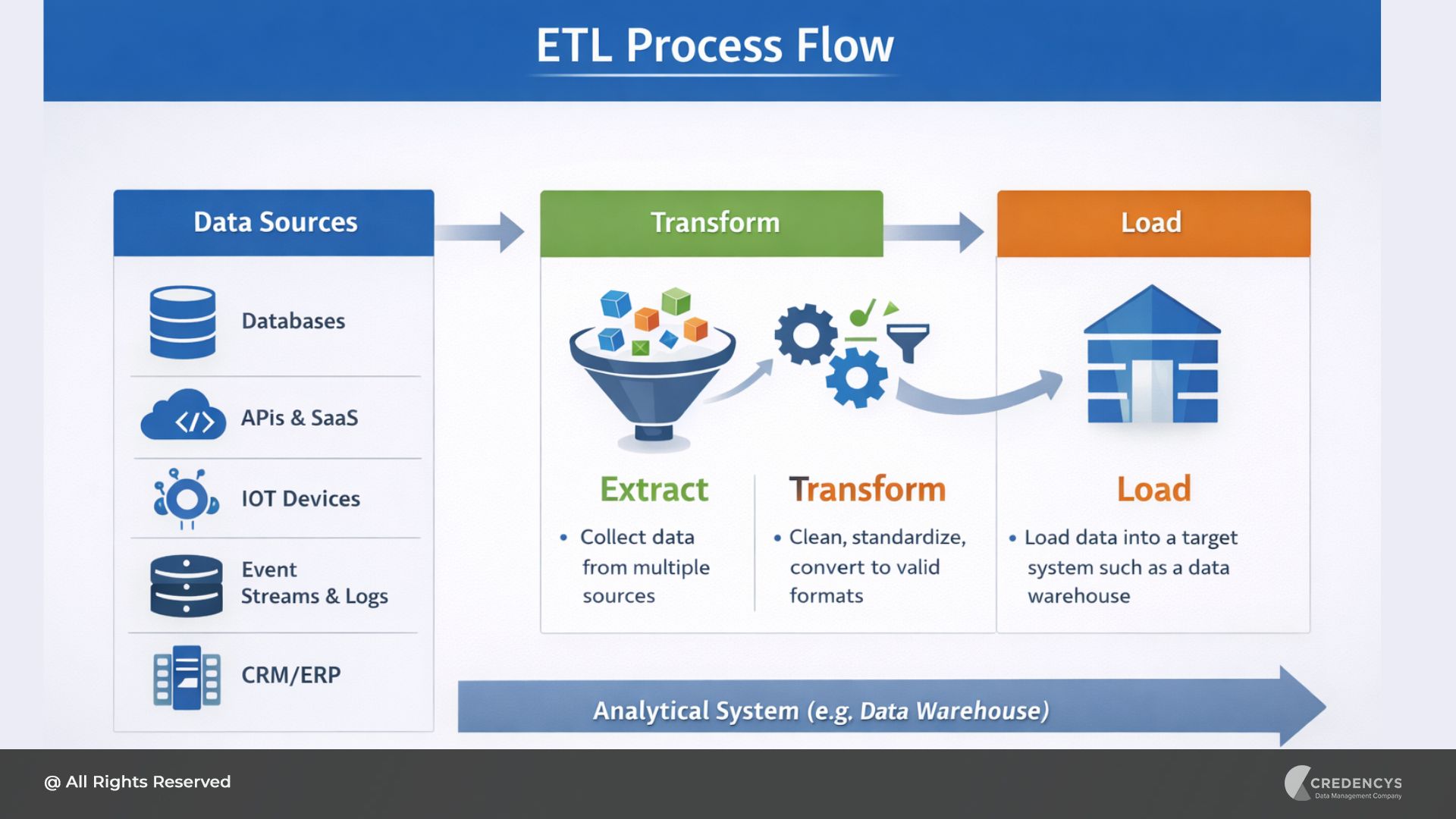
ETL stands for Extract, Transform, Load. It is a traditional data integration approach where data is first extracted from various sources, then transformed into a structured and usable format, and finally loaded into a target system such as a data warehouse.

How ETL Works

1. Extract

Data is collected from multiple sources such as databases, CRM systems, APIs, and files.

2. Transform

The extracted data is cleaned, filtered, enriched, and formatted based on predefined business rules before it reaches the destination.

3. Load

The transformed data is then loaded into a data warehouse or storage system for reporting and analysis.

Key Characteristics of ETL

  • Transformation happens before loading into the target system
  • Requires a separate processing engine or ETL tool
  • Ensures high data quality before storage
  • Works well with structured data and legacy systems

Advantages of ETL

  • Strong data governance and control
  • Clean and consistent data before it reaches analytics systems
  • Suitable for compliance-heavy industries
  • Optimized for traditional on-premise data warehouses

Limitations of ETL

  • Slower processing for large volumes of data
  • Less flexible when dealing with unstructured or semi-structured data
  • Higher infrastructure and maintenance overhead
  • Not ideal for real-time analytics use cases

ETL has been the backbone of data integration for years, especially in environments where data quality and consistency are critical before any analysis takes place. However, as data volumes and speed requirements have increased, newer approaches like ELT have started gaining traction.

What is ELT (extract, load, transform)?

ELT stands for Extract, Load, Transform. It is a modern data integration approach where raw data is first extracted from source systems and loaded directly into a target system, typically a cloud data warehouse. The transformation happens later, within the target system itself.

How ELT Works

1. Extract

Data is collected from various sources such as applications, databases, APIs, and streaming platforms.

2. Load

The raw data is loaded directly into a data warehouse or data lake without significant transformation.

3. Transform

Data is then transformed inside the target system using its processing power, based on analytical needs.

Key Characteristics of ELT

  • Transformation happens after loading into the target system
  • Leverages the compute power of modern cloud platforms
  • Supports structured, semi-structured, and unstructured data
  • Enables faster ingestion of large data volumes

Advantages of ELT

  • Faster data ingestion and processing at scale
  • High flexibility as raw data is always available
  • Ideal for big data and advanced analytics use cases
  • Better suited for cloud-native architectures

Limitations of ELT

  • Requires strong governance to manage raw data
  • Data quality issues can propagate if not handled properly
  • Higher dependency on the performance of the data warehouse
  • Can increase storage and compute costs if not optimized

ELT is becoming the preferred choice for modern data teams, especially those working with cloud data platforms and real-time analytics requirements. It allows organizations to store all their data first and decide how to use it later, making it more adaptable to evolving business needs.

ETL vs ELT: Key Differences

While both ETL and ELT aim to move and prepare data for analytics, the way they handle transformation creates significant differences in performance, scalability, and use cases.

Here is a side-by-side comparison to simplify the decision:

ETL vs ELT Comparison

AspectETLELT
Process OrderTransform before loadingLoad before transforming
Data ProcessingHappens in a separate ETL toolHappens inside the data warehouse
SpeedSlower for large datasetsFaster due to parallel processing
ScalabilityLimited by ETL infrastructureHighly scalable with cloud platforms
Data TypesBest for structured dataSupports structured, semi-structured, and unstructured data
StorageOnly processed data is storedRaw and processed data both stored
FlexibilityLess flexible once data is transformedHighly flexible for future use cases
Cost StructureHigher upfront infrastructure costPay-as-you-go cloud cost model
Use Case FitLegacy systems, compliance-heavy environmentsModern analytics, big data, real-time insights

Key Takeaway

The core difference in ETL vs ELT lies in where and when transformation happens.

ETL focuses on cleaning and structuring data before it enters the warehouse, ensuring control and consistency. ELT, on the other hand, prioritizes speed and scalability by loading raw data first and transforming it later using the power of modern data platforms.
This shift is the reason why many organizations moving to the cloud are adopting ELT as their preferred approach.

ETL vs ELT: When Should You Use Each?

Choosing between ETL vs ELT is not about which one is universally better. It is about selecting the right approach based on your data environment, business priorities, and technical capabilities.

When to Use ETL

ETL is a better fit when control, data quality, and compliance are your top priorities. You should consider ETL if:

  • You are working with legacy or on-premise systems
  • Your organization has strict data governance and compliance requirements
  • You need clean, structured data before loading into the warehouse
  • Your data volumes are manageable and not extremely large
  • You rely heavily on traditional BI and reporting tools

In such scenarios, transforming data before loading ensures consistency and reduces the risk of inaccurate insights.

When to Use ELT

ELT is ideal for organizations that prioritize speed, scalability, and flexibility. You should consider ELT if:

  • You are using cloud data platforms like Snowflake, BigQuery, or Redshift
  • You deal with large volumes of structured and unstructured data
  • You need real-time or near real-time analytics
  • Your use cases include AI, machine learning, or advanced analytics
  • You want to store raw data for future analysis and reprocessing

ELT allows you to ingest data quickly and transform it later based on evolving business needs.

The Modern Reality

For many enterprises today, the decision is not strictly ETL vs ELT. Instead, a hybrid approach is becoming more common. Organizations use ETL for sensitive, compliance-driven workloads and ELT for scalable analytics and innovation use cases.

This balanced strategy helps businesses maintain control where needed while still leveraging the speed and flexibility of modern data platforms.

ETL vs ELT: Which One is Better?

The honest answer is that there is no one size fits all winner in the ETL vs ELT debate. The better approach depends on what your business values more: control or scalability, structure or flexibility, predictability or speed.

Choose ETL if:

  • Data quality and governance are critical from the start
  • You operate in highly regulated industries
  • Your data architecture is largely on-premise
  • You need structured, ready-to-use data before analysis

Choose ELT if:

  • You are building on modern cloud data platforms
  • Speed and scalability are top priorities
  • You want to leverage raw data for multiple use cases
  • Your teams rely on advanced analytics, AI, and machine learning

Strategic Perspective

Modern enterprises are increasingly leaning toward ELT because it aligns better with cloud-first strategies and the growing demand for real-time insights. However, ETL still plays a crucial role in environments where precision, compliance, and data control cannot be compromised.
The key is not to follow trends blindly, but to align your data pipeline strategy with your business goals, technical ecosystem, and future roadmap.

Final Thoughts: ETL vs ELT

Understanding the difference between ETL vs ELT is essential for building a scalable and future-ready data architecture.
As data continues to grow in volume and complexity, organizations that choose the right integration approach will be better positioned to unlock insights, drive innovation, and stay competitive.

If you are planning to modernize your data infrastructure, this decision will shape not just your data pipelines, but your entire analytics and AI strategy.

Top Enterprise AI Agents Development Companies in 2026

According to industry estimates, over 80% of enterprises are expected to deploy AI agents or agent-like systems by 2028, especially across operations, customer experience, and supply chain. Even more interesting is the fact that companies using autonomous AI systems are already seeing 20–30% efficiency gains in complex workflows.

Not small wins, but real business impact. This isn’t about chatbots answering FAQs.

This is about systems that think, decide, and act. And suddenly, choosing the right AI agent development partner becomes kind of a big deal.

Why Enterprises Are Investing in AI Agents

Because the old automation playbook is hitting a wall. Here’s what’s driving the shift:

  • Complex workflows need smarter automation
  • Real-time decision-making is non-negotiable
  • Cost pressure is relentless
  • High Customer expectations
  • Scaling without chaos

AI agents are becoming the backbone of autonomous enterprises.

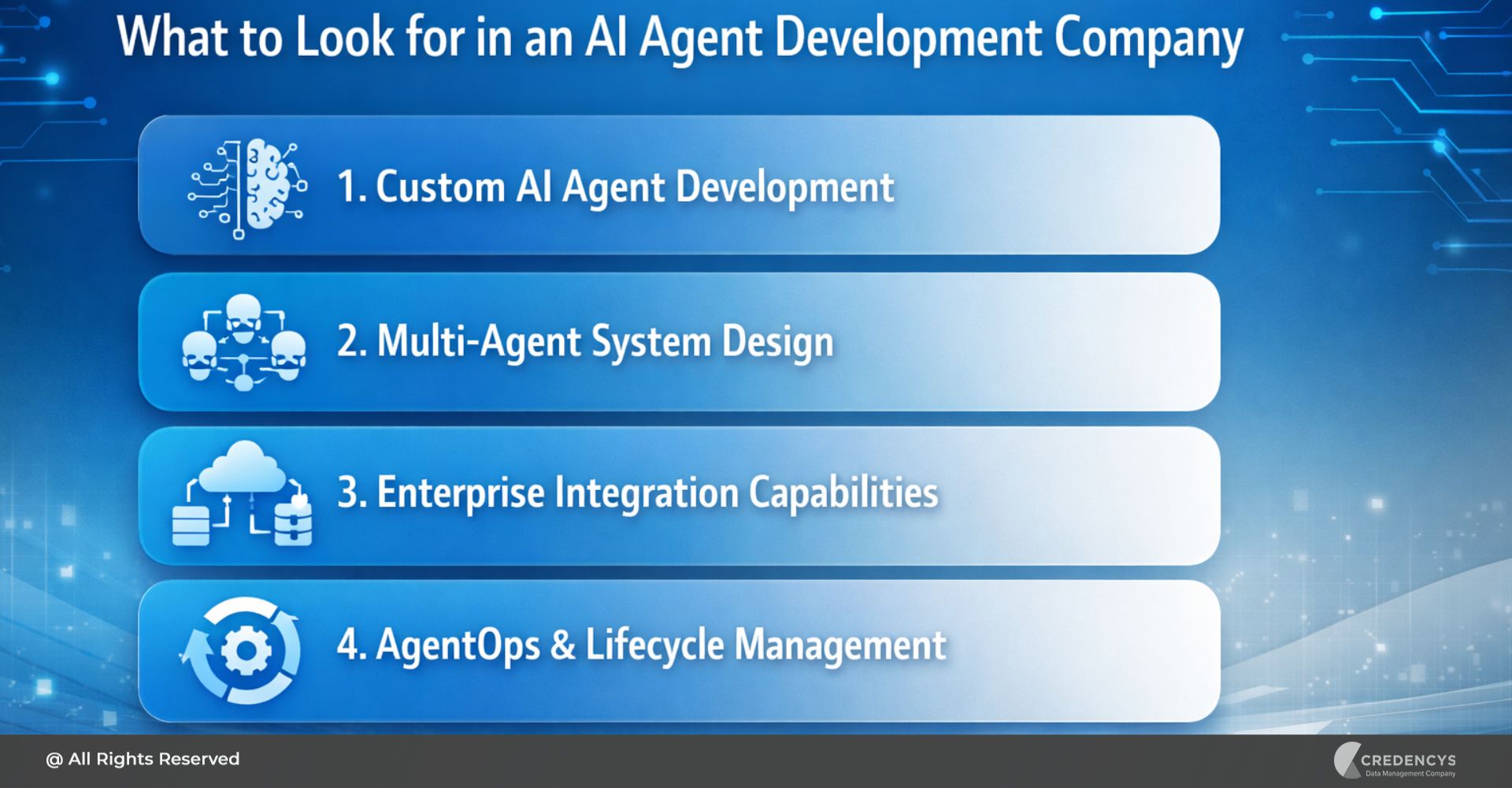
What to Look for in an AI Agent Development Company

Not all vendors are built for this. Some are still stuck in chatbot land.

Here’s what actually matters:

1. Custom AI Agent Development

Look for expertise in:

  • LLMs (Large Language Models)
  • RAG (Retrieval-Augmented Generation)
  • Agent orchestration frameworks

Because plug-and-play won’t cut it.

2. Multi-Agent System Design

Real enterprise use cases rarely involve just one agent. You need systems where:

  • Agents collaborate
  • Delegate tasks
  • Share context

Think orchestration, not isolation.

3. Enterprise Integration Capabilities

If it doesn’t integrate with your:

  • ERP
  • CRM
  • Data platforms

it’s basically a demo.

4. AgentOps & Lifecycle Management

Building agents is one thing, and managing them in production is a completely different game.

You need:

  • Monitoring
  • Logging
  • Continuous improvement loops

What to Look for in an AI Agent Development Company

Top Enterprise AI Agent Development Companies in 2026

Plenty of companies claim they build AI agents. Very few actually deliver systems that survive real enterprise complexity.

Here are five that stand out in 2026, not just for what they promise, but for what they have proven.

1. Credencys Solutions

Credencys is not approaching AI agents as isolated innovations. They are building them as part of a larger, AI-native data ecosystem where agents are deeply connected to enterprise data, workflows, and decision-making layers.

That is a big deal. Most AI agents fail not because of intelligence but because of a lack of context.

Credencys solves that.

Core Strengths

  • Deep expertise in data engineering, data platforms, and AI integration
  • Strong focus on AI-driven decision systems, not just automation
  • Proven experience in retail, CPG, and supply chain ecosystems
  • Ability to embed AI agents into Customer 360, CDPs, and enterprise data lakes
  • End-to-end capabilities, from strategy to deployment to optimization

Key Services

  • AI-powered Customer 360 agents for real-time personalization
  • Autonomous agents for demand forecasting and dynamic pricing
  • Intelligent workflow automation across the supply chain and operations
  • AI agents integrated with enterprise data platforms (Databricks, Snowflake, etc.)
  • Decision intelligence systems that continuously learn and improve

Industries Served

  • Retail
  • CPG
  • Manufacturing
  • Supply chain & logistics

If you are looking to build scalable, enterprise-grade AI agents that actually drive decisions, Credencys stands out as a strategic partner rather than just a service provider.

Success Story: AI Agents for Order Management Automation

It’s one thing to talk about AI agents and another to see them actually work, inside messy, real-world enterprise workflows. Here’s a quick look at how Credencys Solutions helped a business transform its order management process using AI agents.

Challenge

Order management sounds simple, but it’s not. Most enterprises still deal with:

  • Orders coming from multiple channels (emails, PDFs, portals)
  • Manual data entry into ERP systems
  • Frequent errors and delays
  • Teams spending hours on repetitive processing

The result?

  • Slow operations.
  • High error rates.
  • And frustrated customers.

Solution

Credencys implemented an AI agent-driven order management automation system designed to handle the process end-to-end. Instead of just automating tasks, the system actually understood incoming data.

Here’s what the AI agents did:

  • Extracted order data from unstructured inputs (emails, documents, attachments)
  • Validated and standardized information
  • Automatically entered data into ERP systems
  • Flagged exceptions for human review
  • Continuously improved accuracy through learning loops

In short, the agents didn’t just assist, they operated.

Impact

This is where things get interesting. AI-driven order processing systems like this have been shown to:

  • Reduce manual effort by up to 70–75%
  • Cut processing time significantly
  • Improve data accuracy and consistency
  • Free up teams for higher-value work

And that’s exactly the kind of transformation enterprises are aiming for.

  • Less manual work.
  • Faster execution.
  • Better decisions.

2. Algoscale

Algoscale focuses on building LLM-powered autonomous agents designed to handle complex enterprise workflows. Their strength lies in orchestration, getting multiple agents to work together effectively.

Core Strengths

  • Advanced LLM and GenAI expertise
  • Custom-built agent orchestration frameworks
  • Strong focus on scalability and performance
  • Experience with multi-agent environments

Key Services

  • Autonomous AI agents for enterprise operations
  • Multi-agent workflow coordination systems
  • AI copilots for internal teams
  • Decision intelligence platforms powered by LLMs

Industries Served

  • Technology
  • Finance
  • eCommerce
  • SaaS

3. RTS Labs

RTS Labs combines AI agent development with strong data engineering, making its solutions practical and grounded in real business data.

Core Strengths

  • Strong data engineering backbone
  • End-to-end AI solution development
  • Industry-focused implementation approach
  • Practical, execution-first mindset

Key Services

  • AI agents for supply chain optimization
  • Predictive analytics and decision systems
  • Workflow automation across enterprise operations
  • Data-driven AI solutions for complex business problems

Industries Served

  • Logistics
  • Finance
  • Real estate
  • Healthcare

4. Kanerika

Kanerika brings a data-first, compliance-driven approach to AI agent development. They are particularly strong in structured environments where governance and accuracy are critical.

Core Strengths

  • Expertise in data engineering and governance
  • Strong capabilities in document intelligence
  • Focus on compliance-driven AI solutions
  • Integration with enterprise data ecosystems

Key Services

  • AI agents for document processing and automation
  • Compliance and risk management systems
  • Data integration and transformation solutions
  • Intelligent workflow automation

Industries Served

  • Banking & financial services
  • Insurance
  • Healthcare
  • Manufacturing

5. Markovate

Markovate specializes in customer-facing AI agents that enhance engagement, support, and personalization. Their solutions are designed to directly impact customer experience.

Core Strengths

  • Expertise in conversational AI and AI copilots
  • Strong focus on product-driven AI development
  • Ability to build scalable, user-centric AI systems
  • Fast deployment cycles for customer-facing solutions

Key Services

  • AI-powered virtual assistants and chat agents
  • Customer support automation
  • AI copilots for sales and service teams
  • Personalized customer engagement systems

Industries Served

  • Retail & eCommerce
  • Healthcare
  • Fintech
  • Travel & hospitality

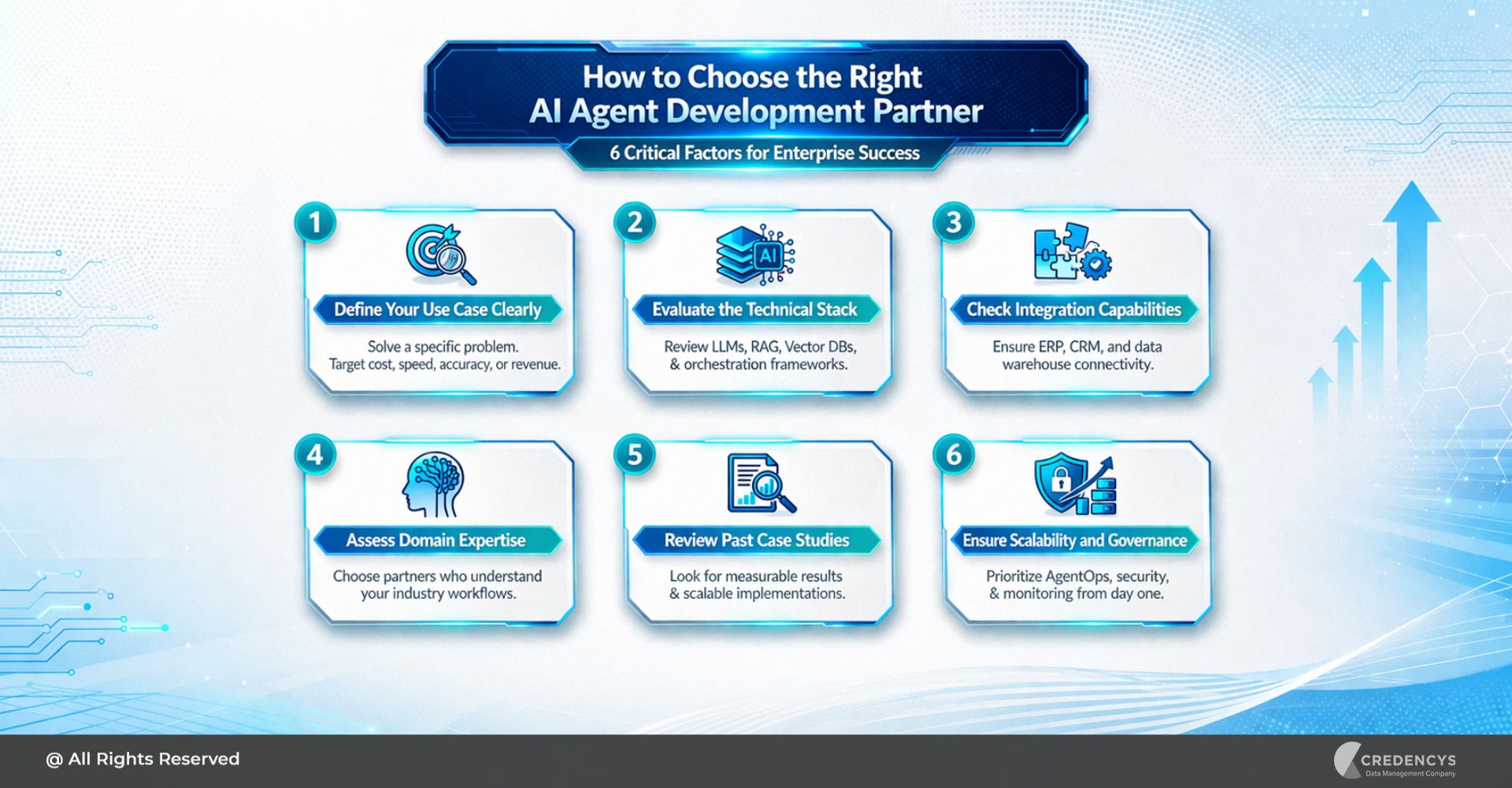
How to Choose the Right AI Agent Development Partner

This is where most enterprises get it wrong. Not because they pick a bad partner.

But because they don’t ask the right questions early enough. And with AI agents, mistakes get expensive fast.

Let’s make this practical.

1. Define Your Use Case Clearly

“Build an AI agent” is not a use case; it’s a vague ambition.

Start with:

  • What specific problem are you solving?
  • Where does human decision-making slow things down today?
  • What outcome do you expect: cost savings, speed, accuracy, revenue?

Be brutally specific. Because the clearer your use case, the easier it is to:

  • Choose the right architecture
  • Avoid overengineering
  • Measure success later

No clarity here = chaos later.

2. Evaluate the Technical Stack

You don’t need to be deeply technical. But you do need to ask smart questions.

A capable partner should comfortably explain:

  • Which LLMs do they use (and why)
  • How they implement RAG (Retrieval-Augmented Generation)
  • What vector databases do they work with
  • Which agent orchestration frameworks do they prefer

If everything sounds like buzzwords stitched together, pause. Good partners simplify complexity rather than hiding behind it.

3. Check Integration Capabilities

Your AI agent is only as powerful as the systems it connects to. Ask:

  • Can it integrate with your ERP, CRM, data warehouse, or CDP?
  • How does it access real-time data?
  • Can it trigger actions across systems?

Because an AI agent that can’t integrate is just a very expensive chatbot.

4. Assess Domain Expertise

AI is not one-size-fits-all. A partner who understands:

  • Retail will think differently from one focused on healthcare
  • Supply chain challenges are very different from fintech workflows

Domain context affects:

  • Data modeling
  • Decision logic
  • Edge cases

You don’t want to spend months explaining your industry.

5. Review Past Case Studies

Not demos and prototypes. Real-world implementations.

Look for:

  • Measurable outcomes (not vague claims)
  • Complexity of use cases
  • Integration depth
  • Scalability of solutions

And if possible, ask, “What didn’t work in your past projects?” The answer tells you more than the success stories.

6. Ensure Scalability and Governance

Your first AI agent is a pilot. Your fifth is a system, and the tenth is a transformation layer.

So, think ahead. Ask about:

  • How agents are monitored and managed (AgentOps)
  • How performance is tracked and improved
  • How security, access control, and compliance are handled
  • How easily new agents can be added over time

Because scaling AI agents without governance is how things quietly spiral out of control.

How to Choose the Right AI Agent Development Partner

Choosing an AI agent development partner is a capability decision instead of a vendor decision. You’re building the foundation for how your business will operate in the future.

So, take your time here, ask uncomfortable questions, and don’t settle for surface-level answers.

Conclusion

AI agents aren’t some experimental layers you can afford to ignore anymore. They are quickly becoming core business infrastructure.

The shift is subtle at first, with a few automated workflows and a decision engine. Then suddenly, the entire process starts running with minimal human intervention.

That’s when it clicks that this isn’t just about efficiency. It’s about how your business operates.

And in that kind of transformation, the partner you choose matters a lot. Because building AI agents isn’t just about writing prompts or plugging into an API.

It’s about:

  • Connecting fragmented data
  • Embedding intelligence into workflows
  • Ensuring decisions are accurate, scalable, and secure

Get it right, and you unlock real competitive advantage. Get it wrong, and you are stuck with expensive experiments that never scale.

That’s where a partner like Credencys Solutions comes in. With a strong foundation in data engineering, deep industry expertise, and a clear focus on AI-driven decision systems, Credencys helps enterprises move beyond surface-level automation, toward truly intelligent and connected operations.

And honestly, that’s the difference that matters. If you are serious about building enterprise-grade AI agents, now’s the time to start.

Best Business Intelligence Companies in 2026 [Expert Picks]

Data is everywhere, but clarity is still rare.

In fact, studies suggest that over 60% of organizations struggle to turn data into actionable insights even after investing heavily in analytics tools.

Dashboards and reports exist, yet decision-making still feels slow, fragmented, and uncertain. That’s the gap Business Intelligence companies are trying to close.

And not just with dashboards. Today’s BI partners help you connect scattered data, build scalable pipelines, and deliver insights that actually drive revenue, efficiency, and growth.

The difference between “we have data” and “we understand our business” often comes down to choosing the right partner. This blog breaks down some of the top Business Intelligence companies in 2026, the ones helping enterprises move from data overload to real clarity. Let’s get into it.

What Do Business Intelligence Companies Do?

At a glance, Business Intelligence companies help you make sense of your data. But that’s a bit of an understatement.

The good ones go deeper. They typically help with:

  • BI strategy and roadmap development
  • Data integration across systems (ERP, CRM, eCommerce, etc.)
  • Data warehousing and lakehouse implementation
  • Dashboard and report development
  • Advanced analytics and forecasting
  • Self-service BI enablement
  • Data governance and quality frameworks

In simple terms, they build the foundation, not just the front-end visuals. Because a dashboard is only as good as the data behind it.

Key Benefits of Working with a Business Intelligence Company

You could try building BI capabilities in-house. Many companies do.

But they quickly realize that it’s not just about tools. Here’s what working with the right BI partner actually unlocks:

  • Faster Decision-Making: No more waiting days (or weeks) for reports.
  • Real-time Visibility: Know what’s happening now, not what happened last month.
  • Improved Operational Efficiency: Spot bottlenecks before they become problems.
  • Better Data Governance: Clean, consistent, and reliable data across teams.
  • Scalable Analytics Infrastructure: Systems that grow with your business; not break under pressure.

How We Selected These Top Business Intelligence Companies

There are hundreds of BI service providers out there. So how do you narrow it down?

For this list, we focused on companies that consistently deliver across a few critical areas:

  • Strong expertise in modern BI tools and platforms
  • Proven capabilities in data engineering and integration
  • Experience across industries like retail, CPG, manufacturing, and eCommerce
  • A track record of successful BI implementations
  • Ability to build scalable, future-ready analytics systems

The companies listed below are not ranked, but each one brings something valuable to the table.

Top Business Intelligence Companies in 2026

1. Credencys Solutions

Credencys Solutions is a data-focused consulting company that specializes in data engineering, analytics, and AI-driven Business Intelligence solutions. Their strength lies in building strong data foundations before layering on BI, something many companies overlook.

Key BI Services

  • BI strategy and consulting
  • Data integration and pipeline development
  • Interactive dashboards and reporting
  • Data warehouse and lakehouse implementation

Industries Served

Retail, CPG, Manufacturing, eCommerce

Success Story: Business Intelligence for Textile Inspection

One example of Credencys’ BI capabilities comes from a global textile quality management organization struggling with fragmented inspection and analytics systems. Their data was scattered across multiple applications.

Reporting and decision-making were slow.

Credencys stepped in and:

  • Integrated multiple application databases into a centralized Azure Data Warehouse
  • Built automated data pipelines to eliminate manual data handling
  • Enabled real-time data access and visualization using Power BI

The result wasn’t just cleaner dashboards; it was a complete shift in how the business operated.

  • 80% improvement in response time to customers
  • Reduced manual effort and increased team productivity
  • Faster, more effective strategy execution with real-time insights

That’s the difference between having data and actually using it.

Read Full Case Study Here

Why Choose Them

  • Deep expertise in modern data architectures like lakehouse and cloud BI
  • Strong focus on data engineering as the backbone of BI success
  • Ability to turn complex, fragmented data into clear, actionable insights

If your data is messy, this kind of foundation-first approach makes a big difference.

2. ScienceSoft

ScienceSoft has been in the IT consulting space for decades and offers comprehensive BI services tailored for enterprise environments. They bring a structured, process-driven approach to analytics.

Key BI Services

  • BI consulting and implementation
  • Data warehousing
  • Dashboard development
  • Predictive analytics

Industries Served

Healthcare, Retail, Manufacturing, BFSI

Why Choose Them

  • Extensive experience with large-scale BI implementations
  • Strong domain expertise across multiple industries

They are a solid choice if you are dealing with complex enterprise ecosystems and need a partner who’s done it all before.

3. Radixweb

Radixweb focuses on delivering Business Intelligence solutions that are both practical and scalable. Their approach leans toward customization, building solutions that fit the business rather than forcing the business to adapt.

Key BI Services

  • BI solution development
  • Data visualization
  • Data integration
  • Analytics consulting

Industries Served

Retail, Logistics, SaaS, Healthcare

Why Choose Them

  • Strong focus on custom BI solutions tailored to business needs
  • Emphasis on flexibility and scalability

They are especially useful for companies that want something more tailored than out-of-the-box BI setups.

4. inVerita

inVerita is a technology consulting firm that combines software development with data analytics and BI capabilities. They are known for their agile delivery approach.

Key BI Services

  • BI implementation
  • Data analytics
  • Dashboard creation
  • Data integration

Industries Served

Finance, Logistics, eCommerce

Why Choose Them

  • Agile methodology enables faster delivery and iteration
  • Strong focus on custom analytics solutions

If speed and adaptability matter to you, they are worth considering.

5. Vention

Vention provides engineering-driven BI and analytics services, helping companies build scalable data ecosystems from the ground up.

Key BI Services

  • BI consulting
  • Data engineering
  • Analytics solutions
  • Visualization tools

Industries Served

Fintech, Healthtech, eCommerce

Why Choose Them

  • Strong engineering expertise in modern data stacks
  • Focus on building scalable, high-performance analytics systems

They are a good fit for tech-driven organizations that need robust, future-ready BI systems.

Key BI Technologies Used by These Companies

Technology matters. But how it’s used matters more.

Most top BI companies work with a mix of:

  • Microsoft Power BI
  • Tableau
  • Looker
  • Qlik
  • Cloud platforms like AWS, Azure, and Google Cloud

These tools enable:

  • Interactive dashboards
  • Real-time analytics
  • AI-powered insights
  • Self-service reporting

But again, it’s not just about the tool. A poorly designed data pipeline will break even the best dashboard.

How to Choose the Right Business Intelligence Company

Choosing a BI partner sounds simple until you start comparing options. Everyone claims “end-to-end expertise”, lists the same tools, and shows polished dashboards.

So how do you actually decide? It comes down to looking beyond surface-level capabilities and asking the right questions.

Here’s how to evaluate a BI company properly, not just based on what looks good in a pitch deck.

1. Look Beyond Dashboards

This is where most companies get it wrong. Dashboards are the output, not the system.

A visually impressive dashboard means very little if:

  • The data is inconsistent
  • Reports don’t match across departments
  • Metrics change depending on who’s looking

Ask this instead:

  • How do you ensure data consistency across reports?
  • How do you define and standardize KPIs?

Because honestly, a simple dashboard with reliable data beats a flashy one with broken logic.

2. Evaluate Data Engineering Capabilities

If the BI partner is not strong in data engineering, you will feel it later in the form of slow dashboards, broken pipelines, missing data, and constant fixes.

Look for expertise in:

  • Data integration (multiple sources, legacy systems, APIs)
  • ETL/ELT pipeline design
  • Data modeling and schema design
  • Cloud data platforms and lakehouse architectures

You want a team that can handle messy and real-world data, not just clean demo datasets.

3. Check Industry Experience

A retail dashboard is very different from a manufacturing one. Same tools, but completely different logic.

A good BI partner should:

  • Understand your key metrics
  • Know common industry challenges
  • Suggest improvements, not just implement what you ask

That kind of context speeds everything up.

4. Assess Their Approach to Scalability

What works for 10GB of data might fail at 1TB. And most companies don’t think about this early enough.

Ask:

  • How do you design systems for scale?
  • What happens when data volume increases 5x or 10x?
  • Can your architecture support real-time analytics later?

You are not just building for today. You are building for what your business will look like in 2–3 years.

5. Understand Their BI Tool Expertise

Yes, tools matter. But here’s the truth: most good BI partners can work with:

  • Power BI
  • Tableau
  • Looker
  • Qlik

The real question is: How do they use these tools?

Do they:

  • Design intuitive, user-friendly dashboards?
  • Enable self-service analytics?
  • Optimize performance for large datasets?

6. Evaluate Their Data Governance and Quality Approach

A strong BI partner should have a clear approach to:

  • Data validation
  • Data cleaning and transformation
  • Governance frameworks
  • Access control and security

Ask them:

  • How do you ensure data accuracy?
  • How do you handle conflicting data sources?

If they don’t have a clear answer, that’s a red flag.

7. Look for a Long-Term Partner, Not Just a Vendor

BI is not a one-time project. It evolves as your business evolves.

You’ll need:

  • New dashboards
  • Updated metrics
  • Integration with new tools
  • Continuous optimization

So ask:

  • Do you offer post-implementation support?
  • How do you handle ongoing improvements?

Because the real value of BI comes after implementation.

8. Review Case Studies

Case studies can be selective. So don’t just look at outcomes.

Look at how they got there. Pay attention to:

  • The complexity of the problem
  • The scale of data involved
  • The industries they have worked in
  • The measurable business impact

Bonus points if they can show:

  • Before vs after scenarios
  • Real metrics improvement

That’s where credibility shows.

9. Communication and Collaboration Style

This one is underrated. A lot of BI projects fail not because of technology but because of misalignment.

You want a partner who:

  • Asks the right questions
  • Challenges assumptions
  • Explains things clearly (without jargon overload)

If the communication feels confusing during the sales process, it probably won’t get better later.

10. Start Small, Then Scale

If you are unsure, don’t commit to a massive project upfront. Start with:

  • A pilot project
  • A single dashboard
  • A specific use case

See how they:

  • Approach the problem
  • Communicate progress
  • Deliver results

Then scale from there. It’s a safer, smarter way to evaluate fit.

BI Trends to Watch in 2026

The BI space is evolving fast. Some trends that are shaping decisions right now:

  • AI-powered BI and augmented analytics
  • Real-time data processing
  • Self-service BI adoption across teams
  • Embedded analytics in business applications
  • Stronger focus on data governance and compliance

We’re also seeing a shift. From dashboards to decision intelligence.

Conclusion

Business Intelligence is no longer optional; it’s foundational. But tools alone won’t get you there.

And hiring internally isn’t always enough, especially as data complexity scales. The right BI partner helps you:

  • Build a strong data foundation
  • Create meaningful insights
  • And actually, use those insights to drive decisions

That’s the real goal. Not more data. Better decisions.

Data Warehouse vs Data Lakehouse: Which Modern Data Architecture Should You Choose?

Data has become the foundation of modern business decisions. But many organizations still struggle with a fundamental question: where should all that data live, and how should it be managed for analytics and AI?

For decades, the data warehouse was the gold standard for enterprise analytics. It helped businesses centralize structured data, generate reports, and support BI dashboards. But as data volumes exploded and new data types emerged, traditional warehouses began showing their limitations.

Today, companies must manage massive datasets from multiple sources such as applications, IoT devices, websites, customer platforms, and operational systems. Much of this data is semi-structured or unstructured, making it harder to store and analyze using conventional data warehouse architectures.

This challenge led to the rise of the data lake, and more recently, the data lakehouse, a modern architecture that combines the flexibility of data lakes with the performance and reliability of data warehouses.

As organizations build AI-ready and analytics-driven platforms, choosing the right data architecture becomes a strategic decision. The debate around data warehouse vs data lakehouse is not just about storage. It impacts scalability, cost efficiency, data governance, and how quickly teams can turn raw data into insights.

In this guide, we’ll break down the key differences between a data warehouse and a data lakehouse, how each architecture works, their advantages and limitations, and how to determine which approach best fits your business needs.

What is a Data Warehouse?

A data warehouse is a centralized data storage system designed to store, organize, and analyze structured data from multiple sources for reporting and business intelligence.

It acts as the single source of truth for historical business data, allowing organizations to generate dashboards, run analytical queries, and support decision-making across departments such as finance, sales, marketing, and operations.

Unlike operational databases that handle daily transactions, a data warehouse is built specifically for analytics workloads. Data from various systems such as CRM platforms, ERP systems, marketing tools, and applications is collected, transformed, and loaded into the warehouse where it can be queried efficiently.

Most traditional data warehouses follow the ETL (Extract, Transform, Load) process. Data is first extracted from source systems, transformed into a consistent format, and then loaded into structured tables optimized for analytics.

Key Characteristics of a Data Warehouse

  1. Structured Data Storage: Data warehouses primarily store structured data organized into tables, schemas, and relationships.
  2. Optimized for Analytical Queries: They are designed for complex queries, aggregations, and reporting rather than transactional processing.
  3. Schema-on-Write Approach: Data must be structured and modeled before it is loaded, ensuring data consistency and quality.
  4. Historical Data Analysis: Warehouses store large volumes of historical data, enabling trend analysis and long-term reporting.
  5. High Performance for BI Tools: They integrate seamlessly with business intelligence tools to power dashboards and reports.

Typical Data Warehouse Architecture

discover data warehouse image

Image source

A typical data warehouse architecture consists of the following layers:

  • Data Sources: Operational systems such as CRM, ERP, transactional databases, marketing tools, and applications.
  • ETL / Data Integration Layer: Data is extracted from sources, transformed into a standardized format, and loaded into the warehouse.
  • Central Data Warehouse: The core repository where cleaned and structured data is stored.
  • Data Marts (Optional): Department-specific subsets of the warehouse created for teams such as finance, marketing, or sales.
  • Analytics & BI Layer: Business intelligence tools query the warehouse to generate dashboards, reports, and insights.

Common Data Warehouse Technologies

Popular modern data warehouse platforms include:

  • Snowflake
  • Amazon Redshift
  • Google BigQuery
  • Azure Synapse Analytics

These cloud-native warehouses provide scalable storage, fast query performance, and strong integration with BI tools.

Limitations of Traditional Data Warehouses

While data warehouses remain powerful for structured analytics, they also present several challenges in modern data environments:

  • High cost when storing very large datasets
  • Limited support for unstructured and semi-structured data
  • Complex data transformation pipelines
  • Difficulty supporting AI and machine learning workloads at scale

What is a Data Lakehouse?

A data lakehouse is a modern data architecture that combines the flexibility and scalability of data lakes with the performance, governance, and reliability of data warehouses.

Traditional data lakes allow organizations to store massive volumes of structured, semi-structured, and unstructured data at a lower cost. However, they often lack strong governance, data quality controls, and optimized query performance. Data warehouses, on the other hand, provide structured analytics and reliable performance but can become expensive and restrictive when handling diverse data types.

The data lakehouse architecture bridges this gap by enabling organizations to store raw data in a data lake while applying warehouse-like capabilities such as ACID transactions, schema enforcement, data governance, and high-performance SQL analytics.

This unified approach allows businesses to support business intelligence, real-time analytics, machine learning, and AI workloads using a single data platform.

Key Characteristics of a Data Lakehouse

  1. Supports Multiple Data Types: A lakehouse can store structured, semi-structured, and unstructured data in the same environment.
  2. Open Storage Architecture: Data is typically stored in open formats such as Parquet or Delta tables on cloud object storage.
  3. Schema Enforcement with Flexibility: Lakehouses support schema-on-read and schema-on-write, allowing both flexibility and governance.
  4. Unified Platform for Analytics and AI: Unlike traditional warehouses, lakehouses support SQL analytics, data engineering, machine learning, and streaming workloads on the same platform.
  5. Cost-Effective Scalability: Since storage and compute are separated, organizations can scale their infrastructure more efficiently.

Typical Data Lakehouse Architecture

A typical lakehouse architecture includes the following layers:

  • Data Sources: Applications, IoT devices, operational databases, APIs, logs, and streaming data.
  • Ingestion & Processing Layer: Batch and streaming pipelines ingest data using tools such as Spark, Kafka, or data integration platforms.
  • Cloud Data Lake Storage: Raw and processed data is stored in cloud object storage systems.
  • Lakehouse Table Layer: Technologies such as Delta Lake, Iceberg, or Hudi provide ACID transactions, schema management, and indexing.
  • Unified Analytics Layer: Data scientists, analysts, and applications query the data using SQL engines, BI tools, notebooks, and AI frameworks.

Popular Data Lakehouse Technologies

Several modern platforms support lakehouse architectures, including:

  • Databricks Lakehouse Platform
  • Apache Iceberg
  • Delta Lake
  • Apache Hudi
  • Snowflake with open table formats

These platforms enable organizations to run analytics, machine learning, and data engineering workloads on a unified architecture.

Data Warehouse vs Data Lakehouse: Key Differences

While both data warehouses and data lakehouses are designed to support analytics and business intelligence, they differ significantly in terms of architecture, data processing, scalability, and use cases.

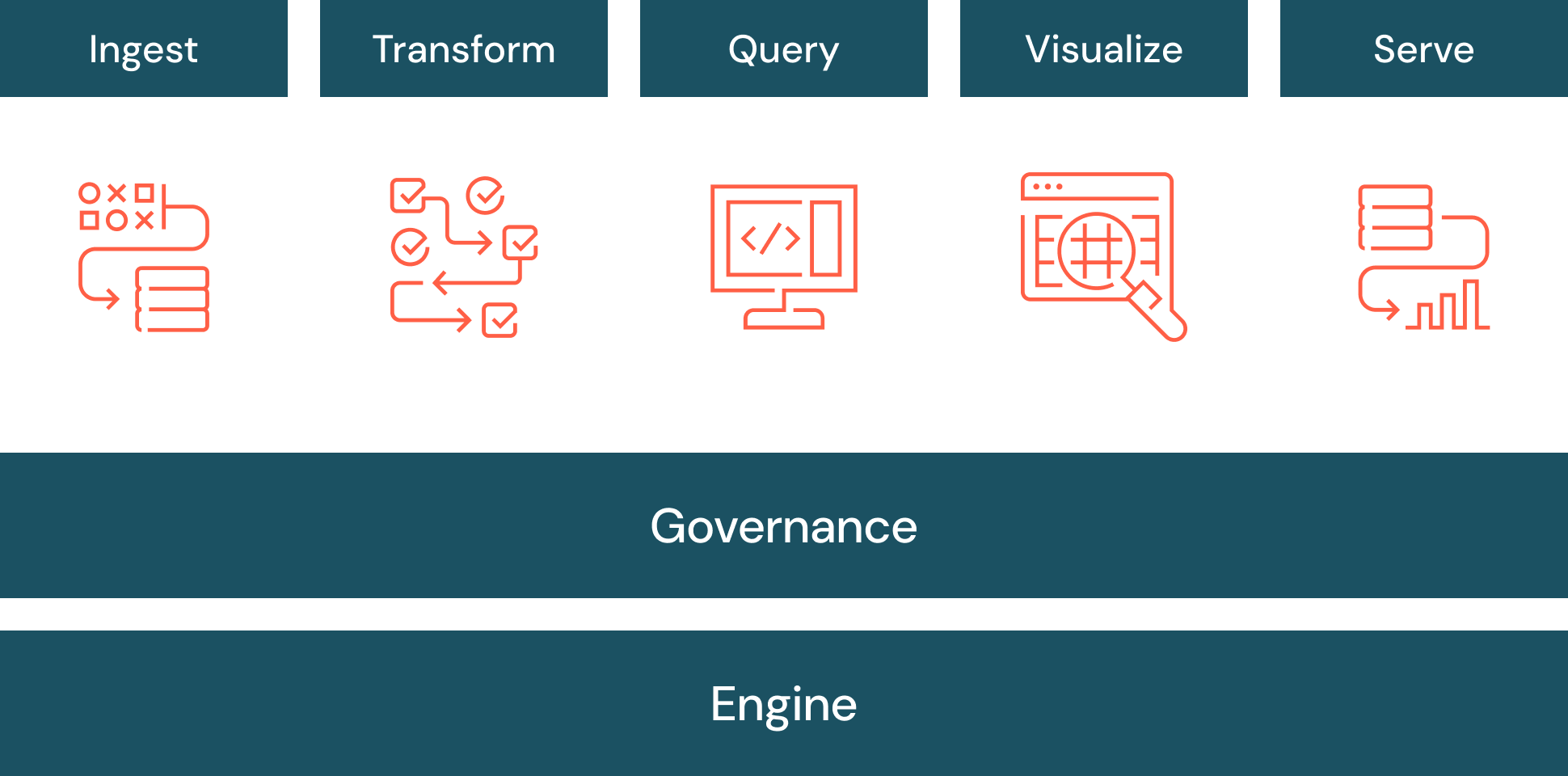
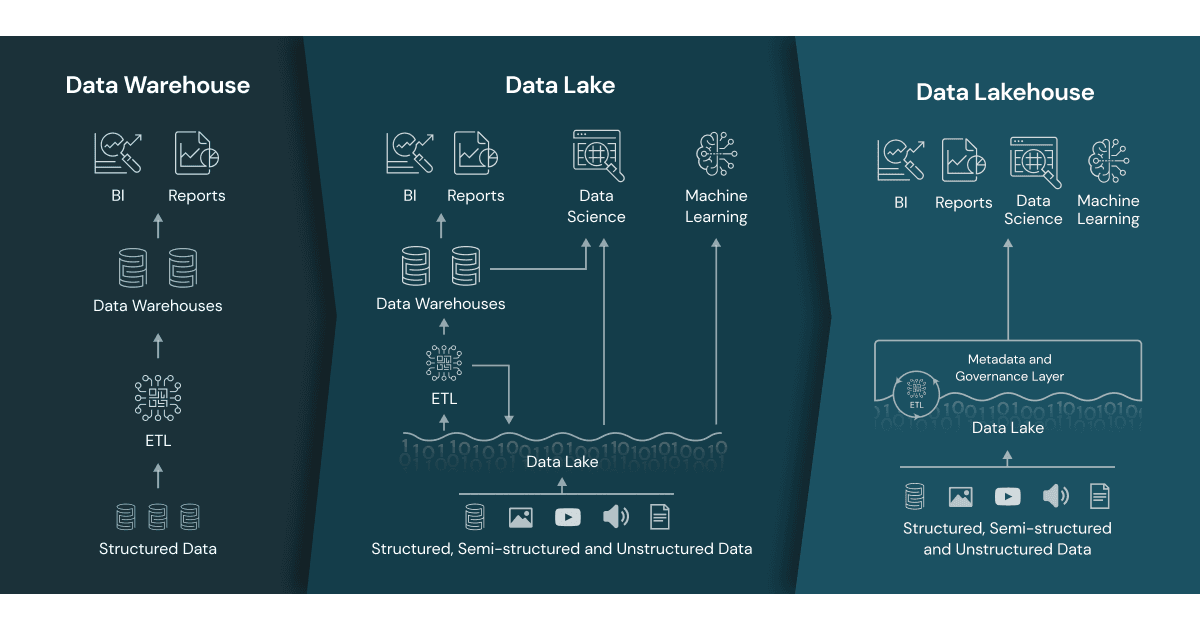
A traditional data warehouse is optimized for structured data and reporting, whereas a data lakehouse is built to handle large volumes of diverse data types while supporting advanced analytics and AI workloads.Evolution of data storage, from data warehouses to data lakes to lakehouses

Image source. 

Understanding these differences helps organizations choose the right architecture based on their data complexity, analytics needs, and long-term data strategy.

Data Warehouse vs Data Lakehouse Comparison

FeatureData WarehouseData Lakehouse
Data Types SupportedPrimarily structured dataStructured, semi-structured, and unstructured data
Schema ApproachSchema-on-write (data structured before storage)Schema-on-read + schema-on-write flexibility
Storage CostHigher storage costMore cost-effective due to cloud object storage
Performance for BI QueriesHighly optimized for BI and reportingOptimized for both analytics and large-scale data processing
Data ProcessingBatch processing with ETL pipelinesSupports batch and real-time streaming
ScalabilityScales well but can become expensiveHighly scalable with decoupled storage and compute
AI & Machine Learning SupportLimited supportBuilt to support ML, AI, and advanced analytics
Typical Data VolumeModerate to large datasetsExtremely large and diverse datasets
Data GovernanceStrong governance and data quality controlsGovernance supported through modern table formats
Typical UsersBusiness analysts and BI teamsData engineers, analysts, and data scientists

Summary of the Differences

In simple terms, a data warehouse focuses on structured analytics, making it ideal for traditional reporting and dashboards.

A data lakehouse provides a unified data platform, allowing organizations to run analytics, machine learning, and large-scale data processing workloads on the same architecture.

For companies dealing with rapidly growing data volumes, diverse data formats, and AI-driven initiatives, lakehouse architectures often provide greater flexibility and scalability.

Data Warehouse vs Data Lakehouse: Real-World Use Cases

Both data warehouses and data lakehouses play an important role in modern data architectures, but they are designed for different types of workloads and business needs. Understanding their real-world applications can help organizations decide which architecture best aligns with their analytics strategy.

Real-World Use Cases for Data Warehouses

Data warehouses are widely used in scenarios where organizations need highly structured, reliable, and consistent data for reporting and business intelligence.

1. Business Intelligence and Executive Reporting

Companies use data warehouses to power dashboards and reports for leadership teams. Structured data from CRM, ERP, and finance systems is aggregated to track KPIs such as revenue, customer acquisition, and operational performance.

2. Financial and Regulatory Reporting

Industries like banking, insurance, and healthcare rely on data warehouses to generate accurate financial statements, compliance reports, and audit trails, where data consistency and governance are critical.

3. Sales and Marketing Analytics

Marketing teams analyze campaign performance, customer segmentation, and conversion rates using structured datasets stored in a warehouse.

4. Supply Chain and Operations Monitoring

Retail and manufacturing organizations use warehouses to track inventory levels, supplier performance, and logistics efficiency through standardized reporting.

Real-World Use Cases for Data Lakehouses

Data lakehouses are ideal for organizations that need to manage large volumes of diverse data while supporting advanced analytics, machine learning, and real-time insights.

1. Machine Learning and AI Model Training

Data scientists require access to raw and diverse datasets such as customer behavior logs, product data, images, and sensor data. Lakehouses provide a unified environment for preparing and training AI models.

2. Customer 360 and Behavioral Analytics

Companies combine structured transactional data with unstructured interaction data such as website activity, mobile app usage, and support conversations to create comprehensive customer profiles.

3. Real-Time Data Processing and Streaming Analytics

Industries like fintech, logistics, and e-commerce process streaming data from applications, transactions, and IoT devices to generate real-time insights.

4. Large-Scale Data Engineering and Data Science Workloads

Lakehouses enable organizations to store raw datasets at scale and process them for advanced analytics, experimentation, and predictive modeling.

Choosing the Right Approach for Your Use Case

In many modern enterprises, the choice is not always data warehouse vs data lakehouse. Instead, organizations often adopt a hybrid data architecture, where a lakehouse handles large-scale data processing and machine learning workloads, while a warehouse powers curated datasets for business intelligence and reporting.

The right approach depends on factors such as data volume, data variety, analytics complexity, governance requirements, and long-term AI initiatives.

How to Choose Between a Data Warehouse and a Data Lakehouse

Choosing between a data warehouse and a data lakehouse depends on your organization’s data maturity, analytics needs, and long-term data strategy. While both architectures support data-driven decision-making, they serve different types of workloads and data environments.

Rather than asking which architecture is “better,” the key question is which one aligns best with your business goals, data complexity, and future analytics requirements.

Below are some practical factors to consider when making this decision.

1. Type and Variety of Data

If your organization primarily works with structured data from operational systems, a data warehouse is often sufficient.

However, if your business needs to manage large volumes of structured, semi-structured, and unstructured data such as logs, IoT data, images, and clickstream data, a lakehouse architecture provides greater flexibility.

Choose a Data Warehouse if:

  • Most data comes from structured sources like CRM, ERP, and transactional systems
  • The primary goal is reporting and dashboards

Choose a Data Lakehouse if:

  • You need to store and process diverse data formats
  • Your data sources include streaming data, logs, and machine-generated data

2. Analytics and Workload Requirements

Data warehouses are optimized for business intelligence, reporting, and SQL-based analytics. They work well for teams focused on dashboards, KPI tracking, and operational reporting.

Data lakehouses support a broader range of workloads, including data engineering, advanced analytics, and machine learning.

Choose a Data Warehouse if:

  • Your teams mainly run BI dashboards and scheduled reports
  • Query performance for structured analytics is the main priority

Choose a Data Lakehouse if:

  • Your organization runs data science and machine learning workloads
  • You need a unified platform for analytics and AI

3. Data Volume and Scalability

Traditional data warehouses scale effectively but can become expensive when storing massive datasets.

Lakehouses are designed to handle petabyte-scale data environments by separating storage and compute, making them more cost-efficient for large data volumes.

Choose a Data Warehouse if:

  • Your data volumes are manageable and predictable

Choose a Data Lakehouse if:

  • Your organization deals with rapidly growing data volumes

4. Cost and Infrastructure Considerations

Data warehouses often require high-performance storage and compute resources, which can increase costs as data grows.

Lakehouse architectures leverage cloud object storage, allowing organizations to store large amounts of raw data at a lower cost while scaling compute independently.

5. Future AI and Data Innovation Goals

Organizations investing in AI, machine learning, and advanced analytics often benefit from lakehouse architectures because they support data engineering, analytics, and data science on the same platform.

Data warehouses remain a strong choice for organizations that prioritize structured reporting and governed analytics environments.

Final Decision Framework

In simple terms:

  • Choose a Data Warehouse when your primary focus is structured reporting, BI dashboards, and governed enterprise analytics.
  • Choose a Data Lakehouse when your organization needs to support large-scale data processing, diverse data types, and AI-driven workloads.

Many modern enterprises adopt a lakehouse-first architecture, where the lakehouse acts as the central data platform and curated datasets are optimized for BI and reporting.

TLDR: Data Warehouse vs Data Lakehouse

If you need a quick summary of data warehouse vs data lakehouse, here are the key takeaways:

  • A data warehouse is designed for structured data, reporting, and business intelligence. It provides reliable performance for dashboards, financial reporting, and operational analytics.
  • A data lakehouse combines the low-cost storage and flexibility of data lakes with the governance and performance of data warehouses.
  • Data warehouses work best when organizations mainly deal with structured data and BI workloads.
  • Data lakehouses are better suited for large-scale data environments that include structured, semi-structured, and unstructured data, especially when supporting AI, machine learning, and advanced analytics.
  • Many modern enterprises adopt a hybrid or lakehouse-first architecture, where raw and large-scale data is stored in the lakehouse while curated datasets power BI tools and reporting systems.

FAQs: Data Warehouse vs Data Lakehouse

1. What is the main difference between a data warehouse and a data lakehouse?

The main difference between a data warehouse and a data lakehouse is the type of data they support and how they process it. A data warehouse is optimized for structured data and reporting, while a data lakehouse can handle structured, semi-structured, and unstructured data while supporting analytics, machine learning, and large-scale data processing.

2. Is a data lakehouse replacing a data warehouse?

A data lakehouse does not always replace a data warehouse. Instead, many organizations use both architectures together. A lakehouse stores and processes large volumes of diverse data, while the warehouse delivers curated datasets optimized for business intelligence and reporting.

3. When should a company use a data warehouse instead of a lakehouse?

A company should choose a data warehouse when its primary use case is business intelligence, dashboards, financial reporting, and structured analytics with strong governance and consistent data models.

4. Why are companies adopting data lakehouse architectures?

Companies are adopting data lakehouse architectures because they provide scalable storage, support multiple data types, and enable advanced analytics and AI workloads on a unified platform.

5. Which is better for AI and machine learning: data warehouse or lakehouse?

A data lakehouse is generally better suited for AI and machine learning workloads because it allows data scientists to work with large volumes of raw and diverse datasets while maintaining governance and performance through modern table formats.

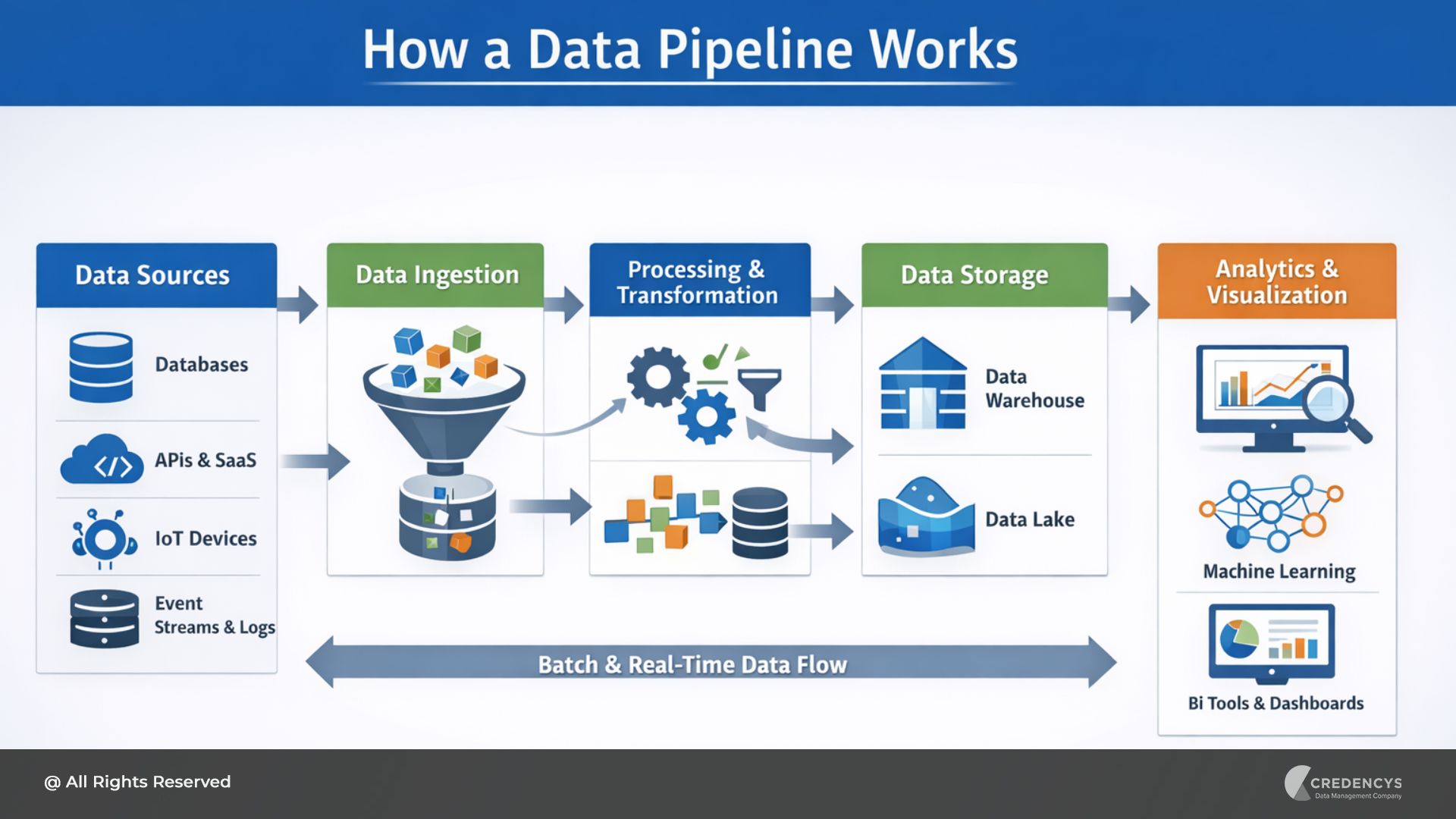
10 Practical Data Engineering Use Cases Every Data Leader Should Know

Modern enterprises rely on data to power analytics, AI models, customer personalization, fraud detection, and operational decisions. But before data can deliver value, it must be collected, cleaned, transformed, and made available in a reliable and scalable way.

Data engineering creates the pipelines, architectures, and data infrastructure that move raw data from multiple sources and prepare it for analytics, machine learning, and real time applications.

In this article, we explore key data engineering use cases that demonstrate how organizations use modern data engineering to unlock insights, enable AI, and build truly data driven operations.

TL;DR

  • Data engineering focuses on building pipelines and architectures that collect, transform, and deliver data for analytics, reporting, and AI.
  • It ensures that raw data from multiple systems becomes reliable, structured, and accessible for business use.
  • Common data engineering use cases include building data pipelines, enabling real time analytics, supporting data warehouses, powering BI dashboards, and preparing data for machine learning.
  • It also helps organizations create Customer 360 views, detect fraud, integrate enterprise systems, process IoT data, and enforce data governance.
  • With strong data engineering foundations, businesses can unlock insights faster, improve decision making, and scale AI and analytics initiatives.

What is Data Engineering?

Data engineering is the discipline of designing, building, and maintaining systems that collect, process, and prepare data for analytics, reporting, and machine learning. It focuses on creating reliable data pipelines and architectures that move data from multiple sources into centralized platforms where it can be analyzed and used for decision making.

Data engineers work with technologies such as data pipelines, data lakes, data warehouses, and streaming platforms to ensure that raw data is cleaned, transformed, and structured in a usable format. This process enables analysts, data scientists, and business teams to access accurate and consistent data without dealing with complex underlying systems.

In modern organizations, data engineering serves as the foundation of the data ecosystem. It powers business intelligence dashboards, supports AI and machine learning models, enables real time analytics, and ensures that data remains scalable, secure, and accessible across the enterprise.

Top Data Engineering Use Cases in Modern Enterprises

Organizations across industries rely on data engineering to transform raw, fragmented data into reliable assets that power analytics, automation, and AI. From enabling real time insights to supporting machine learning systems, data engineering plays a central role in modern data driven organizations.

Below are some of the most impactful data engineering use cases seen across enterprises today.

1. Building Scalable Data Pipelines

One of the most fundamental data engineering use cases is building scalable pipelines that collect and process data from multiple sources. These pipelines ensure that data flows smoothly from operational systems into analytics platforms.

A well designed pipeline helps organizations automate data movement and reduce manual effort.

Key capabilities include:

  • Extracting data from databases, APIs, applications, and third party systems
  • Transforming raw data into clean, structured formats
  • Loading processed data into data warehouses or data lakes
  • Automating scheduled or real time data processing

Scalable pipelines ensure consistent data availability across analytics and business applications.

2. Enabling Real Time Analytics

Modern businesses increasingly rely on real time insights to respond quickly to customer behavior and operational events. Data engineering enables streaming pipelines that process data the moment it is generated.

Instead of waiting for batch reports, organizations can monitor events and respond immediately.

Common real time analytics scenarios include:

  • Tracking website and app user activity
  • Monitoring financial transactions
  • Detecting anomalies in operational systems
  • Analyzing live customer engagement signals

Real time data processing allows businesses to make faster and more informed decisions.

3. Supporting Data Warehouses and Data Lakes

Centralized data platforms such as data warehouses and data lakes depend heavily on strong data engineering foundations. Data engineers design the architecture that integrates data from multiple sources into these platforms.

Without proper data engineering, centralized repositories quickly become disorganized and difficult to use.

Data engineering helps by:

  • Integrating data from CRM, ERP, and operational systems
  • Cleaning and standardizing datasets before storage
  • Structuring data models for analytics and reporting
  • Managing large scale storage environments

This enables analysts and business teams to access reliable data for insights and reporting.

4. Powering Business Intelligence and Reporting

Business intelligence tools depend on accurate and consistent datasets. Data engineering pipelines ensure that dashboards and reports are built on validated and well structured data.

Organizations rely on these systems to track performance and monitor key metrics.

Typical BI data pipelines support:

  • Executive dashboards for business performance monitoring
  • Sales and revenue reporting
  • Marketing campaign analytics
  • Operational performance tracking

By ensuring data accuracy and consistency, data engineering enables reliable decision making.

5. Preparing Data for Machine Learning and AI

Machine learning models require large volumes of high quality training data. Data engineering prepares and organizes this data so it can be used effectively by data science teams.

This process ensures that models are trained using consistent, reliable datasets.

Data engineering tasks that support AI include:

  • Building feature engineering pipelines
  • Cleaning and labeling training datasets
  • Managing large scale data storage for model training
  • Automating data flows for model retraining

These capabilities help organizations build AI powered applications such as recommendation systems and predictive analytics solutions.

6. Enabling Customer 360 and Personalization

Customer data is often scattered across multiple platforms including CRM systems, marketing tools, support applications, and transaction systems. Data engineering helps integrate these fragmented datasets into a unified customer view.

A Customer 360 dataset allows organizations to understand customer behavior across every interaction.

This enables capabilities such as:

  • Personalized product recommendations
  • Targeted marketing campaigns
  • Improved customer support experiences
  • Better segmentation and audience insights

Unified customer data is essential for delivering consistent and personalized experiences.

7. Detecting Fraud and Monitoring Risk

Fraud detection systems require fast and reliable data processing. Data engineering pipelines collect and analyze transaction data, behavioral signals, and system logs to identify suspicious activity.

These pipelines help organizations detect anomalies before they cause major financial or security risks.

Common applications include:

  • Monitoring unusual financial transactions
  • Identifying suspicious account behavior
  • Detecting payment fraud patterns
  • Triggering automated alerts for risk teams

Efficient data pipelines allow organizations to respond quickly to potential threats.

8. Integrating Data Across Enterprise Systems

Enterprises typically operate dozens of systems such as ERP, CRM, supply chain platforms, and marketing applications. Each system stores data in different formats and structures.

Data engineering integrates these datasets into a unified data platform.

This integration supports cross functional insights such as:

  • Connecting sales data with inventory levels
  • Linking marketing campaigns with customer purchases
  • Analyzing operational performance alongside financial metrics
  • Creating enterprise wide data visibility

Integrated data environments help organizations break down data silos.

9. Processing IoT and Sensor Data

Industries such as manufacturing, logistics, and healthcare generate massive volumes of data from connected devices and sensors. Data engineering pipelines are required to ingest and process this high velocity data.

These pipelines enable organizations to monitor operations continuously.

Typical IoT data engineering applications include:

  • Monitoring machine performance in manufacturing
  • Tracking vehicle fleets and logistics operations
  • Analyzing environmental or equipment sensor data
  • Predicting maintenance needs using real time signals

Efficient processing ensures that large streams of device data remain usable and actionable.

10. Supporting Data Governance and Compliance

As organizations collect more data, maintaining governance and compliance becomes essential. Data engineering helps enforce governance policies by implementing controls across data pipelines and storage systems.

These practices ensure that data remains secure, traceable, and compliant with regulations.

Key governance capabilities include:

  • Implementing data quality validation checks
  • Tracking data lineage and transformation history
  • Managing role based data access controls
  • Enforcing regulatory compliance requirements

Strong governance frameworks help organizations maintain trust in their data ecosystem.

Success Story: Data Driven Transformation for a Global Automotive Leader

A leading Korean automotive conglomerate with multiple business units across sales, marketing, and operations needed a unified way to analyze business performance. However, data was scattered across CRM, ERP, and marketing systems, and teams relied heavily on manual spreadsheets for reporting.

Key Challenges

  • Disconnected data across sales, marketing, CRM, and ERP systems
  • Heavy dependence on spreadsheet based reporting
  • Limited access to real time performance insights

Solution

A modern data engineering framework was implemented to centralize and automate data management.

  • Built a centralized data management architecture for faster data ingestion and access
  • Created advanced data models to connect multiple enterprise systems
  • Implemented automated dashboards and reporting, replacing manual spreadsheets

Business Impact

  • 380+ spreadsheets eliminated through automated reporting
  • 400+ business users enabled with access to trusted data
  • 100% removal of manual data reconciliation, improving reporting speed and accuracy

Read the full story here.

Conclusion: Data Engineering Use Cases

Data has become one of the most valuable assets for modern organizations, but its true value can only be realized when it is properly managed and accessible. This is where data engineering plays a critical role. By building scalable pipelines, integrating enterprise data, and preparing datasets for analytics and AI, data engineering transforms raw information into a reliable foundation for decision making.

The data engineering use cases discussed in this article show how organizations across industries are using modern data architectures to power real time analytics, enable machine learning, unify customer data, and improve operational efficiency.

As businesses continue to generate larger volumes of data, investing in strong data engineering capabilities will become essential. Organizations that build robust data pipelines and scalable data platforms will be better positioned to unlock insights faster, innovate with AI, and make smarter strategic decisions in an increasingly data driven world.

Top PIM Companies in 2026: Best Implementation Partners for Product Data Management

Retailers, manufacturers, and CPG brands are now managing product information across dozens of channels: eCommerce sites, marketplaces, mobile apps, retail systems, distributor portals, and more. Each one demands accurate, enriched, and consistent product content.

And when the data isn’t aligned? Product launches delay, listings break, and customers bounce.

Research from Gartner suggests that poor data quality costs organizations an average of $12.9 million every year.

Product data is often one of the biggest culprits. That’s where Product Information Management comes in.

A modern PIM platform serves as the single source of truth for product data, centralizing information from multiple systems and distributing it across all sales channels. It helps teams enrich product content, maintain data accuracy, and launch products faster.

However, implementing PIM isn’t just about installing software. It involves data modeling, integration with ERP and commerce platforms, governance frameworks, and change management across teams.

Without the right expertise, even the most powerful PIM platform can turn into a complicated data silo, which is why businesses increasingly rely on PIM companies. These specialized consulting companies help organizations choose the right PIM platform, design scalable product data models, integrate systems, and ensure the platform actually delivers business value.

And the demand is rising quickly. More companies are investing in PIM.

And they need the right partners to make it work. In this article, we will explore some of the top PIM companies in 2026; the firms helping enterprises manage product data at scale, streamline omnichannel commerce, and turn messy catalogs into structured, actionable information.

But before we get into the list, let’s quickly look at what these PIM consulting companies actually do.

What Do PIM Companies Do?

Buying a PIM platform is easy. Making it actually work across your organization is the tricky part.

Because a PIM project isn’t just a technology rollout. It’s a data transformation initiative.

Product information lives everywhere: ERPs, spreadsheets, supplier feeds, legacy databases, etc. A PIM implementation partner steps in to bring order to that chaos.

They help businesses design the data architecture, workflows, and integrations needed to turn scattered product data into a centralized, structured system that every team can rely on. And yes, sometimes they also act as translators between business teams and IT.

Because product managers, marketers, and developers often speak very different languages. Most PIM consulting firms provide a combination of strategy, implementation, and optimization services.

Here’s what that typically includes.

1. PIM Strategy and Platform Selection

Not every PIM platform fits every business. Implementation partners evaluate your product catalog complexity, sales channels, integrations, and growth plans to recommend the right solution.

2. Data Modeling and Taxonomy Design

Consultants design the product data structure, hierarchies, and attributes that will support thousands, sometimes millions, of SKUs. If the data model is wrong, the whole system struggles later.

3. Data Migration and Enrichment

Legacy data often arrives in a messy state, with duplicate entries, missing attributes, and inconsistent naming conventions. Implementation teams clean, standardize, and migrate this data into the new PIM platform.

It’s tedious work but absolutely critical.

4. Integration with Enterprise Systems

A PIM rarely works alone. It needs to connect with systems like:

  • ERP platforms
  • eCommerce platforms
  • Digital Asset Management systems
  • Marketplace integrations
  • Supply chain systems

Seamless integration ensures product data flows automatically across the organization.0

5. Workflow Automation and Governance

Good PIM systems introduce structured workflows for product creation, enrichment, and approvals. Consultants help define governance models, so teams know exactly who owns what data and when updates happen.

6. Training, Support, and Optimization

Implementation partners help teams adopt the platform, optimize workflows, and continuously improve product data processes. Because the goal isn’t just a functioning PIM.

It’s better product experiences, faster launches, and cleaner data across every channel.

What do PIM Implementation Companies Do

Key Factors to Consider When Choosing PIM Companies

Not all PIM implementation partners are the same. Some are excellent at installing the software, and then they disappear.

Others take a deeper approach, helping businesses rethink how product data is structured, governed, and distributed across channels. Because the success of a PIM project rarely depends solely on the platform.

It depends on how well the partner understands your data, your workflows, and your long-term business goals. So, before you shortlist a consulting firm, here are a few things worth paying attention to.

1. Experience With Multiple PIM Platforms

A good implementation partner is not tied to just one platform. They have worked with several platforms, each with different capabilities, architectures, and limitations.

That experience helps them recommend the right platform for your needs, not simply the one they are most comfortable with.

2. Data Architecture and Modeling Expertise

PIM projects live or die based on data modeling. Attributes, product hierarchies, taxonomy structures, variant relationships; these need to be carefully designed before implementation begins.

If the model is flawed, teams struggle later when the catalog grows or new channels are added.

3. Integration Capabilities

A PIM rarely operates in isolation. It needs to talk to ERP systems, eCommerce platforms, supplier portals, DAM solutions, and sometimes even legacy databases that nobody wants to touch anymore.

Integration expertise is critical. Experienced partners know how to build reliable data pipelines, ensuring product information flows smoothly across systems rather than getting stuck in silos.

4. Industry Experience

Retail, manufacturing, distribution, and CPG companies all handle product data differently. A consulting firm that understands your industry will already know the common challenges: complex product variants, supplier data inconsistencies, marketplace requirements, and so on.

Which means fewer surprises during implementation. And probably fewer late-night troubleshooting calls, too.

5. Scalability and Enterprise Readiness

A capable implementation partner designs systems that scale with your business, ensuring the PIM platform continues to perform as new products, channels, and markets are added.

6. Implementation Methodology and Support

Finally, ask about their implementation approach.

  • Do they follow structured frameworks?
  • How do they handle data migration?
  • What happens after the system goes live?

The best PIM partners don’t treat implementation as a one-time project. They treat it as the foundation of a long-term product data strategy.

Top PIM Companies in 2026

Choosing the right PIM platform is important. Choosing the right implementation partner is more important.

Because a PIM initiative touches multiple systems: ERP, eCommerce, supplier portals, digital asset management platforms, and sometimes a few legacy tools nobody remembers installing. That’s a lot of moving pieces.

The companies listed below specialize in helping organizations design, implement, and optimize PIM solutions that actually deliver results. From data modeling to system integrations, these firms bring the expertise needed to turn complex product catalogs into structured, scalable product data ecosystems.

Let’s take a look.

1. Credencys Solutions

When it comes to product data management, Credencys Solutions has built a strong reputation as a data-focused consulting company. Unlike firms that treat PIM as just another software implementation, Credencys approaches it as a broader data management challenge.

Their teams focus heavily on building scalable data architectures, designing effective product taxonomies, and ensuring product information flows seamlessly across enterprise systems. The company works extensively with global enterprises across retail, CPG, manufacturing, and distribution, helping them manage complex product catalogs and omnichannel commerce requirements.

Another differentiator is their experience in integrating PIM with enterprise data ecosystems, including ERP systems, digital commerce platforms, and analytics environments.

Key PIM Services

  • PIM consulting and platform selection
  • Data modeling and taxonomy design
  • PIM implementation and integration
  • Product data governance frameworks
  • Data migration and enrichment

Industries Served

Retail, CPG, Manufacturing, Distribution

Success Story: Enhanced Brand Consistency for a Global Energy Leader

The company partnered with a global energy giant specializing in petroleum and natural gas that needed to improve how it manages its branding and digital assets across global teams. Their existing brand portal, built on Pimcore, had become outdated and difficult to maintain.

The platform lacked proper support, struggled with outdated technology, and failed to maintain consistent brand guidelines across different regions. Credencys stepped in to modernize the system.

The team upgraded the platform from Pimcore 5.x to Pimcore 10, redesigned the portal interface, and integrated multiple capabilities, including Product Information Management (PIM), Digital Asset Management (DAM), and Digital Experience Platform (DXP), within a unified environment. They also introduced tools that helped internal teams generate announcements, signatures, and branded assets while ensuring all content aligned with global branding guidelines.

Business Impact

  • Improved data quality through structured approval workflows
  • Faster updates and content distribution across global teams
  • Consistent brand experience across digital channels and partner ecosystems
  • A significantly improved user experience through redesigned UI and modern architecture

Projects like this highlight why organizations often turn to Credencys for complex PIM and data management initiatives, especially when product information, digital assets, and global brand governance need to work together seamlessly.

Read Full Case Study Here

Why Businesses Choose Them

Organizations often partner with Credencys when they need deep expertise in product data architecture and governance, not just platform deployment.

2. Happiest Minds Technologies

Happiest Minds Technologies is a global digital transformation company that provides a wide range of services, including PIM consulting and implementation. The company has significant experience implementing Pimcore-based PIM solutions, helping enterprises centralize product information and improve data consistency across multiple business systems.

One of the strengths of Happiest Minds lies in its ability to integrate PIM platforms with broader enterprise ecosystems, particularly ERP, commerce, and supply chain systems. For organizations undergoing large-scale digital transformation initiatives, this integration capability can make a big difference.

Key PIM Services

  • PIM consulting and architecture design
  • Pimcore implementation
  • Integration with ERP and commerce platforms
  • Product data migration and enrichment
  • Platform optimization and support

Industries Served

Retail, Manufacturing, Technology, Healthcare

Notable Strengths

Strong enterprise integration expertise and digital transformation capabilities.

3. Krish TechnoLabs

Krish TechnoLabs focuses heavily on digital commerce consulting, and PIM implementation is a key part of its service portfolio. Their teams help brands centralize product data, improve catalog management, and distribute enriched product information across online marketplaces and eCommerce platforms.

Because of their strong background in commerce technologies, the company is particularly well-suited for businesses looking to streamline product content across multiple digital sales channels.

They also provide expertise across several PIM platforms, allowing businesses to choose solutions that align with their commerce strategies.

Key PIM Services

  • PIM consulting and platform evaluation
  • Product data modeling and taxonomy design
  • PIM platform implementation
  • Integration with eCommerce platforms
  • Product data enrichment workflows

Industries Served

Retail, Fashion, Consumer Goods, eCommerce

Why Businesses Work with Them

Their strength lies in aligning product data management with digital commerce strategies.

4. Ntara

Ntara is well known for its focus on product experience management, a discipline that combines product data management with digital customer experience. The company helps organizations implement PIM systems that support not just internal data management but also rich product storytelling across channels.

Their consulting approach often starts with understanding how product information flows through the business before designing the PIM architecture. That strategic perspective helps companies create systems that are easier to manage and scale over time.

Key PIM Services

  • PIM consulting and architecture planning
  • Product data modeling and governance
  • Integration with ERP and commerce platforms
  • Product content optimization

Industries Served

Manufacturing, Distribution, Retail

Notable Strength

Deep expertise in product experience strategy combined with PIM implementation.

5. Nvizion Solutions

Nvizion Solutions is a consulting firm that specializes in product data strategy, governance, and enterprise PIM implementations. Their work typically focuses on helping large organizations transform scattered product information into structured, governed, and scalable data environments.

In many cases, businesses come to them when product data has grown messy. Multiple systems, inconsistent attributes, supplier feeds that don’t match internal standards.

Nvizion’s consulting teams help clean that up by designing robust product data models, governance frameworks, and PIM architectures that support long-term scalability. They also bring strong expertise in enterprise PIM platforms, particularly for organizations managing large, complex product catalogs across global markets.

Key PIM Services

  • PIM consulting and implementation
  • Product data governance frameworks
  • Data modeling and taxonomy design
  • Data migration and quality improvement
  • Integration with enterprise systems

Industries Served

Manufacturing, Distribution, Retail

Why Businesses Work with Them

Organizations often partner with Nvizion when they need deep expertise in enterprise product data governance and large-scale PIM transformations.

How to Choose the Right PIM Company

Here’s the truth most vendors won’t say out loud. A PIM platform alone won’t fix your product data problems.

You could buy the most advanced solution on the market, deploy it perfectly, and still struggle if the underlying data strategy isn’t right. That’s why choosing the right implementation partner matters so much.

The right partner doesn’t just configure software. They help you rethink how product data moves across the business from suppliers and internal systems all the way to customer-facing channels.

If you are evaluating PIM consulting firms, here are a few practical questions to ask.

1. Do They Understand Your Industry?

Product data looks very different across industries. A fashion retailer deals with variants like sizes, colors, and seasonal collections.

A manufacturing company might manage complex product specifications, technical attributes, and compliance documentation. Implementation partners with industry experience already understand these nuances.

That familiarity speeds up implementation and reduces costly trial-and-error.

2. Can They Handle Complex Integrations?

A PIM rarely works alone. It needs to connect with ERP systems, eCommerce platforms, digital asset management tools, supplier portals, and sometimes legacy systems that were built long before anyone used PIM.

Strong partners know how to design reliable integration architectures so product data flows smoothly between systems. Without that, you end up with yet another silo.

3. Do They Focus on Data Modeling Early?

Product hierarchies, attributes, variant structures, and taxonomy definitions form the foundation of the PIM system. If the data model isn’t properly designed from the start, the system becomes difficult to scale later.

Experienced PIM partners spend serious time here, which is usually a good sign.

4. Do They Have a Clear Implementation Methodology?

Every consulting firm claims they can implement PIM. The better ones can explain how they do it.

Look for structured approaches that include:

  • Data discovery and assessment
  • Product data modeling
  • System integration design
  • Phased implementation
  • User training and governance frameworks

Clear methodology usually means fewer surprises during the project.

5. Do They Support Long-Term Optimization?

PIM isn’t a one-and-done project. Product catalogs evolve, new channels appear, and data standards change.

The right implementation partner stays involved beyond go-live, helping businesses refine workflows, improve product data quality, and expand the platform as the organization grows. Because the real value of PIM shows up months after deployment, when teams start using it to launch products faster and deliver better product experiences across every channel.

Choosing the Right PIM Implementation Partner

Conclusion

Product data has quietly become one of the most important assets inside modern organizations. Every product page, marketplace listing, distributor catalog, and marketing campaign depends on accurate, structured product information.

When that data is scattered across systems or managed in spreadsheets, things start to break. Listings go live with missing attributes, teams waste hours fixing inconsistent data, and customers leave because product information simply isn’t clear enough.

This is exactly why PIM has moved from being a nice-to-have tool to a core component of digital commerce infrastructure. But the PIM platform alone doesn’t guarantee success.

The real impact comes from how well the platform is implemented, integrated, and aligned with your product data strategy. That’s where experienced implementation partners make a huge difference.

PIM companies help businesses structure their product data, connect systems, and build workflows that actually scale as catalogs grow. As product catalogs grow and omnichannel commerce continues to expand, organizations that invest in structured product data management will have a clear advantage in launching products faster, delivering better customer experiences, and operating with far less data chaos behind the scenes.

And honestly, that’s the goal most teams are chasing.

Top Master Data Management Companies in 2026

Implementing MDM is not just software deployment; it involves data governance, architecture design, integration, and organizational alignment. And that’s where specialized master data management companies come in.

In this guide, we highlight some of the top Master Data Management companies in 2026 that are helping enterprises build reliable data foundations and unlock the real value of their data.

Why Enterprises Need Master Data Management Companies

Most organizations don’t struggle with a lack of data. They struggle with lack of trusted data.

But implementing Master Data Management isn’t just about buying a platform and turning it on. In reality, it’s a multi-layer transformation that touches technology, processes, and people.

And that’s where MDM consulting firms become critical. Experienced partners help organizations:

  • Design scalable data architectures
  • Implement leading MDM platforms
  • Establish data governance frameworks
  • Integrate MDM with enterprise systems
  • Improve data quality across the organization

More importantly, they help businesses avoid the common trap of treating MDM as just another IT project. When done right, Master Data Management becomes the foundation of analytics, AI initiatives, customer intelligence, and operational efficiency.

And that’s exactly why many enterprises are turning to specialized partners like Credencys Solutions and other data consulting firms to lead their MDM programs.

How We Selected the Top Master Data Management Companies

Not every data consulting firm truly specializes in Master Data Management. Some offer it as a small piece of a much larger service portfolio.

Others build their entire practice around solving complex data governance and master data challenges. So, when putting together this list, we didn’t just look at company size or brand recognition.

Instead, we focused on firms that actually help enterprises solve real master data problems; the messy, complicated ones that happen when data is spread across dozens of systems. Here are a few of the key factors we considered.

Proven Expertise in Master Data Management

A company had to demonstrate clear expertise in Master Data Management, not just general data consulting. That includes experience with:

  • MDM strategy and roadmap development
  • Multidomain data management
  • Data governance implementation
  • Data quality frameworks
  • Master data integration across enterprise systems

In other words, companies that understand the full lifecycle of master data, not just the tooling.

Experience Across Data Domains

Not all master data looks the same. Customer data behaves differently from product data.

Supplier data introduces its own complexities. And location or asset data can quickly turn into a governance nightmare if not handled correctly.

So, we looked for companies with experience managing multiple master data domains, including:

  • Customer master data
  • Product master data
  • Supplier and vendor data
  • Location and asset data

That kind of multidomain experience matters a lot.

Data Governance and Data Quality Capabilities

MDM without governance is chaos waiting to happen. A strong MDM partner needs to help organizations establish clear governance frameworks that includes:

  • Data stewardship models
  • Data ownership definitions
  • Data quality monitoring
  • Workflow and approval processes

Because once master data is created, someone has to own it, maintain it, and govern it.

Enterprise Integration Expertise

Master data doesn’t live in isolation. It flows through ERP systems, CRM platforms, analytics tools, eCommerce systems, and marketing applications.

Sometimes all at once. That’s why integration capability was another major factor.

The companies on this list have experience connecting MDM solutions with complex enterprise ecosystems.

Industry Experience

Finally, we considered companies with real-world experience across industries where master data complexity is especially high. Think:

  • Retail
  • CPG
  • Manufacturing
  • eCommerce

Industries where product catalogs expand to thousands of SKUs, customer records multiply across channels, and supplier data must remain consistent across global operations demand serious data discipline.

How We Selected the Top MDM Companies

And the companies featured below have demonstrated the ability to deliver exactly that.

Top Master Data Management Companies in 2026

Choosing the right Master Data Management partner can make or break a data initiative. The right partner helps you bring order to fragmented data, build governance frameworks, and create a trusted data foundation across systems.

Below are some of the top companies helping enterprises implement and scale Master Data Management programs in 2026. These firms bring a mix of consulting expertise, technology capabilities, and real-world experience across complex data ecosystems.

Let’s start with one that has built a strong reputation specifically in the data management space.

1. Credencys Solutions

Credencys is a global data management and digital transformation company that focuses heavily on helping organizations unify and govern their critical business data. The company has developed strong expertise in implementing scalable Master Data Management programs that bring structure, governance, and consistency to enterprise data environments.

But what really sets them apart is their ability to connect data strategy with real operational outcomes. Not just dashboards or architecture diagrams, but actual business impact.

Key Strengths

Credencys has built its reputation around delivering practical, scalable MDM implementations. Their approach combines data governance, architecture design, and platform implementation to create long-term data foundations.

Some of their key strengths include:

  • Deep expertise in customer and product master data management
  • Strong experience across industries such as retail, CPG, manufacturing, and eCommerce
  • Implementation expertise across leading MDM and PIM platforms
  • A strong focus on data governance, data quality, and enterprise data strategy

They also work closely with organizations to build Customer 360 and Product 360 ecosystems, helping businesses unify data from multiple operational systems into a single trusted view.

Core Services

Credencys offers a range of services designed to support organizations at every stage of their Master Data Management journey. These include:

  • Master Data Management consulting and implementation
  • Data governance framework design
  • Customer 360 data solutions
  • Product Information Management (PIM) implementation
  • Data quality and data integration services

For enterprises looking to build a modern data foundation that supports analytics, AI, and digital transformation, Credencys has positioned itself as a strong partner in data management.

Success Story: Unifying Data for a Leading Food Delivery Platform

A recent engagement by Credencys Solutions highlights how effective Master Data Management can transform large-scale digital platforms. A fast-growing food delivery company was facing increasing complexity in managing restaurant and menu data as it expanded across multiple markets.

Data was spread across different operational systems, leading to inconsistencies and duplication that made it difficult to maintain accurate records.

The Problem

Restaurant details, menu items, and catalog attributes were stored across multiple systems with limited standardization. As the platform scaled, duplicate records, inconsistent naming conventions, and fragmented data made it harder for teams to maintain a reliable view of information.

Key Challenges

  • Restaurant and menu data distributed across multiple systems
  • Duplicate and inconsistent records
  • Difficulty maintaining accurate catalog data at scale
  • Data inconsistencies impacting reporting and operations

The Implemented Solution

To address these issues, Credencys Solutions implemented a structured data management framework that centralized restaurant and menu master data. The solution standardized data formats, eliminated duplicates, and improved synchronization across systems.

As a result, the platform established a more consistent and scalable data foundation, enabling better operational efficiency and more reliable information across its ecosystem.

Read Full Case Study Here

2. Stibo Systems

The company is widely known for its multidomain MDM platform, which helps organizations manage and govern critical business data across the enterprise. Product, customer, supplier, and location data are all managed through a unified framework.

And in large enterprises, that kind of structure matters more than people think. Because once data starts spreading across dozens of applications, ERP, CRM, eCommerce platforms, and analytics tools, inconsistencies multiply fast.

That’s where the Stibo Systems platform comes in. Their solution focuses on creating a centralized, governed master data hub that synchronizes information across systems while enforcing data quality and governance rules.

Key Strengths

Over the years, Stibo Systems has built strong capabilities around enterprise-scale data management. The platform is designed to support complex data ecosystems where multiple domains and systems must remain aligned.

Some of its key strengths include:

  • A robust multidomain Master Data Management platform
  • Strong capabilities for managing product, customer, and supplier data
  • Advanced data governance workflows and approval processes
  • Scalable architecture designed for large enterprise environments

Another area where Stibo Systems stands out is product data management. Many global retailers and manufacturers rely on their platforms to maintain consistent product information across multiple channels, a task that is no small feat in today’s omnichannel world.

3. Amitech Solutions

Amitech Solutions is a data and analytics consulting company that helps enterprises build robust data governance frameworks and scalable data management strategies. Their work often sits at the intersection of data architecture, governance, and advanced analytics.

In other words, they don’t just implement tools. They help organizations design their entire data ecosystem.

Key Strengths

Over the years, Amitech Solutions has built a reputation for helping organizations address complex data challenges, particularly in industries where data governance and compliance are critical.

Some of their key strengths include:

  • Expertise in data governance strategy and implementation
  • Strong capabilities in Master Data Management consulting
  • Focus on improving data quality and data stewardship processes
  • Experience designing scalable enterprise data architectures

Another area where Amitech brings value is helping organizations create structured data ownership models. Once master data exists, someone within the organization must be responsible for managing it.

That’s where governance frameworks become essential.

4. Innovadis

Innovadis focuses on helping organizations modernize their digital and data ecosystems, where Master Data Management becomes a critical building block. When businesses expand across digital channels, cloud platforms, and enterprise systems, maintaining consistent data across the entire ecosystem becomes complicated.

Innovadis works with enterprises to design and implement data architectures that support scalable, well-governed data environments. And in many of those environments, Master Data Management plays a central role.

Key Strengths

Innovadis brings a strong mix of digital consulting and enterprise data expertise to organizations looking to improve how their data is managed and integrated across systems. Some of their notable strengths include:

  • Experience designing enterprise data architectures
  • Strong capabilities in data integration and data management
  • Expertise in cloud-based data modernization initiatives
  • Support for complex digital transformation programs

Their work often involves connecting multiple business systems: ERPs, eCommerce platforms, analytics environments, and operational applications, while ensuring master data remains consistent across the ecosystem.

5. Zensar Technologies

Zensar Technologies is a global digital engineering and IT services firm that helps enterprises modernize their technology and data ecosystems. While the company works across a wide range of digital transformation initiatives, data management, including Master Data Management, plays an important role in many of its enterprise programs.

Before organizations can fully unlock analytics, automation, or AI, they need reliable data foundations. And that starts with mastering their core business data.

Key Strengths

Over the years, Zensar Technologies has built strong capabilities in enterprise data transformation and large-scale technology modernization initiatives. Some of their key strengths include:

  • Experience delivering enterprise data transformation programs
  • Capabilities in data engineering and data governance
  • Expertise in building cloud-based data architectures
  • Support for complex enterprise modernization initiatives

Their work often involves helping organizations bring structure and governance to large, distributed data environments. Which, as most enterprises know, can quickly become difficult to manage without the right frameworks in place.

How to Choose the Right Master Data Management Company

Picking a Master Data Management partner sounds straightforward until you actually start evaluating vendors. Everyone claims they can implement MDM, support governance, and has a slide somewhere mentioning data strategy.

But once you start digging deeper, the differences become obvious. Some companies truly understand the complexities of Master Data Management, and others treat it like just another system implementation.

And that distinction matters. Here are a few things organizations should pay close attention to when selecting an MDM partner.

Start With the Business Problem

Before choosing a platform and evaluating vendors, start with the problem you are trying to solve.

  • Is customer data fragmented across multiple systems?
  • Are product records inconsistent across channels?
  • Is supplier data difficult to manage across procurement platforms?

Different problems require different MDM strategies. A good partner will spend time understanding the data challenges behind the initiative, not just the technology involved.

Look for Strong Data Governance Expertise

Here’s something many companies underestimate. MDM is as much about governance as it is about technology.

Without clearly defined ownership, approval workflows, and stewardship processes, master data can quickly revert to the same messy state it started in. That’s why it’s important to work with partners who can help establish:

  • Data ownership models
  • Stewardship roles
  • Governance workflows
  • Data quality monitoring processes

Because once the system is live, someone needs to maintain and protect the integrity of that data.

Evaluate Platform and Integration Experience

Master data rarely lives in a single application. It flows across CRMs, ERPs, analytics platforms, eCommerce systems, marketing tools, and operational databases, making integration expertise critical.

The right partner should have experience implementing and integrating MDM platforms within complex enterprise environments, ensuring master data stays consistent across systems, which can get complicated quickly.

Consider Industry Experience

Data structures vary widely across industries. Retail organizations manage thousands of SKUs.

Manufacturing companies deal with supplier hierarchies and product variants. eCommerce platforms must maintain consistent product data across marketplaces and digital storefronts.

Working with a partner that understands these domain-specific challenges can make the entire MDM initiative smoother.

Think Beyond the Initial Implementation

This might be the most important point. Master Data Management isn’t a one-time project.

It’s an ongoing capability. Data evolves, systems change, new channels appear, and governance frameworks need continuous refinement.

So, when evaluating vendors, organizations should consider whether the partner can support long-term data management strategies, not just the initial implementation. Because the real value of MDM shows up years after the platform goes live.

Choosing the Right MDM Company

Final Thoughts

Master data sounds simple on paper. Just create a single source of truth for your most important business data, customer records, product catalogs, and supplier information.

Right? Not quite.

In reality, implementing Master Data Management means untangling years of fragmented systems, inconsistent records, and disconnected processes. It requires governance, integration, data stewardship, and a clear architectural vision.

And that’s why choosing the right partner matters so much. The companies featured in this list bring different strengths to the table, from enterprise MDM platforms to consulting expertise and digital transformation capabilities.

But the common goal remains the same. Helping organizations bring order to their data.

Because when master data is consistent, trusted, and well-governed, everything else becomes easier. Analytics improves, customer experiences become more personalized, operational decisions become more reliable, and data starts working for the business instead of against it.

That’s the real value of Master Data Management. If your organization is struggling with fragmented data across systems, inconsistent customer records, or unreliable product information, it may be time to invest in a well-structured MDM strategy.

At Credencys Solutions, we help enterprises design and implement scalable Master Data Management solutions that unify critical business data and establish strong governance frameworks. From strategy and architecture design to platform implementation and data governance, our team works closely with organizations to build a reliable, future-ready data foundation.

Because when your master data is trusted, every decision built on top of it becomes stronger.

Data Pipeline vs ETL: Which One Does Your Data Platform Actually Need?

If you ask five data engineers to explain data pipeline vs ETL, you may get five different answers.

Some consider ETL a type of data pipeline. Others believe data pipelines are replacing traditional ETL processes. And in many organizations, the two terms are used interchangeably, which often leads to confusion when designing data architectures.

In reality, data pipelines and ETL serve different roles in the data ecosystem. ETL focuses on extracting, transforming, and loading structured data into analytics systems. Data pipelines provide the broader infrastructure that moves data between applications, platforms, and storage systems.

Understanding the distinction between data pipeline vs ETL is critical for building efficient, scalable, and modern data platforms. This guide explains the key differences, architecture patterns, and when to use each approach.

TL;DR

The difference between data pipeline vs ETL lies in their scope and purpose.

A data pipeline is the broader system that moves data from one place to another. It manages the flow of data between sources, processing systems, and destinations, and can support both batch and real time data movement.

ETL (Extract, Transform, Load) is a specific process used to extract data from multiple sources, transform it into a structured format, and load it into a target system such as a data warehouse.

In simple terms, ETL is often one process within a larger data pipeline. Modern data architectures typically use both together to ensure data moves efficiently and is properly prepared for analytics, reporting, and AI applications.

What is a Data Pipeline?

A data pipeline is a system that moves data from one or more sources to a destination where it can be stored, processed, or analyzed. It automates the flow of data across systems, ensuring that information is consistently collected, processed, and delivered without manual intervention.

Data pipelines are a fundamental component of modern data architecture because organizations rely on multiple data sources such as applications, databases, APIs, IoT devices, and cloud platforms. A data pipeline ensures that this data flows smoothly into destinations like data warehouses, data lakes, analytics platforms, or machine learning systems.

Unlike traditional batch processes, modern data pipelines can handle both batch data processing and real time data streaming, allowing businesses to analyze and act on data faster.

Key Components of a Data Pipeline

A typical data pipeline consists of several stages that move and prepare data for downstream systems.

  • Data Sources: These are the systems where data originates. Sources can include operational databases, SaaS applications, APIs, event streams, logs, or IoT devices.
  • Data Ingestion: Data is collected from source systems and brought into the pipeline. Ingestion can occur in batches at scheduled intervals or continuously through streaming.
  • Data Processing or Transformation: In this stage, data may be cleaned, enriched, filtered, or transformed to make it usable for analytics or applications.
  • Data Storage or Destination: The processed data is delivered to a target system such as a data warehouse, data lake, analytics platform, or operational system.

How a Data Pipeline Works

Data Pipeline

In a typical data pipeline architecture, data flows through several stages:

  1. Data is generated in source systems such as applications, databases, or external APIs.
  2. The pipeline ingests this data through connectors or ingestion tools.
  3. Processing systems clean, validate, or transform the data if needed.
  4. The prepared data is stored in platforms like data lakes or data warehouses.
  5. Analytics tools, dashboards, or machine learning models use the data for insights and decision making.

What is ETL?

ETL stands for Extract, Transform, and Load. It is a data integration process used to collect data from multiple sources, transform it into a structured and usable format, and load it into a target system such as a data warehouse or analytics platform.

ETL has been a core component of traditional data warehousing for decades. It helps organizations consolidate data from different systems and prepare it for reporting, business intelligence, and analytics.

The goal of ETL is to ensure that data stored in analytical systems is clean, consistent, and structured for accurate insights.

The Three Stages of ETL

The ETL process consists of three main steps.

1. Extract

In the extraction stage, data is collected from various source systems. These sources can include databases, enterprise applications, CRM platforms, ERP systems, APIs, and log files.

The extracted data may exist in different formats and structures, which is why it needs further processing before it can be used.

2. Transform

During the transformation stage, the extracted data is cleaned, standardized, and prepared for analysis. This may involve several operations such as:

  • Removing duplicates and errors
  • Converting data formats
  • Applying business rules
  • Aggregating or filtering data
  • Enriching datasets with additional information

This step ensures the data is reliable and consistent for analytical workloads.

3. Load

In the final stage, the transformed data is loaded into a target destination. Common destinations include data warehouses, data marts, and analytics systems where the data can be queried and analyzed by business users.

ETL Process Flow

ETL

A typical ETL workflow follows this sequence:

  1. Data is extracted from multiple operational systems.
  2. The data is transformed to ensure quality, consistency, and compatibility with analytical systems.
  3. The processed data is loaded into a centralized storage platform such as a data warehouse.

Once loaded, the data becomes available for reporting, dashboards, and advanced analytics.

Why ETL is Important

ETL plays a crucial role in enabling organizations to build reliable analytics environments. Key benefits include:

  • Data Consistency: ETL standardizes data coming from different systems, ensuring consistent formats and definitions.
  • Improved Data Quality: Transformation processes clean and validate data before it enters analytical systems.
  • Centralized Analytics: ETL consolidates data into a single destination such as a data warehouse, making it easier for teams to analyze information.
  • Support for Business Intelligence: Clean and structured datasets enable accurate reporting, dashboards, and data driven decision making.

Data Pipeline vs ETL: Key Differences

Although data pipelines and ETL are closely related, they are not the same. ETL is a specific process used within data integration workflows, while a data pipeline represents the broader infrastructure responsible for moving data across systems.

Understanding the distinction between data pipeline vs ETL helps organizations design more efficient and scalable data architectures.

Below is a comparison of the key differences.

AspectData PipelineETL
DefinitionA system that moves data from one system to anotherA process that extracts, transforms, and loads data into a destination
ScopeBroad concept that manages data movement across systemsA specific type of data integration process
TransformationMay or may not include data transformationAlways includes transformation before loading
Use CasesData integration, streaming data, real-time analytics, machine learning pipelinesData warehousing, reporting, business intelligence
Processing ModeSupports both batch processing and real-time data streamingTraditionally batch-based
FlexibilityCan move structured, semi-structured, and unstructured dataPrimarily designed for structured data

Key Takeaway

The easiest way to understand data pipeline vs ETL is to view ETL as a type of workflow that can exist inside a data pipeline.

A data pipeline focuses on moving data efficiently across systems, while ETL focuses on transforming data so it can be used for analytics and reporting.

In modern data architectures, organizations often use data pipelines to orchestrate multiple processes, including ETL, ELT, streaming ingestion, and real time data processing.

When to Use Data Pipelines vs ETL

Choosing between a data pipeline and ETL depends on the type of data architecture an organization is building and the specific use case it needs to support. While ETL focuses on preparing data for analytics systems, data pipelines provide the broader infrastructure for moving data across platforms and applications.

Understanding when to use each approach helps organizations design efficient and scalable data systems.

When to Use a Data Pipeline

Data pipelines are ideal when organizations need to move data continuously across multiple systems and support modern data workloads.

Common scenarios include:

1. Real Time Data Processing

Organizations that rely on real time insights, such as fraud detection, recommendation engines, or monitoring systems, use data pipelines to stream data continuously.

2. Multiple Data Sources and Destinations

When data needs to flow between many systems such as applications, APIs, cloud platforms, and data lakes, pipelines help orchestrate the movement efficiently.

3. Machine Learning and AI Workloads

Data pipelines enable automated data delivery for training models, running predictions, and updating AI systems with fresh data.

4. Event Driven Architectures

Modern applications often generate event streams that must be processed and delivered in near real time, which is best handled through pipelines.

When to Use ETL

ETL is best suited for structured data integration and preparing data for analytics and reporting environments.

Typical scenarios include:

1. Data Warehousing

Organizations use ETL to extract data from operational systems, transform it into consistent formats, and load it into a centralized data warehouse.

2. Business Intelligence and Reporting

ETL ensures that data used for dashboards and reports is clean, standardized, and reliable.

3. Data Consolidation

When data from multiple systems must be combined into a single analytical environment, ETL processes help ensure consistency.

4. Historical Data Analysis

ETL workflows are often used to process historical datasets that are loaded periodically into analytics systems.

The Modern Approach

In modern data architectures, organizations rarely treat data pipelines vs ETL as competing approaches. Instead, ETL is often implemented within a broader data pipeline architecture.

For example, a data pipeline may ingest data from applications, process it through ETL transformations, and then deliver it to a data warehouse or analytics platform.

This combination allows organizations to build scalable data platforms that support both operational data movement and advanced analytics.

Data Pipeline vs ETL in Modern Data Architectures

As data ecosystems evolve, the discussion around data pipeline vs ETL has become more relevant for organizations building modern data platforms. Traditional ETL processes were designed primarily for structured data and batch processing in data warehouses. However, modern businesses generate data from a wide range of sources, including cloud applications, APIs, mobile platforms, and connected devices.

To handle these growing data demands, organizations are adopting modern data architectures that rely heavily on scalable data pipelines.

1. Shift from Batch Processing to Continuous Data Flow

Traditional ETL workflows typically operate in scheduled batches. Data is extracted from source systems, transformed, and then loaded into a data warehouse at specific intervals such as hourly or daily.

Modern data pipelines support both batch and real time data processing, enabling organizations to ingest and process data continuously. This capability is essential for use cases such as fraud detection, recommendation engines, real time analytics, and operational monitoring.

2. Rise of Cloud Data Platforms

Cloud data platforms have significantly changed how organizations manage and process data. Instead of relying solely on on premises data warehouses, companies now use cloud based platforms that support flexible and scalable data pipelines.

These platforms enable organizations to ingest large volumes of structured and unstructured data while supporting advanced analytics and machine learning workloads.

3. From ETL to ELT

Another major shift in modern data architecture is the transition from ETL to ELT (Extract, Load, Transform).

In this approach, data is first loaded into a data warehouse or data lake and then transformed within the platform itself. Cloud data warehouses provide the computational power needed to perform transformations directly within the storage layer.

This shift allows organizations to process larger datasets and reduce the complexity of traditional ETL workflows.

4. Building a Unified Data Ecosystem

Today, organizations rarely rely on a single data integration method. Instead, they build comprehensive data ecosystems that include:

  • Data pipelines for continuous data movement
  • ETL or ELT processes for data transformation
  • Data lakes and warehouses for storage
  • Analytics and machine learning platforms for insights

In this context, the debate around data pipeline vs ETL becomes less about choosing one over the other and more about understanding how both approaches work together to support modern data platforms.

Key Takeaways: Data Pipeline vs ETL

Understanding data pipeline vs ETL is important for designing efficient and scalable data architectures. While the terms are sometimes used interchangeably, they represent different concepts within the data ecosystem.

Here are the key points to remember.

  • Data pipelines are broader systems: A data pipeline is responsible for moving data between systems. It manages the entire flow of data from sources to destinations and may include ingestion, processing, and delivery stages.
  • ETL is a specific data integration process: ETL focuses on extracting data from sources, transforming it into a usable format, and loading it into a target system such as a data warehouse.
  • Data pipelines can include ETL processes: In many architectures, ETL workflows operate inside a data pipeline. The pipeline orchestrates how data moves, while ETL ensures the data is properly prepared for analytics.
  • Modern architectures combine multiple approaches: Today’s data platforms often use a mix of data pipelines, ETL or ELT processes, and cloud data platforms to support analytics, AI, and real time decision making.
  • The right approach depends on your use case: Organizations that need continuous data movement and real time processing rely heavily on data pipelines. Businesses focused on structured analytics and reporting environments commonly use ETL.

Data Pipeline vs ETL FAQs

1. What is the difference between a data pipeline and ETL?

The difference between data pipeline vs ETL lies in their scope. A data pipeline is a broader system that moves data from one system to another, which may or may not include transformation. ETL (Extract, Transform, Load) is a specific data integration process that extracts data from sources, transforms it into a usable format, and loads it into a destination such as a data warehouse.

2. Is ETL a type of data pipeline?

Yes, ETL can be considered a type of data pipeline process. A data pipeline manages the overall movement of data across systems, while ETL focuses specifically on extracting, transforming, and loading data for analytics or reporting. In modern architectures, ETL workflows often run as part of larger data pipelines.

3. Do modern data architectures still use ETL?

Yes, ETL is still widely used in modern data architectures, especially for data warehousing, reporting, and business intelligence. However, organizations increasingly combine ETL with data pipelines and ELT approaches to support real time analytics, machine learning, and large scale cloud data platforms.

Data Engineering Outsourcing: A Complete Guide for Modern Enterprises

Modern enterprises generate massive volumes of data from applications, customer interactions, IoT devices, digital platforms, and third-party systems. Yet for many organizations, turning that raw data into reliable insights remains a challenge.  

The reason is simple: data is only as valuable as the engineering behind it. 

According to the IDC, global data is expected to reach 175 zettabytes, and enterprises are rapidly investing in modern data platforms to manage and analyze this growth.  

However, building and maintaining scalable data pipelines, real-time architectures, and reliable data platforms requires specialized expertise that many organizations struggle to hire and retain internally. 

This is where Data Engineering outsourcing becomes a strategic advantage. Instead of building large internal teams from scratch, organizations increasingly partner with experienced data engineering providers to design, build, and maintain modern data infrastructures. These partners bring proven frameworks, skilled engineers, and deep expertise in cloud platforms, helping businesses accelerate analytics, AI initiatives, and data-driven decision-making. 

For enterprises aiming to modernize their data stack, reduce infrastructure complexity, and ensure reliable data pipelines, outsourcing data engineering offers a faster and more cost-effective path to scale. 

In this guide, we’ll explore what data engineering outsourcing includes, the challenges it solves, the benefits it delivers, and how enterprises can choose the right outsourcing model and partner. 

TL;DR

  • Modern enterprises rely on strong data engineering foundations to power analytics, AI, and real-time decision-making.
  • Building scalable data platforms requires specialized skills in pipelines, cloud infrastructure, data modeling, and governance.
  • Many organizations struggle with talent shortages, high hiring costs, and increasing data complexity.
  • Data engineering outsourcing allows companies to access experienced engineers without long hiring cycles.
  • Outsourced teams help build reliable data pipelines, scalable cloud data platforms, and high-quality datasets for analytics and AI.
  • It also helps organizations reduce operational complexity, accelerate data initiatives, and improve analytics performance.
  • By partnering with experts like Credencys Solutions Inc., enterprises can transform fragmented data environments into scalable, reliable data platforms that enable faster and smarter decisions.

Data Engineering Outsourcing: What’s Included 

Data engineering outsourcing involves partnering with external specialists to design, build, and maintain the systems that collect, organize, and move data across an organization. 

At its core, data engineering focuses on creating reliable pipelines and preparing raw data for analysis, while ensuring information flows smoothly between databases, applications, and analytics tools. 

data engineering outsourcing

Data engineers design the infrastructure that supports reporting, dashboards, AI models, and day-to-day business decisions, making it one of the most critical functions in modern data-driven organizations. 

As a discipline, data engineering requires a combination of: 

  • Software engineering 
  • Database architecture 
  • Cloud infrastructure management 
  • Data governance 
  • Workflow automation 

Because of this complexity, skilled data engineers are highly sought after. According to research from the U.S. Bureau of Labor Statistics, demand for data-related roles continues to grow rapidly, while hiring cycles remain competitive and expensive. 

As a result, many organizations choose data engineering outsourcing to access experienced talent and accelerate their data initiatives. 

Common reasons companies outsource data engineering include: 

  • Rising data complexity 
  • Shortage of experienced data engineers 
  • High hiring and retention costs 
  • Slow or unreliable analytics pipelines 
  • Increasing pressure to support AI and automation initiatives 

Core Responsibilities you Get in Data Engineering Outsourcing 

A strong outsourced data engineering team typically supports a wide range of responsibilities across the data lifecycle, including: 

  • Pipeline design and ETL workflow development 
  • Cloud data infrastructure in AWS, Azure, or Google Cloud 
  • Data modeling and data warehousing 
  • Real-time and streaming data processing 
  • Database optimization and SQL engineering 
  • Data quality frameworks and validation 
  • Workflow automation and orchestration 
  • DevOps and MLOps support for data systems 

Key Common Roles Companies Outsource 

When organizations outsource data engineering, they often extend their internal teams with specialized experts such as: 

  • Mid-level and senior data engineers 
  • ETL developers 
  • Data pipeline architects 
  • SQL engineers 
  • Database administrators 
  • Cloud infrastructure engineers 
  • DevOps and MLOps engineers 

Which Challenges does Data Engineering Outsourcing Help Solve? 

As organizations scale their digital operations, data environments become increasingly complex. New applications, cloud platforms, customer channels, and analytics tools continuously generate and consume data. Without strong engineering foundations, these systems often become difficult to manage. 

Many enterprises struggle to maintain reliable pipelines, scalable infrastructure, and consistent data quality with limited internal resources. Data engineering outsourcing helps organizations overcome these challenges by providing specialized expertise and scalable engineering support. 

Below are some of the most common challenges companies address through data engineering outsourcing. 

1. Talent Shortage and Long Hiring Cycles 

Experienced data engineers are among the most in-demand professionals in the technology industry. Recruiting senior engineers often takes months, and competition for talent can drive salaries significantly higher. 

Outsourcing allows companies to access experienced engineers immediately, without lengthy hiring processes or long-term staffing commitments. 

2. Unstable or Failing Data Pipelines 

Many organizations rely on pipelines that frequently break, produce incomplete data, or require manual fixes. When pipelines fail, analytics teams lose trust in the data, and decision-making slows down. 

An outsourced data engineering team can redesign pipelines with proper orchestration, monitoring, and error handling, ensuring reliable data flow across systems. 

3. Growing Data Volumes and Infrastructure Complexity 

As businesses adopt more digital platforms, the amount of data they generate grows rapidly. Managing large-scale data infrastructure across cloud platforms requires deep technical expertise. 

Data engineering outsourcing helps organizations build scalable architectures that can handle increasing data volumes without performance bottlenecks. 

4. Slow Analytics and Reporting 

If data pipelines are inefficient or poorly structured, analytics queries can become slow and unreliable. This delays reporting and limits the ability of business teams to make timely decisions. 

Outsourced engineers optimize data models, storage structures, and query performance, enabling faster reporting and better analytics outcomes. 

5. Poor Data Quality and Governance 

Inconsistent or inaccurate data can lead to flawed insights and poor business decisions. Many organizations lack the frameworks needed to maintain data quality across systems. 

Data engineering outsourcing helps implement data validation, monitoring, and governance frameworks that ensure consistent and trustworthy data. 

6. Difficulty Supporting AI and Advanced Analytics 

Modern initiatives such as machine learning, predictive analytics, and real-time decision systems require well-engineered data pipelines and structured datasets. 

Outsourced data engineering teams help prepare AI-ready data environments, ensuring that machine learning models receive high-quality, well-structured data. 

The Most Significant Benefits of Data Engineering Outsourcing 

When executed with the right partner, data engineering outsourcing delivers more than just additional development capacity. It enables organizations to build stronger data foundations, accelerate innovation, and reduce operational risks. 

By leveraging external expertise, enterprises can modernize their data infrastructure while allowing internal teams to focus on analytics, product development, and strategic initiatives. 

Here are the most significant benefits organizations gain from outsourcing data engineering. 

1. Faster Data Platform Development 

Building modern data platforms requires expertise in pipelines, cloud infrastructure, data modeling, and orchestration tools. Hiring and assembling a full internal team can take months. 

Data engineering outsourcing allows organizations to accelerate platform development with experienced engineers who can quickly design and deploy scalable architectures. 

2. Access to Specialized Expertise 

Data engineering spans multiple disciplines, including cloud architecture, database optimization, streaming systems, and workflow orchestration. Few organizations have deep expertise across all of these areas internally. 

Outsourcing gives companies access to specialized engineers with experience across modern data stacks and large-scale data environments. 

3. Reduced Operational Costs 

Hiring and maintaining a full in-house data engineering team can be expensive, especially in competitive talent markets. 

Data engineering outsourcing helps organizations optimize costs by accessing skilled engineers without the overhead of long hiring cycles, recruitment costs, and full-time salaries. 

4. Improved Data Reliability 

Reliable data pipelines are essential for analytics, reporting, and AI initiatives. Poorly designed pipelines often lead to failures, delays, and inconsistent insights. 

Experienced outsourcing partners implement robust pipeline architectures, monitoring systems, and automated error handling, improving the reliability of enterprise data systems. 

5. Scalability for Growing Data Needs 

As organizations grow, their data volumes and processing requirements increase significantly. Internal teams may struggle to scale infrastructure quickly enough to support these demands. 

Outsourcing allows companies to scale data engineering resources and infrastructure without major internal restructuring. 

6. Stronger Support for AI and Analytics 

Advanced analytics and AI initiatives require clean, structured, and well-governed data. Without strong engineering foundations, these initiatives often fail to deliver expected results. 

Data engineering outsourcing helps organizations prepare data for machine learning, real-time analytics, and intelligent automation, enabling faster adoption of AI-driven solutions. 

Onshore, Nearshore, or Offshore: Choosing the Right Data Engineering Outsourcing Model 

When organizations decide to pursue data engineering outsourcing, one of the first strategic decisions is choosing the right outsourcing model. The location of your engineering team can impact collaboration, costs, scalability, and overall project success. 

Most enterprises typically choose between onshore, nearshore, and offshore outsourcing models, each offering different advantages depending on business priorities. 

1. Onshore Outsourcing 

Onshore outsourcing involves working with a data engineering partner located in the same country as your organization. 

This model offers strong communication alignment, similar working hours, and fewer cultural differences. Teams can collaborate more easily and meet in person if needed. 

However, onshore outsourcing is usually the most expensive option, especially in markets like the United States or Western Europe where engineering salaries are significantly higher. 

Best suited for: 

  • Highly regulated industries 
  • Projects requiring close collaboration 
  • Organizations prioritizing proximity over cost savings 

2. Nearshore Outsourcing 

Nearshore outsourcing means partnering with engineering teams located in neighboring or nearby countries, often within similar time zones. 

This model balances cost efficiency with collaboration benefits. Teams typically share overlapping working hours, making communication smoother compared to offshore teams. 

Many organizations choose nearshore outsourcing to maintain strong collaboration while still reducing operational costs. 

Best suited for: 

  • Companies seeking moderate cost savings 
  • Projects requiring regular collaboration 
  • Organizations that prefer smaller time-zone differences 

5. Offshore Outsourcing 

Offshore outsourcing involves working with engineering teams located in distant regions, often in countries known for strong technology talent pools such as India, Eastern Europe, or Southeast Asia. 

This model offers the highest cost efficiency and access to large talent pools. Offshore teams can scale quickly and provide specialized expertise across modern data technologies. 

With strong processes, communication frameworks, and experienced partners, offshore outsourcing can deliver significant value for enterprises building modern data platforms. 

Best suited for: 

  • Large-scale data platform development 
  • Long-term data engineering initiatives 
  • Companies seeking cost optimization and rapid scalability 

Choosing the Right Model 

The right outsourcing model depends on several factors, including: 

  • Project complexity 
  • Budget constraints 
  • Collaboration requirements 
  • Time-zone preferences 
  • Security and compliance considerations 

Many enterprises adopt a hybrid approach, combining offshore engineering teams with local project management to balance cost efficiency with effective collaboration. 

Selecting the right outsourcing model ensures that organizations can scale data engineering capabilities while maintaining strong communication, reliability, and delivery speed. 

Why Choose Credencys for Data Engineering Outsourcing 

Successful data engineering outsourcing requires more than technical skills. It requires a partner who understands modern data architecture, cloud platforms, and how data systems support real business outcomes. 

At Credencys Solutions Inc., we help organizations build scalable data platforms that power analytics, AI, and data-driven decision-making. 

1. Modern Data Engineering Expertise 

Our team designs and builds modern data ecosystems including data pipelines, cloud data platforms, and scalable architectures that support growing data volumes and advanced analytics. 

2. End-to-End Data Engineering Support 

Credencys provides complete data engineering capabilities, including: 

  • Data ingestion and integration 
  • ETL/ELT pipeline development 
  • Cloud data platform architecture 
  • Data warehousing and modeling 
  • Data governance and quality frameworks 
  • Pipeline monitoring and optimization 

3. Flexible Engagement Models 

We offer flexible outsourcing models that allow organizations to extend internal teams, build dedicated engineering squads, or accelerate large-scale data initiatives. 

With deep technical expertise and a collaborative approach, Credencys helps enterprises transform complex data environments into reliable, scalable data platforms. 

Our Data Engineering Success Stories 

Data Engineering Transformation for a Global Textile Quality Management Leader 

A Hong Kong–based global textile quality management organization needed a unified data platform to support inspection, analysis, and reporting across geographically distributed teams. Their data was spread across multiple applications, which created delays in reporting, slowed decision-making, and required frequent manual intervention. 

To address this challenge, Credencys Solutions Inc. implemented a centralized Azure-based data platform that unified data from multiple operational systems. Using Azure Data Factory, Azure SQL Database, and Azure Analysis Services, the team built automated pipelines and established a single source of truth for analytics. 

With automated data processing and modern dashboards, the organization gained real-time visibility into global operations and significantly reduced manual data handling. 

Business Impact 

  • 80% faster response time to customer queries 
  • Significant reduction in manual data processing 
  • Real-time visibility across global operations 

 Read the full story here

Data-Driven Transformation for a Global Automotive Leader 

A leading Korean automotive conglomerate struggled with fragmented data across sales, marketing automation, CRM, and ERP systems. Business teams relied heavily on spreadsheets to combine data, which made reporting slow, inconsistent, and prone to errors. 

Credencys implemented a centralized data management and analytics framework to unify data across departments. The solution included automated data ingestion, advanced data modeling, and interactive dashboards that replaced manual reporting processes. 

This modernized data platform enabled business users to access consistent, real-time insights across multiple business units. 

Business Impact 

  • 380+ spreadsheets eliminated through automated reporting 
  • 400+ business users enabled with trusted data access 
  • 100% elimination of manual data reconciliation 

 Read the full story here.

Data Engineering Outsourcing: Key Takeaways

As data volumes grow and organizations invest in analytics and AI, strong data engineering foundations are essential. However, building and managing scalable pipelines, cloud data platforms, and reliable data systems requires specialized expertise that many companies struggle to hire internally.

Data engineering outsourcing allows enterprises to access experienced engineers who can design modern data architectures, build reliable pipelines, and support advanced analytics initiatives, without the delays and costs of building large in-house teams.

By partnering with experts like Credencys Solutions Inc., organizations can modernize their data infrastructure, improve analytics performance, and build scalable data platforms that support faster and smarter business decisions.

 Frequently Asked Questions (Data Engineering Outsourcing)

1. What is data engineering outsourcing? 

Data engineering outsourcing is the practice of hiring external specialists or teams to design, build, and maintain data infrastructure such as pipelines, data warehouses, and cloud-based data platforms. These teams help organizations ensure reliable data flow, improve analytics capabilities, and support AI initiatives without building large in-house engineering teams. 

2. When should a company consider data engineering outsourcing? 

Organizations typically consider data engineering outsourcing when they face challenges such as unstable data pipelines, long hiring cycles for data engineers, increasing data complexity, or the need to modernize their data platforms for analytics and AI. 

3. What services are included in data engineering outsourcing? 

Data engineering outsourcing usually includes services such as data pipeline development, ETL/ELT implementation, cloud data platform architecture, data warehousing, real-time data processing, data quality management, and pipeline monitoring. 

4. Is data engineering outsourcing secure? 

Yes, when working with an experienced partner, data engineering outsourcing can follow strict security and governance frameworks, including role-based access control, data encryption, compliance with data privacy regulations, and secure cloud infrastructure management. 

5. How do you choose the right data engineering outsourcing partner? 

Choosing the right partner involves evaluating their experience with modern data architectures, cloud platforms, scalability capabilities, governance practices, and proven project outcomes. A strong data engineering outsourcing partner should also provide transparent collaboration and flexible engagement models to support long-term data initiatives.