How to Choose the Right Data Engineering Service Providers in 2026 (Enterprise Guide)

Data is in your ERP, CRM, eCommerce platform, POS systems, supply chain tools, and marketing automation dashboards. And now it is also in streaming apps, IoT devices, AI models, and customer apps that generate signals every second.

It’s not just “big data” anymore. It’s relentless data.

And here’s the uncomfortable truth: most enterprises are not struggling because they lack data. They are struggling because they can’t engineer it properly.

That’s where a data engineering service provider enters the picture. But choosing one in 2026 isn’t simple.

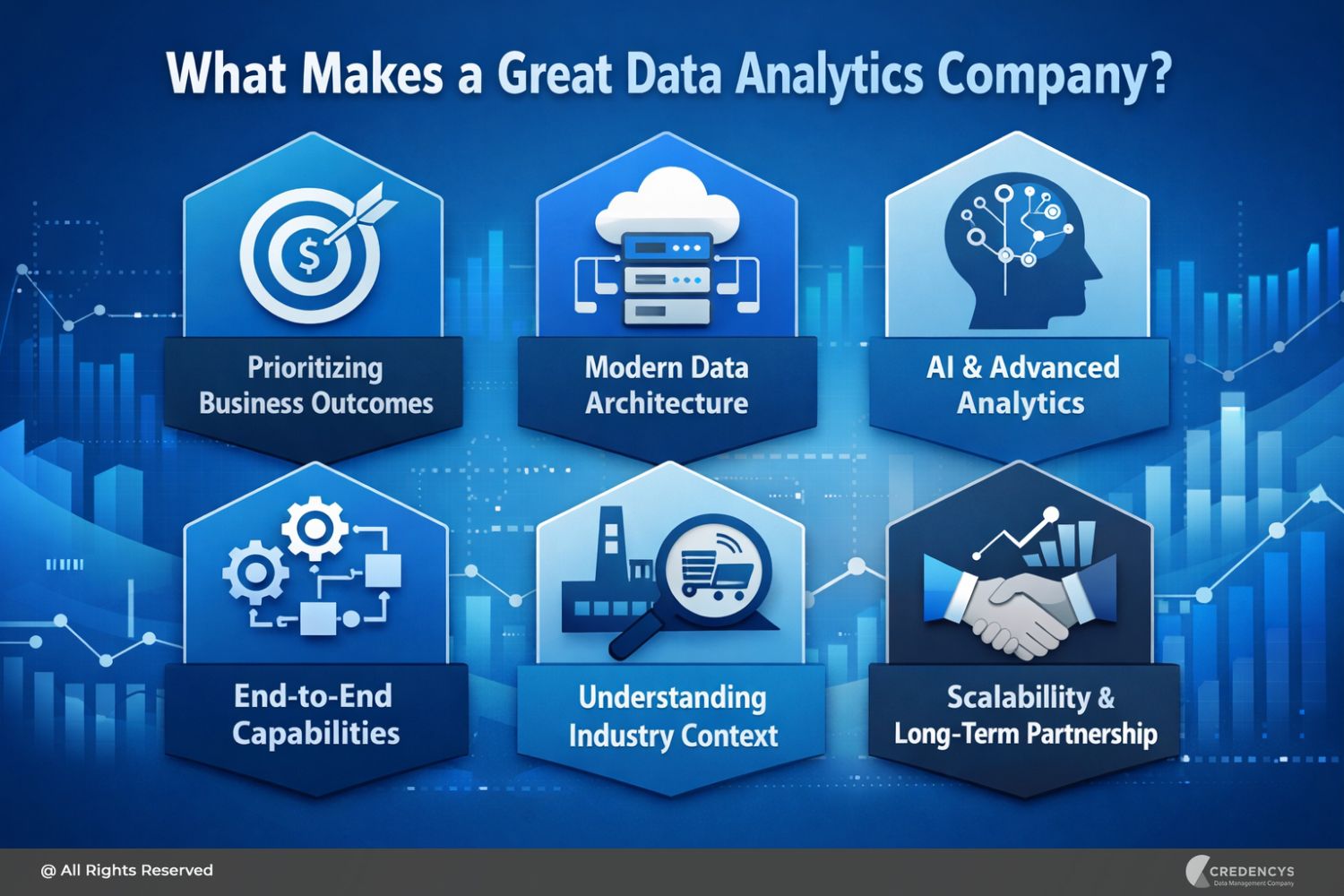
Modern enterprises need real-time pipelines, cloud-native architectures, AI-ready data models, built-in governance, and cost optimization baked into the foundation.

The wrong provider won’t just slow you down. They will lock you into fragile architecture that becomes expensive, rigid, and painfully hard to scale.

You will spend the next three years fixing what should have been built right the first time. This guide is built for enterprise leaders: CTOs, CIOs, Heads of Data, and Digital Transformation leaders who are at that decision point right now.

The goal is not to overwhelm you with jargon. It’s to give you a clear, practical evaluation framework so you can choose a data engineering service provider that actually accelerates business outcomes.

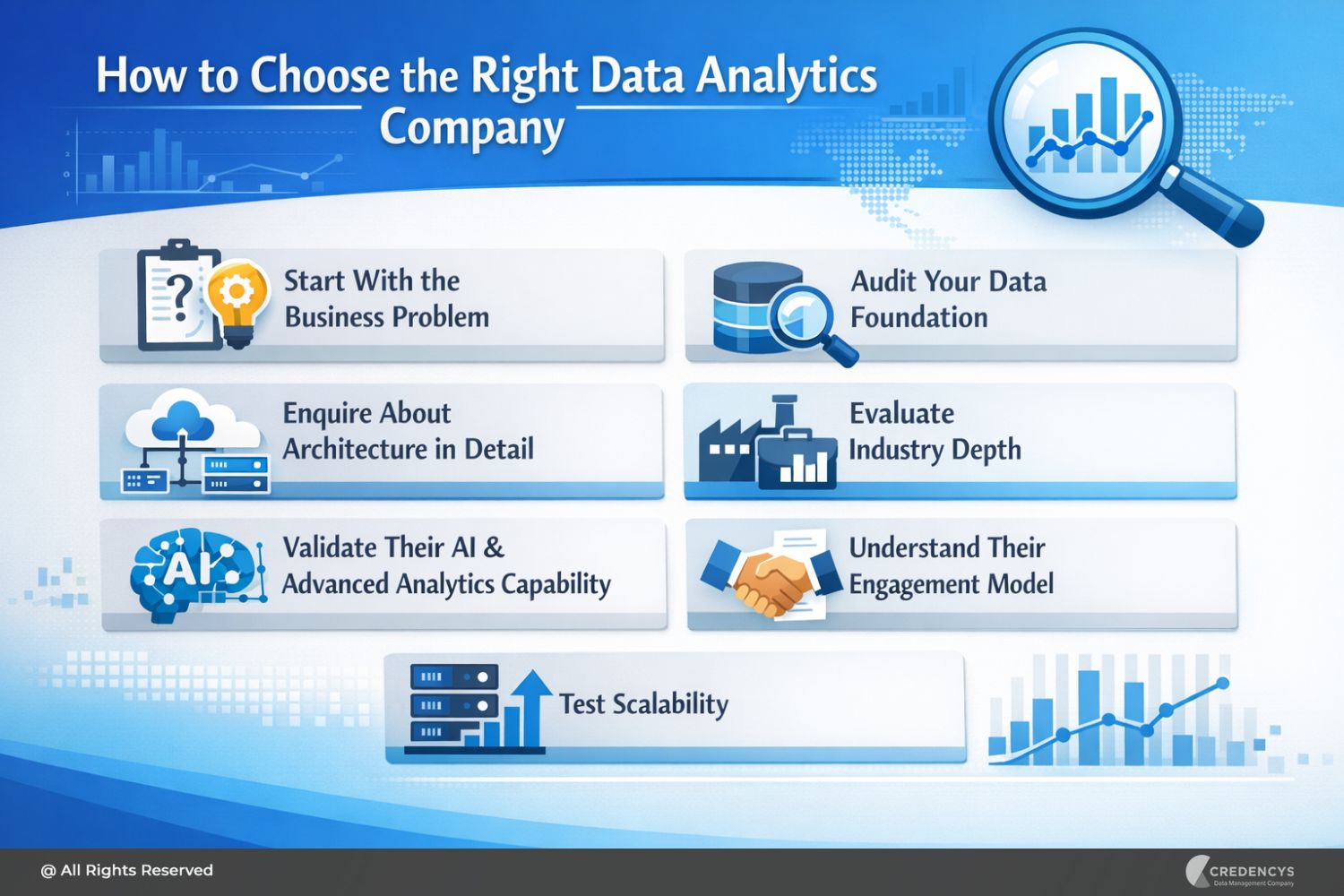
Step 1: Start with Business Outcomes, Not Technology

This is where most enterprises get it wrong. They start with tools.

“We want to implement Databricks.” “We’re moving to Snowflake.” “We need a modern data stack.”

If the conversation begins with a platform name instead of a business objective, you’re already narrowing the solution space before you’ve defined the problem, which is dangerous. A strong data engineering service provider will slow you down here.

They will ask uncomfortable questions. They will push past the “we need better dashboards” surface-level statement and dig into what the business is actually trying to achieve.

Revenue growth? Cost reduction? Faster time-to-market? Improved customer retention? Operational efficiency?

Because data architecture should serve outcomes. Not the other way around.

A tool-first provider will design around the platform they know best. A business-first provider will design around your KPIs, constraints, growth plans, and competitive landscape.

If your priority is AI-driven demand forecasting, your pipelines must enable clean historical datasets and feature engineering. If cost optimization is key, the provider should design with cloud efficiency in mind from day one.

Different outcomes. Different architecture decisions.

So, before you evaluate technical expertise, ask this:

  • Do they understand your business model?
  • Can they translate revenue targets into data requirements?
  • Are they mapping architecture decisions back to measurable impact?

If the proposal is full of technical diagrams but light on business alignment, that’s a red flag.

Step 2: Assess Their Architecture Expertise (Modern Data Stack Readiness)

The architecture decisions you make today will either support your growth for the next five years or quietly sabotage it. A data engineering service provider in 2026 must be fluent in modern architecture patterns.

Let’s break this down.

Cloud Expertise: Beyond Basic Migration

Almost everyone says they do cloud. That doesn’t mean they design cloud-native systems.

There’s a big difference between lifting and shifting legacy workloads into AWS, Azure, or GCP and architecting distributed, elastic, auto-scaling systems from scratch.

You want to ask:

  • Have they led large-scale cloud migrations?
  • Can they design multi-cloud or hybrid environments?
  • Do they optimize for performance and cost?
  • Do they understand networking, security layers, and data locality?

Because cloud bills can spiral fast. And poorly designed cloud architectures become very expensive experiments.

A strong provider doesn’t just deploy in the cloud. They engineer for it.

Data Platform & Lakehouse Experience

Modern enterprises are adopting lakehouse architectures that unify structured and unstructured data, support BI workloads, and power AI pipelines, all within a single ecosystem. But building one correctly is not trivial.

It requires a deep understanding of:

  • Distributed storage systems
  • Compute orchestration
  • Metadata management
  • Query optimization
  • Data modeling for analytics and ML

Some providers can build ingestion pipelines. Few can design scalable, AI-ready lakehouse environments.

That distinction matters. Because rebuilding architecture two years later becomes painful, expensive, and politically exhausting.

Real-Time & Streaming Capabilities

Batch is comfortable. Real-time is transformative.

If your business relies on:

  • Live inventory visibility
  • Fraud detection
  • Personalized offers
  • Dynamic pricing
  • IoT monitoring

Then your provider must understand streaming architectures. And not just theoretically, they should be able to design event-driven systems, manage data latency, handle fault tolerance, and ensure reliability under load.

Streaming done poorly leads to chaos, whereas, done well unlocks competitive advantage.

Scalability & Performance Engineering

Enterprises often underestimate how quickly data scales. As soon as a new channel launches, a merger occurs, IoT devices come online, or AI models demand richer datasets, yesterday’s “future-proof” system suddenly looks fragile.

You need a provider who:

  • Designs for horizontal scaling
  • Optimizes queries at large volumes
  • Plans partitioning strategies carefully
  • Test performance under stress
  • Anticipates growth instead of reacting to it

And yes, who thinks about cost optimization at scale not as an afterthought. Because performance and cost are deeply connected.

Step 3: Evaluate Industry-Specific Experience

Here’s something that sounds obvious. But gets ignored all the time.

Data engineering is not industry-neutral. A provider who has built real-time data systems for a fintech company will not automatically understand the chaos of omnichannel retail.

A team that excels in SaaS analytics may struggle with manufacturing IoT streams. Different data shapes, different velocity, different compliance pressures, and different business logic.

And that difference shows up fast. Let’s say you’re in retail.

You are dealing with POS systems, eCommerce platforms, loyalty programs, marketplace feeds, warehouse data, returns, promotions, pricing fluctuations, and customer behavior signals, all flowing at different speeds. That’s not just a technical integration challenge.

It’s a domain challenge. The same goes for CPG companies managing distributor-level data and secondary sales visibility.

Or manufacturers processing machine-telemetry and predictive-maintenance signals. Or logistics firms juggling route optimization, fuel analytics, and real-time fleet tracking.

Each industry has patterns. And a provider who has seen those patterns before will design better architecture from day one.

So, ask direct questions

  • Have you solved similar use cases?
  • Can you show case studies, not just logos?
  • What industry-specific data challenges have you handled?
  • What went wrong in those projects? What did you learn?

Generic engineering firms often talk in abstractions. Industry-experienced providers talk in specifics.

They mention SKU-level forecasting complexities. Or distributor data reconciliation issues. Or IoT signal noise. Or compliance nuances.

Specificity builds trust. And here’s another angle people overlook.

Industry familiarity shortens implementation time. Because the provider doesn’t need six months just to “understand your business.”

They already understand the moving parts and know where data typically breaks. They anticipate bottlenecks.

Choosing a data engineering service provider isn’t just about technical skill. It’s about contextual intelligence.

Find someone who understands your world, not just your tech stack. It will save you more time and frustration than you think.

Step 4: Validate Their AI & Advanced Analytics Enablement

Many data engineering service providers can move data. Far fewer can make it AI-ready.

Because enterprises aren’t investing in data infrastructure just to build prettier dashboards. They’re investing to power machine learning models, predictive analytics, personalization engines, automation workflows, and increasingly GenAI-driven systems.

If your provider stops at ingestion and transformation, you’ll hit a ceiling fast. AI initiatives don’t fail because data doesn’t exist.

They fail because the data isn’t structured, enriched, governed, or accessible properly. You need to assess whether the provider understands what happens after the pipeline is built.

Ask questions like:

  • Do you support feature engineering workflows?
  • Can you design ML-ready data models?
  • How do you manage training vs inference data pipelines?
  • Do you enable real-time analytics environments?
  • Have you supported Customer 360 or personalization use cases?

Notice the shift. We’re not asking, “Can you build a pipeline?”

We’re asking, “Can you build a foundation that supports AI at scale?” Those are different capabilities.

For example, AI use cases often require:

  • Clean historical datasets with a consistent schema
  • Time-series optimization
  • Data versioning
  • Experiment tracking
  • Low-latency access layers
  • Real-time data feeds

If a provider has never worked closely with data scientists or ML engineers, they might not anticipate these needs. And that’s when friction begins.

  • Data scientists start creating shadow pipelines.
  • Teams build workarounds.
  • Governance weakens.
  • Complexity multiplies.

The right data engineering service provider thinks ahead. They design for analytics consumption.

They align with ML teams. They ensure pipelines feed both BI dashboards and model training environments.

And they don’t treat AI like a buzzword. They treat it like an architectural requirement.

One more thing. Ask them how they handle real-time analytics.

Because predictive insights delivered three days late is not helpful. If your strategy includes dynamic pricing, demand forecasting, fraud detection, or real-time customer engagement, your provider must design with latency in mind.

Step 5: Examine Their Data Governance & Security Framework

This is the part executives care about, and engineers sometimes postpone, until something leaks. Data governance doesn’t get applause in board meetings, but quietly determines whether your data platform becomes an asset or a liability.

When evaluating a data engineering service provider, don’t just ask how they move data. Ask how they protect, control it, standardize, and audit it.

Because without governance, scale becomes chaos. Here’s what to dig into.

Data Quality Frameworks

  • Do they define validation rules?
  • Do they implement automated checks?
  • Do they monitor anomalies in pipelines?

Bad data flowing fast is still bad data.

Metadata & Cataloging

  • Can they implement metadata management?
  • Is there clear data lineage tracking?
  • Can business users understand where data originated?

If your team can’t trace a number back to its source, trust erodes quickly.

Access Control & Security

How do they manage role-based access?

Do they enforce least-privilege principles?

How is sensitive data masked or tokenized?

Security missteps aren’t minor inconveniences. They’re reputational risks.

Compliance Awareness

Does the provider proactively design for compliance requirements such as GDPR, CCPA, and industry-specific regulations? Because retrofitting governance later is painfully expensive.

And here’s something subtle but important. Strong governance actually accelerates analytics.

It sounds counterintuitive, but when data definitions are standardized, when ownership is clear, and when quality is monitored, teams move faster.

There’s less debate, less rework, and less confusion. Clarity speeds things up.

So, if a provider glosses over governance and focuses only on shiny architecture diagrams, pause. Architecture without governance is fragile, and fragile systems don’t survive scale.

Step 6: Understand Their Engagement & Delivery Model

Even the most brilliant data engineers can derail a project if the engagement model is chaotic, unclear, or misaligned with your internal teams. And this is where many enterprise partnerships quietly fall apart.

On paper, everything looks solid: a skilled team, impressive case studies, and a modern tech stack, but then timelines slip, communication gets messy, ownership becomes blurry, internal teams feel disconnected, and momentum fades. So before signing anything, get clarity on how the relationship will function day to day.

Enquire if they are offering staff augmentation or true managed services? Staff augmentation means you are essentially renting engineers.

You manage priorities, define architecture, and carry the strategic burden.

Managed services is deeper. The provider owns delivery outcomes, architectural decisions, optimization, and ongoing improvements.

Have clarity on how they plan and execute? Do they follow the Agile methodology, or do they have sprint reviews?

Do they provide transparent reporting? Is architectural documentation standard practice?

Many projects lack proper documentation, and then when leadership changes, everything becomes tribal knowledge. Also, ask about escalation paths.

Who responds if something breaks at 2 AM, and if there is 24/7 monitoring? Do they proactively detect pipeline failures?

Because data downtime impacts revenue. And another important thing to ask is how they handle disagreements?

A strong partner will challenge you when necessary. They won’t blindly implement flawed ideas just to keep the contract smooth.

That kind of honesty signals long-term thinking.

Red flags to watch:

  • Vague scope definitions
  • No long-term roadmap
  • Over-promising AI transformation timelines
  • Lack of defined KPIs
  • No clarity on post-implementation support

The right data engineering service provider behaves like a strategic partner. They think beyond the immediate project.

They talk about continuous optimization. They bring ideas proactively and anticipate scale.

Because data engineering isn’t a one-time initiative, but an evolving capability.

And your engagement model should reflect that reality.

Step 7: Evaluate Cost Structure & ROI Potential

Data engineering is not a small investment. Cloud infrastructure, engineering talent, governance frameworks, and monitoring tools add up quickly.

But many enterprises make this mistake of optimizing for the lowest proposal and then spend the next three years paying for architectural shortcuts. A cheap implementation can become very expensive to maintain.

So instead of asking, “Who is the most affordable?” ask, “Who delivers the strongest long-term ROI?” Start by understanding their pricing model.

  • Fixed cost?
  • Time & material?
  • Managed service subscription?
  • Outcome-based pricing?

Each model has trade-offs. Fixed costs provide predictability but can sometimes limit flexibility.

Time & material offers adaptability but requires close oversight. Managed services provide long-term continuity but demand trust.

Now look deeper. How do they approach cloud cost optimization?

  • Do they design with computational efficiency in mind?
  • Do they implement workload auto-scaling?
  • Do they monitor storage tiering?
  • Do they optimize query performance to reduce consumption costs?

Because cloud bills grow silently. And inefficient data pipelines burn money every single day.

Also, ask how they define ROI. Can they tie data engineering initiatives back to measurable business impact?

For example:

  • Reduced manual reporting hours
  • Faster time-to-insight
  • Increased campaign conversion rates
  • Improved forecast accuracy
  • Lower infrastructure costs

If ROI conversations feel vague, that’s a warning sign. You don’t want a provider who talks only about technical metrics like throughput and latency. Those matters, but executives care more about revenue, margin, efficiency, and risk reduction

One more subtle but important angle is the cost of delay. If your data foundation is slowing AI initiatives, personalization strategies, or operational optimization, that’s not just a technical issue, but an opportunity cost.

Every month of delay means competitors move ahead. So, cost evaluation isn’t just about contract size; it’s about value velocity.

Choose a partner who understands that conversation. Because in enterprise data engineering, price is visible, but value is compounding.

Conclusion: Your Data Engineering Partner Will Shape Your Competitive Edge

The provider you choose will influence how fast you launch AI initiatives, how confidently executives trust analytics, how efficiently operations scale, how quickly new data sources integrate, and how securely sensitive information is managed. That’s not a small impact.

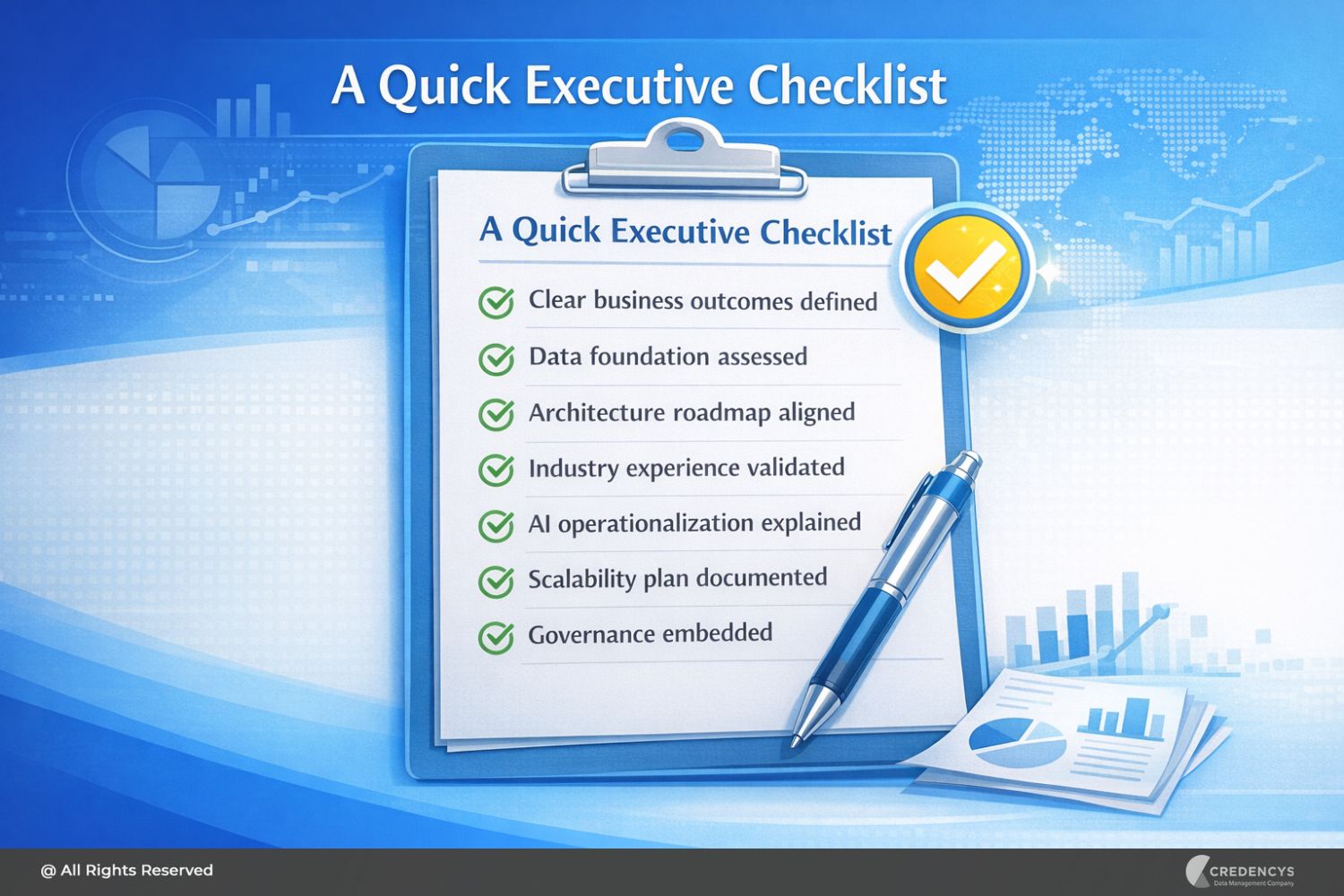
And that’s why this decision deserves real scrutiny. Ask hard questions, demand architectural clarity, insist on business alignment, and evaluate long-term scalability.

Choose poorly, and you will spend years fixing what should have been built right from the start. Choose wisely, and your data becomes a strategic asset that compounds over time.

Top Gen AI Development Companies in 2026

In 2026, Generative AI is no longer a side project; it’s infrastructure. What started with public fascination around ChatGPT has now evolved into enterprise copilots, AI-driven decision engines, autonomous workflows, and domain-specific LLM systems embedded inside core business operations.

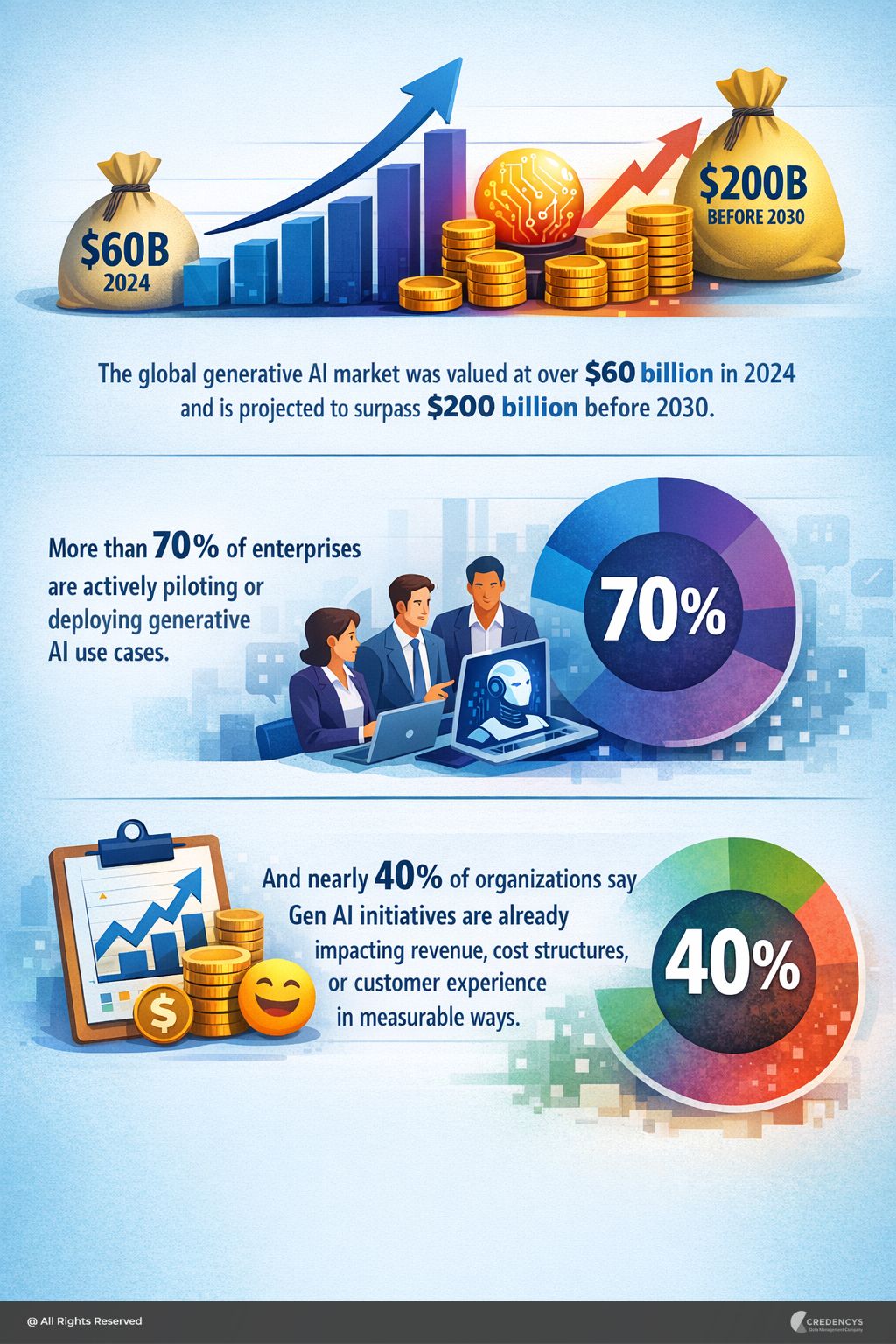
And companies are not just testing anymore; they are heavily investing. The numbers tell the story.

GEN AI Stats

But here’s the catch. Building a flashy demo using GPT-4 or integrating Claude 3 into a chatbot is easy.

Building a secure, scalable, hallucination-resistant, governance-ready, production-grade AI system is hard.

And this is exactly why the demand for serious Generative AI development partners has exploded. Not agencies that “play with prompts” or vendors who repackage APIs.

But engineering-led companies that understand data pipelines, LLMOps, model evaluation frameworks, vector databases, enterprise security, and cost optimization. Because Gen AI isn’t just about the model.

It’s about data quality, architecture, fine-tuning, retrieval strategies, monitoring, compliance, integration with legacy systems, and change management. And most organizations don’t have all of that in-house.

So, the real question in 2026 isn’t: “Should we adopt Generative AI?” It’s: “Who can actually build it right and make it scale?”

In this guide, we have evaluated the top generative AI development companies in 2026 based on enterprise deployments, technical depth, industry expertise, and their ability to move from proof-of-concept to production. Let’s get into it.

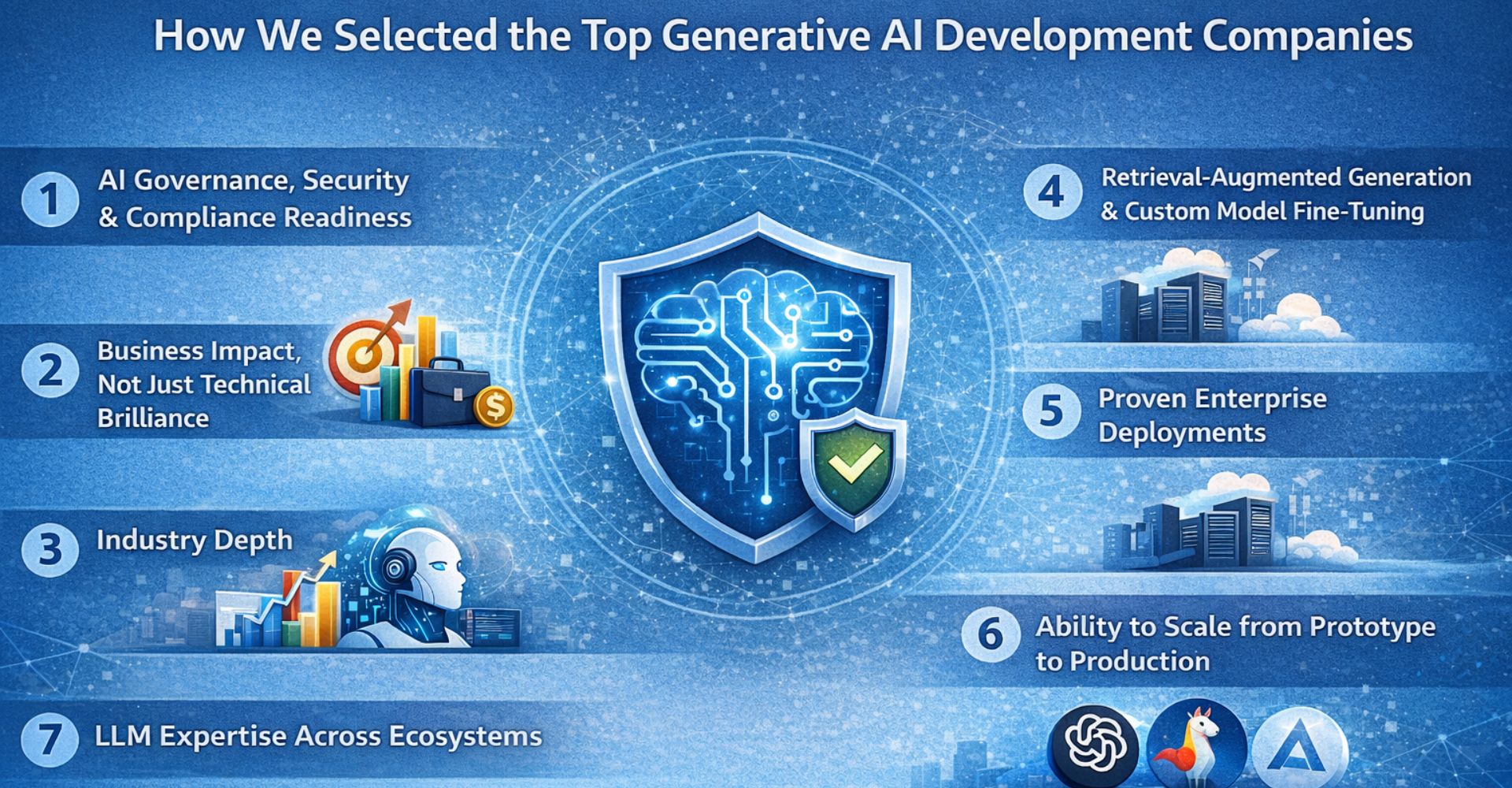
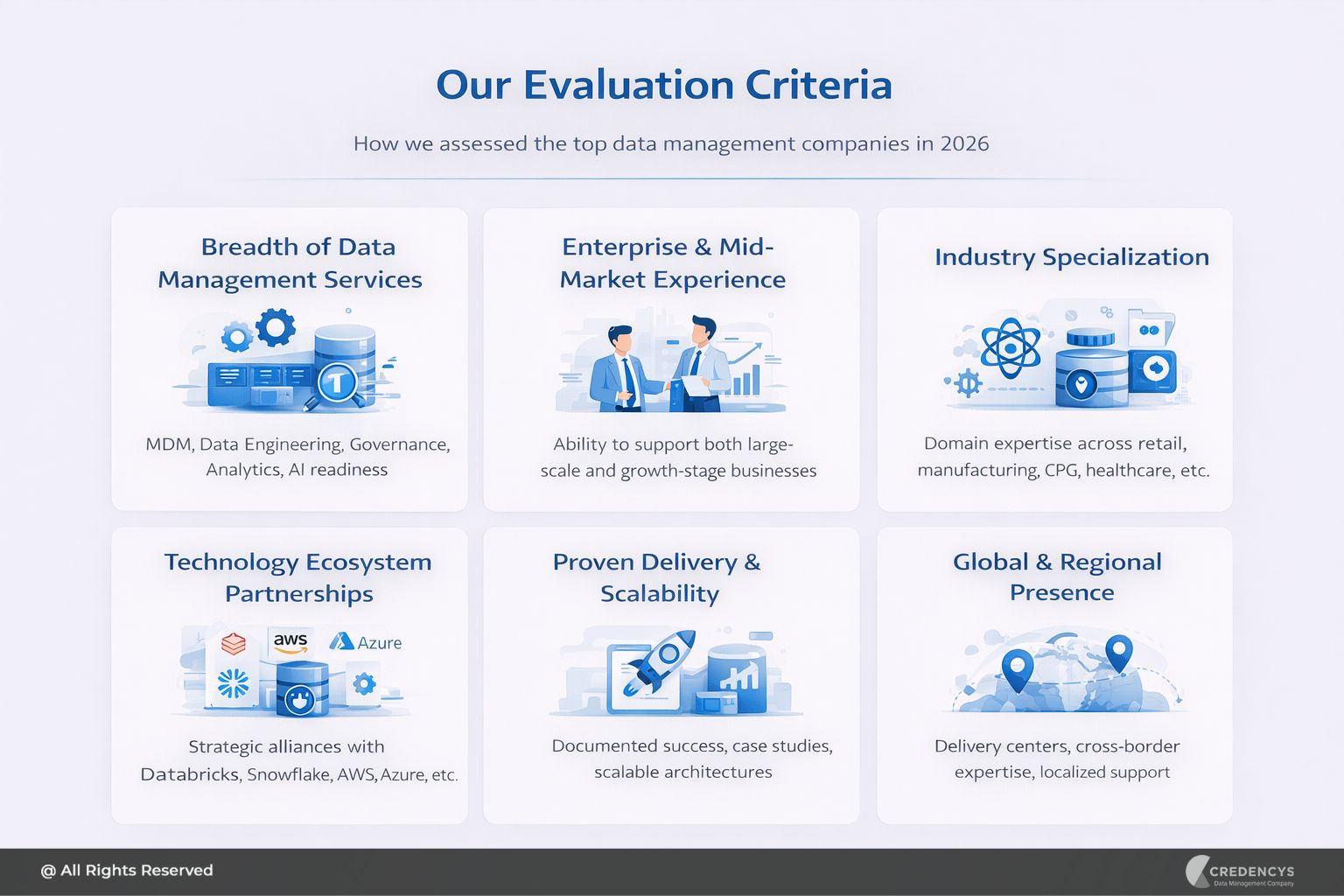
How We Selected the Top Gen AI Development Companies in 2026

Every AI company says they are “leading.” Every website says “cutting-edge.”

And every pitch deck has a slide with neural network graphics. But slides don’t ship production systems.

So, we didn’t build this list based on marketing noise. We focused on execution, real deployments, real engineering depth, and real enterprise impact.

Here’s exactly what we looked at.

1. AI Governance, Security & Compliance Readiness

In 2026, governance is not optional. Enterprises now demand:

  • Role-based access controls
  • Data encryption
  • Model monitoring
  • Bias detection
  • Explainability frameworks

Especially in regulated industries. Any company that ignores governance is still living in 2023.

2. Business Impact, Not Just Technical Brilliance

Some companies build incredible models. But enterprises don’t buy models.

They buy outcomes. We evaluated whether these firms tie AI initiatives to:

  • Revenue growth
  • Operational efficiency
  • Cost reduction
  • Customer experience improvement

Gen AI is no longer a research project. It’s a business lever.

3. Industry Depth

Generic AI knowledge is not enough. Retail AI is different from healthcare AI.

Manufacturing use cases are not the same as fintech automation. We favored companies that understand industry context, compliance requirements, domain vocabulary, and business workflows.

Because context improves accuracy. And accuracy builds trust.

4. Retrieval-Augmented Generation & Custom Model Fine-Tuning

Enterprise Gen AI rarely works “out of the box.” It needs:

  • Structured and unstructured data integration
  • Vector databases
  • Fine-tuning strategies
  • Domain-specific embeddings
  • Evaluation pipelines

We evaluated firms that build robust RAG frameworks, not just surface-level integrations. Because without high-quality data retrieval, even the best LLM will hallucinate.

5. Proven Enterprise Deployments

It’s easy to build a chatbot over GPT-4; however, it’s much harder to:

  • Deploy it securely inside a Fortune 500 environment
  • Connect it to internal systems
  • Handle thousands (or millions) of user interactions
  • Monitor performance and hallucinations
  • Maintain uptime and cost efficiency

We prioritized companies that have moved beyond sandbox experiments.

6. Ability to Scale from Prototype to Production

Here’s where most AI initiatives collapse. They build something impressive in 8 weeks.

Leadership gets excited. And then scaling exposes every architectural weakness.

We looked for LLMOps maturity, MLOps pipelines, Cloud-native AI infrastructure, cost optimization frameworks, and continuous monitoring and feedback loops. Because scaling AI is not just a technical challenge, it’s an operational one.

7. LLM Expertise Across Ecosystems

Serious Gen AI partners don’t depend on a single model. They work across OpenAI models, anthropic models, Google DeepMind models, and Open-source models like Llama

Model selection should depend on use case, cost, latency, compliance, and control. If a company only works with one ecosystem, that’s a limitation.

Criteria to Select the Top Gen AI Development Companies

So, this list isn’t about hype. It’s about who can actually design, build, deploy, secure, and scale generative AI systems in real-world enterprise environments.

And yes, that’s a much higher bar. Now, let’s look at the companies that are clearing it in 2026.

Top Gen AI Development Companies in 2026 (Ranked & Reviewed)

Let’s get into the names. These are the companies that are not just experimenting with Generative AI, they are engineering it, deploying it, and scaling it inside real enterprises.

1. Credencys Solutions

Let’s start with a company that approaches Generative AI differently. While many firms begin with “Which model should we use?”, Credencys starts with: What business outcome are we solving?

And that changes everything.

Core Strengths:

  • Enterprise-grade Gen AI applications
  • AI-powered Customer 360 platforms
  • Retail & CPG intelligence systems
  • RAG-based enterprise search
  • AI-driven pricing and demand forecasting
  • Strong data engineering + AI integration

What makes Credencys stand out in 2026 is its foundation in data architecture. Because Generative AI without structured, governed, accessible data is just a prompt experiment.

They focus heavily on:

  • Lakehouse-aligned AI architecture
  • LLMOps frameworks
  • Secure deployments
  • Scalable AI pipelines

Success Story: How Credencys Helped a Specialty Apparel Retailer

When talking about AI consulting companies that deliver real business impact, it’s one thing to talk strategy and another to show it. Here’s a powerful example from one of Credencys’ engagements with a leading women’s specialty apparel retailer that was struggling with fragmented data and inconsistent omnichannel experiences.

Client Challenge: With over 415 stores nationwide, the retailer faced a common but critical problem: customer and operational data were scattered across on-premises systems, cloud tools, and third-party platforms. This fragmentation made it nearly impossible to:

  • Provide a seamless omnichannel experience
  • Support flexible fulfilment options like buy online, pick up in store (BOPIS)
  • Maintain real-time inventory visibility across channels
  • Deliver personalized experiences based on unified customer data

This wasn’t just a database problem; it was a business growth blocker.

Credencys’ Solution: Instead of rolling out another isolated analytics tool, Credencys implemented a customized AI-Native Customer 360 solution to unify data across all systems, online, offline, cloud, and legacy sources. The solution included:

  • A unified Customer 360° data layer that pools customer interactions and profiles
  • Real-time order tracking and BOPIS support
  • Centralized inventory visibility across all locations
  • Personalized product recommendations and targeted promotions
  • A scalable system designed to support future omnichannel innovation

In short: data chaos became clarity, and experience gaps became growth levers.

Business Impact: This wasn’t a small operational lift; it was a profound business transformation. After implementation, the retailer saw:

  • 24% increase in online sales through smoother customer experiences
  • 31% improvement in customer satisfaction thanks to unified omnichannel engagement
  • Significant reduction in stockouts and fulfillment delays
  • Strengthened brand loyalty due to consistent and personalized shopping journeys

These metrics show what happens when AI consulting isn’t just about models, it’s about data alignment, customer experience, and measurable business outcomes.

Read Full Case Study

Ideal for: Mid-to-large enterprises in retail, manufacturing, supply chain, and digital commerce that want AI tied directly to measurable business KPIs.

Where many AI firms lead with models, Credencys leads with impact.

2. LeewayHertz

LeewayHertz has positioned itself as a strong enterprise AI engineering partner, particularly in the US market.

Core Capabilities:

  • Custom LLM application development
  • Enterprise chatbot systems
  • Blockchain + AI integration
  • AI product engineering

They work extensively with large enterprises looking to embed Gen AI into internal workflows. Best suited for organizations building AI-powered products or internal automation platforms.

3. Ksolves

Ksolves brings a broader enterprise technology background into AI.

What they offer:

  • AI and ML development
  • NLP solutions
  • Conversational AI
  • Data engineering services

They are particularly attractive for companies that want AI integrated into existing enterprise systems rather than built from scratch.

4. CaliberFocus

CaliberFocus operates at the intersection of AI consulting and digital transformation.

Strength Areas:

  • Generative AI consulting
  • Digital engineering
  • AI integration within enterprise systems

They are often a fit for companies early in their AI maturity journey, needing advisory plus implementation support.

5. Xavor

Xavor focuses on AI-enabled digital engineering solutions, particularly in the US enterprise space.

Capabilities include:

  • AI-driven enterprise modernization
  • Custom Gen AI applications
  • Intelligent automation systems

They are strong in digital transformation projects where Gen AI becomes part of a broader modernization roadmap.

A Quick Reality Check

There isn’t one “best” Gen AI company. There’s the best company for:

Your industry, your data maturity, your budget, your timeline, and your risk appetite. Some are ideal for massive global rollouts.

Some excel at focused AI product development. Some shine in data-first AI strategies.

The right choice depends on what you are trying to build and how serious you are about scaling it. Now, let’s look at the types of Generative AI services these companies actually offer beyond the buzzwords.

Types of Generative AI Services These Companies Offer

“We build Gen AI solutions” can mean a hundred different things. Some companies are building internal copilots.

Some are deploying AI-powered search across enterprise data. Some are fine-tuning domain-specific LLMs.

And some are just wrapping APIs. So, what are the real services leading Gen AI development companies offer in 2026?

Let’s break it down.

1. AI-Powered Enterprise Search

Search inside enterprises has always been messy. Files everywhere, outdated documentation, and siloed systems.

Now companies are deploying AI search systems that understand intent, summarize documents, extract key insights, and connect across structured and unstructured data. It’s not keyword search anymore, but semantic intelligence.

2. Custom Model Fine-Tuning & Domain LLMs

Sometimes off-the-shelf models aren’t enough. So, companies fine-tune models like Llama or adapt enterprise versions of foundation models through providers like OpenAI.

This is particularly important for Healthcare, Financial services, Legal industries, and Manufacturing domains. Because domain language is different, and generic models struggle with specialized nuance.

3. LLMOps & AI Monitoring Frameworks

And this is the part nobody talks about in flashy demos. Leading development companies build model-performance dashboards, prompt-management systems, cost-tracking mechanisms, hallucination-detection workflows, and bias-evaluation systems.

Because once AI goes live, you don’t just “set it and forget it.” You monitor, optimize, and iterate every week.

4. Multimodal AI Systems

Text is just one part of the story. Leading Gen AI firms are building systems that process text, images, audio, and structured data

This enables use cases like visual inspection in manufacturing, AI-driven product content generation, intelligent video summarization, and multimodal customer support systems. It’s more complex but also more powerful.

5. AI Agents & Autonomous Workflows

This is where Gen AI is heading next. AI agents that don’t just respond, they act.

They can trigger workflows, pull data from systems, execute predefined actions, and coordinate multi-step tasks. These systems often integrate with enterprise tools and leverage APIs across platforms.

It’s still evolving. But adoption is accelerating fast.

6. Document Intelligence & Automation

This is one of the fastest-growing use cases in 2026. Gen AI systems now extract insights from contracts, summarize legal documents, process invoices, analyze claims, and interpret compliance reports

And they do it at scale. When combined with automation frameworks, this dramatically reduces manual review cycles.

Less repetitive work and more strategic time.

7. Enterprise AI Copilots & Conversational Systems

This is where it all started. But it’s evolved far beyond basic chatbots.

Companies are building internal knowledge assistants, sales copilots, HR automation assistants, developer copilots, and customer support AI agents. These systems are often powered by models such as GPT-4, Claude 3, or Gemini, but are heavily customized using enterprise data.

Because generic answers don’t cut it in regulated or complex industries. And yes, accuracy matters more than creativity in enterprise environments.

8. Retrieval-Augmented Generation (RAG) Systems

This is the backbone of serious enterprise Gen AI. RAG-based systems connect large language models with internal documents, knowledge bases, product catalogs, policy databases, and real-time structured data

Instead of relying solely on pre-trained knowledge, the AI first retrieves relevant internal information and then generates responses. Result?

Fewer hallucinations, higher contextual accuracy, and better trust. If a development company doesn’t deeply understand RAG architecture, vector embeddings, and retrieval optimization, that’s a red flag.


How to Choose the Right Gen AI Development Partner in 2026

This is where most companies get it wrong. They get excited about the demo, impressed by the UI, blown away by how “human” the responses sound.

And they forget to ask the hard questions. But Generative AI isn’t a design decision is an architectural one.

So, before you sign anything, pause and ask this instead.

1. Do They Understand Your Data Architecture?

Gen AI is only as good as the data behind it. Ask:

  • How will you integrate with our existing systems?
  • How do you handle structured + unstructured data?
  • What’s your RAG architecture approach?
  • How do you ensure data freshness?

If their answer is vague, that’s a problem. Because Gen AI is 20% model and 80% data engineering.

2. What’s Their Approach to Hallucination Mitigation?

Every LLM hallucinates, even the most advanced ones. Whether it’s built on GPT-4 or Claude 3, hallucinations are real.

So, ask:

  • How do you evaluate model accuracy?
  • Do you implement grounding frameworks?
  • How do you measure response confidence?
  • What monitoring systems are in place?

3. Do They Design for Scale or Just for Demo Day?

A prototype is easy. Scaling to thousands of users is a different game.

Ask about LLMOps pipelines, auto-scaling infrastructure, latency management, cost optimization strategies, and token usage monitoring. Because Gen AI costs can escalate fast.

And suddenly your “pilot project” has a six-figure monthly bill.

4. How Strong Is Their Governance Framework?

This one’s critical. Especially in regulated industries.

Ask:

  • How do you handle data privacy?
  • Is sensitive information masked or filtered?
  • What compliance standards do you align with?
  • Do you support audit trails?

Governance isn’t an afterthought anymore, but rather a matter of board-level visibility.

5. Can They Tie AI to Business KPIs?

Here’s the real differentiator. Some firms will talk about embeddings, transformers, and fine-tuning.

That’s great. But ask them:

  • How will this improve revenue?
  • Where will costs reduce?
  • What measurable outcome should we expect?
  • What does success look like in 6 months?

If they can’t translate AI into business metrics, they are not the right partner. Because leadership doesn’t approve of cool tech but only of ROI.

6. What Happens After Deployment?

This is where reality kicks in. Ask:

  • Who maintains the model?
  • How are updates managed?
  • What does continuous improvement look like?
  • How do we retrain or optimize over time?

Gen AI systems evolve. They require iteration, evaluation, and feedback loops.

If a vendor disappears after go-live, you are left holding a fragile system that breaks easily.

7. Do They Offer Cross-Model Flexibility?

The Gen AI landscape is evolving quickly. Today, it might be OpenAI.

Tomorrow, it might be another provider. Or an open-source ecosystem.

Your partner should design architecture that allows flexibility, not lock you into a single model vendor.

Planning a Generative AI Initiative in 2026?

If you are exploring how Gen AI fits into your data ecosystem, whether it’s AI-powered Customer 360, intelligent automation, enterprise search, or domain-specific copilots, the starting point isn’t the model but your architecture and your outcomes. At Credencys, we help enterprises design, build, and scale production-grade Generative AI systems grounded in strong data foundations and measurable business impact.

If you are serious about moving from pilot to production, it might be time to have that conversation.

Data Engineering Best Practices for Your Business (Updated List)

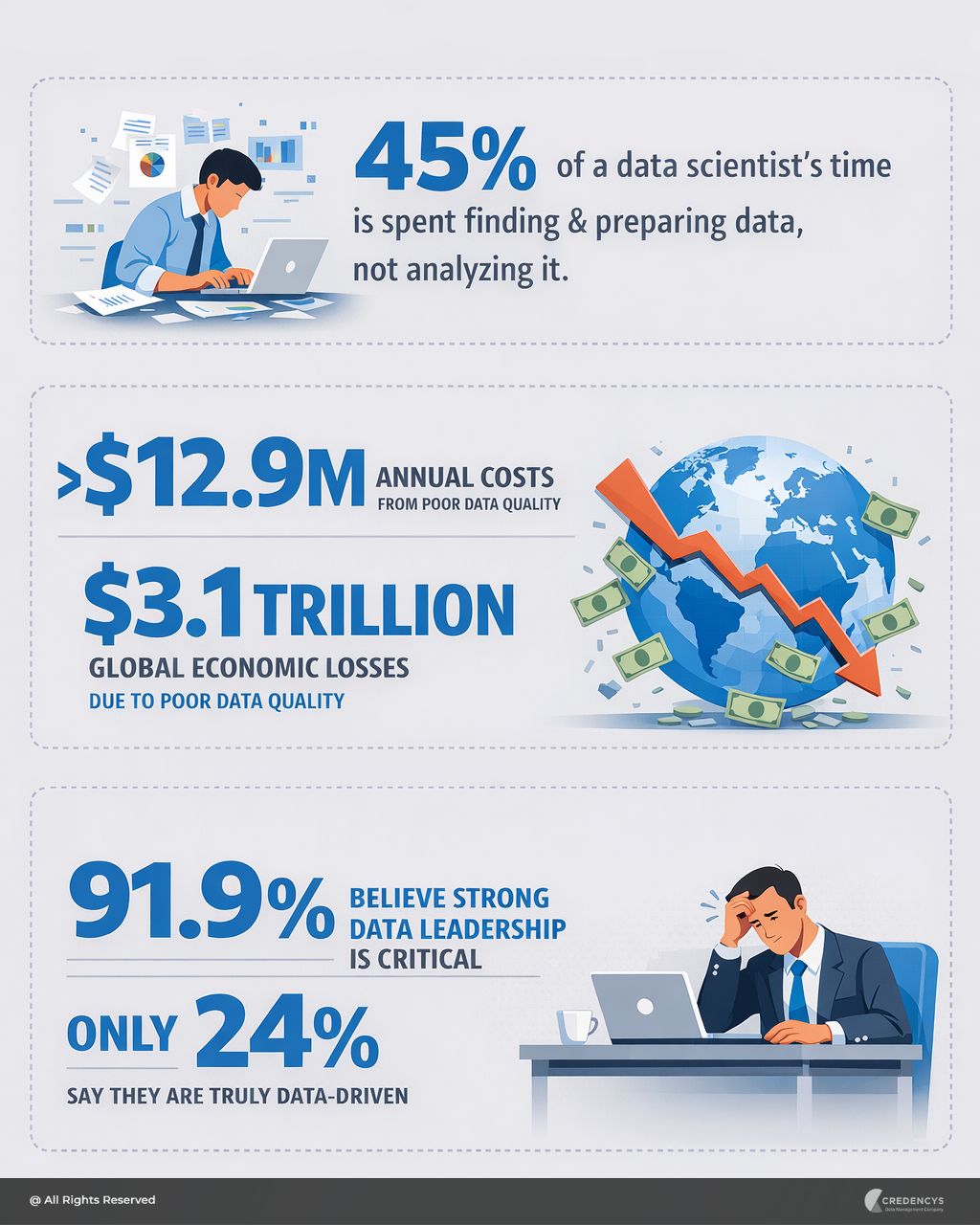
Poor data quality costs organizations an average of $12.9 million per year, according to Gartner.

That number usually surprises leadership teams. Not because data problems are rare, but because they are often invisible. The reports look polished. Dashboards load on time. AI models produce outputs. Yet underneath, pipelines fail silently, definitions conflict across departments, and decisions are made on incomplete or inconsistent data.

Most businesses do not struggle due to lack of analytics tools. They struggle because the underlying data foundation is fragile.

This is why Data Engineering matter more today than ever before. As organizations adopt cloud platforms, real-time analytics, and AI-driven systems, the volume, velocity, and variety of data continue to grow. Without structured engineering discipline, complexity increases faster than value.

Strong data engineering is not just about data movement. It is about reliability, scalability, governance, and performance. It ensures that insights are trusted, systems are stable, and innovation can scale without breaking infrastructure.

In the sections ahead, we will explore why data engineering is critical for your business, the real cost of getting it wrong, and the essential data engineering best practices every organization should follow to build resilient, future-ready systems.

Why Data Engineering is Critical for Your Business

Data has become the backbone of modern decision-making, but data alone does not create value. The systems that collect, transform, store, and deliver that data determine whether it becomes an asset or a liability.

Data engineering sits at the center of this transformation.

Every dashboard your leadership team reviews, every forecast your supply chain relies on, every personalization model your marketing team deploys depends on well-designed data pipelines working quietly in the background. When those pipelines are stable and scalable, business teams move faster and with greater confidence. When they are fragile, progress slows and trust erodes.

Strong data engineering enables your organization to:

  • Deliver consistent, reliable insights across departments
  • Reduce manual data reconciliation and reporting efforts
  • Scale analytics initiatives without rebuilding infrastructure
  • Support AI and advanced analytics with clean, structured data
  • Improve governance, compliance, and auditability

It also creates alignment. When data definitions are standardized and systems are integrated, departments stop debating whose numbers are correct and start focusing on strategy.

In fast-growing organizations, complexity increases quickly. New systems are added. Data sources multiply. Reporting demands expand. Without disciplined engineering practices, this complexity becomes unmanageable.

That is why data engineering is not just an IT function. It is a strategic capability that directly influences operational efficiency, innovation, and long-term competitiveness.

The Cost of Poor Data Engineering

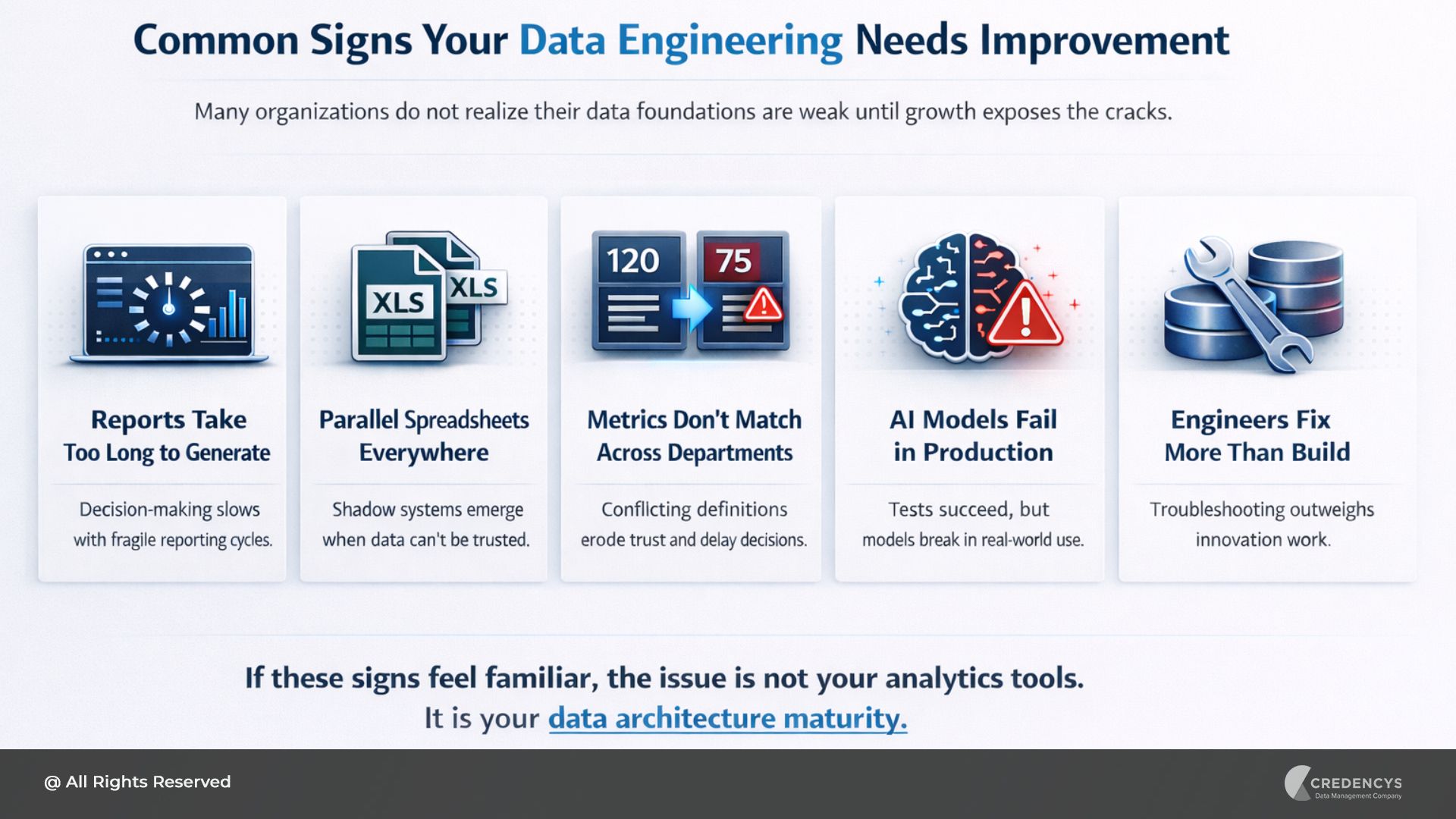
The impact of weak data engineering rarely appears as a single dramatic failure. It shows up gradually, in subtle inefficiencies that compound over time.

A report that takes hours to reconcile. A dashboard that displays conflicting numbers. An AI model that performs well in testing but fails in production. A leadership meeting where teams debate which dataset is accurate instead of discussing strategy.

These are not isolated incidents. They are symptoms of underlying engineering gaps.

Poor data engineering often leads to:

  • Frequent pipeline failures and delayed reporting
  • Inconsistent data definitions across departments
  • Manual workarounds that increase human error
  • Low trust in analytics outputs
  • Slower adoption of AI and advanced analytics initiatives

The financial cost is real, but the strategic cost can be even greater.

Over time, the organization begins to operate defensively rather than proactively. Instead of using data to anticipate change, it reacts to problems after they surface.

data engineering best practices

Investments in analytics tools, cloud platforms, and AI solutions cannot compensate for weak foundations. Without disciplined data engineering best practices, technology becomes layered complexity rather than scalable advantage.

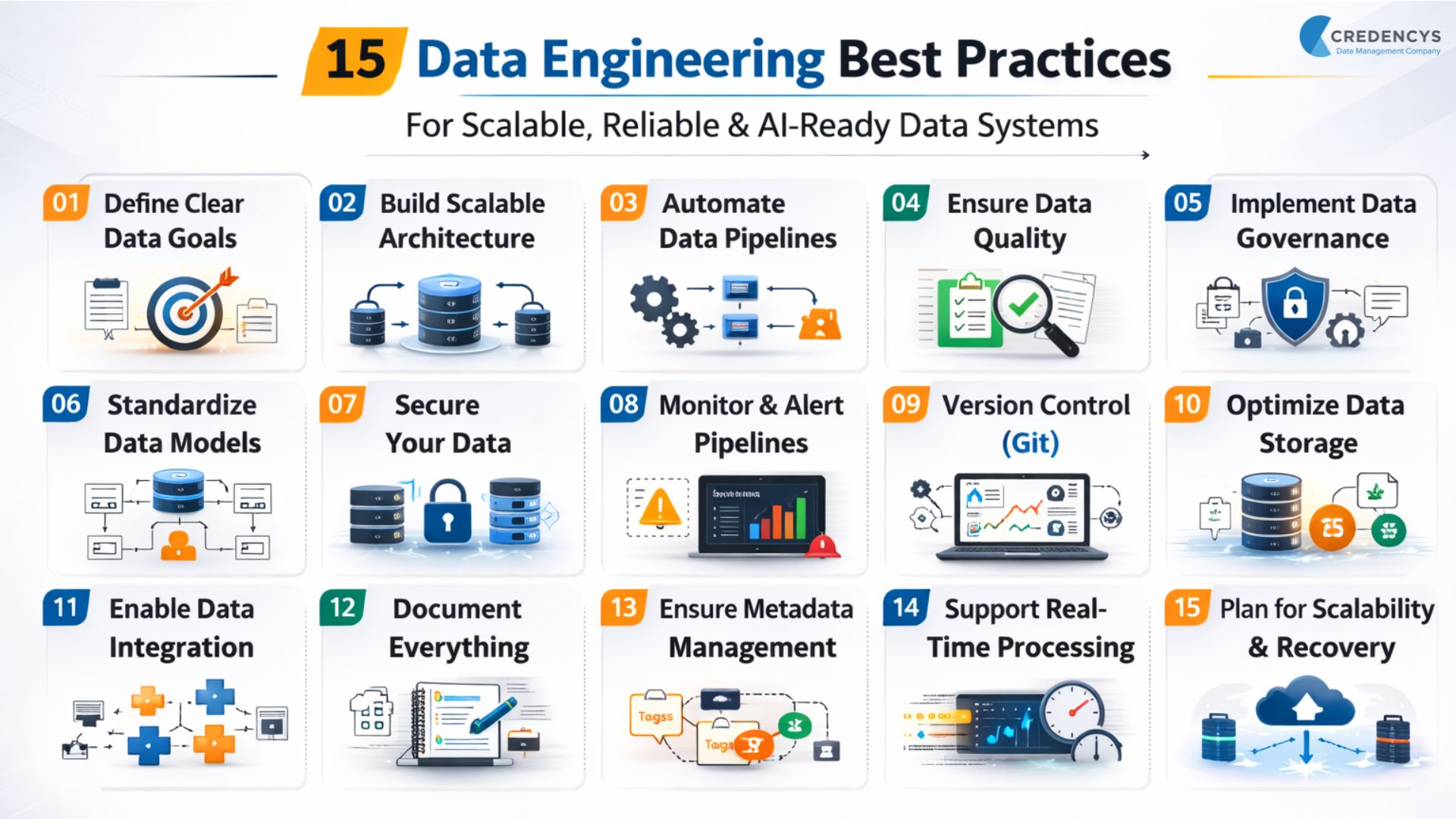
15 Data Engineering Best Practices for your Business

Strong data systems are the result of intentional architecture, disciplined processes, and alignment between engineering teams and business leadership.

Organizations that treat data engineering as a strategic capability rather than a back-end utility build infrastructure that supports analytics, AI, compliance, and operational growth for years without constant rework.

Below are 15 data engineering best practices explained in greater depth.

1. Design With Scalability in Mind

Most data architectures are designed for current workloads, not future growth. That is where long-term instability begins.

As your organization scales, data sources multiply, user queries increase, and AI workloads demand more compute power. If your architecture cannot scale horizontally or elastically, performance bottlenecks and cost inefficiencies will emerge.

Scalable architecture requires:

  • Cloud-native storage that separates compute and storage
  • Distributed processing frameworks capable of parallel execution
  • Partitioned datasets to improve query performance
  • Auto-scaling compute clusters that adapt to workload fluctuations
  • Infrastructure-as-code to enable repeatable provisioning

Beyond technology, scalability also means designing schemas and transformation logic that can handle additional attributes, entities, and integrations without major redesign.

2. Automate Data Pipelines End-to-End

Manual intervention in pipelines creates fragility. Every manual export, spreadsheet transformation, or ad-hoc script introduces inconsistency.

End-to-end automation ensures data flows predictably from ingestion to consumption.

This includes:

  • Automated ingestion from APIs, databases, and event streams
  • Scheduled and event-triggered workflows
  • Dependency management across tasks
  • Automatic retries and failure recovery mechanisms
  • CI/CD practices for pipeline deployment

Automation reduces operational overhead and ensures consistency across environments.

More importantly, it transforms data engineering from reactive maintenance to proactive enablement.

3. Prioritize Data Quality From Day One

Data quality cannot be treated as a downstream cleanup activity. By the time incorrect data reaches dashboards or AI models, the damage is already done. A strong quality framework integrates checks at every stage:

During ingestion:

  • Schema validation
  • Format consistency checks
  • Mandatory field validation

During transformation:

  • Business rule enforcement
  • Standardization of units and categories
  • Referential integrity validation

During delivery:

  • Data completeness verification
  • Freshness monitoring
  • Reconciliation with source systems

High-quality data builds confidence across departments. Without it, analytics adoption slows, and AI initiatives struggle in production environments.

4. Implement Strong Data Governance

Governance ensures clarity around ownership, access, compliance, and accountability. Without governance, organizations experience metric misalignment, compliance risks, and data misuse.

A mature governance framework includes:

  • Clearly assigned data owners and stewards
  • Role-based access control with least-privilege principles
  • Metadata catalogs for discoverability
  • Policy-driven data classification
  • Regulatory compliance mapping

Governance should function as an enabler. It provides transparency and trust, allowing teams to innovate within defined boundaries rather than operating in uncertainty.

5. Use Modular and Reusable Pipeline Design

As organizations expand analytics use cases, pipeline sprawl becomes a serious risk. Custom-built pipelines for each department create redundancy, maintenance overhead, and inconsistencies.

A modular approach allows you to:

  • Reuse ingestion templates across systems
  • Build shared transformation libraries
  • Parameterize logic for flexible deployment
  • Standardize validation components

This architectural discipline reduces development time, accelerates onboarding of new use cases, and simplifies long-term maintenance.

Reusable components also support better documentation and onboarding for new engineers.

6. Monitor Pipeline Performance Continuously

Pipelines rarely fail dramatically. They degrade gradually. Latency increases, jobs run longer, data freshness declines, and small delays accumulate until reporting becomes unreliable.

Continuous monitoring should cover:

  • Execution duration trends
  • Throughput performance
  • Data freshness metrics
  • Error frequency patterns
  • Infrastructure utilization

Advanced monitoring also includes anomaly detection for unusual data patterns.

Observability tools should provide dashboards and proactive alerts that notify teams before stakeholders notice issues.

Reliability is not about preventing all failures. It is about detecting and resolving them before business impact occurs.

7. Adopt Version Control for Data and Code

Data transformations evolve constantly as business requirements change. Without version control, teams struggle to trace logic changes or revert problematic updates.

Adopt structured versioning for:

  • SQL transformation scripts
  • Pipeline orchestration configurations
  • Infrastructure definitions
  • Data contracts and schemas

Pair version control with peer review processes and automated testing to reduce production risks.

Version control creates traceability, improves collaboration, and supports auditability in regulated environments.

8. Enable Real-Time Processing Where It Matters

Batch processing remains efficient for many workloads, but modern enterprises increasingly require real-time insights. Real-time architecture should be implemented strategically, not universally.

Ideal use cases include:

  • Fraud detection and risk monitoring
  • Supply chain tracking
  • Dynamic pricing updates
  • Customer behavior personalization
  • IoT and operational event monitoring

Hybrid architectures that combine batch efficiency with event-driven streaming allow organizations to balance cost and responsiveness.

Real-time systems require careful design around latency, throughput, and reliability to avoid instability.

9. Standardize Data Definitions Across Departments

Inconsistent definitions undermine executive confidence. Revenue calculated differently by finance and sales creates confusion. Customer definitions varying between marketing and operations create misalignment.

Standardization requires:

  • A centralized business glossary
  • Cross-functional alignment workshops
  • Documented metric calculation logic
  • Controlled schema naming conventions
  • Data contracts between teams

When definitions are aligned, dashboards become trusted tools rather than negotiation starting points.

Standardization reduces friction and improves decision velocity.

10. Optimize for Cost Efficiency

Cloud-based scalability introduces the risk of uncontrolled spending.

Engineering teams must continuously monitor resource usage to ensure financial sustainability.

Cost optimization includes:

  • Right-sizing compute clusters
  • Enabling auto-suspend and auto-termination policies
  • Optimizing storage formats and compression
  • Archiving or purging unused datasets
  • Query performance tuning

Regular cost reviews prevent silent waste and ensure ROI from data investments. Efficient systems deliver performance without excess overhead.

11. Secure Data by Design

Security should be embedded in architecture, not layered on later. Data breaches damage reputation, disrupt operations, and create regulatory exposure.

Security best practices include:

  • Encryption in transit and at rest
  • Fine-grained access control policies
  • Data masking for sensitive attributes
  • Continuous audit logging
  • Zero-trust network principles

Security design must balance protection with usability.

When done correctly, security strengthens trust across internal and external stakeholders.

12. Build for Observability and Data Lineage

When data issues arise, teams must trace problems back to their source quickly. Observability provides visibility into system health. Data lineage provides transparency into data flow.

Ensure your architecture supports:

  • End-to-end lineage visualization
  • Impact analysis before schema changes
  • Dependency mapping across systems
  • Root cause tracing for anomalies

Lineage improves compliance readiness and simplifies troubleshooting. Without visibility, complexity becomes unmanageable as systems grow.

13. Separate Development, Testing, and Production Environments

Mixing environments introduces risk and instability. Changes should be tested in controlled settings before affecting live operations.

Best practices include:

  • Dedicated development sandboxes
  • Automated testing in staging environments
  • Structured approval workflows
  • Canary releases or phased deployments

This separation supports innovation without compromising production reliability.

14. Align Data Engineering with Business Objectives

Data engineering must directly support measurable business outcomes. Technical excellence alone does not justify investment.

Alignment requires:

  • Clear linkage between pipelines and KPIs
  • Regular stakeholder collaboration
  • Prioritization based on revenue or efficiency impact
  • Performance metrics tied to business value

When engineering understands strategic priorities, infrastructure becomes a growth engine rather than a background utility.

15. Prepare for AI and Advanced Analytics

AI initiatives place unique demands on data infrastructure. Machine learning requires:

  • Structured feature pipelines
  • Large-scale training datasets
  • Continuous model retraining workflows
  • Low-latency inference environments
  • Governance around model inputs and outputs

Data systems must support experimentation while maintaining production stability. Organizations that build AI-ready infrastructure early avoid costly re-architecture later.

AI success is rarely limited by algorithms. It is limited by data readiness.

data engineering best practices

The Future of Data Engineering

Data engineering is no longer just about moving and storing data. It is evolving into a strategic function that directly shapes how organizations innovate, compete, and scale.

As businesses adopt AI, real-time analytics, and cloud-native ecosystems, the expectations from data engineering teams continue to grow. Stability is no longer enough. Systems must be intelligent, automated, and adaptable.

Here is where the future is headed.

1. Greater Automation and Self-Healing Pipelines

Modern platforms are increasingly capable of detecting anomalies, correcting schema changes, and optimizing performance automatically.

The future of data engineering will rely heavily on intelligent monitoring systems that reduce manual intervention and improve reliability.

2. Closer Integration With AI and Machine Learning

Data engineering and AI will become even more intertwined. Feature engineering, model retraining workflows, and real-time inference pipelines will be designed as part of unified architectures rather than separate layers.

Organizations that prepare their infrastructure for AI today will adapt more easily to tomorrow’s advancements.

3. Real-Time and Event-Driven Architectures

As customer expectations shift toward instant experiences, data systems must support streaming workflows and event-driven processing.

Hybrid architectures that balance batch efficiency with real-time responsiveness will become the norm rather than the exception.

4. Stronger Governance and Compliance Frameworks

With increasing regulatory scrutiny and growing concerns around data privacy, governance will become more sophisticated.

Future-ready data engineering will prioritize transparency, traceability, and security without slowing innovation.

5. Data as a Product Mindset

Leading organizations are beginning to treat datasets as products with defined owners, quality standards, and service-level agreements.

This mindset improves accountability, enhances usability, and encourages continuous improvement across data assets.

Wrapping Up

Data has become one of the most valuable assets inside modern organizations. Yet data alone does not create impact. The systems that move it, validate it, secure it, and deliver it determine whether it becomes a competitive advantage or an operational burden.

When pipelines are reliable, definitions are standardized, governance is clear, and infrastructure is built for growth, teams spend less time fixing data and more time using it. Analytics becomes trusted. AI becomes production-ready. Strategy becomes data-driven rather than assumption-driven.

The future will only increase the demands placed on data systems. Real-time insights, predictive models, and intelligent automation all depend on strong engineering foundations. Organizations that invest in structured best practices today will be better positioned to innovate tomorrow.

Data engineering may not always be visible, but its impact is felt everywhere. And in a world driven by data, that impact shapes the trajectory of the entire business.

AI and Data Engineering: Why They Must Work Together for Real Business Impact

AI promises automation, predictive insights, personalization, smarter decisions, and competitive advantage. But here’s the uncomfortable truth most organizations discover too late:

AI without strong data engineering is just an expensive experiment.

According to industry research, nearly 80% of AI projects fail to deliver measurable business value. Mainly because the data feeding those models is fragmented, inconsistent, or simply not production-ready.

This is where AI and Data Engineering become inseparable.

AI is the intelligence layer.

Data engineering is the foundation that makes intelligence possible.

Without reliable pipelines, clean datasets, scalable infrastructure, and governance controls, even the most advanced AI models struggle to move beyond proof-of-concept. On the other hand, when AI and Data Engineering are aligned, organizations move from dashboards to decisions, and from predictions to measurable impact.

What You’ll Learn

In this blog, we’ll explore:

  • Why AI initiatives stall without strong data engineering
  • How modern data architectures enable scalable AI
  • The real business outcomes when both work together
  • What leaders should prioritize to build an AI-ready data foundation

What AI and Data Engineering Must Deliver for AI to Actually Work

AI sounds powerful in theory. Feed it data, train a model, deploy it, and let the insights flow. But in practice, AI is far more demanding than most organizations expect. It is not enough to simply “have data.” AI needs structured, reliable, and continuously flowing data environments. That is where AI and Data Engineering intersect in a very real, operational way.

When leaders say, “Our AI model isn’t performing as expected,” the root cause is rarely the algorithm. It is usually the data foundation underneath it.

Here is what AI truly needs from Data Engineering to move beyond experimentation.

1. Clean, Trusted, and Governed Data

AI models amplify whatever you feed them. If the data is inconsistent, duplicated, incomplete, or biased, the output will reflect those flaws.

Data engineering ensures:

  • Standardized data formats across systems
  • Removal of duplicates and inconsistencies
  • Clear data ownership and governance rules
  • Validation checks before data reaches AI models

2. Reliable Data Pipelines, Not Manual Exports

Many AI pilots begin with CSV files manually pulled from different systems. That may work for a demo. It does not work in production. AI needs automated, scalable pipelines that:

  • Ingest data from multiple sources in near real time
  • Transform and enrich it consistently
  • Deliver structured datasets to training and inference environments
  • Run without constant human intervention

3. Scalable Infrastructure

AI workloads are not static. Models retrain. Data volumes grow. New features get added. If infrastructure cannot scale, performance degrades. Modern data engineering provides:

  • Cloud-native storage and compute
  • Distributed processing frameworks
  • Elastic scaling for training workloads
  • Monitoring and performance optimization

4. Context, Not Just Raw Data

Raw data alone does not create intelligence. Context does. For example, a spike in sales numbers means little without understanding promotions, seasonality, supply chain delays, or regional variations. Strong AI and Data Engineering frameworks integrate:

  • Historical data
  • Real-time transactional data
  • External variables
  • Business rules and metadata

5. Continuous Feedback Loops

AI is not “build once and forget.” Models drift. Customer behavior changes. Markets shift. Data engineering supports AI through:

  • Continuous data refresh cycles
  • Performance monitoring dashboards
  • Model retraining pipelines
  • Version control and traceability

Why AI and Data Engineering Often Fail to Align

On paper, AI and Data Engineering seem naturally connected. One produces intelligence. The other supplies the data. But inside many organizations, they operate in parallel rather than in partnership.

And that gap is where AI initiatives quietly lose momentum.

The data team focuses on pipelines, warehousing, and governance. The AI team focuses on models, accuracy metrics, and experimentation. Both are technically strong. Yet the business still struggles to see measurable impact.

Here’s why.

1. Different Success Metrics

Data engineering teams are often evaluated on stability, uptime, and delivery timelines. AI teams are evaluated on model performance and innovation.

But production AI success depends on both.

If pipelines break, the model cannot function. If models are not tuned to business KPIs, accurate predictions may still lack relevance. Without shared performance goals, misalignment grows.

2. AI Pilots Without Production Planning

Many organizations build impressive AI proofs of concept. The models work well in controlled environments. But once it is time to deploy, the infrastructure is not ready. Common challenges include:

  • No automated data ingestion
  • No real-time model deployment pipelines
  • No monitoring for model drift
  • No governance for AI decision traceability

3. Data Silos That AI Cannot Bridge

AI cannot magically unify disconnected systems. If customer data sits in CRM, transactions live in ERP, and marketing data exists in separate tools, AI models will see only fragments.

When AI and Data Engineering are not integrated at an architectural level, the model trains on incomplete truth.

And incomplete truth leads to flawed insights.

4. Underestimating the Operational Complexity

AI is often perceived as an advanced analytics layer sitting on top of existing systems. In reality, it changes how data flows across the organization. It requires:

  • Higher data quality standards
  • More frequent refresh cycles
  • Stronger governance controls
  • Cross-functional collaboration

When AI and Data Engineering teams operate in silos, AI remains experimental. When they co-design architecture, pipelines, governance, and performance tracking together, AI becomes embedded in business workflows.

How Your Organization Can Align AI and Data Engineering

If AI initiatives in your organization feel slow, fragmented, or permanently stuck in pilot mode, the challenge may not be technical capability. More often, it is a matter of alignment between AI ambitions and the underlying data engineering foundation required to support them.

AI and Data Engineering must evolve together. When they operate in silos, progress becomes uneven and business value remains unclear. When they are aligned around shared objectives and architecture, execution becomes smoother and outcomes become measurable.

Here is how your organization can approach this alignment in a structured and practical way.

1. Start With the Business Problem, Not the Algorithm

Before discussing models, frameworks, or tools, clarify the business objective you are trying to influence. AI initiatives gain momentum when they are rooted in tangible outcomes rather than technical curiosity. Ask questions such as:

  • What specific decision are we trying to improve or automate?
  • Which business metric must move for this initiative to be considered successful?
  • Who will rely on these insights, and how will they use them in daily operations?

2. Strengthen the Data Foundation Before Scaling AI

AI cannot compensate for fragmented, inconsistent, or poorly governed data. If foundational datasets lack accuracy or standardization, model outputs will reflect those weaknesses. Your organization should focus on:

  • Cleaning and standardizing critical data assets across departments
  • Eliminating system silos that prevent a unified view of information
  • Establishing clear data ownership and accountability
  • Implementing governance controls and validation checks before data reaches AI systems

3. Design Data Pipelines With Production in Mind

One of the most common reasons AI initiatives stall is that deployment considerations were overlooked during early experimentation. A model may perform well in a controlled environment, but without production-ready pipelines, it cannot operate consistently in real-world conditions. Your organization should ensure that:

  • Data ingestion processes are automated and reliable
  • Transformation workflows are standardized and repeatable
  • AI models receive fresh and context-rich data on a continuous basis
  • Predictions are embedded directly into operational systems rather than isolated dashboards

4. Align Success Metrics Across Technical and Business Teams

Misalignment often occurs when teams operate under different definitions of success. Data engineers may focus on system stability, while data scientists focus on model accuracy, and business leaders focus on revenue or cost impact. Bringing these perspectives together requires shared KPIs such as:

  • Revenue growth influenced by AI insights
  • Cost reduction driven by predictive optimization
  • Improvement in forecast accuracy or decision speed
  • Operational efficiency gains across departments

5. Establish Continuous Feedback and Improvement Loops

AI is not a static deployment. Customer behavior shifts, markets evolve, and data patterns change over time. Without continuous monitoring and refinement, even well-built systems can lose effectiveness. Your organization should encourage:

  • Regular reviews of model performance against business KPIs
  • Open communication between business users and technical teams
  • Ongoing refinement of data inputs and assumptions
  • Monitoring systems that detect anomalies or model drift early

The Business Impact of Aligning AI and Data Engineering

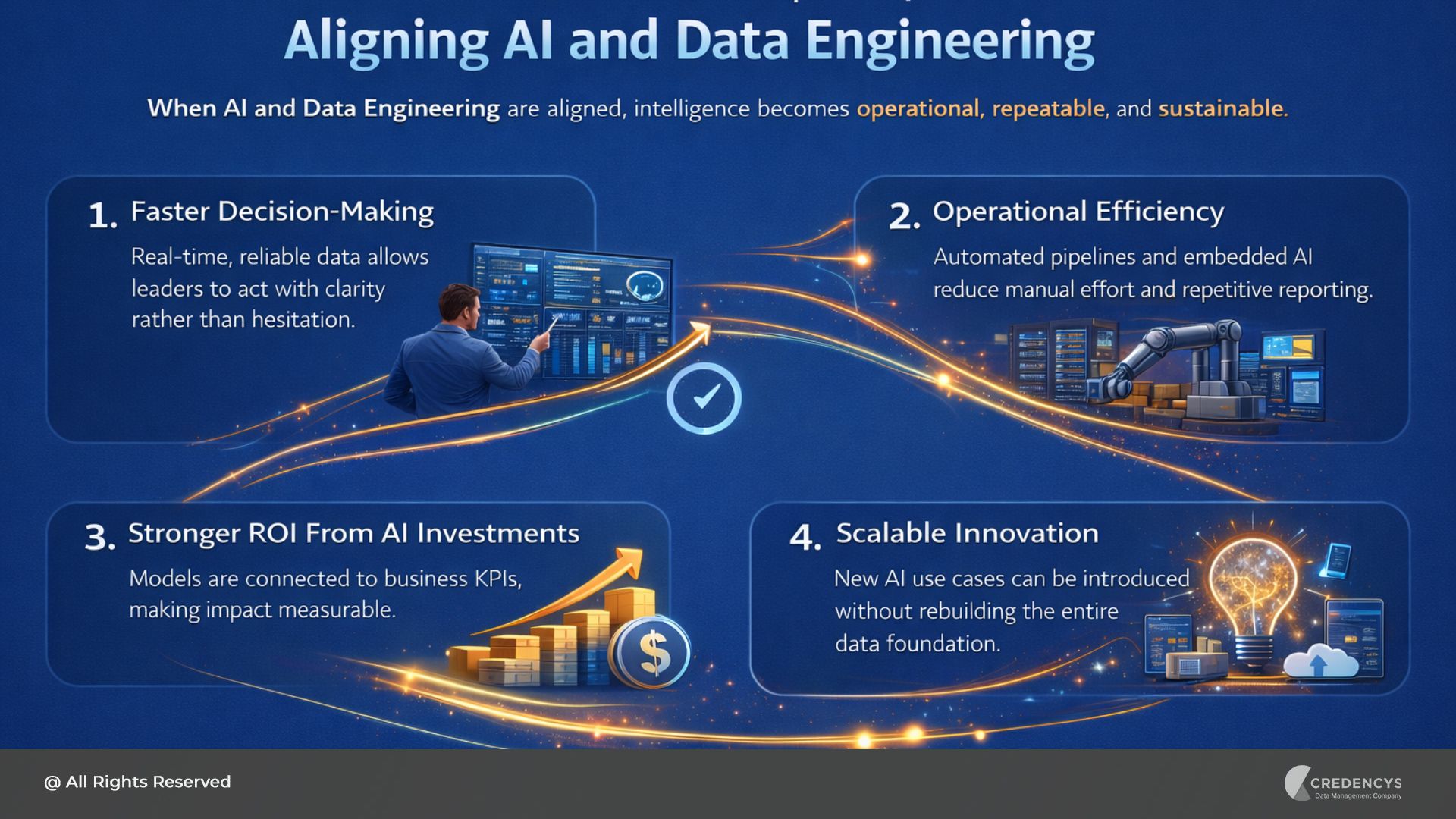
When AI and Data Engineering are aligned, the impact is felt quickly and across the organization. AI stops being a proof-of-concept experiment and starts becoming part of how real decisions are made.

AI and Data Engineering

Instead of fragmented insights and unreliable outputs, organizations gain a steady flow of trusted intelligence that directly supports operations and strategy. Here is what typically changes.

  • Faster decision-making: Real-time, reliable data allows leaders to act with clarity rather than hesitation.
  • Operational efficiency: Automated pipelines and embedded AI reduce manual effort and repetitive reporting.
  • Stronger ROI from AI investments: Models are connected to business KPIs, making impact measurable.
  • Scalable innovation: New AI use cases can be introduced without rebuilding the entire data foundation.

Why AI and Data Engineering Are Stronger Together

AI is exciting. It promises smarter decisions, automation, and competitive advantage. But behind every successful AI initiative is something less glamorous and far more important: disciplined data engineering.

Organizations often chase AI because it feels transformative. The real transformation, however, happens when AI and Data Engineering mature together. When pipelines are reliable, data is trusted, infrastructure is scalable, and governance is clear, AI stops being experimental. It becomes dependable.

If your organization is investing in AI, the most strategic question to ask is not, “Which model should we build next?” It is, “Is our data foundation ready to support intelligence at scale?”

Because AI does not fail due to lack of ambition. It fails when the systems underneath it cannot sustain it.

When AI and Data Engineering operate as one integrated capability, intelligence becomes operational, repeatable, and aligned with business goals. Decisions become faster. Insights become clearer. Investments become measurable.

How AI is Transforming Retail Demand Forecasting for Higher Profits

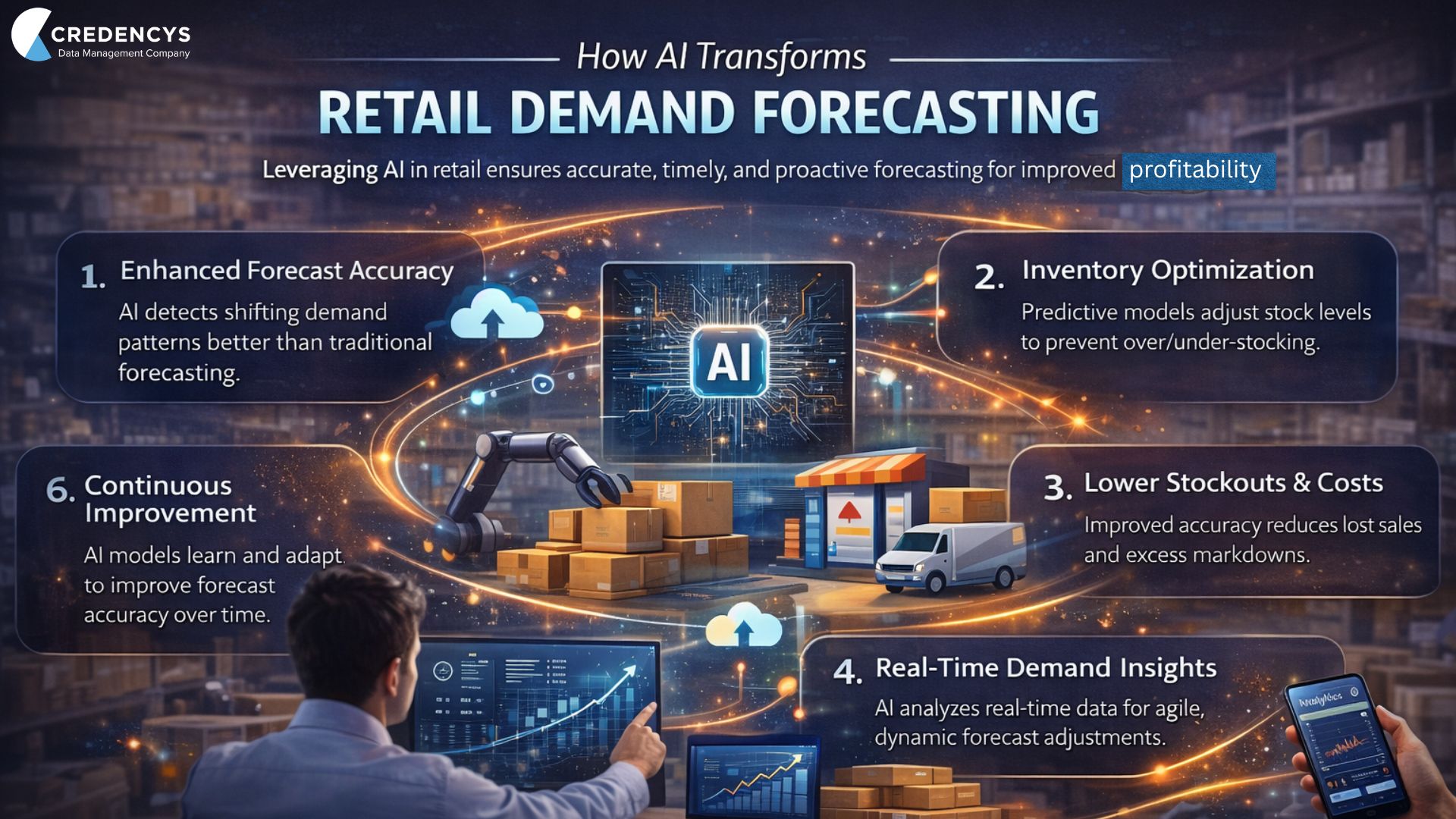
Nearly three out of four retailers have already piloted or partially adopted AI for operational tasks, and those early adopters are seeing measurable benefits: predictive analytics can cut stockouts by about 35% and reduce excess inventory by roughly 28%, directly protecting revenue and margins.

Retail demand forecasting used to be a seasonal spreadsheet exercise. Today it’s a continuously learning system that ingests point-of-sale data, promotions, weather, local events, and online signals, then turns those inputs into fast, location-level decisions about what to stock, when to replenish, and where to move inventory. The difference for retailers is clear:

  • Better forecasts mean fewer lost sales
  • Lower carrying costs
  • Freed-up working capital that can be re-invested in growth

This blog explores how AI is reshaping demand forecasting in retail, driving smarter decisions, better inventory planning, and ultimately higher profits.

Why You Need Retail Demand Forecasting

Most conventional models depend on limited datasets and linear projections. As a result, they struggle with:

  • Over-reliance on historical averages without contextual signals
  • Inability to factor in external variables like promotions, holidays, or weather
  • Manual adjustments that introduce bias and inconsistency
  • Slow recalibration cycles, often monthly or quarterly
  • Lack of real-time visibility across omnichannel inventory

The consequences are expensive.

  • Excess inventory ties up working capital and increases markdown risk
  • Stockouts result in lost sales and damaged brand trust
  • Poor replenishment planning increases operational inefficiencies
  • Margin erosion becomes a recurring problem

Retail leaders often believe their forecasting problem is a data issue. In reality, it is an intelligence issue. The data exists. What is missing is the ability to interpret it dynamically and at scale.

Instead of reacting to past performance, AI-driven Retail Demand Forecasting systems continuously learn from patterns, detect anomalies early, and adjust predictions in near real time.

How AI is Redefining Retail Demand Forecasting

Artificial intelligence does not simply automate existing forecasting processes. It fundamentally changes how predictions are generated, refined, and acted upon.

Unlike traditional models that depend on static formulas, AI-powered Retail Demand Forecasting systems continuously analyze massive volumes of structured and unstructured data. They detect hidden patterns, correlations, and demand drivers that human-led models often overlook.

Retail Demand Forecasting

At its core, AI introduces three transformative capabilities: learning, adaptation, and contextual awareness.

1. Learning from Complex Data Patterns

Modern retail ecosystems generate data from multiple sources:

  • POS transactions
  • E-commerce browsing behavior
  • Loyalty programs
  • Promotions and discount campaigns
  • Weather data
  • Social sentiment and trend signals
  • Supply chain movement data

AI models process these variables simultaneously, identifying relationships that would be impossible to detect manually. For example, a spike in umbrella sales may correlate not only with rainfall but also with regional search trends and weekend footfall.

This multi-variable analysis dramatically improves forecast accuracy.

2. Real-Time Adaptation

Retail demand is rarely static. Promotions, competitor pricing shifts, and viral trends can change buying behavior overnight.

AI models continuously retrain using fresh data, enabling:

  • Dynamic demand recalibration
  • Faster response to sudden demand spikes
  • Early detection of anomalies
  • Real-time inventory adjustments

Instead of waiting for the next monthly planning cycle, retailers can respond instantly.

3. Predictive and Prescriptive Insights

AI does not just predict demand. It recommends actions.

Advanced Retail Demand Forecasting systems can:

  • Suggest optimal replenishment quantities
  • Identify SKUs at risk of stockout
  • Flag overstock situations before markdown pressure builds
  • Recommend pricing adjustments based on demand elasticity

This shift from descriptive reporting to predictive and prescriptive intelligence is what directly drives higher profitability.

The Direct Impact of AI on Retail Profitability

Improving forecast accuracy is important. Improving profit margins is critical. The real value of AI-powered Retail Demand Forecasting lies in how it translates better predictions into measurable financial outcomes.

When forecasting becomes smarter, the ripple effects are felt across inventory management, supply chain operations, merchandising strategy, and cash flow planning.

1. Reduced Inventory Carrying Costs

Excess inventory quietly erodes margins. It ties up working capital, increases warehousing costs, and often leads to heavy markdowns.

AI improves demand precision by:

  • Aligning procurement volumes with actual buying patterns
  • Preventing over-ordering of slow-moving SKUs
  • Optimizing safety stock levels based on risk probability
  • Continuously adjusting forecasts as demand shifts

The result is leaner inventory without compromising availability.

2. Fewer Stockouts, Higher Revenue Retention

Stockouts are not just lost sales. They often push customers to competitors.

With AI-enabled Retail Demand Forecasting, retailers can:

  • Identify high-risk SKUs before inventory depletion
  • Trigger automated replenishment workflows
  • Prioritize distribution across high-demand locations
  • Allocate inventory dynamically between online and offline channels

By protecting product availability, retailers protect revenue.

3. Smarter Promotion Planning

Promotions can either drive growth or destroy margins if poorly forecasted.

AI models analyze historical campaign performance, price elasticity, seasonal demand, and customer behavior to:

  • Predict promotional lift more accurately
  • Avoid underestimating demand during peak events
  • Prevent excess stock post-promotion
  • Optimize discount depth without sacrificing profitability

This allows retailers to treat promotions as strategic growth levers rather than risky bets.

4. Better Working Capital Optimization

Retail profitability is closely tied to how efficiently capital is deployed.

Improved forecasting supports:

  • More accurate procurement planning
  • Reduced emergency logistics costs
  • Lower markdown exposure
  • Improved sell-through rates

When forecasting becomes proactive instead of reactive, financial planning becomes more predictable and resilient.

Case Study: AI-Powered Retail Demand Forecasting for a Leading Retail Group

A leading retail group managing franchise rights for global brands partnered with Credencys to modernize its Retail Demand Forecasting approach. With 175+ stores and a growing eCommerce presence, legacy rule-based models were causing stock imbalances, seasonal inaccuracies, and working capital inefficiencies.

Credencys implemented an AI-driven forecasting solution on Databricks, using machine learning models to analyze historical sales, seasonality, and external demand signals. Forecast outputs were seamlessly integrated into existing ERP and replenishment systems, enabling smarter inventory allocation across stores and online channels.

Business Impact

  • 31% improvement in demand forecast accuracy
  • 24% increase in inventory turnover
  • 22% boost in omni-channel customer satisfaction

Read the full story here. 

What Retailers Need to Successfully Implement AI in Retail Demand Forecasting

AI can dramatically improve Retail Demand Forecasting, but only when supported by the right data, infrastructure, and organizational alignment. Retailers that treat AI as a plug-and-play tool often struggle. Those that build a strong foundation see sustained profitability gains.

1. Unified and High-Quality Data

Accurate forecasting starts with reliable data. Retailers must eliminate silos and create a single, trusted source of truth across channels.

Key focus areas include:

  • Consolidating POS, eCommerce, ERP, and inventory data
  • Cleaning and standardizing historical sales records
  • Integrating promotional, pricing, and seasonal variables
  • Ensuring real-time data ingestion pipelines

Without data consistency, forecast accuracy improvements remain limited.

2. Scalable and Modern Data Infrastructure

AI models require computing power and flexibility. Cloud-native environments and lakehouse architectures enable retailers to process large data volumes efficiently and retrain models continuously.

Retailers should prioritize:

  • Scalable storage and compute environments
  • Automated model retraining workflows
  • Real-time analytics capabilities
  • Secure data governance frameworks

This ensures forecasts adapt quickly to demand volatility.

3. Cross-Functional Alignment and Operational Integration

Forecasting is not just a supply chain function. It influences merchandising, finance, marketing, and operations.

Successful AI-driven Retail Demand Forecasting requires:

  • Embedding forecasts directly into ERP and replenishment systems
  • Providing decision-ready dashboards for business teams
  • Aligning KPIs across departments
  • Establishing accountability for forecast performance

When insights are operationalized, predictions translate into profit impact.

4. Continuous Monitoring and Optimization

Consumer behavior evolves constantly. AI models must evolve with it.

Retailers should:

  • Track forecast accuracy metrics regularly
  • Identify bias or model drift early
  • Refine algorithms based on new data patterns
  • Maintain a feedback loop between business users and data teams

Sustainable profitability comes from continuous refinement, not one-time deployment.

The Future of Retail Demand Forecasting: From Prediction to Profit Engine

Retail Demand Forecasting is no longer a back-office planning exercise. With AI at its core, it becomes a strategic growth engine that directly influences revenue, margin, and customer experience.

As retail environments grow more dynamic, AI-powered forecasting shifts organizations from reactive correction to proactive optimization. Instead of responding to stock imbalances after they occur, retailers can anticipate demand shifts, align procurement intelligently, and protect margins before pressure builds.

AI-driven Retail Demand Forecasting enables retailers to:

  • Respond instantly to seasonal spikes and market disruptions
  • Optimize working capital without compromising availability
  • Reduce markdown dependency through smarter inventory planning
  • Improve omni-channel customer satisfaction with better product availability
  • Turn forecasting insights into measurable financial outcomes

More importantly, it builds resilience. When demand becomes unpredictable, AI provides clarity. When competition intensifies, data-driven precision becomes a differentiator.

Retailers that invest in intelligent forecasting today are not just improving accuracy. They are strengthening profitability, operational agility, and long-term competitiveness.

Top AI Consulting Companies Powering Business Growth [2026 Edition]

AI is no longer just a tech buzzword. It’s everywhere.

You probably feel it at work, in meetings, in strategy decks, and even in casual coffee conversations. That’s because businesses aren’t just experimenting with AI any longer; they’re betting billions on it.

Globally, the AI consulting market is booming. It was valued at more than $11 billion in 2025 and is expected to grow even larger in 2026 as companies scramble to build real-world AI solutions.

While nearly 78% of consulting firms have fully deployed AI tools in client engagements, many organizations still struggle to turn AI hype into actual outcomes like productivity gains or revenue impact. And that’s exactly where AI consultants come in.

Companies need partners who can knit all the pieces together: strategy, data, implementation, and continuous optimization. They need trusted guides, not just vendors selling fancy dashboards.

So, in this crowded and fast-moving landscape, how do you separate the mere talkers from true transformers who actually help businesses make AI real? That’s exactly what this guide is here to do.

We are giving you business leaders, CTOs, Heads of Data, and decision-makers, a clear, practical, no-nonsense look at the top AI consulting companies in 2026. Let’s dive in.

What Makes an AI Consulting Company “Top” in 2026?

Before we jump into names and rankings, we need to answer something more important. What actually makes an AI consulting firm worth hiring in 2026?

Not branding. Not marketing.

Not a shiny “GenAI practice” page. Real capability.

And the bar is much higher now.

1. They Start with Business Outcomes, Not Algorithms

The best AI consulting firms don’t walk in talking about models. They discuss margin expansion, customer retention, supply chain efficiency, fraud reduction, and the impact of dynamic pricing.

According to McKinsey & Company, companies that successfully scale AI across business units can see a 20–30% improvement in EBIT in AI-enabled functions.

That’s not experimentation. That’s transformation.

If a consulting firm can’t clearly articulate how AI connects to measurable business KPIs, that’s your first warning sign.

2. They Have Deep Data Engineering Expertise

AI projects fail more often because of data problems, not model problems. In fact, research from Gartner shows that 85% of AI projects fail to deliver on expectations, often due to poor data quality, unclear objectives, or lack of operationalization.

So, a top AI consulting company in 2026 must be strong in:

  • Data architecture
  • Data lakehouse implementation
  • Data governance
  • Data quality frameworks
  • Integration across legacy systems

Because AI without a clean, governed data foundation is just hallucinating at scale.

3. They Know How to Move Beyond PoCs

Proofs of concept are easy. Scaling is hard.

And many firms quietly live in PoC land forever. But enterprise AI success depends on:

  • MLOps frameworks
  • Model monitoring
  • Continuous retraining
  • Deployment pipelines
  • Cross-functional adoption

According to IBM’s Global AI Adoption Index, while AI adoption has grown significantly, only a fraction of organizations have achieved full-scale, enterprise-wide AI integration. This gap is where the real consulting value lies.

4. They Bring Industry Context, Not Generic AI

AI is not one-size-fits-all. Retail AI is different from manufacturing AI.

BFSI AI is different from healthcare AI. The best firms bring:

  • Pre-built accelerators
  • Domain-specific data models
  • Industry-trained ML frameworks
  • Regulatory awareness

Because building a fraud model without understanding banking regulations is risky. And building demand forecasting without understanding supply chain variability is incomplete.

5. They Understand Generative AI But Don’t Overhype It

Yes, generative AI changed the conversation. But mature consulting firms know when to use GenAI and when not to.

The global generative AI market is projected to exceed $100 billion by 2030, according to Bloomberg Intelligence.

Big numbers. But smart firms ask:

  • Does this use case actually require GenAI?
  • Or would predictive analytics do the job better?
  • What are the data privacy implications?
  • How do we prevent hallucinations?

Hype is loud. Responsible implementation is quiet and far more valuable.

6. They Embed Responsible AI and Governance from Day One

By 2026, AI governance isn’t optional anymore; it’s board-level. Top firms provide:

  • Bias detection frameworks
  • Explainability models
  • Audit trails
  • Compliance alignment
  • Model risk documentation

Because one flawed AI decision can damage trust overnight, which is hard to rebuild.

7. They Offer Long-Term Partnership

AI is not a one-time project. It evolves, adapts, and learns. The strongest AI consulting firms structure engagements around:

  • Continuous optimization
  • Managed AI services
  • AI Centers of Excellence
  • Internal capability building

What makes a top AI consulting company

They don’t want you dependent forever. They want you to be capable.

That’s a huge difference. So, what separates the best from the rest?

It’s simple. Anyone can build a model.

Fewer can deploy it. Even fewer can scale it.

And only a handful can align AI with business strategy, data foundations, governance, and long-term enterprise growth, all at once. That’s the lens we are using to evaluate the companies in the next section.

Let’s get into the list.

Top AI Consulting Companies in 2026

These companies are recognized for their ability to move AI from idea to implementation and, more importantly, from pilot to measurable business impact.

Credencys Solutions

If AI success depends on strong data foundations, Credencys stands out. Unlike firms that begin with flashy AI demos, Credencys starts where it matters most: data engineering, governance, and scalable architecture.

Because AI without reliable data isn’t intelligence. It’s noise.

Credencys focuses on building AI systems that are not only accurate but production-ready and business-aligned.

Core Strengths:

  • AI-native Customer 360 solutions
  • AI-driven demand forecasting
  • Dynamic pricing optimization
  • Data lakehouse architecture implementation
  • AI operationalization & MLOps frameworks
  • Retail & CPG-focused AI accelerators

What makes them different?

They don’t treat AI as a standalone project. They embed it into business workflows: merchandising, supply chain, marketing, and pricing, where it directly drives revenue and efficiency.

And because they combine data strategy with AI engineering, clients don’t get stuck in endless proof-of-concept cycles. They get deployed systems.

Best For: Mid-to-large enterprises that want outcome-driven AI solutions built on a strong data foundation, especially in retail, CPG, and data-intensive industries.

Success Story: How Credencys Helped a Specialty Apparel Retailer

When talking about AI consulting companies that deliver real business impact, it’s one thing to talk strategy and another to show it. Here’s a powerful example from one of Credencys’ engagements with a leading women’s specialty apparel retailer that was struggling with fragmented data and inconsistent omnichannel experiences.

Client Challenge: With over 415 stores nationwide, the retailer faced a common but critical problem: customer and operational data were scattered across on-premises systems, cloud tools, and third-party platforms. This fragmentation made it nearly impossible to:

  • Provide a seamless omnichannel experience
  • Support flexible fulfilment options like buy online, pick up in store (BOPIS)
  • Maintain real-time inventory visibility across channels
  • Deliver personalized experiences based on unified customer data

This wasn’t just a database problem; it was a business growth blocker.

Credencys’ Solution: Instead of rolling out another isolated analytics tool, Credencys implemented a customized AI-Native Customer 360 solution to unify data across all systems, online, offline, cloud, and legacy sources. The solution included:

  • A unified Customer 360° data layer that pools customer interactions and profiles
  • Real-time order tracking and BOPIS support
  • Centralized inventory visibility across all locations
  • Personalized product recommendations and targeted promotions
  • A scalable system designed to support future omnichannel innovation

In short: data chaos became clarity, and experience gaps became growth levers.

Business Impact: This wasn’t a small operational lift; it was a profound business transformation. After implementation, the retailer saw:

  • 24% increase in online sales through smoother customer experiences
  • 31% improvement in customer satisfaction thanks to unified omnichannel engagement
  • Significant reduction in stockouts and fulfillment delays
  • Strengthened brand loyalty due to consistent and personalized shopping journeys

These metrics show what happens when AI consulting isn’t just about models, it’s about data alignment, customer experience, and measurable business outcomes.

Read Full Case Study Here

Accenture

If you are a Fortune 500 enterprise planning AI at global scale, Accenture is almost always in the conversation. They have invested billions into AI capabilities, acquisitions, and partnerships.

Their strength lies in enterprise transformation and AI model development. Think cross-border deployments, multi-cloud AI architecture, and board-level digital strategy.

Key Capabilities:

  • Enterprise AI transformation
  • Generative AI integration
  • Responsible AI frameworks
  • Industry-specific AI accelerators

Best For: Large global enterprises looking for end-to-end AI transformation.

Fractal Analytics

Fractal is more AI-focused than traditional consulting giants. They specialize in advanced analytics, consumer intelligence, and AI decision science.

Particularly strong in retail, CPG, and financial services.

Key Capabilities:

  • AI-powered customer intelligence
  • Advanced predictive modeling
  • AI strategy consulting
  • Data science at scale

Best For: Consumer-driven enterprises prioritizing AI-powered decision intelligence.

IBM Consulting

IBM Consulting blends legacy enterprise depth with modern AI engineering. Backed by IBM’s AI ecosystem and hybrid cloud expertise, they are strong in automation-heavy transformations.

They have also been vocal about responsible AI and enterprise governance. According to IBM’s own AI adoption research, enterprises that fully operationalize AI significantly outperform peers in revenue growth and operational efficiency.

Key Capabilities:

  • AI + automation integration
  • Hybrid cloud AI deployment
  • AI governance frameworks
  • Enterprise data modernization

Best For: Large enterprises modernizing legacy systems while embedding AI.

Mu Sigma

Mu Sigma built its reputation around decision sciences. Their model focuses on long-term analytics partnerships rather than one-off projects.

They emphasize data-driven decision-making frameworks.

Key Capabilities:

  • Enterprise analytics transformation
  • AI-powered decision frameworks
  • Data strategy + AI integration
  • Operational analytics

Best For: Organizations seeking long-term analytics-driven transformation partnerships.

Red Flags to Watch When Hiring an AI Consulting Company

Knowing who’s good is one thing, and knowing who to avoid is more important. AI projects are expensive.

High visibility, politically sensitive. If they fail, everyone notices.

So, here are the warning signs you should not ignore while hiring AI consulting companies.

1. They Talk Models Before They Talk Business

If the first few meetings are filled with:

  • Neural networks
  • LLM fine-tuning
  • Transformer architecture
  • Vector databases

But no one asks about:

  • Revenue targets
  • Margin pressure
  • Customer churn
  • Supply chain inefficiencies

Pause. AI without a business anchor drifts fast.

The best firms always start with outcomes.

2. They Ignore Your Data Reality

If a consulting firm assumes your data is “ready enough,” that’s dangerous. Most organizations struggle with:

  • Inconsistent master data
  • Siloed systems
  • Poor data quality
  • Limited governance

And research from Gartner consistently highlights that poor data quality remains one of the primary reasons AI initiatives fail. If they don’t assess your data maturity before proposing AI, that’s not confidence, but negligence.

3. Everything is a Proof of Concept

PoCs feel productive. They look impressive in steering committee meetings.

But if the firm cannot clearly explain:

  • How the model will be deployed
  • How it integrates into workflows
  • Who owns monitoring
  • How retraining happens
  • What the MLOps framework looks like

Then you are stuck in demo mode. And demos don’t generate ROI.

4. No Clear ROI Model

AI consulting without measurable impact metrics is a risk. You should see:

  • Cost reduction projections
  • Revenue uplift modeling
  • Efficiency gains
  • Time-to-value estimates

If they leave figuring out ROI later, that’s a red flag. AI isn’t R&D anymore.

It’s an investment-grade transformation.

5. No Responsible AI or Governance Framework

By 2026, AI governance is not optional. If a firm doesn’t proactively discuss:

  • Explainability
  • Audit trails
  • Model risk management
  • Bias testing
  • Compliance alignment

You should question their maturity.

6. Overhyping Generative AI for Everything

Yes, GenAI is powerful, but not every use case needs it. If every conversation magically turns into “Let’s build a chatbot” or “Let’s deploy an LLM,” be careful.

Sometimes a predictive model is smarter, faster, and cheaper. Mature consulting partners know the difference.

7. No Post-Deployment Support Strategy

AI is not plug-and-play. It needs:

  • Monitoring
  • Retraining
  • Drift detection
  • Continuous improvement

If the engagement ends at deployment, your AI system will decay over time.

Red Flags to Watch When Hiring an AI Consulting Company

Conclusion

AI in 2026 isn’t optional. It’s operational, competitive advantage, and boardroom-level strategy.

But here’s what most organizations eventually realize: AI success doesn’t come from buying tools, from flashy demos, and from running endless pilots. It comes from alignment.

Alignment between business goals and AI strategy, data foundations and model development, and between deployment and measurable ROI. That’s why choosing the right AI consulting partner isn’t just a procurement decision.

It’s a long-term growth decision. Some enterprises will need the scale of global consulting giants.

Others will need focused, execution-driven AI specialists who can move fast, modernize data foundations, and embed AI directly into revenue-generating workflows. And that’s where companies like Credencys Solutions bring a distinct advantage.

Because AI isn’t treated as a standalone experiment. It’s built on strong data engineering, structured governance, industry-specific accelerators, and operational scalability.

Especially for retail, CPG, and data-intensive enterprises, that combination makes a difference. The AI consulting landscape will only get more crowded from here.

More firms, more AI claims, more “GenAI-first” banners. But the next wave of winners won’t be the ones selling the most models.

They will be the ones delivering measurable business outcomes, faster, safer, and at scale. So, if you are evaluating AI consulting partners in 2026, don’t just ask: “What can they build?”

Ask: “What business impact can they prove?” And more importantly: “Can they scale it across my organization?”

Because that’s the difference between experimenting with AI and actually leading with it.

AI Agents for Data Analytics: The Complete Guide

What if the biggest risk in your analytics strategy is not lack of data, but lack of trust in it?

According to Gartner, poor data quality costs organizations an average of $12.9 million per year. Data analysis consistently ranks as the #2 priority use case for enterprise adoption, behind only process automation.

Yet most teams are still spending hours manually validating reports, cross-checking spreadsheets, and reconciling conflicting dashboards before making decisions.

AI agents for data analytics are emerging as a response to this trust gap. Not as another dashboard layer, but as autonomous systems that monitor, analyze, and surface insights proactively. Instead of reacting to reports, organizations are beginning to rely on agents that detect anomalies, investigate root causes, and initiate next steps automatically.

This blog covers everything you need to know: what these systems actually are, how they work under the hood, where they deliver the most value, which tools lead the market, and what the real challenges look like.

What are AI Agents for Data Analytics?

An AI agent for data analytics is an autonomous software system that can perceive data inputs, reason about them, plan multi-step actions, execute those actions using connected tools, and deliver a structured output, without requiring a human to guide every step of the process.

That last part is what separates agents from the previous wave of AI tools. A chatbot answers a question when you ask it. A copilot helps you write a query when you open the editor. An agent, by contrast, can be given a goal, say, “monitor our North America revenue metrics and flag any anomalies”, and then go handle it, repeatedly, with no hand-holding.

How AI Agents Work in a Data Analytics Context

Understanding the mechanics matters, both for setting realistic expectations and for communicating the value to stakeholders who will ask how this is different from what they already have.

When a business user asks an AI agent a question, in plain language, through a chat interface or an embedded widget, here is the sequence that plays out behind the scenes.

The Six-Step Process

StepWhat HappensReal-World Example
PerceptionThe agent receives and interprets the natural language query“Why did our customer acquisition cost spike in Q3?”
PlanningIt decomposes the question into sub-tasks, identifying which data sources are relevantFlags CRM data, paid media spend, and conversion rate tables as needed inputs
Tool ExecutionIt queries databases, runs computations, and retrieves relevant recordsPulls Q2 vs Q3 ad spend, channel-level conversion rates, and cost-per-click trends
ReasoningIt synthesizes the results, detects patterns, and forms a hypothesisIdentifies that paid social efficiency dropped 34% in July due to audience saturation
ResponseIt delivers a structured answer with supporting evidenceWritten summary with chart, root cause, and a budget reallocation recommendation
Action (optional)It can trigger downstream workflows without additional inputSends a Slack alert to the marketing lead; opens a tracking task in Jira

Single-Agent vs. Multi-Agent Architecture

For straightforward tasks, a weekly sales digest, a nightly data quality check, a single agent handling the full workflow is usually the right choice. It is simpler to configure, easier to govern, and sufficient for the job.

For complex, enterprise-scale analytics, a multi-agent architecture starts to make more sense. Picture a coordinator agent that receives a business question and routes sub-tasks to specialist agents: one that handles data extraction, one that handles statistical analysis, one that handles visualisation, and one that handles delivery. The orchestration layer ensures each piece feeds the next correctly.

This architecture is what allows organisations to unify 170-plus data sources and respond to critical business needs in real time, a task that no single tool, traditional or AI-assisted, could handle efficiently.

The Key Benefits of AI Agents for Data Analytics

The case for AI agents in analytics is not abstract. The numbers from early enterprise deployments are specific enough to use in internal business cases.

  • 85% of enterprises now use AI agents in at least one workflow.

  • 66% of adopters report measurable productivity gains.

  • 55% average cost savings reported by early adopters.

  • 38% of executives trust agents most for data analysis tasks.

Speed is usually the first benefit people point to, and the numbers are striking.

Tasks that previously took two to four hours, pulling data, running analysis, writing up findings, now complete in seconds. But speed is actually the less interesting part of the value proposition.

The more important shift is from reactive to proactive analytics.

Traditional and AI-assisted tools wait to be asked. A well-configured agent monitors continuously, surfaces anomalies before they become crises, and initiates workflows downstream. For an e-commerce business, that means catching a checkout failure before customer support gets flooded with complaints. For a hospital system, it means flagging a patient risk pattern before a physician’s morning rounds.

The third benefit is accessibility.

When analytics can be driven through natural language rather than SQL or complex BI interfaces, the pool of people who can generate insights expands dramatically. Business stakeholders who previously depended entirely on data teams can answer their own questions, which frees up data teams for higher-value work.

The Challenges No One Talks About Enough

Any honest treatment of this topic needs to address what goes wrong, because a lot does go wrong when organisations rush implementation without thinking through the constraints.

1. Data Quality Is Still the Foundation

AI agents do not fix bad data, they amplify the consequences of it. If your data pipelines are inconsistent, if field definitions vary across systems, or if historical data has gaps, an agent will confidently generate incorrect insights from that flawed foundation. The organisations seeing the strongest results from agentic analytics are consistently the ones with solid data governance already in place.

2. Security and Access Control

An autonomous agent that can query sensitive financial or customer data needs strictly scoped permissions. Without granular access controls and sandboxed execution environments, a poorly configured agent can inadvertently expose data it should never have touched. This is not hypothetical, it is a documented failure mode in early enterprise deployments.

3. Governance, Auditability, and the Gartner Warning

Gartner has flagged that over 40% of agentic AI projects are at risk of being cancelled by 2027, specifically because organisations lack the observability infrastructure to audit what agents are doing, demonstrate ROI, and satisfy compliance requirements. Building audit trails and explainability into the architecture from day one is far cheaper than retrofitting them later.

4. Legacy System Integration

Connecting AI agents to fragmented, siloed, or legacy infrastructure remains a genuine technical challenge. Most enterprise data environments were not designed with autonomous agents in mind, and the integration work required to get agents functioning reliably across heterogeneous systems can be significant.

5. The Human Side

Experienced analysts who have built careers around their data skills may resist tools that appear to automate their core function. The organisations that navigate this most successfully tend to involve their analytics teams in the design and rollout process early, framing agents as force multipliers rather than replacements, and structuring KPIs so that analyst performance is measured on the quality of decisions driven by insights, not the volume of analyses produced.

How to Get Started: A Practical Five-Step Approach

For most organisations, the biggest implementation mistake is trying to do too much at once. The five-step approach below is drawn from patterns in successful enterprise deployments.

1. Start with one contained, high-value use case

Pick something where the data is clean, the success metric is clear, and the stakes of an error are manageable. A good first candidate is often a recurring internal report that currently consumes significant analyst time.

2. Define what success looks like before you start

Is it time saved per analyst per week? Report turnaround time? Error rate reduction? Stakeholder satisfaction scores? Without a baseline and a target, you cannot demonstrate ROI, and without demonstrable ROI, the programme will not survive scrutiny.

3. Run a structured pilot with active human oversight

Do not fully automate anything in the first phase. Run the agent in parallel with existing processes, compare outputs, and correct errors before reducing human review. This builds confidence and surfaces edge cases early.

4. Build governance infrastructure in parallel

Audit logs, access scoping, alert thresholds, and escalation protocols are not optional extras, they are load-bearing components of a production analytics agent. Build them before you scale.

5. Scale based on demonstrated value, not roadmap pressure

Expand the agent’s scope only after each stage has proved reliable and the team is comfortable with how it behaves. Organisations that rush this step are the ones that end up with the governance and trust problems Gartner warns about.

Wrap Up: The Shift is Already Underway

AI agents for data analytics are not just a faster way to build reports. They represent a shift from reactive dashboards to autonomous, continuous intelligence. Instead of waiting for questions, agents monitor, analyse, and act in real time.

The organizations gaining the most value are not simply investing in AI. They are strengthening data foundations, defining clear success metrics, and building governance into the architecture from day one. AI agents amplify what already exists. Clean, well-governed data leads to better outcomes. Weak foundations lead to faster mistakes.

The opportunity is significant: faster insights, proactive anomaly detection, measurable cost savings, and more strategic use of analyst time. But the advantage goes to those who implement deliberately, not impulsively.

Some teams are still exporting spreadsheets to find answers. Others have agents surfacing insights before the workday begins. The difference is no longer about tools. It is about strategy.

Frequently Asked Questions

1. What is the difference between an AI agent and a chatbot for analytics?

A chatbot responds to a single question with a single answer. It has no memory of previous interactions, cannot plan multi-step tasks, and cannot take actions in external systems. An AI agent can hold context across a conversation, decompose a complex goal into sub-tasks, execute those tasks using connected tools, and initiate follow-on actions, all autonomously.

2. Can AI agents replace data analysts?

Not in any near-term scenario that the evidence supports. What they do is change the composition of analytics work. Repetitive, time-sensitive, high-volume tasks, scheduled reporting, anomaly detection, data quality checks, are strong candidates for automation. The interpretive, strategic, and stakeholder-facing dimensions of analytics work remain firmly human. The organisations seeing the best outcomes are treating agents as a way to elevate what their analysts do, not eliminate them.

3. What industries benefit most from AI agents for data analytics?

Finance, healthcare, retail, e-commerce, and marketing have the most documented early adoption because they combine high data volumes, time-sensitive decision needs, and clear ROI metrics. That said, the underlying capability is industry-agnostic, any organisation with complex, recurring analytics needs and reasonably clean data infrastructure is a candidate.

Key Challenges in Implementing Data Analytics Services That Limit ROI

Did you know that poor data quality costs organizations an average of $12.9 million every year? (Gartner)

Yet despite rising investments in AI, analytics platforms, and cloud data ecosystems, many enterprises still struggle to turn data into measurable business value.

Many enterprises start their data analytics journey with high expectations. The vision is clear: smarter forecasting, faster decisions, better customer experiences, and improved operational efficiency. But somewhere between data collection and actionable insights, momentum slows down.

Dashboards exist, but teams do not fully trust them. Reports are generated, but decisions still rely on instinct. Data lakes grow, yet business clarity does not.

The reality is that implementing analytics is not just about deploying tools. It is about aligning strategy, technology, governance, and people. And that is where most organizations encounter the key challenges in implementing data analytics services.

Before analytics can truly transform a business, these challenges must be understood and addressed systematically.

Key Challenges in Implementing Data Analytics Services

Implementing analytics sounds straightforward in theory. Collect data. Analyze it. Generate insights. Drive action.

In reality, it is far more complex.

Below are the most common key challenges in implementing data analytics services that organizations encounter across industries.

1. Disconnected Data Ecosystems

Most enterprises operate across multiple systems: ERP, CRM, marketing automation, POS, supply chain platforms, and external data sources.

When these systems do not communicate seamlessly, data remains siloed. Teams spend more time reconciling numbers than interpreting them. Without unified data architecture, analytics outputs are often inconsistent and difficult to trust.

2. Poor Data Quality and Governance

Analytics is only as reliable as the data behind it.

Duplicate records, missing attributes, inconsistent definitions, and outdated data create noise. Without clear ownership and governance frameworks, errors compound over time.

Business leaders may question the accuracy of dashboards, which ultimately slows adoption and reduces ROI from analytics investments.

3. Lack of Clear Business Alignment

One of the most underestimated challenges is misalignment between analytics initiatives and business objectives.

Data teams may focus on building technically advanced models, while business users seek answers to operational questions. When analytics projects are not tied to measurable business outcomes, adoption declines.

Analytics should solve real problems, not just produce reports.

4. Legacy Infrastructure Limitations

Traditional data warehouses and manual reporting systems struggle to handle growing data volumes and real-time needs.

Outdated forecasting models, static reports, and spreadsheet-based workflows limit agility. As data complexity increases, these systems become bottlenecks rather than enablers.

Modern analytics requires scalable, cloud-native platforms and advanced data engineering capabilities.

5. Limited Advanced Analytics Capabilities

Organizations often invest in reporting but hesitate to move into predictive and prescriptive analytics.

Machine learning, AI-driven forecasting, and automated optimization require specialized skills and structured data pipelines. Without the right expertise, businesses remain stuck in descriptive analytics, reacting to the past instead of preparing for the future.

6. Change Management and Adoption Barriers

Even the most sophisticated analytics solution fails if teams do not use it.

Resistance to change, lack of training, and unclear workflows can derail implementation. Analytics transformation is as much a cultural shift as it is a technical upgrade.

Successful implementations prioritize user enablement alongside technology deployment.

These key challenges in implementing data analytics services are not signs of failure. They are natural friction points in transformation journeys.

The difference between stalled initiatives and successful ones lies in how systematically these challenges are addressed.

Experts Guide to Overcome the Key Challenges in Implementing Data Analytics Services

Recognizing the challenges is important. Addressing them systematically is what drives results.

Here is how organizations successfully overcome the key challenges in implementing data analytics services:

  • Create a Unified Data Architecture: Integrate ERP, CRM, POS, and operational systems into a centralized platform to eliminate silos and ensure a single source of truth.
  • Establish Strong Governance: Define data ownership, validation rules, and monitoring frameworks early to maintain accuracy and build trust in analytics outputs.
  • Align Analytics with Business Outcomes: Tie initiatives directly to measurable KPIs such as forecast accuracy, cost reduction, revenue growth, or operational efficiency.
  • Modernize Infrastructure: Adopt scalable, cloud-native platforms that support real-time analytics and advanced machine learning capabilities.
  • Move Toward Predictive Intelligence: Go beyond descriptive dashboards. Implement AI-driven models that anticipate trends instead of reacting to them.
  • Drive User Adoption: Enable teams with intuitive dashboards, training, and clear workflows to ensure insights translate into action.

How Credencys Can Help in Implementing Data Analytics Services for your Business

Addressing the key challenges in implementing data analytics services requires more than technical execution. It requires experience across industries, strong architectural thinking, and the ability to translate data complexity into business clarity.

key challenges in implementing data analytics services

At Credencys, data analytics implementation is not treated as a one-time project. It is designed as a long-term capability that evolves with your business.

1. Strategic Assessment Before Execution

Many analytics initiatives fail because implementation begins without a structured assessment.

Our engagement starts with a deep evaluation of your current data landscape, business priorities, reporting gaps, and technology stack. We identify where inefficiencies exist, where data friction slows decisions, and where predictive insights can create competitive advantage.

This prevents overengineering and ensures investments are directed toward high-impact use cases.

2. End-to-End Data Engineering Capabilities

Data analytics implementation demands strong engineering foundations.

Our team builds scalable data pipelines, modern data warehouses, and lakehouse architectures that handle structured and unstructured data seamlessly. We specialize in:

  • Data ingestion and transformation across ERP, CRM, POS, and third-party systems
  • Real-time and batch processing architectures
  • Performance optimization for large-scale data workloads
  • Data modeling tailored for analytics and reporting

This ensures that insights are built on stable, high-performing infrastructure rather than fragmented systems.

3. Advanced Analytics and Machine Learning Expertise

Beyond dashboards, we focus on intelligence.

Credencys develops predictive and prescriptive models that support:

  • Demand forecasting
  • Customer segmentation and behavior modeling
  • Inventory optimization
  • Revenue and profitability analysis
  • Operational efficiency monitoring

By integrating machine learning into analytics ecosystems, we help organizations move from reactive reporting to proactive decision-making.

4. Governance-Driven Implementation

One of the most overlooked aspects of analytics transformation is governance.

We embed data quality checks, validation frameworks, monitoring mechanisms, and access controls directly into the architecture. This creates transparency, accountability, and auditability.

When business leaders trust the data, adoption accelerates naturally.

5. Industry-Focused Expertise

Our experience across retail, manufacturing, automotive, and enterprise environments allows us to anticipate industry-specific challenges before they become bottlenecks.

For example:

  • Retail and franchise networks require accurate demand forecasting and omni-channel visibility.
  • Manufacturing environments demand supply chain analytics and production performance insights.
  • Multi-brand enterprises require consolidated reporting across distributed operations.

Because we understand these nuances, our implementations are not generic. They are contextual and performance-oriented.

6. Measurable Impact, Not Just Deployment

Credencys measures success by business outcomes, not by system go-live dates.

We track KPIs such as forecast accuracy improvement, inventory turnover growth, operational cost reduction, revenue uplift, and customer satisfaction impact.

This accountability-driven approach helps organizations overcome the key challenges in implementing data analytics services and build analytics ecosystems that deliver sustained ROI.

31% Higher Forecast Accuracy for a Leading Retail Group: Data Analytics Success Story

A leading retail group operating 175 stores and growing e-commerce channels struggled with stock imbalances. Some locations faced frequent stockouts, while others carried excess inventory, locking up working capital.

The issue was not lack of data. It was lack of predictive intelligence, one of the common key challenges in implementing data analytics services.

The Transformation

Credencys implemented an AI-driven forecasting framework that:

  • Analyzed seasonality and external demand drivers
  • Adapted to real-time market shifts
  • Optimized inventory allocation across channels
  • Integrated insights directly into ERP workflows

The Results

  • 31% improvement in forecast accuracy
  • 24% increase in inventory turnover
  • 22% boost in customer satisfaction

Read the full story here.

Turning Analytics into Real Business Impact

The key challenges in implementing data analytics services are rarely about technology alone. They stem from disconnected systems, unclear priorities, limited predictive capabilities, and low adoption across teams.

But when analytics is aligned with real business outcomes, supported by strong data foundations, and designed for everyday decision-making, the impact becomes measurable.

If your organization is investing in data but still struggling to see consistent returns, it may be time to reassess the foundation, not just the tools.

At Credencys, we believe analytics should simplify decisions, not complicate them.

If you would like to explore what a more structured, outcome-driven analytics approach could look like for your business, we are always open to a conversation.

Top-Rated Data Analytics Companies in 2026 [Ranked & Reviewed]

The global data analytics market is hitting around $83.8 billion in 2026 with a blistering growth trajectory that’s only going up from here. Some forecasts even show triple-digit billion-dollar growth over the next decade.

Over 90% of organizations are seeing measurable value from their analytics investments, which is the real and bottom-line impact. Despite massive spending, most businesses still fail to turn that data into real results.

They buy tools. They build dashboards. They spend.

But the insights and the business impact are much harder to capture.

Some firms spend 2.8% of revenue on analytics, yet only a fraction of that translates into strategic action. Analytics isn’t a “nice-to-have” anymore, but the engine under the hood of every competitive business.

Retailers personalize every sale. Banks predict fraud before it happens.

Manufacturers optimize supply chains in real time. So, the real question isn’t whether analytics matters.

It’s who you trust to turn your chaos into clarity. This blog is your shortlist of the data analytics companies that actually get it.

The firms that turn data confusion into decision confidence. The partners that help you do more than just “look at numbers.”

Let’s dive in.

What Makes Great Data Analytics Companies in 2026?

Not all data analytics companies are built the same.

Some sell dashboards. Some sell buzzwords. Some sell transformation decks that look beautiful and change absolutely nothing.

And then there are the ones that actually move revenue, margins, and market share.

So before we jump into the list of top-rated data analytics companies, let’s get something straight: what separates a serious data analytics partner from a glorified reporting vendor?

Here’s what matters in 2026.

1. Prioritizing Business Outcomes

The real conversation should start with questions like:

  • What decision are you trying to improve?
  • Where is revenue leaking?
  • What operational bottleneck is costing you money?
  • What would a 5% improvement mean financially?

Because analytics without a business objective is just decoration.

The best data analytics companies reverse-engineer everything from outcomes. They tie dashboards to KPIs. KPIs to strategy. Strategy to measurable impact.

And they’re comfortable talking ROI. Not just architecture diagrams.

2. Implementing Modern Data Architecture

Most analytics problems are not analytics problems. They are data engineering problems.

Fragmented systems. Poor data quality. No governance. Batch pipelines in a real-time world.

In fact, industry research consistently shows that poor data quality costs organizations millions annually in operational inefficiencies and lost opportunities. Nearly 80% of data leaders admit that data silos are slowing down digital transformation initiatives.

You can’t build AI on chaos.

A strong data analytics company in 2026 understands:

  • Cloud-native architectures
  • Lakehouse models (Databricks, Snowflake, modern stack)
  • Real-time data processing
  • Scalable pipelines
  • Governance frameworks

3. Leveraging AI & Advanced Analytics Capability

Everyone can build a dashboard. Not everyone can build predictive models that actually drive decisions.

More than 70% of enterprises are actively investing in AI-driven analytics, moving beyond descriptive reporting toward predictive and prescriptive intelligence. And the companies doing this well are seeing measurable performance gains: faster decisions, optimized pricing, improved customer retention.

The right partner doesn’t just show what happened.

They help you answer:

  • What will happen?
  • Why will it happen?
  • What should we do about it?
  • Can we automate that decision?

That’s the difference between reporting and decision intelligence.

4. End-to-End Capabilities

Here’s where many initiatives break.

Strategy is done by one firm. Engineering by another.

BI by a third. AI by someone else.

And nobody owns the outcome.

A strong data analytics company covers the full lifecycle:

  • Data strategy & roadmap
  • Data engineering & modernization
  • BI & visualization
  • Advanced analytics & AI
  • Governance & quality
  • Change management

Because analytics is a capability and not a project. And it must scale beyond a single pilot use case.

5. Understanding Industry Context

Retail analytics ≠ Manufacturing analytics.

Supply chain ≠ Fintech.

B2C ≠ B2B.

A generic analytics solution rarely delivers category-leading results. The best companies understand domain nuances:

  • Retail → demand forecasting, dynamic pricing, customer 360
  • Manufacturing → predictive maintenance, yield optimization
  • Supply chain → inventory intelligence, real-time visibility
  • CPG → trade promotion analytics, consumer behavior modeling

6. Scalability & Long-Term Partnership

Can they move beyond a proof of concept? Because a pilot that never scales is just an expensive experiment.

In 2026, enterprises are consolidating their vendor base. They want fewer partners but deeper ones.

Firms that can:

  • Scale globally
  • Integrate across ecosystems
  • Support long-term transformation
  • Evolve as the business evolves

Analytics maturity doesn’t happen quickly; it’s built layer by layer.

What Makes a Great Data Analytics Company

Top Data Analytics Companies in 2026

There are hundreds of firms claiming they “do analytics.” But very few can connect data strategy, engineering, AI, and business impact into one cohesive execution engine.

This list highlights the top data analytics companies that are helping enterprises turn raw data into measurable outcomes. Let’s start strong.

1. Credencys Solutions – Leading Data Analytics Company

If you’re looking for a company that doesn’t just build dashboards but builds decision systems, Credencys deserves attention. What makes Credencys stand out as the best data analytics company in 2026 isn’t just technical capability; it’s the business-first mindset.

Every engagement starts with outcomes: revenue growth, margin improvement, operational efficiency, not with tools. And that shift changes everything.

Credencys combines:

  • Data strategy and roadmap consulting
  • Cloud-native data engineering
  • Lakehouse architecture (Databricks, Snowflake)
  • AI-driven analytics use cases
  • Governance and data quality frameworks

But here’s where it gets interesting. They go in-depth on industry use cases, especially across retail, CPG, manufacturing, and supply chain.

That means practical, ROI-driven solutions like:

  • AI-powered demand forecasting
  • Dynamic pricing optimization
  • AI-native Customer 360
  • Marketing performance intelligence
  • Real-time supply chain visibility

Credencys is ideal for enterprises with fragmented analytics initiatives that want to consolidate them into a scalable, AI-ready architecture. Because in 2026, the question isn’t “Can you build a dashboard?”

It’s “Can you build a system that continuously improves decisions?” And that’s where Credencys excels.

Learn more about Credencys’ Data Analytics Services

Success Stories

Success Story #1: AI-Driven Dynamic Pricing for a Global Hotel Chain

Credencys helped a leading global hotel chain overcome a major revenue challenge: outdated static pricing that couldn’t keep up with real-time demand shifts, competitor movements, or seasonal trends. The client struggled with manual price adjustments, unpredictable demand, and missed revenue opportunities during peak seasons.

To tackle this, Credencys implemented an AI-driven dynamic pricing solution powered by machine learning and predictive analytics. The system analyzed real-time booking demand, competitor pricing data, and customer booking behavior to automatically optimize room rates across platforms, eliminating inefficiencies and human delay.

Business Impact:

  • Increase in revenue per available room (RevPAR) during peak travel seasons
  • More optimized occupancy rates while staying competitively priced
  • Enhanced pricing agility with real-time adjustments
  • Improved customer satisfaction through fair, dynamic rate strategies

Read full case study here

Success Story #2: Inventory Optimization for a European Footwear Retailer

A leading European footwear retailer was facing a persistent challenge: excess inventory in some stores, stockouts in others, and no clear visibility into demand trends. The result?

Lost sales, wasted markdowns, and strained supply chains that ate into profitability. Credencys stepped in with a data-driven inventory optimization solution that combined real-time sales data, historical demand patterns, and predictive analytics giving planners the ability to forecast demand and allocate stock with scientific precision.

The platform delivered actionable insights directly into merchandising and planning workflows.

Business Impact:

  • Reduced stockouts
  • Lowered excess inventory levels
  • Improved alignment between store inventory and customer demand trends
  • Faster, data-informed replenishment and allocation decisions

Read full case study here

2. Fractal Analytics – Decision Science & AI Focus

Fractal positions itself squarely at the intersection of AI and decision science. Their approach leans heavily into advanced analytics, personalization, and predictive modeling.

They work extensively in retail, CPG, insurance, and consumer industries.

Strength areas:

  • AI-driven customer analytics
  • Revenue growth management
  • Personalization engines
  • Advanced ML deployment

Fractal is ideal for companies that already have a foundational data infrastructure and want to accelerate into AI-powered competitive differentiation.

3. Tiger Analytics – AI-Powered Retail & CPG Intelligence

Tiger Analytics has carved a strong niche in retail and CPG analytics. They focus heavily on AI-led use cases such as:

  • Assortment optimization
  • Demand forecasting
  • Pricing intelligence
  • Supply chain analytics

They combine strong data science talent with scalable engineering execution, making them a good fit for consumer-focused enterprises seeking measurable AI impact.

4. Mu Sigma – Structured Decision Sciences Approach

Mu Sigma approaches analytics through a structured problem-solving methodology.

They emphasize:

  • Decision modeling
  • Cross-functional analytics
  • Centralized analytics centers of excellence

Their model often supports enterprises building internal analytics capabilities rather than fully outsourcing them.

5. LatentView Analytics – Insights & Storytelling Meets Data Science

LatentView isn’t your average analytics consultancy. They’ve got one foot deep in advanced modeling and the other in real, business-ready insights.

LatentView has built a reputation for turning spreadsheets into strategic narratives that executives use to make hard decisions, not just pretty dashboards.

Their sweet spots include:

  • Customer journey analytics
  • Marketing performance measurement
  • Revenue growth optimization
  • Brand and pricing insights
  • Consumer behavior modeling

They blend analytics with context, producing actionable insights rather than abstract ones.

Customers who want analytics that actually get adopted tend to gravitate toward LatentView. It’s smart, story-driven analytics with teeth.

Quick Recap – The Full Lineup

1. Credencys SolutionsBusiness-first, outcome-driven, AI integration
2. Fractal AnalyticsAdvanced AI & personalization
3. Tiger AnalyticsAI-powered operations intelligence
4. Mu SigmaDecision science + internal capability building
5. LatentView AnalyticsData + narrative + action

How to Choose the Right Data Analytics Company in 2026

Before you sign a multi-year contract or greenlight a transformation program, slow down. Ask the questions below that will actually help your business growth.

1. Start With the Business Problem

If you walk into a vendor conversation saying, “We want to implement Snowflake” or “We need a new BI tool,” you’ve already narrowed the conversation too early. Instead, define:

  • What decision needs to be improved?
  • What KPI must move?
  • What financial impact are you targeting?
  • What timeline matters?

Specific. Measurable. Non-negotiable.

If a partner can’t translate your problem into an analytics roadmap tied to outcomes, that’s a red flag.

2. Audit Your Data Foundation

This is where things get real. Ask yourself:

  • Do we have centralized, trusted data?
  • Are there silos across departments?
  • Is data quality monitored or assumed?
  • Are pipelines real-time or batch-heavy?
  • Do we have governance policies in place?

Because sometimes what looks like an “analytics” gap is actually a data engineering maturity gap. And if your foundation is shaky, even the best AI models won’t save you.

The right partner will assess your architecture first, not jump straight into dashboard development.

3. Enquire About Architecture in Detail

Ask:

  • What architecture do you recommend for our scale?
  • Why lakehouse vs warehouse?
  • How will this support AI use cases later?
  • How will governance be embedded?
  • What happens when data volume doubles?

Watch how they respond. Serious firms talk in systems.

Weak firms talk in features. There’s a difference.

4. Evaluate Industry Depth

Retail analytics is not the same as manufacturing analytics. Customer lifetime value modeling in CPG is not the same as B2B subscription forecasting.

Ask for:

  • Relevant case studies
  • Industry-specific accelerators
  • Pre-built models or frameworks
  • Reference architectures for your sector

If they give you generic answers, that tells you something.

5. Validate Their AI & Advanced Analytics Capability

Here’s a simple test. Ask them to explain:

  • How they move from descriptive → predictive → prescriptive analytics
  • How models are operationalized
  • How do they monitor model drift
  • How business teams consume AI outputs

If they only show PowerPoint slides with buzzwords like “AI-powered insights”, dig deeper. AI without deployment is just math on a server.

6. Understand Their Engagement Model

Are they:

  • Strategy-only advisors?
  • Staff augmentation providers?
  • Full lifecycle transformation partners?
  • Managed analytics service providers?

There’s no single “right” answer. But there is a right answer for your maturity stage.

If you’re early in your analytics journey, you might need heavy architecture and engineering support. If you’re mature, you might need an advanced AI specialization.

7. Test Scalability

This is where many projects stall. The pilot works. Everyone’s excited.

Then scaling becomes expensive. Slow. Painful.

So ask:

  • How do you move from PoC to enterprise-wide deployment?
  • What’s your approach to change management?
  • How do you enable internal teams?
  • What’s the roadmap beyond year one?

A good partner thinks in phases. A great partner thinks in capabilities.

How to Choose the Right Data Analytics Company

A Quick Executive Checklist

Before you finalize a decision, confirm:

Checklist

If even two of these feel unclear, pause and give it a second thought.

Final Thoughts: The Right Partner Changes Everything

Data analytics isn’t optional anymore. It’s the operating system of modern business.

Most organizations don’t struggle because they lack data. They struggle because they lack alignment. Architecture. Ownership. A partner who sees beyond tools.

Choosing a data analytics company in 2026 isn’t about picking the biggest brand on the list. It’s about choosing the one that understands your business model, your industry nuances, your data maturity, and your long-term ambition.

Because analytics maturity doesn’t happen in one sprint. It’s built. Layer by layer. Use case by use case. Decision by decision.

The right partner will:

  • Tie analytics to measurable business outcomes
  • Build scalable, AI-ready foundations
  • Embed governance from day one
  • Move you from reporting to real decision intelligence
  • And stay with you as the complexity grows

That’s the real differentiator.

And if you’re at that point where dashboards aren’t enough anymore, where AI feels promising but fragmented, where your data foundation needs to evolve, then the conversation needs to shift from “which tool?” to “which partner?”

Top Data Management Companies 2026 [Complete List]

Today, enterprise data is exploding in volume, in variety, in velocity. Structured. Unstructured. Streaming in real time. Spread across ERPs, CRMs, eCommerce platforms, supplier portals, warehouses, IoT systems, and cloud applications. And every department wants access to it.

Data Management Stats

But here’s the catch. More data doesn’t automatically mean better decisions.

In fact, for many enterprises, it means the opposite: fragmented systems, inconsistent master records, duplicate customer profiles, conflicting product data, and governance chaos. And that’s why data management has become a priority.

Because analytics, AI, personalization, demand forecasting, and dynamic pricing, none of it works without trusted, governed, consistent data foundations. That’s why data management companies are in high demand in 2026.

Enterprises aren’t just looking for tools anymore. They’re looking for partners who can unify, govern, modernize, and scale their data across domains: customer, product, supplier, material, while aligning everything with long-term analytics and AI goals.

In this guide, we’ve curated a list of leading data management companies based on their service breadth, industry expertise, technology ecosystem strength, and delivery capabilities. If you’re evaluating partners to bring order to your data ecosystem, this list is a strong place to start.

What Do Data Management Companies Do?

At a glance, “data management” sounds simple. But in reality, it’s far more strategic and far more complex.

Modern data management companies don’t just handle databases. They design the foundation that analytics, AI, reporting, automation, and digital experiences are built on.

And when that foundation is weak, everything built on top of it wobbles. Here’s what leading data management partners actually do:

1. Master Data Management

Master Data Management ensures that core business entities, customers, products, suppliers, materials, and locations are consistent and unified across systems. It gives:

  • One version of the truth for customer data
  • Standardized product information across eCommerce and ERP
  • Clean supplier records across procurement systems

Without MDM, every department works off a slightly different dataset. And small inconsistencies snowball into reporting errors, compliance risks, and poor customer experiences.

2. Data Integration & ETL

Data management companies build integration pipelines and ETL (Extract, Transform, Load) frameworks that:

  • Consolidate siloed data
  • Transform it into standardized formats
  • Load it into data warehouses, lakehouses, or analytics platforms

The goal isn’t just movement. It’s a meaningful movement, making data analytics ready.

3. Data Quality & Governance

Dirty data is expensive. Duplicates. Missing fields. Incorrect hierarchies. Non-standard formats.

These issues quietly break dashboards and corrupt AI models. Strong data management partners implement:

  • Data profiling and cleansing
  • Validation rules and workflows
  • Governance frameworks and approval processes
  • Role-based access controls
  • Compliance alignment

Because trust in data doesn’t happen by accident. It’s engineered.

4. Domain-Specific Data Management

Not all data is the same. Managing product data is very different from managing customer data.

And supplier or materials data comes with its own complexity, especially in industries like retail, manufacturing, and distribution. Leading firms offer domain-focused expertise such as:

  • Product Information Management (PIM)
  • Customer Master Data Management
  • Supplier & Vendor Master Data
  • Parts & Materials Data Management

This domain depth matters. A generic approach rarely works.

5. Cloud Data Modernization

Legacy systems are holding many enterprises back. Data management companies help organizations migrate from fragmented, on-premises setups to scalable cloud-based ecosystems, whether that’s modern data warehouses, lakehouses, or hybrid architectures.

And it’s not just about moving data. It’s about redesigning architecture to support real-time analytics, AI workloads, and composable systems.

How We Evaluated the Top Data Management Companies

Not every company that “does data” truly does data management. Some specialize in analytics dashboards.

Some focus purely on engineering. Others resell tools.

So before putting together this list, we looked beyond marketing claims. We evaluated firms based on practical capability, delivery strength, and long-term enterprise value.

Here’s the lens we used:

1. Breadth of Data Management Services

True data management isn’t one-dimensional. We prioritized companies that offer a wide spectrum of services from master data management and data governance to integration, modernization, and domain-specific data solutions.

Because enterprises rarely need a single-point solution. They need an interconnected data ecosystem.

2. Enterprise and Mid-Market Experience

Handling data for a startup is very different from running a global MDM program across multiple geographies. We considered:

  • Experience with complex enterprise environments
  • Multi-system integrations
  • Large-scale governance rollouts
  • Cross-functional stakeholder management

At the same time, flexibility for mid-market organizations also matters. Scalability is key.

3. Industry Specialization

Data models aren’t generic. Retail has product hierarchies and omnichannel challenges.

Manufacturing deals with parts, materials, and supply chain complexity. Distribution businesses rely heavily on supplier and inventory accuracy.

Companies with industry depth tend to design far more effective data frameworks. So, specialization is an important factor.

4. Technology Ecosystem Partnerships

Strong partnerships signal credibility. We looked at companies aligned with leading data platforms, MDM tools, cloud ecosystems, and analytics technologies.

These partnerships often reflect certified expertise and hands-on implementation experience. But again, tools alone weren’t enough.

The focus remained on delivery capability.

5. Proven Delivery and Scalability

Case studies. Program maturity. Long-term client relationships.

We assessed whether firms have successfully delivered governed, scalable data programs, not just pilot projects. Because data management isn’t a one-time initiative.

It’s an ongoing discipline.

6. Global and Regional Presence

Some enterprises need global delivery models. Others prioritize strong regional expertise, especially in India and APAc markets.

We considered both. The result?

A curated mix of consulting-led data management firms with strong service portfolios, industry alignment, and proven execution capabilities.

Our Evaluation Criteria

Now, let’s look at the companies leading the space in 2026.

Top Data Management Companies to Partner With

The data management landscape is crowded. But not everyone operates at the same level of depth, consulting maturity, or domain expertise.

Below are companies that stand out in 2026 for their capabilities, delivery strength, and strategic approach to enterprise data.

1. Credencys Solutions – Enterprise Data Management Consulting Company

Credencys Solutions is one of the best data management companies that helps enterprises build trusted, scalable, and business-ready data foundations. With a strong consulting-led approach, Credencys works closely with organizations to align data strategy, governance, and execution with long-term analytics and digital transformation goals.

Rather than focusing on isolated tools or technologies, Credencys emphasizes end-to-end data management, ensuring that enterprise data is accurate, consistent, governed, and usable across business functions.

Core Data Management Services at Credencys

  • Data Management Consulting: Data strategy definition, architecture design, and roadmap development tailored to business objectives.
  • Master Data Management (MDM): Implementation and optimization of master data solutions across key domains, including:
    • Customer Master Data Management
    • Product Information Management (PIM)
    • Supplier Master Data Management
    • Parts and Materials Master Data Management
  • Data Quality Management: Data profiling, cleansing, validation, and continuous monitoring to ensure reliable and trusted data.
  • Data Governance Services: Establishment of data governance frameworks, policies, ownership models, and controls to support compliance and enterprise-wide data consistency.

Why Credencys Stands Out

  • Strong focus on consulting and business alignment, not just technology implementation
  • Deep experience across retail, manufacturing, supply chain, and distribution domains
  • Proven expertise in enterprise master data and governance programs
  • Emphasis on building analytics- and AI-ready data foundations

Success Stories

Success Stories #1: Accelerating Time-to-Market with AI-Powered PIM for a Leading Fashion Retailer

A leading Southeast Asian retail conglomerate, managing over 100 fashion, beauty, and lifestyle brands, was struggling to manage massive volumes of product information. With disconnected systems, inconsistent product content, and manual processes, the client faced slow product publishing and delayed time-to-market, which impacted their operational efficiency and sales performance.

Credencys implemented an AI-Powered PIM solution using Pimcore to centralize product and media data and automate key workflows.

Business Impact:

  • Improved accuracy and consistency of product information across channels
  • Reduced manual effort and operational cost through automated workflows
  • Enhanced customer experience with richer and more reliable product content

Read Full Case Study Here

Success Stories #2: Centralized Customer Data Management Driving Operational Efficiency

A division of a leading global pharmaceutical company, specializing in advanced treatments across multiple geographies, depended on an outdated customer management system that resulted in fragmented customer records, manual data processes, and integration gaps. These issues slowed operations, reduced data accuracy, and hindered regulatory compliance and customer trust.

Credencys provided the client with a scalable Customer Data Management solution that centralized customer profiles and automated data lifecycle processes.

Business Impact:

  • Centralized customer data improved accuracy and reduced manual errors.
  • Automated workflows accelerated data processing and lowered operational costs.
  • Seamless integration with third-party systems unified the data ecosystem and improved visibility.

Read Full Case Study Here

Ideal For: Mid-sized and large enterprises looking to unify, govern, and scale their data across multiple domains while supporting analytics, AI, and operational use cases.

2. Kanerika

Kanerika is known for its strong presence in data engineering and analytics-driven data platforms. The company focuses on building modern, cloud-based data ecosystems that support analytics and BI initiatives.

Its services span data integration, engineering, governance, and performance optimization.

Strengths include:

  • Modern cloud data architecture
  • Analytics-ready data platforms
  • Strong BI and reporting enablement
  • Enterprise-grade delivery capabilities

Kanerika is often engaged by organizations looking to modernize legacy data infrastructure and accelerate analytics adoption.

3. N-iX

N-iX has a strong global presence and works extensively with enterprise clients across North America and Europe. The company offers comprehensive data management and analytics services, including:

  • Data integration
  • Governance frameworks
  • Data modernization
  • Enterprise analytics support

With a focus on scalability and enterprise architecture, N-iX supports organizations navigating large-scale digital and data transformation programs. Its strength lies in combining technical depth with global delivery capabilities.

4. Complere Infosystem

Complere Infosystem specializes in ETL, data integration, and analytics enablement. The company has strong capabilities in:

  • Data warehousing
  • ETL pipeline development
  • Reporting and business intelligence support
  • Data migration and transformation

With a global clientele, Complere is often selected by enterprises seeking structured data integration and reporting-focused solutions. Their approach tends to be execution-driven, with emphasis on structured data consolidation and analytics support.

5. Codewave

Codewave blends data management with broader digital transformation initiatives. The firm focuses on enabling enterprises to leverage data for product innovation and digital growth. Its services include:

  • Data platform implementation
  • Integration services
  • Analytics enablement
  • Cloud modernization

Codewave brings a strong product and UX-oriented mindset to data initiatives, which can be valuable for organizations aligning data strategy with customer-facing digital experiences.

6. DevsData

DevsData provides data management, engineering, and analytics services for both startups and enterprise clients. The company is known for:

  • Flexible engagement models
  • Strong technical expertise
  • Cloud and AI-driven data modernization
  • Enterprise and Fortune 500 clientele

DevsData supports organizations building modern data pipelines and scalable architectures, particularly those investing in AI-powered analytics. Each of these companies brings distinct strengths, whether consulting depth, engineering execution, or cloud modernization expertise.

How to Choose the Right Data Management Company

Choosing a data management partner isn’t just a procurement decision. It’s a long-term commitment.

The wrong partner leaves you with disconnected tools and half-implemented frameworks. The right one builds a scalable, governed data foundation that supports analytics, AI, and growth for years.

So how do you choose wisely?

1. Define Your Core Data Domains

Start with clarity. Are you struggling with:

  • Customer data inconsistencies?
  • Product information chaos across channels?
  • Supplier and vendor duplication?
  • Parts and materials master complexity?

Not every company has deep experience across all domains. Some specialize in PIM.

Others focus on customer MDM. A few handle multi-domain enterprise programs.

Be specific about what you need unified and governed.

2. Assess Your Current Data Maturity

Where are you really? Do you have documented governance policies?

Defined data ownership? Standardized hierarchies?

Automated validation rules? Or are most processes manual and reactive?

A strong partner won’t jump straight into implementation. They’ll assess your maturity, identify structural gaps, and design a phased roadmap.

If someone promises instant transformation without discovery, pause.

3. Look Beyond Tools

Tools are necessary. But they’re not strategy.

Ask:

  • Will this partner define governance frameworks?
  • Can they align business and IT stakeholders?
  • Do they redesign processes, or just configure platforms?
  • Are they thinking about long-term scalability?

Data management fails when it’s treated as a software installation instead of an organizational shift. And you need a partner who understands that.

4. Evaluate Industry Experience

Retail data challenges are not the same as manufacturing. Supply chain data complexity is very different from digital commerce ecosystems.

Look for proven experience in your industry. It shortens implementation cycles.

It reduces rework. It improves governance design because the partner understands real-world domain structures.

Industry context speeds everything up.

5. Ensure Scalability & Long-Term Support

Data management is not a one-time initiative. Choose a partner that can support enterprise-scale growth, evolving data needs, and long-term governance.

Ensure Alignment with Analytics & AI Goals

This is critical in 2026. Your data foundation should directly support:

  • Advanced analytics
  • Demand forecasting
  • Personalization engines
  • AI-driven automation
  • Executive reporting

If the partner cannot articulate how data management feeds into analytics and AI readiness, you’re building a silo. And that defeats the purpose.

How to Choose the Right Data Management Company

The best data management companies don’t just clean data. They create clarity, consistency, and confidence.

And when those three exist, digital transformation becomes far more than a buzzword.

Conclusion

Data management is no longer optional. It’s infrastructure, governance, and strategy.

And in 2026, it’s the quiet engine behind analytics, AI, personalization, supply chain optimization, and every serious digital transformation initiative. Without clean, unified, governed data, even the most advanced AI models collapse under inconsistency.

Dashboards lose credibility. Teams stop trusting numbers.

Decisions slow down. Everything moves faster.

The right data management partner doesn’t just implement tools. They design scalable data programs.

They align business and IT. They define governance frameworks.

They build foundations that last.