


Data Engineering Best Practices for Your Business (Updated List)
Poor data quality costs organizations an average of $12.9 million per year, according to Gartner.
That number usually surprises leadership teams. Not because data problems are rare, but because they are often invisible. The reports look polished. Dashboards load on time. AI models produce outputs. Yet underneath, pipelines fail silently, definitions conflict across departments, and decisions are made on incomplete or inconsistent data.
Most businesses do not struggle due to lack of analytics tools. They struggle because the underlying data foundation is fragile.
This is why Data Engineering matter more today than ever before. As organizations adopt cloud platforms, real-time analytics, and AI-driven systems, the volume, velocity, and variety of data continue to grow. Without structured engineering discipline, complexity increases faster than value.
Strong data engineering is not just about data movement. It is about reliability, scalability, governance, and performance. It ensures that insights are trusted, systems are stable, and innovation can scale without breaking infrastructure.
In the sections ahead, we will explore why data engineering is critical for your business, the real cost of getting it wrong, and the essential data engineering best practices every organization should follow to build resilient, future-ready systems.
Why Data Engineering is Critical for Your Business
Data has become the backbone of modern decision-making, but data alone does not create value. The systems that collect, transform, store, and deliver that data determine whether it becomes an asset or a liability.
Data engineering sits at the center of this transformation.
Every dashboard your leadership team reviews, every forecast your supply chain relies on, every personalization model your marketing team deploys depends on well-designed data pipelines working quietly in the background. When those pipelines are stable and scalable, business teams move faster and with greater confidence. When they are fragile, progress slows and trust erodes.
Strong data engineering enables your organization to:
- Deliver consistent, reliable insights across departments
- Reduce manual data reconciliation and reporting efforts
- Scale analytics initiatives without rebuilding infrastructure
- Support AI and advanced analytics with clean, structured data
- Improve governance, compliance, and auditability
It also creates alignment. When data definitions are standardized and systems are integrated, departments stop debating whose numbers are correct and start focusing on strategy.
In fast-growing organizations, complexity increases quickly. New systems are added. Data sources multiply. Reporting demands expand. Without disciplined engineering practices, this complexity becomes unmanageable.
That is why data engineering is not just an IT function. It is a strategic capability that directly influences operational efficiency, innovation, and long-term competitiveness.
The Cost of Poor Data Engineering
The impact of weak data engineering rarely appears as a single dramatic failure. It shows up gradually, in subtle inefficiencies that compound over time.
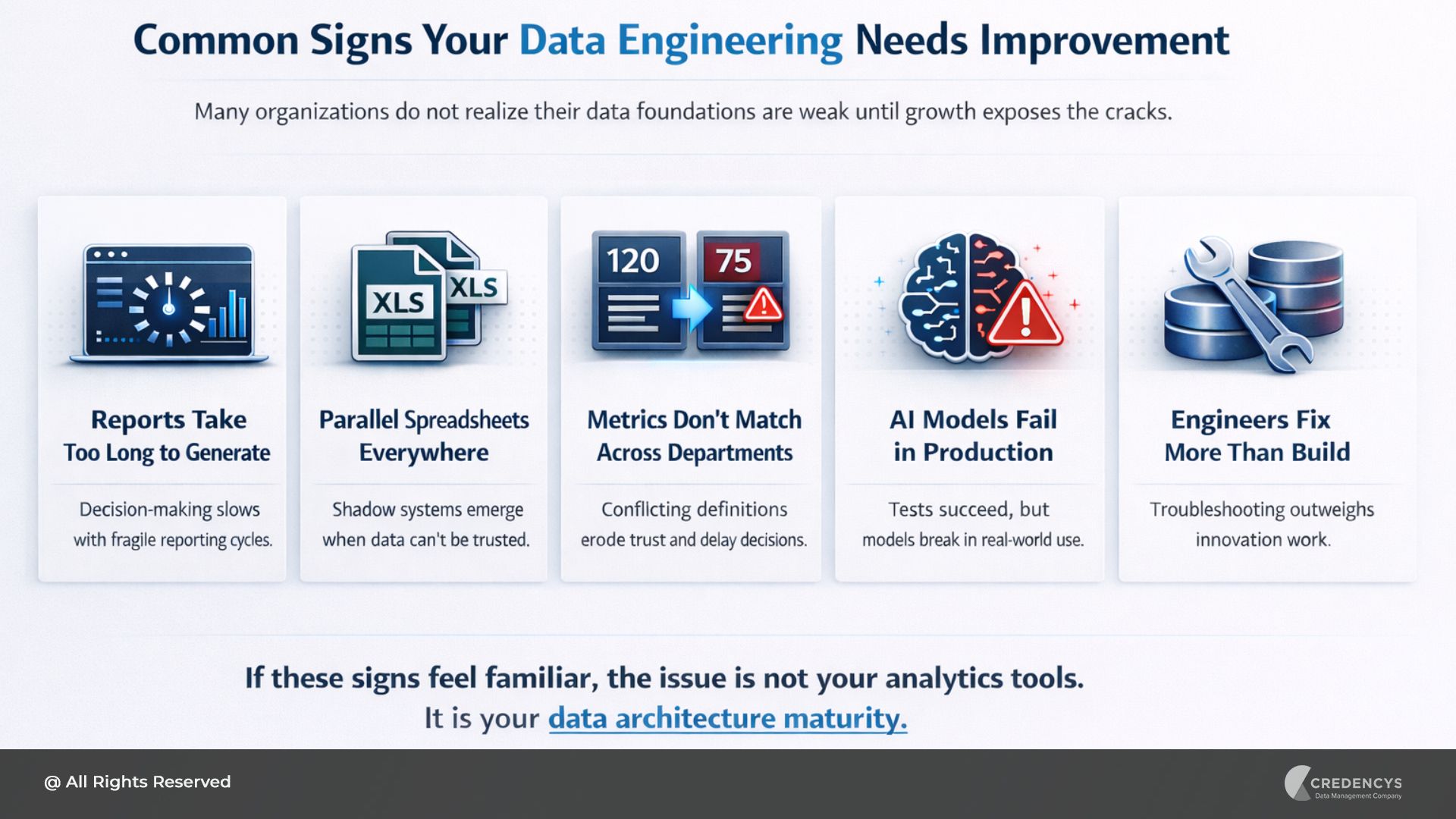
A report that takes hours to reconcile. A dashboard that displays conflicting numbers. An AI model that performs well in testing but fails in production. A leadership meeting where teams debate which dataset is accurate instead of discussing strategy.
These are not isolated incidents. They are symptoms of underlying engineering gaps.
Poor data engineering often leads to:
- Frequent pipeline failures and delayed reporting
- Inconsistent data definitions across departments
- Manual workarounds that increase human error
- Low trust in analytics outputs
- Slower adoption of AI and advanced analytics initiatives
The financial cost is real, but the strategic cost can be even greater.
Over time, the organization begins to operate defensively rather than proactively. Instead of using data to anticipate change, it reacts to problems after they surface.
Investments in analytics tools, cloud platforms, and AI solutions cannot compensate for weak foundations. Without disciplined data engineering best practices, technology becomes layered complexity rather than scalable advantage.
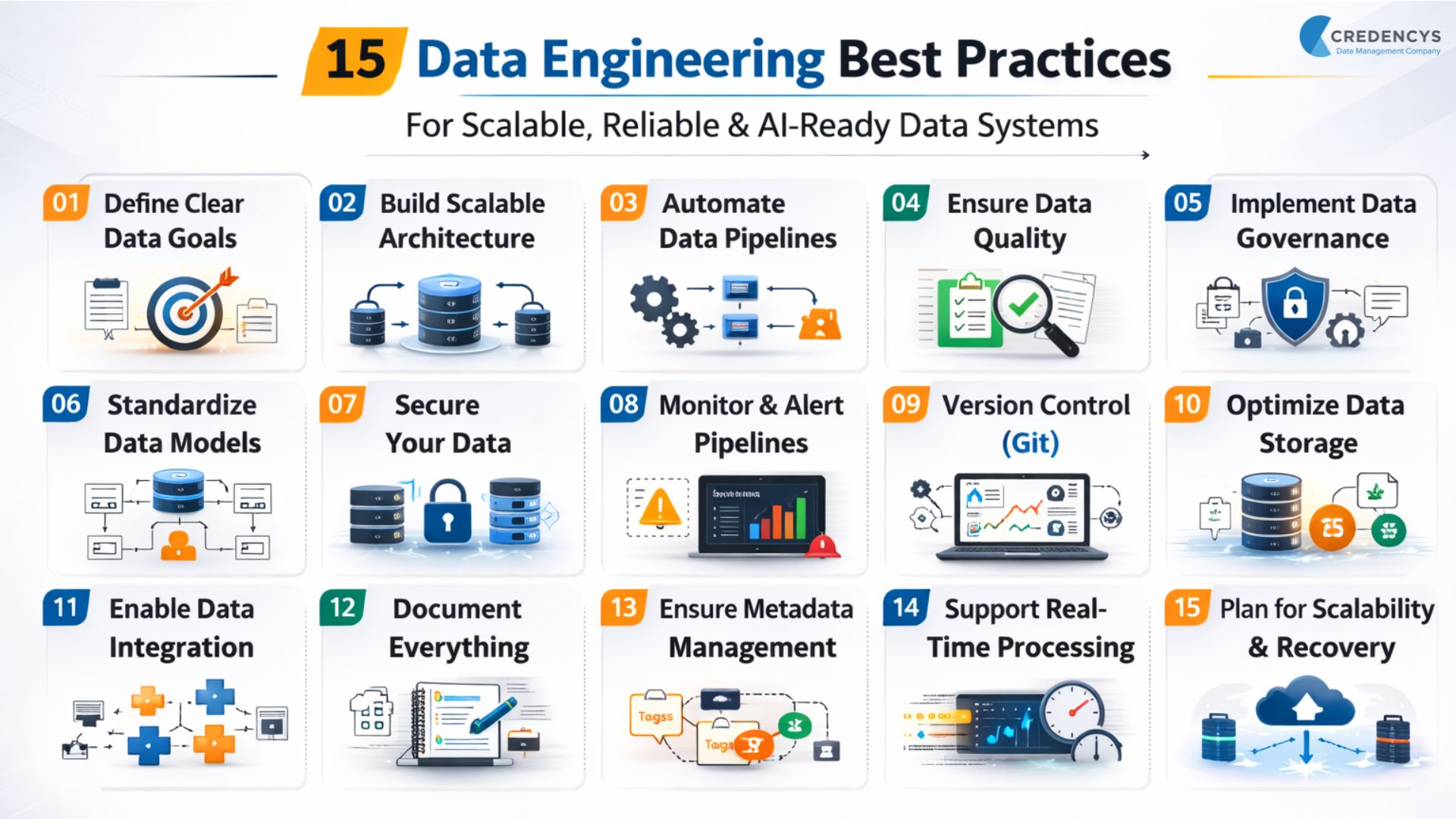
15 Data Engineering Best Practices for your Business
Strong data systems are the result of intentional architecture, disciplined processes, and alignment between engineering teams and business leadership.
Organizations that treat data engineering as a strategic capability rather than a back-end utility build infrastructure that supports analytics, AI, compliance, and operational growth for years without constant rework.
Below are 15 data engineering best practices explained in greater depth.
1. Design With Scalability in Mind
Most data architectures are designed for current workloads, not future growth. That is where long-term instability begins.
As your organization scales, data sources multiply, user queries increase, and AI workloads demand more compute power. If your architecture cannot scale horizontally or elastically, performance bottlenecks and cost inefficiencies will emerge.
Scalable architecture requires:
- Cloud-native storage that separates compute and storage
- Distributed processing frameworks capable of parallel execution
- Partitioned datasets to improve query performance
- Auto-scaling compute clusters that adapt to workload fluctuations
- Infrastructure-as-code to enable repeatable provisioning
Beyond technology, scalability also means designing schemas and transformation logic that can handle additional attributes, entities, and integrations without major redesign.
2. Automate Data Pipelines End-to-End
Manual intervention in pipelines creates fragility. Every manual export, spreadsheet transformation, or ad-hoc script introduces inconsistency.
End-to-end automation ensures data flows predictably from ingestion to consumption.
This includes:
- Automated ingestion from APIs, databases, and event streams
- Scheduled and event-triggered workflows
- Dependency management across tasks
- Automatic retries and failure recovery mechanisms
- CI/CD practices for pipeline deployment
Automation reduces operational overhead and ensures consistency across environments.
More importantly, it transforms data engineering from reactive maintenance to proactive enablement.
3. Prioritize Data Quality From Day One
Data quality cannot be treated as a downstream cleanup activity. By the time incorrect data reaches dashboards or AI models, the damage is already done. A strong quality framework integrates checks at every stage:
During ingestion:
- Schema validation
- Format consistency checks
- Mandatory field validation
During transformation:
- Business rule enforcement
- Standardization of units and categories
- Referential integrity validation
During delivery:
- Data completeness verification
- Freshness monitoring
- Reconciliation with source systems
High-quality data builds confidence across departments. Without it, analytics adoption slows, and AI initiatives struggle in production environments.
4. Implement Strong Data Governance
Governance ensures clarity around ownership, access, compliance, and accountability. Without governance, organizations experience metric misalignment, compliance risks, and data misuse.
A mature governance framework includes:
- Clearly assigned data owners and stewards
- Role-based access control with least-privilege principles
- Metadata catalogs for discoverability
- Policy-driven data classification
- Regulatory compliance mapping
Governance should function as an enabler. It provides transparency and trust, allowing teams to innovate within defined boundaries rather than operating in uncertainty.
5. Use Modular and Reusable Pipeline Design
As organizations expand analytics use cases, pipeline sprawl becomes a serious risk. Custom-built pipelines for each department create redundancy, maintenance overhead, and inconsistencies.
A modular approach allows you to:
- Reuse ingestion templates across systems
- Build shared transformation libraries
- Parameterize logic for flexible deployment
- Standardize validation components
This architectural discipline reduces development time, accelerates onboarding of new use cases, and simplifies long-term maintenance.
Reusable components also support better documentation and onboarding for new engineers.
6. Monitor Pipeline Performance Continuously
Pipelines rarely fail dramatically. They degrade gradually. Latency increases, jobs run longer, data freshness declines, and small delays accumulate until reporting becomes unreliable.
Continuous monitoring should cover:
- Execution duration trends
- Throughput performance
- Data freshness metrics
- Error frequency patterns
- Infrastructure utilization
Advanced monitoring also includes anomaly detection for unusual data patterns.
Observability tools should provide dashboards and proactive alerts that notify teams before stakeholders notice issues.
Reliability is not about preventing all failures. It is about detecting and resolving them before business impact occurs.
7. Adopt Version Control for Data and Code
Data transformations evolve constantly as business requirements change. Without version control, teams struggle to trace logic changes or revert problematic updates.
Adopt structured versioning for:
- SQL transformation scripts
- Pipeline orchestration configurations
- Infrastructure definitions
- Data contracts and schemas
Pair version control with peer review processes and automated testing to reduce production risks.
Version control creates traceability, improves collaboration, and supports auditability in regulated environments.
8. Enable Real-Time Processing Where It Matters
Batch processing remains efficient for many workloads, but modern enterprises increasingly require real-time insights. Real-time architecture should be implemented strategically, not universally.
Ideal use cases include:
- Fraud detection and risk monitoring
- Supply chain tracking
- Dynamic pricing updates
- Customer behavior personalization
- IoT and operational event monitoring
Hybrid architectures that combine batch efficiency with event-driven streaming allow organizations to balance cost and responsiveness.
Real-time systems require careful design around latency, throughput, and reliability to avoid instability.
9. Standardize Data Definitions Across Departments
Inconsistent definitions undermine executive confidence. Revenue calculated differently by finance and sales creates confusion. Customer definitions varying between marketing and operations create misalignment.
Standardization requires:
- A centralized business glossary
- Cross-functional alignment workshops
- Documented metric calculation logic
- Controlled schema naming conventions
- Data contracts between teams
When definitions are aligned, dashboards become trusted tools rather than negotiation starting points.
Standardization reduces friction and improves decision velocity.
10. Optimize for Cost Efficiency
Cloud-based scalability introduces the risk of uncontrolled spending.
Engineering teams must continuously monitor resource usage to ensure financial sustainability.
Cost optimization includes:
- Right-sizing compute clusters
- Enabling auto-suspend and auto-termination policies
- Optimizing storage formats and compression
- Archiving or purging unused datasets
- Query performance tuning
Regular cost reviews prevent silent waste and ensure ROI from data investments. Efficient systems deliver performance without excess overhead.
11. Secure Data by Design
Security should be embedded in architecture, not layered on later. Data breaches damage reputation, disrupt operations, and create regulatory exposure.
Security best practices include:
- Encryption in transit and at rest
- Fine-grained access control policies
- Data masking for sensitive attributes
- Continuous audit logging
- Zero-trust network principles
Security design must balance protection with usability.
When done correctly, security strengthens trust across internal and external stakeholders.
12. Build for Observability and Data Lineage
When data issues arise, teams must trace problems back to their source quickly. Observability provides visibility into system health. Data lineage provides transparency into data flow.
Ensure your architecture supports:
- End-to-end lineage visualization
- Impact analysis before schema changes
- Dependency mapping across systems
- Root cause tracing for anomalies
Lineage improves compliance readiness and simplifies troubleshooting. Without visibility, complexity becomes unmanageable as systems grow.
13. Separate Development, Testing, and Production Environments
Mixing environments introduces risk and instability. Changes should be tested in controlled settings before affecting live operations.
Best practices include:
- Dedicated development sandboxes
- Automated testing in staging environments
- Structured approval workflows
- Canary releases or phased deployments
This separation supports innovation without compromising production reliability.
14. Align Data Engineering with Business Objectives
Data engineering must directly support measurable business outcomes. Technical excellence alone does not justify investment.
Alignment requires:
- Clear linkage between pipelines and KPIs
- Regular stakeholder collaboration
- Prioritization based on revenue or efficiency impact
- Performance metrics tied to business value
When engineering understands strategic priorities, infrastructure becomes a growth engine rather than a background utility.
15. Prepare for AI and Advanced Analytics
AI initiatives place unique demands on data infrastructure. Machine learning requires:
- Structured feature pipelines
- Large-scale training datasets
- Continuous model retraining workflows
- Low-latency inference environments
- Governance around model inputs and outputs
Data systems must support experimentation while maintaining production stability. Organizations that build AI-ready infrastructure early avoid costly re-architecture later.
AI success is rarely limited by algorithms. It is limited by data readiness.
The Future of Data Engineering
Data engineering is no longer just about moving and storing data. It is evolving into a strategic function that directly shapes how organizations innovate, compete, and scale.
As businesses adopt AI, real-time analytics, and cloud-native ecosystems, the expectations from data engineering teams continue to grow. Stability is no longer enough. Systems must be intelligent, automated, and adaptable.
Here is where the future is headed.
1. Greater Automation and Self-Healing Pipelines
Modern platforms are increasingly capable of detecting anomalies, correcting schema changes, and optimizing performance automatically.
The future of data engineering will rely heavily on intelligent monitoring systems that reduce manual intervention and improve reliability.
2. Closer Integration With AI and Machine Learning
Data engineering and AI will become even more intertwined. Feature engineering, model retraining workflows, and real-time inference pipelines will be designed as part of unified architectures rather than separate layers.
Organizations that prepare their infrastructure for AI today will adapt more easily to tomorrow’s advancements.
3. Real-Time and Event-Driven Architectures
As customer expectations shift toward instant experiences, data systems must support streaming workflows and event-driven processing.
Hybrid architectures that balance batch efficiency with real-time responsiveness will become the norm rather than the exception.
4. Stronger Governance and Compliance Frameworks
With increasing regulatory scrutiny and growing concerns around data privacy, governance will become more sophisticated.
Future-ready data engineering will prioritize transparency, traceability, and security without slowing innovation.
5. Data as a Product Mindset
Leading organizations are beginning to treat datasets as products with defined owners, quality standards, and service-level agreements.
This mindset improves accountability, enhances usability, and encourages continuous improvement across data assets.
Wrapping Up
Data has become one of the most valuable assets inside modern organizations. Yet data alone does not create impact. The systems that move it, validate it, secure it, and deliver it determine whether it becomes a competitive advantage or an operational burden.
When pipelines are reliable, definitions are standardized, governance is clear, and infrastructure is built for growth, teams spend less time fixing data and more time using it. Analytics becomes trusted. AI becomes production-ready. Strategy becomes data-driven rather than assumption-driven.
The future will only increase the demands placed on data systems. Real-time insights, predictive models, and intelligent automation all depend on strong engineering foundations. Organizations that invest in structured best practices today will be better positioned to innovate tomorrow.
Data engineering may not always be visible, but its impact is felt everywhere. And in a world driven by data, that impact shapes the trajectory of the entire business.







Tags: